Resources and Entrepreneurial Development
Inter-organizational relationships and innovation: A case study on the financial services industry
 Ana L. R. Facco
Ivan L. Garrido
Ana L. R. Facco
Ivan L. Garrido
Inter-organizational relationships and innovation: A case study on the financial services industry
RAM. Revista de Administração Mackenzie, vol. 23, no. 2, eRAMR220110, 2022
Editora Mackenzie; Universidade Presbiteriana Mackenzie
Received: 25 May 2020
Accepted: 05 April 2021
Abstract
Purpose: The purpose of this study is to understand how inter-organizational relationships can contribute to innovation in service firms, by iden.pngying practices used in a given alliance or dyad.
Originality/value: Literature development on inter-organizational relationships and innovation confirms that this debate has become relevant in management studies. However, given the variety of drivers in this process, we iden.pngied the need for an in-depth understanding of the role of inter-organizational relations in innovation, a gap that this study sought to fill. Much of the knowledge on innovation management stems from the understanding of manufacturing industries, requiring a greater understanding of the management process, strategy and practices in the service industry. Based on this, this study offers theoretical and managerial contributions.
Design/methodology/approach: We carried out a single case study, through an exploratory qualitative approach, with a focus on a strategic alliance between a startup and a traditional bank in the Brazilian financial industry.
Findings: Motivations for engaging in an alliance, selection of partners, practices adopted for sharing complementary resources, including knowledge, collaboration and learning were iden.pngied in the case under analysis as factors that favored both the creation of an environment of innovation and the innovation results for both companies.
Keywords: inter-organizational relationships+ partnerships+ innovation+ services+ strategy.
INTRODUCTION
Innovation has been iden.pngied as an essential path for organizations’ survival and prosperity and should be managed and understood as a process, sustainability and competition strategy, as well as a source of results ( Dodgson et al., 2014). Innovation has relational characteristics and commonly involves collaboration between two or more partners ( Salter & Alexy, 2014), given the relevance of external connections ( Schüßler et al., 2013). Regarding innovation management, access to external sources of knowledge through collaboration ( Dodgson et al., 2014) can determine the role of inter-organizational relationships as one of the key elements for innovation ( Kastelle & Steen, 2014).
Cap et al. (2019) observed that inter-organizational collaboration is one of the main drivers of innovation. In addition, the analysis of inter-organizational relationships as a means of accessing and sharing external resources is one of the main research subjects on networks and innovation, focusing on how to transfer knowledge within networks, creating opportunities for mutual learning and innovation ( Cantù et al., 2015).
Recently, Yström et al. (2019) highlighted the importance of supporting knowledge creation within inter-organizational networks, pointing to a learning model oriented towards collaborative innovation. Other empirical studies ( Qi Dong et al., 2017; Sampson, 2007; Dyer & Hatch, 2006; Goes & Park, 1997) showed how relevant is resource sharing, access to new knowledge, and learning between partners, which creates the conditions for a better innovation performance.
Literature development on inter-organizational relationships and innovation confirms that this debate has become relevant in management studies. However, with the variety of drivers (complexity of the knowledge domain, heterogeneity of the actor in the network and their functions, governance mechanisms, for example), in addition to the potential levels of analysis (actor, dyad, and network), there is the need for a deeper understanding of the role of inter-organizational relationships in innovation ( Cantù et al., 2015).
Much of the knowledge about innovation management is based on the manufacturing industries ( Dodgson et al., 2010). Since, in recent decades, the awareness of the importance of service innovation for economic growth has been increasing ( Morrar, 2014), there are a few theoretical and managerial contributions to the understanding of the management process, the strategy, and how companies innovate in this industry. The service economy shows a change of focus regarding the industrial economy, favoring organizational systems - arrangements of people, information, and processes -, consumer experience, and multidisciplinary, holistic, collaborative and open organizations ( Dodgson et al., 2010). Based on these arguments, the research question emerged:
-
How can inter-organizational relationships contribute to innovation in service companies?
Therefore, this research sought to understand how inter-organizational relationships could contribute to innovation in service companies, through the iden.pngication of practices used in a given partnership. Although we have focused on a single case, the analysis model can also be useful to other types of inter-organizational relationships between companies in other sectors. In this case, the mentioned practices are institutionalized processes between companies, deliberately conceived to facilitate knowledge exchange in an alliance ( Dyer & Singh, 1998). In this perspective, Dyer and Singh (1998) and Dyer et al. (2018) showed that companies can create and capture value - processes that are inherent to innovation - from alliances, when they iden.pngy partners with complementary resources, build high levels of informal trust and share knowledge.
As an empirical field for this study, we chose the Brazilian financial services industry, which presents fast and continuous changes, driven by intense competition for innovations and technological transitions. This scenario has been affected by new organization models, such as fintechs or startups, and by partnerships between this type of company and large banks that traditionally operate in the sector. This practice has become increasingly common in searching for innovations ( Federação Brasileira de Bancos - Febraban, 2018b).
Hence, this study sought to contribute both to the theory and practice of innovation management in services. We used single case study as research method, since we wished to analyze the case in-depth, iden.pngying its characteristics and relationships with the literature ( Yin, 2015; Gil, 2010). We structured the study in the following sections: theoretical framework, iden.pngying central aspects that support the research proposal; method, in which we detailed the procedures adopted for data collection and analysis; presentation and discussion of results; and final remarks.
THEORETICAL FRAMEWORK
In this section, we explore the topics strategy, innovation, management, and inter-organizational relationships as theoretical subsidies for the study.
Innovation, strategy, and management
Innovation, in the strategic perspective, is considered one of the key aspects for organizations’ success and sustainability ( Sinha & Srivastava, 2016), related to the ability to use their existing knowledge base, in addition to acquiring knowledge from external sources ( Kyläheiko et al., 2011). Innovations can be different, and one of the main distinctions is between product innovations, which involve the creation and launch of new products or services, and process innovations, which change operations, tasks, and ways of working in organizations ( Salter & Alexy, 2014).
Regarding an innovation’s degree of novelty, incremental innovations occur more frequently in established markets, using technologies and processes more familiar to the organization’s existing activities. Radical innovations, in turn, have greater impacts on markets and involve technologies and processes very different from those supported by the organization’s resource base ( Dodgson et al., 2014).
Besides the distinction between what is new or substantially improved, we may
apply the definitions of product/service, process, marketing (position), and
organizational (paradigm) innovation (
Francis
& Bessant, 2005), in order to categorize the forms of innovation
made by companies that affect performance.
Francis and Bessant (2005) proposed the 4P model (product, process,
position, and paradigm) to define the possible types of innovation:
-
Product innovation: consisting of significant changes in essential characteristics of the products/services that a company provides.
-
Process innovation: changes due to the use of new or significantly improved methods, or in the way products/services are produced/provided.
-
Position innovation: changes in the context in which products/services are offered, and the opening of new markets.
-
Paradigm innovation: for instance, changes in the mental models that guide what the company does and how it uses its knowledge, new organizational arrangements.
The literature on service innovation highlights its peculiarities either through the attributes of the service itself, or the process by which the service sector makes innovations ( Hipp & Grupp, 2005). Services are activities with particular features that distinguish them from goods from the manufacturing industry, given that the products created are not fully formatted and coded ( Kon, 2004; Sundbo & Gallouj, 1998), which makes the innovation analysis process more difficult. We can examine service innovations through four dimensions: 1. the concept of service - what is new in the market; 2. customer interface - new ways by which customers get involved in the production of services; 3. service provision system, which comprises new forms of service delivery; and 4. technology ( Hertog, 2000).
Some authors argue that service innovation is the result of contextual aspects, actors, and their interactions ( Toivonen & Tuominen, 2009), thus differing from innovations in the manufacturing industry. For this study, and based on the definitions presented ( Hertog, 2000; Francis & Bessant, 2005; Toivonen & Tuominen, 2009), we consider that innovation comprises new services, new processes for its creation and offers, new markets that companies access, new ways of using knowledge, and new organizational arrangements, as well as significant improvements in these aspects, which add value to companies.
In practice, innovation, including in services, can be fostered by new technological and market opportunities that emerge from potential sources, with multiple influences and incentives; they can result from new regulations or technical standards and competition that forces companies to develop new solutions and seek collaborative partners, for example. Such incentives combine to produce a complex and interrelated matrix of collaborators for the innovation process ( Dodgson et al., 2014), since innovating individually can be a more costly and limited process.
By uniting strategy, management, and practices from the engagement in projects for developing new technologies and creation of new markets, a process of learning, qualification, and organizational renewal emerges. Therefore, efforts to explore learning, transfer knowledge, and replicate new practices throughout the organization can help it institutionalize new routines, building, thus, the necessary capacities for innovation ( Brady & Davies, 2004; Shamsie et al., 2009; Brady & Davies, 2014).
Regarding the process of innovation-seeking and building organizational capacities to innovate, a strategic issue for companies is to get external information and knowledge ( Berchicci, 2013; Wang et al., 2017). Knowledge spillover is the process by which knowledge is transferred from one organization (knowledge source) to another (knowledge recipient), which is also a learning process. Thus, a given company can achieve a higher performance in innovation through knowledge acquired from external sources, such as strategic partners, reducing its individual innovation efforts ( Wang et al., 2017; Griliches, 1991; Smith, 1994).
In summary, knowledge exchange and resource sharing in a given partnership can occur as part of the innovation management strategy, especially in dynamic environments, where companies compete for innovations and have insufficient resources for innovating separately at the necessary speed ( Dodgson et al., 2014; Gulati, 1998). Hence, the company is no longer the exclusive locus of innovation ( Wang et al., 2017), which is now the whole network. The analysis of this process contributes to understanding how companies can manage it and achieve advantages from inter-organizational relationships ( Cantù et al., 2015), once again considering the relationship between strategy, management, and practices. In this perspective, it is important to iden.pngy how and under which conditions affiliation to a network or a partnership becomes a strategic resource for innovation.
Inter-organizational relationships and innovation
Alliances are organizational arrangements that allow independent companies to share different types of resources to create value ( Anand & Khanna, 2000). From a strategic perspective, companies start alliances, establishing inter-organizational relationships, and the unit of analysis becomes the dyad, through the following sequence of events: 1. decision to start an alliance; 2. choice of an appropriate partner; 3. choice of the alliance structure; and 4. dynamic evolution of the alliance, as the relationship develops over time. Hence, although not all processes of building alliances follow this sequence, this series of events comprise several managerial decisions to take, which are intrinsic to the management process ( Gulati, 1998).
In practice, large and small companies can participate in alliances ( Anand & Khanna, 2000). While large companies seek to access complementary resources, such as innovation sources and knowledge exchange, smaller and younger firms can get benefits from specific relationships and resources with established companies ( Baum et al., 2000; Gulati, 1998). Under this logic, relationships are able to create and add value since the initial stages ( Eggert et al., 2006), not only by improving operations’ efficiency, but essentially by making new businesses possible ( Dzever et al., 2001; Biggemann & Buttle, 2012).
Empirical studies show that alliances are one of the main sources of new ideas and information that result in technology and innovations, with an impact on performance ( Pouwels & Koster, 2017; Hippel, 1988; Powell et al., 1996). Using data from 32 European countries, in six different sectors, Pouwels and Koster (2017) analyzed the effect of the relationship between inter-organizational cooperation and innovation, showing a positive effect on organizational structure, network interaction, acquisition of external knowledge, and access to complementary resources.
Another empirical study on the agribusiness sector, in Brazil and Spain, on the relationship of inter-organizational networks for innovation development ( Dias et al., 2019), showed the importance of sharing resources in an inter-organizational network for innovation. The authors also observed that the network is a structure that favors innovation development, however, management is necessary to achieve a higher performance. This strengthens the argument that strategy, management, and practices should be aligned, in order to get results from strategic alliances.
Lavie (2006) suggested that alliances could provide competitive advantage at the network level, focusing on the routines of the dyad or of the network as units of analysis. Such routines are a regular standard of interfirm interactions that allow knowledge transfer, recombination, or creation ( Grant, 1996; Dyer & Singh, 1998). According to Qi Dong et al. (2017), companies that work together with other organizations in a network of alliances are more likely to access the types of knowledge needed for more disruptive innovations, increasing their innovation capacity.
Under this logic, we can still understand routines as practices - companies’ institutionalized processes deliberately designed to facilitate knowledge exchange between the partners ( Dyer & Singh, 1998). Seeking to learn how inter-organizational relationships can affect companies’ innovations, the strategy of building alliances, combined with management and the defined practices, is a path for analyzing this phenomenon. Based on the literature review, we iden.pngied factors that make up both strategy and management within strategic alliances, in addition to the practices adopted for promoting innovations:
-
Partner selection: Qi Dong et al. (2017) argued about the challenges for strategic alliances when they search for partners for developing innovations. The authors found that organizations that build alliances with partners that are central to the network tend to develop more innovation through inter-organizational relationships. Yet, the heterogeneity of the public-private partnership was a moderator in the relationship between partners, regarding innovation in inter-organizational alliances. Finally, they observed that companies that have more interaction with private partners are more likely to develop innovations. Therefore, the motivation for engaging in an alliance corresponds to the strategy itself, in the search for partners with complementary resources.
-
Collaboration: Schoenmakers and Duysters (2010) argue that organizations tend to collaborate with others that are central to an alliance network, in order to have more access to external knowledge. Qi Dong et al. (2017) observed that organizations working in alliances tend to be more exposed to the knowledge needed for developing innovation, which affects their innovation capacity.
-
Practices: Yström et al. (2019) developed a model to foster learning on a collaborative platform for inter-organizational networks, based on how the learning process through actions changed the nature of interactions. For the authors, the process through actions involves creating spaces for interactions, which is essential for learning. One approach to assess complementarity - and how the alliance will probably create value - is to consider if the resources that will benefit from the partner’s synergy are tangible resources or assets (for example, facilities, equipment, locations), or intangible resources (knowledge), or both ( Dyer, et al., 2018). In addition, Lee et al. (2010) observed that partners that collaborate to seek synergy by accessing complementary resources are more likely to be successful.
-
Learning: Pouwels and Koster (2017) defend a positive relationship between cooperation and innovation. Such results indicated the existence of mechanisms for innovation progress, access to complementary resources, and involvement in interactive learning, showing a potential effect of knowledge transfer. In the same study, they pointed to the significant impact of employees’ qualification on innovation. Another finding was the considerable effect of informal knowledge acquisition on innovation. In addition, Yström et al. (2019) described the complexity of learning in inter-organizational networks, showing the dynamics of implementing actions to support collaboration in a collective knowledge creation initiative.
-
Innovation: Innovation here is a result of the process, the interaction between strategy, management, and practices, capable of promoting relevant changes in products or services and processes, either incremental or radical, and, also, an objective in alliance building. Hynes and Elwell (2016) showed that networks challenge innovation, suggesting that companies’ greater market reach results from collective action. For Goes and Park (1997), inter-organizational relationships generate opportunities for learning and sharing innovation resources, which is also a result of the process.
According to Autio and Thomas (2014), the notion of innovation ecosystems, which expands the concept of inter-organizational relationships and comprises a range of interactions for value creation among sets of interconnected organizations, is the scenario in which partnerships are quickly developing, especially regarding innovation. In short, companies seek to engage in partnerships or alliances to access and share resources, thereby creating value ( Dyer et al., 2018; Anand & Khanna, 2000).
Therefore, this strategy tends to affect innovations ( Hynes & Elwell, 2016; Dias et al., 2019), in several ways: through its own effectiveness in partner selection ( Qi Dong et al., 2017), through the collaborative process that emerges within the alliance ( Schoenmakers & Duysters, 2010), through the processes that involve spillover and knowledge creation and sharing ( Wang et al., 2017; Griliches, 1991; Smith, 1994), through learning ( Yström et al., 2019; Goes & Park, 1997), and through the established practices that facilitate interactions and knowledge exchange ( Dyer & Singh, 1998; Yström et al., 2019).
All of these are aspects that enable the alliance’s management to achieve its goals.
METHOD
As research method, we used the single case study, with an exploratory qualitative approach ( Yin, 2015). To select the case, we used a non-probabilistic method, judgmental sampling, which includes elements selected in a non-random manner ( Gates & McDaniel, 2003). Thus, the case meets the research interest criteria, as a form of intentional sampling based on previously observed characteristics ( Hair et al., 2005).
For the case selection, we used the following criteria: 1. companies operating in the Brazilian financial industry, since the type of relationship under study is a constant practice in the sector for leveraging innovations ( Febraban, 2018b); and 2. companies that have engaged in innovation partnerships in the last year. Through research on websites and indications from professionals in the area, we iden.pngied some partnerships disclosed in the sector, which enabled the qualified selection of the case.
The main instrument for data collection was a semi-structured interview script. We also used secondary data and internal documents, as well as media publications. We invited to participate in the interview companies’ representatives that were directly involved in the alliance’s building process and events, resulting in four interviews, conducted between July 2018 and May 2019, a period in which interactions developed more effectively.

For data analysis, we used the content analysis technique, through the following steps: 1. pre-analysis: material preparation; 2. content exploration and categorization; and 3. result treatment and presentation of content, results, and conclusions ( Bardin, 2011).
Figure 1 shows the adopted research model, as a summary of the theoretical framework, from which emerged the analysis categories.
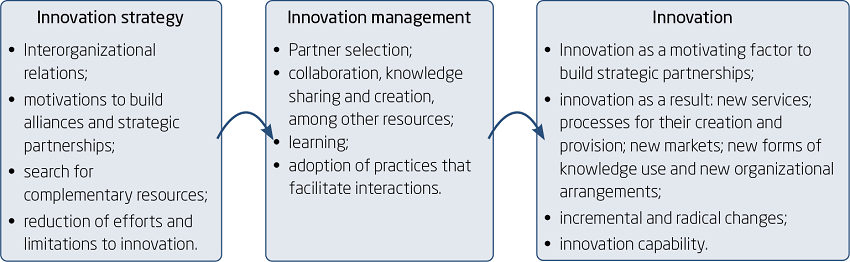
Figure 1
Research model
Source: Elaborated by the authors.
From the literature review, we defined analysis categories and subcategories a priori, as shown in Table 2.

In summary, the protocol adopted for the study covered the following steps: 1. literature review, research question, and objective, defining the theoretical-conceptual and structural guidelines, as well as the method; 2. planning the case study, defining the unit of analysis, data collection method, the semi-structured interview script, based on the analysis categories defined a priori; 3. data collection; 4. data analysis; and 5. preparation of the report for presentation and discussion of results.
RESULTS
Brazilian financial market, startups, and fintechs
Innovation has assumed a strategic role in the expansion and sustainability of businesses, both for small and large companies, mainly due to the changes in the competitive scenario, driven by the increase in the use of technology. In the financial industry, it is not different, mostly because of the impacts of new financial technologies implemented by fintechs and startups (Inter-American Development Banl - IDB, 2017).
Brazilian and foreign banks that operate in Brazil are investing in the exploration, development, application, and improvements in technologies, with a focus on the consumer experience of financial services, expanding the use of digital channels ( Febraban, 2018b). Fintechs and startups, in turn, have been transforming the financial industry through innovations, focused on financial inclusion and service expansion, often serving segments not attended by traditional banks (IDB, 2017).
In this scenario, there is also an increase in cooperation initiatives between large companies in the financial sector and startups ( Banco Central do Brasil - Bacen, 2018). When focusing on customer experience, banks need to develop innovative services quickly, which requires not only mastering technology but also organizational agility, comprising investments in innovation, management of talents, and partnerships, within a broad ecosystem. Differently, startups bring in their essence this competence, as they are able to notice consumer needs more readily. From the coexistence of established banks, fintechs, and startups, a changing ecosystem emerges, which is a favorable context for partnerships ( Febraban, 2018b).
The ecosystem of startups intensive in the use of financial technology (fintech) is diversified and growing in Brazil (Bacen, 2018). Startups are organizations created to develop new products and services under conditions of extreme uncertainty, strongly supported by innovation and entrepreneurship ( Ries, 2012). Regarding their activities, fintechs, according to the Financial Stability Board (FSB), are financial innovations, enabled by technologies that can result in new business models, applications, processes, or products with tangible effects in the provision of financial services (Bacen, 2018).
Faced with this scenario, although fintechs and startups have greater innovative potential and agility for proposing solutions, large banks can use three factors to protect their leadership positions: regulatory barriers, consumers’ natural inertia, and the lack of significant resources from entrants to acquire or imitate competitors ( Febraban, 2018b). Hence, collaborating can be a strategic alternative and an opportunity for superior gains for both.
Strategic alliance/partnership between bank A and startup B
As the study subject, we analyzed a partnership between a traditional Brazilian bank (bank A) and a startup accelerator (startup B). This partnership aimed to leverage innovations in bank A regarding solutions for the financial market, capturing startup projects that could be supported and implemented by the alliance with startup B, besides furthering the qualification of bank A’s employees on entrepreneurship and innovation culture, resulting in process innovations.
In a brief summary, bank A operates in the Brazilian and international markets, as one of Latin America’s largest financial institutions, with consolidated operations in several segments of the financial market. startup B was founded in 2011. In the several editions of its acceleration programs in Brazil, 317 startups participated, involving a group of more than 1,000 entrepreneurs. Startup accelerators operate by offering methodology, connections, and support for structuring startups’ activities and are compensated according to the new businesses’ performance.
The companies formalized the partnership by establishing the expected scope of deliveries and responsibilities of each partner. The expected deliveries in the contract were divided into four pillars, namely: positioning in the ecosystem (strategy); access to startups (exchange of knowledge, new businesses); training (qualification of bank A’s team on agile methods used by startups for developing solutions and new businesses); and startup acceleration, through the specific program for new businesses’ acceleration.
Discussion of results
In theory, companies start strategic alliances to share different types of resources and create value ( Anand & Khanna, 2000), and inter-organizational collaboration is seen as one of the innovation drivers ( Cap et al., 2019). This process comprises a sequence of events that begins with the strategic decision to engage in an alliance, followed by the choices of an appropriate partner, the alliance structure, and its dynamic evolution over time ( Gulati, 1998). In this case, we adopted this sequence of events, supported by strategic and managerial decisions.
As for the motivations for engaging in alliances, as a strategy to enhance innovation results, large companies seek alliances to access complementary resources ( Dyer et al., 2018) and to exchange knowledge, while smaller and newer firms can benefit from specific relationships and resources of established companies ( Baum et al., 2000; Gulati, 1998). According to E04, when a large company looks for innovations, this process involves approaching startups, either by hiring, through partnerships, or in some way that it may understand how startups work, supporting the development of a change-prone innovation culture, seeking process innovations, besides an increase of its innovation capacity.
In the case of startups, there is considerable variation in access to resources and stable relationships. When starting alliances, startups can access competitive, social, technical and commercial resources that would normally require years of operational experience to achieve ( Baum et al., 2000). Thus, mentoring and acceleration practices included in the scope of activities of the partnership between bank A and startup B strengthened this argument.
Including aspects of innovation management, partnership building is a recurring practice for both companies. bank A was one of the pioneers to structure an open banking operation in Brazil, in partnership with a startup, offering a financial management and control platform for micro and small companies. In terms of experience, startup B had already developed similar partnerships with large companies. However, in this case, there is a unique characteristic for bank A, as reported by interviewee E01:
[...] having an external accelerator to promote, develop, and incubate innovation projects at the bank is unprecedented. There is a similar initiative with an accelerator in the United States, but there are fewer accelerated teams, and the scope of projects is defined exclusively by the bank, while, in the startup, the scope of projects is wider and the speed of project development is higher. In both scenarios, the scope of employed technologies is not restricted to bank standards.
Regarding the partner selection, in accordance with respondents E01 and E02, bank A seeks to select them based on criteria such as iden.pngica- tion of best practices or those that have an exclusive technical capacity. For startup B, the search for partners for the development of joint projects is based on the following criteria, pursuant to interviewee E04: institution seriousness, capacity or potential to add value to startups and to the ecosystem, and whether it will really develop a work that supports startups’ growth.
Concerning the adopted practices, the methods used for exchanging knowledge and interactions in the partnership were considered innovations for the companies. According to interviewee E01 “[...] instead of competing, companies are acting as partners, approaching and fostering these innovation initiatives”. This practice confirms a strategic trend in the financial market: Large banks are developing initiatives to foster partnerships with fintechs and startups, in an environment of intense competition for innovations ( Febraban, 2018a).
Practices between partner companies included the following modules:
-
People module: production of content on innovation (articles and video lessons), training for mentors (qualification of employees, in order to internalize the entrepreneurial attitude and the agile methods of startups in the bank), and periodic mentoring for projects developed by bank A’s innovation team (internal structures for the development of projects focused on innovation), with the purpose of improving projects, based on questionings and provocations from experts outside the bank.
-
Business module: display of bank A’s brand in actions promoted by startup B with other startups, as well as product advertising and exclusive contract in the banking segment.
-
Innovation module: promotion of events, both for accelerating startups and approaching bank A to the entrepreneurial ecosystem.
As an example, in mentoring practices, there is an exchange of experiences between a startup and its mentor, based on a specific challenge. Thus, the mentor can contribute with his knowledge and experience to the startup growth, helping to iden.pngy business opportunities that have synergy with the bank. According to E03, around 30 bank A executives were trained to be mentors. In terms of training on work methodologies at startups, 12 areas of bank A were directly affected, by working with different levels of challenges, both business and strategic, involving internal mentors and those from the ecosystem.
The main events and interactions that occurred during the partnership and mentioned by interviewees were: 1. training for bank A mentors; 2. periodic mentoring conducted by startup B for bank A’s innovation team; 3. events with the participation of partner companies, entrepreneurs, and startups; 4. lectures and workshops; 5. meetings with partner companies; and 6. periodic production of articles to disseminate the innovation culture through bank A’s internal communication channels. The processes conducted during the partnership resulted mostly in process innovations, through the adoption of new methods and by improvement, expanding the innovation capacity of both companies, as well as enabling access to new markets.
We iden.pngied examples that characterize the collaborative process through the sharing of complementary resources, in line with the vision of networks as structures that favor innovation creation ( Dias et al., 2019), in which companies can access external resources and knowledge ( Dodgson et al., 2014; Kyläheiko et al., 2011). As reported by interviewees E03 and E04, companies shared, in addition to knowledge and experience, physical spaces (structures), creating environments for interaction.
In terms of knowledge exchange, according to interviewee E04, startup B received several insights from bank A, in addition to contributing with knowledge on new working methods, with interesting arguments in debates with startups, aiming to foster changes in the bank’s organizational culture. Although each company has its own characteristics and pace, after understanding some internal processes and the best ways for knowledge exchange, the flow was improved.
From bank A’s standpoint, there was a need for internal adjustment of processes and people for the partnership to achieve its goals, through a dynamic process of learning and process innovation for both companies, which was the main challenge faced during the partnership (E03). This was highlighted mainly because of the different attributes of each company, one large, with more hierarchical processes, and the other with a more agile culture and structure, as a startup.
In addition, knowledge spillover was pointed by E03 through the exchange of information that happened during interactions, building companies’ knowledge and experience. Mentors who were bank A’s employees, for example, when executing projects at startup B, also learned and brought knowledge from outside into the organization, which strengthens the idea of mentoring practice as a means of learning for both partners. This is in line with Wang et al. (2017), who state that a closer access to information enhances the learning process, besides turning into a source of innovative ideas, both incremental and radical. The relationship model with startups developed in this partnership was mentioned as learning and innovation for bank A, as an open innovation practice.
As for learning, both companies reported access to new knowledge and information, in addition to making some adjustments for better workflow and results. For startup B, in practical terms, interviewee E04 mentioned, as main examples of learning, the contact with the innovation structure of bank A, the development of intrapreneurship projects, and how large institutions manage to act proactively towards innovation. Another aspect related to learning was innovation escalation, that is, how to make new solutions reach a large number of people, new markets - in the case of a company with a large and diversified customer base -, keeping a good level of quality and management in the processes.
Such practices positively affected the innovation process of both companies, generating new processes and enabling them to try out new solutions, involving access to complementary resources, among them knowledge, through interactive learning ( Pouwels & Koster, 2017). We also iden.pngied aspects of learning through inter-organizational networks, showing the dynamics of implementing support actions and collaboration in an initiative for shared knowledge creation ( Yström et al., 2019).
The resulting innovations include those in training processes, access to potential sources of ideas and new businesses, as well as expansion of the network of relationships within the ecosystem, focused on incremental processes that, in the long run, may result in radical innovations. In addition, the development of capacities for managing the relationship with startups was noticed as an innovation result (E03). Such perceptions are in accordance with Hynes and Elwell (2016), who stated that interactions in inter-organizational networks challenge innovation and that companies’ wider reach in the market will result from a collective action focused on disruptive technology, increasing innovation capacity and results.
With regard to the specificities of the service sector, innovation has a multidimensional character ( Durst et al., 2015) and is a result of contextual aspects, players, and interactions ( Toivonen & Tuominen, 2009). Through the partnership between bank A and startup B, a new context of innovation was achieved, with new actors and new knowledge, and learning was achieved through the interactions, fostering the adoption of new working methods and incremental process innovations, besides access to new markets for both companies as short-term results.
According to the literature, orientation towards innovation allows service companies to carry out innovation practices strategically ( Ryu & Lee, 2018; Baron et al., 2009; Menor & Roth, 2007; Worren et al., 2002). With the partnership, both companies shared resources, with the purpose of making innovations, noticed mainly in the processes and organizational culture, in this case. In line with what we observed, efforts to explore learning, transfer knowledge, and replicate new practices throughout the organization help companies to institutionalize new routines, thus, building the necessary capacities for both incremental and radical innovation ( Brady & Davies, 2004; Shamsie et al., 2009; Brady & Davies, 2014).
Table 3 presents a summary of innovation results from the partnership, which lasted for about two years. As they were noticed during the partnership, we consider them short-term results. We estimate that such benefits may affect companies’ innovations also in the long term, by increasing their innovation capacity.

FINAL REMARKS
The results of this case study, which sought to understand the impact of inter-organizational relationships on the innovation of service companies, present theoretical and practical contributions. The results confirm the theoretical aspects listed based on the literature as a path for a broad understanding of the phenomenon in organizations. The motivations for engaging in a strategic alliance, mechanisms for partner selection, adopted practices, collaborative process through resource sharing, learning, and impacts on the process and results of innovation could be observed in the case, enabling connections between theory and practice, and providing empirical evidence that adds to theory building and managerial practice.
Understanding how companies innovate is challenging, in view of the innovation process in service firms, because of the heterogeneity and complexity of this particular sector; therefore, the study offers contributions from case observations. By integrating elements of strategy, management, and practices as a way to analyze the impacts of inter-organizational relationships on innovation, we found that building strategic partnerships corresponds to an innovation strategy, which may not be exclusive, but part of the corporate strategy, in which management and the adoption of new practices are essential for partners to achieve positive results.
The need for adjustments that both companies had to manage because of the practices adopted, resulting in process innovations, corresponds to a relevant learning on the structuring of the management model applied to partnerships, mainly between companies with different sizes, structures, and organizational cultures. In fact, changes resulting from the partnership and perceived as innovation results in the short term led to relevant impacts for building strategies and innovation management models based on partnerships, which resulted in the adoption of new practices and the creation of a new innovation context, also affecting the culture and innovation capacity of both partners.
As a managerial contribution, the study offers a vision of how strategic alliances can expand knowledge limits, thus, becoming a source of complementary resources, expanding companies’ relationship network and potential sources of innovation. New ways of fostering innovation, changes in the organizational culture by making it more aligned with the dynamics of the competitive environment, as well as emerging organizational arrangements, are contemporary strategic challenges, aiming at organizations’ sustainability.
Regarding future research, we suggest an investigation on how companies create knowledge, or new knowledge bases, moving away from the status quo towards disruptive innovations, through inter-organizational relationships; and, as a complement to our results, how they manage such knowledge at the dyad or network level, or how partnerships affect individuals and the ecosystem.
Case studies, which seek an in-depth understanding of real aspects of the investigated process, and where boundaries between the phenomenon and the context are not clear, have a limitation, since they do not allow results’ generalization ( Yin, 2015). However, they allow comprehending a certain reality in a given context, with specific contributions.
REFERENCES
Anand, B. N., & Khanna, T. (2000). Do firms learn to create value? The case of alliances. Strategic Management Journal, 21(3), 295-315.
Autio, E., & Thomas, L. (2014). Innovation ecosystems. In Dodgson, M., Gann, D. M., & Phillips, N. (Eds.), The Oxford handbook of innovation management (pp. 204-288). OUP Oxford.
Banco Central do Brasil (2018). Relatório de economia bancária 2017. http://www.bcb.gov.br/pt-br#!/n/REB
Banco Interamericano de Desenvolvimento, & Finnovista (2017). Fintech: Inovações que não sabia que eram da América Latina e o Caribe. https://publications.iadb.org/handle/11319/8265?locale-attribute=pt&
Bardin, L. (2011). Análise de conteúdo. Edições 70.
Baron, S., Patterson, A., Oakes, S., Harris, K., Droege, H., Hildebrand, D., & Forcada, M. A. H. (2009). Innovation in services: Present findings, and future pathways. Journal of Service Management, 20(2), 131-155.
Baum, J. A., Calabrese, T., & Silverman, B. S. (2000). Don’t go it alone: Alliance network composition and startups’ performance in Canadian biotechnology. Strategic Management Journal, 21(3), 267-294.
Berchicci, L. (2013). Towards an open R&D system: Internal R&D investment, external knowledge acquisition and innovative performance. Research Policy, 42(1), 117-127.
Biggemann, S., & Buttle, F. (2012). Intrinsic value of business-to-business relationships: An empirical taxonomy. Journal of Business Research, 65(8), 1132-1138.
Brady, T., & Davies, A. (2004). Building project capabilities: From exploratory to exploitative learning. Organization Studies, 25(9), 1601-1621.
Brady, T., & Davies, A. (2014). Managing structural and dynamic complexity: A tale of two projects. Project Management Journal, 45(4), 21-38.
Cantù, C., Corsaro, D., Tunisini, A., Dagnino, G. B., Levanti, G., Minà, A., & Picone, P. M. (2015). Interorganizational network and innovation: A bibliometric study and proposed research agenda. Journal of Business & Industrial Marketing, 30(3/4), 354-377.
Cap, J. P., Blaich, E., Kohl, H., Raesfeld, A. von, Harms, R., & Will, M. (2019). Multi level network management: A method for managing inter-organizational innovation networks. Journal of Engineering and Technology Management, 51, 21-32.
Dias, C., Hoffmann, V. E., & Martínez-Fernández, M. T. (2019). Resource complementarities in R&D network for innovation performance: Evidence from the agricultural sector in Brazil and Spain. International Food and Agribusiness Management Review, 22(2), 193-213.
Dodgson, M., Gann, D. M., & Phillips, N. (2014). Perspectives on innovation management. In Dodgson, M., Gann, D. M., & Phillips, N. (Eds.), The Oxford handbook of innovation management (pp. 3-25). OUP Oxford.
Dodgson, M., Gann, D., & Wladawsky-Berger, I. (2010). Engineers and services innovation. Ingenia, 44, 33-35.
Durst, S., Mention, A. L., & Poutanen, P. (2015). Service innovation and its impact: What do we know about? Investigaciones Europeas de Dirección y Economía de la Empresa, 21(2), 65-72.
Dyer, J. H., & Hatch, N. W. (2006). Relation-specific capabilities and barriers to knowledge transfers: Creating advantage through network relationships. Strategic Management Journal, 27(8), 701-719.
Dyer, J. H., & Singh, H. (1998). The relational view: Cooperative strategy and sources of interorganizational competitive advantage. Academy of Management Review, 23(4), 660-679.
Dyer, J. H., Singh, H., & Hesterly, W. S. (2018). The relational view revisited: A dynamic perspective on value creation and value capture. Strategic Management Journal, 39(12), 3140-3162.
Dzever, S., Merdji, M., & Saives, A. L. (2001). Purchase decision making and buyer-seller relationship development in the French food processing industry. Supply Chain Management: An International Journal, 6(5), 216-229.
Eggert, A., Ulaga, W., & Schultz, F. (2006). Value creation in the relationship life cycle: A quasi-longitudinal analysis. Industrial Marketing Management, 35(1), 20-27.
Federação Brasileira de Bancos (2018). Inovação e competição: Novos caminhos para redução dos spreads bancários? https://portal.febraban.org.br/pagina/3141/26/pt-br/apresentacoes-setor-bancario
Federação Brasileira de Bancos (2018). Pesquisa de tecnologia bancária. https://portal.febraban.org.br/pagina/3106/48/pt-br/pesquisa
Francis, D., & Bessant, J. (2005). Targeting innovation and implications for capability development. Technovation, 25(3), 171-183.
Gates, R., & McDaniel, C. (2003). Pesquisa de marketing. Thomson.
Gil, A. C. (2010). Amostragem na pesquisa social. In A. C. Gil (Org.), Métodos e técnicas de pesquisa social (6a ed., pp. 90-109). Atlas.
Goes, J. B., & Park, S. H. (1997). Interorganizational links and innovation: The case of hospital services. Academy of Management Journal, 40(3), 673-696.
Grant, R. M. (1996). Toward a knowledge-based theory of the firm. Strategic Management Journal, 17(S2), 109-122.
Griliches, Z. (1991). The search for R&D spillovers [Working Paper nº w3768]. National Bureau of Economic Research.
Gulati, R. (1998). Alliances and networks. Strategic Management Journal, 19(4), 293-317.
Hair, J., Babin, B., Money, A., & Samouel, P. (2005). Fundamentos de métodos de pesquisa em administração. Bookman.
Hertog, P. D. (2000). Knowledge-intensive business services as co-producers of innovation. International Journal of Innovation Management, 4(4), 491-528.
Hipp, C., & Grupp, H. (2005). Innovation in the service sector: The demand for service-specific innovation measurement concepts and typologies. Research Policy, 34(4), 517-535.
Hippel, E. (1988). The source of innovation. Oxford University Press.
Hynes, N., & Elwell, A. D. (2016). The role of inter-organizational networks in enabling or delaying disruptive innovation: A case study of mVoIP. Journal of Business & Industrial Marketing, 31(6), 722-731.
Kastelle, T., & Steen, J. (2014). Networks of innovation. In Dodgson, M., Gann, D. M., & Phillips, N. (Eds.), The Oxford handbook of innovation management (pp. 102-120). OUP Oxford.
Kon, A. (2004). Economia de serviços: Teoria e evolução no Brasil. Campus.
Kyläheiko, K., Jantunen, A., Puumalainen, K., Saarenketo, S., & Tuppura, A. (2011). Innovation and internationalization as growth strategies: The role of technological capabilities and appropriability. International Business Review, 20(5), 508-520.
Lavie, D. (2006). The competitive advantage of interconnected firms: An extension of the resource-based view. Academy of Management Review, 31(3), 638-658.
Lee, S., Park, G., Yoon, B., & Park, J. (2010). Open innovation in SMEs; An intermediated network model. Research Policy, 39(2), 290-300.
Menor, L. J., & Roth, A. V. (2007). New service development competence in retail banking: Construct development and measurement validation. Journal of Operations Management, 25(4), 825-846.
Morrar, R. (2014). Innovation in services: A literature review. Technology Innovation Management Review, 4(4), 6-14.
Pouwels, I., & Koster, F. (2017). Inter-organizational cooperation and organizational innovativeness: A comparative study. International Journal of Innovation Science, 9(2), 184-204.
Powell, W. W., Koput, K. W., & Smith-Doerr, L. (1996). Interorganizational collaboration and the locus of innovation: Networks of learning in biotechnology. Administrative Science Quarterly, 41(1), 116-145.
Qi Dong, J., McCarthy, K. J., & Schoenmakers, W. W. (2017). How central is too central? Organizing interorganizational collaboration networks for breakthrough innovation. Journal of Product Innovation Management, 34(4), 526-542.
Ries, E. (2012). A startup enxuta. Leya.
Ryu, H. S., & Lee, J. N. (2018). Understanding the role of technology in service innovation: Comparison of three theoretical perspectives. Information & Management, 55(3), 294-307.
Salter, A., & Alexy, O. (2014). The nature of innovation. In Dodgson, M., Gann, D. M., & Phillips, N. (Eds.), The Oxford handbook of innovation management (pp. 26-49). OUP Oxford.
Sampson, R. C. (2007). R&D alliances and firm performance: The impact of technological diversity and alliance organization on innovation. Academy of Management Journal, 50(2), 364-386.
Schoenmakers, W., & Duysters, G. (2010). The technological origins of radical inventions. Research Policy, 39(8), 1051-1059.
Schüßler, E., Decker, C., & Lerch, F. (2013). Networks of clusters: A governance perspective. Industry and Innovation, 20(4), 357-377.
Shamsie, J., Martin, X., & Miller, D. (2009). In with the old, in with the new: Capabilities, strategies, and performance among the Hollywood studios. Strategic Management Journal, 30(13), 1440-1452.
Sinha, N., & Srivastava, K. B. (2016). Perceived innovation championing strategies and intrapreneurial orientation the role of social cultural context. Journal of Management Research, 16(2), 77-86.
Smith, S. C. (1994). Innovation and market strategy in Italian industrial cooperatives: Econometric evidence on organizational comparative advantage. Journal of Economic Behavior & Organization, 23(3), 303-320.
Sundbo, J., & Gallouj, F. (1998). Innovation in services in seven European countries: The results of work packages 3-4 of the SI4S project. [Research Report] Université Lille 1, CLERSE; Roskilde University.
Toivonen, M., & Tuominen, T. (2009). Emergence of innovations in services. The Service Industries Journal, 29(7), 887-902.
Wang, C. C., Sung, H. Y., Chen, D. Z., & Huang, M. H. (2017). Strong ties and weak ties of the knowledge spillover network in the semiconductor industry. Technological Forecasting and Social Change, 118, 114-127.
Worren, N., Moore, K., & Cardona, P. (2002). Modularity, strategic flexibility, and firm performance: A study of the home appliance industry. Strategic Management Journal, 23(12), 1123-1140.
Yin, R. K. (2015). Estudo de caso: Planejamento e métodos. Bookman.
Yström, A., Ollila, S., Agogué, M., & Coghlan, D. (2019). The role of a learning approach in building an interorganizational network aiming for collaborative innovation. The Journal of Applied Behavioral Science, 55(1), 27-49.
Author notes
Priscila P. Sartori is now a doctoral student at the Postgraduate Program in Management of University of Vale do Rio dos Sinos (Unisinos); Ana L. R. Facco is now a doctoral student at the Postgraduate Program in Management of Unisinos; Ivan L. Garrido is now a professor at the Postgraduate Program in Management of Unisinos.
Correspondence concerning this article should be addressed to Priscila P. Sartori, Avenida Nilo Peçanha, 1600, Boa Vista, Porto Alegre, Rio Grande do Sul, Brazil, Zip Code 91330-002. E-mail: priscisartori@gmail.com