Resources and Entrepreneurial Development
Received: 03 April 2020
Accepted: 17 November 2021
DOI: https://doi.org/10.1590/1678-6971/eRAMR220114.en
Abstract
Purpose: Many academic and technical studies have explored information and communications technology (ICT) applications in the agri-food sector from the farmers’ perspective. However, the technology supplier perspective on the ICT application has been largely overlooked. This paper aims to analyze how digital technologies are used within the agri-food value chain and their benefits and advantages from the technology supplier perspective.
Originality/value: First, the study analyzed the benefits of ICT for the agri-food sector from the technology supplier perspective. Second, it comprised the integrated analysis of the complete set of ICT applied to the entire agri-food value chain. Third, we guaranteed the study’s replicability by using a straightforward methodological approach.
Design/methodology/approach: Exploratory study with a descriptive approach was employed to map the complete set of digital technologies commercialized by 131 agri-food technology companies. The Organisation for Economic Co-operation and Development’s (OECD) (2018) typology for ICT solutions was used to identify technology types. The NVIVO software cluster analysis was applied to the data related to the benefits and advantages of the firms’ ICT solutions.
Findings: We identified that cost reduction and rapid decision-making are the essential benefits of ICT. It was found that the ICT field in the agri-food sector is composed of different companies’ generations, and many are not startups. We identified two new phenomena: agricultural servitization, which comprehends the increasing importance of services as crucial input for agricultural production, and agricultural manufacturing, which refers to increasing control over production factors in agriculture.
keywords: agri-food, ICT, AgTech, value chain, innovation.
Resumo
Objetivo: Diversos estudos técnicos e acadêmicos exploraram as aplicações das tecnologias da informação e comunicação (TIC) no setor agroalimentar do ponto de vista dos agricultores. No entanto, a perspectiva do fornecedor de tecnologia na aplicação de TIC foi amplamente esquecida. O objetivo deste artigo é analisar como as tecnologias digitais estão sendo utilizadas na cadeia de valor agroalimentar e quais são seus benefícios e vantagens na perspectiva dos fornecedores de tecnologia.
Originalidade/valor: Em primeiro lugar, o estudo analisou os benefícios das TIC para o setor agroalimentar na perspectiva dos fornecedores de tecnologia, permitindo a análise integrada do conjunto completo de TIC aplicadas em toda a cadeia de valor agroalimentar. Finalmente, usando uma abordagem metodológica robusta, garantimos a replicabilidade do estudo.
Design/metodologia/abordagem: Foi empregado um estudo exploratório com abordagem descritiva para mapear o conjunto completo das tecnologias digitais comercializadas por 131 empresas de tecnologia agroalimentar. Usou-se a tipologia da Organização para a Cooperação e Desenvolvimento Econômico (OCDE) (2018) para classificar os tipos de tecnologias. Por meio do software NVIVO, a análise de cluster foi aplicada aos dados de benefícios e vantagens das soluções digitais comercializadas pelas empresas.
Resultados: Identificaram-se a redução de custos e a rápida tomada de decisão como os benefícios mais importantes das TIC. No setor agroalimentar, essas tecnologias são criadas por diferentes gerações de empresas, sendo a maioria delas startups. Identificaram-se os fenômenos de servitização agrícola, compreendendo a crescente importância dos serviços como insumo-chave para a produção agrícola, e de manufaturização agrícola, que trata do incremento do controle sobre os fatores de produção na agricultura.
Palavras-chave: agroalimentar, TIC, AgTech, cadeia de valor, inovação.
INTRODUCTION
The information and communication technologies (ICT) revolution has transformed the agri-food value chains worldwide. New technologies such as big data, the internet of things (IoT), and so on allow the creation of disruptive solutions for agri-food value chains (Kamilaris et al., 2017; Sarker et al., 2020; Wolfert et al., 2017). The emergence of ICT marked the transition from the techno-economic paradigm based on mass production of tangible goods to the paradigm based on creating services (Freeman & Perez, 1988; Perez, 2004).
Until recently, the phenomenon of industry convergence in the agri-food sector was quite limited, as raw commodity production relied on traditional agricultural knowledge fields, such as biological, chemical, and mechanical (Evenson, 1974). In turn, the use of ICT has spread among the global economy since the 1980s; however, only recently has it enabled a greater convergence among different agri-food subsectors, which enhances the process of value creation and delivery (Boehlje et al., 2011).
The ICT revolution in the agri-food sector is only possible because many agricultural technology companies, mostly AgTechs, are developing radical innovations for agriculture (Mikhailov et al., 2018). This new set of technologies is helping agricultural firms increase their productivity and efficiency and facilitating their innovative performance (Dutia, 2014; Pham & Stack, 2018; Yadav et al., 2021).
There are three main groups of actors when considering the creation, application, benefits, and advantages of using ICT in the agri-food sector. The first one comprises the scientific community, universities, and research centers, which focus on developing state-of-art knowledge about the possibilities of new technologies for the agri-food sector (Mikhailov, Oliveira, Padula & Reichert, 2021; Shepherd et al., 2020). There are also plenty of papers that have proposed new technical solutions for agriculture and some empirical studies that analyzed the practical and potential applications of a given set of ICT to agricultural production through bibliographic reviews and technical and academic perspectives (Basnet & Bang, 2018; Bronson & Knezevic, 2016; Deichmann et al., 2016; Kamilaris et al., 2017; Mukherjee et al., 2021; Sarker et al., 2020; Weersink et al., 2018; Wolfert et al., 2017).
The second group is the farmer itself, responsible for agricultural production and commercialization. Thus, the adoption of new technologies by the farmer and their perspective on digital technology has been intensively studied by academic scholars (Aubert et al., 2012; Jayashankar et al., 2019; Kernecker et al., 2020; Michels et al., 2020; Micheels & Nolan, 2016; Pivoto et al., 2019; Zeng et al., 2017). These studies focus on the users’ perspective to determine these digital solutions’ adoption success (or not).
The third group encompasses the suppliers of technologies, agri-food technology firms, which develop technologies that support phases of production and commercialization (Mikhailov et al., 2018; Pham & Stack, 2018). This group of actors is significant because, differently from the scientific community (who possess theoretical knowledge) and farmers (who have market knowledge), it includes both technological and market knowledge and is the main responsible for transforming state-of-art scientific knowledge into innovative solutions that transform the agri-food value chain.
However, the technology supplier perspective on the application, benefits, and advantages of ICT in the agri-food sector has been largely unexplored. It is particularly true for large emerging economies, such as Brazil. Also, previous studies often analyzed just one specific sub-sector or one value chain link (e.g., farm). They did not provide evidence on how firms position their solutions in the market. This raises some questions:
-
What agricultural technology companies are commercializing digital technologies for each link in the agri-food chain?
-
What are the advantages and benefits they might bring to the technology user?
Therefore, this paper aims to analyze how digital technologies are being applied in the agri-food sector and determine its core benefits and advantages from the technology supplier perspective. To achieve it, we conducted an exploratory study with a descriptive approach in Brazil, the fourth-largest agricultural raw product producer (Food and Agriculture Organization of the United Nations [FAO], 2009) and is the hometown of AgTech Valley – one of the largest agriculture technology hubs of Latin American Countries (LAC). The country is the world’s leader in raw agricultural production and has a vast network of agricultural research centers (Empresa Brasileira de Pesquisa Agropecuária – Embrapa, 2020; Vieira Filho & Fishlow, 2017). Due to its climatic issues and variety of soil and weather conditions, the technologies developed by the country have a high potential for application in most developing countries of the global south, especially for those related to tropical agriculture production (Vieira Filho & Fishlow, 2017).
With this study, we expect to fill the literature gap by bringing empirical evidence about how ICT allows agri-food firms to enhance their efficiency and productivity from the point of view of agri-food technology suppliers. The results show that most agri-food technology companies focus on solving issues inside the farm by developing software-based and not hardware-based solutions. We highlight that agricultural technology companies have differences in their foundation dates for each value chain position. It suggests the possibility of existing different technological generations of companies, which reinforces the ongoing paradigm shift.
Likewise, the analysis of the benefits and advantages of ICT for agri-food value chains suggests two new phenomena in the field: agricultural servitization and agricultural manufacturingmanufacturing. The former refers to the increasing importance of services as crucial input for agricultural production. The latter comprehends the growing control over production factors in agriculture. By using cluster analysis techniques to identify the benefits of ICT for the agri-food sector, we guaranteed the study’s replicability. Furthermore, the study comprises the integrated analysis of the whole set of ICT and not of a given technology in an isolated manner.
THEORETICAL BACKGROUND
Two subsections compose the theoretical background. The first describes transitions of technological paradigms in the agri-food sector. The second explains the application of digital technologies in the agri-food sector
Technological paradigms
Freeman and Perez (1988) argue that innovation can be incremental or radical. Incremental innovations occur more or less in a continuous manner in any business activity through “learning by doing” and “learning by using.” Incremental innovations are essential to the overall growth of efficiency and productivity of a given technology (e.g., product, service, process, etc.). In contrast, radical innovations usually emerge from planned research and development (R&D) activity (Dosi, 1982; Freeman & Perez, 1988).
When combined, successive incremental and radical changes may affect the whole technological system of production in several sectors, modifying the patterns of technical change (Freeman & Perez, 1988; Pavitt, 1984). Some changes in technology systems are so profound that they impact the entire economy. These changes are called techno-economic paradigms1 (Freeman & Perez, 1988; Perez, 2004).
A techno-economic paradigm or technological revolution relates to a long-term change that transforms the dominant model on how technical progress and economic systems should behave. Each techno-economic paradigm leads to profound changes in the world’s economy. A technological change must fulfill conditions such as high potential use of new critical factors of production, cost reduction, quality changes, and unlimited resource availability over long periods to become a paradigm (Freeman & Perez, 1988).
When discussing the impacts of shifts in techno-economic paradigms on the agri-food sector, it is essential to understand the structure of its value chains. The agri-food value chain is generally composed of actors accommodated within three value chain links. The first is the ‘before the farm’ link, which includes suppliers’ tangible and intangible inputs for agricultural production (Pham & Stack, 2018; Boehlje & Broring, 2011). The second is the farm and farmers themselves, called “inside the farm”. The third link includes “after the farm” actors, such as processors, retailers, and consumers (Gereffi et al., 2009; Pham & Stack, 2018).
During the 20th century, farm inputs were provided by large companies, particularly in the chemical field (Pham & Stack, 2018). Before the emergence of AgTechs, the farm input market was composed of two large players: machinery and equipment producers and chemical and biological input companies. With the emergence of ICT, digital technology became one of the fundamental pillars of agricultural innovation, creating a transition to agriculture 4.0 (Klerkx & Rose, 2020; Weersink et al., 2018). New companies arrived in the market, diversifying the number of solutions offered and the pace of innovation creation. As a matter of fact, in Brazil alone, 328 agri-food technology companies develop innovative solutions to the value chain (Jardim, 2018). Many of these companies are AgTechs (Mikhailov et al., 2018). The core technology used by agri-food technology companies relies on ICT. From now the word ICT is used interchangeably with digital technology.
During the 21st century, two discontinuities emerged in the agri-food sector. The first discontinuity was the development of ICT. This first discontinuity derived from ICT and made the production of sensors, low-cost internet-connected devices, and data storage become cheaper (Bronson & Knezevic, 2016; Deichmann et al., 2016; Oliveira et al., 2017; Weersink et al., 2018; Wolfert et al., 2017), allowing small companies to engage in pursuing the creation of radical innovation with the use of high-tech devices. This discontinuity contributed to the rise of a second discontinuity, which is the emergence of AgTechs (Mikhailov et al., 2018; Mikhailov et al., 2019; Wolfert et al., 2017). AgTechs are technology companies engaged in improving any phase of agricultural production and distribution or farm management (Mikhailov et al., 2018). These different landscapes of agriculture are shown in Figure 1.
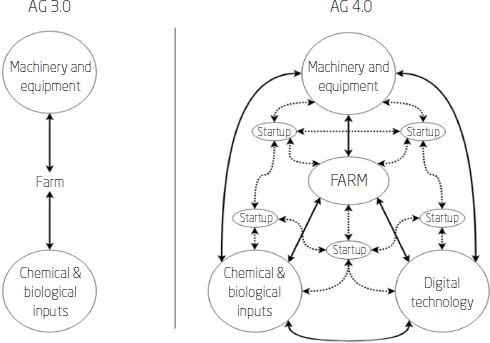
Figure 1
Transition in the landscape of agricultural inputs from the 20th to the 21st century
Source: Based on Pham and Stack (2018) and Wolfert et al. (2017).
The application of digital technologies in the agri-food sector
Gokhberg et al. (2013) suggested that all technologies can be categorized in three types. The first type is emerging technology, which is a rapidly evolving technology with the potential to cause broad societal and economic impacts. When created in the 1980s, ICT could be considered an emerging set of technologies. The second technology type is called enabling technologies. It includes technologies based on already-available inventions and innovations that are about to increase its user’s capabilities in using other technologies radically. The third type is general-purpose technology, which has a high pervasiveness, innovation-spawning effect, and scope for improvement (Bresnahan, 2019; Gokhberg et al., 2013; Helpman & Trajtenberg, 1994).
ICT, in some way, may fit all previous categories of technologies. It is extended to virtually all industries; it is still subject to rapid evolution. Moreover, in the case of agri-food value chains, it can be considered an enabling technology, and the major advances in this chain usually require the use of ICT. Particularly in the agri-food sector, these technologies have been applied since the beginning of the 21st century, with a large increase in use in the last years (Sarker et al., 2020; Pham & Stack, 2018; Zhang, 2020).
ICT in agriculture includes solutions based on big data, IoT, machine learning, blockchain, remote sensing systems, drones, and agricultural robots (OECD, 2018). These technologies increase efficiency and help reduce transaction costs and deliver value to most actors in agribusiness. ICT allows increased control over different production factors, such as animal health, soil conditions, harvest, and sowing periods through real-time monitoring of the farmland, crops, animals, and equipment used for the production (Wolfert et al., 2017).
According to the OECD (2018), ICT applied to agri-food value chains can be understood as various tools and devices. Table 1 describes these technologies.
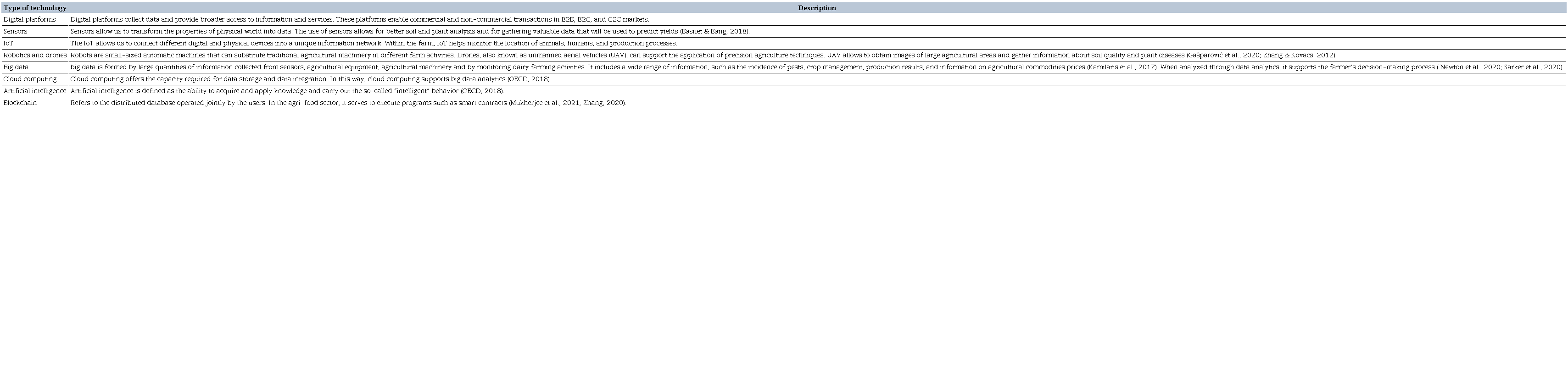
The advent of digital platforms for agri-food products constitutes one of the most important innovations affecting most value chain elements. For instance, small-scale farmers usually face more difficulties achieving proper profit margins than large-scale producers. This happens due to the lack of information on the products’ prices, lack of connections with the target market, and high transaction costs (Markelova et al., 2009). Thus, digital platforms decrease these disadvantages, notably by connecting farmers directly to consumers without intermediates (Mukherjee et al., 2021; Zeng et al., 2017). They also connect farmers to upstream value chain elements (OECD, 2018).
Blockchain is a distributed database replicated across many locations and operated by users. It allows “smart contracts” and digital currency to perform transactions and access financial resources. The advantages of blockchain technology over traditional financial mechanisms are the authenticity and transparency of the information of transactions, which in turn show significant reductions in cost (Manski, 2017; Mukherjee et al., 2021; Zhang, 2020). Blockchain allows us to evaluate food origins better, improving the value to final customers.
Altogether, ICT applied to the agri-food sector can be represented as a “package” of technologies that aim to increase the productivity of farming enterprises and agricultural commodities, food products distribution, and commercialization (Basnet & Bang, 2018; Deichmann et al., 2016; Kamilaris et al., 2017; Ogundari & Bolarinwa, 2018; Wolfert et al., 2017).
Despite the availability of information on new digital technologies applied to the agri-food sector, literature still has not yet explored the perspective of technology suppliers regarding the knowledge about the benefits and advantages of these technologies. Therefore, it becomes essential to go deeper into this issue.
METHODS
To identify how digital technologies are being applied in the agri-food sector and their benefits, we mapped ICTs solutions for agriculture that Brazilian agri-food technology companies developed. These firms developed many new technologies within the agribusiness sector and thus offered a wide range of digital technologies.
The geographical delimitation of this study in Brazil is because the country figures as the third largest agricultural producer in the world (United States Department of Agriculture [USDA], 2017), is also the leader in tropical agricultural research, and concentrate many AgTechs (Embrapa, 2020). Studies show that 24% of Brazilian GDP comes from agribusiness (Instituto Brasileiro de Geografia e Estatística – IBGE, 2017). Likewise, the country is the hometown of the AgTech Valley, the main center of agricultural technology research in Latin America (Jardim, 2018). To achieve our objective, the method was divided into three steps, represented in Figure 2.
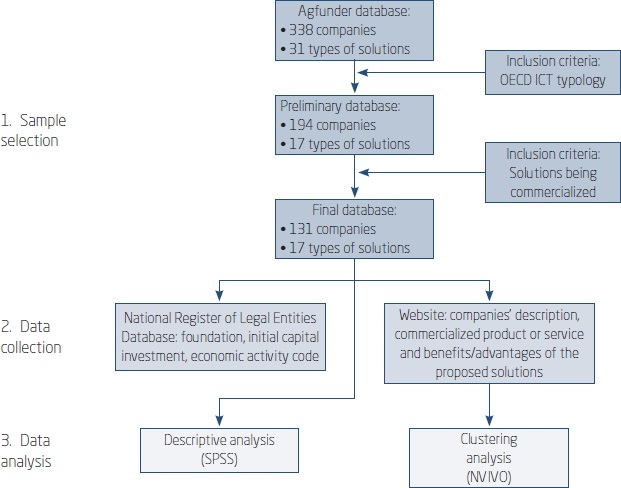
Figure 2
Research design
Source: Elaborated by the authors.
Population and sample
We used an agricultural technology company open database provided by Jardim (2018), one of the world’s largest agribusiness venture capital platforms. Of the 338 agri-food technology companies in Brazil, the Agfunder methodology identified and defined 31 different types of solutions. Nine of those solutions were related to the “before the farm” value chain. Another twelve were developed for the “inside the farm” value chain. And ten were linked to the “after the farm” value chain, mainly related to food and agricultural product distribution.
Then, we used the OECD’s2 ICT typology to identify what technologies are at the core of those solutions offered by the companies. The OECD’s typology describes seven types of ICT for agriculture: digital platforms, robotics, and drones, IoT, big data, artificial intelligence, cloud computing, and sensors.
By using this criterion to select only companies with ICT as their main technological core, 14 solutions that did not meet the OECD’s typology were excluded from the analysis, totaling 194 companies. The remained types of solutions were: content and education; distribution management; e-grocery; farm management; financial services; food safety and traceability; image diagnosis; industry 4.0; IoT; loyalty program; meteorology and irrigation; precision farming; restaurant marketplace; scouting; sharing economy; telemetry and automation; unmanned aerial vehicles (UAV).
In situations where it was impossible to identify exact or similar terms to OECD’s typology, the researchers used keywords to define the technology type applied by the company. For instance, once they identified words such as “SaaS,” “software,” or “platform,” the researchers inferred the use of a “digital platform” technology by the company. Expressions such as “realtime access” suggested the “cloud computing” technology. The “machine learning” technology was allocated into the “artificial intelligence” category.
Then, we selected only the companies already commercializing their products and services. We assume that it is only possible to consider companies with validated business models that are effectively influencing the specific link of the value chain because, in the startup scene, it is very usual to launch prototypes that may (or may not) provide the expected benefits for technology users and bring profits for the company. We pre-screened the companies’ websites to analyze if they offer solutions and if their National Register of Legal Entities code is active. The final sample included 131 agricultural technology companies.
Data collection
To achieve our objective, we collected both quantitative and qualitative data from three different sources between November 2018 and March 2019. First, the Agfunder database allowed us to identify the companies’ value chain position and solution types to define and characterize the sample.
Second, through the agricultural technology companies websites, it was possible to obtain information related to their field area, the main commercialized product or service list, and the benefits/advantages of their solutions. It is essential to highlight that these data embrace the institutional perspective of companies on how they communicate information about their history, solutions, and competitive advantages to target audiences. Third, through the National Register of Legal Entities Database, it was possible to extract data on companies’ foundations, initial capital investment, and economic activity code.
All information was compiled into a new database to enable comparative analyses.
Data analysis
Researchers used the description of companies, the definition of its solutions and the description of benefits provided by the commercialized products and services and OECD (2018) criteria to define technology types applied by the analyzed companies. Data on age, value chain position, value chain types, initial capital invested, and solution types of agri-food technology were analyzed using the IBM SPSS 17 software.
Furthermore, we codified the data related to the benefits and advantages of the leading solutions offered by each firm through the NVIVO software. We considered the 250 most frequent derived words to create codes and linked them to the previous literature. Then, we performed a cluster analysis based on Pearson’s correlation parameters, which enabled the creation of a dendrogram with the codes. After finishing the previously described analysis, the data were triangulated with the current literature to identify how digital technologies are being applied in the agri-food sector.
RESULTS AND DISCUSSION
Description of agricultural technology companies
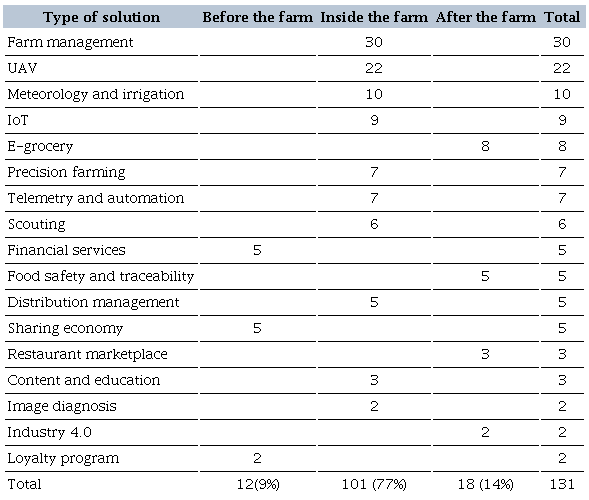
The results show that most companies (77.01% of firms) focus on solving the issues inside the farm (Table 2). 13.74% of agricultural technology companies develop solutions for agents located after the farm. The solutions for upstream agri-food value chains are developed by twelve companies, corresponding to approximately 9.16% of the total number of companies.
Number of agri-food technology companies per type of solution and position in the value chain
Source: Elaborated by the authors.
Likewise, 10 out of 17 types of ICT-based solutions are developed for the farm. We highlight that almost half of the agricultural technology companies (47%) provide answers to monitor the operations, decrease the waste of resources, and predict potential issues such as farm management, UAV-based, and meteorology and irrigation technologies. In contrast, two agricultural technology companies developed solutions focused on industry 4.0, image diagnosis, and loyalty programs.
Besides that, 86.26% of agricultural technology companies develop solutions for crop production and the rest for animal production. The companies are exploiting ICT to solve climate variability, pest control, soil fertility, etc. This focus on crop production instead of animal production is congruent with the higher proportion of the crop production within the total revenue in agriculture compared to animal production value.
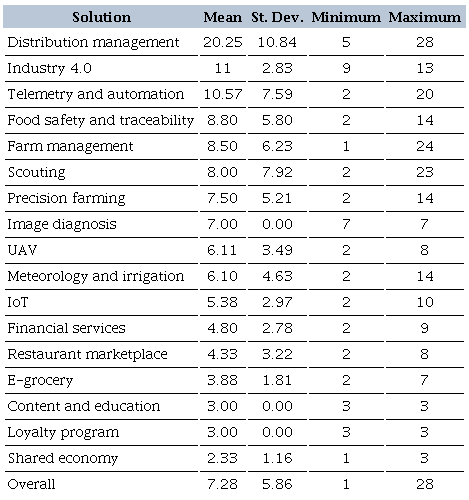
When looking into the age of agri-food technology companies per solution type (Table 3), it is possible to observe vast differences among solution types. While the companies engaged in distribution management solutions present a mean age of 20.3 years, the sharing economy and loyalty program companies have a mean age of no more than three years. The overall mean age of the analyzed agricultural technology companies is 7.3 years. It is essential to add that many scholars agree that the limit of age for considering a technology company to be a new one is about six years (Dai et al., 2017; Saemundsson & Candi, 2017; Zahra et al., 2000). Almost 40% of the total companies (39.2%) had more than six years by the research time. Hence, even when considering that most AgTechs may present lower scalability and longer product development life cycle than other new ventures (Mikhailov et al., 2018), it is suggested that a great number of Brazilian agri-food technology companies are not startups anymore.
Mean age of agri-food technology companies per solution type (age and standard deviation)
Source: Elaborated by the authors.
Consequently, the ICT field in the agri-food sector comprises different generations of these companies. Some of the solutions are being developed almost exclusively by young companies, such as those engaged in sharing economy, e-grocery, content, and education solutions. The companies involved in farm management and precision management solutions are young and relatively mature organizations. Finally, the dis tribution management solution is composed mainly of relatively mature companies.
Moreover, when analyzing the mean age per position of solution in the value chain, it is observed that inside-the-farm companies present the highest one, equal to 8.2 years. The average age for companies that create solutions for after-the-farm agents is 5.9 years, and those that focus on before-the-farm solutions are 3.7 years.
It is important to argue that the presence of many relatively mature companies in the agri-food technology value chain (39,2%) can be justified by the necessity of more mature companies to develop radically new solutions due to the high pace of technological development advances in this field. Still, even with many mature companies in the ICT field, the rate of AgTechs creation remains relatively high, as 27.6% of the analyzed agri-food technology companies were founded less than three years ago. It shows that the agri-food technology sectors continue to grow and develop.
At the same time, it is possible to observe a rate of diversity in terms of economic activity codes amongst the analyzed agri-food technology companies since many of them are not registered as software firms within the national activity classification catalog. Therefore, similarly to the world’s landscape of big data in agribusiness (Wolfert et al., 2017), the Brazilian landscape of agri-food technology companies engaged in ICT is diverse in age, size, and the original economic activity of the organizations.
Types of commercialized technologies
By mapping ICT-based solutions commercialized, it was possible to identify the wide range of technologies applied to agri-food and, particularly, to agricultural production. In agriculture, as in other economic sectors, obtaining the required information at the “right” time has gained crucial relevance for the overall performance of food production and distribution.
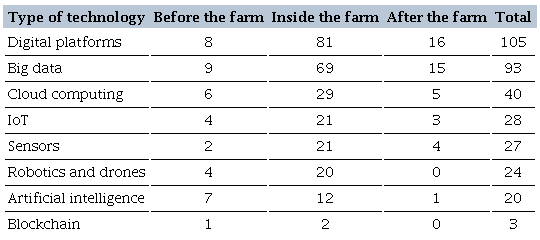
Farms are the main focus of ICT-based solutions compared to other upstream and downstream value chain actors. Likewise, it is observed that “inside the farm” is the only value chain position that receives solutions based on all OECD’s (2018) technology types. As shown in Table 4, most agri-food technology companies (80.7%) argued for using digital platform technology to provide innovative solutions to customers. More than 70% of firms stated to big data in their answers. Cloud computing technology is used by 30.7% of firms. Hardware-based solutions, including sensors, robotics, and drones, are developed by 41 companies. The least applied technology is the blockchain, with only three companies.
Number of companies offering the given technology per value chain position3
Source: Elaborated by the authors.
From the results, we argue that the emergence of ICT makes the inside the farm the most impacted stage of the value chain. In this sense, the structure of production function in agriculture moves from the rationale of using physical inputs to the increasing importance of service-based solutions. This technology trend suggests that soon farms will become heavy users of ICT while transforming agricultural production into a more servitized economic activity than it is today.
In turn, these changes may affect the decision-making process for agricultural production. In the past, farmers were the main ones responsible for decisions regarding farming and harvesting activities. The rise of digital platforms, big data, IoT, and artificial intelligence in agriculture will upgrade farmers’ decision-making procedures. It is possible to suppose that soon the farmers’ decisions will concern technology adoption issues at least as much as the decisions related to production issues.
Benefits and advantages of ICT in agri-food
After describing the types of digital technologies, we focused on analyzing the main benefits and advantages of different solutions offered by the selected companies. The most frequent words extracted from their websites were data, information, control, system, management, and costs (Figure 3).
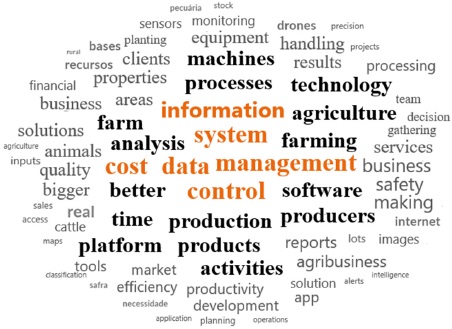
Figure 3
Word cloud of most frequent words
Source: Elaborated by the authors.
From the results, it seems clear that implementing these digital technologies in the different links of the value chain can bring operational and managerial benefits to its users. These solutions offer the possibility of collecting data from other sources, which are systematized and analyzed. Depending on the purpose of the solution, these software or integrated plat forms provide valuable information which can be used to make more proactive decisions.
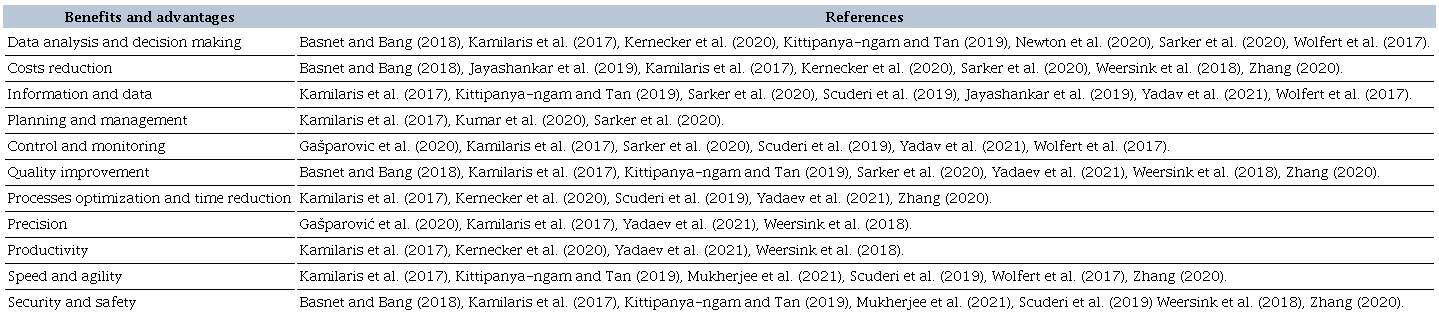
Through production control and monitoring, it is possible to increase productivity, reduce costs and improve product quality. These technologies enable users to speed up and gain agility by ensuring greater precision and safety throughout the production processes. Indeed, it is possible to optimize the processes and adjust some of the activities related to farming because every strategy and its consequent implementation can be based on real-time information. These most frequent words were used to create the codes presented in Table 5.
Benefits and advantages of using ICT in the agri-food sector
Source: Elaborated by the authors.
From these created codes, we sought to identify if they are correlated and what this relationship looks like. We performed a clustering analysis in the form of a dendrogram. A dendrogram diagram shows the hierarchical relationship between coded words (Figure 4).
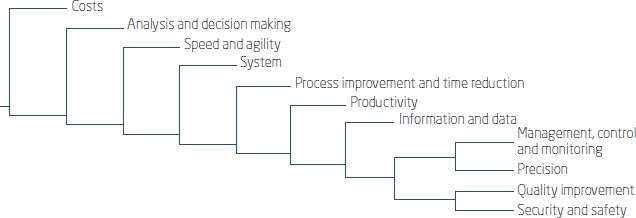
Figure 4
Cluster analysis by word similarity
Source: Elaborated by the authors.
The most important benefits that companies intend to provide to technology users are cost reduction and rapid decision-making. It occurs because the processes performed by farm producers are systematized on digital platforms. When these systems are implemented, they change how most production and management activities are done, leading to gains in productivity and time. Due to digitalization, companies need to improve or change some processes, which allows them to harness the full potential of these solutions.
When applied to a specific activity, these technologies, especially drones, sensors, and IoT, enable collection and storage of a significant amount of data (big data) on digital platforms. Therefore, that data can be analyzed in real-time due to cloud computing and artificial intelligence. Consequently, the entire agri-food value chain can produce products and services with higher quality and safety since they can monitor, control, and better manage their business
Using these digital technologies allows exploiting data to obtain insights and information that will help companies in their planning process. It might bring a great revolution in the agri-food sector because every actor will raise their knowledge base and be interconnected to develop, produce and deliver cheaper high-quality products to the target market.
Considering the results shown in Table 2 (solution types) and Table 4 (commercialized solutions), we suggest a new phenomenon occurring in the agri-food sector, particularly agricultural production. We call this phenomenon agricultural servitization, as services become a critical factor of agricultural production. For instance, financial services and sharing economy solutions allow farmers – particularly small ones – to obtain the financial resources necessary to promote agricultural production. By providing farmers with real-time data, digital platforms and farm management solutions allow them to manage their farms like a commercial firm. In turn, e-grocery, food safety, and traceability help farmers sell their products, improve the farm’s transactional capability, and improve customer experience.
At the same time, from the results presented in Table 5 (benefits and advantages of ICT use) and figures 3 (word cloud) and 4 (cluster of benefits and advantages of ICT use), we suggest that the phenomenon of agricultural servitization is helping to create another disruption in agricultural production. As shown above, intelligent machinery allows the farmer to learn about soil quality and plant diseases (Gašparović et al., 2020; Zhang & Kovacs, 2012) and, therefore, to better plant and harvest crops. Precision sensors monitor the farm and the cattle in real-time (Basnet & Bang, 2018). Big data analytics allows the farmer to improve and make faster the decision-making process (Kamilaris et al., 2017; Sarker et al., 2020). Overall, terms such as monitor and control, quality improvement, precision, security, and safety are very similar to those used by managers and engineers in the manufacturing industry.
Similar to what happened in the industrial sector during the late 19th and early 20th centuries, now it is possible to monitor the production phases in agriculture, access production indicators in real-time, and foresee the output according to the invested financial and physical resources. We argue that the identified phenomena related to the increasing control over production factors in agriculture should be called agricultural manufacturing.
FINAL CONSIDERATIONS
The present study showed that the solutions commercialized by agricultural technology companies aim to solve the technical and managerial issues of farms by improving interconnectivity and allowing lower resource consumption through the intelligent use of equipment and machinery. Overall, they focus on farm management and transaction operations. We highlighted that the different groups of agricultural technology companies present significant differences in their mean age (Table 3). This suggests the possibility of existing different generations of agricultural technology companies, which reinforces the ongoing paradigm shift.
Our research brought some theoretical contributions and practical implications. Firstly, it showed the perspective of technology suppliers on the benefits and advantages of ICT in the agri-food sector. Unlike academic scholars and farmers, technology suppliers possess a holistic view of technological, management, and market aspects of agri-food production and commercialization. With that, their vision has paramount importance for the sector’s future.
Secondly, it identified two new phenomena: agricultural servitization and agricultural manufacturing. We expect that the present article’s concept forming these phenomena will allow further studies. We may also question: will the digitalization gap between the farm and other sub-sectors of the agri-food value chain decrease over time? Before introducing ICT in agriculture, farming was mainly based on physical production factors. Considering that farming is possibly the least digitized sector of the agri-food value chain, it represents a significant market opportunity for ICT companies.
Thirdly, similarly to the current global scenario (Pham & Stack, 2018; Wolfert et al., 2017), the Brazilian landscape of agricultural technology supplies is diverse. There are different generations of agricultural technology companies in the field. Policymakers should pay attention to their peculiarities regarding size, age, financial resources, and knowledge resources when formulating policies for the agri-food sector.
We also highlight that we focused on the firms’ perception of the benefits and advantages of their solutions and not on the users’ perception. This methodological approach can be replicated for other studies carried out worldwide.
We recognize that this study has some limitations. First, the present study used only secondary data. Therefore, we claim urgency for applying a survey with the analyzed companies to refine and validate the actual use of the identified technologies. Second, this research was performed with companies that act in tropical agriculture environments. Thus, it would be interesting to compare possible differences in the use of ICT among both types of agriculture.
For future studies, we suggest incorporating qualitative ICT analysis through the perception of experts and practitioners about the benefits of ICT applied to the agri-food sector. Once identified that there are different generations of agri-food technology companies, it would be interesting to investigate the technological trajectory of incumbent firms when engaging in the development of new high-tech solutions for the agri-food sector.
The new phenomena of agricultural manufacturing should be deeply explored. Which agricultural production processes will be the most similar in terms of management and control to the manufacturing sector? How can the impact of the development of industry 4.0 on agriculture 4.0 be enhanced? Where do industry 4.0 and agriculture 4.0 overlap, and what are their differences? Finally, considering the rapid pace of technological evolution in the sector, new studies could be conducted to identify the possible changes in the current situation.
REFERENCES
Aubert, B. A., Schroeder, A., & Grimaudo, J. (2012). IT as enabler of sustainable farming: An empirical analysis of farmers’ adoption decision of precision agriculture technology. Decision support systems, 54 (1), 510–520. https://doi.org/10.1016/j.dss.2012.07.002
Basnet, B., & Bang, J. (2018). The state-of-the-art of knowledge-intensive agriculture: A review on applied sensing systems and data analytics. Journal of Sensors, 2018. https://doi.org/10.1155/2018/3528296
Boehlje, M., & Bröring, S. (2011). The increasing multifunctionality of agricultural raw materials: Three dilemmas for innovation and adoption. International Food and Agribusiness Management Review, 14 (2), 1–16. https://doi.org/10.22004/ag.econ.103981
Boehlje, M., Roucan-Kane, M., & Bröring, S. (2011). Future agribusiness challenges: Strategic uncertainty, innovation, and structural change. International Food and Agribusiness Management Review, 14 (5), 53–82. https://doi.org/10.22004/ag.econ.119971
Bresnahan, T. F. (2019). Technological change in ICT in light of ideas first learned about the machine tool industry. Industrial and Corporate Change, 28 (2), 331–349.
Bronson, K., & Knezevic, I. (2016). Big data in food and agriculture. Big data & Society, 1 (5). https://doi.org/10.1177/2053951716648174
Dai, Y., Goodale, J. C., Byun, G., & Ding, F. (2017). Strategic flexibility in new high-technology ventures. Journal of Management Studies, 55 (2), 265–294. https://onlinelibrary.wiley.com/doi/abs/10.1111/joms.12288
Deichmann, U., Goyal, A., & Mishra, D. (2016). Will digital technologies transform agriculture in developing countries? Agricultural Economics, 47 (S1), 21–33. https://doi.org/10.1111/agec.12300
Dosi, G. (1982). Technological paradigms and technological trajectories: A suggested interpretation of the determinants and directions of technical change. Research policy, 11 (3), 147–162. https://doi.org/10.1016/0048-7333(82)90016-6
Dutia, S. G. (2014). AgTech: Challenges and opportunities for sustainable growth. Innovations: Technology, Governance, Globalization, 9 (1-2), 161–193. https://doi.org/10.1162/inov_a_00208
Empresa Brasileira de Pesquisa Agropecuária – Embrapa (2020). www.embrapa.org
Evenson, R. (1974). International Diffusion of Agrarian Technology. The Journal of Economic History, 34 (1), 51–73. https://doi.org/10.1017/S0022050700079626
Food and Agriculture Organization of the United Nations – FAO. (2009). Global agriculture towards 2050. In How to feed the world 2050: High-level expert forum. Food and Agriculture Organization of the United Nations, Rome.
Freeman, C., & Perez, C. (1988). Structural crises of adjustment, business cycles and investment behaviour. Technology, Organizations and Innovation: Theories, concepts and paradigms, 38–66.
Instituto Brasileiro de Geografia e Estatística – IBGE (2017). https://www.ibge.gov.br/
Gašparović, M., Zrinjski, M., Barković, D., & Radočaj, D. (2020). An automatic method for weed mapping in oat fields based on UAV imagery. Computers and Electronics in Agriculture, 173.https://doi.org/10.1016/j.compag.2020.105385
Gereffi, G., Lee, J., & Christian, M. (2009). US-based food and agricultural value chains and their relevance to healthy diets. Journal of hunger & environmental nutrition, 4 (3-4), 357–374. https://doi.org/10.1080/19320240903321276
Gokhberg, L., Fursov, K., Miles, I., & Perani, G. (2013). Developing and using indicators of emerging and enabling technologies. In Handbook of innovation indicators and measurement. Edward Elgar Publishing.
Helpman, E., & Trajtenberg, M. (1994). A time to sow and a time to reap: Growth based on general purpose technologies. National Bureau of Economic Research.
Jardim, F. (2018). Brazil Agtech Market Map: 338 Startups Innovating in Agricultural Powerhouse. https://agfundernews.com/brazil-agtech-market-map-338-startups-innovating-in-agricultural-powerhouse.html.
Jayashankar, P., Johnston, W. J., Nilakanta, S., & Burres, R. (2019). Co-creation of value-in-use through big data technology-a B2B agricultural perspective. Journal of Business & Industrial Marketing, 35 (3), 508–523. https://doi.org/10.1108/jbim-12-2018-0411
Kamilaris, A., Kartakoullis, A., & Prenafeta-Boldú, F. X. (2017). A review on the practice of big data analysis in agriculture. Computers and Electronics in Agriculture, 143, 23–37. https://doi.org/10.1016/j.compag.2017.09.037
Kernecker, M., Knierim, A., Wurbs, A., Kraus, T., & Borges, F. (2020). Experience versus expectation: Farmers’ perceptions of smart farming technologies for cropping systems across Europe. Precision Agriculture, 21 (1), 34–50. https://doi.org/10.1007/s11119-019-09651-z
Kittipanya-ngam, P., & Tan, K. H. (2019). A framework for food supply chain digitalization: lessons from Thailand. Production Planning & Control, 31 (2-3), 158–172. https://doi.org/10.1080/09537287.2019.1631462
Klerkx, L., & Rose, D. (2020). Dealing with the game-changing technologies of Agriculture 4.0: How do we manage diversity and responsibility in food system transition pathways? Global Food Security, 24. https://doi.org/10.1016/j.gfs.2019.100347
Kumar, A., Singh, R. K., & Modgil, S. (2020). Exploring the relationship between ICT, SCM practices and organizational performance in agri-food supply chain. Benchmarking: An International Journal, 27 (3), 1003–1041. https://doi.org/10.1108/BIJ-11-2019-0500
Manski, S. (2017). Building the blockchain world: Technological commonwealth or just more of the same? Strategic Change, 26 (5), 511–522.
Markelova, H., Meinzen-Dick, R., Hellin, J., & Dohrn, S. (2009). Collective action for smallholder market access. Food Policy, 34 (1), 1–7. https://doi.org/10.1016/j.foodpol.2008.10.001
Micheels, E. T., & Nolan, J. F. (2016). Examining the effects of absorptive capacity and social capital on the adoption of agricultural innovations: A Canadian Prairie case study. Agricultural Systems, 145, 127–138. https://doi.org/10.1016/j.agsy.2016.03.010
Michels, M., Fecke, W., Feil, J. H., Musshoff, O., Pigisch, J., & Krone, S. (2020). Smartphone adoption and use in agriculture: empirical evidence from Germany. Precision Agriculture, 21 (2), 403–425. https://doi.org/10.1007/s11119-019-09675-5
Mikhailov, A., Reichert, F. M., & Pivoto, D. (2018). Innovation in agribusiness: The case of agricultural technology new ventures [IFAMA: 28TH World Conference Disruptive Innovations: Better business, management, science and government, Buenos Aires, Argentina].
Mikhailov, A., Camboim, G., Reichert, F. M., & Zawislak, P. A. Identifying how digital technologies are being applied in agribusiness value chains [XLIII Encontro da Anpad – ENANPAD 2019, São Paulo, Brazil].
Mikhailov, A., Oliveira, C., Padula, A. D., & Reichert, F. M. (2021). Californian innovation ecosystem: Emergence of agtechs and the new wave of agriculture. Innovation & Management Review, 18 (3), 222–236. https://doi.org/10.1108/INMR-12-2018-0098
Mukherjee, A. A., Singh, R. K., Mishra, R., & Bag, S. (2021). Application of blockchain technology for sustainability development in agricultural supply chain: Justification framework. Operations Management Research. https://doi.org/10.1007/S12063-021-00180-5
Newton, J. E., Nettle, R., & Pryce, J. E. (2020). Farming smarter with big data: Insights from the case of Australia’s national dairy herd milk recording scheme. Agricultural Systems, 181. https://doi.org/10.1016/j.agsy.2020.102811
Organization for Economic Cooperation and Development – OECD (2018). Digital technologies in food agriculture: Reaping the benefits [Global Forum on Agriculture, Paris, France]
Ogundari, K., & Bolarinwa, O. D. (2018). Impact of agricultural innovation adoption: a meta-analysis. Australian Journal of Agricultural and Resource Economics, 62 (2), 217–236. https://doi.org/10.1111/1467-8489.12247
Oliveira, C. A. O., Pivoto, D., & Pimentel, M. H. Evolutionary theory: An application to agriculture. [2nd international conference on natural resources management and public policy, 2017, Wuhan, China].
Pavitt, K. (1984). Sectoral patterns of technical change: Towards a taxonomy and a theory. Research policy, 13 (6), 343–373. https://doi.org/10.1016/0048-7333(84)90018-0
Perez, C. (2004). Technological revolutions, paradigm shifts and socio-institutional change. In E. S. Reinert (Ed.), Globalization, Economic Development and Inequality: An Alternative Perspective (pp. 217-242). https://doi.org/10.4337/9781845421625
Pivoto, D., Barham, B., Dabdab, P., Zhang, D., & Talamin, E. (2019). Factors influencing the adoption of smart farming by Brazilian grain farmers. International Food and Agribusiness Management Review, 22 (1030-2019-2946), 571–588.
Pham, X., & Stack, M. (2018). How data analytics is transforming agriculture. Business Horizons, 61 (1), 125–133. https://doi.org/10.1016/j.bushor.2017.09.011
Saemundsson, R. J., & Candi, M. (2017). Absorptive capacity and the identification of opportunities in new technology-based firms. Technovation, 64, 43–49. https://doi.org/10.1016/j.technovation.2017.06.001
Sarker, M. N. I., Islam, M. S., Murmu, H., & Rozario, E. (2020). Role of big data on digital farming. International Journal of Scientific & Technology Research, 9 (4), 1222–1225.
Scuderi, A., Foti, V., & Timpanaro, G. (2019). The supply chain value of pod and pgi food products through the application of blockchain. Calitatea, 20 (S2), 580–587. https://www.proquest.com/scholarly-journals/supply-chain-value-pod-pgi-food-products-through/docview/2198417566/se-2?accountid=130632
Shepherd, M., Turner, J. A., Small, B., & Wheeler, D. (2020). Priorities for science to overcome hurdles thwarting the full promise of the ‘digital agricultural revolution. Journal of the Science of Food and Agriculture, 100 (14), 5083–5092. https://doi.org/10.1002/jsfa.9346
United States Department of Agriculture – USDA. (2017). World agricultural production report. Foreign Agricultural Service. Circular Series, WAP 12–17, December 2017.
Yadav, S., Luthra, S., & Garg, D. (2021). Modelling Internet of things (IoT)-driven global sustainability in multi-tier agri-food supply chain under natural epidemic outbreaks. Environmental Science and Pollution Research, 28, 16633–16654. https://doi.org/10.1007/s11356-020-11676-1
Vieira Filho, J. E. R., & Fishlow, A. (2017). Agricultura e indústria no Brasil. Instituto de Pesquisa Economia Aplicada (IPEA).
Weersink, A., Fraser, E., Pannell, D., Duncan, E., & Rotz, S. (2018). Opportunities and challenges for big data in agricultural and environmental analysis. Annual Review of Resource Economics, 10, 19–37. https://doi.org/10.1146/annurev-resource-100516-053654
Wolfert, S., Ge, L., Verdouw, C., & Bogaardt, M. J. (2017). Big data in smart farming–a review. Agricultural systems, 153, 69–80. https://doi.org/10.1016/j.agsy.2017.01.023
Zeng, Y., Jia, F., Wan, L., & Guo, H. (2017). E-commerce in agri-food sector: A systematic literature review. International Food and Agribusiness Management Review, 20 (4), 439–460. https://doi.org/10.22004/ag.econ.264235
Zahra, S. A., Ireland, R. D., & Hitt, M. A. (2000). International expansion by new venture firms: International diversity, mode of market entry, technological learning, and performance. Academy of Management journal, 43 (5), 925–950.
Zhang, D. (2020). The innovation research of contract farming financing mode under the block chain technology. Journal of Cleaner Production, 270. https://doi.org/10.1016/j.jclepro.2020.122194
Zhang, C., & Kovacs, J. M. (2012). The application of small unmanned aerial systems for precision agriculture: A review. Precision agriculture, 13 (6), 693–712. https://doi.org/10.1016/j.jclepro.2020.122194
Notes
Author notes
Andrei Mikhailov is now a researcher at the Graduate Program in Management of University of Vale do Rio dos Sinos (Universidade do Vale do Rio dos Sinos – Unisinos); Guilherme F. Camboim is now a researcher at the Department of Management of Federal University of Rio Grande do Sul (Universidade Federal do Rio Grande do Sul – UFRGS); Fernanda M. Reichert is now an associate professor at the Department of Management of UFRGS; Paulo A. Zawislak is now a full professor and research coordinator at the Department of Management of UFRGS.
Correspondence concerning this article should be addressed to Andrei Mikhailov, Avenida Doutor Nilo Peçanha, 1600, sala 214, Boa Vista, Porto Alegre, Rio Grande do Sul, Brazil, ZIP code 91330-002. Email: andreimikh@gmail.com
