Resources and Entrepreneurial Development
A hierarchical model for industry 4.0 concepts1
Um modelo hierárquico para conceitos da indústria 4.0
 Luciana P. Reis
June M. Fernandes
Luciana P. Reis
June M. Fernandes
A hierarchical model for industry 4.0 concepts1
RAM. Revista de Administração Mackenzie, vol. 24, no. 2, pp. 1-41, 2023
Editora Mackenzie; Universidade Presbiteriana Mackenzie
Received: 11 March 2021
Accepted: 22 March 2022
Abstract
Purpose: This research aims to structure a hierarchical model that integrates the industry 4.0 (I4.0) concepts and standardizes concepts based on the literature.
Originality/value: Kamble et al. (2018) point out the lack of architecture to represent I4.0 concepts. This paper brings an approach to the relationship between these concepts of I4.0. It expands the studies by Ghobakhloo (2018) and Liao et al. (2017) and homogenizes terms present in the literature.
Design/methodology/approach: From a systematic review of the literature in the Scopus and ScienceDirect databases, from 2011 to 2019, 91 articles were reviewed, of which 58 articles were analyzed.
Findings: From the literature, the terms related to I4.0 were grouped into three categories: technologies, principles, and dimensions. Technology clusters represent tools used to promote changes and transformations in the processes, here called principles. These changes and transformations create new industry standards, enabling process integration for problem-solving, and contributing to implementing intelligent management. The relationship between these categories results in a hierarchical model for I4.0 concepts. This hierarchical model can be used to identify opportunities for future research, demonstrating associations between categories that have not yet been explored. It opens possibilities for organizations to enter the fourth industrial revolution. The results help practitioners and researchers to understand this new process in detail and facilitate the construction of a valid and operational intelligent manufacturing platform.
Keywords: Industry 4.0+ dimensions+ technologies+ principles+ hierarchical model.
Resumo
Objetivo: Esta pesquisa tem como objetivo estruturar um modelo hierárquico que integre os conceitos da indústria 4.0 (I4.0) e padronizar conceitos com base na literatura.
Originalidade/valor: Kamble et al. (2018) apontam para a falta de uma arquitetura para representar os conceitos I4.0. Este artigo traz uma abordagem para a relação entre esses conceitos de I4.0. Ele expande os es - tudos de Ghobakhloo (2018) e Liao et al. (2017) e homogeneíza termos presentes na literatura.
Design/metodologia/abordagem: A partir de uma revisão sistemática da literatura nas bases de dados Scopus e ScienceDirect, de 2011 a 2019, foram revisados 91 artigos, dos quais 58 foram analisados.
Resultados: A partir da literatura, os termos relacionados com I4.0 foram agrupados em três categorias: tecnologias, princípios e dimensões. Os clusters de tecnologia representam ferramentas utilizadas para promover mudanças e transformações nos processos, aqui chamados de princípios. Essas mudanças e transformações criam novos padrões da indústria, permitindo a integração de processos para a solução de problemas, contribuindo para a implementação do gerenciamento inteligente. A relação entre essas categorias resulta em um modelo hierárquico.
Palavras-chave: Indústria 4.0, dimensões, tecnologias, princípios, modelo hierárquico.
INTRODUCTION
Recent technological developments have transformed the conventional production system into self-sufficient digital production models, ushering in a new industrial revolution. The term industry 4.0 (I4.0) is used to represent this new production cycle. This term was introduced publicly at the Hannover Fair in Germany in 2011. I4.0 is defined as the ability of systems to operate seamlessly throughout the various stages of the production process and various levels of the supply chain, as well as make decentralized decisions with minimal intervention (Castelo-Branco et al., 2019).
Restructuring of industrial scenarios can be seen as the convergence of various emerging concepts and new technologies, such as radio frequency identification (RFID), big data, cloud computing, intelligent sensors, machine learning, robotics, additive manufacturing, artificial intelligence, augmented reality, and the internet of things (IoT) (Li et al., 2019; Rajput & Singh, 2019). Adopting techniques that aim to increase the connectivity, automation, and digitization of industrial processes allows greater flexibility of the chains; significantly increases their productive potential; and exerts financial, sustainability, and security impacts on their processes (RuizSarmiento et al., 2020).
Despite the benefits that the adoption of I4.0 technologies brings to supply chains, these technologies have not yet been defined adequately. The literature on I4.0 shows that the concepts are neither clear nor homogeneous (Ghobakhloo, 2018; Qin et al., 2016). The studies by Ghobakhloo (2018) and Liao et al. (2017) have limitations, as they do not include all terms present in the 58 selected articles, nor the interactions between the terms searched. Besides that, Kamble et al. (2018) point out that defining a design or architecture to represent I4.0 is a significant challenge for current authors. In this sense, this research has a guiding question:
-
How to integrate the concepts of industry 4.0 hierarchically in a reference model?
Then, to create architecture to represent I4.0, this research aims to structure a hierarchical model that integrates the industry 4.0 concepts and standardizes concepts based on the literature. A categorization of the terms was proposed by dividing them into 1. technology clusters, 2. principles (process changes achieved through these innovations), and 3. dimensions (a new division of smart plant processes based on their stakeholders and integration of the process) and established the relationships between these categories by building the relationship matrices. From this conceptual hierarchical model, it is possible to link to each technology the principle to be worked on in the context of I4.0 and the respective dimension to be explored, enabling integration between the concepts present in intelligent manufacturing platforms.
This hierarchical model’s structuring is expected to contribute to the practice insofar as the relationship between technologies, principles, and dimensions helps to guide the implementation of I4.0. This relationship allows practitioners to identify which technologies must be implemented to achieve the desired principles and dimensions. In addition, this research contributes not only to practice but also to the literature by seeking to establish a pattern and a relationship between the concepts of I4.0, favoring a better understanding of the term “I4.0” among professionals and scholars on the topic.
This article is divided into three sections in addition to this brief introduction. The second section deals with the researched literature and conceptual developments. The third section, a systematic review of the literature using PRISMA (Preferred Reporting Items for Systematic reviews and Meta-Analyses) (Page et al., 2021; Paré et al., 2015), examines the quality of systematic review reports and an extensive literature search to identify articles methodological and others that could support this study. The last section presents the analysis of the collected data and the main discussions that led to the structuring of the proposed model. Finally, a brief conclusion is presented, pointing out the central points of the study, suggestions for future research, and limitations.
THEORETICAL GROUNDS
Industrial revolution and the theoretical foundations of I4.0
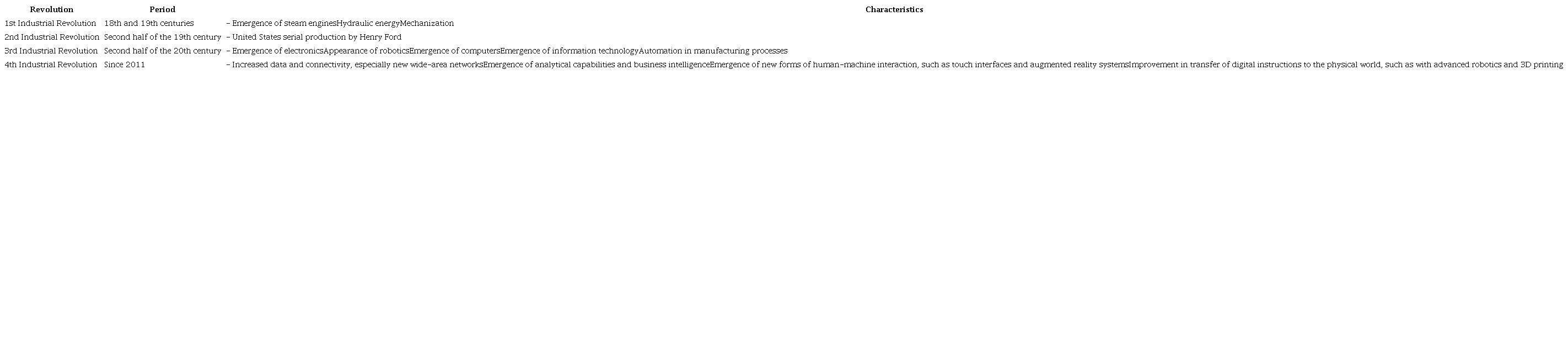
The first industrial revolution took place in Europe with the introduction of mechanical production facilities in the second half of the 18th century. This revolution intensified throughout the 19th century, revolutionizing the way goods were previously produced, and it was driven by the emergence of steam engines, hydraulic power, and mechanization (Galati & Bigliardi, 2019). Beginning in the 1870s, the electrification and division of labor (i.e., Taylorism) led to the second industrial revolution, marking the beginning of the US assembly and serial production lines by Henry Ford (Liao et al., 2017; Hermann et al., 2016). The third industrial revolution, also called the “digital revolution,” emerged in the 1970s when advanced electronics and technological information further developed production automation. At this time, machines not only came to assume a substantial proportion of “manual labor” but were also a part of the “intellectual work” (Ghobakhloo, 2018). With the advancement of the internet and robotic intelligence came a new production concept responsible for the union of the natural world and the virtual one: this began the fourth industrial revolution era (Henning et al., 2013).
First used in 2011 at the Hannover fair in Germany, the term I4.0 is approached as a strategic high-tech project that seeks to promote German manufacturing and boost its sales (Dassisti et al., 2019; Sung, 2018). Presented as a new industrial stage, the project enables the management of information and business strategies based on a data integration system, which facilitates the optimization of operations in real time (Horváth & Szabó, 2019; Telukdarie et al., 2018; Caricato & Grieco, 2017; Grieco et al., 2017).
Considered one of the major trends in today’s production systems, I4.0 utilizes the integration between operations systems and information and communication technologies to form the so-called cyber-physical systems (CPS), thus demonstrating significant implications for sustainability (Bendul & Blunck, 2019; Gobbo Junior et al., 2018; Jabbour et al., 2019; Wang et al., 2016). Sung (2018) lists four factors as drivers of this new industrial stage: 1. increase in data and connectivity; 2. emergence of analysis and business intelligence resources; 3. emergence of new forms of human-machine interaction; 4. and improvements in the transfer of digital instructions to the physical world (3D) printing.
The new concept of production is developing through the collective efforts of government agencies, industries, and academic research institutions (Da Costa et al., 2019). In this scenario, besides Germany, the United States leads in researching and developing I4.0 concepts and technologies, as it has implemented its innovative manufacturing project since 2012 (Büchi et al., 2020). Several governments are now following new I4.0 incentive programs, such as the New France Industrial (2013) in France; The European Commission Factories of the Future (2014) in the European Union; Manufacturing 3.0 (in 2014) in South Korea; Made in China 2025 and Internet Plus (in 2015) in China; Japan Super Society (in 2015) in Japan; and Singapore Research, Innovation, and Enterprise Plan 2020 (in 2016) in Singapore (Mariani & Borghi, 2019). Table 1 presents a summary of the industrial revolutions and their main characteristics.
I4.0 and its vocabulary
In recent years, the number of publications linked to I4.0 has significantly increased. In an attempt to understand this new industrial scenario, authors investigate its concepts and applications through literature reviews and case studies. Some examples include the works of Büchi et al. (2020), Pacchini et al. (2019), Vaidya et al. (2018), Bortolini et al. (2017), and Mittal et al. (2019), as their main objective was the identification of the terms and technological trends of I4.0.
Scholars such as Dombrowski et al. (2018), Gobbo Junior et al. (2018), and Liao et al. (2017) believe that I4.0 can be defined based on its design principles and technology trends. I4.0 design principles indicate the characteristics and changes occurring in the supply chain with the adoption of practices and new technology trends, a term that describes advanced innovations (Reis et al., 2021a, 2021b).
Kamble et al. (2018) point out that defining a design or architecture to represent I4.0 is a significant challenge for current authors. For Gunes et al. (2014), I4.0 is a new concept. The terms used to describe it are not presented clearly and homogeneously, and there are divergences in the literature regarding their definitions.
Given the lack of research related to the creation of a conceptual structure of terms that explore the connections and associations of I4.0, the present study united the categorizations suggested by Ghobakhloo (2018) and Liao et al. (2017) and classified the terms into three categories: technology clusters, principles, and dimensions. In the following, the three categories and their interactions through the relationship matrices are described in detail.
METHOD
A systematic literature review is an important scientific research method that combines relevant studies to address a formulated question (Kitchenham & Charters, 2007). The theoretical question is addressed based on a review of the literature to identify and organize the relevant concepts (Schumacher et al., 2016; Mello & Turrioni, 2012). In this study, scientific knowledge was constructed as a result of three research steps, as presented in Figure 1, based on PRISMA 2020 (Page et al., 2021).
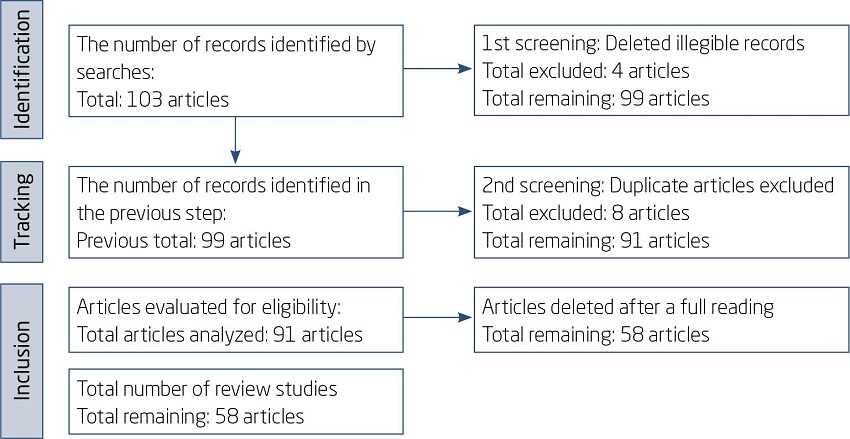
The first step refers to the identification of articles. The survey was conducted by consulting the Scopus and ScienceDirect publication databases to cover prior contributions in the fields of engineering, production, logistics, management, and business. ScienceDirect is an Elsevier platform and the choice of the Scopus database, for example, is justified because it is a broad database for bibliographic references with abstracts and citations of peerreviewed scientific literature. In these databases, the terms “Industry 4.0” and “Industrie 4.0” were searched for in the articles’ summaries, titles, and keywords; these two spellings were searched to cover both English and German publications. The search included the period from 2011 to 2019, considering only scientific articles. As the term originated in Germany, many authors use “Industrie 4.0” in their abstracts and keywords, which justifies the use of this term for the survey of articles. The term was first used in 2011 at the Hannover Fair in Germany to address a high-tech strategic project aimed at promoting German manufacturing and boosting its exports (Dassisti et al., 2019; Sung, 2018). This search resulted in 1046 articles. For the filter, only articles published in journals classified A1 to B2 in Qualis CAPES were considered, in addition to making these keys mandatory in the title or abstract, culminating in 103 selected articles. Of this amount, four articles were eliminated for not being able to obtain the full article for analysis, resulting in 99 articles.
The second stage includes more detailed tracking. Eight of the 99 articles were excluded because they were duplicates, resulting in 91 articles. Ninety-one articles were cataloged, 22 from the ScienceDirect database and 69 from the Scopus directory. The publications were analyzed for their relevance to the theme to ensure the reliability of the review process.
The third stage was a thorough reading of 91 articles, and in the end, 33 articles were excluded from the database. Finally, 58 articles were selected that supported the development of this research. From the registration of articles, the terms related to industry 4.0 were organized in an auxiliary table using excel software, as shown in Figure 2.
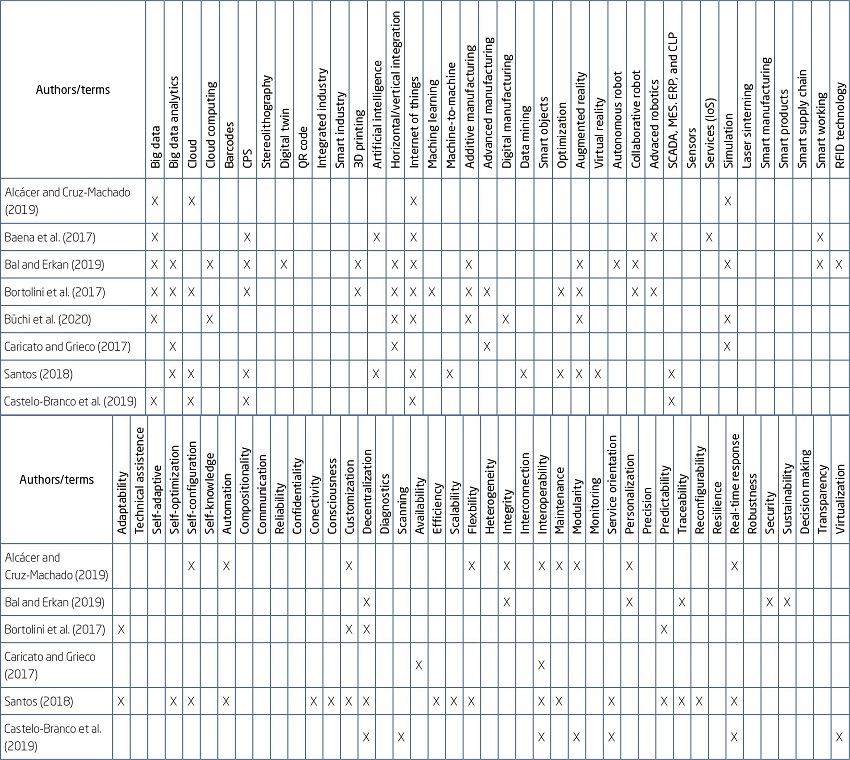
Figure 2
Terms related to industry 4.0
In the second step, based on the initial categorization proposed by Ghobakhloo (2018) and Liao et al. (2017), it was decided to classify the terms into three categories: 1. technology cluster, which addresses enabling technologies; 2. principles, which refer to the changes brought about by the introduction of technological tools in the production chain; and 3. dimensions that meet the divisions of the smart factory based on the integration of the production chain and its stakeholders. For each category, the corresponding authors were identified. Especially for the category of technology clusters and principles, the terms were grouped according to the similarities in their application.
A second in-depth analysis of the selected articles was carried out. The relationship matrices were elaborated from the relationships between these three categories explained in the body of the pieces. The matrices elaborated were dimension versus principle, principle versus technology, and technology versus technology. The authors who established such a link were also identified. The matrices present the relationship between the terms, where the percentage values indicate the number of studies that establish this relationship. From these matrices, network graphs were created as a way of representing and visualizing relationships. Finally, the industry 4.0 hierarchical model was developed, describing the relationship between the three categories.
DISCUSSION
At this stage, the study carries out a systematic review focused on the content of the literature. According to the authors, relationship matrices were created based on the concepts mentioned above to identify the main technological trends, principles, and dimensions of I4.0. The matrix construction process consists of two main steps: 1. identification and selection of links between terms, and 2. determination of link weights based on the total number of authors found for each relationship. The objective is to present an original structure capable of systematizing the terms and offering a strategic roadmap that can serve as a simple guide for the I4.0 process. The matrices were made following the order: dimensions versus principles, principle versus technologies, and technologies versus technologies.
Technology clusters
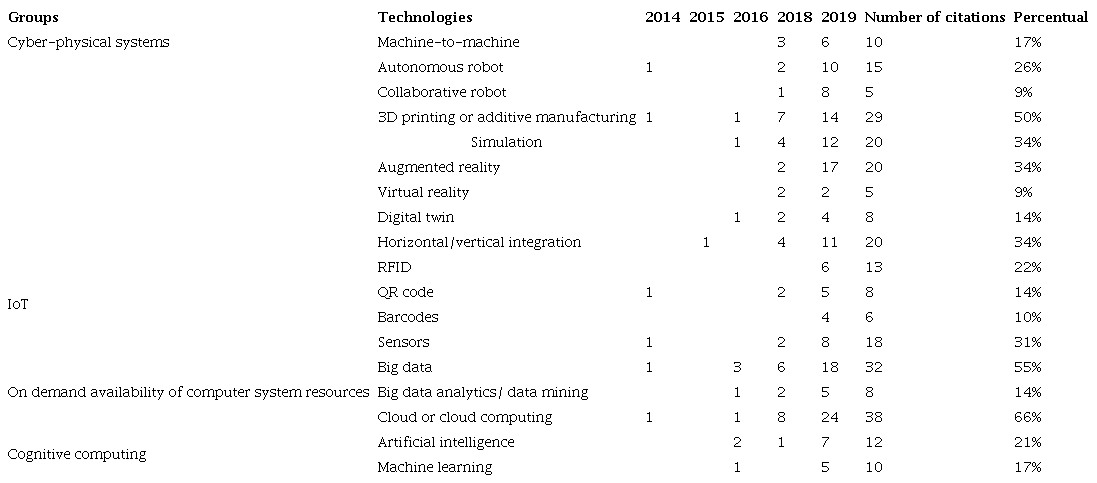
This section discusses the context-related technologies of I4.0 and their concepts. According to Qin et al. (2016), researchers use these different considerations about the requirements of I4.0 or hinder scientific research, which requires a conceptual and terminological basis for applying any theoretical study. Based on the survey of the terms, as shown in Table 2, one cause of the mismatch in the I4.0 technology-related citation numbers is the divergent nomenclature, that is, two names often representing the same term. The literature presents a set of technologies classified as CPS, IoT, on-demand availability of computer system resources, and cognitive computing.
Cyber-physical systems
According to Lee et al. (2014), an integrated manufacturing system is built through the union of physical and digital systems, generating or called cyber-physical systems (CPS). These systems consist of objects with integrated software and electronics that are connected to each other or via the internet to form a single networked system, in which operations are monitored, coordinated, controlled, and integrated by communication centers (De Sousa Jabbour et al., 2018; Hermann et al., 2016). CPS operates in a more dynamic environment, allowing companies to increase productivity by reacting effectively to sudden and unpredictable failures and defects in the production system processes.
Machine-to-machine communication (M2M) is the communication between objects, especially between machines and the CPS. The exchange of information was achieved through telemetry (transmission via radio waves), which is the language machines use to communicate with each other (Müller et al., 2019).
Advanced robotics deals with the use of robots to carry out operational activities without human intervention, called autonomous robots or, in collaborative situations, collaborative robots. They act to ergonomically reduce activities in unhealthy places that can pose risks to human health (Ghobakhloo, 2018).
Additive manufacturing involves superimposing a thin layer of material, plastic, or metal to create products from data and 3D models (3D printing) (Frank, Mendes et al., 2019; Caricato & Grieco, 2017; Grieco et al., 2017). This facilitates the customization of parts, allowing the design of more complex, stronger, and lighter geometries (Ghobakhloo, 2018).
Digital manufacturing refers to the use of tools and software to create a 3D virtual network that represents manufacturing resources and allows the optimization of its processes and activities (De Sousa Jabbour et al., 2018). The simulation and modeling tools aim to simplify and cost-benefit when designing and testing the active operation of the manufacturing systems. Augmented reality extends access to information about machines, equipment, products, and services, including projections of content and complementary information in the real world. The virtual twin is the virtual replica of a company’s assets, processes, and systems and is used in the physical world to gain greater control of manufacturing facilities (Sharpe et al., 2019).
According to Mittal et al. (2019), the process of moving from the traditional factory to a highly reconfigurable manufacturing system is based on the integration of vertical and horizontal integration systems. Vertical integration refers to communication at different hierarchical levels in an organization, taking place through management software (Kunst et al., 2019; Dombrowski et al., 2018). On the other hand, horizontal integration consists of a collaboration between companies, customers, and suppliers, with resources and the exchange of information in real-time (Bendul & Blunck, 2019; Luthra & Mangla, 2018).
Internet of things
The term IoT (internet of things) was introduced in 1999 at the Massachusetts Institute of Technology (MIT) with the idea that “all things are connected over the internet.” This tool is responsible for the interconnectivity of the network, allowing communication and identification by the internet and through technologies. The mutual exchange of data results in the tracking and monitoring of objects and generates information about the context in which they exist (Alcácer & Cruz-Machado, 2019; Sung, 2018; Baena et al., 2017).
On-demand availability of computer system resources
Due to the large amount of data captured (big data), they are processed and validated through analysis programs known as big data analytics or data mining (Stefan et al., 2018; Lee et al., 2014). These tools are responsible for managing and processing this information and generating feedback that helps to control engineering in decision-making (Ghobakhloo, 2018; Reis et al., 2018; Wang et al., 2016) and allow organizations to extract economic value from this data (Ghobakhloo, 2018; Wang et al., 2016). These programs seek to identify relevant results and information using cognitive and predictive skills, in addition to analyzing trends for making diagnoses and predictions and suggesting actions (Dalenogare et al., 2018).
The interaction between machines and humans throughout a production process has led to an enormous amount of continuously generated data and transported information (Müller et al., 2019). The captured data is stored and organized in large digital reservoirs known as clouds. A cloud computing application provides instant infrastructure, provisioned and managed over the internet, and is cited as an essential CPS facilitator (Ghobakhloo, 2018).
Cognitive computing
To ensure complete intelligent manufacturing, the process needs to be able to make decentralized decisions. This includes the adoption of artificial intelligence tools, such as machine learning. This technology uses the construction of computational models to analyze and discover patterns in large data sets. Thus, the system becomes self-organized, adaptable to different situations, and capable of making autonomous decisions (Gobbo Junior et al., 2018; Lee et al., 2014).
To facilitate interpretation and to understand the relationships between the topics covered, Table 2 presents a summary of all the technology clusters cited in the literature, their related technologies, the number of citations, and percentages based on the total of 58 initial articles. The technologies that stood out the most were: the internet of things 81%, Cloud 66%, and CPS 66%. There was a significant increase in the number of citations of all technologies in 2019, the year that industry 4.0 gained greater visibility. It should also be noted that in 2015, few articles were found that worked on I4.0 technologies.
Principles
By adopting enabling technologies, processes and business models between sectors are being transformed; this created new standards and characteristics of the industry, defined in the literature as principles of I4.0 (Sung, 2018). Sixteen I4.0 principles were mapped according to the basic texts for constructing this theoretical framework to accompany the latest phase of digitalization in the manufacturing sector.
Real-time response (or decision-making) is defined as the ability to define actions and modify production processes in real time. It deals with the possibility of obtaining accurate information through artificial intelligence based on data analysis and pattern recognition (Alcácer & CruzMachado, 2019; Dalenogare et al., 2018).
A virtual copy of the physical world (virtualization) is created by linking sensor data to digitized plant models, providing information and data analysis essential for decision-making and information transparency (Frank, Mendes et al., 2019; Ghobakhloo, 2018). Together with robotics equipment, these principles act as a technical assistance system to support human activities (Sung, 2018; Hermann et al., 2016).
The decentralized decision is based on the interconnection of objects and people and information transparency inside and outside a production facility (Hermann et al., 2016). It is defined as the ability of CPS to make decisions independently and perform their tasks in the most autonomous way possible so that they remain aligned with the ultimate organizational objective (Ghobakhloo, 2018). Only in cases of exceptions, interference, or conflicting goals are tasks delegated to a higher level (Sung, 2018).
Interconnectivity between manufacturers and the spread of IoT and cloud computing has created new manufacturing ecosystems, allowing companies to automatically communicate their manufacturing needs and capabilities. Increasing the interrelationship between production and customers is called service orientation and allows the customer to be an agent of a process change (Ivanov et al., 2018; Caricato & Grieco, 2017; Grieco et al., 2017).
For a system to be considered intelligent, innovative, and integrated, it is necessary to develop dynamic networks to build more flexible and adaptable value chains (Reis et al., 2021a, 2021b). Modularity (Hermann et al., 2016) or compositionality (Mittal et al., 2019; Qin et al., 2016) is the principle of I4.0, which is concerned with developing subunits of work that work independently, and that can dynamically reconfigure production routes. Heterogeneity is the principle that considers the diversity and differences between these units (Mittal et al., 2019). The ability of a system to change its state and adjust its configuration is called adaptability, flexibility, or reconfigurability (Qin et al., 2016).
The ability to communicate and work together on smart objects is called interoperability. In the context of sector 4.0, interoperability is the communication of all components connected through the IoT, such as human resources, intelligent products, and any relevant technologies. It also supports the principle of traceability and location of these resources (Ghobakhloo, 2018). Production customization is defined as the mass production of goods and services that meet each customer’s needs (Mittal et al., 2019).
Products and processes are considered sustainable if they are reusable and cause minimum environmental damage, making them more economical, social, and ecological (Mittal et al., 2019). Sustainability is a principle of I4.0 that guarantees the capacity of the processes without compromising the system’s resources, using them efficiently (Qin et al., 2016).
When allowing integration between objects and the environment, an important feature must be considered, information security (Alcácer & Cruz-Machado, 2019). Security measures must be in place to control access to system resources and protect information from unauthorized disclosure, thus ensuring system confidentiality and integrity (Qin et al., 2016).
Reliability refers to the property of the system to maintain the execution of its functions, without significant degradation in its performance and result, even in case of changes. Other names for this principle are found in the literature, such as robustness, resilience, and scalability (Mittal et al., 2019; Qin et al., 2016).
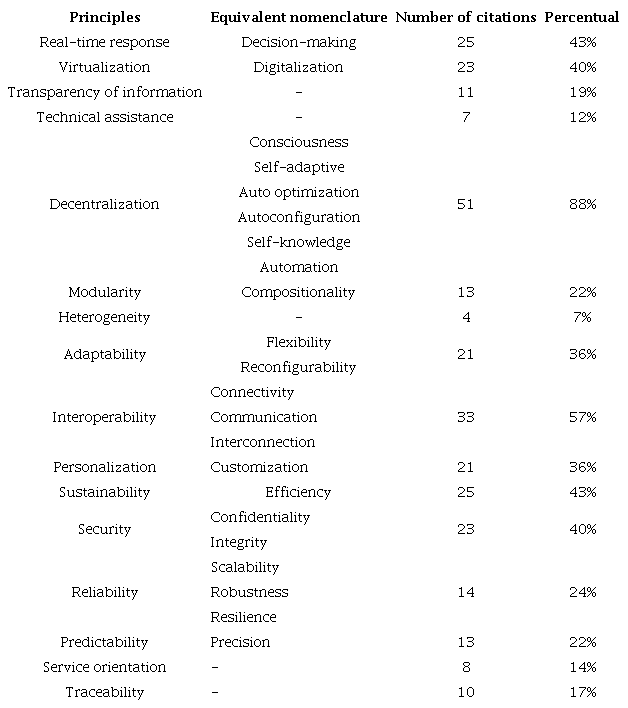
Predictability or precision is responsible for the degree of predicting the system’s behavior qualitatively or quantitatively, with a result as close to the real as possible. Table 3 summarizes all these principles, showing the number of citations and percentages based on 58 initial articles. The principles stand out: decentralization 88%, interoperability 57%, real-time response 43%, sustainability 43%, and security 40%.
Dimensions
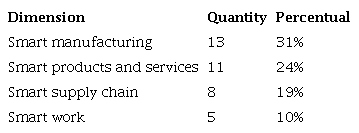
De Sousa Jabbour et al. (2018), Ghobakhloo (2018), Ribeiro (2018), and Santos (2018) divide I4.0 into four smart business components: smart manufacturing, smart product and services, smart supply chain, and smart work. This division is based on integrating the production chain and its stake holders. According to them, the technologies of I4.0 can potentially interfere significantly with all processes, strengthening the relationships with consumers and providing new business models. Therefore, smart processes, products, and services will integrate into a connected, flexible, responsive, and context-sensitive industrial environment.
Smart manufacturing considers the set of technologies that focus on the internal aspects of the factory (Hermann et al., 2016) and that are allocated to improve the processes and make them smarter. The traceability of materials ensures the integration of equipment and the different organizational levels through the technological resources of IoT and horizontal and vertical integration. The autonomy of the production system is considered using collaborative man-machine work as well as applications of additive manufacturing tools that ensure the flexibility, customization, and sustainability of productive environments (Müller et al., 2019; Ribeiro, 2018; Santos, 2018; Henning et al., 2013).
Smart products and services consider products that can communicate with the environment, allowing them to offer additional customer services and gather information relevant to the company’s manufacturing and engineering (De Sousa Jabbour et al., 2018; Ghobakhloo, 2018; Gobbo Junior et al., 2018; Lichtblau et al., 2015). According to Ribeiro (2018) and Santos (2018), actions aimed at developing connectivity and digitizing equipment are essential for producing intelligent services and products.
Smart supply chain targets the real-time integrated work of company logistics operations with suppliers, distributors, and other company units to improve lead times, demand forecasting, and other factors affecting logistics costs. In this stage, the vertical and horizontal integration platforms are highlighted (Ghobakhloo, 2018; Ribeiro, 2018; Santos, 2018).
Smart working considers technologies that fulfill the function of assisting the worker so that the worker becomes more productive. This aid can be divided into six steps: 1. cognitive aid in the planning phase of a production system, 2. physical assistance in the execution phase, 3. sensory aid in the execution phase, 4. cognitive aid in the execution phase, 5. sensory aid in the maintenance phase, and 6. cognitive aid in the maintenance phase (Rauch et al., 2020). Smart working technologies include advanced robotics and digital manufacturing block technologies that facilitate decision-making, monitoring, and remote operation through augmented reality and virtual reality capabilities (Ribeiro, 2018; Santos, 2018; Lichtblau et al., 2015). Table 4 describes the four dimensions and the number of citations and percentages based on the 58 initial articles.
Dimensions versus principles
So that the four-values creation system (four dimensions) to operate its functions, it is necessary for the system to present some characteristics or capabilities referred to here as principles. Table 5 represents the relationship between the dimensions defined by the lines and the principles described by the columns. Altogether nine authors were found that addressed these links. The percentages represent the number of authors within the nine who cited such a link. For example, smart manufacturing x real-time response (11% of articles established such a relationship, that is, 0.11 * 9 = 1 article).

Smart manufacturing was the dimension with the greatest number of relationships with the principles. Nine relationships were identified, and according to the values found in the percentages of connections, the principles: of decentralization (with 89% of articles), interoperability (78%), and adaptability (44%) were the most related to the dimension of intelligent manufacturing according to the authors.
Smart product has a relationship with six principles: virtualization, interoperability, personalization, sustainability, service orientation, and traceability. The principles of interoperability and traceability (with 44%) and personalization (with 33%) had the highest relationship percentages. In the smart work dimension, four relationships were found: virtualization, technical assistance, interoperability, and sustainability. Technical assistance (44%) is the principle with the greatest representation. The smart supply chain has a relationship with four principles: information transparency, interoperability, sustainability, and service orientation. Regarding the call percentages, interoperability (with 56%) and service orientation (with 33% of the articles listed) stand out.
Among the principles, it is worth noting that no relationship between reliability and heterogeneity has been identified. Future studies are suggested for these principles, in which no relationships have been identified. Interoperability and sustainability were principles addressed in the four dimensions. In other words, for developing I4.0, the dynamic networks that compose it need to operate from the perspective of connectivity and efficiency. Figure 3 addresses the behavior of all the principles and dimensions of I4.0 in a global view.
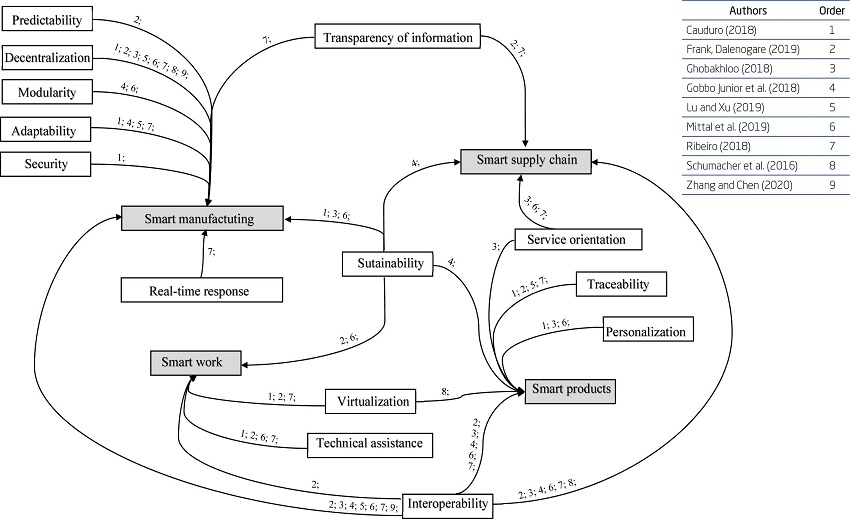
Figure 3
Relationship between dimensions and principles
Figure 3 visually represents the relationships in Table 5, showing the studies that address the relationships between a given principle and a given dimension. The numbers represent the authors who establish these relationships. It is observed that the smart manufacturing dimension was the one that was most related to different principles. Among these principles, decentralization stands out, which has the most significant number of authors relating to this dimension (Cauduro, 2018; Frank, Dalenogare et al., 2019; Ghobakhloo, 2018; Lu & Xu, 2019; Mittal et al., 2019; Ribeiro, 2018; Schumacher et al., 2016; Zhang & Chen, 2020).
Principles versus technologies
After identifying the relationships between the principles and each dimension of I4.0, a new relationship matrix was elaborated, contemplating the technologies and principles as shown in Table 6. The objective is to identify which technologies enable these characteristics, being an additional aid for those who wish to implement the concepts of I4.0.

The principles of interoperability (related to eight technologies), decentralization (with six technologies), and sustainability (five technologies) were those that had the highest number of views with technologies, as shown in the last column of the table. It is worth mentioning that interoperability was the principle with the largest number of technologies studied and the principle that was related to all dimensions according to the studies.
Most technologies presented links between one and three principles. The only exceptions found were in big data analytics technologies, which relate to six principles and CPS, which relate to five principles. There were no links identified with the principles: of modularity, heterogeneity, service orientation, and reliability, and with the technologies: QR code and bar codes, the same being cited as a possibility for future studies. Evaluating the technology groups separately, no relationships between the on-demand availability of computer system resources and cognitive computing groups with the principles were found in the literature.
Due to the large number of connections involving principles and technologies, the network graph was plotted, as shown in Figure 4.
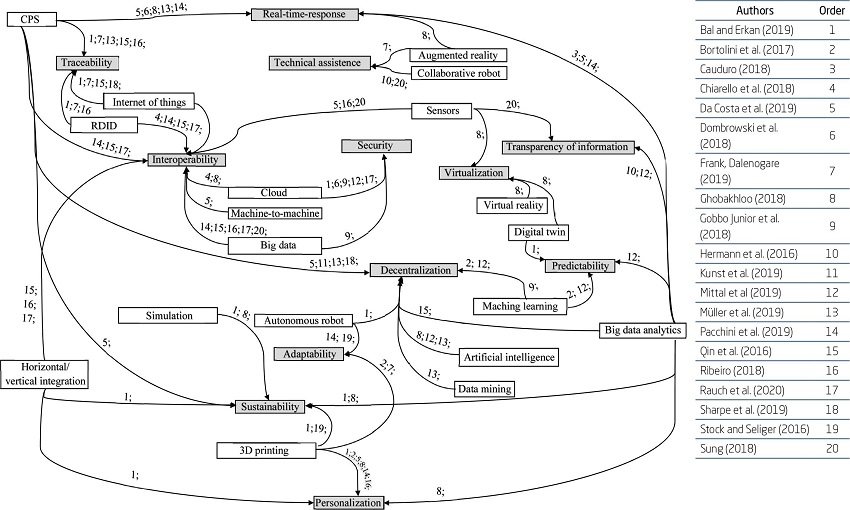
Figure 4
Relationship between principles and technologies
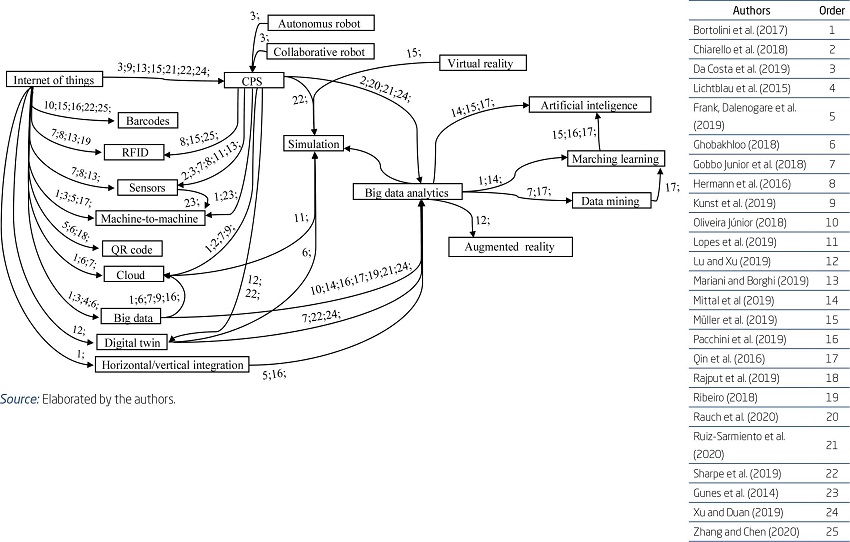
Figure 5
Relationship between technologies in industry 4.0
Visually analyzing the relationships between principles and technologies, a greater density of relationships between technologies and the interoperability principle is observed, especially with the internet of things technology. This relationship has been analyzed by seven studies (Chiarello et al., 2018; Da Costa et al., 2019; Ghobakhloo, 2018; Qin et al., 2016; Ribeiro, 2018; Rauch et al., 2020; Sung, 2018).
Technologies versus technologies
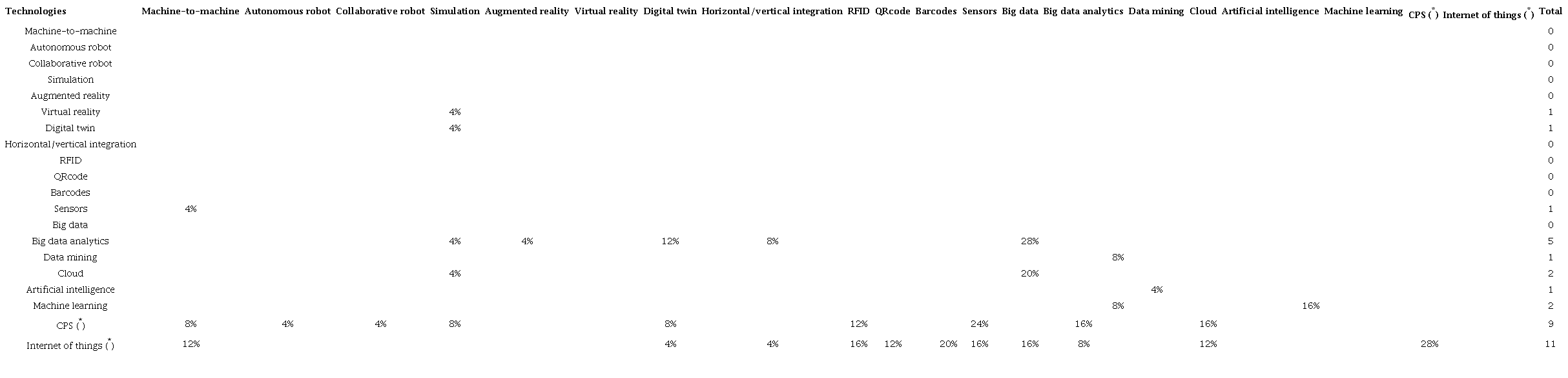
For the perfect operation and applicability of I4.0, some technologies have their performance linked to other equipment and technologies. Based on this foundation, a new relationship matrix was created to represent the relationships between the 21 technologies that make up industry 4.0, based on a literature review of 25 articles related to the theme.
The technologies that most stand out concerning numbers are the internet of things with 11, followed CPS with 9, followed big data analytics with 5, as shown in the last column. They also showed the highest percentages of relationships: the internet of things is strongly related to CPS at 28%, that is, 0.28 * 25 = 7 articles out of the 25 studied establish such a relationship. Big data analytics showed a strong relationship with big data, 28%, and big data with cloud, 20%. Finally, the CPS relates strongly to sensors, 24%. It is worth noting that CPS, the internet of things, and big data are technologies related to interoperability, which is the principle related to all dimensions.
No link was found to 3D printing technology; it and other unrelated principles and technologies are cited as possibilities for future research. The following network graph illustrates all these connections illustratively.
By observing the figure above, we notice that the internet of things is the technology most related to other different technologies. In particular, the internet of things technology with CPS technology was the one most addressed by other studies (Da Costa et al., 2019; Kunst et al., 2019; Mariani & Borghi, 2019; Müller et al., 2019; Ruiz-Sarmiento et al., 2020; Xu & Duan, 2019).
HIERARCHICAL MODEL FOR INDUSTRY 4.0 CONCEPTS
Among the smart manufacturing technologies, we focus on CPS, the internet of things, the cloud, and big data, commonly found in related documents, whose central idea is chain integration. According to Da Costa et al. (2019), with the combination of these technologies, the digital interoperability process occurs through the capture, analysis, and availability of data from within and outside the organization’s borders. Monitoring physical and environmental conditions allows manufacturing organizations to proactively and effectively reduce risks related to equipment and the environment (Gobbo Junior et al., 2018). For De Sousa Jabbour et al. (2018), the connection of the systems allows productivity improvement and guarantees more economical manufacturing processes.
Stock and Seliger (2016) also present companies’ vertical and horizontal integration systems as a solution for connectivity since they can collect information in real time and turn them into responses for planning. In addition, other advantages are gained with the horizontal and vertical integration tools. Its use relates to customized customer-based manufacturing, increasing resource efficiency, and optimizing the global supply chain. In addition, companies are becoming more flexible with this system (Bal & Erkan, 2019; Fernandes et al., 2017).
I4.0 requires operations to be highly cognitive and autonomous. For this to happen, it is necessary to introduce advanced technologies that allow greater autonomy to accelerate individualization and flexibility. Production must be faster and cheaper with the use of additive manufacturing technologies, enabling greater customization of products. Autonomous robots can accurately and intelligently complete a specific task within a given deadline and focus on security, flexibility, versatility, and collaboration (Vaidya et al., 2018).
For Bal and Erkan (2019), digitizing the system through digital manufacturing technologies has an important role in this context. According to Bortolini et al. (2017), creating a digital system identical to the physical system allows us to digitally model a system response with several scenarios, using the methods of artificial intelligence and machine learning for decision-making. In the manufacturing context, the Digital twin is directly linked to the principles of predictability (Lu & Xu, 2019).
Based on the matrices of relationship (technologies versus technologies principles versus technologies dimensions versus principles), a hierarchical model for I4.0 concepts was structured. Applying new technologies will result in changes and transformations throughout the production process, which will be referred to as the principles of I4.0. These changes and transformations create new industry standards, enabling process integration for problem-solving in the four dimensions.
The idea is to create a relationship of belonging; that is, technology enables the implementation of the principle that, in turn, enables the implementation of the dimension. Thus, it is understood that the principle is the categorization of links, which unites the three categories, and the relationship between dimension x technology is implied. This cadence establishes a hierarchy between the concepts of I4.0.
Figure 6 shows the hierarchical model representing the integration between the dimensions, principles, and technologies of I4.0.
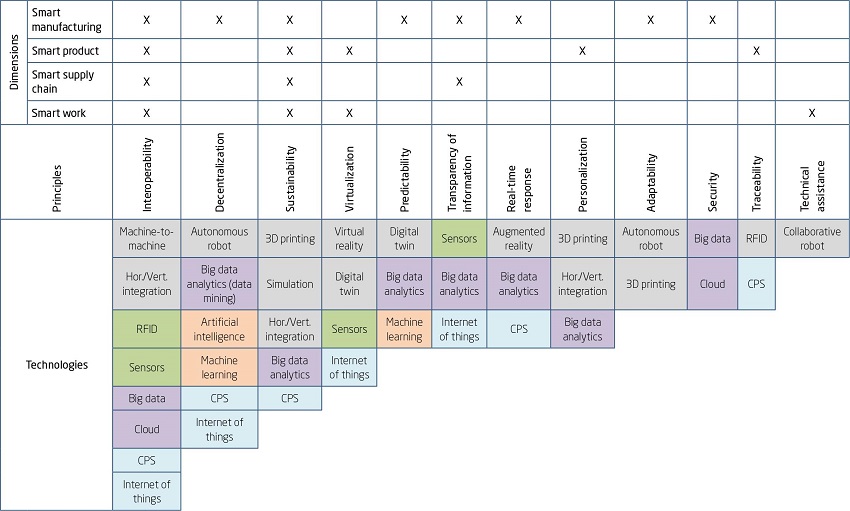
Figure 6
A hierarchical model for industry 4.0 concepts
It is observed that smart manufacturing is the dimension that has the most significant coverage considering principles and technologies, demonstrating to be the dimension most worked on by the literature. On the other hand, studies are scarce, mainly on the smart supply chain dimension relating to principles and technologies.
Analyzing Figure 6, some questions arise for developments in future research:
- 1. Can CPS technologies contribute to implementing the principles of the “Transparency of information” and “Security”?
- 2. Can IoT technologies contribute to implementing the “Adaptability”, “Traceability”, and “Technical assistance” principles?
- 3. Is there a sequence of implementation of the technologies and principles to be followed for configuring the dimensions of I4.0? (e.g., does a company with CPS have less difficulty implementing cognitive computing)?
- 4. Interoperability and sustainability are principles that contribute to the four dimensions of I4.0. Is there a relationship between the adoption of technologies to implement the principles in more than one dimension?
- 5. Is there a dependency relationship between smart manufacturing for the configuration of the other dimensions?
- 6. How to assess the maturity level of an organization in implementing I4.0 from the analysis of technologies, principles, and dimensions?
CONCLUSIONS
This research aimed to structure a hierarchical model that integrates the industry 4.0 concepts and standardizes concepts based on the literature. It was observed that I4.0 is an integrative value creation system composed of 4 dimensions, 16 principles, and 21 technology trends. However, no single strategy adapts all terms, which means that the I4.0 roadmap is not yet clear. To clarify the terminology involving I4.0 and structure the hierarchical model, a systematic review of the literature was performed using the PRISMA 2020. As a result, 58 articles were selected and analyzed. The terminologies and concepts in these studies related to the theme of I4.0 were identified.
Based on these terminologies and concepts, the relationships involving principles versus dimensions, principles versus technologies, and technologies among themselves were raised. In this way, proposing a hierarchical model for industry 4.0 concepts was possible. The figures presented in this study can offer a holistic view of the common steps manufacturers must take in their transition to I4.0.
The method identified that CPS, the internet of things, big data analytics technologies, and the principles of interoperability and sustainability were more prominent. I4.0 is defined as manufacturing systems that include the development of dynamic work networks to build flexible and open supply chains to manufacture intelligent products (Gobbo Junior et al., 2018). IoT technologies, the CPS, and big data analysis play a key role in the context of I4.0. These technologies introduce cognitive automation to implement the concept of intelligent production, leading to efficient products and services (Kunst et al., 2019).
The practical contributions of this study are twofold: 1. the design principles help to clarify the basic understanding of the term “I4.0” among professionals, and 2. these principles, combined with the technologies, help to identify possible use cases and provide guidance during implementation.
In the future, researchers will be able to focus on the gaps in I4.0 technology to obtain more empirical results and further evaluate the application of technologies in real-world case studies. The matrices point to some research gaps, where no studies have been found that establish the relationships. The heterogeneity principle, for example, was not related to any dimension or technology. In the next studies, research is suggested to investigate terms that have not been found in relationships, such as the principles: of modularity, heterogeneity, service orientation, and reliability, and the technologies: QR code, bar codes, and 3D printing.
As additional suggestions for future research, it is suggested to identify the aspects that lead the “Smart manufacturing” dimension to have a more significant relationship with the principles of I4.0. Another future challenge is to explore the greater connection between the principles of “interoperability,” “decentralization,” and “sustainability” with the technologies raised. It is also worth highlighting the importance of understanding the reasons that lead the “interoperability” principle to have greater relationships with the dimensions and technologies identified in this study.
The limitations of this work result from its scope and research method. Only publications in English were used, and there may be relevant contributions in other languages. I4.0 architectures generally have a factory-related context, so new terms and meanings can be found in a search for specific articles in each area and technology principles.
REFERENCES
Alcácer, V., & Cruz-Machado, V. (2019). Scanning the Industry 4.0: A literature review on technologies for manufacturing systems. Engineering Science and Technology, an International Journal, 22(3), 899-919. https://doi.org/10.1016/j.jestch.2019.01.006
Baena, F., Guarin, A., Mora, J., Sauza, J., & Retat, S. (2017). Learning factory: The path to Industry 4.0. Procedia Manufacturing, 9, 73-80. https://doi.org/10.1016/j.promfg.2017.04.022
Bal, H. Ç., & Erkan, Ç. (2019). Industry 4.0 and competitiveness. Procedia computer science, 158, 625-631. https://doi.org/10.1016/j.procs.2019.09.096
Bendul, J. C., & Blunck, H. (2019). The design space of production planning and control for Industry 4.0. Computers in Industry, 105, 260-272. https://doi.org/10.1016/j.compind.2018.10.010
Bortolini, M., Ferrari, E., Gamberi, M., Pilati, F., & Faccio, M. (2017). Assembly system design in the Industry 4.0 era: A general framework. IFACPapersOnLine, 50(1), 5700-5705. https://doi.org/10.1016/j.ifacol.2017.08.1121
Büchi, G., Cugno, M., & Castagnoli, R. (2020). Smart factory performance and Industry 4.0. Technological Forecasting and Social Change, 150, 119790. https://doi.org/10.1016/j.techfore.2019.119790
Caricato, P., & Grieco, A. (2017). An application of Industry 4.0 to the production of packaging films. Procedia Manufacturing, 11, 949-956. http://dx.doi.org/10.1016/j.promfg.2017.07.199
Castelo-Branco, I., Cruz-Jesus, F., & Oliveira, T. (2019). Assessing Indus - try 4.0 readiness in manufacturing: Evidence for the European Union. Computers in Industry, 107, 22-32. https://doi.org/10.1016/j.compind.2019.01.007
Cauduro, M. A. S. (2018). The adaptive nature of investors risky-preferences. J. Bus. Fin. Aff., 7(326), 1-8. https://doi.org/4172/2167-0234.1000326
Chiarello, F., Trivelli, L., Bonaccorsi, A., & Fantoni, G. (2018). Extracting and mapping industry 4.0 technologies using wikipedia. Computers in Industry, 100, 244-257.
Da Costa, M. B., Dos Santos, L. M. A. L., Schaefer, J. L., Baierle, I. C., & Nara, E. O. B. (2019). Industry 4.0 technologies basic network identification. Scientometrics, 121, 977-994. https://doi.org/10.1007/s11192-01903216-7
Dalenogare, L. S., Benitez, G. B., Ayala, N. F., & Frank, A. G. (2018). The expected contribution of Industry 4.0 technologies for industrial performance. International Journal of Production Economics, 204, 383-394. https://doi.org/10.1016/j.ijpe.2018.08.019
Dassisti, M., Giovannini, A., Merla, P., Chimienti, M., & Panetto, H. (2019). An approach to support Industry 4.0 adoption in SMEs using a coremetamodel. Annual Reviews in control, 47, 266-274. https://doi.org/10.1016/j.arcontrol.2018.11.001
De Sousa Jabbour, A. B. L., Jabbour, C. J. C., Foropon, C., & Godinho Filho, M. (2018). When titans meet - Can industry 4.0 revolutionise the environmentally-sustainable manufacturing wave? The role of critical success factors. Technological Forecasting and Social Change, 132, 18-25. https://doi.org/10.1016/j.techfore.2018.01.017
Dombrowski, U., Wullbrandt, J., & Krenkel, P. (2018). Industrie 4.0 in production ramp-up management. Procedia Manufacturing, 17, 1015-1022. https://doi.org/10.1016/j.promfg.2018.10.085
Fernandes, J., Reis, L. P., & Serio, L. C. D. (2017). Planning technological businesses: A study of market positioning and the value chain. Revista de Administração Mackenzie, 18(3), 70-116. https://doi.org/10.1590/167869712017/administracao.v18n3p70-116
Frank, A. G., Dalenogare, L. S., & Ayala, N. F. (2019). Industry 4.0 technologies: Implementation patterns in manufacturing companies. International Journal of Production Economics, 210, 15-26. https://doi.org/10.1016/j.ijpe.2019.01.004
Frank, A. G., Mendes, G. H. S., Ayala, N. F., & Ghezzi, A. (2019). Servitization and Industry 4.0 convergence in the digital transformation of product firms: A business model innovation perspective. Technological Forecasting and Social Change, 141, 341-351. https://doi.org/10.1016/j.techfore.2019.01.014
Galati, F., & Bigliardi, B. (2019). Industry 4.0: Emerging themes and future research avenues using a text mining approach. Computers in Industry, 109, 100-113. https://doi.org/10.1016/j.compind.2019.04.018
Ghobakhloo, M. (2018). The future of manufacturing industry: A strategic roadmap toward Industry 4.0. Journal of Manufacturing Technology Management, 29(6), 910-936. https://doi.org/10.1108/JMTM-02-20180057
Gobbo Junior, J. A., Busso, C. M., Gobbo, S. C. O., & Carreão, H. (2018). Making the links among environmental protection, process safety, and Industry 4.0. Process Safety and Environmental Protection, 117, 372-382. https://doi.org/10.1016/j.psep.2018.05.017
Grieco, A., Caricato, P., Gianfreda, D., Pesce, M., Rigon, V., Tregnaghi, L., & Voglino, A. (2017). An Industry 4.0 case study in fashion manufacturing. Procedia Manufacturing, 11, 871-877. http://dx.doi.org/10.1016/j.promfg.2017.07.190
Gunes, V., Peter, S., Givargis, T., & Vahid, F. (2014). A survey on concepts, applications, and challenges in cyber-physical systems. KSII Transactions on Internet and Information Systems (TIIS), 8(12), 4242-4268. https://doi.org/10.3837/tiis.2014.12.001
Henning, K., Wolfgang, W., & Johannes, H. (2013). Recommendations for implementing the strategic initiative Industrie 4.0. Final report of the Industrie, 4, 82.
Hermann, M., Pentek, T., & Otto, B. (2016, January 5-8). Design principles for Industrie 4.0 scenarios. [Conference session, pp. 3928-3937]. 49th Hawaii International Conference on System Sciences (HICSS). IEEE. https://doi.org/10.1109/HICSS.2016.488
Horváth, D., & Szabó, R. Z. (2019) Driving forces and barriers of Industry 4.0: Do multinational and small and medium-sized companies have equal opportunities? Technological Forecasting and Social Change, 146, 119-132. https://doi.org/10.1016/j.techfore.2019.05.021
Ivanov, D., Sethi, S., Dolgui, A., & Sokolov, B. (2018). A survey on control theory applications to operational systems, supply chain management, and Industry 4.0. Annual Reviews in Control, 46, 134-147. https://doi.org/10.1016/j.arcontrol.2018.10.014
Jabbour, C. J. C., de Sousa Jabbour, A. B. L., Sarkis, J., & Godinho Filho, M. (2019). Unlocking the circular economy through new business models based on large-scale data: An integrative framework and research agenda. Technological Forecasting and Social Change, 144, 546-552. http://dx.doi.org/10.1016/j.techfore.2017.09.010
Kamble, S. S., Gunasekaran, A., & Sharma, R. (2018). Analysis of the driving and dependence power of barriers to adopt industry 4.0 in Indian manufacturing industry. Computers in Industry, 101, 107-119. https://doi.org/10.1016/j.compind.2018.06.004
Kitchenham, B., & Charters, S. (2007). Guidelines for performing systematic literature reviews in software engineering version 2.3. Engineering, 45(4ve), 1051.
Kunst, R., Avila, L., Binotto, A., Pignaton, E., Bampi, S., & Rochol, J. (2019). Improving devices communication in Industry 4.0 wireless networks. Engineering Applications of Artificial Intelligence, 83, 1-12. https://doi.org/10.1016/j.engappai.2019.04.014
Lee, J., Kao, H.-A., & Yang, S. (2014). Service innovation and smart analytics for Industry 4.0 and big data environment. Procedia Cirp, 16, 3-8. http://dx.doi.org/10.1016/j.procir.2014.02.001
Li, D., Landström, A., Fast-Berglund, Å., & Almström, P. (2019). Humancentred dissemination of data, information, and knowledge in industry 4.0. Procedia CIRP, 84, 380-386. https://doi.org/10.1016/j.procir.2019.04.261
Liao, Y., Deschamps, F., Loures, E. D. F. R., & Ramos, L. F. P. (2017). Past, present, and future of Industry 4.0-A systematic literature review and research agenda proposal. International Journal of Production Research, 55(12), 3609-3629. https://doi.org/10.1080/00207543.2017.1308576
Lichtblau, K., Stich, V., Bertenrath, R., Blum, M., Bleider, M., Millack, A., & Schröter, M. (2015). IMPULS-Industrie 4.0-readiness. Impuls-Stiftung des VDMA, Aachen-Köln. 1-76, 2015.
Lu, Y., & Xu, X. (2019). Cloud-based manufacturing equipment and big data analytics to enable on-demand manufacturing services. Robotics and Computer-Integrated Manufacturing, 57, 92-102. https://doi.org/10.1016/j.rcim.2018.11.006
Luthra, S., & Mangla, S. K. (2018). Evaluating challenges to Industry 4.0 initiatives for supply chain sustainability in emerging economies. Process Safety and Environmental Protection, 117, 168-179. https://doi.org/10.1016/j.psep.2018.04.018
Mariani, M., & Borghi, M. (2019). Industry 4.0: A bibliometric review of its managerial intellectual structure and potential evolution in the service industries. Technological Forecasting and Social Change, 149, 119752. https://doi.org/10.1016/j.techfore.2019.119752
Mello, C. H. P., & Turrioni, J. B. (2012). Metodologia de pesquisa em engenharia de produção: Estratégias, métodos e técnicas para condução de pesquisas quantitativas e qualitativas. Programa de Pós-graduação em Engenharia de Produção, 1, 191.
Mittal, S., Khan, M. A., Romero, D., & Wuest, T. (2019). Smart manufacturing: Characteristics, technologies and enabling factors. Proceedings of the Institution of Mechanical Engineers, Part B: Journal of Engineering Manufacture, 233(5), 1342-1361. https://doi.org/10.1177/0954405417736547
Müller, F., Jaeger, D., & Hanewinkel, M. (2019). Digitization in wood supply- A review on how Industry 4.0 will change the forest value chain. Computers and Electronics in Agriculture, 162, 206-218. https://doi.org/10.1016/j.compag.2019.04.002
Pacchini, A. P. T., Lucato, W. C., Facchini, F., & Mummolo, G. (2019). The degree of readiness for the implementation of Industry 4.0. Computers in Industry, 113, 103125. https://doi.org/10.1016/j.compind.2019.103125
Page, M., McKenzie, J. E., Bossuyt, P. M., Boutron, I., Hoffmann, T. C., Mulrow, C. D., Shamseer, L., Tetzlaff, J. M., Akl, E. A., Brennan, S. E., Chou, R., Glanville, J., Grimshaw, J. M., Hróbjartsson, A., Lalu, M. M., Li, T., Loder, E. W., Mayo-Wilson, E., McDonald, S., McGuiness, L. A., Stewart, L. A., Thomas, J., ... Moher, D. (2021). The PRISMA 2020 statement: An updated guideline for reporting systematic reviews. BMJ, 71, 105906. https://doi.org/10.1136/bmj.n71
Paré, G., Trudel, M. C., Jaana, M. & Kitsiou, S. (2015). Synthesizing information systems knowledge: A typology of literature reviews. Information & Management, 52(2), 183-199. https://doi.org/10.1016/j.im.2014.08.008
Qin, J., Liu, Y., & Grosvenor, R. (2016). A Categorical Framework of Manufacturing for Industry 4.0 and Beyond. Procedia Cirp, 52, 173-178. https://doi.org/10.1016/j.procir.2016.08.005
Rajput, S., & Singh, S. P. (2019). Connecting circular economy and industry 4.0. International Journal of Information Management, 49, 98-113. https://doi.org/10.1016/j.ijinfomgt.2019.03.002
Rauch, E., Linder, C., & Dallasega, P. (2020). Anthropocentric perspective of production before and within Industry 4.0. Computers & Industrial Engineering, 139, 105644. https://doi.org/10.1016/j.cie.2019.01.018
Rauch, E., Unterhofer, M., Rojas, R. A., Gualtieri, L., Woschank, M., & Matt, D. T. (2020). A maturity level-based assessment tool to enhance the implementation of industry 4.0 in small and medium-sized enterprises. Sustainability, 12(9), 3559.
Reis, L. P., Fernandes, J. M., & Armellini, F. (2021a). Leveraging a processoriented perspective on frugal innovation through the Linkage of Lean Product Development (LPD) Practices and Waste. International Journal of Innovation and Technology Management, 18(7), 2130004. https://doi.org/10.1142/S0219877021300044
Reis, L. P., Fernandes, J. M., Barreto, E. J., Lima, M. V. V., & Armellini, F. (2021b). Impact Assessment of Lean Product Development and Lean Startup Methodology on Information Technology Startups’ Performance. International Journal of Innovation and Technology Management (IJITM), 18(6), 2150034. https://doi.org/10.1142/s0219877021500346
Reis, L. P., Fernandes, J. M., Silva, S. E., & Andrade, H. A. D. (2018). 3Cs method for firms’ make-or-buy decisions: application in a large metal mechanical company. International Journal of Business Innovation and Research, 17(4), 494-515. https://doi.org/10.1504/IJBIR.2018.096370
Ribeiro, J. P. V. (2018). Proposta de adaptação de modelo de maturidade para avaliação de indústrias brasileiras em Indústria 4.0. https://scholar.google.com.br/scholar?cluster=16618382242529315206&hl=pt-BR&as_sdt=0,5
Ruiz-Sarmiento, J. R., Monroy, J., Moreno, F. A., Galindo, C., Bonelo, J. M., & Gonzalez-Jimenez, J. (2020). A predictive model for the maintenance of industrial machinery in the context of industry 4.0. Engineering Applications of Artificial Intelligence, 87, 103289. https://doi.org/10.1016/j.engappai.2019.103289
Santos, R. C. (2018). Proposta de modelo de avaliação de maturidade da Indústria 4.0 [Doctoral dissertation, Instituto Superior de Engenharia de Coimbra]. https://comum.rcaap.pt/bitstream/10400.26/25346/1/Reginaldo-Carreiro-Santos.pdf
Schumacher, A., Erol, S., & Sihn, W. (2016). A maturity model for assessing industry 4.0 readiness and maturity of manufacturing enterprises. Procedia Cirp, 52, 161-166. https://doi.org/10.1016/j.procir.2016.07.040
Sharpe, R., Van Lopik, K., Neal, A., Goodall, P., Conway, P. P., & West, A. A. (2019). An industrial evaluation of an Industry 4.0 reference architecture demonstrating the need for the inclusion of security and human components. Computers in Industry, 108, 37-44. https://doi.org/10.1016/j.compind.2019.02.007
Stefan, L., Thom, W., Dominik, L., Dieter, K., & Bernd, K. (2018). Concept for an evolutionary maturity-based Industrie 4.0 migration model. Procedia Cirp, 72, 404-409. https://doi.org/10.1016/j.procir.2018.03.155
Stock, T., & Seliger, G. (2016). Opportunities of sustainable manufacturing in industry 4.0. procedia CIRP, 40, 536-541. https://doi.org/10.1016/j.procir.2016.01.129
Sung, T. K. (2018). Industry 4.0 - A Korea perspective. Technological Forecasting and Social Change, 132, 40-45. https://doi.org/10.1016/j.techfore.2017.11.005
Telukdarie, A., Buhulaiga, E., Bag, S., Gupta, S., & Luo, Z. (2018). Industry 4.0 implementation for multinationals. Process Safety and Environmental Protection, 118, 316-329. https://doi.org/10.1016/j.psep.2018.06.030
Vaidya, S., Ambad, P., & Bhosle, S. (2018). Industry 4.0-a glimpse. Procedia Manufacturing, 20, 233-238. https://doi.org/10.1016/j.promfg.2018.02.034
Wang, S., Wan, J., Li, D., & Zhang, C. (2016). Implementing Smart Factory of Industrie 4.0: An Outlook. International Journal of Distributed Sensor Networks, 12(1), 3159805. https://doi.org/10.1155/2016/3159805
Xu, L. D., & Duan, L. (2019). Big data for cyber physical systems in industry 4.0: A survey. Enterprise Information Systems, 13(2), 148-169. https://doi.org/10.1080/17517575.2018.1442934
Zhang, C., & Chen, Y. (2020). A review of research relevant to the emerging industry trends: Industry 4.0, IoT, blockchain, and business analytics. Journal of Industrial Integration and Management, 5(1), 165-180.
Notes
Author notes
Raphaella F. Cordeiro is now a production engineer at the Production Engineering Department of Federal University of Ouro Preto (Universidade Federal de Ouro Preto - UFOP); Luciana P. Reis is now an associate professor at the Production Engineering Department of UFOP; June M. Fernandes is now an associate professor at the Production Engineering Department of UFOP
Correspondence concerning this article should be addressed to Raphaella F. Cordeiro, Rua Magnólia, 156, João Monlevade, Recanto do Paraíso, MG, Brazil, ZIP code 35930-140. Email: raphaella. cordeiro@aluno.ufop.edu.br