Resources and Entrepreneurial Development
The digitalization phenomenon and digital strategies in emerging countries: A semi-systematic review
O fenômeno da digitalização e estratégias digitais em países emergentes: Uma revisão semissistemática

The digitalization phenomenon and digital strategies in emerging countries: A semi-systematic review
RAM. Revista de Administração Mackenzie, vol. 24, no. 3, pp. 1-32, 2023
Editora Mackenzie; Universidade Presbiteriana Mackenzie
Received: 11 March 2021
Accepted: 29 March 2022
Abstract
Purpose: Through a review of the literature on digitalization in emerging countries, we analyzed how companies operating in these regions develop and implement strategies to navigate the digital era.
Originality/value: The emergence of new technologies has reconfigured businesses’ survival and competitiveness worldwide, however, little is known about the digital strategies employed by companies in emerging markets. By reviewing the literature, scarce in this context, we contributed by presenting examples of digital strategies that businesses have implemented. In line with our findings, we propose a research agenda to guide future studies.
Design/methodology/approach: We performed a semi-systematic review of business and management journals, comprising a total sample of 30 articles from different fields of knowledge. We present our findings in three thematic categories and other subcategories.
Findings: Our findings suggest the institutional voids that limit firms’ innovation (e.g., lack of clear regulations, skilled workforce, access to data, and financial resources) are the main challenges keeping them from digitalizing themselves. Nevertheless, firms develop capabilities to scout opportunities, despite the challenges, and implement digital strategies that support their digitalization process.
Keywords: Digitalization+ emerging countries+ developing countries+ strategy+ semi-systematic review.
Resumo
Objetivo: Por meio de uma revisão da literatura sobre digitalização em países emergentes, analisamos como as empresas que operam nessas regiões desenvolvem e implementam estratégias para navegar na era digital.
Originalidade/valor: O surgimento de novas tecnologias tem reconfigurado a sobrevivência das empresas e a competitividade no mundo, entretanto, pouco se sabe sobre as estratégias digitais empregadas pelas empresas em mercados emergentes. Revisando a literatura, escassa nesse contexto, nós contribuímos apresentando exemplos de estratégias digitais que as empresas têm implementado. Em conformidade com os nossos achados, propomos uma agenda de pesquisa que pode guiar estudos futuros.
Design/metodologia/abordagem: Foi feita uma revisão semissistemática de revistas de negócios e gestão, chegando, por fim, a uma amostra de 30 artigos de diferentes campos do conhecimento. Os achados são apresentados em três categorias temáticas e outras subcategorias.
Resultados: Os achados sugerem que os vazios institucionais que limitam a inovação das empresas (falta de regulamentação clara, de força de trabalho qualificada, de acesso a dados e de recursos financeiros) são os desafios principais que as impedem de se digitalizar. No entanto, empresas desenvolvem capacidades que permitem que elas aproveitem oportunidades, apesar dos desafios, e implementem estratégias digitais que apoiam o processo de digitalização.
Palavras-chave: Digitalização, países emergentes, países em desenvolvimento, estratégia, revisão semissistemática.
INTRODUCTION
Digitalization has reshaped the world. The advent of the internet and social media, followed by technologies such as cloud computing and artificial intelligence (AI), has radically altered how we interact, learn and make decisions, disrupting many existing markets and creating new business models and opportunities (Kraus et al., 2019; Vadana et al., 2019). These changes are so significant that scholars refer to digitalization as the fourth industrial revolution (Björkdahl, 2020).
Besides allowing the emergence of the so-called born-digital companies, which are digital from inception (Monaghan et al., 2020), this new era also forces traditional and non-digital companies to engage in the process of digital transformation, given the impacts of digital technologies on all aspects of the organization’s environment (Chanias et al., 2019). Digital transformation is understood here as “a process that aims to improve an entity by triggering significant changes to its properties through combinations of information, computing, communication, and connectivity technologies” (Vial, 2019, p. 118).
The digital transformation journey comprises at least four essential dimensions: the use of technologies, changes in the creation of value, structural changes, and financial aspects (Matt et al., 2015). These elements have to be jointly considered. This is just possible if the decision-making happens at the strategic level of the company, in which the plans for the whole organization are drawn up with the integration of all departments and external partners (Matt et al., 2015). Thus, organizations need to formulate and implement a digital strategy to conduct a digital transformation. Digital strategy is an “organizational strategy formulated and executed by leveraging digital resources to create differential value” (Bharadwaj et al., 2013, p. 472). According to Heavin and Power (2018), nowadays, firms must have digitalization as a core strategy to compete and survive. This necessity has become even more critical in the context of the recent Covid-19 pandemic, which accelerated digitalization and increased the adoption of digital technologies to deal with the crisis (Almeida et al., 2020). To Ross et al. (2018), the digital strategy must guide the company, help executives manage the digitalization process and redirect efforts when necessary.
Driven by its relevance, scholars have taken a particular interest in firms’ digitalization. In fact, the topic has been studied in various fields, such as organization studies (Trittin-Ulbrich et al., 2020), strategic management (Benner & Waldfogel, 2020; Garud et al., 2022), international business (Banalieva & Dhanaraj, 2019; Hennart, 2019), marketing (Kannan & Li, 2017), and finance (Gomber et al., 2017). However, a significant share of research on digitalization has been conducted in developed countries, especially in the United States (e.g., Benner & Waldfogel, 2020; Garud et al., 2022) and Europe (e.g., Hadjielias et al., 2021; Warner & Wäger, 2019).
In this paper, we argue that emerging countries1 present specificities that influence the phenomenon of digitalization, which, in turn, has important implications for the companies operating in those countries. Some of these issues include infrastructure limitations (Dahlman et al., 2016), institutional voids (Gao et al., 2017), and the digital divide (Souza et al., 2017; Venkatesh & Sykes, 2012), which refers to “the gap between individuals, households, businesses and geographic areas at different socio-economic levels with regard both to their opportunities to access ICT and to their use of the Internet for a wide variety of activities” (Organization for Economic Cooperation and Development, 2001, p. 5).
Due to such specificities, we posit that the studies’ findings in developed countries are not necessarily transferable to the emerging world’s context. All the factors mentioned above can impact firms’ business strategies, how they compete globally, and how they build a relationship with their customers and partners (Dewan & Riggins, 2005). Therefore, studies focused specifically on regions such as Latin America, Africa, and Asia are needed to clarify how companies are adapting and coping with the characteristics of emerging countries and, in particular, how they influence firms’ responses to digitalization. This paper contributes to the literature by synthesizing the research on companies’ strategies to deal with digitalization in emerging markets and proposing a research agenda for future studies. We focus on digital strategy because it is likely the first formal step organizations take toward digitalization (Bharadwaj et al., 2013; Matt et al., 2015). To achieve our objective, we conducted a semi-systematic literature review grounded on the following research question: what do we know about companies’ strategies to navigate the digital era in emerging countries?
Three subcategories of strategies have arisen from our analysis: innovating and changing to adapt, innovating through the ecosystem, and relying on data cooperation. Many scholars have acknowledged the role of innovation in emerging market organizations (Bagno et al., 2017; Salerno et al., 2015; Silva et al., 2014). Here, we discussed how innovation can help the digitalization process development. From that, we also acknowledge the opportunities and challenges these organizations face when implementing digital strategies.
This paper was divided into four sections besides this introduction. First, we describe the method we adopted to conduct our literature review. Next, we present the findings and discussion. The fourth section suggests a research agenda for future studies. The closing section has our final remarks and concludes this paper.
METHODOLOGY
Following Snyder (2019), we conducted a semi-systematic review. It is a review based on the analysis of quantitative and qualitative research articles, aiming to overview a research area, track development, answer broad questions, and contribute with the themes in literature, historical overview, theoretical models or framework, taxonomy or classification, research agenda, and the state of knowledge (Snyder, 2019). Through this analysis, we sought to map out the theory, synthesize the current state of knowledge, identify gaps and themes, and propose a future research agenda for the fields of business and management. Since our sample is diverse and can differ significantly in how scholars conceptualize the topic, the semi-systematic review is more appropriate (Snyder, 2019). To guide our analysis, we seek to investigate how digitalization has influenced firms in emerging countries.
Sample selection
Since the literature refers to both the phenomenon (digitalization) and the region (emerging countries) with different wording, we searched for the combination of words that would bring the most extensive results. Our sample includes papers from both developing and emerging countries; thus, aiming for conciseness, hereafter, we refer to both categories as emerging countries. A more generic filter was applied to avoid excluding any potential articles prematurely. A more comprehensive range of articles, however troublesome, allowed us to assess the potential contribution of papers from different fields of knowledge to the strategy discipline. Table 1 illustrates our entire process of selection.


Source: Elaborated by the authors.
In line with previous reviews (Calabrò et al., 2019; De Bakker et al., 2005), we focused our search on the most renowned databases for social research in business and management (Web of Science and Scopus). After excluding repeated articles, we selected those from 2009 to 2020 because we noticed that the bulk of research has emerged in the last ten years.
In the next step, we analyzed the alignment of the selected articles’ abstracts with our research questions. The chosen articles and those lacking sufficient information in the abstract were investigated thoroughly. To guarantee the reliability and quality of this review, all five authors defined and followed a set of standards for exclusion/inclusion of studies and to assess the article’s quality. The assessment of a paper’s quality was an important aspect considered in this phase. After carefully considering all criteria and the given article’s potential to answer our research question, we selected 30 papers.
Reviewing process
We based our review process on a first and a second coding cycle, thus allowing the emergence of thematic categories and subcategories (Miles et al., 2014; Saldaña, 2013). In the first coding cycle, we used the following criteria as guidelines for the descriptive coding: context (e.g., country, region, continent), main concept/construct, theory, approach (qualitative, quantitative, conceptual), method, main findings, and future studies and limitations. Using two cycles is a proper coding method to make sense of the data collected from several data sources (Miles & Huberman, 1994; Saldaña, 2003, 2013; Wolcott, 2009). This process resulted in a thorough description of each paper and a general idea of how the data were coming together, allowing us to better organize the information from each article in initial groups that were most likely to become categories (Saldaña, 2013). The initial descriptive coding was essential to the data abstraction and the conceptualization of ideas (Snyder, 2019), which guided the second coding cycle.
We applied a pattern coding method in the second coding cycle (Miles & Huberman, 1994; Saldaña, 2003) to identify the emergent themes. As Miles and Huberman (1994) observed, such an approach allows researchers to group those summaries into a smaller number of themes. In this phase, three major categories emerged: advantages of digitalization, challenges of digitalization, and digital strategies. Further analysis demonstrated the need to develop subcategories to better summarize the digital strategy finding.
The allocation of content in each category followed an iterative process performed independently by all the five authors. Then, these allocations were cross-checked by them. In case of discrepancies, we relied on group discussion to solve any disagreement, as our goal was to reach a consensus on the final distribution of content (Harry et al., 2005; Saldaña, 2013). This approach can provide higher quality and reliability to the review process.
Descriptive analysis
Our review comprises a total of 30 articles. Most of the articles found (n = 17) were qualitative studies, followed by studies with a quantitative approach (n = 11) and mixed methods (n = 2). Regarding the methods, most qualitative articles present case studies (single- and multiple-case studies), and the most used method in quantitative studies is survey with statistical analysis. Most papers addressed China’s context (n = 7). China is probably a successful case among emerging countries. The country has been recognized as a “front-runner” in the application of technologies in manufacturing (United Nations Industrial Development Organization, 2019) and a “digital superpower” (Iansiti & Lakhani, 2014). However, China still presents institutional and contextual characteristics similar to those of emerging countries, such as institutional voids and low-income populations, which justify its inclusion in our sample.
Other articles focus on Russia and South Africa, with two articles each. The remainder focus on Latin America (n = 4), Middle East (n = 4), Africa (n = 5), and Asia (n = 4), and two articles addressed multiple countries. Analyzing the journals that published these articles, we found that half of them are not listed in Chartered Association of Business Schools (CABS). Among the other half, there are papers spreading from ABS1 to ABS4*. Despite our review’s total number of articles, we comprised research from several disciplines (e.g., international business, information management, innovations, social science, and strategy).
FINDINGS AND DISCUSSION
Emerging regions are generally latecomers in developing information and communication technologies (ICTs). Although the digitalization literature is still incipient, we synthesized its findings. In line with Hanelt et al. (2021), we see a tendency in the literature to focus on innovation and integration of the multiple actors of the ecosystem when dealing with the digitalization process. From this synthesis, we can extract the overall advantages and challenges of strategizing in the digital era and four thematic patterns of firms’ strategies. The data are interpreted below.
Advantages of digitalization to business in emerging countries
The digital revolution transformed businesses, and its positive effects can be identified in different sectors. Literature has also pointed out that digitalization and technology evolution enables platform-based firms to better connect with stakeholders, strengthen their network effects, and improve value creation (Zeng et al., 2019). Correspondingly, farmers in Mexico have experienced better interaction with stakeholders due to emerging technologies that have reduced geographic barriers and increased community collaboration. Technological advancements provided more accurate information, enhancing farmers’ decision-making (Torres et al., 2021). Access to data is critical in the digital economy. Žebrytė et al. (2019) found that firms operating in the tourism industry rely on open data sources to drive decision-making, especially during natural disasters. In the context of emerging countries, where resources are limited, open data seem to be an essential asset.
Literature shows that companies in emerging countries exploit the opportunities and advantages business digitalization can provide. A study about the banking sector in Oman highlighted how digitalization had affected this sector with the emergence of the internet, mobile applications, cloud computing, and digital currencies (Al-Busaidi & Al-Muharrami, 2021). To deal with this new scenario, Omani banks have invested in ICTs. Such investments are crucial to gaining a competitive advantage and achieving high performance, improving customer service, guaranteeing customer data privacy, and providing further information on customers’ needs. In a sample of 45 African countries, Silvanskiy et al. (2019) identified that the widespread of the mobile phone contributed to the income-equalizing effect. The authors found that mobile payment tools with support from local authorities and service providers impact businesses positively by allowing for cost reduction, customer satisfaction, convenience, and data security. These studies carried out in the African context provide empirical evidence of the influence of digitalization on the business development of firms in the region.
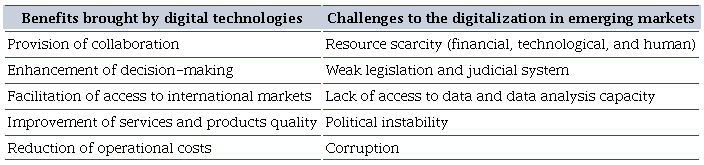
Del Giudice et al. (2019) argue that digitalization and internet working are paramount driving forces for small and medium enterprises (SMEs) to innovate, making them pioneers in the digital transformation. By studying Beijing’s context – in which digitalization dramatically changed the way of doing business –, the authors show that SMEs can take advantage of horizontal technology spillover to grow internationally (Del Giudice et al., 2019). Similarly, digitalization can help companies develop an ability of internationalizing, which, in turn, leads to better products and services advantages for SMEs in the long run (Lee & Falahat, 2019). Although emerging countries still face significant challenges regarding internet access, the literature acknowledges that business digitalization reduces entry barriers to other countries. Thus, it offers firms an opportunity to sell their products and services abroad with lower maintenance fees and a regular client base (Jean et al., 2020). Digitalization facilitates several processes, such as internationalization, helping SMEs reach better service and product standards quickly, as it diminishes physical barriers, creates new management forms and enhances value creation, although it may also pose challenges to companies operating in emerging countries. In Table 2, we summarize some of the advantages digital technologies can bring to companies in emerging markets.
Source: Elaborated by the authors.
Challenges to the digitalization of businesses in emerging countries
In the digital era, companies worldwide face increasing challenges to succeed and digitalize their businesses (Autio et al., 2021; Petricevic & Teece, 2019). The challenges are likely to be more significant for companies in emerging countries due to their institutional voids, such as political instability, lack of infrastructure, resource scarcity, colonial legacy, weak legislation, and corruption (Asogwa, 2012; Dey et al., 2019; Teberga & Oliva, 2018). Companies struggle with certain digital capacity deficiencies, which defy the businesses’ managers daily. These companies must face cultural and contextual differences and overcome market product specificity, foreign market competition, domestic institutional voids, and foreign market uncertainty. Resource scarcity affects value creation (Boojihawon & Ngoasong, 2018), making it necessary to think of new strategies to overcome it. Business models designed for firms in emerging countries must account for the scarcity of resources on multiple levels – knowledge, data, finance, and infrastructure. Such limitation affects the business capacity for value creation, and, therefore, it is extremely important not to neglect the architectural and contextual factors (Boojihawon & Ngoasong, 2018).
Platforms are a specific type of business model characterized by their complex information technology system (Kabakova et al., 2016). For example, Teberga and Oliva (2018) analyzed the case of Catarse in Brazil, the most prominent crowdfunding website in Latin America. The company faced several challenges in introducing innovative technologies and products in a nonexistent market. To achieve that, they had to face operational challenges associated with remote work, lack of skilled labor, and dependency on a single payment method since there was no viable option in the market. Also, they had judicial and accountability problems because of the lack of Brazilian legislation regulating crowdfunding (Teberga & Oliva, 2018). Regarding the introduction of novel technologies and the creation of markets that did not exist before, the authors identified three types of risks to which firms may be exposed to: technical, market, and user risks. These can affect companies’ ability to develop a product that meets the consumers’ needs.
Even though that study focuses on a startup company, other types of companies such as SMEs, international new ventures (INVs), and multinational enterprises (MNEs), could face the same problems when introducing a digital product, especially regarding innovations in developing countries, characterized by institutional voids. By studying INVs in China, Jean et al. (2020) found that this type of firm faces challenges related to its size, export experience, and export performance. Contextual aspects such as market product specificity, foreign market competition, domestic institution voids, and foreign market uncertainty are the antecedents to those challenges. In this case, the entrepreneurial orientation acts as a risk mitigator due to the founder’s capacity to define organizational culture, perceive risk, and affect internationalization outcomes. To address the digital platform’s risk, managers in emerging markets’ organizations must improve their skills, relationships, and knowledge.
Another significant challenge identified in our review is data management capacity (Ansong & Boateng, 2019; Asogwa, 2012; Jin et al., 2020; Rashid & Ratten, 2020). Access to data and the ability to analyze and use them is critical to plan and implement strategies in the digital era (Jin et al., 2020), for it guides decision-making in organizations (Rashid & Ratten, 2020). Nonetheless, we found that there is a lack of resources for digital businesses in emerging countries that limits their ability to collect, store, and analyze data. The causes for this usually fall into financial restraints, lack of infrastructure, and absence of skilled workforce.
For instance, Ansong and Boateng (2019) found that Ghana’s digital businesses hardly rely on data analytics to develop their strategies. Extensive data analysis is far from these businesses’ realities, and this issue is recurrent in Africa. While analyzing the e-records in sub-Saharan Africa, Asogwa (2012) stressed several challenges to developing a digital environment: weak legislation, absence of organizational frameworks, inadequate ICT skills and competencies, colonial legacy, political instability, and corruption. Dey et al. (2019) also pointed out issues concerning corruption and unethical use of digital technologies in a Bangladeshi mobile financial platform, forcing several agent accounts to close. Therefore, assuring digital technologies’ ethical use is a significant challenge for companies in emerging countries. In Table 2, we summarize some of the challenges companies in emerging markets face.
Strategies to thrive in the digital era
As we described in the previous sections, while digitalization has brought many opportunities for businesses to grow (Nambisan et al., 2019), significant challenges have come with it (Brenk et al., 2019), forcing companies to redesign their business models and develop new strategies and capabilities to exploit the opportunities and succeed in the digital economy. We explore some of these strategies next.
Innovating and changing to adapt
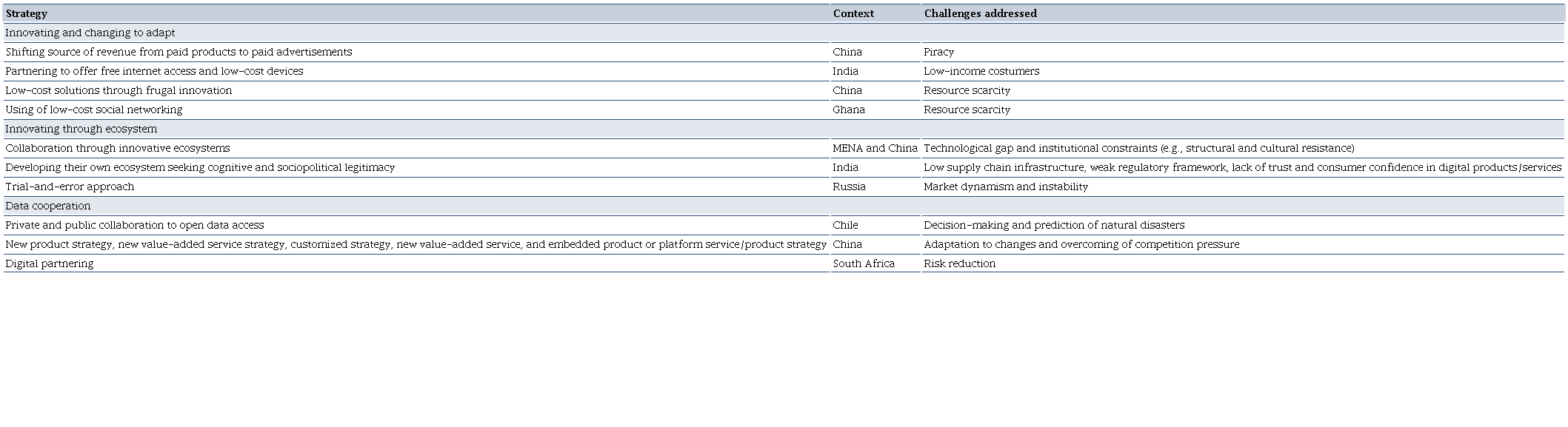
Our data suggest that firms in emerging markets are developing innovative strategies to adapt their businesses to their context. In general, the studies indicate that the macro-scenario significantly impacts how firms build strategies and innovate in the digital era in emerging countries. The video game industries in China, India, and Russia exemplify how cultural and institutional differences have influenced companies to adopt specific strategies to exploit opportunities in such contexts (Simon, 2018). In China, companies shift the source of revenue from paid games to paid advertisements in free games to fight against piracy. Meanwhile, in India, because of the poor internet infrastructure and low internet access, companies are developing low-cost smartphones in partnership with big techs. Also, these firms are offering unlimited 4G internet access to grow their user base. For the mobile gaming industry, the widespread of low-cost devices also represented a technical and contextual challenge in the way that games designed for the Indian market have to be able to run on simpler devices with less storage and memory capacity. The Russian case is different as the gaming industry has focused mostly on PC games since this country has the highest percentage of PC gamers globally. Regarding mobile usage, the country still experiences a digital divide (Simon, 2018), but the gaming industry on this platform is also growing, despite the preference for PC games. In all three cases, there is the growth strategy of developing local-relevant content to grow nationally and abroad in certain situations.
Also, since emerging market companies find it difficult to access financial resources, companies have been changing their business model to adapt to the digital world. More specifically, some studies show that they focus on low-cost solutions, aiming to provide superior value at lower cost by engaging in product innovation (Lan & Liu, 2017). In Ghana, Ansong and Boateng (2019) found that digital companies have been facing a significant challenge in accessing financial resources; therefore, their strategy to grow their business and engage with clients has relied on accessible and low-cost social networking services, such as Facebook and cloud computing.
Lan and Liu (2017) observed a similar use of social networking, showing how employing the customer-to-business (C2B) strategy through frugal innovation has made it easier for a Chinese company to adapt. C2B strategy redesigns the business and the business model according to the customers’ demands, experiences, and behavior. Accordingly, frugal innovation is related to innovating in context with resource constraints, allowing for affordable products with the best quality possible (Zeschky et al., 2011). Such a characteristic is particular to emerging countries, where resources and infrastructure are limited. Similarly, consumers have a lower purchasing power, demanding good enough products at lower prices. This case shows that companies in emerging markets are also in tune with new strategies needed to survive in the digital era (e.g., C2B). These companies adopt different means to cope with their contextual limitations and adapt to the new demands.
Although the development of innovative products and strategies may be an essential tool for adaptation, companies must also be aware that innovations can change in multiple unexpected ways, following a different trajectory from what was initially planned (Oborn et al., 2019). These transformations are likely to be more significant for digital innovations such as mobile technologies and innovations “implemented and used in locales that are distant and distinct from those where the innovation was initially developed” (Oborn et al., 2019, p. 1097). This may happen because innovations interact with local conditions and practices. An example is the MPS case, a mobile money payment system developed in the United Kingdom to be implemented in Kenya. Although the technology was initially expected to be small in scale and generate limited value, its purpose was entirely reframed when it was employed in Kenya. It ultimately grew in scale, created a high value for customers and substantially altered financial inclusion in the country (Oborn et al., 2019).
Research has identified that digital innovations have a strong relationship with business performance (Al-Dmour et al., 2022). Therefore, companies of all sorts must craft a digital mindset to integrate digital and nondigital operations. This context requires new behavior to incorporate the changes and, therefore, new capabilities to select the proper digital channels, aiming to achieve resource maximization, transparent communication with customers, and proactive employees able to seize opportunities (Rashid & Ratten, 2020). In the Chinese digital video player industry, firms have gained core capabilities in technology development, which was fundamental to delivering superior products and keeping their advantage over foreign firms. In these companies, engaging in innovation was a vital modality of learning. These capabilities allow various improvements in the firms, from incremental to radical innovations, which helps to adapt and develop a competitive advantage (Lu & Mu, 2011).
In this adaptation process, the firm’s dynamic capabilities are essential to renew its resource base in responding to radical technological change (Teece, 2007). Tw o manufacturing capabilities were identified in the Chinese context: manufacturing flexibility and supplier integration. These can support a firm’s competitive advantages (Zeng et al., 2017). In the region of SouthEastern Europe, Turulja and Bajgoric (2018) suggest that information technology (IT) capability, human resources management, and knowledge management are paramount to achieving superior performance in the digital era.
Other capabilities manifest themselves at different development stages, such as unlearning, organizational learning, adaptation, innovation, and other industries’ capabilities. The company is not path-dependent. It must also be capable of unlearning experiences in disrupting times and applying new knowledge and new knowledge structures – unlearning refers to the firm’s capability of sensing and shaping opportunities and threats. It is also imperative to be part of an ecosystem and use the partner’s resources to improve competitive advantages (Zeng et al., 2017). The development of dynamic capabilities in emerging countries is critical for these companies to remain competitive as they seek legitimacy, cope with resource scarcity, and develop innovation strategies (Boughzala & Szostak, 2023). Additionally, dynamic capabilities allow them to adapt by creating and modifying their limited resources as their market shifts (Helfat et al., 2007; Teece, 2007).
Innovating through an ecosystem
Companies from emerging markets may also innovate by exploring their ecosystem. Innovation ecosystems can promote collaboration, resulting in simplified business processes, agility, digitization, and openness (Zalan & Toufaily, 2017).
In Russia, Kabakova et al. (2016) observed three strategies that firms have used in platform ecosystems: inclusion, market dynamics, and reliance on independent ecosystem participants. Inclusion means that the business does not have a target audience or audience segmentation; instead, they have a vast data array to improve the platform’s functionality, which is possible due to low transaction costs. The digital market is dynamic and unstable, so that executives rely more on trial and error than on predicting market development’s direction. There is also more reliance on independent actors, increasing competition among those actors, hence reducing development costs (Kabakova et al., 2016).
In the Middle East and North Africa (MENA) region, studies by Zalan and Toufaily (2017) on the financial industry also highlight the importance of ecosystems. Based on Moore (2006, p. 33), the authors define ecosystems as “intentional communities of economic actors whose individual business activities share in some large measure the fate of the whole community”. According to them, the capacity of a financial technology (FinTech) company to create value is essentially dependent on the availability and development of critical parts of the ecosystem, such as regulations, services, consumers, and technology suppliers. Also, they found that the primary strategy adopted by MENA’s incumbent banks to respond to potential disruption from fintechsdopted is partnering (or collaboration). According to them, this response is inconsistent with the strategies usually recommended for incumbents in the disruption innovation literature. Still, it can be explained by characteristics of the digital economy related to digitization, disintermediation, and decentralization, such as high fixed costs of production, high human capital costs, and near-zero communication and distribution costs. The authors argue that
[...] these factors, together with a need for providing a frictionless expe rience for the tech-savvy consumer of a broad range of financial services, often underpinned by AI and big data analytics, may necessitate an ecosystem-like bank-fintech collaboration (Zalan & Toufaily, 2017, p. 13).
Firms need to build their ecosystems while launching the organization proposal. In the scope of an online Indian cab driver platform called Ola, Mukerji and Roy (2019) observed three phases in the company ecosystem’s development: innovation introduction, mobilization, and structuring. During the innovation introduction, the firm undertook activities to gain cognitive legitimacy with stakeholders and deal with competition, entering into the organizational field. During mobilization, the firm increased sociopolitical legitimacy, enabled by the coercive and mimetic forces that helped shape the institutional fields. Finally, in the structuring process, the isomorphic forces become more normative, internalized by the firm as norms and practices. In the specific case of Ola, the firm had to build trust in its segment. Thus, at the beginning of their operations, to compete with more “traditional” firms, they had to adapt their processes, accepting payments in cash and also enabling cab booking using the telephone due to the low widespread of credit cards and smartphones. Another strategy was to partner with regular taxi drivers on their platform. This helped both users and drivers to get familiar with the app, fostering collaboration.
Nonetheless, it is important to highlight that developed innovation ecosystems in emerging countries are an exception as most of them are still at an early stage. The literature shows that several actors must participate in the promotion of ecosystem development. During the organizational field development, it is possible to observe an increase in interactions among participants and information sharing to improve the platform, mutual awareness of the customers that started using the platform and the developers that started sharing the codes to get improvements, as well as dominant structures and coalition (Mukerji & Roy, 2019). Many companies use this collaboration among actors to position themselves in the organizational field.
Countries’ specific conditions may also help the development of concrete innovation ecosystems. For instance, the sanctions Iran has suffered throughout the years have forced Iranian companies to respond strategically, creating local companies and solutions to replace foreign companies. Due to the United States sanctions, some of the Iranian company’s apps were removed from Apple Store and Google Play, forcing those companies to innovate by offering a web-based version of their products. Notably, the country has developed a robust digital market, skyrocketing from 130 digital businesses in 2013 to 41,130 in 2017 (Arbatani et al., 2019).
The use of data cooperation to support strategies
Data have emerged as a key asset in the digital era. In South Africa, evidence has shown that digital partnering helps firms to improve their competitive advantage, increase performance, and reduce risks (Aghimien et al., 2022). Successful partnering strategies depend on digital partners’ trust, top management support, and digital partner selection (Aghimien et al., 2020). By studying four Chinese manufacturers, Jin et al. (2020) found that depending on the types of data ownership and the fundamental value proposition, incumbent organizations’ digital strategy can vary. They suggest five strategies: new product strategy, new value-added service strategy, customized strategy, new value-added service, and embedded product or platform service/product strategy. These strategies can help firms to overcome competition pressure and market changes, achieving their transformation.
Decision-making is now guided by several gigabytes of collected data, which are only valuable if added to the employees’ analytical skills (Rashid & Ratten, 2020). Hence, firms also must be aware of and rely on data analytics to grow their business. In Chile, public and private organizations are cooperating to use open data in the local businesses’ decision-making process. In such a context, the data can help business to predict natural disasters. Although such a strategy is valuable for local entrepreneurs, the lack of expertise in analyzing these data is still an issue (Žebrytė et al., 2019).
Data are an excellent tool to overcome resource scarcity. Even in cases of limited data management capacity, many entrepreneurs rely on data to help with important decisions. If it were not for institutional voids, such as financial restraints, lack of infrastructure, and the absence of skilled workers, the companies could better use data and other digital facilities. Even with these challenges, the digital business helps to achieve cost reduction, service improvement, customer satisfaction, convenience, and data security/privacy. However, not every entrepreneur can use this tool since the digital divide makes digital access hard for a significant part of the population, challenging the introduction of new technologies, new products, and access to data. In the same way that technology provides more accurate information on product or service specificity, in peripheral countries, only a fraction of the population has access to the internet, which turns consumers into ghosts or unattractive parties to companies. In other words, digital technologies are not boundless tools, they can go as far as the social constraints allow them to go. In Table 3, we highlight some of the strategies these companies are deploying.
Source: Elaborated by the authors.
FUTURE AGENDA
This review has yielded numerous insights that can advance the research on digitalization in emerging countries. Indeed, we acknowledge that the possibilities are too many to be all accounted for here. Therefore, we focused on three themes aligned with our analysis results, and that can support research to advance the studies in emerging contexts: 1. innovation, ecosystem, and collaboration; 2. skills, leadership, and education; and 3. data access. These three avenues are paramount for analyzing the specificities of emerging countries. As for the first one, we argue that structural, institutional, and contextual aspects may influence the development of digital ecosystems. For example, the lack of adequate ICT infrastructure plays a pivotal role in how businesses evolve in emerging countries. Regarding the second theme, we show evidence of how digital skills and competencies shape digitalization. In the context of the digital divide in emerging countries (OECD, 2001), research should address the impact of such skills on digitalization and digital strategies. The third and last topic for future research is crucial for understanding digitalization in emerging markets and is closely related to the two other themes. Considering the importance of data access to digital strategies (Jin et al., 2020), it remains underexplored in emerging countries. ICT infrastructure functions as a barrier to that access, while the lack of skilled workforce undermines data analysis. That equation is detrimental not only to the development of startups and digital ecosystems but also to the digitalization of existing businesses.
Besides the avenues for future research detailed below, we suggest methodological approaches for investigating such themes. As an extra suggestion, we can point out the urgent need to strengthen research in emerging countries other than China.
Innovation, ecosystem, and collaboration
We found in our review that the need to innovate within an ecosystem is increasingly relevant. Ecosystems are also a means to promote collaboration (Zalan & Toufaily, 2017). In this sense, a digital ecosystem is different from a traditional business ecosystem because of its turbulent nature (El Sawy & Pereira, 2013). One key aspect that characterizes a turbulent digital environment is the complex interdependence and heterogeneity of several partners (Jacobides et al., 2018). Similarly, due to other reasons (e.g., weak institutions, corruption, lack of infrastructure), emerging countries’ business environments are also considered turbulent. Thus, digital business ecosystems in emerging countries tend to differ significantly from those in developed contexts. Future studies may address this phenomenon from various perspectives.
First, it would be relevant to understand the antecedents to digital ecosystems’ development in such contexts. Because of the digital era, markets are much more connected, and participants are involved in several rapidly changing networks (Hanelt et al., 2021). Future studies should also investigate how the actors in a particular ecosystem interact and the specific role of relevant actors (e.g., government). A qualitative approach may be better suited to address these issues. For example, case studies focus on “understanding the dynamics present within single settings” (Eisenhardt, 1989, p. 534), and their application can enable a deeper understanding of how the development of these digital environments and their interactions has taken place.
Second, the contextual constraints to the emergence of a digital environment, such as resource (knowledge, data, finance, and infrastructure) scarcity (Boojihawon & Ngoasong, 2018), regulations, and cultural aspects must be thoroughly investigated so that research can further develop existing theories or create new theories that better explain the specificities of these regions and the implications to business management.
Finally, to further understand digitalization as a phenomenon, it is critical to investigate how new business models emerge in a given context and across fields and ecosystems (Hanelt et al., 2021). In emerging countries, this problem may be developed in-depth to provide insights into the contextual aspects implicated in the development of innovative solutions. Understanding how local firms create specific value propositions to answer contextspecific demands and whether multinational corporations (from emerging and developed countries’ multinational subsidiaries) transfer the innovations to developed countries emerge as two relevant topics.
Skills, leadership, and education
One of the main constraints to the digitalization process is the lack of skilled workforce in emerging markets (Teberga & Oliva, 2018), in which digital literacy is limited (Chetty et al., 2018). Managers are a crucial component of organizational change, innovation, and, thus, firms’ digital strategies. They must have a set of competencies that can initiate the organization’s digitalization process (Francisco et al., 2017; Hanelt et al., 2021). Managers’ capabilities are closely related to their skills, cognition, and experience, which, in turn, can influence organizational change and decision-making (Helfat & Martin, 2015). From this future perspective, studies can be developed in several disciplines and at various levels. A multilevel approach can address the influence of a manager’s lack of skills (e.g., technical, managerial, and digital skills) on business performance or digital ecosystem development. Microlevel research can delve into the analysis of managers’ specific characteristics according to the country or region and the influence of these differences or similarities on the success of digital strategy development and implementation. To capture these nuances, scholars would benefit from the adoption of comparative methods, such as the qualitative comparative analysis (QCA), in investigations comparing firms and managers in emerging and developed countries.
Data access
Data access and data analysis are critical elements in the digital era. Digitalization is highly dependent on technologies such as social, mobile, analytics, cloud computing, and the internet of things (Sebastian et al., 2017), which provide several gigabytes of information to guide decision-making in organizations (Rashid & Ratten, 2020). Studies have assessed the importance of data usage to firms (Weichert, 2017) and its properties (Yoo et al., 2010), mostly in the context of developed countries, where data availability is not usually an issue. Conversely, in emerging countries, access to data is a major constraint to business digitalization (Ansong & Boateng, 2019; Asogwa, 2012; Jin et al., 2020; Rashid & Ratten, 2020). To the extent of our review, there is a significant gap in understanding the implication of data accessibility in emerging countries. Data access is an issue, as well as the resources needed to analyze and store the data. Thus, future studies that seek further research on how firms from emerging countries are circumventing these issues are of particular interest. In these cases, longitudinal studies can explore the relationships between access to data and business digitalization in emerging countries. Similarly, other problems related to data are also relevant, such as cyberwar and data security, mainly due to the lack of law enforcement or even nonexistence of such laws in these countries.
CONCLUSION
In this paper, we examined the phenomenon of digitalization in emerging countries. Despite the growing attention that digitalization has received in the last years in developed countries, it remains understudied in other contexts and regions. This paper addresses this gap by examining the research on digitalization, specifically in the context of emerging countries, while proposing an agenda to advance the research on this topic. We found that digitalization positively influences businesses of all sorts, facilitating decision-making processes, strengthening the connection with customers and stakeholders, enhancing products and services, and improving value creation. Specifically, regarding SMEs, digitalization fosters innovation while facilitating internationalization. As for the challenges in the emerging market, we identified many factors, such as low regulation and a lack of skilled workforce and resources to work on data function, as barriers to digitalization. Our analysis also highlighted that firms are learning to innovate, building their strategies with a strong reliance on data to overcome these difficulties. Based on our analysis, our agenda focuses on three main avenues for future investigation: 1. innovation, ecosystem, and collaboration; 2. skills, leadership, and education; and 3. data access. The main limitation of this study is the fact that our search only comprised Web of Science and Scopus databases, which might leave out many papers and potential insights for the analysis of digitalization in emerging countries.
REFERENCES
Aghimien, D., Aigbavboa, C., Oke, A., Thwala, W., & Moripe, P. (2022). Digitalization of construction organizations – A case for digital partnering. International Journal of Construction Management, 22(10), 1950–1959. https://doi.org/10.1080/15623599.2020.1745134
Aghimien, D. O., Aigbavboa, C. O., & Oke, A. E. (2020). Critical success factors for digital partnering of construction organisations – A Delphi study. Engineering, Construction and Architectural Management, 27(10), 3171–3188. https://doi.org/10.1108/ECAM-11-2019-0602
Al-Busaidi, K. A., & Al-Muharrami, S. (2021). Beyond profitability: ICT investments and financial institutions performance measures in developing economies. Journal of Enterprise Information Management, 34(3), 900–921. https://doi.org/10.1108/JEIM-09-2019-0250
Al-Dmour, H., Asfour, F., Al-Dmour, R., & Al-Dmour, A. (2022). Validation of the impact of marketing knowledge management on business performance via digital financial innovation as a mediating factor. VINE Journal of Information and Knowledge Management Systems, 52(1), 33–56. https://doi.org/10.1108/VJIKMS-05-2020-0085
Almeida, F., Santos, J. D., & Monteiro, J. A. (2020). The challenges and opportunities in the digitalization of companies in a post-COVID-19 world. IEEE Engineering Management Review, 48(3), 97–103. https://doi.org/10.1109/EMR.2020.3013206
Ansong, E., & Boateng, R. (2019). Surviving in the digital era – Business models of digital enterprises in a developing economy. Digital Policy, Regulation and Governance, 21(2), 164–178. https://doi.org/10.1108/DPRG-08-2018-0046
Arbatani, T. R., Norouzi, E., Omidi, A., & Valero-Pastor, J. M. (2019). Competitive strategies of mobile applications in online taxi services: The cases of Snapp and Tap30 in Iran. International Journal of Emerging Markets, 16(1), 113–130.
Asogwa, B. E. (2012). The challenge of managing electronic records in developing countries: Implications for records managers in sub Saharan Africa. Records Management Journal, 22(3), 198–211. https://doi.org/10.1108/09565691211283156
Autio, E., Mudambi, R., & Yoo, Y. (2021). Digitalization and globalization in a turbulent world: Centrifugal and centripetal forces. Global Strategy Journal, 11(3), 3–16. https://doi.org/10.1002/gsj.1396
Bagno, R. B., Salerno, M. S., & Dias, A. V. C. (2017). Innovation as a new organizational function: Evidence and characterization from large industrial companies in Brazil. Production, 27, e20162073. https://doi.org/10.1590/0103-6513.207316
Banalieva, E. R., & Dhanaraj, C. (2019). Internalization theory for the digital economy. Journal of International Business Studies, 50, 1372–1387. https://doi.org/10.1057/s41267-019-00243-7
Benner, M. J., & Waldfogel, J. (2020). Changing the channel: Digitization and the rise of “middle tail” strategies. Strategic Management Journal, 44(1), 264–287. https://doi.org/10.1002/smj.3130
Bharadwaj, A., El Sawy, O. A., Pavlou, P. A., & Venkatraman, N. (2013). Visions and voices on emerging challenges in digital business strategy. MIS Quarterly, 37(2), 633–661. https://doi.org/10.25300/misq/2013/37.2.14
Björkdahl, J. (2020). Strategies for digitalization in manufacturing firms. California Management Review, 62(4), 17–36. https://doi.org/10.1177/0008125620920349
Boojihawon, D. K., & Ngoasong, Z. M. (2018). Emerging digital business models in developing economies: The case of Cameroon. Strategic Change, 27(2), 129–137. https://doi.org/10.1002/jsc.2188
Boughzala, Y., & Szostak, B. L. (2023). The impact of international inter-organizational relationships on creativity: The local partner perspective in an emerging country. European Journal of Innovation Management, 26(1), 157–182. https://doi.org/10.1108/EJIM-09-2020-0378
Brenk, S., Lüttgens, D., Diener, K., & Piller, F. (2019). Learning from failures in business model innovation: Solving decision-making logic conflicts through intrapreneurial effectuation. Journal of Business Economics, 89, 1097–1147. https://doi.org/10.1007/s11573-019-00954-1
Calabrò, A., Vecchiarini, M., Gast, J., Campopiano, G., De Massis, A., & Kraus, S. (2019). Innovation in family firms: A systematic literature review and guidance for future research. International Journal of Management Reviews, 21(3), 317–355. https://doi.org/10.1111/ijmr.12192
Chanias, S., Myers, M. D., & Hess, T. (2019). Digital transformation strategy making in pre-digital organizations: The case of a financial services provider. Journal of Strategic Information Systems, 28(1), 17–33. https://doi.org/10.1016/j.jsis.2018.11.003
Chetty, K., Qigui, L., Gcora, N., Josie, J., Wenwei, L., & Fang, C. (2018). Bridging the digital divide: Measuring digital literacy. Economics, 12(1), 1–20. http://dx.doi.org/10.5018/economics-ejournal.ja.2018-23
Dahlman, C., Mealy, S., & Wermelinger, M. (2016). Harnessing the digital economy for developing countries (Working Paper No. 334). OECD Development Centre Working Papers. https://doi.org/10.1787/18151949
De Bakker, F. G. A., Groenewegen, P., & Den Hond, F. (2005). A bibliometric analysis of 30 years of research and theory on corporate social responsibility and corporate social performance. Business and Society, 44(3), 283–317. https://doi.org/10.1177/0007650305278086
Del Giudice, M., Scuotto, V., Garcia-Perez, A., & Petruzzelli, A. M. (2019). Shifting Wealth II in Chinese economy: The effect of the horizontal technology spillover for SMEs for international growth. Technological Forecasting and Social Change, 145, 307–316. https://doi.org/10.1016/j.techfore.2018.03.013
Dewan, S., & Riggins, F. J. (2005). The digital divide: Current and future research directions. Journal of the Association for Information Systems, 6(12), 298–337. https://doi.org/10.17705/1jais.00074
Dey, B. L., Babu, M. M., Rahman, M., Dora, M., & Mishra, N. (2019). Technology upgrading through co-creation of value in developing societies: Analysis of the mobile telephone industry in Bangladesh. Technological Forecasting and Social Change, 145, 413–425. https://doi.org/10.1016/j.techfore.2018.05.011
Eisenhardt, K. M. (1989). Building theories from case study research. Academy of Management Review, 14(4), 532–550. https://doi.org/10.5465/amr.1989.4308385
El Sawy, O. A., & Pereira, F. (2013). Business modelling in the dynamic digital space: An ecosystem approach. Springer. https://doi.org/10.1007/978-3-642-31765-1
Francisco, E. D. R., Kugler, J. L., & Larieira, C. L. C. (2017). Líderes da transformação digital. GV Executivo, 16(2), 22–27. https://doi.org/10.12660/gvexec.v16n2.2017.68671
Gao, C., Zuzul, T., Jones, G., & Khanna, T. (2017). Overcoming institutional voids: A reputation-based view of long-run survival. Strategic Management Journal, 38(11), 2147–2167. https://doi.org/10.1002/smj.2649
Garud, R., Kumaraswamy, A., Roberts, A., & Xu, L. (2022). Liminal movement by digital platform-based sharing economy ventures: The case of Uber Technologies. Strategic Management Journal, 43(3), 447–475. https://doi.org/10.1002/smj.3148
Gomber, P., Koch, J.-A., & Siering, M. (2017). Digital finance and FinTech: Current research and future research directions. Journal of Business Economics, 87, 537–580. https://doi.org/10.1007/s11573-017-0852-x
Hadjielias, E., Dada, O. (Lola), Cruz, A. D., Zekas, S., Christofi, M., & Sakka, G. (2021). How do digital innovation teams function? Understanding the team cognition-process nexus within the context of digital transformation. Journal of Business Research, 122, 373–386. https://doi.org/10.1016/j.jbusres.2020.08.045
Hanelt, A., Bohnsack, R., Marz, D., & Marante, C. A. (2021). A systematic review of the literature on digital transformation: Insights and implications for strategy and organizational change. Journal of Management Studies, 58(5), 1159–1197. https://doi.org/10.1111/joms.12639
Harry, B., Sturges, K. M., & Klingner, J. K. (2005). Mapping the process: An exemplar of process and challenge in grounded theory analysis. Educational Researcher, 34(2), 3–13. https://doi.org/10.3102/0013189X034002003
Heavin, C., & Power, D. J. (2018). Challenges for digital transformation – Towards a conceptual decision support guide for managers. Journal of Decision Systems, 27(suppl. 1), 38–45. https://doi.org/10.1080/12460125.2018.1468697
Helfat, C. E., Finkelstein, S., Mitchell, W., Peteraf, M., Singh, H., Teece, D., Winter, S. G., & Maritan, C. (2007). Dynamic capabilities and organizational processes. In C. E. Helfat, S. Finkelstein, W. Mitchell, M. Peteraf, H. Singh, D. Teece, & S. G. Winter, Dynamic capabilities: Understanding strategic change in organizations (pp. 30–45). Blackweell Publishing.
Helfat, C. E., & Martin, J. A. (2015). Dynamic managerial capabilities: Review and assessment of managerial impact on strategic change. Journal of Management, 41(5), 1281–1312. https://doi.org/10.1177/0149206314561301
Hennart, J.-F. (2019). Digitalized service multinationals and international business theory. Journal of International Business Studies, 50, 1388–1400. https://doi.org/10.1057/s41267-019-00256-2
Iansiti, M., & Lakhani, K. R. (2014). Digital ubiquity: How connections, sensors, and data are revolutionizing business. Harvard Business Review, 92(11), 90–99. https://www.hbs.edu/faculty/Pages/item.aspx?num=48199
Jacobides, M. G., Cennamo, C., & Gawer, A. (2018). Towards a theory of ecosystems. Strategic Management Journal, 39(8), 2255–2276. https://doi.org/10.1002/smj.2904
Jean, R.-J. “Bryan”, Kim, D., & Cavusgil, E. (2020). Antecedents and outcomes of digital platform risk for international new ventures’ internationalization. Journal of World Business, 55(1), 101021. https://doi.org/10.1016/j.jwb.2019.101021
Jin, J., Ma, L., & Ye, X. (2020). Digital transformation strategies for existed firms: From the perspectives of data ownership and key value propositions. Asian Journal of Technology Innovation, 28(1), 77–93. https://doi.org/10.1080/19761597.2019.1700384
Kabakova, O., Plaksenkov, E., & Korovkin, V. (2016). Strategizing for financial technology platforms: Findings from four Russian case studies. Psychology & Marketing, 33(12), 1106–1111. https://doi.org/10.1002/mar.20945
Kannan, P. K., & Li, H. “Alice”. (2017). Digital marketing: A framework, review and research agenda. International Journal of Research in Marketing, 34(1), 22–45. https://doi.org/10.1016/j.ijresmar.2016.11.006
Kraus, S., Palmer, C., Kailer, N., Kallinger, F. L., & Spitzer, J. (2019). Digital entrepreneurship: A research agenda on new business models for the twenty-first century. International Journal of Entrepreneurial Behaviour and Research, 25(2), 353–375. https://doi.org/10.1108/IJEBR-06-2018-0425
Lan, F., & Liu, X. (2017). Business model transformation in digital enablement context through frugal innovation: Learning from Chinese experience. International Journal of Technology, Policy and Management, 17(4), 360–373. https://doi.org/10.1504/IJTPM.2017.10007747
Lee, Y. Y., & Falahat, M. (2019). The impact of digitalization and resources on gaining competitive advantage in international markets: Mediating role of marketing, innovation and learning capabilities. Technology Innovation Management Review, 9(11), 26–39. https://doi.org/10.22215/timreview/1281
Lu, F., & Mu, L. (2011). Learning by innovating: Lessons from China’s digital video player industry. Journal of Science and Technology Policy in China, 2(1), 27–57. https://doi.org/10.1108/17585521111107889
Matt, C., Hess, T., & Benlian, A. (2015). Digital transformation strategies. Business and Information Systems Engineering, 57, 339–343. https://doi.org/10.1007/s12599-015-0401-5
Miles, M. B., & Huberman, A. M. (1994). Qualitative data analysis: An expanded sourcebook (2nd ed., Vol. 1). Sage.
Miles, M. B., Huberman, A. M., & Saldaña, J. (2014). Fundamentals of qualitative data analysis. In M. B. Miles, A. M. Huberman, & J. Saldaña, Qualitative data analysis, a methods sourcebook (3rd ed., pp. 69–104). Sage.
Monaghan, S., Tippmann, E., & Coviello, N. (2020). Born digitals: Thoughts on their internationalization and a research agenda. Journal of International Business Studies, 51, 11–22. https://doi.org/10.1057/s41267-019-00290-0
Moore, J. (2006). Business ecosystems and the view from the firm. The Antitrust Bulletin, 51(1), 31–75. https://doi.org/10.1177/0003603X0605100103
Mukerji, M., & Roy, P. S. (2019). Platform interactions and evolution of Ola’s Organizational Field: Case stury on Ola. Australian Journal of Information Systems, 23, 1–23. https://doi.org/10.3127/ajis.v23i0.2113
Nambisan, S., Zahra, S. A., & Luo, Y. (2019). Global platforms and ecosystems: Implications for international business theories. Journal of International Business Studies, 50, 1464–1486. https://doi.org/10.1016/j.jbusres.2019.06.037.
Oborn, E., Barrett, M., Orlikowski, W., & Kim, A. (2019). Trajectory dynamics in innovation: Developing and transforming a mobile money service across time and place. Organization Science, 30(5), 1097–1123. https://doi.org/10.1287/orsc.2018.1281
Organization for Economic Cooperation and Development (OECD). (2001). Understanding the digital divide. Prometheus: Critical Studies in Innovation, 19(4), 333–336. https://doi.org/10.1080/08109020127271
Petricevic, O., & Teece, D. J. (2019). The structural reshaping of globalization: Implications for strategic sectors, profiting from innovation, and the multinational enterprise. Journal of International Business Studies, 50, 1487–1512. https://doi.org/10.1057/s41267-019-00269-x
Rashid, S., & Ratten, V. (2020). A dynamic capabilities approach for the survival of Pakistani family-owned business in the digital world. Journal of Family Business Management, 10(4), 373–387. https://doi.org/10.1108/JFBM-12-2019-0082
Ross, J. W., Sebastian, I. M., & Beath, C. M. (2018). How to develop a great digital strategy. In MIT Sloan Management Review, How to go digital (pp. 7–9). MIT Press. https://doi.org/10.7551/mitpress/11633.003.0004
Saldaña, J. (2003). Longitudinal qualitative research: Analyzing change through time. Rowman Altamira.
Saldaña, J. (2013). The coding manual for qualitative researchers (2nd ed.). Sage. https://books.google.com/books/about/The_Coding_Manual_for_Qualitative_Resear.html?id=V3tTG4jvgFkC
Salerno, M. S., Gomes , L. A. D. V., Silva, D. O. da, Bagno, R. B., & Freitas., S. L. T. U. (2015). Innovation processes: Which process for which project? Technovation, 35, 59–70. https://doi.org/10.1016/j.technovation.2014.07.012
Sebastian, I. M., Ross, J. W., Beath, C., Mocker, M., Moloney, K. G., & Fonstad, N. O. (2017). How big old companies navigate digital transformation. MIS Quarterly Executive, 16(3), 197–213.
Silva, D. O. da, Bagno, R. B., & Salerno, M. S. (2014). Models for innovation management: Review and analysis of the literature. Production, 24(2), 477–490. https://doi.org/10.1590/S0103-65132013005000059
Silvanskiy, A., Zotov, V. B., Aleksandrova, A., Shcherbina, T., & Stepanova, D. I. (2019). Income from innovation in digital economy: The use of wireless technologies. Espacios, 40(35), 2–11. https://www.revistaespacios.com/a19v40n35/19403502.html
Simon, J. P. (2018). Triggering the emergence of digital ecosystems: The role of mobile and video games in emerging economies. Digital Policy, Regulation and Governance, 20(5), 449–478. https://doi.org/10.1108/DPRG-03-2018-0008
Snyder, H. (2019). Literature review as a research methodology: An overview and guidelines. Journal of Business Research, 104, 333–339. https://doi.org/10.1016/j.jbusres.2019.07.039
Souza, C. A. de, Siqueira, É. S., & Reinhard, N. (2017). Digital divide of small and medium-sized enterprises: An analysis of influencing factors using the toe theory. Revista de Administração Mackenzie, 18(2), 15–48. https://doi.org/10.1590/1678-69712017/administracao.v18n2p15-48
Teberga, P. M. F., & Oliva, F. L. (2018). Identification, analysis and treatment of risks in the introduction of new technologies by startups. Benchmarking: An International Journal, 25(5), 1363–1381. https://doi.org/10.1108/BIJ-06-2017-0156
Teece, D. J. (2007). Explicating dynamic capabilities: The nature and microfoundations of (sustainable) enterprise performance. Strategic Management Journal, 28(13), 1319–1350. https://doi.org/10.1002/smj.640
Torres, C. L. F., Olvera-Vargas, L. A., Gómez, J. S., & Contreras-Medina, D. I. (2021). Discovering innovation opportunities based on SECI model: Reconfiguring knowledge dynamics of the agricultural artisan production of agave-mezcal, using emerging technologies. Journal of Knowledge Management, 25(2), 336–359. https://doi.org/10.1108/JKM-01-2020-0078
Trittin-Ulbrich, H., Scherer, A. G., Munro, I., & Whelan, G. (2020). Exploring the dark and unexpected sides of digitalization: Toward a critical agenda. Organization, 28(1), 8–25. https://doi.org/10.1177/1350508420968184
Turulja, L., & Bajgoric, N. (2018). Information technology, knowledge management and human resource management: Investigating mutual interactions towards better organizational performance. VINE Journal of Information and Knowledge Management Systems, 48(2), 255–276. https://doi.org/10.1108/VJIKMS-06-2017-0035
United Nations Industrial Development Organization (UNIDO). Industrial development report 2020. https://www.unido.org/resources-publications-flagship-publications-industrial-development-report-series/idr2020
Vadana, I.-I., Torkkeli, L., Kuivalainen, O., & Saarenketo, S. (2019). The internationalization of born-digital companies. In A. Chidlow, P. Ghauri, T. Buckeley, E. Gardner, A. Qamar, & E. Pickering (Eds.), The changing strategies of international business (pp. 199–220). Palgrave Macmillan. https://doi.org/10.1007/978-3-030-03931-8_10
Venkatesh, V., & Sykes, T. A. (2012). Digital divide initiative success in developing countries: A longitudinal field study in a village in India. Information Systems Research, 24(2), 239–260. https://doi.org/10.1287/isre.1110.0409
Vial, G. (2019). Understanding digital transformation: A review and a research agenda. Journal of Strategic Information Systems, 28(2), 118–144. https://doi.org/10.1016/j.jsis.2019.01.003
Warner, K. S. R., & Wäger, M. (2019). Building dynamic capabilities for digital transformation: An ongoing process of strategic renewal. Long Range Planning, 52(3), 326–349. https://doi.org/10.1016/j.lrp.2018.12.001
Weichert, M. (2017). The future of payments: How FinTech players are accelerating customer-driven innovation in financial services. Journal of Payments Strategy & Systems, 11(1), 23–33. https://hstalks.com/article/1810/the-future-of-payments-how-fintech-players-are-acc/
Wolcott, H. F. (2009). Writing up qualitative research (3rd. ed.). Sage.
Yoo, Y., Henfridsson, O., & Lyytinen, K. (2010). Research commentary: The new organizing logic of digital innovation: An agenda for information systems research. Information Systems Research, 21(4), 724–735. https://www.jstor.org/stable/23015640
Zalan, T., & Toufaily, E. (2017). The promise of FinTech in emerging markets: Not as disruptive. Contemporary Economics, 11(4), 415–430. https://doi.org/10.5709/ce.1897-9254.253
Zeng, J., Khan, Z., & Silva, M. de. (2019). The emergence of multi-sided platform MNEs: Internalization theory and networks. International Business Review, 28(6), 101598. https://doi.org/10.1016/j.ibusrev.2019.101598
Zeng, J., Simpson, C., & Dang, B.-L. (2017). A process model of dynamic capability development: Evidence from the Chinese manufacturing sector. Management and Organization Review, 13(3), 643-673. https://doi.org/10.1017/mor.2016.42
Zeschky, M., Widenmayer, B., & Gassmann, O. (2011). Frugal innovation in emerging markets. Research-Technology Management, 54(4), 38-45. https://doi.org/10.5437/08956308X5404007
Žebrytė, I., Fonseca-Vasquez, F. F., & Hartley, R. (2019). Emerging econo my entrepreneurs and open data: Decision-making for natural disaster resilience. Journal of Small Business Strategy, 29(1), 43-54. https://libjournals.mtsu.edu/index.php/jsbs/article/view/1358
Notes
Author notes
Correspondence concerning this article should be addressed to Pablo Leão, Avenida Nove de Julho, 2029, Bela Vista, São Paulo, São Paulo, Brazil, ZIP code 01313-902. Email: pabloeleao@gmail.com