Knowledge, Strategy, and Innovation
Received: 04 April 2021
Accepted: 09 September 2022
DOI: https://doi.org/10.1590/1678-6971/eRAMC240124.en
Abstract
Purpose: The digital mindset can be defined as a set of individual behaviors related to the degree of adherence to digital transformations. After reviewing the literature on the subject, this research’s objective was to answer the following question: “Is it possible to measure the digital mindset of employees through a scale designed for the context of Brazilian organizations?”.
Originality/value: The digitization of organizations has become the center of business transformation. However, one of the often-overlooked factors in the transition process is developed at the micro-organizational level. Collaborators vary in interest, knowledge, and ability to innovate. A measure to identify individual digital mindset profiles would be essential to guide the planning and development of a digital learning culture mindset. Still, such a tool was not yet found in the Brazilian literature.
Design/methodology/approach: A multidimensional digital mindset construct was proposed based on the literature on cognitive structures and digital transformation mindset. Items were prepared to measure the degree of maturity of the construct, described through three digital profiles (open mind, transformer, and entrepreneur) and an analog profile. The scale was submitted to 574 professionals from Brazilian companies for exploratory factor analysis.
Findings: The digital mindset scale showed signs of validity, confirming, in the present sample, the mindset dimensions related to the digital environment (Cronbach’s alphas between 0.85 and 0.62).
Keywords: Digital mindset, scale, measure, digital transformation, mindset.
Resumo
Objetivo: O mindset digital pode ser definido como um conjunto de comportamentos individuais relacionados ao grau de aderência às transformações digitais. Nesse contexto, o objetivo da presente pesquisa foi, após revisão de literatura sobre o tema, responder à seguinte questão: “É possível mensurar o mindset digital de profissionais por meio de uma escala elaborada para o contexto das organizações brasileiras?”.
Originalidade/valor: A digitalização das organizações passou a ser o centro da transformação dos negócios. No entanto, um dos fatores muitas vezes negligenciado no processo de transição é o desenvolvimento no nível micro-organizacional. Os profissionais variam no nível de interesse, no conhecimento e na capacidade de inovar. Para guiar o planejamento e desenvolvimento de uma cultura de aprendizagem digital, uma medida para identificar os perfis individuais de mindset digital seria essencial, mas tal ferramenta ainda não era encontrada na literatura brasileira.
Design/metodologia/abordagem: A partir da literatura sobre estruturas cognitivas e a transformação digital, foi proposto um construto multidimensional de mindset digital. Elaboraram-se itens para a mensuração do grau de maturidade do construto, descrito por meio de três perfis digitais (open mind, transformador e empreendedor) e um analógico. A escala foi submetida a 574 profissionais de empresas brasileiras para análise fatorial exploratória.
Resultados: A escala de mindset digital apresentou bons indícios de validade, sendo confirmadas, na presente amostra, as dimensões de mindset relacionadas ao meio digital (alfas de Cronbach entre 0,85 e 0,62).
Palavras-chave: Mindset digital, escala, medida, transformação digital, mindset.
INTRODUCTION
We are in a digital age characterized by rapid changes in how we live - enabled by the acceleration of technological innovations - which forms a volatile, uncertain, complex, and ambiguous environment called the VUCA world, meaning it is volatile, uncertain, complex and ambiguous (Horney et al., 2010). While this digitization megatrend has created opportunities to improve businesses, it has also caused many disruptions across all industries (Hoe, 2019).
A few years ago, companies could decide whether or not to use tech-nology and establish for what purpose it would be used (Benke, 2013). From the moment technology became the core of business transformation movements, its use ceased to be a choice and became an imperative for survival in the market. This imperative unfolded in the need for a more complex technological transformation that assigns strategic roles to new digital technologies and organizations’ ability to innovate (Yoo et al., 2010). Smart and connected products leverage - through information technology (IT) - the creation of business value (Porter & Heppelmann, 2015). In other words, being digital goes far beyond using digital technology to ensure operational excellence. It involves rethinking the company’s value proposition (Ross, 2017). A digital transformation strategy is considered comprehensive when it guides the entire organization’s transformation journey. Therefore, functional thinking holistically addresses the opportunities and risks associated with digital technologies (Singh & Hess, 2017).
Faced with the complexity of transformation, many organizations fail to transition. Despite having more than 20 years of business digitization history, the MIT Center for Information Systems Research (CISR) found that only 28% of companies surveyed successfully digitized (Sebastian et al., 2017). Scientific literature, in principle, does not facilitate this process, as the digital transformation itself is a very fragmented field and results from the existence of multiple and diverse areas of investigation, such as the digi-tal transformation of societies, industries, economies, and individuals (Ismail et al., 2017). Although the focus is only on organizations, equally diverse factors must be managed for a successful digital transformation.
One of the factors often overlooked both in the corporate world and in the academic world is the demand for professionals who present digital behaviors in line with new work needs (Agrawal, Smet, Poplawski et al., 2020; White, 2019; Hoe, 2019; Manyika et al., 2017). Digital transformation is a reality that is eliminating jobs and demanding new skills. Of approximately 60% of occupations, at least a third could be automated, which implies substantial changes in the workplace for all professionals. It is estimated that up to 375 million people, about 14% of the global workforce, must change occupational categories or learn new skills (Manyika et al., 2017). This process was boosted by Covid-19, which widened the skills gaps required by the intensive use of new technologies and the implementation of new business models and strategies (Agrawal, Smet, Lacroix et al., 2020).
Organizations have several challenges, such as understanding technological trends, deploying disruptive innovations, and mapping new customer expectations. But the most important aspect of this changing scenario is adapting culture and skills to the new digital way of working (Novotný et al., 2022). The digital transformation of this moment, which drives this new revolution, is creating winners and losers in the market. In this context, if a company wants to be part of the first group, its workforce must develop digital skills and competencies (Benke, 2013).
Organizations are essentially made up of people, and the change in the mentality of professionals works as a lever for digital transformation and, consequently, for the gain of business productivity. Organizations found themselves in a very complex process of transforming their on-site teams into at least partially remote teams, also called a hybrid system. In this process, in addition to adapting to work, adapting people’s skills was a significant barrier to overcome. Many professionals had difficulties making this transition, and organizations needed to adjust and cut operating costs, which again ran into problems with technology since a good part of these changes was based precisely on adopting new tools.
In this sense, employees’ greater or lesser effort to adapt and adopt these technologies became an element of competitive advantage in such difficult times. And consulting firms have been in great demand to map professionals in terms of their digital capabilities and potential for change. If, on the one hand, some companies had serious difficulties in making this transition, others accelerated a movement that they had been doing for some years. Whether due to the nature of the business, cost reduction, or greater attractiveness for highly qualified professionals, the fact is that many companies have already invested in remote teams based on digital tools. In recent months, these companies have seen their investment pay off as they not only made a smoother transition but also avoided some common mistakes - outdated equipment, employees lacking remote work expertise, and difficulties adapting work processes.
Leaders were especially affected, as while dealing with their difficulties in adapting to digital, they had the responsibility to continue leading their teams, minimally maintaining people’s productivity, motivation, and engagement. Many companies needed to pay special attention to managers, offer support, and enable the adaptation of leadership to feel the effects of the lack of qualifications of professionals in terms of the digitization of work.
Many organizations seek to connect with change by promoting a digital transformation journey in their business. This journey requires professionals to engage in a constant learning process so that they can continue to acquire new skills and adapt to the work environment (Oberländer et al., 2020). However, there is still an urge to map and define the digital skills needed to deal with the new scenario (Soltanifar & Smailhodz• ić, 2021). Some publications sought to answer this question and focused on competencies and rele-vant skills, such as critical thinking, problem analysis/solving, self-management, active learning, resilience, stress tolerance, and flexibility, which are fundamental for current and emerging professions (Schwab & Zahidi, 2020).
In addition to specific competencies and skills, there is a more macro level of perception, interpretation, and understanding of the market and new work environments that need to be discussed and properly worked on within organizations. Some fundamental beliefs about the very concept of work still come from an industrial and manufacturing mindset. It is common to find professionals who still understand work as a linear process, with a beginning, middle, and end with as few breaks as possible, almost like a Fordist production line.
This mentality contrasts with the current reality of occupations, which are becoming increasingly complex and demand superior cognitive processes, such as analytical skills, logical reasoning, and creativity, which are not linear. This same mentality is reflected in somewhat taboo aspects, such as the concepts of working hours, workplace restraints, and hours worked vs. products or deliveries. It poses an obstacle to the modernization of work environments and processes.
To try to solve these problems, in parallel with changes in processes and work environments, organizations began to use an important variable in their recruitment, selection, performance evaluation, and training processes - the so-called digital competence. The term digital competence is recent and is related to skill and efficiency in the use of technology (Ilomäki et al., 2016). For a long time, it was linked to IT and information and communi-cation technology (ICT), which focused on knowledge and skills in tech-nology. As these skills and knowledge were incorporated into the daily lives of organizations, the term became a reference to professionals who have digital behaviors to navigate with ease in an increasingly technological society (Wong et al., 2022). Digital competence involves the ability to meet complex demands by drawing on and mobilizing psychosocial resources (including skills and attitudes) in a particular context. Thus, we can define digital competence as a set of knowledge, skills, and attitudes regarding digital tech-nology, which the individual recognizes and uses in daily professional or personal activities (Benke, 2013).
However, the concept of digital skills is still not used consistently, either because of its complexity or even because it is a relatively new concept, which still needs to be explored in greater detail (Baumgartner et al., 2021). In any case, the different conceptions of digital competencies are related and incorporate characteristics of several other similar concepts: digital literacy, digital skills, digital behavior, and digital mindset, among others (Benke, 2013).
Developing the digital competencies of the population allows for a better exercise of citizenship and a more just and egalitarian society since, both in the public and private sectors, the digitalization process is still taking place. At least in the medium term, it will not be possible for the citizen to fully exercise their role without having developed some digital skills. Thus, digital competence approaches the idea of digital literacy, which requires recognizing and using abilities to manipulate and transform digital media to easily distribute and adopt them in constructing new insights and models.
Digital literacy and its effects on entrepreneurial behavior are not limited to learning to use technological tools but also refer to the development of skills and attitudes (Young et al., 2020). In this broader sense of a cognitive structure in constant development, another construct that belongs to the core meaning to which the term competencies have referred in practice stands out: the mindset.
In this context, the study proposes to answer the following question:
-
Is it possible to measure the digital mindset of professionals through a scale developed for the context of Brazilian organizations?
Thus, the objective of the research was to develop and seek evidence of validity for a scale capable of identifying behaviors and degrees of adherence of these individuals to digital transformation. In order to answer this question, a study was carried out with 574 professionals from large companies located in the states of the Southeastern Region of Brazil.
In addition to this introduction, the article presents the theoretical framework in which the main concepts related to the cognitive and information processing aspects are involved in the digital mindset. It also explains the differences between analog and digital thinking, the three dimensions associated with the construct, and the main tools of measurement that exist today. Next, the methodology presents information about the sample, a description of the instrument and procedures, data analysis, and the results achieved. Finally, the last section discusses these results and their implications, as well as research limitations and suggestions for future research.
THEORETICAL ASPECTS OF THE DIGITAL MINDSET
The term mindset has been widely used in the corporate context as a synonym for mentality. However, the terminology has a more complex scientific meaning, starting from positive psychology. Mindset refers to the cognitive processes of analyzing and processing information (Dweck, 2017). As humans have a limited ability to absorb and process information, according to Dweck (2017), mindsets help to filter what is absorbed and how reality is interpreted.
For Dweck (2017), mindset is a set of knowledge structures based on individuals’ experience and occurs during information absorption and processing. This way of thinking is an adaptive attitude observed in rapidly changing environments such as organizations (Bai-Ngern & Tubtiang, 2020). Thus, not only does the mindset predetermine the view that a person has about a given situation, but it also comes from learning. In this sense, new observations, experiences, and adequate training could favor a change in the mindset of professionals since these structures are not stable. It is believed that the success of countries, companies, and professionals depends on new knowledge, skills, and attitudes (Schwab & Zahidi, 2020), which respond to the growing digital market, further accelerated by Covid-19. The search is not just for the most experienced professional but for the one with the most transferable skill sets and a mindset that allows adaptation to emerging technologies (White, 2019).
The interest in promoting a mindset aligned with digital transformation gave rise to the term digital mindset. It is still new but has become popular as it points to essential behaviors for business survival. Benke (2013) defines digital mindset as a set of knowledge structures formed due to living in a digitalized society.
Developing a digital mindset is a fluid process toward a consolidation stage when it reaches maturity (White, 2019). Considering the fluidity of its construction process, Dweck (2007), among other authors, mark the dif-ference between two poles in a continuum. On the one hand, a non-digital, or analog mindset, and on the other, a mature digital mindset. A non-digital mindset starts from the desire to maintain the previous and known structure. Therefore, a person with this mindset uses technology only when necessary, avoids its challenges, is not curious about technologies, and ends up knowing them later. The digital mindset is based on the desire to understand and embrace the new. This attitude facilitates adopting technology in different areas of life based on interest and willingness to overcome challenges and be updated (Benke, 2013).
In organizations, there will always be professionals in different positions on the continuum between digital and non-digital mindsets. In order to make changes, it would be necessary to identify the location of professionals in this continuum of openness to digital transformation. Thus, based on the characteristics of digital mindsets described in the literature, it is proposed to organize the construct in three dimensions based on the key behaviors that describe them. Each dimension characterizes the different profiles: open mind, transformer, and entrepreneur. The analog mindset would be configured in opposition and without digital development stages. The definitions of each dimension, according to the characteristics found in the literature, are detailed below and summarized later in Table 1.
Constitutive definition of the digital mindset dimensions according to the literature

The proposition of the dimensions of the digital mindset
Open mind mindset
In the literature, it is possible to map definitions in which the digital mindset is related to keywords such as a passion for technology, analytical agility, agile learning, and disruptive capacity (Benke, 2013; Baumgartner et al., 2021; Wong et al., 2022). It is, therefore, possible to describe this profile of people who are open and interested in digital innovations, who demons-trate ease and agility to learn and apply new digital knowledge in a protagonist way. They adapt well to an ever-changing world.
In a survey conducted by MIT, 90% of professionals, including managers, analysts, and executives, emphasized the need to update skills at least once a year to be able to work in a digital world (Kane et al., 2018). Navigating this digital transformation landscape requires active learning and critical thinking to apply new technologies (Guzmán et al., 2020), and to drive digi-tization across the organization, it is important to identify people who are enthusiastic and open to digital novelty and willing to help work teams in this transition (Baumgartner et al., 2021).
In this sense, behaviors are linked to the proposition of changes, the construction of strategic actions using digital tools, risk-taking, mastery of digital methodologies/tools, and the ability to conduct pilots and simulations to test the feasibility of ideas. Also, a focus on increasing productivity and improving processes with the use of technologies was included in this dimension.
Transformer mindset
Likewise, in the literature, definitions of openness to technology can be identified, including the relationship with teamwork (Parviainen et al., 2017; Guzmán et al., 2020; Merkt et al., 2021). In this sense, the transformer dimension indicates that the individual is capable of knowing new technologies and implementing them in their environment, modifying processes, creating standards and optimizing tasks, and aggregating and connecting people towards shared and creative solutions. Important aspects of this mindset include win-win negotiation and an inspiring attitude to connect talents. Essentially, it would be a profile that manages to influence digital culture. Still, it remains positive in the face of obstacles, acting as a facilitator and connection point between people to achieve the goals of the digital transformation of the business.
Connectivity is a fundamental point in digital experiences (Merkt et al., 2021), and to act as a transformer, the professional use negotiation skills to establish agreements of shared benefits, creating a collaborative and participatory environment with gains for all involved. It also assumes a persuasive stance to encourage digital decision-making (Guzmán et al., 2020). Thus, at the organizational level, investing in digital ventures requires adapting, embracing, and integrating actions by professionals toward digitalization (Parviainen et al., 2017).
For this dimension, the behaviors included were linked to building partnerships to transform processes, the ability to develop ideas to generate change, the ability to inspire people to innovate, persistence in implementing new projects, and the ability to engage people around a common goal linked to digital transformation.
Entrepreneur mindset
Finally, there are definitions of digital mindset that are aligned with the concepts of entrepreneurship and organizational intrapreneurship that are, in many cases, the basis of technological innovations and the renewal of companies (White, 2019; Young et al., 2020; Baumgartner et al., 2021). Common keywords in this literature portion refer to the characteristics of experimentation, the proposition of solutions, and strategic vision. Thus, the employee would be at a stage of development in which he assumes a more strategic position for the business, proposing simple, agile, and viable solutions. Its premise would be the intensive use of technology to generate innovations in processes, increase productivity and create new products and businesses.
Entrepreneurs become digital entrepreneurs as they consider and take advantage of opportunities generated by the internet, mobile technologies, or digital media to develop process improvements and new business models (Young et al., 2020). White (2019) argues that individuals with a mature digital mindset bring with them the self-confidence to explore and experiment without fear of taking risks and making mistakes. They quickly recognize and exploit opportunities, gaining an advantage even in unforeseen circumstances (Young et al., 2020).
To act as protagonists and lead the digital transformation movements in companies, managers and professionals need to develop skills such as strategic vision to build a digital and future culture; problem-solving to create alternatives; experimentation to test new models; and collaboration to create an environment for networking and using new technologies (Guzmán et al., 2020). Thus, it is important for the organization to encourage experimentation using different technologies to boost the development of behaviors linked to the entrepreneurial mindset.
Behaviors in this dimension are linked to a passion for technology, ability to keep up to date, curiosity about technological advances and novelties, willingness to learn, ease in dealing with new technologies, questioning existing standards based on new solutions, and creativity and boldness to integrate technologies in everyday life.
MEASURES OF DIGITAL MINDSET DIMENSIONS
Considering that the digital mindset is described here as a set of behaviors that facilitate, on the part of the professional, the adaptation to the digital transformation in organizations and that, consequently, there are profiles that can be identified from subsets of these behaviors, the researchers arrived at the following question:
-
Is it possible to measure a set of behaviors related to the degree of adherence of professionals to digital transformation in organizations through a scale built and adapted to the context of Brazilian organi-zations?
Thus, the objective of the work was exactly to elaborate an instrument of measurement of such behaviors since there are few tools to measure the digital mindset.
Kontić and Vidicki (2018) present a questionnaire based on research from MIT Sloan Management and Capgemini Consulting with 32 questions, whose objective was to understand the stage of digital maturity of the organi-zation. Hagen and Wibe (2019) used their instrument to differentiate a fixed mindset from a growth mindset (closer to the digital mindset) and its impact on the use of technology by subordinates. Russo (2019) also adopted an instrument with some digital mindset items focusing on digital literacy. However, Wagner et al. (2019) developed a specific tool for the German context, focusing on the so-called digital readiness to analyze a construct closer to skills than to mindset.
In addition to the inadequacy of the tools available to measure the cognitive structure of individuals, it is assumed that these structures are recognized and used by an individual to become successful in the digital environment. That is, a person develops as applied on a daily basis. Benke (2013) reinforces that the concept of a digital mindset goes far beyond technology. It needs to encompass something fundamental - the behavior - as tech-nology has changed the world and, consequently, the behavior of individuals in the face of technology and the environment.
Thus, instead of adapting any of the scales mentioned earlier, this study proposes the construction of an original scale, developed especially for the Brazilian context, to measure a set of behaviors that indicate the degree of adherence of professionals to the digital mindset, that is, to the mindset directed towards digital transformation in organizations. In this sense, the present research aimed to elaborate and seek valid evidence for a scale capable of determining the individual profiles of digital mindset.
METHOD
Sample
A total of 574 professionals from large companies located in Southeastern Brazil participated in the survey, 52% of whom were male, with an average age of 41.2 years (SD = 14.2), 14.2 years of average professional experience (SD = 7.63) and in positions of different hierarchical levels. These professionals were invited to participate in the research through a database of the Clave Consultoria company, from which invitations were sent to complete the instrument voluntarily. Those who chose to fill out the tool were included in the sample, provided that they completed the form within the deadline offered.
Preparation and description of the instrument
In order to measure the individual digital mindset profile, an instrument was developed. The three-dimensional theoretical model was adopted for the digital mindset construct: entrepreneur, open mind, and transformer profiles. For each dimension, items were prepared from the literature in the area, in addition to scales of similar constructs in the literature, such as the digital transformation scale (Kontić & Vidicki, 2018), the digital literacy scale (Russo, 2019) and the digital readiness scale (Wagner et al., 2019). A total of 54 items were elaborated, undergoing review by expert judges and the target population. After this step, some items were rewritten and refined for greater clarity and adequacy to the behavior they sought to assess. Only the items approved after this stage were included in the first version of the scale, consisting of 31 items, as indicated in the theoretical dimension described in Table 2.
Factor loadings of items and dimension scores in terms of Cronbach’s alpha, corrected item-total correlation, and percentage of variance explained
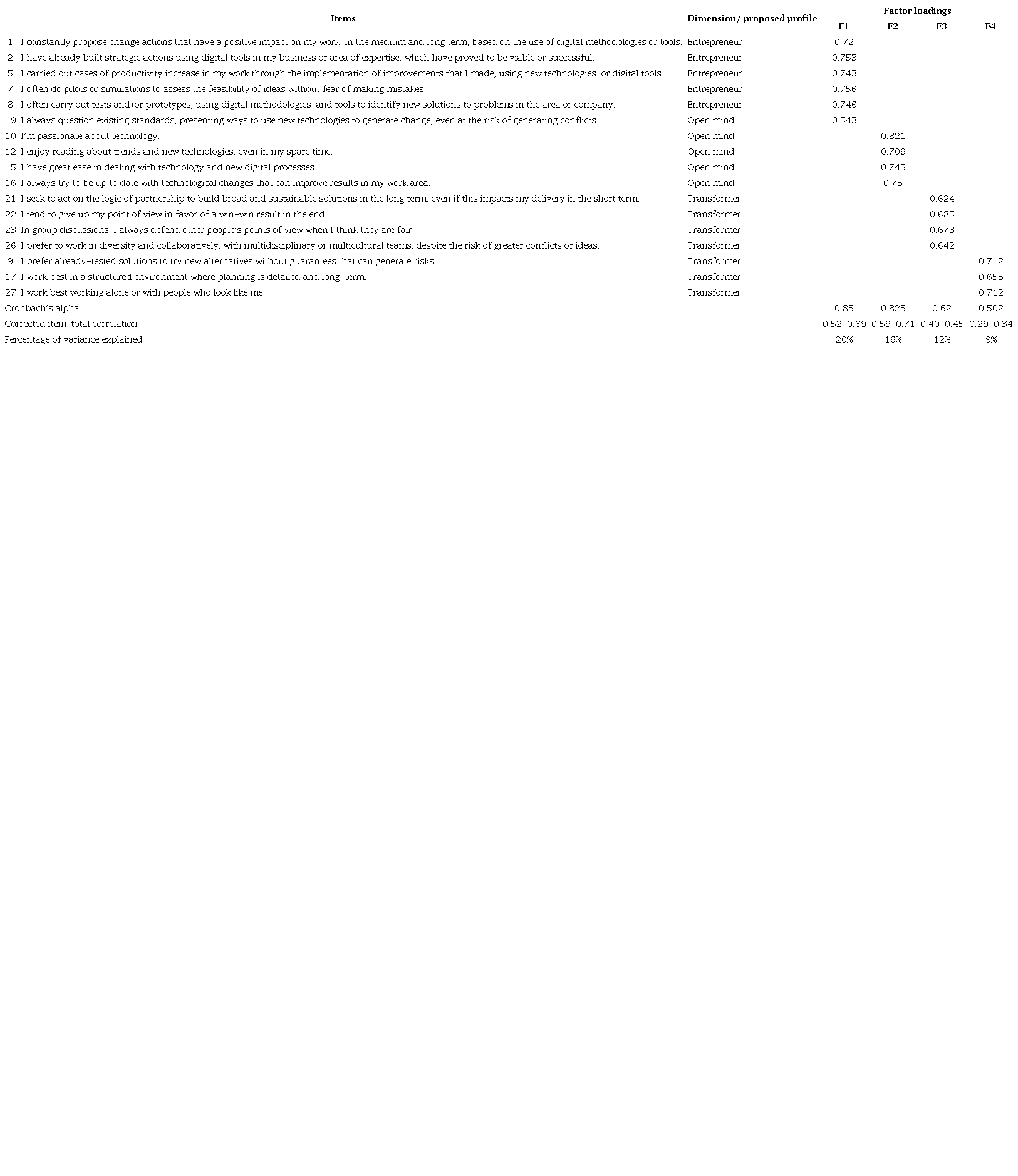
Each item should be rated on an 11-point scale, ranging from strongly disagree (0) to strongly agree (10). Likert-type agreement scales continue to be considered a good behavior measurement strategy (Macey & Fink, 2020). It does not seem to significantly affect the scale structure due to the number of answering points (Capik & Gozum, 2015).
Finally, in addition to the digital mindset measure, the questionnaire presented sociodemographic questions regarding age, time in the current employer, and gender.
This first version was applied as a test to an initial sample to check collection procedures and eventual adjustments to the tool. From this initial application, only layout changes were identified and performed to visualize the items better.
PROCEDURES AND DATA ANALYSIS
Data was collected through an electronic questionnaire prepared in SurveyMonkey, which proposed identifying characteristics related to technical mastery and the use of information technology resources among workers. The link was sent through a client database of Clave Consultoria, a consulting company that serves large companies for professional profile mapping.
In order to analyze the responses, the SPSS statistical package was used based on the methods suggested by Hair et al. (2009) to develop and evaluate measurement scales. According to the authors, exploratory factor analysis (EFA), Cronbach’s alpha, and corrected item-total correlation (Citc) are useful in the initial stages of an empirical investigation to determine the number of latent variables underlying the complete set of items.
RESULTS
The sample measures indicated adequacy to the analysis: KMO = 0.931; Bartlett’s sphericity test = p < 0.001. Thus, a series of AFEs with Varimax rotation was conducted to determine the latent dimensions of the scale, with items with commonalities and factor loadings lower than 0.40 or with factor loadings above 0.40 in more than one factor being eliminated in each round (Thompson, 2004). Aiming at a better fit of the model and the optimization of the instrument as a whole, the process above of eliminating items and checking the structure was carried out and was successful. From 31 items, the best solution retained 17 statements, distributed in four factors, with an explained variance of 57.7%. The scree plot shows the adjustment of the tool in four elements as the best solution, as shown below in Figure 1.
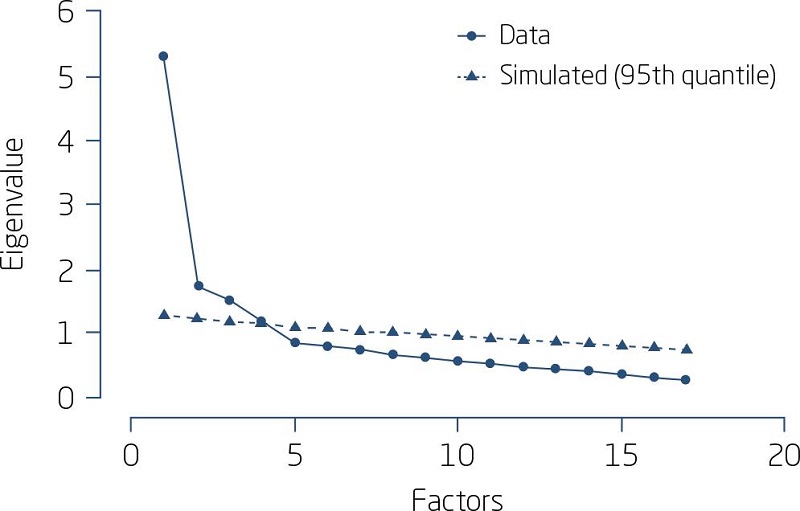
Figure 1
Scree plot
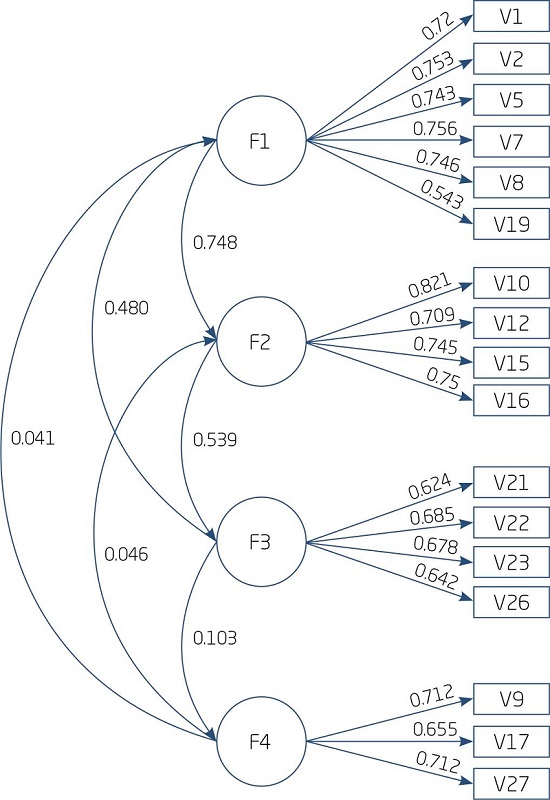
Figure 2
Factor structure of the Digital Mindset Clave Scale
Thus, evidence was obtained that the digital mindset could be a multidimensional construct, with items grouped into these four factors, as shown in Table 2.
After being theoretically interpreted, the factors gave rise to four profiles: factor 1 (α = 0.85) - entrepreneurial profile; factor 2 (α = 0.825) - open mind profile; factor 3 (α = 0.62) - transformer profile; factor 4 (α = 0.502) - analog profile. The entrepreneur profile describes professionals who think of technology as business opportunities, generating new ideas and creating innovative solutions. The open mind profile refers to openness and curiosity about technology, indicating the need to learn and curiosity in this area. The transformer profile refers to the behavior of implementing technologies and optimizing processes through digital tools with a strong, practical characteristic.
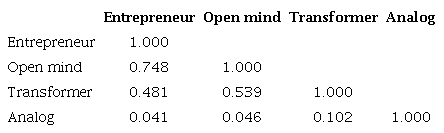
As can be seen in Table 3, the correlations between the factors were within the expected parameters, with a more significant correlation between the entrepreneur/open mind and open mind/transformer factor pairs, which makes practical sense since they are characteristics commonly observed in the reality of companies, with people with an entrepreneurial profile, who are open to innovation and open people who are also capable of executing transformations, implementing their ideas (Young et al., 2020).
Correlations between factors
The factor structure of the instrument and the correlations between the factors are shown in the following figure:
As can also be seen in Table 3, factors one to three showed good levels of internal consistency (Cronbach’s alpha between 0.60 and 0.80) according to Thompson (2004) and a strong relationship with the latent variable they sought to measure (minimum recommended Citc value of 0.40), according to the same author. However, the fourth factor, the analog profile, did not present indicators within the expected values to show good level of reliability and consistency.
DISCUSSION
This study sought to advance one more step in the literature on digital mindset, especially in Brazil, by proposing a multidimensional definition and developing a measure capable of evaluating the behaviors associated with the use of IT by professionals in organizations. Evidence of validity was sought in measuring the degree of professionals’ adherence to the growing movement of digital transformation of companies. The results generally confirm the relevance of the final set of items to measure how much an employee can present a digital mindset. The theoretically predicted dimensions also demonstrate an excellent explanatory power of the construct, considering the low dispersion of items, even under stricter criteria for excluding items from the first version (Thompson, 2004).
Only item 19, “I always question existing standards, presenting ways to use new technologies to generate changes, even at the risk of generating conflicts,” initially foreseen for the open mind profile, obtained a higher factorial load in the entrepreneur dimension. This is understandable due to the content of innovation at the expense of possible risks, which is contained in the definition of the entrepreneur profile. The analog profile, in turn, showed lower reliability (α = 0.502), which can be explained by the lower number of items. However, it is considered important to group an item opposing each digital profile.
Cognitive psychology reinforces that the mindset exists in the form of knowledge structures, whose two main aspects are differentiation and integration. Differentiation refers to the narrowness and breadth of knowledge, whereas integration refers to the extent to which a person can integrate different elements of knowledge. Therefore, even if it is possible to differentiate an individual’s score in one or another dimension, caution is recommended in interpreting the results. Instead of labeling an employee as a holder of a specific mindset, it is necessary to understand that the structure is constantly developing and that the psychological assessment is a portrait of the moment (Damásio & Borsa, 2017).
In addition, it is necessary to consider that the measurement of the stage of development of the digital mindset of professionals presented here helps to develop action plans for planning training and development initiatives in organizations (Agrawal, Smet, Poplawski et al., 2020). Creating and fostering a collaborative culture in which employees share knowledge has been identified as crucial in digital transformation (Berg & Josefsson, 2019). Thus, digitization is not a problem located at the micro level of organizational behavior but requires attention at all levels, especially the macro-organizational level.
In the face of the transformation scenario, the importance of digitally talented professionals who are interested in applying skills at work to evolve with technological innovation as the business environment and society are digitized (Chetty et al., 2018) grows. Thus, to guide an organization in digital transformation, the company culture must encourage its professionals to learn and creatively experiment with digital resources (Jacobi & Brenner, 2017). In fact, there is no way out of developing a digital mindset culture in organizations, but the potential to flourish in a pro-digital culture depends on the cognitive structures of each worker.
In this sense, the digital mindset scale is a tool that can significantly collaborate, both to an increasingly urgent and relevant research agenda and in the practical scope, allowing organizations and consulting companies the possibility of mapping the behavioral profile of workers regarding the ability to adapt to work based on digital tools. Let’s consider that the trend is toward increasing digitization. The demand for this type of tool tends to grow, as well as the need for more literature in the area, especially considering different cultural groups, sectors of activity, and hierarchical levels.
Some limitations of the present study derive precisely from this gap in the literature in the area. Selecting the variables to be measured would benefit significantly from broader and deeper literature on the concept. Another limitation was the absence of check items for attention to completion, which would bring an extra layer of security to the results. Future instrument versions should include this type of item and other types that contribute to the instrument’s validation process. Finally, it is worth mentioning that the research focuses on a sample of Brazilian professionals, and the elaboration of the scale is focused on this context. Therefore, applying the tool outside this context should be viewed with caution.
As a suggestion for future research, the authors propose to expand the sample size to validate the scale with greater precision and to carry out hierarchically and geographically stratified studies to understand whether other attributes can generate changes in the construct.
In terms of practical and theoretical implications, considering the current state of science in the area, the Clave Digital Mindset Scale already presents itself as a robust instrument for use in organizations, offering relevant information on the measured variables and allowing development actions to be carried out to facilitate adaptation and better allocation of professionals. It can also be used in research, especially considering the need for a better understanding of the construct and its relationships with other variables and improvements in the instrument’s internal structure. Thus, the present study brings contributions both to professional practice and to the scientific and theoretical development of the construct, even considering the limitations previously discussed.
The development of a digital mindset scale has important implications for Brazilian managers and organizations, not only because of the digital transformation process itself, which, much more than technical changes, brings with it impacts that can be observed in the culture of organizations (Merkt et al., 2021). In this process, companies and their respective managers and human resources areas must understand that professionals with different characteristics will need different strategies to adapt. Without adequate measurement in the behavioral sphere, this work becomes even more challenging (Wong et al., 2022).
Digital transformation is becoming a hot topic for organizations worldwide (Hildebrandt & Beimborn, 2022). At this very significant moment, it is clear that there is still a large gap between the executives’ intentions and the realization of successful digital transformation initiatives, especially in eradi-cating analog strategies incorporated by corporations (Ismail et al., 2017). The Clave Digital Mindset Scale is expected to help transition Brazilian organi-zations towards talent management for the flourishing of professionals in the digital environment.
REFERENCES
Agrawal, S., Smet, A., Lacroix, S., & Reich, A. (2020). To emerge stronger from the Covid-19 crisis, companies should start reskilling their workforces. McKinsey Insights, 1-7. https://www.mckinsey.com/business-functions/organization/our-insights/to-emerge-stronger-from-the-covid-19-crisis-companies-should-start-reskilling-their-workforces-now
Agrawal, S., Smet, A., Poplawski, P., & Reich, A. (2020). Beyond hiring: How companies are reskilling to address talent gaps. McKinsey Insights, 1-9. https://www.mckinsey.com/capabilities/people-and-organizational-performance/our-insights/beyond-hiring-how-companies-are-reskilling-to-address-talent-gaps
Bai-Ngern, K., & Tubtiang, A. (2020, November 4-6). Leadership in the digital era. 5th International STEM Education Conference (iSTEM-Ed). IEEE. https://doi.org/10.1109/iSTEM-Ed50324.2020.9332712
Baumgartner, C., Hartl, E., & Hess, T. (2021). New workplace, new mindset: Empirical case studies on the interplay between digital workplace and organizational culture. In F. Ahlemann, R. Schütte, & S. Sieglitz (Eds.), Lecture notes in information systmes and organisation: Vol. 46. Innovation through information systems and organisation (Vol. 3, pp. 91-107). Springer. https://doi.org/10.1007/978-3-030-86800-0_7
Benke, V. (2013). The digital mindset: A theoretical discussion. [Unpublished master thesis]. Aalborg Universitet. https://projekter.aau.dk/projekter/files/77247472/Vivienne_Benke_Masters_thesis.pdf
Berg, E., & Josefsson, C. (2019). Enabling digital transformation: A dynamic capabilities approach. [Unpublished master thesis]. Linkpöping University. https://www.propia.se/wp-content/uploads/2020/12/enabling-digital-transformation.pdf
Brennan, A., & Dooley, L. (2005). Networked creativity: A structured management framework for stimulating innovation. Technovation, 25(12), 1388-1399. https://doi.org/10.1016/j.technovation.2004.08.001
Bughin, J., Chui, M., & Pollak, L. (2014). Organizing the networked enterprise for change. McKinsey Quarterly. https://www.mckinsey.com/capabilities/mckinsey-digital/our-insights/organizing-the-networked-enterprise-for-change
Capik, C., & Gozum, S.(2015) Psychometric features of an assessment instrument with likert and dichotomous response formats. Public Health Nursing, 32(1), 81-86. https://doi.org/10.1111/phn.12156
Chetty, K., Qigui, L., Gcora, N., Josie, J., Wenwei, L., & Fang, C. (2018). Bridging the digital divide: Measuring digital literacy. Economics: The Open-Access, Open-Assessment E-Journal, 12, 1-20. http://dx.doi.org/10.5018/economics-ejournal.ja.2018-23
Damásio, B. F., & Borsa, J. C. (Orgs.) (2017). Manual de desenvolvimento de instrumentos psicológicos. Vetor.
Dweck, C. (2017). Mindset: A nova psicologia do sucesso. Objetiva.
Eisenmann, T. (2013). Entrepreneurship: A working definition. Harvard Business Review. https://hbr.org/2013/01/what-is-entrepreneurship
Gimpel, H., & Röglinger, M. (2015). Digital transformation: Changes and chances - Insights based on an empirical empirical study. Project Group Business and Information Systems Engineering (BISE). Fraunhofer Institute for Applied Infor-mation Technology FIT. https://fim-rc.de/wp-content/uploads/2020/02/Fraunhofer-Studie_Digitale-Transformation.pdf
Greenfield, P. M. (2014). Mind and media: The effects of television, video games, and computers. Psychology Press.
Guzmán, V. E., Muschard, B., Gerolamo, M., Kohl, H., & Rozenfeld, H. (2020). Characteristics and skills of leadership in the context of Industry 4.0. Procedia Manufacturing, 43, 543-550. https://doi.org/10.1016/j.promfg.2020.02.167
Hagen, M. B., & Wibe, P. B. (2019). When support is important: A study of leaders with a fixed digital mindset and their employees’ active usage or avoidance towards new technology -the mediating effect of perceived developmental supervisor support. [Unpublished master thesis]. Norwegian Business School. https://biopen.bi.no/bi-xmlui/handle/11250/2626153
Hair., J. F., Junior, Black, W. C., Babin, B. J., Anderson, R. E., & Tatham, R. L. (2009). Análise multivariada de dados. Bookman.
Hildebrandt, Y., & Beimborn, D. A. (2022). A cognitive conveyor for digital innovation-definition and conceptualization of the digital mindset. Track 7: Digital Business Models & Entrepreneurship, Wirtschaftsinformatik 2022, Proceedings 12. https://aisel.aisnet.org/wi2022/digital_business_models/digital_business_models/12/
Hoe, S. L. (2019). Digitalization in practice: The fifth discipline advantage. The Learning Organization, 27(1), 54-64. https://doi.org/10.1108/TLO-09-2019-0137
Horney, N., Pasmore, B., & O’Shea, T. (2010). Leadership agility: A business imperative for a VUCA World. People & Strategy, 33(4), 32-38. https://luxorgroup.fr/coaching/wp-content/uploads/Leadership-agility-model.pdf
Ilomäki, L., Paavola, S., Lakkala, M., & Kantosalo, A. (2016). Digital competence: An emergent boundary concept for policy and educational research. Education and Information Technologies, 21, 655-679. https://doi.org/10.1007/s10639-014-9346-4
Ismail, M. H., Khater, M., & Zaki, M. (2017). Digital business transformation and strategy: What do we know so far? Cambridge Service Alliance. https://cambridgeservicealliance.eng.cam.ac.uk/system/files/documents/2017NovPaper_Mariam.pdf
Jacobi, R., & Brenner, E. (2017). How large corporations survive digitalization. In C. Linnhoff-Popien, R. Schneider, & M. Zaddach (Eds.), Digital marketplaces unleashed (pp. 83-97). https://doi.org/10.1007/978-3-662-49275-8_11
Kane, G. C., Palmer, D., Phillips, A. N., Kiron, D., & Buckley, N. (2018). Coming of age digitally. MIT Sloan Management Review and Deloitte Insights, 59(5), 1-10.
Kontić, L., & Vidicki, Đ. (2018). Strategy for a digital organization: Testing a measurement tool for digital transformation. Strategic Management, 23(1), 29-35. https://doi.org/10.5937/StraMan1801029K
Macey, W. H., & Fink, A. A. (2020). Employee surveys and sensing: Challenges and opportunities. Oxford University Press.
Manyika, J., Lund, S., Michael, C., Bughin, J., Woetzel, J., Batra, P., Ko, R., & Sanghvi, S. (2017). Jobs lost, jobs gained: workforce transitions in a time of automation. McKinsey Global Institute. https://www.mckinsey.com/~/media/BAB489A30B724BECB5DEDC41E9BB9FAC.ashx
McLaughlin, S. A. (2017). Dynamic capabilities: Taking an emerging technology perspective. International Journal of Manufacturing Technology and Management, 31(1-3), 62-81. https://doi.org/10.1504/IJMTM.2017.082014
Menzel, H. C., Aaltio, I., & Ulijn, J. M. (2007). On the way to creativity: Engineers as intrapreneurs in organizations. Technovation, 27(12), 732-743. https://doi.org/10.1016/j.technovation.2007.05.004
Merkt, R., Lang, V., & Schmidt, A. (2021). Digi-cultural mindset. In V. Liermann, & C. Stegmann (Eds.), The digital journey of banking and insurance (vol. 1, pp. 185-212). Palgrave Macmillan. https://doi.org/10.1007/978-3-030-78814-8_11
Novotný, O., Potančok, M., & Krajčík, V. (2022). Human digital transformation readiness: Integrate data into the mindset and decision-making processes. In G. Antošová (Ed.) Innovative strategic planning and international collaboration for the mitigation of global crises (pp. 16-30). IGI Global. https://doi.org/10.4018/978-1-7998-8339-5.ch002
Oberländer, M., Beinicke, A., & Bipp, T. (2020). Digital competencies: A review of the literature and applications in the workplace. Computers and Education, 146, 103752. https://doi.org/10.1016/j.compedu.2019.103752
Parviainen, P., Tihinen, M., Kääriäinen, J., & Teppola, S. (2017). Tackling the digitalization challenge: How to benefit from digitalization in practice. International Journal of Information Systems and Project Management, 5(1), 63-77. https://doi.org/10.12821/ijispm050104
Porter, M. E., & Heppelmann, J. E. (2015). How smart, connected products are transforming companies. Harvard Business Review, 93(10), 96-114.
Ross, J. (2017). Don’t confuse digital with digitization. In MIT Sloan Mana-gement Review, Who wins in a digital world?: Strategies to make your organization fit for the future (pp. 3-7). MIT Press. https://sloanreview.mit.edu/article/dont-confuse-digital-with-digitization/
Russo, K. (2019). Conquering the digital divide: With a digital native who never was. [Unpublished doctoral dissertation]. James Cook University. http://dx.doi.org/10.25903/5ecde7ffe069f
Schwab, K., & Zahidi, S. (2020). The future of jobs report 2020. World Economic Forum. http://www3.weforum.org/docs/WEF_Future_of_Jobs_2020.pdf
Sebastian, I. M., Ross, J. W., Beath, C., Mocker, M., Moloney, K. G., & Fonstad, N. O. (2017). How big old companies navigate digital transformation. MIS Quartelry Executive, 16(3), 197-213.
Singh, A., & Hess, T. (2017). How chief digital officers promote the digital transformation of their companies. In R. D. Galliers, D. E. Leidner, & B. Simeonova (Eds.), Strategic information management (pp. 202-220). Routledge. https://doi.org/10.4324/9780429286797-9
Soltanifar, M., & Smailhodz• ić, E. (2021). Developing a digital entrepreneurial mindset for data-driven, cloud-enabled, and platform-centric business activities: Practical implications and the impact on society. In M. Soltanifar, M. Hughes, & L. Göcke (Eds.), Digital entrepreneurship (pp. 3-21). https://doi.org/10.1007/978-3-030-53914-6_1
Thompson, B. (2004). Exploratory and Confirmatory Factor Analysis: Understanding Concepts and Applications. Washington DC: American Psychological Association. https://doi.org/10.1037/10694-000
Thompson, B. (2004). Exploratory and confirmatory factor analysis: Understanding concepts and applications. Washington, DC, 10694(000). https://psycnet.apa.org/PsycBOOKS/toc/10694
Wagner, M., Heil, F., Hellweg, L., Schmedt, D. (2019). Working in the digital age: Not an easy but a thrilling one for organizations, leaders and employees. In P. Krüssel (Ed.), Future telco (pp. 395-410). Springer. https://doi.org/10.1007/978-3-319-77724-5_36
White, C. (2019, July 15-18). We may have digital literacy and skill sets but do we have the Digital Mindset to succeed in a digital workplace. 24th Asia Pacific Decision Science Institute International Conference. https://usc.esploro.exlibrisgroup.com/esploro/outputs/conferencePaper/We-may-have-Digital-Literacy-and/99451318302621?institution=61USC_INST
Wong, S. I., Solberg, E., & Traavik, L. (2022). Individuals’ fixed digital mindset, internal HRM alignment and feelings of helplessness in virtual teams. Information Technology & People, 35(6), 1693-1713. https://doi.org/10.1108/ITP-04-2021-0310
Yoo, Y., Henfridsson, O., & Lyytinen, K. (2010). Research commentary: The new organizing logic of digital innovation: An agenda for information systems research. Information Systems Research. https://doi.org/10.1287/isre.1100.0322
Young, R., Davis, E., Abhari, K., & Wahlberg, L. (2020, August 15-17). Towards a theory of digital entrepreneurship mindset: The role of digital learning and digital literacy. 26th Americas Conference on Information Systems. https://aisel.aisnet.org/amcis2020/culture_in_is/culture_in_is/7/
Notes
Author notes
Editor-in-chief
Fellipe Silva Martins
Luis Pinochet
Gabriel Henrique Carille
Publishing coordination
Jéssica Dametta
Irina Migliari (Bardo Editorial)
Correspondence concerning this article should be addressed to Roberto Francisco da Costa, Rua Gustavo Corção, 825, room 303, Recreio dos Bandeirantes, Rio de Janeiro, Brazil, ZIP code 22790-150. Email: roberto@claveconsultoria.com.br
