Knowledge, Strategy, and Innovation
Factors that influence the survival of micro and small enterprises in Brazil1
Fatores que influenciam a sobrevivência das micro e pequenas empresas no Brasil
 Poliano Bastos da Cruz
Octavio Locatelli
Poliano Bastos da Cruz
Octavio Locatelli
Factors that influence the survival of micro and small enterprises in Brazil1
RAM. Revista de Administração Mackenzie, vol. 25, no. 1, eRAMC240073, 2024
Editora Mackenzie; Universidade Presbiteriana Mackenzie
Received: 25 March 2022
Accepted: 08 November 2022
Abstract
Purpose: This article studies which sets of variables, besides credit and profitability, influence the survival of micro and small enterprises (MSE) over time.
Originality/value: This study innovates in presenting independent variables related to a common objective, contributing to the literature by identifying factors, including financial ones, that can influence MSE survival in a single model, which has not yet been identified in the literature. Therefore, acquiring knowledge that stimulates changes in the behavior of entrepreneurs, public authorities, stakeholders, and private institutions related to the subject is expected to promote the creation of new management tools, which can decrease the closure of several MSEs within a short time of operation.
Design/methodology/approach: Secondary data from the 26 Brazilian states and the Federal District relative to the period between 2008 and 2012 were used. Reduced equation models with estimation utilizing a Tobit were used, as the dependent variable is censored, in addition to the OLS method with fixed effects panel and robust error, with equivalent results. The factor analysis by the principal component method (FA-PCM) was used in the data analysis.
Findings: The results showed significant factors for MSE survival, such as the need for employment and income, investments in health, access to financing, and, mostly, the importance of education, among others. Moreover, the study demystifies that the leading cause of MSE death is the lack of credit, as there is too much credit on the market, either through banks or investors.
Keywords: Micro and small enterprises+ survival+ entrepreneurship+ factor analysis+ Brazil.
Resumo
Objetivo: Estudar quais conjuntos de variáveis, além do crédito e da rentabilidade, influenciam a sobrevivência das micro e pequenas empresas (MPE) ao longo do tempo.
Originalidade/valor: O presente estudo inova na apresentação de variáveis independentes relacionadas com objetivo comum. Contribui para a literatura ao identificar fatores, além dos financeiros, que podem influenciar na sobrevivência das MPE em um único modelo, algo ainda não identificado na literatura. Espera-se assim adquirir conhecimentos que estimulem mudanças no comportamento por parte dos empreendedores, do poder público, dos stakeholders e de instituições privadas afins ao tema, para que seja estimulada a criação de novas ferramentas de gestão que venham a minimizar o fechamento de tantas MPE com pouco tempo de existência.
Design/metodologia/abordagem: Utilizaram-se dados secundários dos 26 estados e do Distrito Federal brasileiros entre os anos de 2008 e 2012. Foram empregados os modelos de equação reduzida com estimação por meio de um Tobit, haja vista a variável dependente ser censurada, e pelo método MQO em painel com efeitos fixos e erro robusto, com resultados equivalentes. Na análise de dados, utilizou-se o método da análise fatorial pelo método dos componentes principais (AF-MCP).
Resultados: Os resultados apresentados apontaram fatores significantes para a sobrevivência das MPE, como necessidade de emprego e renda, investimentos em saúde, acesso a financiamento e, em destaque, a importância da educação, entre outras. Além disso, o trabalho desmistifica que a causa principal da mortandade das MPE é a falta de crédito, pois há ofertas em demasia no mercado, seja por meio dos bancos ou de investidores.
Palavras-chave: Micro e pequenas empresas, sobrevivência, empreen-dedorismo, análise fatorial, Brasil.
INTRODUCTION
Some studies on micro and small enterprises (MSEs) have pointed to their importance in socioeconomic development due to their participation in social stability (Aoki & Badalotti, 2014; Garcia et al., 2022), generation of new ideas and inputs for other companies (Hyytinen & Toivanen, 2005), and promotion in the improvement of society’s quality of life (Jones-Evans, 2015), among other benefits.
However, Bedê’s studies (2016) showed that many MSEs cannot reach three years of existence. According to Beck et al. (2011), one of the most commented obstacles regarding the adversity of these companies is the difficulty of accessing credit. The authors reported that the cost of this resource is very high. Dong and Men (2014) said that the short existence time generates insecurity in investors.
Thus, there is a gap in the literature relative to a group of factors that may affect MSEs’ longevity. This research sought to study which sets of variables, in addition to credit and profitability, influence MSEs’ survival over time. Regarding the difficulties in accessing financial resources, Morais (2008) observed an offer of credit in the market through bank financing lines and incentive programs, such as the Employment and Income Generation Program (Proger). However, the lack of guarantees and the high cost can make this access difficult for MSEs. Credit for these companies could be more accessible if more public policies were aimed at this objective (Hyytinen & Toivanen, 2005). Not many academic studies deal specifically with MSEs’ performance, addressing, for instance, entrepreneur schooling, public investment, and bank financing applications.
As possible factors, studies have highlighted that MSEs’ survival is associated with the generation of employment and income (Chandler, 2012; Beck, 2013; Sprakel & Machado, 2020), reduction of inequalities (Khan, 2015), dissemination of knowledge in regions where they are located (Nitescu, 2015), and development of new technologies (Denis, 2004; Massa et al., 2020). Data from the 26 Brazilian states and the Federal District between 2008 and 2012, extracted from systems, reports, balances of Ipeadata, IBGE, PNAD/IBGE, SIM-DATASUS, STN, Sebrae, and Atlas of Human Development in Brazil - PNUD, IPEA, and João Pinheiro Foundation (MG), were used to reach the proposed objective of this study. A reduced equation model was built to identify which variables influence MSEs’ survival probability.
This study contributes to the literature by identifying factors, including financial ones, that can influence MSEs’ survival in a single model, which has not yet been identified in the literature. Therefore, MSEs’ survival is linked to factors such as the degree of urbanization, which contributes to increasing gross domestic product (GDP), according to Davis and Henderson (2003); worker’s income (wage), which boosts the economy (Zica & Martins, 2008); and teaching, which encourages the development of entrepreneurs (Hanushek, 2013; Pereira, 2017; Nabi et al., 2017). Regarding the practical contribution, acquiring knowledge that stimulates changes in the behavior of entrepreneurs, public authorities, stakeholders, and private institutions related to the subject is expected to stimulate the creation of new management tools, such as courses of training, consulting methodologies, and other instruments and procedures, which can decrease the closure of several MSEs with a short time of operation.
THEORETICAL FRAMEWORK
Micro and small enterprises (MSE)
The importance of MSEs can be certified by the study by Beck (2013), which highlights that they represent 95% of companies worldwide. The following contributions of MSE stand out to improving society’s quality of life: encouragement of entrepreneurship and technological innovation (Chu, 2009); generation of employment and income (Denis, 2004; Zica & Martins, 2008); contribution to poverty reduction (Nitescu, 2015); wealth distribution (Beck et al., 2011); and other positive factors, being the main responsible for GDP growth in some countries (Khan, 2015). They contribute to the economy in developed countries, such as Canada and some in the European Union, by participating in job creation, reaching more than 65% in these companies (Beck et al., 2011; Chandler, 2012; Nitescu, 2015).
In Brazil, the study by Bedê (2016) pointed out that 45% of MSEs close their doors in the first two years of activity for several reasons, such as bureaucracy, lack of labor, and lack of planning, among other factors. Organi-zations and support agencies, such as the Brazilian Micro and Small Business Support Service (Sebrae), have provided support for MSEs to minimize these harmful effects, including information and knowledge through articles and publications of booklets with technical and training data, consultants in all states, presential and distance training and lectures, and awards that value good management practices.
The legal definition of MSEs in Brazil was adopted to level their understanding. Bedê (2016) says they conduct commercial activities unrelated to associative activities or public administration. The classification as MPE was determined in the present study following the Complementary Law (CL) no. 123/2006 (Brazilian National Congress, 2006), amended by Complementary Law no. 155/2016 (Brazilian National Congress, 2016), which fits MSEs according to their annual gross revenue, which allows them to be included in the Integrated System of Tax and Contribution Payment for Micro and Small-sized Enterprises - Simples Nacional (simplified taxation regime):
-
Microenterprises: revenues up to R$ 360,000.00.
-
Small enterprises: revenues above R$ 360,000.00 up to R$ 4,800,000.00.
MSE survival
Some variants pointed out in the literature were identified to understand what can influence MSEs’ survival, such as the poor distribution of income and high Gini index levels, which inhibit access to better education by the most impoverished, harming them from obtaining better jobs (Barro, 2000); and variables related to education, a preponderant factor for the development of new technologies, which improve MSEs’ competitiveness (Barro, 2013). These factors are associated with the effectiveness of com-panies given their beneficial effects for generating jobs and income, which provide public investments, developing a healthy environment for MSEs (Gonçalves et al., 2017). Some studies have addressed the need for companies to add more competitive advantages such as investments in research and development - R&D (Lee & Marvel, 2009), promotion of innovation (Brito et al., 2009), and persistence in the development of new technologies (Merrilees et al., 2011; Rosenbusch et al., 2011).
Regarding performance, the most used indicators are related to growth and profitability (Lu & Beamish, 2006). However, these indicators are ineffective in evaluating performance, as they use inaccurate information since the current legislation exempts MSEs from disclosing detailed accounting information, which may cover excessive indebtedness, false financial records, and other situations (Forte et al., 2013). Moreover, Hudson et al. (2001) questioned whether the current measurement models, such as the Balanced Scorecard (BSC), are appropriate for MSEs because they were developed based on medium and large-sized companies. Therefore, their applicability may not reflect reality due to their distinct characteristics, such as a lean structure and ease of adaptation, among other attributes.
Critical factors for MSE survival
According to research in Empreendedorismo no Brasil - GEM - Global Entrepreneurship Monitor (Lima et al., 2015), opening one’s own business ranks fourth among Brazilians’ dreams. Bulgacov et al. (2011) cite the need and the opportunity as the main reasons to start a business. MSEs that arise out of necessity are an alternative for survival, while those that arise out of opportunity are made up of people who can perceive the market needs. However, several factors contribute to MPEs not surviving for a long time.
The lack of schooling makes it challenging to find good jobs, and recession cycles are among the main reasons to undertake out of necessity (Aoki & Badalotti, 2014). Opening a business to help relatives and friends is also a cause to undertake out of necessity (Lima et al., 2015). Regarding the reason to start a business by opportunity, the highest education level enables people to better structure the business and achieve more chances of success, as shown by the research on Empreendedorismo no Brasil (Lima et al., 2015).
Access to financial resources for MSEs is mostly through private or public financial institutions (Zica & Martins, 2008; Tavares et al., 2015). However, this difficulty in accessing credit has been the object of different studies that show some limitations: precarious banking relationships (Matias, 2009), problems with the documentation required by banking legislation (Khan, 2015), lack of credit options, and higher interest rates (Beck & Demirguc-Kunt, 2006). These difficulties, added to entrepreneurs’ misinformation, directly affect their enterprises’ survival (Beck et al., 2011; Nitescu, 2015; Khan, 2015).
It reflects the low concern of financial institutions in offering quality services (Çirpin & Sarica, 2014), such as low availability of information, inadequate service by employees, excessive time to resolve pending issues, and high cost for precarious services (Hankinson et al., 1997; Singhal et al., 2013). Regarding government actions, the Canadian government created programs to provide guarantees to facilitate the inflow of bank financing for MSEs (Chandler, 2012).
As for governmental factors, different programs to support MSEs were created in Brazil, such as the Proger and the Guarantee Fund for Generation of Employment and Income (Funproger), according to the study by Morais (2008). Also, some federal laws were created to favor MSEs: CL no. 123/2006 (Brazilian National Congress, 2006), known as the General Law for Micro and Small Enterprises, later amended by CL no. 155/2016 (Brazilian National Congress, 2016). Moreover, the simplified taxation system, called Simples Nacional or Supersimples, is provided for in the same Complementary Law no. 123/2006, which came into force in July 2007 (Brazilian National Congress, 2006). The Supersimples benefited the MPEs because the aggregate six federal taxes, one state tax, and one municipal tax, as follows: corporate income tax (IRPJ), social contribution on net income (CSLL), social integration program (PIS), tax for social security financing (Cofins), Brazilian Social Security Institute (INSS), excise tax (IPI), value-added tax on sales and services (ICMS), and services tax (ISS).
Schooling is another relevant factor in the literature for MSEs’ survival. In this sense, Cabrer-Borrás and Rico Belda (2018) indicated that schooling impacts MSEs’ survival, making it necessary to promote entrepreneurial training to increase the chances of survival and induce more enterprises by opportunity since they have higher survival rates. Bertolami et al. (2018) also show that factors related to human capital, such as education, training, skills, and experience, impact MSEs’ survival.
Finally, environmental factors also stand out as crucial for MSEs’ survival. Eseoghene et al. (2021) pointed out factors such as competition, ease of transport, government instability, and financial capital and training. Couto et al. (2017) also pointed out external factors, such as competition, politics, economy, and bureaucracy, necessary for MSEs’ bankruptcy.
METHODOLOGY
Data collection
The present study is a quantitative research with secondary panel data. The sample consists of data from the 27 Brazilian federative units from 2008 to 2012. The choice of the period was based on the availability of data on the dependent variable, that is, the MSEs’ survival rate, computed by Sebrae research, as well as some of the independent variables used in the factor analysis by the principal component method (FA-PCM), conducted in the study. The data were collected from systems, reports, and balance sheets from Ipeadata, IBGE, PNAD/IBGE, SIM-DATASUS, STN, Sebrae, and Atlas of Human Development in Brazil - PNUD, IPEA and João Pinheiro Foundation.
The MSEs’ survival rate is an index that measures enterprises’ effectiveness, influenced by several factors, such as size, sector, activity, the technology employed, and human and financial resources. In other words, there is no single business model that guarantees the longevity of an MSE. However, we intended to identify which factors can prevent MSEs’ death (Mas-Verdú et al., 2015).
The dependent variable corporate survival rate in reference to MSEs was selected to show how the new ventures behave and how many have survived over the years (Bedê, 2016). As for dependent variables, studies have indicated that the survival rate of MSE can be influenced by factors related to education (Hyytinen & Toivanen, 2005), employment and income (Nitescu, 2015), wealth generation (Sawaia, 2017), inequality (Pereira, 2017), financial resources (Jones-Evans, 2015), and population life expectancy (Andrade et al., 2016). This study focused on variables related to these factors. All statistical and econometric analyses, as well as FA-PCM, were conducted using the Stata 17.1 software.
PRESENTATION AND ANALYSIS OF RESULTS
Factor analysis by the principal components method
The empirical strategy adopted in this research was to map all variables correlated with entrepreneurship and, therefore, with the MSEs’ survival rate. Sixty independent variables were identified after searching the above databases, which estimated a regression model as a non-parsimonious process. An FA-PCM was conducted to reduce the dimensionality of the set of 60 variables. Therefore, the objective was to identify how many and which factors reflect the joint variance of the 60 variables and the resulting factor structure of the data set (Figueiredo & Silva, 2010). Subsequently, we sought to name and assign a meaning to each factor based on the results obtained from FA-PCM in light of the literature.
Thus, factor analysis aims to summarize the number of factors to be observed for better understanding, considering the arrangement of data for better exposure and interpretation of the most significant variables identified. Its importance is related to the simplification to identify the correlations of factors and their respective variables, in addition to the singularity, which defines the total percentage of variance that all the variables included in the analysis share with each other (Hair et al., 2009; Figueiredo & Silva, 2010).
FA-PCM used the Measure of Sampling Adequacy (MSA) as a sample adequacy criterion. Thus, the factor solution was established to retain factors with eigenvalues > 1 to meet the Kaiser-Meyer-Olkin (KMO) standard when estimating FA-PCM. The resulting solution kept seven factors, ensuring an optimal degree of correlation between all model variables (Hair et al., 2009; Figueiredo & Silva, 2010).
The next step was the application of the Varimax orthogonal rotation in the factor solution obtained in FA-PCM. The purpose of rotating the initial factor solution is to remove bias from the sequential formation of factors. Seven factors were created after applying the Varimax orthogonal rotation in the factor analysis (Table 1). The factor loadings of the independent variables, based on a standardized statistical correlation of the available data, remained with values of singularity in percentages below 28%, confirming the excellent degree to the variable composing the formation of factors (Hair et al., 2009; Figueiredo & Silva, 2010).
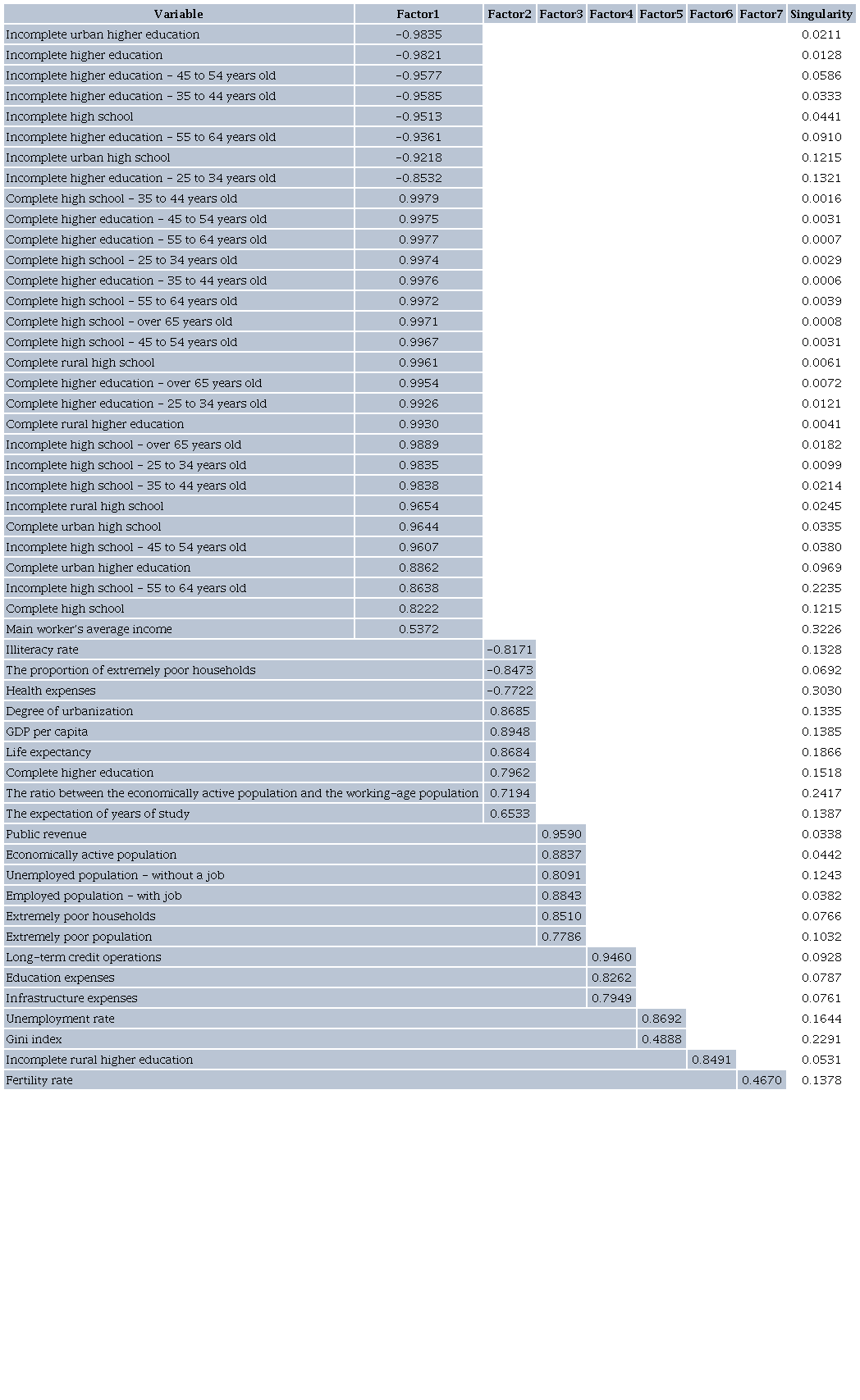
Finally, the factors were generated to proceed with the regression model estimation. Unlike most studies that adopt the factor analysis associated with the regression analysis, the elements were not created by taking the average of the values of the variables they reflect. The regression method, in which each factor is constructed through 60 regressions of the factor against each variable so that not only the factor loadings are considered but also the cross-factor loadings, was used in this study (Hair et al., 2009; Figueiredo & Silva, 2010).
Composition and naming were analyzed according to the factors:
-
Factor 1 - inequality, with variables related to education, and also the Gini index, which are related to social and economic development.
-
Factor 2 - productive environment, with variables that suggest business development and economic growth.
-
Factor 3 - workforce, with variables related to the population employability.
-
Factor 4 - socioeconomic investments, variables related to public investments.
-
Factor 5 - unemployment, with the variable unemployment rate.
-
Factor 6 - rural education, referring to higher education in the rural area.
-
Factor 7 - family planning, referring to the birth rate.
Descriptive statistics
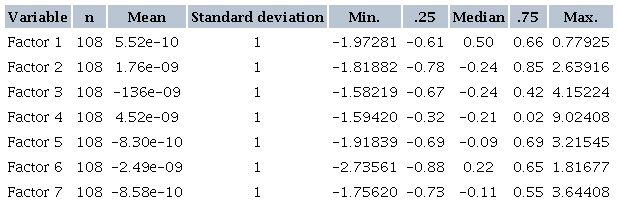
Table 2 shows the data referring to descriptive statistics, with the sample consisting of 108 observations, a number within the recommended criteria for using FA-PCM.
OLS regression method with fixed effects panel
The regression model was composed of seven factors with the reduction in the dimensionality of the data after the FA-PCM (Table 3), whose estimation of regression 1 was carried out using the ordinary least squares method with fixed effects panel (OLS-FE), considering the 27 federative units from 2008 to 2012, with robust error, aiming to correct possible heteroscedas-ticity errors. The result points to the coefficients that positively and negatively influence MSEs’ survival, with the respective coefficients, confidence intervals, and significant outcomes identified in six factors. Notably, the results were found by the Tobit method.
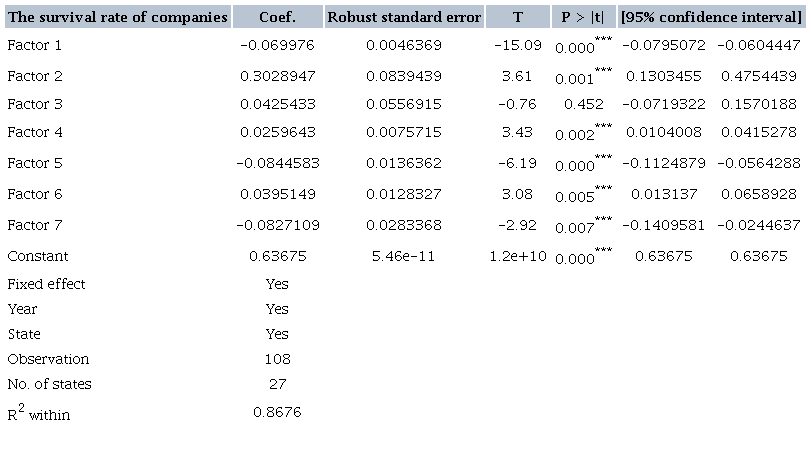
*** p < 0.01,** p < 0.05,* p < 0.1.
Analysis and interpretation of the seven factors
-
Factor 1 - inequality: According to the first column of Table 1, factor 1 is composed of 31 variables with a negative effect on the MSEs’ survival rate. The data on education, distributed by graduation and age ranges, suggest that the higher the education quality, the better the technological advances, one of the proven conditions for improving MSEs’ performance and survival (Barro, 2000, 2013).
Regarding education, all variables related to incomplete higher education and unfinished high school in the state and urban area negatively loaded factor 1. It supports Pereira (2017), who observed that schooling is directly related to the insertion of the individual into the labor market, being a condition for suitable professional qualification and human capital formation, favorable requirements for MSEs’ permanence (Nabi et al., 2017). Education variables also positively loaded the factor, confirming that education favors thinking about knowledge and skills necessary for good business performance (Nabi et al., 2017).
The Gini index used to calculate the degree of inequality in the distribution of household income per capita of the population (Barro, 2000; Andrade et al., 2016) has a negative effect on factor 1. The studies show that the lower the inequality, the better the conditions of people’s quality of life, creating an environment with socioeconomic dynamism, which generates better opportunities for MSEs’ longevity (Silveira & Menezes, 2010). The variable main worker average income, loading positively, assumes that income is favorable for MSEs’ permanence, as income is fuel for consumption, contributing to maintaining markets.
Factor 1 shows that the incompleteness of an education degree has a negative effect on the factor regardless of the age group, as found for the decrease of inequality in income distribution. Other analysis shows that any degree of study in the rural area has a positive effect due to the region’s difficulty and lack of education.
The result of factor 1 shows that adequate remuneration, better income distribution, better education level, and some level of education in rural areas make up the factor. This result, with a negative effect, corroborates the idea of entrepreneurship by necessity because the higher the education level, including any education level in the rural area, the better the income to which these people have access, choosing not to open an MSE or even getting a decently remunerated job and, therefore, the entrepreneur gives up staying with the MSE.
-
Factor 2 - productive environment: This factor had a positive effect on the MSEs’ survival rate (second column of Table 1), consisting of nine variables, namely expectation of years of study, complete higher education, illiteracy rate, proportion of extremely poor households, degree of urbanization, GDP per capita, life expectancy, health expenses, and ratio between economically active population and working age population.
The variables related to education attest to the study by Nabi et al. (2017), who consider education providential for entrepreneurship, enabling short-term and long-term results with satisfactory business management, a requirement for MSEs’ longevity.
The result of the variable referring to poverty justifies the studies already presented, demonstrating its reduction as beneficial for MSEs’. The increased number of people in urban centers favor increased schooling (Bertinelli & Black, 2004) and is related to a higher job offer (Sato & Zenou, 2015), conditions for a good MSEs’ performance. Similarly, the increase in GDP, directly related to wealth generation, creates an environment conducive to maintaining an enterprise (Davis & Henderson, 2003).
Regarding the variables related to well-being, the increase in people’s life expectancy, if associated with improved health, helps to avoid inequality (Andrade et al., 2016), minimize poverty rates (Salvato et al., 2010), enhance the increase in employment and income, as well as economic and social development (Zica & Martins, 2008). However, the decrease in investments in health negatively affects this factor probably because the state invests its resources inappropriately, which is in line with studies that have pointed out that resources provide a return of up to four times the amount invested when correctly employed (Masters et al., 2017), creating a healthy environment for MSEs’ longevity.
The analysis of the variable ratio between the economically active population and the working-age population confirms several studies that have shown the importance of working for MSEs since these businesses are considered the main generators of employment and income (Denis, 2004; Zica & Martins, 2008; Hoffmann et al., 2009) and creation and distribution of wealth (Beck et al., 2011), thus being directly responsible for building an ecosystem with job and income opportunities and legitimizing MSEs continuity.
Factor 2 reflects the importance of creating a good atmosphere in cities, generating wealth, providing jobs, making the necessary investments in health, and encouraging education. These actions, duly implemented, allow poverty reduction, social exclusion, and illiteracy rates, providing opportunities for investments in other areas, which may increase the conditions for a more equitable, productive environment with better infrastructure, sanitation, and energy.
-
Factor 3 - workforce: This factor, with a negative effect on the MSEs’ survival rate, is shown in the third column of Table 1 and consists of the variables economically active population, unemployed population - without a job, employed population - with a job, extremely poor population, extremely poor households, and public revenue. All these variables had a positive effect on factor 3.
Variables related to work and occupation, according to some studies, have a positive effect on MSEs’ survival due to the formation of an economi-cally dynamic environment conducive for an MSE to maintain itself (Dong & Men, 2014), also contributing to an increased GDP per capita (Khan, 2015). According to Khan (2015), economic growth is beneficial for these companies. The correct use of public revenues, focusing on infrastructure investments, could lead to sustainable economic growth (Gonçalves et al., 2017), which will probably boost MSEs.
The variables referring to the quality of life contradict what some studies have pointed out. In this sense, Sawaia (2017) found that social exclusion causes several harmful situations for MSEs, such as degradation of the labor market and a precarious and disorganized education system, making it impossible for people to get a job. Moreover, quality of life benefits from employment and income favors MSE (Nitescu, 2015).
The result of factor 3 leads one to think about the possibility that an increase in work and employment is related to better wages, which inhibits people from venturing into entrepreneurship. On the contrary, the rise in unemployment, which would provoke the opening of an MSE by necessity, does not happen in certain situations. Notably, the regression shows that factor 3 exceeded the 10% confidence interval, with a result of 47.2%.
-
Factor 4 - socioeconomic investments: This factor, identified in the fourth column of Table 1, shows a positive effect on the MSEs’ survival rate and comprises three variables: long-term credit operations, infrastructure expenses, and education expenses. All the variables positively load factor 4. According to Chandler (2012), Dong and Men (2014), and Jones-Evans (2015), MSEs’ survival depends on access to credit. Similarly, better public investments reduce the economy’s vulnerability to crises and function as inducers of economic growth, a beneficial scenario for MSE development (Orair, 2016). Regarding education investments, Samir and Lutz (2017) observed that improving the population’s education level directly boosts GDP growth, the progress of the economic system, and the sustainable development of countries, favoring MSEs’ maintenance and growth.
Factor 4 confirms the scenario of promising results when there is a good relationship between investments. The responsible application of financial resources to respond to the basic needs of society, linked to financing for production, can favor public policies aimed at education. All these variables converge to a common objective: development promotion, which is healthy for MSEs’ maintenance.
-
Factor 5 - unemployment: The fifth column of Table 1 shows factor 5, nega-tively affecting the MSEs’ survival rate. It is formed by the variable unemployment rate, positively loading factor 5, justifying the studies that have reported that unemployment is harmful to any social situation and economic growth, and this scenario may also be related to recession or lack of worker capacity to enter or remain in the labor market (Mattos & Lima, 2015). Furthermore, people who could be able to be employed are on the margins of the labor market due to low education and precarious health conditions, among other situations that exclude them from getting a paid activity (Reis & Schwartzman, 2002).
The harmful effect of factor 5 on MSEs’ maintenance suggests the possibility that the increase in unemployment can be a consequence of numerous situations that may favor this context according to the studies already presented in the present research, which is positively and negatively related to MSEs, implemented by opportunity or necessity, respectively. Considering that unemployment is harmful, decreased consumption harms the circulation of money in the market. On the other hand, unemployment favors opening new MSEs if necessary (Aoki & Badalotti, 2014). Moreover, the repercussion of unemployment may be due to economic recession, which is a scenario that disfavors all enterprises that are not prepared adequately to protect themselves from the harmful effects that a crisis generates in the socioeconomic environment.
-
Factor 6 - rural education: This factor is presented in the sixth column of Table 1 and positively affects the MSEs’ survival rate. The variable incomplete rural higher education positively loads factor 6. According to some studies, education is one of the leading causes for the good development and survival of MSEs, providing better training and knowledge for entrepreneurs to succeed (Omerzel & Antončič, 2008), vali-dating the study by Hanushek (2013), who points to low education as a harmful factor for building human capital, which is crucial for the survival of any company.
Reflection on this factor leads to considering the few opportunities and conditions of work in rural areas with good remuneration and what this reality promotes in its citizens. The implication of the study, even incomplete in rural areas, may provide people with greater chances of observing the opportunities that arise from undertaking a business and achieving competitive advantages for their companies with better management and more innovation and productivity, among others, obtaining more chances of success (Lima et al., 2015). However, the discussion is more complex, as the studies already commented on in this research have also pointed out that a better education inhibits the opening of micro and small enterprises because the higher the education level, the higher the probability of a person getting a job with good pay and, therefore, not risking investing time and money in opening an MSE.
-
Factor 7 - family planning: The variable fertility rate is identified for this factor, negatively affecting the MSEs’ survival rate and positively loading the factor. According to Adserà (2004), fertility is related to a decrease in the workforce on the market, and, in this case, the focus is on women, who are increasingly present and, in many situations, influence several sectors and business segments.
Thus, the negative correlation between fertility and workforce, as shown in the seventh column of Table 1, may be associated with companies that arise out of necessity. This situation fits these enterprises because they arise when the entrepreneur is without a paid activity and proposes to open a business. The lack of relevant planning and preparation, looking to the future and the possible obstacles that will certainly arise, makes the appearance of children difficult to reconcile with raising them and maintaining the enterprise.
CONCLUSIONS
The present study proposed some factors that can influence the survival of micro and small enterprises (MSEs). Thus, the analysis of secondary data obtained from government and official sources allowed identifying not only the difficulty of accessing financial resources either through financing or through external investors (Beck et al., 2011; Chandler, 2012; Dong & Men, 2014; Jones-Evans, 2015) but also other factors that may influence MSEs’ longevity.
This study investigated 52 independent variables that may influence MSEs’ survival, with the highest factorial loads consisting of variables related to education, proven to be a preponderant factor for development, social equity, and inequality reduction (Santos et al., 2011; Nabi et al., 2017; Sawaia, 2017). The regression estimation was performed using the OLS method, which presented equivalent results to the Tobit method. The exploratory factor analysis (EFA) identified seven factors whose results pointed to seve-ral causes that influence MSEs’ survival and led to a reflection for future studies on what determines the survival or not of these companies.
The results show, more specifically, that factors related to inequality, workforce, unemployment, and family planning are negatively associated with MSEs’ survival. In contrast, productive environment, socioeconomic investment, and rural education are positively associated. These results may contribute to direct studies and public policies and guide entrepreneurs on which aspects they should pay attention to increase the survival of companies.
As a theoretical contribution, this study demystifies that the main cause of MSEs’ closure is the lack of credit, which is widely offered on the market through banks or investors. In addition, it indicates other relevant variables for MSEs’ survival, which can be better explored in further studies. As practical contributions, this study enabled to assess which points should be better structured by entrepreneurs, how to improve planning and training, and how the government should create relevant public policies, such as investing in education, improving the productive environment, and reducing unemployment and inequality to allow better MSEs’ survival rates.
The limitation of the present study consists of the short time covered by the database, five years, available in systems and reports. Given this limitation, we suggest extending the period in further research, thus veri-fying these effects over time and under different conditions. Also, studying the motivation to undertake and the consequences of survival for the economic environment and entrepreneurs is suggested, in addition to verifying the factors that increase MSEs’ survival for each type of motivation. Final-- ly, the deepening of studies and research may lead to a clear view of how MSEs behave concerning the effect on the economic growth of countries and regions.
REFERENCES
Adserà, A. (2004). Changing fertility rates in developed countries: The impact of labor market institutions. Journal of Population Economics, 17(1), 17-43. https://doi.org/10.1007/s00148-003-0166-x
Andrade, F. C. D., Wu, F., Lebrão, M. L., & Duarte, Y. A. O. (2016). Life expectancy without depression increases among Brazilian older adults. Revista de Saúde Pública, 50, 1-9. https://doi.org/10.1590/S1518-8787.2016050005900
Aoki, V. C. G., & Badalotti, R. M. (2014). Dificuldades e perspectivas no acesso de micro e pequenas empresas a linhas de crédito públicas: O caso de Chapecó. Revista de Administração Pública, 48(5), 1305-1327. https://doi.org/10.1590/0034-76121310
Barro, R. J. (2000). Inequality and growth in a panel of countries. Journal of Economic Growth, 5, 5-32. https://doi.org/10.1023/A:1009850119329
Barro, R. J. (2013). Education and economic growth. Annals of Economics and Finance, 14(2), 277-304.
Beck, T. (2013). Bank financing for SMEs: Lessons from the literature. National Institute Economic Review, 225, 23-38. https://doi.org/10.1177/002795011322500105
Beck, T., & Demirguc-Kunt, A. (2006). Small and medium-size enterprises: Access to finance as a growth constraint. Journal of Banking & Finance, 30(11), 2931-2943. https://doi.org/10.1016/j.jbankfin.2006.05.009
Beck, T., Demirgüç-Kunt, A., & Pería, M. S. M. (2011). Bank financing for SMEs: Evidence across countries and bank ownership types. Journal of Financial Services Research, 39, 35-54. https://doi.org/10.1007/s10693-010-0085-4
Bedê, M. A. (Coord.) (2016). Sobrevivência das empresas no Brasil. Sebrae. https://www.sebrae.com.br/Sebrae/Portal%20Sebrae/Anexos/sobrevivencia-das-empresas-no-brasil-102016.pdf
Bertinelli, L., & Black, D. (2004). Urbanization and growth. Journal of Urban Economics, 56(1), 80-96. https://doi.org/10.1016/j.jue.2004.03.003
Bertolami, M., Artes, R., Gonçalves, P. J., Hashimoto, M., & Lazzarini, S. G. (2018). Sobrevivência de empresas nascentes: Influência do capital humano, social, práticas gerenciais e gênero. Revista de Administração Contemporânea, 22(3), 311-335. https://doi.org/10.1590/1982-7849rac2018160121
Brito, E. P. Z., Brito, L. A. L., & Morganti, F. (2009). Inovação e o desempenho empresarial: Lucro ou crescimento? RAE-Eletrônica, 8(1), 3281-7898. https://doi.org/10.1590/S1676-56482009000100007
Bulgacov, Y. L. M., Cunha. S. K., Camargo, D., Meza, M. L., & Bulgacov, S. (2011). Jovem empreendedor no Brasil: A busca do espaço da realização ou a fuga da exclusão? Revista da Administração Pública, 45(3), 695-720. https://doi.org/10.1590/S0034-76122011000300007
Cabrer-Borrás, B., & Rico Belda, P. (2018). Survival of entrepreneurship in Spain. Small Business Economics, 5, 265-278. https://doi.org/10.1007/s11187-017-9923-1
Chandler, V. (2012). The economic impact of the Canada small business financing program. Small Business Economics, 39, 253-264. https://doi.org/10.1007/s11187-010-9302-7
Chu, W. (2009). The influence of family ownership on SME performance: Evidence from public firms in Taiwan. Small Business Economics, 3, 353-373. https://doi.org/10.1007/s11187-009-9178-6
Çirpin, B. K., & Sarica, K. (2014). Measurement of service quality in banking industry: A case study from Turkey. Istanbul University Journal of the School of Business Administration, 43(2), 205-217. https://dergipark.org.tr/tr/download/article-file/98207
Couto, M. H. G., Campos, P. C., Castro, A. C., & Oliva, F. L. (2017). Mortalidade precoce das micro e pequenas empresas: Estudo das principais causas de falência empresarial em Bambuí/MG. Revista da Micro e Pequena Empresa, 11(3), 39-53. https://doi.org/10.6034/rmpe.v11i3.1014
Davis, J. C., & Henderson, J. V. (2003). Evidence on the political economy of the urbanization process. Journal of Urban Economics, 53(1), 98-125. https://doi.org/10.1016/S0094-1190(02)00504-1
Denis, D. J. (2004). Entrepreneurial finance: An overview of the issues and evidence. Journal of Corporate Finance, 10(2), 301-326. https://doi.org/10.1016/S0929-1199(03)00059-2
Dong, Y., & Men, C. (2014). SME financing in emerging markets: Firm characteristics; banking structure and institutions. Emerging Markets Finance and Trade, 50(1), 120-149. https://doi.org/10.2753/REE1540-496X500107
Eseoghene, E. V., Ayegbuna, F. I., Ejogb, O. A. (2021). The politics of small businesses survival in a competitive market: Problems and solutions. Turkish Journal of Computer and Mathematics Education (TURCOMAT), 12(5), 1068-1076. https://doi.org/10.17762/turcomat.v12i5.1752
Figueiredo, D. B., Filho, & Silva, J. A., Junior. (2010). Visão além do alcance: Uma introdução à análise fatorial. Opinião Pública, 16(1), 160-185. https://doi.org/10.1590/S0104-62762010000100007
Forte, D., Barros, L. A., & Nakamura, W. T. (2013). Determinants of the capital structure of small and medium sized Brazilian enterprises. Brazilian Administration Review, 10(3), 347-369. https://doi.org/10.1590/S1807-76922013000300007
Garcia, F. T., ten Caten, C. S., Campos, E. A. R., Callegaro, A. M., & Pacheco, D. A. J. (2022). Mortality risk factors in micro and small businesses: Systematic literature review and research agenda. Sustainability, 14(5), 1-37. https://doi.org/10.3390/su14052725
Gonçalves, L. G., Funchal, B., & Bezerra, J. E., Filho. (2017). A influência dos ciclos políticos nos investimentos públicos em infraestrutura: Um estudo nos estados brasileiros no período de 2003 a 2014. Revista de Administração Pública, 51(4), 462-481. https://doi.org/10.1590/0034-7612156337
Hair, J. F., Jr., Black, W. C., Babin, B. J., Anderson, R. E., & Tatham, R. L. (2009). Análise multivariada de dados (6a ed.). (M. A. G. A. S. Sant’Anna, Trad.). Bookman.
Hankinson, A., Bartlett, D., & Ducheneaut, B. (1997). The key factors in the small profiles of small-medium enterprise owner-managers that influence business performance: The UK (Rennes) SME survey 1995-1997 - An international research project UK survey. International Journal of Entrepreneurial Behavior & Research, 3(3), 168-175. https://doi.org/10.1108/13552559710190421
Hanushek, E. A. (2013). Economic growth in developing countries: The role of human capital. Economics of Education Review, 37, 204-212. https://doi.org/10.1016/j.econedurev.2013.04.005
Hoffmann, R. A., Hoffmann, V. E., & Cancellier, E. L. P. L. (2009). As estratégias da microempresa varejista e seus estágios de informatização. Revista de Administração Mackenzie, 10(2), 110-134. https://doi.org/10.1590/S1678-69712009000200006
Hudson, M., Smart, A., & Bourne, M. (2001). Theory and practice in SME performance measurement systems. International Journal of Operations & Production Management, 21(8), 1096-1115. https://doi.org/10.1108/EUM0000000005587
Hyytinen, A., & Toivanen, O. (2005). Do financial constraints hold back innovation and growth?: Evidence on the role of public policy. Research Policy, 34(9), 1385-1403. https://doi.org/10.1016/j.respol.2005.06.004
Jones-Evans, D. (2015). Access to finance to SMEs at a regional level - the case of Finance Wales. Venture Capital, 17(1-2), 27-41. https://doi.org/10.1080/13691066.2015.1052624
Khan, S. (2015). Impact of sources of finance on the growth of SMEs: Evidence from Pakistan. Decision, 42(1), 3-10. https://doi.org/10.1007/s40622-014-0071-z
Lee, I. H., & Marvel, M. R. (2009). The moderating effects of home region orientation on R&D investment and international SME performance: Lessons from Korea. European Management Journal, 27(5), 316-326. https://doi.org/10.1016/j.emj.2009.04.011
Lei Complementar nº 123, de 14 de dezembro de 2006 (2006). Institui o Estatuto Nacional da Microempresa e da Empresa de Pequeno Porte. http://www.planalto.gov.br/ccivil_03/LEIS/LCP/Lcp123.htm
Lei Complementar nº 155, de 27 de outubro de 2016 (2016). Altera a Lei Complementar no 123, de 14 de dezembro de 2006, para reorganizar e simplificar a metodologia de apuração do imposto devido por optantes pelo Simples Nacional. http://www.planalto.gov.br/ccivil_03/LEIS/LCP/Lcp155.htm
Lima, B. R., Lima, E. P., Lazzarin, G. R. S., Salusse, M. A. Y., Macedo, M. M., Guimarães, M. L., Greco, S. M. S. S., & Souza, V. L. (2015) Empreendedorismo no Brasil 2015 - GEM-Global Entrepreneurship Monitor. Instituto Brasileiro da Qualidade e Produtividade, Serviço Brasileiro de Apoio às Micro e Pequenas Empresas e Centro de Empreendedorismo e Novos Negócios. http://ibqp.org.br/wp-content/uploads/2017/07/GEM_2015-Livro-Empreendedorismono-Brasil.pdf.pdf
Lu, J. W., & Beamish, P. W. (2006). SME internationalization and performance: Growth vs. profitability. Journal of International Entrepreneurship, 4, 27-48. https://doi.org/10.1007/s10843-006-8000-7
Massa, R. M., Andreassi, T., Lana, J., & Lyra, F. R. (2020). Mental models and dynamic capabilities in a Brazilian family company. Brazilian Business Review, 17(3), 293-308. https://doi.org/10.15728/bbr.2020.17.3.3
Masters, R., Anwar, E., Collins, B., Cookson, R., & Capewell, S. (2017). Return on investment of public health interventions: A systematic. Journal of Epidemiology & Community Health, 71(8), 827-834. https://doi.org/10.1136/jech-2016-208141
Mas-Verdú, F., Ribeiro-Soriano, D., & Roig-Tierno, N. (2015). Firm survival: The role of incubators and business characteristics. Journal of Business Research, 68(4), 793-796. https://doi.org/10.1016/j.jbusres.2014.11.030
Matias, M. N. (2009). O relacionamento bancário e o financiamento das PME: Uma revisão da literatura. Revista Portuguesa e Brasileira de Gestão, 8(1), 21-31. https://www.redalyc.org/pdf/3885/388539115003.pdf
Mattos, F. A. M. de, & Lima, S. da S. (2015). Apontamentos para o debate sobre o pleno emprego no Brasil. Economia e Sociedade, 24(2), 293-328. https://doi.org/10.1590/1982-3533.2015v24n2art3
Merrilees, B., Rundle-Thiele, S., & Lye, A. (2011). Marketing capabilities: Antecedents and implications for B2B SME performance. Industrial Marketing Management, 40(3), 368-375. https://doi.org/10.1016/j.indmarman.2010.08.005
Morais, J. M. (2008). Programas especiais de crédito para micro, pequenas e médias empresas: BNDES, Proger e Fundos Constitucionais de Financiamento. In J. A. De Negri & L. C. Kubota (Orgs.), Políticas de incentivo à inovação tecnológica (pp. 389-433). Ipea. https://repositorio.ipea.gov.br/bitstream/11058/3237/1/Pol%c3%adticas%20de%20incentivo%20%c3%a0%20inova%c3%a7%c3%a3o%20tecnol%c3%b3gica%20no%20Brasil.pdf
Nabi, G., Liñán, F., Fayolle, A., Krueger, N., & Walmsley, A. (2017). The impact of entrepreneurship education in higher education: A systematic review and research agenda. Academy of Management Learning & Education, 16(2), 277-299. https://doi.org/10.5465/amle.2015.0026
Nitescu, D. C. (2015). A new beginning for SMEs development? Theoretical and Applied Economics, 22(3), 39-52.
Omerzel, D. G., & Antončič, B. (2008). Critical entrepreneur knowledge dimensions for the SME performance. Industrial Management & Data Systems, 108(9), 1182-1199. https://doi.org/10.1108/02635570810914883
Orair, R. O. (2016). Investimento público no Brasil: Trajetória e relações com o regime fiscal (Texto para discussão, nº 2215). Ipea.
Pereira, M. H. (2017). Educação inclusiva: Uma percepção quanto a execução do programa e as ações realizadas em uma escola no município de Limoeiro do Norte - Ceará, no período de 2014 a 2015. [Monografia não publicada]. Universi-dade da Integração Internacional da Lusofonia Afro-Brasileira.
Programa das Nações Unidas para o Desenvolvimento, Fundação João Pinheiro, & Instituto de Pesquisa Econômica Aplicada. Atlas do desenvolvimento humano no Brasil. http://http://www.atlasbrasil.org.br/consulta
Reis, E. P., & Schwartzman, S. (2002). Pobreza e exclusão social: Aspectos sociopolíticos. World Bank.
Rosenbusch, N., Brinckmann, J., & Bausch, A. (2011). Is innovation always beneficial? A meta-analysis of the relationship between innovation and performance in SMEs. Journal of Business Venturing, 26(4), 441-457. https://doi.org/10.1016/j.jbusvent.2009.12.002
Salvato, M. A., Ferreira, P. C. G., & Duarte, A. J. M. (2010). O impacto da escolaridade sobre a distribuição de renda. Estudos Econômicos, 40(4), 753-791. https://doi.org/10.1590/S0101-41612010000400001
Samir, K. C., & Lutz, W. (2017). The human core of the shared socio-economic pathways: Population scenarios by age, sex and level of education for all countries to 2100. Global Environmental Change, 42, 181-192. https://doi.org/10.1016/j.gloenvcha.2014.06.004
Santos, L. M., Silva, G. M., & Neves, J. A. B. (2011). Risco de sobrevivência de micro e pequenas empresas comerciais. Revista de Contabilidade e Organizações, 5(11), 107-124. https://doi.org/10.11606/rco.v5i11.34788
Sato, Y., & Zenou, Y. (2015). How urbanization affect employment and social interactions. European Economic Review, 75, 131-155. https://doi.org/10.1016/j.euroecorev.2015.01.011
Sawaia, B. (2017). As artimanhas da exclusão: Análise psicossocial e ética da desigualdade social (14a ed.). Vozes.
Silveira, R. M., Neto, & Menezes, T. A. (2010). Nível e evolução da desigualdade dos gastos familiares no Brasil: Uma análise para as regiões metro-politanas no período 1996 a 2003. Estudos Econômicos, 40(2), 341-372. https://doi.org/10.1590/S0101-41612010000200004
Singhal, S., Krishna, A., & Lazarus, D. (2013). Service failure magnitude and paradox: A banking perspective. Journal of Relationship Marketing, 12(3), 191-203. https://doi.org/10.1080/15332667.2013.836027
Sprakel, E., & Machado, A. (2020). Open innovation strategies and appropriability in knowledge-intensive business services: Evidences and implications in the Brazilian context. Brazilian Business Review, 18(1), 62-81. https://doi.org/10.15728/bbr.2021.18.1.4
Tavares, F. O., Pacheco, L., & Almeida, E. F. (2015). Financiamento das pequenas e médias empresas: Análise das empresas do distrito do Porto em Portugal. Revista da Administração Pública, 50(2), 254-267. https://doi.org/10.5700/rausp1198
Zica, R. M. F., & Martins, H. C. M. (2008). Sistema de garantia de crédito para micro e pequenas empresas no Brasil: Proposta de um modelo. Revista de Administração Pública, 42(1), 181-204. https://doi.org/10.1590/S0034-76122008000100009
Notes
Author notes
Marcus Louriçal Neves is now an alumnus from the Accounting Sciences and Administration Department of Fucape Business School; Poliano Bastos da Cruz is now an associate professor at the Accounting Sciences and Administration Department of Fucape Business School; Octavio Locatelli is now an assistant professor at the Accounting Sciences and Administration Department of Fucape Business School.
Editor-in-chief
Fellipe Silva Martins
Edson de Aro
Gabriel Henrique Carille
Publishing coordination
Jéssica Dametta
Irina Migliari & Andrew Benson(Bardo Editorial)
Correspondence concerning this article should be addressed to Marcus Louriçal Neves, Rua Diógenes Malacarne, 326, Praia da Costa, Vila Velha, Espírito Santos, Brazil, ZIP code 29101-210. Email: marcuslourical@gmail.com