CONSUMER BEHAVIOR FOR ORGANIC PRODUCTS
COMPORTAMIENTO DEL CONSUMIDOR DE PRODUCTOS ORGÁNICOS
COMPORTEMENT DES CONSOMMATEURS POUR LES PRODUITS BIOLOGIQUES
COMPORTAMENTO DO CONSUMIDOR DE PRODUTOS ORGÂNICOS
CONSUMER BEHAVIOR FOR ORGANIC PRODUCTS
Agroalimentaria, vol. 22, no. 43, pp. 37-50, 2016
Universidad de los Andes
Received: 06 October 2015
Revised: 05 February 2016
Accepted: 28 July 2016
Abstract: The organic products consumption reported some common characteristics to users, as location –residing in urban areas, in big cities most the time; buying behavior –considering factors such as quality, origin, and production method; demographic –typically well educated upper middle class; and purchasing power –varying from average to high. Commercialization of organic products has come to the attention of researchers due to its differences with conventional agricultural commodities. Different studies have shown that consumers are driven by healthrelated issues and environmental sustainability, and are willing to pay more for these. More people are looking for their health, nutrition, and beauty, using natural food as a preventive factor for disease and a healthier life. In this context, this paper aimed to evaluate consumption characteristics of organic products in Botucatu, Sao Paulo State (Brazil). To this investigation, the product, consumer, environment, and marketing mix are considered as parts of the decision-making process (Shamdasani, Chon-Lin & Richmond, 1993). Thus, consumer choice is influenced by a cognitive factor; sociocultural factors and situational factors (Nunes, 2006). Sixtynine consumers were interviewed using a structured questionnaire classified into four categories: a) respondent profile; b) type of organic products consumed; c) where natural products purchased; and, d) reasons for their consumption choices. Data were analyzed using descriptive statistics supported by factor analysis. Main results corroborated with previous studies, indicating consumers’ high education level, concerns about health and the environment, and a diverse consumption pattern. Key words: Botucatu, Brazil, consumer behavior, organic products, organic market
Keywords: : Botucatu, Brazil, consumer behavior, organic products, organic market.
Resumen: El consumo de productos orgánicos reporta algunas características comunes a los consumidores de estos productos, tales como la ubicación –residen en zonas urbanas, en ciudades normalmente grandes–; el comportamiento de compra –teniendo en cuenta factores como la calidad, origen y método de producción–; algunos factores demográficos –por lo general bien educados, de clase media alta– y el poder de compra –que varía de medio a alto–. La comercialización de productos orgánicos es objeto de atención por parte de los investigadores, debido a sus diferencias con la de los productos agrícolas convencionales. Diferentes estudios han demostrado que los consumidores están impulsados por problemas de salud relacionados con el medio ambiente y la sostenibilidad, al tiempo que están dispuestos a pagar más por ellos. Hay más gente cuidando su salud, nutrición y belleza, para quienes la dieta constituye un factor preventivo de enfermedades y para alcanzar una vida más saludable. En este contexto, este trabajo tuvo como objetivo evaluar las características de consumo de productos orgánicos en Botucatu, estado de Sao Paulo (Brasil). En él se consideraron al producto, al consumidor, al medio ambiente y a la mezcla de marketing como partes del proceso de toma de decisiones (Shamdasani, Chon-Lin & Richmond, 1993). Por tanto, la elección del consumidor está influenciada por factores cognitivos, factores socioculturales y factores situacionales (Nunes, 2006). Así, se entrevistaron 69 consumidores mediante un cuestionario estructurado, cuyas variables se clasificaron en cuatro categorías: a) el perfil del entrevistado; b) el tipo de productos orgánicos consumidos; c) dónde son consumidos los productos orgánicos; y, d) las razones de sus elecciones de consumo. Los datos fueron analizados mediante estadística descriptiva, con base en el análisis factorial. Los principales hallazgos corroboran los de estudios anteriores para explicar el consumo de orgánicos, indicando la importancia que tienen los niveles altos de educación en los consumidores, sus preocupaciones por la salud y el medio ambiente, así como sus preferencias por un patrón de consumo más variado.
Palabras clave: Botucatu, Brasil, comportamiento del consumidor, mercado de productos orgánicos, productos orgánicos.
Résumé: La consommation de produits biologiques fait état de certaines caractéristiques communes aux consommateurs de ces produits, comme l’emplacement (résidant dans les zones urbaines, les grandes villes normalement); le comportement au moment de l’achat (il s’agit des personnes tenant compte de facteurs tels que la qualité, l’origine et la méthode de production); la démographie (généralement bien instruits, appartenant à la classe moyenne supérieure) ; et leur pouvoir d’achat (variant de moyen à élevé ). La commercialisation de produits biologiques a porté à l’attention des chercheurs en raison de ses différences avec les produits agricoles conventionnels. Différentes études ont montré que les consommateurs sont plus conscients des problèmes de santé liés à l’environnement ainsi que de risques écologiques de la production et sont prêts à payer ces prix. Dans ce contexte, le présent document vise à évaluer les caractéristiques de consommation de produits biologiques à Botucatu, dans l’État de Sao Paulo (Brésil). Soixante-neuf consommateurs ont été interrogés à l’aide d’un questionnaire structuré classés en quatre catégories: a) profil du répondant; b) type de produits biologiques consommé; c) lieu où les produits biologiques sont achetés ; et, d) les raisons de leurs choix de consommation. Les données ont été analysées à l’aide de statistiques descriptives prises en charge par l’analyse factorielle. Les principaux résultats indiquent que le niveau d’éducation des consommateurs, leur préoccupations sur la santé et l’environnement, donnent compte de la diversité dans la consommation. Ainsi l’on constate que le choix du consommateur est influencé par des facteurs cognitifs, socioculturels et conjoncturels (Nunes, 2006).
Mots clés: Botucatu, Brésil, comportement des consommateurs, marché bio, produits bio.
Resumo: O consumo de produtos orgânicos mostrou características comuns aos consumidores destes produtos, como a localização, residência urbana (normalmente grandes cidades), o comportamento de compra, tendo em conta fatores como a qualidade, origem e método de produção, bem como de pertencimento às classes média e alta e média, maior escolaridade e poder de compra, que varia de médio a alto. A comercialização de produtos orgânicos tem chamado a atenção dos pesquisadores por causa de suas diferenças com produtos agrícolas convencionais. Diversos estudos têm mostrado que os consumidores são conduzidos pelo interesse de evitar problemas de saúde ligados ao meio ambiente, estando em geral dispostos a pagar mais em relação ao produto convencional. Mais pessoas estão cuidando de sua saúde, nutrição e beleza, com a dieta como um fator de prevenção da doença para uma vida mais saudável. Neste contexto, este estudo avaliou as características do consumo de produtos orgânicos em Botucatu, estado de São Paulo, Brasil. Para esta pesquisa considerou-se produto, consumidor, ambiente e marketing mix como elementos do processo de tomada de decisão (Shamdasani, Chon-Lin & Richmond, 1993). Portanto, a escolha do consumidor é influenciada por fatores cognitivos, os fatores socioculturais e os fatores situacionais (Nunes, 2006). Foram entrevistados sessenta e nove consumidores por meio de um questionário estruturado composto por quatro categorias: (a) perfil do respondente, (b) tipo de produtos orgânicos consumidos, (c) onde são comprados os produtos orgânicos e (d) razões para suas escolhas de consumo. Os dados foram analisados, usando estatística descritiva apoiada por análise fatorial. Resultados corroboram estudos anteriores, indicando influência de alto nível de educação dos consumidores, preocupações com a saúde e o ambiente e um padrão de consumo diferente.
Palavras-chave: Botucatu, Brasil, comportamento do consumidor, mercado orgânico, produtos orgánicos.
1. INTRODUCTION
The agro-food market has substantially changed in recent decades (Botonaki, Polymeros, Tsakiridou & Mattas, 2006). Ethical and health questions are challenges to supply the population with sufficient food involving products and safe conditions to rural workers, protecting the environment and biodiversity, and securing both human and animal wellbeing (Maravegias et al., 2002; Ormond, Paula & Rocha, 2002; Kontogeorgos & Semos, 2008).
In the last few years, biotechnology has revolutionized food production. In agriculture, a plethora of productive, innovative processes has appeared for field crops along with social and economic impacts. Conventional, transgenic, natural, organic, biodynamic, sustainable, ecological, and biological agriculture are some of the current ones, each one characterizing its production by a collection of its own concepts, from fundamental philosophies, religious or esoteric precepts, to defining resource types, in an attempt to differentiate production processes and products aimed at increasing market share or creating new niche markets (Ormond et al., 2002; Salomão, 2006).
Organic produce is becoming more common on supermarket shelves. The underlying conditions which define organic products are the absence of agro-toxins and chemical fertilizers in their production. It is a productive process which uses production technology from the origins of agriculture. The producer must follow norms in all stages of production, from soil preparation to packaging, always preserving natural resources (Miranda, 2001).
In relation to consumption, Willer, Yussefi & Sorensen (2010) reported that some characteristics were common to consumers of these products: location –residing in urban areas, usually the big cities; buying behavior –considering factors such as quality, origin, and production method; demographic –typically well educated, upper middle class; and purchasing power –varying from average to high (Kny et al., 2005).
Commercialization of organic products has come to the attention of researchers due to its differences with conventional agricultural products. This market had around a 10% growth rate in the 90s. From 2000, this has increased to around 25% each year (Gazeta Mercantil, 2000; IBD, 2013); as records of the Organics Brazil (2016), the growth rate was 25% in 2015. In 2004, the sector turnover of US$ 29 billion, according to Organic Monitor consultancy. Ten years later, in 2013, the market was estimated at US$ 72 billion, i.e., two and a half times. Various studies have shed light on the reasons involved in organic produce consumption. According to Darolt (2001), they vary according to country, culture, and product under analysis. Different studies in the country have shown that consumers are driven by health-related issues and environmental sustainability, and are willing to pay more for these. More people are looking for their health, nutrition, and beauty, using diet as a preventive factor for disease and a healthier life (Storch, Azevedo, Silva, Brizola, Vaz & Bezerra, 2003; Sambiase-Lombardi, Moori & Sato, 2004).
In a survey of studies on the identification of consumers of organic products, Hughner, McDonagh, Prothero, Shultz & Stanton (2007) point out, first, to the lack of consensus on the meaning of the word «Organic». Furthermore, consumers of organic foods are not homogeneous in demographics or beliefs. The organic food industry must better understand the variety of motivations, perceptions, and attitudes consumers hold regarding organic foods and their consumption if their long-term interests. Own health is the primary reason for customers, showing that this predictor is a selfish reason rather than altruistic. Other causes can be cited: Taste, environmental protection, food safety, animal welfare and support the local economy, especially (Hughner et al., 2007).
In this context, this study was developed to evaluate the characteristics of organic product consumption in Botucatu, Sao Paulo State (Brazil). The Municipal area of Botucatu has certain peculiarities which affect the production and consumption of organic products. The area is well known for the spread of organic agriculture, due to the founding of Estancia Demetria, which works on the principles of biodynamic farming, and the creation of the Biodynamic Institute (IBD) in 1984, one of the largest certifying bodies in the country whose seal is internationally accepted.
Over time organic production has developed with producers forming the Botucatu Regional Association of Organic Producers, creating commercial channels such as the Street Market and Greengrocer. Producers look for ways of improving production techniques through courses and exchanging experiences with other organic farmers.
Products found in the region vary widely from vegetables to baking products, and cosmetics to processed products, demonstrating a wide diversity.
Quantities produced, product standards and production planning have interfered in the opening and maintaining commercialization channels (Arnaldi & Perosa, 2004).
By being an individual region in respect of the availability, accessibility, and attitudes towards organic product consumption, this study will contribute to a better understanding of consumption habits and attributes which have more value for organic product consumers. It is a reference study and suggests analysis elements for other regions and organizations who wish to attract a higher number of people to the organic market.
The specific objectives of this study are: i) to identify the profile of organic product consumers in Botucatu-SP; ii) to determine the type of organic products consumed by those interviewed; iii) to identify where the consumer acquires the organic products he consumes; iv) to find out the main reasons why organic product consumers opt for this product category; and, v) to identify attribute priorities for organic produce consumers.
The type of research used was exploratory by the quantitative method, adopting a nonprobabilistic sample, since population knowledge is not exactly guaranteed. The sample used consisted of 69 Botucatu residents, whose data were collected by an organic product consumer questionnaire.
The questionnaire was divided into four sections: (a) respondent profile; (b) type of organic products consumed by respondent; (c) place of purchase; and (d) identifying the reasons why the consumer opts for this kind of product.
2. THEORETICAL APPROACH
Consumer behavior revolves around cognitive, motivational, and emotional processes which guide the customer before and after the transaction and consumption of the goods acquired. The complexity of these processes requires drawing on knowledge from various scientific areas such as psychology, economy, sociology, cultural anthropology, semiotics, demographics, and history (Levitt, 1975; Nunes, 2006; Smith, Drumwright & Gentile, 2010).
Understanding consumer behavior is relevant as it allows us to comprehend how the process of generating value functions for the customer. Then makes it possible to understand the factors which influence consumer decisions in different types of customer.
From methods used to study consumer behavior, five theory groups are prominent: a) Economic Rationality; b) Behavioral; c) Psychoanalytical; d) Social and Anthropological, and, e) Cognitive. Economic Rationality Theory is based on microeconomic theories, which consider the individual as a utility maximizer. Despite being an incredibly developed theory, it does have severe limitations in that it touches psychological processes, which permeate consumer behavior. There are also difficulties measuring utility for users (Nunes, 2006).
Behavioral Theory has its origins in psychology and attempts to understand consumption as a type of behavior affected by environmentally located stimuli. In this way, understanding these stimuli could explain consumer choice mechanisms.
Psychoanalytical Theory also has its origins in psychology, more precisely in the psychoanalytical works Sigmund Freud. The fundamental question in this approach is linked to the unconscious, which influences individual behavior. Therefore, from this angle, consumption can be an expression of unconscious desires such as personal anxiety and conflict. Through consumption, these people try to satisfy these desires partially.
From sociological and anthropological angles, consumption is a social process, consubstantiated by historical, social, and cultural conditioning. Such views offer a deeper vision of social and cultural dynamics, trying to link their impacts with variations in consumption patterns. The way that consumption currently occurs could have resulted from a historical process of value convergence (Campbell & Liepins, 2001). In this sense, consumption could be an element in constructing individuals’ social identities, positioning them in each economic strata of society. From this angle, consumption is not exclusively determined by a process of personal choice and rational.
Finally, we find the Cognitivism Theory, which is also related to the field of psychology. Widely used, this approach considers the product, consumer, and environment as parts of the decision-making process. Thus, consumer choice is influenced by cognitive factors such as perception, motivation, learning, memory, attitudes, values, and personality; sociocultural factors such as group influence, family, culture, and social class; and situational factors such as environmental influences at the time of purchase (Nunes, 2006).
A series of factors can affect an individual’s consumption decisions. From these, we can highlight psychological factors such as perception, motivation, learning and memory, attitudes, personality and lifestyle, and sociocultural factors (Kotler, 1996; Nunes, 2006). Such factors encompass different questions which affect consumer attitude. Motivation allows understanding of consumer choice; it is initially linked to satisfying the needs of individuals. Motivation can be defined as «a state of psychological tension which precedes and prepares the individual for action» (Nunes, 2006, p. 14). Thus through need, the consumer performs an action with the aim of satisfying that need according to his motivation at that time.
Motivation consists of different needs, feelings, and desires which drive people in their actions. It has been thoroughly explored in marketing to gain a better understanding of the mechanisms of individual choice.
From the theories studying personal motivation, one of them (Maslow, 2003) presented a hierarchical level of needs scaler motivations, as shown in Figure Nº 1.
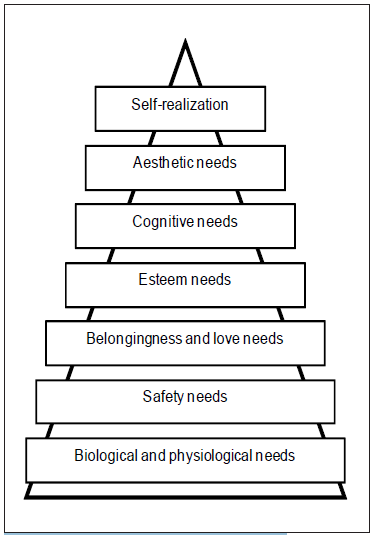
According to Maslow, individuals try to satisfy these different levels from the most basic needs and objectives, such as nutrition (hierarchy level 7), to the more complex and subjective ones which deal with personal desires and ideologies. For the author, these needs should be satisfied in increasing order according to an individual’s possibilities.
On this subject, it is interesting to observe that the consumption of organic products goes beyond just meeting physiological needs. It can be seen in practically all Maslow’s needs levels, and in addition to the demands of nutritional quality and health as social and environmental questions, it is intimately linked to the ideological background of consumers, towards self-realization.
A tool used to bring a better understanding of people’s buying motivation and consumption is the Marketing Mix (Shamdasani et al., 1993; Woodside & Wilson, 1994; Andrews & Franke, 1996). The marketing system is an instrument for identifying the validity of strategies chosen by companies and product categories. In this way, organizations can align their understanding of client wishes and needs with value generating attributes and those which justify adopting a particular product or service.
Cobra (2003) stated that the process of adopting marketing strategies consists of four elements from marketing mix. These are product, price, promotion, and place, also known as the four Ps. From the viewpoint of Prof. McCarthy, who coined them, their interaction is important for an organization to reach its objectives in harmony with satisfying the needs and desires of consumers.
Marketing mix is the way by which a company translates its strategy from a declaration of intention into a market force. Each element of the mix must be conceived in a form which adds to the position required. An area of differentiation for highquality products or services would not be so attractive if the price charged were very low; also, the promotion dimension must communicate its quality and required an appeal. Distribution systems or channels must guarantee that products or services reach their target consumers (Hooley, Saunders & Piercy, 2001). Shamdasani et al. (1993) conducted an exploratory study with «green» consumers from personal, social and marketing mix dimensions. This research, in turn, follows a similar methodological perspective, from the cognitive aspects of the marketing mix.
Similarly, the methodological procedures described below are intended to capture personal, social aspects and marketing strategies to identify characteristics of consumption of organic products in a particular region.
3. METHODOLOGY
A quantitative method was used with an exploratory type study, having adopted a non-probabilistic sample. Therefore, inferences extracted from the sample must be weighed together with the limitations of this approach (Vergara, 1998).
The total sample consisted of 72 respondents in Botucatu, SP, Brazil and 69 were finally selected.
Data were collected by using a questionnaire with closed questions, in four blocks: a) respondent profiles; b) type of organic products consumed by respondent; c) locale where organic products purchased; and, d) identification of reasons why the consumer opts for this type of product on the marketing mix. Data were processed by descriptive statistics using frequencies, percentages and multivariate statistics by factor analysis of obtained responses. Study data are shown followed by results analysis linked to the theory behind them to look for better explanatory power for the work.
4. RESULTS DISCUSSION
Results are first presented by descriptive analysis which provides sample characterization and impressions on consumer behavior for organic products per se. These are followed by factor analysis of the statements, in an attempt to more clearly show factors which influence the decision of Botucatu respondents to consume organic products.
4.1. SAMPLE CHARACTERIZATION
Most respondents were male (53.6%). Their ages varied with a small advantage in the 41 to 50 year age group (27.54%).
Ninety percent (90%) of respondents were Botucatu residents. The rest were from neighboring cities, the most distant being São Paulo and Londrina.
Practically 70% of respondents had a university education, followed by graduation (18.8%) and high school (5.8%). The most common occupation was a professor (24.6%), followed by agronomist (10.1%), indicating consumption concentrated in professionals with a much higher education level.
Television was the most common communication medium used by respondents to keep themselves informed (73.91%), followed equally by newspapers and the internet (65.22%), magazines (50.72), radio (34.78%), and other means of communication (13.04%).
4.2. ORGANIC PRODUCT CONSUMPTION CHARACTERISTICS
In relation to product types, 82.61% consumed two or more types of organic product, the largest being vegetables (94.20%), followed by fruits (75.36%), processed products (55.07%), ready meals (36,23%), hygiene products (24.64%), and others (10.14%); data are shown in Graph Nº 1.
Most respondents consumed organic products in two or more distinct locations, showing the concentration advantages in product place. The most common place for purchasing organic products was the Organic Fayre (66.67%), followed by greengrocers (52.17%), supermarkets (42.03%), street markets (37.68%), restaurants (36.23%), pharmacies (24.64%), and others (20.29%), which includes the following: direct from the producer, community vegetable garden, natural product stores, and Estancia Demetria. These data are shown in Graph Nº 2.
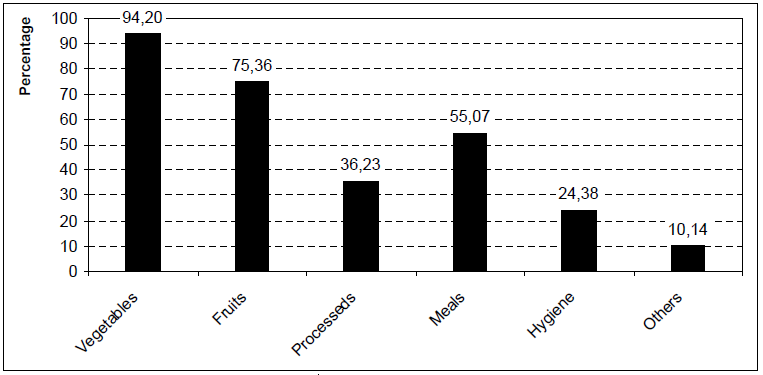
Graph 1.
Organic products consumption
Own elaboration
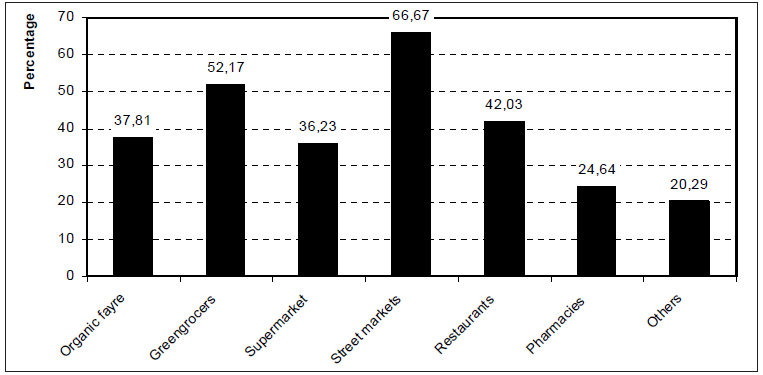
Graph 2.
Organic products points of sale
Own elaboration
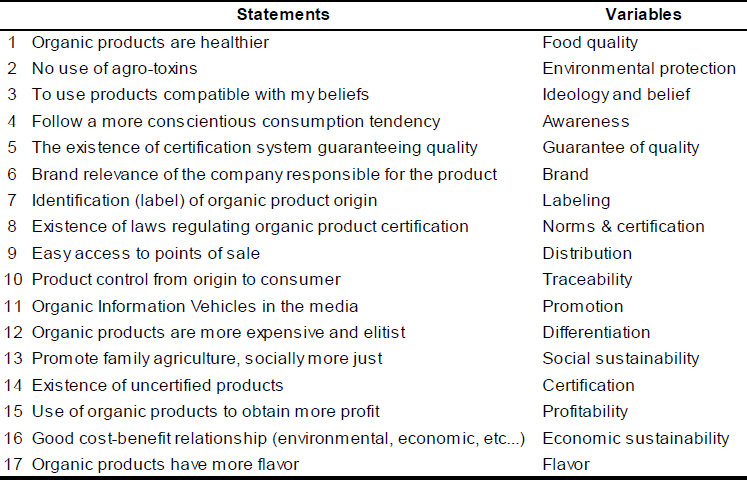
One-quarter of the research instrument was composed of a five point Likert Scale aimed at identifying variables which represent consumer motivation in acquiring organic products. From a list of seventeen (17) statements showed in Table Nº 1, the customer declared what level of influence each had on the purchasing act, varying from «no influence» to «very strong influence» in their decision to buy organic products. Factor analysis was used to study these phrases in order to identify the most significant factors.
4.3. FACTOR ANALYSIS FOR VARIABLE REDUCTION
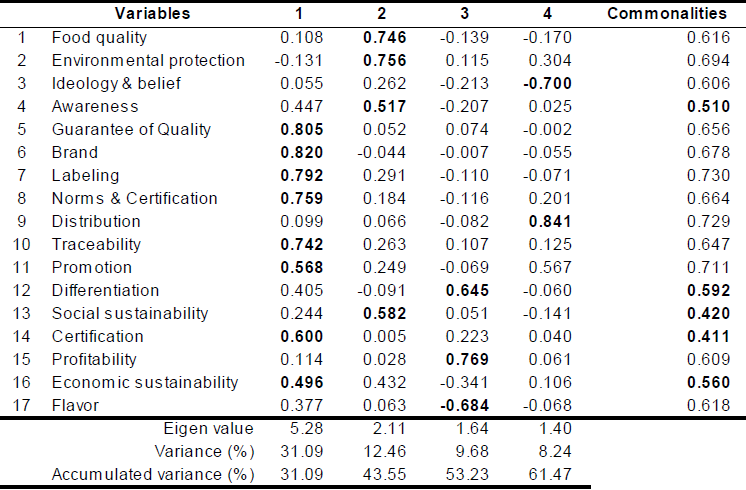
Results analysis of descriptive terms was made using factorial analysis by substituting the original group of variables with another smaller group called factors so as to identify the latent dimensions in these variables to get a more comprehensive interpretation according to standard directions (Malhotra, 2012). For this, the varimax criteria were used which maximizes the variance between factors for factor matrix rotation. The results of applying factor analysis are shown in Table Nº 2.
Before continuing the analysis, it was necessary to verify some essential basic premises in the technique of applying factor analysis (Hair, Anderson, Tatham & Black, 2005). The first referred to the probability of relationships existing between the study variables. This could be seen by Bartlett’s Test of Sphericity (BTS) values equal to 439.05 and significance levels of 0.000. The second premise referred to the Measure of Sampling Adequacy (MSA), where the Kaiser-Meyer-Olkin (KMO) test value was 0.73. KMO equal to 0.73 indicated that data were a reasonable fit for factor analysis (Pereira, 1999). Thus having verified and satisfied the necessary premises for applying factor analysis, the next phase was extraction analysis of the subjacent factors from the group of collected data. Four significant factors were identified related to eigenvalues greater than 1 and representative of 61% of the original data variance.
In addition, the proportion of total variations for the variables which were involved with the factors identified given by commonalities were higher than 0,618, except for those identified by number 4 (Awareness), 12 (Differentiation), 13 (Social sustainability), 14 (Certification), and 16 (Economic sustainability) that explicit 51,0%, 59,2%, 42,0%, 41,1% and 56,0%, respectively. This proportion of explained variances (61,8% total
Own calculations, based on research data
Own calculations, based on research dataTable 2. BTS (Bartlett’s Test of Sphericity) Approx. Chi-Square: 439.05
Degree of freedom: 136
Significance level: 0.000
Measure of Sampling Adequacy (MSA), Kaiser-Meyer-Olkin (KMO): 0.73
Own calculations, based on research data
variance) gave a good indication of the level of which these variables were related to the factor. The main components and new denominations of the subjacent factors area presented next.
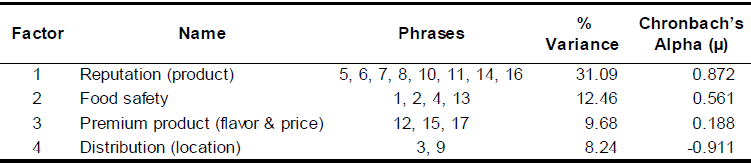
The Table Nº 3 shows that «Reputation» was the most important factor and explained 31.0% of the total variance and internal consistency or confidence, given a Chronbach’s a coefficient of 0.872. It signifies that the «Reputation» factor has an internal consistency or confidence of 87%.
Chronbach’s a coefficient varies between 0 and 1 where values of 0.6 to 0.7 are considered as the lower limit of acceptability.
The other factors, «Food safety», «Premium product», and «Distribution» explained 30.4% of the total variance. However, internal consistency gave by Chronbach’s a coefficients of 0.561; 0.188; and -0.911, respectively, were less than the lower limit of 0,6. Also by being negative, «distribution» violated the objective of the confidence model (Iacobucci & Duhachek, 2003).
In this point it must be clearly highlighted that the possible values for Cronbach’s a coefficient are between 0 and 1, where the judgment of whether the combination of factors or principal components resulting from the obtained values is satisfactory or not, rests exclusively on the researcher as there is no ideal cutoff point with which to judge the conception of any indicator (Pereira, 1999).
However, considering values greater than 0.6 for each variable as a guide to acceptable level, we can see from Table Nº 2 that that the main component «Reputation» incorporated two variables, «certification» and «economic sustainability» with commonality values of 0.411 and 0.560, which are below a Chronbach’s a of 0.6. Thus, «Reputation» was reconsidered, removing these two variables and changing it from a factor incorporating eight to a factor combining six variables.
4.4. PURCHASING ATTRIBUTE IMPORTANCE
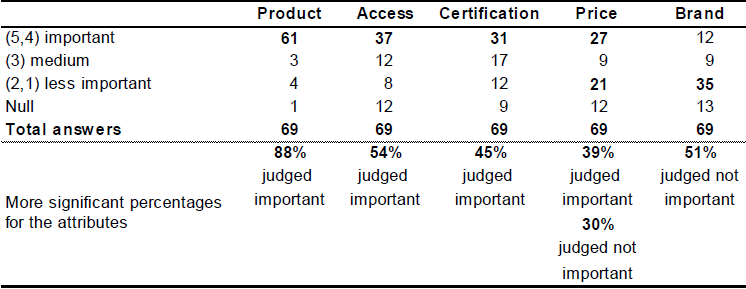
The fifth step in the questionnaire aimed to understand which attributes were more important to the client when buying organic products from the perspective of the marketing mix. For this, the respondent was asked to put into order of importance the following attributes: Product, Price, Promotion (Brand and Certification), and Place (Access).
Results can be seen in Table Nº 4, where apparently the Product is given highest importance (88%); followed by product accessibility (54%) and certification (45%), whose influence is perceived but not a detail with which the consumer in Botucatu is very interested. Price is in fourth place with similar percentages of respondents judging it important (39%) and not important (30%); this could be directly related to respondent acquisition power or sustainability mindset. The item least valued by this sample was brand (51%), demonstrating that this population is not sensitive to product brand; giving the level of education and awareness of these consumers shows that value is attributed to questions essential and real to the product and life rather than to isolated product promotion.
Finally, putting the individual attributes most valued by organic product consumers from Botucatu in descending order of importance, we get the following: product, access, price, certification, and brand, as shown in Table Nº 4.
4.5. ANALYSIS AND COMMENTS
In this section, it was used the specific objectives to present the analysis and feedback of data results under the approaches behavioral, cognitive and sociological.
In relation with the first specific goal, i.e. identify the profile of organic product consumers, it was found they are adult consumers, nearly all resident in Botucatu, well educated, well informed; both sexes participating in decisions on consuming organic products, and a significant number working in education and agronomy. It is a distinguished audience if we consider that the average years of schooling of the people of 10 years or more does not reach eight years in Brazil (IBGE,
Own calculations, based on research data
2016). Here, the focus is on the personal dimension, one of the aspects that influence the buying process by the Cognitive Theory.
According to this approach, the consumer, the product, and the environment are part of the buying decision. Among the factors are the cognitive perception, learning, memory, personality, and attitudes. With respect to the product, the specific objective 2 (i.e. identify the type of products consumed by respondents) pointed results to the highest consumption as vegetables (94.20%), followed by fruit (75.36%), has a strong relationship to the existence of organized groups with local producers such as Botucatu Gardens Community (Hortas Comunitárias de Botucatu), Botucatu Organic Producers Association (Associação de Produtores Orgânicos de Botucatu), among others. The Municipal Council’s Agriculture Department promotes discussion with bodies to strengthen the work of organic producers in the Botucatu region (Pessoa, 2007). Other movements such as Demetria District, which has grown out of work started by biodynamic producers in Estancia Demetria in 1974, currently look after diverse related initiatives such as restaurants, schools, associations, markets, and other attractions. The local stimulus given by the media pointed to Behavioral Theory is where the understanding of the environment makes it possible to explain the mechanisms of choice of purchase.
The third specific objective, i.e. identify where consumers acquire their organic products, confirms the importance of the environment in which the close relationship between Botucatu and biodynamic and organic agriculture movements has resulted in a more specialized product distribution system, providing outlets where these products can be purchased. The Organic Fayre and Verde Vivo greengrocers are examples of initiatives by Botucatu Organic Producers Association in partnership with the Municipal Council and Sebrae (The Brazilian Small Business Initiative), bringing specialized organic products points of sale. Conventional greengrocers and supermarket chains also offer these types of product with easy access to the city’s green belt and good consumer acceptance. From the sociological perspective, consumption takes place in the midst of a social process consubstantiated by historical, social, and cultural conditioning.
Thus, the fourth specific objective, i.e. understand the primary factors which affect their organic product consumption, show that sociocultural characteristics open new opportunities for adopting strategies focused on supplying particular client groups (Aaker, 2001), specifically establishments such as restaurants, bars, pizzerias, and pharmacies.
Lastly, the fifth specific objective, i.e. identify attribute priorities for organic product consumers, highlighted four factors, which were named Reputation, Food Safety, Premium Product, and Distribution by the authors.
The Factor 1, most significant, was «Reputation». It was directly related to the consumer perception of the product. This image is created by statements which correspond to tangible product resources such as quality guarantee, healthiness, product promotion, and organization; also with aspects of labeling, norms and regulations, product traceability, and certification. The significance of this factor provides clear indications of the need to organize the organic segment in the regions of Brazil, but specifically in Botucatu, São Paulo State – this study’s audience; beyond belief that organic product is better than the conventional.
The consumer recognizes the need for «Food Safety», highlighted by Factor 2, which is related to food and handling quality which guarantees environmental protection and renewal. However, this is a curious conjunction of aspects related to social awareness and sustainability for which the other characteristics should be obtained. In the case of Brazil, there is an evident lack of information and education for most of the population, leaving them marginalized to the more aware and safer consumer opportunities. Reporting on the Maslow motivation hierarchy, consumption needs permeate all seven levels of his theory’s pyramid, from simple biological nutrition to the realization of feeling a part of the whole, which takes more socially conscious decisions.
Factors 3 and 4, respectively named «Premium Product» and «Distribution», declare certain cohesion in the sense that the aspects grouped under Premium Product, relate to price, differentiation, profitability, and flavor. Based on these findings, is possible to highlight that these are the characteristics of premium products, a marketing strategy term for differentiated products reserved for niche markets, and which generally give high returns to makers, producers, and resellers. It is believed that organic products in Brazil are still seen as products in this premium category, by providing flavor and price differentiation.
Factor 4, distribution, unites statements about product ideology and distribution, and with its negative value could represent potential difficulties in the distribution of organic products and the need for a strong ideology to search for them. Access to organic products in Brazil is still restricted to specific regions where professional activity provides this type of handling, as is the case in Botucatu, and also has got on the priority lists of large supermarket chains, to create their own high value brand group, as is the case with the Pão de Açúcar chain and their brand Taeq and Carrefour, with the Viver brand.
The way in which factor analysis groups variables with higher explanation power, provides an important scenario for marketing strategies and their managers, through showing market paths and consumer needs.
6 CONCLUSIONS
In analyzing organic product consumer behavior in Botucatu were found aspects from personal, environmental and marketing strategies.
From a behavioral approach, cognitive and marketing system (or marketing mix) angle, it is possible to identify which attributes are more and less valued by the client in the act of buying, the social context, as well as perceive how companies who produce and commercialize this type of product can mount their strategies.
Company actions are not always consciously related to the marketing theory proposal, which concerns itself with the relationship between goods and services and its target public. In the case of Botucatu companies, the sociocultural environment of the city and region contribute to knowledge and access to the different types of organic products offered to the population, be they natural, prepared, or processed. The influx of cultural groups who value and foster this sort of management influence others to share similar ideas. Institutional organizations also contribute in a facilitating and supporting role for favorable movements towards this category of products. As behavioral theory says, the stimulus from the environment could explain consumer choice mechanisms.
Apart from the external environment, the results of this study have shown that the organic product consumer of Botucatu is highly interested with product reputation, valuing the mechanisms of quality guarantee, brand, labeling, norms, traceability, and certification. Other attribute categories, such as price and accessibility, are not so relevant in this case. It does not mean that they are not important; on the contrary, they open new avenues of exploration by companies which commercialize organic products in Botucatu and other regions.
The conclusions of this study are, in principle, compatible with earlier studies made in other areas of the behavior of organic product consumers. However, improvements are prudent and necessary in the applied scale that details such actions and marketing strategies, as well as following individual and sociocultural changes in food consumption.
Future studies should replicate this research in other locations to identify whether the organic products market in Botucatu follows the same behavior profile or is more related to regional peculiarities.
References
Aaker, D. (2001). Administração estratégica de mercados. Porto Alegre: Bookman.
Andrews, R. L. & Franke, G. R. (1996). Dynamics of aggregate response sensitivities to marketing mix variables. Journal of Business Research, 36(2), 145-155.
Arnaldi, C. R. & Perosa, J. M. Y. (2004). Comercialização de produtos orgânicos em Botucatu. Procedures of the XLII Congresso da Sociedade Brasileira de Economia e Sociologia Rural, Cuiába – MT, Brazil.
Botonaki, A., Polymeros, K., Tsakiridou, E. & Mattas, K. (2006). The role of food quality certification on consumers’ food choices. British Food Journal, 2/3(108), 77-90.
Campbell, H. & Liepins, R. (2001). Naming organics: Understanding organic standards in New Zealand as a discursive field. Sociologia Ruralis, 41(1), 21-39.
Cobra, M. (2003). Administração de Marketing no Brasil. São Paulo: Cobra Editora.
Darolt, M. R. (2001). O papel do consumidor no mercado de produtos orgânicos. Agroecologia Hoje, 2, 8-9.
Gazeta Mercantil. (09/29/2000). Boa procura por alimentos orgânicos. Gazeta Mercantil Journal, Sao Paulo, SP, Brazil.
Hair, J. R., Anderson, J. F., Tatham, R. E. & Black, W. C. (2005). Multivariate data analysis. Upper Saddle River, NJ: Prentice-Hall, 5th ed.
Hooley, G. J., Saunders, J. A. & Piercy, N. F. (2001). Estratégia de marketing e posicionamento competitivo. São Paulo: Prentice Hall.
Hughner, R. S., McDonagh, P., Prothero, A., Shultz, C. J. & Stanton, J. (2007). Who are organic food consumers? A compilation and review of why people purchase organic food. Journal of Consumer Behavior, 6(2 3), 94-110.
Instituto Brasileiro de Geografia e Estatística, IBGE. (2016). Média de anos de estudo das pessoas de 10 anos ou mais de idade por sexo. Retrieved from http://seriesestatisticas.ibge.gov.br/series.aspx?no=4&op=0&vcodigo=ECE370&t= media-anos-estudo-pessoas-10-anos
Iacobucci, D. & Duhachek, A. (2003). Advancing alpha: Measuring Realibility with confidence. USA: Journal of Consumer Pshychology, 13(4), 478-487.
Instituto Biodinâmico, IBD. (2013). Instituto Biodinâmico. Available on http:// www.ibd.com.br
Kny, M. A., Senna, A. J. T., Barata, T. S., Cesar, C., Correa, D. K. A., Goulart, G. R.& Koehler, T. H. (2005). Análise comparativa dos valores pessoais dos produtores e consumidores de produtos orgânicos. Procedures of the XXIX Enanpad – Encontro Nacional Anpad. Brasilia, DF, Brazil.
Kotler, P. (1996). Administração de marketing, análise, planejamento e controle. São Paulo: Atlas.
Kontogeorgos, A. & Semos, A. (2008) Marketing aspects of quality assurance systems: The organic food sector case. British Food Journal, 110(8), 829-839.
Levitt, T. (1975). Marketing myopia. Harvard Business Review, 53, 26-48.
Malhotra, N. K. (2012). Pesquisa de marketing: uma orientação aplicada. Bookman Editora.
Maravegias, N., Apostolopoulos, K., Mattas, K., Baltas, N., Moisidis, A., Papageorgiou, K. & Psaltopoulos, D. (2002). Sustainable agriculture in a developed countryside: A ten year strategy for the agricultural development of Greece. Working Paper, Greek Ministry of Agriculture, Athens.
Maslow, A. H. (11/19/2003). O diário de negocios de Maslow. Rio de Janeiro: Qualitymark.
Miranda, L. (2001). Cresce a variedade de alimentos mais saudável. Jornal OESP, Biotecnologia, p. A11.
Mowen, J. C. & Minor, M. S. (2003). Comportamento do consumidor. SP: Prentice Hall.
Nunes, J. M. G. (2006). Comportamento do consumidor e pesquisa de mercado. Rio de Janeiro: Editora FGV, 3rd ed.
Organics Brazil. (2016). Mercado de orgânicos cresce o dobro no Brasil. Retrieved from http://www.organicsnet.com.br/2016/01/mercado- de-organicos-cresce-o-dobro-no-brasil/
Ormond, J. G. P., Paula, S. R. L. & Rocha, L. T. M. (2002). Agricultura Orgânica: quando o passado é futuro. BNDES Setorial, Rio de Janeiro, Brazil. Retrieved from https://web.bndes.gov.br/bib/jspui/handle/1408/2479
Pereira, J. C. R. (1999). Análise de dados qualitativos. São Paulo: Editora da Universidade de São Paulo.
Pessoa, A. (2007). Botucatu participa pela primeira vez de feira internacional de produtos orgânicos. Web Site Agricultura. Retrieved from http://www.botucatu.sp.gov.br/news/
Salomão, C. C. (2006). Mercado de orgânicos no Brasil e exterior. Retrieved from http:// www.arscientia.com.br
Sambiase-Lombardi, M., Moori, R. G., & Sato, G. (2004). Um estudo exploratório dos fatores relevantes na decisão de compra de produtos orgânicos. Revista de Administração Mackenzie, 5(1). Retrieved from http:// editorarevistas.mackenzie.br/index.php/RAM/article/view/46
Shamdasani, P., Chon-Lin, G. O. & Richmond, D. (1993). Exploring green consumers in an oriental culture: Role of personal and marketing mix factors. Advances in Consumer Research, 20(1), 488-493.
Smith, N. C., Drumwright, M. E. & Gentile, M. C. (2010). The new marketing myopia. Journal of Public Policy & Marketing, 29(1), 4-11. doi: http://dx.doi.org/10.1509/jppm.29.1.4
Storch, G., Azevedo, R., Silva, F., Brizola, R., Vaz, D. & Bezerra, A. (2003). Caracterização dos consumidores de produtos da agricultura orgânica na região de Pelotas – RS. Agrociência, 9(1), 71-74.
Vergara, S. C. (1998). Projetos e relatórios de pesquisa em administração. São Paulo: Atlas.
Willer, H., Yussefi, M. & Sorensen, N. (2010). The world of organic agriculture: Statistics and emerging trends 2008. Bonn (Germany): Earthscan.
Woodside, A. G. & Wilson, E. J. (1994). Diagnosing customer comparisons of competitors´ marketing mix strategies. Journal of Business Research, 31(1,2), 133-144.
Author notes