Articulos
Influential factors in the adherence to the certified organic production system in relation to the profile of the establishments and rural producers in Brazil
Factores determinantes de la adopción del sistema de producción orgánica certificada en relación con el perfil de los establecimientos y productores rurales en Brasil
Facteurs influençant la certification du système de production biologique et sa relation avec le profil d’établissements et des producteurs ruraux au Brésil
Fatores que influenciam na certificação do sistema orgânico de produção e sua relação com o perfil dos estabelecimentos e produtores rurais no Brasil
Influential factors in the adherence to the certified organic production system in relation to the profile of the establishments and rural producers in Brazil
Agroalimentaria, vol. 25, no. 49, pp. 45-63, 2019
Universidad de los Andes

This work is licensed under Creative Commons Attribution-NonCommercial-ShareAlike 3.0 International.
Received: 11 June 2018
Revised: 04 June 2019
Accepted: 03 September 2019
Abstract: From 2011 the adoption of the organic product seal, through a certification process, has become compulsory for marketing in Brazilian commercial establishments, except for sales made directly in the municipalities of production origin. In this way, rural producers who remained marketing their products in local and non-local establishments have had to comply with the new legislation. Beyond the legal aspect, there are other factors that influence the decision to obtain a certificate of organic, above all, the need for investment to do so. Thus, this work aims to identify and analyze the influence factors in the adoption of organic certification in rural production in Brazil. Therefore, it is identified whether or not there are differences due to the rural establishments found or the profiles of the producers analyzed. For the development of this research, a survey was carried out with 200 rural producers with organic certification in Brazil. Data were analyzed by using descriptive statistics, exploratory factor analysis and hypothesis tests. The influence factors in the certification identified in this survey refer to the principles of organic production, market and external groups. It should be emphasized that there was a heterogeneity regarding the importance of these factors as an influence on the decision to obtain the certificate of organic. In the aspects related to the characteristics of rural establishments, the highlights were the State where the producer is located and the level of product processing. On the other hand, in the aspects related to the characteristics of the producers, the level of schooling and the type of certification used stand out.
Keywords: Brazil, certification, exploratory factorial analysis, organic certification, organic production, rural agriculture.
Resumen: Desde 2011, la adopción del sello orgánico a través de un proceso de certificación de productos es obligatoria para la comercialización en los establecimientos comerciales de Brasil, excepto para las ventas realizadas directamente en los municipios de origen de producción. De esta forma, los productores rurales que continuaron comercializando sus productos en diversos establecimientos, tanto los ubicados en su localidad como fuera de ella, tuvieron que cumplir la nueva legislación. Más allá del aspecto legal, existen otros factores que influyen en la decisión de obtener un certificado de producto orgánico; sobre todo, las inversiones necesarias para poder llevarlo a cabo. En este escenario, la investigación realizada tuvo como objetivo identificar y analizar los factores que determinan la adopción de la certificación orgánica en la producción agrícola en Brasil. Con este propósito se determinó si existían o no diferencias en cuanto a la adopción de esta certificación en función del tipo de establecimientos rurales y del perfil de los productores analizados. Para el desarrollo de esta investigación se realizó una encuesta a 200 productores rurales que habían adoptado la certificación orgánica. Los datos fueron analizados mediante estadística descriptiva, análisis factorial exploratorio y pruebas de hipótesis. Los factores que inciden en la certificación identificados en esta encuesta se refieren a los principios de producción orgánica, mercado y grupos externos. Cabe destacar que hubo una heterogeneidad con respecto a la importancia de estos factores como determinantes de la decisión de adoptar la certificación de producto orgánico. En cuanto a los aspectos referidos a las características de los establecimientos rurales, los más destacados fueron el estado donde se encuentra el productor y el nivel de procesamiento del producto. Por otro lado, en cuanto a los aspectos referidos a las características de los productores, se destacan el nivel de escolaridad y el tipo de certificación adoptada.
Palabras clave: agricultura rural, análisis factorial exploratorio, Brasil, certificación, certificación orgánica, producción orgánica.
Résumé: Depuis 2011, l’adoption du label de produits biologiques, par le biais d’un processus de certification, est devenue obligatoire pour la commercialisation dans les établissements commerciaux au Brésil, à l’exception des ventes effectuées directement dans les municipalités d’origine. De cette manière, les producteurs ruraux qui ont continué à commercialiser leurs produits dans des établissements locaux et non locaux ont dû se conformer à la nouvelle législation. Au-delà de l'aspect juridique, d'autres facteurs influencent la décision d'obtenir un certificat de produit biologique; surtout, les investissements nécessaires à sa réalisation. Ainsi, ce travail vise à identifier et analyser les facteurs qui déterminent l’adoption de la certification biologique dans la production rurale au Brésil. À cette fin, il a été déterminé s'il y avait ou non des différences dans l'adoption de cette certification en raison du type d'établissements ruraux trouvés, ainsi que des profils des producteurs analysés. Pour le développement de cette recherche, une enquête a été menée auprès de 200 producteurs ruraux certifiés biologiques au Brésil. Les données ont été analysées à l’aide de statistiques descriptives, d’analyses factorielles exploratoires et de tests d’hypothèses. Les facteurs influençant la certification identifiés dans cette enquête se réfèrent aux principes de la production biologique, du marché et des groupes externes. Il convient de souligner qu’il y avait une hétérogénéité quant à l’importance de ces facteurs en tant que déterminants de la décision d'obtenir la certification de produit biologique. En ce qui concerne les aspects liés aux caractéristiques des établissements ruraux, les plus importants sont l’État où se trouve le producteur et le niveau de transformation du produit. En revanche, en ce qui concerne les aspects liés aux caractéristiques des producteurs, on distingue le niveau de scolarité et le type de certification utilisé.
Mots clés: Agriculture rurale, analyse exploratoire des facteurs, Brésil, certification, certification biologique, production biologique.
Resumo: A partir de 2011 a adoção do selo de produto orgânico, por meio de um processo de certificação, se tornou compulsória à comercialização em estabelecimentos comerciais do Brasil, com exceção para vendas efetivadas diretamente nos próprios municípios de origem da produção. Desta maneira, os produtores rurais que permaneceram no mercado comercializando seus produtos nos estabelecimentos comerciais locais, tanto quanto fora deles, tiveram que se adequar à nova legislação. Além do aspecto legal, existem outros fatores que interferem na decisão de obter um certificado de orgânico, sobretudo, a necessidade de investimentos para tal. Assim, esse trabalho busca identificar e analisar os fatores que influenciam na adesão da certificação orgânica na produção rural no Brasil, identificando se há ou não diferenças nesta decisão, em razão dos estabelecimentos rurais encontrados ou dos perfis dos produtores analisados. Para o desenvolvimento desta pesquisa, foi realizado um survey com 200 produtores rurais com certificação orgânica no Brasil e os dados foram analisados utilizando-se estatística descritiva, análise fatorial exploratória e testes de hipóteses. Os fatores de influência na certificação identificados na pesquisa referem-se aos princípios da produção orgânica, mercado e grupos externos. Ressalta-se que houve uma heterogeneidade no que se refere à importância desses fatores, enquanto influência na decisão de certificar-se. Nos aspectos relacionados às características dos estabelecimentos rurais, destacaram-se o estado onde está localizado o produtor e o nível de beneficiamento do produto e, nos aspectos relacionados às características do produtor, o nível de escolaridade e o tipo de certificação utilizada.
Palavras-chave: agricultura rural, análise fatorial exploratória, Brasil, certificação, certificação orgânica, produção orgânica.
1. Organic agriculture and certification
Organic farming is not a new activity and has been developed over decades by producers and groups opposed to conventional farming. The National Research Council and the United States Department of Agriculture (USDA) supported such productive activity in 1980, first in the USA, when they began a series of studies on production systems that were able to reduce the use of synthetic chemical inputs.
In 1990, an agricultural law called “Facta” was enacted in the United States (US), which gave the USDA the responsibility to establish development programs directed to this type of agriculture. This law has come to be seen as an ecologically balanced, socially just and economically viable model of agriculture (Souza & Alcantara, 2003). This Act established in 2002 the legal basis for the National Organic Program (NOP) to enforce agricultural products sold, labeled, or represented as organic within in US. The legislation of organic production had some updates in 1992, 1997 and 2010 (Huber, Schmid, Batlogg & Castro, 2019).
In the early 1990s, the technical regulations for the organic production of plant origin in the European Union (EC 2092/91; EC, 1991) were drafted, at the time the largest organic market, with updates in 2008 and 2018. By the end of the decade, the Codex Alimentarius established guidelines for organic production of plant origin and, in 2001, issued guidelines for animal production (GL-32/99/Rev. 2001; FAO, 2001). In 2018 the data of the Research Institute of Organic Agriculture (FiBL) pointed that 93 countries have organic legislation and 16 countries are in the process of drafting legislation. It is also noteworthy that in the Asia and Pacific Region and Africa Region there are countries that mostly do not have national legislation for organic production (Huber, Schmid, Batlogg & Castro, 2019).
These international reference standards are based on the specific realities, practices and contexts of temperate and high-income countries. However, today it is common practice in most countries to practice the equivalence agreement between international standards, which promotes access to a diversity of organic products on the global market. The world growth in agricultural areas occurred more expressively since the turn of the millennium. Between 2000 and 2008 there was a growth in the area of approximately 20 million hectares, from 15 million to 35 million hectares (Willer & Kilcher, 2010). The latest report from FiBL-IFOAM (2019) pointed that a total of 69.8 million hectares were organically managed at the end of 2017, representing a growth of 20 percent of over 2016, the largest growth ever recorded. Australia has the largest organic agriculture area, followed Argentina and China (FiBL-IFOAM, 2019).
In terms of number of producers, Asia represents the region with the largest number of producers. Of the 2.9 billion producers in the world, 40% are in Asia, followed by Africa (28%) and Latin America (16%). With regard to sales of organic products, the countries with the largest markets for organic food are the United States (€ 40 billion), flowed of Germany (€ 10 billion and France (€ 7.9 billion) (FiBL-IFOAM, 2019).
This expansion is largely associated with rising costs, environmental problems and food contamination caused by conventional or industrial agriculture. At the same time, ecologically based agriculture can provide benefits for biodiversity, the environment and animal welfare. In addition, consumer demand for “clean”, chemical-free and/or genetically modified products is increasing.
Organic cultivation in Brazil was also initiated in the 1980s through influences from religious and ethical movements in pursuit of more sustainable food production. In Latin America, Brazil is the leader of the Organic Market. However, in relation to the extension of land destined to organic agriculture, the country is third in the region, after Argentina and Uruguay, in tenth in the world (MAPA, 2019b).
However, in the late 1990s, the sector was regulated by Normative Instruction No 007, dated May 17th, 1999 (MAPA, 1999). In 2003, Law 10,831 was sanctioned (Brasil, 2003), regulated by Decree 158 of 2004 and complemented by Normative Instruction No. 016, also of 2004 (Brasil, 2004). These standards establish guidelines for production, typing, processing, bottling, distribution, identification and quality certification for organic products of plant and animal origin. In December 2007, Decree No. 6,323 put important specifications in regulating the organic sector (Brasil, 2007). From the date of its publication, the certifiers were required to register the data of the rural properties that certify their products in the Ministry of Agriculture and Livestock (known as MAPA, by its Portuguese acronym). These data refer to: quantity of properties, area of exploitation, production, productivity and crops (Brasil, 2007).
According to Art. 1 of Law 10,831 of December 23rd, 2003, which deals with activities relevant to the development of organic agriculture, it is considered an organic system of agricultural production
(…) all those in which specific techniques are adopted, through the optimization of the use of available natural and socio-economic resources, and respect for the cultural integrity of rural communities, with the objective of economic and ecological sustainability, maximization of social benefits, minimization of dependence on non-renewable energy, using, wherever possible, cultural, biological and mechanical methods, as opposed to the use of synthetic materials, the elimination of the use of genetically modified organisms and ionizing radiation at any stage of the production, processing, storage, distribution and marketing process and the protection of the environment. (Brasil, 2003)
Brazilian law establishes three instruments to certificate of organic products: i) the Third Party Organization; ii) the Participatory Guarantee Systems; and, iii) Social Control for direct sale without certification. Certification by audit (third party) is the process in which a third party –which does not have link with who will be certified– ensures that a product, process or service meets certain requirements, by issuing a certificate. There are two ways of certification, individually or in groups. A second control mechanism is the Participatory Guarantee System (PGS) of organic quality. This system is characterized by collective responsibility of theirs members in obtaining this control mechanism, but it is noteworthy that the PGS must have a Participatory Body Conformity Assessment (PBCA), legally constituted (being a legal entity) and accredited in MAPA (2011). PGS are particularly suitable for small-scale famers and local markets, and since 2004 the numbers of PGS has been growing on all continents, particularly in the Latin America and Caribbean region (Andriguetto, Kirschner, Castro & Varini, 2019). This kind of certification is recognized by IFOAM and it is used in some of countries like Brazil Bolivia, Costa Rica, Ecuador, Chile, Mexico, Paraguay, Uruguay, French Polynesia, India, Japan and New Caledonia (Huber, Schmid, Batlogg & Castro, 2019). The Latin America is the region where this kind of certification system is most representative, and Brazil is in first. The third option for control is social control in direct selling. This certification mechanism offers the producer a certificate that the product it is marketing is organic, but the producer cannot use the organic label (Scalco & Servi, 2014).
In Brazil, from the regulation of the sector, with the obligation of organic systems to be certified, began a process of positive evolution in the number of certified producers in the country. In 2012 there were 5,934 certified producers, reaching 2019 with 17,730 certified producers (MAPA, 2019a), that is, an increase of 200% in terms of number of certified producers. Despite this exponential growth in the number of certified organic producers, it is noteworthy that the last Brazilian agricultural census revealed that there were 90,000 producers in the country who declared themselves as organic; that is, it has in the country another 73,000 producers who did not certify their ownership and who self-declared as organic producers. The expectation is that the evolution in terms of number of producers is still positive, as producers overcome barriers and feel safe to enter the certified system (MAPA, 2019b).
Although public policies developed worldwide for organic production are still unrepresentative in relation to production, the number of government policies and programs is growing, such as subsidy schemes, market development support, capacity building and research investment (Varini & Andriguetto, 2019). The leading continent in terms of public support to organic production is Europe (particularly the European Union, EU). The measures provided the introduction of support for the conversion to and maintenance of organic production. In the case of United States, leading the global organic market, adopt a less interventionist policy and prefers to let market forces drive the agricultural sector and market development. The government covers partially the certification costs (Varini & Adriguetto, 2019). In Latin America, policy support for organic agriculture has been generally very low, except Brazil. The Brazilian government has developed public policies to motivate producers who use agroecological management practices to enter the Brazilian organic system. One of the public policies developed is the PNAE (Programa Nacional de Alimentação Escolar) that privileges the food produced by organic family farming in the municipality.
There are producers who use organic management practices, but they do not certify their product. This is a marketing issue, certify or not certify. Each country is free to determine whether certification of organic products should be mandatory or not. In US, European and Brazilian markets, the use of certification for the commercialization of organic products is mandatory. In Brazil, specifically, family farmers are exempted from the use of the certificate for direct sale; however they must be registered in the inspection body (Brasil, 2007).
The United States and Europe offer some incentives for the producer to certify. In the US, for example, small producers receive 75% reimbursement in payment to the certifier.
Veldstra, Alexander & Marshall (2014) conducted a survey with US producers (conventional and organic) in order to understand whether or not to, first, produce in the organic system; and, secondly, to certify organic production. They observed that small-scale growers (with income less than a USD 5,000) have more production under organic practices, and less production under certification. The researchers noted that the producers did not intend to certify their production, since they market in direct channels; that is, because the interaction with consumers is high, this does not require the need for a certificate. In addition, consumers in these channels are more willing to pay a higher price because of the purchase of local products than because of organic production (Veldstra et al., 2014).
Producers who access direct channels have lower distribution costs, since they do not require intermediaries. Thus, those who access the consumer directly do not need to certify or prove that it is an organic product, while large producers who need to access other markets need to make it.
The authors Veldstra et al. (2014) also observed in their research that the location of producers is also an influencing factor in the decision to certify or not. Producers in certain regions tend to opt for certification as demand for organic products in these regions are higher. Dimitri & Oberholtzer (2008) also noted that producers opt for certification to serve regions that demand the products, which are often in the region of production and in other States of the country. In Brazil consumption and sales are concentrated in the States of Minas Gerais (MG), Bahia (BA), São Paulo (SP), Rio Grande do Sul (RS), Ceará (CE), Paraná (PR), and Pernambuco (PE) (IBGE, 2006). The smallest properties and the highest production values are in the states of the Northeast, Southeast and South regions, which represent precisely the largest consumer market (IBGE, 2006).
Less experienced producers have more production under organic practices, but more experienced organic producers have more production that is certified. While education does not influence the use of organic practices, producers with more years of education have more production that is certified organic (Veldstra et al., 2014).
A comparison was made on the return on investment between small pineapple properties in Ghana that used organic certification and GlobalG.A.P. certification. Although in both groups the increased profitability after adoption of the certifications was observed, organic pineapple growers were more profitable than the GlobalG.A.P. certified pineapple growers. In addition, producers who opted for the production of certified organic fruit also showed a higher level of poverty and less schooling, compared to those who opted for GlobalG.A.P. Certification. The decision to produce certified organic products was influenced by the potential increase in income provided by access to the external market, with better remuneration for its products (Kleemann, Abdulai & Buss, 2014).
In a survey of 60 rural producers in Chile, the producers consider the benefit in terms of farm income is the most important factor determining satisfaction with the certification system, although the bureaucracy associated with organic certification negatively affects farmers’ expectations (Bravo, Spiller & Villalobos, 2012).
Some studies as Lapple & Rensburg (2011), Sheeder & Lynne (2011) and Sierra et al. (2008) indicate financial factors as incentives in the insertion of production and certification of organic products and also non-financial factors such as adoption of sustainable practices in agriculture. Lapple & Rensburg (2011) observed that although all producers of organic, both recent and more experienced, consider the environmental issues an influencer factor for inclusion in the activity, the most recent ones in the activity were little influenced by the reason of greater profitability, and more influenced by the reason related to the environmental aspects than the more experienced ones. Sierra, Klonsky, Strochlic, Brodt & Molinar (2008) pointed out in their studies with California (US) producers that the three main reasons that led producers to organic activities were market potential (39%), environmental issues (17%) and land free of pesticides (17%). Besides that, Sierra et al. (2008) observed that one of the main reasons for dropping out of certified organic agriculture refers to the regulatory aspects.
Pietola & Lansink (2001) found that direct subsidies were a significant factor in the decision of producers in Finland to switch to organic production. However, it is noteworthy that in Brazil there is no subsidy for the rural producer to obtain and remain certified.
For Meira & Candiotto (2011) the organization of farmers (association or cooperative) is fundamental for the expansion of the organic movement and is necessary to overcome financial and technological obstacles of rural properties, such as the certification process, and easy access to resources for the production and marketing of products.
Among the producers there are different motivations regarding the decision to adopt an organic product certificate. Therefore, this paper aims to identify the factors that influence the organic producers of horticultural products in the adoption of the organic product certificate and also to verify among these factors, which are affected by characteristics of the rural establishments and the producers that develop their activities there.
2. Materials and methods
This is an exploratory research with a quantitative approach. According to Gil (1999), an exploratory research has as its main objective to develop, clarify and modify concepts and ideas in order to the formulation of problems and searchable hypotheses for further studies. This type of research is carried out when the subject matter is unexplored and it is difficult to provide accurate and actionable hypotheses about it. Particularly, for this research this method is the most appropriate since this theme (i.e., determining factors influencing adoption of organic certification and profile property and profile producer) is a matter practically unexplored.
2.1. Data collection
For data collection and scientific treatment thereof it was chosen the quantitative approach. This approach is characterized by the use of quantification, both in information collection modalities, as to the treatment of them by means of statistical techniques (Richardson, 2008).
Data were collected between the years 2012 and 2013 through organizations related to organic food production in Brazil, such as organic producers associations and certification agencies of organics, by means of private certifying agencies or through associations that performed the evaluation of participative compliance. At referred period there were eleven capable agencies (certified by MAPA) to conduct the compliance assessment in Brazil. Among these agencies, it was not possible to obtain contacts data of the producers in three: a certifying agency and two associations that performed participatory certification. It is noteworthy that producers who are registered by means of social control agencies were not part of this research once they are not required to have a certificate of compliance assessment of organic production, as foreseen in the Brazilian official regulation.
Thus from the database of these certification agencies a data collection was conducted using the survey as a research method. The data collection instrument used in this study was a survey with closed multiple choice questions. This one was applied by e-mail, by post and through in-person or telephone interviews with 900 farmers with the organic production certificate in Brazil, of whom 200 (22.20%) agreed to participate and completed the survey. Having in mind that the sample was selected in a random way, i.e., was composed only of producers who agreed to participate in the survey, it is not representative of the population of certified producers in Brazil. But in exploratory studies, as in this case, the representativeness of the sample becomes a secondary concern, since the purpose is to analyze a phenomena and not extrapolate the results to the population (Churchill, 1999). It was not possible to access producers with properties that no longer have the organic production, since the certifying body did not provide complete contact information for all producers and thus the sample stratum of these producers would very small. Thus, the focus was given to producers whose properties are certified, which does not invalidate the research, as the opinion of the producers is extremely important for action to maintain and strengthen the organic production sector in Brazil. The survey was composed by 12 variables (assertive), coded from V1 a V12, as shown in Table Nº 1. Each variable covers the factor that influenced the adoption of the organic product certification and corresponded to a Likert scale of five points (had no influence, had minor influence, had influence, had major influence, had great influence). For these answers were assigned the values 1, 2, 3, 4 and 5, respectively. The respondents stationed themselves in each of the 12 variables, indicating the possible points of this scale. The process of creating these variables took place from initial impressions of the object of study, informal conversations, as well as papers relating to the organic sector.
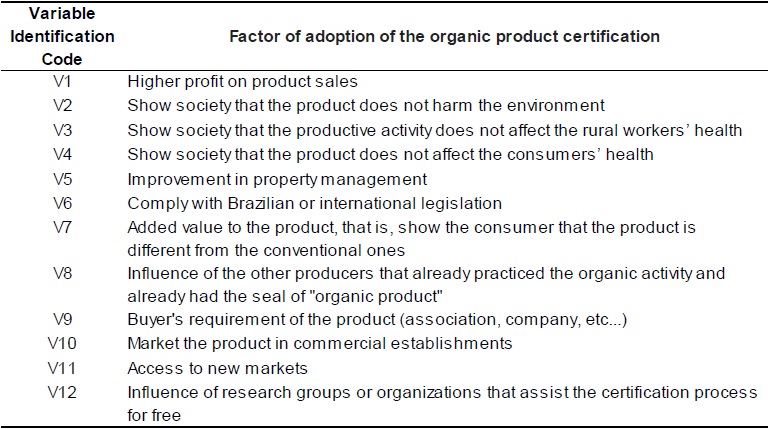
Source: Own elaboration, based on the research data
Thus data (assertive) were analyzed and the constructs were obtained (influence factors in the adoption of the certification). This step has been done by the use of multivariate analysis technique based on Exploratory Factorial Analysis (EFA). All analyzes were performed using SPSS software (IBM, 2013). After that, data were analyzed using descriptive statistics in order to complement the analysis of the results. Finally, an analysis of the factors in relation to the profile of the establishment and the producer was carried out in order to identify whether or not there are differences in the characteristics of the property and the producer. The non-parametric Kruskal-Wallis test was used for the appropriate comparisons between the characteristics of the establishment and producer profile and the influencing factors in the adoption of organic certification. The variables that correspond to the property profile and the producer are described in Table Nº 2.
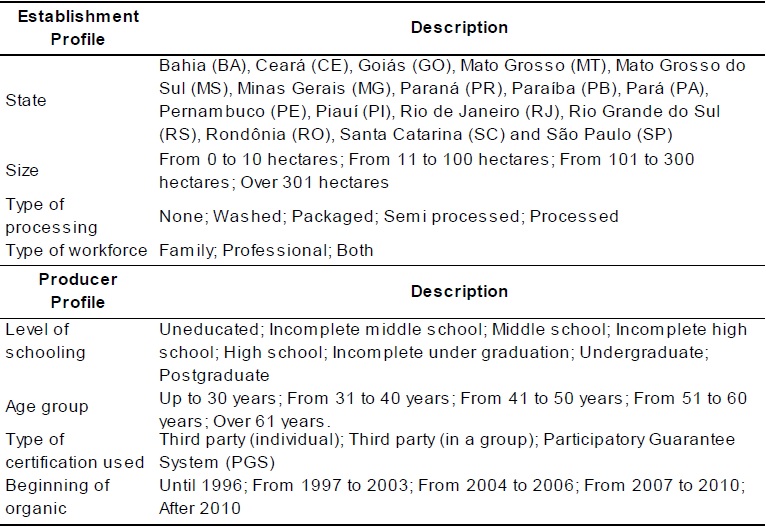
Source: Own elaboration, based on the research data
2.2. Exploratory Factorial Analysis
Factorial Analysis (FA) is used when there are a lot of variables correlated to each other based on the assumption that the correlation between the variables arises because they share or are related by the same factor. Therefore, the objective of FA is to identify factors that are not directly observable (latent variables) through the correlation between a set of observables variables that can be measured (Corrar, Paulo, & Dias, 2009).
In this study it was used Exploratory Factorial Analysis (EFA), which is characterized by not requiring previous knowledge of the dependency relationship between the variables under study. The EFA analyzes understands and identifies a relationship structure between these variables.
At EFA we seek to minimize the number of variables included; however, we should maintain a reasonable number of variables by factor, avoiding factors composed by a single variable. As a general rule, the sample size (or the number of observations) should be at least five times greater than the number of variables to be analyzed (Hair, Black, Babin, Anderson & Tatham, 2006). Considering that there are 12 (assertive) variables, to adopt this method of analysis, the minimum sample size should be 60 individuals. Since the sample is composed of 200 producers, the minimum criteria of observations has been respected.
The procedure for EFA in this paper can be described as:
- 1. Mathematical model of Cronbach's Alpha: Coefficient based on the average correlation between items. It is about an analysis of the measurement scales, checking the reliability of the construct dimensions or the real impact of latent random variables. This coefficient varies between 0 and 1, and the closer it is to 1, greater is the reliability (Corrar et al., 2009). According to Hair et al. (2006), the ideal minimum value for Cronbach’s Alpha is 0.7 for applied surveys and 0.6 for exploratory ones. The Cronbach’s Alpha seeks to show the internal reliability of the issues.
- 2. Calculation of the correlation matrix: It is a matrix that shows the simple correlations between all possible pairs of variables analyzed. The measures for sampling adequacy (or assessment of the adequacy EFA) are: i) Measure of Kaiser-Meyer-Olkin (KMO), which varies between 0 and 1 by checking the degree of partial correlation among the variables. If KMO > 0.6 is possible to use EFA, and the closer to 1 much the better it will be; ii) Bartlett test of spherical shape, which examines the hypothesis that the population correlation matrix is an identity matrix (zero correlation between variables). If p-value ≤ 0,001, then it can be concluded that the model EFA is suitable for data processing; iii) The anti-image correlation matrix, which indicates the explanation power of the factors for each variable analyzed. This matrix shows in its diagonal the value of the sample adequacy measurement for each variable and in other fields the partial correlation (Corrar et al., 2009). In this analysis, the main diagonal values lower than 0.50 were considered not significant, indicating variables which could be drawn from the analysis; and, iv) Commonality matrix, which indicates the ratio of the variance that a variable shares with all other variables considered, or even, is the proportion of variance explained by common factors. The commonality values lower than 0.50 also were considered not significant, indicating variables which could be drawn from the analysis.
- 3. Extraction of factors: There are numerous methods for the extraction of factors in literature, such as key components, key factors, factorization by imaging, factorization by maximum likelihood estimation, alpha factorization, least squares, etc. In order to obtain a reduction of data, the method based on Principal Component Analysis (PCA) was chosen. This method seeks for a linear combination of variables, so that the maximum variance can be explained by this combination. Then, the previously explained variance is removed and there is a search for a new linear combination of variables that explains the biggest remaining amount of variance and so on (Johnson & Wichern, 1992). This procedure results in orthogonal factors, i.e., are not correlated with each other. Thus, the number of factors were chosen by the Kaiser criteria (Corrar et al., 2007), i.e., only the factors with eigenvalues (total variance explained by each factor) above one were extracted.
- 4. Rotation of factors: There are two types of rotation (orthogonal and oblique) to obtain the mathematical model that rotates the axes in the geometric space and determines which variables are loaded into which components. Both, generally, present similar results. In orthogonal rotations must be assumed that the factors are independent, however, they are easier to describe and interpret. The oblique rotations allow that factors are related, but they are more complex to describe and interpret (Tabachnick & Fidell, 2007). In this work it was chosen the Varimax orthogonal rotation method with Kaiser normalization. This method is the most commonly used in literature and seeks to minimize the number of variables that have high loads (simple correlations between variables and factors) in each factor.
- 5. Calculation of scores: Scores are estimated components of each observation (organic producer certified) in the derivative factors. The scores coefficient matrix has values that, when multiplied by the original values of the variables, give rise to latent indicators or simply factorial scores.
3. Results and Discussion
First, it was done a reliability analysis of the construct composed of 12 questions used to obtain the data. The Croanbach’s Alpha of each construct obtained by means EFA was between 0.700 and 0.850. Therefore, the questions are suitable for the purpose for which they are designed.
According to Table Nº 3, the final EFA (after four attempts) resulted in a KMO coefficient of 0.735. Therefore, the data adjustment degree to the EFA is above the level of 0.6 that is a limiting factor in application of this technique. The spherical shape test also resulted in a probability of significance below the level of significance adopted (∞ = 0.05), once again confirming the suitability of the EFA to the data. The procedure was repeated four times and the variables whose values were below 0.5 were extracted. For the model adjustment, in the last extraction of variables, the commonalities presented values from 0.539 to 0.830.
Furthermore, the anti-image correlation matrix for these variables was between 0.792 and 0.902. For both cases the values are above 0.5, confirming the importance of selected variables for the formation of the factors. Also according to Table Nº 4, the total variance of the data can be explained by three factors (extracted by the Kaiser method), since these factors correspond to approximately 70% of this variance. The values obtained shall be considered satisfactory, allowing a deepening in the analysis of the factors generated by EFA.
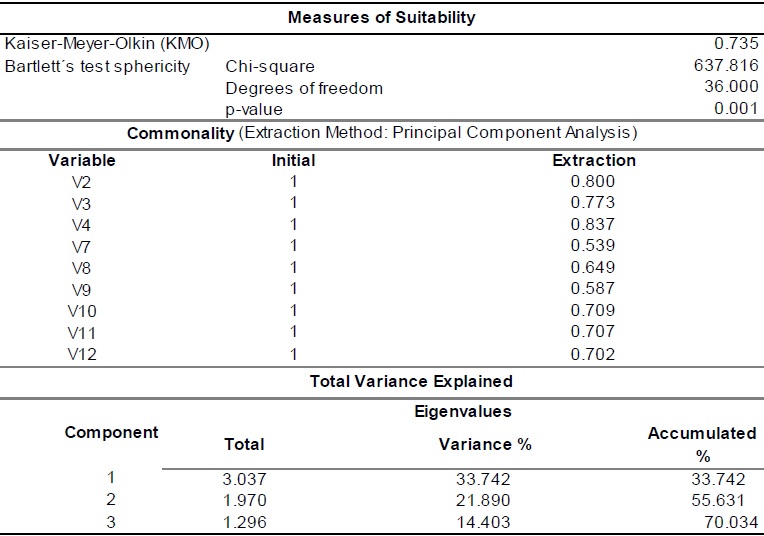
Source: Own elaboration, based on the research data
Thus, the EFA resulted in three determining factors for variables that influenced to adoption of certification of organic production. As shown in Table Nº 4, the first factor brings together variables V2, V3, V4 and V7 (Principles of organic production). The second factor brings together variables V9, V10 and V11 (Market). And the third sector brings together V8 and V12 variables (External groups). Cronbach’s Alpha model also shows that items (or variables) that compose each factor have acceptable internal reliability.
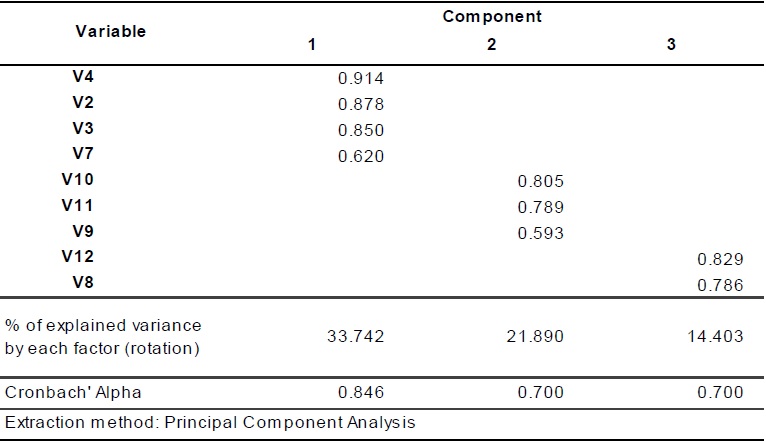
Source: Own elaboration, based on the research data
Considering that the factors can be represented by the linear relationship between the variables, it can be expressed by the following equations:
 (1)
(1)
 (2)
(2)
 (3)
(3)Therefore, according to developed EFA, factors influencing the adoption of organic certification results from the following order of relevance of the factors:
- 1. Factor F1, which can be called “Principles of organic production”. In this group of variables are the influence factors related to the principles of organic production: to produce products that do not harm the environment; products that do not affect the health of the consumer and the producer, and to deliver to the consumer a product that has these aggregate characteristics. In this sense, the variables related in this group refer to the producer’s need to ensure that his product meets the principles of organic production (V2, V3, V4) that stand out from being different from conventional products (V7). This factor explains about 33.74% of the data variance. Such evidence reinforces the studies by Lapple & Rensburg (2011), and Sierra, Klonsky, Strochlic, Brodt & Molinar (2008) that point out the environmental issues an influencer factor for inclusion in the activity.
- 2. Factor F2, which can be called “Market”. In this group are the variables related to aspects of market access, which are: Buyer’s requirement of the product (V9); Market the product in commercial establishment (V10) and access to new markets (V11). In this sense, the producers that joined the certification system were influenced by variables that correspond to the aspects related to the insertion in the market of organic products. This factor explains about 21.89% of the data variance. These results corroborate the studies by Veldstra, Alexander & Marshall (2014), Sierra, Klonsky, Strochlic, Brodt & Molinar (2008) that consider the market as a driving force for adhering to the certified system.
- 3. Factor F3, which can be called “External groups”. In this group are the variables related to the influences of other external agents: influence of the other producers that already practiced the organic activity and already had the seal of “organic product” (V8), Influence of research groups or organizations that assist the certification process (V12). This factor explains nearly 14.40% of the data variance. In this context, it is interesting to note that in Brazil there are organizations that support organic agriculture, and thus greatly influence the adoption of certification. Meira & Candiotto (2011) highlight the role of the organization of farmers (association or cooperative) as fundamental for the expansion of the organic movement and is necessary to overcome financial and technological obstacles of rural properties, such as the certification process.
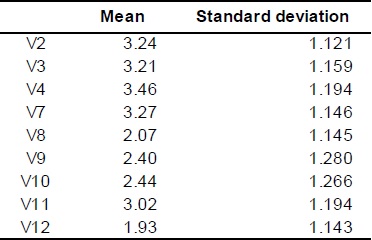
A descriptive analysis of the variables contained in the three constructs obtained in the EFA was done, according to Table Nº 5. It can be observed that the variables that had the greatest influence on the adoption of the certification refer to the “Principles of organic production” factor, with averages between 3.21 and 3.46 (on the Likert scale of minimum 1 and maximum 5). In addition, it can be seen that the variables referring to the “Market” factor were also significant in the certification decision. The variables that make up the “External groups” factor were not very influential in this decision, since the average of this group is between 1.93 and 2.07.
Next, the three factors considered as influential in the adoption of organic product certification were summarized by means of three regression lines. Kolmogorov-Smirnov normality tests were performed for the coefficients that make up each of these lines. This was done in order to identify, for difference of averages, which hypothesis test (parametric or non-parametric) was more adequate to verify if the factors are affected by characteristics of the establishments and the producers. Under the null hypothesis Ho of existence of normality, if p-value (significance probability) ≤ a, Ho is rejected at a significance level . of 5%. Thus, it was observed that the coefficients of the three regression lines generated for factors F1, F2 and F3 did not present a normal pattern for the level of significance considered, with p-values equal to 0.001, 0.027 and 0.001, respectively.
Therefore, the Kruskal-Wallis nonparametric test was used to compare the characteristics of the establishment and producer profile and the influence factors in the adoption of the organic certification system. Under the null hypothesis Ho of equality between averages (there is no difference within each group of characteristics of the establishment profile –or producer profile– for the influence factor in the adoption of the organic certificate –F1 or F2 or F3–), if p-value ≤ a, Ho is rejected at a significance level of 5%.
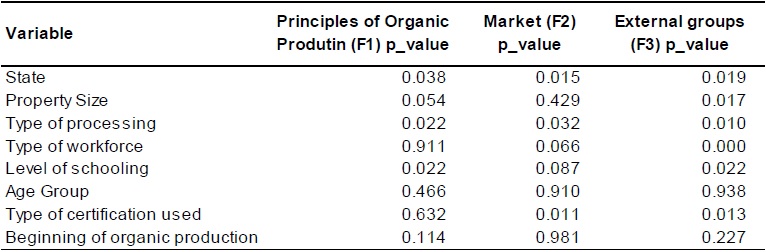
Table Nº 6 shows the result of the p-values obtained for all the tests made with each characteristic of the property profile and the producer profile for each of the factors (F1, F2 and F3).
Source: Own elaboration, based on the research data
According to Table Nº 6, it can be observed that the three factors (F1, F2 and F3) show significant differences mainly by State, by property with different types of processing, by producer’s level of schooling and by type of certification, respectively; that is, these variables were not homogeneous for each of these factors. Specifically, in relation to the characteristics of the producer, two variables showed heterogeneity: level of schooling (for F1 and F3 factors) and type of certification used (for factors F2 and F3). In addition, two variables (age group and beginning of organic production) were homogeneous for all factors. Thus, it can be said that the three factors were presented in the same way for the different age groups of the producers, as well as for the period of beginning of the organic production activity, unlike what was pointed out by Veldstra et al. (2014), who concluded that there is a greater propensity to certification by more experienced and older producers.
When analyzing the variables that form each of the factors versus the characteristics of the profile of rural establishments and producers, the following results are obtained:
3.1. Principles of Organic Production (Factor 1)
Within the principles of organic production, the producer’s intention to show society that the product does not harm the environment (V2) was important and behaved very differently in the country. More than 50% of the producers considered the intention to join the organic certification system as a strong or very strong influence, as observed in the center-west region of Brazil, especially in the States of GO and MG; in the Northeast region, in the States of CE and PI; in the Northern region, in the States of PA and RR, and in the State of RJ, in the Southeastern region of Brazil. On the contrary, about 40% of respondents in the South Central region of Brazil, in States like SP, PR and SC, point out that this intention has little or very little influence in this decision making.
Other points discussed relate to aspects harmful to workers’ health (V3) and consumer (V4). For the first case in almost all States was considered important the fact that the producer’s intention to preserve the health of their employees, except for those interviewed in the States of SC, SP and PI, which saw very little or little influencer to the adoption certificate. Similarly, the majority of respondents in the country consider the fact that the product does not harm consumers’ health (V4) very or very important, influencing the adoption of certification. Through the scale used, the interviewees from the States of MG, SP, PR and SC attributed the criterion “important” for such decision making.
Among the principles of organic production, the one that presented greater heterogeneity for the interviewees and regions was the question related to the value added to the product, showing consumers that the organic product is different from conventional ones (V7).
This variable strongly influences the adoption of the organic certification system for 70% of respondents from ten Brazilian States: CE, GO, MT, MS, PB, PE, PI, RJ, RS and SC. Whereas, for those interviewed in PR, SP, and RR, between 30% and 50% do not even consider it relevant to adoption. By highlighting the States with the greatest volume of production and consumption of organic products (MG, SP, RS, CE, PR and PE), the heterogeneity to the variable was even more accentuated.
If the processing of the products is taken into account, as lower is the processing of the products, lower is the influence of the importance of the perception of the aggression of that product to the environment (V2). For the variable that shows respect for workers’ activities (V3), in the category of producers who pack or practice some processing, this variable was not considered relevant for 30% of respondents. For those who considered consumer’s health (V4), all producers (regardless of the level of processing) also considered it as important for certification. However, 70% of the producers who produced only washed products considered it with great or very great influence. Only producers in the packaged and processed category considered it as having little or no influence (between 20 and 30% of those producers). Concerning the added value to the product (V7), although all producers considered it important, about 30% of the producers in the non-processed, packaged and semi-processed categories considered it with little or no influence.
Finally, it was observed that the majority of producers at any level of schooling answered that V2 was important for the adoption of the certification. Specifically, V2 was very or extremely influential in this decision for 50% of uneducated, with Middle school and with Postgraduate producers. Only 30% of uneducated, incomplete or complete high school producers attributed little or no influence to it. Analyzes for V3 and V4 are similar to V2. However, for V3 there was a differentiation in relation to the producers with complete superior, in which 30% of them attributed no influence of the same to the decision to adopt the certificate. V7 was relevant for producers of different levels of schooling, especially for the uneducated ones (100% of cases). On the other hand, about 40% of the producers with incomplete middle and high school did not consider it influential or had little influence. Although the results show some tendencies, it is not possible to infer if a lower or a higher level of schooling would have direct relation with the adoption or not of the certification with respect to the principles of organic production, differently from what was pointed out by Veldstra et al. (2014) in a research conducted in the USA.
Regarding age, although the research by Lapple & Rensburg (2011) found that younger producers compared to more experienced producers give greater relevance to production that meets the sustainability principles of agriculture as more relevant for insertion in the certified organic system, this research does not presented difference of perspective between young and experienced producers.
3.2. Market (Factor 2)
Buyer’s requirement of the product (V9) was considered important for more than 50% of the producers in the adoption of the seal for the States of GO, MG, PI, RS and SC. In the States of CE, MT, MS, PR, PB, PA, PE and RO, it was not considered influential or very influential for more than 70% of the producers in each of these States.
Regarding the intention to market the product in commercial establishments (V10), there was an attribution of influence in the adoption of the certificate for the producers of the States where the largest organic producers in the country are located (CE, GO, MG, RS, SC and SP). However, the producers of the remaining States (MT, MS, PR, PB, PA, PE, PI, RJ and RO) considered it very little or no influence on this adoption (where organic producers are not representative for the country). This finding reinforces research by Dimitri & Oberholtzer (2008) that noted that producers opt for certification to serve regions that demand the products, which are often in the region of production and in other States of the country.
Regarding access to new markets (V11), this variable was not considered important for the States of MT, MS and PE, since the producers attributed little or no influence of the same. On the other hand, the vast majority of States (more than 50% of producers) considered it relevant in obtaining the seal. Therefore, according to the results, it is observed that the producers located in the most representative States in terms of organic production (RS, SP, SC and MG) were motivated by their markets. This is due to the fact that the high volume of production indicates that these producers need to transfer their production to more distant areas and/or to commercial establishments in which certification is required.
It is assumed that producers located in less productive regions trade in the municipality, especially in fairs where certification is not mandatory. In this sense, these results corroborate with those obtained by Kleemann, Abdulai & Buss (2014), who concluded that the market is one of the main factors that influence the decision to produce and certify organic products.
V9 did not prove to be important in the adoption of the certification for more than 60% of producers, regardless of the level of processing of the product, except for the washed category, in which more than 60% of producers considered it to be influential. For V10, packaged and processed producers attributed equal importance in adopting certification in both influence levels and non-influence ones. In semi-processed and non-processed products, this was considered as influential or of little influence to more than 50% of producers. For the washed category, this variable was very or very important for more than 45% of the producers. However, for producers in packaged and processed categories, this variable was equally distributed across all levels of influence.
For V9, regardless of the type of certification, most producers (more than 50%) considered little or no influence of the same for the adoption of certification. In addition, producers who have adopted third-party certification (in group or individual) have given greater importance to this variable compared to those who have adopted the PGS. With V10, the previous result becomes more evident, since this was considered influential in the adoption of the seal for third party producers and no influence or little influence for those who used the PGS. V11 also had the same behavior as the two previous variables, and was even more relevant to the adoption of the organic certificate for third party producers (in group or individual). V11 was also pointed out as relevant by producers with PGS, but less important compared to the two third party modalities.
In this sense, it can be considered that the consumer, in part, could influence the adoption of the certification, suggesting to the producer to be certified by means of a third party company of their preference. That is, retailers direct the type of certification and even which certifier the producers should use.
3.3. External Groups (Factor 3)
The influence of other organic producers (V8) on the adoption of the certificate was relevant for the producers of GO and PR, but for the States of CE, MT, MS, PB, PA, PE, RO and SP was disregarded for more than 70% of its producers. In the States of RS, SC and PR there was a balance between the influence and the non-influence of this variable for adoption. Regarding the influence of research groups or organizations that support certification (V12), this variable was considered as little or no influence on the certification for more than 70% of the producers in the States of CE, MT, MS, MG, MG, PB, PA, PE, RO, SC and SP, and was evenly distributed in a degree of importance from strong to moderate for the States of GO, PR and PI.
For V8, most producers did not consider it important (little or no influence) at all levels of processing. However, in the washed category, this was more relevant for the adoption of certification. For the no processing category, only 8% of the producers attributed some relevance to this variable. The same analysis was obtained for V12.
V8 was evaluated in relation to the size of the rural establishment and was practically unimportant in the adoption of the seal for all producers with establishments above 10 ha and for half of the producers with areas smaller than 10 ha. For V12, the result was very similar to the previous one. At this point it was observed that for producers in establishments of up to 10 ha, there was some importance attributed to this variable (36%); however, all producers of establishments above 300 ha did not consider it as influential in adopting certification. Possibly, the reason that small-scale producers consider the V8 and V12 variables to be important in the certification decision is associated with the exchange of experiences of these producers with neighboring properties and also the fact that they have been the object of research and extension activities of external groups.
There were differences in terms of the influence for the adoption of the certification regarding the size of the property and workforce. As larger is the size of the property, lower is the impact of V8 and V12 for adoption. More than 70% of the producers whose establishments had over 300 ha considered them to be very little or not at all influential for certification. In this sense, this analysis corroborates with the one referring to the size of the establishments, since the small ones use family labor, or both (family and professional), and the large ones use professional labor.
Regarding the level of schooling, V8 was not relevant (i.e., little or no influence) to the adoption of the organic certificate for the majority of the producers (more than 80%), especially those uneducated, with incomplete under graduation and postgraduates. The producers that considered it important for the certification were those with complete middle and high school and undergraduate one (more than 40%).
V12 was also disregarded as relevant for certification by more than 50% of the producers, highlighting here the uneducated, with incomplete and complete under graduation and postgraduate. On the other hand, it was considered influential for about 30% of the producers with complete and incomplete middle and high school. Similarly to the F1 factor, it was not possible to relate the level of schooling to the adoption or not of the certificate for factor F3.
Finally, regarding the type of certification for both V8 and V12, more than 58% did not consider them important (i.e., little or no influence) for the adoption of certification. Since the producers who certified by third party individually were the most representative in this group (about 80%). Those who considered V8 and V12 to be relevant or influential in adopting the seal were about 40% of the producers using in group third party certification and producers with PGS. In this sense, it can be concluded that producers who have some form of contact with external groups may have adopted certification and opted for the type of certification that involves groups (third party or PGS).
4. Final considerations
This paper aimed to identify and analyze the factors that influence the adoption of organic certification in rural production in Brazil. Thus, this survey aimed to identify whether or not there are differences in terms of decision to certify in relation to the set of producers analyzed through the characteristics of rural establishments and the producer.
In general, the factors influencing the adoption of certification were categorized into three: principles of organic production, market and external groups, regardless of the profile of rural establishments and producers. Among those three factors, which had higher expression in terms of influence was the factor related to the principles of organic production, which are to guarantee a product that does not harm the environment, the producer and the consumer, and also adds value to it.
Considering the characteristics of rural establishments and producers, there was a difference observed between the variables that influenced the adoption of certification. In this sense, the characteristics of the rural establishments were more expressive regarding the heterogeneity in the responses related to the variables that influenced the adoption of the certification, highlighting the “State” where the establishments are located and the “level of beneficiation of the product”.
Regarding the characteristics of the producers, it is also important to note the influence of the type of certification adopted by the producer, where producers using third-party certification emphasized the buyer’s requirement for adoption of the certificate. Producers who opted for third party certification in group or PGS attributed the influence of external groups in the decision to certify. Therefore, it can be concluded that the contact and exchange of information between producers and external producer support organizations may have fostered certification processes beyond the type of certification adopted. In addition, it was observed that the influence of the principles of organic production (environment, consumer health, worker health and value added) for the adoption of certification were relevant factors for mature producers (with more advanced ages) and experienced in the activity.
It should also be noted that although the need to comply with current legislation was considered as a variable of influence in the adoption of certification, this was not very significant among rural producers, and was excluded when performing the exploratory factor analysis. It is noteworthy that only 10% of the producers in this sample of 200 producers obtained the organic certificate before 1999, when the process of regulating the sector began. The vast majority, more than half of the producers obtained the certificate after 2007; that is, although the producers did not indicate this factor as a factor of influence, coincidentally the certification was adopted after the publication of the regulation that made it obligatory.
The process of regulation of the sector, making compulsory the use of the certificate by the producers that commercialize with commercial establishments is an important instrument for the consumer, who has the guarantee of the product that is acquiring. However, there are some obstacles that are difficult to overcome mainly by small producers. The high investment needed to obtain the certificate by a certification company is highlighted here. Such a situation can be mitigated in places where there are producer groups, which has the option of adopting some group certification system, either by third party or by the participatory guarantee system (PGS).
However, small producers who produce organic products and are isolated in certain regions do not have the financial support to adopt a third-party certification system. Given this, there is a need for a public policy that can allow access to this mechanism by small farmers, as occurs in other countries that subsidize the certification processes, bearing most of the associated costs.
Acknowledgments
The authors would like to thank CNPq (Conselho Nacional de Desenvolvimento Científico e Tecnológico) for funding the research project developed in 2012-2014, and FAPESP (Fundação para Pesquisa do Estado de São Paulo), as well as the Brazilian organic growers who took the time to participate in the research.
REFERENCIAS
Andriguetto, J. K., Kirchner, C., Castro, F. M. E, & Varini, F. (2019). Participatory guarantee systems in 2018. In FiBL-IFOAM (Ed.), The world of agriculture organic. Statistics and emerging tendencies (pp. 161-166). Retrieved from https://shop.fibl.org/CHen/mwdownloads/download/link/id/1202/?ref=1
Brasil. Presidência da Republica. (2003). Lei Nº 10831, de 23 de dezembro de 2003. Brasília: Diário Oficial da União, Seção 1, p. 8. Retrieved from http://www.agricultura.gov.br/assuntos/sustentabilidade/organicos/legislacao/portugues/lei-no-10-831-de-23-de-dezembro-de-2003.pdf/view
Brasil. Presidência da Republica. (2004). Instrução Normativa Nº 16 de 11/06/2004, [que] Estabelece os procedimentos a serem adotados, até que se concluam os trabalhos de regulamentação da Lei nº 10.831, de 23 de dezembro de 2003, para registro e renovação de registro de matérias primas e produtos de origem animal e vegetal, orgânicos, junto ao Ministério da Agricultura, Pecuária e Abastecimento – MAPA.Brasília: Diário Oficial da União, Seção 1, p. 4. Retrieved from http://sistemasweb.agricultura.gov.br/sislegis/action/detalhaAto.do?method=consultarLegislacaoFederal
Brasil. Presidência da Republica. (2007). Decreto lei N.6.323, de 27 de dezembro de 2007, [que] Regulamenta a Lei no 10.831, de 23 de dezembro de 2003, que dispõe sobre a agricultura orgânica, e dá outras providências. Retrieved from http://sistemasweb.agricultura.gov.br/sislegis/action/detalhaAto.do?method=consultarLegislacaoFederal
Bravo, C. P., Spiller, A., & Villalobos, P. (2012). Are organic growers satisfied with the certification system? A causal analysis of farmers’ perceptions in Chile. International Food and Agribusiness Management Review, 15(4).
Churchill Jr., G. A. (1999). Marketing research: Methodological foundations. Orlando, FL: Dryden Press.
Corrar, L. J., Paulo, E., & Dias Filho, J. M. (2007). Análise multivariada. FIPECAFI, Brasil: Atlas.
Dimitri, C., & Oberholtzer, L. (2008). Using vertically coordinated relationships to overcome tight supply in the organic market. Washington: USDA Economic Research Service.
European Commission, EC. (1991). Council Regulation (EC) No 2092/91 of 24 June 1991 on organic production of agricultural products and indications referring thereto on agricultural products and foodstuffs. Retrieved from http://europa.eu.int/eur-lex/en/consleg/main/1991/en_1991R2092_index.htm
Food Agriculture Organization, FAO. (2001). Guidelines for the production, processing, labelling and marketing of organically produced foods. Rome: FAO, Codex Alimentarius Commission. Retrieved from http://www.fao.org/docs/eims/upload/230124/CXG_032e.pdf
Gil, A. C. (1999). Métodos e técnicas de pesquisa social. (5a. ed.). São Paulo: Atlas.
Hair Jr., J. F., Black, W. C., Babin, B. J., Anderson, R. E., & Tatham, R. L. R. (2006). Multivariate data analysis. Upper Saddle River, NJ: Pearson Prentice Hall.
Huber, B., Schmid, O., Batlogg, V., & Castro, F. M. E. (2019). Public standards and legislation. In FiBL-IFOAM (Ed.), The world of agriculture organic. Statistics and emerging tendencies (pp. 152-160). Retrieved from https://shop.fibl.org/CHen/mwdownloads/download/link/id/1202/?ref=1
IBM. (2011). IBM® SPSS Statistics (Version 22.0) [Windows]. Armonk, Nueva York: IBM.
Instituto Brasileiro de Geografia e Estatística, IBGE. (2006). Censo Agropecuário 2006. Brasília: IBGE. Retrieved from http://www.ibge.gov.br
Johnson, R. A. & Wichern, D. W. (1999). Applied multivariate statistical analysis. Englewood Cliffs: Prentice Hall.
Kleemann, L., Abdulai, A., & Buss, M. (2014). Certification and access to export markets: Adoption and return on investment of organic-certified pineapple farming in Ghana. World Development, 64, 79-92. http://doi.org/10.1016/j.worlddev.2014.05.005
Lapple, D., & Rensburg, T. Van. (2011). Adoption of organic farming: Are there differences between early and late adoption? Ecological Economics, 70(7), 1406-1414. Retrieved from http://doi.org/10.1016/j.ecolecon.2011.03.002
Ministério da Agricultura, Pecuária e Abastecimento, MAPA. (1999). Instrução Normativa Nº 7, de 17 de maio de 1999, [que] Estabelece as normas de produção, tipificação, processamento, envase, distribuição, identificação e de certificação da qualidade para os produtos orgânicos de origem vegetal e animal. Brasília: Diário Oficial da União, Seção 1, p. 11. Retrieved from http://www.agroecologia.gov.br/sites/default/files/publicacoes/IN%20007.pdf
Ministério da Agricultura Pecuária e Abastecimento, MAPA. (2011). Mecanismos de controle de qualidade orgânica. Brasília: MAPA. Retirado de http://www.prefiraorganicos.com.br/agrorganica/mecanismosdecontrole.aspx
Ministério da Agricultura Pecuária e Abastecimento, MAPA. (2019a). Em sete anos triplica o número de produtores orgânicos cadastrados no ministério. Brasilia: MAPA. Retirado de http://www.agricultura.gov.br/noticias/em-sete-anos-triplica-o-numero-de-produtores-organicos-cadastrados-no-mapa
Ministério da Agricultura Pecuária e Abastecimento, MAPA. (2019a). Alimentos orgânicos renderam R$ 4 bilhões a produtores brasileiros em 2018. Brasilia: MAPA. Retirado de http://www.agricultura.gov.br/noticias/mercado-brasileiro-de-organicos-fatura-r-4-bilhoes
Meira, S. G., & Candiotto, L. Z. P. (2011). A organização de produtores nos municípios de Francisco Beltrão e de Verê – PR para a comercialização de alimentos orgânicos. Revista de Geografia, 28(1), 57-72.
Pietola, K., & Lansink, A. (2001). Farmer response to policies promoting organic farming technologies in Finland. European Review of Agricultural Economics, 28(1), 1-15.
Research Institute of Organic Agriculture- International Federation of Organic Agriculture Movements, FiBL-IFOAM. (2019). The world of agriculture organic. Statistics and emerging tendencies. Retrieved from https://shop.fibl.org/CHen/mwdownloads/download/link/id/1202/?ref=1
Richardson, R. J. (2008). Pesquisa social – Métodos e técnicas. (3a. ed.). São Paulo: Atlas.
Sierra, L., Klonsky, K., Strochlic, R., Brodt, S., & Molinar, R. (2008). Factors associated with deregistration among organic farmers in California. Davis, CA: California Institute for Rural Studies (March). Retrieved from Http://169.237.124.167/Organic/Reports/2008_Deregistration_Factors.Pdf
Scalco, A. R., & Servi, R. G. (2014). Manutenção da certificação orgânica em produtores rurais. Revista em Agronegócio e Meio Ambiente, 7(3), 515-534.
Souza, A. P. de O. & Alcântara, R. L. C. (2003). Alimentos orgânicos: estratégias para o desenvolvimento do mercado. In: M. F. Neves & L. T. Castro (Orgs.), Marketing e estratégia em agronegócios e alimentos. São Paulo: Atlas.
Tabachnick, B., & Fidell, L. (2007). Using multivariate analysis. Needham Heights: Allyn & Bacon.
Varini, F. & Andriguetto, J. K., (2019). Policies supporting de organic sector. In FiBL-IFOAM (Ed.), The world of agriculture organic. Statistics and emerging tendencies (pp. 167-173). Retrieved from https://shop.fibl.org/CHen/mwdownloads/download/link/id/1202/?ref=1
Veldstra, M. D., Alexander, C. E., & Marshall, M. I. (2014). To certify or not to certify? Separating the organic production and certification decisions. Food Policy, 49(P2), 429-436. http://doi.org/10.1016/j.foodpol.2014.05.010
Willer, H., & Kilcher, L. (Eds.) (2010). The world of organic agriculture - Statistics and emerging trends 2010. Bonn and Frick: IFOAM-FiBL.