Review Article
Sustainable entrepreneurship in Colombia: strengths and opportunities1
Fortalezas y oportunidades del emprendimiento sostenible en Colombia
 Angela Yinet Camargo Calderón aycamargoc@unal.edu.co
Luisa Fernanda Latorre Carrillo luflatorreca@unal.edu.co
Jennifer Lorena Gómez Contreras jennifer.gomez@unimilitar.edu.co
Angela Yinet Camargo Calderón aycamargoc@unal.edu.co
Luisa Fernanda Latorre Carrillo luflatorreca@unal.edu.co
Jennifer Lorena Gómez Contreras jennifer.gomez@unimilitar.edu.co
Sustainable entrepreneurship in Colombia: strengths and opportunities1
Cuadernos de Administración (Universidad del Valle), vol. 36, no. 68, pp. 190-203, 2020
Universidad del Valle
Received: 14 April 2020
Revised document received: 27 July 2020
Accepted: 19 October 2020
Abstract: Sustainable development has emerged by the raised awareness that natural resources consumption has led to ecosystem degradation and damaged populations’ social conditions. Entrepreneurship has been included as an alternative for implementing sustainable development strategies hoping that a shift towards more sustainable products and services will stabilize the development model. The objective of this paper is to analyze the strengths and opportunities of sustainable entrepreneurship in Colombia. To that end, a document review was conducted, focusing on documents prepared in and/or related to the Colombian context. The Scielo, Dialnet plus, JSTOR, proposal, ScienceDirect, EBSCO Academic Search Ultimate, EBSCO Business Source Complete, Emerald Insight databases were consulted, and Colombian universities’ domestic journals and repositories were reviewed. The review concluded that the Colombian entrepreneurship system did incorporate elements at the macro, medium, and micro levels, which constitute strengths while allowing the transition towards sustainability. Among those elements, there are paradigms, regulations, networks, public authorities, policies, and institutions that promote sustainable entrepreneurship and facilitate financing thereof, the niches where innovative ideas and projects, among others, are born. Regarding opportunities for improvement, methodological aspects in assessing business plans need adjusting to include social and environmental factors, and government entities need to provide more significant support and assistance to sustainable entrepreneurs.
Keywords: Entrepreneurship, Sustainable Entrepreneurship, Social Innovation, Colombia, Sustainable Development.
Resumen: El desarrollo sostenible ha emergido gracias a la conciencia de que la forma de consumo de los recursos naturales ha llevado a la degradación de los ecosistemas y daño en las condiciones sociales de las poblaciones. Como una alternativa para la implementación de las estrategias de desarrollo sostenible se ha incluido al emprendimiento, esperando que la transformación hacia productos y servicios más sostenibles logre estabilizar el modelo de desarrollo. El objetivo del presente artículo es analizar las fortalezas y las oportunidades del emprendimiento sostenible en el país. Para lo cual se realiza una revisión documental centrada en documentos elaborados en y/o relacionados al contexto colombiano. Se consultaron las bases de datos Scielo, Dialnet plus, JSTOR, proquest, ScienceDirect, EBSCO Academic Search Ultimate, EBSCO Business Source Complete, Emerald Insight, y adicionalmente se revisaron revistas nacionales y repositorios de universidades colombianas. Se concluye que en el sistema de emprendimiento colombiano se han incorporado elementos a nivel macro, medio y micro que se constituyen en fortalezas en tanto que permiten una transición hacia la sostenibilidad, dentro de estos elementos se encuentran: paradigmas, regulaciones, redes, autoridades públicas, políticas e instituciones que promueven los emprendimientos sostenibles y facilitan la financiación de los mismos; nichos donde se generan ideas y proyectos innovadores; entre otros. Respecto a las oportunidades de mejora, es necesario ajustar aspectos metodológicos de la evaluación de los planes de negocios para que se incluyan factores sociales y ambientales, y proporcionar mayor apoyo y asistencia por parte de entes gubernamentales a los emprendedores sostenibles.
Palabras clave: Emprendimiento, Emprendimiento sostenible, Innovación social, Colombia, Desarrollo Sostenible.
1. Introduction
Sustainable development as a concept was named by the United Nations Conference in 1987 as one “meeting the needs of the present generation without compromising future generations’ ability to meet their own needs” (United Nations, 1987). However, understanding that natural systems have limitations and human well-being requires living within these limitations (Hall, Danake, and Lenox, 2010), social, environmental, and economic objectives must be regarded. Furthermore, sustainable development must mean using renewable resources where possible, reducing non-renewable resources, and recycling those resources to extend their useful life and enable future generations’ access.
When discussing sustainable development as an economic process, it is about entrepreneurs’ economic development and the generation of profits that offset or surpass the social group’s losses where a given entrepreneurship operates. In this vein, by including production processes’ externalities, the benefits to stakeholders other than entrepreneurs themselves must be comparable or exceeded; the impacts generated on communities or ecosystems usually are unaccounted for (Chang, 2001). Entrepreneurship will actually be sustainable if economic benefits are substantial and above the damages generated when monetizing impacts on interest groups.
Similarly, entrepreneurs who engage in sustainable development and sustainability objectives are responsible for considering non-economic costs and profits in their operation, including life expectancy, education, equity, and equal opportunities (Parris and Kates, 2003).
Therefore, sustainable entrepreneurship is a concept that integrates social and environmental factors (Larson, 2000; Kyrö, 2001; Strothotte and Wüsternhagen, 2005; Cohen and Winn, 2007; Cohen, Smith, and Mitchell, 2008; Schaltegger and Wagner, 2011). Hence, the companies making social or environmental progress in their business model can be called sustainable ventures, generating new products, services, techniques, and organizational modes that reduce negative environmental impacts and improve the quality of life of communities affected by the presence of venture in their territory.
The earlier research in the first database review (the subject matter of which deals with sustainable entrepreneurship in Colombia) emphasizes different aspects, namely, the institutional and regulatory environments, the factors at play in success, collaboration networks, sustainable development, value creation types, rural entrepreneurship, international entrepreneurship, sustainable business models, sustainable entrepreneurial intent and social entrepreneurship (Figure 1). However, all failed to analyze the strengths and opportunities of sustainable entrepreneurship in Colombia.
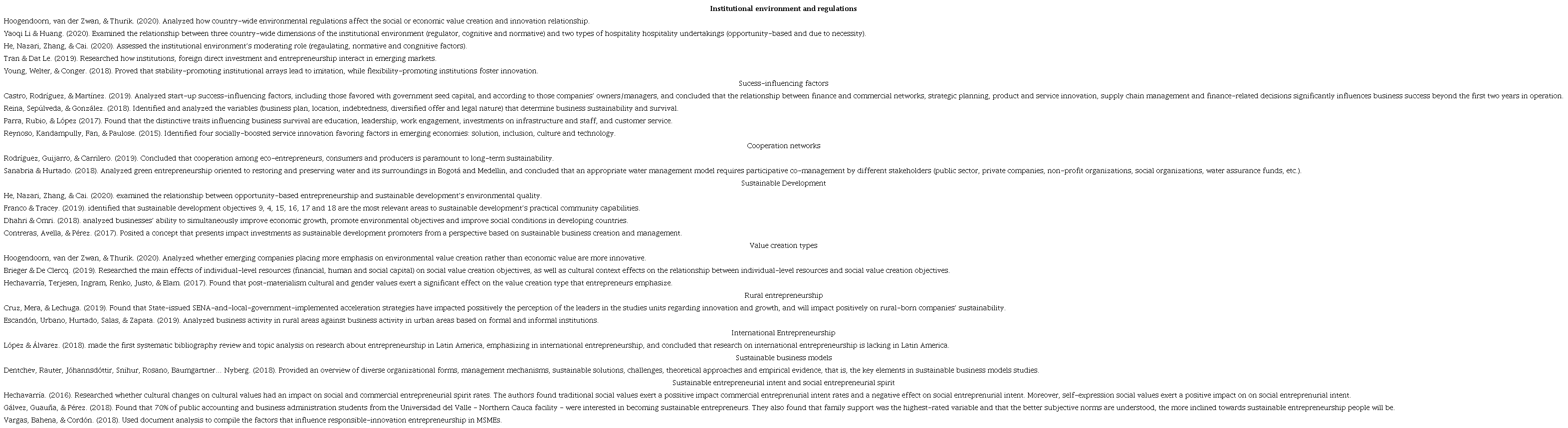
Source: Authors’ own elaboration
On the other hand, an analysis of the papers in the complimentary review, on which the theoretical framework and discussion portions were drawn up, observed that the strengths and opportunities for improvement are specific for each author, as each emphasizes on a particular aspect; there is no evidence of an all-encompassing conclusion covering different areas of sustainable entrepreneurship in Colombia. This document aims to provide an account of the strengths and opportunities of sustainable entrepreneurship in Colombia to bridge those gaps.
To meet this research’s objective, we will build on Hörisch’s(2015) proposal, which ascertains that achieving a system in which entrepreneurship is actually incorporated into the transition towards sustainability requires a series of elements integrating different stakeholders and variables. Thus, a literature review will seek to identify those elements in Colombia’s sustainable entrepreneurship or the lack thereof, whether they are strengths or opportunities for improvement, and for entrepreneurship to commit to transitioning towards sustainability.
Papers prepared in and/or related to the Colombian context were searched for to meet that objective. An initial database review was performed (Scielo, Dialnet plus, JSTOR, request, ScienceDirect, EBSCO Academic Search Ultimate, EBSCO Business Source Complete, Emerald Insight) using this search equation: (“sustainable entrepreneurship”) AND Colombia. The following were established as criteria for inclusion: (a) Document type: Papers in indexed journal/journal article, b) Year of publication: 2015-2020, c) Language: Spanish or English, and d) full access to the text. The result consisted of 23 full-text PDF papers selected for review (Figure 2).
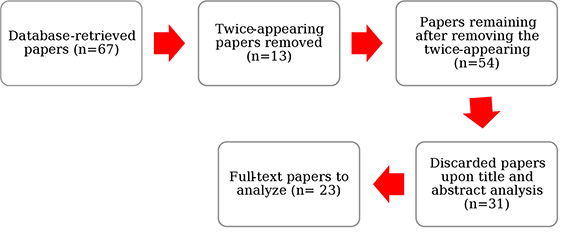
Figure 2
Records retrieved according to search equations and inclusion criteria
As figure 2 has shown, the number of publications available in international databases is limited, making it necessary to conduct a complimentary review in national journals and repositories of Colombian universities to procure more information. The second complementary search was non-time filtered; however, the oldest dates back to 2010.
Likewise, taking into account that the first database search revealed the most recurring terms in sustainable entrepreneurship-related literature, the complementary search included keywords according to the most frequent terms identified, such as: “sustainable entrepreneurship, eco-entrepreneurship, environmental entrepreneurship, social-based entrepreneurship, entrepreneurship for sustainability, sustainability though entrepreneurship, and social entrepreneurship.” After finding a significant number of publications related to that topic, connections between the authors were made to identify, link, and consolidate the varied perspectives to finally analyze the country’s sustainable entrepreneurship phenomenon’s strengths and opportunities.
2. Theoretical framework
2.1. The concept of sustainable entrepreneurship in Colombia
The concept of entrepreneurship continually evolves, varying according to the author and the context (Holguín and Clavijo, 2017). Figure 3 below shows some perspectives around entrepreneurship. Under that classification in Figure 3, sustainable entrepreneurship is considered a combination of ventures that generate social value and green ventures.
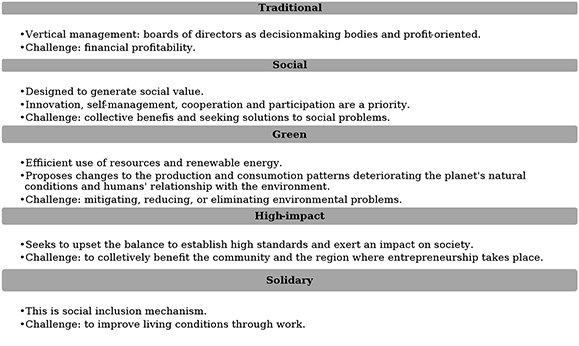
Figure 3
Perspectives on Entrepreneurship
Source: Authors’ own elaboration based on Chaparro (2010), Arboleda & Zabala (2011), Sanabria & Hurtado (2018), Chavarro, Diez, & Rodríguez 2015, and Ortiz & Arias (2013)
Sustainable entrepreneurship allows empowering and dignifying the human being, as it enables labor inclusion in communities classified as vulnerable by generating self-employment and employment for others (Chirinos and Pérez, 2016). It also enables territorial rooting, cooperation, and self-management - for which entrepreneurs must participate in planning, implementation, control, and decision-making (Arboleda and Zabala, 2011).
Similarly, it breaks inequality and unsustainability of territories by eliminating capitalist entrepreneurial entrepreneurship that seeks profit maximization and accumulation (Chaparro, 2010). Nevertheless, sustainable entrepreneurship combines features of capitalist entrepreneurship, such as the interaction among resources and work and technology skills, among others (Arboleda and Zabala, 2011).
One determinant of sustainable ventures’ success in vulnerable communities is State assistance, guidance, and counseling to these communities, educational institutions, and public and private companies (Chirinos and Pérez, 2016).
Our analysis of those perspectives made it evident that they share some elements, but differ in that some emphasize the satisfaction of people’s needs in a specific environment (Chirinos and Pérez, 2016; Pérez, Chirinos, and Martínez, 2017), while others highlight the role of this type of entrepreneurship in the face of the demand for environmental and socially responsible practices (Holguín and Clavijo, 2017).
2.2. Birth and evolution of entrepreneurship in Colombia
Entrepreneurship policies in Colombia date back to the National Learning Service’s (SENA) 1986 and 1987 early initiatives to train entrepreneurs and Universidad Icesi’s creation of the Latin American Congress on Entrepreneurship (Chamorro, Osorio, and Botero, 2013).
Subsequently, the wise men mission was created and summoned during the government of César Gaviria (1990-1994) for universities to educate entrepreneurs instead of just employees (Colciencias, 1995 as cited in Chamorro et al., 2013).
In the early 1990s, SENA created the training program for company creators and trained entrepreneurs as a strategy for employment and wealth generation during Andrés Pastrana’s government (SENA, 2000 as cited in Chamorro et al., 2013).
During Andrés Pastrana’s government (1998 to 2002), the Youths’ Act that created the Young Entrepreneur program was enacted, the Ministry of Foreign Trade created the Young Exporting Entrepreneurs’ program. Lastly, Law 590 of 2000 was enacted. It is responsible for fostering the creation and enabling the operation of micro, small enterprises, small enterprises (MSMEs) based on strategies such as the implementation of the venture capital investment fund for those rural companies, the reduction of parafiscal contributions during the first three (3) years of life, and the entrepreneurial spirit and company creation policy was passed (Chamorro et al., 2013).
During the first term of Álvaro Uribe, the 2002-2006 Development Plan detailed an objective to link entrepreneurship with competitiveness, promoting entrepreneurship among SENA graduates, facilitating financial and non-financial support, and strengthening research and technological development (Chamorro et al., 2013). Likewise, that government passed Law 789 of 2002, which created the Entrepreneurship Fund in the hope of allowing university students access to non-refundable capital by submitting their proposals to the fund; Law 905 of 2004, which allowed the government to extend its support to MSMEs by incorporating the National MSME System, the Regional Councils of SMEs, among others; and Law 1014 of 2006, known as the Entrepreneurship Act (Chamorro et al., 2013).
Law 1014 of 2006 generated entrepreneurship promoting instruments and became a State policy because it sought to support business ideas associated with entrepreneurship, innovation, science, and technology development through government agencies and private institutions (Chamorro et al., 2013; Zambrano, 2016). It also sought to create an institutional framework that fosters and develops an entrepreneurship culture by involving the educational and productive systems in order to develop that culture from training, thereby creating better conditions for new company creation and operation and strengthening business processes, which contribute to local, regional and territorial development.
Similarly, that Law incorporated the Entrepreneurship National Network and the Regional Network, the objectives of which seek to establish policies, guidelines and strategic plans that promote the culture of entrepreneurship, as well as to work in conjunction with organizations in order to articulate them, harness synergies and enhance efforts in relation to entrepreneurial ventures.
Álvaro Uribe’s second term (2006-2010) saw the National System of Science, Technology, and Innovation strengthened (starting with the GDP 1% target), Law 1286 of 2009, which allowed more funding for research projects by Colciencias (Zambrano, 2016), and the issue of entrepreneurship was explicitly included in Conpes Document 3527 of 2008, namely, the national competitiveness and productivity policy (DNP, 2008 as cited in Chamorro et al.,2013).
The first term of Juan Manuel Santos (2010-2014) used entrepreneurship boosting strategies like the creation of the Business Growth Management Unit of the National Government (INNPulsa) and the Modernization and Innovation Fund for MSME (Zambrano, 2016). The Public Entertainment Act was also enacted, which strengthened the performing arts through tax incentives to artists also reduced formalities, and promoted companies in that sector (DNP, 2012 as cited in Zambrano, 2016). Lastly, the National Planning Department (DNP) began working on high-impact social innovation- based models in 2012 (Sanchéz, 2017). Whereas Juan Manuel Santos’s second term’s (2014-2018) entrepreneurship-promoting strategies related to the approval of a Conpes whereby companies that invest in innovation received tax breaks, the science, technology, and innovation policy was formulated and created financial and tax support for companies that generate environmental benefits such as reforestation, restoration, ecotourism and biotechnology (Zambrano, 2016).
On the other hand, the 2018- 2022 National Development Plan by sitting President Iván Duque holds legality and entrepreneurship as the strategic axes to achieve equity, based on the improved and efficient state interventions and public investment projects, as well as productivity promoting policy planning (DNP, 2018).
As per the foregoing, Colombia’s interest has grown in fostering a culture of innovation and entrepreneurship that enables its economic growth.
2.3. Hörisch’s Proposal
To achieve a system wherein entrepreneurship actually transitions towards sustainability, different elements that integrate a variety of stakeholders and variables are required (Figure 4)
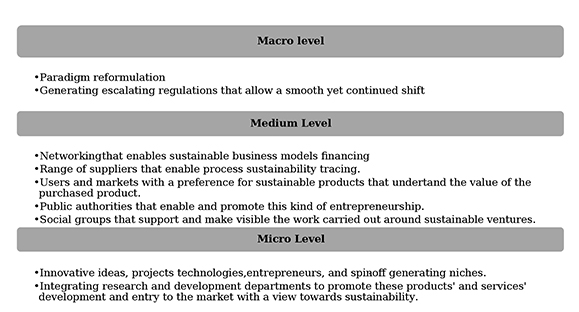
Figure 4
Elements for entrepreneurship transition to sustainability
Source: Authors’ own elaboration based on Hörisch (2015)
3. Discussion
In analyzing the evolution of entrepreneurship in Colombia, it is essential to highlight -as a strength- the judicious work that the State and government agencies have carried out. Such work has aimed at reformulating the paradigm woven around being an employee, seeking to broaden people’s vision to get them to see their entrepreneurial potential (and become employers), thereby fostering the culture of entrepreneurship and contributing to the development of the skills required in the field. That was brought to life by fostering spaces for training and academic dialogue around topics such as entrepreneurship training, entrepreneurial intent, entrepreneurship education, and start-ups, competitive strengthening of companies, and training for job and wealth creators. Likewise, the first steps were taken towards linking entrepreneurship and competitiveness and the education system to production.
There has also been an interest in the issuing of entrepreneurship and business creation promoting regulations by incorporating institutions such as the Entrepreneurship Fund and INNPulsa to foster entrepreneurship, innovation, and productivity as the axes for entrepreneurship and competitiveness development in Colombia. Likewise, regulations (in the form of laws and policies) that explicitly include entrepreneurship matters have been issued and designed to encourage different types of companies, to wit, cultural, high-impact, innovative, or those that bring on social and environmental benefits. Furthermore, the horizon foreshadows changes in the formulation of science, technology, and innovation policies that directly impact these issues since entrepreneurship is related to innovation.
Thus, at the macro level, paradigms have been revisited and incremental regulations issued. At the medium level, that required government and private bodies to support the State policies that stimulate and go hand in hand with business ideas, business plans, and already-incorporated businesses. Furthermore, Colombia’s institutional framework sought to improve the existing conditions for new business creation and operation and strengthen existing businesses’ processes.
By the creation of institutions such as the Entrepreneurship Fund and INNPulsa, and agencies such as the National MSME System, the Regional Councils of SMEs, and the Entrepreneurship National Network and the Regional Network, financial (access to seed capital) and non-financial (training, mentoring, networking with investment groups) support has been provided to entrepreneurs and businessmen, in the pursuit to articulate them with each other, so as to foster synergy and produce enhanced results.
Moreover, in terms of funding, there is evidence of a) increased financing for research projects due to increased budgets for the institutions that oversee innovation and research, and b) tax breaks for entrepreneurs and businessmen across different regulations.
At the micro-level, programs (e.g., young businessmen, young entrepreneurs), policies (such as the promotion of entrepreneurship and business creation), and institutions have been launched to promote entrepreneurship, strengthen research and technology development.
Regarding social innovation, that concept was incorporated in 2008 into the state’s agenda and in the speeches of private and social actors in Colombia and materialized in Medellín’s positioning as a socially innovative city and in its inclusion in the National Development Plans entitled Prosperity for All (2010-2014) and All for a New Country (2014-2018) by the Juan Manuel Santos government (Villa and Melo, 2017).
Moreover, public, social, private, and academic entities have made social innovation their own in order to solve their problems efficiently and legitimately, and as a differentiating element that provides sustainability. Furthermore, other cities in the country see Bogotá and Medellín as points of reference for innovation and social entrepreneurship, making cities more receptive to these dynamics, which, in turn, has those dynamics to continue to grow (Villa and Melo, 2017).
Concerning the strengths identified above at the macro, medium, and micro levels, it is worth mentioning that entrepreneurs recognize that the presence of promotion entities has created an entrepreneurial culture and also value these entities’ activities in the form of training, counseling, and access to funding (Sepúlveda and Reina, 2016).
Upon contrasting several authors, five categories (project formulation and assessment, accompaniment and stimuli, culture and training, research and institutions) were identified, wherein the aspects deemed improvement opportunities for the Colombian sustainable entrepreneurship arena can be grouped (Figure 5).
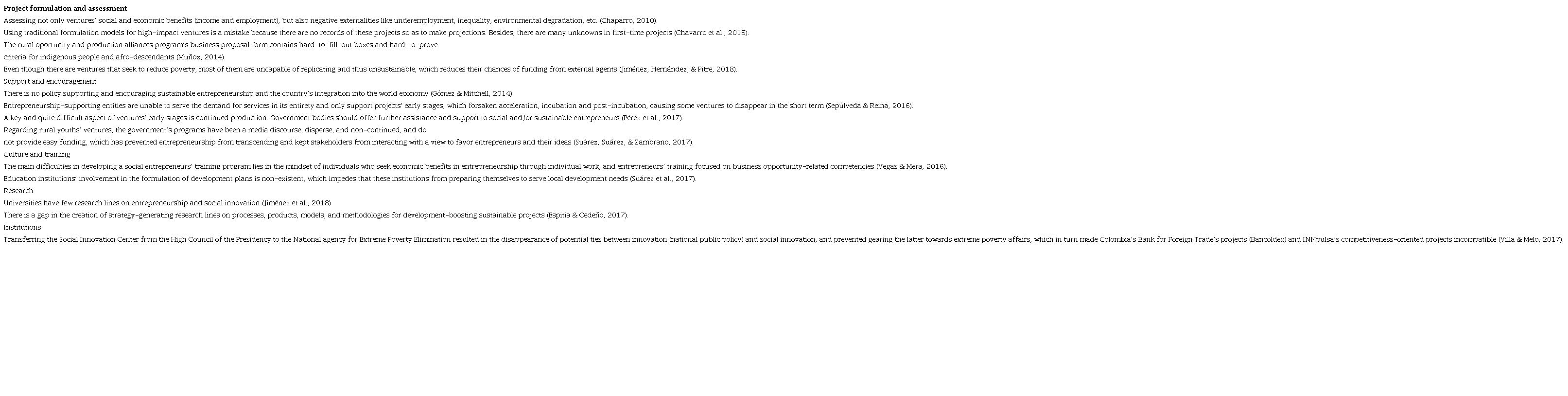
Source: Authors’ own elaboration.
4. Conclusions
This document contributed to identifying, contrasting, and consolidating the different authors’ positions regarding entrepreneurship’s strengths and opportunities in Colombia. Regarding the strengths, at the macro level, there is evidence of reformulation of paradigms and the generation of incremental regulations. At the medium level, State policies have built on government and private agencies to stimulate and support business ideas, business plans, and existing companies. Likewise, businessmen and entrepreneurs have been granted tax breaks and provided easier access to financial and non-financial resources in the form of increased funding for research projects due to increased budgets for the institutions that oversee innovation and research. At the micro-level, programs, policies, and institutions have been created to promote entrepreneurship and business creation and strengthen research and technological development.
Thus, we may conclude that some of the macro-, medium- and micro-level elements that Hörisch (2015) suggested have been incorporated into shaping an entrepreneurship system, wherein the transition towards sustainability has actually been incorporated.
However, our literature review was unable to account for the degree to which are present a) social groups that support and make visible the work carried out around sustainable enterprises, b) users or markets that prefer sustainable products and understand the value of the products they purchase, and (c) suppliers that make sustainability processes traceable processes. Therefore, it would be interesting to address these issues in future research in a country-applied case study.
On the other hand, what the government has actually done in terms of paradigm reformulation, the regulation issuance and the creation of institutions that support the culture of entrepreneurship and the entrepreneurs’ positive perception of these elements seem to be in agreement.
Concerning improvement opportunities, it is worth highlighting the adjustments to the business plan assessment methodology for it to include, in addition to socio-economic aspects, and analysis of other social and environmental factors. Also noteworthy is the provision of more robust support and assistance by government bodies to sustainable entrepreneurs, assured continuity, focus, and easy funding through entrepreneurship supporting government programs; the issuance of a policy explicitly aimed at supporting and stimulating sustainable entrepreneurship; contemplating the particularities of indigenous peoples, Afro-descendants, high-impact companies in business proposals. It is also paramount that support be provided during a project’s early stages and the acceleration, incubation, and post-incubation thereof with a view to continued productivity; to highlight and encourage entrepreneurs’ social and environmental responsibility in entrepreneurs’ training programs. Also, educational institutions must provide the knowledge and tools that enable individuals to contribute to local development, while institutions and policies must focus on social innovation as required, for public policies’ emphasis shifted from social innovation to extreme poverty. Hence, it is essential to develop specific programs for each of those two topics since they differ at project formulation and assessment levels. The preceding intends to provide financial and non-financial support so that innovation and entrepreneurship can be assessed in terms of competitiveness, social, environmental, and economic impact. In contrast, projects aimed at supporting communities under extreme poverty must contemplate these populations’ particularities and implement other assessment scales. Finally, the university and other academic and scientific communities’ research lines need strengthening in terms of entrepreneurship and sustainable entrepreneurship and social innovation specifically, so that it will become possible to enhance these companies’ capabilities to contribute to the improvement of vulnerable populations’ conditions and environmental protection.
Likewise, it was observed each author considered specific improvement opportunities, and there is no evidence of an all-encompassing conclusion that encompasses different areas, wherefore this study serves the national government as a reference point for its activities in this regard.
6. References
Arboleda, O. L., y Zabala, H. (2011). Condiciones claves para el éxito y sostenibilidad de los emprendimientos solidarios de Medellín. Semestre Económico, 14(28), 77-94. Doi: 10.22395/seec.v14n28a5
Brieger, S. A., & De Clercq, D. (2019). Entrepreneurs’ individual-level resources and social value creation goals: The moderating role of cultural context.International Journal of Entrepreneurial Behavior & Research, 25(2), 193-216. Doi: 10.1108/IJEBR-12-2017-0503
Castro, H., Rodríguez, F., & Martínez, Y. A. (2019). Success factors of MSMEs in colombia. Clio America, 13(26), 318-327. Doi: 10.21676/23897848.3429
Contreras, O., Avella, A. C. P., y Pérez, M. J. M. (2017). La inversión de impacto como medio de impulso al desarrollo sostenible: Una aproximación multicaso a nivel de empresa en Colombia. Estudios Gerenciales, 33(142), 13-23. Doi: 10.1016/j.estger.2017.02.002
Chamorro, E., Osorio, H., y Botero, J. (2013). Política de emprendimiento en Colombia, 2002-2010. Estudios Gerenciales, 29(128), 274-283. Doi: 10.1016/j.estger.2013.09.001
Chang, M. Y. (2001). La economía ambiental 165-178. En Pierri, N., y Foladori, G. (Coord.), Sustentabilidade? Desacuerdos sobre el desarrollo sostenible. Montevídeo: Trabajo y capital.
Chaparro, A. (2010). Emprendimiento y empresas agrarias y rurales más sustentables, para la sustentabilidad de los territorios. Agronomía Colombiana, 28(3), 483-490. Recuperado de http://www.scielo.org.co/pdf/agc/v28n3/v28n3a15.pdf
Chavarro, L., Diez, H., y Rodríguez, D. (2015). Gestión de emprendimientos sostenibles de alto impacto innovador: competencias y herramientas no convencionales (pp. 233-258).. En N. Cáceres, C. Peréz, J. Vargas, D. Ocampo, y E. Guilles (Comp.), VI Congreso Internacional en Gestión, Empredimiento e Innovación - Nueva Economía e Innovación Social. Colombia: Ediciones EAN. Recuperado de http://hdl.handle.net/10882/9027
Chirinos, Y., y Pérez, C. (2016). La responsabilidad Social Universitaria: emprendimiento sostenible como impacto de intervención en comunidades vulnerables. Revista Escuela Administrativa de Negocios, 81, 91-110. Doi: 10.21158/01208160.n81.2016.1560
Cohen, B., Smith, B., & Mitchell, R. (2008). Toward a sustainable conceptualization of dependent variables in entrepreneurship research. Business Strategy and the Environment, 17(2), 107-119. Doi: 10.1002/bse.505
Cohen, B., & Winn, M. I. (2007). Market imperfections, opportunity and sustainable entrepreneurship. Journal of Business Venturing, 22(1), 29-49. Doi: 10.1016/j.jbusvent.2004.12.001
Cruz, F. O., Mera, C. W., y Lechuga, J. I. (2019). Evaluación de estrategias de emprendimiento sostenible e innovación implementadas en las unidades productivas del SENA centro industrial y desarrollo empresarial de Soacha- Cundinamarca- Colombia. Tendencias,20(1), 183-202. Doi: 10.22267/rtend.192001.113
Dentchev, N., Rauter, R., Jóhannsdóttir, L., Snihur, Y., Rosano, M., …Baumgartner, R., et al. (2018). Embracing the variety of sustainable business models: A prolific field of research and a future research agenda. Journal of Cleaner Production, 194, 695-703. Doi: 10.1016/j.jclepro.2018.05.156
Dhahri, S., & Omri, A. (2018). Entrepreneurship contribution to the three pillars of sustainable development: What does the evidence really say?, World Development, 106, 64-77. Doi: 10.1016/j.worlddev.2018.01.008
DNP. (2018). DNP traza lineamientos del Plan Nacional de Desarrollo del Gobierno Duque. Recuperado de https://www.dnp.gov.co/Paginas/DNP-traza-lineamientos-del-Plan-Nacional-de-Desarrollo-del-Gobierno-Duque.aspx
Escandón, D. M, Urbano, D., Hurtado, A., Salas, J., Zapata, A. (2019). Formal institutions, informal institutions and entrepreneurial activity: A comparative relationship between rural and urban areas in Colombia. Journal of Urban Management, 8(3), 458-471. Doi: 10.1016/j.jum.2019.06.002
Espitia, P., y Cedeño, M. (2017). Formulación de una línea de investigación en Diseño Sostenible para la innovación y el emprendimiento en Colombia, a partir del análisis de las líneas y grupos de investigación registrados en el Sistema de Ciencia Tecnología e Innovación (CTI). ArDIn Arte, Diseño e Ingeniería, (6), 24-45. Recuperado de http://polired.upm.es/index.php/ardin/article/view/3590/3670
Franco, I.B., & Tracey, J. (2019). Community capacity-building for sustainable development: Effectively striving towards achieving local community sustainability targets.International Journal of Sustainability in Higher Education, 20(4), 691-725. 10.1108/IJSHE-02-2019-0052
Gálvez, E. J., Guauña, R. A., y Pérez, R. I. (2018). Impacto de la norma social subjetiva en la intención de emprendimiento sostenible: un caso de estudio con estudiantes colombianos. Revista EAN, (85), 57-74. Doi: 10.21158/01208160.n85.2018.2048
Gómez, H., y Mitchell, D. (2014). Innovación y emprendimiento en Colombia: balance, perspectivas y recomendaciones de política, 2014 - 2018. Cuadernillos de Fedesarrollo, 50 94. Recuperado de http://hdl.handle.net/11445/149
Hall J., Danake G., & Lenox M. (2010). Sustainable development and entrepreneurship: Past, contributions and future directions. Journal of Business Venturing, 25(5), 439-449. Doi: 10.1016/j.jbusvent.2010.01.002
He, J., Nazari, M., Zhang, Y., & Cai, N. (2020). Opportunity-based entrepreneurship and environmental quality of sustainable development: A resource and institutional perspective. Journal of Cleaner Production, 256, 1-12. Doi: 10.1016/j.jclepro.2020.120390
Hechavarría, D. M. (2016). The impact of culture on national prevalence rates of social and commercial entrepreneurship. International Entrepreneurship and Management Journal, 12(4), 1025-1052. Doi: 10.1007/s11365-015-0376-1
Hechavarría, D. M., Terjesen, S. A., Ingram, A. E., Renko, M., Justo, R., & Elam, A. (2017). Taking care of business: The impact of culture and gender on entrepreneurs’ blended value creation goals. Small Business Economics, 48(1), 225-257. Doi: 10.1007/s11187-016-9747-4
Holguín, M. T., y Clavijo, A. (2017). Oportunidades que tienen los emprendedores con enfoques sustentables en el marco de una paz estable y duradera. En 5to Simposio Internacional de Investigación en Ciencias Económicas, Administrativas y Contables - Sociedad y Desarrollo y 1er Encuentro Internacional de estudiantes de Ciencias Económicas, Administrativas y Contables, Universidad Libre, Colombia. Recuperado de http://www.unilibre.edu.co/bogota/ul/eventos-anuales/simposio-internacional-de-investigacion-en-ciencias-economicas-administrativas-y-contable
Hoogendoorn, B., van der Zwan, P., & Thurik, R. (2020). Goal heterogeneity at start-up: are greener start-ups more innovative?, Research Policy, 49(10), 1-17. Doi: 10.1016/j.respol.2020.104061
Hörisch, J. (2015). The Role of Sustainable Entrepreneurship in Sustainability Transitions: A Conceptual Synthesis against the Background of the Multi-Level Perspective.Administrative Sciences. 5(4), 1-15. Doi: 10.3390/admsci5040286
Jiménez, A., Hernández, H., y Pitre, R. (2018). Emprendimiento social y su repercusión en el desarrollo económico desde los negocios inclusivos (Colombia). Revista Logos Ciencia & Tecnología, 10(2), 198-211. Doi: 10.22335/rlct.v10i2.462
Kyrö, P. (2001). To grow or not to grow? Entrepreneurship and sustainable development. International Journal of Sustainable Development & World Ecology, 8(1), 15-28.
Larson, A. L. (2000). Sustainable innovation through an entrepreneurship lens. Business Strategy and the Environment, 9(5), 304-317. Doi: 10.1002/1099-0836(200009/10)9:5%3C304::AID-BSE255%3E3.0.CO;2-O
Ley 1014. (2006, enero). Diario oficial No. 46.164, Colombia. Recuperado de https://normograma.info/men/docs/pdf/ley_1014_2006.pdf
Lopez, T., & Alvarez, C. (2018). Entrepreneurship research in Latin America: a literature review, Academia Revista Latinoamericana de Administración, 31(4), 736-756. Doi: 10.1108/ARLA-12-2016-0332
Muñoz, J. (2014). La oferta institucional para la gestión de la sustentabilidad. El caso del programa IRACA en Colombia. Gestión y Ambiente, 17(2), 55-67. Recuperado de https://revistas.unal.edu.co/index.php/gestion/article/view/48968
Naciones Unidas. (1987). Informe de Brundtland. Oxford University Press.
Ortiz, L., y Arias, C. (2013). Mesa de Empresarismo Social de Antioquia. Potenciado Emprendimientos Sociales (pp. 514-532). En M. Benegas, Formando comunidades académicas para el emprendimiento sustentable: VII Workshop. Colombia: Corporación Universitaria Remington. Recuperado de https://www.uniremington.edu.co/wp-content/uploads/2019/01/formando-comunidades-uniremington.pdf
Parra, M., Rubio, G., y López, L. M. (2017). Factores distintivos de emprendimiento que propiciaron el éxito: casos de estudio enempresarios de Ibagué, Tolima. Pensamiento & Gestión, (43), 89-127. Doi: 10.14482/pege.43.10583
Parris, T. M., & Kates, R. W. (2003). Characterizing and Measuring Sustainable Development. Annual Review of Environment and Resources, 28(1), 559-586. Doi: 10.1146/annurev.energy.28.050302.105551
Pérez, C., Chirinos, Y., y Martínez, C. (2017). Emprendimiento social sostenible en comunidades vulnerables: caso altos de la sabana de la ciudad de Sincelejo, Sucre, Colombia (pp. 233-260). En Y. Chirinos, C. Peréz, M. Barris, y C. Martínez, Desde la perspectiva laboral. Colombia: Editorial de la Universidad Simón Bolívar. Recuperado de https://url2.cl/zeAEP
Reina, W., Sepúlveda, C. I., y González, G. J. (2018). Análisis semiparametrico de los factores asociados a la sostenibilidad de los emprendimientos. Revista Facultad De Ciencias Económicas: Investigación y Reflexión, 26(1), 163-180. Doi: 10.18359/rfce.3144
Reynoso, J., Kandampully, J., Fan, X., & Paulose, H. (2015). Learning from socially driven service innovation in emerging economies.Journal of Service Management, 26(1), 156-176. Doi: 10.1108/JOSM-11-2013-0313
Rodríguez, M., Guijarro, M., & Carrilero, A. (2019). An overview of ecopreneurship, eco-innovation, and the ecological sector. Sustainability, 11(10), 2909 Doi: 10.3390/su11102909
Sanabria, S., y Hurtado, E. (2018). Emprendimiento verde en torno a la conservación y recuperación del agua y sus espacios en Bogotá y Medellín (Colombia). Revista Facultad de Ciencias Económicas, 16(1), 93-111. Doi: 10.18359/rfce.3141
Sanchéz, C. (2017). Emprendimiento e innovación social - Elementos de contextualización para la convivencia pacífica a través de la asociatividad en Colombia. Revista de la Universidad de la Salle, (73), 241-258. Recuperado de https://ciencia.lasalle.edu.co/cgi/viewcontent.cgi?article=2119&context=ruls
Schaltegger S., & Wagner M. (2011). Sustainable Entrepreneurship and Sustainability Innovation: Categories and Interactions. Business Strategy and the Environment, 20(4), 222-237. Doi: 10.1002/bse.682
Sepúlveda, C., y Reina, W. (2016). Sostenibilidad de los emprendimientos: Un análisis de los factores determinantes. Revista Venezolana de Gerencia, 21(73), 33-49. Recuperado de http://www.redalyc.org/jatsRepo/290/29045347003/html/index.html
Strothotte, T. G., & Wüstenhagen, R. (2005). Structure of Sustainable Economic Value in Social Entrepreneurial Enterprises. The Emergence of Entrepreneurial Economics. Research on Technological Innovation Management and Policy, 9, 129-140. Doi: 10.1016/S0737-1071(05)09008-6
Suárez, M., Suárez, L., y Zambrano, S. (2017). Emprendimiento de jóvenes rurales en Boyacá-Colombia: Un compromiso de la educación y los gobiernos locales. Revista de Ciencias Sociales, 23(4), 23-32. Recuperado de http://www.redalyc.org/pdf/280/Resumenes/Resumen_28055641003_1.pdf
Tran, N. H., & Dat Le, C. (2019). Governance quality, foreign direct investment, and entrepreneurship in emerging markets.Journal of Asian Business and Economic Studies, 26(2), 238-264. Doi: 10.1108/JABES-09-2018-0063
Vargas, E. E., Bahena, I. L., y Cordón, E. (2018). Innovación responsable: nueva estrategia para el emprendimiento de MIPYMES. Innovar: Revista de Ciencias Administrativas y Sociales, 28(69), 41-53. Doi: 10.15446/innovar.v28n69.71695
Vegas, J., y Mera, C. (2016). Modelo de formación en emprendimiento social para Instituciones de educación Superior en Colombia. Revista Escuela Administrativa de Negocios, (81), 29-44. Doi: 10.21158/01208160.n81.2016.1563
Villa, L., y Melo, J. (2017). Panorama de la Innovación Social en Colombia en 2017. Revista Universidad Pontificia Bolivariana, 56(156), 37-51. Recuperado de https://revistas.upb.edu.co/index.php/upb/article/view/478/345
Yaoqi Li, S., & Huang, L.S. (2020). Opportunity and necessity entrepreneurship in the hospitality sector: Examining the institutional environment influences. Tourism Management Perspectives, 34, 1-13. Doi: 10.1016/j.tmp.2020.100665
Young, S. L., Welter, C., & Conger, M. (2018). Stability vs. flexibility: The effect of regulatory institutions on opportunity type. Journal of International Business Studies, 49(4), 407-441. Doi: 10.1057/s41267-017-0095-7
Zambrano, L. A. (2016). El papel del Estado en el desarrollo del emprendimiento: Comparativo Colombia - Ecuador (Tesis de maestría). Universidad Nacional de Colombia, Bogotá, Colombia. Recuperado de http://bdigital.unal.edu.co/57213/7/luzadrianazambranocarbonell.2016.pdf
Notas:
Conflict of interest declaration