Article of Scientific and Technological Research
Internationalization and open innovation in SMEs from the horticultural sector in Colombia
Internacionalización e innovación abierta en PYMES del sector hortofrutícola en Colombia
 Tulio Ferney Silva Castellanos tulio.silva@correounivalle.edu.co
Fernando Echeverry Valencia fernando.echeverry.v@correounivalle.edu.co
Luis Felipe Bocanegra Henao gerencia@aprocol.com.co
Tulio Ferney Silva Castellanos tulio.silva@correounivalle.edu.co
Fernando Echeverry Valencia fernando.echeverry.v@correounivalle.edu.co
Luis Felipe Bocanegra Henao gerencia@aprocol.com.co
Internationalization and open innovation in SMEs from the horticultural sector in Colombia
Cuadernos de Administración (Universidad del Valle), vol. 37, no. 71, e2510668, 2021
Universidad del Valle
Received: 07 October 2020
Revised document received: 27 September 2021
Accepted: 12 October 2021
Published: 13 December 2021
Funding
Contract number: CI8137
Funding statement: This research is sponsored by the Research Office of the Universidad del Valle (The Role of Open Innovation in the Competitive Advantage of the Horticultural Sector, CI8137 - APROCOL) and was carried out by researchers and staff from the International Business and Foreign Trade Group
Abstract: This study empirically assesses the relationship between open innovation, exploration, and exploitation activities in the context of the internationalization process of SMEs in the fruit and vegetable sector from Northern Valle del Cauca, Colombia. Considering that SMEs generally lack the resources and skills to arrange the entire innovation process, they must be open to external sources to innovate and seek internationalization strategies. The exercise has been based on a sample of 102 SMEs and the determination of a partial least squares structural equation model (PLS-SEM) to test a series of research hypotheses. The findings confirm a positive and significant relationship between exploration and exploitation activities with open innovation, with this relationship being much more robust in exploitation activities. However, a relationship between open innovation and internationalization could not be verified. These findings suggest that internationalization is not a consequence of open innovation but instead finds enablers in public policies and the consolidation of the National Agricultural Innovation System (NAIS) regarding the case discussed here. In the literature, there is a lack of studies in the field of research.
Keywords: Open innovation, Internationalization, SMEs, Exploration, Exploitation.
Resumen: El presente estudio evalúa de manera empírica la relación entre la innovación abierta, las actividades de exploración y explotación en el contexto del proceso de internacionalización de las PYMES del sector hortofrutícola del Norte del Valle del Cauca en Colombia. Teniendo en cuenta que las PYMES generalmente carecen de los recursos y las competencias para organizar todo el proceso de innovación, deben estar abiertas a fuentes externas para innovar y buscar estrategias de internacionalización. El ejercicio se ha basado en una muestra de 102 PYMES y la determinación de un modelo de ecuación estructural de mínimos cuadrados parciales (PLS-SEM) para probar una serie de hipótesis de investigación. Los hallazgos confirman que existe una relación positiva y significativa entre las actividades de exploración y explotación con la innovación abierta, siendo mucho más fuerte esta relación en las actividades de explotación. No obstante, no se pudo comprobar una relación entre la innovación abierta y la internacionalización. Estos hallazgos sugieren que la internacionalización no es una consecuencia de la innovación abierta; sino que encontraría dinamizadores en las políticas públicas y la consolidación del Sistema Nacional de Innovación Agrícola (SNIA), para el caso aquí tratado. En la literatura se evidencia una escasez de estudios frente al campo de investigación.
Palabras Clave: Innovación abierta, Internacionalización, PYMES, Exploración, Explotación.
1. Introduction
Developing countries are trying to boost their horticultural industry to increase export earnings and benefit rural communities. The horticultural industry is a strategic sector for the productive development of Colombia. According to Asohofrucol (2019), this sector accounts for 17% of the country’s total agricultural sector production. Between 2010 and 2019, the planted area had a sustained average growth of 3% per year. The departments with the highest participation in the sector are Antioquia (11%), Santander (10%), Meta (8%), Arauca (7%), Valle del Cauca (7%), and Cundinamarca (6%), which gather 49% of the total production (Asohofrucol, 2019).
Asohofrucol (2019) points out that in terms of exports, they totaled more than 264 thousand tons in 2019, and transactions’ worth amounted to more than 409 million dollars, a 14% increase compared to 2018. The main products in terms of exported volume in 2019 were banana (39%), avocado (15%), prepared or preserved mangoes (8%), other edible fruits (7%), cape gooseberries (6%), and fresh mangoes (5%). These six products account for 80% of total sales. The central destination countries for those exports are the United States (32%), the United Kingdom (18%), the Netherlands (15%), Belgium (5%), and Spain (4%) (Asohofrucol, 2019). These reasons, among others, offer an understanding of the particular interest that the government has placed in designing public policies that promote this sector’s activities.
Although the horticultural sector is considered strategic in developing countries, obstacles prevail derived from the scarcity of financial and human resources, the degradation of natural resources, an uncertain climate, and a very dynamic panorama of markets and consumer demands (Dehnen-Schmutz, Holdenrieder, Jeger, and Pautasso, 2010). These and other difficulties can be overcome by forming networks to benefit from shared knowledge and enhanced capabilities, two fundamental vectors in open innovation.
Indeed, open innovation is defined as the set of efforts deployed by SMEs to seek knowledge and innovate beyond their organizational limitations (Chesbrough, 2003). The objective of open innovation is to open the innovation process to other organizations in order to explore and exploit knowledge flows both inside and outside (Santoro, Vrontis, Thrassou, and Dezi, 2018). Several studies have regarded exploration and exploitation as antecedents of open innovation; however, few have focused on horticultural sector managers’ exploration and exploitation activities as determinants of open innovation (Ali, Ali, Malik, Hamza, and Ali, 2020).
Therefore, managers should explore new options and exploit their resources and internal knowledge to lead the horticultural sector to adopt an open innovation approach into its processes and make SMEs more profitable and competitive in international markets. Moreover, since SMEs generally lack the resources and competencies to arrange their entire innovation process, they must be open to external sources to innovate and internationalize (Ferraris, Santoro, and Papa, 2018).
Nevertheless, it is necessary to point out that some researchers (Santoro, Mazzoleni, Quaglia, and Solima, 2019) sustain that internationalization and open innovation have been analyzed under the fact that innovation activities affect company capacity for international expansion. One of the responses to this finding comes from Love and Roper (2015), who argue that innovation ecosystems and National Innovation Systems (NIS) are needed where there are SME public policies to stimulate innovation and internationalization. However, other researchers (Battisti, Gallego, Rubalcaba, and Windrum, 2015; Kumar, 2009; Yi, Wang, and Kafouros, 2013) did not find a causal relationship between the two variables.
This study identified a research gap in the analysis of exploration, exploitation, open innovation, and internationalization in horticultural SMEs. The studies in the literature deal with international business theories, which characterize SME internationalization as the ability to exploit competitive advantages and the desire to explore resources that strengthen global company competitiveness (Villar, Pla-Barber, and Ghauri, 2020; Silva, González-Loureiro, and Braga, 2021). Meanwhile, (Lee and Hemmert (2021) pointed out that, in general, the existing literature suggests that innovation activities increase the likelihood of exporting and that exporting SMEs are more prone to innovate.
As already mentioned, horticultural SMEs represent a significant share of the productive vocation in Colombia and Valle del Cauca. Therefore, analyzing this company typology is relevant both for academic research and for political and managerial implications. Consequently, this paper presents the results of a survey aimed at managers of SMEs in the horticultural sector in Valle del Cauca. It seeks to determine whether managers’ exploration and exploitation activities affect open innovation in SMEs and if open innovation determines propensity to export. The hypotheses that support this research were tested with the modeling of partial least squares structural equations (PLS-SEM).
Consequently, this paper is structured as follows: initially, the most relevant aspects of the review of the existing literature on concepts of open innovation in SMEs in the horticultural sector will be presented (the relationship between internationalization and open innovation); then, the paper will show how exploration and exploitation influence open innovation; lastly, there will be the development and testing of the model built for this study. In the end, the research conclusions will be presented, clarifying implications for the future and stressing the areas in need of further empirical research as a contribution to the bank of experiences in akin areas of knowledge.
2. Open innovation in SMEs in the horticultural sector
The open innovation model recognizes that smaller companies hold an increasingly prominent role in the contemporary innovation landscape (Van de Vrande, De Jong, Vanhaverbeke, and De Rochemont, 2009). In Chesbrough’s early studies (2003), he argues that SMEs begin to adopt open innovation practices to some extent.
Thus, open innovation is relevant for the horticultural inasmuch as, firstly, SMEs represent the most of the business fabric in these activities; consequently, they bring together all the elements that limit their financial, labor, and infrastructure capabilities to innovate autonomously (Van de Vrande et al., 2009). Secondly, horticultural products must be subject to international regulations when meant for exporting and, therefore, innovation must also be subject to international benchmarks. Thirdly, some production processes originate in more traditional methods, making it difficult for these companies’ managers to get positioned products to follow market trends (Fortuin and Omta, 2009).
Although the studies on open innovation and the horticultural sector are incipient, most focus on the agricultural sector. Among them, the research by Fielke, Botha, Reid, Gray, Blackett, Park, and Williams (2018) stands out. They recognize that open innovation is contextual, and each actor in the Innovation System (IS) pursues their own interests due to mistrust prevailing among actors. Joffre, Klerkx, Dickson, and Verdegem (2017) managed to identify that open innovation in the agricultural sector seeks to create better products and new business opportunities, and they also point out that the role of institutions and regulatory frameworks is to guide the behavior of actors within the IS, generating a more reliable context for liaisoning.
As an illustration of the above, Fertő, Molnáry, and Tóth (2016) demonstrated that open innovation is a natural practice of these SMEs when studying 300 agricultural SMEs in Hungary. This is because the entire chain behaves like a mature industry where incremental innovations are taking place. Other authors, such as Schut et al. (2015), created the Rapid Assessment of Agricultural Innovation Systems (RAAIS) model in Tanzania and Benin and demonstrated that the interactions in an agricultural system present problems in its ability for innovation. For their part, Klerkx and Nettle (2013) sustain that, without strong institutional support for innovation co-production processes, agricultural sector stakeholders are less capable of effectively operating in innovation co-production roles, hence the importance of this study. It lays down some fundamental grounds for constructing an institutional synergy favorable to open innovation in the horticultural sector in Colombia.
3. Open innovation and internationalization in SMEs
In an increasingly globalized world, company internationalization is one of the most critical factors that determine the competitiveness of a country. Lim, Sharkey, and Kim (1991) defined internationalization as a business innovation process because both phenomena unfold in an uncertain environment where information is lacking, and both are carried out to control and minimize risk. Both internationalization and innovation are processes that unfold by stages that develop in incremental steps (Moreno and Casillas, 2014). Regarding SME internationalization, the same encounters barriers and difficulties such as limited resources and international contacts, unfavorable environmental factors, as well as a lack of information and qualified human resources. In this sense, open innovation can be harnessed to reduce negative factors and thus help SMEs’ internationalization efforts.
Open innovation can be a suitable alternative for SMEs to create value, generate new products and processes with external networks at an international level and thus gain access to new international markets. The literature assumes that the relationship between internationalization and innovation is two-way (Moreno and Casillas, 2014) because innovative activities improve a company’s productivity and international competitive advantage. This way, innovation, and internationalization may be complementary or substitute strategies (Lee and Hemmert, 2021).
Thus far, there is a shortage of studies that assess the relationship between open innovation and internationalization processes in SMEs (Santoro et al., 2019) in the horticultural sector; therefore, it is in an embryonic state. However, research such as that by Golovko and Valentini (2011) demonstrated that product innovation encourages SMEs’ export activities. Zucchella and Siano (2014) demonstrated a positive relationship between innovation and internationalization in a regional SME system in the textile industry.
Currently, the studies by Santoro et al. (2019) stand out, who empirically proved a positive relationship between an external knowledge supply strategy and internationalization in 135 SMEs in Europe. Yoon and Ryu (2020) established that international networks are essential for SMEs because they help establish and intensify and optimize international performance. Ryu, Baek, and Yoon (2021) found that technological innovation capacity significantly influences international performance. Moreover, adding to this experience, Lee and Hemmert (2021) determined that SMEs must balance their exploratory and exploitative orientation within and across innovation domains and market reach to improve their performance.
In contrast, there are studies where no positive relationship was found between internationalization and open innovation. Kumar (2009) found a negative relationship between product innovation and international markets. Battisti, Gallego, Rubalcaba, and Windrum (2015) did not find a positive effect between the intensity of the knowledge supply and foreign sales. On the other hand, Yi, Wang, and Kafouros (2013) showed that internationalization depends on a company’s innovative capabilities and its institutional characteristics, the institutional environment, and the location in which it operates. Thus, even in this context, it is still advisable that the NIS and the innovation policy be oriented to promoting and further supporting SME internationalization (Omta and Fortuin, 2013) because external knowledge is not spontaneous; it is the result of public policies and the National Innovation Systems (NIS) of the countries (Chesbrough and Vanhaverbeke, 2018).
Vrontis, Thrassou, Santoro, and Papa (2017) point out that SMEs in the horticultural sector need open innovation to innovate as well as to pursue internationalization strategies. For this reason, the prevailing formulation in this study is that open innovation holds a positive relationship with internationalization because it engages different actors in the innovation process. This can help develop innovative processes and activities that are globally appreciated. Consistent with the above, the following research hypothesis is set forth:
Hypothesis 1: Open innovation positively influences export propensity.
4. Exploration and exploitation activities in SMEs
As concerns this study, open innovation can be understood as the set of practices that allow companies in the horticultural sector to collect ideas from their external environment, unleash those ideas in innovation processes, and, thereby, increase company competitiveness. However, the manager’s ability to explore and exploit the available knowledge is essential to collect, systematize, categorize, disseminate and exploit the knowledge that may be stem from external sources (O’Connor and Kelly, 2017); without such managerial skills, relevant knowledge is incapable of being generated.
The first theorist to conceptualize exploration and exploitation at the managerial level was March (1991), who considered that exploration is related to search, discovery, variation, risk-taking, experimentation, and flexibility. For March (1991), the essence of exploration is to expand the existing knowledge base through a search for new forms, routines, and organizational systems, experimenting with new approaches and technologies, and adopting a long-term focus, and reconsidering existing beliefs and decisions (Mom, Van Den Bosch, and Volberda, 2009).
On the contrary, according to March (1991), exploitation is related to refinement, choice, production, efficiency, implementation, and execution. The essence of exploitation activities is to build trust through experience and deepen the existing knowledge base in the manager (Mom et al., 2009). The exploitation activities carried out by the administrators include using and perfecting their existing knowledge, its application, improvement, and expansion of existing skills, technologies, processes, and products, focusing on production and under a short-term focus while building on existing beliefs and decisions (Vrontis, Culasso, Giacosa, and Stupino, 2019).
Exploitation activities expand knowledge and reinforce existing skillsets and processes (Jansen, Van Den Bosch, and Volberda, 2006); that is, they refine existing procedures and derive value from what is already known (Evald, Clarke, and Boyd, 2021). Therefore, exploitation is linked to the notion of incremental innovation (Sun, Liu, and Ding, 2020). For its part, exploration is associated with future-oriented activities; as managers develop new capabilities, experiment with new technologies, and seek new customers and markets, they can reach disruptive innovation (Sun et al., 2020).
Exploration and exploitation have generally been studied at the company level (Lubatkin, Simsek, Ling, and Veiga, 2006) or business unit level (Jansen et al., 2006). However, conceptual understanding and empirical validation of exploration and exploitation at the managerial level are lacking (Ali, Ali, Malik, Hamza, and Ali, 2020). In the literature, there are some studies aimed at evaluating how exploration and exploitation activities influence business performance (Arif and Hasan, 2021), creativity, research, employee development and product innovation (Munoz-Pascual and Galende, 2020), the generation of patents, and the performance of innovation (Park and Seo, 2018), and the degree of innovation (Vrontis et al., 2019). However, studies specific to the horticultural sector are incipient.
Concerning small farmers, exploration activities consist of searching for new ways of doing things to address their problems in communities formed with relatives and neighbors or NAIS actors (Meissner and Carayannis, 2017). On the other hand, exploitation allows horticultural sector managers to adapt to existing environmental requirements, constantly test new alternatives, update processes and technology to meet transformation needs, and improve existing capacities (Sun et al., 2020).
According to the literature, exploration and exploitation impact open innovation (Sun et al., 2020). In the context of the horticultural sector, Zakić, Bugarčić, and Milovanović (2017) found that both exploration and exploitation influence the propensity for open innovation. Cillo, Rialti, Bertoldi, and Ciampi (2019) found that being capable of knowledge exploitation and exploration is an enabler for open innovation strategies in agri-food companies.
This confirms the approach of Perdomo, Farrow, Trienekens, and Omta (2016) in that open innovation offers new ways of producing knowledge and allows the stakeholders to address the contextual and structural challenges faced by small producers. Consequently, per these approaches, the objective of this research is to verify whether the horticultural managers’ exploration activities, such as searching, discovering, creating, and experimenting with new opportunities (Mom et al., 2009) and exploitation activities, such as selecting, implementing, improving and refining existing certainties ( Mom et al., 2009) play a role in the successful implementation of open innovation. Hence, to support this argument, the following hypotheses were raised.
Hypothesis 2. The manager’s exploration activities positively influence open innovation.
Hypothesis 3: The manager’s exploration activities positively influence open innovation.
5. Methodology
This research involves information from 102 SMEs in the horticultural sector of Northern Valle de Cauca, Colombia. The data were collected through a questionnaire prepared and validated on the basis of a careful literature review, the application of which was directed to SME owner-managers and administrators in charge of making critical company decisions as a way to avoid common method bias. Gathering the information took about six weeks.
In order to reach the horticultural sector managers, it was necessary to work together with the National Agricultural Innovation System (NAIS) parties (Aprocol, Asohofrucol, Agrosavia, ELIA, Cattleya, Ministry of Agriculture and Rural Development). Firstly, a pre-test was carried out with ten producers. However, due to the Sars-CoV2 pandemic health emergency, the questionnaire could not be applied in the field, wherefore 90% of the companies answered the questionnaire by phone call and the rest online. As a complement to the above, a cycle of online conferences was held to socialize the instrument. A total of 152 companies participated in the study, but 102 questionnaires were used nevertheless.
The constructs were evaluated using 7-point Likert-type scales ranging from 1 (strongly disagree) to 7 (strongly agree). The Open Innovation scale was created from the Chesbrough principles (2003, p.26) and was measured using ten items. The Export propensity scale addressing was based on Moreno and Casillas (2014) with a dichotomous variable that takes the value one if the company does export and 0 if no exports in 3 years. Regarding the exploration and exploitation variables, the Mom, Van Den Bosch, and Volberda (2009) scale was adapted to the administrators’ context with seven items per construct. The exploration scale determines the extent to which a manager engaged in exploration activities in the last three years, while the exploitation scale determines the extent to which the manager engaged in exploitation activities in the last three years.
Following the conceptual framework for open innovation in SMEs proposed by Lopes and de Carvalho (2018), the model used the following control variables: company size, company age, formalization, range of sales, type of innovation, number of formal and informal employees. In addition, administrator demographics such as educational attainment and gender were included.
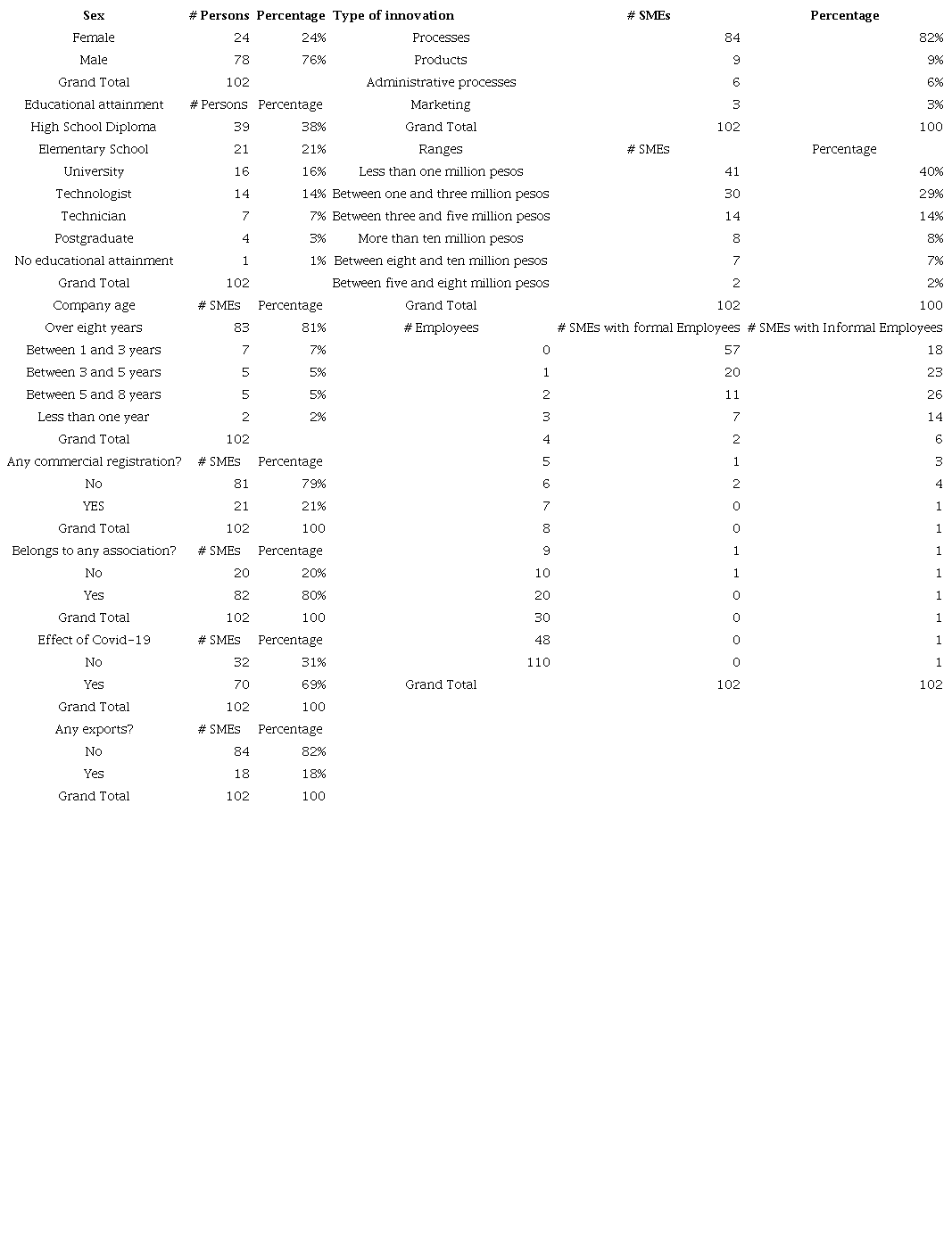
The literature yielded descriptive studies mostly, showing how Covid-19 affected global agricultural chains and intensified food insecurity worldwide (Tougeron and Hance, 2021). It also triggered a labor shortage in plantations, decreased sales and production, distribution problems, market performance alterations, and increased phytosanitary measures in exports (Van Hoyweghen, Fabry, Feyaerts, Wade, and Maertens, 2021). Therefore, the dichotomous control variable on the impact (YES/NO) of COVID-19 was included because the pandemic could change producers’ perceptions about open innovation. Descriptive results are shown in Table 1.
Source: Author’s own elaboration.
6. Analysis of results
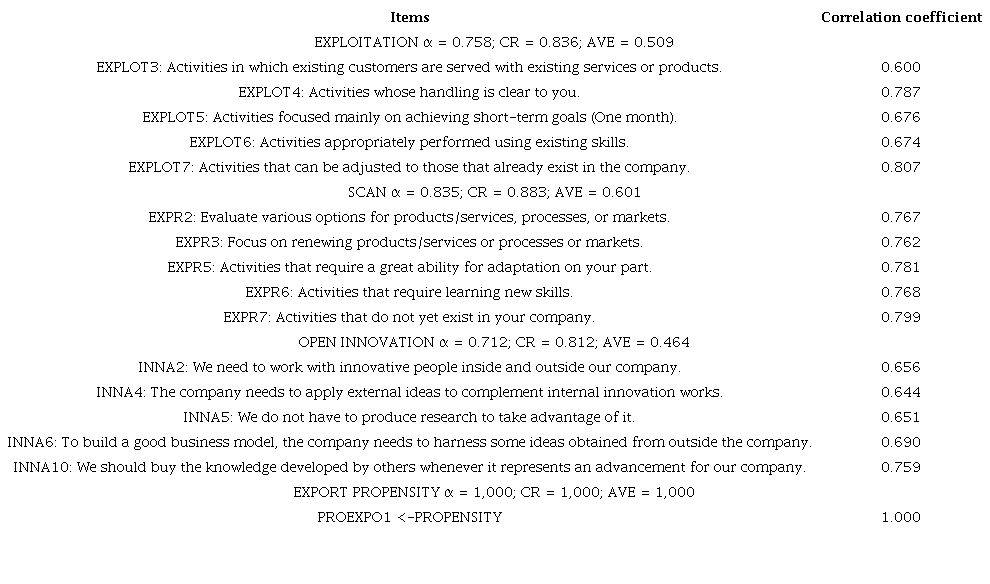
The statistical processing of the data uses a Partial Least Squares (PLS) model through the SmartPLS software, which allows, from the structural model, to show the relationships between independent variables and dependent variables. The PLS-SEM was used for its predictability capacity at the exploratory level and small sample sizes (Hair, Hult, Ringle, Sarstedt, Castillo, Cepeda, and Roldán, 2019). The first step to validate the model is to analyze the reliability for each factor. The study presents reflective constructs with a factorial load equal to or >0.5 (Hair, Anderson, Tatham, and Black, 1998). However, five open innovation items, two exploitation, and two exploitation items were discarded.
The assessment of the reflective pattern is analyzed through Cronbach’s alpha composite reliability index (IFC) and the average variance extracted (AVE) (Table 2). Nunnally and Bernstein (1994) suggest a minimum value of 0.70 for Cronbach’s alpha, while Fornell and Larcker (1981) suggest values above 0.70 for IFC and 0.5 for AVE. For open innovation, the AVE is close to the minimum expected value; however, Fornell and Larcker (1981) point out that if the AVE is less than 0.5, but the composite reliability is greater than 0.6 (CR = 0.812 for open innovation), the convergent validity of the construct is still adequate. It should be noted that the composite reliability of the Export Propensity variable is one because there is only one indicator to it (Hair et al., 2019).
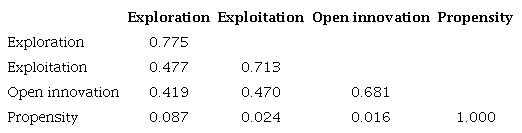
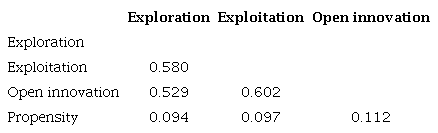
The Fornell and Larcker (1981) criteria and the HTMT matrix are employed to assess the discriminant validity. According to Fornell and Larcker (1981), a construct has discriminant validity if its AVE is greater than the squared correlations between this construct and the others (Table 3). Furthermore, Table 4 presents the relationship of heterotrait-monotrait correlations (Henseler, Hubona, and Ray, 2016) to assess discriminant validity better. If the HTMT value is greater than the HTMT value of 0.90, there is a discriminant validity problem. Discriminant validity was achieved under both criteria. Likewise, the model’s Fit is considered acceptable as it meets the SRMR indicator, a goodness-of-fit measure for PLS-SEM that can be used to avoid incorrect model specifications. Although Hu and Bentler (1999)sustain that it should be 0.08, Hu and Bentler (1999), in a more conservative version, accept a value below 0.10 or 0.08. The SRMR for this study is 0.10 and the Chi-Square 269.124.
Source: author’s own elaboration.
Source: Author’s own elaboration.
Source: Author’s own elaboration.
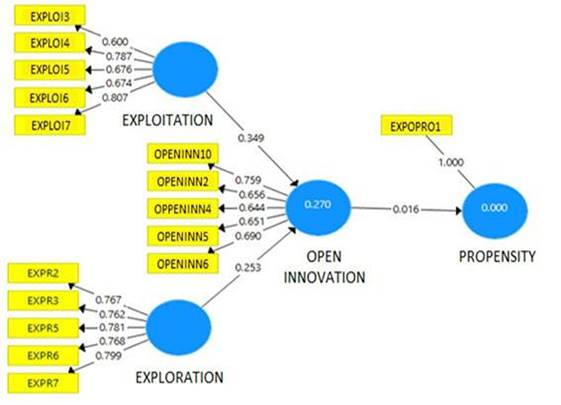
Figure 1
Model with T-Statistics values
Source: Author’s own elaboration.
Once the validity and reliability of the reflective model have been demonstrated, the structural model is assessed (Figure 1). To measure the relationships between variables, the beta coefficient (β) represents the strength of the relationship. For the level of significance, the T-Student test is obtained from a bootstrapping process in SMARTPLS.
Table 5 shows the results obtained through the structural model.
Table 5 shows the results obtained through the structural model. The correlation coefficient expresses the degree of linear dependence between two quantitative variables. The variable that best explains open innovation in SMEs in the horticultural sector is exploration activities, with a level of explanation of 34.9%. Thus, the exploration activities variable explains 25.3% of open innovation. However, open innovation only explains 1.6% of the propensity to export. On the other hand, the variation percentage of the response variable that explains its relationship with one or more predictor variables, is 0.270, which means that 27% of open innovation is explained by the manager’s exploration and exploitation activities. However, the between open innovation and the propensity to export is 0%.

R2 Open innovation: 0.270; Export propensity: 0.000 S = Hypothesis Corroborated NS = Hypothesis not corroborated Source: Author’s own elaboration.
Lastly, the T-value and the P-value represent the level of significance of the hypothesis, considered significant in this case; the hypothesis is approved with a T-value >1.96 and P-value <0.05. This study demonstrated the positive and direct relationships between exploitation activities and exploration and open innovation, that is, hypotheses 2 and 3. However, it is impossible to corroborate a relationship between open innovation and the propensity to export because it is not statistically significant; therefore, our empirical research does not support hypothesis 1. Likewise, the model was confirmed not affected by any control variable.
7. Discussion
Thus far, research on open innovation has focused on large companies, and there have been few studies on open innovation practices in SMEs, particularly in the horticultural sector. Based on a sample of 102 SMEs from the horticultural sector in Valle del Cauca (Colombia), it can be concluded, on the one hand, that SMEs in this sector are engaging in open innovation activities; and, on the other, that open innovation does not hold a significant relationship with internationalization. Managers’ exploration and exploitation activities positively affect open innovation, and exploitation holds a more significant relationship with open innovation.
Innovation was found as not having a causal relationship with the propensity to export, a finding that coincides with Yi et al. (2013), who sustain that this relationship is not uniform but depends on the institutional environment in which the company operates and is context-specific. According to Kenny and Meaton (2007), the public sector is necessarily chiefly accountable for using knowledge. Consequently, the NAIS can influence the relationship between open innovation and internationalization. However, the findings reveal that only 11% of the producers know about the NAIS and, furthermore, these engage with few actors from the NAIS, 60% have engaged with up to three main actors (SENA, ASOHOFRUCOL, and the Associations). According to these figures, the NAIS is embryonic, and, as stated by Omta and Fortuin (2013), open innovation does not affect internationalization in countries with a weak NIS.
According to Battisti et al. (2015), there is the thesis of learning by exporting, and companies do benefit from the technical and managerial experience of foreign companies or foreign liaisons. In the horticultural sector, exports are carried out by national and international intermediaries, accounting for the production link’s 82% level of informality. Therefore, it is believed that SMEs do not associate the benefit of external knowledge (open innovation) with internationalization. In other words, open innovation may not be able to trigger the internationalization process because open innovation involves learning processes (Love and Roper, 2015).
Methodologically speaking, no model proposals were found to study the relationship between SMEs, open innovation, and the propensity to export; thus, our exercise may be regarded as an input in expanding knowledge in this regard. In addition, measuring internationalization as a dichotomous variable based on the model by Moreno and Casillas, 2014 shuts down the possibilities of delving into areas such as the propensity to export and its conditions.
On the other hand, this study showed that manager exploitation and exploration activities positively affect open innovation in companies in the horticultural sector. This finding coincides with other authors, such as Cillo et al. (2019), Laursen and Salter (2006), and Aloini, Pellegrini, Lazzarotti, and Manzini, 2015), who found that exploration and exploitation capabilities are relevant to improve SMEs’ in the horticultural sector gearing towards open innovation.
This result reflects managers’ ability and their ability to search, discover, create and experiment with new opportunities. In this way, SME managers can approach NAIS actors and learn from them. They can also select, implement, improve, and refine existing certainties, which will help them successfully implement open innovation. Exploitation activities were also found more influential because managers in the agricultural sector lean more towards incremental process innovation.
8. Conclusions, limitations, and future research
This study showed that a consolidated NAIS is necessary for SMEs in the horticultural sector to engage in internationalization. If SMEs do not place themselves in ecosystems that help them overcome information asymmetries and the costs of entering export markets, this process will not be successful. In the case of Valle del Cauca, there is a strong presence of multinational companies exporting fruits and vegetables that become the means whereby companies can export. However, foreign companies’ influence can negatively impact knowledge management because SMEs do not learn by exporting, which might restrict them from pursuing innovation or export ambitions.
Another obstacle is the cost of internationalization. The research revealed that over 70% of the SMEs in the sector have an income of between 1 and 3 million pesos per month, a meager amount for contemplating expansion activities. In addition, more than half of the producers (59%) of the SMEs have elementary and secondary education. In this way, not having highly qualified workers affects R&D processes and harnessing external knowledge (Harris and Moffatt, 2011).
As for innovation exploitation activities, our data suggest that many SMEs benefit from the initiatives and knowledge acquired by managers. If both variables were reinforced, SMEs’ capacity to explore and exploit the knowledge provided by NAIS actors would increase. Meanwhile, most SMEs attempt to engage the SENA, Associations, and Asohofrucol in innovation processes regarding exploration activities. In this way, producers can effectively combine exploitation and exploration to accelerate their innovation capabilities. This can afford companies a competitive advantage to identify new opportunities and improve their relationship with NAIS actors.
Our findings offer essential guidance for managers wishing to understand how internal resources and institutional factors improve export performance. The managers of horticultural SMEs must concentrate their efforts on adapting their strategies to the institutional environment in which their companies operate. Specifically, our research suggests that managers should strive to match competitive resources with various institutional factors, not just improve in acquiring innovation capabilities when trying to improve export performance. This research confirms that the shift towards an “open innovation” paradigm allows SMEs in the horticultural sector to reduce their need for innovation-related capital investments because business innovation can become accessible.
Furthermore, although our model does not account for the incidence of the Covid-19 control variable, 69% of SMEs were affected by the pandemic, negatively affecting sales, income, generating a decrease in customers and increased costs. According to Chesbrough (2020), open innovation can mitigate this type of impact. The study by Benedek, Balogh, Baráth, Fertő, Lajos, Orbán, and Nemes (2020) reveals that horticultural producers saw advantages during the pandemic in Hungary because they were open enough to learn and make use of the opportunities that modern technology offered them. Likewise, Criado and Guevara-Gómez (2021) demonstrated that citizens cooperated with governments during the pandemic and progressed their innovative capacities, mainly in the digital sphere. Thus, the pandemic could generate an opportunity scenario to reconsider open innovation for the future of food production in Colombia, and the Agricultural Innovation System must be strengthened for that to happen.
The findings pave the way for future research. In order to better understand the relationship between open innovation and internationalization in the horticultural sector, the same must be addressed through quantitative studies and more empirical research in other departments of the country with a high horticultural and export vocation. Also, other variables need to be included: absorption capacity, entrepreneurial orientation, breadth and depth, cultural variables, business performance to account for open innovation.
More studies are needed to increase the knowledge of how horticultural SMEs can successfully work with open innovation in ways that allow them to exploit their current capabilities and, simultaneously, fundamentally explore competencies. On the other hand, to deepen the studies on open innovation and export capacity, the focus should be placed on their formalization and organization, type of innovation generated, and the benefits accumulated in the company (Huggins and Thompson, 2017; Thompson and Zang, 2020).
This research may interest public policymakers in Latin America and the country because governments could address the limitations that horticultural SMEs face to innovate due to lack of resources. Future research should use data over a more extended period to assess the relationship between innovation and exports as Colombia’s business and institutional environment change. In addition, it must be borne in mind that this study focusing on horticultural SMEs may limit the generalization of the results. Therefore, examining the explanatory power of institutional factors in other emerging countries is a valuable way to expand the theorizing on the relationship between open innovation and internationalization.
9. References
Ali, F. H., Ali, M., Malik, S. Z., Hamza, M. A., & Ali, H. F. (2020). Managers’ Open Innovation and Business Performance in SMEs: A Moderated Mediation Model of Job Crafting and Gender. Journal of Open Innovation: Technology, Market, and Complexity, 6(3), 89. https://doi.org/10.3390/joitmc6030089
Aloini, D., Pellegrini, L., Lazzarotti, V. & Manzini, R. (2015). Technological strategy, open innovation and innovation performance: evidences on the basis of a structural-equation-model approach. Measuring Business Excellence, 19(3), 22-41. https://doi.org/10.1108/MBE-04-2015-0018
Arif, M. R. & HasaN, D. (2021). Relationship Between Innovation Activities and Business Performance: A Case Study in Indonesia. The Journal of Asian Finance, Economics and Business, 8(4), 307-315. https://doi.org/10.13106/JAFEB.2021.VOL8.NO4.0307
Asohofrucol. (2019). Frutas y hortalizas. https://www.asohofrucol.com.co/
Battisti, G., Gallego, J., Rubalcaba, L., & Windrum, P. (2015). Open innovation in services: knowledge sources, intellectual property rights and internationalization. Economics of Innovation and New Technology, 24(3), 223-247. https://doi.org/10.1080/10438599.2014.924745
Benedek, Z., Balogh, P. G., Baráth, L., Fertő, I., Lajos, V., Orbán, É., Szabó, G. G., & Nemes, G. (2020). The Kings f the Corona Crisis: The Impact of the outbreak of Covid‐19 on Small‐scale Producers in Hungary. EuroChoices, 19(3), 53-59. https://doi.org/10.1111/1746-692X.12292
Chesbrough, H. (2020). To recover faster from Covid-19, open up: Managerial implications from an open innovation perspective. Industrial Marketing Management, 88, 410-413. https://doi.org/10.1016/j.indmarman.2020.04.010
Chesbrough, H. W. (2003). Open innovation: The new imperative for creating and profiting from technology. Harvard Business Press.
Chesbrough, H. W., & Vanhaverbeke, W. (2018). Open innovation and Public Policy in the EU with Implications for SMEs (pp. 455-492). In Researching open innovation in SMEs. World Scientific Publishing Co. https://doi.org/10.1142/9789813230972_0015
Cillo, V., Rialti, R., Bertoldi, B., & Ciampi, F. (2019). Knowledge management and open innovation in agri-food crowdfunding. British Food Journal, 121(2), 242-258. https://doi.org/10.1108/BFJ-07-2018-0472
Criado, J. I. & Guevara-Gómez, A. (2021). Public sector, open innovation, and collaborative governance in lockdown times. A research of Spanish cases during the COVID-19 crisis. Transforming Government: People, Process and Policy. https://doi.org/10.1108/TG-08-2020-0242
Dehnen-Schmutz, K., Holdenrieder, O., Jeger, M. J., & Pautasso, M. (2010). Structural change in the international horticultural industry: some implications for plant health. Scientia Horticulturae, 125(1), 1-15. https://doi.org/10.1016/j.scienta.2010.02.017
Evald, M. R., Clarke, A. H., & Boyd, B. (2021). An Open Innovation Project Typology of Exploration and Exploitation: Managerial Implications and Empirical Applications. Journal of the Knowledge Economy, 12(2), 740-755. https://doi.org/10.1007/s13132-020-00642-4
Ferraris, A., Santoro, G., & Papa, A. (2018). The cities of the future: Hybrid alliances for open innovation projects. Futures, 103, 51-60. https://doi.org/10.1016/j.futures.2018.03.012
Fertő, I., Molnar, A. & Tóth, J. (2016). Borderless ideas-open innovation in the Hungarian food chain. British Food Journal, 118(6), 1494-1515. https://doi.org/10.1108/BFJ-10-2015-0399
Fielke, S. J., Botha, N., Reid, J., Gray, D., Blackett, P., Park, N., & Williams, T. (2018). Lessons for co-innovation in agricultural innovation systems: a multiple case study analysis and a conceptual model. The Journal of Agricultural Education and Extension, 24(1), 9-27. https://doi.org/10.1080/1389224X.2017.1394885
Fornell C, Larcker D. F. (1981). Structural Equation Models with Unobservable Variables and Measurement Error: Algebra and Statistics. Journal of Marketing Research, 18(3):382-388. https://doi.org/10.1177/002224378101800313
Fortuin, F. T. J. M. & Omta, S. W. F. (2009). Innovation drivers and barriers in food processing. British Food Journal, 111(8), 839-851. https://doi.org/10.1108/00070700910980955
Golovko, E., & Valentini, G. (2011). Exploring the complementarity between innovation and export for SMEs’ growth. Journal of international business Studies, 42(3), 362-380. https://doi.org/10.1057/jibs.2011.2
Hair, J. F., Black, W. C., Babin, B. J., Anderson, R. E., & Tatham, R. L. (1998). Multivariate Data Analysis ( 5a ed. pp. 207-219). Prentice Hall
Hair, J. F., Hult, G. T. M., Ringle, C. M., Sarstedt, M., Castillo Apraiz, J., Cepeda Carrión, G., & Roldán, J. L. (2019). Manual de partial least squares structural equation modeling (pls-sem). OmniaScience Scholar. https://doi.org/10.3926/oss.37
Harris, R. & Moffat, J. (2011). R&D, innovation and exporting. London School of Economics and Political Sciences. http://eprints.lse.ac.uk/id/eprint/33593
Henseler, J., Hubona, G., & Ray, P. A. (2016). Using PLS path modeling in new technology research: updated guidelines. Industrial management & data systems, 116(1). https://doi.org/10.1108/IMDS-09-2015-0382
Hu, L. T. & Bentler, P. M. (1999). Cutoff criteria for fit indexes in covariance structure analysis: Conventional criteria versus new alternatives. Structural Equation Modeling: a Multidisciplinary Journal, 6(1), 1-55. https://doi.org/10.1080/10705519909540118
Hu, L.-t. & Bentler, P. M. (1999). Cutoff criteria for fit indexes in covariance structure analysis: Conventional criteria versus new alternatives. Structural Equation Modeling, 6(1), 1-55. https://doi.org/10.1080/10705519909540118
Huggins, R. & Thompson, P. (2017). Entrepreneurial networks and open innovation: the role of strategic and embedded ties. Industry and Innovation, 24(4), 403-435. https://doi.org/10.1080/13662716.2016.1255598
Jansen, J. J, Van Den Bosch, F. A., y Volberda, H. W. (2006). Innovación exploratoria, innovación explotadora y desempeño: efectos de antecedentes organizacionales y moderadores ambientales. Ciencias de la Gestión, 52(11), 1661-1674. https://doi.org/10.1287/mnsc.1060.0576
Joffre, O. M., Klerkx, L., Dickson, M., & Verdegem, M. (2017). How is innovation in aquaculture conceptualized and managed? A systematic literature review and reflection framework to inform analysis and action. Aquaculture, 470, 129-148. https://doi.org/10.1016/j.aquaculture.2016.12.020
Kenny, B. & Meaton, J. (2007). Cross‐benchmarking international competitiveness and performance in human language technologies. Benchmarking: An International Journal, 14(5), 594-608. https://doi.org/10.1108/14635770710819272
Klerkx, L. & Nettle, R. (2013). Achievements and challenges of innovation co-production support initiatives in the Australian and Dutch dairy sectors: a comparative study. Food Policy, 40, 74-89. https://doi.org/10.1016/j.foodpol.2013.02.004
Kumar, V. (2009). A process for practicing design innovation. Journal of Business Strategy. https://doi.org/10.1108/02756660910942517
Laursen, K. & Salter, A. (2006). Open for innovation: the role of openness in explaining innovation performance among UK manufacturing firms. Strategic Management Journal, 27(2) 131-150. https://doi.org/10.1002/smj.507
Lee, Y. & Hemmert, M. (2021). Performance implications of combining innovation and internationalization for Korean small-and medium-sized manufacturing firms: an exploration-exploitation perspective. Asian Business & Management, 1-25. https://doi.org/10.1057/s41291-020-00144-w
Lim, J. S., Sharkey, T. W., & Kim, K. I. (1991). An empirical test of an export adoption model. MIR: Management International Review, 31, 51-62. https://www.jstor.org/stable/40228331
Lopes, A. P. V. B. V. & de Carvalho, M. M. (2018). Evolution of the open innovation paradigm: Towards a contingent conceptual model. Technological Forecasting and Social Change, 132, 284-298. https://doi.org/10.1016/j.techfore.2018.02.014
Love, J. H. & Roper, S. (2015). SME innovation, exporting and growth: A review of existing evidence. International small business journal, 33(1), 28-48. https://doi.org/10.1177/0266242614550190
Lubatkin, M. H., Simsek, Z., Ling, Y., & Veiga, J. F. (2006). Ambidexterity and performance in small-to medium-sized firms: The pivotal role of top management team behavioral integration. Journal of management, 32(5), 646-672. https://doi.org/10.1177/0149206306290712
March, J. (1991). Exploration and Exploitation in Organizational Learning. Organization Science, 2(1), 71-87. http://www.jstor.org/stable/2634940
Meissner, D. & Carayannis, E.G. (2017). Value generation from industry-science linkages in light of targeted open innovation. Journal of Knowledge Management, 21(2), 295-307. https://doi.org/10.1108/JKM-11-2016-0510
Mom, T. J., Van Den Bosch, F. A., & Volberda, H. W. (2009). Understanding variation in managers’ ambidexterity: Investigating direct and interaction effects of formal structural and personal coordination mechanisms. Organization Science, 20(4), 812-828. https://www.jstor.org/stable/25614694
Moreno-Menéndez, A. M. & Casillas, J. C. (2014). Open Innovation and Internationalization Behavior: The Case of Spanish Firms. In Open innovation through strategic alliances (pp. 85-106). Palgrave Macmillan. https://doi.org/10.1057/9781137394507_5
Munoz-Pascual, L. & Galende, J. (2020). Ambidextrous Knowledge and Learning Capability: The Magic Potion for Employee Creativity and Sustainable Innovation Performance. Sustainability, 12(10), 3966. https://doi.org/10.3390/su12103966
Nunnally, J. C. & Bernstein, I. H. (1994). Psychological theory. McGraw-Hill.
O’Connor, C. & Kelly, S. (2017). Facilitating knowledge management through filtered big data: SME competitiveness in an agri-food sector. Journal of Knowledge Management, 21(1), 156-179 https://doi.org/10.1108/JKM-08-2016-0357
Omta, S. W. F. & Fortuin, F. T. J. M. (2013). Effectiveness of cluster organizations in facilitating open innovation in regional innovation systems: the case of Food Valley in the Netherlands. Woodhead Publishing Series in Food Science, Technology and Nutrition, 2013, 174-188. https://doi.org/10.1533/9780857097248.2.174
Park, E. M. & Seo, J. H. (2018). Effects of exploration and exploitation activities on patent capacity and innovation performance: Moderating effects of absorptive capacity. Indian Journal of Public Health Research & Development, 9(9), 1295-1302. https://doi.org/10.1016/j.brq.2017.04.002
Perdomo, S. P., Farrow, A., Trienekens, J. H., & Omta, S. W. F. (2016). Stakeholder roles for fostering ambidexterity in Sub-Saharan African agricultural netchains for the emergence of multi-stakeholder cooperatives. Journal on Chain and Network Science, 16(1), 59-82. https://doi.org/10.3920/JCNS2014.0007
Ryu, D., Baek, K. H., & Yoon, J. (2021). Open Innovation with Relational Capital, Technological Innovation Capital, and International Performance in SMEs. Sustainability, 13(6), 3418. https://doi.org/10.3390/su13063418
Santoro, G., Vrontis, D., Thrassou, A., & Dezi, L. (2018). The Internet of Things: Building a knowledge management system for open innovation and knowledge management capacity. Technological forecasting and social change, 136, 347-354. https://doi.org/10.1016/j.techfore.2017.02.034
Santoro, G., Mazzoleni, A., Quaglia, R., & Solima, L. (2019). Does age matter? The impact of SMEs age on the relationship between knowledge sourcing strategy and internationalization. Journal of Business Research, 128. https://doi.org/10.1016/j.jbusres.2019.05.021
Schut, M., Klerkx, L., Rodenburg, J., Kayeke, J., Hinnou, L. C., Raboanarielina, C. M., Adegbola, P. Y., van Ast, A., & Bastiaans, L. (2015). RAAIS: Rapid Appraisal of Agricultural Innovation Systems (Part I). A diagnostic tool for integrated analysis of complex problems and innovation capacity. Agricultural Systems, 132, 1-11. https://doi.org/10.1016/j.agsy.2014.08.009
Silva, C., González-Loureiro, M., & Braga, V. L. (2021). The Influence of Organizational Ambidexterity on SME Speed of Internationalization. Journal of Global Information Management (JGIM), 29(1), 68-84. https://doi.org/10.4018/JGIM.2021010104
Sun, Y., Liu, J., & Ding, Y. (2020). Analysis of the relationship between open innovation, knowledge management capability and dual innovation. Technology Analysis & Strategic Management, 32(1), 15-28. https://doi.org/10.1080/09537325.2019.1632431
Thompson, P., & Zang, W. (2020). The impact of foreign influence on exporting through open innovation. Growth and Change, 51(1), 256-277. https://doi.org/10.1111/grow.12349
Tougeron, K. & Hance, T. (2021). Impact of the COVID-19 pandemic on apple orchards in Europe. Agricultural Systems, 190, 103097. https://doi.org/10.1016/j.agsy.2021.103097
Van de Vrande, V., De Jong, J. P., Vanhaverbeke, W., & De Rochemont, M. (2009). Open innovation in SMEs: Trends, motives and management challenges. Technovation, 29(6-7), 423-437. https://doi.org/10.1016/j.technovation.2008.10.001
Van Hoyweghen, K., Fabry, A., Feyaerts, H., Wade, I., & Maertens, M. (2021). Resilience of global and local value chains to the Covid‐19 pandemic: Survey evidence from vegetable value chains in Senegal. Agricultural Economics, 52(3). https://doi.org/10.1111/agec.12627
Villar, C., Pla-Barber, J., & Ghauri, P. (2020). Learning from foreign operation modes: The virtuous path for innovation. Business Research Quarterly, 23(2), 159-171. https://doi.org/10.1177/2340944420916341
Vrontis, D., Thrassou, A., Santoro, G., & Papa, A. (2017). Ambidexterity, external knowledge and performance in knowledge-intensive firms. The Journal of Technology Transfer, 42(2), 374-388. https://doi.org/10.1007/s10961-016-9502-7
Vrontis, D., Culasso, F., Giacosa, E., & Stupino, M. (2019). Entrepreneurial exploration and exploitation processes of family businesses in the food sector. British Food Journal, 121(11). https://doi.org/10.1108/BFJ-02-2019-0118
Yi, J., Wang, C., & Kafouros, M. (2013). The effects of innovative capabilities on exporting: Do institutional forces matter? International Business Review, 22(2), 392-406. https://doi.org/10.1016/j.ibusrev.2012.05.006
Yoon, J., Sung, S., & Ryu, D. (2020). The Role of Networks in Improving International Performance and Competitiveness: Perspective View of Open Innovation. Sustainability, 12(3), 1269. https://doi.org/10.3390/su12031269
Zakić, N., Bugarčić, M., & Milovanović, M. (2017). Proclivity for open innovation in the case of agricultural and food companies in Serbia. International Review, (3-4), 64-71. https://doi.org/10.5937/intrev1704064Z
Zucchella, A. & Siano, A. (2014). Internationalization and innovation as resources for SME growth in foreign markets: a focus on textile and clothing firms in the Campania Region. International Studies of Management & Organization, 44(1), 21-41. https://doi.org/10.2753/IMO0020-8825440102
Notes
Conflict of interest declaration