Article of Scientific and Technological Research
Received: 24 October 2021
Revised document received: 25 February 2022
Accepted: 18 April 2022
DOI: https://doi.org/10.25100/cdea.v38i73.11679
Abstract: The current paper presents a taxonomy of material-handling-equipment for distribution centers, based on a Systematic Literature Review of previous works on both Material Handling Equipment in real picking-intensive logistics contexts and the Decision Support Systems DSS employed to solve this type of problem. The current review work intends to sort the literature on the topic through a Material Handling Equipment taxonomy supported on a Systematic Literature Review. A historical appraisal of the problem is complemented by the corresponding synthesis, conclusions and future research perspectives. The current study presents an overall view of Material Handling Equipments in real picking-intensive logistics contexts and Decision Support Systems employed to solve this type of problem. New research perspectives and future recommendations aim at a more thorough integration with expert systems (or any more efficient hybrid method) for candidate equipment assessment and final selection. This could be done by using MCDM techniques like to Stochastic Multicriteria Aceptability Analysis SMAA.
Keywords: Review, Distribution center design, Material handling equipment selection.
Resumen: El presente artículo presenta una taxonomía de equipos de manipulación de materiales para centros de distribución, basada en una revisión sistemática de la literatura de trabajos previos tanto sobre equipos de manipulación de materiales en contextos logísticos reales de picking intensivo como sobre los Sistemas de Soporte de Decisiones DSS empleados para resolver este tipo de problema. La revisión pretende ordenar la literatura sobre el tema a través de una taxonomía sobre Equipo de Manipulación de Materiales apoyada en la Revisión Sistemática de Literatura. Una valoración histórica del problema se complementa con las correspondientes síntesis, conclusiones y perspectivas de investigación futura. El presente estudio presenta una visión general de los Equipos de Manipulación de Materiales en contextos logísticos reales de picking intensivo y DSS empleados para resolver este tipo de problemas. Las nuevas perspectivas de investigación y las recomendaciones futuras apuntan a una integración más completa con sistemas expertos (o cualquier método híbrido más eficiente) para la evaluación de equipos candidatos y la selección final. Esto podría hacerse mediante el uso de técnicas de MCDM como el Análisis Estocástico de Aceptabilidad Multicriterio SMAA.
Palabras Clave: Revisión, Diseño de centros de distribución, Selección de equipos de manipulación de materiales.
1. Introduction
The current levels of Supply Chain [SC] competitiveness are challenging companies to develop elevated production and distribution standards, while keeping low inventory levels throughout their operational structure. In addition, they are managing larger and more varied numbers of Stock Keeping Units [SKU], which implies higher restocking frequencies and shorter response-to-the-customer times (Van Den Berg and Zijm, 1999). This situation imposes the need for high performance layout standards in the design of DCs, which in this way consolidate as key SC facilities.
DCs play a central role in business success or failure, since their adequate operation is critical in determining SC speed, accuracy, reliability, profitability and productivity (Baker and Canessa, 2009; Gu et al., 2007; Frazelle, 2003; Frazelle, 2002; Gray et al.,1992; Holzapfel et al., 2016).
Material Handling Equipment Selection [MHES] has been identified by Riopel et al. (2005) as a typical DC decision, among other 48 logistic decisions. In turn, García-Cáceres and Escobar-Velasquez (2016) have described 123 different SC issues and a series of classified relations among different components which include both MHES and DCs. DC functioning is not only one of the most important SC problems and design decisions, but also a very scarcely treated one, as it has been shown in two successive reviews covering 50 scientific contributions to the literature on logistics and SCs (Gu et al., 2007, Gu et al., 2010).
This work intends to sort the literature on the topic through a MHES taxonomy supported on a Systematic Literature Review, which is detailed below.
2. Methodology
This work is supported in the Systematic Literature Review (SLR) (Xiao and Watson, 2019) which comprise four steps:
Literature Search. The literature search finds materials for the review; therefore, a systematic review depends on a systematic search of literature. Channels for literature search. There are three major sources to find literature: (1) electronic databases; (2) backward searching; and (3) forward searching.
Data Extraction. The process of data extraction will often involve coding, especially for extending reviews. It is important to establish whether coding will be inductive or deductive (i.e., whether or not the coding will be based on the data or preexisting concepts)
Data Analysis and Synthesis. Once the data extraction process is complete, the reviewer will organize the data according to the review they have chosen.
Findings Report. The researchers should report the findings from literature search, screening, and quality assessment.
These steps are displayed below.
2.1. Literature Search
The literature consulted in this work dates back to 1977, due to the need to include classic works permanently taken into account in the literature on DCs and MHES, however, the vast majority of works are related to the last three decades. Many studies seem to take storage and material handling infrastructure for granted, which prevents considering the way they should be selected (Tejesh and Neeraja, 2018).
DCs are key nodes in supply chains wherein storage is time-limited and dominated by high turnover items, thus resulting in processes oriented towards the movement of materials and the productivity of the operation (Higginson and Bookbinder, 2005). In addition, they facilitate a continuous supply of large product amounts to the market, buffer both material flow and demand seasonality, shorten transport distances, allow promptly responding to the customer, consolidate and deconsolidate materials of different origins to be delivered to multiple customers, and facilitate value addition through maquila processes (Gu et al., 2007; Baker and Canessa, 2009; Frazelle, 2002).
MHES has been studied since the 1970s through diverse approaches ranging from practical selection guides (Apple, 1977; Rudenko, 1971; Muther, 1981) to complex DSS. The literature review shows 62 different approaches to MHES directly or indirectly tackling the subject. Saputro et al., (2015) conducted a review of 42 MHES papers, which they classified as related to Artificial Intelligence, Optimization, and MCDM, the latter accounting for approximately 33%.
The decision process is usually highly dependent on the experience and preferences of Decision Makers [DM], which makes it difficult to develop precise and objective selection criteria (Saputro et al., 2015; Onut et al., 2009; Gu et al., 2010). According to Rouwenhorst et al., (2000). This difficulty is mainly due to: a) the objective or utility function of the selection models is often complex and partially qualitative in nature; b) the set of alternatives is large, each of them having multiple attributes, which makes the determination of all possible solutions a very complicated task; c) the stochastic behavior of some variables such as useful life of equipment or performance rates; and d) the unpredictable behavior of the demand, which impacts DC capacity.
The review shows that the main MHES techniques in manufacturing and building contexts are AHP (Gray et al., 1992; Skibniewski and Chao, 1992; Luong, 1998; Chan et al., 2001; Bhattacharya et al.,2002; Shapira and Goldenberg, 2005; Chakraborty and Banik., 2006; Dağdeviren, 2008; Lin et al., 2008; Komljenovic and Kecojevic, 2009; Momani and Ahmed, 2011; Kildienė et al., 2014; Patel et al., 2016; Varun et al., 2016; Hafezalkotob et al., 2018; Gaur and Ronge, 2020; Mathew et al., 2020; Zakarya et al., 2021); expert systems and Knowledge-Based Rules (Fisher et al., 1988; Hosni, 1989; Matson et al., 1992; Bookbinder and Gervais, 1992; Chu et al.,1995; Welgama and Gibson, 1995; Park, 1996; Fonseca et al., 2004; Cho and Egbelu, 2005; Hassan, 2014; Chakraborty and Prasad, 2016); optimization and mathematical programming and analytical methods (Hassan et al., 1985 ; Ziai and Sule, 1989; Velury and Kennedy, 1992; Welgama and Gibson, 1996; Lashkari et al., 2004; Sujono and Lashkari, 2007; Ioannou, 2007; Santelices et al., 2015); Simulation and Queuing Theory (West et al., 1993); Raman et al., 2009); and Hybrids, Metaheuristics, Axiomatic Design and other methods such as Fuzzy Logic, Techniques for Order Preference by Similarity to Ideal Solution (TOPSIS), FVIKOR algorithms, outranking methods (ELECTRE, PROMETHEE), Quality Function Deployment [QFD], and Weighted Utility Additive [WUTA], among others (Chittratanawat and Noble, 1999; Haidar et al., 1999; Braglia et al., 2001; Deb et al., 2002; Kulak, 2005; Mirhosseyni and Webb, 2009; Onut et al., 2009; Ulubeyli and Kazaz, 2009; Tuzkaya et al., 2010; Athawale and Chakraborty; Valli and Jeyasehar, 2012; Lashgari et al., 2012; Atanasković et al., 2013; Sawant an Mohite, 2013; Yazdani-Chamzini, 2014; Mousavi et al., 2014 ; Hadi-Vencheh and Mohamadghasemi, 2015; Khandekar and Chakraborty, 2015; Pamučar and Ćirović, 2015; Prasad et al., 2015; Karande and Chakraborty, 2013; Cortés et al., 2017; Hosseini and Seifbarghy,2016; Saputro and Erdebilli, 2016; Jiamruangjarus and Naenna, 2016; Tom et al., 2020).
2.2. Data Extraction
As all the mentioned methods have strengths and weaknesses, their adequacy of use depends on the specific decision context to be managed. A brief synthesis of the applicability and critical points of the models presented in the literature has to do with:
equipment type, since these models have mainly focused on material conveyance, thus ignoring necessary equipment for storage, identification, communication, control and support in DCs.
objective: strong emphasis has been put on the traditional cost minimization, disregarding other user needs such as security, increased productivity, equipment utilization, and environmental impact and life cycle, among others.
subjectivity: the available techniques still do not treat it rigorously; it is usually associated to DM preferences and little attention is given to the endogenous estimation of criterion weights with respect to the utility function that evaluates equipment alternatives.
uncertainty: the stochastic nature of some equipment attributes is usually left aside;
many models are not capable of processing ordinal and cardinal criteria simultaneously.
stronger efforts are necessary for the development of systematic, comprehensive and consistent MHES tools with emphasis on their practical application, i.e., their manageability and easiness of use.
The current literature review shows that MHES studies focusing exclusively on logistics systems such as DCs are generally very limited in context, degree of specialization, specification of the attributes in question, and coverage of the available equipment alternatives. According to Khandekar and Chakraborty (2015), about 75% of the existing MHES methods consider only quantitative information, only the remaining 25% having the capability to process qualitative and quantitative information simultaneously. Since around 2007, there has been substantial increase in the application of other methods, and this trend is projected to spread around the world until 2022. In a review of 88 scientific publications and 25 MCDM methods, Jato-Espino et al., (2014) focused on the construction sector, where they found that, alone or combined, AHP is the most frequently used technique.
In a typical industrial facility, material handling is estimated to represent 15% to 70% of the total cost of manufacturing and distributing a product. This implies that any improvement in this activity is likely to bring about not only increased efficiency in logistic and manufacturing flows, but significant savings in operation costs (Tompkins et al., 2010).
In sum, the literature shows that MHES research is not only scarce and limited, but it lacks practical robustness as well (Saputro et al., 2015; Hadi-Vencheh and Mohamadghasemi, 2015; Prasad et al., 2015; Jato-Espino et al., 2014; Gu et al., 2010; Hassan, 2010; Gu et al., 2007; Kulak, 2005; Welgama and Gibson, 1996; Welgama and Gibson, 1995; Ziai and Sule, 1989).
The literature review contains 87 articles from which 77.01% are Q1, 11.49% are Q2, 4.59% are Q3, 1.14% are Q4, and 5.74% are not part of SCOPUS when it comes to books. Table 1 shows the main publishers with their percentage of participation in the construction of the taxonomy.
2.3. Data Analysis and Synthesis and Findings Report
The current study presents an overall view of MHES in real picking-intensive logistics contexts and DSS employed to solve this type of problem. An appropriate MHES allows improving the performance of an organization through stronger financial operation, reduced response times and streamlined resource use. Having reviewed 62 works with different approaches to MHES, the current study aims to strengthen and facilitate DC design.
In spite of their importance, the literature has paid relatively little attention to DCs. The few theoretical developments regarding their functionality certainly contrast with those associated to other SC components, as is the case of factories (Van Den Berg and Zijm, 1999; Higginson and Bookbinder, 2005). The design of DCs is a highly complex task requiring comprehensive and systematic methods which have been poorly developed (Rouwenhorst et al., 2000; Gu et al., 2010; Baker and Canessa, 2009; Yener and Yasgan, 2019). This important planning activity, together with its pre-operative stages, requires fundamental decisions intended not only for the articulation of both layout and equipment selection, but for the adjustment of labor force, work and operative tactic conditions as well (Hassan, 2010; Rouwenhorst et al., 2000). These decisions form a complex network of sequential and interdependent relations in which material handling should not be isolated, but integrated with the activities and resolutions of the rest of the organization. Said decisions determine: 1) MHES; 2) appropriate and sufficiently detailed layout; 3) operations strategy; 4) facility size and dimensionality; and 5) general structure or conceptual design of the material flow pattern. Out of the above, MHES and Layout determination are considered to be the most important issues in DC design (Lashkari et al., 2004; Park, 1996; Hassan et al., 1985; Temiz and Calis, 2017).
The Figure 1 shows the identified MHES decision criteriaI.
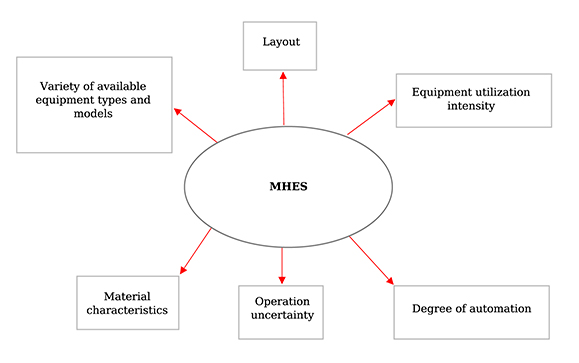
Figure 1
MHES decisión criterio
Source: Authors’ own elaboration.
Finding the best combination of these and other factors involved in this process represents a complex decision problem (Onut et al., 2009; Sule, 2001). But it is precisely the administration of this complexity what allows the MHES process to determine what and where the equipment needs are (Onut et al., 2009).
In addition, the DMs could use this work for MHES processes at any logistics operation, with other equipment and criteria, and at manufacturing, services or construction industries as required. Recently, the integration of SMAA with other techniques has resulted in new methods aimed at strengthening the consistency of results and the management of uncertainty and preference information. Such is the case of SMAA-PROMETHEE (Corrente et al., 2014) and SMAA-3 (Hokkanen et al., 1998), both of which resulted from hybridization with the traditional outranking methods; and of SMAA-TOPSIS (Okul et al., 2014) and SMAA-III (Tervonen et al., 2009), the latter resulting from the combination with ELECTRE. Building on the work of Lahdelma et al. (2003), and Lahdelma et al. (2002), and more recently SMAA-M when the theoretical paradigm rules the decision process (García-Caceres, 2020). In this regard, the Figure 2 shows the synthesis of the percentages of the MHES techniques.
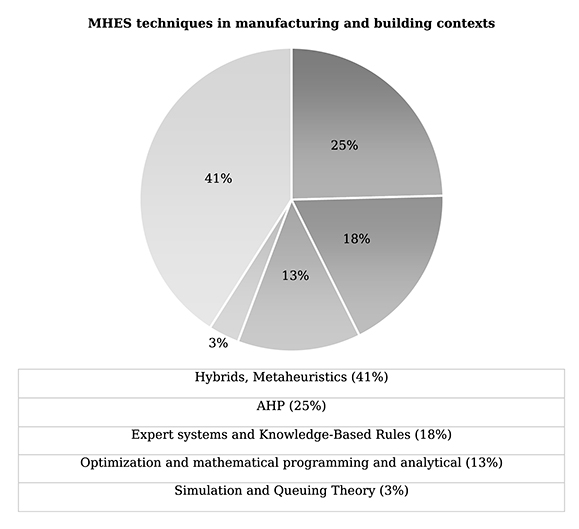
Figure 2
MHES techniques
Source: Authors’ own elaboration.
The review shows its theoretical and practical value allowing to identify the most used decision-making support techniques as well as the criteria, the key aspects, and the decision context of MHES, especially in the DCs proposing research perspectives.
A contradiction has been observed between research conducted on the design and operation of DCs and actual work practices observed in industry. Some authors coincide in highlighting the need for a more practical and consistent way of communicating and applying research results, so that they serve the purpose of designing real DCs (Gu et al., 2010; Baker and Canessa, 2009; Gu et al., 2007). In this sense, simultaneously considering both the qualitative and quantitative aspects of the MHES process allows contemplating it together with complex Multi-Criteria Decision Making (MCDM) problems (Saputro et al., 2015; Momani and Ahmed, 2011; Onut et al., 2009; Dağdeviren, 2008), which have received far less attention than that of layout (Gu et al., 2010).
The review show as an adequate MHES allows improving financial return, reducing response times, rationalizing the use of human resources and increasing the flexibility of the productive system (Tuzkaya et al., 2010; Mirhosseyni and Webb, 2009; Chan et al., 2001; Chu et al., 1995; Matson et al., 1992; Prasad et al., 2015). Selecting proper equipment for the handling of materials involves making decisions aimed at reducing move distances, increasing the size of handled units, seeking opportunities for round trips during product storage or order picking, and improving cube utilization (Manzini, 2012).
As to MCDM, the literature review shows several theoretical and practical approaches to the topic in question. MCDM is a dynamic Operations Research scientific field in which diverse techniques have been developed (Jato-Espino et al., 2014). Two large families correspond to Multiattribute Utility Theory (MAUT) based methods (Keeney and Raiffa, 1976) and Outranking methods such as ELECTRE (Elimination Et Choix Traduisant la Realité) (Roy, 1996), PROMETHEE (Preference Ranking Organization Method for Enrichment Evaluations) (Brans and Mareschal, 2005), and SIR (Superiority and Inferiority Ranking method) (Xu, 2001). According to Tervonen et al. (2007), the former ones are supported by a stronger mathematical basis. The work of Pamučar and Ćirović (2015) stands out for the implementation of a new DEMATEL-MABAC (Multi-Attributive Border Approximation Area Comparison) method for the selection of forklifts in logistics centers.
New research perspectives and future recommendations aim at a more thorough integration with expert systems (or any more efficient hybrid method) for candidate equipment assessment and final selection. This could be done by using MCDM techniques like to Stochastic Multicriteria Aceptability Analysis - SMAA (Hokkanen et al., 1998; Lahdelma and Salminen, 2001; Lahdelma et al., 2002; 2003; García-Cáceres, 2020), ELECTRE, PROMETHEE, SIR, VIKOR, ANP, TOPSIS, fuzzy logic. Furthermore, if an integral MHES optimization is intended, Integral Analysis Method - IAM (García-Cáceres et al., 2009) might come in handy for the case.
3. References
Apple, J. (1977). Plant Layout and Material Handling. John Wiley & Sons.
Atanasković, P., Gajić, V., Dadić, I., & Nikoličić, S. (2013). Selection of forklift unit for warehouse operation by applying multi-criteria análisis. Promet - Traffic & Transportation, 25(4), 379-386. https://doi.org/10.7307/ptt.v25i4.1338
Athawale, V., Chakraborty, S. (2011). Decision making for material handling equipment selection using ELECTRE II method. Journal of the Institution of Engineers (India), Part PR: Production Engineering Division, 91, 9-17. https://www.researchgate.net/publication/287524966_Decision_making_for_material_handling_equipment_selection_using_ELECTRE_II_method
Baker, P., Canessa, M. (2009). Warehouse design: A structured approach. European Journal of Operational Research, 193(2), 425-436. https://doi.org/10.1016/j.ejor.2007.11.045
Bhattacharya, A., Sarkar, B., & Mukherjee, S. (2002). Material handling equipment selection under multi-criteria decision making (MCDM) environment. Industrial Engineering Journal, 31, 17-25. https://www.researchgate.net/publication/284791491_Material_handling_equipment_selection_under_multi-criteria_decision_making_MCDM_environment
Bookbinder, J., Gervais, D. (1992). Material-Handling Equipment Selection Via an Expert System. Journal of Business Logistics, 13(1), 149-172. https://ssrn.com/abstract=2801643
Braglia, M., Gabbrielli, R., & Micon, D. (2001). Material handling device selection in cellular manufacturing. Journal of Multi-Criteria Decision Analysis, 10(6), 303-315. https://doi.org/10.1002/mcda.310
Brans, J., Mareschal, B. (2005). PROMETHEE methods. Springer.
Chakraborty, S., Banik, D. (2006). Design of a material handling equipment selection model using analytic hierarchy process. The International Journal of Advanced Manufacturing Technology, 28, 1237-1245. https://doi.org/10.1007/s00170-004-2467-y
Chakraborty, S., Prasad, K. (2016). A QFD-based expert system for industrial truck selection in manufacturing organizations. Journal of Manufacturing Technology Management, 27(6), 800-817. https://doi.org/10.1108/JMTM-02-2016-0020
Chan, F. T. S., Ip, R. W. L., & Lau, H. (2001). Integration of Expert System with Analytic Hierarchy Process for the Design of Material Handling Equipment selection system. Journal of Materials Processing Technology, 116(2-3), 137-145. https://doi.org/10.1016/S0924-0136(01)01038-X
Chittratanawat, S., Noble, J. S. (1999). An integrated approach for facility layout, P/D location and material handling system design. International Journal of Production Research, 37(3), 683-706. https://doi.org/10.1080/002075499191733
Cho, C., Egbelu, P. (2005). Design of a web-based integrated material handling system for manufacturing applications. International Journal of Production Research, 43(2), 375-403. https://doi.org/10.1080/0020754042000268866
Chu, H., Egbelu, P., & Wu, C. (1995). ADVISOR: A computer-aided material handling equipment selection system. International Journal of Production Research, 33(12), 3311-3329. https://doi.org/10.1080/00207549508904876
Corrente, S., Figueira, J., & Greco, S. (2014). The SMAA-PROMETHEE method. European Journal of Operational Research, 239(2), 514-522. https://doi.org/10.1016/j.ejor.2014.05.026
Cortés, P., Gómez-Montoya, R., Muñuzuri, J., & Correa-Espinal, A. (2017). A tabu search approach to solving the picking routing problem for large- and medium-size distribution centres considering the availability of inventory and K heterogeneous material handling equipment. Applied Soft Computing, 53, 61-73. https://doi.org/10.1016/j.asoc.2016.12.026
Dağdeviren, M. (2008). Decision making in equipment selection: an integrated approach with AHP and PROMETHEE. Journal of Intelligent Manufacturing, 19, 397-406. https://doi.org/10.1007/s10845-008-0091-7
Deb, S., Bhattacharyya, B., & Sorkhel, S. (2002). Material Handling Equipment Selection by Fuzzy Multi-criteria Decision Making Methods, Lecture Notes in Computer Science. Springer. https://doi.org/10.1007/3-540-45631-7_14
Fisher, E., Farber, J., & Kay, M. (1988). Mathes: An expert system for material handling equipment selection. Engineering Costs and Production Economics, 14(4), 297-310. https://doi.org/10.1016/0167-188X(88)90034-1
Fonseca, D., Uppal, G., & Greene, T. (2004). A knowledge-based system for conveyor equipment selection. Expert Systems with Applications, 26(4), 615-623. https://doi.org/10.1016/j.eswa.2003.12.011
Frazelle, E. (2002). World-Class Warehousing and Material Handling. McGraw-Hill. http://img.yakaboo.ua/media/mediagallery/pdf/l/i/listalca_skladskoe_hranenie.pdf
Frazelle, E. (2003). Supply Chain Strategy, the Logistics of Supply Chain Management. McGraw-Hill. https://industri.fatek.unpatti.ac.id/wp-content/uploads/2019/03/144-Supply-Chain-Strategy-The-Logistics-of-Supply-Chain-Management-Edward-Frazelle-Edisi-1-2002.pdf
Gaur, A. V., Ronge, B. P. (2020). Ranking Material Handling Equipment Selection Criteria by AHP. In P. Pawar, B. Ronge, R. Balasubramaniam, A. Vibhute, S. Apte (Eds.), Techno-Societal 2018. Springer, Cham. https://doi.org/10.1007/978-3-030-16962-6_18
García-Cáceres, R. G., Araoz, J., & Palacios, F. (2009). Integral Analysis Method - IAM. European Journal of Operational Research, 192(3), 891-903. https://doi.org/10.1016/j.ejor.2007.10.001
García-Cáceres, R. G., Escobar-Velasquez, J. (2016). Characterization of the supply chain problems. DYNA, 83(198), 68-78. http://dx.doi.org/10.15446/dyna.v83n198.44532
García-Cáceres R. G. (2020). Stochastic Multicriteria Acceptability Analysis - Matching (SMAA-M). Operational Research Perspectives, 7, 100145. https://doi.org/10.1016/j.orp.2020.100145
Gray, A., Karmarkar, U., & Seidmann, A. (1992). Design and operation of an order-consolidation warehouse: Models and application. European Journal of Operational Research, 58(1), 14-36. https://doi.org/10.1016/0377-2217(92)90232-X
Gu, J., Goetschalckx, M., & McGinnis, L. (2007). Research on warehouse operation: A comprehensive review. European Journal of Operational Research, 177(1), 1-21. https://doi.org/10.1016/j.ejor.2006.02.025
Gu, J., Goetschalckx, M., & McGinnis, L. (2010). Research on warehouse design and performance evaluation: A comprehensive review. European Journal of Operational Research, 203(3), 539-549. https://doi.org/10.1016/j.ejor.2009.07.031
Haidar, A., Naoum, S., Howes, R., & Tah, J. (1999). Genetic Algorithms Application and Testing for Equipment Selection. Journal of Construction Engineering and Management, 125(1), 32-38. https://doi.org/10.1061/(ASCE)0733-9364(1999)125:1(32)
Hadi-Vencheh, A., Mohamadghasemi, A. (2015). A new hybrid fuzzy multi-criteria decision making model for solving the material handling equipment selection problema. International Journal of Computer Integrated Manufacturing, 28(5), 534-550. https://doi.org/10.1080/0951192X.2014.880948
Hafezalkotob, A., Hami-Dindar, A., Rabie, N., & Hafezalkotob, A. (2018). A decision support system for agricultural machines and equipment selection: A case study on olive harvester machines. Computers and Electronics in Agriculture, 148(1), 207-216. https://doi.org/10.1016/j.compag.2018.03.012
Hassan, M., Hogg, G., & Smith, D. (1985). A construction algorithm for the selection and assignment of materials handling equipment. International Journal of Production Research, 23(2), 381-392. https://doi.org/10.1080/00207548508904715
Hassan, M. (2010). A framework for selection of material handling equipment in manufacturing and logistics facilities. Journal of Manufacturing Technology Management, 21(2), 246-268. https://doi.org/10.1108/17410381011014396
Hassan, M. (2014). An evaluation of input and output of expert systems for selection of material handling equipment. Journal of Manufacturing Technology Management, 25(7), 1049-1067. https://doi.org/10.1108/JMTM-08-2012-0077
Higginson, J., Bookbinder, J. (2005). Distribution Centres in Supply Chain Operations. Springer Science + Business Media. https://doi.org/10.1007/0-387-24977-X_3
Hokkanen, J., Lahdelma, R., Miettinen, K., & Salminen, P. (1998). Determining the implementation order of a general plan by using a multicriteria method. Journal of Multi-Criteria Decision Analysis, 7(5), 273-284. https://doi.org/10.1002/(SICI)1099-1360(199809)7:5<273::AID-MCDA198>3.0.CO;2-1
Holzapfel, A., Kuhn, H., & Sternbeck, M. (2016). Product allocation to different types of distribution center in retail logistics networks. European Journal of Operational Research, 264(3), 948-966. https://doi.org/10.1016/j.ejor.2016.09.013
Hosni, Y. (1989). Inference engine for material handling selection. Computers & Industrial Engineering, 17(1-4), 79-84. https://doi.org/10.1016/0360-8352(89)90040-5
Hosseini, S., Seifbarghy, M. (2016). A novel meta-heuristic algorithm for multi-objective dynamic facility layout problema. RAIRO - Operations Research, 50(4-5), 869-890. https://doi.org/10.1051/ro/2016057
Ioannou, G. (2007). An integrated model and a decomposition-based approach for concurrent layout and material handling system design. Computers & Industrial Engineering, 52(4), 459-485. https://doi.org/10.1016/j.cie.2007.02.003
Jato-Espino D., Castillo-Lopez E., Rodriguez-Hernandez, J., & Canteras-Jordana, J. (2014). A review of application of multi-criteria decision making methods in construction. Automation in Construction, 45, 151-162. https://doi.org/10.1016/j.autcon.2014.05.013
Jiamruangjarus, P., Naenna, T. (2016). An integrated multi-criteria decision-making methodology for conveyor system selection. Cogent Engineering, 3(1). https://doi.org/10.1080/23311916.2016.1158515
Karande, P., Chakraborty, S. (2013). Material handling equipment selection using weighted utility additive theory. Journal of Industrial Engineering, 2013, 1-9. https://doi.org/10.1155/2013/268708
Khandekar, A., Chakraborty, S. (2015). Selection of Material Handling Equipment using Fuzzy Axiomatic Design Principles. Informatica, 26(2), 259-282. https://doi.org/10.15388/Informatica.2015.48
Keeney, R., Raiffa, H. (1976). Decisions with Multiple Objectives: Preferences and Value Tradeoffs. Wiley. https://doi.org/10.1017/CBO9781139174084
Kildienė, S., Zavadskas, E., & Tamošaitienė, J. (2014). Complex assessment model for advanced technology deployment. Journal of Civil Engineering and Management, 20(2), 280-290. https://doi.org/10.3846/13923730.2014.904813
Komljenovic, D., Kecojevic, V. (2009). A Multi-attribute selection method for materials handling equipment. International Journal of Industrial and Systems Engineering, 4(2), 151-173. https://www.inderscienceonline.com/doi/abs/10.1504/IJISE.2009.02237
Kulak, O. (2005). A decision support system for fuzzy multi-attribute selection of material handling equipments. Expert Systems with Applications, 29(2), 310-319. https://doi.org/10.1016/j.eswa.2005.04.004
Lahdelma, R., Salminen, P. (2001). SMAA- 2: Stochastic Multicriteria Acceptability Analysis for group decision making. Operations Research, 49(3), 444-454. https://doi.org/10.1287/opre.49.3.444.11220
Lahdelma, R., Miettinen, K., & Salminen, P. (2003). Ordinal criteria in Stochastic multicriteria acceptability análisis. European Journal of Operational Research, 147(1), 117-127. https://doi.org/10.1016/S0377-2217(02)00267-9
Lahdelma, R., Salminen, P., & Hokkanen, J. (2002). Locating a waste treatment facility by using stochastic multicriteria acceptability analysis with ordinal criterio. European Journal of Operational Research, 142(2), 345-356. https://doi.org/10.1016/S0377-2217(01)00303-4
Lashkari, R., Boparai, R., & Paulo, J. (2004). Towards an integrated model of operation allocation and material handling selection in cellular manufacturing systems. International Journal of Production Economics, 87, (2), 115-139. https://doi.org/10.1016/S0925-5273(03)00097-5
Lashgari, A., Yazdani-Chamzini, A., Fouladgar, M., Zavadskas, E., Shafiee, S., & Abbate, N. (2012). Equipment Selection Using Fuzzy Multi Criteria Decision Making Model: Key Study of Gole Gohar Iron Mine. Inzinerine Ekonomika-Engineering Economics, 23(2), 125-136. https://doi.org/10.5755/j01.ee.23.2.1544
Lin, C., Wang, W., & Yu, W. (2008). Improving AHP for construction with an adaptive AHP approach (A3). Automation in Construction, 17(2), 180-187. https://doi.org/10.1016/j.autcon.2007.03.004
Luong, L. (1998). A decision support system for the selection of computer-integrated manufacturing technologies. Robotics and Computer-Integrated Manufacturing, 14(1), 45-53. https://doi.org/10.1016/S0736-5845(97)00026-4
Manzini, R. (2012). Warehousing in the Global Supply Chain. Springer- Verlag. https://link.springer.com/book/10.1007/978-1-4471-2274-6
Mathew, M., Chakrabortty, R. K., & Ryan, M. J. (2020). A novel approach integrating AHP and TOPSIS under spherical fuzzy sets for advanced manufacturing system selection. Engineering Applications of Artificial Intelligence, 96, 103988. https://doi.org/10.1016/j.engappai.2020.103988
Matson, J., Mellichamph, J., & Swaminathan, S. (1992). EXCITE: Expert consultant for in-plant transportation equipment. International Journal of Production Research, 30(8), 1969-1983. https://doi.org/10.1080/00207549208948133
Mirhosseyni, H., Webb, P. (2009). A Hybrid Fuzzy Knowledge-Based Expert System and Genetic Algorithm for efficient selection and assignment of Material Handling Equipment. Expert Systems with Applications, 36(9), 11875-11887. https://doi.org/10.1016/j.eswa.2009.04.014
Momani, A., Ahmed, A. (2011). Material Handling Equipment Selection using hybrid Monte Carlo simulation and Analytic Hierarchy Process. World Academy of Science, Engineering and Technology International Journal of Mechanical, Aerospace, Industrial, Mechatronic and Manufacturing Engineering, 5(11), 2177-2182. https://doi.org/10.5281/zenodo.1085141
Mousavi, S., Vahdani, B., Tavakkoli-Moghaddam, R., & Tajik, N. (2014). Soft computing based on a fuzzy grey group compromise solution approach with an application to the selection problem of material handling equipment. International Journal of Computer Integrated Manufacturing, 27(6), 547-569. https://doi.org/10.1080/0951192X.2013.834460
Muther, R. (1981). Distribución en Planta, ordenación racional de los elementos de producción industrial (4th ed.), Hispano Europea S.A. https://www.iberlibro.com/Distribución-planta-Ordenación-racional-elementos-producción/20328534437/bd
Okul, D., Gencer, C., & Aydogan, E. (2014). A Method Based on SMAA-Topsis for Stochastic Multi-Criteria Decision Making and a Real-World Application. International Journal of Information Technology & Decision Making, 13(5), 957-978. https://doi.org/10.1142/S0219622014500175
Onut, S., Kara, S., & Mert, S. (2009). Selecting the suitable material handling equipment in the presence of vagueness. The International Journal of Advanced Manufacturing Technology, 44, 818-828. https://doi.org/10.1007/s00170-008-1897-3
Pamučar, D., Ćirović, G. (2015). The selection of transport and handling resources in logistics centers using Multi-Attributive Border Approximation area Comparison (MABAC). Expert Systems with Applications, 42(6), 3016-3028. https://doi.org/10.1016/j.eswa.2014.11.057
Park, Y. (1996). ICMESE: Intelligent Consultant System for Material Handling Equipment Selection and Evaluation. Journal of Manufacturing Systems, 15(5), 325-333. https://doi.org/10.1016/0278-6125(96)84195-1
Patel, S., Chourasiya, R., & Dixit, V. (2016). Material Handling Equipment Selection for a Galvanizing Steel Industry using Combined AHP-GRA Mode. International Journal of Scientific Research in Science, Engineering and Technology, 2(2), 228-238. https://ijsrset.com/IJSRSET162272
Prasad, K., Zavadskas, E., & Chakraborty, S. (2015). A software prototype for material handling equipment selection for construction sites. Automation in Construction, 57, 120-131. https://doi.org/10.1016/j.autcon.2015.06.001
Raman, D., Nagalingam, S., Gurd, B., & Lin, G. (2009). Quantity of Material Handling Equipment - A Queuing Theory based Approach. Robotics and Computers - Integrating Manufacturing, 25(2), 348-357. https://doi.org/10.1016/j.rcim.2008.01.004
Riopel, D., Langevin, A., & Campbell, J. (2005). The Network of Logistics Decisions. Springer Science + Business Media. https://doi.org/10.1007/0-387-24977-X_1
Rouwenhorst, B., Reuter, B., Stockrahm, V., Van Houtum, G., Mantel, R., & Zijm, W. (2000). Warehouse design and control: Framework and literature review. European Journal of Operational Research, 122(3), 515-533. https://doi.org/10.1016/S0377-2217(99)00020-X
Roy, B. (1996). Multicriteria Methodology for Decision Analysis. Kluwer Academic Publishers. https://link.springer.com/book/10.1007/978-1-4757-2500-1
Rudenko, N. (1971). Materials Handling Equipment. Peace Publishers. https://books.google.com.co/books/about/Materials_Handling_Equipment.html?id=E4JptgAACAAJ&redir_esc=y
Rushton, A., Croucher, P., & Baker, P. (2006). The Handbook of Logistics and Distribution Management (3rd ed.). Kogan Page. https://industri.fatek.unpatti.ac.id/wp-content/uploads/2019/03/149-The-Handbook-of-Logistics-and-Distribution-Management-Understanding-the-Supply-Chain-Alan-Rushton-Phil-Croucher-Peter-Baker-Edisi-1-2014.pdf
Santelices, G., Pascual, R., Lüer-Villagra, A., Mac-Cawley, A., & Galar, D. (2015). Integrating mining loading and hauling equipment selection and replacement decisions using stochastic linear programming. International Journal of Mining, Reclamation and Environment, 31(1), 52-65. https://doi.org/10.1080/17480930.2015.1115589
Saputro, T., Masudin, I., & Rouyendegh, B. (2015). A literature review on MHE selection problem: levels, contexts, and approaches. International Journal of Production Research, 53(17), 5139-5152. https://doi.org/10.1080/00207543.2015.1005254
Saputro, T., Erdebilli, B. (2016). A hybrid approach for selecting material handling equipment in a warehouse. International Journal of Management Science and Engineering Management, 11(1), 34-48. https://doi.org/10.1080/17509653.2015.1042535
Sawant, V., Mohite, S. (2013). A composite weight based multiple attribute decision support system for the selection of automated guided vehicles. International Journal of Computer Applications, 70(19), 8-16. https://citeseerx.ist.psu.edu/viewdoc/oad?doi=10.1.1.403.341&rep=rep1&type=pdf
Shapira, A., Goldenberg, M. (2005). AHP-Based Equipment Selection Model for Construction Projects. Journal of Construction Engineering and Management, 131(12), 1263-1273. https://doi.org/10.1061/(ASCE)0733-9364(2005)131:12(1263)
Skibniewski, M., Chao, L. (1992). Evaluation of advanced construction technology with AHP method. Journal of Construction Engineering and Management, 118(3), 577-593. https://doi.org/10.1061/(ASCE)0733-9364(1992)118:3(577)
Sujono, S., Lashkari, R. (2007). A multi-objective model of operation allocation and material handling system selection in FMS design. International Journal of Production Economics, 105(1), 116-133. https://doi.org/10.1016/j.ijpe.2005.07.007
Sule, D. (2001). Instalaciones de Manufactura, Ubicación, Planeación y Diseño. Thomson Learning. https://books.google.com.co/books/about/Instalaciones_de_manufactura.html?id=NXCsAAAACAAJ
Tervonen, T., Lahdelma, R. (2007). Implementing Stochastic Multicriteria Acceptability Analysis. European Journal of Operational Research, 178(2), 500-513. https://doi.org/10.1016/j.ejor.2005.12.037
Tervonen, T., Figueira, J., Lahdelma, R., Almeida-Dias, J., & Salminen, P. (2009). A stochastic method for robustness analysis in sorting problems. European Journal of Operational Research, 192(1), 236-242. https://doi.org/10.1016/j.ejor.2007.09.008
Tompkins, J., White, J., Bozer, Y., & Tanchoco, J. (2010). Facilities Planning. John Wiley & Sons Inc. https://books.google.com.co/books/about/Facilities_Planning.html?hl=es&id=-xBIq6Qm2SQC&redir_esc=y
Tejesh, B., Neeraja, S. (2018). Warehouse inventory management system using IoT and open source framework. Alexandria Engineering Journal, 57(4), 3817-3823. https://doi.org/10.1016/j.aej.2018.02.003.
Temiz, I., Calis, G. (2017). Selection of Construction Equipment by using Multi-criteria Decision Making Methods. Procedia Engineering, 196, 286-293. https://doi.org/10.1016/j.proeng.2017.07.201
Tom, D., Paul, M., Oliver, O., & Jan, K. (2020). Manufacturing System Optimization with Lean Methods, Manufacturing Process Objectives and Fuzzy Logic Controller Design. Procedia CIRP, 93, 658-663. https://doi.org/10.1016/j.procir.2020.04.145
Tuzkaya, G., Gülsün, B., Kahraman, C., & Özgen, D. (2010). An integrated fuzzy multi-criteria decision making methodology for material handling equipment selection problem and an application. Expert Systems with Applications, 37(4), 2853-2863. https://doi.org/10.1016/j.eswa.2009.09.004
Ulubeyli, S., Kazaz, A. (2009). A multiple criteria decision‐making approach to the selection of concrete pumps. Journal of Civil Engineering and Management, 15(4), 369-376. https://doi.org/10.3846/1392-3730.2009.15.369-376
Valli, P., Jeyasehar, C. (2012). Genetic Algorithm based Equipment Selection Method for Construction Project using Matlab Tool. International Journal of Optimization in Civil Engineering, 2(2), 235-246. http://pga.iust.ac.ir/ijoce/article-1-89-fa.pdf
Van Den Berg, J., Zijm, W. (1999). Models for warehouse management: Classification and examples. International Journal of Production Economics, 59(1-3), 519-528. https://doi.org/10.1016/S0925-5273(98)00114-5
Varun, S., Harshita, R., Pramod, S., & Nagaraju, D. (7-9 July 2016). Evaluation and selection of material handling equipment in iron and steel industry using analytic hierarchy process. Frontiers in Automobile and Mechanical Engineering, IOP Conf. Series: Materials Science and Engineering (vol. 197), Sathyabama University, Chennai, India. https://doi.org/10.1088/1757-899X/197/1/012060
Velury, J., Kennedy, W. (1992). A systematic procedure for the selection of bulk material handling equipment. International Journal of Production Economics, 27(3), 233-240. https://doi.org/10.1016/0925-5273(92)90097-Q
Welgama, P., Gibson, P. (1995). A hybrid knowledge based/optimization System for automated selection of Materials handling system. Computers & Industrial Engineering, 28(2), 205-217. https://doi.org/10.1016/0360-8352(94)00200-7
Welgama, P., Gibson, P. (1996). An integrated methodology for automating the determination of layout and materials handling system. International Journal of Production Research, 34(8), 2247-2264. https://doi.org/10.1080/00207549608905023
West, T., Amundsoma, A., & Randhawaa, S. (1993). Evaluation of alternative materials handling systems. Computers & Industrial Engineering, 25(1-4), 187-190. https://doi.org/10.1016/0360-8352(93)90252-S
Xiao, Y., Watson, M. (2019). Guidance on Conductiong a Systematic Literature Review. Journal of Planning Education and Research, 39(1), 93-112. https://doi.org/10.1177/0739456X17723971
Xu, X. (2001). The SIR method: A superiority and inferiority ranking method for multiple criteria decision making. European Journal of Operational Research, 131(3), 587-602. https://doi.org/10.1016/S0377-2217(00)00101-6
Yazdani-Chamzini, A. (2014). An integrated fuzzy multi-criteria group decision-making model for handling equipment selection. Journal of Civil Engineering and Management, 20(5), 660-673. https://doi.org/10.3846/13923730.2013.802714
Yener, F., Yazgan, H. (2019). Optimal Warehouse Design: Literature Review and Case Study Application. Computers & Industrial Engineering, 129, 1-13. https://doi.org/10.1016/j.cie.2019.01.006
Zakarya, S., Pierre, D., & Zakaria, Y. (2021). A methodology for the selection of Material Handling Equipment in manufacturing systems. IFAC-PapersOnLine, 54(1), 122-127. https://doi.org/10.1016/j.ifacol.2021.08.193
Ziai, M., Sule, D. (1989). Computerized materials handling and facility layout design. Computers & Industrial Engineering, 17(1-4), 55-60. https://doi.org/10.1080/00207548508904715
Notes
Conflict of interest declaration
