Articles
CSR Sensemaking on the collapse of the Samarco’s tailings dam
Entendimento da Responsabilidade Social Corporativa da Samarco no rompimento da barragem de Fundão
CSR Sensemaking on the collapse of the Samarco’s tailings dam
Revista de Contabilidade e Organizações, vol. 12, e151356, 2018
Universidade de São Paulo, Faculdade de Economia, Administração e Contabilidade de Ribeirão Preto
Recepção: 25 Outubro 2018
Aprovação: 22 Dezembro 2018
Publicado: 27 Dezembro 2018
Abstract: This paper examines the fundamental orientation guiding the Corporate Social Responsibility (CSR) activities in the voluntary report published by Samarco - a Brazilian mining company, identifying how the company perceives itself regarding a severe environmental disaster occurred in 2015. Our analysis applied Basu and Palazzo's (2008) model based on an organizational sensemaking process to explain how the organization expresses its thinking, how it discusses and acts to cope with the accident expectancy and its consequences. We analyzed the reports that depict the tailings dam collapse, observing whether the risks and damages to the ecosystem would be mentioned and anticipated to the stakeholders. Our evidence points out that the company had not disclosed beforehand any relevant information about the real hazards or critical impacts of its operating activities. After the accident, Samarco seems to maintain its relational posture towards society. However, the practical actions signal that the company is after its own business.
Palavras-chave: Criação de sentido, Responsabilidade Social Corporativa, Global para relatórios, Relatório de sustentabilidade, Gestão de desastres.
Resumo: O artigo examina a orientação intrínseca que orienta as atividades de Responsabilidade Social Corporativa (RSC) nos relatórios voluntários de sustentabilidade publicados pela Samarco, mineradora brasileira, identificando como a empresa se percebe em relação ao sério desastre ambiental ocorrido em 2015. Nossa análise aplicou o modelo de Basu e Palazzo (2008) baseado em um processo de entendimento organizacional para explicar como a empresa expressa seu pensamento, como ela o discute e como ela atua para lidar com as expectativas e consequências do acidente. Analisamos os relatórios que retratam o colapso da barragem de rejeitos, observando em que extensão os riscos e prejuízos ao ecossistema seriam antecipados e mencionados aos stakeholders. Nossas evidências mostram que a empresa não antecipou qualquer informação relevante sobre os perigos reais ou impactos críticos de suas atividades operacionais. Após o acidente, a Samarco parece manter sua postura relacional com a sociedade. Entretanto, as ações práticas indicam estar cuidando de seus próprios interesses.
Palavras-chave: Criação de sentido, Responsabilidade Social Corporativa, Global para relatórios, Relatório de sustentabilidade, Gestão de desastres.
Keywords: Sensemaking, Corporate Social Responsibility, Global Reporting Initiative Sustainability report, Post-disaster management
1 INTRODUCTION
A long list of scandals and frauds has led firms to aim at portraying a more socially responsible image, causing Corporate Social Responsibility (CSR) to continue to be at the center stage of management accounting research (Richter & Arndt, 2018). According to Matten and Moon (2008), many organizations have systematically started proactive efforts to adopt practices that show their active and constructive role within societies.
However, recent events, such as the cases of British Petroleum in the Gulf of Mexico and Samarco in Brazil increase the need for better monitoring on business activities and on companies attempts to legitimize themselves as ‘CSR companies’.
In order to understand why companies undertake specific actions, for instance how they anticipate or react to environmental jolts, it is essential to identify the shared organizational understanding (Georgieva, 2012, p. 5). The shared understanding is collective constructed through the "sensemaking" process, that means how the organization makes sense of an unknown event (Weick, 1995, p. 4), coming up with plausible understandings and meanings (Weick, 2001). Sensemaking is inherently collective (Weick & Roberts, 1993), and it includes actions to cope with the unknown situation (Weick et al., 2005). Consequently, one can understand how the company is engaged to CSR practices observing how they react to critical events (Basu & Palazzo, 2008, p. 26), as the organizational sensemaking is being developed and registered on companies’ reports, internal communication, chats, etc.
This paper examines the CSR sensemaking process, analyzing the intrinsic orientation that guides CSR-related activities in its voluntary sustainability reporting. We adopted the model of Basu and Palazzo (2008) to identify how the company defines its CSR and perceives itself concerning stakeholders and its purpose in business as a result. The case is the Samarco disaster occurred in 2015, when a tailing dam operated by Samarco - a Brazilian mining company - collapsed, one of the most critical environmental accident occurred in Brazil.
This paper is structured as follows. The next section presents the potential contribution to the literature, with an extensive review of Basu and Palazzo's model. We applied the concept of CSR by analyzing the case of the Brazilian company’s behavior in a severe environmental disaster, which results in a CSR incongruence between sustainability discourse and practice. After explaining the methodology and presenting our results, we discuss our findings in light of the extended framework and conclude by discussing limitations and reviewing the contributions of this study.
2 ANALYTICAL FRAMEWORK
Organizations carry and increasingly need to deal with expectations from society and stakeholders about their social and environmental impacts (Cramer, Van der Heijden & Jonkern, 2006). Corporate Social Responsibility reports (CSR) communicate the sustainable practices and the explanations which the organization selects to share to a broad audience. As there is a positive effect related to the jobs created and to the regional economic development (Georgieva, 2012, p. 13), the presence of organizations is positive, but they also carry responsibilities with local communities and the environment.
The CSR report, as a type of disclosure, would be an act of releasing all relevant information about a company, providing useful elements for stakeholders’ decision-making concerning its activities risks in its reports. However, even when these reports are an inevitable part of an organization’s communication, there may still be some events that seem to conflict with stakeholders' perception and expectation. In order to show definite evidence of their industrial activities, companies try to include sustainability and CSR into their business policies (Basu & Palazzo, 2008, p. 15). Notwithstanding, it is possible to observe differences between the published CSR report and the daily company practices.
The use of too much energy and time, and too many resources in the CSR activities, as well as the fulfillment of certain standards, are not enough to configure the company’s right sustainable posture (Georgieva, 2012, p. 13). Furthermore, the detection of a negative deviant drives CSR engaged organizations to publish useless information about their activities not to impair their social image (Greene, 2012). Therefore, companies do not represent the real organizational sense about their activities (Singh, Connaughton & Davies, 2015).
The company and the stakeholders are involved in a continuous process of understanding their business context, implications, opportunities and mutual expectations. They are continuously triggered to make sense of novelties, unknown events, and uncertainties. During such collective process, called “sensemaking” process by Weick (1995, p. 4), individuals from many stakeholders involved and affected by an unknown event will converge for a plausible understanding and meaning for such event (Weick, 2001). Such process also includes the development of “plausible images that rationalize what people are doing" and enables individuals in organizations to rationalize both everyday happenings and out-of-the-ordinary experiences (Weick et al., 2005, p. 409). The individuals inside the organization will interact, negotiate and create a collective meaning and understanding about a “coherent account of the world” in which it is enrolled (McNamara, 2015).
The CSR report, similarly, represents how an organization understands its interaction with the external environment regarding social responsibility and sustainability. The CSR is a type of an “internally and externally shared frame of reference concerning CSR objectives, activities and results" through which the company systematically creates and recreates its posture regarding social responsibility and sustainability (Nijhof & Jeurisen, 2006, p. 319).
The CSR report is related to the sensemaking process in two ways. First, it affects the organization’s legitimacy from relevant stakeholders, as investors, regulatory agencies and society (Jackson, 2010, p. 5). The annual CSR reports are a representation of what the organizations believe their market wants to hear, and so are used to promote themselves (Castelló & Lozano, 2011); what the organization chooses to promote about themselves (Singh, Connaughton, & Davies, 2015). Consequently, the communication applied to CSR report is a critical cultural and symbolic resource for an organization to develop and convey the sense that they have made (Alvesson, 1993). Second, it is part of a conflict with the internal understanding of its sustainability posture. Once the organization published these reports, the disclosure of the accurate information of the firm's CSR has to make sense for them, as organizations will pursue the objectives defined under the labels and categories exposed by the CSR report rather than what is hidden or poorly documented (Singh, Connaughton & Davies, 2015).
Some organizations espouse a commitment to society and the environment but run their business decisions and actions not aligned with their commitments; there is a perceived gap between the construct of their reality and their action (Christian, 2004; Conley & Williams, 2005). As sensemaking exists in the interplay between "action and interpretation" (Greene, 2012, p. 38), such gap could be used to analyze the sensemaking process (Greene, 2012, p. 43-44). More than “simply analyzing the content of its CSR actions within a certain context or over a certain period of time", "studying CSR through the lens of sensemaking - which might include motivation for CSR as one of its surface representations - as a feature of a firm's general organizational character” (Basu & Palazzo, 2008, p. 6).
Sensemaking studies cover a great variety of topics and use different methodological approaches. The construction of meaning is an interpretative process, where the meaning and significance of things are generated by words, sentences, and conversations used by organizations (Faria, 2017, p. 175). Through the sensemaking activity, stakeholders may close the loop of their understanding and interpretation on differences between actions and expected outcome, and create individual cognitive maps, ascribing specific interpretations to observed actions, events, and outcomes (Brown & Hyseni, 2012; Alexander, 2004). This stimulates reflection on aspects not observed in everyday organizational practices and emphasizes connections between action and communication to uncover the organizational reality (Montenegro & Casali, 2008, p. 12).
We adopt the model proposed by Basu and Palazzo (2008). For those authors, the Annual Sustainability Report can be analyzed as a determinant of CSR, to examine not only actions for sustainability but also the chaining of these initiatives related to the decision-making process in business management. Figure 1 will present the relevant sensemaking process dimensions in CSR process model by Basu and Palazzo (2008, p. 8), within three broad domains: i) cognitive; ii) linguistic; and iii) conative.
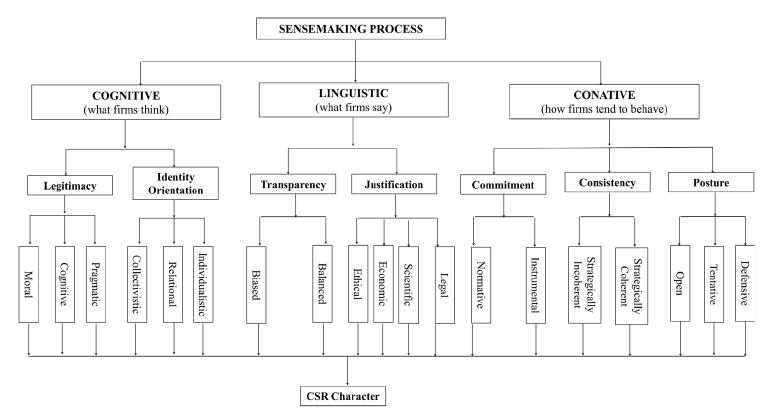
Figure 1
CSR Dimensions of the Sensemaking Process
Source: Elaborated by the authors based on Basu and Palazzo (2008, p. 43) and Georgieva (2012, p. 18)
The cognitive domain is about “legitimacy” and “identity” or how the organization thinks on the adequate way to interact with their stakeholders and with the external world (Basu & Palazzo, 2008, p. 9-12). Companies have to explain the way they think and understand on the prioritization of the common good or their business growth, the commitment with their business activities’ impact. On the other hand, knowing the intention of the "good deeds" of companies helps to understand the real meaning of facts. However, although the Annual Sustainability Report shows the company financial investments, it does not clarify their actual intentions. In practice, some companies do not fully report all the figures requested, systematically omitting some data in an attempt to expose the positive side and avoid giving much visibility to the information considered harmful.
Legitimacy carries a “generalized perception or assumption that organizational activities are desirable, proper, or appropriate within some socially constructed system of norms, values, beliefs, and definitions" (Suchman, 1995, p. 577). It can be i) pragmatic; ii) cognitive; or iii) moral (Suchman, 1995, p. 571).
When companies react to external demands by trying to convince their stakeholders of the usefulness of their decisions and activities, theirs goal is to gain pragmatic legitimacy. In this case, this suggests that companies "might monitor internal and external risks which pose a threat to its reputation" (Richter & Arndt, 2018, p. 589), and "are in control of their environment and can manage the legitimacy as a resource" (Georgieva, 2012, p. 19). On the other hand, as the cognitive legitimacy assumes that the environment controls companies, they need to align their actions to perceived external expectations, focusing on institutionalizing a rational discourse (Palazzo & Scherer 2006). Finally, moral legitimacy is about to co-create acceptable norms of behavior with relevant stakeholders (Georgieva, 2012, p. 19).
Moral legitimacy is useful to the joint to a normative discourse on social issues when the company feels that it is losing the public trust (Palazzo & Scherer 2006). For instance, companies may engage in the development of local, industry-wide, or global CSR standards (e.g., within the FSC - Forest Stewardship Council - normative framework) or assume responsibility with regards to community, consumer, customer, supply chain, etc., or contribute to development and sustainable business solutions (Richter & Arndt, 2018, p. 591). In some cases, the moral dimension of legitimacy may be blocked due to the nature of the companies’ products, what forces them to try to find alternative legitimation strategies to restore the product image.
The Basu and Palazzo (2008, p.9) model also presents the "identity orientation" as an important pillar to interaction with stakeholders. It covers “commonly shared assumptions of what the firm is, and is expected to affect motivation and behavior" (Richter & Arndt, 2018, p. 589). The identity orientation can be classified as individualistic, relational and collectivistic (Brickson, 2005, 2007). It is not a stable concept (Brickson, 2007), as the organizational identity can change due to context and leadership (Georgieva, 2012). The identity orientation is also about the recognition of the company's identity by its employees, that is, what the company thinks of itself (Richter & Arndt, 2018). In the Annual Sustainability Reports, indicators on human resources and teams, such as appreciation of diversity, job creation, and outsourcing practices are insufficient to clarify the company’s assumptions and expectations about its employees; but on the other hand, it influences the employees' perception about its employer.
The second dimension, linguistics, refers to the idea of communicating the reasons about ‘the why’ companies have committed to CSR (Basu & Palazzo, 2008, p. 8-9). The first aspect is the mode of justification; or how the company recognizes its responsibilities to society and stakeholders, considering the way it justifies its actions. The companies' communication reveals what they think about their tasks. In the Annual Sustainability Report, although there is financial information, if companies report their investments far beyond the minimal compulsory, it may mean the company is justifying them. The second aspect of the linguistics dimension is transparency, a measure of whether the company is willing to expose good and bad actions, even evaluating their possible consequences and mitigating them whenever possible. As it is difficult for companies to express harmful actions they may have taken, companies may highlight positive activities and reduce the visibility of harmful events and actions. Alternatively, companies justify the harmful impact on the environment or society through social projects, tax payments or royalties.
The third dimension is the conative one, or the consistency, and commitment of the posture adopted by companies in their activities through the persuasion perceived by their relationships (stakeholders and society in general) (Basu & Palazzo, 2008, p.8). Such dimension is composed of: i) posture, ii) consistency, and iii) commitment. The company's posture towards the criticisms and demands of its stakeholders points out how essential they release their image. But the company will accept society's feedback on its actions and decisions depending on the cost-benefit and on the coherence between its values and the emerged critics (Basu & Palazzo, 2008, p.17).
Finding out how far the company engages with CSR or whether it publishes its sustainability report efficiently involves reviewing the consistency of its reports. This dimension, as pointed out by Basu and Palazzo (2008, p.19), is fundamental to understand how willing managers are to act comprehensively and systematically in their decision-making processes, and which could impact the effectiveness and credibility of their results. It may be considered: (i) when they publish the report; (ii) in what way this is being carried out; (iii) whether the company is actually changing its corporate culture; (iv) if it believes in the welfare of society as a whole, by investing not only in money but also in the propagation of sustainable ideas among its employees, in the local population, among the suppliers. Thus, not only is the publication of the Sustainability Report necessary to understand the companies' commitment to the CSR, but rather whether their actions show constancy and solidity over time.
Finally, the authors analyze the commitment extent. Evaluating whether a company is committed to CSR practices is not just to see if it publishes its sustainability report within GRI standards. It involves disregarding formalities and reflecting on the cause of the commitment and the consequences of such a decision. Is the publication of the sustainability report a decision that is independent of the stakeholders' attention? How much the proposed marketing will influence the perception of society with companies is an important issue.
Such a model was applied by Richter & Arndt (2018) in the case of Switzerland's British American Tobacco (BAT). They classified the company as a ‘‘legitimacy seeker,’’ characterized mainly by a relational identity orientation and legitimation strategies that might provide pragmatic and/or cognitive legitimacy. Another empirical study was run by Georgieva (2012) to the case of British Petroleum (BP).
3 RESEARCH METHOD
We employed qualitative research with content analysis to discuss the case of Samarco Mineração S.A, a Brazilian mining company, to explore its CSR sensemaking around an environmental disaster occurred in 2015. We searched for pieces of evidence on the way the company thinks, its sustainability discourse and its reactions when the context for its legitimacy changed due to the disaster. We adopted the framework by Basu and Palazzo (2008) presented in the last section.
We selected the Samarco case as an "extreme case" (Eisenhardt, 1989) through the lens of the CSR literature. Currently, Samarco presents a particularly severe track record in its relationships with the civil society due the most massive and worst environmental disaster caused by it in Brazil's history - the Fundão mining dam collapse in 2015, in Mariana city, Minas Gerais. To explore the case of Samarco, as a single in-depth exploratory case study (Yin, 2014), we applied a qualitative Content Analysis (Bardin, 2016, p. 1-42, Bauer, 2002, 192), as we focus on " the presence or absence of a given characteristic of content or set of characteristics in a certain fragment of the message" (Lima, 1993, p.54), defined as "the statistical semantics of political discourse". Such an approach enables a more detailed exploratory investigation to provide a comprehensive analysis of Samarco’s CSR character and clarify its sensemaking process. Such methodological choice joints the recent qualitative case studies which have examined impression management, narrative, sensemaking, and sensegiving (see Beattie, 2014).
Why sustainability reports? Currently, the sustainability report is one of the main ways that organizations have to dialog with their stakeholders, presenting their ideas and actions for sustainability. Although the first sustainability reports just disclosed how companies' operations impacted the environment and what they did to address such issues (Borges et al., 2018, p. 146), nowadays they disclose information other than environmental information. The ideas and thoughts that emanate from the top management of the organization are disclosed in this report, mainly through the section where the words of the organization's president, the company's mission, and organizational vision and values are presented.
Therefore, it is possible that the sustainability report discloses how the CSR practices permeate every organization and its related parts, and the processes that affect CSR. Therefore, from the content analysis of Sustainability Reports, using the Basu and Palazzo (2008) model, it is possible to identify the processes that guide organizational sensemaking through the tripartite vision of essential processes - cognitive, linguistic and conative - and how the company defines and conducts its CSR, as well as perceives itself in relation to the stakeholders and their business purposes.
In order to capture the CRS sensemaking, we adopted a comparative analysis and analyzed reports before and after the disaster of its tailings dam (named Fundão) on 5 November 2015. In its Annual Sustainability Report 2014 , Samarco assigns itself the G4 rating (Samarco, 2014 p.2), one of the highest scores possible by the Global Reporting Initiative (GRI), an international body that establishes global guidelines for its elaboration.
Primary data on Samarco was collected in two rounds. First, the research source was defined. Then the "Annual Sustainability Report 2014" and the "Biennial Report 2015-2016" selected as sources for an in-depth understanding of the issues related to the disclosure of the Samarco's report which, for this research, should focus on responsible and sustainable management. The 2014 report was analyzed in its entirety as well as the 2015/2016 report. However, the data that guided our analysis was in the presentation chapters, who we are, the vision of the future and the results and perspectives of the 2014 report; and in the introductory chapters, Samarco, 2015-2016 indicators, on the breakdown of the dam. The contents of these reports were analyzed to identify keywords or phrases that correspond to the categories proposed in the Basu and Palazzo's framework and thus signal how Samarco thinks, what it says, and how it behaves.
In the second round, we selected news articles on the Internet, either on news sites or YouTube videos, in order to analyze Samarco's current behavior or the society's impression of its behavior, corroborated or not presented in its sustainability reports. Data acquiring was carried out by two researchers autonomously and independently and discussed and harmonized, later, by all the authors of this article, to guarantee and corroborate the reliability and validity of the methodological procedures and data categorization.
After completing the data collecting, with the data categorization, we analyzed and interpreted the data at least two times, coding the way Samarco thinks, says and acts and thus, its CSR profile. The final coding scheme detailed this company's profile (description of the dimensions for the CSR character) and based on the current news, and items were analyzed and compared with the results found at the previous stage, to corroborate or not Samarco's discourse. This final step was carried out together by all authors to ensure the thoroughness of the results. In examining our data, we followed a three-stage process of open, axial, and selective coding, building upon and adapting the framework of Basu and Palazzo (2008). The data collection, coding, and analysis procedures as well as the discussion of measures taken to ensure credibility, corroboration, and generalizability of our analysis and resulting findings was decided in agreement among the authors, always based on the assumptions present in the literature.
Finally, we double checked journalistic information and other publicity materials with testimonials and interviews of the victims of the accident and the company itself, to verify whether everything the company thinks about and publishes about CSR in its reports is what is done and perceived by the people in the communities where it operates.
4 THE CASE CONTEXT
Samarco is a closed-capital joint venture controlled in equal shares by Vale S.A. and BHP Billiton Brasil Ltda. Founded in 1977, it operates in the Brazilian mining sector, including the manufacture of iron ore pellets marketed to the steel industry for about 19 countries in the Americas, the Middle East, Asia, and Europe (Appendix).
Regarding the analyses of the disaster event, Samarco stored sludge residues in a magnitude well above the established technical limit, using manipulated technical advice. These drainage system problems initiated from 2000, with the entrance of mud in unforeseen areas and aggravated by the works of alteration of the massif, besides the accumulation of rainwater in the dam, and became an explosive fuel to provoke the tragedy in 2015 (fifteen years after).
In the tragedy, twenty-one people died when the dam collapsed and destroyed the district of Bento Gonçalves. About 700 residents were left homeless. The Brazilian government (with army, navy and air force actions), provided initial emergency assistance to the affected population. It was followed by the government’s social programs to minimize the local social damages.
As part of the reconstruction of some structures and rehousing of people, a lengthy investigation process has been in place since them, for more than three years without a clear outcome regarding the responsibilities and sanctions. A preliminary technical opinion from the Brazilian Institute of Environment and Renewable Natural Resources (in Portuguese: IBAMA - Instituto Brasileiro do Meio Ambiente e dos Recursos Naturais) pointed out that 1,469 hectares of vegetation - along 77 kilometers of watercourses, including permanent preservation areas - were destroyed with the dam rupture at the Mariana mine. As for the impacts on the fauna, it is impossible to estimate a return period of the fauna to the surroundings, aiming at the rebalancing of the species in the "Rio Doce" basin. Besides the suspension of water supply in the affected municipalities, the presence of metals demands continuous monitoring.
In socioeconomic terms, out of the 251 sub-district buildings, 207 are in the area affected by mud, and at least 1,200 fishermen were affected in more than 40 cities in Minas Gerais State and Espírito Santo State. Finally, about 3,000 thousand employees were affected, with their jobs at stake by the closing of the company.
Since the accident, Samarco has been prevented from operating, not engaging in any economic activity in the region or the country. However, it negotiated with the State Public Ministry a Term of Transactions of Adjustment of Conduct (TTAC) in which several actions were planned to recover the degradation caused to the environment, as well as the reconstruction of the city in another nearby place, aiming to resettle the population that had their houses hit by mud. Such a term was signed with the Federal and State Governments of Minas Gerais and Espírito Santo, and the recovering actions start to be coordinated by the Renova Foundation.
Samarco and its shareholders, Vale and BHP Billiton, report that they have been working with Brazilian federal and state authorities on an agreement aimed at the continuity of actions to remedy the social and environmental disaster impacts. However, IBAMA stressed that Samarco had not set deadlines allowing to monitor the goals and actions. For the IBAMA’s director, the Samarco’s recovery plan is "amateurish" as it does not stipulate the applied parameters for such R$20 billion recovery plan in 10 years.
At the end of the day, the news agrees that Samarco has done little about the disaster recovering actions. Only the very first emergency actions took place and many families are still not receiving any compensation or help. At the time, Samarco intends to reduce its employees by 40%, or 1.2 thousand voluntary dismissals. The state prosecutor questioned the measure saying that the workers were the ones hit by the episode and should not be penalized by it. But, Samarco has not taken the blame for the accident nor disclosed the causes or reasons for the rupture of the dam. Its image on social media is very negative, despite its inappropriate internet campaign called (Somos todos Samarco - We are all Samarco) comparing the tragedy with the garbage dumped on the streets.
A recent report by the newspaper "O Globo" points out that many doubts arise about what is on the horizon regarding such a situation. It is difficult to know about the commitment to rebuild destroyed areas, and about the compensation to the victims. Even more, it is unsure whether effective actions were taken to prevent further disruptions in the same or other dams. It is argued that it is difficult to estimate the impacts of the mud destroying the Bento Rodrigues community, and of the trail of contamination left by the moving mud up to the sea, which compromised a huge geographical area of fauna, flora, and families. Notwithstanding, with the rainy season, according to IBAMA’s alert, there is a change of new pollution with mud and tailings in the Doce River .
5 INTERPRETATION AND ANALYSIS OF THE CASE
As the following analyses will present, the sensemaking content, for cognitive, linguistic and conative dimensions, is strongly permeated by the relational aspect, bringing the various stakeholders to share commitments, actions and consequently the subliminal responsibilities. We present each dimension and consolidate them in the conclusions.
Cognitive drivers
We start analyzing the Samarco's discourse, from the cognitive drivers present in the reports before and after the disaster of Mariana (Table 1). The company maintains similar thinking on the relationships with stakeholders after the disaster, what may be significantly harmful to the identity orientation of the company's actions. The firms with relational characteristics are perceived as partners in relationships with stakeholders, often exhibiting strong personal ties (Brickson, 2005).
For instance, the keywords like "value for all", "partnership", "trust", "shared value", "open dialogue" in the sustainability report for 2014 point out for such relational orientation. The speech shows the partnership the company intends to have with those who influence or are influenced by the company, emphasizing an open dialogue and trust. Such relational behavior manifests itself for instance in community meetings. The concern to co-generate value with civil society is frequently highlighted, combining promises of long-term benefits for the company and for the place where it operates.
In its self-descriptions, two years after its dam collapse, Samarco recognizes that the trust, so valued in previous sustainable reports, has been tested and profoundly shaken. In order to regain the confidence of the Brazilian society, it would need significant effort to render itself in recreated company. To reinforce the "respect for people", it demands coherent ethical conduct and social and environmental integrated management. Such strong relational orientation shows its concern with a potential short-term solution to regain public trust and resume its activities.
| CSR Character | 2014 Report | 2015/2016 Bienal Report | ||
|---|---|---|---|---|
| Cognitive - What Samarco Thinks | Orientation | Individualistic | Not Disclosed | Not Disclosed |
| Relational | Value for all; Partnership and trust; Respect for people; Shared value; Open and trustworthy dialogue. | Shared value; Respect for people; Performance with respect for all; Appreciation of social dialogue (impacted communities); Reliable relationship with customer and suppliers. | ||
| Collectivistic | Not Disclosed. | Not Disclosed. | ||
| Legitimacy | Pragmatic | Not Disclosed. | Economic impacts of inactivity. | |
| Cognitive | Dialogue with society. | Not Disclosed. | ||
| Moral | Strengthening compliance; Code of conduct with guidelines on ethics, environment, and safety; Dissemination of good practice; Monitoring and control of occurrences; Contracts with clauses on security, human rights and the prohibition of the use of slave and child labor. | Transparency and compliance (compliance handbook); Code of Conduct, the Corruption and Fraud Prevention Policy; The Antitrust Policy; Policy on the Giving and Receiving of Gifts and Hospitality; Human rights in the value chain; Global Compact. |
The company’s legitimation strategies, also relational in its essence, occur cognitively at the moral dimension, through dialogue with society. The primary emphasis of its legitimation strategies is to align its actions to be compatible with perceived social expectations, either through explicit public consultations or creation of standards to meet external expectations. One can observe that there are constant dialogues with the communities where Samarco acts to identify people's expectations and needs and, thus develop actions in this sense, characterizing its cognitive legitimacy (See Youtube, 2016a; 2016b). However, the pragmatic legitimacy practically reduces its possibilities of returning to operate due to civil society’s and employers’ expectation (See Oliveira, 2018; Globoplay, 2018; Leite 2016; Rodrigues, 2016). Moreover, the disaster significantly strained the cognitive legitimacy of the mining industry as a whole (See G1, 2016).
There is a strong moral influence on the development of norms of behavior and codes of conduct (e.g., environment, security, ethics, and human rights). After the tragedy, Samarco better specifies its set of moral statements linking them to external programs, looking to bring the legitimacy of external stakeholders back to the company. Some external sources of legitimacy used are: "UN Global Compact"; "Millennium Development Goals"; "Business Contributions to the Promotion of a Green and Inclusive Economy"; "Open Letter to Brazil on Climate Change"; and, "Brazilian Business Pact for Integrity and Against Corruption". Evidence of this type of posture is identified on post-disaster attitudes. An example, in 2016 government entities agreed with Samarco, Vale, and BHP to establish short, medium and long-term measures to repair, compensate and remediate environmental and socio-economic disaster damages. Furthermore, public civil actions demanded increasing Samarco's civil liability regarding the disaster.
Linguistic drivers
The company’s linguistic process (what this firm says) is about how the company may choose to respond to critics and justify its actions. It would be proxied through the how it interprets its responsibilities and relations with stakeholders (Table 2).
| CSR Character | 2014 Report | 2015/2016 Bienal Report | ||
|---|---|---|---|---|
| Linguistic - What Samarco Says | Justification | Economic | It positions itself as a local development agent, leaving a positive legacy in the places where it operates. (Projects: Rural Producer Development Program, Citizen of the Future, Environmental Education Program, Solidarity Tax). Local purchases - US$1.5 billion; Taxes in the three areas - US$225 million; Expansion of jobs in the region - 16.2%; professional development - more than 1,400 people in Minas Gerais and Espirito Santo; Delivery of various equipment items to Town Halls: trucks, tractors, ambulances. | Governance model of the Social Transformation Strategy (institutional articulation, basic and vocational education, economy and business (sustainable and vocational businesses), citizenship and social participation. In 2015, about US$ 11 million were invested in projects and initiatives in the areas of direct influence and 2016, about US$ 4 million. |
| Legal | Not Disclosed. | Investments made under judicial demand. | ||
| Scientific | Not Disclosed. | Data from the Vox Populi Institute; Data from the Tendências Consultoria Integrada. | ||
| Transparency | Ethical | Not Disclosed. | Not Disclosed | |
| Balanced | No. | Yes | ||
| Biased | Yes. | Yes |
The justification adopted by the company is essentially economic oriented, but justifies benefits to stakeholders, reinforcing the relational aspect. Samarco adopts a pragmatic discourse trying to display the economic impacts of the company's inactivity. The justification focuses on the negative impacts on trade, jobs and employment, and on the income of the Minas Gerais and Espírito Santo States. Additionally, they employed a scientific oriented discourse contracting research from the Vox Populi Institute, whose the conclusion was ‘the majority of the population understands that Samarco should continue operating’.
The transparency is not neutral, as the 2014 Sustainability Report presents just extensive positive data about past results and expectation of future positive achievements. After the disaster, Samarco sought a balance bringing in to its report the disaster damages and the actions taken to remedy the situation. Notwithstanding, this report was also somehow biased, highlighting the company's achievements to the affected communities. The implicit objective seems to justify the importance of the company's operations in order to guarantee the "license to operate."
Conative drivers
The conative CSR dimension describes how Samarco is inclined to behave and which set of actions the company considers as appropriate and feasible. Such actions can be analyzed by the posture, the consistency, and the commitment regarding the actions (Table 3).
| CSR Character | 2014 Report | 2015/2016 Bienal Report | |
|---|---|---|---|
| Posture | Defensive | Not Disclosed | Not Disclosed |
| Tentative | Not Disclosed | Not Disclosed | |
| Open | Maintains good relations | Determined to learn from the tragedy, and to share those learnings globally with regulators and the society. | |
| Consistency | Strategically Coherent | To “, and investment in sustainability. | We are part of a process of sustainable development, beneficial to all. |
| Strategically Incoherent | Not Disclosed | Not Disclosed | |
| Internally Consistent | The fight against corruption, respect for human rights and ethical business conduct are dealt with a compliance program. | They are fulfilling our duties and are open to collaborating with other players for the common good of the industry. | |
| Commitment | Internally Inconsistent | Not Disclosed | Not Disclosed |
| Instrumental | Global Compact; the Millennial Development Goals; Business contribution to the promotion of the inclusive green economy; an open letter to Brazil on Climate Change; Corporate Pact for Integrity and against corruption. (these codes are also associated with the normative aspect) | ||
| Normative | Respect for people and integrity. | The basic responsibility lies in obeying the Term of Transactions of Adjustment of Conduct, using the Renova Foundation. | |
The 2014 Report shows actions related to environmental issues. It presents 13 new forms of environmental training programs defined for employees, about 1,980 listed ideas put into practice by field ideas, and about 1,790 participants in training programs on the selective collection of household and industrial waste offered by the ‘Samarco School of Excellence’. But they are not related to the disaster at all.
The posture, consistency, and commitment of Samarco’s actions also have a deep anchor in relational aspects after the tragedy. The discourse always welcomes dialogue, creating discussion forums and internal and external communication channels. It reflects an open posture, accessible to alternative perspectives and willing to share their perceptions and discuss possible changes in their operations. The posture from “good relations” changed to “learning from the tragedy, and sharing those learnings globally”, based on a relational focus, but not really undertaking the change in its operation, but just “learning .. and sharing”, as the company could play a relevant role globally, from guilty to reference for knowledge. Despite the open dialogue suggested in 2014 and 2016 reports, the affected communities vigorously complain about the lack of dialogue. Thereafter, the company has probably a defensive stance regarding the society’ feedback on Mariana's tragedy, as the company tries to minimize and curb criticisms and also the perception of the damages - classifying them as minimal or derisory.
It seems clear that Samarco intends to be strategically and internally consistent, trying to align its strategic plan while disseminating the social values to the employees and the others stakeholders (Samarco, 2014). However, after the tragedy the relational aspect has increased: Samarco is part of a process of sustainable development (Samarco, 2016). Such a relational aspect was not perceptible in this more individualist statement. We believe that Samarco drives towards a more relational identity orientation are due to the need for public confidence recovering.
The company intends to commit itself to which type of behavior or standard? For both aspects, instrumental and normative, the commitments are connected to relations with external stakeholders. The normative discourse on social issues increases moral legitimacy, as they are losing public trust. The same norms, regulations and external codes classified as instrumental, also strongly influence the normative commitment. Despite this, the normative effect of such codes demands an observation of the everyday activities and the company’s value chain.
The CSR sensemaking model for Samarco
Figure 2 summarizes the 3 dimensions of CSR sensemaking for the analyzed case.
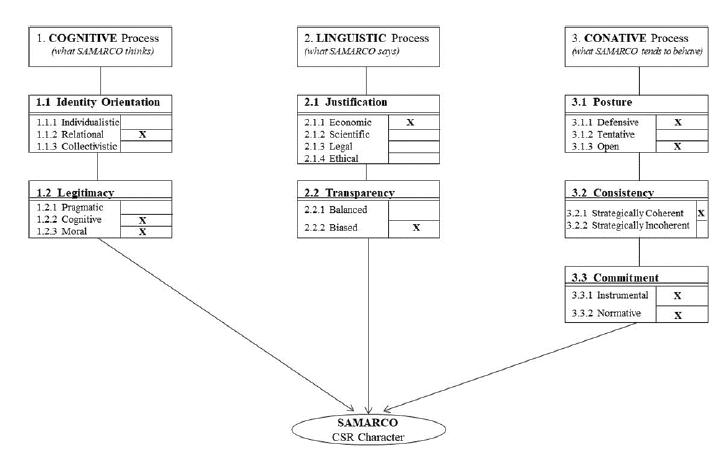
Figure 2
The CSR character of Samarco
Source: Elaborated by the authors based on Basu and Palazzo (2008, p. 43) and Georgieva (2012, p. 18)
6 FINAL REFLECTIONS
This article shows how effective strategies activate the intrinsic orientation that guides the responsible and sustainable business constructed in the Annual Sustainability Reports. Drawing on insights from Basu and Palazzo (2008), we focused on the Brazilian company Samarco's discourses identifying the cognitive, linguistic and conative aspects.
For the analyzed case, there is no consistency between what Samarco thinks, speaks and does. The sensemaking perspective of Samarco's Annual Sustainability Report shows that the company's discourse on the CSR and on sustainable management does not adequately report the events, actors, and the real context about the socio-environmental impact of its industrial activities. Three years after the most significant environmental disaster in Brazil, the scenes of this tragedy still impress. Nothing that Samarco and Renova Foundation are doing is of their own free will. In reality, all is the result of social pressure and a series of deals and court decisions (Longman & Almeida, 2018). The disaster consequences still lack an effective scaling of environmental and social reparations, despite difficulties in measuring all the costs of this scourge and damages.
The CSR sensemaking for the Samarco case suggests that the disaster and the following events are being interpreted as a sequence of legitimacy recovering, mostly using moral and instrumental standards of conduct enacted by external and powerful stakeholders. Despite the economic arguments applied in the 2016 report to justify the license to still be operating, the strategy to deal with such tragedy is essentially relational. Additionally, the company offers an open posture supposedly but reacts defensively.
As the sensemaking literature suggests, Samarco's managers are enrolled in the sensemaking about all events triggered by and after the collapse of the dam. But so are the others stakeholders interested and communities strongly impacted by the event. From the event onwards, individuals collectively develop a narrative about what happened, what the next steps will be, who is responsible for. Such narrative influences and is influenced by corporate communications, as sustainability reports. Additionally, the narratives developed in CSR sensemaking will embrace how the managers will consider coping with future events and designed strategies. The consistency present in those reports shows the strategic orientation of the CSR sensemaking, but it is also a constrained set of decisions responding to the legal and legitimacy demands from stakeholders.
REFERENCES
Alexander, D.E. (2004). Cognitive mapping as an emergency management training exercise. Journal of Contingencies & Crisis Management, 12(4), 150-159. DOI: https://doi.org/10.1111/j.0966-0879.2004.00445.x.
Alvesson, M. (1993). Organizations as Rhetoric: Knowledge-Intensive Firms and the Struggle with Ambiguity. Journal of Management Studies, 30(6), 997-1015. DOI: https://doi.org/10.1111/j.1467-6486.1993.tb00476.x.
Ancona, D. (2012). Sensemaking: Framing and Acting in the Unknown. In: Snook, S; Nohria, N; Khurana, R. (eds.) The Handbook for Teaching Leadership: Knowing, Doing, and Being. Thousand Oaks, CA: SAGE Publications, Inc
Bardin, L. (2016). Análise de conteúdo. Lisboa: Edições 70.
Basu, K., & Palazzo, G. (2008). Corporate social responsibility: A process model of sensemaking. Academy of Management Review, 33(1), 122-136. DOI: https://doi.org/10.2307/20159379.
Bauer, M.W. (2002). Análise de conteúdo clássica: uma revisão. In: Bauer, M.W., Gaskell, G. Pesquisa qualitativa com texto, imagem e som: um manual prático. 3 ed. Petropolis, RJ: Vozes, 189-217.
Beattie, V. (2014). Accounting narratives and the narrative turn in accounting research: Issues, theory, methodology, methods, and a research framework. British Accounting Review, 46(2), 111-134. DOI: https://doi.org/10.1016/j.bar.2014.05.001.
Borges, M. L., Anholon, R., Ordoñez, R.E.C., & Quelhas, O.L.G. (2018). O uso dos Relatórios de Sustentabilidade como fonte de pesquisas acadêmicas: tendências e gaps a serem explorados. Revista Metropolitana de Sustentabilidade, 8(1), 143-164.
Brickson, S. L. (2005). Organizational identity orientation: Forging a link between organizational identity and organizations’ relations with stakeholders. Administrative Science Quarterly, 50(4), 576-609.
Brickson, S. L. (2007). Organizational identity orientation: The genesis of the role of the firm and distinct forms of social value. Academy of Management Review, 32(3), 864-888. DOI: https://doi.org/10.2307/20159339.
Brown, C. J., & Hyseni, H. (2012). Sensemaking the business case: championing low-carbon initiatives. International Journal of Innovation and Learning, 12(4), 448-467. DOI: https://doi.org/10.1504/IJIL.2012.049355.
Burke, K.A. (1969). Rhetoric of motives. Berkley, CA: University of California Press.
Caregnato, R.C.A., & Mutti, R. (2006). Pesquisa qualitativa: análise de discurso versus análise de conteúdo. Texto & Contexto Enfermagem 15(4), 679-684, out/dez. DOI: http://dx.doi.org/10.1590/S0104-07072006000400017.
Castelló, I., & Lozano, J.M. (2011). Searching for New Forms of Legitimacy Through Corporate Responsibility Rhetoric. Journal of Business Ethics, 100(1), 11-29. DOI: https://doi.org/10.1007/s10551-011-0770-8.
Cramer, J., van der Heijden, A., & Jonker, J. (2006). Corporate social responsibility: making sense through thinking and acting. Business Ethics: A European Review 15(4), 380-389. DOI: https://doi.org/10.1111/j.1467-8608.2006.00459.x.
Christian, A. (2004). Behind the mask: the real face of corporate social responsibility. London. Avaiable in: https://www.st-andrews.ac.uk/media/csear/app2practice-docs/CSEAR_behind-the-mask.pdf.
Conley, J.M., & Williams, C. A. (2005). Engage, Embed and Embellish: Theory Versus Practice in the Corporate Social Responsibility Movement. The Journal of Corporation Law 31(1), 1-38. DOI: http://dx.doi.org/10.2139/ssrn.691521.
Correa, M. V. P.; Rese, N., Sander, J. A., & Ferreira, J. M. (2014). O Papel do Sensemaking nos Processos de Mudança nas Organizações. In: Encontro de Estudos Organizacionais da ANPAD, 8, Gramado. Anais Gramado, 1-14.
Daft, R.L., & Weick, K.E. (1984). Toward a Model of Organizations as Interpretive Systems. Academy of Management Review 9, 284-295. DOI: https://doi.org/10.5465/amr.1984.4277657.
Dervin, B. (1983). An overview of sense-making research: concepts, methods, and results to date. International Communication Association annual meeting: Dallas/US.
Dervin, B. (1992). From the mind's eye of the user: the sense-making qualitative-quantitative methodology. In: Glazier, J.D & Powell, R.R (eds.). Qualitative Research in Information Management. Englewood, CO: Libraries Unlimited, 61-84.
Dervin, B., Foreman-Wernet, L., & Lauterbach, E. (2003). Sense-making methodology reader: selected writings of Brenda Dervin. Cresskill, NJ: Hampton Press.
Dervin, B. (1998). Sense-Making theory and practice: An overview of user interests in knowledge seeking and use. Journal of Knowledge Management, 2(2), 36-46.
Eberle, A. D., & Casali, A. M. (2012). Crise organizacional e sensemaking: o caso de um hospital público no contexto da pandemia de influenza A (H1N1). Cadernos EBAPE.BR, 10(4), 822-840, Dez. DOI: http://dx.doi.org/10.1590/S1679-39512012000400004.
Eisenhardt, K.M. (1989). Building Theories from Case Study Research. The Academy of Management Review, 14(4), 532-550. DOI: http://dx.doi.org/10.2307/258557.
Eisenhardt, K.M., & Graebner, M.E. (2007). Theory building from cases: Opportunities and challenges. Academy of Management Journal, 50(1), 25-32. DOI: https://doi.org/10.5465/amj.2007.24160888.
Faria, J. P. A. (2012). A construção de sentido (sensemaking) no meio aeronáutico. In: Vicente, J. P. N. & Baltazar, A. R. (Coords.). Cultura, comportamento organizacional e sensemaking, Cadernos do IUM n.º 16, Lisboa: Instituto Universitário Militar, p. 161- 239.
Georgieva, A. (2012). CSR sensemaking - a process defined by leadership: A case study of an oil company on how the CSR character of the organization evolves and how leadership matters. Master thesis, Copenhagen Business School, Copenhagen, Denmark.
Greene, L.M. (2012). The Rhetoric and Reality Gap: a Sensemaking Perspective on Corporate Social Responsibility. Master of Philosophy Thesis, Stellenbosch University.
Jackson, S. (2010). Mind the Gap: Making Sense of Sustainability from a Business Manager’s Perspective. Cranfield (UK): The Doughty Centre for Corporate Responsibility, Cranfield School of Management.
Lima, M.A.D.S. (1993). Análise de conteúdo: estudo e aplicação. Rev Logos (1), 53-58.
Matten, D., & Moon, J. (2008). ‘‘Implicit’’ and ‘‘explicit’’ CSR: a conceptual framework for a comparative understanding of corporate social responsibility. Academy of Management Review, 33(2), 404-424. DOI: http://dx.doi.org/10.2307/20159405.
Montenegro, L. M., & Casali, A. M. (2008). O Modelo de Organizing de Karl Weick e sua Ênfase na Comunicação. In: Encontro de Estudos Organizacionais da ANPAD,5, Belo Horizonte. Anais Belo Horizonte, 1-14.
Nijhofand, A, & Jeurissen, R. (2006). A sensemaking perspective on corporate social responsibility: introduction to the special issue. Business Ethics: A European Review 15(4), 316-322, October. DOI: https://doi.org/10.1111/j.1467-8608.2006.00455.x.
Palazzo, G., & Scherer, A. G. (2006). Corporate legitimacy as deliberation: A communicative framework. Journal of Business Ethics, 66(1), 71-88. DOI: https://doi.org/10.1007/s10551-006-9044-2.
Ring, P. S., & Rands, G. P. (1989). Sensemaking, understanding, and committing. In A. H. Van de Ven, H. Angle, & M. S. Poole (Eds.), Research on the management of innovation: The Minnesota Studies, 337-366. New York: Ballinger/Harper Row.
Richter, U. H., & Arndt, F. F. (2018). Cognitive Processes in the CSR Decision-Making Process: A Sensemaking Perspective. Journal of Business Ethics, 148(3), 587-602. DOI: https://dx.doi.org/10.1007/s10551-015-3011-8.
Singh, A., Connaughton, J., & Davies, R. (2015). Making sense of corporate social responsibility strategies in construction organizations in the UK. In: Raidén, A.B. & Aboagye-Nimo, E. (eds.) Procs 31st Annual ARCOM Conference, 7-9 September 2015, Lincoln, UK, Association of Researchers in Construction Management, 187-196.
Schouten, E. M. J. & Remmé, J. (2006). Making sense of corporate social responsibility in international business: experiences from Shell. Business Ethics: A European Review 15(4), 365-379, October. DOI: https://doi.org/10.1111/j.1467-8608.2006.00456.x.
Starbuck, W.H., & Milliken, F.J. (1988). Executives' Perceptual Filters: What they notice and how they make sense. In: Hambrick, D. (ed.) The Executive Effect: Concepts and methods for studying top managers. Greenwich, CT: JAI Press, 35-66.
Suchman, M. (1995). Managing legitimacy and institutional approaches. Academy of Management Review, 20(3), 571-610. DOI: http://dx.doi.org/10.2307/258788
Thomas, J.B., Clark, S.M., & Gioia, D.D. (1993). Strategic sensemaking and organizational performance: linking among scanning, interpretation, action and outcomes. Academy of Management Journal, 36, 239-270. DOI: http://dx.doi.org/10.2307/256522
Vala, J. (2014). A Análise de Conteúdo. In: Silva, A.S. & Pinto, J.M. [orgs.]. Metodologia das Ciências Sociais. 16ª ed. Porto: Edições Afrontamento, 101-128.
Weick, K. E. (1993). The collapse of sensemaking in organizations: The Mann Gulch disaster. Administrative Science Quarterly, 38, 628-652. DOI: http://dx.doi.org/10.2307/2393339.
Weick, K. E. (1995). Sensemaking in Organizations. 3 ed. London: Sage Publications.
Weick, K. E. (2001). Making sense of the organization. Oxford: Blackwell.
Weick, K. E., & Roberts, K. H. (1993). Collective mind in organizations: Heedful interrelating on flight decks. Administrative Science Quarterly, 38, 357-381.
Weick, K.E., Sutcliff, K.M., & Obstfeld, D. (2005). Organizing and the Process of Sensemaking. Organization Science, 16(4), 409-421, July-August. DOI: https://doi.org/10.1287/orsc.1050.0133.
Yin, R.K. (2014). Case study research. Design and methods. 5. ed. Thousand Oaks, California: Sage Publications.
Zinenko, A. (2014). Making sense of CSR in Spanish and Danish frontrunners. Tesis doctoral, Barcelona: Universitat Autònoma de Barcelona.
From the web:
Amarante, L. Depoimentos de vítimas da tragédia ambiental causada pela mineradora Samarco. Available in: http://www.leonardoamarante.com.br/depoimentos-1/. [Accessed on November 14, 2016]
G1 (2016). ONU diz que resposta de empresas a tragédia de Mariana foi insuficiente. Available in: http://g1.globo.com/mundo/noticia/2016/11/onu-diz-que-resposta-de-empresas-tragedia-de-mariana-foi-insuficiente.html [Accessed on November 9, 2016]
Globoplay (2018). Três anos após desastre de Mariana, atingidos ainda enfrentam transtornos e problemas. Available in: https://globoplay.globo.com/v/7138529/ [Accessed on December 15, 2018]
Instituto Ethos de Empresas e Responsabilidade Social. Avaiable in: http://www3.ethos.org.br/[Acessed on July 10, 2016]
Istoé (2016). Um ano depois, as feridas da tragédia de Mariana continuam abertas. Avaiable in: http://www.istoedinheiro.com.br/noticias/negocios/20161102/ano-depois-feridas-tragedia-mariana-continuam-abertas/428637[Accessed on November 08, 2016]
McNamara, L. A. (2015). Sensemaking in Organizations: Reflections on Karl Weick and Social Theory, blog post, Sandia National Laboratories. Available in: https://www.epicpeople.org/sensemaking-in-organizations/. [Acessed on December 16, 2018]
Leite, C. (2016). Samarco fez pouco para recuperar estragos ambientais, afirma Ibama. Available in: http://g1.globo.com/jornal-hoje/noticia/2016/10/samarco-fez-pouco-para-recuperar-estragos-ambientais-afirma-ibama.html. [Acessed on November 08, 2016]
Lindsay Newland Bowker. Avaiable in: https://lindsaynewlandbowker.wordpress.com/[Acessed on September 8, 2016]
Longman, G.; Almeida, L. de (2018). Três anos após tragédia, vítimas de Mariana enfim projetam suas novas casas. Available in: https://www1.folha.uol.com.br/cotidiano/2018/11/tres-anos-apos-tragedia-vitimas-de-mariana-enfim-projetam-suas-novas-casas.shtml. [Acessed on December 13, 2018]
Oliveira, C. (2018). Tragédia de Mariana 3 anos: atingidos lançam carta-denúncia e vão a Londres para buscar apoio. Available in: https://www.hojeemdia.com.br/horizontes/trag%C3%A9dia-de-mariana-3-anos-atingidos-lan%C3%A7am-carta-den%C3%BAncia-e-v%C3%A3o-a-londres-para-buscar-apoio-1.669185. [Acessed on December 08, 2016]
O Globo (2016). O desafio de dimensionara tragédia de Mariana. Available in: http://oglobo.globo.com/opiniao/o-desafio-de-dimensionar-tragedia-de-mariana-20456748 [Accessed on November 15, 2016]
Rodrigues, L. (2016). Atingidos em Mariana ainda não sabem quando serão indenizados pela Samarco. Available in: http://agenciabrasil.ebc.com.br/geral/noticia/2016-11/mariana-um-ano-depois-da-tragedia-atingidos-nao-sabem-quando-serao-indenizados. [Acessed on November 7, 2016]
Samarco. (2014). Relatório Anual de Sustentabilidade. Avaiable in: https://www.samarco.com/wp-content/uploads/2016/08/2014-Relatorio-Anual-de-Sustentabilidade.pdf Accessed on: 21 dez 2018.
Samarco. (2016). Fazer o que deve ser feito: esse é o nosso compromisso. Available in: https://www.samarco.com/wp-content/uploads/2016/02/Dossi--_24_02.pdf Accessed on: 21 dez 2018.
YouTube (2016a).Ações humanitárias Samarco - Assistência às famílias impactadas pelo acidente em Mariana.Avaiable in: https://www.youtube.com/watch?v=r9PaPEhC71c. [Acessed on November 10, 2016]
YouTube (2016b). Mariana: acordo sob medida para a Samarco. Available in: https://www.youtube.com/watch?v=QGbAGyLYOAw. [Acessed on November 6, 2016]
YouTube (2016c).ProfissaoReporter COMPLETO 26/10/2016 - Um Ano de Mariana. Available in: https://www.youtube.com/watch?v=tip4k2I84HM. [Acessed on November 9, 2016]
APPENDIX: GENERAL DATA OF SAMARCO
 | SAMARCO MINERAÇÃO S.A. |
| Slogan | Development commitment |
| Type | Closed-capital company |
| Industry | Mining |
| Kind | Subsidiary / Corporation |
| Foundation | 1977 |
| Headquarters | Belo Horizonte city, Minas Gerais State, Brazil |
| Shareholders | Joint-venture between Vale and BHP Billiton Brazil Ltda. (owned by Anglo-Australian BHP Billiton), each with 50% of the shares of the company |
| Predecessor company | Anonymous society Mineradora Trindade (SAMITRI) |
| Official site | www.samarco.com |
| Units | Samarco’s structure includes one concentration plant, two pelletizing plants, a pipeline, and its own sea terminal. The starting point of Samarco´s production process is in Germano Mine, in an open-pit mine with mineral resources of 3.5 billion tons of iron ore. The plant is located between the municipalities of Mariana and Ouro Preto, in Minas Gerais State, with a production capacity of 16.5 Mtpa of concentrate. The ore is moved out of the mine across a pipeline on nine-km-long conveyor belts which lead to the beneficiation plant. There the low-grade itabirite ore is concentrated; in other words, its iron content is enhanced by the removal of impurities. The resulting material is mixed with water, at a proportion of 70% solids and 30% water, forming a slurry, whose consistency lets it be conveyed through a pipeline all the way to the coast in Ponta Ubu city, Espírito Santo State. The Ponta Ubu complex consists of two pellet plants, where the arriving slurry is dewatered and transformed into pellets, which are stockpiled and then carried by conveyor belts to the company’s own port facilities for out shipment. |
| Products | Iron ore pellets |
| Employment generation | About 2,969 |
| Gross revenue | US$ 2.8 million |
| Sales | Exported 25.3 million tons (pellets and fines) |
| Net profit | US$ 1.1 million |
| Production | 25.1 million tons of pellet produced |
| Production cost | US$ 57.11 (unit cost per ton of pellet sold) |
| Investments | US$ 489 million euros (operations) |
| Social Investments | US$ 3.9 million (volunteer in the community) |
| Environment Investments | US$ 33 million |
| Gross Value Added | US$ 1.6 million |
| Net Value Added | US$ 1.5 million |
| Asset | US$ 7.4 billion |
| Equity | US$ 1.6 billion |
| Dividends | US$ 1.0 million (paid to shareholders) |
| Taxes | US$ 225 million in taxes generated in Germano (MG), Ubu (ES) and pipeline from 2011 to 2014 |
| Production impacts | At least five other episodes of environmental accidents in the structures of the levees of the Samarco mining, also known “Bento Rodrigues Case”, and in four of these episodes mud leaked out killing fish and paralyzing the uptake of water. In addition to these leaks, in 2014, the company was one of those responsible for the serious pollution in the capital of Espirito Santo State, Vitória city, which resulted in a Parliamentary Investigation called the "Black Powder”. |
Autor notes
Autor Correspondente: Tel. (21) 2629-9867 E-mail: jpcosenza@id.uff.br (J.P. Cosenza); cintiaalbuquerque@id.uff.br (C. de M. de A. Ribeiro); alevy@id.uff.br (A. Levy); selmadios@vm.uff.br (S.A. Dios) Universidade Federal Fluminense, Faculdade de Administração e Ciências Contábeis. Rua Mário Santos Braga, s/n, - Campus do Valonguinho - Centro - Niterói/ RJ - 24020140, Brasil