Article
The collapse of the Fundão dam: An analysis of the marginalization of affected communities in the post-disaster governance process
O rompimento da barragem de Fundão: análise da marginalização dos atingidos na governança pós-desastre
 Filipe Maciel Euclydes
Jussara Jéssica Pereira
Francisco César Pinto da Fonseca
Filipe Maciel Euclydes
Jussara Jéssica Pereira
Francisco César Pinto da Fonseca
The collapse of the Fundão dam: An analysis of the marginalization of affected communities in the post-disaster governance process
Revista de Contabilidade e Organizações, vol. 16, e186049, 2022
University of São Paulo
Received: 21 May 2021
Accepted: 31 January 2022
Published: 13 June 2022
Abstract: This article analyzes the dimensions of the political asymmetry that were responsible for shaping the exclusion process of those affected in post-disaster contexts. The case of the Fundão Dam collapse in Mariana (MG), 2015 was investigated and Steven Lukes’ theoretical construct of the three faces of power was adapted for understanding the exclusion dynamics in the post-disaster governance process. A qualitative approach was used as the methodology, which involved document analysis, observation, and semi-structured interviews. The results showed how those affected played a subordinate role and were disregarded in the main decisions that shaped the post-disaster governance. The process employed was structured by way of institutional frameworks that were persistently defective, and which, even when they were modified, were not satisfactorily implemented. The conclusion we draw is that the exclusion of those affected involved decisions, arenas, and ideas, and that “non-instrumental rationality” was disregarded throughout the entire process. The use of the three faces construct proved to be productive and can be applied when analyzing other post-disaster scenarios.
Keywords: Power asymmetries, Post-disaster governance, Mining, Affected communities.
Resumo: O objetivo deste artigo foi analisar as dimensões de assimetria política responsáveis por configurar o processo de marginalização dos atingidos em contextos pós-desastres. Investigou-se o caso do colapso da barragem de Fundão, ocorrido em Mariana, (MG), 2015, e o constructo teórico das três faces de poder de Steven Lukes foi adaptado para compreender as dinâmicas de exclusão presentes na governança pós-desastre. Como metodologia, utilizou-se abordagem qualitativa, por meio de análises documentais, observação e entrevistas semiestruturadas. Nos resultados, foram evidenciados o papel subalterno e a desconsideração dos atingidos nas principais decisões que conformaram a governança pós-desastre. Esse processo se estruturou em marcos institucionais com vícios renitentes, e que, mesmo com modificações, não foram satisfatoriamente implementados. Concluiu-se que, a marginalização abrangeu decisões, arenas e ideias, sendo a “racionalidade não-instrumental” obliterada em todo processo. O emprego do constructo das três faces mostrou-se profícuo, podendo ser aplicado para análise de outros pós-desastres.
Palavras-chave: Assimetria de poder, Governança pós-desastre, Mineração, Comunidades atingidas.
1 INTRODUCTION
Since the 1980s, there has been a consolidation of the diagnosis that the extent and complexity of the impacts that are caused by natural or socio-technical disasters have grown significantly (Beck, 2015; Bullock, Haddow, & Coppola, 2017). In a response to this situation, studies on antecedents, explanations, effects, and solutions for disaster prevention and remediation have been expanded (Tierney, 2012; Birkland, 2013; Bullock, Haddow, & Coppola, 2017).
This debate in public policy literature lies on the dividing line between two sets of arrangements (Tierney, 2012): i) those linked to the rules that relate to preventing, mitigating, and monitoring disaster risks; and ii) those responsible for remedying, recovering and compensating for the damage that occurred as a result. This work is part of the second group and specifically discusses the participation of affected communities in post-disaster governance processes.
In studies of post-disaster policies, the consensus is that the communities that have been affected have a fundamental role to play in providing greater legitimacy and effectiveness to the planning and execution of recovery actions (Chandrasekhar, 2012; Chandrasekhar, Zhang, & Xiao, 2014; Curato 2018a; 2018b). It is equally evident that these processes tend to register the imbalance of forces that exists between the affected communities and the decision-making agents (public or private), with reparatory arrangements commonly characterized by a top-down configuration, a phenomenon that is observed both in countries in the northern hemisphere (Chandrasekhar et al., 2014; Amore, Hall, & Jenkins, 2017) and in the global south (Curato, 2018a; 2018b). This asymmetry of forces is amplified according to the magnitude of the social divide that exists in certain territories, the guiding rationality of the reparation actions taken, the institutional positions of the political actors, and the permeability of the political and reparation arrangements as far as those affected are concerned (Pelling, 2003; Chandrasekhar, 2012; Birkland, 2013; Chandrasekhar et al., 2014; Amore et al., 2017).
One theoretically possible way of revealing the asymmetries found in political decision-making processes is by using the concept of the three faces of power of Lukes (2005). The model has been improved and is currently being applied for analyzing asymmetries in different empirical objects (see Gaventa, 2019), such as public health policies in the pandemic (Mulinari & Vilhelmsson, 2020); housing (Mupambwa & Zaaiman, 2020); and corruption (Reynalds, 2019). The construct as applied in disaster literature has proved useful for analyzing the marginalization of local actors in a post-disaster situation in New Zealand (Amore et al., 2017), although the third face of power was not analyzed in this particular study (Amore et al., 2017). Therefore, the construct still needs to be applied in its entirety.
Considering the brief scenario set out above, this work aims to analyze how different dimensions of political asymmetry shape and help us understand the marginalization of affected communities in post-disaster contexts. We used the three faces of power model theoretically, (Lukes, 2005), and adapted it in order to analyze post-disaster governance (Amore et al., 2017). To materialize this research, we chose to investigate the case of the Fundão Dam collapse, which occurred on November 5, 2015, in Mariana (MG) and was considered the greatest environmental disaster in Brazilian history (IBAMA, 2015) and the largest involving a mining dam in the world (Bowker, 2015). The Samarco mining company, which is a joint venture between Vale S.A and Anglo-Australian company, BHP Billiton, is responsible for the Fundão Dam. The collapse released more than 50 million m3 of mining waste into the environment, which travelled about 650 km and directly affected 40 municipalities before reaching the mouth of the Rio Doce in the State of Espírito Santo (ES), Brazil (Ibama, 2015). According to official data, there were 19 deaths and material damage estimated at R$ 20 billion (Federal Prosecution Office, 2016).
Despite the intrinsic relevance of the case, analysis of the Fundão disaster enables us to visualize how the three faces of power materialize and are responsible for crystallizing the marginalization of those affected in a post-disaster context, which makes our choice of the Fundão case, therefore, instrumental (Stake, 2005). In parallel with its theoretical contribution, this study synthesizes the exclusion process that has been pointed out in different studies of the case (Zorzal, Cayres, & Souza, 2017; Roland et al., 2018; Zorzal, Cayres, & Souza, 2019; Fernandes, Teixeira, & Castelfranchi, 2019; Carlos, 2020; Milanez, Ali, & Oliveira, 2021; Losekann & Milanez, 2021), and the multidimensional understanding it offers is a concrete contribution to this literature.
In addition to this introduction, this work has four sections: a theoretical framework; the methodology used; the results; and final considerations.
2 THEORETICAL FRAMEWORK
Various analytical possibilities can be used for discussing the concept of power (Gaventa, 2003). These possibilities indicate different approaches based on the assumptions and criteria adopted (theoretical dimension) and the methodological choices made (Gaventa, 2003).
In this work, we chose to use the model inspired by Lukes (2005) to analyze the asymmetries that occurred between the affected groups and the two structuring forces: the mining companies and the Brazilian state. In doing so we observe how the three faces of power shape the conflicting interactions between those affected and the other public and private actors.
The three faces construct is the consolidation of a perspective in which political power cannot be reduced to a visible conflict between the actors (the first face of power), which is a traditionally privileged dimension (Dahl, 1961). We must also analyze the power and asymmetry dimensions considering the hidden conflict (Bachrach & Baratz, 1970) by the characteristics of the decision-making arenas and their favoring of certain biases (second face) (Healey et al., 1999). It is important, also, to analyze the latent conflict that is made invisible by the hegemony of a particular idea/reason/ideology/knowledge over another normative concept (third face) (Gaventa, 1980; Healey et al., 1999; Amore et al., 2017). According to Lukes (2005), the faces of power must be thought of in an interdependent way, by which these three dimensions, even though they are usually discussed separately, form a dynamic and superimposed phenomenon.
Lukes’ perspective of decomposing political power has been refined and used to analyze various research objects (see Gaventa, 2019). Amore et al. (2017) used the model for analyzing post-disaster governance. In doing so they analyzed the key decision episodes when differences occur and excluded the demands of affected local groups in the first face. Broadly speaking, the first face covers the visible mobilization of actors and interests within a given discussion space (Healey et al., 1999).
This mobilization is always carried out to a greater or lesser degree in an asymmetrical way since it is influenced by the norms of the spaces in which it operates, and by the resources available and the structural power patterns (Amore et al., 2017). To complement the gaps not addressed by open conflict, the second face is concerned with the institutional characteristics of the arenas in which policy decision-making takes place, noting how bias (dis)favors certain interests (Healey et al., 1999). Understanding the second face helps reveal why, despite social dissatisfaction, demands are unable to rise to the political arenas (Bachrach & Baratz, 1970), an understanding of the rules and instruments being fundamental.
Finally, although they did not directly apply the third face in their study, Amore et al (2017) highlight the characteristics of knowledge that govern reparation as an analytical dimension to be investigated. The third face, which is called ideological power, is sometimes the most naturalized and, therefore, the most subtle aspect of power, which is exerted by forming the beliefs and values of society (Gaventa, 1980; Lukes, 2005). We observe elements of this dimension in the tensions that exist between “lay knowledge”, which is generally attributed to the affected local groups, and the technical-scientific knowledge of the agents that are responsible for the reparation (Fernandes et al., 2019; Krick, 2021).
When reviewing the types of knowledge that are valued in participation processes, Fernandes et al (2019:3) listed three possibilities: i) technocratic, by which the person affected is seen as a blank slate of knowledge and needs to be properly informed about the relevant issues; ii) the consumption of knowledge, which arouses the individual’s interest in typically technical-scientific “goods”; and iii) “epistemic” or “activist citizenship”, whose “lay expertise” is recognized, with these subjects being expected to contribute to solving specific problems (Fernandes et al., 2019: 3).
In addition to the asymmetry dimensions in decision making (first face) and the configurations of decision arenas (second face), it is important to identify the characteristics of ideas and knowledge that become hegemonic (third face), since they also influence the multidimensional marginalization process of the affected communities.
3 METHODOLOGICAL PERSPECTIVE
A case study strategy was chosen (Stake, 2005) to verify the dimensions of the asymmetries found in the post-disaster process, with the political choices and initiatives taken to remedy the event being defined as the unit of analysis.
As for its operationalization, this work adopted a qualitative approach, in which primary (documentary) sources were collected, such as the Conduct Adjustment Instruments1 (TACs), which structure the post-disaster governance; editions of the newspaper, “A Sirene”, which is produced by those affected in the Upper Rio Doce region; and documents that were prepared by the Public Prosecutor’s Office, such as the formal complaint that was lodged against the companies, and a legal opinion on the participation of those affected. We attended events and meetings that took place in July 2017 in Mariana (MG), which lasted six hours, and observed ten remote governance meetings between February 2020 and October 2020, which was the period in the pandemic when meetings were held in person. In all, we observed 41 hours of remote events. Finally, we conducted 28 semi-structured interviews that were not recorded and that took place over four years, between July 2017 and October 2021. We conducted half (14) of the interviews in person, while the other half (14) was done remotely. The face-to-face interviews were divided into eight in Mariana (MG), and six in Rio Doce (MG) and Santa Cruz do Escalvado (MG). The interviews were authorized by the Institutional Ethics Committee of the institution to which the researchers are linked.
Table 1 shows the main sources of data collection used.

The interviews lasted an average of 65 min. We used sources and data triangulation to validate the information. This made it possible for us to verify the repetition of certain observations and common elements. To analyze the data, we applied the categories of the three faces of power (Lukes, 2005) to post-disaster governance (Amore et al., 2017). In presenting the results, we decided to use the reference that indicates the informant’s category and a code to differentiate them to preserve their identity.
Table 2 shows the category definitions, the units of analysis, and the guiding questions.

Analyses of the faces of power do not exhaust the understanding of the phenomenon but indicate the complexity of the process by which those affected are excluded, as shown below.
4 RESULTS
The research findings and their interpretations and analyses are segmented according to the analytical categories of the three faces: decisions, arenas, and ideas.
4.1 First face: The exclusion of those affected by key decisions
When analyzing Lukes’ (2005) first face of power, we notice an important pattern in the marginalization of those affected: they have no influence over the main decisions about the constitution and development of post-disaster governance. This characteristic is repeated from formulating the first signed document (TTAC), which structured the entire reparation process, to the negotiations that took place between the Public Prosecutor’s Office and the companies about corrective instruments.
The governance regime we analyzed started with the option of the Brazilian government to sign the “Transition and Adjustment of Conduct Term” in March 2016, a document that defines the roles of the companies and federal and state public bodies concerning the reparation process.
Entered into by the federal government, the states of Minas Gerais and Espírito Santo, plus five federal and six state agencies on the one hand, and by Samarco, Vale, and BHP Billiton on the other, the TTAC established 42 programs for repairing the collapse of the Fundão Dam. To carry out these programs, it was decided to set up a private foundation, financed by Samarco and its supporters, the Renova Foundation, which consists of members appointed by the mining companies. Governance bodies were also created, such as the “Inter-Federative Committee” (CIF) and 11 technical chambers (CTs) to guide and monitor the actions to be carried out. In October 2016, in the section entitled “They are still deciding for us”, A Sirene, described how the Renova Foundation functioned at the time and made the following criticism:
As 90% of the Foundation’s decision power lies with people indicated by Samarco and its shareholders, we need to be alert to their future actions. Without the guarantee offered by the involvement of all the stakeholders, this management, for example, will define the amount of the compensation to be paid (Edition 7, October 2016, page 4).
The TTAC’s clear limitations - the Foundation’s excessive discretion, local actors not represented in the reparation process, and the need for a better diagnosis of the damage caused - led to the negotiation of new reparation instruments, which altered the terms of the post-disaster governance (Roland et al., 2018). In January 2017, therefore, the Federal Prosecutor’s Office signed a Provisional Adjustment Instrument (TAP) with the mining companies and, in November of the same year, an amendment to it. In August 2018, the Governance TAC (TACG) was signed, to remodel the existing governance system.
Figure 1 shows the respective signed post-disaster governance configuration documents in chronological order. We then analyze the influence of those affected by these decisions.
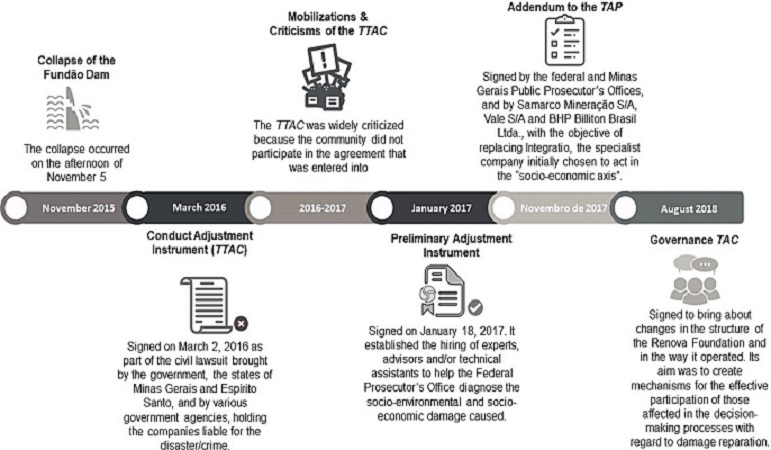
Figure 1
Timeline of the governance instruments relating to the collapse of the Fundão dam
Source: Prepared by the authors from União et al. (2016); Federal Prosecutor’s Office, Samarco Mineração S.A., et al. (2017); Federal Prosecutor’s Office, Prosecutor’s Office of the State of Minas Gerais, et al. (2017); Federal Prosecutor’s Office, et al. (2018).
Concerning the first instrument that was signed, despite Clause 11 of the TTAC providing for “the possibility of those affected effectively participating, being heard and having an influence at all stages and phases” (União et al., 2016:28), this participation did not materialize at the prior discussion, planning, and instrument-signing stages. The exclusion of affected communities is already symptomatic in the composition of the twelve members who signed the agreement in March 2016: half were from the government and the States of Minas Gerais and Espírito Santo, two were representatives of Samarco Mineração S/A, two were from Vale SA and two were from BHP Billiton Brasil Ltda (TTAC, 2016). The document comprises, therefore, two interested parties: “government” and “companies involved”, which distances itself from the “tripod” of interests.
Dissatisfaction with how this whole process started in an exclusionary manner is exemplified by the criticism that was directed at the president of the Foundation at a public meeting held in Mariana on July 18, 2017: “Why did you secretly go to Brasilia to make the decision (TTAC) without taking someone with you who had been affected? Now you’re wanting us “swallow” everything you’ve agreed” (Affected 1).
Criticism of the instrument and rejection of the Renova Foundation by those affected were also pointed out by the Minas Gerais State prosecutor in Mariana, in an interview with “A Sirene” (Edition 15, June 2016, p. 3):
(The Foundation) does not have the support of the Federal Prosecutor’s Office or the Minas Gerais Prosecutor’s Office, which are energetically questioning the agreement that was signed without the consent of those affected (...) acceptance can only be achieved if it is based on the transparency of the activities and the participation of members of the community. These are two essential requirements that are not in this relationship and that are the source of the whole illegitimacy of the Renova Foundation (Minas Gerais State prosecutor, Mariana legal district).
As has been pointed out, the various weaknesses of the TTAC (see Roland et al., 2018; Losekann & Milanez, 2021) led to corrective instruments being signed for post-disaster governance. But although the prosecutor’s office also criticized the non-participation of the people when it proposed renegotiations should carried out, the new instruments signed by the Federal Prosecutor’s Office and the companies (TAP and TACG) maintained the marginalization of those affected (Affected 6, 8; Academics 1, 2).
With regard to the first corrective instrument, the TAP chose Integratio to be responsible for providing independent technical advice to help organize/mobilize the different communities that had been affected (Academics 1, 2). The choice of an organization that had no links to the territories, however, displeased those who had been affected, who, once again, were not consulted about the production of the document (Roland et al., 2018).
In this new scenario of dissatisfaction, in 2017 “the federal prosecutor’s office organized a working group, and invited civil society representatives who were in some way or another involved in the case of the dam’s collapse, such as social movements, religious groups, academics, and others.” (Roland et al., 2018:5). This group, however, was disbanded in 2017 after disagreements about referrals. Members of civil society were critical, among other things, of the hiring of Fundação Getulio Vargas, because it had indirect relations with Vale SA. They also disagreed with the reformulation of the governance until technical advisory services had been hired in the affected territories. In the words of one of the group members, “the impression we had was that we were only there to legitimize the decisions taken by the prosecutor’s office, which ended up with members leaving the group" (Academic 2, in a remote interview on 11/06/2020).
At the beginning of 2018, during negotiations for the TACG, which was to be the instrument for correcting the established governance, the prosecutor’s office requested an assessment of the perceptions of the affected communities with regard to the reformulation being negotiated with the companies. The document indicates their incredulity at the persistent repetition of their exclusion: “if the prosecutor’s office proposed a public civil action to contest the TTAC alleging that when it was drafted it did not include the participation of those affected, how could it now itself participate in preparing the draft of the Governance TAC without those affected participating?” (person affected from the Upper Rio Doce region, MPMG, 2018:20).
Except for the Upper Rio Doce region - Mariana, Barra Longa, Santa Cruz do Escalvado, and Rio Doce - most of the territories in the affected basin still did not have any technical assistance, which was seen as essential for organizing the affected communities and influencing the renegotiation of the post-disaster governance. Even though it was criticized by various actors, the TACG was signed in August 2018, with the instrument once again being formulated in a top-down manner and without those affected being properly represented (Academics 1, 2; Technical Assistance 2, 3; Affected 6, 8).
Let us now look at the social control dimension of those affected by the institutions that were created.
4.2 Second face: Perspective of those affected by the terms of the "accords"
Concerning the institutional characteristics of the governance arrangement - the second face of power - the TTAC established that the functions of monitoring and supervising the remedial actions would be carried out by the collegiate instance entitled the “Inter-Federative Committee” (CIF), comprising 12 members representing the Federal and State Executive Branches and the affected municipalities. Eleven technical chambers (CTs) were also created to assist the CIF in proposing demands and providing guidance to the Renova Foundation. Figure 2 shows the governance structure initially created by the TTAC.
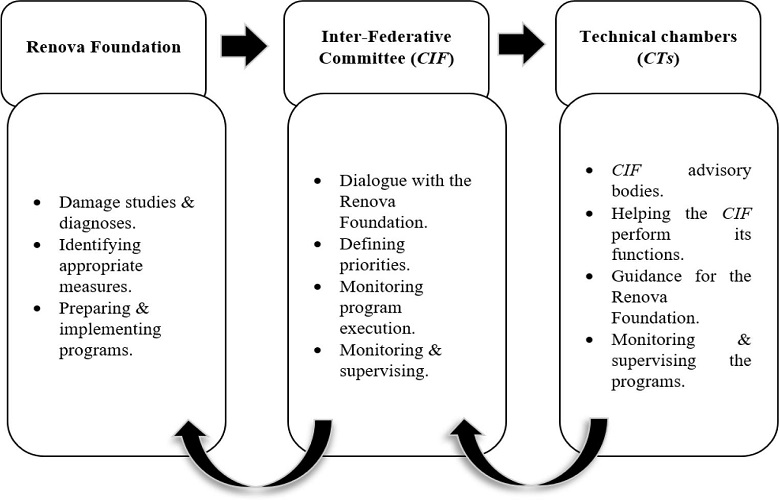
Notwithstanding the existence of arenas such as the CIF and the TCs, we see that there are gaps in the participation of those affected. The Advisory Board, an intra-Foundation institution, is the only instance on which those affected are represented. There is no link, however, between the Foundation’s actions and its preferences. Presence in this space is limited to “listening” to the demands, which is closer to “administrative formalities” than to “social control” (Affected 6, 8, 9). This situation is pointed out by a representative of the Movement of People Affected by Dams (MAB), for whom: “those affected were invited to participate on an advisory board, that is, [...] to talk about whether or not they liked the actions, but the decision is not made there” (MAB representative at a public meeting in July 2017).
Instituting the TACG in August 2018 sought to remodel the post-disaster governance arrangement, thus ensuring: the presence of those affected in CIF and TC meetings; the renegotiation of current programs; the creation of specific spaces where those affected could participate and deliberate; and the reconfiguration of the members in the existing instances (MPF et al., 2018). In this sense, it is worth mentioning the creation of two new instances of governance, which influence the entire functioning of the TACG: i) Local Commissions of the Affected, which are recognized as interlocutory instances in the damage reparation process, and formed by people affected, who can count on the support of technical advisors; and ii) Regional Chambers, for dialogue with the Renova Foundation and the local commissions, which can propose changes to the reparation projects.
These new arenas, which were provided for by the TACG, are nevertheless conditional upon the hiring of technical advisors throughout the river basin, who according to the document are responsible, for helping to establish local and regional chambers (MPF et al., 2018). Three years after the TACG was signed, however, these two instances have not yet materialized, which nullifies any real possibilities of influence that those affected might have. The difficulty of hiring advisors is seen as a strategic action by the mining companies, according to a statement made by the Rio Doce Task Force’s lawyer in February 2020:
We’re finding it extremely difficult to hire technical advisors for the 18 other territories of the Rio Doce basin. The mining companies are trying to prevent advisors that have not yet been hired from being able to order independent studies and research projects (statement on the Agência Brasil portal).
Of the main advances provided for by the TACG, only attendance at CIF and the TC meetings has been implemented, but without the right to be part of the formal composition of the instances; for example, three new members of the CIF were to be appointed by those affected via the regional chambers, which as of October 2021 was still on the drawing board. So although it presents content that is relevant to the restructuring of the governance arenas, in practice the TACG has had little influence on the participation of those affected in the whole of the Rio Doce basin that was damaged (Renova Foundation representative 2; Prosecutor’s Office representative 2; Academics 2).
The asymmetries in the third dimension of power that also crystallize the subordinate role of the communities are presented below.
4.3 Third face: Symbolic and normative exclusion
The marginalization of local groups vis-à-vis the main decisions that have been taken and the difficulty they are having in penetrating the governance arenas is repeated in the normative reparation dimension, that is, the values and ideas that govern the conception and implementation of post-disaster governance.
Until 2017, when the reparation process was managed directly by the mining companies - Renova was still being structured - there was strong criticism of the profile of the employees who had been hired because a significant number were former agents of Samarco and Vale (Prosecutor’s Office representative 2; Technical Advisor 1). In addition to being contradictory, since these professionals were linked to those companies that had caused the damage, the employees were characterized as having “great expertise in dealing with the market, but very little in dealing with issues of public interest, which is what they should doing while TTAC executors” (Zorzal, Cayres & Souza, 2017:13). Criticism of and pressures on the profile of the employees led to the hiring of the Foundation’s staff being repositioned, with professionals who had a new profile and who were considered “technicians” now being hired. In an interview carried out in 2017, when asked why those affected had not been included to assist in the reparation actions, a Renova employee replied:
Hiring those affected ends up being very complex because Renova is trying to put together a strong technical body that is neutral. It may be possible to hire those affected as labor when reparation gets underway because now they have no training and we’re looking for specialist professionals (Communication representative 1 from the Renova Foundation in a face-to-face interview in July 2017).
After the Renova Foundation was structured, as part of its legitimization strategy it hired professionals who had formal knowledge of how to plan, prepare and implement post-collapse compensatory measures: these were, in the words of the interviewee, “neutral” agents. This guideline is justified by the credibility attributed to these professionals as actors with technical knowledge, given the non-specialization of the affected communities (Renova representative 1). The fact, therefore, that those affected had built their multiple trajectories in the territories and so have empirical knowledge of the reality in which they operate, which can benefit the damage planning/reparation/restoration processes, was disregarded (Chandrasekhar, 2012; Curato, 2018b).
It is important to emphasize that this disregard for those affected was constantly observed in the words of other agents involved in the disaster reparation process (Affected 6, 8, 10; Technical Advisors 1, 2, 3). At a remote meeting of one of the CTs on 8/18/2020, its coordinator, who is a government employee, commented on the possibility of those affected taking part in the discussions: “As its name implies, this is a technical chamber. The presence here of those affected can disrupt an environment that is already difficult when it comes to solving problems”. According to one affected person interviewed, distrust of the abilities of those affected is repeated in the governance bodies that were set up, because: “To begin taking part in CT and CIF meetings was also a struggle. Once again we had to “kick the door” to get into them because nobody tells us anything willingly. What we say is never technical (Affected 6, in a remote interview on 8/18/2020). Likewise, in another remote meeting, this time of the Health CT on 8/19/2020, these were the words of one affected person: “We’ve been in this struggle for participation and recognition for four years now. I don’t have a university degree, but I have practical knowledge, which is worth a lot more when it comes to knowing what we want”.
The normative marginalization identified is a reflection of the elitism and self-attributed “technocratic arrogance”, given the alleged superiority of formal (“technical”) knowledge over the affected citizen who is rooted in the community. Criticism of this cognitive narrowing is highlighted by a former Renova employee, for whom the concepts that are often used in reparation are unable to meet the demands of the affected communities, because: “the affected person often seeks to get their subjectivity back; it’s the water tap they had access to, or their neighbors, the animals, the plants. Farms and very modern houses are being delivered to them, and you’ll see: they’ll receive these properties and sell them right away because that’s not what they want” (Renova Foundation representative 4, in a remote interview on 10/07/2021).
It is important to note that this technocratic model is politically comfortable for actors who find themselves in advantageous positions of power. Fernandes et al. (2019, p.9) cite the work of Madden et al. of 2016, according to which “researchers in the areas of science, technology, engineering, and mathematics tend to adopt the deficit model as a political issue, since this is how controversies are reduced and the academic consensus is facilitated, thus guaranteeing greater influence over public policies”. Fundão’s post-disaster rationality, which is equally comfortable for public agents, especially for the mining companies, is based on “top-down” knowledge, in which instrumental reason obliterates other possibilities of knowledge and blocks the inclusion of those affected (Krick, 2021).
5 FINAL CONSIDERATIONS
Post-disaster policy literature has shown that the incorporation of local communities is a key factor in reparation processes (Chandrasekhar, 2012; Chandrasekhar, Zhang, & Xiao, 2014; Curato 2018b). The characteristics of this inclusion, however, are conditioned by the power asymmetries that permeate the different remediation arrangements and dynamics (Pelling, 2003; Amore et al., 2017; Curato, 2018a).
In order to understand how this phenomenon happens empirically, in this article we sought to recompose the scenario that shapes the exclusion of affected communities from the reconstruction process of the Fundão disaster, which occurred in Mariana (MG) in 2015. The multidimensional framework of the three faces of power, inspired by Lukes (2005), was useful for analyzing the marginalization and revealing asymmetries about the main decisions, institutional arenas, and the rationality of the process that materializes post-disaster governance.
As we identified in this study, the subordinate position of the affected communities tends to be reflected in actions that are disconnected from the needs of the territories and of the groups that were impacted. The latter were doubly affected: by the collapse of the Fundão dam, which “was no accident”, but negligence; and by their exclusion from the institutional process and from the participation and control processes (both of which were vetoed). From a broader perspective, the setting up and continuity of the Renova Foundation can be seen as a synthesis of the institutional fragility of the Brazilian state, in which the reparation process, as far as the model, modus operandi, and temporality are concerned, is still under the direct influence of the mining companies that are responsible for the socio-environmental crime, even though they have signed new governance instruments in an attempt to modify this hegemony.
It is important to note, however, that despite the particular aspects of the Fundão case, which certainly amplify the degree of marginalization of those that were affected, the exclusion processes are also the tonic of governance managed by public agents. It is not, therefore, the nature of the actors that is the necessary and sufficient condition that configures the exclusion phenomenon (Pelling, 2003; Birkland, 2013; Bullock et al., 2017). In fact, mitigation and reparation policies are always contextual processes, the materialization of which is influenced by whether: the type of disaster is natural or socio-technical; it is embedded in arrangements that are predominantly of the justice system, or are carried out by executive powers; it is mainly managed by public or private agents; and is in more or less permeable political domains, with distinct social divides, and other characteristics of their variability (Pelling, 2003; Chandrasekhar, 2012; Tierney, 2012; Birkland, 2013; Chandrasekhar et al., 2014; Amore et al., 2017).
Despite the inherent contingency of the object, however, the main theoretical contribution of this work is precise to demonstrate how the three faces construct makes it possible to advance our understanding of the complex intricacies that perpetuate the persistent marginalization process of those affected, making it possible to synthesize the three-dimensional political dynamics of power that are present to a greater or lesser extent in all post-disaster processes.
We encourage, therefore, the use of the outlined framework in other empirical cases for analyzing the inclusion/exclusion of those affected. As this line of research matures it will enable similar characteristics of marginalization and their causal mechanisms to be identified. This will enable us to reflect, in parallel, on strategies that are capable of lessening these asymmetries, which are inherently present in disaster reparation processes.
REFERENCES
Amore, A., Hall, M.C., & Jenkins, J. (2017). They never said ‘Come here and let's talk about it’: Exclusion and non-decision-making in the rebuild of Christchurch, New Zealand. Local Economy, 32(7), 617-639. https://doi.org/10.1177/0269094217734326
Bachrach P. & Baratz M. (1970) Power and Poverty: Theory and Practice. Oxford: Oxford University Press.
Beck, U. (2015). Sociedade de risco mundial: em busca da segurança perdida. Lisboa: Edições 70.
Birkland, T. (2013). Disasters, Focusing Events, and Sociolegal Studies. Oñati Sociolegal Series, 3(2), 363-377. Available from: http://ssrn.com/abstract=2221290
Bowker, L. N. (2015). Samarco dam failure: Largest by far in recorded history. Bowker Associates, Science & Research In The Public Interest.
Bullock, J., Haddow, G., & Coppola D. (2017). Introduction to Emergency Management Butterworth-Heinemann.
Carlos, E. (2020). “Civil Society and Social Mobilizations in the Context of the Rio Doce Socioenvironmental Disaster.” Integrated Environmental Assessement and Management, 16(5), 681-690. DOI: https://doi.org/10.1002/ieam.4282
Chandrasekhar, D. (2012). Digging deeper: participation and non-participation in post-disaster community recovery. Community Development, 43(5), 614-629. DOI: https://doi.org/10.1080/15575330.2012.730538
Chandrasekhar, D., Zhang, Y., & Xiao, Y. (2014). Nontraditional participation in disaster recovery planning: Cases from China, India, and the United States. Journal of the American Planning Association, 80(4), 373-384. DOI: https://doi.org/10.1080/01944363.2014.989399
Curato, N. (2018a). Beyond the spectacle: slow-moving disasters in post-Haiyan Philippines. Critical Asian Studies, 50(1), 58-66. DOI: https://doi.org/10.1080/14672715.2017.1407249
Curato, N. (2018b). From authoritarian enclave to deliberative space: governance logics in post-disaster reconstruction. Disasters, 42(4), 635-654. DOI: https://onlinelibrary.wiley.com/doi/full/10.1111/disa.12280
Dahl, R. (1961). Who Governs?. New Haven: Yale University Press.
Fernandes, V.J.A., Teixeira, R.O.S., & Castelfranchi, Y., (2019). Entre a retórica da participação e a tecnocracia: tensões da participação em ciência e tecnologia a partir do desastre da Samarco. Anais do 19◦ Congresso Brasileiro de Sociologia, Florianópolis, SC, Brasil.
Gaventa, J. (1980). Power and Powerlessness: Quiescence and rebellion in an Appalachian valley. Chicago: University of Chicago Press.
________. (2003). Power after Lukes: A Review of the Literature. Brighton: Institute of Development Studies.
________. (2019). Applying power analysis: using the “Powercube” to explore forms, levels and spaces. In: L McGee R, Pettit J, eds. Power, Empowerment and Social Change, London: Routledge, pp. 117-138.
Healey P, de Magalhaes C, Madanipour A, et al. (1999) Urban Governance, Institutional Capacity and Regenerating City Centres. Full Report Research, Activities and Results. Newcastle UponTyne: Centre for Research in European Urban Environments, University of Newcastle.
Ibama. (2015). Laudo Técnico Preliminar: Impactos ambientais decorrentes do desastre envolvendo o rompimento da barragem de Fundão, em Mariana, Minas Gerais. Ministério do Meio Ambiente Brasília.
Krick, E. (2021). Citizen experts in participatory governance: Democratic and epistemic assets of service user involvement, local knowledge and citizen science. Current Sociology. DOI: https://doi.org/10.1177/00113921211059225
Losekann, C., & Milanez, B. (2021). Mining disaster in the Doce River: Dilemma between governance and participation. Current Sociology. DOI:https://doi.org/10.1177/00113921211059224.
Lukes S (2005) Power: A Radical View, 2nd ed. New York: Palgrave Macmillan.
Milanez, B., Ali, S., Oliveira J. (2021). Mapping industrial disaster recovery: lessons from mining dam failures in Brazil. The Extractive Industries and Society, 8(2), 1-13.. DOI: https://doi.org/10.1016/j.exis.2021.100900
Ministério Público Federal. (2016). Ação Civil Pública 60017-58.2015.4.01.3800.
_____________. Samarco Mineracão S.A., Vale S.A., & BHP Billiton Brasil Ltda. (2017). Termo de Ajustamento Preliminar (TAP). Belo Horizonte.
____________. Ministério Público do Estado de Minas Gerais, Samarco Mineracão S.A., Vale S.A., & BHP Billiton Brasil Ltda. (2017). Termo Aditivo ao Termo de Ajustamento Preliminar (TAP Aditivo). Belo Horizonte.
____________. Ministério Público do Estado de Minas Gerais, Ministério Público do Estado do Espírito Santo, Defensoria Pública da União, Defensoria Pública do Estado de Minas Gerais, Defensoria Pública do Estado do Espírito Santo, Fundação Renova. (2018). Termo de Ajustamento de Conduta Governança (TACG). Belo Horizonte.
___________. (2018). Parecer No 279/2018/Sppea. Recuperado de: http://www.mpf.mp.br/grandes-casos/caso-samarco/documentos/parecer-no-279-2018
Mulinari, S., & Vilhelmsson, A. (2020). Revisiting the Pharmaceuticalisation of Pandemic Influenza Using Lukes’ Framework of Power. Sociology of Health & Illness, 42, 327-341. DOI: https://doi.org/10.1111/1467-9566.13006
Mupambwa, G., J. Zaaiman. (2020). “The Khutsong Housing Project and Power Relationships: An Application of Lukes’ Three Dimensions of Power.” South African Review of Sociology, 51(2). DOI: https://doi.org/10.1080/21528586.2020.1828158
Pelling M. (2003). The Vulnerability of Cities: Natural Disasters and Social Resilience. London: Earthscan.
Reynolds L. (2019). Not Up for Discussion: Applying Lukes' Power Model to the Study of Health System Corruption Comment on "We Need to Talk About Corruption in Health Systems". Journal of Health Policy Management, 8(12), 723-726. DOI: https://doi.org/10.15171/ijhpm.2019.75
Roland, M., Faria, L., Mansoldo, F., Senra, L., Ferreira, L. (2018). Negociação em contextos de violações de Direitos Humanos por empresas. PoEMAS, 2(1), 3-25.
Stake, R. (2005). Case Studies. In: Denzin, N.; Lincoln, T. Handbook of Qualitative Research. London: Sage, pp. 108-132.
Tierney, K. (2012). Disaster governance: Social, political, and economic dimensions. Annual Review of Environment and Resources, 37, 341-363. DOI: https://doi.org/10.1146/annurev-environ-020911-095618
União, Instituto Brasileiro de Meio Ambiente e dos Recursos Naturais Renováveis, Instituto Chico Mendes de Conservação da Biodiversidade, Agência Nacional de Águas, Departamento Nacional de Produção Mineral, Fundação Nacional do Índio, BHP Billiton Brasil Ltda. (2016). Termo de Transação e de Ajustamento de Conduta (TTAC). Brasília.
Zorzal, M., Cayres, D. C., & Souza, L. A. M. de. (2019). Desastre Socioambiental e Termo de Transação e Ajustamento de Conduta (TTAC) como instrumento de política pública: o caso da barragem de Fundão, MG. Civitas-Revista de Ciências Sociais, 19(2), 464-488. DOI: https://doi.org/10.15448/1984-7289.2019.2.30227
Zorzal, M., Cayres, D. C., & Souza, L. A. M. (2017). Inovações institucionais no processo de produção de políticas públicas: o caso do rompimento da barragem de Fundão em Mariana-MG. Anais do 18o Congresso Brasileiro de Sociologia, Brasília, Brasil.
Notes
Author notes
Corresponding author: Tel. +55 (11) 3799-3455 E-mail: fillipemaciel@gmail.com (F. M. Euclydes); jussarajpereira@gmail.com (J. J. Pereira); franciscofonsecacp@gmail.com (F. C. P. da Fonseca) Fundação Getúlio Vargas. Av. Paulista, 548, Andar Intermediário - Bela Vista/SP - 01310000, Brazil