Article
The primacy of management over planning in Brazilian states
A primazia da gestão fiscal sobre o planejamento nos estados brasileiros
 Robson Zuccolotto
Juliani Nunes Campos Johanson
Luiz Cláudio Louzada
Janilson Suzart
Robson Zuccolotto
Juliani Nunes Campos Johanson
Luiz Cláudio Louzada
Janilson Suzart
The primacy of management over planning in Brazilian states
Revista de Contabilidade e Organizações, vol. 16, e186475, 2022
University of São Paulo
Received: 01 June 2021
Accepted: 31 January 2022
Published: 15 June 2022
Abstract: We assume that there is currently a primacy of management over planning and seek to investigate the relationship between the primary and nominal budget balances and investments in Brazilian states and verify the effect that political cycles had on this relationship during the period from 2001 to 2018. To accomplish this, we use multiple linear regression models with errors clustered by state and year. The results demonstrate the existence of a positive relationship between fiscal management and planning in the Brazilian states, confirming the literature’s findings and our research hypothesis. In addition, we demonstrate that electoral cycles interfere with the relationship between fiscal management and governmental planning, given that investments increase in pre-election years.
Keywords: Governmental planning, Governmental management, Political cycle.
Resumo: Considerando que a literatura crítica ao neoliberalismo considera que sua expansão inverteu a primazia do planejamento governamental sobre a gestão fiscal dos entes governamentais, esta pesquisa, assumindo a existência da primazia da gestão fiscal sobre o planejamento, investiga a relação entre resultado primário e resultado nominal com os investimentos nos estados brasileiros e verifica o efeito que os ciclos políticos provocam nesta relação no período de 2001 a 2018. Para tanto, foram utilizados modelos de regressão linear múltipla com erros clusterizados por estados e por ano. Os resultados evidenciam a existência de relação positiva entre a gestão fiscal e planejamento nos estados brasileiros, confirmando a literatura e nossa hipótese de pesquisa. Além disso, a pesquisa evidenciou que os ciclos políticos eleitorais interferem na relação entre gestão fiscal e planejamento governamental, uma vez que os investimentos aumentam nos períodos pré-eleitorais.
Palavras-chave: Planejamento governamental, Gestão governamental, Ciclo político.
1 INTRODUCTION
Brazilian governmental planning went through a profound transformation at the beginning of the 1990s with the implementation of the neoliberal management model, which was in full expansion abroad. This model incorporated elements of business administration in managing the public sector, such as decentralization, results orientation, flexibility, competitiveness internally and externally, transparency and accountability (Evans, 2008).
Together with the transformations due to the implementation of the neoliberal management model, the country, based on the Federal Constitution of 1988, adopted a budgetary model with a greater alignment with the neoliberal model, which favors fiscal management over planning. Driven by the state’s fiscal crisis in the 1990s, which resulted in a rigorous fiscal adjustment and annual short-term targets, this model gained force, becoming one of the programmatic pillars of the new wave of reform of the bureaucratic state (Rezende, 2010).
One of the problems of neoliberal planning incorporated by the Federal Constitution of 1988 is that it reduces the horizon of possible action in planning to the short and medium term, conditioning the instrument on the available budgetary forecast, as well as transforming it into a mere everyday action of the state. Expressed another way, planning ceased to be a strategic process and no longer drove the implementation of policies which could promote the development of the states, and instead became concerned to a great extent with meeting short-term fiscal targets (Cardoso Jr., 2014).
In addition, even though the Federal Constitution of 1988 idealized the Multiyear Plan as a planning instrument, its cycle which consists of four years is not sufficiently long to give a long-term strategic vision. In this way, in programming fiscal and financial targets, the Multiyear Plan came to be characterized as a medium-term budget and not a long-term strategic plan (Rezende, 2010). From a similar perspective, Pares and Valle (2006) agree that in investment decisions the Multiyear Plan has benefitted short-term planning, and at the same time has failed to provide a long-term vision.
With the new management matrix, the Multiyear Plan made the government’s long-term targets conditioned on the existence of short-term financial results, limiting state action in terms of development. Under this scenario, many managers allege that in order to achieve financial results, notably those established by the Fiscal Responsibility Law, managers end up restricting investment, which harms local development. In other words, the Brazilian governmental planning model has conditioned investment on the primary and/or nominal fiscal balance, completely inverting the reigning theoretical logic regarding planning and management. Cardoso Jr. (2014) stresses that ever since the moment in which the short-term planning model was institutionalized, as “the only way of structuring and conducting things in the government, budgeting anticipates and commands planning and investment, when in truth we should be thinking of the opposite causality”.
Even though the literature indicates a change in the planning process in Brazil (Cardoso Jr., 2014), termed the primacy of management over planning, up until this investigation there have been no empirical studies that demonstrate the existence of this primacy. In other words, we have not found studies that analyze the relationship between short-term management indicators and planning indicators (medium-term in Brazil). In addition, we need to consider that investment decisions in subnational studies may not be dependent only on budgetary savings (the primary or nominal surplus), but also political variables, above all those related to the political cycle (Nordhaus, 1975a), or in other words, a cycle of political opportunity in which managers make decisions based on their possibilities of being reelected. This argument became more relevant in Brazil after Constitutional Amendment 16/1997, which allowed governments to be elected for consecutive mandates, and this influenced the way public spending was managed (Novaes & Mattos, 2010), given that managers could use the public machine to win votes for their reelection.
Considering the arguments presented above, or in other words, the primacy of fiscal management over planning and the influence of political cycles in state investment, the second question arises: What is the relationship between budgetary balances (primary and nominal fiscal balances) and governmental planning (investments) and how do electoral cycles interfere with this relationship? Given this research problem, and assuming the primacy of management over planning, this study seeks to investigate the effect of fiscal management on planning in Brazilian states and the Federal District. Specifically, this study will investigate the effects of fiscal management on the planning adopted by Brazilian states as well as the effect of political cycles on this relationship.
To achieve the proposed objectives, this work uses a multiple linear regression technique with clustered errors for each year and state in our sample. These in turn are grouped in subsamples in terms of election periods to test the relationship between long-term planning and short-term plans in Brazilian states and the Federal District from 2001 to 2018. This study’s results demonstrate the existence of a positive relationship between fiscal management and planning in Brazilian states, with there being interference in this relationship when we consider political cycles as well as greater investment in periods close to elections.
In addition to this introduction, this work is divided into five more sections. Section two briefly recounts the history of governmental planning in Brazil explaining how this inversion of the primacy of planning over financial management took place. Section three stirs the pot a bit in terms of the debate about the primacy of fiscal management over planning, explaining how political cycles affect this primacy. The fourth section presents the methodological paths taken in the elaboration of this work, while section five presents our results and the respective analyses. The last section consists of our final considerations.
2 REVIEW OF THE LITERATURE AND THE DEFINITION OF OUR RESEARCH HYPOTHESIS
2.1 Governmental planning and management in Brazil
Governmental planning and fiscal management constitute two crucial and inseparable dimensions in the actions of contemporary states, given that the academic literature establishes the primacy of planning over management, or in other words, first one plans, then one executes (fiscally and financially) the plans. Within the governmental context, the need to plan, above all in developing countries, involves prioritizing actions, policies and investments that are capable of ensuring the economic and social development of the population.
Even though the primacy of planning over fiscal management is recognized by academics and is common sense, it has not always occurred in Brazil and has suffered the influence of factors linked to the political-economic context and the predominant managerial models in each historic period. In this manner, even though there is no consensus in the literature, we assume as does Cardoso Jr. (2014) that up until the end of the 1980s the primacy of planning reigned over management, and this relationship was inverted beginning in the 1990s.
Despite the existence of previous experience, it was with the advent of the New State in the 1930s that Brazil began to systematically conceive of and adopt governmental planning (Maciel, 1989), with the 1950s being considered the zenith of governmental planning in this country when the ideology of development was consolidated and disseminated theoretically by the Economic Commission for Latin America and the Caribbean, which was put into concrete form with Juscelino Kubitschek’s Target Plan. Other experiences of governmental planning succeeded the Target Plan, which in general terms sought to further the country’s economic development. For almost all of the 20th century, the historical context made it necessary to establish the country’s material base with the diffusion of the ideology and policies of industrialism which were made possible by obtaining social support for the transformation of local structures for national development (Cardoso Jr., 2010; Cardoso Jr, 2014).
By the end of the 1970s, the socio-economic situation of the country had begun to deteriorate due to great public debt and persistent stagflation. Gremaud and Pires (1999) tell us that at the time the level of inflation reached 220% per year, compromising the population’s buying power and increasing social exclusion and tensions in the country and the cities. This unsatisfactory scenario circled by financial crises along with technological backwardness and the absence of an effective industrial policy made Brazil one of a group of countries that were suffering from globalization together with a severe fiscal crisis (Souza, 2004).
Given this panorama during the dissemination of the neoliberal agenda, encouraged above all by multilateral organizations and the Washington Consensus, Brazil abdicated its medium and long-term policies and began to adopt short-term management policies, inverting the primacy of planning over management, which had been instrumental in the country’s economic growth for four decades (Cardoso Jr., 2014; Klein, 2008;).
This new model of planning, adopted at the end of the 1980s, materialized in Article 165 of the Federal Constitution of 1988 which created a group of norms to regulate legal planning instruments, among which stand out the Multiyear Plan, the Budgetary Guidelines Law, and the Annual Budget Law. Despite the conceptual optimism of these instruments, it soon became clear that the Multiyear Plan would become just a formal planning instrument with ample operational content and little policy content to provide adequate guidance to the government, becoming a multiyear budget rather than a planning instrument (Santos, 2011).
From this perspective it is possible to state that these planning instruments came to simply conduct what had been budgeted, without any concern about instituting long-term public policies and/or investments. Along the same lines, Cardoso Jr., (2014) points out the way in which the Multiyear Plan materialized as merely the operationalization of the budgetary-plan junction, emptying it of its strategic policy content.
In addition to the Federal Constitution of 1988, Complementary Law 101/2000, known as the Law of Fiscal Responsibility which establishes the norms of public finances for responsibility in terms of fiscal management, was another great instrument which limited the planning activity of the states. Bercovici (2015), emphasizes that independent of the merit of seeking to control public spending and reducing waste, this law imposed a balanced budget policy for all of the entities in the country, making control of fiscal management the only possible public policy.
In sum, what the literature has pointed out is that the primary and nominal fiscal balances of short-term budgetary management, mainly established by the Law of Fiscal Responsibility became more relevant than long-term investment and development policies, giving financial management primacy in long-term social transformation strategies, or in other words, investment strategies. Thus, given that short-term neoliberal logic was incorporated into the Brazil budgetary model, inverting the primacy of planning over management (Cardoso Jr., 2014), we can postulate our first research hypothesis:
Hypothesis 1: There is a positive relationship between fiscal management and governmental planning within the context of the Brazilian states.
However, as we have presented, planning and fiscal management are activities which are totally intertwined, with there being no benefit for any institution to conduct them in a segregated manner. In addition to being contained within planning, plans (fiscal management) should make it possible to attain macro-targets (De Toni, 2009).
In addition to fiscal issues, the Brazilian magna carta introduced another ingredient in this debate, given that the definition of the electoral system resulted in a system of political competition which seems to stimulate larger average short-term investments with electoral returns rather than long-term strategic investments (Cardoso Jr, 2014).
2.2 The effect of the political cycle on fiscal management and governmental planning
The creation of Constitutional Amendment 16/1997, known as the “Reelection Amendment”, which allows a government to stay in power for up to two consecutive mandates was an important change in the Brazilian electoral system. Novaes and Mattos (2010) affirm that this device influenced the management of public spending, given that managers came to use the public machine to win votes to get reelected. This generates, according to the political cycle theory (Nordhaus, 1975a), a political opportunity in which managers make decisions based on their chances of being reelected.
In this sense, Rogoff (1990), points out that those in power tend to use fiscal policy instruments to signal their competence, prioritizing the execution of spending that electors will perceive to the detriment of other expenses. Shi and Svensson (2006) corroborate this understanding, pointing out that public managers normally promote expansionary policies in an immediate and visible manner, causing an overall increase in public spending with the purpose of signaling their competence to the electorate, even if these measures result in budgetary deficits. From this perspective, Schuknecht (2000) points out that public representatives give priority to investments, especially during pre-election periods, which will have a direct and immediate effect on the well-being of the electors, which will make the representatives more likely to win their votes.
Even though the discussion of political cycles in Brazil is broad and involves various authors and fields of knowledge, an important contribution to this discussion has been made by Orair, Gouvêa & Leal (2014) who identified new empirical evidence for the literature that explores the presence of electoral cycles in public investments in Brazil. The main contributions of this study are: i) the identification of the qualitative differences in electoral cycles in each state, finding a smaller degree of direct influence in municipal elections when we look first at the local sphere, then the state and federal spheres; and ii) the observation of a tight relationship between biennial cycles of federal government transfers and state investments.
One of the problems of political-budgetary cycles according to Rocha and Brilhante (2014) is that they are inefficient equilibria, because those in power act in an opportunistic manner during the economic cycle, using fiscal policy at a suboptimal level, which in turn interferes with the efficient allocation of factors of production and the stability of the state’s finances. It is important to point out how much the public interest is compromised by the instability of investments adopted by managers. Among the consequences are the overbilling and poor quality of public works which affect long-term planning. Nakaguma and Bender (2006) share this understanding, reinforcing the idea that “reelection spending” has made political cycles more extreme in Brazilian states due to opportunistic manipulation during electoral periods.
Given the arguments presented, we believe that the primacy of fiscal management over planning can be affected by political cycles and the electoral opportunism of incumbents, which leads us to our second hypothesis:
Hypothesis 2: Political cycles affect the relationship between fiscal management and governmental planning within the context of Brazilian states.
3 METHODOLOGY AND ADOPTED SAMPLES
This study investigates the relationship between governmental planning and fiscal management in the 26 states and the Federal District and is qualitative in nature, given that it uses data collection to test hypotheses using numerical measurements and statistical analyses to establish behavioral patterns. In terms of its objectives, this study is classified as descriptive, given that it analyzes, registers and interprets facts without concerning itself with the merit of the content (Bervian, Cervo, & Silva, 2007).
3.1 Data collection
The information was collected from Budgetary Execution Reports and General Balance Sheets published by the Treasury Departments of the states and the Federal District for the period from 2001 to 2018 - a time period that begins with 2001, because this is when the budgets began to be executed under the rules of the Law of Fiscal Responsibility, sanctioned the previous year. Where the information has not been available, we have used the Finances of Brazil database and searches justified by the Access to Information Law. The demographic and GDP information for the states were obtained from the Brazilian Institute of Geography and Statistics website and the information regarding the HDI was obtained through the National Household Survey.
3.2 Data analysis
To investigate the relationship between management and planning in the Brazilian states and also observe whether electoral periods interfere in this relationship, we used regression models with clustered transversal data. The overall model is:
The names of the variables, their codes, descriptions, expected effects and theoretical foundations are described in Table 1.
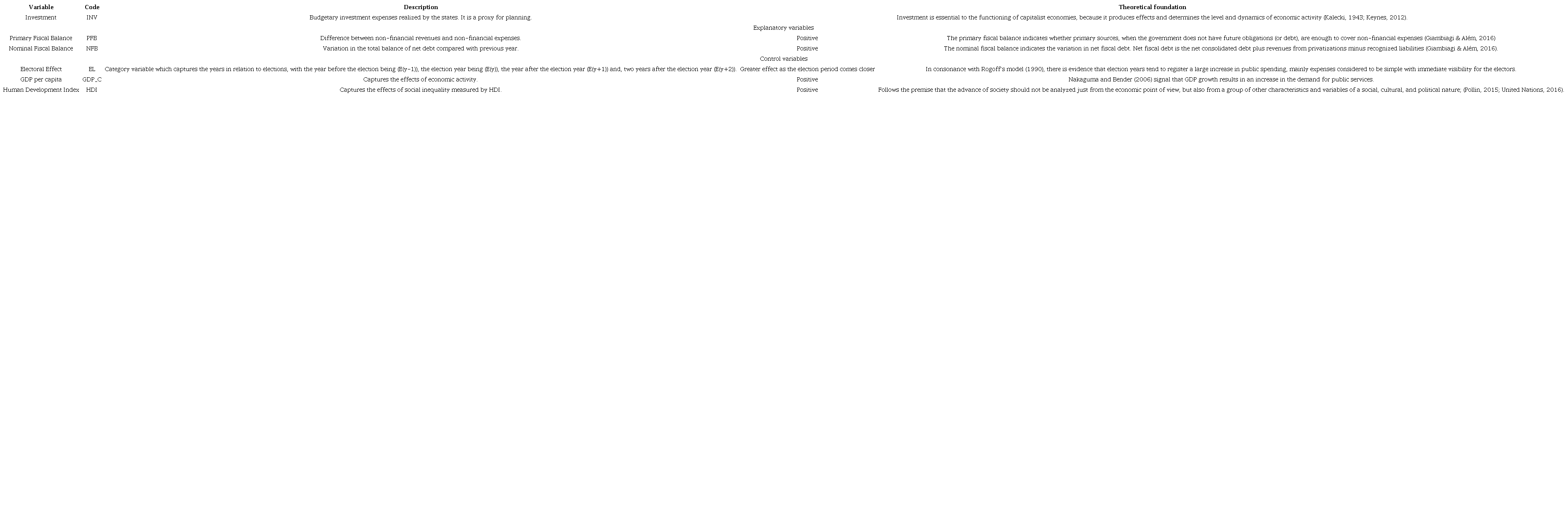
The investment variables function as a proxy for planning, given that we assume that investment planning should produce primary and nominal fiscal balances. However, since fiscal management has primacy over planning in Brazil, we expect that this relationship will be inverted, or in other words, that the primary and nominal fiscal balances will be conditioners of investment.
3.3 Descriptive statistics and the correlation of the variables
Table 2 presents the descriptive statistics of the variables of this study for the universe of 26 Brazilian states and the Federal District from 2001 to 2018. The sample was generated from 486 observations with annual data, and it has been winsorized at 1% to handle extreme data, with the POP variable being expressed as a logarithm to minimize problems of variable normality (Table 2).
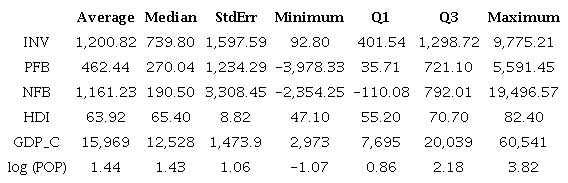
The variable which represents long-term planning (INV) presents an average of R$ 1,200.82 and the variables which represent fiscal management present averages of R$ 462.44 for the primary fiscal balance (PFB), and R$ 1,161.23 for the nominal fiscal balance (NFB). Overall, in comparing the average with the median, the data presents left (negative) skewness, which suggest a distribution with a greater probability of assuming below-average values. The comparison between the minimums and the maximums reveals great dispersion in the data.
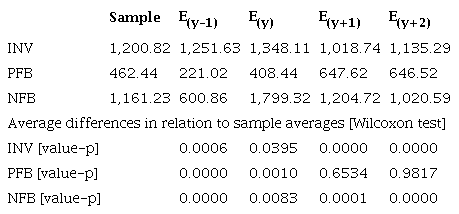
In addition, the sample was divided into four subgroups, which made it possible to observe through difference of averages tests the effect that pre-election, election and post-election years had on the study variables (Table 3). The averages of the subgroups between periods in relation to the election year (Table 3), demonstrate that the values of the investments (INV) increased in relation to the sample average of the year before the election and the election year, with this increase followed by a decrease in the two years following the election year. In terms of the primary fiscal balance (PFB), it follows the inverse behavior, with its values reduced in relation to the sample average in the year before the election and the election year, followed by an increase in the two years following the election year. The nominal fiscal balance (NFB), on the other hand, with its values reduced in the year before the election year, increased in the election year and decreased during the two years after the election year. The Wincoxon test reveals the existence of statistical differences when compared to the average of variables in the overall sample in relation to the annual subsamples, except the PFB variables in the two years following the election year.
These results demonstrate the use of investments as a political resource for part of the government, given that in pre-election years and election years, the values of investments increased, corroborating the arguments of Nordhaus (1975) and Rogoff (1990).
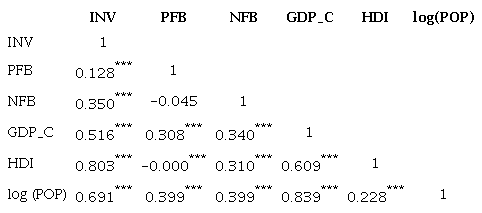
The Pearson correlation (Table 4) demonstrates the existence of a positive correlation between fiscal management (PFB and NFB) and planning (INV), with correlations of 12.8% and 35% respectively. The correlations among the control variables Gross domestic product per capita (GDP_C), Human development index (HDI), and the logarithm of the Population (logPOP) are high and statistically significant, and just one variable NFB does not have a significant correlation with the variable PFB. We also observed a very high correlation between GDP_C and logPOP (80.3%), which suggests according to Fávero, Belfiore, Silva and Chan (2009) that the logPOP variable should be excluded from the final model to avoid problems of multicollinearity.
The tests of the models’ residuals refute the individual and group normality hypotheses, reinforcing the need to control the models’ heteroskedasticity. To correct this problem, we adopt models with clustered standard errors as advocated by Petersen (2009) and Hasan and Habib (2017).
4 PRESENTATION AND ANALYSIS OF THE RESULTS
In order to verify the effect of short-term plans (PFB and NFB) on planning (INV), we generated three regression models based on the overall sample, with the regressions being estimated with clustered standard errors per year and per state (Table 5).
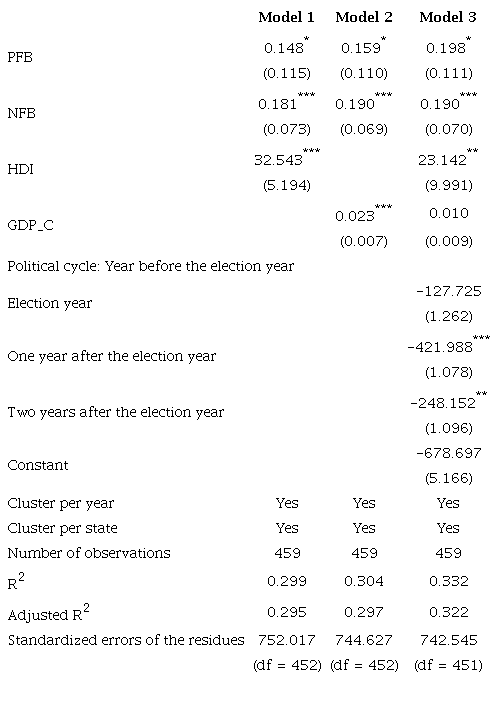
In addition to the models, the averages of the short-term budget given by the primary fiscal balance (PFB) and nominal fiscal balance (NFB) presented positive and significant relationships with planning (INV), and we also observed behavior that is consistent with the three presented models. In relation to the primary fiscal balance, we can observe that investments increased R$ 0.148 for every unit variation in the primary fiscal balance (PFB) (Model 1), however, when we add Gross Domestic Product per capita (GDP_C) to the model, the effect increases to R$ 0.159 (Model 2), and when we insert the political cycles, the effect increases to R$ 0.198 (Model 3), with the other variables remaining constant.
In terms of the nominal fiscal balance, investments increased R$ 0.181 for every unit variation in the nominal fiscal balance (NFB) (Model 1), but when we insert the Gross Domestic Product per capita (GDP_C), the effect increases to 0.190 (Model 2 and Model 3), with the other variables remaining constant.
Given these results, we can say that there is evidence of the positive effects of fiscal management on planning in Brazilian state governments, confirming Hypothesis 1 of this study and corroborating the findings of Cardoso Jr, 2014, which indicate that the planning process in Brazil after the 1970s, influenced by the neoliberal model and in the 1990s the Washington Consensus, came to favor short-term results, inverting the primacy of planning over fiscal management.
The socioeconomic variables except GDP per capita (GDP_C) in Model 3 were statistically significant, revealing a positive effect on planning (INV). This is expected given that the better the economic condition of a state (measured in this work by GDP), the greater its fundraising capacity and, as a result, its capacity to generate short-term cash, which is used to realize investments. The categorization in relation to the political cycles demonstrates that in pre-election years, the states allocated more resources in investments compared to other years. Thus, in the years after elections years, they allocated an average of R$ 421,988 million less investment than the pre-election years. Two years after the election year, this value was reduced to R$ 248,152 million (Model 3), demonstrating the existence of an electoral cycle effect in terms of investment decisions in Brazilian states.
In this way, the three models converge in terms of their results, making our findings more robust. In addition, the complete model, which considers the political cycle (Model 3), has greater explanatory power than the more restricted models. We next subdivided the sample by annual periods in relation to election years in Brazil in order to verify the effect of political cycles (and the years close to them) on the studied relationships (Table 6).
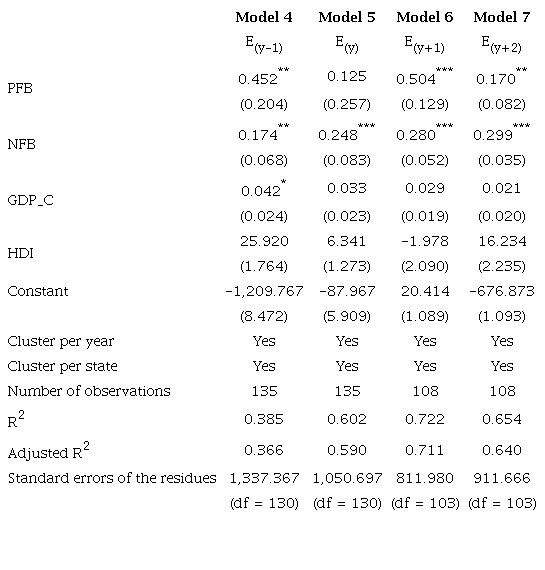
The effects between fiscal management and planning in Brazilian state governments presented a positive and statistically significant association, except for the subsample which represents election years (Model 5), where the primary fiscal balance (PFB) was not statistically significant. In the other models (4, 6 and 7), the association of the variables with the fiscal balances (PFB and NFB) presented the same relationship as the study’s main model.
When controlling subsamples for political cycles, the models suggested the existence of a greater association effect during the pre-election and election years, with this effect being reduced in subsequent years. The difference in the investment values for the various years of the political cycle suggests the existence of temporal management in the allocation of investment resources, which confirms Hypothesis 2 of our study.
These studies corroborate the findings of Bercovici (2015); Cardoso Jr, (2014); and Santos (2011), and conform with what the literature has identified, or in other words, that there was a change from the developmental ideology to the neoliberal ideology in the 1990s, and since then investment decisions by Brazilian states have ceased to be strategic and are governed by short-term indicators, limiting the capacity of local development. This leads to a suboptimal fiscal effect which harms everyone. The results further indicate that even though investment decisions have lost their strategic nature, governments have maintained strategic electoral behavior in relation to their use of budgetary resources. In the words of Nordhaus (1975), Rogoff, (1990), and Orair et al,, (2014), among others, political cycles, especially in pre-electoral years, affect the use of budgetary resources.
5 CONCLUSION
Based on the assumption of the existence of a primacy of fiscal management over planning cited by the literature, this work investigates the relationship between fiscal management and planning in Brazilian states. The results demonstrate the existence of positive effects between fiscal management and planning in the analyzed entities, corroborating the studies of Cardoso Jr. (2010) and Santos (2011), who affirm that in Brazil, above all since the import of neoliberal management models, governmental budgets (management) have come to define investment (planning).
In addition, when we control the subsamples for political cycles, the models suggest that there is greater investment during pre-election periods, with this effect being reduced in the two years following election years, demonstrating evidence of temporal management in the allocation of investment resources. These findings reinforce the arguments of Nordhaus (1975b) and Rogoff (1990) regarding the effect of political cycles on state investment, and also corroborate the findings of Orair et al, (2014) in an analysis of the Brazilian context.
To sum up, corroborating the thinking of Cardoso Jr. (2014), we can affirm that the fiscal and political transformations that have occurred in Brazil since redemocratization, aligned with the fact that it was not easy for public institutions to admit the application of new criteria particularly when they led to fewer resources, have also effected Brazilian budgetary planning, which has come be operational in nature rather than strategic. The most frequent result has been the elaboration of budgets without considering planning systems, despite the fact that laws and norms have established that there should be coordination and consistency between budgets and planning. In other words, planning is no longer a strategic process and is no longer concerned with the implementation of policies which can promote development in Brazilian states, and instead it is mostly concerned with meeting short-term fiscal targets which now condition investments.
This indicates that there is a need to rethink Brazil’s planning model and reestablish the primacy of planning over fiscal management, defining development strategies for the short, medium, and long term. This solution would not only break with the tradition of short-term financial planning which dominates in neoliberal models, it would make it possible to reconnect planning and the budget with development. In addition, the results also suggest the need to rethink budgetary control systems and their enforcement mechanisms during electoral periods, without committing the errors of limiting the actions of elected politicians and always considering investments to be pandering to the electorate.
An important limitation to this study is that it just examines this behavior in states without examining it in other entities. There is also the question of time which did not allow us to determine whether this behavior was different before the 1990s, the zenith of the development of neoliberal models in Brazil. These limitations suggest some avenues for future research: (i) verifying the effect that economic cycles have on fiscal management and planning; (ii) investigating the effect of political alternation/competition on the relationship between fiscal management and planning; and (iii) observing the heterogeneity of these effects among Brazilian regions.
REFERENCES
Bercovici, G. (2015). Estado, Planejamento e Direito Público no Brasil Contemorâneo. In J. C. Cardoso Jr. & E. A. V. dos Santos (Eds.), PPA 2012-2015: experimentalismo institucional e resistência burocrática. (Livro 2, p. 310). Brasília, DF: IPEA.
Bervian, P.A. Cervo, A.L. & Silva, R (2007). Metodologia Científica. São Paulo: Pearson.
Brasil. Constituição da República Federativa do Brasil de 1988. Retrived from: http://www.planalto.gov.br/ccivil_03/constituicao/constituicaocompilado.htm.
Cardoso Jr., J. C. (2010). Estado, instituições e democracia: desenvolvimento. (C. J. J. Celso., Ed.), IPEA, Série perspectivas do desenvolvimento brasileiro. (Vol. 3). Brasília, DF: IPEA.
Cardoso Jr, J. C. (2014). Estado, planejamento, gestão e desenvolvimento. Balanço da experiência brasileira e desafios no século XXI, 35. Retrieved from https://repositorio.cepal.org/handle/11362/36635
De Toni, J. (2009). Em busca do planejamento governamental do século XXI: novos desenhos. In: REPETTO, F. et al. (Org.). Reflexões para Ibero-América: planejamento estratégico. Brasília: Enap, 2009. p. 21-36. Retrived from: https://repositorio.enap.gov.br/bitstream/1/712/1/Reflex%c3%b5es%20para%20Ibero-Am%c3%a9rica%20Planejamento%20Estrat%c3%a9gico.pdf
Evans, P. (2008). In search of the 21st century developmental state. The Centre for Global Political Econom, 4.
Fávero, L. P., Belfiore, P., Silva, F. L., & Chan, B. L. (2009). Análise de Dados: Modelagem multivariada para tomada de decisões. São Paulo: Elsevier.
Giambiagi, F., & Além, A. C. (2016). Finanças Públicas: Teoria e Prática no Brasil (5th ed.). Rio de Janeiro: Elsevier.
Gremaud, A. P., & Pires, J. M. (1999). II Plano Nacional de Desenvolvimento-II PND (1975-1979). In A. (Org) Kon (Ed.), Planejamento no Brasil II (pp. 67-101). São Paulo: Perspectiva.
Hasan, M. M. & HABIB, A. Firm life cycle and idiosyncratic volatility. International Review of Financial Analysis, v. 50, p. 164-175, 2017.
Kalecki, M. (1943). Political aspects of full employment. The Political Quarterly, 14(4), 322-330. https://doi.org/https://doi.org/10.1111/j.1467-923X.1943.tb01016.x
Keynes, J. M. (2012). Teoria geral do emprego, do juro e da moeda. São Paulo: Saraiva.
Klein, N. (2008). A doutrina do choque: a ascensão do capitalismo de desastre. Rio de Janeiro: Nova Fronteira.
Maciel, E. (1989). A crise do planejamento brasileiro. Revista do Serviço Público, 117(1), 37-47. Retrieved from http://repositorio.enap.gov.br/handle/1/2613
Nakaguma, M. Y., & Bender, S. (2006). A emenda da reeleição e a Lei de Responsabilidade Fiscal: impactos sobre ciclos políticos e performance fiscal dos Estados (1986-2002). Economia Aplicada, 10(3), 377-397. https://doi.org/10.1590/s1413-80502006000300005
Nordhaus, W. D. (1975a). The Political Business Cycle. The Review of Economic Studies, 42(2), 169. https://doi.org/10.2307/2296528
Nordhaus, W. D. (1975b). The Political Business Cycle. The Review of Economic Studies, 42(2), 169-190. https://doi.org/doi.org/10.2307/2296528
Novaes, L., & Mattos, E. (2010). O efeito da intenção de reeleição sobre gastos em saúde: uma análise com base no modelo de reputação política. Revista de Economia Política, 30(1), 140-158. https://doi.org/10.1590/s0101-31572010000100009
Orair, R. O., Gouvêa, R. R., & Leal, É. M. (2014). Ciclos políticos eleitorais e investimentos das administrações públicas no Brasil. Brasília, DF.
Pares, A., & Valle, B. (2006). A retomada do planejamento governamental no Brasil e seus desafios. In J. Giacomoni & J.L. Pagnussat (Eds.), Planejamento e orçamento governamental (pp. 229-270). Brasília, DF.
Petersen, M. A. Estimating standard errors in finance panel data sets: Comparing approaches. The Review of Financial Studies, v. 22, n. 1, p. 435-480, 2009.
Pollin, R. (2015). Greening the Global Economy. Cambridge, MA: MIT Press.
Rezende, F. (2010). Planejamento no Brasil: auge, declínio e caminhos para a reconstrução. Textos para discussão. Brasília, DF.
Rocha, F. J., & Brilhante, Á. A. (2014). Ciclos Político-Orçamentários nos Estados Brasileiros: um exemplo de problema de delegação na relação principal-agente. Política & Sociedade, 13(26), 113-132. https://doi.org/https://doi.org/10.5007/2175-7984.2014v13n26p113
Rogoff, K. (1990). Equilibrium Political Budget Cycles. The American Economic Review, 80(1), 21-36. Retrieved from https://www.jstor.org/stable/2006731?seq=1
Santos, E. A. V. dos. (2011). O confronto entre o planejamento governamental e o PPA. In J. C. Cardoso Jr. (Ed.), A reinvenção do planejamento governamental no Brasil. (4th ed.). Brasília, DF: IPEA.
Schuknecht, L. (2000). Fiscal Policy Cycles and Public Expenditure in Developing Countries. Public Choice, 102(1-2), 113-128. https://doi.org/https://doi.org/10.1023/A:1005026806998
Shi, M., & Svensson, J. (2006). Political budget cycles: Do they differ across countries and why? Journal of Public Economics, 90(8-9), 1367-1389. https://doi.org/10.1016/j.jpubeco.2005.09.009
Souza, A. R. de. (2004). As trajetórias do planejamento governamental no Brasil: meio século de experiências na administração pública. Revista do Serviço Público, 55(4), 5-29. https://doi.org/10.21874/rsp.v55i4.254
United Nations. E-Government Survey. (2016). New York. Retrived from: https://publicadministration.un.org/egovkb/Portals/egovkb/Documents/un/2016-Survey/E-Government%20Survey%202016.pdf
Notes
Author notes
Corresponding author Tel. +55 (27) 4009-2222 E-mail: robsonzuccolotto@gmail.com (R. Zuccolotto); juliani_nunes@hotmail.com (J. N. C. Johanson); louzadalvi@gmail.com (L. C. Louzada); suzart@suzart.cnt.br (J. Suzart); Universidade Federal do Espírito Santo. Av. Fernando Ferrari, 514 - Vitória/ES - 29075-910, Brazil