Article
The influence of performance measurement systems on organizational agility and open innovation
Influência do sistema de mensuração de desempenho na agilidade organizacional e na inovação aberta
 Evellin Ramlow Brüggemann evebruggemann@gmail.com
Januário José Monteiro januariomonteiromonteiro@gmail.com
Rogério João Lunkes rogeriolunkes@hotmail.com
Evellin Ramlow Brüggemann evebruggemann@gmail.com
Januário José Monteiro januariomonteiromonteiro@gmail.com
Rogério João Lunkes rogeriolunkes@hotmail.com
The influence of performance measurement systems on organizational agility and open innovation
Revista de Contabilidade e Organizações, vol. 16, e193897, 2022
University of São Paulo
Received: 02 January 2022
Accepted: 07 August 2022
Published: 10 December 2022
Abstract: This study analyzed the influence of Performance Measurement Systems (PMS) on organizational agility and open innovation. The data was collected from managers of Brazilian companies listed on the country’s stock exchange Brasil, Bolsa, Balcão (B3), and 105 valid responses were obtained. The analysis was conducted using structural equation modeling, and the results showed that interactive PMS positively influences organizational agility and open innovation. Also, it was observed that organizational agility mediates the relationship between interactive PMS and open innovation. This evidence contributes to the management literature by suggesting organizational agility as an important factor (mediator) that reinforces the effects of PMS on open innovation. In addition, it advances by proposing interactive PMS as an antecedent of open innovation.
Keywords: Performance measurement system, Organizational agility, Open innovation, Brazilian firms.
Resumo: Este estudo busca analisar a influência do sistema de mensuração de desempenho na agilidade organizacional e na inovação aberta. O processo de coleta dos dados foi efetuado com gestores de empresas brasileiras listadas na Brasil, Bolsa, Balcão (B3). Foram obtidas 105 respostas válidas, e analisadas por meio da técnica de modelagem de equações estruturais. Os resultados mostram que o sistema de mensuração de desempenho interativo influencia positivamente na agilidade organizacional e na inovação aberta. Os achados revelam ainda que a agilidade organizacional medeia a relação entre o sistema de mensuração de desempenho interativo e a inovação aberta. Essas evidências contribuem para a literatura gerencial ao sugerir a agilidade organizacional como um fator importante (mediador) que reforça os efeitos do PMS na inovação aberta. Além disso, avança ao mostrar que a implementação de PMS interativo é um importante antecedente da inovação aberta.
Palavras-chave: Sistema de mensuração de desempenho, Agilidade organizacional, Inovação aberta, Empresas brasileiras.
1 INTRODUCTION
The literature on management control systems has developed a robust body of studies on the importance of adopting performance measures to assess the organizations’ innovation capacity (Bisbe & Otley, 2004; Bedford, 2015; Chenhall & Moers, 2015; Lill et al., 2020; Henri & Wouters, 2020). The performance measurement system (PMS) stands out among the types of control systems that evaluate performance measures due to its ability to involve financial and non-financial measures to achieve organizational objectives (Ferreira & Otley, 2009; Broadbent & Laughli, 2009).
Studies such as Moulang (2015) have suggested that the interactive use of PMS influences organizations in generating creative ideas regarding product creation. For Simons (1995), the diagnostic use of PMS can also help the company innovate. Although the literature has recognized the possibility of exploring systems in a complementary way (Bedford, 2020; Gerdin, 2020), this research focuses on the isolated analysis of systems since there is limited evidence on the isolated effects of controls on open innovation - understood as a set of internal and external ideas, focused on the market and aimed at technological advancement (Chesbrough, 2003). While interactive control is associated with the organizations’ innovation performance in the context of exploration, companies in the context of exploitation tend to benefit when the emphasis is on diagnostic systems (Bedford, 2015). This is because the diagnostic use of PMS follows a mechanistic and traditional approach, while the interactive use adopts an organic, constructive, and knowledge-inclined control approach (Ferreira & Otley, 2009). Furthermore, the interactive use of PMS leads to increased organizational capabilities (learning, entrepreneurship, and creativity) (Henri, 2006; Widener, 2007).
Despite the consolidated knowledge about the effect of PMS on innovation, few studies have addressed open innovation (Liao et al., 2019; Biswas & Akroyd, 2022), which is surprising for three reasons. First, open innovation encourages dialogue and the exchange of ideas and promotes greater stakeholder integration (Gould, 2012). The best innovation performance assumes a collective effort, in which the business strategy encourages the participation of individuals (Breunig et al., 2014). Second, New Product Development (NPD) activities have many advantages when linked to open innovation, with more significant results in creating innovative products, reduced costs, flexibility, and market expansion (Lu et al., 2017). Third, it opens up new opportunities and markets since, unlike closed innovation - focused on incremental improvements in existing products - open innovation focuses on disruptive solutions (Liao et al., 2019).
Despite the consolidated knowledge about the effect of PMS on innovation, few studies have addressed open innovation (Liao et al., 2019; Biswas & Akroyd, 2022), which is surprising for three reasons. First, open innovation encourages dialogue and the exchange of ideas and promotes greater stakeholder integration (Gould, 2012). The best innovation performance assumes a collective effort, in which the business strategy encourages the participation of individuals (Breunig et al., 2014). Second, New Product Development (NPD) activities have many advantages when linked to open innovation, with more significant results in creating innovative products, reduced costs, flexibility, and market expansion (Lu et al., 2017). Third, it opens up new opportunities and markets since, unlike closed innovation - focused on incremental improvements in existing products - open innovation focuses on disruptive solutions (Liao et al., 2019).
In addition, understanding the role of organizational agility in the relationship between PMS and innovation is limited. Organizational agility involves the organization’s ability to respond quickly to changes (Liao et al., 2019) by facilitating the search for new knowledge to innovate (Trinh-Phuong et al., 2010). As the ability to respond quickly is essential in the innovation process, it may be a critical mediating element between using PMS (interactive and diagnostic) and open innovation. The organization’s ability to use organizational resources to support innovation generates several benefits, such as better organizational performance and competitive advantage (Liao et al., 2019). Therefore, further studies are needed to expand this investigation scope. This study considers these gaps and analyzes the influence of the PMS on organizational agility and open innovation.
Exploring the relationships between management controls and innovation is critical for businesses to reinvent themselves and meet the stakeholders’ demands (Bedford et al., 2019). Despite the robust literature that has contributed to knowledge about the relationship between control systems and innovation (Simons, 1990; Moulang, 2015; Bedford et al., 2019), little has been added in recent years on the relationship between PMS (interactive and diagnostic) and open innovation, which indicates the originality and contribution of this research. The relevance of this study lies in considering agility as a variable that facilitates this relationship between PMS and open innovation. This evidence builds on previous studies that explored the relationship between the management control system and its consequences regarding innovation by suggesting that the agility of organizations can facilitate the effects of the PMS on innovation.
In practical terms, this research offers elements for managers to implement PMS supporting innovation in their organizations. In addition, managers are asked to pay attention to their capacity to be agile when coping with the constant changes in the market. The results demonstrate that flexible controls are more effective than standardized controls regarding open innovation. The ability to respond rapidly and the ease of using new knowledge are fundamental for sharing knowledge (intellectual property) and, consequently, the promotion of intangible capital. Among the study’s social contributions, the importance of innovation in developing countries such as Brazil can be highlighted as it promotes the companies’ competitiveness and survival, increasing income and job generation.
2 THEORETICAL FRAMEWORK
2.1 Performance measurement system and open innovation
The concept of Management Control Systems (MCS) is slightly less comprehensive. However, there is extensive literature on this topic, which is why the term Performance Management System (PMS) began to be included in studies in this field. Anthony (1965) coined the classic definition of management control as the process by which managers ensure that resources are obtained and used effectively and efficiently to achieve the organization’s objectives. For Flamholtz (1985), MCS are like processes for influencing behavior. Some recent definitions, such as Malmi and Brown (2008), consider MCS a model and rule system that directs individual behavior to achieve the organization’s goals.
Anthony’s (1965) view also separated managerial control from strategic and operational control. A more open perspective of MCS integrates the strategic process - it encompasses both strategic formulation (Mintzberg, 1978) and strategic implementation (Merchant & Otley, 2007). Ferreira and Otley (2009), holistically conceptualize MCS as a system composed of formal and informal metrics, implemented by companies to pass on objectives and goals between management levels and to facilitate strategic decision-making. Simons (1990, 1991, 1995, 2000), distinguished the styles of using control systems into two types: diagnostic control systems (used to monitor and fulfill specific goals through reviewing performance variables or key success factors) and interactive control systems (used to expand opportunity seeking and learning).
Gould (2012) understands that organizational innovation efforts are simultaneously driven by the need and opportunity to improve products and processes. Simons (1987) showed that companies that base their competitive advantage on innovation and growth use control systems significantly more than companies that follow a defense strategy. For Grafton et al. (2010), PMS can generate a range of activities associated with innovation by incorporating a broad set of financial and non-financial measures. This facilitates the achievement of innovation objectives, increasing the relevant information available for decision-making.
O’Sullivan and Dooley (2009) define innovation as the process of making changes to something already settled and established by introducing something new that adds more value to customers. Thus, considering the many things already established that can be improved, innovation plays an ongoing role in all aspects of the organizational experience (Gould, 2012). The concept of open innovation was initially presented by Chesbrough (2003) as a set of internal and external ideas focused on the market and aimed at technological advancement. Open innovation emphasizes that successful innovation requires significant integration of internal and external components.
Empirical studies show a positive relationship between product innovation and performance, offering evidence about the contribution made by product innovation to performance improvement, measured in terms of growth, increased customer value, profitability, and stock valuations (Cockburn & Griliches, 1988; Capon et al., 1992; Geroski, 1995; Moerloose, 2000). As the use of PMS can be linked to product innovation, it consequently generates implications for the performance of companies (Bisbe & Otley, 2004). The control system can take a diagnostic form to ensure that organizational objectives are met and can be used interactively to ensure that information is shared across the organization to communicate top management concerns (Widener, 2007; Müller-Stewens et al., 2020). The use of these systems encourages innovation because it drives management attention to focus on customer needs and the insertion of more competitive products in the market (Chenhall & Moers, 2015). Both serve as inputs to assist managers in coordinating organizational activities that involve acquiring external technological knowledge and intellectual property, which fosters open innovation. Previous studies have indicated that control systems can affect open innovation. For example, Pfister et al. (2017) showed that performance indicators are important for the strategic work of middle managers in informing upper management about open innovation. Biswas and Akroyd’s (2022) case study showed that managers designed and used MCS to drive open innovation. Additional evidence has shown that sharing information and knowledge increases the capacity for open innovation because it leads organizations to reduce asymmetries in company-partner relationships (Mannes & Beuren, 2021). Despite this evidence, there is room for further studies to deepen the understanding of the impact of PMS (diagnostic and interactive) on open innovation. Based on this literature, the following hypotheses are presented:
-
H1a: Diagnostic PMS positively influences open innovation.
-
H1b: Interactive PMS positively influences open innovation.
2.2 The mediating role of organizational agility
An emerging stream of research reveals how Management Control Systems (MCS) can play a central role in managing innovation. Bisbe and Otley (2004) understand the use of MCS as contributors to product innovation. Bedford (2015) shows evidence that using interactive control is associated with exploration innovation. However, companies that excel at exploitation innovation tend to benefit from the emphasis on diagnostic systems, and, in ambidextrous companies, the balanced and combined use of diagnostic and interactive controls creates the dynamic tension necessary to innovate.
Lill et al. (2021) understand that the relationship between MCS and innovation can be influenced by other factors. Research by Bisbe and Otley (2004) and Bedford (2015) reveal that other variables can increase the understanding of this relationship. Since competitive advantage is crucial for innovative companies, it seems appropriate to consider organizational agility as a mediating variable in the relationship between PMS and innovation since agility focuses on the organization’s ability to respond quickly to market and demand changes, increasing competitive advantage (Liao et al., 2019).
For Trinh-Phuong et al. (2010), organizational agility refers to a company’s ability to facilitate the search for relevant knowledge, allowing to apply this knowledge to develop new products or react to new competitors. Chakravarty et al. (2013) suggest that organizational agility is shaped by information technology competencies that, in turn, facilitate company performance.
For Teece et al. (2016), from the perspective of dynamic capability, there is immense importance in organizational agility in detecting and responding promptly to changes in customer tastes and preferences, as well as to the actions of competitors. Mikalef and Pateli (2017) point out that the idea that organizational agility has an important effect on company efficiency is not new in research on strategic management. Visions that encompass organizational agility and open innovation can provide valuable insights into the drivers of business model innovation (Huang et al., 2013). Based on the literature, the following hypotheses are established:
-
H2a: Organizational agility mediates the relationship between diagnostic PMS and open innovation.
-
H2b: Organizational agility mediates the relationship between interactive PMS and open innovation.
According to the hypotheses, a summary of the relationships to be tested is presented in the theoretical model (Figure 1).
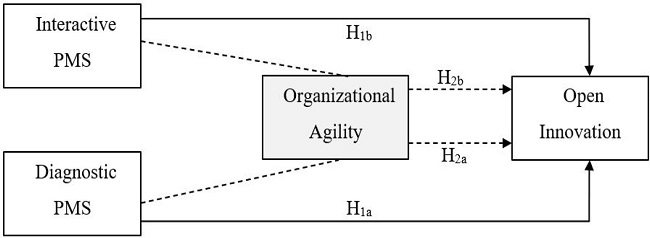
Figure 1
Research theoretical model
Source: Elaborated by the authors.
3 METHODOLOGY
3.1 Population and sample
This descriptive research was based on data collected through a questionnaire. The population consisted of managers of Brazilian companies from all sectors (except financial) listed on the country’s stock exchange Brasil, Bolsa, Balcão (B3). The listed companies were chosen because of their size since large organizations are more likely to adopt a formal performance measurement system (PMS) (Monteiro & Beuren, 2020; Anzilago et al., 2022). Also, these organizations usually disclose information about their managers (name and position, for example), facilitating the identification of these professionals on the social media platform LinkedIn. The proposed research model presents a series of complex interrelationships, which require a focus on different companies (from various sectors and market segments) to increase validity (Anzilago et al., 2022).
3.2 Elaboration of research instrument and data collection
The questionnaire consisted of 20 questions, including those about demographics (such as gender, age, and experience). The first block captured the construct “performance measurement system” (PMS) through nine questions, and the second captured organizational agility with six questions. The third block captured open innovation, presenting five questions.
Managers were approached through the social media platform LinkedIn. About 1,100 invitations were sent to Chief Executive Officers (CEOs), Chief Financial Officers (CFOs), managers, coordinators, and supervisors. For better control, an average of three invitations were sent per company until one of the managers accepted to participate. Thus, 105 complete responses were collected from november 2020 to may 2021. This response rate is comparable to previous studies that explored innovation in the literature on management control (Monteiro & Beuren, 2020; Mannes et al., 2021; Frare et al., 2021).
Regarding the sample characteristics, most respondents were male (102), with only three female respondents. Of the respondents, 48.5% were up to 40 years old, and 51.5% were over 40 years old. As for the level of education, 27 had an undergraduate degree, while most respondents, 60 managers, completed specialization programs at a graduate level, and 22 had master’s degrees (four of them had both a master’s and a specialization at a graduate level). As for the position, most respondents were general managers (44), followed by coordinators.
3.3 Measurement of variables and analysis procedures
The study variables comprise the Performance Measurement System (PMS), organizational agility, and open innovation. They were selected to increase understanding of how Brazilian companies implement control systems to foster agility and open innovation in an increasingly competitive environment.
Performance Measurement System: Construct composed of nine questions presented in two parts, based on Harlez and Malagueno (2016) and measured on a 5-point Likert scale (1 - not at all and 5 - great extent) to assess the respondents’ perception. The first part sought to assess diagnostic PMS, asking about the use of the system (i) to track progress, (ii) to monitor results, (iii) to compare results, and (iv) to review measures. The second part consisted of evaluating interactive PMS, asking about the use of the system (v) to define objectives and goals, (vi) to debate action plans, (vii) to signal areas for improvement, (viii) to challenge new ideas, and (iv) to engage in discussions.
Organizational agility: Construct with six questions based on Liao et al. (2019) measured on a 5-point Likert scale (1 - totally disagree and 5 - totally agree) to analyze the degree of agreement to the following items: (i) agility to increase or decrease production/service levels to support market demand, (ii) agility in alternative arrangements and internal adjustments when there is no supply, (iii) meet demands for fast and special response, (iv) agility to make and plan decisions in the face of market/customer changes, (v) seeking how to reinvent itself to serve the market better, and (vi) treats market changes and apparent chaos as opportunities for quick capitalization.
Open innovation: Construct composed of five questions based on Liao et al. (2019) measured on a 5-point Likert scale (1 - totally disagree and 5 - totally agree) to analyze the degree of agreement to the following items: (i) frequency of acquisition of external technological knowledge, (ii) regular search for external ideas that can add value, (iii) has a system for searching and acquiring technology and intellectual property, (iv) proactive outreach to third parties for better technological knowledge or products, (v) tendency to build stronger ties with external parties and trust their innovation.
Data analysis used structural equation modeling (SEM), following the data non-normal distribution and partial least square (PLS) estimation. This choice is justified due to the flexibility of SEM, allowing the use of small samples (Hair et al., 2017). In addition, SEM allows control of measurement error and facilitates the analysis of models with complex relationships that may involve indirect effects (Henri & Wouters, 2020).
4 RESULTS
4.1 Measurement model
The first phase evaluated and validated the variables’ reliability in order to carry out the SEM. Because the research sought to assess diagnostic and interactive PMS, organizational agility, and open innovation, the PLS algorithm was executed with 300 iterations and seven stopping criteria. Table 1 presents the result of the measurement model.
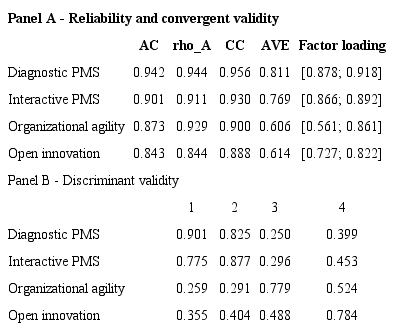
Table 1 shows that the reliability criterion of the constructs was met. The diagnostic PMS, for example, had the highest AC (0.942) and CC (0.956). The other constructs were also greater than 0.70, indicating the variables’ high consistency. Regarding convergent validity, the AVEs of the variables indicate that this criterion was met since they were greater than 0.50. The same occurred concerning the discriminant validity confirmed by the Fornell-Larcker and HTMT criteria, as proposed in the literature (Hair et al., 2017). As for collinearity, the constructs are adequate since the VIF was below the threshold of 5. Likewise, the non-response and common method biases are not a concern for the model since there was no significant difference between the first 10% of respondents and the last 10%, and the variance of the extraction of the first factor was less than 0.50.
4.2 Structural model
The structural model allows the research hypotheses to be tested through path analysis. As suggested in the literature, the bootstrapping technique was used with 5,000 resamples (Hair et al., 2017). The confidence interval also considered a significance level of 10% and the Bias-corrected and accelerated (Bca) method. Table 2 presents the relationships between the constructs.
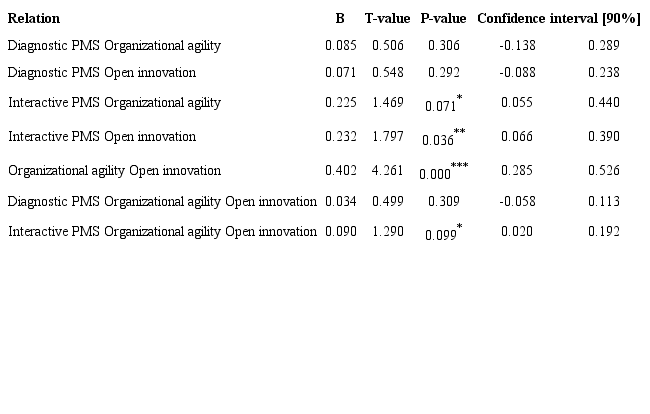
The results of the path analysis indicate that the diagnostic PMS does not positively influence open innovation (β = 0.071; p > 0.10), not supporting H1a. These results indicate that the rigid characteristics of PMS can limit open innovation. In H1b, the results were as expected since it was confirmed that interactive PMS positively influences open innovation (β = 0.232; p < 0.05). It was also observed that organizational agility leads to greater open innovation (β = 0.402; p < 0.01).
Regarding H2a, organizational agility does not mediate the relationship between diagnostic PMS and open innovation (β = 0.034; p > 0.10), unlike H2b, which confirmed the mediation of organizational agility in the relationship between interactive PMS and open innovation (β = 0.090; p < 0.10). This evidence points out that organizations that use interactive PMS are agile in responding to market changes and can foster open innovation because they presuppose constructive debates in the work environment.
5 DISCUSSION OF RESULTS
The first research hypothesis (H1a) - the diagnostic PMS positively influences open innovation - was not confirmed. When used alone, diagnostic PMS (which, according to Harlez and Malagueno (2016), monitors results and tracks progress on goals) may not lead directly to the sharing of technology/products or to building ties with stakeholders that foster mutual innovation (Liao et al., 2019). When monitoring the results, diagnostic control can lead to corrective actions or low productivity (Henri, 2006), which affects the organization’s ability to innovate. Furthermore, it can restrict the ability to meet goals (Simons, 1995), lead to a low level of involvement by senior managers, and insufficient attention to issues related to innovation (Bisbe & Otley, 2004). Therefore, open innovation was not achieved using this control. However, if used in a complementary way with other systems (e.g., interactive control), it can lead to the generation of internal and external ideas that benefit technological and product innovation (Bedford, 2020).
Hypothesis H1b proposed that interactive PMS influences open innovation, which was confirmed at a 5% significance level. The confirmation of H1b is consistent with the findings from Bedford (2015), showing that interactive control increases communication, facilitating the generation of creative ideas, which in turn leads to more significant innovation. Interactive control gives top managers access to emerging activity patterns, allowing them to select and invest resources in initiatives with the greatest potential to deliver competitive advantage (Simons, 1995), a precursor to open innovation. It is inferred that the presence of interactive control contributes to the success of open innovation since interactive control is essential to allow an emerging strategy that increases innovation (Widener, 2007). The confirmation of this hypothesis converges with Bisbe and Otley (2004), who concluded that the more interactive the use of control by superior managers, the greater the effect of product innovation and its performance. For Chenhall and Moers (2015), this interactive use helps to translate creativity into improved performance and effective innovations.
Hypothesis H2a, which suggested mediation of organizational agility in the relationship between diagnostic PMS and open innovation, was not confirmed. These results are in line with the existing consensus in the literature, in which the isolated use of diagnostic control limits product innovation (Lill et al., 2021) because it creates impulses that do not necessarily manage to generate tensions favorable to innovation (Curtis & Sweeney, 2021). Diagnostic control is designed to monitor progress toward predefined goals, so its operating mechanism requires little ability to search and retrieve relevant knowledge for organizational agility (Grabner et al., 2018), which is why the mediation was not confirmed.
H2b proposed the mediation of organizational agility in the relationship between interactive PMS and open innovation. This hypothesis was confirmed, corroborating studies that suggested that agility can impact open innovation by enriching and accelerating the development of new products to meet emerging market opportunities (Teece et al., 2016), and the use of control interaction reinforces the effect of product innovation on organizational performance (Bisbe & Otley, 2004). Henri and Wouters (2020) concluded that environmental unpredictability reinforces product innovation. It is inferred that open innovation is achieved because environmental unpredictability is one of the central factors of organizational agility (and interactive PMS is crucial for the constant debate of assumptions).
6 CONCLUSION
This study analyzed the influence of performance measurement systems (PMS) on organizational agility and open innovation. Data were collected from managers of Brazilian companies listed on the country’s stock exchange Brasil, Bolsa, Balcão (B3). We collected and analyzed 105 questionnaires using structural equation modeling (PLS-SEM).
This paper provides evidence on how interactive PMS positively influences open innovation and how this innovation can be reinforced by taking organizational agility into account. The results also reveal that a mechanistic PMS is less effective than more organic forms of control, which can be proven by the non-positive influence of the diagnostic use of PMS to generate open innovation. On the other hand, interactive PMS encourages knowledge, and its application stimulates organizational agility to detect and respond to necessary changes related to demand and competition, leading to open innovation.
Previous studies analyzed the relationship of management controls with different types of innovation, such as product innovation (Müller-Stewens et al., 2020) and process innovation (Guo et al., 2019). These studies contributed to the management literature as they reported that diagnostic and interactive controls facilitate process coordination and consequently product innovation (Müller-Stewens et al., 2020). Furthermore, they suggested that input controls facilitate process innovation in both high-tech and low-tech sectors (Guo et al., 2019). However, this research brings new evidence by treating the relationship between diagnostic and interactive PMS and open innovation in a segregated and individual way, advancing the literature on management control. Understanding open innovation is important because it benefits companies by allowing external technological knowledge to be absorbed and incorporated, new external ideas that add value to the organization to be imported, and adapting the system of intellectual property search and acquisition. The approach of organizational agility as a mediator of this relationship also becomes a differentiating factor. Thus, this study contributes by expanding the literature on PMS as an antecedent of open innovation. This research contributes by confirming that organizational agility mediates the relationship between interactive PMS and innovation, revealing its essential role for organizations.
The study results can have numerous practical implications by demonstrating that the impact of interactive PMS on open innovation has relevant positive effects. Greater interactive PMS is suggested to ensure that managers are more aware of recurring issues in the organization, willing to dialogue with each other and share new lessons learned. In this context of debate and interaction, more effective proposals for solutions begin to be presented, giving space to the ability to respond quickly to market and demand changes, generating creative ideas, and fostering innovation. This shows company managers that developing open innovation requires organizational environments with greater dialogue, employee participation, and flexible controls in the decision-making process. Allied to this is the ability to respond quickly to market threats and opportunities, with agile and fast solutions at the speed of change.
Some social contributions of the study can also be highlighted. This research encourages companies to implement innovative actions that involve the internal and external environment so that organizations become more competitive and increase the generation of income and jobs that contribute to social well-being. Innovation is a major driver of economic development and has become a key success factor in developing countries. It is recommended that companies invest in innovation activities to generate value for society as a whole, improving the quality of life.
Although the research followed scientific rigor, it is necessary to list some limitations. First, the study aimed to understand a specific type of management control, interactive and diagnostic PMS, in the context of large companies. Thus, generalizations must be cautious, as these relationships may differ depending on the organizational segment. Therefore, future studies may focus on a segment where innovation is a central business issue. On the other hand, one can test organizational agility as a moderating factor. Future studies may also assess other intervening variables in this relationship between PMS and open innovation (e.g., cognitive conflict). An increased understanding of the differences between open and closed innovation effectiveness seems to be an open research question. Additionally, the lack of control variables in the model is a limitation. Future studies may use information related to research and development projects and company size, among other variables, to control the effects of the control system on innovation.
REFERENCES
Anzilago, M., Gomez-Conde, J., & Lunkes, R. J. (2022). How do Managers use Management Control Systems in Response to Shareholder Activism? European Accounting Review. https://doi.org/10.1080/09638180.2022.2063152.
Anthony, R. N. (1965). Planning and control systems: a framework for analysis. Division of Research, Graduate School of Business Administration, Harvard University.
Bedford, D. S. (2015). Management control systems across different modes of innovation: Implications for firm performance. Management Accounting Research, 28, 12-30. https://doi.org/10.1016/j.mar.2015.04.003
Bedford, D. S., Bisbe, J., & Sweeney, B. (2019). Performance measurement systems as generators of cognitive conflict in ambidextrous firms. Accounting, Organizations and Society, 72, 21-37. https://doi.org/10.1016/j.aos.2018.05.010
Bedford, D. S. (2020). Conceptual and empirical issues in understanding management control combinations. Accounting, Organizations and Society, 86, 101187. https://doi.org/10.1016/j.aos.2020.101187
Bisbe, J., & Otley, D. (2004). The effects of the interactive use of management control systems on product innovation. Accounting, Organizations and Society, 29(8), 709-737. https://doi.org/10.1016/j.aos.2003.10.010.
Biswas, S. S. N., & Akroyd, C. (2022). Management control systems and the strategic management of innovation. Qualitative Research in Accounting & Management. https://doi.org/10.1108/QRAM-04-2021-0083
Breunig, K. J., Aas, T. H., & Hydle, K. M. (2014). Incentives and performance measures for open innovation practices. Measuring Business Excellence, 18(1), 45-54. https://doi.org/10.1108/MBE-10-2013-0049
Broadbent, J., & Laughlin, R. (2009). Performance management systems: A conceptual model. Management Accounting Research, 20(4), 283-295. https://doi.org/10.1016/j.mar.2009.07.004
Capon, N., Farley, J. U., Lehmann, D. R., & Hulbert, J. M. (1992). Profiles of product innovators among large US manufacturers. Management Science, 38(2), 157-169. https://doi.org/10.1287/mnsc.38.2.157
Chakravarty, A., Grewal, R., & Sambamurthy, V. (2013). Information technology competencies, organizational agility, and firm performance: Enabling and facilitating roles. Information Systems Research, 24(4), 976-997. https://doi.org/10.1287/isre.2013.0500
Chenhall, R. H., & Moers, F. (2015). The role of innovation in the evolution of management accounting and its integration into management control. Accounting, Organizations and Society, 47, 1-13. https://doi.org/10.1016/j.aos.2015.10.002
Chesbrough, H. W. (2003). Open innovation: The new imperative for creating and profiting from technology. Harvard Business Press.
Cockburn, I. M., & Griliches, Z. (1988). Industry effects and appropriability measures in the stock markets valuation of R&D and patents. American Economic Review, 78(2), 419-423.
Curtis, E., & Sweeney, B. (2017). Managing different types of innovation: mutually reinforcing management control systems and the generation of dynamic tension. Accounting and Business Research, 47(3), 313-343. https://doi.org/10.1080/00014788.2016.1255585
Ferreira, A., & Otley, D. (2009). The design and use of performance management systems: An extended framework for analysis. Management Accounting Research, 20(4), 263-282. https://doi.org/10.1016/j.mar.2009.07.003
Flamholtz, E. G., Das, T. K., & Tsui, A. S. (1985). Toward an integrative framework of organizational control. Accounting, Organizations and Society, 10(1), 35-50. https://doi.org/10.1016/0361-3682(85)90030-3
Frare, A. B., da Cruz, A. P. C., Lavarda, C. E. F., & Akroyd, C. (2021). Packages of management control systems, entrepreneurial orientation, and performance in Brazilian startups. Journal of Accounting & Organizational Change. https://doi.org/10.1108/JAOC-04-2021-0052
Gerdin, J. (2020). Management control as a system: Integrating and extending theorizing on MC complementarity and institutional logics. Management Accounting Research, 49, 100716. https://doi.org/10.1016/j.mar.2020.100716
Geroski, P. A. (1995). Market structure, corporate performance, and innovative activity. OUP Catalogue.
Gould, R. W. (2012). Open innovation and stakeholder engagement. Journal of Technology Management & Innovation, 7(3), 1-11. http://dx.doi.org/10.4067/S0718-27242012000300001
Grabner, I., Posch, A., & Wabnegg, M. (2018). Materializing innovation capability: A management control perspective. Journal of Management Accounting Research, 30(2), 163-185. https://doi.org/10.2308/jmar-52062
Grafton, J., Lillis, A. M., & Widener, S. K. (2010). The role of performance measurement and evaluation in building organizational capabilities and performance. Accounting, Organizations and Society, 35(7), 689-706. https://doi.org/10.1016/j.aos.2010.07.004
Hair Jr, J. F., Sarstedt, M., Ringle, C. M., & Gudergan, S. P. (2017). Advanced issues in partial least squares structural equation modeling. Sage publications.
Harlez, Y., & Malagueno, R. (2016). Examining the joint effects of strategic priorities, use of management control systems, and personal background on hospital performance. Management Accounting Research, 30, 2-17. https://doi.org/10.1016/j.mar.2015.07.001
Henri, J. F. (2006). Organizational culture and performance measurement systems. Accounting, Organizations and Society, 31(1), 77-103. https://doi.org/10.1016/j.aos.2004.10.003
Henri, J. F., & Wouters, M. (2020). Interdependence of management control practices for product innovation: The influence of environmental unpredictability. Accounting, Organizations and Society, 86, 101073. https://doi.org/10.1016/j.aos.2019.101073
Huang, H. C., Lai, M. C., Lin, L. H., & Chen, C. T. (2013). Overcoming organizational inertia to strengthen business model innovation: an open innovation perspective. Journal of Organizational Change Management, 26(6), 977-1002. https://doi.org/10.1108/JOCM-04-2012-0047
Liao, S., Liu, Z., & Ma, C. (2019). Direct and configurational paths of open innovation and organisational agility to business model innovation in SMEs. Technology Analysis & Strategic Management, 31(10), 1213-1228. https://doi.org/10.1080/09537325.2019.1601693
Lill, P., Wald, A., & Munck, J. C. (2021). In the field of tension between creativity and efficiency: a systematic literature review of management control systems for innovation activities. European Journal of Innovation Management, 24(3), 919-950. https://doi.org/10.1108/EJIM-11-2019-0329
Lu, P., Yuan, S., & Wu, J. (2017). The interaction effect between intra-organizational and inter-organizational control on the project performance of new product development in open innovation. International Journal of Project Management, 35(8), 1627-1638. https://doi.org/10.1016/j.ijproman.2017.09.009
Malmi, T., & Brown, D. A. (2008). Management control systems as a package - Opportunities, challenges and research directions. Management Accounting Research, 19(4), 287-300. https://doi.org/10.1016/j.mar.2008.09.003
Merchant, K. A., & Otley, D. T. (2007). A review of the literature on control and accountability. Handbooks of Management Accounting Research, 2, 785-802. https://doi.org/10.1016/S1751-3243(06)02013-X
Mannes, S., & Beuren, I. M. (2021). Influência da capacidade de rede e do compartilhamento de informações e de conhecimento na inovação aberta. Advances in Scientific and Applied Accounting, 14(2), 164-178/179. https://doi.org/10.14392/asaa.2021140207
Mannes, S., Frare, A. B., & Beuren, I. M. (2021). Efeitos do uso dos orçamentos estático e flexível na inovação de processos e produtos. Revista de Contabilidade e Organizações, 15, e180829-e180829. https://doi.org/10.11606/issn.1982-6486.rco.2021.180829
Mikalef, P., & Pateli, A. (2017). Information technology-enabled dynamic capabilities and their indirect effect on competitive performance: Findings from PLS-SEM and fsQCA. Journal of Business Research, 70, 1-16. https://doi.org/10.1016/j.jbusres.2016.09.004
Moerloose, C. (2000). Turning innovation into success. European Business Forum, 1, 29-35.
Monteiro, J. J., & Beuren, I. M. (2020). Efeitos do debate do sistema de mensuração de desempenho e do conflito cognitivo na inovação ambidestra. Revista de Contabilidade e Organizações, 14. https://doi.org/10.11606/issn.1982-6486.rco.2020.170418
Moulang, C. (2015). Performance measurement system use in generating psychological empowerment and individual creativity. Accounting & Finance. 55(2), 519-544, 2015. https://doi.org/10.1111/acfi.12059
O’Sullivan, D., & Dooley, L. (2009). Applying Innovation. Sage Publications Inc., Thousand Oaks.
Pfister, J. A., Jack, S. L., & Darwin, S. N. (2017). Strategizing open innovation: How middle managers work with performance indicators. Scandinavian Journal of Management, 33(3), 139-150. https://doi.org/10.1016/j.scaman.2017.06.001
Simons, R. (1987). Accounting control systems and business strategy: An empirical analysis. Accounting, Organizations and Society, (12)4, 357-374. https://doi.org/10.1016/0361-3682(87)90024-9
Simons, R. (1990). The role of management control systems in creating competitive advantage: New perspectives. Accounting, Organizations and Society, 15(1-2), 127-143. https://doi.org/10.1016/0361-3682(90)90018-P
Simons, R. (1991). Strategic orientation and top management attention to control systems. Strategic Management Journal, 12(1), 49-62. https://doi.org/10.1002/smj.4250120105
Simons, R. (1995). Levers of control: How managers use innovative control systems to drive strategic renewal. Boston: Harvard Business School Press.
Simons, R. (2000). Performance measurement and control systems for implementing strategy. Upper Saddle River: Prentice Hall.
Teece, D., Peteraf, M., & Leih, S. (2016). Dynamic capabilities and organizational agility: Risk, uncertainty, and strategy in the innovation economy. California Management Review, 58(4), 13-35. http://dx.doi.org/10.1525/cmr.2016.58.4.13
Trinh-Phuong, T., Molla, A., & Peszynski, K. (2010). Enterprise systems and organisational agility: Conceptualizing the link. 21st Australasian Conference on Information Systems.
Widener, S. K. (2007). An empirical analysis of the levers of control framework. Accounting, Organizations and Society, 32(7-8), 757-788. https://doi.org/10.1016/j.aos.2007.01.001
Author notes
This research offers elements to help managers to implement a performance measurement system supporting innovation in their organizations. It raises awareness among managers regarding their capacity to be agile when coping with the constant changes in the market.
Corresponding author: Tel. + 55 (48) 3721-9381, E-mail: evebruggemann@gmail.com (E. R. Brüggemann); januariomonteiromonteiro@gmail.com (J. J. Monteiro); rogeriolunkes@hotmail.com (R. J. Lunkes);, Universidade Federal de Santa Catarina. R. Delfino Conti - Florianópolis/SC - 88040-900, Brazil.