Reflections and trends
1 INTRODUCTION
Science, and consequently scientific research, coexist, although currently to a much lesser extent, with dichotomies that affect their development: conventional and non-conventional epistemologies; normative research and positive research; theoretical approach and empirical approach; and quantitative approach and qualitative approach. Some discussions within the scope of scientific methodology, although nowadays quite moderated, treat distinct concepts as if they were mutually exclusive.
With regard to quantitative and qualitative approaches, the tendency has been towards an understanding that, developed in interdependent studies, they are complementary (Denzin & Lincoln, 2017; Flick, 2009). That is, there is an understanding that there is a significant gain for science when adding results from different studies using one or the other assessment, extracting the virtues of each of them.
In this essay, in addition to the discussion on the use of one or another form of assessment in interrelated research, the debate evolves to the reflection on the integration of qualitative and quantitative approaches in a single study. This is what has been addressed with the predominant term ‘mixed methods research’, also referred to with other less prevalent terms, such as ‘convergent methodology’, ‘combined research’, ‘integrative research’, ‘mixed research’, etc. (Grafton et al., 2011).
There are several arguments aimed at supporting the use of mixed methods. Some of the main ones are based on the idea of the increasing complexity of phenomena and the fact that quantitative and qualitative approaches have their strengths and weaknesses. The use of both can lead to their strengths being added and their weaknesses being minimized, contributing to investigations through which a better perception of the object analyzed can be sought (Denzin & Lincoln, 2017; Grafton et al., 2011; Yin, 2006).
Numerous benefits of using mixed methods have been highlighted, such as extending discoveries beyond those reached using a single approach, the possibility of identifying empirical contradictions, and seeking convergence of results obtained from different research approaches (Denzin & Lincoln, 2017; Leech & Onwuegbuzie, 2009; Yin, 2006).
The use of mixed methods lends itself to both triangulation and complementarity of results. That is, it allows for triangulation or cross-validation of results, so that qualitative results reinforce quantitative results or vice versa. And the use of research can also aim at complementarity, so that different aspects of a question can be answered through one approach or another (Greene, 2008; Yin, 2006).
In the social sciences, mixed methods have been used in research for a long time. Similarly, management literature has several studies dealing with the application of these methods and even methodological articles on strategy (Creswell & Clark, 2015; Denzin & Lincoln, 2017). In accounting studies however, there is still little application in investigations. In Brazil there are few studies that employ these approaches and highlight their use, with the awareness of the complexity of the integration process, as attested in a survey carried out in the following topic.
In view of this, this essay aims to contribute to the theme, addressing issues related to mixed methods, in order to stimulate their use by accounting researchers, and even from other areas. It does so through some initiatives, such as: discusses what are and what are not mixed methods; it is inserted in the question of the compatibility of integrating approaches in view of their epistemological bases; selects and discusses mixed method strategies classification; conducts a survey of national scientific articles in accounting that indicate the use of integration; indicates potential uses of these strategies in future research in the area; and points to methodological care to be adopted in the integration of approaches.
2 WHAT ARE AND WHAT ARE NOT MIXED METHODS
The quantitative evaluation concerns the focus of scientific research that uses data collection and analysis with numerical measurement, with emphasis on the measurement of the phenomenon. It originates from the works of Auguste Comte (1798-1857) and Émile Durkheim (1858-1917) and presupposes the study of social phenomena with the same scientific method of natural sciences, considering that things or phenomena can be measured (Sampieri et al., 2010). The quantitative approach, by its characteristics, emphasizes the scope, and aims at the statistical generalization of the results. For this reason, it tends to treat phenomena superficially without deepening their understanding.
Qualitative assessment, in turn, is the focus of scientific research that uses data collection and analysis without numerical measurement, with an emphasis on understanding the phenomenon. It originates from the work of Max Weber (1864-1920), conceiving that studies must consider the meanings and the understanding of the context. With the qualitative emphasis, the terms ‘understanding’ and ‘comprehension’ are introduced. (Sampieri et al., 2010). As the qualitative approach prioritizes the in-depth study of the meanings of the phenomenon, it has a limited power of generalization, at least regarding statistical generalization, as there are other logics of generalization.
The idea of interdependent studies with the use of either approach, enjoying the strengths of each of the methodologies to add their results, is very logical and has been developed in greater or lesser proportion in various areas of knowledge. A greater challenge has been faced when seeking to employ both approaches in the same study (Denzin & Lincoln, 2017; Morgan, 2007; Yin, 2006).
Considering that 'concept' is a term that refers to the conception of an object from the point of view external to it, there are logically the concepts found on mixed methods, depending on the different worldviews. The term 'definition' corresponds to the intrinsic conception of an object and must express it through the minimum elements that characterize it. Reflecting in terms of a definition of mixed methods, we understand that it must simultaneously contain the terms: “integration”, “unique study”, “quantitative approach”, and “qualitative approach”. That is, a definition of mixed methods could be stated as: 'Integration, in a single study, of the quantitative approach and the qualitative research approach'.
In an essay that discusses the potentialities of integrated use of quantitative and qualitative approaches, it is important to comment on doubts that may arise in the classification of studies, leading to inadequacies in their development and, therefore, can affect their quality. One of these confusions falls on considering as a qualitative approach all that is not a quantitative approach. Thus, it is not suitable, for example, to classify bibliographic studies as qualitative. Bibliographic studies do not include data analysis. And it is the nature of the analysis that makes the study quantitative or qualitative. As a result, it cannot be considered that mixed methods are used in quantitative studies, considering the bibliographic review as the qualitative emphasis of this research.
In this same context, it is important to reiterate the differentiation between bibliographic studies and documentary studies. Both use bibliographic materials, but with different purposes. Bibliographic studies resort to sources such as books, scientific articles, etc., seeking in them what was written on a particular theme, citing them, aiming at theoretical support. In turn, documentary studies extract data from bibliographic materials and use them in their empirical analyzes. As examples of documentary studies, bibliometric studies have as their object bibliographic materials such as journal articles, for example, extracting data for analysis. The treatment that is used for the data characterizes it as quantitative, whether the claim is to measure characteristics of publications, or qualitative, whether the purpose is to deepen in the analysis of its contents.
Another incorrectness that is usually perceived is to associate research strategies with only one type of evaluation: quantitative or qualitative. Admittedly, studies that use experimental research strategy are eminently quantitative. But the survey research strategy, for example, can understand quantitative assessment using closed questions, or qualitative assessment, through interviews with open question forms. The case study research strategy, due to its peculiarities, can arouse further classification doubts. You can tend to associate it only with qualitative research. But the fact is that quantitative case studies can also be developed when the purpose of the study is measured.
It also causes doubt, which leads to incorrect classifications, considering that discussions that are developed in the analysis of quantitative measurement results are qualitative in nature, classifying the studies thus developed as quanti-quali. The fact is that if the emphasis of the study is in the measurement, which makes it quantitative, it is not the discussion of the results found that will add to it a qualitative aspect. Results do not speak for themselves and discussions about them are necessary and related to the approach itself.
Likewise, it is not correct to consider as quali-quanti a study that, employing the qualitative approach, uses numerical data. Including numerical data does not make a quantitative research, particularly if this data did not result from measurements developed in the study. In employing the qualitative approach, in the effort to seek understanding and meaning of phenomena, one can use numbers to seek to support their arguments.
3 DIVERGENCES REGARDING THE COMPATIBILITY OF APPROACHES
Two dominant and contrary versions differ in the possibility of integrating quantitative and qualitative approaches into single study: vision of incompatibility and pragmatic vision (Graftton et al., 2011; Small, 2011).
The arguments of those who advocate the conception of incompatibility are based on the idea that quantitative and qualitative methodologies are based on different epistemological assumptions that, because they rival each other, are in this reasoning therefore, non-compatible (Sale et al., 2002). Therefore, within the scope of this line of thought, the use of mixed methods is not permitted.
Defenders of the second conception, pragmatics, emphasize the opportunities for convergence - as previously highlighted - and secondary the importance of the epistemological bases that guide the research (Johnson & Onwuegbuzie, 2004). Scott and Briggs (2009, p, p. 231) argue in this sense, that mixed method researchers favor their research logic and not epistemologies, even stating that “methodology is, in practice, usually agnostic in relation to epistemology”.
The importance of epistemological conceptions cannot be disregarded: different ways of conceiving reality originate different ways of approaching it. On this issue one can consider, among several classifications found, a taxonomy that subdivides epistemologies into three main strands: positivists/empiricists, phenomenological, and critical-dialectic. By correlating these epistemologies with both types of approaches, one has that positivist/empiricist epistemologies privilege the quantitative approach; the phenomenological, the qualitative approach; and the critical-dialectic reconciles both approaches (Martins & Theóphilo, 2014).
Looking from this perspective, considering that the critical-dialectic approach already considers the coexistence of quanti and quali evaluations, the issue would be, in our understanding, in the other two epistemological approaches. The conceptions called positivists/empiricists, based on quantitative evaluations, are associated with the origin of scientific thinking and have remained exclusive conceptions for a long time. The phenomenological approach warns of the conception of the non-possibility of investigating certain phenomena with the same epistemological logic of conventional approaches. This approach fits the logic of qualitative assessment.
What is noted is that while epistemological approaches do not coexist on their different foundations and assumptions, some researchers oriented by these, even divergent conceptions, have admitted the integration of quantitative and qualitative assessments in the same study. Perhaps the question would not be that the methodologies were 'agnostic' regarding epistemologies, as in the speech of Scott and Briggs. What seems to us is that the issue is in researchers to consider that integration brings gains for the intended investigation. Thus, in our understanding, a researcher founded on positivist logic, quantitative in nature, uses qualitative research to deepen the findings of their research, but does it as a researcher who conceives reality from a positivist and non- phenomenological perspective. Similarly, a researcher guided by phenomenological epistemological logic adds quantitative assessment to their predominantly qualitative research, but under a phenomenological perception of reality.
4 ALTERNATIVES OF MIXED METHOD STRATEGIES
An issue that arises for those who envision the use of mixed methods in their studies concern the alternatives of strategies that can be employed, whose choices are related, primarily to: if the collection of quantitative and qualitative data will be concomitant or sequential; if in data analysis one approach will be prioritized in relation to the other or both will have the same emphasis (Creswell, 2010; Hanson, 2005; Tashakkori & Teddlie, 2003; Yin, 2006).
Mixed method strategies are often described through a notation that has abbreviated labels and symbols, representing a way in which researchers communicate their procedures. The following notation is based on Creswell (2010) which, in turn, is reported to be a model adapted from studies developed by other scholars, including previous studies:
-
‘Quan’ and ‘Qual’ represent quantitative and qualitative respectively.
-
Use of upper case (capital letters) indicates a weight or priority, an emphasis of the quantitative or qualitative approach in the study.
-
The symbol ‘—»’ indicates a sequential form of data collection, with one form (quantitative data or qualitative data) built on the other (qualitative data or quantitative data).
-
The symbol '+' indicates a simultaneous or concomitant form of quantitative and qualitative data collection.
Six types of main strategies are listed, resulting from the combinations of these perspectives: three sequential strategies, i.e., in which one approach is followed by the other; and three concomitant strategies, in which, as the name implies, approaches are employed at the same time. Sequential approaches by nature are: explicative or explanatory, exploratory, and transformative. Concomitant strategies are: triangulation, incorporated, and transformative. Figures 1 to 6, which represent these strategies, are adapted from Creswell (2010).
4.1 Sequential research strategies
The explanatory sequential strategy1 is so named because the data is collected and analyzed at different stages of the research and the greater emphasis is on the quantitative approach. It assumes that first, the collection and analysis of quantitative data as the main approach, followed by the collection and analysis of qualitative data. The combination of the data is found when the initial results guide data collection in the secondary phase. The qualitative approach stems from the interest in explaining and interpreting quantitative data (Figure 1).
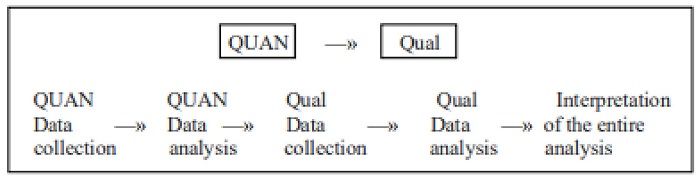
Figure 1
Explanatory sequential strategy
Exploratory sequential strategy, in contrast, is so-called in consonance with the greater emphasis on qualitative approach, affecting investigations conducted with the purpose of seeking understanding and meaning of phenomena. The steps are reversed compared to the explanatory sequential strategy: the first step is of qualitative data collection and analysis, followed by collection and analysis of quantitative data. Quantitative results aim to assist in the interpretation of previously collected qualitative data (Figure 2).
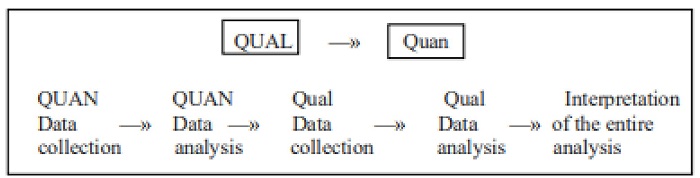
Figure 2
Exploratory sequential strategy
The transformative sequential strategy, as in the previously discussed strategies, is developed in two phases. The difference is that the emphasis is given to the theoretical lens, and the qualitative and quantitative procedures may come in one sequence, as they best serve the adopted theoretical perspective (Figure 3).

Figure 3
Transformative sequential strategy
But it is admitted in the literature that there is still little written material and little guidance to guide studies under this approach.
4.2 Concomitant research strategies
The concomitant strategy of triangulation is the most familiar among mixed models. Quantitative and qualitative data, collected at the same phase of the research, are compared to verify if there is convergence between them. Hence triangulation terminology, which refers, under these circumstances, to the use of multiple research methods, which are crossed to ensure the deeper understanding of the investigated phenomenon. Ideally, the same weight is attributed to quantitative and qualitative approaches, but may occur from one or the other priority. Triangulation is developed in discussions of the results, when databases are compared with each other (Figure 4).
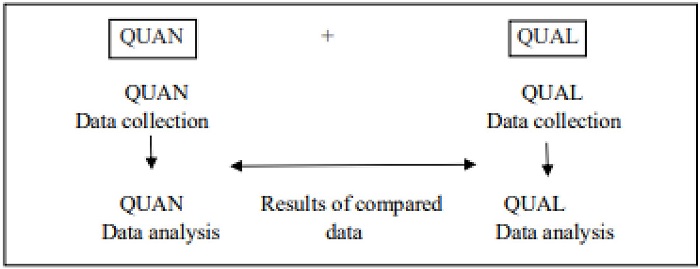
Figure 4
Concomitant strategy of triangulation
The incorporated concomitant strategy also presupposes collection and analysis of qualitative and quantitative data simultaneously, but with the peculiarity that either approach is defined as the main. The secondary approach will be incorporated or housed in the predominant approach. The combination of approaches promotes integration. Data obtained according to different approaches can be compared, but may also not be used for comparison but to make a compound assessment of the problem (Figure 5).
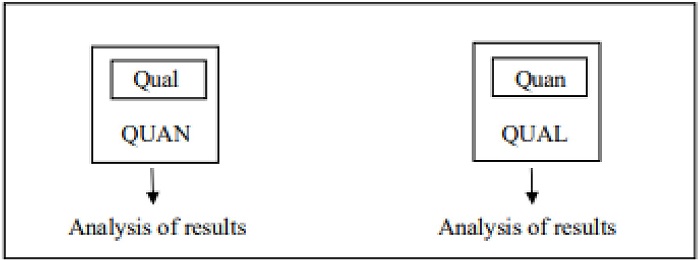
Figure 5
Incorporated concomitant strategy
As with the transformative sequential approach, the concomitant transformative approach is guided by a theoretical perspective, differing from the former of course, because the data is collected simultaneously. The theoretical or conceptual structure is that it guides and sustains the development of the study, including serving the definition of its methodological perspective (Figure 6).
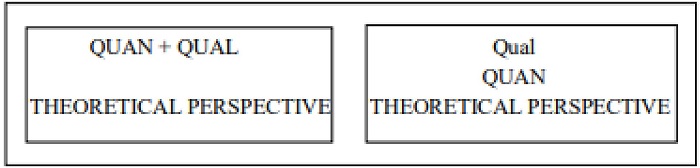
Figure 6
Concomitant transformative strategy
Other classifications are proposed in the literature, but the most important thing is to have a configuration as a guide, which certainly facilitates the efforts of researchers interested in the use of mixed methods in their studies.
5 EXAMPLES OF APPLICATION OF MIXED METHODS IN ACCOUNTING RESEARCH
To illustrate with examples the discussion of mixed methods, in order to encourage their use in research, particularly in accounting, a survey was conducted in the CAPES Periodicals Portal. The descriptors ‘methods’, 'mixed', and 'accounting' in the first, second, and third fields of research simultaneously; date of publication (any year); material type (articles); research database (collections: SciELO Brasil and DOAJ); and only articles revised by peers were used.
The research returned 19 articles. Their contents were analyzed and we found that only four of them effectively proposed the use of mixed methods2. None of them discussed, as is the proposal of this essay, the application of mixed methods in accounting research, which reinforces the unprecedentedness of this manuscript in terms of national literature. Similarly, the fact that few studies have been found that applied mixed methods in their investigations reiterates the perception of the incipient stage of their use in research in the area. Of course, it is possible to have one or another study that may have used integrated approaches, but because they do not contain the terms used as descriptors in search parameters employed in this research, they were not identified.
The articles that were excluded in the analysis contained the terms employed in the research, but did not refer to the application of mixed methods. The term referred to, for example, the (mixed) questionnaire, interview (mixed), economy company (mixed ownership); or it was some misconception in the classification of the study, as in a situation in which it was intended to classify as mixed methods the joint use of bibliographic research and questionnaires. Of course, as reiterated here, bibliographic research cannot be classified as qualitative research.
Example 1
Social support and stress at work: an analysis with mixed methods3 Vânia Lúcia Pereira de Andrade, Amalia Raquel Pérez-Nebra
The objective of the research, as stated by the authors, was to investigate how social support contributes to people dealing with stressful situations in the workplace. Quantitative evaluation described the degree of satisfaction with social support and organizational support, using a scale that summarized organizational support perception factors. Qualitative assessment aimed to describe stressors, sources, and types of social support perceived in the workplace. The questionnaire and interview were answered in a single meeting. In the conclusions, the use of mixed methods and the advantages they would have provided for the study was emphasized. According to the authors, for the purpose of analyzing objective and subjective information, the use of mixed methods seemed adequate, and it was possible to better understand the use of social support strategy, which appeared as a protective factor against stress in the workplace.
Considering Creswell's taxonomy, previously discussed, the study is classified as an incorporated concomitant strategy, as the data were collected simultaneously and was given more emphasis on the quantitative approach, with the qualitative approach of secondary importance.
Example 2
Potential antecedents of the adoption of business analytics in accounting4 Leticia Silva Araujo, Ariel Behr, Fernanda da Silva Momo
The objective of the authors was to analyze which factors precede the intention to adopt business analytics in accounting, according to professionals working in the area. They classified the design of mixed methods adopted as a (explanatory) sequential strategy, since the quantitative study was performed first and the results of this step served as an input for the qualitative part. The authors indicated that the research was operationalized through a survey and semi-structured interviews. The authors justified the choice of this strategy as a way to use qualitative results to assist in explaining and analyzing quantitative results. They indicated that while there are several researches on business analytics adoption using the model's theoretical lens, there are few empirical studies about its adoption in the accounting context. Therefore the authors understood that this sequence could offer additional insights based on context-specific results.
The taxonomy defined by the authors is the same as adopted in this essay. The explanatory sequential strategy presupposes data collection in two steps, with qualitative data the purpose of interpreting and explaining quantitative data, which has greater emphasis.
Example 3
Effects of informal controls and psychological empowerment on job satisfaction5
Ana Paula Capuano da Cruz, Anderson Betti Frare, Monique Couto Accadrolli, Vagner Horz
The objective was to investigate the effects of informal controls on psychological empowerment and job satisfaction. According to the authors, the study adds new evidence of informal controls in organizations by exploring the intervening role of psychological empowerment and the effects on job satisfaction. A survey was applied with directors and business unit managers from one of the largest cooperative credit systems in Brazil. Data were analyzed with a mixed method approach: structural equations modeling by minimum partial squares and fuzzy-set qualitative comparative analysis. The use of mixed methods is highlighted by the authors, who point for the study to provide a methodological contribution to national management research by adding this type of methodological approach.
By the approach reported by the authors, in the taxonomy adopted in this essay, the employed design would be classified as an incorporated concomitant strategy, and the quantitative approach as the main and the qualitative as secondary.
Example 4
Economic and financial impacts of the Covid-19 pandemic in the B3 higher education sector6 Annor da Silva Junior, Vitor Correa da Silva, Priscilla de Oliveira Martins-Silva
The authors indicate that the article aimed to analyze the preliminary economic and financial impacts of the Covid-19 pandemic on higher education companies, listed in the Brazilian capital market. To perform the analysis, a set of economic and financial indicators was selected. The authors were dedicated to justifying and explaining the adoption of mixed methods, highlighting the articulation of quantitative and qualitative approaches, with the predominance of the former. In the quantitative analysis, the company's economic and financial indicators were compared at different periods over time. Qualitative analysis was developed from the content analysis technique of accounting reports. In the final considerations, there is no mention of having used mixed methods, nor is the effect of their application on the results.
From the authors' report, it appears that considering the taxonomy adopted in this essay, there is an incorporated concomitant strategy, since data collection is simultaneous and there is a main approach, in this case the quantitative; this main approach is incorporated or accepted by the qualitative approach.
6 POSSIBILITIES FOR RESEARCH WITH THE USE OF MIXED METHODS
In the previous section, the different designs of mixed methods, as adapted by Creswell (2010) was explained, discussing and illustrating their logics. In this section the purpose is to glimpse possibilities for employment of these strategies, including through examples focused on accounting research, but also extending, by analogy, to other areas of research.
6.1 Explanatory sequential research strategy
As previously explained, the explanatory sequential research strategy consists of an investigation of mixed methods with an emphasis on the quantitative approach, which includes the collection in sequence of quantitative and qualitative data. The literature points to the employment opportunity of this strategy when you want to deepen the knowledge about the results obtained quantitatively or even when unexpected results of quantitative analysis appear (Creswell, 2010).
Here we reflect on studies of this nature with the potential to be developed in accounting, among others:
-
Survey Research Strategy: Quantitative data collection through closed question questionnaires, followed by qualitative data collection with interview employment, with the all respondents or a sample of them. For example, a quantitative research with accounting professionals, office owners, who are questioned about their perception about the growth of the participation of virtual accounting enterprises. Qualitative research could specifically include online office owners, aiming to deepen knowledge about the peculiarities of these businesses.
-
Document research strategy, with emphasis on the quantitative phase, followed by qualitative analysis, with the purpose of deepening understanding.
For example, a bibliometric study, with quantitative data analysis, through the use of bibliometric laws, followed by qualitative analysis aiming to deepen the understanding of the topics dealt with in the selected scientific works, using the content analysis technique.
-
Case study research strategy with quantitative emphasis and detail of analysis through qualitative approach.
As an example, a case study with quantitative emphasis on a company's budget, complemented with qualitative analysis developed on information gathered in interviews with professionals responsible for the budget process.
6.2 Exploratory sequential research strategy
As discussed previously, this type of strategy is given greater emphasis on the qualitative approach, complemented by the quantitative approach. The literature points out that the strategy has the potential to be used in situations such as: quantitative tests of an emerging theory from the qualitative phase; or when a researcher intends to develop a data collection instrument, in the absence of one that is suitable for their research, and then apply it (Creswell, 2010).
Given these indications, we reflect on any situations of application in accounting research:
-
Qualitative survey research by nature, using interviews, aimed at developing a data collection instrument; followed by a quantitative phase with the application of this instrument to a sample of respondents through questionnaires.
For example, with controllers as respondents, a survey that addresses the challenges of these professionals' work within organizations, with the data collection instrument being developed in the qualitative phase of the research and its application carried out using a quantitative approach.
-
Qualitative documentary research followed by secondary quantitative analysis.
For example, a study that develops a qualitative content analysis on a sample of management reports and complements this analysis with measurements of excerpts of texts found repeatedly in these reports.
-
Case study, through which a theory (grounded theory) is developed, based on an emerging theory and a process of selective collection and categorization of data. This theory would be tested through measurements in the subsequent quantitative documentary phase.
For example, as in an accounting survey, which develops an emerging theory on society's perception of the profile of the accounting professional. Once this theory has been developed, a quantitative study would be carried out to test it through measurements.
6.3 Triangulation concomitant research strategy
As discussed above, the triangulation concomitant research strategy consists of collecting and analyzing data simultaneously. The purposes of this strategy, as reported in the literature, are to compare the two databases, analyzing their convergences and divergences. Theoretically, the same emphasis is given to both approaches, although in practice one or the other may be prioritized.
Some situations in which this strategy can be used are:
-
· Survey research in which quantitative and qualitative data are simultaneously collected from a sample of the same population and then these data are compared. For example, a study with Accounting students on how they manage their personal finances. Data would be collected at the same time through responses to questionnaires with closed questions and data from an interview form composed of open questions. These data would then be compared, seeking convergences, divergences, and combinations of data through triangulation.
-
· Documentary research with simultaneous collection of quantitative and qualitative data, aiming at their triangulation.
For example, in a study that aimed to compare earnings releases published by companies and the economic and financial situation revealed in their financial statements. At the same time, that is, in the same phase of the research, quantitative data would be collected with a view to measuring economic and financial indicators and qualitative data from the published releases.
6.4 Incorporated concomitant research strategy
In the incorporated concomitant research strategy, data collection is carried out simultaneously, that is, in the same phase of the study, with one of the approaches, quantitative or qualitative, having greater importance than the other, which assumes a secondary character. According to the literature, this strategy can serve several purposes, such as: when a researcher decides to use different methods to study different groups, for example, managers and employees of a company; or in the case of using a method within the framework of another method, for example in an experiment, using a case study to observe the study participants (Creswell, 2010).
Some situations in which we can visualize the use of this strategy:
-
Survey research, with a quantitative emphasis, with questionnaires and interviews applied in the same phase of the study.
For example, a study that contemplates the opinion of accountants on aspects of tax legislation. The questionnaire would be aimed at accountants in general and the interviews would be applied, in a complementary manner, to accountants who own large accounting firms. In this way, the research would aim to capture different perspectives of data obtained through the two approaches, in their different conceptions, applied to different groups.
-
Main quantitative documentary research, combined with secondary qualitative survey research, with data collection occurring in the same phase of the study.
For example, in a research in which the main purpose was to analyze the influence of certain accounting information on the behavior of stock prices in the market. In this phase of the research, documentary data with quantitative analysis would be used. Interviews would be collected in the same phase of the study, with stock exchange operators, about the importance given to this information in their analyses.
The examples do not cover transformative approaches, on which as mentioned above, the literature lacks guidance.
7 PRECAUTIONS IN THE USE OF MIXED METHODS
Based on methodological assumptions applicable to various research projects, but with a specific focus on investigations that employ mixed methods, we understand that the development of research of this nature must take some care in its design and conduct, in order to achieve the desired purposes:
-
State objectives that refer specifically to the empirical analyses of each of the approaches - quantitative and qualitative -, in order to guide the methodologies to be employed.
-
Select the mixed methods research strategy to be employed, defining whether a sequential or concomitant strategy will be employed, and opting for one of its subclassifications, depending on whether or not you intend to give more emphasis to one of the approaches.
-
Highlight the option to employ mixed methods, detailing the justification for such choice and pointing out the possible potential gains expected with the integration of the approaches.
-
Organize the data analysis in a manner consistent with the type of strategy chosen, sequential or concomitant, and its variations, seeking to best express the results obtained in the study, valuing the use of both approaches and ensuring that the integration takes place in the most appropriate way possible.
-
In the final considerations, when presenting the summary of the results, indicate whether the use of mixed methods effectively contributed or not to the intended objectives, highlighting, if so, the advantages obtained with the integration of the quantitative and qualitative approaches or, if not, the possible reasons for not obtaining the expected gains.
8 FINAL CONSIDERATIONS
Reality is complex and its knowledge does not seem to be fully attainable. Nevertheless, researchers seek in their research efforts as much as possible, to approximate this ideal of broad understanding, using the most diverse resources, revealing different aspects of real-world phenomena.
In a contemporary view, quantitative and qualitative approaches have been conceived as complementary, under the understanding that as they have different emphases, their integration brings relevant opportunities for expanding knowledge of phenomena. The understanding is that the scope provided by quantitative studies should be combined with the depth of qualitative studies, with important potential gains for the effort to understand phenomena.
The discussion on the different designs of research using quantitative methods revealed a range of research possibilities that allow for the use of qualitative and quantitative approaches, either sequentially or concomitantly, with one or the other aspect having greater emphasis, or even reconciling them, without one overriding the other in importance.
Research in Accounting Sciences has a relatively recent scientific development, even when compared to other areas of applied social sciences. In Brazil, empirical development dates back to the beginning of the 20th century, as attested in our doctoral thesis (Theóphilo, 2004), summarized in Theóphilo and Iudícibus (2005). The recent empirical development encourages the use of different research instruments, as in the case of the methods discussed in this essay.
There are some in-depth discussions on mixed methods, such as among others, the details on the integration of approaches in the research process and the issue regarding the aspects of validity and reliability of studies that employ these designs. However, we chose to discuss what we consider to be the most fundamental in a first approach to the subject, considering the length of an article.
We hope that this essay fulfills the purpose of awakening researchers in the area, and even in related areas, to the potential of studies that apply the integration of quantitative and qualitative approaches. May this manuscript be a reference to motivate and even an initial guide to develop mixed methods studies. And may these future studies point to the expansion of the possibilities of the strategies discussed and provide an opportunity for in-depth discussions on the topic.
REFERENCES
Creswell, J. W. C. (2009). Research design: Qualitative, quantitative, and mixed methods approaches. (3. ed.). Los Angeles: Sage.
Creswell, J. W.; Clark, V. L. P. (2015). Mixed methods search: Research methods series. London: Publishing Think.
Denzin, N. K. & Lincoln Y. S. (2017). The sage handbook of qualitative research. (5. ed.). London: Sage.
Flick, Uwe (2009). An introduction to qualitative research. (4. ed.). London: Sage.
Grafton, J., Lillis, A. M., & Mahama, H. (2011). Mixed methods research in accounting. Qualitative Research in Accounting and Management, 8(1), 5-21. https://doi.org/10.1108/11766091111124676
Greene, J.C. (2008). Is mixed methods social inquiry a distinctive methodology. Journal of Mixed Methods Research, 2(1), 7-22. https://doi.org/10.1177/1558689807309969
Hanson, W. E. et al. (2005). Mixed methods research designs in counseling psychology. Journal of Counseling Psychology, 52 (2), 224.
Johnson, R.B. & Onwuegbuzie, A.J. (2004) Mixed methods research a research paradigm whose time has come. Educational Researcher, 33 (7), 14-26.
Leech, N. L., & Onwuegbuzie, A. J. (2009). A typology of mixed methods research designs. Quality & Quantity, 43 (2), 265-275.
Martins, G. A., & Theóphilo, C. R. (2016). Metodologia da investigação científica para ciências sociais aplicadas. (3. ed.). São Paulo: Atlas.
Morgan, D. (2007). Paradigms Lost and Pragmatism Regained, Methodological Implications of Combining Qualitative and Quantitative Methods. Journal of Mixed Methods Research January, 1(1), 48-76.
Sale, J., Lohfeld, L. and Brazil, K. (2002). Revisiting the qualitative-quantitative debate: implications for mixed methods research. Quality & Quantity. 36(1), 43-53.
Sampieri, R. H., Collado, C. F., & Lucio, M. P. B. (2010). Metodología de la investigación. (5. ed.). México D.F.: McGraw-Hill.
Scott, P.J. & Briggs, J.S. (2009). A pragmatists argument for mixed methodology in medical informatics. Journal of Mixed Methods Research, 3(2), 223-41. https://doi.org/10.1177/1558689809334209
Small, M. L. (2011). How to conduct a mixed methods study: Recent trends in rapidly growing literature. Annual Review Sociology, 37(1), 57-86.
Tashakkori, A., & Teddlie, C. (2003). Handbook on mixed methods in the behavioral and social sciences. Thousand Oaks: Sage.
Theóphilo, C. R. (2004). Pesquisa em contabilidade no Brasil: uma análise crítico-epistemológica (Tese Doutorado). Universidade de São Paulo, São Paulo.
Theóphilo, C. R., & Iudícibus, S (2005). Uma análise crítico epistemológica da produção científica em contabilidade no Brasil. UnB Contábil, 8 (2), 147-175.
Yin, R. K. (2006). Mixed methods research: are the methods genuinely integrated or merely parallel? Research in the Schools, 13(1), 41-7.
Author notes
Corresponding author: Tel. +55 (38) 3229-8000 E-mail: carlos.theophilo@unimontes.br Campus Universitário Prof. Darcy Ribeiro, Av. Prof. Rui Braga, s/n - Vila Mauriceia, Montes Claros - MG, 39401-089, Brazil. Responsible editor: Prof. Sílvio Hiroshi Nakao.
