Investigación
Evaluation of Teacher-Induction Programs (E-Tip): Validity of the Criteria
Evaluación de los programas de inducción docente (E-Tip): Validación de los criterios
 Jonathan Martínez-Líbano ps.jmartinez@gmail.com
Evaluation of Teacher-Induction Programs (E-Tip): Validity of the Criteria
Revista de estudios y experiencias en educación, vol. 23, no. 51, pp. 213-233, 2024
Universidad Católica de la Santísima Concepción. Facultad de Educación
Received: 07 November 2022
Revised document received: 04 August 2023
Accepted: 18 August 2023
ABSTRACT: The aim of this study was to validate the criteria of an instrument created to ensure the quality of teaching induction programs. It was an applied research with a mixed method approach. The sample was non-probability by convenience. The instrument was constructed on the basis of available bibliography and the content was validated by expert judgment through a Likert scale with an alpha of Cronbach of 0.86. The Aiken V was applied to the judgment of the experts. The 14 relevant criteria had an average approval rate of 80.6% versus 3.6% of disapprovals and, according to the Aiken V, thirteen of the fourteen items should be included in the final version of the scale. In conclusion, the E-Tip criteria proved to be valid in the content validation. Furthermore, further research is needed on qualitative instruments to assess the criteria mentioned.
Keywords: Education & training, educational administration, induction of labor, teacher preparation, job rotation.
RESUMEN: El objetivo del presente estudio fue validar los criterios de un instrumento creado para el aseguramiento de la calidad de los programas de inducción docente. Se trató de una investigación aplicada con un enfoque de métodos mixtos. La muestra fue no probabilística por conveniencia. El instrumento se construyó con base en la bibliografía disponible y el contenido fue validado por juicio de expertos a través de una escala de Likert con un alfa de Cronbach de 0.86. Se aplicó la V de Aiken al juicio de los expertos. Los 14 criterios relevantes tuvieron una aprobación media del 80,6% frente al 3,6% de desaprobación y, según la V de Aiken, trece de los catorce ítems deberían incluirse en la versión final de la escala. En conclusión, los criterios del E-Tip resultaron ser válidos en la validación de contenido. Además, es necesario realizar más investigaciones sobre instrumentos cualitativos para evaluar los criterios mencionados.
Palabras clave: Educación y Formación, Administración Educativa, Inducción al Trabajo, Preparación Docente, Rotación Laboral.
1. Introduction
There is a wide variety of educational organizations whose differentiating factors are mainly the target audience, financial support, the educational model, the administrative model, mission, vision, and organizational purposes, among others (OECD, 2021; Pedraja-Rejas & Rodríguez-Ponce, 2015). Thus, every organization has its own culture. Educating is an essential task that gets beginner teachers to face the feeling of not having all the means or training they need ( Marcelo et al., 2009; Waychunas, 2022). The induction of new teachers has become relevant due to the increasing attention to educational quality ( Flores Gómez, 2014; Johnson et al., 2019). In many countries, induction has become a priority ( United Nations, 2020). The literature has been comprehensive and profuse in the theoretical and empirical support to justify the need to accompany teachers in their initiation to teaching ( Kozikoglu, 2017; Ruffinelli Vargas, 2016). Even though they are mainly in the classroom, teachers entering an organization must face all these differences and adapt to them ( Çakmak et al., 2019; Hamurabi Sözen, 2018; Kozikoglu, 2017; Marcelo García, 1999; Öztürk, 2008). Many organizations have teacher induction systems to support their collaborators in this process; however, in many cases, it is only a voluntary action of the organization ( Marcelo, 2009; Wendel, 2022; Willis, 2022).
In every school, the teacher has a fundamental and irreplaceable task: teaching. According to different dictionaries, a teacher teaches as an occupation ( Cambridge Dictionary, 2022; IGI Global, 2022; Merriam-Webster, 2022; Oxford Advanced Learner’s Dictionary, 2022). Depending on the type of organization, teachers can be either education professionals (certified teachers) or professionals from other areas associated with their teaching field ( Ellerbrock et al., 2022; Qian, 2022; Sisto, 2011; Yoon & Kim, 2022). They may have different names depending on the country or type of organization (Faculty, Professor, Relator, among others) ( Cambridge Dictionary, 2022; IGI Global, 2022; Merriam-Webster, 2022; Oxford Advanced Learner’s Dictionary, 2022; University of Leeds, 2022). In the United States, the requirements for being a professor vary in subject and organization. Usually, postsecondary teachers need a Ph.D. However, master’s degrees are sometimes enough certification at community colleges. Concerning teaching certificates, only postsecondary education teachers may benefit from a teaching credential, but only under the principle that professors should have the same credentials their college students would get; in summary, professors do not need a teaching credential. They only need preparation in their field ( Bureau of Labor Statistics, 2020). The situation is similar in the United Kingdom, as in most European countries. Contributions in the disciplinary area must be demonstrated. However, pedagogical preparation is not required ( University of Leeds, 2022). Teaching methodology, group management, and classroom management are part of their professional training for education professionals. However, teachers not certified in education but in other professional areas may not be prepared with the full spectrum of teaching skills necessary for teaching-learning success and act mainly by intuition. The teacher’s task is complex and requires the mastery of pedagogical strategies that facilitate their didactic performance; learning to teach is necessary to understand and enjoy it better ( Iwuanyanwu, 2022; Rodriguez Vite, 2017). At the different school levels, employers or external organizations offer training and specializations for supporting and certifying teachers in improving the teaching-learning process. This means that a teacher from a professional area outside education can complement their studies concerning the areas of knowledge associated with teaching methodologies, among others. Thus, there are plenty of courses, diplomas, master’s degrees, and even doctorates in education since an essential proportion of teachers, especially in higher education, were trained in different professional areas ( Kraiger, 2022; Marcelo et al., 2009).
However, although there are several instances of improvement in pedagogical aspects, there needs to be more consistency among programs regarding duration, structure, and intensity (Koehler & Kim, 2012; Salokhojaeva, 2022; Yurkofsky, 2022). Besides, each school’s organizational culture is a pivotal element to manage so that teachers can perform in the best way; that is, to meet the organization’s expectations and properly administer its available resources (human, material, and time) ( Rodríguez Mansilla & Quezada Menares, 2007; Rostini et al., 2022). Each organization has different missions and visions on which goals are built, and human resources are defined. Each position description will depend on the organization, so teachers’ responsibilities and procedures may differ among schools. We can find teachers who dedicate all their time to the classroom and others who must divide the time between meetings, administrative tasks, student care, and teaching ( Santiago Páez, 2019). That is why it has been established that induction processes are essential for the success of both the employee and the organization ( Segovia Gutierrez, 2020), and many schools have induction programs for their teachers ( González Torres, 2019).
2. Literature Review
2.1 Causes of teachers’ job rotation
Job rotation is defined as the voluntary and permanent termination of the worker’s labor relationship with an organization; the same changes could also occur involuntarily (e.g., accident, illness); however, voluntary termination may be prevented ( Bretones & González, 2009; Shibru, 2022). Teacher turnover is a complex phenomenon that varies from country to country; however, governments worldwide have implemented policies and programs to encourage people to choose a teaching career ( Thomson, 2021). Different factors promote job rotation. One of the causes could be the relationship between the worker and the organization in which the person works; the success, efficiency, productivity of the company, and wellbeing at work depend significantly on that relationship ( Mlekus & Maier, 2021; Rodríguez, 2006; Sood & Ong, 2022). Organizational factors can also influence rotation behavior, such as lack of recognition, pressure, stress, human relations, fatigue, physical work conditions, and leadership styles ( Al-Romeedy, 2019; Bretones & González, 2009; Du & Liu, 2020). Along the same line, Mobley’s classic model suggests that the working conditions affect the consequence of the workers’ dissatisfaction with the job ( Badrianto & Ekhsan, 2020; Puji Astuti et al., 2020; Velando Rodríguez, 2004). After analyzing the previous ideas, it can be asserted that rotation is not a cause but an effect of certain phenomena that condition employees; rotation is a consequence of diverse psychological, individual, organizational, and environmental factors ( Boukis & Christodoulides, 2020; Bretones & González, 2009; Jai et al., 2021; Min et al., 2020).
2.2 Consequences of teachers’ rotation
A worker’s voluntary rotation can severely affect the organization’s tangible and intangible operational costs (e.g., selection and training of the person and the substitute, decreased productivity, decreased product or service quality, and failure to prevent risks, among others). Some authors have quantified rotation costs between 1-1.5 salaries per rotated person ( Bloom et al., 2022; Bretones & González, 2009). In addition to the economic costs of rotation, social effects such as disruption of social structures and organizational communication disruption are also observed ( Asamoah et al., 2020; Levin & Kleiner, 1992). Considering that one of the intangible costs is the possibility of a decrease in the quality of service-in this case, teaching-it is essential to point out that teacher rotation could directly affect students’ satisfaction, having a direct monetary impact on the organization. Besides, it is imperative to emphasize that the retention of talent is a beneficial action for the company and its total responsibility; the organizations must identify the main problems to be solved in the organizations, directly promoting the decrease of rotation ( Bakker et al., 2021; Bretones & González, 2009). Based on the above, it is crucial to develop a Human Resources plan that allows the correct systematic induction of new teachers to support their work and retain teaching talent. Among the advantages found in a fair induction process are the reduction of recruitment and selection costs, the detection of training needs, the evaluation of the new employee, the sense of belonging, the acceptance of authority, and increased performance, among others. The first experiences an employee lives in the organization will ultimately qualify their performance and his adaptation, hence the importance of the induction process ( del Giudice et al., 2021; Grados, 2013). As previously stated, the complexities of knowledge evolution and the transmission of knowledge make training and induction fundamental for any organization to achieve its objectives ( Bencsik, 2021; Orozco Delgado, 2001). It is essential to emphasize that all educational organizations’ actions toward the community are built on the contribution and strength of their human resources. Therefore, employees must be well attended to from the very moment their work begins so they can meet the recruitment needs ( Allal-Chérif et al., 2021; Orozco Delgado, 2001). In summary, the induction process should be seen as beneficial for rapid integration into the position and an economic benefit for the organization.
2.3 Teachers’ Induction
Paying attention to the initiation and professional induction period is a profitable investment, both from the permanence of the teaching staff in the classroom and the responsibility of ensuring a higher quality teaching with better-prepared professionals. Likewise, induction programs arise from thinking of the beginner teacher and the need to maintain or retain teachers in their jobs as mechanisms to avoid desertion and abandonment of the teaching profession ( Marcelo García, 1999; Otele, 2022). The reception within the organization is called “general induction” or “organizational socialization” ( Bermúdez Restrepo, 2011; Omanović & Langley, 2021). Induction is a polysemic concept, depending on the definer’s ideology and their way of seeing the teacher’s professional development process, with its specific stages and characteristics ( Bozu, 2009; Sorensen, 2022). Induction has been defined as a phase of the administrative process; some organizations practice induction, and through it, new personnel are offered the necessary information to return to their jobs without delay, confidently and safely, and effectively contribute to the achievement of organizational objectives and goals ( Amushila et al., 2021; Orozco Delgado, 2001). Also, induction has been referred to as a process by which an organization proposes a systematic program of support for teachers to introduce them to the profession and help them address problems that reinforce their autonomy or facilitate their continued professional development ( Bozu, 2009; Neuer Colburn & Bowman, 2021). Other definitions set induction as the process by which new employees are integrated into the company and its workplace; in this stage, it is necessary to clarify what is expected of employees in their position, which helps them overcome the tensions of transition ( Bermúdez Restrepo, 2011; Rymaniak et al., 2021). During induction, training is necessary to welcome academic, teaching, or administrative staff. Besides induction, the training process’s actions also aim to improve the quality of human resources. They seek to improve skills, increase knowledge, change attitudes, and develop the individual; the central objective is to generate changes to meet the organization’s goals. Through training and development, organizations meet their present and future needs by better using their human potential, motivating them to collaborate more efficiently; this naturally seeks to translate into increased productivity ( Rewel Jiminez et al., 2021; Reynoso Castillo, 2007).
Today’s education’s essential mission is to form highly trained professionals who act as responsible, competent, and committed citizens with social development; hence, the teacher’s work is critical for students to learn and transcend even material obstacles ( Le & Nguyen, 2022; Rodriguez Vite, 2017). Teacher induction is considered a relevant element in law connected to the teacher’s professional development; however, it is not always mandatory ( Ruffinelli Vargas, 2016; Strom & Viesca, 2021). Despite this, teacher turnover rates are very high, especially in higher education ( Mejía Pérez, 2019; Mustafa et al., 2022). Thus, it is essential to consider that a person who handles the organization’s procedures and expectations will have lower anxiety levels, which leads to increased job satisfaction ( Rodríguez Mansilla & Quezada Menares, 2007; Shipman et al., 2021). Considering the breadth of the educational field and the different ways to induce new teachers to their work, it is essential to have an instrument that allows educational organizations to ensure that all their teachers are correctly induced in their positions and the corresponding organizational culture.
3. Materials and Methods
The present study objective was to validate the criteria of an instrument created for quality assurance of teacher induction programs. It was applied research with a mixed method approach (quantitative and qualitative data, integration, and discussion) ( Hernández-Sampieri & Mendoza Torres, 2018) and from an interpretative paradigm, which focuses on understanding the educational reality from the meanings of the people involved and studies their beliefs, intentions, motivations and other characteristics of the educational process that cannot be directly observed or experienced ( Garay, 2010). The sample was non-probabilistic for convenience. For the general objective, it was first necessary to determine the essential elements for successful labor induction. The instrument was built based on the current literature, and the content was validated by expert judgment through a Likert scale for each instrument’s criterion. The reliability of this validation instrument was 0.86 in Cronbach’s alpha, and Aiken’s V was applied to the experts’ judgment.
3.1. Construction of the instrument
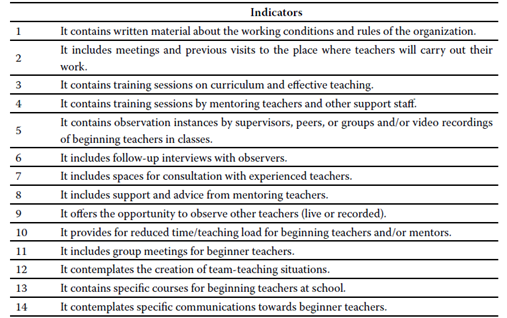
Organizations establish conditions that must be met by those who wish to join them and requirements that must be met by all members ( Rodríguez, 2013). An induction or initiation program should contain components already determined by the literature. These are written material on working conditions and school policies; previous meetings and visits; seminars on curriculum and effective teaching; training sessions by mentor teachers and other support staff; observations of new teachers in classes by supervisors, peers, or groups; follow-up interviews with observers; consultations with experienced teachers; support and mentoring by teacher mentors; opportunities to observe other teachers; reduced teacher time-charge for beginning teachers and mentors; group meetings of beginning teachers; creation of team teaching situations; specific courses for beginning teachers at school; and, special publications for beginning teachers ( Marcelo García, 1999) . It is then established that induction depends on each school’s organizational culture and the work the new employee will perform; however, this would be a step that no organization should omit in the induction process despite the differences. We constructed an evaluation instrument of teacher induction programs (E-Tip) from the revised bibliography. This instrument contains the essential characteristics established by Marcelo García (1999), and it should be applied as a comparison guideline to determine the present and missing elements in a teacher induction program. The indicators are listed in Table 1.
3.2 Instrument Validation
The content validation was carried out under expert judgment through a rating scale (Likert). They were consulted on demographic aspects, such as the level of the organization in which they work, the position they hold, and the relevance of each indicator (14) on the following scale: 1) Irrelevant; 2) Poorly relevant; 3) Medium relevant; 4) Relevant; 5) Essential. Besides, Aiken’s V was applied to experts’ judgment. The E-Tip criteria were presented in Spanish to be assessed by experts (its original language). According to Aiken’s V., items below 0.70 should be eliminated on the recommendation of the expert judges. In the criteria that resulted lower than 0.70, a review of the means of the groups concerning their place of work (Higher Education: Secondary Education) and a test of independent samples was performed: Levene’s test for equality of variances and t-test for equality of means. The reliability of the validation instrument was 0.86 in Cronbach’s alpha.
3.3 Participants
The inclusion criteria for evaluators were holding a professional degree, being part of an educational organization, and having at least one managerial or coordinating position since induction comprehends the integration of the professional into organizations. Thirty experts answered the evaluation. The proportion of participants concerning their workplace was 9:1 (Higher Education: Secondary Education). Concerning the positions experts held in these organizations, persons in positions of Coordination were 40%, Directors 6,7%, Deaneries 50%, and Vice-Chancellors 3,3%.
3.4. Expert Judgment
The instrument was validated between September 19 th and September 26 th, 2020, through Microsoft Forms® under correlation id 731c347d-2323-4d12-8a89-ad1cbb74f9f7.
4. Results
The results of the assessment of the relevance of the criteria (C) included in the E-Tip instrument are shown in Table 2.
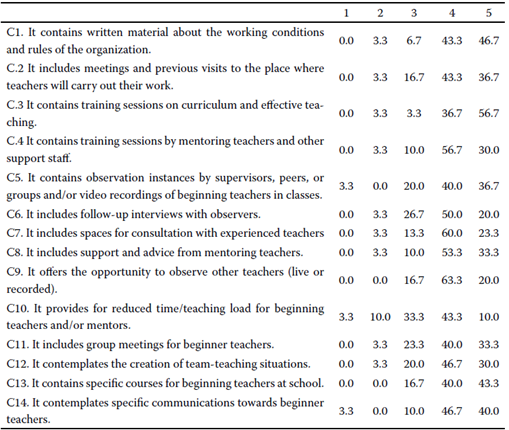
Scale: 1: Irrelevant; 2: Poorly relevant; 3: Medium relevant; 4: Relevant; 5: Essential; C: Criterion.
The relevance of the 14 criteria averaged 80.6% approval and 3.6% disapproval. The two criteria with the highest approval (%Relevant + %Essential) were C1 and C3, with 90% and 93%, respectively. The criterion with the highest disapproval (%Irrelevant + %Poorly Relevant) was C10 with 13%. The criteria with 0% disapproval were C13 and C9.
According to Aiken’s V., items below 0.70 should be eliminated on the recommendation of the expert judges. Therefore, according to the results in Table 3, item 10 should be excluded from the instrument. For this criterion, a review of the means of the groups concerning their place of work (Higher Education: Secondary Education) (See Table 4) and a test of independent samples were performed: Levene’s test for equality of variances and t-test for equality of means.
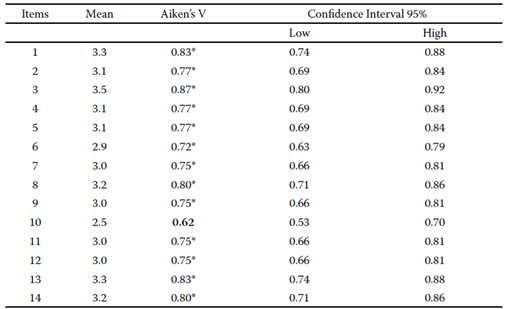

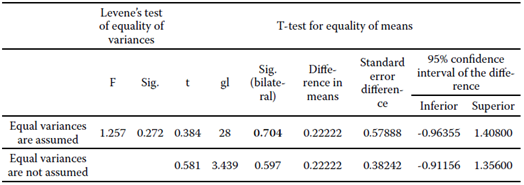
Table 5 shows the results of Levene’s test, which were non-significant. Next, the Students’ t-test results for independent samples showed non-significant differences (0.704) between the secondary versus higher education groups. In conclusion, C10 should be excluded from the final instrument.
5. Discussion
The present study objective was to validate the criteria of an instrument created for quality assurance of teacher induction programs.
5.1 The E-Tip Criteria
The E-Tip instrument not only seeks to ensure pedagogical support for teachers, which is vital. Teachers in educational organizations may be updated with educational models and methodologies. However, beyond the pedagogical tools, this instrument intends to ensure that teachers who join an educational organization can be nurtured in the organizational culture to manage their work more effectively and efficiently and contribute to their team faster and more efficiently. The instrument’s criteria were divided into two categories to analyze the results: teaching support (activities supporting the teaching-learning process) and management support (supporting teachers in administrative areas). The criteria were analyzed per category and then as a total, as seen in Table 6 and Figure 1.
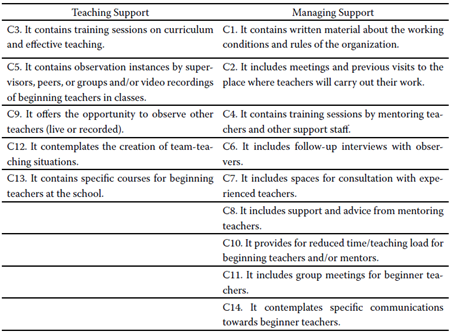
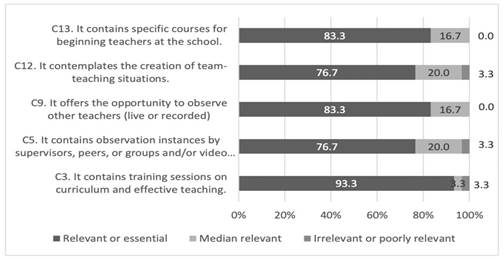
Figure 1
Relevance of teaching support criteria.
Regarding the criteria associated with teaching support ( Figure 1), the aspect with the most support from the experts was related to training on the curriculum and effective teaching (C3), and the least valued, but still having a high percentage of approval, was the criterion that refers to creating team-teaching situations and observation instances by supervisors or peers (C5). The latter may be related to observation instances implying other employees’ participation-who already have different assigned roles-which could translate into work overload for some.
Concerning the criteria associated with management support, compared to this group, the most widely supported criterion was that the teacher induction program should contain written material on working conditions and the organization’s standards (C1) ( Figure 2). That is to say, the working conditions must be officialized, and standards should be written down and included in the induction program, which may prevent different interpretations of the roles and tasks.
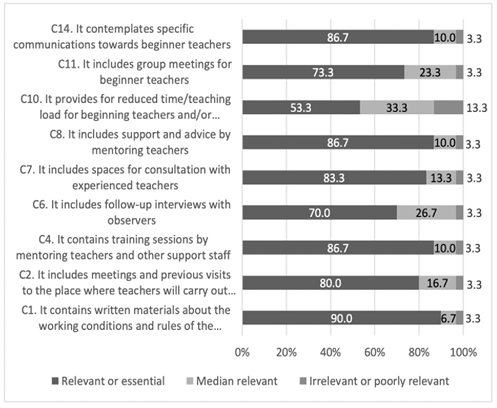
Figure 2
Relevance of Management-Support Criteria.
5.2 The E-Tip Criteria Relevance
Let us analyze the approval given to all fourteen criteria. Based on expert judgment, we can see that the criteria for training in teaching and curriculum, and induction in working conditions and standards exceed 90% of approval (C1 and C3, respectively). This aligns with the theoretical frame; a school requires all officials who begin their work, whether administrative or teaching, to know the organization best to become familiar and integrated ( Orozco Delgado, 2001). Entering the working world within higher education organizations has its particularities, and facing learning and knowledge within an organization cannot be easy; therefore, it is necessary to manage the organization from human capital management processes. As a collaborative community, the organization must have as its ultimate horizon the understanding of its recipients’ reality and the discovery of strategies that best respond to learning needs and the demands of the environment ( Salgado-Cruz et al., 2017). Likewise, concerning new teachers, caring for new teachers’ training is fundamental for the education system. Most of the habits and knowledge teachers will use in their professional practice in their first work years are formed and consolidated ( Bozu, 2009; Sorensen, 2022). The process of personnel induction applied to new members should be offered as an easily accessible alternative and a significant opportunity to expedite personnel’s integration with high possibilities of achieving the desired academic and research productivity ( Colmenárez, 2008). The management aspects become essential in the teacher’s excellent performance, the organization’s knowledge, the formal accompaniment, and the formal allocation of time for adaptation ( Marcelo García, 1999). The expert judgment revealed that the theory is still valid; since evaluators were experts who lead human groups in educational organizations, they assessed the relevance according to their knowledge and experience in management and accompaniment.
According to the expert judgment, thirteen out of the fourteen criteria are essential in the following order: training sessions on curriculum and effective teaching (C3); written material about working conditions (C1); training sessions by mentor teachers and other staff, and specific communication towards beginning teachers, and support and advice by mentoring teachers, in the same level (C14, C8, and C4); spaces for consultation with experienced teachers, opportunities to observe other teachers, and specific courses for beginning teachers, in the same level (C7, C9, and C13); meetings and previous visits to the place where teachers will carry out their work (C2); observation instances by supervisors, peers or groups, and team teaching situations, in the same level (C5 and C12); team meetings for beginner teachers (C11); and follow up interviews with observers (C6). Finally, reduced time/teaching load for novels and mentors was not considered an essential criterion (C10). Thus, it was removed.
The ranking that emerged from the expert judgment was not an objective of the investigation; however, it gives us a perspective from administrators and their beliefs about teaching training. This is primarily collaborative learning, involving mentors, supervisors, and peers observing and getting feedback. One important observation about this nine-level ranking is that the first three levels (summarized in training, manuals, and accompaniment) lead to quality assurance and confidence in the work.
As mentioned before, the teacher’s role is irreplaceable. If that work is achieved effectively, the whole system stays intact since the service that is supposed to be given is absent. Regarding training, administrators must ensure that this essential work is done correctly and avoid content flaws (C3) ( Leu, 2005; United Nations, 2020). About manuals, written material about working conditions can clarify any misunderstood information and guide teachers in their roles and responsibilities; it also may reduce the number of mistakes or misunderstandings in the team (C1) ( Böckerman & Ilmakunnas, 2008; González Brito et al., 2005; The National Institute of Occupational Safety and Health, 2020). Concerning accompaniment, training, support, advice, and direct communication with new teachers can improve work management and integration into the team by increasing a sense of belonging, acceptance of authority, and increased performance, among others (C14, C8, and C4) ( Bretones & González, 2009; Grados, 2013).
Since rotation is a consequence of diverse psychological, individual, organizational, and environmental factors ( Bretones & González, 2009; Fernández De Pelekais et al., 2019), from the psychosocial perspective, these three top levels can be seen as a reinforcement of selfconfidence in the employee. Regarding training, teachers must continuously be updated on curriculum and effective teaching since programs evolve, and different methodologies arise responding to the social needs and the organization’s education models; updates may also respond to expected and professional competencies ( Pazyura, 2015). When teachers feel supported in their development, a sense of professional identity, empowerment, and more positive morale and energy increase ( Leu, 2005). On the other hand, when workers know precisely what to do and how they are expected to do it, their work can be more efficient, and they will act more confidently; that is, organizational culture, beliefs, and expectations shared by the organization, and a determined way in which things are done (C3) ( Macgregor et al., 2005). Regarding manuals, written information about working conditions will make new teachers more confident in the new environment. They will know what to expect without asking around and feeling lost; training, role clarity, role conflict, and stress management are criteria that affect the quality of work-life regarding stress ( Bermúdez Restrepo, 2011; The National Institute of Occupational Safety and Health, 2020). Finally, concerning accompaniment, it may decrease anxiety levels. Adaptation to contexts increases the satisfaction of the employee and affects organizational happiness. People who are happy with their jobs may be more productive and grateful and have a greater sense of belonging ( Bretones & González, 2009; Fernández De Pelekais et al., 2019; Reynoso Castillo, 2007; Rodríguez Mansilla & Quezada Menares, 2007).
There is an excellent diversity of induction programs worldwide, which usually require a mentor and release of hours for the mentor and beginner ( Ruffinelli Vargas, 2016). For this reason, it is noteworthy that, although considered relevant by evaluators, the least supported of the fourteen criteria is contemplating reducing the time or workload for beginning teachers and mentors. Since expert judges perform administrative roles, they might observe a diversion of person-hours (p-h) to tasks not initially considered in teachers’ job descriptions. For this purpose, a detailed analysis of teachers’ dedication hours should be made to define the time dedicated to induction and make fair use of it. Systematization is an essential tool in the distribution of p-h. Suppose collaborative work is not considered in the tasks of experienced teachers. In that case, some might be overloaded, leading to employee dissatisfaction or burnout syndrome, among others ( The National Institute of Occupational Safety and Health, 2020).
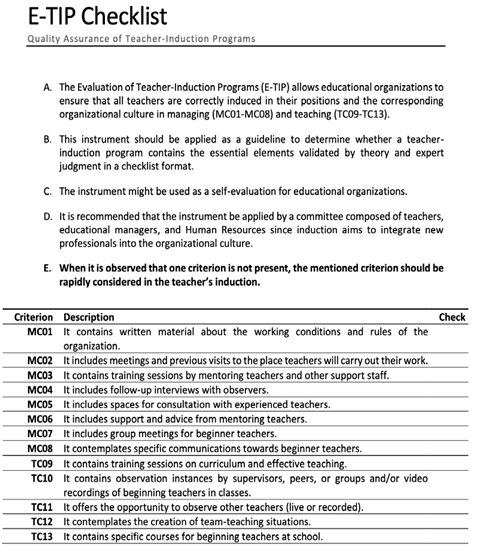
The induction process is beneficial for rapid integration into the position and an economic benefit for the organization. On the other hand, self-confident teachers, well prepared, with proper management of the organization’s culture and supported by their team, will be happier with their job and beneficial to the organization. A restructuring of Human Resources will likely be required to carry out an induction program that meets all the relevant criteria. Finally, according to the literature and expert judgment, thirteen out of fourteen criteria presented in the E-Tip instrument are pertinent to assess ( Annex 1).
6. Conclusions
The present study objective was to validate the criteria of an instrument created for quality assurance of teacher induction programs. The E-Tip criteria were valid in content validation, and thirteen out of fourteen items should be included in the final version of the scale. In addition, further investigation needs to be done concerning qualitative instruments to assess the level of achievement of the mentioned criteria.
Practical Applications
This instrument should be applied as a guideline to determine whether a program contains the essential elements validated by theory and expert judgment in a checklist format. The instrument might be used as a self-evaluation for educational organizations. It is recommended that the instrument be applied by a committee composed of teachers, educational managers, and Human Resources since induction aims to integrate new professionals into the organizational culture. When it is observed that one criterion is not present, the mentioned criterion should be rapidly considered in the teacher’s induction.
References
Allal-Chérif, O., Yela Aránega, A., & Castaño Sánchez, R. (2021). Intelligent recruitment: How to identify, select, and retain talents from around the world using artificial intelligence. Technological Forecasting and Social Change, 169. https://doi.org/10.1016/j.techfore.2021.120822.
Al-Romeedy, B. Samir. (2019). The role of job rotation in enhancing employee performance in the Egyptian travel agents: the mediating role of organizational behavior. Tourism Review, 74, 1003-1020. https://www.emerald.com/insight/content/doi/10.1108/TR-10-20180153/full/html.
Amushila, J., Bussin, M. H. R., & Bussin, M. (2021). SA Journal of Human Resource Management. https://doi.org/10.4102/sajhrm.
Asamoah, D., Agyei-Owusu, B., & Ashun, E. (2020). Social network relationship, supply chain resilience and customer-oriented performance of small and medium enterprises in a developing economy. Benchmarking, 27(5), 1793-1813. https://doi.org/10.1108/BIJ-082019-0374.
Badrianto, Y., & Ekhsan, M. (2020). Effect of work environment and job satisfaction on employee performance in P.T. Nesinak Industries. Journal of Business, Management, and Accounting, 2(1), 85-91. http://e-journal.stie-kusumanegara.ac.id.
Bakker, T., Dugué, P., & de Tourdonnet, S. (2021). Assessing the effects of Farmer Field Schools on farmers’ trajectories of change in practices. Agronomy for Sustainable Development. https://doi.org/10.1007/s13593-021-00667-2/Published.
Bencsik, A. (2021). The sixth generation of knowledge management - the headway of artificial intelligence. Journal of International Studies, 14(2), 84-101. https://doi.org/10.14254/2071-8330.2021/14-2/6.
Bermúdez Restrepo, H. L. (2011). La inducción general en la empresa. Entre un proceso administrativo y un fenómeno sociológico. Universidad & Empresa, 21, 117-142. http://www.redalyc.org/resumen.oa?id=187222420006.
Bloom, N., Bunn, P., Mizen, P., Smietanka, P., & Thwaites, G. (2022). Staff Working Paper No. 900. The impact of Covid-19 on productivity. (No. 900; Staff Working Paper ). http://www.bankofengland.co.uk/working-paper/staff-working-papers.
Böckerman, P., & Ilmakunnas, P. (2008). Interaction of working conditions, job satisfaction, and sickness absences: Evidence from a representative sample of employees. Social Science and Medicine, 67(4), 520-528. https://doi.org/10.1016/j.socscimed.2008.04.008.
Boukis, A., & Christodoulides, G. (2020). Investigating Key Antecedents and Outcomes of Employee-based Brand Equity. European Management Review, 17(1), 41-55. https://doi.org/10.1111/emre.12327.
Bozu, Z. (2009). El profesorado universitario novel y su proceso de inducción profesional. https://www.redalyc.org/pdf/2810/281021548008.pdf.
Bretones, F. D., & González, J. M. (2009). Absentismo y rotación laboral. Psicología Del Trabajo, January 2009, 91-113. https://www.researchgate.net/publication/302167865_Absentismo_y_rotacion_laboral.
Bureau of Labor Statistics, U. S. (2020). Department of Labor, Occupational Outlook Handbook, Postsecondary Teachers. https://www.bls.gov/ooh/education-training-and-library/postsecondary-teachers.htm#tab-4.
Çakmak, M., Gündüz, M., & Emstad, A. B. (2019). Challenging moments of novice teachers: survival strategies developed through experiences. Cambridge Journal of Education, 49(2), 147-162. https://doi.org/10.1080/0305764X.2018.1476465.
Cambridge Dictionary. (2022). Meaning of TEACHER. https://dictionary.cambridge.org/es/diccionario/ingles/teacher.
Colmenárez, L. (2008). Proceso de Inducción del Personal Docente del Decanato de Administración y Contaduría de la UCLA. 11, 5-22. https://www.taylorfrancis.com/books/mono/10.4324/9781003223207/improvising-teacher-nick-sorensen.
del Giudice, M., Scuotto, V., Papa, A., Tarba, S. Y., Bresciani, S., & Warkentin, M. (2021). A Self-Tuning Model for Smart Manufacturing SMEs: Effects on Digital Innovation. Journal of Product Innovation Management, 38(1), 68-89. https://doi.org/10.1111/jpim.12560.
Du, Y., & Liu, H. (2020). Analysis of the influence of psychological contract on employee safety behaviors against COVID-19. International Journal of Environmental Research and Public Health, 17(18), 1-14. https://doi.org/10.3390/ijerph17186747.
Ellerbrock, C. R., Main, K. M., & Virtue, D. C. (2022). Middle Level Teacher Preparation across International Contexts: Understanding Local and Global Factors Influencing Teacher Education. https://doi.org/10.4324/9781003213789.
Fernández De Pelekais, C., el Kadi, O., & Financial, K. (2019). Happiness as a potential tool of productivity in financial organizations. Revista Global Neotium, 2(2), 99-112. https://www.researchgate.net/publication/335541185.
Flores Gómez, C. X. (2014). Inducción de profesores novatos en Chile: un estudio de caso. Pensamiento Educativo. Revista de Investigación Educacional Latinoamericana, 51(2), 41-55. https://doi.org/10.7764/PEL.51.2.2014.4.
Garay, L. (2010). Paradigmas en la Investigación Educativa. In MMINEDU Perú. http://www2.minedu.gob.pe/digesutp/formacioninicial/?p=411.
González Brito, A. I., Araneda Garcés, N., Hernández González, J., & Lorca Tapia, J. (2005). Inducción Profesional Docente. Estudios Pedagógicos (Valdivia), 31(1). https://doi.org/10.4067/s0718-07052005000100003.
González Torres, A. (2019). Procedimiento de trabajo para facilitar el diseño de perfiles de cargos por competencias en la Universidad Central “Marta Abreu” de las Villas [Universidad Central “Marta Abreu” d elas Villas]. http://dspace.uclv.edu.cu:8089/handle/123456789/11283.
Grados, J. (2013). Reclutamiento, selección, contratación e inducción del personal. https://www.academia.edu/34731979/Reclutamiento_selección_contratación_e_inducción_del_personal_Jaime_Grados.
Hamurabi Sözen, P. (2018). CHALLENGES OF NOVICE TEACHERS. IJAEDU- International E-Journal of Advances in Education, IV(12). http://ijaedu.ocerintjournals.org/en/download/article-file/615408.
Hernández-Sampieri, R., & Mendoza Torres, C. P. (2018). Hernández-Sampieri, R. & Mendoza, C. (2018). Metodología de la Investigación. Las Rutas cuantitativas, cualitativa y mixta. Mc Graw Hill Education. https://doi.org/https://doi.org/10.22201/fesc.20072236e.2019.10.18.6.
IGI Global. (2022). What is Teacher. https://www.igi-global.com/dictionary/family-community-higher-education-partnership/48939.
Iwuanyanwu, P. N. (2022). Facilitating Problem Solving in a University Undergraduate Physics Classroom: The Case of Students’ Self-Efficacy. Interdisciplinary Journal of Environmental and Science Education, 18(2), e2270. https://doi.org/10.21601/ijese/11802.
Jai, T. M. (Catherine), Fang, D., Bao, F. S., James, R. N., Chen, T., & Cai, W. (2021). Seeing It Is Like Touching It: Unraveling the Effective Product Presentations on Online Apparel Purchase Decisions and Brain Activity (An fMRI Study). Journal of Interactive Marketing, 53, 66-79. https://doi.org/10.1016/j.intmar.2020.04.005.
Johnson, A., Galloway, C., Friedlander, E., & Goldenberg, C. (2019). Advancing educational quality in Rwanda: Improving teachers’ literacy pedagogy and print environments. International Journal of Educational Research, 98, 134-145. https://doi.org/10.1016/j.ijer.2019.08.016.
Koehler, A. A., & Kim, M. C. (2012). Improving Beginning Teacher Induction Programs through Distance Education. CONTEMPORARY EDUCATIONAL TECHNOLOGY, 2012(3), 212-233. https://doi.org/10.30935/cedtech/6079.
Kozikoglu, I. (2017). A content analysis concerning the studies on challenges faced by novice teachers. Cypriot Journal of Educational Sciences, 91-106. https://www.ceeol.com/search/article-detail?id=965396.
Kraiger, K. (2022). Online I-O graduate education: Where are we and where should we go? Industrial and Organizational Psychology, 15(2), 151-171. https://doi.org/10.1017/iop.2021.144.
Le, H. T. Q., & Nguyen, T. H. (2022). A study on Non-English Major Students’ Learner Autonomy: Difficulties and Solutions. International Journal of TESOL & Education, 2(3), 197-207. https://doi.org/10.54855/ijte.222313.
Leu, E. (2005). The Role of Teachers, Schools, and Communities in Quality Education: A Review of the Literature (1st ed.). Academy for Educational Development, Incorporated. https://files.eric.ed.gov/fulltext/ED490174.pdf.
Levin, J. M., & Kleiner, B. H. (1992). How to reduce organizational turnover and absenteeism. https://doi.org/10.1108/00438029210018633.
Macgregor, E., Hsieh, Y., & Kruchten, P. (2005). Cultural Patterns in Software Process Mishaps: Incidents in Global Projects. Workshop on Human and Social Factors of Software Engineering, 2-5. https://doi.org/doi:10.1145/1083106.1083116.
Marcelo, C. (2009). Los comienzos de la docencia: un profesorado con buenos principios. 13, 1. https://recyt.fecyt.es/index.php/profesorado/article/view/41898.
Marcelo, C., Mayor, C., & Murillo, P. (2009). Monográfico: profesorado principiante e inserción profesional a la docencia. Revista de Currículum y Formación Del Profesorado, 13(1), 1. https://revistaseug.ugr.es/index.php/profesorado/article/view/20568/20045.
Marcelo García, C. (1999). Estudio sobre estrategias de inserción profesional en Europa. Revista Iberoamericana de Educación, 19, 1-33. https://rieoei.org/historico/oeivirt/rie19a03.htm.
Mejía Pérez, G. (2019). Un panorama del mercado laboral docente en la Educación Superior en México. Revista de Educación Superior En América Latina. http://dx.doi.org/10.14482/esal.5.378.122.
Merriam-Webster. (2022). Teacher Definition & Meaning. https://www.merriam-webster.com/dictionary/teacher.
Min, Y., Yexiang, F., Weilin, T., & Jiajie, Z. (2020). Study on safety behavior planning theory and control strategies for coal chemical workers. Safety Science, 128. https://doi.org/10.1016/j.ssci.2020.104726.
Mlekus, L., & Maier, G. W. (2021). More Hype Than Substance? A Meta-Analysis on Job and Task Rotation. In Frontiers in Psychology (Vol. 12). Frontiers Media S.A. https://doi.org/10.3389/fpsyg.2021.633530.
Mustafa, M., Alzubi, F. K., & Bashayreh, A. (2022). Factors Affecting Job Performance of Teaching and Non-Teaching Staff in Higher Education Levels in Oman. Privacy Policy A/B Testing Terms of Use Copyright Cookie Policy. In Source: Ilkogretim Online. 2021 (Vol. 20). https://www.bibliomed.org/mnsfulltext/218/218-1616506690.pdf?1709690543.
Neuer Colburn, A. A., & Bowman, S. N. (2021). CES-SUCCESS: A Role Induction Group to Prepare Future Counselor Educators. Journal for Specialists in Group Work, 46(2), 202- 213. https://doi.org/10.1080/01933922.2021.1900961.
OECD. (2021). Education at a Glance 2021. OECD. https://doi.org/10.1787/b35a14e5-en.
Omanović, V., & Langley, A. (2021). Assimilation, Integration or Inclusion? A Dialectical Perspective on the Organizational Socialization of Migrants. Journal of Management Inquiry. https://doi.org/10.1177/10564926211063777.
Orozco Delgado, V. H. (2001). Reflexiones teórico-metodológicas para desarrollar el proceso de inducción como apoyo a la gestión del recurso humano universitario. Revista Educación, 25(1), 27. https://doi.org/10.15517/revedu.v25i1.2929.
Otele, E. P. W. (2022). Influence of Induction Practices On Service Delivery by Newly Employed Teachers in Primary Schools [JARAMOGI OGINGA ODINGA UNIVERSITY OF SCIENCE AND TECHNOLOGY]. http://ir.jooust.ac.ke:8080/xmlui/handle/123456789/10974.
Oxford Advanced Learner’s Dictionary. (2022). Definition of teacher. https://www.oxfordlearnersdictionaries.com/definition/english/teacher.
Öztürk, M. (2008). Induction into teaching: adaptation challenges of novice teachers [Graduate School of Social Sciences of Middle East Technical University]. https://open.metu.edu.tr/handle/11511/18265.
Pazyura, N. (2015). Progressive ideas in updating teacher trainning in developed countries. Proceedings of the National Aviation University, 2(63), 120-123. https://doi.org/https://doi.org/10.18372/2306-1472.63.8879.
Pedraja-Rejas, L., & Rodríguez-Ponce, E. (2015). El aseguramiento de la calidad: un imperativo estratégico en la educación universitaria. Ingeniare. Revista Chilena de Ingeniería, 23(1), 4-5. https://doi.org/http://dx.doi.org/10.4067/S0718-33052015000100001.
Puji Astuti, J., Sa, N., Diah Rahmawati, S., Yuli Astuti, R., Sudargini, Y., & Stikubank Semarang, U. (2020). The Effect of Work Motivation, Work Environment, Work Discipline on Employee Satisfaction and Public Health Center Performance. Journal industrial engineering & management research (JIEMAR), 1(2), 2722-8878. https://doi.org/10.7777/jiemar.v1i2.
Qian, S. (2022). Reform and Innovation of Higher Education in Economic Reform Period. International Journal of Education and Humanities, 2(3). https://drpress.org/ojs/index.php/ijeh/article/view/382/320.
Rewel Jiminez, S. J., Thi Anh, D., Ehsan Ullah, S., & Sadiq, M. (2021). Development of Human Resource Management Activities in Vietnamese Private Companies. In Turkish Journal of Computer and Mathematics Education (Vol. 12, Issue 14). https://www.researchgate.net/publication/355384107_Development_of_Human_Resource_Management_Activities_in_Vietnamese_Private_Companies.
Reynoso Castillo, C. (2007). Notas sobre la Capacitación en México. 5, 165-190. https://www.redalyc.org/pdf/4296/429640260009.pdf.
Rodríguez, D. (2006). Gestión Organizacional (4th ed.). https://www.academia.edu/43370463/Gestion_Organizacional_Dario_Rodriguez.
Rodríguez, D. (2013). Diagnóstico Organizacional. https://tecnoadministracionpub.files.wordpress.com/2019/08/libro_diagnostico_organizacional_dario_r.pdf.
Rodríguez Mansilla, D., & Quezada Menares, S. (2007). Cultura en las Organizaciones del Tercer Sector. Revista Española Del Tercer Sector, 121-152. https://dialnet.unirioja.es/servlet/articulo?codigo=2376738.
Rodriguez Vite, H. (2017). Importancia de la formación de los docentes en las instituciones educativas. Ciencia Huasteca Boletín Científico de La Escuela Superior de Huejutla, 5(9). https://doi.org/https://doi.org/10.29057/esh.v5i9.2219.
Rostini, D., Zaeni, R., Syam, A., & Achmad, W. (2022). The Significance of Principal Management on Teacher Performance and Quality of Learning. Jurnal Pendidikan, 14(2), 2513- 2520. https://doi.org/10.35445/alishlah.v14i1.1721.
Ruffinelli Vargas, A. (2016). Ley de desarrollo profesional docente en Chile: de la precarización sistematica a los logros, avances y desafíos pendientes para la profesionalización. Estudios Pedagógicos, XLII(4), 261-279. https://doi.org/http://dx.doi.org/10.4067/S071807052016000500015.
Rymaniak, J., Lis, K., Davidavičienė, V., Pérez-Pérez, M., & Martínez-Sánchez, Á. (2021). From stationary to remote: Employee risks at pandemic migration of workplaces. Sustainability (Switzerland), 13(13). https://doi.org/10.3390/su13137180.
Salgado-Cruz, M., Gómez-Figueroa, O., & Juan-Carvajal, D. (2017). Niveles para la capacitación en una organización. Ingeniería Industrial, 38(2), 154-160. https://www.redalyc.org/pdf/3604/360452099004.pdf.
Salokhojaeva, F. (2022). Methodology for the Development of Communicative Competence Through Steam Technologies. International Journal of Social Science Research and Review, 5(2), 111-116. https://doi.org/10.47814/ijssrr.v5i2.207.
Santiago Páez, M. (2019). Optimización del proceso pedagógico y la gestión docente: una mirada a los entornos virtuales de aprendizaje. https://doi.org/10.13140/RG.2.2.35697.63845.
Segovia Gutierrez, E. (2020). Plan de acción en el área de talento humano para procesos de inducción y desarrollo del personal de la empresa Image S.A. http://repositorio.ucsg.edu.ec/handle/3317/14479.
Shibru, B. (2022). Impact of Employee Turnover on Organizational Performance: The Case of Bekas Chemicals Plc., Ethiopia. Journal of Material Sciences & Manufacturing Research. https://doi.org/10.47363/JMSMR/2022(3)125.
Shipman, K., Burrel, D. N., & mac Pherson, A. H. (2021). An organizational analysis of how managers must understand the mental health impact of teleworking during COVID-19 on employees. International Journal of Organizational Analysis. https://doi.org/https://doi.org/10.1108/IJOA-03-2021-2685.
Sisto, V. (2011). New professionalism and teachers: a reflection from the analysis of current policies of “professionalism” for education in Chile. Signo y Pensamiento, XXXI(59), 178-192. http://www.scielo.org.co/scielo.php?script=sci_arttext&pid=S0120-48232011000200013.
Sood, H., & Ong, C. E. (2022). Revisiting Job Rotation and Stress. In The Complexities and Strategies of Occupational Stress (pp. 300-322). https://doi.org/10.4018/978-1-66843937-1.ch017.
Sorensen, N. (2022). The improvising teacher : reconceptualising pedagogy, expertise and professionalism (Routledge, Ed.). Taylor & Francis. https://doi.org/https://doi.org/10.4324/9781003223207.
Strom, K. J., & Viesca, K. M. (2021). Towards a complex framework of teacher learningpractice. Professional Development in Education, 47(2-3), 209-224. https://doi.org/10.1080/19415257.2020.1827449.
The National Institute of Occupational Safety and Health. (2020). Quality of Worklife Questionnaire| NIOSH | CDC. Stress at Work. https://www.cdc.gov/niosh/topics/stress/qwlquest.html#download.
Thomson, G. (2021). The Global Report on the Status of Teachers 2021. https://www.ei-ie.org/en/item/25403:the-global-report-on-the-status-of-teachers-2021.
United Nations. (2020). Development program. Goal 4. Quality education. https://www.un.org/sustainabledevelopment/education/.
University of Leeds. (2022). What is a Professor?: Professors and professorship: origins and history. https://professors.leeds.ac.uk/what-is-a-professor/.
Velando Rodríguez, M. (2004). El proceso de abandono voluntario: revisión de las principales aportaciones realizadas en la literatura. Investigaciones Europeas de Dirección y Economía de La Empresa, 10(3), 157-169. https://dialnet.unirioja.es/servlet/articulo?codigo=1096696.
Waychunas, W. (2022). Context and the Continuum: Insights and Connections Between Preparation, School Organization, and Beginning Teachers’ Instruction (pp. 338-358). https://doi.org/10.4018/978-1-6684-3848-0.ch017.
Wendel, M. (2022). Teacher perceptions of the supports and barriers for professional collaboration: a phenomenological study [Middle Tennessee State University]. https://media.proquest.com/media/hms/PFT/2/iJ3oM?_s=NHJNF%2BzP%2BQmqw7P1dNObVa1LSR8%3D.
Willis, U. M. (2022). Improving the beginning teacher induction program experience for African-American teachers within the green pastures school district: an applied study [Liberty University]. https://digitalcommons.liberty.edu/cgi/viewcontent.cgi?article=4656&context=doctoral.
Yoon, I., & Kim, M. (2022). Dynamic patterns of teachers’ professional development participation and their relations with socio-demographic characteristics, teacher self-efficacy, and job satisfaction. Teaching and Teacher Education, 109(103565). https://doi.org/10.1016/j.tate.2021.103565.
Yurkofsky, M. (2022). From Compliance to Improvement: How School Leaders Make Sense of Institutional and Technical Demands When Implementing a Continuous Improvement Process. Educational Administration Quarterly, 58(2), 300-346. https://doi.org/10.1177/0013161X211053597.
Annex 1
Author notes
*Correspondencia: María-Mercedes Yeomans-Cabrera. mmyeomans@outlook.com.