Reseñas

Esta obra está bajo una Licencia Creative Commons Atribución-CompartirIgual 4.0 Internacional.
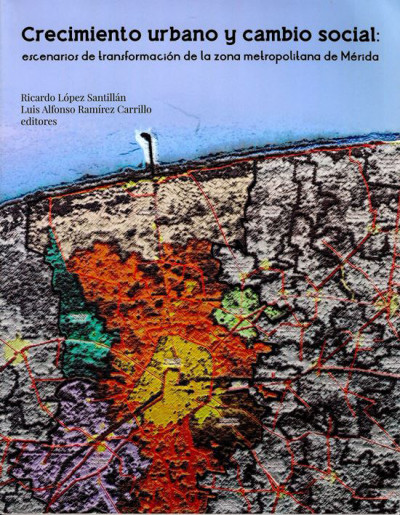 | López Santillán Ricardo, Ramírez Carrillo Luis Alfonso. Crecimiento urbano y cambio social. Escenarios de transformación de la zona metropolitana de Mérida. 2014. México. CEPHCIS/ UNAM. 475pp.. 9786970257490 |
|---|
Ricardo López Santillán and Luis Alfonso Ramírez Carrillo present us with an urgent and necessary compilation of papers for understanding the metropolitan area of Mérida. The work brought together around 18 researchers from different disciplines and institutions. The editors show urban growth and its social, sociological, political, economic, cultural and even ecological development, in a city that already appears, from the colonial era, as an isolated peninsular metropolis center, and therefore, with its own logic and its own processes of social construction.
Since the presentation, the editors warn the reader that this is a multilateral and multidisciplinary work that goes from the field of urbanism to linguistics. First, Jorge Bolio Osés presents a historical overview of the past 100-150 years of the Yucatecan capital and warns of the profound changes that have occurred in the city; be it sociologically, visually, or with the landscape, all shaping the social fabric. It is quite interesting to observe how Bolio Osés emphasizes the impact of neoliberal policies on the city and its economic corridors.
Enrique Pérez and Paulina Gallano Campusano Chaine present us with a pair of complementary papers that revolve around socio-spatial segregation and migration trends from and to Mérida. The authors interpret official statistics to show how migration flows always given in terms of economic development, and how these flows create social segregation both in Mérida and its suburbs and even a little beyond.
Susana Pérez Medina and Lane Fargher are immersed in 3 populations of the peri-urban area of Mérida: Cholul, Kanasín and Umán. Each population with a development and logic different from each other, but all directly related to the city of Mérida. It is interesting to observe how the town of Umán develops a parallel to the capital but without reaching its importance. While Kanasín and Cholul are much more dependent on what happens in Mérida, this is not necessarily reflected in the services or first need goods that these populations offer.
Luis Alfonso Ramírez Carrillo shows a long, rich and very detailed social history of corporate political actors of the city. Starting in pre-Hispanic times and reaching the 21st century, the author shows the weight that certain personalities can have on political and social life. At the same time, Ramírez Carrillo presents us how some groups have been building up over time. We can see then how the city´s constitution has been the end result of the balance of various local socio-economic-political forces, the author shows this phenomenon in great detail.
Othón Baños Ramírez takes us on cultural consumption and the way how new citizenships are built, in this case in a place like the city of Mérida. From a review of the media and social networks, the author observes how a “virtual” citizenship, a non-participatory citizenship, a phenomenon that does not contribute to a consolidation of democracy is created. Taking the examples of the local campaigns of 2011, Ramirez shows that the population does not become citizens, because although there is already a virtual participation, this is clearly reflected in the media and social networks, but the new cultural consumption is designed to not to leave the virtual space. Contrary to what has been happening elsewhere, in the case of Mérida, social and technological conditions do not work together to allow the birth of the citizenship among the population.
Gina Valdes Villagómez is interested in a very little visible sector of the population: the older population. When statistical data crosses with a field study, the author makes a vast analysis of the population of the elderly in the state of Yucatan but emphasizing Mérida. Then we observe the conditions and the situation of multiple poverty and extreme poverty in which they find this important sector of the population that tends to be “invisible” in the eyes of society. Interestingly, the contribution that the author made at the end of his presentation to show how the elderly Yucatecans have tended to assimilate the new rules of social and family roles, but also how they have managed to become an increasingly visible sector for the state itself.
Los trabajadores de los nuevos servicios en la Mérida globalizada. Reflexiones iniciales sobre el trabajo y cambio social, a text from Beatriz Torres Góngora where, based on hard data, the author shows that the fact of having a relatively strong market economy, based on the development of the tertiary sector, trade and services, in the city of Mérida, does not necessarily mean improvements in living conditions for thousands of young people who enter the labor market each year. This was mainly due to the conditions that the global economic system imposed on all corners of the world: insecurity, flexible working, unfixed schedules, lack of social security, job insecurity, etc. The second issue that the author is interested to note is the fact that the tertiary sector in Mérida has grown mainly in the field of information, technology and communication. This has had a direct impact on young people who are faced with new situations on the peninsula.
Beatriz Castilla Ramos is interested in the issue of SMEs as a global phenomenon of late capitalism, but despite the economic changes of the past 50 years, has managed to remain and to some extent consolidated in various parts of the world. From this information the author delves first into the Mexican case, then goes to the Yucatecan case, and finally shows the Méridan case. The data presented by Castilla Ramos show the important presence of SMEs in the city of Mérida to be the main source of the jobs economy. However, as the author points out, with regional markets in full consolidation, there are a lot of challenges for the SMEs in the 21st century. Working conditions, government support, public policy, financing, innovation and technological development are the items to continue researching and working about the SMEs in the middle cities such as Mérida.
Ricardo López Santillán performs an exercise in sociological analysis to show how the city that has demographically grown the most in Yucatan, Kanasín, continues strongly rooted in pre-modern and rural traditions. The so-called “positive segregation” that has been referred to, the author revolves around a social space that has not necessarily followed the logic of urban organization imposed by neoliberalism (peri-urban segregationally areas and gentrification in inner cities). The “poor relation” of Mérida, has its own urban and cultural process that allows us to locate ourselves halfway between the urban and the rural. Despite the “bad press”, Kanasín is considered by its inhabitants as a much better place than the suburbs or the housing development that have arisen along the Méridan periphery. The author concludes by pointing out:
There are processes related to the current forms of neoliberal urbanization that effectively segregate and poverty periurbanizan (…). A space socioeconomically segregated and of urban equipment (…). On the other hand (…). It is the distance and difference with the capital city that has allowed them to preserve their culture.
Laura Machuca Gallegos presents two neighboring municipalities to the city of Mérida to exemplify the transition from the rural to the urban or it that she calls “the rurality without agriculture”. El problema agrario en Kanasín y Umán, Yucatán, Siglos XIX y XX, gives us a historical tour of both locations and allows us to observe the social, economic and political problems that have occurred during two centuries on the outskirts of the city. The evolution of these locations will have an immediate and significant effect on the “White City”, and also in social phenomena that emerge and become institutionalized in the collective consciousness of the population (the “Divine Casta”). This is a result of a process of unfinished urban incorporation. Understanding that this is due largely to the success medium, or medium failure, depending on where you will observe, of the agrarian reform during the 20th century.
“Chichí Suárez, a poor neighborhood being incorporated into the capital, is not one of the largest, is not one of the most renowned, however it is a place of striking contrasts in whose everyday live very different realities”. Laura Hernández Ruiz takes an anthropological work where from presenting socioeconomic and demographic data of the place, (the same author points out, it is unclear whether it is a poor neighborhood or peri-urban colony of Mérida), for revisiting many social problems. Social phenomena such as suicide, poor hygiene and alcoholism cohabit with phenomena such as family harmony, social participation and the conservation of traditional rituals within this population. This provides a well-defined and delimited identity to the people of Chichí Suárez. A situation where poverty plays a protective role and the cause of segregation at the same time.
The book closes with a sociolinguistic study by Barbará Pfeiler, Juana Sanchez and Josue Villegas entitled La vitalidad lingüística del maya en cuatro localidades de la zona metropolitana de Mérida, Yucatán: Cholul, Umán y San José Tzau; from an ethnographic survey conducted in these locations the authors show how, contrary to what is often thought, “Maya” is very much present in the daily lives of people; family, the market, parks, and streets are the scenarios where “Maya” continues to be spoken fluently; however, these spaces must compete with institutions such as school, church, public services and the media. The authors also show the difference between being “Maya” and being “Mayero” more often attached the latter to the use of the language. A strange paradox is discovered by the authors: they note that the historical moment when the “Maya” has greater linguistic vitality in the metropolitan area of Mérida is also the time when there was also the greatest risk of gradually losing its use.
Easy and entertaining to read, the texts integrated into the book offer several new readings around the Méridan space. The effort made by the editors to form a galaxy of researchers resulting in a work that becomes necessary for its variety and versatility, not only for the public interest in the study of Mérida, but for all those who want to understand the once-named “White City”. The DVD which accompanies the book deserves special mention, offering a series of summaries of the entirety of the book accompanying it with images of Mérida and the Peninsula in general.
