Artículos
Political Memory, Authoritarian Legacies, and the Quality of Democracy: Considerations for a Comparison Between Brazil and Argentina[1]
Políticas de memoria, legados del autoritarismo y calidad de la democracia: consideraciones para una comparación entre Brasil y Argentina
 Carlos Artur Gallo galloadv@gmail.com
Political Memory, Authoritarian Legacies, and the Quality of Democracy: Considerations for a Comparison Between Brazil and Argentina[1]
Revista del CESLA, vol. 25, pp. 251-276, 2020
Uniwersytet Warszawski

This work is licensed under Creative Commons Attribution-ShareAlike 4.0 International.
Received: 20 January 2020
Accepted: 01 June 2020
Abstract: : Within the context of the Cold War, Brazil and Argentina experienced national security dictatorships responsible for a many violations of human rights. With the transitions, Argentina and Brazil returned to democracy although persistence of a series of authoritarian legacies can be observed in the new social-political scenario. The present study analyzes: a) which legacies of authoritarianism currently remain in these countries; b) which public policies were pursued to deal with the crimes committed by the authoritarian regime; and c) how the maintenance of these authoritarian legacies can have repercussions in the quality of democracy.
Keywords: national security dictatorships, authoritarian legacies, politics of memory, quality of democracy, transitional justice.
Resumen: En el contexto de la Guerra Fría, Brasil y Argentina han pasado por dictaduras de Seguridad Nacional responsables por una masiva violación a los derechos humanos. Con las transiciones, Argentina y Brasil volvieron a ser democracias aunque persista un conjunto de legados del autoritarismo en el nuevo escenario social y político. Este estudio analiza: a) cuales legados del autoritarismo están presentes en los países referidos; b) cuales las políticas públicas que fueron creadas para hacer frente a los crímenes cometidos por el régimen autoritario; c) como los legados autoritarios pueden impactar en la calidad de la democracia.
Palabras clave: dictaduras de seguridad nacional, legados del autoritarismo, políticas de memoria, calidad de la democracia, justicia transicional.
Introduction
Brazil, between 1964 and 1985, and Argentina, between 1976 and 1983, experienced national security dictatorships. Counting to a greater or lesser degree on the direct support from the civil elite, the military in power aimed on the one hand at realigning the internal economic system to the new standards of growth of the international capitalist system while on the other hand, concentrating on impeding the supposed expansion of communism in the region with the application of the National Security Doctrine (NSD). As a result of the diffusion of this doctrine, aside from the reflection in the restructuring and reorganization of the political institutions, they left a trail of repression[2] with arrests, persecutions, exiling, torturing, killing, and disappearing of thousands of civilians (Cavarozzi, 1996; Martins, 1988; Motta, 2002; Padrós, 2006, 2008).
However, if the development of the authoritarian regimes in Argentina and Brazil are marked by similarities in, for example, the international context in which a state coup takes place (in the height of the Cold War) and the continuous and deliberate use of repression in these countries, there are also important differences, above all in relation to the content of the ensuing transition. For while the transition to democracy in Brazil was the result of negotiations considerably controlled by the sectors in power, and therefore termed by scholars as the transition trough transaction (negotiated) (Arturi, 2001; Munck & Leff, 1997; O’Donnell & Schmitter, 1988), in Argentina, the transition process was severely abrupt and therefore classified by some authors as the process of transition trough rupture conducted by society (Munck & Leff ,1997; Stepan, 1994).
The transition “by rupture” in Argentina began with the military defeat in the Malvinas War in June 1982 (Novaro & Palermo, 2003; O'Donnell & Schimitter, 1988; Quiroga, 2006). The result of the dispute against the British, combined with the brutality of the repression and the bad result of economic policies implemented by the dictatorship, contributed to an accelerated loss of civilian support to the military regime and pressing for urgent changes in the political sectors in power. Seeing an accelerating reduction in its authority, the military junta tried to guarantee some level of transition control, proposing a presidential election in the second quarter of 1983. Facing difficulties for obtaining prerogatives in the transition process, the dictatorship has its last great defeat in the presidential elections, held in October, when the civilian Raúl Alfonsín was elected, a candidate committed to the cause of human rights in the country and declaredly opposed to the impunity of those involved in political repression. The inauguration of President Alfonsín, in December of that year, brought Argentine civil-military dictatorship to an end.
Brazil’s “negotiated” transition started in 1974, a period marked by contradictions. On the one hand, the regime still enjoyed the benefits of an economic growth, while on the other hand, the repression of the opposition was at its peak. In that year, the Dictator-President Ernesto Geisel (1974-1979) started, within the government itself, a “slow, gradual and secure” transition project, negotiated from above, which would continue until March of 1985, with the inauguration of President José Sarney (Arturi, 2001).
The transition process in Brazil was slowly achieved and marked by advances and setbacks. On one hand, exception rules were repealed, censorship ended, Amnesty Law was edited, political exiles returned, and new political parties were founded. On the other hand, the constant control of the process by the Armed Forces guaranteed important political prerogatives for themselves and for the civil sectors that supported and participated in the dictatorship (Arturi, 2001; Codato, 2005; Gugliano & Gallo, 2013; Martins, 1988).
With the continuity of the transition processes begun within that which, according to the theory of Samuel Huntington (1994), would be the third wave of democratization, Argentina and Brazil have returned step by step to political normality. However, thirty years on from the end of these dictatorships, it can be observed that even within the new social-political scenario there persist legacies to authoritarianism which sit alongside democracy. Using the referred context as a starting point, the present study analyzes: a) which authoritarian legacies of authoritarianism remain in Brazil and Argentina; b) which public policies public have been developed to combat the maintenance of these links; and c) how their continued presence can have repercussions in the quality of democracy.
Applying qualitative analysis, the accumulated data has been organized into three sections. In the first of these, a presentation and analysis is made of the main public policies formulated in these countries to work with the memory of the political repression practiced during the term of office of the NSD. Following this, institutional and cultural traces of the bureaucratic-authoritarian regime are identified and analyzed which, as indicated by scholars such as Alfred Stepan (1988), Martha Huggins (2000), Anthony W. Pereira (2010), Alain Rouquié (2011) and Jorge Zaverucha (1992, 1994, 2000, 2010), represent authoritarian legacies. Finally, in the last section of this study, an analysis is made of the quality of the Argentinian and Brazilian democracies in the light of the authoritarian legacies, reflecting upon the impact of the remnants of authoritarianism in the elaboration of human rights policies.
1. Public policies, human rights, and memory of political repression in Brazil and Argentina: a panorama
The end of the civil-military Latin American dictatorships reveals the ways in which the memory of political repression varies from country to country. In Brazil, significant advances in developing policies to address the junta’s abuses of political rights occurred after the Conference of Vienna, where it became evident that the formulation of a national policy for human rights in the country took a new turn after 1995 when Fernando Henrique Cardoso assumed his first term of office as President of the Republic (González, 2010: 112).
Re-elected in 1998 and throughout his eight years in government (1995-2002), President Cardoso opened the way for significant steps to be taken towards the development of policies directed towards the general cause of human rights with a view to embrace political repression memory in the country. Resulting from this are: a) the elaboration of the first two versions of the National Programme of Human Rights (PNDH), of 1996 and 2002, respectively; b) the publication of Law nº 9.140, 1995, recognizing cases of death and political “disappearances” which occurred during the repression; c) the creation of the Special Commission for Political deaths and disappearances (Comissão Especial sobre Mortos e Desaparecidos Políticos – CEMDP), through the Law nº 9.140; and d) the creation of the Commission of Amnesty (Comissão de Anistia), in 2001.
Equally in the first and second publications of the PNDH, the policies devised for memory of repression were significantly watered down, which stimulated the promotion of a) educational policies directed towards the sedimentation of a “culture of human rights”; b) policies directed towards the guarantee of access to justice; c) the fight against impunity and torture; d) the dissemination of international mechanisms for the international protection of human rights; and e) the support for human rights defense groups. Despite being a secondary plan, the theme consolidated complementary and necessary guarantees for the realization of the cause.
The most important policies elaborated by the Federal Government in relation to facing the legacy of repression was Law nº 9.140, 1995, also known as the “Law of the Dead and Disappeared.” Resulting from almost two decades of battling by families of dead and “disappeared” politicians (who could count on the support of national and international organizations for the protection-promotion of human rights), this public policy officially recognized the responsibility of the Brazilian state for the deaths of 135 activists and hailed the creation of the CEMDP.
The CEMDP[3] was responsible for conceding compensations for the families of the 135 dead or “disappeared” people mentioned in the amendment to Law nº 9.140, and also for the legal analysis of new requests for recognition of the responsibility of the state for the deaths and disappearances during the time of the repression. At a later date, Law nº 9.140 was complemented with Law nº 10.536, 2002 and the deadline for protection in terms of dealing with cases of dead or “disappeared” people, originally fixed for the period 1961 to 1979, was extended to the period 1961 to 1988.
In the wake of the advances promoted by his predecessor, President Luís Inácio Lula da Silva (2003-2006 and 2007-2010) ensured the continuity of the Brazilian politics of memory. During the eight years of his government, the following occurred: a) the enlargement and revision of the content of Law nº 9.140, through Law nº 10.875, 2004, by which the people who died during action against the civil-military regime or who committed suicide after having been tortured, were recognized as having been killed by the Brazilian state; b) the series of publications, The Right to Memory and Truth .Direito à memória e à verdade) by the CEMDP; c) the continuation of the work of the Commission for Amnesty, which initiated the realization of its “Caravanas” (itinerant events and procedures occurring in various parts of the country to publicly access requests for compensation for victims of the dictatorship); d) the creation of the Portal “Memories revealed” (Memórias Reveladas); and e) the publication of the PNDH-3, which prepared the way for the creation of the National Truth Commission (Comissão Nacional da Verdade – CNV).
Through the PNDH-3, there was a significant broadening in relation to the operation of memory of repression, with a specific guideline reserved for the subject in the document: Reference VI, entitled “Right to Memory and truth.” Of equal importance to the organization of a reference for the subject, was its original content. Aside from preserving and promoting the memory of repression (Directive nº 24) and the revision of the legislation which, established during the military period, was still in force (Directive nº 25), in accordance with Directive nº 23, the creation in 2010 of the National Truth Commission was set into motion.
It is important to note that in the projection of the Directive nº 23 in the new edition of the program, there was tension since the first drafting of the document. This was because, despite the ample mobilization occurring throughout the processes of formulation of the PNDH-3 (conferences took place in all the country to debate the new text), and, with the intention of conferring greater legitimacy to the directives established by the conferences, before the launching of the new edition of the program there was an attempt to pass the directives on to all the Ministries for screening (31 Ministries approved the text). The presentation of an opposing position to the official acknowledgement of the violations which took place during the period of authoritarianism by the Ministry of Defense, lead at that time by the minister Nelson Jobim, managed to delay the launching of the program for almost a year (in accordance with IPEA, 2010: 285).
With the publication of the new PNDH in December 2009, a series of public demonstrations and controversial discussions took place within the first few months of 2010. Involving supporters of human rights on one side and members and/or supporters of the armed forces on the other, the controversies which were centered around the proposals of Reference VI of the PNDH-3 ended up becoming severe criticisms of other articles of the program which were not related to the authoritarian period (there were aspects/proposals related to terms such as, for example, secularity of the state and liberty of expression).
As a result, in May 2010 the Federal Government published the Decree nº 7.177, which altered the proposals of Reference VI in a way in which the work of the National Truth Commission became modified and limited in comparison with the original proposal.
The Commission began its work at the end of the first half of 2012, facing at least three problems: 1º) the reduced number of members (7 members); 2º) the duration of the work (initially only two years to investigate events which occurred in a country the size of Brazil); 3º) the definition of the time lapse to be analyzed by the Commission which, after the emergence of the controversies, was established for the period from 1946 to 1988 (which avoided the necessity of investigating the crimes committed during the civil-military dictatorship separately, equating them with political crimes from other periods of the history of the country). In December 2014, the Truth Commission submitted its final report to President Dilma Rousseff.[4]
In Argentina, policies related to memory began to be considered and were formulated soon after the period of exception (Brasil, 2010: 36-43; CELS, 2010: 61-108; Parenti & Pellegrini, 2009: 133-152), making it possible to identify four phases in the process of confronting the former period of Argentinean authoritarianism: 1ª) Truth and Justice; 2ª) Impunity; 3ª) alternative search for the truth; 4ª) the return to Justice (CELS, 2010: 62-65).
The first phase of “Truth and Justice” began at the end of 1983 when President Raúl Alfonsín published decrees nº 157 and 158, which stipulated that leaders of guerrilla organizations and members of the military junta which governed the country be tried. Besides this, he established the Argentinean Truth Commission, entitled “The National Commission for ‘Disappeared’ People (Comisión Nacional sobre la Desaparición de Personas – CONADEP). It was in this period, between 1983 and 1984, that CONADEP organized a minutely detailed report on the cases of human rights violations committed during the Argentinean repression; this report, also known as the “Sábato Report” (because it was headed by the writer Ernesto Sábato), was published with the title “Never Again” (Nunca Más). The repercussions after this publication were very large in the region, with the expression “Never Again” being exported to all the countries which had experienced situations similar to those practiced in the illegal houses of detention spread throughout Argentina. Following this first stage of confronting the subject of violations, from 1987 Argentina experienced retrogression – the “Phase of Impunity,” when, still during the time of Alfonsín’s government, the Laws of “Closing Page” (Punto Final) and “Due Obedience” (Obediencia Debida) were published. At a later date, the granting of pardons was bequeathed to the agents of repression from President Carlos Menem. Alongside this “Phase of Impunity,” other attempts at rewriting the truth about events which occurred during the period of authoritarianism lead to the development of the phrase “Alternative phase of the search for the truth,” in which innumerous cases were presented which did not seek criminal prosecutions for those involved in violations.
Generally speaking and as a result of the Argentinean proceedings, alongside the public recognition of the violations, the concession of compensation for the families of “disappeared” people or people who had suffered severe injuries as a result of torture, the ample promulgation of the facts to ensure that contestation of them during the time of the dictatorship could no longer occur by anyone, it should be noted that, between advances and setbacks, Argentina was the first of the countries of the Southern Cone to take its ex-dictators to court and condemn them.
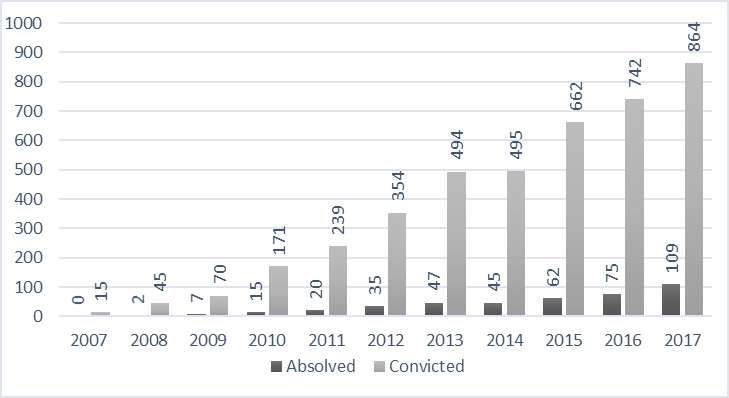
Figure 1
– Trials in Argentina 20072017 number of convictions and absolutions
Source: Diagram elaborated by the authors of the research from statistics organized by the Centre of Legal and Social studies – CELS and available on their online platform about the trials.
To really take advantage of the achievements gained during this period, enormous effort was required by the interested parties until 2003 and 2005, respectively, when the Argentinean parliament and Supreme Court declared that the laws existent to the aforementioned decrees “Closing Page” and “Due Obedience,” which had suspended the possibility of punishment of the agents of repression, were unconstitutional. It was this which initiated the hitherto referred “Fourth Phase.” In the same vein, from 2003, President Néstor Kirchner revoked pardons conceded by ex-President Menem for 277 violators of human rights, permitting, through international law, their extradition for trial.
Numbers related to the increase of trials in Argentina after 2005 can be observed in Figure 1, which presents data systematized by the Centre of Legal and Social Studies (CELS), a body in the country which offers judicial advice in the processes of demands related to human rights violations occurred during the time of the dictatorship.
2. Legacies of authoritarianism in Brazil and Argentina: fragments of a past which never passes
Legacies of authoritarianism, as conceived by Leonardo Morlino (2013: 262-263) in his study on democracy in countries in southern Europe: “cover all the behavioural standards, rules, relations, social and political situations and also norms, procedures and institutions, both introduced with vigour and visibly strengthened during the authoritarian regime just before.”
The aim of this section is to analyze how and which legacies of the dictatorship are still present today within the political scenario of Brazil and Argentina. For a comparative analysis, five types of legacy of authoritarianism were identified which can be projected – and/or project themselves – in time beyond that of the duration of the regimes of exception themselves: a) the existence and permanence of “laws of impunity” (Norris, 1992), which block the identification and judgment of those involved in human rights violations during the time of the dictatorship; b) closed access to documents, which limits the reconstruction of memory of the authoritarian period; c) the military prerogatives; d) the cultural remnants of authoritarianism; e) legacies of authoritarianism within the judicial area.
a. Laws of impunity
According to Robert Norris (1992), since 1970, an assortment of laws have been proclaimed in Latin America with the aim of hindering or impeding the punishment of crimes committed in periods of dictatorship as, for example, the proclamation of unrestricted amnesty, legal time limits, pardons, and laws of due obedience.
In Argentina during the defeat in the Malvinas War, the military junta published Law nº 22.924, envisaging self-amnesty (automatic amnesty) for the sectors involved in the dirty war. This law, amongst others, suspended all the penal investigations involving crimes committed in the combat against terrorism between May 1973 and June 1982. With the fall of the dictatorship and the installation of the civil government of President Raúl Alfonsín, Law 23.040 was sanctioned, which opened the way for the annulment of self-amnesty, making the broad punishment possible of military figures involved in crimes of the military governments, not just involving perpetrators of violations but also the members of the military juntas and other components of the leaders of the armed forces who planned and ordered the violations. In accordance with the previous section, remnants of the legislation of impunity, such as the Law of “Closing Page” (Ley nº 23.492) and the Law of due obedience (Ley nº 23.521) proclaimed after the end of the dictatorship, were considered unconstitutional by the Supreme Court in 2005, making possible the re-opening and increase in the number of court cases involving violations of human rights in the country.
In relation to the Brazilian context, the Amnesty Law (Lei nº 6.683, 1979) published during the “slow, gradual and safe” transition period, in practice, blocked the process of making the agents of repression responsible, spreading and consolidating the idea that there had been a reciprocal amnesty (for both “the victims of torture and the torturers”).
Even though this interpretation has been repeatedly contested by victims of repression, families of dead or “disappeared” people and various human rights organizations, it remains present today, strengthening the belief in the idea that everything which occurred during the dictatorship should be forgotten for the sake of the logic of national reconciliation (Mezarobba, 2009).
Referred to as one of the non-negotiable items of Brazilian transition (Martins, 1988: 129), the assurance of the absence of responsibility regarding agents involved in acts practiced in the name of the coup d’état of 1964 is constantly being rediscussed. Regardless of this, the point of view defending, amongst others, sectors involved in the civil-military coup were reinforced in April 2010 by the Federal Supreme Court (Supremo Tribunal Federal or STF), when the majority of the ministers judged as unfounded the argument for the breach of fundamental precept – ADPF nº 153, proposed by the Federal Council of the OAB (Ordem dos Advogados do Brasil, the Brazilian Bar Association) in 2008.
Supporting their decision on the premise that the national reconciliation which occurred in 1979 justified that agents of repression were not punished, the STF impaired the collective discussion about violations which had been practiced, fueling the belief that wishing to know about facts which had occurred at that time in the history of the country is a kind of revenge game. Moreover, the decision went against international legislation for the protection of human rights and in December 2010 (the same year of the trial of the ADPF), which resulted in the country being condemned by the Inter-American Court of Human Rights – IACHR through a case brought about by families of “disappeared” people in Araguaia.
b. Closed access documents
According to Graciela Karababikián (2007: 645):
the archives related to the violation of human rights perpetrated in our region had the function of bringing about court cases with the aim of taking to trial the perpetrators and compensating the victims; contributing to the construction of a common shared memory of the period as a way of preventing similar future situations; offering information to know more and in more depth what has happened in our recent history and as material for investigation and divulgence of the events.
In Brazil, a national policy of closed access to documents was in practice for decades, which impeded and/or hampered access to official documentation produced in the various sectors of organs responsible for defense of the National Security of the dictatorship. Despite the fact that after 2005, the Federal Government signaled, with the creation of the Memories Revealed project – a change in the approach to the subject of opening archives from the period of repression, many claims from victims of repression remained unattended. In truth, the national policy of closed access to documents, which had established deadlines and criteria for granting access to documents classified as secret, remained much as it had been since the end of the authoritarian period until May 2012, when Lei nº 12.527/2011, came into force, signaling the end of permanent closed access.
Despite there having been a change with the application of the new text in the Law of Access to Information (and in part also with the work of the National Truth Commission), many documents of the period remained inaccessible, and with application of the new rule, rendering impossible the intended democratization of information. Furthermore, it is important to note that, in practice, the policy of closed access to documents represents a legacy which for over 30 years has produced effects as much individually as collectively in the interpretation of amnesty. In a singular way, the closed access to documents made it impossible to really put into action the right to memory and the truth in a collective plan because, as many archives remained (and in some case, still remain) inaccessible, the official versions which were produced by the apparatus of repression continued to lack documental proof, which made them publicly invalid. Linked with the Amnesty law, the legacy of the closed access documents produced effects at the procedural level in that the documental proof produced in the cases brought about by families of victims of repression, for example, was low due to the small number of archives available.
In Argentina, the policy of access to public archives was established in a very different way to that of Brazil. The basic right of access to information had already been guaranteed to Argentinean citizens in its constitution since the return to democracy, but:
the access to information may or may not occur, depending on the conception that each administration has in relation to access/restriction. Besides this, each city, province or governmental body has its own legislation regarding the subject without restrictions because Argentina does not have a national archives policy as a reference (Lopes & Konrad, 2013: 17).
For this reason, partial satisfaction concerning right of access to archives of repression based on arbitrary criteria, formed because of the absence of a general regulatory norm, have always been far from the ideal, even if at times showing themselves to be useful (Karababikián, 2007: 645-646). Today, even if the neighboring country has not yet approved a federal law granting access to information, inserted within the context of the “Return to Justice,” as analyzed in the previous section of this study, in 2003 (with Decree nº 1.172/2003) and in 2010 (with Decree nº 4/2010), the national government established norms which granted access to many documents concerning violations of human rights which had occurred during the last dictatorship with a view to the right to justice. In addition, in 2003 the National Archive of Memory was created, which was responsible for both the custody of documents produced by the apparatus of repression and documents obtained and organized by human rights organizations and victims of repression.
The greatest difficulty still faced by Argentineans in the final analysis does not, as noted by Graciela Karababikián (2012: 272-278), concern a problem related to access to documents but in fact to a problem concerning the custody and preservation of these sources of information. In Brazil, despite the continuing difficulty of access, supported by policies of document protection, which was maintained until a short while ago, Federal legislation exists for the subject and there are physical structures with greater document management capacity.
c. The military prerogatives
On the other hand, beyond the results produced within the judicial-legal sphere, it can be seen that the authoritarian legacy can also be found within the armed forces, concentrated in the existence and maintenance of a series of military prerogatives (Stepan, 1988; Zaverucha, 1992, 1994, 2000, 2010), which limit the possibilities of democratizing the civil-military relationships. This is because, in a general form, Zaverucha has sustained that, when the number of military prerogatives co-existing with democratic political systems is greater, the greater the possibility that in the imminence of a crisis, conservative sections grasp the opportunity for direct intervention from military sectors prepared to use these prerogatives.
In the Brazilian context, Zaverucha (2000) certified that until the end of the first term of office of President FHC (1995-1998) the situation identified in his analysis at the beginning of 1990 was the same: the military authorities maintained all the prerogatives which they had obtained in the political game of the transition. In June 1999, changes began to be put into practice when the Ministry of Defense was formed. Lead by a civil minister entrusted with the responsibility of’ coordinating the three armed forces groups – Army, Navy, and Air Force – the ministry represented the interests of these sectors together with the Federal Government.
But when examining the practical results issuing from this situation, the existence of a Ministry of Defense offered no guarantees that there would not be military subordination in relation to civil control, operating the latter more in terms of “a forwarding agent for the interests of the armed forces than a formulator of governmental policies” (Zaverucha, 2010: 70). It is of no surprise that regarding memories of repression and the demands from families of dead or “disappeared” politicians, concrete situations are found both prior to and after the creation of the Ministry of Defense, which treat as contingent any more optimistic analysis about the capacity for producing profound changes in the behavior and attitude of the Brazilian armed forces.
One fact which corroborates this analysis is closely related to the training of officers of the armed forces in the country. Contrary to the general opinion, which considers that an ideology which is passé and linked to the NSD would only reflect on the reserve officers, Sued Lima (2012) observes that, analyzing the system for military teaching throughout the twentieth century and the beginning of the new millennium, the anti-democratic and extremely conservative position present in the organization of the armed forces during the time of the dictatorship remains in essence the same today.
Furthermore, when Law nº 9.140/95 (related to the acknowledgement of dead or “disappeared” people and compensation for their families) was published, it met with resistance from the armed forces. It became necessary that for its approval, the president himself guarantee that the acknowledgement of dead or “disappeared” military personnel and the active role of the CEMDP did not characterize a kind of revenge game, with the accomplishment of the measures being limited by the interpretation of reciprocal amnesty. In addition, and after the law was approved, General Oswaldo Pereira Gomes was assigned representative of the armed forces in the special commission, quoted in the project Brazil: Never Again, as an agent of repression (Brasil, 2010: 137), with Brazilian military personnel having constant involvement in the organization of searching for “disappeared” people in Araguaia.
Between the end of 2009 and the beginning of 2010, confident of the control of the Ministry of Defense in the hands of Nelson Jobim, the same sectors which in the first half of the 1990s imposed limits on the law of the dead and disappeared and the work of the CEMDP, manifested opposition to devices of the PNDH-3. Therefore, besides having already postponed the publication of the plan because they were against the creation of the National Truth Commission (IPEA, 2010: 285), in the first few months of 2010, the armed forces, represented by the Ministry of Defense, managed to generate public tension which, as had been observed, resulted in alterations to the document already approved by all the Ministries in 2009.
In Argentina, where the transition process to democracy had occurred abruptly, the military powers were given less capacity for interference in the path to the new democracy, and Érica Winand and Héctor Luis Saint-Pierre (2007: 65) observed:
besides that this [Argentina] relied on a Ministry of Defence for many more decades than Brazil, it relies on, within a judicial system, a statute which does not accept the assignment of military positions unless they are in reserve and if there are no qualified and adequately prepared civil personnel. The imposition of these criteria have contributed in a way that defence be predominantly conducted by civil hands. A further credit to Argentina is that it allows for aspiration to civil control which strengthens democracy in the fact that there exists a well founded culture of defence, disseminated by the educational system of the country. For Paz Tibiletti, proof of this lies in the fact that every day a greater number of civil youth enroll on courses offered by the National School of Defence, making it possible that both the Ministry of Defence and the parliamentary commissions related to it can rely on specialized personnel of a civil character.
Another aspect which deserves attention in the analysis of the Argentinean case is that the study plans used for the graduate programs for the armed forces of the country follow curriculum specifications which observe the national educational guidelines (Winand & Saint-Pierre, 2007: 68). Therefore, and bearing in mind data such as has been referred to which, even if still seen with reservations in terms of the reduction of the potential of the Argentinean military prerogatives, ponders that while there are important advances there have been some setbacks, Ernesto Lopez (2007: 30) believes that the resulting balance for the country is a positive one because:
The genocides of the last dictatorship were – and continue to be – tried in court, relocating in a central position the ethical recuperation of our society. The National Security Doctrine was removed from the centre of the military institutions, despite the continued existence of some encrusted ideologies and fragments of moral tone associated with them, especially among retired personnel. A solid legal line was elaborated to support the primacy of public authorities and arrive at military subordination, as well as developing civil capacities for conducting military defence and policies.
d. Cultural Remnants of authoritarianism
Creating an impact on the short and long term span in the political culture of the population living under dictatorships, the public invasion in the private sphere consolidated remnants of a “culture of fear” of the service, based on the NSD (Padrós, 2006, 2008; Rouquié, 2011). For example, it can be seen that in Brazil the fact of not facing the traumas of the past together with the impunity which defends those responsible for political crimes, contributed to the sedimentation of a culture where disrespect of human rights is considered something natural, allowing for those responsible for violent police practices today to visualize, within the impunity of violence in the past, a lack of constraint for its indiscriminate use in the future (Huggins, 2000).
In Argentina, where political repression reached levels way above those in Brazil (the number of “disappeared” people in Argentina being between 10,000 and 30,000), a culture in favor of human rights gained strength in the political scenario of transition, enabling, as discussed earlier, the construction of a more effective political agenda of memory. It is within this particular viewpoint of the Argentinean case in comparison with Brazil that Caroline Silveira Bauer (2012: 120) says:
The absence of debate about what happened during the civil-military dictatorship, together with the absence of space for sharing the experience of state terrorism in the culture of fear, makes it impossible to elaborate a collective memorial about these experiences. Therefore, there is hegemonic consolidation of the official memory as “the truth” concerning recent historical Brazilian events. … the general feeling established by the official memory finds itself within the inconvenience of “revenge games” and in the isolation of groups directly affected by the political repression (like families of dead and ‘disappeared’ politicians).
On the other hand, though closely overlapping in the same way as vestiges of a culture created and/or given potency in the time of the National Security were maintained in every analysed case, it can be seen that, compared with Argentina, Brazil appears to have greater difficulty in overcoming certain traces of authoritarianism which remain present within society. While amongst Argentineans since the 1990s a high degree of preference for democracy as the best governing regime can be observed (see Table 1), among Brazilians, the level is above 50% in the research of 2010 but is always below that of its neighbor country. Besides this, as can be observed in Table 2, it is possible to note that the Brazilians have a high level of confidence in the armed forces, signifying almost a complete opposite in terms of the perception of Argentineans.
| Country/ Reference year | 1995 | 2000 | 2005 | 2010 | 2015 |
| Argentina | 75.5% | 69.9% | 65.7% | 65.9% | 70.1% |
| Brazil | 41% | 38.2% | 37% | 53.7% | 54.4% |
| Country/ Reference year | 1995 | 2000 | 2005 | 2010 | 2015 |
| Argentina | 37.2% | 37.2% | 38.7% | 37.4% | 41.7% |
| Brazil | 58.7% | 58.2% | 60.7% | 63.3% | 53.7% |
e. Legacy of authoritarianism in the judicial sector
For the dictatorships to be able to remain in power, applying the NSD and implementing their political projects directed towards the modernization of the economic structures, it was necessary, to a greater or lesser extent, that they applied this type of interference in the judicial sector: publishing rules, intervening in the organization of its institutions and appointing ministers for the Supreme Courts.
From Anthony W. Pereira’s (2010) point of view, the dictatorships established in the Southern Cone during the cold war did not have the same intensity of impact on the judicial sector in these countries, consequently generating from these circumstances, different kinds of authoritarian legality. In Brazil a more intense authoritarian legality was generated, in which members of the regime were responsible for developing many rules and, with their activities being legal, there was a greater degree of judicialization of crimes committed against the National Security by political activists (having also space for defense lawyers of the accused). In Argentina, on the other hand, a less intense degree of authoritarian legality occurred in that the majority of the human rights violations or crimes were committed by the apparatus of repression on the margins of the judicial system and its institutions.
It is of no surprise that Pereira (2010: 53-63), therefore, has drawn attention to the number of dead or “disappeared” politicians in Brazil (around five hundred cases), in Chile (between three and five thousand) and Argentina (between twenty and thirty thousand), believing that the lower number of fatal victims of repression in Brazil can be explained because of the type of legality in operation. While in Argentina, a kind of “disappearing power” (poder desaparecedor, in accordance with Calveiro, 2013) was in operation almost always without political activists being taken to court, with almost all people of the opposition disappearing under the repression, in Brazil it was a kind of “power of the torturer” (poder torturador, in accordance with Teles, 2013), with a very large number of political activists being tried for crimes falling within the National Security Law.
Within this context, despite the fact that the trials in Brazil had contributed to strengthening the legality of the dictatorship and its activities in relation to society, the cases brought against political activists guaranteed the life of these people in most cases. While in Argentina, for every person tried, there were seventy one cases of “disappearances,” in Brazil, for every death or “disappearance”, twenty three people were taken for trial in the military courts (Pereira, 2010: 59).
In reference to the political scenario before the transition, one of the hypothesis proposed in the study of Pereira (2010) consists of the idea that the bigger the impact of the dictatorship on the area of law, the greater the difficulty with the return to democracy that the existent authoritarian legality during the authoritarian period be dismantled. According to Leonardo Morlino (2009: 215), an inheritance from a dictatorship projected over the long term can be identified when it is verified, in the new political scenario, for example, that rules made by the authoritarian regime continue to be applied.
Other evidence of the difficulties of a rupture with authoritarian measures established during the dictatorship in the judicial area of these countries can be identified when observation is made, for example, of the impact of these regimes of exception in the framework of the Supreme Courts. Equally in Brazil and Argentina there were appointments of ministers to the Supreme Courts during the dictatorship. In fact, in the Brazilian case, the dictatorship had a significant impact on the Supreme Court, altering the number of ministers who made up the plenary institution and making compulsory retirement for three members who demonstrated conflicting interests to the regime (see Table 3).
What finally occurred was that with the transition to democracy, all the ministers of the Supreme Court who had been appointed during the time of the dictatorship either dismissed themselves from their positions or were removed from their posts at the beginning of Raúl Alfonsín’s government in December 1983. In the SC, there was no significant change in the transition in that all the Ministers who had been appointed during the dictatorship continued to fulfill their functions normally in the new democracy. This remained the same until the beginning of 2000, when Mister Sydney Sanches, the last of the members of the court appointed by the dictatorship, retired (27th Abril, 2003).
| Government | Structure of the plenary court | Ministersappointed until the end of military rule | Ministers given compulsory retirement until the end of the military rule |
| Castello Branco (1965-1967)* | 16 | 8** | 0 |
| Costa e Silva (1967-1969)*** | 16 | 4 | 3 |
| Médici (1969-1974) | 11 | 4 | 0 |
| Geisel (1974-1979) | 11 | 7 | 0 |
| Figueiredo (1979-1985) | 11 | 9 | 0 |
If the fact that they had been recommended for their posts during the dictatorship signifies that these ministers were incapable of acting independently in the interests of the regime of exception, and always acted in favor of the regime, it is equally true that the civil-military coalitions in power did not appoint people to fulfill their posts who could represent a possibly significant obstacle against their interests. Having the highest court of a country in a democracy composed of members appointed during a dictatorship is something which, at least from a symbolic viewpoint, should be the object of reflection on its real conditions for dismantling authoritarian remnants in the short, medium and long term.
3. The quality of democracy alongside authoritarian legacies
Studies on “The quality of democracy” reflect a real necessity resulting from the political scenario arising from the transitions to democracy initiated in Latin America from the 1970s. According to Osvaldo Iazzetta (2013: 141):
The studies on democracy in the last three decades have accompanied the changing mood and context which shook the region. If the problems of the transition and consolidation of democracy … dominated the investigative agenda of the 1980’s, today, a similar place is occupied by studies on the quality of democracy …
A variable traditionally associated with analyses on the operation of a democratic political system is related to the electoral participation of the population. If the fact that electoral participation is (and, apparently, should always be) an important question for consideration, above all when it is necessary to present quantitative data on the operations of a particular government, it is evident, on the other hand, that the qualitative dimension of the democracy go way beyond the participation of the electorate in the ballot boxes (Gugliano, 2013: 235-236).
Despite recognizing that there are differences between one country and another, Larry Diamond and Leonardo Morlino (2004), for example, believe that it is possible to establish a standard form of analysis and evaluation of the quality of existent democracies, regardless of the independent characteristics which each case study presents. Diamond and Morlino, for example, propose eight dimensions for qualitative evaluation (indexing) of the results, foundations and democratic processes: 1) the rule of law; 2) participation; 3) free competition; 4) vertical and horizontal accountability; 5) respect for social liberty; 6) respect for political liberty; 7) progressive implementation of equal rights policies; 8) responsiveness. For the countries analyzed in this study to have a good level of quality of democracy, they should be analyzed carefully using the eight dimensions proposed by the authors.
In relation to the last four dimensions, which are also known as substantive criteria of democracy, Bruno Konder Comparato (2011: 23) highlights that:
Substantive criteria are related to respect for civil and political rights and with the progressive implementation of greater political, social and economic equality. Here it refers to the guarantee of effectiveness of human rights, whether they be individual or collective.
If the intention is to evaluate the quality of democracy in the light of authoritarian legacies which remain in a determined political scenario, it would seem useful to establish a connection which makes an analysis possible combined of the level of guarantee and effectiveness of human rights. This argument is particularly present in the studies of Guillermo O’Donnell (2013) when he identifies human rights as a central element when qualifying the operation of a democratic political system.
In relation to the guarantee and effectiveness of human rights in Brazil, in accordance with the analysis in the first section of this study, it is true that specific and significant advances were made, particularly from the middle of the 1990s with the implementation of changes stimulated and/or suggested by the Vienna Conference. One question remaining on the agenda of human rights of the country is related to the recognition of violations to human rights perpetrated during the civil-military dictatorship. Not facing up to this subject, on the other hand, signifies not just an obstacle for the new democracy but also a kind of debt acquired in the name of Brazilian re-democratization (Gugliano & Gallo, 2011: 36). In Argentina, the political agenda of transition was directly influenced by the demands associated with the establishment of human rights in the country (Vezzetti, 2012). Evidence of this can be seen in one of the first acts of Raúl Alfonsín, who assumed the presidency of the republic, when he created CONADEP after the exit of the military government.
When the focus of analysis reverts to the public policies directed towards the memory of repression practiced during the dictatorship, it is possible to identify a link between the authoritarian legacies presented in the previous section and the limits contained in the policies implemented in each country. In Brazil, besides members of the armed forces having been openly involved in the processes of elaboration and implementation of human rights, as in Lei nº 9.140/95, the PNDH-3 and the National Truth Commission, a fact which denotes the strength of the military prerogatives, the strengthening of the subject of reciprocal amnesty is another fact which shows evidence of the existence of variables which treat as contingent more positive evaluations in relation to satisfaction with the substantive criteria of Brazilian democracy.
This does not mean that in Argentina remnants of the dictatorship have not stopped having an influence in policies formed to face the remnants of the repression and the demands of the mothers, grandmothers and children of “disappeared” people. Between many advances and setbacks, the memory of Argentinean repression was debated publicly and collectively during the transition to the new democracy. Even if certain policies should have been questioned by certain segments of the population, state terrorism generated an atmosphere in which torture and death of members of the population was considered unjustifiable, with members of the military junta who commanded the bureaucratic-authoritarian regime being tried and condemned for crimes committed in the name of the state.
Final considerations
Throughout this account, and to produce elements which make a comparative analysis possible about the quality of democracy and policies for memory of repression and human rights in Brazil and Argentina, five vestiges of the authoritarian regime have been identified: 1) the maintenance of laws of impunity; 2) a national policy of closed access to documents; 3) the permanence of military prerogatives; 4) the reproduction-maintenance of an authoritative culture; 5) vestiges of authoritarianism in the judicial area.
Regarding the first of these proposed categories, it can be observed that while in Brazil, a wide interpretation of the law of amnesty was maintained, barring the trial of those involved in committing violations, in Argentina this legacy was not maintained. Between advances and setbacks, the laws of impunity published in the neighboring country were declared invalid by the Supreme Court in 2005 and new cases were opened to investigate crimes committed under the apparatus of repression, with many of those involved being condemned and punished through the law.
As far as the existence of a national policy for closed access to documents is concerned, both countries under analysis have positive and negative aspects to be considered. While Brazil has a law for access to information, active since 2012, in Argentina there is still no law to establish a national policy for this subject. This is not to say, as has been seen, that access to documentation produced during the dictatorship or during the period of repression does not occur in Argentina. There the demands for “memory, truth, and justice” have been in a process of consolidation since the transition, with access to many documents being guaranteed by the Argentinean constitution; in the first ten years of the millennium vehicles were created which facilitated and made available archives related to the period of repression. The persistent problem is in relation to the preservation of documents. In the case of Brazil, the storing and preservation of documents related to the period is not the main concern. A federal law exists which ensures access and there is a vehicle responsible for the custody of the archives (the project for revealed memories). The basic problem is that many public documents from the period of repression continue to remain inaccessible and/or have been withheld for more than three decades.
Observing the situation of the armed forces in each country, it is clear that the Brazilian armed forces have not only had a greater capacity for guarding for themselves a list of military prerogatives much larger than that of Argentina, but have also had greater facility for maintaining themselves in the new political scenario. Acting like veto players, especially when dealing with the subject of repression, the Brazilian armed forces, though contained within a Defense Ministry, do not have one ounce of satisfactory democratization. The officials are trained within a conservative educational system which is antidemocratic and ideologically linked to national security. In Argentina, even with the contemplations of analysts, the training of officials follow the guidelines anchored in national education plans, and there is a more effective civil control of the armed forces.
Referring to the reproduction and/or maintenance of the cultural vestiges of authoritarianism of these countries, despite the fact that it does not seem right to say that the Argentinean case is exemplary, indications can be found that some of the Brazilian behavioral standards fall short of a democratic and pluralistic culture. It is indicative, therefore, that while the Argentineans possess a belief in democracy as the best form of government with a ratio of around 70% since the 1990s, the Brazilian perception has oscillated between 35% and 50% in the same period. On the other hand, aside from Brazilians having greater confidence in the armed forces than the Argentineans, there is a constant presence in Brazil of elements which reflect back to an unfavorable culture concerning human rights in that these rights can be constantly treated as contingent in the name of “maintenance of order.”
Lastly, and in relation to the judiciary, it is believed that, even though Argentina is not yet immune to the attempts to prevent the realization of demands for justice in the country when compared to Brazil, the difference between the two countries is evident. In the Brazilian judicial system, with very few exceptions, cases involving human rights violations practiced by agents of repression do not flourish, with the validity of amnesty being used as the principle legal argument to hinder any trials. In addition, ministers of the Supreme Court appointed during the period of the dictatorship remained in their positions after the transition, just as the judicial structure and legislation which was produced, based on the National Security Doctrine, remained in use on a daily basis. In the Argentinean judiciary, after the setbacks of the 1980s and 90s, hundreds of cases were taken up and tried in the last decade, gathering strength after the declaration of the annulment of the laws of impunity by the national Supreme court. With relation to the judicial structure, members of the Supreme Court appointed during the dictatorship did not remain in office with the return to democracy. Significant constitutional reform took place in the 1990s and in the last few years, in the wake of the amplitude of cases concerning crimes of the dictatorship, the responsibility of judges and civil servants involved in violations practiced during the period of repression have been cleared of responsibility.
Recently, both countries analyzed in this study have experienced tense social situations which are directly or indirectly related to the subject of the vestiges of the dictatorships. An example in the case of Brazil are the demonstrations in favor of the impeachment of the President, Dilma Rousseff (removed definitively from office in August 2016) which took place in various cities around the country between 2015 and 2016. They were by no means small numbers of people carrying placards calling for a return to military control and even treating the repression as contingent on what was practiced at the time of the dictatorship, through banners bearing phrases with the words that those who behaved themselves correctly suffered nothing between 1964 and 1985.
For Argentina, controversies related to the legacy of repression have been appearing since President Mauricio Macri assumed office in December 2015. Among the arising controversies, two deserve mentioning: 1) the questioning by members of Macri’s government about the number of “disappeared” politicians; 2) the recent decision by the Supreme Court on 2 May 2017 and voted by the majority of the ministers, that a law which had been revoked in 2001 could be applied to reduce the sentences of old practitioners of repression. What is interesting in the two cases mentioned is the capacity for mobilization by significant numbers of the Argentinean population in the name of human rights. In both situations, hundreds of thousands of people went onto the streets throughout the country, especially in Plaza de Mayo (located in the center of Buenos Aires), to join in supporting the mothers and grandmothers of disappeared people, provoking possible reversion on the part of those sectors which had tried to slow down the trials which had been taking place since 2005.
As a synthesis of the analysis, it is believed that, if it cannot be considered correct to conclude that a greater permanence of authoritarian legacies in the case of Brazil gives justification for an essentially pessimistic outlook when compared to Argentina, then it would also not be right to go on to affirm that the existence of legacies intertwined with institutions and democratic practices do not constitute constraints for the fully fledged development of the democratic regimes in the two countries selected for this study. With the practical problems involved in its maintenance, not only does the cause of human rights itself become weak but also, while authoritarian legacies remain, the actual quality of democracy can be questioned or at least treated as contingent. Finally, the absence of reflection on the way in which authoritarian legacies are present until today weakens the development of the present democracy and, in fact, makes it impossible to construct – strengthen the mechanisms which in some way reduce the chances of new periods of exception from occurring.
References
Arturi, C. S. (2001). O debate teórico sobre mudança de regime político: o caso brasileiro. Revista de Sociologia e Política, (17), pp. 11-31. https://doi.org/10.1590/S0104-44782001000200003
Bauer, C. S. (2012). Brasil e Argentina: ditaduras, desaparecimentos e políticas de memória. Porto Alegre, Brasil: Medianiz.
Brasil. (2010). Habeas Corpus: que se apresente o corpo: a busca dos desaparecidos políticos no Brasil. Brasília, Brasil: Secretaria de Direitos Humanos.
Calveiro, P. (2013). Poder e desaparecimento: os campos de concentração na Argentina. São Paulo, Brasil: Boitempo.
Cavarozzi, M. (1996). Autoritarismo y democracia (1955-1983). Buenos Aires, Argentina: Editores de América Latina.
CELS (Centro de Estudios Legales y Sociales). (2010). Derechos humanos en Argentina: informe 2010. Buenos Aires, Argentina: Siglo XXI.
Codato, A. (2005). Uma história política da transição brasileira: da ditadura militar à democracia. Revista de Sociologia e Política, (25), pp. 83-106. https://doi.org/10.1590/S0104-44782005000200008
Comparato, B. K. (2011). O impacto dos processos de revisão das leis de anistia na qualidade da democracia na América Latina. O público e o privado, 9(18), pp. 15-30.
Diamond, L., & Morlino, L. (2004). The Quality of Democracy. An Overview. Journal of Democracy, 15(4), pp. 20-31. https://doi.org/10.1353/jod.2004.0060
González, R. S. (2010). A política de promoção aos direitos humanos no Governo Lula. Revista Debates, 4(2), pp. 107-135. https://doi.org/10.22456/1982-5269.16534
Gugliano, A. A. (2013). Apontamentos sobre o conceito de qualidade da democracia. Revista Debates, 7(1), pp. 229-243. https://doi.org/10.22456/1982-5269.36918
Gugliano, A. A., & Gallo, C. A. (2011). Modelos de transição, memória da repressão e políticas de direitos humanos no Brasil. O público e o privado, 9(18), pp. 31-42.
Gugliano, A. A., & Gallo, C. A. (2013). On the ruins of the democratic transition: human rights as an agenda item in abeyance for the Brazilian democracy. Bulletin of Latin American Research, 32(3), pp. 325-338. https://doi.org/10.1111/blar.12034
Horowicz, A. (2012). Las dictaduras argentinas: historia de una frustración nacional. Buenos Aires, Argentina: Edhasa.
Huggins, M. K. (2000). Legacies of authoritariarism: Brazilian torturers’ and murderers’ reformulation of memory. Latin American Perspectives, 27(2), pp. 57-78. https://doi.org/10.1177/0094582X0002700204
Huntington, S. P. (1994). A terceira onda: democratização no final do século XX. São Paulo, Brasil: Ática.
Iazzetta, O. (2013). Democracia, calidad de la democracia y democratización. Revista Debates, 7(1), pp. 139-150. https://doi.org/10.22456/1982-5269.33463
IPEA (Instituto de Pesquisa Econômica Aplicada). 2010. Políticas sociais: acompanhamento e análise. Brasília, Brasil: IPEA.
Karababikián, G. (2007). Archivos y derechos humanos en Argentina. Boletín del Archivo General de la Nación, XXXII(119), pp. 619-647.
Karababikián, G. (2012). Memória, verdade e justiça: o caso argentino (Entrevista com Graciela Karababikián). In E. S. Padrós (Ed.), Cone Sul em tempos de Ditadura: reflexões e debates sobre a História Recente (pp. 265-279). Porto Alegre, Brasil: Evangraf / UFRGS.
Latinobarómetro. (n.d.). Data Bank (Online). Available in http://www.latinobarometro.org/lat.jsp
Lima, S. (2012). A formação dos oficiais das Forças Armadas brasileiras. Tensões Mundiais, 8(14), pp. 199-215.
Lopes, J. V., & and Konrad, G. V. R. (2013). Arquivos da Repressão e Leis de Acesso à Informação: os casos brasileiro e argentino na construção do direito à verdade. Aedos, 5(13), pp. 6-23.
Lopez, E. (2007). Argentina: um longo caminho rumo ao controle civil sobre os militares. In H. L. Saint-Pierre (Ed.), Controle civil sobre os militares e política de defesa na Argentina, no Brasil, no Chile e no Uruguai (pp. 15-31). São Paulo, Brasil: UNESP.
Martins, L. (1988). A ‘liberalização’ do regime autoritário no Brasil. In G. O’Donnell, P. C. Schmitter & L. Whitehead (Eds.), Transições do regime autoritário: América Latina (pp. 108-139). São Paulo, Brasil: Vértice / Revista dos Tribunais.
Mezarobba, G. (2009). Anistia de 1979: o que restou da lei forjada pelo arbítrio? In C. MacDowell Santos, E. Teles & J. de Almeida Teles (Eds.), Desarquivando a ditadura: memória e justiça no Brasil (v. 2, pp. 372-385). São Paulo, Brasil: Hucitec.
Morlino, L. (2009). Democracias y democratizaciones. Madrid, Espanha: Centro de Investigaciones Sociológicas.
Morlino, L. (2013). Legados autoritários, política do passado e qualidade da democracia na Europa do Sul. In A. Costa Pinto & F. C. Palomanes Martinho (Eds.), O passado que não passa: a sombra das ditaduras na Europa do Sul e na América Latina (pp. 261-294). Rio de Janeiro, Brasil: Civilização Brasileira.
Motta, R. P. S. (2002). Em guarda contra o perigo vermelho: o anticomunismo no Brasil (1917-1964). São Paulo, Brasil: Perspectiva / Fapesp.
Munck, G., & Leff, C. (1997). Modes of Transition and Democratization: South America and Eastern Europe in comparative perspective. Comparative Politics, 29(3), pp. 343-362. https://doi.org/10.2307/422125
Norris, R. E. (1992). Leyes de impunidad y los derechos humanos en las Américas: una respuesta legal. Revista del Instituto Interamericano de Derechos Humanos, 8(15): pp. 47-121.
Novaro, M., & Palermo, V. (2003). La dictadura militar (1976-1983): del golpe de estado a la restauración democrática. Buenos Aires, Argentina: Paidós.
O’Donnell, G. (2013). Democracia, desenvolvimento humano e direitos humanos. Revista Debates, 7(1), pp. 15-114. https://doi.org/10.22456/1982-5269.36892
O’Donnell, G., & Schmitter, P. C. (1988). Transições do regime autoritário: primeiras conclusões. São Paulo, Brasil: Vértice / Revista dos Tribunais.
Padrós, E. S. (2006). Elementos constitutivos do Terror de Estado implementado pelas Ditaduras Civis-Militares de Segurança Nacional latino-americanas. In E. S. Padrós (Ed.), As ditaduras de Segurança Nacional: Brasil e Cone Sul (pp. 15-22). Porto Alegre, Brasil: Corag.
Padrós, E. S. (2008). Repressão e violência: segurança nacional e terror de Estado nas ditaduras latino-americanas. In C. Fico (Ed.), Ditadura e democracia na América Latina: balanço histórico e perspectivas (pp. 143-178). Rio de Janeiro, Brasil: Editora FGV.
Parenti, P. F., & Pellegrini, L. (2009). Justicia de transición: informes nacionales (Argentina). In K. Ambos, E. Malarino & G. Elsner (Eds.), Justicia de transición: con informes de América Latina, Alemania, Italia y España (pp. 133-152). Montevideo, Uruguay: Fundación Konrad-Adenauer-Stiftung.
Pereira, A. W. (2010). Ditadura e repressão: o autoritarismo e o estado de direito no Brasil, no Chile e na Argentina. Rio de Janeiro, Brasil: Paz e Terra.
Quiroga, H. (2006). La política en tiempos de dictadura y democracia. In H. Quiroga & C. Tcach (Eds.), Argentina 1976-2006: entre la sombra de la dictadura y el futuro de la democracia (pp. 69-96). Rosario, Argentina: Homo Sapiens.
Rouquié, A. (2011). A la sombra de las dictaduras: la democracia en América Latina. Buenos Aires, Argentina: Fondo de Cultura económica.
Stepan, A. (1988). As prerrogativas militares nos regimes pós-autoritários: Brasil, Argentina, Uruguai e Espanha. In A. Stepan (Ed.), Democratizandoo Brasil (pp. 521-562). Rio de Janeiro, Brasil: Paz e Terra.
Stepan, A. (1994). Caminos hacia la redemocratización. In G. O’Donnell, P. C. Schmitter & L. Whitehead (Eds.), Transiciones desde un gobierno autoritário: perspectivas comparadas (pp. 105-135). Barcelona: Paidós.
Teles, J. de A. (2013). Apresentação: Ditadura e repressão no Brasil: paralelos e distinções. In P. Calveiro (Ed.), Poder e desaparecimento: os campos de concentração na Argentina (pp. 7-18). São Paulo, Brasil: Boitempo.
Vezzetti, H. (2012). Pasado y presente: guerra, dictadura y sociedad en la Argentina. Buenos Aires, Argentina: Siglo Veintiuno.
Winand, É., & Saint-Pierre, H. L. (2007). O legado da transição na agenda democrática para a defesa: os casos brasileiro e argentino. In H. L. Saint-Pierre (Ed.), Controle civil sobre os militares e política de defesa na Argentina, no Brasil, no Chile e no Uruguai (pp. 33-72). São Paulo, Brasil: UNESP.
Zaverucha, J. (1992). Prerrogativas militares nas transições brasileira, argentina e espanhola. Revista Brasileira de Ciências Sociais, (19), pp. 56-65.
Zaverucha, J. (1994). Rumor de sabres. São Paulo, Brasil: Ática.
Zaverucha, J. (2000). Frágil democracia: Collor, Itamar, FHC e os militares (1990-1998). Rio de Janeiro, Brasil: Civilização Brasileira.
Zaverucha, J. (2010). Relações civil-militares: o legado autoritário da Constituição brasileira de 1988. In E. Teles & V. Safatle (Eds.), O que resta da ditadura: a exceção brasileira (pp. 41-76). São Paulo, Brasil: Boitempo.
Notes