Debate
Youth employment in Argentina (2004-2020): First effect of the pandemic
Empleo joven en Argentina (2004-2020): primer efecto de la pandemia
 Federico Favata ffavata@unsam.edu.ar
Julián Gabriel Leon julian.leone@outlook.com
Jorge Lo Cascio jorge.locascio@gmail.co
Federico Favata ffavata@unsam.edu.ar
Julián Gabriel Leon julian.leone@outlook.com
Jorge Lo Cascio jorge.locascio@gmail.co
Youth employment in Argentina (2004-2020): First effect of the pandemic
Revista del CESLA, vol. 29, pp. 69-96, 2022
Uniwersytet Warszawski

Esta obra está bajo una Licencia Creative Commons Atribución 4.0 Internacional.
Recepción: 23 Abril 2021
Aprobación: 15 Junio 2022
Abstract: This article explores the early effects of the pandemic on youth employment and income. First, it considers changes and continuity in both the employment morphology and the actual evolution of hourly earnings during the pandemic peak in 2020 second quarter, and the third quarter rebound. Young workers continue to have the worst employability gradient (informality, temporary work, part-time work, low-skilled tasks) as well as a striking wage gap in the young-adult population. The COVID-19 lockdown halted almost all informal activities; thereby, the lower tail of the distribution, overwhelmingly represented by younger women and low-skilled workers, has been withdrawn from the labour force. Consequently, the average income of young people increases, while at the same time there is a notorious decline in their labour participation in the peak of the pandemic, with only one out of every four young people taking part in the labour market.
Keywords: youth employment, labour market, income, pandemic effect.
Resumen: Este artículo explora los primeros efectos de la pandemia en el empleo y los ingresos de los jóvenes. En primer lugar, se consideran los cambios y las continuidades tanto en la morfología del empleo como en la evolución de los ingresos laborales reales por hora durante el pico de la pandemia en el segundo trimestre de 2020 y la recuperación del tercero. Los jóvenes continúan teniendo el peor gradiente de empleabilidad (informalidad, trabajo temporal, a tiempo parcial, tareas poco calificadas) como una notoria brecha de ingresos respecto a la población adulta. El efecto del cierre por la pandemia descontinuó casi todas las actividades informales; al retirarse la cola más baja de la distribución, representada, abrumadoramente, por las mujeres jóvenes y los trabajadores poco cualificados, los ingresos laborales medios de los jóvenes aumentan, mientras que el descenso de la participación laboral fue notable, por caso sólo uno de cada cuatro jóvenes participó en el mercado laboral.
Palabras clave: empleo joven, mercado laboral, ingreso, efecto de la pandemia.
Introduction
The determining factors of labour income are subject to controversy and debate. One approach, stemming from neoclassical theory, states that wages are equal to the value of marginal productivity. Others, however, emphasise the role of labour demand. Theoretical contributions are, therefore, broadly divided into two fields: on the one hand, human capital theory stresses labour supply and education as determinants of productivity and, on the other hand, theories of labour segmentation and structural heterogeneity see wages as being related to attributes of labour demand, such as occupation and economic sector. Nonetheless, determinants of youth employment can be found midway and both approaches need to be considered when dealing with such a unique labour market.
The question on youth unemployment attracts considerable attention in developed countries. One of the main reasons has to do with demographic factors: an inverted pyramid poses a challenge to pension systems. Given that both age groups are substitutes for each other, demand prioritises applicants among the adult population, the problem exacerbated by the rising retirement age (Bertranou & Casanova, 2015). There is also a “youth division” that summarises the controversies surrounding job instability. Problems associated with first jobs and job rotation may define willingness or unwillingness to make career transitions. (Jacinto et al., 2005). Although these flows are highest in the first steps of life, there is debate about the voluntary nature of these transitions. When it comes to inflows to the labour market, they are attributed to non-economic factors such as formal education. Similarly, the outline of an uphill career path is also mentioned, looking for subsequent "better" jobs given the lack of knowledge about the availability of jobs and their abilities. The youth period could correspond to the exploration of different occupations according to their qualifications, in search of a better match by switching between different jobs, as stated by Topel and Ward (1992). The definition of “better” could not only be associated with remuneration but also with greater flexibility, autonomy and achievement, which are not secondary attributes amongst young people (Jacinto et al., 2005). So far, higher voluntary turnover is attributed to labour supply characteristics.
Other arguments are based on the presence of involuntary mobility, explained both by the endowment of characteristics of young people and by the effect of occupational segregation processes. Among individual attributes, the lower endowment of specific human capital stands out, accumulating less on-the-job experience and leading to long-lasting negative effects on earnings. Thus, the cost of direct dismissal would be lower based on a proportional compensation to years in the firm. In terms of job segmentation, the activities performed mostly by young people are characterised by low productivity, high rotation, and low accumulation of specific skills. Consequently, the performance of smaller peripheral tasks in the firm's organisational chart complements the lower cost of direct dismissal with a lower indirect cost derived from the ease of substitution of these functions (Osterman, 1980).
Therefore, age is one of the main determinants for access to the top positions, even above certain levels of schooling (De Ibarrola, 2016). Thus, it could be debated what discourages a young person from being hired in a context of increasing competition, what are the reasons behind decisions to enter (or not) the labour market and what is the appropriate instrument to estimate the determinants of youth income, if it is assumed that it differs from the rest of the employed population. The literature review suggests that individual attributes are the main income predictors, acquiring a significant role in this approach compared to other attributes. However, the characteristics of the position held by young people suggest that labour demand plays a significant role in determining labour income.
As for the Argentinean case, Beccaria et al. (2015) point out that the increasing labour formalisation after 2003 was weaker among young people, who were also the most affected by the labour quality. On the other hand, Bertranou and Casanova (2015) show a widening gap between young and adult informal workers after 2009, reversing a parallel trend that could be traced back as far as the 1980s.
In terms of international experience, Bussolo et al. (2019) show important challenges for younger cohorts in the European market. Greater segmentations, partial flexibilities and a deepening intergenerational inequality were some of the sides to this phenomenon. In addition to a scenario of labour polarisation, educational inequality also amplifies the distances between young people and the labour market. The segmentation process appears early on through differences in the quality of education received, lowering the number of years of formal education (Hanushek & Woessmann, 2009). In this line, Zimmerman (2018) exposes, for the case of Chile, the role of elite universities in the staggering increase in the chances of reaching the top 0.1% of income and management positions in the main companies, exclusively in the case of coming from schools of equal status. He then points out how certain network effects help to widen social background inequalities, overshadowing merit as the main motive for promotion.
On the other hand, for lower educational attainment, early school dropout leads inexorably to dangerous and, in many cases, urgent job placement. The intergenerational transmission of poverty can also be amplified by gender factors. Households with reproductive and care work needs, coupled with insufficient income to pay for it, are forced to internalize that task in the household. They are usually faced by women and girls, adding a new difficulty to their chances of insertion (Pérez, 2018). Finally, intermittent work is particularly relevant for young people, while the decision to participate is affected by specific conditions. Some of these could be classified as voluntary reasons chosen by the individual. Training tasks or job search linked to the delineation of an upward career path are the most prominent. There is also another group of involuntary reasons related to labour demand, low productivity, high turnover, and low accumulation of specific skills. While enrolment in the youth segment has attracted attention in the literature, the selection problem has not done the same in earnings estimates. This paper aims to identify the conditions that influence labour market inflows, to achieve a more precise determination of income, and at the same time to understand the causes that justify their intermittency in the labour market.
The following section describes the morphology of youth employment in urban conglomerates in Argentina along with the evolution of real earnings related to hourly employment in the 21st century. The relevance of this description is explained by the first impact of the COVID-19 pandemic on job supply, working conditions and earnings, with results that may be paradoxical.
The third section explains the methodological choices underlying the use of a selection equation (Heckman, 1979) for the entry (or not) of the young population into the labour market. Both linear regression and corrected regression are used to estimate the determinants of employment-related real hourly earnings in the young population. Also, the sources of information used are specified.
The “Results” section describes and discusses the outcomes of the Heckman selection equation, as well as the regressions used. The most important evidence regarding labour market entry selection bias of young people is associated with gender, the presence of underage children in the household and the socio-economic status of the family. On the determinants of real hourly earnings related to youth employment, the elements that weigh most heavily are human capital endowment and job quality (status). Finally, he points out that the first effects of the pandemic on the determinants of youth employment in Argentina do not provide any evidence to argue that both the selection equation and the OLS results are modified.
Youth employment morphology in Argentina
As mentioned above, the relationship between young people and the labour market differs in several ways from that of the general population. Significantly lower labour participation, lower human capital endowment and labour skills, the importance of reproductive and care work are some of the main angles in which young people present their differences (Figure 1). Moreover, Argentinean macroeconomic empirical evidence adds its own twist to an already complex behaviour.
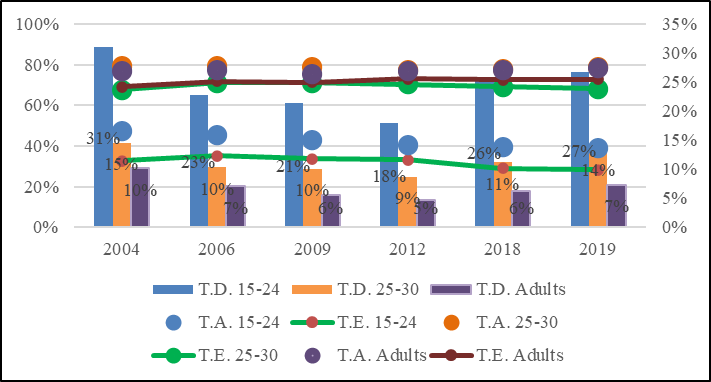
Figure 1
Labour force participation rate and employment rate left axis and unemployment rate right axis by age Urban conglomerates Argentina 20042019
Note: T.A: labour force participation rate; T.D: unemployment rate y T.E: employment rate. Source: authors’ calculations based on EPH-INDEC.
After the great local recession of 2001-2002, youth participation presented a high rate in the early years, surpassing even the longest-lived segment. This situation was reversed in the decade during the strength of the economic recovery, which allowed for better educational opportunities for young people regardless of productive tasks.
The considerable decline in youth unemployment up to 2012 was explained by the fall in the activity rate; job creation at the young age segment proved to be weak. In fact, part of this young population, instead of turning to the labour market, moved towards education, and their contribution to the household budget also fell. Not only have young people gradually left the labour market, but also those who remained did so with less intensity and relevance for the household.
However, those young people who decided to enter the labour market faced major challenges. Unemployment rates remained by far the highest and have a notable presence in the under-30 segment; the economic downturn and the reduction in the number of new hires has had a full impact on new entrants. Although the downturn affected both young people and adults, it is the former who are contributing with the highest number of entrants, and thus who are hit by the highest relative unemployment. In turn, real employment-related hourly earnings are affected by the role of low (or lack of) seniority and experience in the job and therefore less specific human capital.
Increased educational attendance of young people does not necessarily imply a voluntary decision to study and remain inactive. Poor employment prospects may extend the educational pathway, masking an involuntary decision. Indeed, many young people, especially men, move directly from inactivity to employment, without going through a search process (unemployment).
The analysis of job qualifications helps understand the requirements of demanding sectors. In this sense, the observed gap between young people and adults at higher grades is not fully explained by educational attainment. While the mismatch is not unique to the former, it is larger among younger workers. The low demand for skilled labour is far from being matched by a growing supply, having expanded during the period under analysis (see Table 3 in the appendix).
At the same time, educational endowments do much less to explain the gaps in low grades, where young people have the same share as average in low (or null) education (see Table 4 in the appendix) but work more intensively in tasks with zero requirements (potential indicator of labour underutilization). These workers receive much less on-the-job training, sinking the indirect cost of layoffs as do the direct ones. Thus, the qualification mismatch among task qualification and formal education is larger for the low tail of the qualification distribution (unskilled workers and semi-skilled worker) and specially for women. In that sense, it presumably shows that job seekers focus on specific and cumulated experience for that kind of jobs (see Table 1 below and Table 3 in the appendix). As a result, principally for young employment, there are some inefficiencies that arise both in the labour market (the demand for and supply of workers/skills) and in the interaction between the labour market and the education and training system.
| 2019 | ||||||
| Educational under qualification | Matched | Educational overqualification | ||||
| Population | 21 30 years old | Population | 21 30 years old | Population | 21 30 years old | |
| Professional worker | 22% | 44% | 78% | 56% | - | - |
| Skilled Worker | 11% | 6% | 42% | 60% | 47% | 34% |
| Semi-skilled worker | 22% | 8% | 20% | 22% | 59% | 69% |
| Unskilled worker | 0% | 0% | 28% | 14% | 72% | 86% |
| 2009 | ||||||
| Professional worker | 25% | 36% | 75% | 64% | - | - |
| Skilled Worker | 13% | 6% | 41% | 56% | 45% | 38% |
| Semi-skilled worker | 28% | 14% | 20% | 20% | 52% | 67% |
| Unskilled worker | 0% | 0% | 41% | 20% | 59% | 80% |
Finally, the organisational structure itself adds an additional issue. The participation of young people in managerial and high-ranking activities is well below that of adults, also showing a decreasing trend. This is the case even despite a higher participation in occupations that operate with computerised systems and equipment, associated with a higher value added in the company. In this way, the hypothesis of the adjustment variable for the employing companies is reinforced, not only because of a lower cost of dismissal given their low seniority, but also because of the peripheral role in the company’s task schedule (easier to replace) and the lower specific skills in the tasks conducted.
The first impact of the pandemic on youth employment
Argentina started its confinement policy due to the COVID-19 health crisis in March 2020 (second quarter of 2020). In this regard, only essential jobs could perform face-to-face tasks, while the rest had to be reorganised virtually, which meant that some jobs could not be converted. Around the third quarter of 2020, period considered in our analysis, certain activities were recovering at a slow pace operating under strict constraints.
At present, as this paper is being written, economies are struggling to find solutions to the devastating impact of the Covid 19 pandemic. Among other aspects, it has overwhelmingly affected the labour market, expanding and exacerbating previous challenges and creating new ones. Young people face some of the major difficulties due to previous and completely new working conditions, in which the crisis disrupts the labour market (International Labour Organization [ILO], 2020). After a general agreement that youth unemployment rates double or even triple the aggregate proportions, it should not come as a surprise to observe the same proportion, even with alarming results reaching 35% of the unemployment rate for young workers. However, the reduction in the employment rate outweighs the unemployment result, concluding that another pattern is operating so that youth unemployment is not higher. The decline in participation of young people in the labour market was notable in the second quarter of 2020 (the pandemic peak), with only one in four young people deciding to participate in the labour market. In other words, despite increases in the inactivity rate in the population, the “discouragement effect” due to the harsh conditions for finding a job disproportionately impacted young workers.
The first impact of the pandemic in Argentina shows a downfall in the activity rate, in line with what ECLAC and ILO (2020) and Beccaria et al. (2022) find for Latin America as a whole. The 13 pp (percentage points) decline in the activity rate is remarkable among 25 –30-year-olds (Table 3), with a noteworthy recovery that barely achieves 6 pp when some restrictions were abandoned, and as for the 15-24 age range the decline is proportionally larger. Although the plunge affected both men and women in similar proportions, for the 25-30 age group there was a disproportionate impact on women.
In the third quarter, not only many young people return to the labour market, but also the unemployment rate declines as job creation outstrips both variables. For the employment rate, both total population (12 pp) experiences a plunge in the second quarter as a recovery of 5 pp as young people replicates that tendency (Table 3). In the 25-30 age group, the employment rate stood at around 69% in the period 2004-2019, but in the second quarter of 2020 it dropped 14 pp. Moreover, the 15-24 age range stood at 17% during the most severe restrictive measures, a reduction of 11 pp compared to pre-pandemic levels.
The downfall in the employment rate affected both men and women relatively equally for both total population and young people, but it is worth noting that in the case of the 15-24 age group, women were reached by a decline of just over 45% in employment (due to its lower comparation base), while for men the decline was 28% (but larger in percentage points (13 pp). In the third quarter, despite a significant recovery in the employment rate, it does not make up for the collapse in the previous quarter. The employment rate for 15-24 years recovers only a third from pre-pandemic levels, while that share turns to a half for 25-30, close to the rest of adult population. On the other hand, while young recovery presents a similar dynamic no matter the gender, for adult population it is larger for males.
As a result, the increase in the unemployment rate was significant both in the adult population (where it increased by 33%, 2.4 pp) and for the “young adults” profile (Table 3). However, and more dramatically, for the 15-24 age group, unemployment rose to 34%, with an increase of 7.4 pp. It is worth clarifying that, as stated by ECLAC and ILO (2020), young people were already facing increasing difficulties in labour markets, both in obtaining employment and in terms of income. The period 2004-2019 was not particularly auspicious for Argentine youth employment, with the unemployment minimum in 2012 overlapping with the last peak in Argentina’s economic cycle. Thus, its macroeconomic elasticity identifies 2020 as one of the greatest losses for young people.
Disaggregating the evolution of unemployment by gender, we observe a dissimilar impact on men and women according to age groups, even for young people: 15 to 24 years men’s increase is around 4 pp while young women’s is around 12 pp (besides presenting a low starting point). For the rest of the age distribution, the gender gap increase is less wide, both for the plunge and the recovery with men almost returning to the pre-pandemic share. Nonetheless, for the youngest males, the economic retrieval displays 25% recovery in the unemployment rate, in place of a half for youngest women. While in the 15-24 age cohort unemployment grew by 18% in men compared to 40% in women, in the 25-30 age group the unemployment rate in women increased by 11% and in men by 26%. It should be noted that, even though unemployment has affected men more than women in the adult population, the unemployment rate for women remains higher than for men in all age groups, reflecting persistent gender asymmetries.
In the third quarter of 2020, despite the unemployment rate decrease from the pandemic peak for the adult population, it is placed by 20% above the second quarter of 2019. Young people aged 15-24 come up with 4 pp lower than in the second quarter but 4 pp above pre-pandemic rates. For the 25-30 age range, the recovery is steeper, and the unemployment rate is back to the previous levels of the second quarter of 2019.
However, new entrants intensify the usual challenges. At first, the working hour intensity not only failed to return to previous measures, but also continued its decline (partly due to the part-time scheme). A fall in average working hours between 2019 and the second quarter of 2020 is found in the adult population as well as in young people. The fall in the 15-24 cohort affects women (13%) more than men (9%). Nevertheless, by the third quarter of 2020, the population aged over 30, slightly recovers but not reaching 2019 levels, as a stronger process for 25–30-year-olds, achieving pre-pandemic figures. A different story can be told for the 15-24 age group, whose average working hours continue with its tumble (Figure 2).
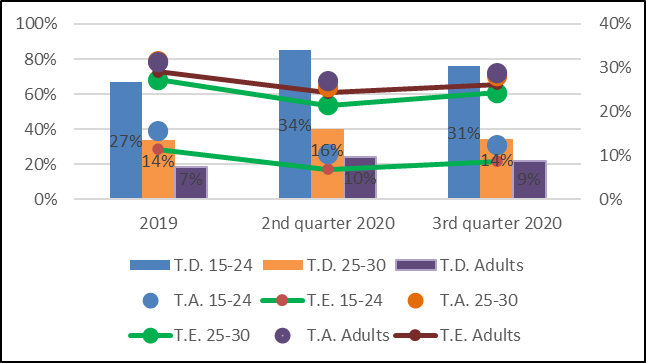
Figure 2
Labour force participation rate and employment rate left axis and unemployment rate right axis by age Urban conglomerates 20192020
Note: T.A: labour force participation rate; T.D: unemployment rate y T.E: employment rate. Source: authors calculations based on EPH-INDEC.
As would be expected, in the context of widespread job losses, the first to suffer the effects are employees who are not registered in the social security system. Likewise, youth informality rates range at almost 65% requiring a thorough review to find such ratios (post-crisis period). Hence, the rate of informal workers for the adult population decreases by 33% between 2019 and the second quarter of 2020, falling to an absolute minimum in the 21st century. In the age range of 15–24-year-olds the decline is milder (14%), but for the 25-30 age range the fall is no less than 21%. This result is even more shocking after the decrease in non-registration in the pandemic crisis, not due to a formalisation process, but because of job destruction. Moreover, it is especially exacerbated for young women, whose rising unemployment rate was the highest during the pandemic, as informal women workers were the ones who were initially removed from their jobs.
In terms of real hourly employment-related earnings, the 57% increase in the adult population between the end of 2019 and the second quarter of 2020 is striking, both because of the decrease in working hours and due to a decrease in employment of informal employees who tend to earn lower labour income given their non-registration status in social security. For the young, there is a similar setup, but the levels differ in the 15-24 age group: the increase in real labour income between 2019 and the second quarter of 2020 is 35% (24% for males and 54% for females). Then, in the third quarter of 2020, earnings fell again coinciding with the re-entry of unregistered employees. The 25-30 age range shows an increase between Q4 2019 and Q2 2020 of 60%, higher than the adult population. The situation was more beneficial for men (74%) than for women (37%). By the third quarter of 2020, with the re-entry of employees not registered for social security and the increase in working hours, real hourly labour earnings fell by 20% compared to the second quarter but remained above 2019 levels.
The difference in the outcome on employment-related real hourly earnings by age and education level is also striking. In the 15-24 age group, the largest increase is seen in the tertiary/university incomplete and secondary incomplete strata. Disaggregation by gender shows that the effect is more pronounced for women in the incomplete and complete secondary tertiary/university strata, more than doubling the hourly labour income in 2019. Whereas in the 25-30 age range, the largest increase is found at the tertiary or incomplete university level. The effect is verified for both women and men.
Overall, the implications of employment shocks on average income should be treated with caution. The “pandemic peak” pay rise should not be assumed to be a new version of the 2018-2019 collapse. On the contrary, workers with the worst employability gradient (informality, temporary work, part-time, low-skilled) are taken out of the income distribution as they are the first to face the consequences of the pandemic crisis. That is, the lower tail of the distribution, overwhelmingly represented by younger women and low-skilled workers is drawn out, so that average income rises. Consequently, the (slow) recovery in the third quarter sets up a decline for all individual attributes, as precarious employment that had been withdrawn from the market starts to be promoted. Still, real hourly earnings are below the pre-pandemic target, concluding that the extent of the crisis is far from being surmounted.
Data base and methodology
Undoubtedly, entry into the labour market is a milestone in people’s lives, as well as in their transition to formal education. Thus, any estimation and weighting effort must first assume the effect of education on employment, which should not exclude the consideration of the wide range of variables involved (individual attributes, the task performed, the productive sector, the quality of the job, the hourly intensity and, of course, its remuneration).
The complexity in identifying both individual education and the aggregate schooling range of a specific population correlates with employment-related real hourly earnings for a wide number of reasons, but does not necessarily infer causality (Morduchowicz, 2004). Different studies use instrumental variables for a more precise conclusion. Some of the best known is the use of birth quarters as an instrument of individual education (Angrist & Krueger, 1991), or compulsory schooling laws and minimum age to enter the labour market (Acemoglu & Angrist, 1999).
Gender-sensitive studies are noteworthy for adjusting female earnings given women’s registration in the labour market. Those with the highest educational endowment tend to have the highest activity rate and therefore their educational returns are overestimated in the total sample (or discrimination is underestimated). Although different studies incorporate Heckman’s methodology for the gender variable, they do not do so specifically for youth employment. Recent research does focus on this area; for young women in Malawi, the earnings estimation bias is corrected against men (Kim, 2020). However, once again the focus is on gender issues and not on the youth segment of the age distribution. Given the gap observed in this literature, especially for Argentina, this paper proposes to use Heckman’s methodology to estimate the determinants of real hourly income of the main occupation for the young age group.
Data from the Argentinean Household Living Conditions Statistics (EPH for its Spanish acronym) is the micro data used to retrieve individual and labour characteristics such as level of schooling, activity status, skills, employment-related income and working hours, among other variables relevant for the proposed models. Thus, according to the different economic cycles for the period 2004-2020, the real hourly employment-related income of the main occupation will be estimated and deflated using the index of the basic food basket in income poverty measurements.
Heckman correction
For the estimation of the real hourly employment-related income determinants of the main occupation for the young age group, two models are proposed. The first uses an ordinary least squares (OLS) linear regression, while the second model incorporates a Heckman correction for the inactive population. In this way, the functional form of the models is presented:

Where ln w is the logarithm of the real hourly wage, NivEd is the Educational Level (incomplete high school, complete high school, incomplete higher education y complete higher education), CatOc is occupational category (private-sector formal worker, private-sector informal worker, public-sector formal worker, public-sector informal worker, self-employed and employer) and T corresponds to time dummies. In addition, the model has control variables (xi ) such as region of Argentina, age, and sectorial categories.
Additionally, the Heckman equation includes the variable lambda (λ), corresponding to the Mills inverse to control for selection bias from non-randomly selected samples or incidentally truncated dependent variables (Heckman, 1979). Finally, u., v. and e. correspond to shocks or residuals from their respective models.
The Heckman model has two stages which come together for one outcome. The first one includes the selection equation, which will determine the probability of entering or not in the labour market, and therefore a reweighing of the sample. Meanwhile, the second stage is a multivariate regression that controls influence on income of sociodemographic characteristics and labour insertion.
In the first stage of the Heckman model, the variable returned for the “Inactive” column takes the value “1” if the individual is employed, while otherwise it takes the value “0” if the individual is inactive (non-labour force individuals). In this case, the selection bias comes from not observing those young people who decide, for voluntary reasons frequently associated with education, or involuntary (demotivation), to postpone their entrance into the labour market. Note that the sample on which the regression is applied will consider the characteristics of those who enter the market versus those who, for one reason or another, do not. Thus, a sample reweighing will be necessary to correct the bias of considering exclusively those who declare income from the subpopulation who work.
Consequently, an issue of crucial importance is to establish the variables that make up the selection equation that seeks to correct the course of the selection bias. The benchmark was not easy to set and is certainly open to criticism. To overcome this difficulty, a detailed descriptive analysis of the labour market and the income dynamics of the young age group was carried out. In this sense, abundant literature was considered in search of certain consensus on the matter and recurring phenomena.
One of the main variables conditioning labour market entrance is the individual’s gender. Given its importance, this paper runs the two-stage regressions separately for men and women. Therefore, the weights of the determinants of real earnings related to hourly employment for each gender and age range can be seen.
Accordingly, the occupational gaps for young female workers compared to their adult peers are significant. In addition, a significant share still lives in the family home: they are neither heads of household nor wives but “daughters” (Bertranou & Casanova, 2015). Given the apparent lack of need to perform productive tasks, it is understood that many women assume, exclusively, domestic, or reproductive tasks. Holzer and LaLonde (1998) conclude that the main source of instability for young women is linked to marital status and the presence of children, based on the high rates of voluntary transition to inactivity (resignation instead of dismissal) among those who dropped out of high school. Considering that many young people who neither study nor work are women, caregiving tasks should have a relevant explanatory power in Argentina’s youth insertion.
Another determinant of young people’s entry into the labour market is the socio-economic position of the household (PosHog) data that arises from the household survey EPH. It is possible to think that households with larger resources can outsource or hire private services, alleviating their own young members. Meanwhile, low-income households spend a large part of their members’ time on domestic tasks, limiting their ability to enter the labour market.
Furthermore, its inclusion in interaction with the gender variable is of special interest. From a classical perspective, the rational choice of women would lead to a lower workload, or non-insertion in the labour force, making employment compatible with caregiving and reproductive functions. These tasks rely without exception on women, especially in households that lack resources. It could then be thought that the family “chooses” which members oversee these tasks (maximization of joint utility, instead of individual leisure-work maximization). In this sense, Trombetta et al. (2019) show an income effect for the upper quintiles, reducing the gender gap in unpaid care tasks. This is explained by a decrease in the time spent by women in wealthier households on unpaid household chores.
There is also an interaction between socio-economic status and childcare, therefore, the second variable in the selection equation is the presence of minors in the household (PresNi), given that households with higher resources spend more time caring for their children than their lower quintile peers (Batthyány & Sánchez, 2020). This phenomenon is also repeated in developed countries; “time with children” is presented as a luxurious good. Guryan et al. (2008) find for a group of developed countries that those parents with higher income and educational level spend more time with their children than those in the lower tail of the distribution. Higher household resources are correlated with more time spent on parenting, contrary to what would lead to a higher opportunity cost.
Therefore, the income distribution by quintile is included as a per capita household variable that controls the socio-economic position of the household. This contemplates movements based on monetary perception and demographic reasons, as well as considering the number of members in the household. At the same time, the presence of children is added as a control variable, separating their care from the rest of the domestic tasks. On average, 65% of young people who neither study nor work live in households where children under fourteen are present (Bertranou & Casanova, 2015).
It should be noted that this study includes not only the presence of children in the household but also minors, considering any kinship relationship with the analysed individual. Also, female activity shrinks with the increase of minors at home, while the male activity rate rises. In this sense, women are less likely to seek paid work outside the household, while men are induced to search for family income in the labour market.
As a result, the three variables considered, both individually and its interaction, present non-neutral effects on the labour participation and hourly intensity. Therefore, these controls are included to correct a selection bias found in the sample analysed for the young segment. (Heckman, 1979)
Results and Discussion
In this section, the results of Heckman’s selection equation for both men and women are shown and analysed. It is observed that the lambda variable is significant, which provides evidence to assert that there is selection bias in the population group of 15 to 30 years old. In addition, the variables chosen for the selection equation, the presence of minors at home, children under age 3 and the economic level of the household, turn out to be explanatory to the selection bias of young people as a population group.
The description and analysis of OLS results shed evidence regarding the determinants of young people’s hourly work income. The strongest explanatory variables are the level of education as an endowment of human capital, and the quality of the job.
Thirdly, it points to the first effects of the pandemic on the determinants of young employment in Argentina, providing elements to argue that both the selection equation and the results of the OLS are not modified.
Results of Heckman's selection equation
Concerning the selection equation, on the one hand, the significance of the “lambda” variable implies that the sample correction is relevant, and, therefore, there is a selection bias for the young stages. In this case, it is observed that the sign of the variable “lambda” is negative and significant, showing that the ordinary least squares regression (OLS) overestimates the coefficients due to a selection bias. In other words, those individuals who are inactive will demand a higher income than those who are employed.
Thus, the variable referring to children in households under 3 years of age is always significant and positive for men, increasing the individual’s probability of being employed. According to the higher household requirements, note that the need to internalise productive tasks is clearly verified in the male distribution. In the case of young women, it presents a much more diffuse pattern. For the 15 to 25-year-old segment, it is slightly positive: young women also take on productive tasks in the presence of minors, although with much less probability than in the case of men. However, reverse results are exposed for those between 26 and 30 years old, where having minors at home entails a lower probability of entering the labour market. The latter is in line with what the literature describes for the internalisation of both care and reproductive tasks.
Therefore, considering households with minors, the opportunities to enter the labour market decrease for women, since productive and paid tasks are intensively assumed by men, even more likely than in the case of non-dependent members. At the same time, the fact that an older age corresponds to a higher hourly employment-related income and a lower activity rate, reproductive tasks could be understood as a luxury good. In this way, one would expect a greater time distribution in childcare by mothers with higher incomes.
Socioeconomic household backgrounds have strong implications for labour market insertion. The results show that the higher family income per capita, the larger the chances of being employed. This inference would contradict the relationship between higher income households and young people postponing their entry into the labour market due to higher educational attainment. However, although a significant share of the inactivity rate is explained by non-economic activities such as education, another fraction is due to involuntary reasons.
Inactivity among young people is, in many cases, only a place on the pathways between unemployment or informal occupations. Frequently, it is associated with involuntary reasons such as erratic mobility or involuntary exit from the labour market because of demotivation. Young people present a higher labour mobility and move more intensely into unemployment and inactivity, in addition to presenting greater friction from unemployment to employment. Consequently, family budget does not seem to present significant differences between active and inactive young people, especially at the extremes of the distribution (Maurizio, 2011).
It should be mentioned that the dichotomic states are occupation and inactivity, leaving out the unemployed, who could be identified with the worst vector of individual characteristics. Although the unemployed are part of the active population, since they do not declare any income, they cannot be included in a typical income regression. In summary, the importance of socioeconomic background presents a clear gender bias for adolescent employment, where the impact is higher for women. Although not exclusively, but specially for them, belonging to high income households makes a larger extent both in obtaining a job and in the expected income.
Results for young real hourly employment-related income determinants
For the general regression, the contributing factors that make up labour compensation are analysed. These include the above-mentioned contributions of the two theoretical streams. Both the human capital approach (on the labour supply side) and the labour segmentation and productive heterogeneity (on the demand side) are combined to achieve an analysis that encompasses the influencing factors. The first highlights the educational improvement, including across the different individual credentials, age, and gender. On the labour demand side, different job characteristics such as type of employment and productive sector are added up.
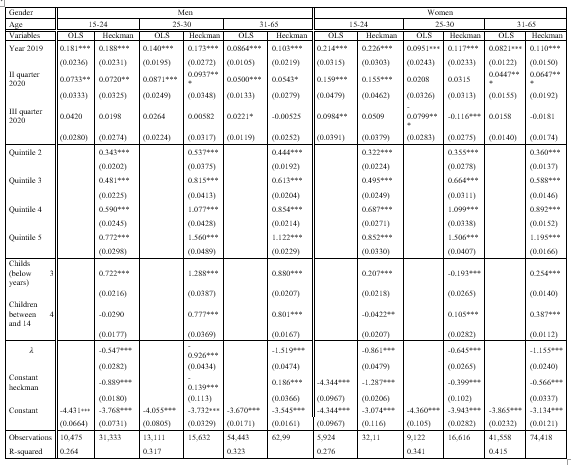
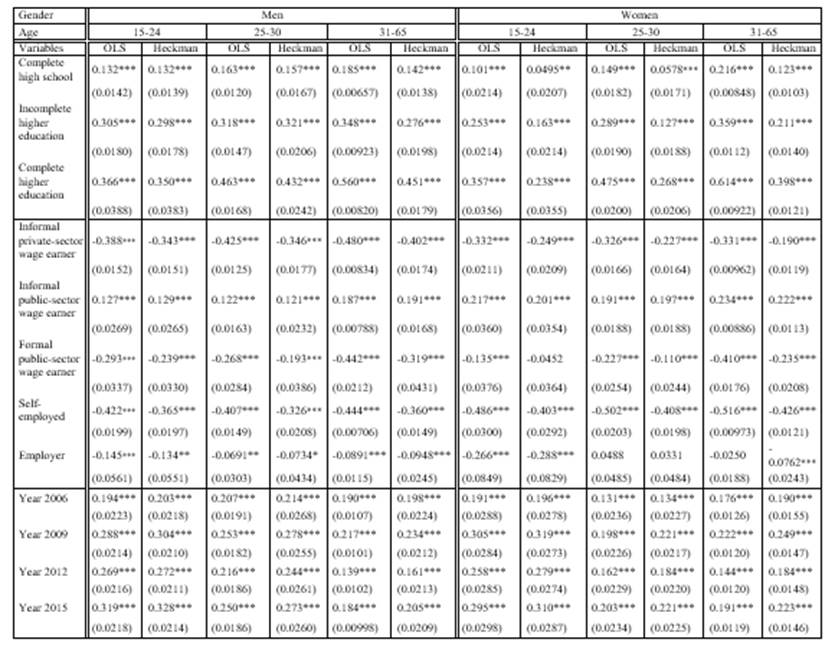
Table 2 shows that gender differentiation displays a coefficient with strong differences between the “corrected” model and the ordinary least squares linear regression. For inactive women, who present a lower human capital endowment than the observed in the specific sample, any discrimination is greater than the observed. For the total female distribution, the difference between market income and reserve income is usually considered, with the latter depending on personal characteristics and the stock of human capital, while the former only on human capital (Perlbach de Maradona & Calderón, 1998).
If the variables for the distribution of young people are controlled, the coefficient acquires a significant negative value. This underestimation is because the vector of characteristics of those employed and earning income is larger than that of the excluded population. Only for the 15-20 segment does it turn positive, showing that those young people who choose to stay out of the labour market would have the largest endowments. This may be due to a good proportion of women remaining inactive while increasing their educational qualifications, thus postponing their entry into the labour market and earnings.
The remaining coefficients of the Heckman regression maintain the same correlation as a “censored” regression. Returns to education show a non-linear relationship: the higher the credentials acquired, the more than proportional growth of “educational prize”. The corrected regression entails lower values, and it can be thought that there are several individuals with high endowments who did not enter the labour market.
The occupational category takes the private-sector formal wage earner as a reference, and their hourly income is only surpassed by formal public-sector wage earners, consistent with the best hiring conditions offered by the sector. Meanwhile, the remaining categories are at a disadvantage, with informal private-sector wage earners and the self-employed standing out. Note that the negative impact is higher for young people than for the total distribution. On the other hand, for both hiring categories, on average, public sector earnings are higher than private sector earnings, a crucial factor due to the extent of the Argentine public sector. The low participation of young people in the latter is caused by both lower earnings and higher informality.
The first impact of the pandemic on the determinants of young people’s income
Regarding periodical checks, the results are important to verify the first impact of the pandemic on young people’s work. First, it should be noted that compared to 2004 real working income schedules increased steadily until 2015, which coincides with the boom in the economic cycle in Argentina. By 2019 revenues continue above compared to 2004 but fall from 2015 onwards due to the macroeconomic crisis, this result provides an indication to explore, in further work, the correlation between young people’s real hourly employment-related income and fluctuations in GDP.
However, the results for the second quarter of 2020 showed a slightly positive sign with little significance, reinforcing the explanations evaluated above, i.e., the actual working income of young people increased during the pandemic year due to the forced departure of informal workers who have the lowest income along with the fall in working hours due to confinement.
Finally, it should be noted that the results from regressions for both the second and third quarters of 2020 show no change in the determinants of young employment and their income, the most relevant characteristics remain the endowment of human capital and the job quality. However, it is possible to quantify a first effect of the pandemic at actual incomes which depends on the chosen model (see Figure 3). The Heckman correction exposes a larger reduction in earnings due to the worse individual attributes of those who stay away from the labour market. The impact is found to be greater for men, strengthening the results of the descriptive section.
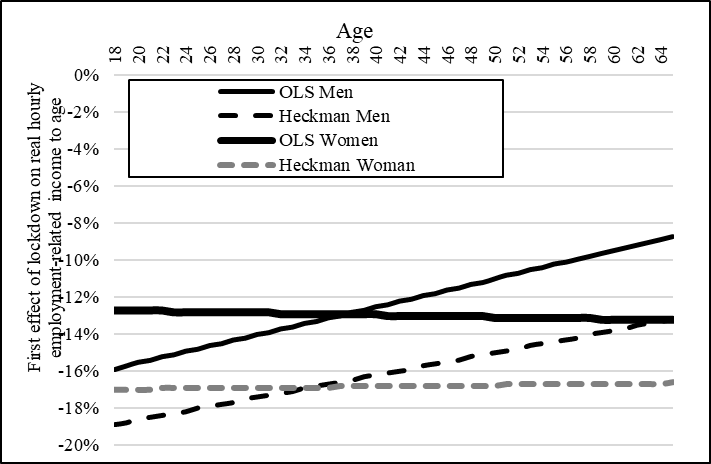
Figure 3
First effect of lockdown on real hourly employmentrelated income to age
Source: authors’ calculations based on EPH-INDEC.
Conclusions
As described in the second section, youth employment shows a pattern of vulnerability to the adult population throughout the period. In line with the articles referenced both nationally and internationally, there is a clear gradient of job fragility for young people. This profile of labour vulnerability is summed up in higher unemployment rates, less job absorption and higher precarious and informal employment than the adult population. On the one hand, the marked instability and labour intermittency stems from persistent macroeconomic volatility. In this way, young people are more affected during the general economic recession with a higher rate of layoffs, falling real hourly employment-related income and fewer hires, processes that disrupt the renewed flow of new participants with greater intensity than the adult population. At the same time, there is also a clear distinction between young people and adults in the phases of economic recovery, with slower and more erratic trends for young people, as shown by the fledgling post-lockdown recovery (third quarter 2020), even clearer for those aged 15-24.
At the time writing, economies are struggling to find solutions to the devastating impact of the Covid 19 pandemic, which overwhelmingly affected the youth work, expanding and exacerbating previous challenges and creating new ones (Velasco, 2021). They face some of the main difficulties due to preceding working conditions, while presenting new channels in which the crisis hit disturbs the labour market. After young unemployment rates double or even triple the aggregate ratios, pandemic brings alarming results that reach a 35% of unemployment rate. At the same time, the decline in the young labour participation was remarkable during the pandemic peak, in which only one in four young people decided to participate in the labour market. Despite the inactivity rate increases in the population overall, the “discouragement effect” (due to the tough conditions to find a job), disproportionally hits young residents.
In a like manner, the hard outcomes are expressed in the recovery, too. In the third quarter, as some restrictions were abandoned, many young people returned to the labour market, and the unemployment rate presents a decline as job creation outpaces both variables. However, new entrants exacerbate the usual challenges. At first, the hourly intensity continues its decline (partially due to part-time scheme). Likewise, the young informality rates range almost 65% requiring an extensive review to find such ratios (post crisis period). This result is even more shocking after the non-registration dwindling in the pandemic crisis, not due to a formalization process but also for job destruction. Moreover, it is specially amplified for young women whose increasing unemployment rate was the largest during the pandemic as the informal workers were those who initially were removed from their jobs.
These job disruptions during the first impacts of the pandemic have their implications on middle income, so the results must be understood wisely. The increase in real hourly labour income should not be assumed as a reversal of the collapse of 2018-2019. On the contrary, during the second quarter of 2020, young workers with worse working conditions (informality, temporary work, part-time, low qualifications) and therefore low incomes lost their jobs, which allows for an improvement in real hourly income because of the suppression of the lower tail of the distribution.
As a result, the subdued and slow recovery of employment in the third quarter of 2020 leads to a decline, for all individual attributes, in real earnings related to hourly employment, as precarious employment that had been eliminated from the youth labour market begins to recompose itself. The outlook for youth employment in Argentina’s urban agglomerates shows the vulnerability of the younger generations in their insertion in increasingly precarious jobs with lower educational requirements and in productive activities that exhibit less stability and low labour supply relative to the adult population.
This situation reveals itself in econometric models. In turn, the contractual employment relationship displays the largest explanatory coefficient for income, even above the educational level. Thus, the smaller scope of the labour formalization process significantly explained the income differential for the youth-adult dimension. Labour contract relationship is in line, on the one hand, with a marked sector insertion profile, where hiring takes place in industries that are intensive in unstable jobs. On the other hand, it does so with occupational qualification and higher performance in secondary positions for which on-the-job training is marginal.
The worst working conditions should not be associated with the characteristics of youth la-bour supply since the increased participation of young people in low-skilled tasks does not correspond to educational levels achieved by the young population, which is even above the credentials of the population average. There is also a marked overqualification in the jobs that young people have and few matches between credentials (offer) and job qualifications (demand). This is also verified in the performance of more elementary tasks within the organization chart of companies, accessing positions more expendable to a greater extent than the adult population. This situation reinforces the increased labour turnover of young people due to the lower costs of direct and indirect redundancy (little experience) that favour youth layoff. It suggests a vicious cycle in which young people are inserted with an employment profile that generates conditions which facilitate their exit from the labour market or periods of unemployment.
The belief of a selection bias for the participation (or not) in the labour market by young people, makes a choice for a Heckman model, which is essential to understand the determinants of working income hours in the youth population. Empirical evidence was found about selection bias in gender-related youth, the presence of children at home, and the socioeconomic level of the family. Thus, for women the probability for reinforcing the labour participation increases along with the economic level of the family and the absence of children at home. For males, however, the presence of minors increases the likelihood of entry into the labour market, taking on more productive tasks in the labour market. Therefore, it is supported that women’s transitions are associated with involuntary intermittency as sensitivity to the economic cycle are confirmed.
Finally, to overcome the challenges of young people, the creation of high-quality jobs is mandatory, but specific promotion of public policies is also required to address the labour insertion and education link.
References
Acemoglu, D., & Angrist, J. (1999). How large are the social returns of education? Evidence from compulsory schooling laws. National Bureau of Economic Research. https://doi.org/10.3386/w7444
Angrist, J., & Krueger, A. (1991). Does compulsory school attendance affect schooling and earnings? Quarterly Journal of Economics, 106(4), 979–1014.
Batthyány, K., & Sánchez, A. (2020). Profundización de las brechas de desigualdad por razones de género: el impacto de la pandemia en los cuidados, el mercado de trabajo y la violencia en América Latina y el Caribe. Astrolabio, (25), 1–21. https://doi.org/10.55441/1668.7515.n25.29284
Beccaria, L., Bertranou, F., & Maurizio, R. (2022). Le COVID-19 en Amérique latine: Les effets sur l'emploi et les revenus d'une crise sanos précédent. Revue Internationale du Travail, (161), 95–118. https://doi.org/10.1111/ilrf.12232
Beccaria, L., Maurizio, R., & Vázquez, G. (2015). Recent decline in wage inequality and formalization of the labor market in Argentina. International Review of Applied Economics, 29(5), 677–700. https://doi.org/10.1080/02692171.2015.1054369
Bertranou, F., & Casanova, L. (2015). Trayectoria hacia el trabajo decente de los jóvenes en Argentina: Contribuciones de las políticas públicas de educación, formación para el trabajo y protección social. International Labour Organization.
Bussolo, M., Dávalos, M., Peragine, V., & Sundaram, R. (2019). Toward a new social contract: Taking on distributional tensions in Europe and Central Asia. World Bank. https://doi.org/10.1596/978-1-4648-1353-5
Economic Commission for Latin America and the Caribbean [ECLAC] & International Labour Organization [ILO]. (2020). La dinámica laboral en una crisis de características inéditas: Desafíos de política (Coyuntura Laboral en América Latina y el Caribe, Nº 23). Santiago de Chile.
De Ibarrola, M. (2016). Claroscuros en las relaciones entre la escolaridad y el trabajo: Configuraciones y límites. Revista Páginas de Educación, 9(2). https://doi.org/10.22235/pe.v9i2.1293
Guryan, J., Hurst, E., & Kearney, M. (2008). Parental education and parental time with children. Journal of Economic Perspectives, 22(3), 23–46. https://doi.org/10.1257/jep.22.3.23
Hanushek, E., & Woessmann, L. (2009). Schooling, cognitive skills, and the Latin American growth puzzle (Working Paper 15066). National Bureau of Economic Research. https://doi.org/10.3386/w15066
Heckman, J. (1979). Sample selection bias as a specification error. Econometrica, 47(1), 153–161. https://doi.org/10.2307/1912352
Holzer, H., & LaLonde, R. (1998). Job changes and job stability among less-skilled young workers. Michigan State University.
International Labour Organization [ILO]. (2020). Los jóvenes y la Covid-19: efectos en los empleos, la educación, los derechos y el bienestar mental.
Jacinto, C., Wolf, M., Bessega, C., & Longo, M. (2005). Jóvenes, precariedades y sentidos del trabajo: Nuevos escenarios en el mundo del trabajo: rupturas y continuidades. ASET.
Kim, S. (2020). Gender earnings gap among the youth in Malawi. African Development Review, 32(2), 176–187. https://doi.org/10.1111/1467-8268.12426
Maurizio, R. (2011). Trayectorias laborales de los jóvenes en Argentina: ¿Dificultades en el mercado de trabajo o carrera laboral ascendente? CEPAL.
Morduchowicz, A. (2004). Discusiones de economía de la educación. Losada.
Osterman, P. (1980). Getting started: The youth labor market. MIT Press.
Pérez, P. (2018). Inserción laboral de jóvenes y desigualdades de género en la Argentina reciente. Revista Reflexiones, 97(1), 85–98.
Perlbach de Maradona, I., & Calderón, M. (1998). Estimación del sesgo de selección para el mercado laboral de Mendoza. XXXIII Reunión Anual AAEP, Mendoza. AAEP.
Topel, R. H., & Ward, M. (1992). Job mobility and the careers of young men. Quarterly Journal of Economics, (197), 439–479.
Trombetta, M., Micha, A., & Pereyra, F. (2019). Determinantes del tiempo de trabajo de cuidado y brechas de género. LIV Reunión Anual AEEP, Bahía Blanca. AEEP.
Velasco, J. (2021). Los impactos de la pandemia de la Covid-19 en los mercados laborales de América Latina. Revista Compendium: Cuadernos de Economía y Administración, 8(2), 99–120. https://doi.org/10.46677/compendium.v8i2.935
Zimmerman, S. (2018). Elite colleges and upward mobility to top jobs and top incomes. American Economic Review, 109(1), 1–47. https://doi.org/10.1257/aer.20171019
Appendix
Standard errors in parentheses
*** p<0.01, ** p<0.05, * p<0.1
*Regional, age and sectorial controls are included
| 2019 | 2020 2Q | 2020 3Q | ||||||||
| 15-24 years | 25-30 years | 30-65 years | 15-24 years | 25-30 years | 30-65 years | 15-24 years | 25-30 years | 30-65 years | ||
| both genders | Labour force participation rate | 38,7% | 78,9% | 78,5% | 26,1% | 63,8% | 67,3% | 31,0% | 70,5% | 71,8% |
| Employment rate | 28,4% | 68,2% | 72,7% | 17,2% | 53,6% | 60,8% | 21,5% | 60,8% | 65,6% | |
| Unemployment rate | 26,8% | 13,6% | 7,3% | 34,1% | 16,1% | 9,7% | 30,5% | 13,7% | 8,7% | |
| Men | Labour force participation rate | 45,9% | 90,2% | 90,4% | 30,1% | 76,0% | 79,1% | 35,1% | 82,3% | 84,8% |
| Employment rate | 34,8% | 79,3% | 84,0% | 21,5% | 64,5% | 71,1% | 25,5% | 72,2% | 78,2% | |
| Unemployment rate | 24,4% | 12,0% | 7,1% | 28,5% | 15,2% | 10,1% | 27,5% | 12,3% | 7,7% | |
| Women | Labour force participation rate | 31,4% | 67,5% | 67,9% | 21,9% | 52,1% | 56,7% | 26,7% | 59,2% | 60,5% |
| Employment rate | 21,8% | 56,9% | 62,8% | 12,7% | 43,0% | 51,5% | 17,4% | 49,9% | 54,5% | |
| Unemployment rate | 30,4% | 15,7% | 7,5% | 42,1% | 17,3% | 9,2% | 34,6% | 15,6% | 9,9% | |
| Both genders | Professional worker | 4% | 7% | 12% | 1% | 6% | 9% | 2% | 6% | 8% |
| Skilled Worker | 13% | 16% | 20% | 16% | 18% | 21% | 11% | 13% | 20% | |
| Semi-skilled worker | 48% | 54% | 50% | 46% | 52% | 53% | 54% | 58% | 55% | |
| Unskilled worker | 35% | 23% | 19% | 37% | 24% | 17% | 33% | 23% | 17% | |
| Men | Professional worker | 3% | 8% | 12% | 2% | 5% | 8% | 1% | 7% | 7% |
| Skilled Worker | 12% | 12% | 17% | 12% | 17% | 16% | 10% | 10% | 15% | |
| Semi-skilled worker | 51% | 58% | 61% | 48% | 57% | 65% | 54% | 63% | 67% | |
| Unskilled worker | 34% | 22% | 11% | 38% | 22% | 11% | 35% | 20% | 11% | |
| Women | Professional worker | 4% | 7% | 12% | 1% | 7% | 11% | 3% | 6% | 10% |
| Skilled Worker | 15% | 21% | 23% | 22% | 21% | 26% | 13% | 17% | 25% | |
| Semi-skilled worker | 45% | 47% | 38% | 43% | 45% | 39% | 54% | 51% | 40% | |
| Unskilled worker | 36% | 25% | 28% | 34% | 27% | 24% | 31% | 26% | 24% | |
| Years old | Incomplete high school | Full high school | Incomplete Tertiary/University | Full Tertiary/ University |
| 15-20 | 67% | 11% | 22% | 0% |
| 21-25 | 25% | 27% | 42% | 5% |
| 26-30 | 32% | 30% | 21% | 17% |
| 31-50 | 30% | 28% | 13% | 28% |
| 51-60 | 46% | 21% | 8% | 25% |