Artículos
Outline of a sociology of intimate troubles: The “passages” of a single self between Evangelicalism and crime
Esboço de uma sociologia dos problemas íntimos: As coabitações e “passagens” de um único self entre evangelismo e crime
 Diogo Silva Corrêa dioscorrea@gmail.com
Barbara Grillo barbararsgrillo94@gmail.com
Diogo Silva Corrêa dioscorrea@gmail.com
Barbara Grillo barbararsgrillo94@gmail.com
Outline of a sociology of intimate troubles: The “passages” of a single self between Evangelicalism and crime
Revista del CESLA, vol. 29, pp. 195-218, 2022
Uniwersytet Warszawski

Esta obra está bajo una Licencia Creative Commons Atribución 4.0 Internacional.
Recepción: 01 Mayo 2020
Aprobación: 01 Agosto 2021
Abstract: This article is a study on life trajectories and changes of the self of one single person, following the transformation processes that occurred in Rio de Janeiro’s favelas during the last two decades and focusing on the relationship between Evangelicals and drug traffickers. Based on an ethnography of almost two years in Cidade de Deus favela, the trajectory of a single individual, a former drug dealer and a crack addict who switched between the church and the traffic throughout the fieldwork process, is presented in what can be called sociology of intimate troubles or sociology of self-inquiry, that is, a methodology that aims to capture the actors through their problems.
Keywords: sociology of intimate troubles, sociology of self-inquiry, self, Evangelicalism, pragmatic sociology.
Resumo: Este artigo é um estudo sobre a trajetória de vida e as modificações de si de um único ator a partir dos processos de transformação ocorridos, nas últimas décadas, nas favelas do Rio de Janeiro, focando-se na relação entre duas formas de vida, a dos evangélicos e a do crime. Com base em uma etnografia de quase dois anos na favela Cidade de Deus, defendemos que a religião e o tráfico se apresentaram sob a modalidade de regimes normativos e formas de vida que se emaranham e se transformam mutuamente. Para isso, desenvolvemos o que chamamos de sociologia dos problemas íntimos, isto é, uma metodologia que visa apreender um único ator, em suas idas e vindas no tráfico e na igreja, através de seus problemas.
Palavras-chave: sociologia dos problemas íntimos, sociologia da auto-investigação, self, evangélicos, sociologia pragmática.
Introduction
This paper’s goal is to develop what is called sociology of self-inquiry or intimate troubles. From a particular case study that relied on a fieldwork of almost two years in Cidade de Deus favela of Rio de Janeiro, we describe the meeting with Charles, a convert, former dealer, and former crack addict, presenting the reasons for the enlargement of the initial approach and how such an enlargement was related to events in the fieldwork. Moreover, we describe how some theoretical backgrounds influenced the change in our approach as well as the methodology and the codification used to present Charles’s trajectory and alternating positions in respect to the Church. Afterwards, we carefully consider a turning point that occurred in his biographical trajectory in order to unfold two of the main existential dilemmas in Charles’ life: the relation between drug trafficking and religion, and the relation between different conceptions of drug trafficking. Finally, these existential dilemmas are related with with what Feltran (2014, 2020) called the “cohabitation of three types of normativities in Brazilian peripherical and poor places” (the state, the crime and the Evangelicalism) and some general theoretical implications of the sociology of self-inquiry or intimate problems are outlined.
Crime and religion in Brazilian favelas
At least since Valladares and Medina’s work, Favela e religião (1968), the relationship between crime and religion in metropolitan centers has been pointed as central for analyses on Brazilian urban dynamics. Following such trend, researchers based in cities such as Rio de Janeiro developed fruitful research agendas in which religion is sometimes acknowledged as a matter of faith and sometimes as an institution (Alvito, 2001; Vital da Cunha, 2008, 2014; Lins & Silva, 1990; Teixeira, 2011). Those transitions are evidence of a notorious and complex dynamics between public and private dimensions in territories ruled not only by the State, but also by crime and religions. Such diversity has been conceptualized as “normative regimes” by Feltran (2014, 2020). Even though Feltran analyzes São Paulo’s context, in this work we assume these normativities can also be found in Cidade de Deus.
During the 1990s, religions experienced deep transformations in favelas (see Vital da Cunha, 2014). Until the beginning of the 1990s, Afro-religions were popular in the landscape of Rio de Janeiro’s peripheral areas and drug traffickers from these localities, in general, frequented terreiros (places where Afro-Brazilian cults take place) in search of protection and other spiritual services. However, especially since the beginning of the 2000s, there has been a general change in the religious landscape of the peripheral regions, resulting from the decline of Afro-religions and a very strong growth in Evangelical movement. Since then, it has become more common to see traffickers attending Evangelicals’ services rather than terreiros (see Corrêa, 2015, part II). This process has been commonly treated as a matter of conversion of drug dealers and bandits, but in this work we name it “passages”, inspired by Birman (1996).
Throughout the 2000s, a growing literature on Evangelicalism and violence in Brazil set out to better unravel the complex relationships of approximation and proximity – or simply border shifts – between trafficking and the Evangelical church. Scheliga (2004, 2005) presents research that emphasizes conversions to Evangelicalism in penal institutions, focusing, above all, on understanding religious conversion by different employees of the technical-administrative staff of prison units in Paraná, Brazil. Dias (2008) conducted ethnographic research in prisons in São Paulo, seeking to correlate religious trajectories with prison population’s personal experiences of conversion. The work of Côrtes (2007) is also noteworthy, as the author presents her research with former bandits who, once converted, make a career as itinerant preachers. Thus, if the works of Scheliga and Dias explore conversion dynamics inside prison institutions, Côrtes’s research is about life “after conversion”.
However, the works that make a more direct dialogue about the relationship between drug trafficking or the normativity of crime and Evangelicals in Rio de Janeiro favelas are, without a doubt, that of Teixeira (2008, 2011, 2013) and that of Vital da Cunha (2008). While Teixeira is concerned with stressing the moral boundaries that demarcate the relationship between drug dealers and Evangelicals – that is, how cohabitation and proximity without mixing or reducing one another is possible –, always thinking of drug trafficking and the Church as alternative worlds, Vital da Cunha’s work underscores, in a distinct way, the transformations that the drug trade itself underwent as a result of the growth of this cohabitation process with Evangelicalism. Instead of thinking about a logic of alternation, like Teixeira, Vital da Cunha focuses on a coexistence logic, a point that will be explored further on.
While Teixeira focuses his research on “ex-bandits” seeking to describe the concrete conditions involving the passage of someone who belongs to the universe of crime to the universe of the Church – universes that undoubtedly maintain irreducible and well-defined moral and normative boundaries –; Vital da Cunha’s work is concerned with transformations that take place in the drug trade in Acari and its adherence to “Evangelical grammar”. In short, Teixeira describes the transition from “the bandit” to “the Evangelical” as a process of criminal “desubscription” through “spiritual liberation”, while Vital da Cunha describes the process of “evangelicalisation” of drug trafficking that occurred from the 1990s onwards in the Acari favela. This process has several similarities with what happened in Cidade de Deus.
This work intends to follow in the footsteps of the works of Vital da Cunha and Teixeira, by pointing how their ethnographic works shed light on important aspects that seem to share similarities regarding what could be found in Cidade de Deus, in another temporal way, within a trajectory of a single self.
The beginning of fieldwork
November 21st, 2011 was not the first time the favela Cidade de Deus was visited, but it was indeed the first fieldwork day. With the help of Beija-Flor, an old friend and a resident of the favela, a contact with preacher Zezinho do Galão was established. They had met that Monday afternoon in one of the places that, before the arrival of the Pacifying Police Unit (Unidade de Polícia Pacificadora, UPP), were one of the central drug-selling points in the area.
Luckily, Zezinho and other members of the Assembleia de Deus were conducting an outdoors sermon with the aid of loudspeakers in front of the samba school area, known for its weekend dances and parties – especially on Sundays. After Beija-flor’s first request, Zezinho immediately volunteered to help. When the intensions of doing research into religious conversion was disclosed, we were introduced to Maia, a former dealer and “ex-owner” (ex-dono) of the region of the favela where we were[1].
Shortly afterwards, the Church where most of Maia's ex-partners in crime are members, and Zezinho is a minister was visited. From the networking established in the first month of fieldwork resulted a meeting with Charles, a 24-year-old man who was an established member of the Church and who introduced himself as “Maia's fan in the past”[2]. As said before, Charles used to be a dealer and crack addict and had been thrown out of the favela and spent time outside until he converted and returned to live there. He is an Afro-descendent, frequently referred to as "chubby", and is around 5,10 feet tall. When I first met him, he had a shaved head, a neatly shaved beard, and was wearing pants and a formal shirt – the style he always adopted in his Church member periods. In November of 2011, I made the first long interview with him that lasted more than three hours. On that occasion, Charles talked about his life trajectory and presented the justifications for his conversion.
The redirection of the methodological approach
Initially, this research aim was to gather and systematize how the Evangelical group in Cidade de Deus justified their conversion and recounted their transitions and life changes. Inspired by the sociology of justifications of Boltanski and Thévenot (1991) the idea was to map out the moral metaphysics that anchored such individuals in order to justify that change from a specific identity condition to another. In other words, the research’s scope was to describe how Cidade de Deus Assembleia de Deus’s Church members assumed and justified the assumption of a new identity condition: before “dealer”, “criminal”, “homosexual”, “macumbeiro” and now “believer”, “Christian”, “man of God”. This involved describing something as more than the mere postulation of a new identity condition, since this assumption involved the addition of the prefix "ex"[3] to the former one: “ex-criminal”, “ex-addict”, "ex-gay", etc.
The initial approach was also influenced by some classical theories of conversion (Bankston et al., 1981; James, 2002; Lofland & Stark, 1966; Nock, 1998; Rambo, 1993; Richardson, 1978) and the way they always seemed to use a common structure, well summarized by Dewey’s theory of inquiry (1993). To sum up, the hypothesis employed by these authors is that, before the conversion process, there was a stable self that, given some circumstances, faced an indeterminacy that created an inner trouble. Such unstable self seeks to overcome the uncertainty and try to reach a new stable condition. To do so, he or she inquires and tries alternate possibilities in order to achieve a possible solution. Throughout this process, religion appears in a “problem-solving perspective” (Lofland & Stark, 1965). Finally, he or she finds a new stability through the religion adopted. The new self becomes not only stable but “unified and consciously right superior”, as William James would say.
However, an event during the fieldwork encouraged us to enlarge the initial approach: one day we were in front of Zezinho's house, leaning against the car that Zezinho used to deliver water, when Zezinho said: "Hey, you've already interviewed many people who are settled in faith. Why don't you interview the one who has difficulty in the process? I think that it could be profitable”.
This was the trigger for the changing and enlargement of the initial focus. First, going beyond the narrative of the converts turned out to be central. The reason was that it usually privileges a Manichaean perspective of two moments in life: before everything was awful, then everything was marvelous. Their narratives also tended to include all the past moments in a whole present. Once “Christian”, everything went on as if all that took place in the past was a transitory state, that is, elements “put by God” to prepare the person for the moment of the conversion.
A good example can be extracted from the interview made with Maia. When Maia was in the traffic, he practiced an Afro-Brazilian religion –"macumba", as they call it – and, in order to deal with the risky life that he was leading, that was how he looked for protection; now, converted to the Assembly of God, he says: "I practiced the macumba, because all the people in this life of crime need protection. Then I went to the macumba worships, wearing a lot of necklaces (guias) for protection, thinking that by doing it, I was protected. Nowadays I know that, as a Christian, it was God who protected me. It was not through slyness, shrewdness, my guns, or even my rifles. It was God who guarded me because He had a plan in my life.”
The conversion act always involves a retrospective explanation in which the last instants are completely reduced to the post-conversion moment. The orixás, the necklaces and even the guns are abandoned for protection obtained by the “new God”, who was only acknowledged much later. When the speech of the converts is taken up to its last consequences, it seems that Maia, once converted, and now quoting the famous title of Latour’s (1991) book, “has always been Christian” or “has never been a macumbeiro”.
In this sense, the new identity condition becomes the equivalent to what Latour calls “brute facts” or “black boxes” in science (1987) since the uncertainties, doubts and hesitations of the past moments are flattened and almost completely erased or forgotten. Everything is narrated as if the new identity condition had always been there to be discovered, producing something similar to what Bourdieu (1986) called “retrospective rationalization”. Contrary to that, our intention was to show how the self is temporal, that is, permanently subjected to the indeterminacy, and constantly reconstructed in the light of new experiences. Just as Latour, in his work with Woolgar Laboratory Life (1979), described science in the making, it would be interesting to do the same concerning the conversion itself. Why not try to follow the conversion process “in the making” with an “unstable believer” as it was proposed by Zezinho?
Another issue corroborated this intuition. After sharing the everyday lives of converts and interviewing some of them in-depth, it also seemed that, if on the one hand, the conversion might moderate old problems, this soothing was sometimes temporary and, more than that, the conversion itself was the source of new problems, conflicts, tensions and challenges. Thus, there has never been a stable self either after or before the religious conversion. A more reliable approach to understanding religious conversion should therefore show it not only as a lasting solution for certain problems, but also as the beginning for so many others.
An opposition between the previous “terrible and unbearable” and to the new “marvelous and idyllic” moments, typical of conversion narratives were actually limiting this research’s approach. Instead, it turned to the observation and depiction of the converts in time, understanding conversion as a temporal process, that is, as a moving flow of life. This option permitted us to remain closer to the concrete experience of those actors. In order to pursue that, however, the research redirection was necessary, and it was also of paramount importance to go beyond the interviews, which mainly focused on reports of life change through the lenses of religious conversion.
Theoretical framework influences
Pragmatic sociology, especially in the way it has been developed in France after the 1980s, has been useful for the reorientation of the theoretical framework. This sociological movement gave Dewey’s concept of inquiry a sociological facet, going from a philosophy of human inquiry’s elementary form to a sociology of actors’ inquiries. Boltanski’s and Thevenot’s (1991) work on justification is one of the best examples (cf. Corrêa & Dias, 2016, 2020; Corrêa, 2020, 2021). By describing how actors produce agreements in critical moments, they were able to analyze actor’s axiological inquiries when confronted with indeterminate and problematic situations. Following the pragmatic sociologists, especially the later developments made by what Francis Chateauraynaud (2011) called “sociological ballistics”, we attempted to do the same with respect to self-conceptions of the self, not presupposing what the conversion, moralities or realities of the individual were. On the contrary, we focused on how individuals, dealing with critical identity moments, conduct self-inquiries in order to stabilize a new identity condition.
In the same way that the French pragmatic sociologists (cf. Boltanski & Thevenot, 1991; Chateauraynaud, 2011; Latour, 2005) were able to envisage the social or society no longer as a collective consciousness (Durkheim) nor a structured structure (Bourdieu), but as a plethora of problematic flows maintained and modified over time by the actors’ (axiological or ontological) inquiries, a change of scale of analysis (Lahire, 1998; Lepetit, 1995; Revel, 1996) and conceiving individuals as an entanglement of tensions and troubles that evolve over time were key. Thus, during the fieldwork that underlies this work, the goal was to acquire elementary information on the individuals’ self-conceptions by following the evolution of their self over time through a pragmatist approach to life changing or, in other words, through a sociology of self-inquiries or intimate troubles.
Charles's case
In early March 2012, sometime after our interview in November 2011, and soon after preacher Zezinho drew attention to those who had a “hard time when trying to settle on the faith”, Charles became one of those who had just abandoned faith. As some Church members said at the time, “he was no longer steady” and was clearly showing signs of leaving. The first sign was his decreased attendance to their services. The second, was Charles’s clothing: he was wearing shorts around the community.
On March 3rd, 2012, Charles was noticed near the Church where we had had our first conversation. On the occasion, “following” (Latour, 2005) him on a weekly basis was suggested. Although he immediately accepted his proposition, the process itself was not as easy. After that first meeting when he showed the intention of returning to the Church, Charles simply disappeared: he did not answer phone calls and had vanished from the Church’s surroundings and from his own residence neighborhood.
On March 22nd, 2012, nineteen days later, Charles was seen again: he was searching for the minister and chairman of the Church to express his wish of returning. On that same day, a conversation was recorded and, from then on, a relation of confidence developed; and the meetings started to have the periodicity required.
As the successive weekly conversations (58 conversations in total) progressed, conversations which varied from twenty minutes to one-hour, some problematic issues began to appear more frequently. These issues that extended beyond faith matters did not seem to vary endlessly. Work, affectionate (including girlfriends and family) and drug-related relationships aroused repeatedly during the conversations. Drawing from these recurrent issues, a codification that allowed following their variations across time was organized.
To accomplish this, a cursory plan was summarized in a chart[4]. On the rows, there are the days of the conversations; in the columns, the main issues[5]. Everything Charles said regarding the recurrent problematic issues alluded above was transcribed. The differences between (a) self-assigned status and (b) the present horizons of expectation that he showed along the conversations were highlighted. Finally, the (c) turning point events became central in analyzes and as well as the justifications Charles presented to justify the variations in his stances.
It should be noted that the aim is not to make a psychology of Charles's inner problems, but above all to show how the dilemmas that dwelled his for intérieur or his intrapsychic dimension (Lahire, 1998) went beyond himself and expressed the cohabitation of two of the three normative regimes that Feltran (2014, 2020) points out in Brazilian peripheries: the Evangelical regime and the criminal regime. Referring to the peripheries of São Paulo, Feltran states that they have three regimes (in addition to those already mentioned on crime and the Evangelical, there is also the State) and that such regimes:
Try to administrate the order of the urban peripheries, progressively autonomizing their discourses vis-à-vis competitors and, at the same time, negotiating more acutely the active consents, impositions, hybridizations and exchanges between them in the world of practices. Regimes that irradiate discourses and guide practices from very specific places such as evangelical churches of different denominations; points of sale of drugs, jails and criminalized markets; offices of health posts, schools, NGOs and social entities, all very relevant places in the peripheries. (Feltran, 2014, p. 32)
Such regimes Feltran points out about São Paulo's peripheries are also present in Rio de Janeiro's favelas. Furthermore, it must be said that the normative regimes of crime and Evangelicalism are not just a set of normativities or conceptions of devoir-être that order the poor territories of Brazil, but are also ways of life in which individuals who inhabit such regions grow up and are socialized in. In this sense, Charles was to such ways of life as a native bilingual is to languages he or she learned from early childhood. The existence of Charles’s inner-heterogeneity or plurality presupposes the presence of many normative regimes or ways of life existing in the Cidade de Deus social environment. By way of life we consider a set of practices and ways of acting, thinking and feeling associated with what Cefaï called “social worlds” (2015). Each form of life then can be defined, as Cefaï points out, as a "network of perspectives and perspectives on perspectives, relatively stabilized and closed in on itself, with a distribution of roles and statuses, shared languages of participation, an allocation of rights and duties, a granting of privileges to insiders and a regulation of accessibility to outsiders" (2015, p. 32). The drug trade and the Evangelicals have their own reciprocity of expectations, well-demarcated boundaries between "insiders" and "outsiders". There are also internal hierarchical positions and an unequal distribution of status and prestige between them, and a shared language that is recognized by people as belonging to each respective world. Believers and traffickers, as well as the favela Cidade de Deus workers, know, for example, that suspicious (“escaldado”),angry (“boladão”), "underage" (“menor”), “wall is down” (“o muro tá baixo”), "reliable" (“fechamento”), "is with us" “(é nós a vera”) are typical expressions of the world of drug trafficking or crime. Similarly, there is a particular idiom of the Evangelical world: expressions like jump in the power ("pular no poder"), take possession of the blessing ("tomar posse da benção"), pole of fire ("varão de fogo"), “pray in mistery” ("bradar em mistério") are recognized as belonging to the form of life that corresponds to it. That is why we sustain that the tensions and moral dilemmas expressed in the arena (Cefaï, 2002) of Charles inwardness struggles unfolds within competing ways of live or normativities that co-exist in the favela where he was raised and still lives.
Following the variations
In order to highlight central points of the methodology here proposed, we created a chart summarizing Charles's changes through time with respect to his relation with faith. The chart is based on Charles’ declarations during the conversations concerning his situation in the Church – what is called "self-assigned status". We organized the codification based on the classifications used by Charles to define himself as follows: (0) Totally away from Church (“totalmente fora da igreja”); (25) barely going to Church (“indo raramente à igreja”) (50) visitor (“visitante”); (75) member in discipline (“membro na disciplina” ou no “banco”); (100) effective member (“membro efetivo”). All these definitions based on the categories Charles himself used to define his own state are associated with some expected patterns of behavior. For instance, being a member of Assembly of God, according to members’ definitions, requires the observance of a clearly defined set of behaviors and normativities: members cannot drink alcoholic beverages, smoke, or use any type of drug; he or she must avoid going to certain places (bars, drug selling points, funk parties, etc.) except for preaching or “spiritual help” goals. Committed members are not allowed to have sexual relations with anyone of the same sex or anybody other than their wife or husband; men are not even allowed to grow a mustache or a beard. In women´s case, the use of pants and make-up is also not appreciated. When someone "moves away" (se afasta) or "diverts" (se desvia) (starts to break these rules), he or she goes to the "bench" (ir para o banco) and becomes a “member in discipline” (membro na disciplina) – that is, member subjected to a disciplinary probation – and cannot participate in any activity within the Church. During this period, which varies depending on the Church chairman, the he or she commits himself or herself to follow the common practices of the Church to finally be reinstated as a “member” – what, in the language of the Church, means “to go off the bench” and “to go off the discipline” (sair do banco or sair da disciplina).
The following examples will help by clarifying what can be called as “self-assigned status”. On March 22nd, 2012, Charles presents himself as a visitor: "No, I do not consider myself to be a member, but a visitor.” On the 11th of May of the same year, he does not present himself as visitor anymore. Instead, he says he is away from the Church: "Now, I am not even in the position of a visitor. I'm out of it, out of it.” On June 29th, he shows up in a radically different form: "Now I am a hundred per cent in the Church, I am a member.” On August 28th, Charles states he is no longer a member: "Man, it is not like I will go the bench because I already consider myself to be on the bench”. On September 07, Charles says he is out of the Church: "I am away from the Church, I do not consider myself in the Church”. Finally, as a conclusive example, on September 23rd, he declares he is totally out: "I can say I am away once and for all. I have not been doing anything here in the Church.” Below, in fig. 1, is a chart which aims to synthesize the variation of Charles' bond intensity in relation to the church.
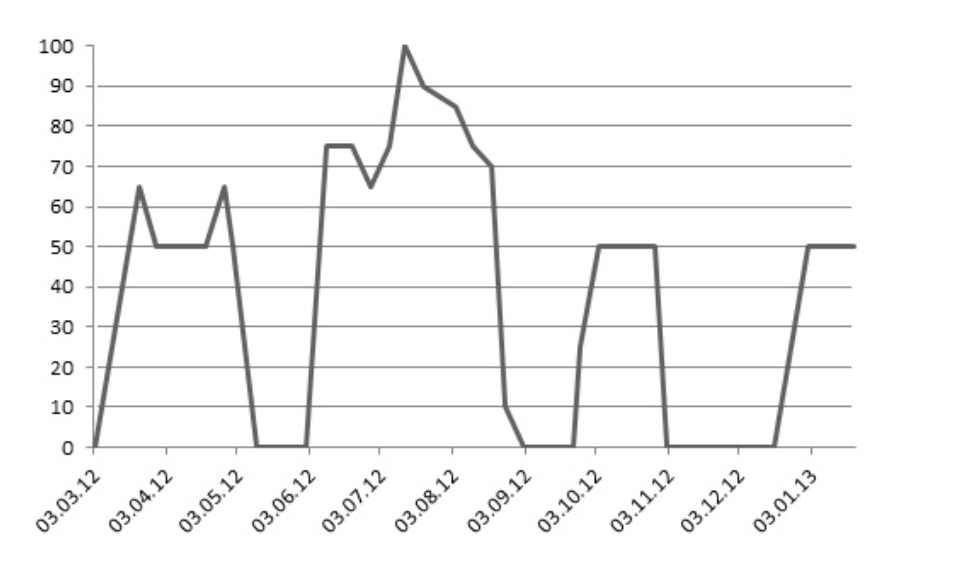
Figure 1
Chart of the variation of Charles’ bond intensity in relation to the church
These variations in relation to the Church can also be observed in the future changes alluded to in each moment, which, following Koselleck (2006), might be pointed as horizons of expectations. For example, on March 3rd, 2012, Charles talks about his possible return to the Church: “I do not have a set date or day, but I know that I will soon be there in the Church again (…) I want to be a minister, a man of God.” On May 11th of the same year, this return is certainly not clear: “Man, I keep going both ways in my head. Now I am not sure if I will return. I was sure that I was going to return one day, but I am not anymore.” On June 1st, this future return becomes more abstract and intangible: "Return? One day, who knows?”. On June 10th, Charles shows a totally differently horizon of expectation: “Now I am going to return to the Church. Because I want to, because I feel again what I used to feel. Now I am going to stay in God’s presence.”
In the methodology proposed, the self-assigned status and the horizon of expectations work as variation markers. They help to demonstrate how Charles experiences and expresses his own changes. But two other questions remain unsolved. First, it is necessary to describe what happened to cause these changes – especially when it is a question of a brusque variation, of a turning point[6] (Abbott, 2001). Second, it is also important to point out how the actor himself explains such variation. Below, in fig. 2, is a chart that aims to point out the moments of abrupt variation in Charles' trajectory in his relationship with the Church.
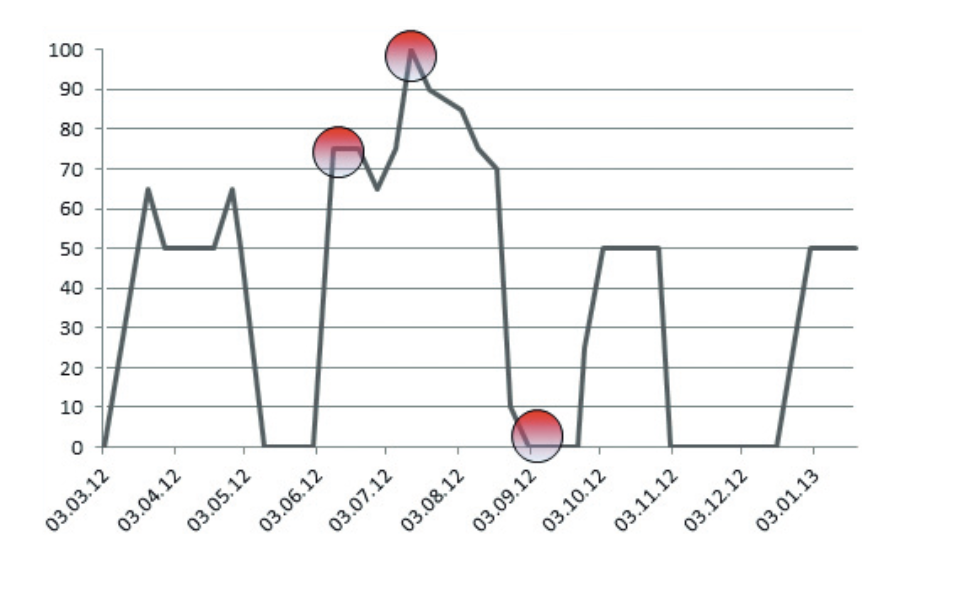
Figure 2
Chart showing Charles’ abrupt variations
The chart is important as it helps to depict the most significant points of variation. It allows us to refer, whenever necessary, to the discourses, accounts and justifications given by Charles for these changes. Later, as an example, one of these variations that takes place as a consequence of a turning point event is analyzed: his near return to drug trafficking followed by his admission into a Spiritual Rehab and his return to the Church.
The return to the Church
In this part of the text, the focus will be on the most significant and brusque change, the one that took place between the 1st and 10th of June 2012. The goal is to understand what happened between these two moments so that, suddenly, Charles went from a “stable” condition of “totally away” from the Church to that of being an effective member again on July 13th, 2012. How this small event clearly expresses a part of the trajectory of one of the most significant existential dilemmas in Charles's life during the following process will be highlighted.
Moving forward to Charles's relation with drug trafficking, it could be said that Charles was indeed an ex-drug dealer. Throughout our conversations, the possibility of returning to the drug trade came up, especially when his horizon of expectations was considered. On March 29th, 2012, when we talked about the theme in question, he seemed not to disregard this hypothesis:
Oh, man, I wouldn't say that there is a chance of returning to the trade, but I wouldn't say either that there isn't. That depends on the circumstances that I am in. I am not going to say that I am going to return, but I am also not going to say the contrary, because I do not know what the future holds.
On April 1st, 2012, this possibility remains on his horizon:
Oh, man, if I return, which is something that I do not disregard, but I think that would be stupid to return. You have already experienced that, you almost died because of that, and you go back to that knowing that, at any moment, you can die? That would be stupid of me.
On April 5th, 2012, this question pops up during our weekly recorded conversation. This time, his position, though categorically negative, expresses once again his existential doubt: "You think I am going to go back to drug dealing? In the name of Jesus, I won’t!”
Let us then draw our main question: What happened between the 1st and 10th of June 2012? The following is an entry from the field diary on the 1st of June:
Charles is away from the Church and talks about the question of drugs and other practices, like listening to pagode, funk, etc., things that are considered inappropriate from the Church’s perspective: 'I have been smoking. As to drinking, I drink occasionally. I drank a batida the other day. I don't only drink beer. I listen to pagode, but not so much to funk.’ Charles also has some news. After repeatedly saying that he was going to get a job, he finally finds one as a cleaner, and starts to work. He tells us: ' I am working as a cleaner in those X condos buildings of X. I start at 7 a.m. and leave at 7 p.m. I work every other day.’ Apparently, since the beginning of the conversations, it is the first time Charles shows a stable trajectory, which is that of being away from Church since the end of April, always claiming that he does not intend to return. And now, with a job, the impression is that this condition will continue.
A week later, however, everything changed. He did not answer the call. His niece said Charles was not at home and she could not say where he was. His mother said that a friend took him to a Spiritual Rehab. Although asked why Charles did so, Graziella said she did not know the reason, but knew he was at the Spiritual Rehab of Ronaldão. This event occurred on June 8th, 2012. It is worth saying that a Spiritual Rehab, in the case of Rio de Janeiro, is a rehabilitation center, belonging to a religious Evangelical denomination, aimed at drug addicts or people who, for some reason, are under a death sentence by drug dealers. It is there that pastors take people when they are in these extreme situations.
On Sunday the 10th, after spending a long time looking for him at the Rehab, we finally found Charles and asked if we could sit to record a conversation. Charles agreed. During the conversation, he was asked why he was there. At first, he said he was having a hard time trying to stop smoking and was facing many problems and doubts. As questions started to delve deeper, Charles decided to explain what happened and the trafficking issue came up again:
Errr... I was going to, I was going... I didn't tell, did I? I was going.... The urchins were planning to get a load of cocaine to sell there. Cocaine and crack. More crack and marijuana to sell there, near the X. And I was going to get some too, in order to make some dough, but I gave up. I did not even get anything, because it was going to be the beginning of the end. Moreover, I’m 24, too old for that. I've already suffered a lot because of that, went away from there because of that. Was I going to stay? It is better to run away from the problem than stay and get into it, right? I ran away from the problem.
A little further during the conversation, we return to the subject, and he again explains what happened:
Man, they called me. They said the deal was to make some dough. They've already talked to Zito to put a few loads to sell here in the X. Then I said to them: we will see. I did not tell them anything about what I was going to do. But I did say: we will see. Then they said: come on man, the deal is we get some money. We are not doing nothing for nobody, and so on… Then I thought for a long time and said: if I do that, I am going to make some money, but they wanted us to do that even If I got arrested, it was up to me to find the money. Then I said: You know what? I'm not gonna do anything, nothing for nobody. While I sell this stuff here, the owner only makes more money. I am not gonna do anything to please him, no way.
The interesting point to retain here is how Charles explained the variation. Inspired by John Dewey’s notion of inquiry (1993), we take Charles’ narrative as an expression of the self-inquiry process through which, amid his problematic issues, he looked for solutions and constantly developed reasons for his variations and changes. As it is a temporal process, the explanations that Charles produced were not tight, but evolved within time. In future conversations, the problematic issues aroused again and sometimes new elements could appear. For example, on July 7th, 2012, Charles added a new justifying element for the change and relates his almost return to drug trafficking to the job he got earlier. Below is Charles's report:
It’s, it’s related: my work and my going back into dealing. For me, cleaning is not worthwhile work. To work as a cleaner is not honorable. Is it honest work? It is. But it’s not honorable. I do not see myself working as a cleaner. Did I work? Yes, I did. But I could not see myself working as a cleaner. I have the possibility to find something better, I just need to work hard. And for me to find something better, I just have to study hard. This job showed me that I was not born to clean the floor of rich men, definitely not.
As time went by and the meetings continued, it was possible to perceive how the past was outlined in new ways – which especially occurred during turning point events – and how the assemblage of heterogeneous entities and elements mobilized to justify some action or happening evolves in time. Therefore, marking the horizon of expectations was as interesting as following the space of experience (Koselleck, 2006). In that conversation, Charles presented another variation: he said that he didn´t want to work anymore and planned to go back to school. When he started to work as a cleaner, while trying out this new condition, Charles realized that it was necessary to work hard to receive a very low salary in this type of work. Drug dealing, in comparison, was much more attractive – and therefore, according to him, a possible option to return to.
Between the Church and trafficking: moral dilemmas
Take the problem of whether a man should go to school and get a doctor’s degree or get into business. He has to consider which world be more valuable to him under the circumstances, which will express his interest best of all. It is a problem to him because in a way he desires both and has to evaluate his desires to see which is the greater. There is a conflict of desires just as much as there is a conflict of facts on the scientific sides. The ideal, of course, would be to find a way of living that answers to all his interests. The interests in this case are those aroused by the specific problem. The real problem involves his whole future life. What I want to bring out is that the conflict between these two suggestions is really a conflict between hypotheses [...] Thinking is a process by means of which we do not simply put one value over against another; it is a process by means of which we can conserve, as far as possible, all the values involved. (Mead, 1972, pp. 463-465)
George Herbert Mead’s passage expresses well what shall be explored through the self-inquiring carried out by Charles amid his troubles, tensions and doubts. Thus, we treat Charles's inquiry process exactly in the way Mead calls thinking or reflective thinking: as an activity by means of which, more than putting contradictory normativities (Feltran, 2014, 2020) and ways of live in opposition, he tries to keep and reconcile them in a coherent synthesis of his own self-heterogeneity.
When Birman (1996) criticizes the classic and rigorous notion of conversion by offering the concept of "passages" and transits that inhabitants of the Brazilian peripheral regions made between Evangelicalism and the Afro religions, we note shared similarities within Charles’ process between Evangelicalism and crime. It is worth noting that the Charles’ "passages" between the forms of life of crime and the Evangelical have a spatial and material dimension related to the places he went to (services or funk balls) and the clothes he wore (pants or shorts). But besides that, they have immaterial dimensions concerning the intensive modulations of his self. By one hand, the cohabitation between these normative regimes and ways of life in his organism or self sometimes produces creative forms and compositions (when Charles, undecided whether to go out or stay in Church, wore folded pants). On the other hand, at times it produces an imperative of choice in which such forms of life and normativities prove themselves impossible or, to speak in a leibnizian terms, incompossible. Now, the moments in which this reconciliation is no longer possible will be explored.
On the various moments that we followed Charles, the normativities of trafficking and the Church frequently appeared as alternative and, to a large extent, incompatible. The turning point event showed in fact how these two possible ways of life sometimes emerged, despite Charles’ efforts to reconcile them, as opposites and antinomics.
A few passages help to understand how Charles showed tendencies that took him in the direction of the way of life of the traffic and, in other moments, of the way of life of the Evangelical Church. For example, on July 13th, 2012, Charles said:
Everybody, I mean really everybody, even the boys of the Church like to dress up, don´t they? Like, they do not buy pants that cost three hundred reais, but one hundred or sixty reais. Let me tell you something: I like, I do like nice clothes. If I had money, if I had one thousand, I would spend everything on myself, especially on clothes or something like that, got it? Who does not want that? To arrive in a shop and order: I want this shirt, that one, those shorts, those pants, who does not want that? Everybody does, Diogo. You too, come on, admit it. When you are at the shop, ready to buy, you just pass the credit card and . . . done. I love it bro, I do love it, especially if I like the stuff. It can be three hundred, four hundred; I buy it on the spot. If it is for me, I buy it. Mainly when I know that I am the one who is going to wear it. If it is for me, I spend it all, no matter what. When the things are for me, I am not stingy. You get into drug trafficking, now you have a hundred and fifty in the pocket. Then you buy a shirt, a gold necklace, that's the deal, man. That's why I was going into [drug trafficking].
Charles then continues:
But formerly it was the dealers who were in charge of the favela. It was a rifle, a stolen motorbike, a stolen car. Come on, man, every woman wants a guy with a rifle on the back, a thick gold necklace. Every woman wants it, Diogo, every woman wants it. Is there a woman who does not want to get into a car and listen to the man say: today we are going to a love hotel. Which woman does not want that, man? Ask any of these girls, even those crazy ones that are over there: let's go to a love hotel! I bet they’ll say yes. It is power that rules.
These passages show how Charles had a set of tendencies to act that pushed him in the direction of the normativity and way of life of drug trafficking. Some issues mentioned such as the “easy money” and the “thick gold necklace” easily evoke values and moralities that are typical and appreciated in the social world of drug dealers. Even though, following the evangelical normativity of the Church, on the contrary, belittles all of those elements due to their association with the “the flesh” and devilish forces.
Anyhow, on January 6th, 2012, Charles added another point of view to such way of life:
In the drug trade you earn more money but get more damage. What if you go to jail? What if you die? They only pay for the funeral. It’s not worth it. I’m not going back. Do you long for that? You do. But the wish is short-lived. I ain’t crazy, man. Better to receive a little hard-earned money every month than to be there destroying yourself. It isn’t worth it, no, this is not life. Tell me: how many dealers got on well in life? Just a few.
Still on the 13th of July 2012, Charles made a complementary statement:
The wish to return to trafficking comes up, but I, I, I... when it comes up, I try to occupy my mind by reading the Bible, to keep my mind busy with Church matters. When I leave the Church, I go to school; after school, I go to prayer time and from there I go home to sleep. Like today: I worked and the minister blessed me with money. I put away the amount I earned to pay my debts. Is it enough? It isn’t. I gave 30 reais to my sister so that she could buy some stuff for the house or for her. I also put away some money for my tithing. I’m broke, but I’m happy. Better to be broke knowing that you spent your money on what is honorable than using the money you must buy cigarettes, drinks, drugs, spending it illegally.
In both passages, Charles clearly defended the typical normativity of the Evangelical Church way of life and of the worker .trabalhador) (Zaluar, 1985), in which it is “better to receive a little hard-earned money every month” or to spend “your money in what is honorable” than to spend your money “illegally” or “to be destroying yourself”.
It is important to emphasize that, in face to his contradictions, it is not up to us to define which of them would be Charles's "real" and "authentic" self. This would mean that there should be one homogeneous, coherent, true Charles. On the contrary, we simply take him to be a heterogeneous entity, a plural self (Lahire, 1998) that, amid his “passages” (Birman, 1996) between different normative regimes (Feltran, 2020) and ways of life, feels existential tensions, dilemmas, anxieties that constantly conducts to intensify his own self-inquiries (Dewey, 1993). Each life form is a kind of investment sphere towards which the intensity of the Charles self-bond varies in time. In other words, it is exactly because different normative regimes coexist in Cidade de Deus´s social environment that Charles selfundergoes intensive modulations between such ways of life. Anyhow, instead of going through constant code switching, as Gumperz (1989) proposes, we recognize a sort of constant normativity and ways of life switching. In other words, we understand his self as a kind of monad permeated by windows and porous spaces which expresses on the microscopic level of its inwardness or arena the (sometimes incompatible) regimes cohabitations that exists on the macroscopic level of the favela Cidade de Deus.
Another important element is the evolution of Charles's posture over time regarding the normativities of drug trafficking and of the evangelicals. It is important to note the moments in which the existential dilemmas arising from the cohabitation of those two normative regimes or ways of life were reduced and even went into hibernation. The follow-up methodology intended to capture variations and modulations of these two ways of life of Charles’ self over the course of time, that way being able to grasp moments in which these dilemmas are particularly intense or appeased.
Around January 2013, for example, the dilemma between the normativities of the Evangelical Church and the crime seemed to subside. During that period, Charles was away from the Church for a few months, not showing any interest in returning. He was working as a security guard in a place in Downtown Rio de Janeiro and was dating a girl he intended to marry. The dilemma regarding drug trafficking and the Church was pacified at this time and only came back when his girlfriend left him. Shortly afterwards, and not by chance, he returned to his dealing activities. This passage of January 21st, 2013, is illustrative of the indifferent posture regarding drug trafficking:
I was thinking of entering the drug trade, but now I have more thing to worry, Diogo. I have no time to be worrying about this shit. I must worry about my work, with the house that we are going to rent. I must think of supporting myself now and to provide for her, in spite of the fact that she also works. We are going to see a place for us to rent, to live together.
The Drug Trade(s)
So far, in discussing the dilemma between Church and drug trafficking, as the way these two normative regimes and ways of life appeared differently in Charles biographical trajectory over time, we treated both as homogeneous categories and without internal differentiation. Nevertheless, the following process proposed by the sociology of self-inquiry or intimate problems showed that such normativities and ways of life, they too, like Charles, undergo changes over time. Regime cohabitation is not only given in spatial and synchronic terms, but also in temporal and diachronic terms: the tension between what is or is not worthwhile, between conflictive normativites or ways of life is not restricted to the opposition between crime and Evangelical Church. It extends to crime itself. The latter was treated by Charles as a temporal heterogeneous category.
In a conversation, on September 23rd, 2012, Charles reported:
It’s not worth it to go back to drug trafficking anymore, no. Trafficking is no longer like it used to be, it doesn’t have that adrenalin of before. It isn’t worth it. I think a lot about going back to dealing, but it is not worth it, Diogo. Trafficking is not like it used to be, it isn’t worth it. And if you get arrested? It’s not like it used to be. It doesn’t have the emotion it used to have.
While talking about his wish to return to the drug trade, Charles developed a differentiation between trafficking way of life during the presence of the Pacifier Police Units and trafficking of the old days, that is, the drug trade that existed before the "pacification"[7] process. To that end, he added at least one element that allowed himself to make such distinction: "it does not have that emotion anymore”. A part of his speech from November 20th, 2012, helps to better understand what is the emotion which he referred to:
It is, Diogo, drug trafficking triggers so much adrenalin, it’s nice. I do not want to go back, but I miss the time I was tied up in it. Sometimes, I catch myself ruminating about it. When the police arrived, you had to run. It was either you or them. I have thought about going back many times! I think about it all the time, I constantly think about going back, but it is not worth it! I’m not crazy! If I was to go back one day, I would go to a rough favela such as Nova Holanda, Parque União, Antares, Cidade Alta. Oh, I would stick to it, dude! There’s a lot of shooting there! There, it’s either them or the cops, so they prefer killing to being shot! I would go to Chapadão.
The passage points to the fact that drug trafficking by then, after the implementation of the Pacifying Police Unit process, was not like it used to be. Cidade de Deus was definitely not the same favela; the environment has changed. As Menezes points out regarding Cidade de Deus and Santa Marta (the two first pacified favela in Rio de Janeiro): in the pacified environments, the “sedentary” force of the rifle give way to the close observation of the lookouts and the “flexible” communication of the mobile phones and radios used to monitor the flow of circulation of people, objects and information that occurred in the territories with Pacifying Police Units (Menezes, 2015, p. 199). One of the main characteristics of the way of life of the drug trade, which Charles belonged to in the past, was then armed confrontation, shooting and the resulting adrenalin. After the arrival of the pacification process, there was almost no armed confrontations in Cidade de Deus. This has naturally led to a reconfiguration of drug trafficking and crime as a way of life.
Such reconfiguration explains why, besides the dilemma produced by these two irreducible normativities and ways of life that drove him towards drug trafficking or the Evangelical Church, Charles also came across another question: in the case of returning to the crime, which path to choose? To stay in the pacified favela where he lived or to go to a rough one in which shootings and the old adrenalin were still reality?
Final consideration
In the present paper, we have followed one hypothesis: to look and follow an individual’s troubles and crises over the course of time allows the apprehension of that individual’s (and some of his environmental) constitutive and elementary characteristics. The aim was to encompass, within the sociological analysis presented, a sociology in an individual scale capable of considering the problems and tensions of the actor as an expression of the spatial and temporal heterogeneity of normative regimes and ways of life of his or her social environment. Everything occurs as if the individual were an arena in which different normativities and ways of life of his surroundings are expressed and modulate in a singular way.
With the methodology proposed, we intended to capture and follow this set of stabilities and instabilities that characterized Charles's self in time, always paying attention as far as possible to the variations and modulation expressed by his statements in the multiple present instants throughout the conversations we had. We then attempted to perform a sociology of self-inquiry or intimate troubles, following one of his intimate struggles throughout time, that is, the one between the Evangelical Church and the crime. From that, our aim is to propose a changing of the personality's concept, now seen not as a universal structure (id, ego, superego), nor as derivative of the society, either through the internalization of the normative expectations (Parsons) nor the incorporation of an objective structure in the way of a habitus (Bourdieu), but simply as an entangle of tensions, crises, troubles, instabilities and stabilities that evolve through time. A minimalist definition aimed at making explicit the categories, questions and problems that arise from the concrete experience of the actors we research.
The present proposal in its most theoretical and abstract ambition is to acknowledge how to develop a sociological perspective in a post-metaphysical world, in which the concept of society has become theoretically obsolete (Ingold, 1996) and the individual can no longer be derived from substantial traits of the society (Parsons, 1964, Bourdieu, 1980) or culture (Sapir, 1949; Boas, 2010). Furthermore, it would also be necessary to develop an approach to the individual without presupposing previously defined metaphysical conceptions about the self or the ego. And later apprehend the metaphysics of any given individual or, in Latour’s terms (1987), the metrologies that individuals themselves use to acknowledge themselves, the others and their own world(s). How looking for a single individual to better understand the normative regimes and ways of life that cohabit the space in which he has dwelled and has been raised? The bet sustained here in this article is that by knowing selves maximally and infinitesimally, that is, following their troubles and problems, we gain privileged epistemic access not only to what is fundamental to them, but above all to the milieux of life and sociological dimension that surrounds and constitutes them.
Bibliography
Abbott, A. (2001). Time matters: On theory and method. University of Chicago Press.
Alvito, M. (2001). As cores de Acari: Uma favela carioca. FGV.
Bankston, W. B., Forsyth, C. J., & Floyd, H. H. (1981). Toward a general model of the process of radical conversion: An interactionist perspective on the transformation of self-identity. Qualitative Sociology, (4), 279–297. https://doi.org/10.1007/BF00986741
Birman, P. (1996). Cultos de possessão e pentecostalismo no Brasil: Passagens. Religião e Sociedade, 17(1-2), 90–109.
Boas, F. (2010). Antropologia cultural. São Paulo, Editora Zahar.
Boltanski, L., & Thévenot, L. (1991). De la justification: Les économies de la grandeur. Gallimard.
Bourdieu, P. (1980). Le sens pratique. Editions de Minuit.
Bourdieu, P. (1986), L'illusion biographique. Actes de la Recherche en Sciences Sociales, (62–63), 69–72. https://doi.org/10.3406/arss.1986.2317
Cefaï, D. (2002). Qu’est-ce qu’une arène publique? Quelques pistes pour une perspective pragmatiste. In D. Cefaï & I. Joseph (orgs.), L’héritage du pragmatisme (pp. 51–83). La Tour d’Aigues; Éditions de l’Aube.
Cefaï, D. (2015). Mondes sociaux: Enquête sur un héritage de l’écologie humaine à Chicago. SociologieS. https://doi.org/10.4000/sociologies.4921
Chateauraynaud, F. (2011). Argumenter dans un champ de forces: Essai de balistique sociologique. Petra.
Côrtes, M. (2007). O bandido que virou pregador: A conversão de criminosos ao pentecostalismo e suas carreiras de pregadores. Aderaldo & Rotschild; Anpocs.
Corrêa, D. (2015). Anjos de fuzil: Uma etnografia das relações entre tráfico de drogas e igreja evangélica [Doctoral thesis, Universidade do Estado do Rio de Janeiro].
Corrêa, D. (2020) Entre o querer e o não querer: dilemas existenciais de um ex-traficante na perspectiva de uma sociologia dos problemas íntimos. Tempo Social, v. 32, n. 2, p. 175-204, 2020. https://doi.org/10.11606/0103-2070.ts.2020.159750
Corrêa, D. (2021). Novos rumos da teoria social a partir de três gestos da sociologia pragmática. Revista Brasileira de Ciências Sociais [online], v. 36, n. 105, 2021. https://doi.org/10.1590/3610505/2020
Corrêa, D., & Dias, R. (2016). Crítica e os momentos críticos: De la Justification e a guinada pragmática na sociologia francesa. Mana, 22(1), 67–99. https://doi.org/10.1590/0104-93132016v22n1p067
Corrêa, D., & Dias, R. (2020). The critique and its critical moments: The recent pragmatic turn in French sociology. Current Sociology, 68(6), 721–737. https://doi.org/10.1177/0011392120914702
Dewey, J. (1993). Logique: La théorie de l’enquête. PUF.
Dias, C. (2008). A igreja como refúgio e a Bíblia como esconderijo: Religião e violencia na prisão. Humanitas.
Ebaugh, H. R. (1988). Becoming an Ex: The process of role exit. The University of Chicago Press. https://doi.org/10.7208/chicago/9780226160535.001.0001
Feltran, G. (2014). O Valor dos pobres: A aposta no dinheiro como mediação para o conflito social contemporâneo. Caderno CRH, 27(72), 495–512. https://doi.org/10.1590/S0103-49792014000300004
Feltran, G. (2020). Das Prisões às periferias: Coexistência de regimes normativos na “Era PCC”. Revista Brasileira de Execução Penal, 1(2), 45–71.
Fillieule, O. (org.) (2005). Le désengagement militant, Paris, Belin.
Gumperz, J. (1989). Engager la conversation: Introduction à la sociolinguistique interactionnelle. Minuit.
Ingold, T. (1996). Key debates in anthropology. Routledge.
James, W. (2002). The varieties of religions expérience. Dover Publications.
Koselleck, R. (2006). Futuro pasado: Contribuição à semântica dos tempos históricos. Contraponto; Editora Puc-RJ.
Lahire, B. (1998). L'Homme pluriel: Les ressorts de l'action. Nathan.
Latour, B. (1987). Science in action: How to follow scientists and engineers. Harvard University Press.
Latour, B. (1991). Jamais fomos modernos: Ensaio de antropologia simétrica. Editora 34.
Latour, B. (2005). Reassembling the social: An introduction to actor-network-theory. Oxford University Press.
Latour B., & Woolgar, S. (1979). Laboratory life: The social construction of scientific facts. Sage.
Lepetit, B. (1995). Les formes de l’expérience: Une autre histoire sociale. Albin Michel.
Lins, P., & Silva, M. de L. da. (1990). Bandidos e evangélicos: Extremos que se tocam. Religião e Sociedade, (15), 166–173.
Lofland, J., & Stark, R. (1965). Becoming a world-saver. American Sociological Review, (30), 862–875. https://doi.org/10.2307/2090965
Mead, G. H. (1972). The philosophy of the act. The University of Chicago Press.
Menezes, P. (2015). Entre o “fogo cruzado” e o “campo minado”: Uma etnografia do processo de “pacificação” de favelas cariocas [Doctoral thesis, Universidade do Estado do Rio de Janeiro].
Nock, A. D. (1998). Conversion: The old and the new in religion from Alexandre the Great to Augustine of Hippo. John Hopkins University Press.
Parsons, T. (1964). Social structure and personality. The Free Press of Glencoe.
Rambo, L. R. (1993). Understanding religious conversion. Yale University Press.
Revel, J. (1996). Jeux d’échelles: La micro-analyse à l'expérience. EHESS; Gallimard; Seuil.
Richardson, J. T. (1978). Conversion careers. Sage.
Sapir, E. (1949). Selected writings in language, culture, and personality. University of California Press.
Scheliga, E. L. (2004). Pesquisando conversão pentecostal em unidades penais. Religião e Sociedade, (24), 73–99.
Scheliga, E. L. (2005). Trajetórias religiosas, experiências prisionais: a conversão religiosa numa instituição penal. Comunicações do ISER, (61), 75–85.
Teixeira, C. (2008). O pentecostalismo em contextos de violência: uma etnografia das relações entre pentecostais e traficantes em Magé. Ciencias Sociales y Religión/Ciências Sociais e Religião, (10), 181–205. https://doi.org/10.22456/1982-2650.3982
Teixeira, C. (2011). A construção social do 'ex-bandido': Um estudo sobre sujeição criminal e pentecostalismo. 7Letras.
Teixeira, C. (2013). A teia do bandido. Um estudo sociológico sobre bandidos, policiais evangélicos e agentes sociais [Doctoral dissertation, Federal University of Rio de Janeiro]. UFRJ.
Tönnies, F. (1995). Comunidade e sociedade. In O. Miranda (Ed.), Para ler Ferdinand Tönnies. Edusp.
Valladares, L. do P., & Medina, C. A. (1968). Favela e religião: Um estudo de caso. CERIS.
Vital da Cunha, C. (2008). “Traficantes evangélicos”: Novas formas de experimentação do sagrado em favelas cariocas. Plural, (15), 13–46. https://doi.org/10.11606/issn.2176-8099.pcso.2008.75226
Vital da Cunha, C. (2014). Religião e criminalidade: Traficantes e evangélicos entre os anos 1980 e 2000 nas favelas cariocas. Religião & Sociedade, (34), 61–93. https://doi.org/10.1590/S0100-85872014000100004
Zaluar, A. (1985). A máquina e a revolta: As organizações populares e o significado da pobreza. Brasiliense.
Notes