Artículos
Renaming Vico’s Dictionary: Reconstructing the Textual Genealogy of the Vocabulario copioso de las lenguas cakchikel y 4iche
Renombrando el diccionario de Vico: reconstrucción la genealogía textual del Vocabulario copioso de las lenguas cakchikel y 4iche
Renaming Vico’s Dictionary: Reconstructing the Textual Genealogy of the Vocabulario copioso de las lenguas cakchikel y 4iche
Indiana, vol. 35, no. 1, pp. 67-95, 2018
Ibero-Amerikanisches Institut Preußischer Kulturbesitz

This work is licensed under Creative Commons Attribution-NonCommercial-NoDerivs 4.0 International.
Received: 10 January 2018
Accepted: 22 January 2018
Abstract: Missionary dictionaries from Highland Guatemala are valuable resources on pre-contact culture and religion and the formation of Christian discourse in the Mayan languages. One of the lexical compilations considered to be particularly rich in information on Highland Maya culture is a Kaqchikel-K’iche’-Spanish dictionary that has traditionally been attributed to the famous early 17th-century Dominican friar Domingo de Vico. This article reconstructs the textual genesis of this trilingual dictionary and re-examines its authorship. Analyzing hitherto unnoticed intertextualities with other unedited Kaqchikel dictionary sources, it is shown that the process of compilation was multistaged and the K’iche’ entries were only integrated in the late 17th century. Textual evidence indicates that the dictionary is more likely of Franciscan than of Dominican origin. The article provides insights into missionary lexicographic practices and shows that mendicant authors copied from each other and modified lexical compilations according to their respective theories of translation.
Keywords: Highland Guatemala, colonial dictionaries, missionary lexicography, authorship, textual genesis, Kaqchikel, K’iche’, Franciscans, Dominicans, Christian discourse.
Resumen: Los diccionarios misioneros del altiplano de Guatemala constituyen valiosas fuentes para el estudio de la cultura y religión pre-contacto, así como de la formación de un discurso cristiano en las lenguas mayas. Una de las compilaciones lexicales con información particularmente rica sobre la cultura maya del altiplano, es el diccionario trilingual de kaqchikel, k’iche’ y español atribuido tradicionalmente al fray dominico Domingo de Vico. La presente contribución reconstruye la historia textual de ese diccionario y re-examina su autoría. Al analizar las intertextualidades existentes entre el diccionario trilingual y otros diccionarios coloniales del kaqchikel, se muestra que el proceso de compilación se llevó a cabo en etapas y que las entradas del k’iche’ no fueron integrados al texto sino en el siglo XVII tardío. Las evidencias textuales señalan que el origen del diccionario es más probablemente franciscano que dominico. El artículo aporta nuevos conocimientos sobre las prácticas de los lexicógrafos misioneros y muestra que los autores mendicantes se copiaban unos de otros y modificaban las compilaciones lexicales según sus respectivas visiones teóricas de la traducción.
Palabras clave: tierras altas de Guatemala, diccionarios coloniales, lexicografía misionera, autoría, génesis de texto, kaqchikel, k’iche’, franciscanos, dominicanos, discurso cristiano.
Introduction1
Highland Guatemala was among the first regions in the Americas where missionaries strategically used the native languages in the conversion of the local population. In this context missionary authors produced descriptive materials on the principal Highland Mayan languages, which included extensive lexical compilations. The dictionaries were primarily compiled for the friars and clergymen who needed to learn the languages, and equipped them with the right words for evangelization. This means that missionary dictionaries were not simply collections of native vocabulary; lexicographers were moreover concerned with finding and defining the vernacular words and neologisms to express the complex concepts of the Christian faith. The lexical compilations are thus records of the creation of Christian discourse.
The lexicographic documentation for the closely related languages Kaqchikel and K’iche’ is particularly abundant. Purchased by us and European collectors in the 19th and early 20th century, many colonial manuscripts of Highland Maya dictionaries found their way into libraries and archives outside of Guatemala. Most manuscripts from the collections of Charles Étienne Abbé Brasseur de Bourbourg and William Gates were photoreproduced, some of them multiple times.2 These reproductions circled among scholars before they eventually found their way into the special collections of libraries, which greatly contributes to confusion, as these sources have often been held to be manuscripts. Although some research has been done on Highland Maya lexicography, a systematic overview of all the existing missionary dictionaries and their genealogical relationships is still a research desideratum.3
The missionaries produced copies of some principle dictionaries that were accessible in the convents. Some of them are exact copies, others were amended, modified, and expanded upon, and accordingly there are multiple versions of some lexicographic sources in the collections. The missionary lexicographers also made it a common practice to use existing vocabularies as templates and sources, from which lexical data were mined for other compilations. These intertextualities and synoptic relationships between the sources have been rarely discussed.
Of particular interest are the connections between Kaqchikel and K’iche’ dictionaries. The lexicography of both languages is closely intertwined. K’iche’ had been the dominant language in the Highlands before the Spanish invasion, but it was Kaqchikel, the language of the region where the Spanish first settled, that became the lingua franca of the linguistic mission.4 Labelled either as lengua de Guatemala (language of Guatemala) or lengua metropolitana (metropolitan language) Kaqchikel was used as matrix for description. Most dictionaries of K’iche’, referred to as lengua utlateca (Utlatec language), were either based on Kaqchikel templates or were organized as comparative multilingual works. The production of dictionaries lay mostly in the hands of Franciscan and Dominican friars. Both mendicant orders had different approaches to translating Christianity into the Highland Mayan languages, with Dominicans strategically appropriating terminology from native religious discourse, while Franciscan materials show a preference for the introduction of neologisms (see Sachse 2016). The extent to which lexicographers of the two orders drew on each other’s materials needs further investigation.
The present article will contribute to that question by reconstructing the textual genesis and authorship of a dictionary that has traditionally been attributed to Domingo de Vico. Scrutinizing the relationship between this Kaqchikel-K’iche’-Spanish dictionary and other lexicographic sources, I argue that the lexicon was not compiled by the famous Dominican friar, but by a Franciscan author almost 150 years after Vico’s martyr death. The paper will provide insights into the methodology of missionary lexicography and the process of colonial knowledge production by showing that mendicant authors copied and modified lexical compilations according to their respective theories of translation.
Vico’s dictionary
Domingo de Vico was certainly one of the most prolific figures of the early mendicant mission in Highland Guatemala. Educated at the University of Salamanca, he was recruited by Bartolomé de las Casas to accompany him to the New World, where he arrived in 1544. Vico was primarily chosen for his linguistic talents. Dominican chronicler Antonio Remesal records that Vico had learned at least seven Mayan languages and left grammars, dictionaries and other doctrinal texts in all of them.
[...] entrando en la Verapaz, en breuissimo tiempo supo la lengua. Vino a Guatemala, hizose maestro en la de aquella Prouincia, y no pasaua pueblo, aunque su lengua fuesse singular y rara, que en tres o quatro días que se detuuiesse en el, no ia sapiesse tan bien como si fuera su original y materna, y con esta perfeccion supo siete diferentes lenguas. En todas ellas, demás de las artes y vocabularios, escribió diferentes tratados para enseñanza de los naturales, y dotrina de los Religiosos (Remesal 1691, book x, chapter viii: 612).
Vico’s written legacy is the Theologia Indorum (Theology for the Indians) in which he explains the Christian faith to indigenous converts in K’iche’.5 The Americas’ first Christian theology covers two volumes of more than 700 folios and is to date the most extensive colonial text to have been written in an indigenous language of the Americas. Judging from the number of surviving copies in various Mayan languages, the Theologia Indorum found wide distribution and had a strong impact on the conversion and the creation of Christian discourse in the colonial highlands. Entire passages from the Theologia were reproduced and reconfigured by indigenous authors and Vico’s death on his mission to the Acalán region in 1555 is referenced in several Highland Maya documents (Christenson 2016: 82; Sparks 2011: 124-126; Sparks, Sachse & Romero 2017: 260-268, 276).
The veneration that was paid to Vico by both indigenous and missionary authors was undoubtedly the result of his ability to teach the Christian doctrine so eloquently in the Highland Mayan languages. Long after his death, Vico remained famous in colonial Guatemala for his linguistic skills and the books and catechisms that he had written in the indigenous languages. Remesal writes about the admiration later missionaries had for Vico’s grammar on the ‘language of Guatemala’, which included a copious dictionary with rare and obscure lexical entries.
Admirausse el Padre Vicario con excesso de verla facilidad con que los Padres auian sabido la lengua de la tierra, y leya con gran gusto el arte que auia compuesto el Padre fray Domingo de Vico, en tan breue tiempo como auia que estaua alli, tan concertada y ordenada por el modo de la Latina, que no le faltaua declinación, conjugacion, tiempo, clases de verbos, formaciones de tiempos, nombres, verbos y aduerbios, y vn vocabulario muy copioso, aun de las dicciones obscuras y poco vsadas, y en todo alaba al Señor (Remesal 1691, book vii, chapter xiiii: 405).
Although Remesal clearly states that the Vocabulario was part of the Arte, grammar and dictionary have been treated by scholarship as two independent texts and have been searched for among the missionary linguistic sources from Highland Guatemala (Acuña 1983: xxvii-xxix; Carmack 1973: 113-116). Vico’s work certainly served later missionaries as a template. There are frequent references to the Theologia Indorum in the Vocabulario de la Lengua Cakchiquel y Guatemalteca by Franciscan friar Thomas de Coto, and the Dominican Francisco Ximénez praises Vico’s work in the prologue to his Primera parte del tesoro de las lenguas ƐaƐchiquel, Quiche y 4,utuhil, and he cites Vico’s grammar multiple times in his Arte de las tres lenguas (Acuña 1983: lxvii; Ximénez 1704-1714: fol. xv; Ximénez 1993). The dictionary however is not explicitly mentioned by anyone else other than Remesal.
A colonial Kaqchikel-K’iche’-Spanish dictionary from the collection of the Manuscrits Américains in the Bibliothèque nationale de France (BnF-MA 46) has been widely understood to be a 17th-century copy of the legendary vocabulario of the Dominican polyglot.6 The manuscript was purchased by Abbé Brasseur de Bourbourg who produced a partial copy with additional entries and emendations that is also housed in Paris (BnF-MA 65).7 Another copy of the same text has been located in the holdings of the John Carter Brown Library in Providence (JCB-b5705183) (see Table 1).8 The paleographic style of both manuscripts, BnF-MA 46 and JCB, suggests that they are copies from the late 17th or early 18th century. Both manuscripts are almost identical in content, including a doctrinal text titled Dotes de gloria de los bien aventurados that follows the actual vocabulary. Gates’ photostatic reproductions of both manuscripts that are archived in the Newberry Library in Chicago, the BYU Harold B. Lee Library in Provo, and the Tozzer Library at Harvard University are listed in the library catalogs under Vico’s name (see Carmack 1973: 114; Weeks 1990: 198).9 This attribution is primarily based on the title page of the BnF-MA 46 manuscript:
Vocabulario de la lengua Cakchiquel con advertencias de los vocablos de las lenguas quiché y tzutuhil se trasladó de la obra compuesta por el Il(ustrisi)mo Padre el venerable Fray Domingo de Vico (Vocabulario copioso, BnF-MA 46, p. iii).
The header is written in a 19th-century hand and was most likely added by Brasseur himself.10 It specifies that the vocabulary was based on, or extracted from, Vico’s work rather than that we are dealing with a dictionary compiled by Vico himself. Authorship is not explicitly stated anywhere in the manuscript. The trilingual source is sorted by a Kaqchikel matrix. Headwords that are identical in K’iche’ are marked with a cross sign in the left-hand margin, while deviating K’iche’ forms are incorporated as subentries. Entries often list derived forms and sample phrases, including a number of explicit references to Vico’s Theologia Indorum that imply the dictionary was compiled from Vico’s writings (see Table 5). It needs to be noted that the manuscript does not appear in Brasseur’s bibliography among the works assigned to Vico, which suggests that the French collector did not attribute authorship to the Dominican genius (Hernández 2009: 142). It remains unclear whether it was Brasseur himself who wrote the title or whether he took the heading from an earlier lost title page. However, the fact that neither of the manuscripts contains any Tz’utujil entries suggests that Brasseur erroneously titled BnF-MA 46 as a dictionary in the three languages, hypothetically influenced by Ximénez’ multilingual Tesoro, a copy of which he held in his possession.11
The original designation of the trilingual Kaqchikel-K’iche’-Spanish dictionary can be reconstructed from the nearly identical manuscript copy in the JCB, which includes in fact two titles. The actual title page reads Vocabulario copioso de las lenguas cakchikel y 4iche, while the first numbered page has a separate heading: Bocabulario en lengua Cakchi4el y 4iche otlatecas. While the adjective copioso (copious) might sound reminiscent of Remesal’s description of Vico’s vocabulary, we need to acknowledge that this term was frequently used in the description of comprehensive dictionaries in the colonial era and therefore does not indicate a connection.12 Instead, it is more likely that the heading on the first folio is the original title of the work. This is suggested by the almost identical title of the Vocabulario en lengua 4iche otlatecas, a bilingual K’iche’-Spanish dictionary in the holdings of the Ibero-American Institute (IAI) in Berlin that has been identified as a partial copy of the Bocabulario en lengua Cakchi4el y 4iche otlatecas (Dürr & Sachse 2017: 23-35). The fact that both titles include the form ‘otlatecas’ rather than the more common ‘utlateco’ corroborates the common origin of both dictionaries. In the following analysis of intertextual relations between the manuscripts, the trilingual Kaqchikel dictionary as a source will be referred to as Vocabulario copioso to avoid confusion with the actual manuscript at the JCB.13
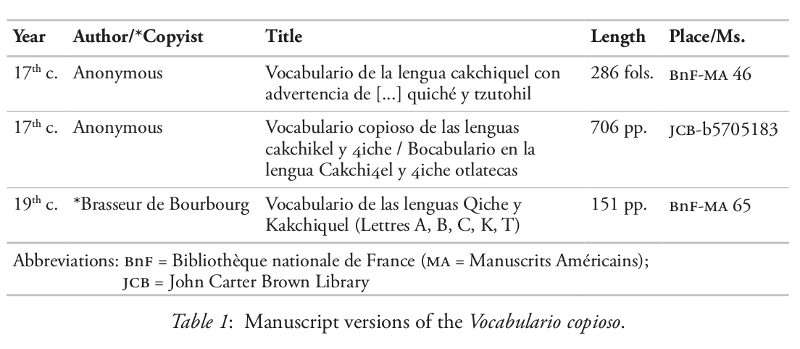
Table 1
Manuscript versions of the Vocabulario copioso.
Synoptic relationships
At first sight, the two late 17th-century manuscripts of the Vocabulario copioso appear to be identical copies of the same dictionary. However, in the recent edition of the Vocabulario otlatecas we have shown that BnF-MA 46 and the JCB manuscript use different orthographic conventions and both include copying mistakes respectively not found in the other text (Dürr & Sachse 2017: 26-35). While the differences seem to be minor, they nevertheless reveal that the two manuscripts of the Vocabulario copioso are not copies of each other. Copying mistakes in the Vocabulario otlatecas also indicate that neither of the two copies of the Vocabulario copioso was used in the compilation of the bilingual K’iche’ lexicon that was excerpted from the trilingual dictionary. Accordingly, the existing manuscripts must have been copied from at least one other unknown source (Dürr & Sachse 2017: 35).
In fact, the Vocabulario copioso shows intertextualities with several other Kaqchikel-Spanish dictionaries from the late seventeenth and early 18th century. This group of interrelated, mostly bilingual dictionaries includes the anonymous Vocabulario de la lengua Cakchiquel in the American Philosophical Society (APS MS. 497.43.V85)14 and three vocabularies from the Bibliothèque nationale de France: the Bocabulario de la lengua cakchiquel de Angel (BnF-MA 41), the Vocabulario en la lengua cakchiquel y castellana de Santo Domingo (BnF-MA 44) and another anonymous dictionary titled Noticia breve de los vocablos mas usuales de la lengua cacchiquel (BnF-MA 43). It has been noticed previously that some of these dictionaries show intertextualities among each other.15 Furthermore, it can be affirmed that the Calepino de la lengua cakchiquel by Francisco de Varea16 and Ximénez’ Tesoro also exhibit interrelations with the bilingual dictionaries in this group (Table 2).
A comparison of the entries for the Kaqchikel day name Aq’b’al from the 260-day calendar provides some indications about how the sources may be related. In Table 3 correspondences of the entries are shown in separate lines and deviations highlighted in bold.17
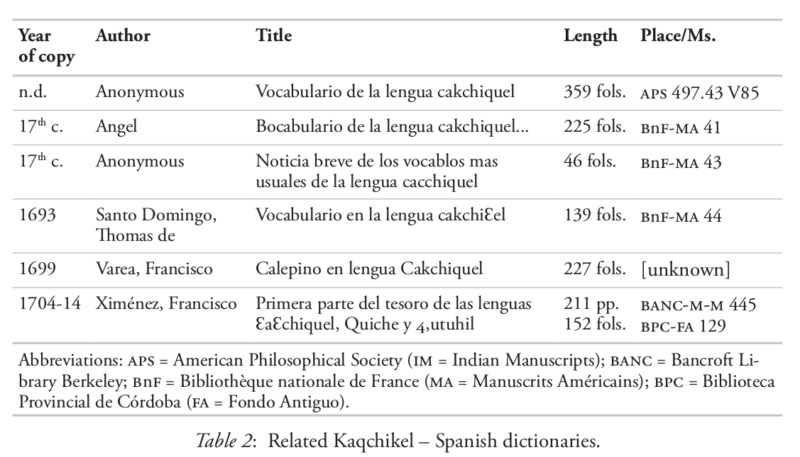
Table 2
Related Kaqchikel – Spanish dictionaries.
Comparing the entries, it is striking that Varea’s Calepino and the Vocabulario de la lengua cakchiquel (APS 497.43.V85) share the same terminology which deviates from the rest of the sources. While these two manuscripts refer to the entry Aq’b’al as a signo (sign) (line 1) and to the 260-day calendar as cuenta de los indios (count of the Indians) (line 6), the other texts use the hispanized semantic reference of día (day) (line 3) and semana de los indios (week of the Indians) (line 4). Ximénez uses both, día (line 3) and signo (line 11), and Angel (BnF-MA 41) also combines both terminological traditions in semana a la cuenta de los indios (week of the count of the Indians). Whereas Ximénez shows greater deviation, Angel’s vocabulary appears to constitute the link between the Vocabulario copioso and the anonymous Vocabulario de la lengua cakchiquel. This is also suggested by Angel’s use of the verb dice (it says) rather than dirá (it will say) (see line 10). But the textual genesis is certainly more complex and the comparison with Ximénez suggests that there was yet another source that links Angel and Ximénez with the Vocabulario de la lengua cakchiquel and which may have been the template from which the Vocabulario copioso was compiled. Angel gives the meaning of the term Aq’b’al as casa (house), while the Vocabulario de la lengua cakchiquel and the Vocabulario copioso have the form cosa (thing) (line 14). Both translations are incorrect, as the meaning of the Kaqchikel term aq’b’al would be (night). The author of the Vocabulario copioso certainly noticed the error, as he added en confuso (unclear, confusing) (line 15). This comment is missing in the entry for the K’iche’ term aq’ab’al in the Vocabulario otlatecas, which might suggest that the original from which the bilingual K’iche’ dictionary was generated did not include the note about the incorrect translation.
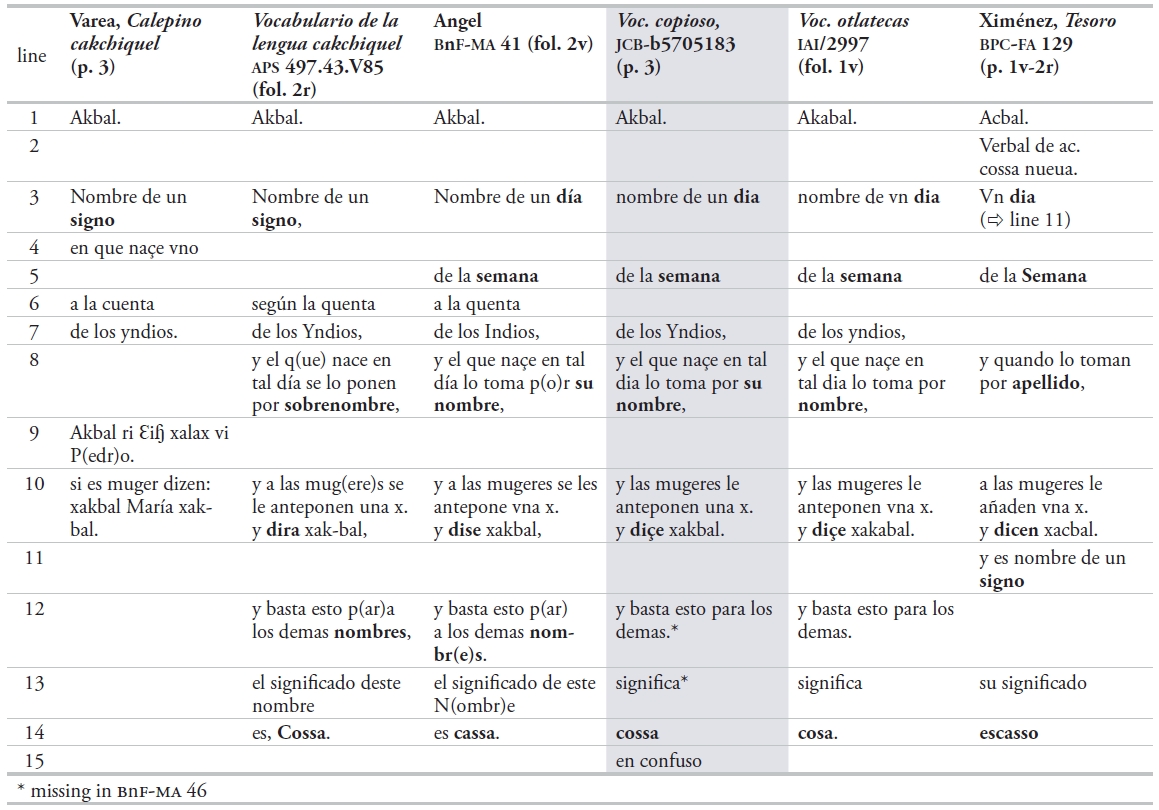
Table 3
Intertextualities between the related dictionaries.
Both copies of Ximénez’ Tesoro give the meaning of the day sign as escaso (scarce), which seems equally incorrect but is at least consistent with the general Highland Maya interpretation of Aq’b’al as a bad or evil day (Weeks, Sachse & Prager 2009: 13). Unless we are dealing with a correction by Ximénez, the original source may have had the term escaso.
With the exception of Varea, all dictionaries share the statement that a person born on the day would take Aq’b’al as a personal name (line 6). The Vocabulario de la lengua cakchiquel specifies that the practice regards the adoption of a sobrenombre (surname), which is rendered by Ximénez as apellido (surname), suggesting that Ximénez was working from a template that had the same specification as the Vocabulario de la lengua cakchiquel. Varea instead gives the sample phrase “Akbal ri Ɛiɧ xalax vi Pedro” (Aq’b’al is the day on which Pedro was born), omitting the explanation of the cultural practice, although his example “María xakbal” in line 8 clearly responds to the description in the other sources that an x- is prefixed to the calendar name when it is used by women. Varea’s Calepino thus draws on the same manuscript tradition, but gives more of a summary and adds new textual elements.18 The same holds true for Ximénez’ Tesoro, though he is still closer to the source and seems to summarize the original entries.
Although the comparison in Table 3 seems to suggest that we are dealing with almost identical versions of one text, it needs to be stressed that these dictionaries are separate texts that share a certain set of core entries deriving from the same source but also include further lexical data. In particular Varea and Ximénez are genuine authors, whose comprehensive dictionaries include a large number of lemmata that have no correspondences in the other bilingual dictionaries. A systematic comparison of shared entries in the interrelated dictionaries reveals that the Vocabulario copioso shows most correspondences with the vocabularies of Angel and Santo Domingo (see Table 4). Although the similarities with Angel outnumber those in Santo Domingo (lines 3, 4, 5, 7, 10), there are also matching forms only found in the Dominican dictionary (e.g. line 2). We can therefore conclude that the Vocabulario copioso must have been compiled from yet another source, which links Angel and Santo Domingo.
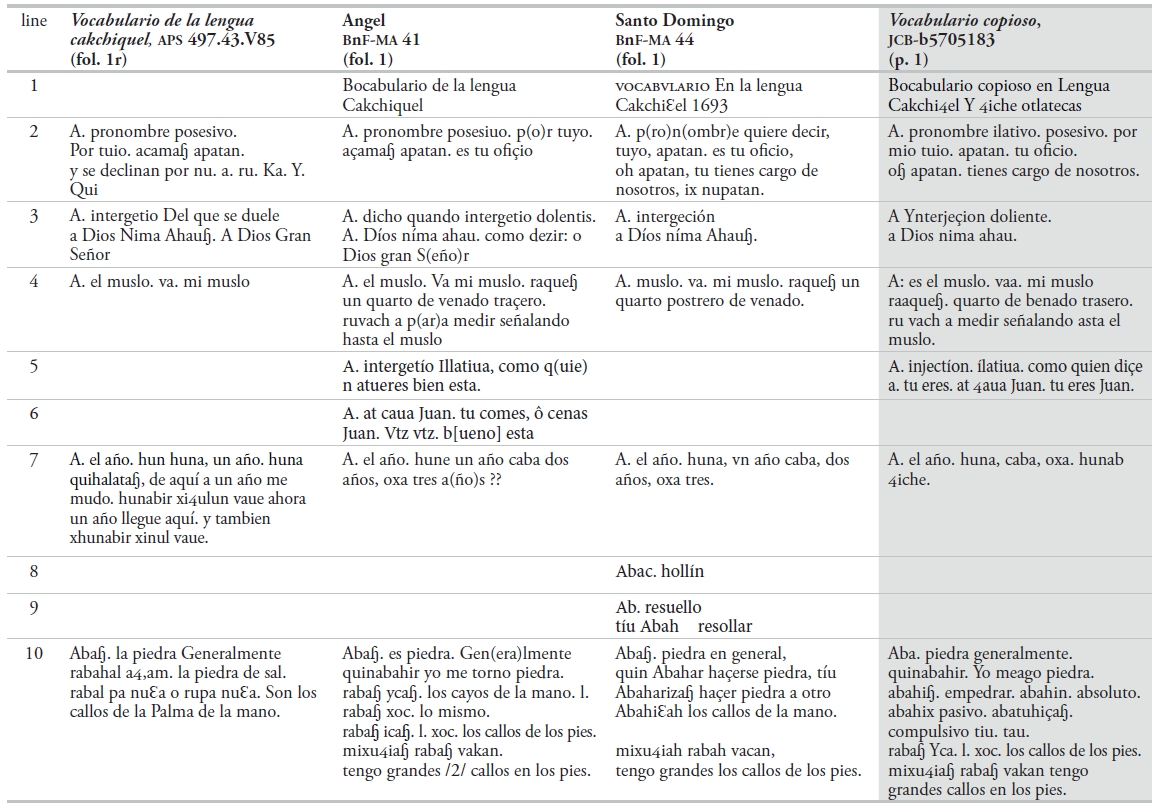
Table 4
Comparison between the Vocabulario copioso and related bilingual Kaqchikel dictionaries.
Another example for the closer correspondence with Angel’s dictionary is the following statement of the author of the Vocabulario copioso referencing the dictionary from which he is copying:
BiƐ. ahogar en agua [...] ti-biƐilox he. el bocabulario trae bi 4 , pero yo aberigue que es Ɛ [...](b’iq. drown in water [...] ti-b’iqilox je’. the vocabulary has b’itz’, but I have ascertained thatit is q [...])(Vocabulario copioso, JCB , p. 65; cf. BnF - MA 46, fol. 22v).
When comparing this entry with the corresponding entries in the two earlier Kaqchikel dictionaries, we find Angel to have the erroneous form that the anonymous author is referring to, while the dictionary of Santo Domingo gives the entry as b’ik, which also seems to be a corrected form.19
Angel: Bi 4 ,. tinbi 4 , ahogar en agua [...] (b’itz’. tinb’itz’ drown in water [...]) (Angel, BnF - MA 41, fol. 20r).Santo Domingo: tin Bic. ahogar en agua (tin b’ik. drown in water [...]) (Santo Domingo, BnF - MA 44, p. 29).
Of the sources compared in Table 4, the Vocabulario de la lengua cakchiquel is the one that deviates most from the Vocabulario copioso, but it is also the text that shows correspondences with all dictionaries in the group and seems to be the closest relative of the ancestral source, from which the vocabularies of Varea, Angel, Ximénez, and the Vocabulario copioso derive. The manuscript in the APS is a 17th-century copy of an earlier source. As illustrated in Table 3, all dictionaries of the group include entries for the names of the days and months of Highland Maya calendar.20 The most detailed of these are found in the Vocabulario de la lengua cakchiquel, which – as discussed above – refers to the day and month names as ‘signs’ rather than ‘days’ or ‘months’, thus alluding to a written calendar tradition in Highland Guatemala and possibly even the use of hieroglyphic writing in the colonial era.21
Can. Signo de un día de los Yndios(Vocabulario de la lengua cakchiquel, APS MS. 497.43.V85, fol. 22v).
Mam. Un signo de veinte dias. Alias Mam. uno tras otro de a veinte dias. hun mam, caymam dicen en su quenta los Yndios(Vocabulario de la lengua cakchiquel, APS MS. 497.43.V85, fol. 112r).
The second example explains that the term Mam refers to the time unit of twenty days and that the 365-day calendar includes two months of that same name, a first and a second Mam. We find related entries in the other dictionaries, where the translation is simplified to nombre de dos meses (name of two months) (Vocabulario copioso, JCB, p. 324). Particularly striking are the Spanish renderings of the entries for the months Pach and Pariche’. Here it says that the month sign entró gobernando (entered to govern) and entró reynando (entered to reign) which comes straight from the Highland Maya calendrical tradition and references the so-called yearbearers, the deified lords of the day signs that fall on the first day of the year and who ‘reign’ or ‘govern’ each of the months. The Kaqchikel verb kuq that is used here means ‘to settle’ and refers to the concept of the yearbearer taking a seat on the first day of the year and the month.22
Pach. signo, ó mes a la quenta de los Yndios. xcuke nabey pach, xcuke rucaan pach. dice que entra governando el primer pach. y el segundo pach(Vocabulario de la lengua cakchiquel, APS MS. 497.43.V85, fol. 155r).
Parichee. Un signo de los Yndios de los dias. xcuke parichee. Ya entro reynando el signo parichee(Vocabulario de la lengua cakchiquel, APS MS. 497.43.V85, fol. 153r).
The Vocabulario de la lengua cakchiquel furthermore includes entries of specialized vocabulary on Highland Maya culture not found in the other sources. Of particular interest are lexical entries referring to different types of divinatory practices, e.g. molol ixim (tell fortune = lit. gather maize kernels); community organization, e.g. pop k’amajay (community representative); and Maya cosmology, e.g. nik’aj saq (world = lit. center of light).23
Some of these terms are also found in the Vocabulario copioso, but with modified semantic references. For example, the Vocabulario de la lengua cakchiquel lists two separate entries and translations of the diphrastic kenning pus nawal. The first translation refers to the Highland Maya concept of spirit transformation, while the second entry describes the medical condition of nocturnal emission – a term that was likely needed by the missionaries in the context of confession. Both translations suggest that the couplet refers to the pre-Christian religious concept of spirit essences that can leave the human body. In the Theologia Indorum, the couplet pus nawal is appropriated to refer to the Christian concept of a ‘miracle’.24
Puz naval. Vn genero de arte maxica que osaban antiguamente los Indios en que se transfor-maban en animales o globos de fuego que iban por el ayre(Vocabulario de la lengua cakchiquel, APS MS. 497.43.V85, fol. 171v).
Puz naval. xel nupuz nunaval pa nuvaram. tube polución en sueños(Vocabulario de la lengua cakchiquel, APS MS . 497.43.V85, fol. 173r).
In the Vocabulario copioso we find only one entry for the kenning which fuses both meanings, combining the translation as ‘witch’ with the illustrative sample sentence for the ‘impure dream’.
Puz naual. el encantador brujo. xel nupuz nunaual chi uarabal. caer en polucion de noche(Vocabulario copioso, JCB , p. 407).
The fact that the Vocabulario de la lengua cakchiquel preserves detailed information on pre-contact culture suggests that the ancestor source was compiled some time in the 16th century. Remesal relates that Vico wrote a treatise on the superstitions of the Highland Maya which likely included a detailed description of the calendar and probably had a wide distribution among the missionaries in the 16th century.
Y por esta razón aquellos primeros Padres que trataron con los indios idólatras, tuvieron gran cuidado en saber las historias de sus supersticiones, el origen de sus dioses, el principio de la idolatría, y de donde le tuvo la abominación de sus sacrificios. Y el Padre Fray Domingo de Vico escribió en la lengua Cachiquel y de la Verapaz un libro grande de este argumento [...] (Remesal 1691, book vi, chapter vii: 300).
Another passage in Remesal probably refers to the same book on superstitions.25
Fue tambien historiador destas gentes, escriviendo en un libro todas las historias, fabulas, consejos, patrañas y errores en que vivian, refutandolas para apartar dellas a los naturales (Remesal 1691, book x, chapter viii: 612).
The lexical entries on calendrical units as well as ritual and cosmological concepts in the Vocabulario de la lengua cakchiquel could hypothetically derive from that source. It is likely that lexical data regarding the phenomena described in the Vico text would also have been included in his lost Kaqchikel dictionary, which according to Remesal was ‘copious’ and comprised ‘obscure sayings’. However, it is striking that the Vocabulario de la lengua cakchiquel does not include the Christian meanings of certain key terms that one would expect from Vico based on his usage of these terms in the Theologia Indorum, such as pus nawal (miracle).26 Yet, the matter is complicated and the lexical data on pre-contact religion could conceivably also have been compiled by another missionary. Acuña even suspects that Vico never wrote a dictionary himself but that instead his writings served other Dominican as well as Franciscan lexicographers as a source (2005: 29). However, since there is no dependable evidence for either scenario, it remains within the realm of speculation whether the Vocabulario copioso does indeed include textual residues of the legendary dictionary from Vico’s quill.
Origin of the trilingual dictionary
The compilation of the Vocabulario copioso can be dated to the end of the 17th century. The best indication for this date is a reference to the death of a pope, which can only regard the death of Alexander VIIIwho died on February 1st 1691 and was followed six months later by Innocence XII who was elected on July 12th 1691 (Bredt-Kriszat & Holl 1997: 178).
seys meses auia q(ue) murio el pontifiçe quando fue electo otro en su lugar por los cardenalesde la S(an)ta Ygleçia(Vocabulario copioso, JCB p. 554; see also BnF - MA 46, fol. 223v).
The reference to this historical event constitutes a terminus postquem for the composition of the trilingual dictionary which was probably completed shortly thereafter.
Some references in the text provide indications regarding authorship and the place of compilation. Of particular significance are several references to the Franciscan friar Diego de Ocaña (Vocabulario copioso, JCB, p. 294, 310, and 347, and BnF-MA 46, fol. 110v, 117r and 134v). Not to be confused with his famous Hieronymite namesake, this Diego de Ocaña received his habit in the Franciscan convent of Guatemala in 1627 and served as a provincial priest until his death in 1680. According to Vázquez, Ocaña was well-known for his learnedness of the scriptures and was according to the chronicler Vázquez a “grande y excelente maestro en los idiomas kiche, kachiquel y zutugil” (a great and excellent teacher of the languages K’iche’, Kaqchikel, and Tz’utujil), who left writings in Kaqchikel (Castro y Castro 1989: 459). The author of the Vocabulario copioso also refers to Ocaña as a “teacher”:
[...] dixo N(uestro) m(aestro) R(everendo) P(adr)e fr(ay) Diego de ocaña, maestro q(ue) fueen la lengua y m(aest)ro P(rovincia)l desta Provincia(Vocabulario copioso, JCB , p. 294, see also BnF- MA 46, fol. 110v).
Of particular interest is the following explanation by the author that names Ocaña in K’iche’ a “great teacher”, a title that has also been attributed to Domingo de Vico:27
ita dixit fray didacus de ocaña nima aɧtiɧ [...](Vocabulario copioso, JCB , p. 310, see also BnF- MA 46, fol. 117r).
Diego de Ocaña was guardian of the Franciscan convent at Samayac (Theologia Indorum, APS MS. 497.4.Ua13, fol. 191v). In the dictionary, we find several references to the town of Samayac in the Department of Suchitepéquez (Vocabulario copioso, JCB, pp. 27, 166, and 551; and BnF-MA 46, fol. 11v, 55r, and 222v). It is possible that these mentions are references from Ocaña’s work, since the author of the Vocabulario copioso explicitly states that he is citing Ocaña’s “notes”:
[...] en las anotaçiones de N(uestro) M(aestro) R(everendo) P(adre) fray Diego de ocañavide. ma qui naal ruvach xinban. hiçelo sin advertir [...](Vocabulario copioso, JCB , p. 247).
The Vocabulario copioso includes a significant number of lexical entries, both in K’iche’ and Kaqchikel, that are not found in either of the related bilingual Kaqchikel dictionaries and were therefore likely added by the late 17th-century author. This regards in particular entries with ethnographically relevant information including terms for medicinal plants or political offices previously attributed to Vico’s authorship.28 In the following entry, the author describes the Highland Maya creator deities Xmuqane and Xpiyakok and adds relevant metadiscourse that he attained this information by hearing the confession of an elder from the Momostenango region in a town near Samayac.29
xmakaníl. nombre del malo q(ue) en figura de un de un [sic] biejo se apareçia a los Yndiosy les deçia que les libraua las milpas de los malos temporales y le ofrecían inçiencio a el el[sic], y una donsella q(ue) le acompañaba que deçia se llamaba xpiako Ɛopoh y con esto losengañaba para q(ue) le diesen adoraçion. assi lo confeço un viejo de chiquimula vissita demomostenango en el pueblo de Santo Domingo visi[t]a de tzamayac(Vocabulario copioso, JCB , pp. 550-551).
While it remains unclear whether this statement comes from the author himself or is another quotation from Ocañas’ notes, it suggests that at least part of the K’iche’ vocabulary added in the 17th century was generated in Samayac. There are also entries that clarify distinct dialectal forms from the Quetzaltenango area,30 which points to the southwestern highlands as the place of compilation.31 The Vocabulario copioso contains further references to towns and toponyms in the Kaqchikel area, including mentions of Pan Cho (= Guatemala), Sololá, Tecpan, Alotenango, Itzapa, Cotzumalhuapa, and San Andrés Semetabaj, which possibly indicates where the compilation of the original Kaqchikel source may have taken place.32
Given that the author of the Vocabulario copioso refers to Ocaña as a teacher, it has been suggested that he may have been one of Ocaña’s students or in any case a Franciscan (Carmack 1973: 114; Bredt-Kriszat et al. 1995, chapter 2.2).33 Several citations of Franciscan authors and intellectuals seems to support that identification. Firstly, the author mentions the Ramillete manual para los yndios sobre la doctrina cristiana, a doctrinal Kaqchikel text by the Franciscan friar Francisco Maldonado (1571-1640) that dates to the beginning of the 17th century.34
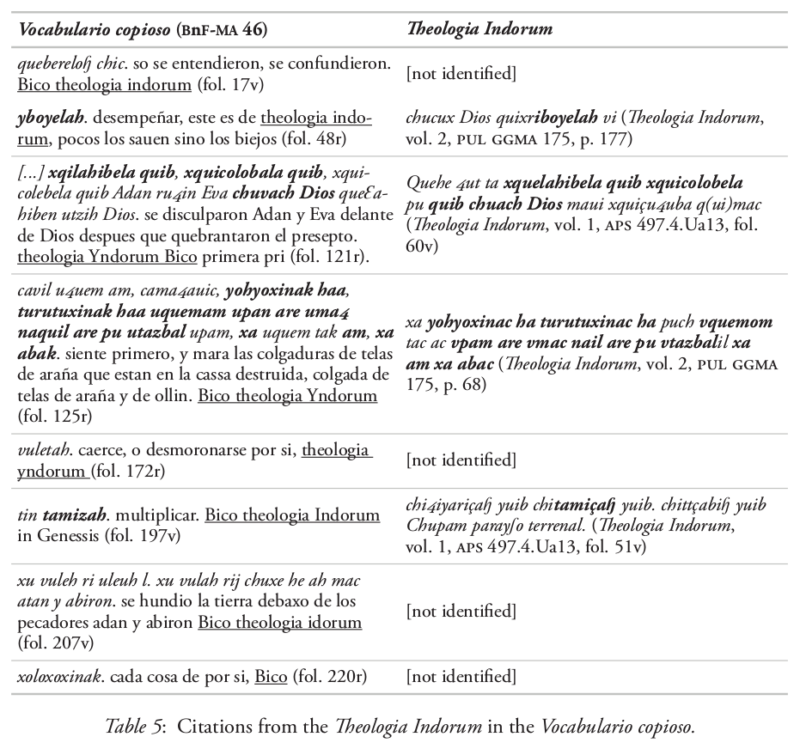
Table 5
Citations from the Theologia Indorum in the Vocabulario copioso.
Further references to Franciscans include “n(uest)ro P(adr)e S(a)n Fran(cis)co” (our Father Saint Francis of Asisi) (BnF-MA 46, fol. 145r) and Francisco de Solano (BnF-MA 46, fol. 121r). It needs to be pointed out that none of the mentioned references is found in any of the related earlier dictionaries, indicating that these additions were made in the process of compilation of the trilingual dictionary.
Despite the seemingly clear Franciscan connection, it was mentioned above that the Vocabulario copioso also includes lexical entries as well as sample phrases that are cited from Vico’s Theologia Indorum. Again, these discursive examples are missing in the Vocabulario de la lengua cakchiquel or the vocabularies by Angel and Santo Domingo, which suggests that the author of the Vocabulario copioso must have added them. Table 5 shows the citations from the dictionary that have been identified in the Theologia Indorum, though half of them are still unattested in the original source.
Attention needs to be paid to the fact that the citations come from both volumes of the Theologia Indorum. This implies that the author must have had access to the full work of Domingo de Vico, which gives us an idea about the reception of the Dominican’s opus magnum among Franciscan missionaries. With respect to this, it is of particular interest that the copy of the first volume of the Theologia Indorum housed in the APS (MS. 497.4.Ua13) includes an autograph of “Diego de Ocaña” on the penultimate folio of the volume.35
Fray Diego de Ocaña. Guard(ia)n de Zamayac. Jullio 6 de 1659(Theologia Indorum, APS MS . 497.4.Ua13, fol. 191v).
At first sight, the note appears to suggest that Diego de Ocaña was in the possession of this particular manuscript copy of the Theologia Indorum from 1605 and that he may have used it to generate lexical entries for the Vocabulario copioso. While this scenario seems plausible, it needs to be pointed out that there are four more autographs of Ocaña’s name on folios 191v, 192r, and 192v as well as two signatures of the name “Fray Francisco Flores” (fol. 192r) and “Fray Francisco de Flores y Fuentes” (fol. 192v) that are written with the same quill and brown ink. In addition we find another signature of the name “Diego de Ocaña” in fol. 191v that is written by a different hand and in black ink. The page certainly gives the impression that someone practiced Ocaña’s signature. Friar Francisco’s full and flowery name is also found as a marginal note on folios 59r and 88r as “Fray Fran(cisc)o Fos de feria e faro e flores e fuentes de francia e Feo” and on folios 100r and 124r as “Fray Fran(cisc)o Fos de Feria e Faro e Flores e Fuentes de francia de Feos e flandes”. As I have not found out anything about Fray Francisco Flores Fuentes, it remains unclear who added the signatures and what connection that person may have had to Ocaña.
For the reconstruction of the compilation process of the Vocabulario copioso it is more relevant that the APS manuscript of the Theologia Indorum contains many marginalia of excerpted verbs and other terms in a hand that is clearly different from the quill and ink of the signatures. In European lexicography, it was a common practice to add marginal notes and glossaries of difficult terms that often became sources for the compilation of vocabularies (Smith-Stark 2009: 14-14). The marginalia in the Theologia Indorum can therefore be taken as an indication that the copy may have been used by someone who was compiling lexicographic data. The marginal notes mostly include vocabulary from the domain of Christian discourse and particularly regards K’iche’ verbs used to express Christian practice, e.g. nimaj (to obey), jikib’a (to confess), makunik (to sin), tz’onoj (to petition), k’ab’owilaj (to worship idols), or q’ijilaj (to worship = lit. to count days). Although the majority of the terms in the marginal notes are attested in the Vocabulario copioso, there is no definite answer, as to whether the APS manuscript of the Theologia Indorum is indeed the source of the lexical data in the dictionary.
Textual genealogy
Summarizing the evidence for the textual genealogy analysed in the preceding sections, we can conclude the Vocabulario copioso was a late 17th-century compilation that was based on an earlier bilingual Kaqchikel dictionary and seems to have incorporated K’iche’ entries from other sources including Vico’s Theologia Indorum (see Figure 1).
The intertextualities between the sources indicate that the Vocabulario de la lengua cakchiquel from the APS is the source closest to the original dictionary that was probably used by Varea in the compilation of the Calepino. The precise relationships between the Kaqchikel dictionaries still require further analysis, but what we can currently ascertain is that Angel, Santo Domingo, and the Noticia breve all derive from a modified version of the bilingual Kaqchikel dictionary which included certain innovations that are also shared by the Vocabulario copioso. The Vocabulario copioso expands upon the Kaqchikel lexicon with K’iche’ entries that were in part excerpted from the Theologia Indorum and integrates ethnographic data collected by the still unidentified author. The author of the Vocabulario otlatecas then used the Vocabulario copioso and another unknown dictionary to create a bilingual K’iche’ dictionary. A particularly interesting result of the textual analysis is that Ximénez’ Tesoro also seems to be based on a version of the Vocabulario copioso. This is suggested by entries in the Tesoro that seem to summarize, abbreviate, and correct entries from the Vocabulario copioso, including some of the citations from the Theologia Indorum.36 This find is intriguing given that Ximénez in the prologue of the Tesoro states that the compilation of his integrative dictionary of the languages Kaqchikel, K’iche’, and Tz’utujil was motivated by
[...] la grande falta que ay de vocabularío copioso de estas tres lenguas; vocabularíos empesa-dos en castilla, muchos ay aunque deminutos pero q(ue) empíesen en lengua no ay mas queuno tan breue que cassí no es Vocabularío [...](Ximénez, Primera Parte del Tesoro, BANC-M-M 445, p. xv-xvi).
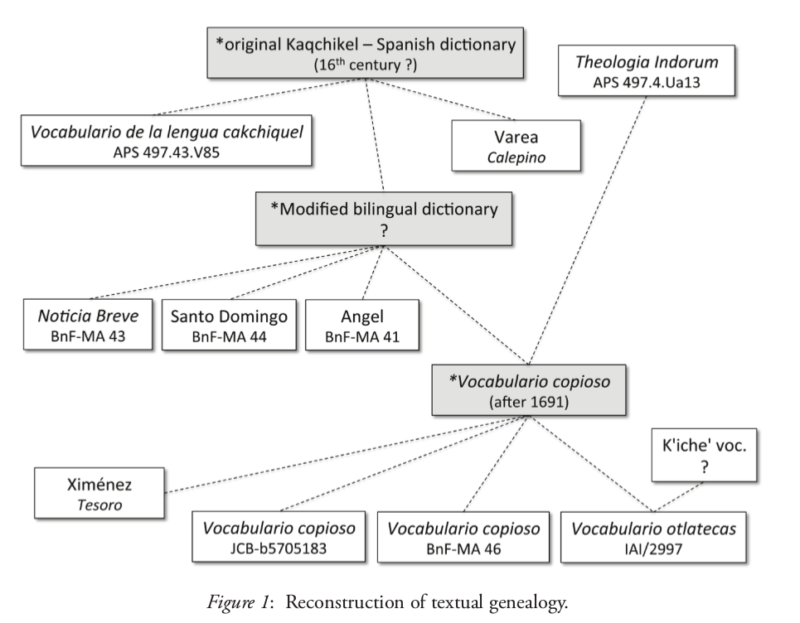
Figure 1
Reconstruction of textual genealogy.
Whether Ximénez refers to the lack of a comprehensive lexical compilation that includes all three languages, or whether he indeed qualifies the Vocabulario copioso as a ‘short’ dictionary, remains unresolved. That Ximénez used a lexical compilation closely related to the known copies of the Vocabulario copioso seems undisputable and sheds further light on the practice of Dominican and Franciscan missionary authors to mine each other’s vocabularies and texts to build their own inventories of words.
The reconstruction of the textual genealogy includes authors of both mendicant orders. Particularly intriguing is the close relationship between the dictionaries by the Franciscan Angel and the Dominican de Santo Domingo, which poses the question about the religious affiliation of the authors of the original and the modified bilingual Kaqchikel dictionaries. The circumstance that all other early lexicographers in Highland Guatemala were Franciscans and that Varea was using the source for the compilation of the Calepino may hint at a mainly Franciscan production line that leads up to the composition of the Vocabulario copioso which probably took place in the Franciscan convent at Samayac, where Diego de Ocaña was guardian in the mid-17th century and where the author would have had access to Ocaña’s written notes.
It has been generally taken for granted that the Vocabulario copioso was originally planned as a trilingual (Kaqchikel-K’iche’-Spanish) dictionary, but the intertextualities with the other sources clearly show that the K’iche’ lexical entries were only incorporated in the late 17th-century. This confirms Kaqchikel as the matrix language of lexical description and that K’iche’ missionary lexicography was developed only subsequently and on the basis of Kaqchikel dictionaries.37
The often remarked first-hand ethnographic data were incorporated into the Vocabulario copioso at two different stages in the genealogical process. While many of the relevant details were only added during the compilation of the trilingual dictionary at Samayac, the specialized vocabulary on the Highland Maya calendar and religious culture can be traced back to the Vocabulario de la lengua cakchiquel and must therefore have been part of the original compilation of the bilingual Kaqchikel dictionary. Although it is tempting to connect these entries with Vico, who is known to have written about these topics, there is no evidence that it is indeed his text that was the source of the information, rather than any of the other likewise lost 16th-century vocabularies by Pedro de Betanzos, Francisco de La Parra, or other less known authors.38
It also needs to be stressed that the Vocabulario copioso does not contain much of this early lexical material in unchanged form; see e.g. the altered semantic reference of the entry pus nawal or the change from the term signo (sign) to día (day) or mes (month). While the eradication of details regarding pre-contact culture would be an expected result of the process of Christianization, in this particular case, it may also be connected to involvement of Franciscan authors and the different approaches both orders had to the creation of Christian discourse in the Highland Mayan languages. The Franciscans rejected the strategic appropriation of terminology from the framework of Highland Maya religion that the Dominicans engaged in, and instead preferred the introduction of neologisms in form of descriptive phrases or loanwords.39 Lexical inventories of Dominican and Franciscan doctrinal texts and dictionaries clearly reflect these different translation strategies. The Vocabulario copioso includes terminology from both traditions, which, given the textual genealogy, is not surprising. Without the systematic transcription and versioning of all the interrelated dictionary sources, it is however still a challenge to answer which portions of the text were added at which stage and thereby indicate a Franciscan or Dominican involvement.
Dominican sources are tagged by a number of key terms that were introduced through Vico’s Theologia Indorum and are found in Dominican materials up to the 18th century, including the works by Basseta, Delgado, and Ximénez. One of these signature terms is Dios nimajaw (God great lord) that is used in the Vocabulario copioso and can be traced back to the earliest ancestral source, the Vocabulario de la lengua cakchiquel (see Table 4, line 3). Garry Sparks argues that the terms Dios nimajaw and Tz’aqol B’itol (creator = lit. framer former) were introduced by Vico and are generally indicative of Dominican authorship (Sparks 2011: 165-169; Sparks, Sachse & Romero 2017: 13-14, 47 n10).40 In Franciscan texts, there is instead a clear preference for the terms Dios qajaw (God our lord) and qanimajawal Dios (Our great lordship [of] God), both of which are also found in the Vocabulario copioso (Sachse 2016: 98-99). The term Tz’aqol B’itol on the other hand is not attested at all, and there is also no separate entry for the expression tz’aq b’it (to create = lit. to frame-form), a term that is widely employed in the Theologia Indorum and refers to the Highland Maya concept of creation concept of creation as described in the Popol Vuh.41 Furthermore, it is noteworthy that the metaphor q’anal raxal (yellowness greenness) occurs in the Vocabulario copioso only in its literal meaning ‘richness, abundance’ and as a reference to the ‘glory (= richness) of God’ (Vocabulario copioso, BnF-MA 46, fols. 170v and 228v). In Vico’s Theologia Indorum and other Dominican sources, the couplet is also used to denote the concept of ‘paradise,’ which the Vocabulario copioso instead translates with the term kotz’i’j ulew (flower land).42 Another term that is explained in Vico’s text and referenced in Basseta’s dictionary is the metaphor ninoch’ natub’ that refers to the Highland Maya concept of the soul and was replaced by Vico with the Spanish term anima (soul). In the Vocabulario copioso, the term is translated with its literal meaning as sombra (shadow) and embedded in a new Christian metaphor runatub’il runinoch’il mak (the shadow of sin) (BnF-MA 46, fol. 136v).
The circumstance that these key terms with their Dominican references are not found in the Vocabulario copioso places its lexical contents closer to the Franciscan lexicographic tradition. The Franciscan author of the trilingual dictionary, while possibly mining Vico’s Theologia Indorum for lexical material, did not incorporate any terms that were indicative of Dominican translation practices. However, more research is required to see which amendments and adjustments were specifically made by the respective authors who contributed to the genesis of this dictionary, and whether Vico’s legendary dictionary may still be hidden somewhere among the many layers of words and their meanings.
References cited. A. Manuscripts
Acuña, René (1977): Letter to the John Carter Brown library referring to the manuscript of the Vocabulario copioso de las lenguas cakchikel, y 4iche. John Carter Brown Library. Providence.
Angel, Fray (18th c.): Bocabulario de la lengua cakchiquel, compuesto por el padre fray Angel, de la Orden de Nuestro Padre de San Francisco. 225 folios. Bibliothèque nationale de France, Manuscrits Américains, no. 41. Paris.
Anonymous (17th c.): Noticia breve de los vocablos mas usuales de la lengua cacchiquel. 46 folios. Bibliothèque nationale de France, Manuscrits Américains, no. 43. Paris.
Anonymous (17th c.): Vocabulario de la lengua cakchiquel, con advertencia de los vocablos de las lenguas quiché y tzutohil. 286 folios. Bibliothèque nationale de France, Manuscrits Américains, no. 46. Paris.
Anonymous (17th c.): Vocabulario de la lengua Cakchiquel. 345 folios. American Philosophical Society. ms 497.43 V85.10. Philadelphia.
Anonymous (18th c.): Vocabulario copioso de las lenguas cakchikel y 4iche / Bocabulario en lengua Cakchi4el y 4iche otlatecas. 706 pp. John Carter Brown Library. JCBL-b570518. Providence.
Bredt-Kriszat, Cristina, Ursula Holl, Karin Pläschke, Ortwin Smailus & Anja Stiehler (eds.) (1995): Vocabulario de la lengua cakchiquel ... – Análisis lexicológico del manuscrito [de la] Bibliothèque Nationale de París - Fond. Amer. 46. Transkription, Einleitung und Anhang. Copia dactilográfica, Hamburg, XII-XXI.
Maldonado, Francisco (1748): Ramillete manual para los yndios sobre la Doctrina Christiana. [original de 1625]. 79 folios. American Philosophical Society. MS 497.4 M29. Philadelphia.
Santo Domingo, Fray Thomas de (1693): Vocabulario en la lengua cakchichel y castellana. 139 folios. Bibliothèque nationale de France, Manuscrits Américains, no. 44. Paris.
Varea, Francisco de. (1699): Calepino en lengua Cakchiquel. 227 folios. American Philosophical Society. MS 497.43 V42. Philadelphia.
Vico, Domingo de (1605): [Theologia Indorum] Vae nima vuh rii Theologia indorum ubinaam [original de 1553]. 190 fols. American Philosophical Society. MS. 497.4.Ua13. Philadelphia.
Villacañas, Benito ( 19th. c.): Arte y vocabulario de la lengua cakchiquel [original de 1692]. University of Pennsylvania Library, Berendt-Brinton Linguistic Collection, Ms. Coll. 700, Item 51.
Ximénez, Francisco (1704-1714): Primera parte de el Tesoro de las lenguas ƐaƐchiquel, Quiche y 4,utuhil. 152 folios. Biblioteca Provincial de Córdoba. Fondo Antiguo, ms. 129. Córdoba.
References cited: B. Printed works
Acuña, René (1983): Introducción. In: Acuña, René (ed.): Thesavrus Verborum: Vocabularia de la Lengua Cakchiquel v(el) Guatemalteca [Thomas de Coto, ~ 1650]. México, D.F.: Universidad Autónoma de México (UNAM).
Acuña, René (2005): Introducción. In: Acuña, René (ed.): Vocabulario de lengua Quiché [Domingo de Basseta 1698]. México, D.F.: Universidad Autónoma de México (UNAM).
Bredt-Kriszat, Cristina & Ursula Holl (1997): Descripción del Vocabulario de la lengua cakchiquel de fray Domingo de Vico. In: Zimmermann, Klaus (ed.): La descripción de las lenguas amerindias en la época colonial. Frankfurt am Main: Vervuert / Madrid: Iberoamericana, 175-192.
Breton, Alain (1999): Rabinal Achi: un drama dinástico del siglo XV. México, D.F.: Centro Francés de Estudios Mexicanos y Centroamericanos (CEMCA).
Carmack, Robert (1973): Quichean civilization: The ethnohistoric, ethnographic, and archaeological sources. Berkeley: University of California Press.
Castro y Castro, Manuel (1989): Lenguas indígenas transmitidas por los Franciscanos del s. XVII. In: Los Franciscanos en el Nuevo Mundo (siglo XVII). Actas del III Congreso Internacional sobre los franciscanos en el nuevo mundo (siglo XVII). La Rábida, 18-23 de septiembre de 1989. Madrid: Deimos, 431-472. <http://dspace.unia.es/handle/10334/1645> (24.05.2018).
Christenson, Allen J. (2016): The burden of the ancients. Austin: University of Texas Press.
Dürr, Michael & Frauke Sachse (eds.) (2017): Diccionario k’iche’ de Berlín: El Vocabulario en lengua 4iche otlatecas. Edición crítica. Estudios Indiana, 10. Berlin: Ibero-Amerikanisches Institut/Gebr. Mann Verlag. <https://www.iai.spk-berlin.de/fileadmin/dokumentenbibliothek/Estudios_Indiana/Estudios_Indiana_10_online.pdf> (24.05.2018).
García Ruíz, Jesus (1992): El misionero, las lenguas mayas y la traducción: nominalismo, tomismo y etnolingüística en Guatemala. Archives de Sciences sociales des Religions 77(1): 83-110. <https://www.persee.fr/doc/assr_0335-5985_1992_num_77_1_1516> (24.05.2018).
Hanks, William F. (2010): Converting words: Maya in the age of the cross. Berkeley: University of California Press
Hernández, Esther 2008 Indigenismos en el Vocabulario de la lengua cakchiquel atribuido a fray Domingo de Vico, ms. bnf r. 7507. Revista de Filología Española 88(1): 67-88. <https://doi.org/10.3989/rfe.2008.v88.i1.45>.
Hernández, Esther (2009): Los vocabolarios hispano-mayas del siglo XVI. In: Zwartjes, Otto, Ramón Arzápalo & Thomas C Smith-Stark (eds.): Missionary linguistics IV: Lexicography. Selected papers from the fifth International Conference on Missionary Linguistics, Mérida, Yucatán, 14-17 March 2007. Studies in the history of the language sciences, 114. Amsterdam/Philadelphia: John Benjamins, 129-150.
Mendieta, Fray Gerónimo de (1993 [1870]): Historia Eclesiástica Indiana: obra escrita á fines del siglo XVI, Joaquín García Icazbalceta (ed.). México, D.F.: Porrua.
Niederehe, Hans-Josef (2004) Los misioneros españoles y el estudio de las lenguas mayas. In: Zwartjes, Otto & Even Hovdhaugen (eds.): Missionary Linguistics: Selected papers from the First International Conference on Missionary Linguistics, Oslo, 13-16 March, 2003. Amsterdam/Philadelphia: John Benjamins, 81-91.
Recinos, Adrián (1950): Popol Vuh: The sacred book of the ancient Quiché Maya. Norman: University of Oklahoma Press.
Remesal, Antonio de (1691): Historia de la Provincia de San Vicente de Chiapa y Guatemala de la Orden de nuestro glorioso padre Sancto Domingo. Madrid: Francisco de Angulo. <https://archive.org/details/historiade-laprov00reme> (25.05.2018).
Sachse, Frauke (2009): Reconstructing the anonymous Franciscan K’ichee’ dictionary. Mexicon 31(1): 10-18.
Sachse, Frauke (2016): The expression of Christian concepts in Colonial K’iche’ missionary texts. In: Dedenbach-Salazar Sáenz, Sabine (ed.): La transmisión de conceptos cristianos a las lenguas amerindias. Sankt Augustin: Academia, 93-116.
Sachse, Frauke (in press): Worlds in words: Precolumbian cosmologies in the context of early Colonial Christianisation in Highland Guatemala. In: Kovac, Milan et al. (eds.): Maya cosmology: Terrestrial and celestial landscapes. Acta Mesoamericana, 29. Munich: Saurwein.
Sigal, Pete (2000): From moon goddesses to virgins: The colonization of Yucatecan Maya sexual desire. Austin, University of Texas Press.
Smailus, Ortwin (ed.) (1989): Vocabulario en lengua castellana y guatemalteca que se llama Cakchiquel Chi. Análisis gramatical y Lexicológico del Cakchiquel colonial según un antiguo diccionario anónimo (Bibliothèque Nationale de Paris - Fonds Américains No. 7). Hamburg: Wayasbah.
Smith-Stark, Thomas C. (2009): Lexicography in New Spain (1492-1611). In: Zwartjes, Otto, Ramón Arzápalo & Thomas C Smith-Stark (eds.): Missionary linguistics IV: Lexicography. Selected papers from the fifth International Conference on Missionary Linguistics, Mérida, Yucatán, 14-17 March 2007. Studies in the history of the language sciences, 114. Amsterdam/Philadelphia: John Benjamins, 3-82.
Sparks, Garry (2011): Xalqat B’e and the Theologia Indorum: Crossroads between Maya spirituality and the Americas’ first theology. Ph.D. dissertation, University of Chicago.
Sparks, Garry, Frauke Sachse & Sergio Romero (2017): The Americas’ first theologies: Early sources of post-contact indigenous religion. New York: Oxford University Press.
Sparks, Garry & Frauke Sachse (2017): A sixteenth-century priest’s fieldnotes among Highland Maya: Proto-theologia as vade mecum. In: Tavárez, David (ed.): Words and worlds turned around: Indigenous Christianities in Latin America. Boulder: University of Colorado Press, 102-124.
Vázquez, Francisco (1940): Crónica de la provincia del santisimo nombre de Jesus de Guatemala de la Orden de N(uestro) Seráfico Padre San Francisco..., Lazaro Lamadrid (ed.). Guatemala: Sociedad de Geografía e Historia.
Weeks, John M. (1990): Mesoamerican ethnohistory in United States libraries: Reconstruction of the William E. Gates collection of historical and linguistic manuscripts. Culver City: Labyrinthos.
Weeks, John M., Frauke Sachs, & Christian M. Prager (2009): Maya daykeeping. Three calendars from Highland Guatemala. Boulder: University of Colorado Press.
Ximénez, Francisco (1993): Arte de las tres lenguas Kaqchikel, K’iche’ y Tz’utujil [1722], Rosa Helena Chinchilla M. (ed.). Guatemala: Academia de Geografía e Historia.
Notes
Alternative link
http://journals.iai.spk-berlin.de/index.php/indiana/article/view/2484 (pdf)