Carátula del artículo
Selection of Bacillus thuringiensis strains toxic to
Meloidogyne incognita
Seleção de estirpes de Bacillus thuringiensis
tóxicas a Meloidogyne incognita
 Jônatas Barros dos Santos jonatas.bsantos@hotmail.com
Universidade de Brasília, Brasil
Alberto do Nascimento Silva albertosilvaagro@gmail.com
Universidade do Estado da Bahia, Brasil
Paulo Roberto Martins Queiroz prqzqueiroz@gmail.com
Centro Universitário de Brasília, Brasil
Barbara Eckstein barbara.eckstein@embrapa.br
Empresa Brasileira de Pesquisa Agropecuária
(Embrapa Recursos Genéticos e Biotecnologia), Brasil
Rose Gomes Monnerat rose.monnerat@gmail.com
Empresa Brasileira de Pesquisa Agropecuária
(Embrapa Recursos Genéticos e Biotecnologia), Brasil
Pesquisa Agropecuária Tropical, vol. 52, e73070, 2022
Escola de Agronomia/UFG
Received: 09 June 2022
Accepted: 23 September 2022
Published: 27 October 2022
Funding
Funding source: Capes
Contract number: Finance code 001
Funding statement: This study was partially financed by the Coordenação de
Aperfeiçoamento de Pessoal de Nível Superior - Brasil (Capes) (Finance code
001).
INTRODUCTION
Agricultural losses caused by nematodes are increasingly frequent in Brazil.
Nematodes of the Meloidogyne genus constitute the most important
group of phytoparasites in the world, with more than 90 species described (Karssen & Moens 2006) and more than 3,000
host plants, among cultivable plants and weeds, representing a threat to the world
agricultural production (Perry et al. 2009,
Xiang et al. 2018). In Brazil,
Meloidogyne incognita (Kofoid and White 1919), Chitwood, 1949
(races 1, 2, 3 and 4), M. javanica and M. arenaria
predominate, being present in any type of soil, mainly in sandy soils and with
temperatures above 25 ºC (Pinheiro et al.
2010).
The main symptom of M. incognita infection is the formation of
typical galls in the roots of susceptible host plants (Xiang et al. 2018), resulting in a lower absorption of water
and nutrients and presenting weakened plants, of smaller stature, withered at
certain times of the day, and with low yield (Priya
et al. 2011,Zeng et al. 2018, Sikandar et al. 2019). These nematodes are endophytic,
sedentary and have a fast reproduction rate. Therefore, their management depend on
crop rotation with non-host plants, what is not interesting from the producer’s
point of view. Chemical control has been the main control strategy used; however, it
presents variable results in the field, high costs and negative impacts on the
environment (Engelbrecht et al. 2018) and, as
such, many of these products that had a non-tolerable level of toxicity to
non-target organisms were withdrawn from use (Oka
2014, Soltanzadeh et al. 2016). In
addition, biological control has shown considerable efficacy results by several
phytopathogenic nematode control microorganisms and by different forms of action
(Engelbrecht et al. 2018, Oliveira et al. 2019, Ramalakshmi et al. 2020).
Among bacteria, Bacillus has a great potential in agricultural pest
control, since it is a microorganism present in various ecological niches, isolated
from various environments, especially the soil, with a direct association with
nematodes (Li et al. 2007). In the
Bacillus genus, B. thuringiensis
(Bt) Berliner, 1915, represents the most successful commercial
biopesticide in the biological control market, due to the great diversity of
isolated and identified strains. In addition to the spectrum of action that
encompasses several agricultural pests, nematodes and public health vectors,
B. thuringiensis has an easy mass reproduction with the use of
different technologies and specific action for its target pests, being harmless to
humans, vertebrates, beneficial plants and insects, as well as completely
biodegradable (Bravo 2018, Gutierrez et al. 2019).
Cry proteins produced by B. thuringiensis are classified into
families from Cry1 to Cry78, based on their amino acid sequence identity (Crickmore et al. 2018). Among these known Cry
toxin families, Cry5, Cry6, Cry12, Cry13, Cry14 and Cry21 demonstrated nematicidal
activity (Guo et al. 2008). Transgenic plants
that express the cry5b (Li et al.
2008) and cry6a (Li et
al. 2007) genes significantly reduce the reproductive capacity of
M. incognita and the number of galls in plant roots. Thus, the
isolation and sequencing of cry genes should be encouraged in the
search for new toxins that can be used in the biological control of pests or in the
genetic transformation of plants.
The search for toxic proteins, regardless of the target, undergoes in
vitro pathogenicity bioassays. In the case of nematodes, it is
necessary to ingest the proteins to know their toxicity. In this way, in order to
induce the ingestion of proteins, the root extract of plants, phenolic compounds
such as resorcinol (Zhang et al. 2012) or
carbamoylcholine chloride (Adam et al. 2008)
have been used, or tested on model microorganisms such as the free-living
bacteriophage nematode Caenorhabditis elegans (Montalvão et al. 2018, Verduzco-Rosas et al. 2021).
Resorcinol is a phenolic compound described as a neurostimulant known to induce the
impulse of the stylet along with the accumulation of esophageal gland secretions,
allowing the absorption of substances present in the solution by the nematode (Jaubert et al. 2002, Williamson & Gleason 2003). Huang et al. (2006) used resorcinol to stimulate dsRNA uptake during the
RNAi (interfering RNA) process in vitro in second stage juveniles
(J2) of M. incognita.Zhang et al. (2012), on the other hand,
perfected the bioassay protocol involving B. thuringiensis and
M. hapla using resorcinol as an inducer of protein intake to
replace root exudates of tomato plants; but the dose used in these assays was not
compatible with M. incognita. However, adverse effects were
reported when stimulants were used to induce the intake of substances, from changes
in mobility (Goto et al. 2010) to even the
death of nematodes (Adam et al. 2008).
Therefore, this study aimed to standardize a methodology of bioassays of B.
thuringiensis with M. incognita and the use of
resorcinol, select strains of B. thuringiensis toxic to M.
incognita in in vitro assays and molecularly identify
the presence of the cry6 gene in strains of B.
thuringiensis with potential to be used in the biocontrol of
nematodes.
MATERIAL AND METHODS
The experiments were carried out from 2017 to 2018, at the Embrapa Recursos Genéticos
e Biotecnologia (Brasília, DF, Brazil). Sixteen strains of Bacillus
thuringiensis (Bt) belonging to the Invertebrate
Bacteria Collection were used: S09, S26, S53, S906, S1295, S1577, S1617, S1615,
S1620, S1930, S2493, S2538, S2548, S2557, S2558 and S2560.
The strains were grown using Embrapa medium (Monnerat
et al. 2007) at 28 ± 2 ºC for 72 h, in a rotary incubator at 200 rpm.
After this culture period, the morphology of the strains was analyzed with a phase
contrast microscope to observe the presence of spores and protein crystals.
The initial inoculum of Meloidogyne incognita race 3 was provided by
the Embrapa. The nematodes were multiplied in tomato (Solanum
lycopersicum L. cv. Santa Clara) for 3 months in a greenhouse. The eggs
were obtained using the technique of Hussey &
Barker (1973), modified by Boneti &
Ferraz (1981). Surface disinfestation of the eggs was performed in a
laminar flow chamber (Zuckerman & Brzeski
1966). The eggs were suspended in 30 mL of 0.12 % chlorhexidine gluconate
solution along with antibiotics (10 μg mL-1 of erythromycin and 2.5 g
L-1 of streptomycin) for 30 min. Then, they were centrifuged (3 min;
360 g) and, after that, the supernatant was discarded and the eggs present in the
pellet were suspended in sterile distilled water. The procedure was repeated twice
in a sterile environment, where the eggs were placed in a modified Baermann funnel
(Flegg 1967) for incubation. The
M. incognita J2 individuals that hatched within 24-48 h were
collected for use in the experiments.
The aforementioned strains were used in the in vitro pathogenicity
test. In 6-cell plates, 1,680 μL of the nematode suspension obtained from the
hatching chamber were added, standardized with approximately 45 juveniles J2 of
M. incognita and 320 μL (16 %) of the bacterial suspensions of
Bt, totaling 2 mL, with the J2 incubated only in sterile
distilled water in the control treatment. The plates were sealed with plastic flm
and kept in a BOD type chamber at 25 ºC, in the absence of light, for 48 h. After
the incubation period, the evaluation was performed, adding 10 µL of 1 N NaOH (Xiang & Lawrence 2016) to the solution, in
order to help diferentiate the paralyzed or immobile nematodes from those that were
actually dead. The counts were performed under an optical microscope and Petters
slide, determining the percentages of dead J2.
In order to obtain the non-lethal concentration of resorcinol, tests were performed
with different doses of the product on the obtained J2, as previously described. For
this, different solutions of resorcinol diluted in distilled water (v/v) were
prepared in pre-established proportions. Given the regression curve generated by the
average of the tests, it was found that the concentration of 0.2 % did not cause
toxicity to the nematodes. From this moment on, new assays were carried out to
evaluate whether this concentration would provide the ingestion of the Cry6Aa
protein, described as a nematicide (Wei et al.
2003, Guo et al. 2008, Palma et al. 2014), obtained from a genetically
transformed strain of Bt.
To this end, the mortality of nematodes was evaluated after 48 h in contact with the
bacterial suspension of Bt (Cry6Aa), at a concentration of 16 %, 10
% of resorcinol (0.2 %) and 74 % of nematode suspension containing approximately 45
juveniles J2 per mL. In the control treatment, the J2 were incubated in sterile
distilled water and the material incubated and evaluated after 48 h. After
standardization, all B. thuringiensis strains were retested in the
presence of resorcinol, following this methodology.
To determine the non-toxic dose of resorcinol, regression analysis was performed with
increasing doses of the product and mortality rate, using the average of 3 trials
and with 4 repetitions for each dose.
The mean mortality data of M. incognita with the use of B.
thuringiensis strains associated or not with resorcinol were submitted
to analysis of variance and compared by the Scott-Knott test at the level of 5 % for
the formation of groups between the tested treatments.
DNA from the strains was extracted using the methodology described by Bravo et al. (1998), with the bacteria cultured
using the Embrapa solid medium (Monnerat et al.
2007) for 16 h, at 30 ºC. After this period, for each sample, the
bacterial growth was collected with a loop and transferred to a properly identified
1.5-mL polyethylene tube containing 200 μL of sterile ultra-purified water (MiliQ).
The samples were then homogenized in a Vortex apparatus and frozen at -80 ºC for 20
min, boiled in bain-marie at 100 ºC for 10 min, and finally incubated on ice for 2
min. The obtained supernatant was used for reactions, then 5 μL of the DNA from each
strain were transferred to a 0.2-mL polyethylene tube containing 0.5 μM of the
oligonucleotide, 0.2 mM dNTP, 1X Ta q buffer and 2.5 U of
Ta q DNA polymerase (5.0 U), totaling a final volume of 25 μL.
The characteristics of the initiator used for the reaction are described in Table 1. The PCR program used for the
amplification was 94 ºC for 5 min, 35 cycles of 94 ºC for 1 min, annealing of 48.5
ºC for 1 min, 72 ºC for 1 min and 30 s, as well as a final extension of 72 ºC for 5
min.
Table 1
Characteristics of the primers used for the detection of the cry6 gene in
Bacillus thuringiensis strains.

For the analysis of the result, 25 μL of the PCR product mixed with 5 μL of 10X
running buffer in 1.5 % agarose gel were applied. The electrophoresis run was done
in 1X TBE buffer (Tris base; boric acid; 0.5 M EDTA; pH 8.0). After electrophoresis,
the gel was stained with ethidium bromide at 1 μg mL-1 for 20 min, and
decolored in distilled water for 15 min. The gel was visualized in a transluminator
under UV light and photographed in a photo-documenter.
RESULTS AND DISCUSSION
Figure 1 shows the percentage of resorcinol
concentration associated with M. incognita, considering a maximum
mortality of 15 % in the tests. Mortality values increased as the product
concentration increased. Adam et al. (2008)
also found that resorcinol doses greater than 0.5 % cause lethality in M.
javanica J2, what was also observed for M. incognita
during this assay.
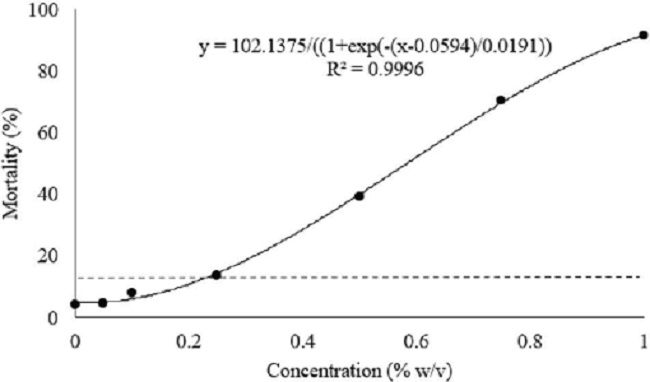 Figure 1
Mean mortality of Meloidogyne incognita in three trials, when
subjected to resorcinol concentrations. The dotted line indicates 15 %
for maximum mortality.
Figure 1
Mean mortality of Meloidogyne incognita in three trials, when
subjected to resorcinol concentrations. The dotted line indicates 15 %
for maximum mortality.
Considering the prescribed mortality limit, a value of 0.2 % was adopted for
subsequent validation tests. From this point, it was tested if this selected
concentration would maintain the neurostimulant properties of the product. In the
following trials, where resorcinol was associated with the bacterial suspension of a
genetically modified B. thuringiensis strain, expressing only the
nematicidal protein Cry6Aa, there was a 3.5-fold higher mortality, when compared to
the treatment of the same strain without resorcinol (Table 2). On the other hand, the control treatment with resorcinol alone
presented only 4.67 % of mortality, well below the 15 % pre-established as a
mortality limit for the control.
Table 2
Mortality rate of Meloidogne incognita, the transformed strain of
Bacillus thuringiensis, when associated or not with resorcinol.
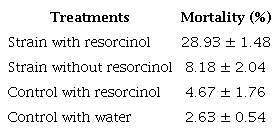
The presence of resorcinol stimulated the intake of nematicidal proteins that were in
the solution, improving the nematicidal activity, considering that there was a
3.5-fold increase in mortality. Zhang et al.
(2012) obtained similar results for M. hapla, verifying
an increase in the nematicidal activity with resorcinol, when compared to tomato
root exudates.
Of the 16 strains of B. thuringiensis tested against M.
incognita in the presence or absence of resorcinol as an inducer of
protein intake (Table 3), it was found that,
in the absence of resorcinol, 8 strains (S1615, S1577, S1617, S2538, S1620, S1295,
S53 and S2493) were statistically equal to the control treatment, not presenting
satisfactory mortality results. Seven other strains presented intermediate results,
difering statistically from the control group and presenting an intermediate
mortality rate between 8.81 and 17.04 % (S09, S2548, S2557, S2558, S2560, S26 and
S906). Finally, the highest mortality obtained without the use of resorcinol was
achieved by the S1930 strain, with 35.7 %.
Table 3
Mortality results (%) of Meloidogne incognita as a function of strains
tested in the presence or absence of resorcinol.
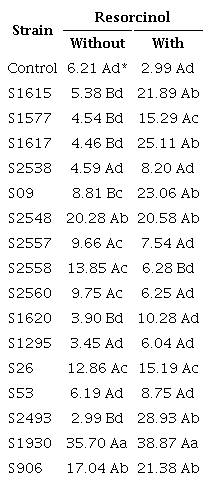 * The same uppercase letter in the row and lowercase letter in the column
do not difer from each other by the Scott-Knott test at 5 % of
probability.
* The same uppercase letter in the row and lowercase letter in the column
do not difer from each other by the Scott-Knott test at 5 % of
probability.
By analyzing the column of the treatments tested with the addition of resorcinol, it
is clear that, in general, the mortality rates in the presence of resorcinol were
higher than those found in the absence of the product, or statistically equal,
except for the S2557 strain, which had its mortality reduced in the presence of the
product, probably interfering negatively in some substance produced by the
strain.
The S2493 strain, which presents the nematicidal gene cry6, which
encodes the Cry6 toxin and presented a low mortality rate (2.99 %), stood out in the
absence of resorcinol, appearing in the intermediate control group (28.93 %). With
the use of resorcinol, taking into account that only the bacterial suspension was
used, without any type of concentration and purification technique aiming to obtain
only the crystals produced by the strain, it is assumed that the mortality result
could be much higher.
Another strain that showed a large increase (greater than 5 times) in mortality was
S1617. Subsequently, it was detected that the strain showed a positive result for
the PCR product with the cry6 primer, indicating that this is the
reason for the mortality expansion.
The strain that caused the highest percentage of mortality in the in
vitro tests was S1930, not being influenced by the presence of
resorcinol, although its use caused a higher mortality. This strain also did not
present the PCR product with the cry6 primer previously tested. It
can be seen, then, in comparison with the strains that presented the nematicidal
protein, that, in the presence of resorcinol, there is a large increase in
mortality, as observed in the strains S2493 and S1617, indicating that the probable
cause of mortality for the strain S1930 was not a Cry protein, but some other toxic
metabolite produced by the strain, which was later verified with the sequencing of
this strain.
Zheng et al. (2016) demonstrated that 120
spore-forming Bacillus strains from different families share
virulence factors, what may contribute to their nematicidal capacity. B.
thuringiensis, B. cereus, B.
subtilis, B. pumilus, B. frmus,
B. toyonensis, Lysinibacillus sphaericus,
Brevibacillus laterosporus and B. brevis were
highly nematicidal, with the first of them demonstrating the highest activity.
Jouzani et al. (2008) observed in
vitro that the concentration of spore-crystal mixtures of 22 selected
strains provided an average mortality 10 % higher in M. incognita
with a concentration 2 times the standard. The strains with the best performances
presented toxicity of 77 and 81 %, respectively, for the combination of spores and
crystals.
Verduzco-Rosas et al. (2021), testing 310
strains of B. thuringiensis, using C. elegans as a
model, found that 10 strains showed toxicity results in spore and crystal
concentration. Of these, two strains produced damage to the body and intestine of
the nematode. Molecular analysis also revealed the presence of
cry5B, cry14A, cry21A and
cyt1A genes and the new cry gene.
The results revealed a very low occurrence of the nematicidal gene
cry6 in the selected strains. As previously mentioned, only the
S1617 strain presented the cry6 gene. According to the methodology
used in the present study, only the detection of the cry6 gene was
sought; thus, it cannot be said that the used strains are not producers of other
nematicidal proteins.
Of the 70 Bt isolates tested by Jouzani et al. (2008), using 12 primers specific for the nematicidal
genes cry5, cry6, cry12,
cry13, cry14 and cry21, the
authors found 22 isolates (31.5 %) which contain at least one cry
gene active against nematodes. Strains containing the cry6 gene
were the most abundant and represent 22.8 % of the isolates.
On the other hand, Bravo et al. (1998),
analyzing multiplex PCR-based with general and specific primers, found a total of
496 samples of B. thuringiensis, which were isolated from 503 soil
samples collected from the five macro-regions of Mexico, of which the proteins are
nematicidal and were analyzed in this study (Cry5, Cry12, Cry13 and Cry14), where no
strains with the cry5, cry12,
cry13, cry14 or cry21 genes
were found.
Although soil is the main source of most B. thuringiensis isolates,
and they still have the ability to present several cry genes in
their molecular profile, their geographical and ecological distribution are very
variable, that is, it is not possible to establish a correlation between
geographical distribution and frequency of occurrence of cry genes
of nematicidal activity.
CONCLUSIONS
- 1.
An in vitro bioassay methodology was defined using
Bacillus thuringiensis and resorcinol as inducer of
protein intake in Meloidogyne incognita;
- 2.
The S1930 strain showed promising results for mortality of M.
incognita, even at low concentrations;
- 3.
There are strains toxic to the nematode M. incognita in
vitro and which have their potential increased with the use of
resorcinol;
- 4.
The S1617 strain tested positive for the cry6 gene
amplification.
ACKNOWLEDGMENTS
This study was partially financed by the Coordenação de Aperfeiçoamento de Pessoal de
Nível Superior - Brasil (Capes) (Finance code 001).
REFERENCES
ADAM, M. A. M.; PHILLIPS, M. S.; JONES, J. T.; BLOK, V. C.
Characterisation of the cellulose-binding protein Mjcbp-1 of the root knot
nematode, Meloidogyne javanica. Physiological and
Molecular Plant Pathology, v. 72, n. 1, p. 21-28,
2008.
BONETI, J. I. S.; FERRAZ, S. Modificação do método de Hussey &
Barker para extração de ovos de Meloidogyne exigua de raízes de
cafeeiros. Fitopatologia Brasileira, v. 6, n. 3, p. 553,
1981.
BRAVO, A. Biodiversity of cry toxins produced by Bacillus
thuringiensis and evolution of resistance to these toxins in
different insect pests. Toxicon, v. 149, e98,
2018.
BRAVO, A.; SARABIA, S.; LOPEZ, L.; ONTIVEROS, H.; ABARCA, C.; ORTIZ,
A.; ORTIZ, M.; LINA, L.; VILLALOBOS, F. J.; PEÑA, G.; NUÑEZ-VALDEZ, M. E.;
SOBERÓN, M.; QUINTERO, R. Characterization of cry genes in Mexican
Bacillus thuringiensis strain collection. Applied
and Environmental Microbiology, v. 64, n. 12, p. 4965-4972,
1998.
CRICKMORE, N.; BAUM, J.; BRAVO, A.; LERECLUS, D.; NARVA, K.;
SAMPSON, K.; SCHNEPF, E.; SUN, M.; ZEIGLER, D. R. Bacillus thuringiensis
toxin nomenclature. 2018. Available at: http://www.btnomenclature.info/. Access on: Sep. 22,
2018.
ENGELBRECHT, G.; HORAK, I.; RENSBURG, P. J. J.; CLAASSENS, S.
Bacillus-based bionematicides: development, modes of action and
commercialization. Biocontrol, Science and Technology, v. 28,
n. 7, p. 629-653, 2018.
FLEGG, J. J. M. Extraction of Xiphinema and
Longidorus species from soil by a modification of Cobb’s
decanting and sieving technique. Annual Applied Biology, v. 60,
n. 3, p. 429-437, 1967.
GOTO, D. B.; FOSU-NYARKO, J.; SAKUMA, F.; SADLER, J.; FLOTTMAN-REID,
M.; UEHARA, T.; KONDO, N.; YAMAGUCHI, J.; JONES, M. G. K. In
planta observation of live fuorescent plant endoparasitic nematodes
during early stages of infection. Nematological Research, v.
40. n. 1, p. 15-19, 2010.
GUO, S.; LIU, M.; PENG, D.; JI, S.; WANG, P.; YU, Z.; SUN, M. New
strategy for isolating novel nematicidal crystal protein genes from
Bacillus thuringiensis strain YBT-1518. Applied and
Environmental Microbiology, v. 74, n. 22, p. 6997-7001,
2008.
GUTIERREZ, M. E. M.; CAPALBO, D. M. F.; ARRUDA, R. O.; MORAES, R. O.
Bacillus thuringiensis. In: SOUZA, B.;
VÁZQUEZ, L.; MARUCCI, R. (ed.). Natural enemies of insect pests in
neotropical agroecosystems. Cham: Springer, 2019.
HUANG, G.; ALLEN, R.; DAVIS, E. L.; BAUM, T. J.; HUSSEY, R. S.
Engineering broad root-knot resistance in transgenic plants by RNAi silencing of
a conserved and essential root-knot nematode parasitism gene.
Proceedings of the National Academy of Sciences of the United States
of America, v. 103, n. 39, p. 14302-14306, 2006.
HUSSEY, R. S.; BARKER, K. R. A comparison of methods of collecting
inocula of Meloidogyne incognita spp., including a new
technique. Plant Disease Report, v. 57, n. 12, p. 1025-1028,
1973.
JAUBERT, S.; LAFFAIRE, J. B.; PIOTTE, C.; ABAD, P.; ROSSO, M.-N.;
LEDGER, T. N. Direct identification of stylet secreted proteins from root-knot
nematodes by a proteomic approach. Molecular and Biochemical
Parasitology, v. 121, n. 2, p. 205-211, 2002.
JOUZANI, G. S.; SEIFINEJAD, A.; SAEEDIZADEH, A.; NAZARIAN, A.;
YOUSEFLOO, M.; SOHEILIVAND, S.; MOUSIVAND, M.; JAHANGIRI, R.; YAZDANI, M.;
AMIRI, R. M.; AKBARI, S. Molecular detection of nematicidal crystalliferous
Bacillus thuringiensis strains of Iran and evaluation of
their toxicity on free-living and plant-parasitic nematodes. Canadian
Journal of Microbiology, v. 54, n. 10, p. 812-822,
2008.
KARSSEN, G.; MOENS, M. Root-knot nematodes. In:
PERRY, R. N.; MOENS, M. (ed.). Plant nematology. Wallingford:
CABI Publishing, 2006. p. 59-90.
LI, X. Q.; TAN, A.; VOEGTLINE, M.; BEKELE, S.; CHEN, C. S.; AROIAN,
R. V. Expression of cry5B protein from Bacillus thuringiensis
in plant roots confers resistance to rootknot nematode. Biological
Control, v. 47, n. 1, p. 97-102, 2008.
LI, X. Q.; WEI, J.-Z.; TAN, A.; AROIAN, R. V. Resistance to
root-knot nematode in tomato roots expressing a nematicidal Bacillus
thuringiensis crystal protein. Plant Biotechnology
Journal, v. 5, n. 4, p. 455-464, 2007.
MONNERAT, R. G.; BATISTA, A. C.; MEDEIROS, P. T.; MARTINS, É. S.;
MELATTI, V. M.; PRAÇA, L. B.; DUMAS, V. F.; MORINAGA, C.; DEMO, C.; GOMES, A. C.
M.; FALCÃO, R.; SIQUEIRA, C. B.; SILVA-WERNECK, J. O.; BERRY, C.
Characterization of Brazilian Bacillus thuringiensis strains
active against Spodoptera frugiperda, Plutella
xylostella and Anticarsia gemmatallis.
Biological Control, v. 41, n. 3, p. 291-295,
2007.
MONTALVÃO, S. C. L.; CASTRO, M. T. D.; SOARES, C. M. S.; BLUM, L. E.
B.; MONNERAT, R. G. Caenorhabditis elegans como indicador de
toxicidade de estirpes de Bacillus thuringiensis a
Meloidogyne incognita raça 3. Ciência
Rural, v. 48, n. 7, e20170712, 2018.
OKA, Y. Nematicidal activity of fuensulfone against some migratory
nematodes under laboratory conditions. Pest Management Science,
v. 70, n. 12, p. 1850-1858, 2014.
OLIVEIRA, D. F.; COSTA, V. A.; TERRA, W. C.; CAMPOS, V. P.; PAULA,
P. M.; MARTINS, S. J. Impact of phenolic compounds on Meloidogyne
incognita in vitro and in tomato plants. Experimental
Parasitology, v. 199, n. 1, p. 17-23, 2019.
PALMA, L.; MUÑOZ, D.; BERRY, C.; MURILLO, J.; CABALLERO, P.
Bacillus thuringiensis toxins: an overview of their
biocidal activity. Toxins, v. 6, n. 12, p. 3296-3325,
2014.
PERRY, R. N.; MOENS, M.; STAR, J. L. Root-knot
nematodes. Wallingford: CABI, 2009.
PINHEIRO, J. B.; AMARO, G. B.; PEREIRA, R. B. Ocorrência e
controle de nematoides em hortaliças folhosas. Brasília, DF:
Embrapa Hortaliças, 2010. (Circular técnica, 89).
PRIYA, D. B.; SOMASEKHAR, N.; PRASAD, J. S.; KIRTI, P. B. Transgenic
tobacco plants constitutively expressing Arabidopsis NPR1 show
enhanced resistance to root-knot nematode, Meloidogyne
incognita. BMC Research Notes, v. 4, n. 1, p. 1-5,
2011.
RAMALAKSHMI, A.; SHARMILA, R.; INIYAKUMAR, M.; GOMATHI, V.
Nematicidal activity of native Bacillus thuringiensis against
the root knot nematode, Meloidogyne incognita (Kofoid and
White). Egyptian Journal of Biological Pest Control, v. 30,
e90, 2020.
SIKANDAR, A.; ZHANG, M. Y.; ZHU, X. F.; WANG, Y. Y.; AHMED, M.;
IQBAL, M. F.; JAVEED, A.; XUAN, Y. H.; FAN, H. Y.; LIU, X. Y.; CHEN, L. J.;
DUAN, Y. X. Effects of Penicillium chrysogenum strain Snef1216
against root-knot nematodes (Meloidogyne incognita) in cucumber
(Cucumis sativus L.) under greenhouse conditions.
Applied Ecology and Environmental Research, v. 17, n. 5, p.
12451-12464, 2019.
SOLTANZADEH, M.; NEJAD, M. S.; BONJAR, G. H. S. Application of
soil-borne actinomycetes for biological control against fusarium wilt of
chickpea (Cicer arietinum) caused by Fusarium
solani fsp. pisi. Journal of
Phytopathology, v. 164, n. 11-12, p. 967-978,
2016.
VERDUZCO-ROSAS, L. A.; GARCÍA-SUÁREZ, R.; LÓPEZ-TLACOMULCO, J. J.;
IBARRA, J. E. Selection and characterization of two Bacillus
thuringiensis strains showing nematicidal activity against
Caenorhabditis elegans and Meloidogyne
incognita. FEMS Microbiology Letters, v. 368, n.
5, efinaa186, 2021.
WEI, J. Z.; HALE, K.; CARTA, L. Bacillus
thuringiensis crystal proteins that target nematodes.
Proceedings of the National Academy of Sciences of the United States
of America, v. 100, n. 5, p. 2760-2765, 2003.
WILLIAMSON, V. M.; GLEASON, C. A. Plant-nematode interactions.
Current Opinion in Plant Biology, v. 6, n. 4, p. 327-333,
2003.
XIANG, N.; LAWRENCE, K. S. Optimization of in vitro
techniques for distinguishing between live and dead second stage juveniles of
Heterodera glycines and Meloidogyne
incognita. Plos One, v. 11, n. 5, e0154818,
2016.
XIANG, N.; LAWRENCE, K. S.; DONALD, P. A. Biological control
potential of plant growth-promoting rhizobacteria suppression of
Meloidogyne incognita on cotton and Heterodera
glycines on soybean: a review. Journal of
Phytopathology, v. 166, n. 7-8, p. 449-458, 2018.
ZENG, J.; ZHANG, Z.; LI, M.; WU, X.; ZENG, Y.; LI, Y. Distribution
and molecular identification of Meloidogyne spp. parasitising
fue-cured tobacco in Yunnan, China. Plant Protection Science,
v. 54, n. 3, p. 183-189, 2018.
ZHANG, F.; PENG, D.; YE, X.; YU, Z.; HU, Z.; RUAN, L.; SUN, M.
In vitro uptake of 140 kDa Bacillus
thuringiensis nematicidal crystal proteins by the second stage
juvenile of Meloidogyne hapla. Plos One, v. 7,
n. 6, e38534, 2012.
ZHENG, Z.; ZHENG, J.; ZHANG, Z.; PENG, D.; SUN, M. Nematicidal
spore-forming bacilli share similar virulence factors and mechanisms.
Scientific Reports, v. 6, n. 1, e31341,
2016.
ZUCKERMAN, B. M.; BRZESKI, M. W. Methods for the study of
plant-parasitic nematodes in gnotobiotic root culture.
Nematologica, v. 11, n. 4, p. 453-466,
1966.
