Carátula del artículo
Occurrence of Dinarmus basalis parasitizing
Callosobruchus maculatus in Vigna
unguiculata in the semiarid region of the Rio Grande do Norte
state, Brazil
Ocorrência de Dinarmus basalis parasitando
Callosobruchus maculatus em Vigna
unguiculata no semiárido do Rio Grande do Norte,
Brasil
 Ewerton Marinho da Costa ewerton.marinho@professor.ufcg.edu.br
Universidade Federal de Campina Grande, Brasil
Francisco Edivino Lopes da Silva edivino_ufersa@hotmail.com
Bayer, Brasil
Elania Clementino Fernandes elaniacf@gmail.com
Universidade Federal Rural do Semiárido, Brasil
Valmir Antonio Costa valmir@biologico.sp.gov.br
Instituto Biológico, Brasil
Elton Lucio Araujo elton@ufersa.edu.br
Universidade Federal Rural do Semiárido, Brasil
Pesquisa Agropecuária Tropical, vol. 53, e75902, 2023
Escola de Agronomia/UFG
Received: 17 April 2023
Accepted: 19 July 2023
Published: 16 August 2023
Callosobruchus maculatus (Fab.) (Coleoptera: Chrysomelidae: Bruchinae)
is the main pest of Vigna unguiculata (L.) Walp. cowpea during the
grain storage period (Heidari et al. 2016, Medeiros et al. 2017, Silva et al. 2020). The damage related to the attack of this pest
is due to the penetration and feeding of the larvae inside the grains, affecting their
commercial and agronomic quality and making them unsuitable for human consumption and
sowing (Oliveira et al. 2014).
The main method to control C. maculatus is chemical control with
synthetic insecticides (e.g., organophosphates, pyrethroids and phosphine) (Gusmão et al. 2013). In Brazil, the number of
insecticides registered for the control of C. maculatus in cowpea is
limited, being restricted to magnesium phosphide (Brasil
2003). However, the inappropriate use of these insecticides can cause several
problems, e.g., intoxication of rural workers, residue accumulation in grains and
emergence of resistant pest populations, among others (Pimentel et al. 2010, Hedjal-Chehheb et al.
2013).
Thus, the use of botanical insecticides (Hedjal-Chehheb et
al. 2013, Izakmehri et al. 2013, Mbata & Payton 2013, Sousa Neto et al. 2019) and biological control with parasitoids
(Amevoin et al. 2007) have been studied as
alternatives to synthetic insecticides. Several parasitoids associated with C.
maculatus have been reported worldwide, with the Pteromalidae family being
the most diversified, with five species distributed in the genera Dinarmus,
Theocolax and Lariophagus (Van Huis 1991). In a study carried out in west Africa, Amevoin et al. (2007) reported that, after the parasitoid
Dinarmus basalis (Rondani) (Hymenoptera: Pteromalidae) was
released, a significant reduction in the populations of C. maculatus in
stored cowpea was observed, consequently resulting in lower losses, when compared to the
control treatment.
In Brazil, information about the occurrence of natural enemies of the
Callosobruchus genus is still scarce, with records in the states of
Santa Catarina (Lima 1942), Pará (Ohashi et al. 1993) and São Paulo (Costa et al. 2007). Therefore, this study aimed to
report, for the first time, the occurrence of a parasitoid associated with C.
maculatus in cowpea, in the semiarid region of the Rio Grande do Norte
state, Brazil.
A total of 20 cowpea samples of 200 g from the Mossoró region (5º11’S and 37º20’W) were
taken to the laboratory at the Universidade Federal Rural do Semiárido, in 2013, where
they were placed in plastic containers (6 cm high × 10 cm in diameter) closed at the top
with voile fabric and kept in an air-conditioned room (25 ± 2 ºC; 70 ± 10 % RH; 12-h
photoperiod). The cowpea samples were inspected daily until the emergence of C.
maculatus adults (± 20 days after collection) or parasitoids. Subsequently,
the obtained insects were transferred to containers with 70 % ethyl alcohol and duly
labelled (date and sampling location). The emerged parasitoids were identified according
to Bouček & Heydon (1997) for genus and Rasplus (1989) for species. The Bruchinae specimens
were sent to the Universidade Federal Rural de Pernambuco (UFRPE), in Recife, Pernambuco
state, Brazil, for identification. The voucher specimens of the parasitoid were
deposited in the entomological collection of the Instituto Biológico of São Paulo,
whereas the C. maculatus specimens were deposited in the entomological
collection of the UFRPE.
A total of 2,083 insects were collected from the cowpea samples, with 1,414 C.
maculatus and 669 parasitoids belonging to Dinarmus
basalis (Rondani) (Hymenoptera: Pteromalidae) (Figure 1). This parasitoid is a solitary idiobiont ectoparasitoid of
immature insects and may be used for the biological control of C.
maculatus (Amevoin et al. 2007). This
parasitoid is the main natural enemy of bruchids in cowpea grains (Sanon et al. 2011). Dinarmus basalis is originally
from Africa and has dispersed throughout the Americas, Asia and Europe due to the trade
in grains and seeds (Rasplus 1989).
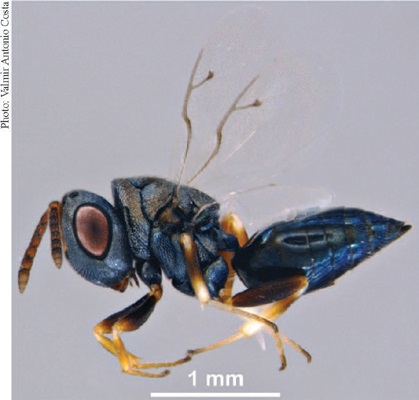 Figure 1
Female of Dinarmus basalis (Rondani) (Hymenoptera: Pteromalidae)
collected in Mossoró, Rio Grande do Norte state, Brazil.
Figure 1
Female of Dinarmus basalis (Rondani) (Hymenoptera: Pteromalidae)
collected in Mossoró, Rio Grande do Norte state, Brazil.
In Brazil, D. basalis has already been reported parasitizing
Callosobruchus chinensis (L.) associated with Vigna
radiata (L.) in the Santa Catarina state (Lima 1942), Acanthoscelides obtectus (Say) in the Northeast
region of Brazil (Oliveira 1948), C.
maculatus associated with V unguiculata in the Pará state
(Ohashi et al. 1993) and
Callosobruchus analis (F.) associated with Glycine
max (L.) in the São Paulo state (Costa et
al. 2007). However, this is the first report of D. basalis
parasitizing C. maculatus associated with cowpea in the semiarid region
of the Rio Grande do Norte state, Brazil.
REFERENCES
AMEVOIN, K.; SANON, A.; APOSSABA, M.; GLITHO, I. A. Biological
control of bruchids infesting cowpea by the introduction of Dinarmus
basalis (Rondani) (Hymenoptera: Pteromalidae) adults into farmers’
stores in west Africa. Journal of Stored Products Research, v.
43, n. 3, p. 240-247, 2007.
BOUČEK, Z.; HEYDON, S. L. Pteromalidae. In: GIBSON,
G. A. P.; HUBER, J. T.; WOOLLEY, J. B. Annotated keys to the genera of
Nearctic chalcidoidea (Hymenoptera). Ottawa: NRC Research Press,
1997. p. 541-692.
COSTA, V. A.; GUZZO, E. C.; LOURENÇÃO, A. L.; TAVARES, M. A. G. C.;
VENDRAMIM, J. D. Occurrence of Dinarmus basalis in
Callosobruchus analis in stored soybean in São Paulo,
Brazil. Scientia Agricola, v. 64, n. 3, p. 301-302,
2007.
GUSMÃO, N. M. S.; OLIVEIRA, J. V.; NAVARRO, D. M. A. F.; DUTRA, K.
A.; SILVA, W. A.; WANDERLEY, M. J. A. Contact and fumigant toxicity and
repellency of Eucalyptus citriodora Hook., Eucalyptus
staigeriana F., Cymbopogon winterianus Jowitt and
Foeniculum vulgare Mill. essential oils in the management
of Callosobruchus maculatus (FABR.) (Coleoptera: Chrysomelidae,
Bruchinae): a review. Journal of Stored Products Research, v.
54, n. 1, p. 41-47, 2013.
HEDJAL-CHEHHEB, M.; TOUDERT-TALEB, K.; KHOUDJA, M. L.;
BENABDESSELAM, R.; MELLOUK, M.; KELLOUCHE, A. Essential oils compositions of six
conifers and their biological activity against the cowpea weevil,
Callosobruchus maculatus Fabricius, 1775 (Coleoptera:
Bruchidae) and Vigna unguiculata seeds. African
Entomology, v. 21, n. 2, p. 243-254, 2013.
HEIDARI, N.; SEDARATIAN-JAHROMI, A.; GHANE-JAHROMI, M. Possible
effects of ultraviolet ray (UV-C) on biological traits of Callosobruchus
maculatus (Col.: Chrysomelidae). Journal of Stored Products
Research, v. 69, n. 1, p. 91-98, 2016.
IZAKMEHRI, K.; MOOSA, S.; MEHRVAR, S.; HASSANPOURAGHDAM, M. B.;
VOJOUDI, S. Lethal and sublethal effects of essential oils from
Eucalyptus camaldulensis and Heracleum
persicum against the adults of Callosobruchus maculatus.
Journal of Insect Science, v. 13, n. 1, p. 1-10,
2013.
LIMA, A. D. F. Mais um inimigo do Callosobruchus chinensis.
Boletim da Sociedade Brasileira de Agronomia, v. 5, n. 1, p.
441-443, 1942.
MBATA, G. N.; PAYTON, M. E. Effect of monoterpenoids on oviposition
and mortality of Callosobruchus maculatus (F.) (Coleoptera:
Bruchidae) under hermetic conditions. Journal of Stored Products
Research, v. 53, n. 1, p. 43-47, 2013.
MEDEIROS, W. R.; SILVA, J. D. C.; SILVA, P. R. R.; GIRÃO FILHO, J.
E.; PADUA, L. E. M.; FRANÇA, S. M. Resistência de genótipos de feijãocaupi
[Vigna unguiculata (L.) Walp.] ao ataque do caruncho
Callosobruchus maculatus (Fabr.) (Coleoptera:
Chrysomelidae). EntomoBrasilis, v. 10, n. 1, p. 19-25,
2017.
OHASHI, O. S.; COUTINHO, J. C. B.; SILVA, O. F. Aspectos biológicos
de Dinarmus basalis (Rondani, 1877) (Hymenoptera: Pteromalidae)
ectoparasito de Callosobruchus maculatus (Fabricius, 1775)
(Coleoptera: Bruchidae). Anais da Sociedade Entomológica do
Brasil, v. 22, n. 1, p. 161-167, 1993.
OLIVEIRA, G. B.; KUNZ, D.; PERES, T. V.; LEAL, R. B.; UCHÔA, A. F.;
SAMUELS, R. I.; MACEDO, M. L. R.; CARLINI, C. R.; RIBEIRO, A. F.; GRANGEIRO, T.
B.; TERRA, W. R.; XAVIER-FILHO, J.; SILVA, C. P. Variant vicilins from a
resistant Vigna unguiculata lineage (IT81D-1053) accumulate
inside Callosobruchus maculatus larval midgut epithelium.
Comparative Biochemistry and Physiology Part B: Biochemistry and
Molecular Biology, v. 168, n. 1, p. 45-52, 2014.
OLIVEIRA, M. A. Contribuição ao estudo do combate biológico do
gorgulho do feijão (Acanthoscelides obsoletus Say) pelo
Bruchobius laticeps Ash. Agros, v. 1, n.
1, p. 258-268, 1948.
PIMENTEL, M. A. G.; FARONI, L. R. D. A.; SILVA, F. H.; BATISTA, M.
D.; GUEDES, R. N. C. Spread of phosphine resistance among Brazilian populations
of three species of stored product insects. Neotropical
Entomology, v. 39, n. 1, p. 101-107, 2010.
RASPLUS, J. Y. Révision des espèces afrotropicales du genre
Dinarmus Thomson (Hymenoptera: Pteromalidae).
Annales de la Société Entomologique de France, v. 25, n. 1,
p. 135-162, 1989.
SANON, A.; BA, M. N.; DABIRÉ, L. C. B.; NÉBIÉ, R. C. H.; MONGE, J.
P. Side effects of grain protectants on biological control agents: how
Hyptis plant extracts affect parasitism and larval
development of Dinarmus basalis. Phytoparasitica, v. 39, n. 3,
p. 215-222, 2011.
SILVA, A. B.; OLIVEIRA, C. R. F.; MATOS, C. H. C.; SANTOS, P. E. M.;
LIRA, C. R. I. M. Bioatividade do óleo essencial de Croton
blanchetianus Baill (Euphorbiaceae) sobre Callosobruchus
maculatus Fabricius, 1775 (Coleoptera: Chrysomelidae).
Nativa, v. 8, n. 4, p. 450-455, 2020.
SOUSA NETO, E. P.; ANDRADE, A. B. A.; COSTA, E. M.; MARACAJÁ, P. B.;
SANTOS, A. B.; SANTOS, J. L. G.; PIMENTA, T. A. Effect of neem powder
(Azadirachta indica A. Juss) on the control of cowpea
weevils [Callosobruchus maculatus (F.) (Coleoptera: Bruchidae)]
in cowpea beans. Journal of Experimental Agriculture
International, v. 30, n. 2, p. 1-7, 2019.
VAN HUIS, A. Biological methods of bruchid control in the tropics: a
review. International Journal of Tropical Insect Science, v.
12, n. 3, p. 87-102, 1991.
