Research Article
Improving nitrogen efficiency and reducing ammonia emissions in wheat: a strategy using cattle slurry and dicyandiamide1
Melhorando a eficiência do nitrogênio e reduzindo as emissões de amônia em trigo com o uso de dejeto líquido de bovino e dicianodiamida
 Alieze Nascimento da Silva alieze.agro@gmail.com
Eveline Ferreira Soares soares.eveline@yahoo.com
Claudir José Basso claudirbasso@gmail.com
Alieze Nascimento da Silva alieze.agro@gmail.com
Eveline Ferreira Soares soares.eveline@yahoo.com
Claudir José Basso claudirbasso@gmail.com
Improving nitrogen efficiency and reducing ammonia emissions in wheat: a strategy using cattle slurry and dicyandiamide1
Pesquisa Agropecuária Tropical, vol. 56, e83428, 2026
Escola de Agronomia/UFG
Received: 17 July 2025
Accepted: 17 November 2025
Published: 19 December 2025
ABSTRACT: Under no-tillage systems, the surface application of cattle slurry may result in significant losses through ammonia volatilization, compromising the nitrogen-use efficiency in wheat. This study evaluated the effects of cattle slurry (CS) application methods (surface vs. injection), with or without the nitrification inhibitor dicyandiamide (DCD), on ammonia (NH₃-N) volatilization, nitrogen-use efficiency and wheat yield, under no-tillage conditions. Two field experiments were carried out in contrasting soils (Oxisol and Ultisol). Pre-sowing NH₃-N losses were strongly affected by the source and application method of N. For the Oxisol, the cumulative volatilization reached 10.67 % of the N applied in the NPK treatment, when compared to 7.80 % in the surface-applied CS and 7.25 % in the injected CS. For the Ultisol, the NH₃-N losses from CS were lower than 1 % of the applied ammoniacal N, and the injection reduced emissions up to 58 %, relatively to the surface application. The injected CS treatment combined with DCD (CSi + DCD) increased the nitrogen uptake by 48-141 kg ha-1, and improved the nitrogen-use efficiency by 1.23-2.53 kg of grains, when compared to NPK. Grain yield was also higher in CSi + DCD, with increases of 20.3 % (Oxisol) and 16.2 % (Ultisol), in relation to NPK. The slurry injection associated with the use of DCD enhanced the N retention, reduced NH₃-N losses, and increased wheat yield, representing an efficient alternative to conventional mineral fertilization in subtropical no-tillage systems.
KEYWORDS: Triticum aestivum, slurry application methods, greenhouse gas mitigation.
RESUMO: Em sistemas de plantio direto, a aplicação superficial de dejetos líquidos de bovinos pode resultar em perdas significativas de nitrogênio por volatilização de amônia, comprometendo a eficiência de uso do nutriente pelo trigo. Este estudo avaliou os efeitos de métodos de aplicação de dejetos líquidos de bovinos (DLB) (superficial vs. injeção), com ou sem o inibidor de nitrificação dicianodiamida (DCD), sobre a volatilização de amônia (NH₃-N), eficiência de uso do nitrogênio e produtividade de trigo, em sistema de plantio direto. Dois experimentos de campo foram conduzidos em solos contrastantes (Latossolo e Argissolo). As perdas de NH₃-N no pré-plantio foram fortemente influenciadas pela fonte e pelo modo de aplicação do N. No Latossolo, a volatilização acumulada atingiu 10,67 % do N aplicado no tratamento NPK, em comparação a 7,80 % para DLB aplicado superficialmente e 7,25 % para DLB injetado. No Argissolo, as perdas de NH₃-N provenientes do DLB foram inferiores a 1 % do N amoniacal aplicado, e a injeção reduziu as emissões em até 58 %, em relação à aplicação superficial. O tratamento com DLB injetado combinado com DCD (DLBi + DCD) aumentou a absorção de N em 48-141 kg ha-1 e melhorou a eficiência de uso do nitrogênio em 1,23-2,53 kg de grãos, quando comparado ao NPK. A produtividade de grãos também foi superior no DLBi + DCD, com incrementos de 20,3 % (Latossolo) e 16,2 % (Argissolo), em relação ao NPK. A injeção de DLB associada ao uso de DCD aumentou a retenção de N, reduziu as perdas de NH₃-N e elevou a produtividade do trigo, representando uma alternativa eficiente à adubação mineral convencional em sistemas subtropicais de plantio direto.
PALAVRAS-CHAVE: Triticum aestivum, métodos de aplicação de dejetos, mitigação de gases de efeito estufa.
INTRODUCTION
The use of global nitrogen (N) fertilizer has continuously risen, reaching 108 million tons in 2022 (FAO 2024), with projections of a further increase of up to 116 million tons by 2025 (IFA 2025). In Brazil, N accounts for nearly one-third of the fertilizer consumption (PNF 2022), and imports grew 15 % in January 2024 (Conab 2024).
In southern Brazil’s crop-livestock systems, cattle slurry (CS) is widely used before wheat sowing, because 75-90 % of the ingested N is excreted by ruminants (Whitehead 1995, Bouwman et al. 2013, Bratti et al. 2022), enabling nutrient recycling but contributing to low nitrogen-use efficiency. Moreover, even simpler liquid fractions of livestock waste, such as cattle urine, have demonstrated considerable fertilization potential, increasing maize yield in smallholder systems (Yemata & Mengistu 2024) and reinforcing the agronomic value of recycled livestock nitrogen.
Globally, crops take up only ~33 % of the applied N, whereas ~67 % is lost as NH₃, N₂O and NO₃- (Park et al. 2021, Peng et al. 2023, Buchen-Tschiskale et al. 2023a, Cassim et al. 2024, IEA 2024). Agriculture, particularly livestock, drives 80-90 % of NH₃ emissions (Aneja et al. 2020, Overmeyer et al. 2021, El Bied et al. 2023), with animal supply chains responsible for 60 % of the global NH₃, 23 % of NOₓ and 32 % of N₂O emissions (Uwizeye et al. 2020).
Under no-tillage, the lack of incorporation intensifies the NH₃ volatilization from CS (Damian et al. 2018, Keskinen et al. 2022, Nyameasem et al. 2022a, Jin et al. 2025, Ofori et al. 2025), especially in the first 24-48 h after application (Fangueiro et al. 2022, van der Weerden et al. 2021, Wang et al. 2021, van der Weerden et al. 2023). For urea, a rapid hydrolysis increases the microsite pH and shifts the NH₄⁺/NH₃ equilibrium toward a higher amount of NH₃ (Rochette et al. 2009a, Cantarella et al. 2018), leading to potential losses of up to 64 % of the applied N, whereas slurry may emit 20-30 % of the total ammoniacal nitrogen, depending on environmental conditions (Rochette et al. 2009, Aita et al. 2018, Andersson et al. 2023).
Mitigation strategies such as slurry injection, trailing-shoe application, acidification, and inhibitors can significantly reduce these losses. Injection typically reduces NH₃ emissions by 17-37 %, whereas acidification decreases early losses by 67-80 % (van der Weerden et al. 2021, Andersson et al. 2023). Urease inhibitors (e.g., NBPT) delay urea hydrolysis, reducing NH₃ losses by ~53 % and increasing wheat yield in Brazil by ~6 % (Cantarella et al. 2018), whereas integrated approaches combining NBPT, hydroquinone or plant-derived additives reduce volatilization by 17-40 % and improve yield and nitrogen-use efficiency (Sanz-Cobena et al. 2008, Abalos et al. 2012, Abalos et al. 2014, Sanz-Cobena et al. 2014, Ramalingappa et al. 2023).
Dicyandiamide (DCD), a widely studied nitrification inhibitor, slows NH₄⁺ oxidation and improves soil N retention, reducing N₂O emissions and NO₃- leaching, and increasing crop N uptake (Ramalingappa et al. 2023). In wheat and forage systems, DCD has reduced N₂O emissions by ~50 %, increased dry matter production and decreased the proportion of unaccounted-for N, defined as the fraction of applied N not recovered in plant uptake, soil N pools, or directly measured loss pathways (Aita et al. 2018, Bray et al. 2021, Park et al. 2021).
Studies combining slurry placement and inhibitors consistently report higher N uptake, higher nitrogen-use efficiency and lower N losses in cereals (Meade et al. 2011, Sieling et al. 2014, Franzluebbers 2020, Capra et al. 2025, Sorecha et al. 2025). However, most evidence comes from temperate regions and soil types distinct from the Oxisol and Ultisol that dominate subtropical, no-tillage systems, in southern Brazil.
The interaction between slurry application method and DCD remains poorly understood in local crop-livestock systems. Thus, this study evaluated the effectiveness of CS injection and DCD in reducing NH₃-N losses in wheat grown on contrasting subtropical soils (Oxisol and Ultisol), as well as their impacts on wheat performance and nitrogen-use efficiency.
MATERIAL AND METHODS
Two field experiments were conducted under no-tillage conditions at two locations in the Rio Grande do Sul state, Brazil - one in the northwest and the other in the central region of the state, during the 2015 growing season.
The experiment I was carried out at the Universidade Federal de Santa Maria, in Frederico Westphalen (27º23′S, 53º25′W and 566 m of altitude), in a humid subtropical climate (Cfa), according to the Köppen classification. Meteorological data from an automatic station located at 500 m from the site are shown in Figure 1a. The soil in the area is classified as Dystrophic Red Latosol (Embrapa 2013), corresponding to Rhodic Hapludox (Oxisol) (USDA 2022), with 654 g kg-1 of clay, pH (H₂O) of 5.1, SMP index (Shoemaker-McLean-Pratt buffer, used to estimate lime requirement) of 5.6, 5.5 mg dm-3 of P, 64.8 mg dm-3 of K, 0.2 cmolc dm-3 of Al, 5.5 cmolc dm-3 of H + Al, 7.94 cmolc dm-3 of effective cation exchange capacity (CEC), 57.22 % of base saturation and 28.4 g kg-1 of organic matter in the 0.00-0.10 m layer.
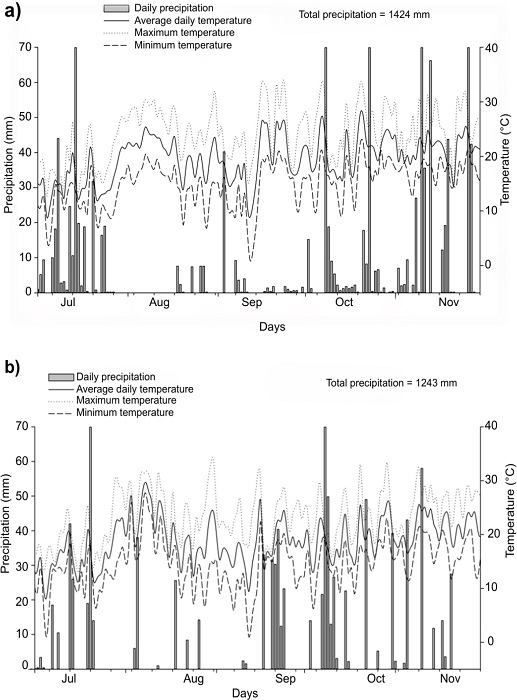
Figure 1
Daily minimum, maximum, and mean air temperatures and rainfall during the experiment. a) Rainfall data sourced from the Frederico Westphalen meteorological station; b) data obtained from the experimental climatological station of the Universidade Federal de Santa Maria.
The experiment II was conducted at the Universidade Federal de Santa Maria, in Santa Maria (29º42′S, 53º42′W and 80 m of altitude), also under a humid subtropical climate (Cfa). Meteorological data are shown in Figure 1b. The soil in the area is classified as Arenic Dystrophic Red Argisol (Embrapa 2013), corresponding to Typic Hapludalf (Ultisol) (USDA 2022), containing 124.3 g kg-1 of clay, 259.1 g kg-1 of silt and 616.6 g kg-1 of sand, with 13 g kg-1 of organic matter, pH of 5.3, 13.2 mg dm-3 of P, 72 mg dm-3 of K, 41.9 % of base saturation, 6.5 cmolc dm-3 of CEC at pH 7.0, and 1.64 g cm-3 of bulk density, in the 0.00-0.10 m layer. The area had remained fallow for one year and had been under no-tillage for two years, with soybean in the summer and ryegrass in the winter.
Both sites present a humid subtropical climate (Cfa), with annual mean temperatures of 18.6 ºC in Frederico Westphalen and 19.1 ºC in Santa Maria, mild winters (12-16 ºC), warm summers (23-27 ºC), and well-distributed rainfall totaling 1,700-1,900 mm annually, with monthly averages of 110-180 mm during the wheat season (Brasil 2022). Climatic conditions recorded during the experiments are shown in Figure 1.
Six treatments were applied in 36-m2 plots (6 × 6 m), arranged in a randomized complete block design, with four replications. The treatments consisted of: surface-applied cattle slurry (CSs) (T1; application of CS distributed over the soil surface); surface-applied cattle slurry plus dicyandiamide (CSs + DCD) (T2; CS applied on the soil surface with the nitrification inhibitor DCD mixed immediately before application); injected cattle slurry (CSi) (T3; CS applied using a mechanical injector that places the material directly into the soil); injected cattle slurry plus dicyandiamide (CSi + DCD) (T4; injected CS combined with DCD incorporated at the time of application); control (T5; no fertilizer and no DCD); and mineral fertilizer (NPK) (T6; conventional mineral fertilization applied to the soil surface following recommended rates for wheat).
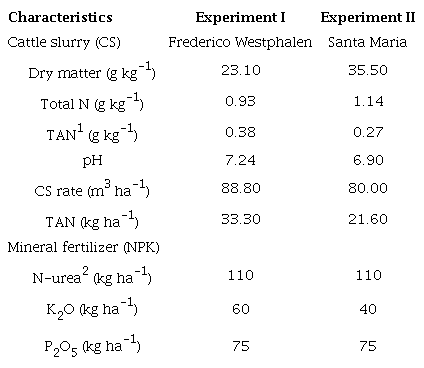
The cattle slurry (CS) used in the experiments originated from lactating dairy cows and consisted of feces, urine, wasted feed and wash water stored in an open anaerobic pit. Its chemical composition is shown in Table 1.
1 TAN: total ammoniacal nitrogen (N-NH3 + N-NH4+);2 The total urea-N rate was split, with 1/3 applied before sowing and 2/3 as topdressing.
For the experiment I, the liquid cattle slurry used in all organic treatments was designated as cattle slurry (CS) and applied at a rate of 88.8 m3 ha-1, supplying 60 kg ha-1 of N, 75 kg ha-1 of P and 60 kg ha-1 of K. In the NPK treatment, 75 kg ha-1 of P₂O₅, 60 kg ha-1 of K₂O and 60 kg ha-1 of N were applied at sowing, followed by 50 kg ha-1 of top-dressed N.
The surface-applied CS (CSs) was manually distributed using watering cans, whereas the nitrification inhibitor DCD (Agrotain Plus®) was mixed with the CS at a rate of 7 kg ha-1 at the moment of application. The injected CS (CSi) was applied using a mechanical injector (Model DAOL-i 4000 Tandem, MEPEL). The wheat (cv. Quartzo OR, Biotrigo) was sown on July 30, 2015. In the experiment II, CS was likewise used in all organic treatments, applied entirely at six days before sowing, at a rate of 80 m3 ha-1, providing 45.4 kg ha-1 of N, 25.6 kg ha-1 of P and 80 kg ha-1 of K. Because this CS dose did not fully meet the crop’s nutritional requirements, supplemental N and P were applied at 37 days after sowing, supplying 64.6 kg ha-1 of N and 16.4 kg ha-1 of P₂O₅.
In the NPK treatment, 75 kg ha-1 of P₂O₅, 30 kg ha-1 of K₂O and 20 kg ha-1 of N were applied at sowing, followed by 90 kg ha-1 of top-dressed N at 40 days after sowing. The wheat (cv. TBIO Sinuelo) was sown on June 22, 2015, at a seeding rate of 160 kg ha-1.
The plant measurements adhered to the growth stage descriptions proposed by Large (1954), and the nitrogen concentration was analyzed according to Tedesco et al. (1995). Based on dry matter production, nitrogen accumulation and grain yield, the following indices were calculated (Craswell & Godwin 1984, Fageria 1998): agronomic nitrogen efficiency, apparent nitrogen recovery, physiological efficiency and nitrogen-use efficiency.
Ammonia emissions were evaluated only in the treatments without DCD (control, NPK, CSs and CSi), since the nitrification inhibitor does not influence NH₃ volatilization (Pujol 2012). Measurements were performed using semi-open static chambers (Nömmik 1973) at 0, 24, 48, 72, 120, 168 and 240 hours after N application. Foam sponges soaked with a trapping solution were used to retain volatilized ammonia. After sampling, the sponges were extracted with KCl, and ammoniacal N was quantified using the semi-micro Kjeldahl distillation method (Tedesco et al. 1995). Hourly fluxes and cumulative NH₃ losses were then calculated.
Statistical analyses were conducted using analysis of variance (Anova). Treatment means were compared with the Tukey test at 5 % of significance and the Fisher’s LSD test at 1 %. Analyses were carried out using the Genes software (Cruz 2007) and SigmaPlot (Systat Software, Inc.).
RESULTS AND DISCUSSION
Pre-sowing ammonia volatilization in wheat was strongly driven by the interaction between the source of N, its application method and soil-climate conditions, as shown by the temporal N-NH₃ flux patterns (Figure 2) and cumulative losses (Figure 4). In the Oxisol (experiment I), surface-applied urea (NPK) generated the highest pre-sowing emissions, with a pronounced peak around 120 h after application and a cumulative emission factor of 10.67 % of the applied N. This behavior is consistent with the well-known dynamics of surface-applied urea, in which rapid hydrolysis increases microsite pH, maintains high total ammoniacal nitrogen (TAN; NH3 + NH4+) concentrations in the upper millimeters of the soil, and promotes intense NH₃ volatilization under warm and moist conditions (Bronson et al. 1989, Rochette et al. 2009, Cantarella et al. 2018).
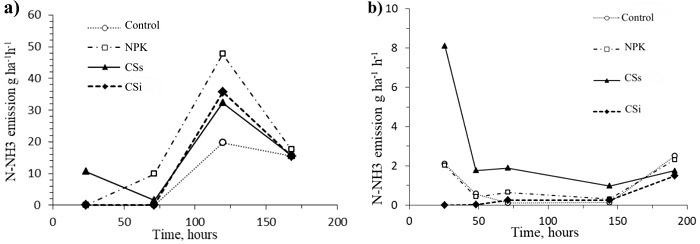
Figure 2
Ammonia (N-NH₃) emissions following pre-sowing application of nitrogen sources in wheat under no-tillage conditions. a) Experiment I - conducted in Frederico Westphalen (Oxisol); b) Experiment II - conducted in Santa Maria (Ultisol). Treatments: control (without N); mineral fertilization (NPK); surface-applied cattle slurry (CSs), and injected cattle slurry (CSi). Vertical bars represent the least significant difference (LSD 0.01).
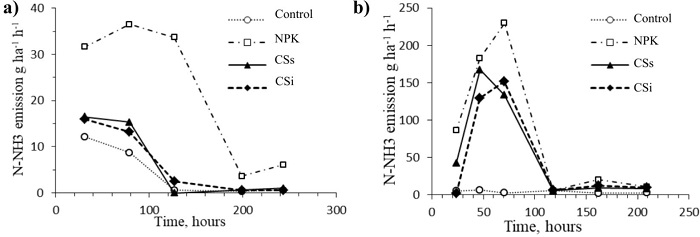
Figure 3
Ammonia (N-NH₃) emissions following urea topdressing in wheat under no-tillage conditions. a) Experiment I - conducted in Frederico Westphalen (Oxisol), where only the mineral fertilization treatment (NPK) received topdressing urea after sowing; b) Experiment II - conducted in Santa Maria (Ultisol), where all fertilized treatments received topdressing urea. Treatments: control (without N); mineral fertilization (NPK); surface-applied cattle slurry (CSs); and injected catlle slurry (CSi). Vertical bars represent the least significant difference (LSD 0.01).
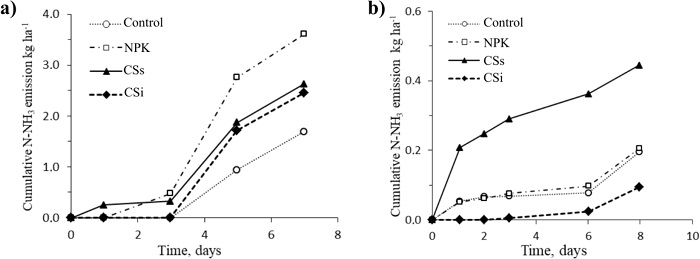
Figure 4
Cumulative amonnia (N-NH₃) losses following cattle slurry (CS) application at pre-sowing in wheat under no-tillage conditions. a) Experiment I - conducted in Frederico Westphalen (Oxisol); b) Experiment II - conducted in Santa Maria (Ultisol). Treatments: control (without N); mineral fertilization (NPK); surface-applied cattle slurry (CSs); and injected cattle slurry (CSi). Vertical bars represent the least significant difference (LSD 0.01).
By contrast, the cattle slurry treatments showed lower emission factors, even though injected slurry (CSi) occasionally exhibited a slightly higher instantaneous peak than surface-applied slurry (CSs) (Figure 2). This transient peak likely reflects a localized TAN concentration in injection slots; however, the cumulative emission factors - 7.80 % for CSs and 7.25 % for CSi - demonstrate that subsurface placement effectively reduced contact between TAN and the soil-air interface, thereby limiting overall NH₃ losses. These findings are in line with field experiments and reviews, indicating that slurry injection or banding reduces volatilization, when compared with surface application, especially on fine-textured or moist soils (Webb et al. 2010, Nyord et al. 2012, Emmerling et al. 2020, Fangueiro et al. 2021, van der Weerden et al. 2021, Nyameasem et al. 2022, Andersson et al. 2023, van der Weerden et al. 2023).
The contrasting behavior observed in the Ultisol (experiment II) highlights the key role of soil physical properties. In this coarse-textured soil, pre-sowing N-NH₃ fluxes were much smaller, and emission factors remained below 1 % for all slurry treatments (Figures 2 and 4). The rapid infiltration of slurry into the sandy matrix, together with lower surface moisture and milder temperatures in the critical first 24 to 72 hours after application, shortened the TAN residence at the soil’s surface and reduced the potential for NH₃ loss. Similar reductions have been reported where high permeability, low water-filled pore space or cooler conditions favor a rapid TAN movement away from the soil-air boundary (Bronson et al. 1989, Keskinen et al. 2022, Ma et al. 2022). Although N₂O was not measured in this study, its known sensitivity to soil moisture and structure (Mazzetto et al. 2015, Taghizadeh-Toosi et al. 2023) reinforces the dominant role of physical conditions in controlling gaseous N losses from manures and fertilizers.
Climatic variability between sites, documented in Figure 1, further amplified these soil-driven differences. In Frederico Westphalen (Oxisol), the total rainfall during the wheat cycle exceeded long-term averages, with several rainfall events occurring immediately before and after N applications. Under such conditions, high surface moisture, restricted gas diffusion at the soil-atmosphere interface and sustained urease activity in crop residues favor NH₃ volatilization from surface-applied urea (Rochette et al. 2009, Webb et al. 2010, Cantarella et al. 2018). In Santa Maria (Ultisol), drier intervals after application and rapid slurry infiltration limited the time during which TAN remained exposed, resulting in very low emission factors. These responses agree with multi-site syntheses, showing that soil texture, water-filled pore space and short-term weather after spreading are dominant regulators of NH₃ and N₂O emission factors from land-applied manure (van der Weerden et al. 2021, van der Weerden et al. 2023, Wang et al. 2024).
Overall, the pre-sowing emission factors observed here - 10.67 % of the applied N for urea, 7.80 and 7.25 % of the applied TAN for, respectively, surface and injected slurry - fall within or below typical ranges reported for temperate and subtropical systems and are lower than the 20-30 % of TAN sometimes reported for cattle manure under favorable volatilization conditions (Aita et al. 2018, Emmerling et al. 2020, Andersson et al. 2023). These results therefore support slurry injection as a robust mitigation strategy in no-tillage wheat, especially when combined with site-specific soil texture and rainfall considerations.
Post-sowing volatilization was dominated by urea topdressing, as illustrated by the flux dynamics in Figure 3 and the cumulative losses in Figure 5. In the experiment I, only the NPK treatment received post-sowing urea, resulting in a secondary NH₃ peak of 36.36 g ha-1 h-1 of N-NH₃ around 79 h after application, whereas slurry-derived TAN contributed minimally at this stage, because most of it had already been infiltrated or transformed. In the experiment II, all fertilized treatments received urea topdressing, and a common volatilization event occurred at approximately 70 h after application, with NPK showing the largest instantaneous peak, followed by slurry-based treatments and the control.
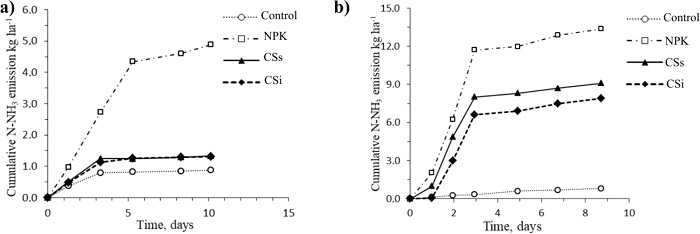
Figure 5
Cumulative ammonia (N-NH₃) losses following urea topdressing application in wheat under no-tillage conditions. a) Experiment I - conducted in Frederico Westphalen (Oxisol), where only the NPK received post-sowing urea; b) Experiment II - conducted in Santa Maria (Ultisol), where all fertilized treatments received topdressing urea. Treatments: control (without N); mineral fertilization (NPK); surface-applied cattle slurry (CSs); and injected cattle slurry (CSi). Vertical bars represent the least significant difference (LSD 0.01).
These patterns closely match meta-analytical and experimental evidence, indicating that most NH₃ losses from surface-applied urea occur within 2 to 5 days after application, driven by rapid hydrolysis, sharp pH increases in the upper soil layer and limited gas diffusion in moist, residue-covered surfaces (Rochette et al. 2009a, Cantarella et al. 2018, Ma et al. 2022). Urease inhibitors such as NBPT have been shown to reduce NH₃ losses and often increase yields in cereals (Sanz-Cobena et al. 2008, Abalos et al. 2012, Abalos et al. 2014, Cantarella et al. 2018), but, in the present study, urea was deliberately applied without inhibitors to focus on the effects of slurry placement and nitrification inhibition. Even under these conditions, cumulative NH₃ losses after topdressing remained lower in slurry-based strategies than in NPK, suggesting that a partial substitution of mineral N with organic N from dairy slurry can mitigate volatilization while sustaining yield (Asing et al. 2008, Capra et al. 2023, Zhu et al. 2023, Capra et al. 2025). These results highlight that an effective mitigation of NH₃ emissions in high-input wheat systems requires both improved slurry management and better strategies for synthetic N, including the combined use of inhibitors, optimized timing and alternative placement (Rose et al. 2018, Park et al. 2021, Taghizadeh-Toosi et al. 2023, Cassim et al. 2024).
The emission factors observed in this study fall within or below typical values reported for surface-applied manures and fertilizers, confirming that NH₃ losses largely depend on the proportion of ammoniacal nitrogen exposed at the soil surface (van der Weerden et al. 2021, van der Weerden et al. 2023). Swedish field experiments on clay soils, for example, reported cumulative losses of 23-32 % of applied TAN within 70 hours, with reductions of 17-37 % under trailing-shoe or injection application (Andersson et al. 2023). In southern Brazil, dairy slurry losses ranged from 22 % in the winter to 82 % in the summer (Aita et al. 2018), demonstrating a high volatilization potential under favorable environmental conditions. In this context, the comparatively modest cumulative losses observed here (≤ 10.67 %) indicate that pre-sowing slurry application under no-tillage - particularly with injection - is an effective mitigation strategy, especially in sandy or well-drained soils.
The integration of flux data (Figures 2 and 3) with cumulative emissions (Figures 4 and 5) provides a comprehensive picture of N-NH₃ dynamics across treatments and sites. In the Oxisol, cumulative pre-sowing losses reached 3.61 kg ha-1 of N-NH₃ in the NPK treatment, clearly exceeding the slurry-based treatments. In the Ultisol, the cumulative losses were markedly lower for all fertilized treatments, with injected slurry showing the smallest emissions (~0.09 kg ha-1). These outcomes corroborate the well-documented benefits of slurry injection, trailing-shoe application, and acidification in reducing NH₃ volatilization from manures (Webb et al. 2010, Fangueiro et al. 2021, Kavanagh et al. 2021, Overmeyer et al. 2021, Pereira et al. 2022, Silva et al. 2022).
When compared with international benchmarks, the emission factor for surface-applied urea in the Oxisol (10.67 %) is close to the IPCC Tier 1 default for synthetic fertilizers (Arndt et al. 2020) and similar to values reported for non-tilled wheat fertilized with urea under Mediterranean conditions (Guardia et al. 2021). In contrast, emission factors for surface-applied and injected slurry in the Oxisol (7.80 and 7.25 %) and the very low losses in the Ultisol (< 1 %) were well below the 20 % default often assigned to manure N in inventories (Arndt et al. 2020, van der Weerden et al. 2021). This suggests that pre-sowing slurry injection under no-tillage, especially on well-drained or sandy soils, can substantially reduce NH₃ emissions relative to both conventional manure and urea-based fertilization.
These results are consistent with meta-analyses showing that improved slurry management and technological additives - such as acidifiers, biochar, and urease or nitrification inhibitors - reduce NH₃ and N₂O emissions without necessarily penalizing yields (Emmerling et al. 2020, Hagner et al. 2021, Wang et al. 2021, Pereira et al. 2022, El Bied et al. 2023, Wang et al. 2024). They also resonate with recent studies on full N balances in grasslands, indicating that a substantial fraction of slurry N may be lost as N₂ or retained in soil organic pools rather than recovered by plants or emitted as NH₃ and N₂O, particularly under improved placement strategies (Buchen-Tschiskale et al. 2023, Dannenmann et al. 2025, Jin et al. 2025, Ofori et al. 2025).
The mitigation potential of CSi and CSi + DCD did not compromise crop performance; instead, it translated into higher shoot dry matter production, N uptake and grain yield (Table 4). In both experiments, CSi + DCD produced the highest biomass and grain yield, surpassing NPK by 20.3 % in the Oxisol and 16.2 % in the Ultisol, whereas injected slurry without DCD (CSi) also outperformed surface-applied slurry (CSs). These responses indicate that placing slurry below the soil surface and delaying nitrification enhanced the synchronicity between N availability and wheat demand, especially under the above-average rainfall observed during the wheat cycle.
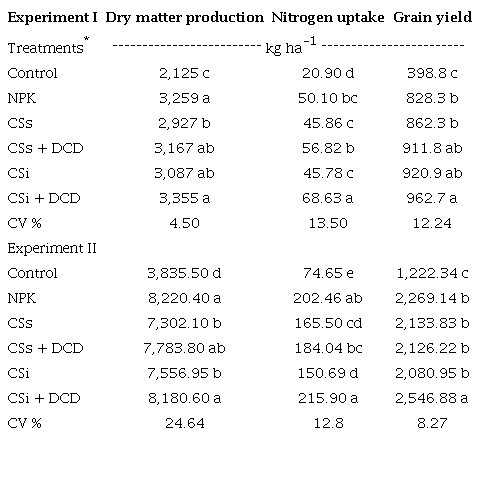
* NPK: mineral fertilizer; CSs: cattle slurry applied to the soil surface; CSi: cattle slurry injected into the soil; DCD: dicyandiamide. Means followed by the same letter in a column do not differ significantly according to the Tukey test (p < 0.05).
The strong increases in N uptake (48 to 141 kg ha-1 relative to the control) are consistent with studies showing that nitrification inhibitors such as DCD and 3,4-dimethylpyrazole phosphate (DMPP) increase soil inorganic N retention, reduce N₂O and NO₃- losses, and increase yields by 5-10 % across systems (Abalos et al. 2014, Rose et al. 2018, Park et al. 2021, Tufail et al. 2023, Wang et al. 2024). Evidence from dairy effluent and slurry-based systems further supports the capacity of inhibitors to improve N-use efficiency without compromising forage or grain yields (Cowley et al. 2019, Franzluebbers 2020, Mdlambuzi et al. 2021, Cosentino et al. 2024, Sorecha et al. 2025).
The superior agronomic performance of CSi + DCD is also in line with long-term trials in wheat and mixed rotations, where organic fertilization with manure or compost, often combined with legumes, matched or exceeded yields obtained with mineral N alone (Sørensen & Amato 2002, Gutser et al. 2005, Ball-Coelho et al. 2006, Meade et al. 2011, Sieling et al. 2014, Fontaine et al. 2022, Kristensen et al. 2022, Salehi et al. 2025). Recent results from organic wheat systems in the northern Great Plains show that cattle manure can sustain or increase grain yield and agronomic performance relative to mineral N fertilization programmes (Carr et al. 2025). Our findings extend this evidence to subtropical no-tillage wheat, demonstrating that dairy slurry, when strategically injected and combined with DCD, can rival or outperform NPK in both yield and environmental performance.
The nitrogen efficiency indices (agronomic nitrogen efficiency, apparent nitrogen recovery, physiological efficiency and nitrogen-use efficiency; Table 5) provide an integrated assessment of treatment performance and reinforce the advantages of CSi + DCD. In both soils, CSi + DCD achieved the highest agronomic efficiency and apparent N recovery, exceeding NPK by 1.23 kg of grains kg-1 of N in the experiment I and 2.53 kg of grains kg-1 of N in the experiment II, showing clear gains in apparent nitrogen recovery. These results confirm that subsurface slurry application combined with nitrification inhibition maximizes plant recovery of applied N and improves the conversion of absorbed N into grain production, even under rainfall regimes that typically enhance N losses.
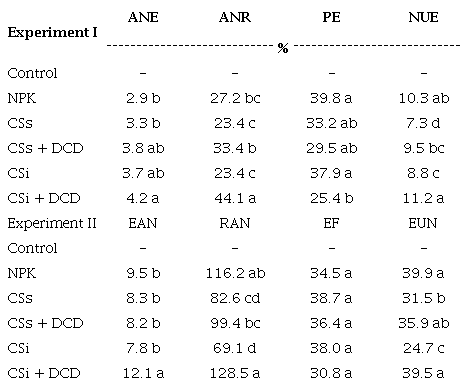
* NPK: mineral fertilizer; CSs: cattle slurry applied to the soil surface; CSi: cattle slurry injected into the soil; DCD: dicyandiamide. Means followed by the same letter in a column do not differ significantly according to the Tukey test (p < 0.05).
Such responses are in agreement with global syntheses reporting that nitrification inhibitors reduce N₂O emissions and nitrate leaching while increasing nitrogen-use efficiency by 10-15 % and yields by 5-10 % (Abalos et al. 2014, Rose et al. 2018, Guo et al. 2022, Taghizadeh-Toosi et al. 2023). Meta-analytical work indicates that DCD tends to be particularly effective in clayey and loamy soils, whereas DMPP may perform better under alkaline or sandy conditions (Guo et al. 2022, Tufail et al. 2023), which helps to explain the strong agronomic response of CSi + DCD in the Oxisol. Although some studies in Brazilian Oxisols have reported limited effects of DCD on N₂O emissions from urine patches (Mazzetto et al. 2015), the clear yield and efficiency gains observed here suggest that its performance is highly context-dependent and can be enhanced when combined with injected dairy slurry rather than surface-applied excreta.
The nitrogen-use efficiency values observed in this study fall within or above the typical range reported for cereals under combined mineral and organic fertilization (Gutser et al. 2005, Meade et al. 2011, Sieling et al. 2014, Cassim et al. 2024). Lower efficiencies in some treatments can be attributed to NH₃ volatilization and nitrate leaching under high rainfall, as widely described in slurry management and greenhouse gas studies (Huygens et al. 2022, Manley et al. 2022, Taghizadeh-Toosi et al. 2023, van der Weerden et al. 2023). Even under these challenging conditions, CSi + DCD maintained a high agronomic nitrogen efficiency, apparent nitrogen recovery, and nitrogen-use efficiency, underscoring the robustness of this strategy for improving N retention and use efficiency in subtropical no-till wheat.
At the global scale, only about one-third of anthropogenic N inputs are recovered in harvested products, whereas the remainder is lost to the environment as NH₃, NOₓ, N₂O, NO₃- and other reactive forms, contributing to air and water pollution and climate forcing (Bouwman et al. 2013, Buchen-Tschiskale et al. 2023, Peng et al. 2023, IEA 2024). Livestock systems are particularly important, accounting for a large share of NH₃, N₂O and NOₓ emissions along global supply chains (Aneja et al. 2020, Uwizeye et al. 2020, Bray et al. 2021, Mazur et al. 2021, Bratti et al. 2022). Improving the management of cattle slurry in crop-livestock systems is therefore crucial to closing N cycles and reducing the environmental footprint of food production (Whitehead 1995, Mdlambuzi et al. 2021, Yemata & Mengistu 2024, De Boer et al. 2024).
Our results show that, in subtropical no-tillage wheat, integrating slurry injection with nitrification inhibition can simultaneously reduce NH₃ emissions to levels comparable to or lower than those of synthetic fertilizers, increase N uptake and grain yield, and enhance N-use efficiency, particularly in sandy or well-drained soils. These outcomes are aligned with the concept of yield-scaled mitigation of N losses - reducing emissions per unit of product rather than in absolute terms alone (Sanz-Cobena et al. 2014, Peng et al. 2023, Cassim et al. 2024). They also reinforce the notion that strategies combining improved placement, inhibitors and partial substitution of mineral fertilizer with organic N can play a central role in the sustainable intensification of crop-livestock systems in southern Brazil and similar regions (Sørensen & Amato 2002, Sieling et al. 2014, Damian et al. 2018, Carr et al. 2025).
CONCLUSIONS
-
1. The effects of cattle slurry (CS) on ammonia volatilization and wheat performance under no-tillage conditions varied according to soil type and application method;
-
2. In the Oxisol, slurry injection did not reduce pre-sowing NH₃-N volatilization, but increased N uptake and grain yield, when compared with surface application;
-
3. In the Ultisol, slurry injection markedly reduced pre-sowing NH₃-N losses, confirming a greater mitigation potential in sandy, well-drained soils;
-
4. Across both experimental sites, injected cattle slurry combined with the nitrification inhibitor dicyandiamide (DCD) (CSi + DCD) consistently enhanced N uptake, grain yield and all nitrogen-use efficiency indices relative to surface-applied slurry;
-
5. Compared with mineral fertilization, the NPK treatment resulted in the highest NH₃-N emissions, whereas slurry-based strategies - especially CSi + DCD - achieved equal or superior yields with lower N losses;
-
6. Overall, integrating slurry injection with nitrification inhibition using DCD represents an effective strategy to improve nitrogen-use efficiency and reduce emissions in subtropical no-tillage wheat systems.
REFERENCES
ABALOS, D.; JEFFERY, S.; SANZ-COBENA, A.; GUARDIA, G.; VALLEJO, A. Meta-analysis of the effect of urease and nitrification inhibitors on crop productivity and nitrogen-use efficiency. Agriculture, Ecosystems & Environment, v. 189, n. 1, p. 136-144, 2014.
ABALOS, D.; SANZ-COBENA, A.; MISSELBROOK, T.; VALLEJO, A. Effectiveness of urease inhibition on the abatement of ammonia, nitrous oxide and nitric oxide emissions in a non-irrigated Mediterranean barley field. Chemosphere, v. 89, n. 3, p. 310-318, 2012.
AITA, C.; GIACOMINI, S. J.; HUNSHE, L. R.; BENETTI, A. E.; GIACOMINI, D. A. Nitrous oxide emissions in a wheat/corn succession combining dairy slurry and urea as nitrogen sources. Revista Brasileira de Ciência do Solo, v. 42, e0170122, 2018.
ANDERSSON, K.; DELIN, S.; PEDERSEN, J.; HAFNER, S. D.; NYORD, T. Ammonia emissions from untreated, separated and digested cattle slurry: effects of slurry type and application strategy on a Swedish clay soil. Biosystems Engineering, v. 226, n. 1, p. 194-208, 2023.
ANEJA, V. P.; SCHLESINGER, W. H.; LI, Q.; NAHAS, A.; BATTYE, W. H. Characterization of the global sources of atmospheric ammonia from agricultural soils. Journal of Geophysical Research: Atmospheres, v. 125, e2019JD031684, 2020.
ARNDT, C.; MISSELBROOK, T. H.; VEJA, A.; GONZALEZ-QUINTERO, R.; CHAVARRO-LOBO, J. A.; MAZZETTO, A. M. Measured ammonia emissions from tropical and subtropical pastures: a comparison with 2006 IPCC, 2019 refinement to the 2006 IPCC, and EMEP/EEA inventory estimates. Journal of Dairy Science, v. 103, n. 7, p. 6706-6715, 2020.
ASING, J.; SAGGAR, S.; SINGH, J.; BOLAN, N. S. Assessment of nitrogen losses from urea and an organic manure with and without nitrification inhibitor, dicyandiamide, applied to lettuce under glasshouse conditions. Australian Journal of Soil Research, v. 46, n. 6-7, p. 535-541, 2008.
BALL-COELHO, B. R.; ROY, R. C.; BRUIN, A. J. Nitrogen recovery and partitioning with different rates and methods of sidedressed manure. Soil Science Society of America Journal, v. 70, n. 2, p. 464-473, 2006.
BOUWMAN, A. F.; BIERKENS, M. F. P.; GRIFFIOEN, J.; HEFTING, M. M.; MIDDELBURG, J. J.; MIDDELKOOP, H.; SLOMP, C. P. Nutrient dynamics, transfer and retention along the aquatic continuum from land to ocean: towards integration of ecological and biogeochemical models. Biogeosciences, v. 10, n. 1, p. 1-23, 2013.
BRASIL. Instituto Nacional de Meteorologia. Normais climatológicas do Brasil: 1991-2020. Brasília, DF: INMET, 2022.
BRATTI, F.; MONTI, D.; BENEVELLO, A. V.; RUGGIERI, I.; BELLOCCHI, M.; SILVÉRIO, R. V. Nitrous oxide and methane emissions affected by grazing intensity and nitrogen fertilization under mixed cereal-pasture system. Grass and Forage Science, v. 77, n. 4, p. 491-502, 2022.
BRAY, C. D.; BATTYE, W. H.; ANEJA, V. P.; SCHLESINGER, W. H. Global emissions of NH₃, NOₓ, and N₂O from biomass burning and the impact of climate change. Journal of the Air & Waste Management Association, v. 71, n. 1, p. 102-114, 2021.
BRONSON, K. F.; TOUCHTON, J. T.; HILTBOLD, A. E.; HENDRICKSON, L. L. Control of ammonia volatilization with N-(N-butyl) thiophosphoric triamide in loamy sands. Communications in Soil Science and Plant Analysis, v. 20, n. 13-14, p. 1439-1451, 1989.
BUCHEN-TSCHISKALE, A.; LASSALETTA, L.; BEUSEN, A. H. W.; ERTL, H.; ZHANG, X.; ZHU, Q.; SHEN, J.; LIU, X.; XU, W.; SUTTON, M. A. Global redistribution of reactive nitrogen and consequences for the environment. Environmental Research Letters, v. 18, e045012, 2023a.
BUCHEN-TSCHISKALE, C.; WELL, R.; FLESSA, H. Tracing nitrogen transformations during spring development of winter wheat induced by 15N labeled cattle slurry applied with different techniques. Science of the Total Environment, v. 871, e162061, 2023.
CANTARELLA, H.; OTTO, R.; SOARES, J. R.; SILVA, A. G. de B. Agronomic efficiency of NBPT as a urease inhibitor: a review. Journal of Advanced Research, v. 13, n. 1, p. 19-27, 2018.
CAPRA, F.; ABALOS, D.; MARIS, S. C.; ARDENTI, F.; LOMMI, M.; TABAGLIO, V.; FIORINI, A. Towards efficient N cycling in intensive maize: role of cover crops and application methods of digestate liquid fraction. GCB Bioenergy, v. 15, n. 6, p. 867-885, 2023.
CAPRA, F.; ARDENTI, F.; ABALOS, D.; LOMMI, M.; POCHINTESTA, D.; GANUGI, P.; PEREGO, A.; TABAGLIO, V.; FIORINI, A. Drip fertigation with slurry as a promising tool to reduce nitrogen losses under organic maize. Scientific Reports, v. 15, e1487, 2025.
CARR, P. M.; VOLKMAN, M. M.; FORDYCE, S. I.; CROOKSTON, B. S.; YOST, M. A.; REEVE, J. R. Cattle manure impacts on organic wheat production in the northern Great Plains. Canadian Journal of Plant Science, v. 105, e8, 2025.
CASSIM, B. M. A. R.; LISBOA, I. P.; BESEN, M. R.; OTTO, R.; CANTARELLA, H.; INOUE, T. T.; BATISTA, M. A. Nitrogen: from discovery, plant assimilation, sustainable usage to current enhanced efficiency fertilizer technologies: a review. Revista Brasileira de Ciência do Solo, v. 48, e0230037, 2024.
COMPANHIA NACIONAL DE ABASTECIMENTO (Conab). Acompanhamento do mercado de fertilizantes. Brasília, DF: Conab, 2024.
COSENTINO, V. R. N.; ROMANIUK, R. I.; MÓRTOLA, N. A.; ESTRADA OTERO, E.; MARTINEK, N.; BELTRAN, M. J.; COSTANTINI, A. O.; IMHOFF, S.; TABOADA, M. A. Nitrification inhibitor addition to farm dairy effluent to reduce nitrous oxide emissions. Revista Brasileira de Ciência do Solo, v. 48, e0230039, 2024.
COWLEY, F.; JENNINGS, J.; COLE, A.; BEAUCHEMIN, K. Recent advances to improve nitrogen efficiency of grain-finishing cattle in North American and Australian feedlots. Animal Production Science, v. 59, n. 11, p. 2082-2092, 2019.
CRASWELL, E. T.; GODWIN, D. G. The efficiency of nitrogen fertilizers applied to cereals grown in different climates. In: TINKER, P. B.; LAUCHLI, A. (ed.). Advanced nutrients. New York: Praeger, 1984. p. 1-56.
CRUZ, C. D. Programa Genes: biometria. Viçosa: Ed. UFV, 2007.
DAMIAN, J. M.; MURARO, D. S.; BASSO, C. J.; SILVA, A. N. da; PINTO, M. A. B.; SANTI, A. L. Strategies for fertilization with pig and cattle slurry in wheat crop. Revista Brasileira de Engenharia Agrícola e Ambiental, v. 22, n. 4, p. 261-266, 2018.
DANNENMANN, M.; YANKELZON, I.; WÄHLING, S.; RAMM, E.; SCHREIBER, M.; OSTLER, U.; SCHLINGMANN, M.; STANGE, C. F.; KIESE, R.; BUTTERBACH-BAHL, K.; FRIEDL, J.; SCHEER, C. Fates of slurry-nitrogen applied to mountain grasslands: the importance of dinitrogen emissions versus plant N uptake. Biology and Fertility of Soils, v. 61, n. 3, p. 455-468, 2025.
DE BOER, H. C.; VAN MULLEKOM, M.; SMOLDERS, A. J. P. Lower nitrate leaching from dairy cattle slurry compared to synthetic fertilizer calcium ammonium nitrate applied to grassland. Environmental Pollution, v. 344, e123088, 2024.
EL BIED, O.; TURBÍ, M. A. T.; GARCÍA-VALERO, A.; CANO, Á. F.; ACOSTA, J. A. Mitigating ammonia, methane, and carbon dioxide emissions from stored pig slurry using chemical and biological additives. Water, v. 15, e4185, 2023.
EMPRESA BRASILEIRA DE PESQUISA AGROPECUÁRIA (Embrapa). Sistema brasileiro de classificação de solos. 3. ed. Brasília, DF: Embrapa, 2013.
EMMERLING, C.; KREIN, A.; JUNK, J. Meta-analysis of strategies to reduce NH₃ emissions from slurries in European agriculture and consequences for greenhouse gas emissions. Agronomy, v. 10, n. 11, e1730, 2020.
FAGERIA, N. K. Otimização da eficiência nutricional na produção das culturas. Revista Brasileira de Engenharia Agrícola e Ambiental, v. 2, n. 1, p. 6-16, 1998.
FANGUEIRO, D.; SURGY, S.; FRAGA, I.; MONTEIRO, F.; CABRAL, F.; COUTINHO, J. Impact of different application techniques for cattle slurry on gaseous emissions and soil quality. Agriculture, Ecosystems & Environment, v. 306, e107221, 2021.
FONTAINE, D.; KRISTENSEN, R. K.; RASMUSSEN, J.; ERIKSEN, J. Data on growth, uptake and N₂ fixation of grass-clover leys fertilized with mineral N fertilizer and cattle slurry. Data in Brief, v. 42, e107998, 2022.
FOOD AND AGRICULTURE ORGANIZATION OF THE UNITED NATIONS (FAO). World fertilizer trends and outlook to 2024. Rome: FAO, 2024.
FRANZLUEBBERS, A. J. Soil-test biological activity with the flush of CO₂: V. Validation of nitrogen prediction for corn production. Agronomy Journal, v. 112, e20094, 2020.
GUARDIA, G.; GARCÍA-GUTIÉRREZ, S.; RODRÍGUEZ-PÉREZ, R.; RECIO, J.; VALLEJO, A. Increasing N use efficiency while decreasing gaseous N losses in a non-tilled wheat (Triticum aestivum L.) crop using a double inhibitor. Agriculture, Ecosystems & Environment, v. 319, e107546, 2021.
GUO, C.; LIU, X.; HE, X. A global meta-analysis of crop yield and agricultural greenhouse gas emissions under nitrogen fertilizer application. Science of the Total Environment, v. 831, e154982, 2022.
GUTSER, R.; EBERTSEDER, T.; WEBER, A.; SCHRAML, M.; SCHMIDHALTER, U. Short-term and residual availability of nitrogen after long-term application of organic fertilizers on arable land. Journal of Plant Nutrition and Soil Science, v. 168, n. 4, p. 439-446, 2005.
HAGNER, M.; RÄTY, M.; NIKAMA, J.; RASA, K.; PELTONEN, S.; VEPSÄLÄINEN, J.; KESKINEN, R. Slow pyrolysis liquid in reducing NH₃ emissions from cattle slurry: impacts on plant growth and soil organisms. Science of the Total Environment, v. 784, e147139, 2021.
HUYGENS, J.; RASSCHAERT, G.; HEYNDRICKX, M.; DEWULF, J.; VAN COILLIE, E.; QUATAERT, P.; DAESELEIRE, E.; BECUE, I. Impact of fertilization with pig or calf slurry on antibiotic residues and resistance genes in the soil. Science of the Total Environment, v. 822, e153518, 2022.
INTERNATIONAL ENERGY AGENCY (IEA). The 2024 breakthrough agenda report: agriculture. Paris: IEA, 2024.
INTERNATIONAL FERTILIZER ASSOCIATION (IFA). Short-term fertilizer outlook 2024-2025: world outlook for fertilizer demand, nitrogen, phosphates and potash from 2023 to 2027. 2025. Available at: https://www.fertilizer.org/resource/public-summary-medium-term-fertilizer-otlook-2023-2027/. Access in: Nov. 2025.
KAVANAGH, I.; BURCHILL, W.; MCGEOUGH, K.; HUMPHREYS, J.; MISSELBROOK, T. H.; LANIGAN, G. J. Mitigation of ammonia and greenhouse gas emissions from stored cattle slurry using acidifiers and chemical amendments. Journal of Cleaner Production, v. 314, e127963, 2021.
KESKINEN, R.; NYKANEN, A.; SALMI, P.; UUSITALO, R.; LI, T.; HAKALA, K.; KURKI, V. Ammonia volatilization from slurry applied to grassland under cold climate conditions. Agricultural and Forest Meteorology, v. 323, e109078, 2022.
KRISTENSEN, R. K.; FONTAINE, D.; RASMUSSEN, J.; ERIKSEN, J. Contrasting effects of slurry and mineral fertilizer on N₂-fixation in grass-clover mixtures. European Journal of Agronomy, v. 133, e126431, 2022.
LARGE, E. C. Growth stages in cereals: illustration of the Feekes scale. Plant Pathology, v. 3, n. 4, p. 128-129, 1954.
MA, Z.; REN, B.; ZHAO, B.; LIU, P.; ZHANG, J. Increasing grain yield, nitrogen-use efficiency of summer maize and reducing greenhouse gas emissions by applying urea ammonium nitrate solution. Agronomy Journal, v. 114, n. 2, p. 948-960, 2022.
MANLEY, A.; COLLINS, A. L.; JOYNES, A.; MELLANDER, P. E.; JORDAN, P. Coupled steroid and phosphorus leaching from cattle slurry at lysimeter scale. Journal of Contaminant Hydrology, v. 247, e103979, 2022.
MAZUR, K.; ROMAN, K.; WARDAL, W. J.; BOREK, K.; BARWICKI, J.; KIERONCZYK, M. Emission of harmful gases from animal production in Poland. Environmental Monitoring and Assessment, v. 193, n. 6, e353, 2021.
JIN, X.; BEHRENS, P.; ERISMAN, J. W.; MOGOLLÓN, J. M. Ammonia emissions from agricultural products at high resolution across Europe. Scientific Data, v. 12, e1493, 2025.
MAZZETTO, A. M.; BARNEZE, A. S.; FEIGL, B. J.; VAN GROENIGEN, J. W.; OENEMA, O.; KLEIN, C. A. M. de; CERRI, C. C. Use of the nitrification inhibitor dicyandiamide (DCD) does not mitigate N₂O emission from bovine urine patches under Oxisol in Northwest Brazil. Nutrient Cycling in Agroecosystems, v. 101, n. 1, p. 83-92, 2015.
MDLAMBUZI, T.; MUCHAONYERWA, P.; TSUBO, M.; MOSHIA, M. E. Nitrogen fertiliser value of biogas slurry and cattle manure for maize (Zea mays L.) production. Heliyon, v. 7, n. 5, e07077, 2021.
MEADE, G.; LALOR, S. T. J.; MCCABE, T. An evaluation of the combined usage of separated liquid pig manure and inorganic fertiliser in nutrient programmes for winter wheat production. European Journal of Agronomy, v. 34, n. 1, p. 62-70, 2011.
NÖMMIK, H. The effect of pellet size on the ammonia loss from urea applied to forest. Plant and Soil, v. 39, n. 2, p. 309-318, 1973.
NYAMEASEM, E. K.; JØRGENSEN, P. E.; HANSEN, E. M.; HEDEGAARD, J.; KONGSTED, A. G.; SØRENSEN, P. Slurry acidification as a solution to minimize ammonia emissions from the combined application of animal manure and synthetic fertiliser in no-tillage. Agriculture, v. 12, n. 2, e265, 2022.
NYAMEASEM, J.; ZHANG, M.; LEE, C.; LI, S.; LI, J.; LU, Y. Slurry injection reduces ammonia emissions and increases nitrogen retention in no-till cropping systems. Soil & Tillage Research, v. 215, e105209, 2022a.
NYORD, T.; HANSEN, M. N.; BIRKMOSE, T. Ammonia volatilisation and crop yield following land application of solid-liquid separated, anaerobically digested, and soil injected animal slurry to winter wheat. Agriculture, Ecosystems & Environment, v. 160, n. 1, p. 75-81, 2012.
OFORI, B.; FRAME, W. H.; STEWART, R. D.; RAPER, T. B.; LEWIS, K. L.; HARRIS, G. Ammonia volatilization from conventional and enhanced-efficiency fertilizers under surface and subsurface placement. Agrosystems, Geosciences & Environment, v. 8, e70190, 2025.
OVERMEYER, V.; DÖRSCH, P.; LAMMEL, J.; WELP, G.; BERGER, N. One-time acidification of slurry: what is the most effective method in practice? Agronomy, v. 11, e1319, 2021.
PARK, S. H.; LEE, B. R.; KIM, T. H. Urease and nitrification inhibitors with pig slurry: effects on ammonia and nitrous oxide emissions, nitrate leaching, and nitrogen-use efficiency in perennial ryegrass sward. Animal Bioscience, v. 34, n. 12, p. 2023-2033, 2021.
PENG, S.; LI, G.; CUI, Z.; ZHANG, F.; CHEN, X.; ZHANG, W.; WANG, Y.; WU, J. Global nitrogen pollution and solutions: a synthetic analysis. Nature Reviews Earth & Environment, v. 4, n. 1, p. 112-125, 2023.
PEREIRA, J. L. S.; BICHANA, A.; SURGY, S.; CABRAL, F.; COUTINHO, J.; FANGUEIRO, D. Mitigating ammonia and greenhouse gas emissions from stored pig slurry using chemical additives and biochars. Agronomy, v. 12, n. 11, e2744, 2022.
PLANO NACIONAL DE FERTILIZANTES 2050 (PNF). Brasília, DF: Ministério da Agricultura e Pecuária, 2022.
PUJOL, S. B. Emissão de amônia e dinâmica do nitrogênio no solo com parcelamento da dose e adição de inibidor de nitrificação em dejetos de suínos. 2012. Dissertação (Mestrado em Ciência do Solo) - Universidade Federal de Santa Maria, Santa Maria, 2012.
RAMALINGAPPA, P. L.; SHRIVASTAVA, M.; DHAR, S.; BANDYOPADHYAY, K.; PRASAD, S.; LANGYAN, S.; TOMER, R.; KHANDELWAL, A.; DARJEE, S.; SINGH, R. Reducing ammonia volatilization and improving nitrogen-use efficiency via organic and inorganic amendments in wheat (Triticum aestivum L.). PeerJ, v. 11, e14965, 2023.
ROCHETTE, P.; ANGERS, D. A.; CHANTIGNY, M. H.; GASSER, M. O.; BERTRAND, N. Reducing ammonia volatilization in a no-till soil by incorporating urea and pig slurry in shallow bands. Nutrient Cycling in Agroecosystems, v. 84, n. 1, p. 71-80, 2009.
ROCHETTE, P.; ANGERS, D. A.; CHANTIGNY, M. H.; MACDONALD, J. D.; BISSONNETTE, N.; BERTRAND, N. Ammonia volatilization following surface application of urea to tilled and no-till soils: a laboratory comparison. Soil & Tillage Research, v. 103, n. 2, p. 310-315, 2009a.
ROSE, T. J.; WOOD, R. H.; ROSE, M. T.; VAN ZWIETEN, L. A re-evaluation of the agronomic effectiveness of the nitrification inhibitors DCD and DMPP and the urease inhibitor NBPT. Agriculture, Ecosystems & Environment, v. 252, n. 1, p. 69-73, 2018.
SALEHI, A.; SURBÖCK, A.; FREYER, B.; FRIEDEL, J. K.; GOLLNER, G. 10-year study on the impact of organic fertilization on winter wheat yield and quality following lucerne and grain pea in a dry sub-humid region under organic cultivation in Austria. Journal of Agriculture and Food Research, v. 21, e101888, 2025.
SANZ-COBENA, A.; LASSALETTA, L.; ESTELLÉS, F.; DEL PRADO, A.; GUARDIA, G.; ABALOS, D.; AGUILERA, E.; PARDO, G.; VALLEJO, A.; SUTTON, M. A. Yield-scaled mitigation of ammonia emission from N fertilization: the Spanish case. Environmental Research Letters, v. 9, e125005, 2014.
SANZ-COBENA, A.; MISSELBROOK, T. H.; ARCE, A.; MINGOT, J. I.; DIEZ, J. A.; VALLEJO, A. An inhibitor of urease activity effectively reduces ammonia emissions from soil treated with urea under Mediterranean conditions. Agriculture, Ecosystems & Environment, v. 126, n. 3-4, p. 243-249, 2008.
SIELING, K.; NI, K.; KAGE, H. Application of pig slurry: first year and residual effects on yield and N balance. European Journal of Agronomy, v. 59, n. 1, p. 13-21, 2014.
SILVA, A. A.; FANGUEIRO, D.; CARVALHO, M. Slurry acidification as a solution to minimize ammonia emissions from the combined application of animal manure and synthetic fertilizer in no-tillage. Agronomy, v. 12, e265, 2022.
SORECHA, E. M.; RUAN, R.; YUAN, Y.; WANG, Y. Partial substitution of biogas slurry for chemical fertilizer improves nitrogen-use efficiency of wheat by decreasing leaf nitrogen concentration and increasing leaf C/N stoichiometry. Environmental Technology & Innovation, v. 39, e104286, 2025.
SØRENSEN, P.; AMATO, M. Remineralisation and residual effects of N after application of pig slurry to soil. European Journal of Agronomy, v. 16, n. 1, p. 81-95, 2002.
TAGHIZADEH-TOOSI, A.; MAJID, Z.; KONGSTED, A. G.; JØRGENSEN, P. E.; AMON, B.; AMON, T.; HANSEN, E. M.; RAHIMZADEH, R. Effect of slurry application techniques on nitrous oxide emission from temperate grassland under varying soil and climatic conditions. Grass and Forage Science, v. 78, n. 3, p. 338-349, 2023.
TEDESCO, M. J.; GIANELLO, C.; BISSANI, C. A.; BOHNEN, H.; VOLKWEISS, S. J. Análises de solo, plantas e outros materiais. 2. ed. Porto Alegre: Ed. UFRGS, 1995.
TUFAIL, M. A.; IRFAN, M.; UMAR, W.; WAKEEL, A.; SCHMITZ, R. A. Mediation of gaseous emissions and improving plant productivity by DCD and DMPP nitrification inhibitors: meta-analysis of last three decades. Environmental Science and Pollution Research, v. 30, n. 23, p. 64719-64735, 2023.
UNITED STATES DEPARTMENT OF AGRICULTURE (USDA). Soil Survey Staff. Keys to soil taxonomy. 13. ed. Washington, DC: USDA, 2022.
UWIZEYE, A.; DE BOER, I. J. M.; OPIO, C. I.; SCHULTE, R. P. O.; FALCUCCI, A.; TEMPIO, G.; TEILLARD, F.; CASU, F.; RULLI, M.; GALLOWAY, J. N.; LEIP, A.; ERISMAN, J. W.; ROBINSON, T. P.; STEINFELD, H.; GERBER, P. J. Nitrogen emissions along global livestock supply chains. Nature Food, v. 1, n. 7, p. 437-446, 2020.
VAN DER WEERDEN, T. J.; NOBLE, A. N.; BELTRAN, I.; HUTCHINGS, N. J.; THORMAN, R. E.; KLEIN, C. A. M. de; AMON, B. Influence of key factors on ammonia and nitrous oxide emission factors for excreta deposited by livestock and land-applied manure. Science of the Total Environment, v. 889, e164066, 2023.
VAN DER WEERDEN, T. J.; NOBLE, A.; KLEIN, C. A. M. de; HUTCHINGS, N.; THORMAN, R. E.; ALFARO, M. A.; AMON, B.; BELTRAN, I.; GRACE, P.; HASSOUNA, M.; KROL, D. J.; LEYTEM, A. B.; SALAZAR, F.; VELTHOF, G. L. Ammonia and nitrous oxide emission factors for excreta deposited by livestock and land-applied manure. Journal of Environmental Quality, v. 50, n. 5, p. 1005-1023, 2021.
WANG, W.; LI, Y.; WANG, W.; DING, K.; ZHANG, K.; ZHANG, Y.; LIU, K.; LI, J.; LI, D.; LIAN, R.; LI, D.; GU, J.; LI, J. Global meta-analysis of individual and combined nitrogen inhibitors: enhancing plant productivity and reducing environmental losses. Global Change Biology, v. 30, e70007, 2024.
WANG, Y.; ZHENG, Q.; HUANG, Y.; FENG, Y.; GUO, Z.; MA, L. NH₃, N₂O and NO emissions from digested pig slurry during storage: effects of storage temperature and oxygen supply. Journal of Cleaner Production, v. 316, e128271, 2021.
WEBB, J.; PAIN, B.; BITTMAN, S.; MORGAN, J. The impacts of manure application methods on emissions of ammonia, nitrous oxide and on crop response: a review. Agriculture, Ecosystems & Environment, v. 137, n. 1, p. 39-46, 2010.
WHITEHEAD, D. C. Nitrogen in grasslands. Wallingford: CAB International, 1995.
YEMATA, G.; MENGISTU, E. Potential of cattle urine as an alternative fertilizer for maize (Zea mays L.) production in Ethiopia. Heliyon, v. 10, n. 22, e39111, 2024.
ZHU, Y.; ZHANG, H.; LI, R.; ZHU, W.; KANG, Y. Nitrogen fertigation affects crop yield, nitrogen loss and gaseous emissions: a meta-analysis. Nutrient Cycling in Agroecosystems, v. 127, n. 3, p. 359-373, 2023.
Author notes