MATERIAL CULTURE STUDIES
The Teixeira Leite sisters and their transatlantic alliances: rebuilding an elite social network from the French Third Republic (1880-1930)
 CECÍLIA ELISABETH BARBOSA SOARES ceciliaebsoares@gmail.com
The Teixeira Leite sisters and their transatlantic alliances: rebuilding an elite social network from the French Third Republic (1880-1930)
Anais do Museu Paulista: História e Cultura Material, vol. 33, e2, 2025
Museu Paulista, Universidade de São Paulo
Received: 06 April 2024
Accepted: 05 June 2024
ABSTRACT: This article partially rebuilds the social network of Brazilian businesswoman Eufrásia Teixeira Leite (1850-1930) and her sister Francisca (1845-1899), by analyzing a sample of letters, cards, and telegram received by her at different periods of her lifetime. A comprehensive methodology used primary sources, such as correspondence and other documents of Eufrásia’s personal archive, complementary to secondary sources, to identify her interlocutors and, indirectly, explore the personality and interests of a 19th century liberal woman. The results illustrate the role of storytelling in sociohistorical research and women’s studies, based on individual cases and using personal archives as a starting point for a broader analysis.
KEYWORDS: Correspondence, Eufrásia Teixeira Leite, Paris, Third Republic, Elite.
RESUMO: O artigo reconstitui parte da rede social da investidora brasileira Eufrásia Teixeira Leite (1850-1930) e de sua irmã Francisca (1845-1899), por meio do estudo de uma amostra de cartas, cartões e telegrama recebidos pelas irmãs em diferentes momentos da vida. Adotou-se uma metodologia abrangente, que complementou a análise de fontes primárias, como correspondência e outros documentos do arquivo pessoal de Eufrásia, com fontes secundárias para identificar os interlocutores e explorar a personalidade e os interesses de uma mulher liberal do século XIX. Os resultados ilustram o papel do storytelling na pesquisa socio-histórica e nos estudos femininos, ao se basearem em casos individuais e no uso de arquivos pessoais como ponto de partida para análises mais amplas.
PALAVRAS-CHAVE: Correspondência, Eufrásia Teixeira Leite, Paris, Terceira República, Elite.
INTRODUCTION
The 19th century witnessed important changes concerning women and their role in modern society, that is, one based upon freedom, the adoption of civil rights, and new perspectives on individuality and paid work.1 However, these movements did not happen evenly in each point of the globe, but in different paces according to each region and each profile.2 One alternative to explore how women felt about these transitions, and their world perspectives,3 is the analysis of individual cases, using personal archives as a starting point.4
The case of Brazilian sisters Eufrásia (1850-1930) and Francisca Teixeira Leite (1845-1899) is particularly interesting. Both were long-time Paris residents; Eufrásia thrived at European finance and multiplied her family inheritance, thus becoming one of the first Brazilian millionaires at the turn of the century. Her financial success, obtained mainly by managing different sorts of bonds in several stock exchanges, justifies calling Eufrásia an “investor”5. Neither sister ever married nor had any issue. In her will, Eufrásia decided to donate almost all her fortune to her hometown, Vassouras, under the condition that schools and hospitals were built.
The Teixeira Leites case can also be used to discuss the effects of globalization and connections between the ex-European colonies from South America and the Old Continent, especially France. They were at the center of a thriving financial market and certainly held a particular social network. However, Eufrásia is mostly known because of her long relationship with Brazilian politician Joaquim Nabuco, a militant for the abolition of slavery in Brazil,6 and Francisca is virtually unknown. There is still a lack of research considering Eufrásia’s network, her communications, her work routine, and the role of sisterhood in her trajectory, among other subjects that might richly illustrate the perspective of pioneer women from the Belle Époque. One of the reasons for this is that Eufrásia’s personal archive is very fragmented, and contains a very small sample of letters and other materials that would be central for this reconstitution of her context and work dynamics.7 In this sense, the case becomes even more interesting because of the missing parts of a complex story.8
This article proposes a sociohistorical interpretation of Eufrásia and Francisca’s activities and world perspectives through an analysis of some of the letters available at Museu Casa da Hera (Ivy House Museum), a house-museum dedicated to the Teixeira Leite family.9 These letters were received by one of the sisters at different moments of their lifetimes, and at least two authors had not been identified beforehand. I take these sources as a starting point to discuss the context of liberal women from the 19th century. These indirect dialogs, as provided by the letters, allow us to partially reconstitute Eufrásia and Francisca’s context and some of their interests, especially Eufrásia’s.
SENDERS AND RECIPIENTS: A SHORT METHODOLOGICAL NOTE ABOUT CORRESPONDENCE IN PERSONAL ARCHIVES AND THE MISSING PARTS OF A DIALOG
One of the major perks of being a researcher of a personal archive is to dive into some of the pieces of evidence of an individual’s life. Indeed, personal archives are specifically built from the belongings of someone, be it documents, writings, pictures, personal goods, etc. Researchers who deal with such cases find themselves developing a relationship with a particular material composition and with their interpretation of it. At the same time, studying a personal archive is an opportunity to explore the matters of memory and personality through different evidences of a lifetime.
Every personal archive can therefore be seen as a case, where a specific composition is partially presented through the lens of an individual.10 Each one can be used as a strategic starting point for broader research, where the individual’s situation and trajectory can be amplified, or detailed, possibly bringing light to other cases. And this, even though personal archives are not a full, continuous version of a lifetime. What is absent can be as interesting and important as the known elements of the archive.11
The composition of personal archives can be as flexible as their owners once were: they can accept a wide variety of goods, reflecting the individual creations of a lifetime. Nevertheless, correspondence is one of their major elements and is widely related to intimacy and dialog. In many cases, the challenge of correspondence is not scarcity, but its opposite: the quantity of paper-based documents can be striking. Researchers often dive into a considerable number of letters, notes, and other written material, which were first meant to be a two-way communication (writer and reader).12 Therefore, the presence of the researcher inaugurates (literally) a new perspective, in a new context. First, because the material is being read by eyes that were not supposed to be aware of this exchange, and this happens, sometimes, many years after the deaths of the individuals concerned in the letters. In this sense,
[...] it is difficult to treat [...] personal letters as simply the record of an interaction between individuals or as an exchange of ideas in documentary form. They can also be seen as cumulative ventures of different storytellers. They have rhetorical and syntactical elements of importance, and their tone is certainly a part of their value as well.13
Personal archives can therefore be versatile sources for many stories and interpretations. The development of a particular story, or version, depends, therefore, on the perspective adopted by the researcher and his or her relation with the material and the complementary use of other sources, which will lead to different possible interpretations. It comes up to the researcher, then, to create a bond with and attribute a role to the letters and other written material possibly found in a personal archive. They can either be central players in an analysis or support witnesses for a particular point. Among different variables, we can consider the number of letters and other notes, their style, who is writing to whom, and how they were collected and inserted in the archives.
Particularly in the case of the 19th century, letters can be seen as rich evidence of a person and his or her lifestyle and personality for several reasons. First, the frequency of correspondence was a well-established habit among the European elite since at least the 17th century; this was not only the main option to reach someone but also illustrated different abilities considered noble - starting with reading and writing. Indeed,
Keeping correspondence can be considered as one of the criteria to belong to a cultivated elite, just as signing up for newspapers, having a personal library, going to shows and/or social meetings, participating in mundane life, and sometimes being a member of scientific societies. The aristocratic lifestyle, inherited from the Old Regime and absorbed by the “conqueror” bourgeois, includes writing letters as an instrument of sociability.14
During the 18th and 19th centuries, letter collections such as Madame de Sévigné’s15 highlighted how many texts were written to be read - whether as expressions of intimacy, as narratives of a specific period, or as philosophical reflections about mankind and its peculiarities. The practice of writing letters was, then, a mix of “written culture and modes of communication”16 and it showed “different registers of skills and motivations, be it emotional, social or economical”17.
A second point was that distances were shortened because of the development of the post offices. This institution was central to organizing a modern notion of “nation”18, by allowing a sharp connection between its citizens and contributing to the definition of frontiers, even becoming a painting subject, as we can see in Van Gogh’s portrait of Postman Roulin (Figure 1).
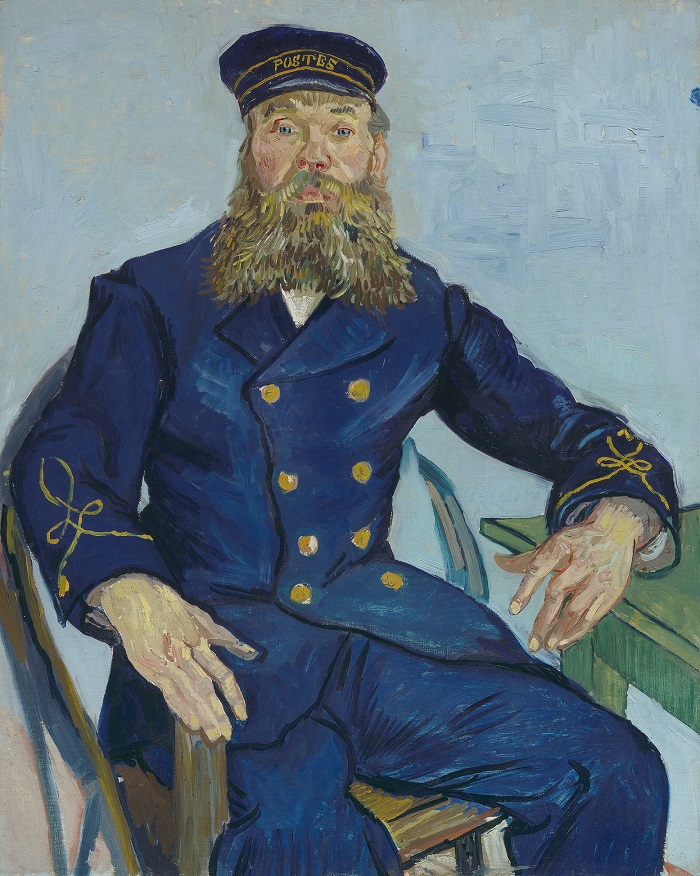
Figure 1
Postman Joseph Roulin, Vincent Van Gogh, 1888, oil on canvas, 81,3 x 65,4 cm.
Photograph © 2024 Museum of Fine Arts, Boston. Accession number 35.1982.
In the case of France,
The Poste, which had a centralized national network, touched every region and was able to reach even the most isolated house, offers an image, and almost a model, of those “silent, continual movements [which] cross the space, connecting and sewing together, obstinately, country and regions, villages and borrows, borrows and towns, provinces and nations”19.
Therefore, more than just considering the intimate contents of a letter, the addresses and the authors can be useful when it comes to recreating a specific social network because they indicate direct contact among individuals. “Contacts and correspondence, that’s what we need to live in the countryside”: this is the sharp affirmation made by Countess d’Hervilly in the early 19th century.20 The consideration is particularly pertinent when it comes to women’s role of registering their memory and also their families. Indeed, women often:
Let the ink flow, they note, they keep notes, they write in the same way others make tapestry. They keep not only the letters they received but often the first drafts of the ones they sent away. Moreover, twenty, forty years later, they include comments in the margins [of the papers], making those letters look like some copy corrected by an imperious reviewer. They are aware that they serve the history of letters, the history of their time, and history at all. Nothing could be lost, almost nothing was lost. It is women who develop family chronicles or the ones of a company. They are the ones preserving tradition, constituting archives.21
Besides the regular letters, urban residents from the 19th century wrote a wide spectrum of day-by-day cards, which could be seen as almost a “previous version of the telephone” or even physical versions of today’s cellphone messaging. The practice is illustrated by the mere existence of figures like the Brazilian moleque de recados (message boy), a small kid (usually a boy) who had the task of simply taking the message and deliver it as fast as possible to the recipient: someone who lived in the same town and probably in the same area. Cards and small notes were regularly distributed to confirm visits, inform on sudden changes (such as postponing a train depart), or anything short enough to fit on a small card, without the solemnity of sitting to write long in-depth narratives.22
A third point is that the communication’s material composition can also be a rich source of evidence. The quality of the paper and the ink, the presence or absence of envelopes, stamps, or other interventions highlight the role of these items as concrete supports of memory, even a palimpsest.
In Eufrásia and Francisca’s case, hardly any letter written by them made it through today. They are mostly the messages’ recipients. We deal mostly with a one-way dialog, where their perspective can only be imagined. In this sense, more than focusing on a discourse analysis, it is important to build a comprehensive methodology that articulates the material references of the letters, their contents, and understanding who is writing, and why - because, by learning more about who were the authors and the circumstances that led them to write, we can create another layer of interpretation about the evidences kept at Eufrásia’s personal archive.
RECREATING A NETWORK: STARTING WITH WHAT IS POSSIBLE
In many senses, this article discusses the challenges of rebuilding a network23 that, for all purposes, must have been very vast, but from which astonishingly few evidences made it to our time. To this day, Eufrásia’s main known interlocutor remains, by far, Joaquim Nabuco, with whom she kept an on-again-off-again relationship for 15 years. Most of the works that discuss or consider Eufrásia’s correspondence24 focus on this material because Nabuco kept a copy of many letters she sent him.25 At the same time, Francisca’s own story is somewhat of a mystery, since there is hardly any known evidence about herself as an individual. Almost all indications of her existence are indirectly provided by documents related to Eufrásia or their family.
Although the Museu Casa da Hera itself contains no letters written by the businesswoman or her sister,26 its archive keeps 201 letters written in Portuguese, French, and English. While the whole sample seems to be destined for Eufrásia’s eyes, there is no indication that the contents would be strictly private: the material might, sometimes, have been read by both sisters.27 In many cases, there is no explicit indication of which of the sisters is the recipient of the message. Even if we assume that it would be Eufrásia, the fact that she and Francisca lived together and seemed to enjoy a shared social life is important.
On the other hand, the businesswoman’s vast will and post-mortem inventory28 contains some messages written by her - they were gathered as law evidence and used as graphological material, for fear that the testament’s signature would be a fake one.29 In this sense, even if we adopt a larger conception of “a personal archive”30, the absence of Eufrásia or Francisca’s letters forbids us to recreate a bilateral flow of writing. Many comments and observations are lacking from their side(s) of the discussion.31 We either have fragments of Eufrásia’s demands or punctual messages from the senders.
Among this material, the letters in French and English are especially interesting and will be the core of my analysis. Even in this fragmented context, we can identify eleven people writing to either one of the sisters or both. By exploring this material, we can begin to rebuild a complex network of the personal and professional ties of the Belle Époque.
This methodological note intends to stress that such work goes way beyond just reading the material and interpreting the different themes discussed by the authors. First, we do not know why these letters made it to our day, while others didn’t. Ernesto Catharino, one of the first researchers of Eufrásia’s life, found a newspaper interview where the investor’s maid, Cecília Bonfim, states that writing was one of Eufrásia’s main activities: “Lady Eufrásia wrote about 30 to 40 letters each day and handled personally all her business negotiations”32.
The destination of the correspondence even became a theme for local rumors, according to which Eufrásia asked to be buried with her letters or demanded that her attorneys burn them after her death. Nevertheless, both post-mortem inventories - the one listing her goods in Brazil and the one listing her goods in France - state that, by the time of Eufrásia’s death, many documents (hers, and even her father’s) filled both houses’ desk drawers.33
From Museu Casa da Hera’s sample of messages and communications, I will focus on 14 of the 17 messages not written in Portuguese - be it in French, in English, or alternating both languages, as it happens in a single case.34 This choice was based on the fact that the letters and cards had not been translated beforehand and could be a central piece of evidence to explore the sisters’ lives abroad.35 They are distributed according to the numbers from Table 1.
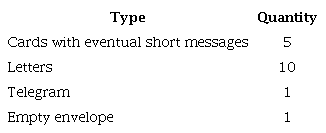
Source: Table made by the author.
Cards, as expected, usually hold no date. They are used as common day-by-day talk, mentioning something useful but with a very short lifespan (from the writer’s point of view), since it was expected that they would be read as soon as possible, to the recipient to be aware of something, be it an answer about a forgotten umbrella, a new idea for a dinner or a small message of greetings and thanks. On the other hand, just as in today’s cellphone messages, one of the major points of the card was who sent it. We will always see the name of the sender - with, sometimes, an address or a nobility rank - on it, usually with a fine print. We can approach these files as pieces of evidence of a fluid conversation, including the possibility/anticipation of physical meetings.
As for the letters, the division between the envelope and the letter per se is important, because the readable information about the senders would be seen in the envelope, and many letters simply do not have it anymore. The envelopes available often suffered mechanical alterations - some kind of cutting to take stamps off, ripping, or the absence of the name of the senders, with generic information about the recipients. This brings us to the first methodological challenge: identifying the senders.
The paper is also a relevant agent, be it because of its material features, or because of the letterhead. The former provides us extra information about the writers - such as where they worked (if the paper came from an institution, as in the case of the French Marine) or where they were during the composition of the letter (regular paper from a ship, during a trip; a notepad from a hotel; or some message left by the author themselves, such as a specific address). These paper features were particularly helpful when it came to identifying the writers, because, often, they simply signed the letters with complex versions of their names, just as people used to sign bank checks. The research is considerably enriched by casual actions, such as probably using the closest paper set available when the writers felt the urge to communicate. Had they been more meticulous about their choices, it would be very difficult to even get their names.
The absence of information about why or how these letters survived the challenges of time complicates the task of understanding their communication. This means that we have no informer, better than the letters themselves, to guide us through the path of gathering more information about the writers, and the subjects they are exploring. We can infer that these items are pieces of evidence of a larger correspondence, but we must rely on the wittiness of the writers to leave more clues about where they are, when they are writing, or why. On several occasions, as we will see, their intention is exactly to provide more information about their whereabouts, in a world that seems to be moving rapidly and makes them fear losing the connection with their reader.
When I mention the importance of trusting the letters as they are, I mean that everything contained in the paper can be a good starting point to identify the senders and, thus, rebuild a broader context of communication. Although the cards do not tell us a detailed story, they allow us to quickly bounce to who was trying to get in touch. The letters bring us contradictory situations, where we can dive into intimate thoughts and feelings, but may take longer to attribute them to a concrete person. In this sense, the first physical feature to separate the materials was the handwriting, and, especially, the signatures.
We had 11 different handwritings and two major periods: 1880-1890 and 1922-1927. This led us to very different contexts: first, Eufrásia and Francisca are in their thirties, thriving during the first years of the French Third Republic. The second set is addressed to a 70-year-old Eufrásia, who crossed the Atlantic a few times until she felt too ill to travel. Indeed, Eufrásia became progressively too frail to go back to France, something she wished with all her heart, and died in Rio de Janeiro in September 1930.36 It is interesting enough to consider that, during both periods, Eufrásia traveled to Brazil and this is an important point for the writers, as we will see.
“ARISTOCARDS”: A TRANSNATIONAL SOCIAL NETWORK IN PARIS
The first group of correspondence was probably produced during the 1880s. All five cards from the sample are either printed in French, with handwritten messages in French, or show personal addresses in Paris. They were sent by the following people: the Baron and Baroness of Estrela; the Italian Commendatore Enrico Martuscelli; the Countess Charles de Lesseps; the Count de Reilhac; and the Prince de Brancovan. As for the letters, two were written by nobleman Roger de Chabrol and three by Admiral Jules Layrle. Their titles immediately indicate a close-knit communication with aristocracy. But who were the recipients of those cards?
Being Fair Ladies during the French Third Republic
Francisca and Eufrásia were the daughters of Joaquim José Teixeira Leite and Ana Esméria Corrêa e Castro.37 Both sides of their family were traditional owners of coffee plantations and their parents settled in Vassouras, a town in the Paraíba Valley (120km from the city of Rio de Janeiro). Between the 19th century and the early 20th century, coffee was the dark gold of Brazil. Its production led to the implementation of “infrastructure, urbanization, industrialization”38 in Brazil, and stressed the role of the South Eastern region in national politics.39 In many senses, however, coffee was not necessarily a sheer vector for the modernization of a former Portuguese Colony, which had just become independent in 1822; it was a strategic crop in a hierarchical, rural, and very conservative society with slow economic improvements. A slave-based system was at the core of this kind of plantation.
At the beginning of the 19th century, coffee became the central production of the Paraíba Valley, and the urban development of the region was directly related to the success of the plantations. Older towns became prosperous and new ones, such as Vassouras, were founded because of this economic structure.40 By the middle of the century, the region was at the peak of its production, but the first signs of soil overconsumption were already there. This would lead to the decline of the local plantations.41 Progressively, the coffee economic system would be relocated west, reaching the state of São Paulo; the landowners would prefer a workforce coming from European migration, with low wages, and would slowly recognize that the slavery days were counted.
Although the Teixeira Leites belonged to a close-knit elite in a very unequal society, they did not entirely comply with the traditional expectations and beliefs of their time. First, Joaquim José, Eufrásia’s father, graduated from Law School in São Paulo and approached the coffee business differently: instead of having farms, he became a comissário de café, or coffee commissioner, that is, a businessman who anticipated money to investors interested in preparing their coffee plantations.42
This choice illustrated a slow, but steady transition of national economics, from a commodity-driven environment to a financial-driven one, where empiric knowledge was being replaced by formal education. Joaquim José earned a law degree and chose to work in the financial sector, rather than keeping up with the family’s rural tradition. Eventually, he also became a relevant politician with bold projects - among other things, he was in favor of building a railway to connect Vassouras to Rio de Janeiro, which would make coffee exportation easier. Joaquim José’s political activities also brought the family closer to the Imperial Court, that is, Rio’s aristocratic elite.43
A second factor that changed the family’s destiny was that Francisca suffered from an unknown disease and the Teixeira Leites spent 2 years in Europe (1857-1859), seeking treatment for her.44 The two girls were direct witnesses of the European transformations - the same ones enthusiastically described by the Brazilian newspapers of the time. Once back in Brazil, both attended Madame Grivet’s school, a comprehensive institution that began its operations at Sebastião Lacerda, a city next to Vassouras, and later moved to the carioca neighborhood of Botafogo.45
During the second half of the 19th century, in Brazil, the core of a woman’s education still included domestic skills, such as stitching, sewing, and general house management; daughters of elite families were expected to be suitable brides, and then skilled wives and mothers. Most of their lives would be spent inside the family’s domains, with little access to the public streets. The Teixeira Leites’ decisions concerning their daughters’ education were pieces of evidence that, in many aspects, the family understood the calling of a new era, when the country’s future would be financial, not rural; and when daughters should be as prepared as sons to handle their fortunes and inheritances.
There are no real indications that the Teixeira Leites wanted Francisca and Eufrásia to ignore the regular journey of elite women, which meant they would eventually find a husband and raise their own family. However, destiny decided once more to play with the family’s expectations. In a short span of 3 years (1870-1873), Francisca and Eufrásia lost their parents and their grandmother. They found themselves in the very peculiar situation of being young, independent women and fully responsible for their inheritances, which they duly received.46 They were free to decide on their next steps and so they did. They moved to Paris in 1873.
Indeed, Paris’ reputation went beyond its position as the capital of France; for the Western people, the City of Lights represented the true ideal of a metropolis and the core of the ideals inherited from Illuminism. Paris held prestigious roles when it came to politics, economics, art, and science. It was presented as the right place to be to fully live the modernization47 brought abought by the 19th century.48 Moreover, Latin American countries, which were mainly former Iberian colonies, developed a strong tie with European references, usually described in a positive light by the elite perspective.49 These families also had the choice to send their children - especially their sons - to Portugal, Italy, and France, where they would earn a university degree50 before coming back home.51 For decades, trips to Europe were also the first prize for national competitions in the fields of the Liberal Arts.52
Although we can consider that this perspective was tainted by colonialism, eagerly defending European references as “best in class”, in many senses, reaching the Old Continent was seen as a remarkable privilege for Latin Americans. The trip, uncertain and expensive, revealed nevertheless an opportunity to deal with a vibrant society with many solid institutions.53 Even by European standards, Paris had a particular highlight, because of its cosmopolitism; it could be seen as “the capital of the 19th century”54. The City of Lights was a longtime gathering hub, with a particular approach to tolerance and sophistication.
Of course, different elements of Paris revealed themselves for each person, according to his or her earnings, perspectives, and network.55 The same city could be a strategic hub with many material and social possibilities, or a very harsh place where people lived in miserable conditions. Until the 1870s, being a Latin American in Paris meant that you were, probably, male and single, finding your way alone in a quite expensive and challenging city. In his Libro del Viajero, the Argentinian Antonio B. Massioti gave tips to the reader: “Mandatory conditions to every traveler going to Paris: money, health, low profile and time”56. However,
[…] this male-biased proportion changed during the last quarter of the 19th century when the traceable presence of many Latin American women altered the shape of the Parisian community. Although this change cannot be backed up with statistical data, many personal testimonies and biographical writings illustrate a significant increase in the number of Latin American women in Paris. [...] Due to the great distances involved, Latin American women in Paris lived relatively free from patriarchal control and social surveillance and enjoyed a larger degree of self-fulfillment than in the more strictly regulated environment of their hometowns.57
Paris’ reputation as a multicultural place in Europe was neat. Moreover, the last quarter of the century brought a certainty that the future would prosper; and this certainty gave birth to a “society of unlimited dreams”58. In 1891, Paris had around 75 foreigners per 1000 habitants, and became the “city with the greatest foreigner proportion in Europe”59, while France had a quite stable population of, roughly, 40 million people during its Third Republic. Most foreigners came from neighboring countries, such as Germany, Belgium, or the Netherlands. Latin Americans, broadly citizens from Spanish- and Portuguese-speaking countries in the Americas, counted for around 4000 people with a remarkable participation from Brazilians, who were around 30% of the total (Figure 2).
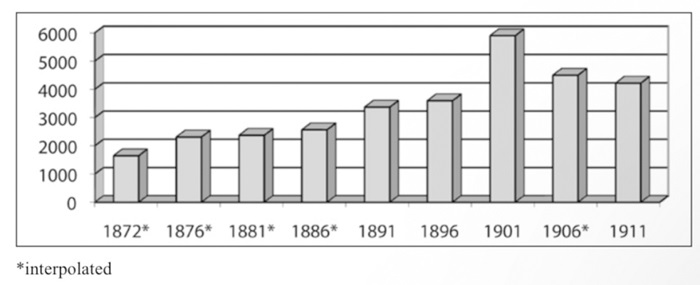
Figure 2
Population of Latin American individuals in Paris (1870-1914).
Source: Streckert (2012, p. 186).
Contrary to other fellow European immigrants, who first came to France in considerably simple conditions, the Latin American community was made “mostly of oligarchs and acaudalados”60. Although rentiers were less than 10% of the actual population of the city, this was a major occupation for Latin Americans in town, who were an important sample of the “social, political and artistic elite of a whole continent”61.
Indeed, in 1854, leading Brazilian journalist Justianiano José da Rocha observed, in his newspaper O Velho Brazil, that “Paris is for us [Brazilians] the city of diamond or cut crystal, just as London is the city of burnished steel”62. And, as early as 1846, the author Merruau observes that “every Brazilian [who lives in Paris] who is not a sugar planter holds stock for a mining company”63.
These comments make it clear that the choice of living comfortably in Paris was expensive. Unsurprisingly, the Brazilians - as the Latin Americans - who were able to keep up with the standards often benefited from a combination of possibilities: they could come from a wealthy family, use their inheritance, and not look for a regular, office-based job; they could earn a public scholarship or a prize, or be a high employee from the public service (a representative of the Nation, such as a diplomat).
In 1891, the local newspaper América en París described its colony in the city:
South Americans hold an important place in the Parisian high society. They love luxury, splendid things, and pleasure, and contribute largely to Paris’ shine, enthusiasm, and charm. [...] It is the South Americans, one must not forget, who bring movement to the big life, the ones who organize the greatest parties, the ones who get the pricier places to see the first version of any sensational event; the ones who buy the 100-thousand-francs accessories; the ones who summon artists and pay fabulous amounts for the most valuable paintings when they are sold. Last but not least, of all exotic people, they are the ones who [...] bring the flow to the very same money which became rare in our pockets because of the harshness of our times.64
Perhaps because of their considerable wealth, the residences of Latin Americans were notoriously concentrated in a few arrondissements of the city, especially the ones located in the West, close to the Triangle d’Or, seen as Paris’ wealthiest region (Figure 3). The 8e arrondissement hosted 25% of the Latin American population of the time,65 with a considerable distribution of the other addresses between the 9e, the 16e, and the 17e arrondissements, and a small participation of the 5e (where the Quartier Latin was a central location for artists and students). The Teixeira Leite sisters’ own address, 40, rue Bassano,66 is at the 8e arrondissement.67
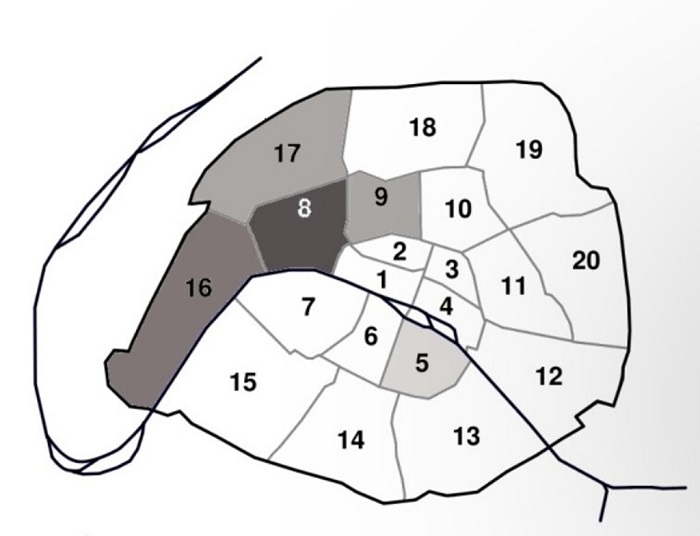
Still today, these neighborhoods are seen as wealthy; however, at the time, it was not unusual for foreigners to settle down in these parts of the city, where up to 80% of the population was not Paris-born in 1891.68 During the second half of the Third Republic, Latin Americans progressively left the 8e and 9e arrondissements and moved to the 16e and 17e.
In this sense, even though Eufrásia and Francisca’s choice of Paris could seem a bold move for the Brazilian society of the 1870s,69 a feminine trend was ongoing at the time, when compared to the early 19th century. The trips were safer than a few decades before, because of the naval improvements;70 the Brazilian community in Paris, albeit with a small number of members when compared to France’s population, came basically from an elite background with close-knit references. Women’s independence was also improving:
Just as for North American women travelers, the challenge for Latin American women living in or visiting Paris at the turn of the century became how to reconcile a European-style taste for freedom with the traditional patriarchal customs and mores of their homelands. Indeed, the excitement, opportunity, and threat of Paris lay in the fact that as both a mythical and real city, it provided Latin American women with a more liberating foil to their own societies. Broadly speaking, the French capital was more liberal than the cities of Latin America in three overlapping ways: spatially, culturally, and intellectually. First, Latin American women enjoyed the spatial freedom that Paris offered. They appreciated the openness of the boulevards and the myriad places in which “respectable” women could congregate. Second, they tended to equate Parisian culture with a “modern” culture, which stood in contrast to their traditional one. By taking part in the latest trends - whether in moral values, novels, music, or fashion - they implicitly critiqued their own societies’ traditions and mores. Third, Latin American elite women value Parisian intellectual circles’ tendency to treat them as autonomous individuals with opinions that were important. Despite continued legal restrictions on women in France and widespread condemnation of the “New Woman”, Latin American women viewed Paris as being less inhibiting in many ways than their own nations.71
In this sense, the two Teixeira Leite sisters were a good example of the liberal expectations of their time. It is noteworthy that Eufrásia and Francisca decided to move to Paris together. If, as was the case for many other women, they “acted upon a recognition of this relative freedom of movement”72, the fact that they traveled and moved together was, at the time, enough for them to not need a “protective gaze of their menfolk”73. They could also look for new social environments by holding salons, going to races, and doing charity work,74 among other options.
The two sisters’ situation in Paris in the last quarter of the 19th century was, in many senses, a classical Brazilian case, but with a twist. Geographically speaking, we can infer that Brazilian families able to afford a comfortable life in Paris usually chose to live in the wealthiest region of the city. In this sense, they seem to be able to adapt themselves to local references of wealthy standards, as did Eufrásia with her sister. Paris was a strategic option for the two sisters since they would be able to enjoy the perks of the city even as young, single women.
However, the aristocratic network shown by the cards indicates that they were not seen as just exotic tropical beauties. Latin Americans in general, and Brazilians in particular, were often noticed in Paris because of their wealth and lavish, extensive lifestyle.75 This didn’t mean they were able to really fit with traditional Parisian families or other profiles. Brazilian Gilberto Amado (1887-1969) observed that “many Frenchmen struggled to locate his country in a specific continent, a ‘French incapacity of learning geography’. For them, Brazil only meant tropical heat, [and] boa constrictors [...]”76. In many cases, “a true exchange between the Old and the New Worlds only happened on an official level”77. Eufrásia, however, seems to have pierced this social bubble and become a member of an important, cross-national network. Who were the people behind the messages?
The card-senders
The first card-sender was the Baron of Estrela, a Brazilian called José Joaquim de Maia Monteiro. He married Teresa Cristina de Vasconcelos Meneses de Drummond in London, in 1877. In 1902, he presented himself as a “capitalist”, with 2 addresses: praça do Rio Comprido, 4, in Rio de Janeiro, and 14, Place Vendôme, in Paris.78 The Baron was also the owner of Fazenda do Cutão, a farm in Minas Gerais, Brazil, that was used as a source for mineral extraction.79
The Parisian address corresponds to Hôtel de la Fare (Figure 5), a hôtel particulier that belonged to singer Jeanne Say. After her 2nd divorce, in 1888, she settled at the château de Brissac, in the Vallée de la Loire ; after her death, in 1916, the Hôtel de la Fare was sold and became the French siège for the JP Morgan bank.80 We can estimate that, perhaps, the Maia Monteiros lived at this address during this period (1888-1916), and, in this case, the card might have been sent much later than 1890.
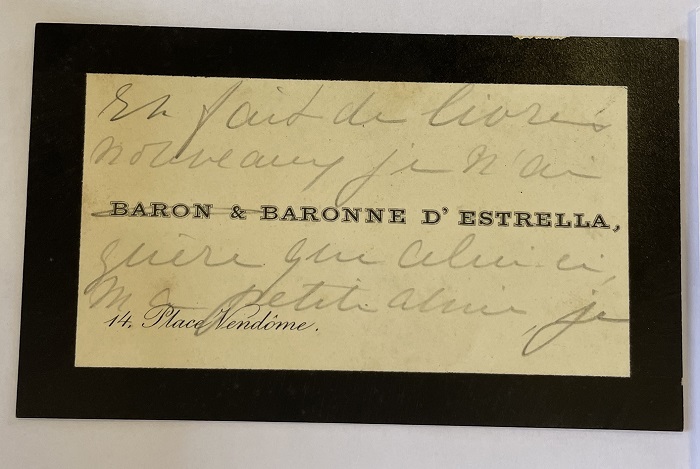
Figure 4
Card sent to Eufrásia Teixeira Leite by the Baron and Baroness de Estrela. Museu Casa da Hera, MCH 90.10.148.
Picture by the author.
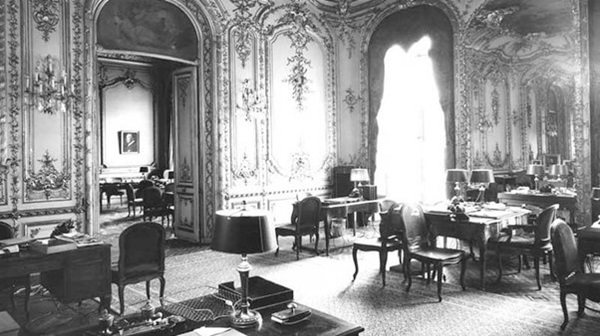
Figure 5
Interior of the hôtel de la Fare.81
The Maia Monteiros were seen as most loyal to the Brazilian empire, being especially close to then-emperor Pedro II. In 1891, when Pedro II died in Paris, a Mr. Henry Le Cocq82 wrote to the Baron d’Estrela, asking him for “two entry places” to the Church of Magdalen (8e arrondissement) to follow the funerary services. Le Cocq considered that “no one would be closer to the Imperial family” than the Baron d’Estrela.83 Indeed, the Baron was a camareiro of the Imperial House of Brazil, as well as a Chevalier de la Légion d’Honneur.84
The Baron and Baroness’ card has a light yellow tone with a black passepartout, and a matching envelope (Figure 4). In the envelope, we can read “mademoiselle Eufrásia Teixeira Leite” written in pencil. Apart from the printed text, “Baron & Baronne d’Estrella, 14, place Vendôme”, a short message was added, also in pencil. It says: “In fact, I have no new book, apart from this one, my girlfriend, I think you’ll find it funny. If the rain stops a little, I’m going to visit you soon. Why leaving so soon? Very tenderly”85. We can suppose that the book mentioned in the message was sent with the card. Curiously, two fellow Brazilians exchange a message in French.
The Baron and Baroness d’Estrela were also, at least twice, guests at Eufrásia and Francisca’s parties, at their hôtel particulier. In May 1895, the two sisters offered a matinée musicale in honor of the Countess d’Eu, that is, Princess Isabel, the daughter of former emperor Pedro II.86 Following this, the couple attended a soirée musicale organized by the Teixeira Leites in April 1896.87
The second card-sender was Enrico Martuscelli (1836-1917), a lawyer and longtime public servant for the Kingdom of Italy. He was ordered Commendatore dell’Ordine della Corona d’Italia in March 1884. In 1893, he became the general director of the Bank of Naples, his hometown,88 and was elected Senator in 1905. This card is very flat and holds no personal message apart from the printed text, which simulates join-up handwriting (Figure 6). We can read: “Cmdr. E. Martuscelli, Extraordinary Spokesperson / Plenipotentiary Minister from H.M. the King of Italy” (“Le Comr. E. Martuscelli, Envoyé Extraordinaire / Ministre Plénipotentiaire de S.M. le Roi d’Italie”).
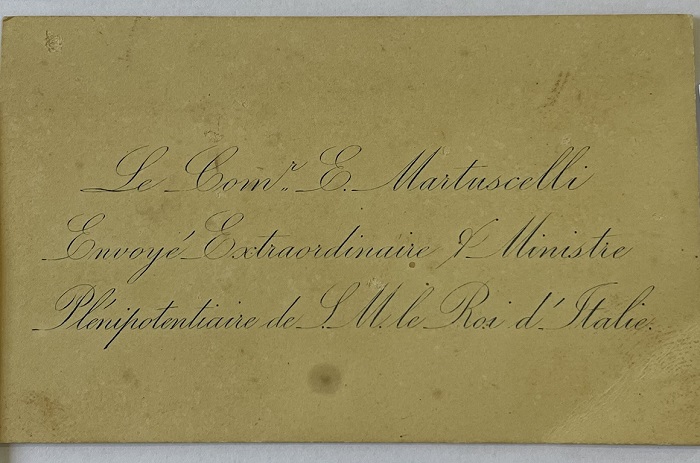
Figure 6
Card sent to one of the Telxeira Leite sisters by commanditore Enrico Martuscelli. Museu Casa da Hera, MCH 90.10.146.
Picure by the author.
The third card-sender was the Comtesse Charles de Lesseps, née Jeanne Antoinette Désirée Conte du Bois des Cours de la Maisonfort. Her husband was the director of the Compagnie du Canal de Suez, founded by his father, Ferdinand de Lesseps.89 The card has a black passepartout with a central text, printed in a simulation of join-up handwriting (Figure 7). We can read: “The Countess Charles de Lesseps, very touched by your proof of sympathy, thank you warmheartedly”90.
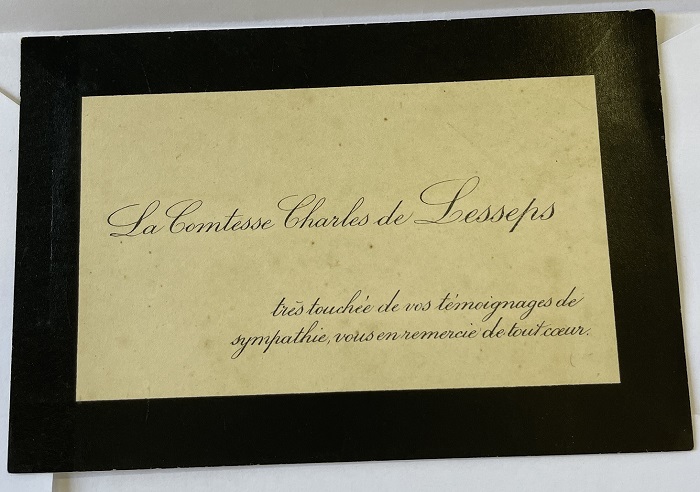
Figure 7
Card sent to one of the Teixeira Leite sisters by the Countess Charles de Lesseps. Museu Casa da Hera, MCH 90.10.143.
Picture by the author.
The fourth card-sender was the Comte Albert Alphonse de Reilhac (1846-1923). He lived in the address on the card, 42bis, Boulevard de La Tour-Maubourg, in the 7e arrondissement, in 1883 (Figure 8)91. The same year, he lost his wife, Marie-Renée de Caix de Saint-Aymour, with whom he had been married since 1873.92 Between 1883 and 1885, he renovated the château de Haute Maison, in Montry; he came back to Paris in 1887, settling at 16, rue Marignan. Of all the cards, this is the one with the most intimate message: “Since I’m only taking the 7 o’clock train, I demand another five minutes of chatting, and, if possible, with the grenat corsage of the day before yesterday - anytime that you can - send me the straw hat for a moment, if possible”93. A signature from Albert de Reilhac in a personal picture (Figures 9-10), from around 1870, shows the same handwriting from the card.
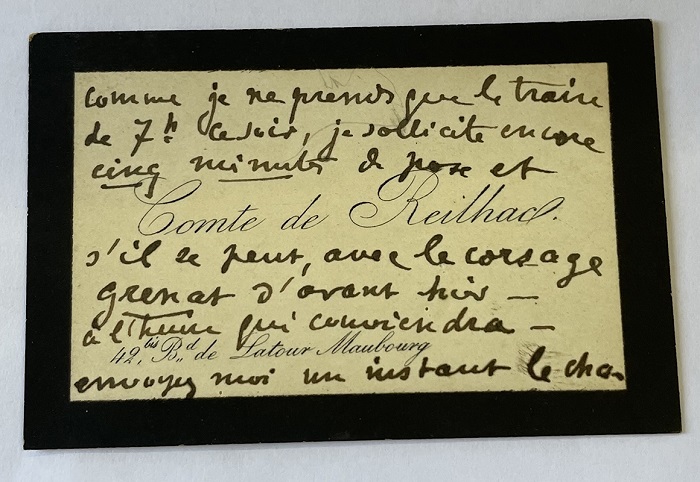
Figure 8
Card sent to one of the Teixeira Leite sisters by the Comte de Reilhac. Museu Casa da Hera, MCH 90.10.142.
Picture by the author.
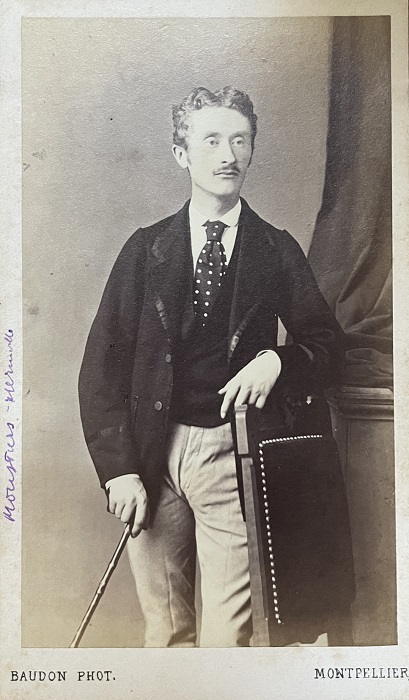
Figure 9
Picture of Albert de Reilhac, front. Albumin, Baudon Frères, Montpellier, around 1870. 6,5 x 9,5 cm.
Property of the author.
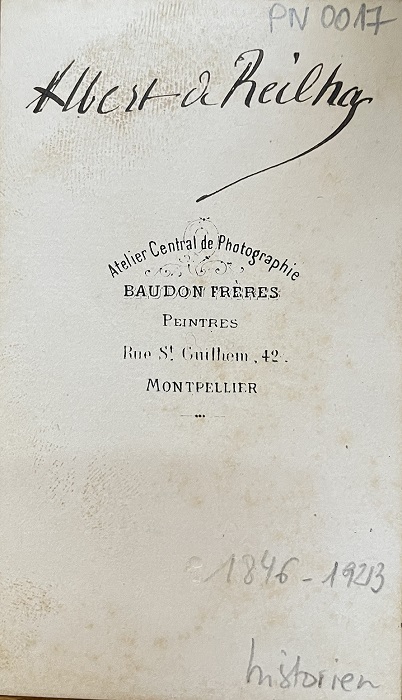
Figure 10
Picture of Albert de Reilhac, back. Albumin, Baudon Frères, Montpellier, around 1870. 6,5 x 9,5 cm.
Property of the author.
This is the only message from which we can infer a broader dialog between the receiver and the Comte de Reilhac. They have met earlier in the week and the Comte is leaving soon; but he asks for a final, short meeting, whenever possible - probably something decided at the last minute. The mention of specific goods - a corset, a hat - indicates different signs of a connection, with indoorsy and outdoorsy aspects.
The fifth and last card-sender is the French-Romanian Grégoire Bibesco-Bassaraba, the Prince de Brancovan (1827-1886).94 The Bibesco family went to exile in France after an opponent clan rose to power in Romania.95 While, during his last years, Grégoire (Figure 12) lived in a villa at Amphion, just outside the city of Évian-les-Bains and close to the Léman Lake (Figure 13), his three children were raised at 34, avenue Hoche, and he died in Paris.96 This address is also at the 8e arrondissement, very close to Eufrásia and Francisca’s own hôtel particulier. Once again, the card’s format is similar to the previous ones: a flat background with a black passepartout; the name “Prince de Brancovan” is printed in capital letters (Figure 11). Moreover, a handwritten text was added. It says: “Very thankful for your proof of sympathy”97.
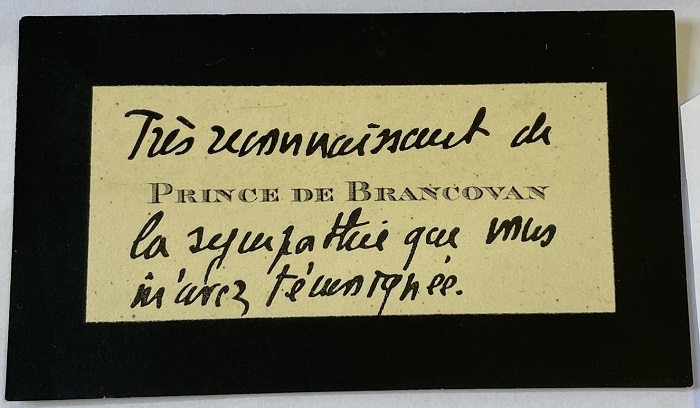
Figure 11
Card sent to one of the Teixeira Leite sisters by the Prince of Brancovan. Museu Casa da .Hera, MCH 90.10.39.
Picture by the author.
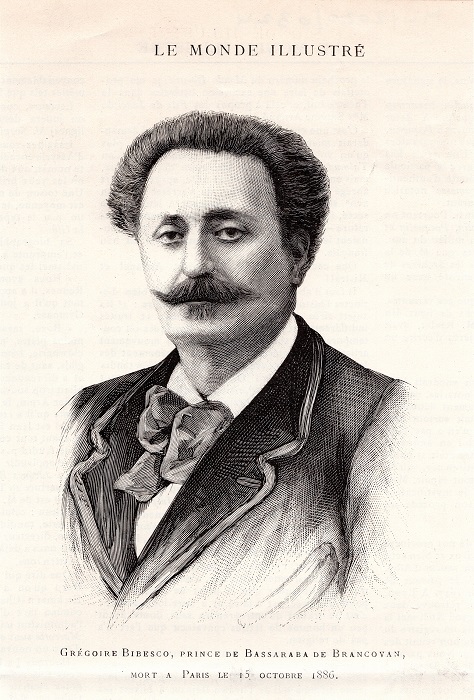
Figure 12
Portrait of Grégoire Bibesco, Prince de Bassaraba de Brancovan. Le Monde Illustré, 1886.
© Collection Musée du Léman, Nyon, Switzerland. Inventory number ML/2020/0324.
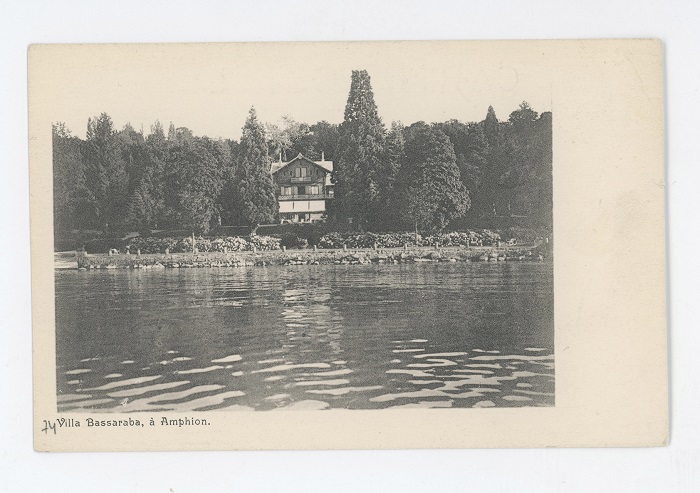
Figure 13
Villa Bassaraba, Amphion.
© Collection Musée du Léman, Nyon, Switzerland. Inventory number ML/2021/0238.
The Prince’s second child, a girl named Anna Élisabeth, was born in 1876 at his brother Georges’s address - 22 Boulevard de La Tour-Maubourg, hence being very close to Albert de Reilhac’s place as well.98 Both Georges’ and Grégoire’s hôtels particuliers were projected by architect Charles Le Coeur, who commissioned painter Pierre Auguste Renoir to paint the ceilings of Georges’ building99 (Figures 14-18). By seeing the architect’s watercolors for the Boulevard de La Tour-Maubourg building, we can partially infer the style of Grégoire’s residency.
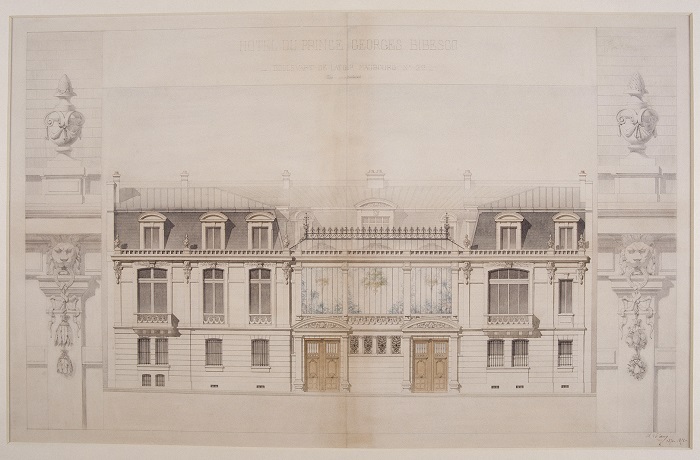
Figure 14
Le Coeur Charles, hôtel du prince Georges Bibesco. Fonds Émile Gallé. ARO1993-22.
Localisation : Paris, musée d’Orsay. (C) GrandPalaisRmn (musée d’Orsay) / Jean-Gilles Berizzi
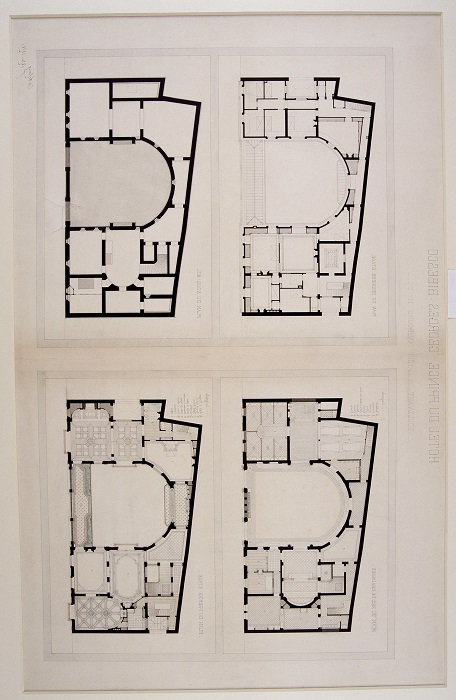
Figure 15
Le Coeur Charles, hôtel du prince Georges Bibesco, 1863-1930. Fonds Émile Gallé. ARO1993-21.
Localisation : Paris, musée d’Orsay. (C) GrandPalaisRmn (musée d’Orsay) / Jean-Gilles Berizzi.
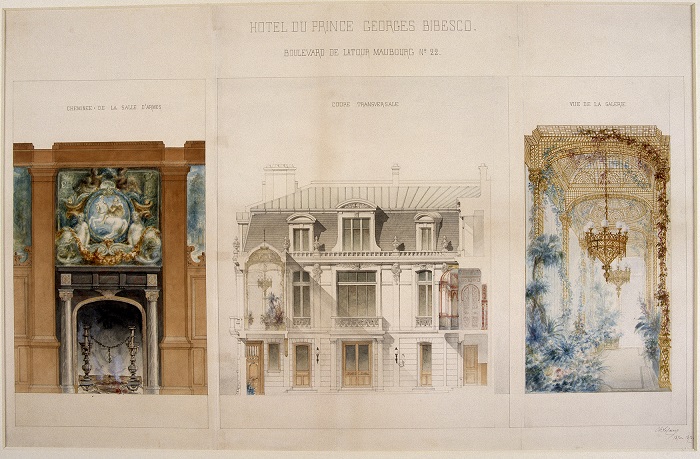
Figure 16
Charles-Justin Le Coeur. Projet pour l’Hôtel du Prince Georges Bibesco, coupe transversale. Entre 1870 et 1872. Pencil, pen and ink, watercolor, lavis and rehauts de gouache et d’or on paper. 61,5 x. 96,5 cm.
RMN-Grand Palais (Musée d’Orsay) / Jean-Gilles Berizzi. Inventoy number ARO 1993 23.
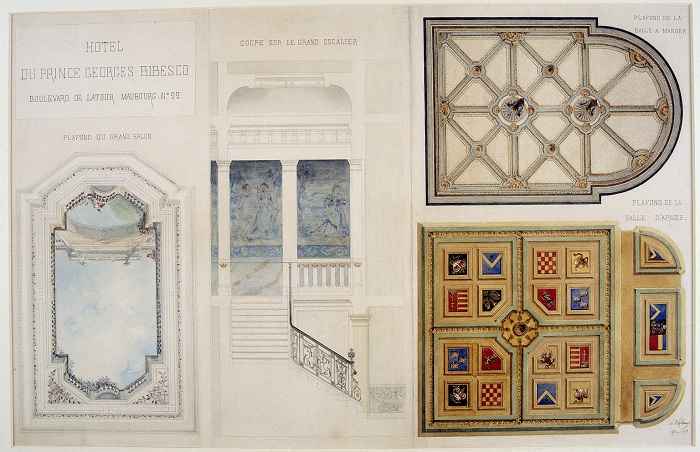
Figure 17
Charles Le Coeur, hôtel du prince Georges Bibesco, 1863-1930. Fonds Émile Gallé. ARO1993-24.
Localisation : Paris, musée d’Orsay. (C) GrandPalaisRmn (musée d’Orsay) / Jean-Gilles Berizzi.
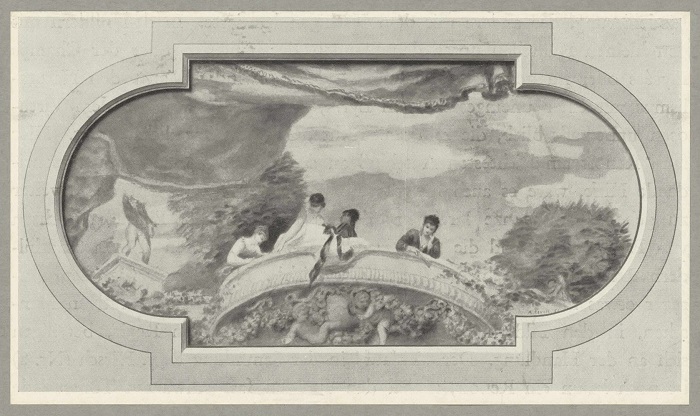
Figure 18
Sketch for a Ceiling Decoration in the House of Prince Bibesco. Renoir, Auguste, 1868. Watercolor, 11 ¼’ x 22 5/8’’.
Frick Digital Collection, code b16044228.
We can roughly situate all 5 cards in a period between 1877 and 1893, especially from 1880 on. At this point, the Teixeira Leite sisters were not Latin American newcomers, but a well-established duo, settled in the 8e arrondissement. The senders illustrate how several nationalities chose Paris for a living; moreover, they shared some values, since they all related to aristocracy, even if, by the time, the French Third Republic had 10 or more years, and the Brazilian Empire would soon become a Republic of its own. The titles of nobility do not necessarily mean a rentier lifestyle, as in the case of the Baron d’Estrela, who was a “capitalist”, or Commandatore Martuscelli, who would eventually become a bank director and a Senator for his country. It is interesting that, because of the lack of envelopes, only one card mentions Eufrásia directly as its main reader. We can only speculate if the sisters would show a personal message to each other. However, the letters bring another light to this prism.
“A WAY OF BEING PRESENT”: THE LETTERS OF THOSE WAITING FOR EUFRASIA
If the cards illustrate a dynamic network in the Paris of the Belle Époque, letters
[...] come from an intellectual and handcrafted effort, which is not meant to reach an abstract legion of people. It focuses on a single heart, that not only needs that information at that moment but, besides, needs that manifestation. [...] It is a symbolic gesture, illustrating that [...] no distance exists between the reader and the sender, and, even if it does exist, no distance is enough to bring them apart.100
But, before discussing what the letters had to say, let’s consider a few methodological possibilities on how to identify who is writing. Two sets were especially interesting because they were the only ones with more than one letter from the same person. In the first case, the sender had neatly written his full name: Roger de Chabrol. However, the second case was a typical example of how to explore different resources from the same paper. This 3-letter set was written between January and March 1885. Not only the handwriting was very small, but the ink suffered some kind of oxidation and became brown, just as the paper acquired a darker tone. The writer did not bother to write the full date each time - just the town, Toulon, the day, and the month (“3 Mars”). It is only by reading them in the correct order that a narrative begins to blossom. As for the signature, it was simply too stylized to be readable.
This identification was possible because the writer used a letter set from the French Navy, where the letterhead indicated “Majorité Générale de la Marine - Cabinet du Major Général”101, therefore inferring that the person should be someone with direct access to this cabinet or even a Navy Major. Indeed, Toulon is one of the headquarters of this national institution (Figure 19).
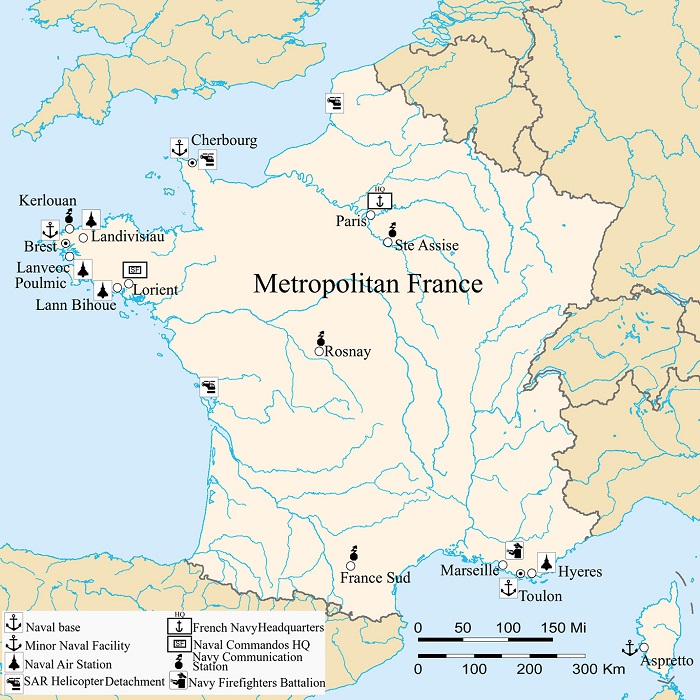
Figure 19
French Navy facilities in Metropolitan France, as of 2015.102
By reading the general contents of the 3 letters, we understand that it is a man and that the writer criticizes internal movements from the French Navy; he is about to take a gap year. He also expects to do specific travels in 1886, when he will resume his activity, mentioning the possibility of going to Madagascar. This means we are dealing with an official.
So 2 alternatives to identify this person were directly by finding his name, or indirectly, by finding a ship that followed the mentioned routes, and then checking its crew. This meant looking for references in two major books: the Annuaire de la Marine et des Colonies,103 a general compilation of people and jobs in the French Navy published every year, and the Dictionnaire des bâtiments de la flotte de guerre française de Colbert à nos jours,104 a herculean work that indicates the period of activity of every French ship and their routes in the sea, during their activity. As those are printed materials, no handwritten evidence would contribute to confirming the identity of the person.
I, then, organized a mixed research, trying to spell the name in the signature and count how many letters there were on it (6), while creating a potential profile according to Eufrásia’s typical network. Apart from being a successful investor, Eufrásia also had keen contact with educated men, usually in the Military or similar, and members of masculine clubs, called “les grands cercles”105. This meant that, probably, the author would have some kind of prestigious rank. In this sense, after looking at the Annuaires from 1884 to 1886, and creating a first filter through the size of the last names, the central possibility was the name of Charles-Jules Layrle, an admiral who came from a navy-driven family. This was confirmed with further checking at the Archives Nationales Léonore database, which lists every person who was given the Légion d’Honneur nobility106 because each one had to sign a document confirming that the medal was duly received. It was therefore possible to compare the signatures and confirm the identity (Figures 20-22).107
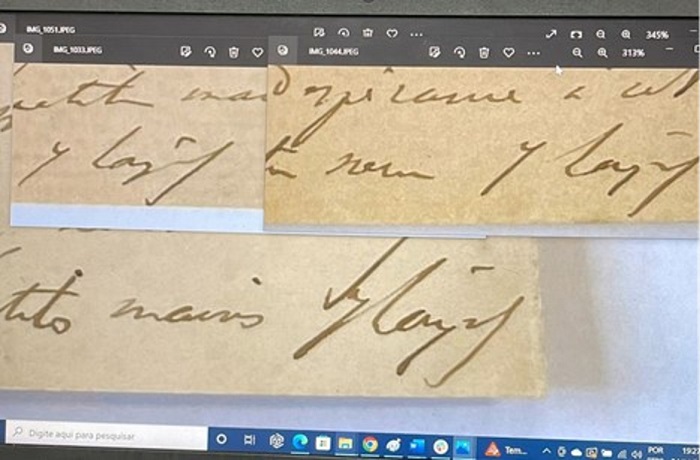
Figure 20
Comparing the signatures in the 3 letters.
Picture by the author.
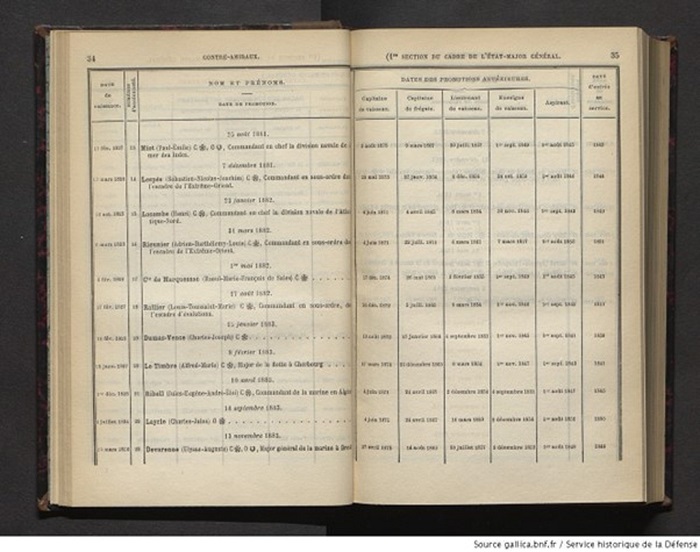
Figure 21
Charles-Jules Layrle mentioned at the Annuaire de la Marine from 1885.
Source: Ministère de la Marine et des Colonies (1885, p. 34-35).
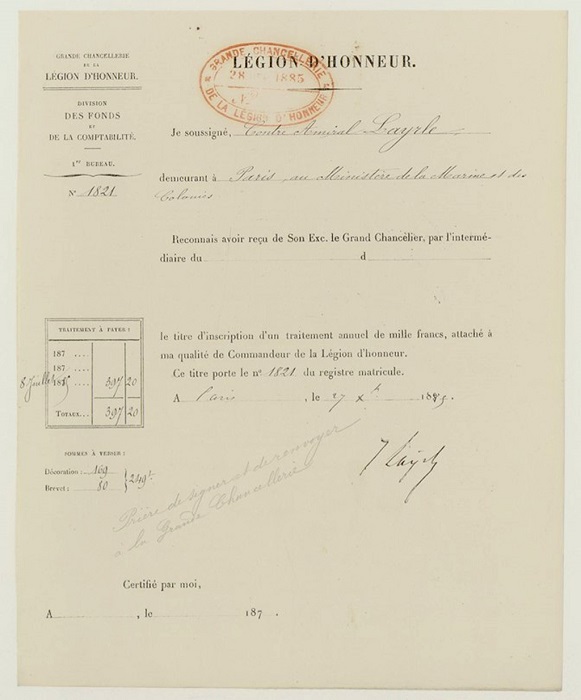
Figure 22
Document confirming that Charles-Jules Layrle duly received his Légion d’Honneur medal.
Archives Nationales, cote LH/1509/69.
Both Chabrol and Layrle had personal motivations to write for Eufrásia, who spent the period between 1884 and 1885 in Brazil and resumed her relationship with Joaquim Nabuco. De Chabrol’s first letter is clearly expecting an answer after asking Eufrásia to marry her. She seems to have refused because the final letter demands an explanation about this decision. The recipient of the letters is unmistakable, first because the 2 envelopes are addressed to “Mademoiselle E Teixeira Leite”. Then, in the letters, de Chabrol directly mentions Francisca as a confident counselor regarding his romantic expectations towards Eufrásia. Moved by anger and disappointment, de Chabrol states: “If I need a distinguished lawyer, I will give my plead to Miss Francisca, who will have to defend her client with intensity and dedication!”108.
As for Layrle, he writes in January, February, and March 1885, wondering when his interlocutor would be back in France. Although these letters do not mention Eufrásia’s name, the author insists on having some kind of news; moreover, he hints that a comeback to France would be proof of choosing sides, something that his recipient would have to eventually do, although Layrle considers that she typically suffers from “indecision”. He states: “Nevertheless, I say goodbye, because you can’t be this slow for much longer”109. It could be that Layrle was somewhat aware of Eufrásia and Nabuco’s relationship and that he feared that, by marrying him, she would never quit Brazil again.
In 3 of these 5 letters, the envelopes indicate Eufrásia’s location, or, at least, where the authors suppose she is: either the Hôtel du Casino, at Deauville (France), Fazenda do Secretário110 in the County of Vassouras, or, “the [Imperial] Court” in Rio de Janeiro (both in Brazil). In this last case, the address indicated is rua Senador Vergueiro, 46A. De Chabrol even joins both sides of the Atlantic, when he adds a note on the envelope: “If absent, forward to Brazil” (“Faire suivre en cas d’absence au Brésil”)111.
The theme of the “comeback” from Brazilian lands was also present in the 1920s set of letters. Those were definitely written to Eufrásia since Francisca passed away in 1899. The main correspondents are Sophie Freeman and Amaury, Marquis de Preaulx, from the Château d’Oublaise; Anna Citrani, who is in Poland; mother Marie-Cécile de la Trinité, from Rome; and Baron Fernand de Christiani. Contrary to de Chabrol and Layrle, these letters were the example of resumed conversations: Sophie and Amaury write because of the Holidays of 1926; mother Marie-Cécile informs that the Baroness of Rio Negro, the mother of one of the sisters of her convent in Rome, has died, but the person is not healthy enough to learn the news, so she is writing to Eufrásia instead. As for Anna, she accepted a job in Poland and left Paris before the return of Eufrásia. She states: “After passing I don’t know how many times in front of your house and finding that it was always shut, alas, I left Paris”112.
The attribution of the last letter to Christiani was challenging. It had no envelope. The person to be identified wrote on Christmas Day, 1922. The letter mentioned several people from the local upper society, mundane events (dinners, playing cards with acquaintances), and general considerations regarding politics. Although the signature was not easy to read, the author made a point of writing the home’s address just beside his or her name: “9, rue d’Artois” (Figure 23). This street belongs to the Faubourg du Roule neighborhood, in the 8e arrondissement of Paris. As we can see, the 8e and 9e arrondissements (which are close enough for someone to walk from one address to another) probably held a central place in Eufrásia’s social life - more than just being “rich neighborhoods”, they also concentrated many potential interlocutors (businessmen, Latin Americans who held a position similar to Eufrásia’s, parishes from churches)113 as well as an intense commercial activity.
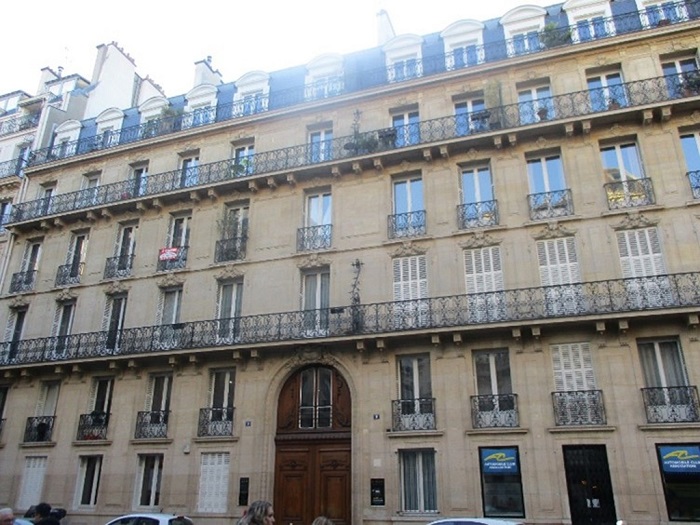
Figure 23
The 9, rue d’Artois building today114
As a sign of modern times, the building in this address is not a hôtel particulier, where a single family lived, but a general apartment building. According to the building’s sommier foncier,115 the place was sold as “nue propriété” by the Leroy family in 1923 to the Lhuilliers,116 who therefore did not live there.117 This meant we were probably looking for someone who rented a particular apartment. Once again, the handwriting, the contents of the letter, and the size of the signature were important references to understand who we were looking for. Although the neat handwriting could be understood as a woman’s, the letter did not discuss intimate matters and could be a man’s. The person would be familiar enough to other noble people, to be invited to dinner. It also seemed to be someone very used to the Parisian dynamics, that is, maybe he or she lived at the same address for a long time.
At this point of the research, digital genealogic trees and platforms were a powerful tool. I contacted several people, looking for more information concerning the Lhuillier family. Eventually, the answers contributed a lot, even suggesting taking a look at Paris’ census from 1926.118 One possibility emerged: Fernand Chevreau, the Baron de Christiani (Figure 20).
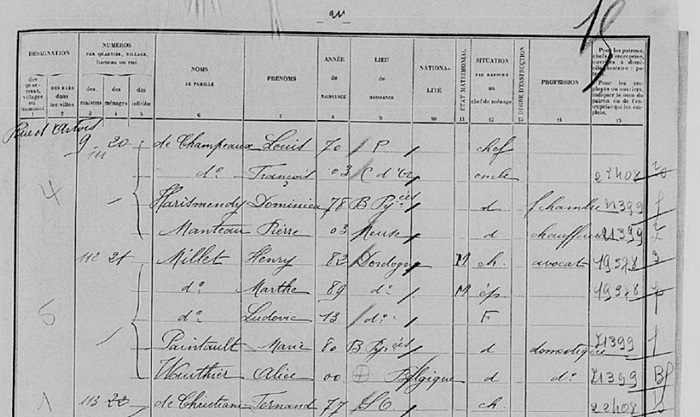
Christiani’s paternal family was given a nobility title because of military achievements. On the other hand, his maternal family came from the Russian aristocracy. An intense monarchist himself, Christiani belonged to the Nouveau Cercle and was at the center of a political controversy during 1899-1900, at the time of the Dreyfus affair. During a horse race in Auteuil, he tried to hit the then-President of the Republic, Émile Loubet. Although Christiani’s gesture just hit Loubet’s hat, it was considered a serious attempt to the Republic’s stability and Christiani was judged, sentenced, and served 4 years in 2 different prisons. After being freed, the Baron did not make the news anymore and died in homecare in Paris, in 1928.
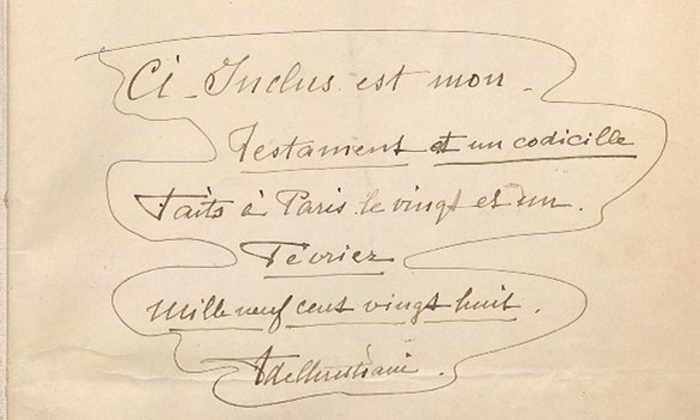
Apart from political controversies, Christiani was also an avid art collector and donated part of his belongings to different French museums, including the Louvre.119 Indeed, Ernesto Catharino mentions Christiani as a “millionaire and artist who painted [Eufrásia’s] portrait that we can see at the Ivy House, but his intense passion left her indifferent”120. His testament procedures were formalized by a Paris notaire (clerk) and allowed us to confirm this identity (Figures 21-22).121

Figure 25
Original letter signature by Christiani with his home address.
Museu Casa da Hera, MCH 90.10.65.
In many aspects, the social origin of the writers of the letters matches the card ones. Most people detain a nobility title or an equivalent. The main exception is Anna, who seems to be a chaperone. However, the ties with Eufrásia stress the role of distance and the feeling of missing her. In many ways, people write to be able to be close to her. In this sense, the letters from the 1920s are not exactly intimate messages but attempts to resume the interaction with the businesswoman, from whom the writers seem to have scarce news. It is noteworthy that, contrary to a fluid correspondence, these items were written mostly on occasions that might trigger the feeling for writing: holidays like Christmas or New Year’s Eve, or a particular situation, such as leaving Paris or bringing an important piece of news. It is also interesting that these authors make a point of informing their address, in case Eufrásia ever wants to reply.
CONCLUSION
Although the Museu Casa da Hera’s correspondence in French and/or English is scarce, the interlocutors of the Teixeira Leite sisters highlight a very aristocratic network - even if the sisters did not hold any nobility titles themselves. This material also was a good example of how to use a complementary set of tools to identify authors that might be key to understanding a specific social network and its meanings.
Most of the correspondence was produced during the 1880s, and, although we may estimate that Eufrásia was the main receiver of these messages, we should not underestimate the importance of Francisca and their sisterhood. By moving to Paris as a duo, Eufrásia and Francisca were able to comply with some of the flexibilizations of their time: they were free to act without the supervision of a husband, a father, or a brother. Even though their move is bold, it is also a piece of evidence of how the context was much more open to women’s emancipation than a few decades earlier. In this sense, the sisters seem to be good context readers. They are familiar with European references and are aware that their wealthy background will be enough to afford them a very comfortable lifestyle in Paris. But they go beyond expectations by creating a social and professional network - especially Eufrásia, who becomes a skilled investor and increases their fortune greatly. Their address indicates that they follow a double trend, choosing a neighborhood with other fellow Brazilians and Latin Americans, but concentrating on wealthy families in general.
During the Belle Époque, visiting is mandatory: It is a “part of time management for a woman from the bonne société”122. Just as other women from the Parisian high society, Eufrásia and Francisca had an active social life,123 which we tend to attribute more to Eufrásia - perhaps because of the lack of information concerning Francisca. However, the fact that there were two of them might have contributed to their excellent adaptation to Paris.124 Instead of being residents but sticking to Brazilian habits while abroad, they were able to build a network with an aristocratic high society from different origins, which did more than enjoy mundane events. Even in a Republican context, aristocratic titles reminded the weight of monarchical tradition. The cards and letters show a different range of themes and feelings: from a mundane life in Paris to the negotiation of possible weddings (thus pushing further the sense of “alliance”) and the feeling of missing Eufrásia once she seldom gave any news of her. By the 1920s, the authors of the letters still insist on getting in touch; if they keep an affective tone, no intimate points are brought up. The expectation that Eufrásia might go back to France is slightly maintained - even by herself - until 1930, when she passes away. In this sense, the 2 cards and lettersets illustrate 2 very different phases of Eufrásia and Francisca’s lifetime. As for many items concerning the Teixeira Leite sisters, we do not know why these items were kept, while others weren’t. Would Eufrásia, during her final days, succumb to the temptation to read old letters and think about her connections?
ACKNOWLEDGEMENTS
I thank Pascal Jacob and Thierry Pin (in the name of the whole team from the Archives Nationales) for their help with the identification of the Baron de Christiani.
REFERENCESManuscripts
ARCHIVES DE L’ÉTAT DE FRIBOURG - AEF. Acte de baptême de Marie-Françoise-Barbara Stoecklin. CH AEF RP IIa 8a, folio 605.
ARCHIVES DE PARIS, MAIRIE DE PARIS. Recensement de la population, 1926, 8e arrondissement, Faubourg du Roule. Cote D2M8 241.
ARCHIVES DE PARIS, MAIRIE DE PARIS. Sommier foncier - 8e arrondissement. Box D34U3 1241; Adjudication de l’immeuble, box DU 4722.
ARCHIVES NATIONALES. Certificat de Légion d’Honneur de Charles-Jules Layrle, November 27, 1885. Cote LH/1509/69. Available at: Available at: https://bit.ly/49pLc4A. Last seen: March 27, 2023.
ARCHIVES NATIONALES. Dépôt des testaments et codicilles d’Isidore Fernand Chevreau, baron de Christiani, sans profession, demeurant 9, rue d’Artois, décédé le 30 juin 1928. Minutes de François Arthur Bazin, 2 juillet 1928. Cote MC/ET/LXIX/1659.
ASSR. Senate of the Kingdom of Italy. Records relating to the appointment of senators. Files of the senators, Enrico Martuscelli, n. 1403.
FERNANDES JUNIOR, Antonio José et al. Ação de apelação (1932). Iphan, item 105.664.842.002.
FERNANDES JUNIOR, Antonio José et al. 1o apenso (1932). Iphan, item 105.664.851.001.
ITAÚNA, Viscondessa de et al. Ação de apelação (1932). Iphan, item 105.664.842.001.
JOURDAIN, Henri. Acte de notaire - Cahier de Charges à la requête de la Santa Casa de Misericórdia de Vassouras et de m. Fernandes. Archives Nationales, item MC/ET/LIX/1404.
JOURDAIN, Henri. Acte de notaire - Inventaire après le décès de melle. Teixeira Leite. Archives Nationales, box MC/ET/LIX/1401.
LE COCQ, Henri. Letter to the Baron d’Estrela, December 7, 1891. Available at: Available at: https://bit.ly/3J6fxdA. Last seen: March 27, 2023.
LEITE, Eufrásia Teixeira. Inventário, 1o volume (1930). Inventariante: Antonio José Fernandes Junior. Iphan, item 105.664.823.001.
LEITE, Eufrásia Teixeira. Inventário, 2o volume (1934a). Inventariante: Antonio José Fernandes Junior. Iphan, item 105.664.834.001.
LEITE, Eufrásia Teixeira. Inventário, 3o volume (1934b). Inventariante: Antonio José Fernandes Junior. Iphan, item 105.664.834.002
LEITE, Eufrásia Teixeira. Inventário, Bens no estrangeiro (1931). Inventariante: Raul Fernandes. Iphan, item 105.664.841.009.
MUSÉE PADEREWSKI. Billet avec enveloppe adressé par la princesse Rachel Bibesco Bassaraba, princesse de Brancovan, à Paderewski, 94, av. Victor-Hugo à Paris en 1892 (?). Brancovan-1892.
SERVICE HISTORIQUE DE DÉFENSE. États de service de l’amiral Charles, Jules LAYRLE. Cote MV CC7 2ème moderne 2. Printed material, no date.
SILVA, Umbelina Teixeira Leite dos Santos et al. Ação civil (1932). Iphan, item 105.664.843.001.
UNIVERSITEITS BIBLIOTHEK GHENT. Doodsbrief Grégoire Prince Bibesco, Prince Bassaraba De Brancovan, 1886. Permalink: https://lib.ugent.be/catalog/rug01:002830004. Location number BIB.GENEA.054042.
Printed material
ALMANACK LAEMMERT, 1902. Available at: Available at: https://bit.ly/3U7Qrl2. Last seen: March 27, 2023.
ANNUAIRE DU GRAND MONDE PARISIEN, 1884. Available at: Available at: https://bit.ly/3TG7AR6. Last seen: March 27, 2023.
CORREIO MERCANTIL, May 20, 1858, p. 3. Last seen: March 27, 2023.
CORREIO MERCANTIL, August 8, 1858, p. 1. Last seen: March 27, 2023.
LA LIBERTE, February 23, 1906. Available at: Available at: https://bit.ly/4aMe5sv. Last seen: March 27, 2023.
LA LIBERTE, June 3, 1908. Available at: Available at: https://bit.ly/3PWw7jV. Last seen: March 27, 2023.
LE COCQ, Henry. Le Brésil à Bourges: notice sur la section brésilienne. Report, no date. Available at: Available at: https://bit.ly/4cQ6o6L. Last seen: March 27, 2023.
LE FIGARO. January 9, 1893, p. 2. Available at: Available at: https://bit.ly/3VLfU4L. Last seen: March 27, 2023.
LE FIGARO. May 18, 1895. Available at: Available at: https://bit.ly/4aNAjKZ. Last seen: March 27, 2023.
LE FRANCO-AMERICAIN, April 15, 1893. https://bit.ly/4cFWUuN. Last seen: March 27, 2023.
LE GAULOIS, October 17, 1886. Available at: Available at: https://bit.ly/3Xa8okM. Last seen: March 27, 2023.
LE GAULOIS, May 2, 1896. Available at: Available at: https://bit.ly/3vJDioO. Last seen: March 27, 2023.
O VELHO BRAZIL, October 31, 1854. Available at: Available at: https://bit.ly/3RBlJ1S. Last seen: March 27, 2023.
OUEST-FRANCE, October 10, 2020. Available at : Available at : https://bit.ly/3W0pali. Last seen: March 27, 2023.
PRÉFECTURE DE LA SEINE. Recueil des actes administratifs de l’année 1928. Partie municipale - deuxième section, no. 08. August 1928, p. 755. Available at: Available at: https://bit.ly/3vHg6Yb. Last seen: June 11, 2023.
Books, articles and thesis
ALONSO, Angela. A experiência inglesa de Joaquim Nabuco. In: ENCONTRO ANUAL DA ANPOCS, 29., 2005. Proceedings [...]. Caxambu: Anpocs, 2005. p. 1-33.
ARBELLOT, S. Les grands cercles en 1900. Revue des Deux Mondes, p. 439-444, 1965.
BARMAN, Roderick J. For Us the city of diamond or cut crystal: the Brazilian conception of Paris during the long nineteenth century (1808-1914). In: SALMON, Carole (org.). Paris in the Americas: yesterday and today. Wilmington and Malaga: Vernon Press, 2022. pp. 101-116.
BENJAMIN, Walter. Le livre des passages. Paris: Cerf, 1989.
BENZAQUEN, Ricardo. O linho e a seda: notas sobre o catolicismo e a tradição inglesa em minha formação, de Joaquim Nabuco. Revista USP, p. 8-13, 2009.
CALDEIRA, Jorge. Mauá: empresário do Império. São Paulo: Companhia das Letras, 1995.
CARVALHO, José Murilo de. Cidadania no Brasil: o longo caminho. Rio de Janeiro: Civilização Brasileira, 2002.
CATHARINO, Ernesto. Eufrásia Teixeira Leite (1850-1930): fragmentos de uma existência. Rio de Janeiro: Author’s edition, 1992.
CHIRIO, Maud. Querido Lula: Cartas a um presidente na prisão. São Paulo: Boitempo Editorial, 2002.
COELHO, Sintia Said; VASCONCELOS, Maria Celi. A criação das instituições de ensino superior no Brasil: o desafio tardio na América Latina. In: COLOQUIO INTERNACIONAL SOBRE GESTÃO UNIVERSITARIA NA AMERICA DO SUL, 9., Santa Catarina. Proceedings [...]. Santa Catarina: UFSC, 2009. p. 1-13.
COOPER, Douglas. Renoir, Lise and the Le Coeur family: a study of Renoir’s early development-II: the Le Coeurs. The Burlington Magazine, v. 101, n. 678/679, pp. 320-329, Sept./Oct. 1959. Available at: Available at: http://www.jstor.org/stable/872743. Last seen: June 8, 2024.
DAUPHIN, Cécile; LEBRUN-PEZERAT, Pierrette; POUBLAN, Danièle. L’enquête postale de 1847. In: CHARTIER, R (org) La correspondance: les usages de la lettre au XIXe siècle. Paris: Fayard, 1991. p. 21-120.
DEL PRIORE, Mary. Ao sul do corpo: condição feminina, maternidades e mentalidades no Brasil Colônia. São Paulo: Unicamp, 2009.
DUQUESNE, Joelle; COMBELLE, Frank. Nina d’Asty: des Sables-d’Olonne à Plougrescant. La Crèche: Compagnie du Livre, 2018.
FALCI, Miridan; MELO, Hildete P. Riqueza e emancipação: Eufrásia Teixeira Leite. Uma análise de gênero. Estudos Históricos, n. 29, pp. 165-185, 2002.
FALCI, Miridan; MELO, Hildete P. A sinhazinha emancipada: Eufrásia Teixeira Leite (1850-1930) : a paixão e os negócios na vida de uma ousada mulher do século XIX. 2nd. ed. São Paulo: Hucitec, 2021.
FEY, Ingrid E. Frou-frous or feminists?: turn-of-the-century Paris and the Latin American woman. In: FEY, I. E; RACINE, K (org.). Strange pilgrimages: exile, travel, and national identity in Latin America, 1800-1990s. Lanham, Maryland: Rowman & Littlefield Publishers, 2000. p. 81-94.
FEY, Ingrid; RACINE, Karen (org.). Strange pilgrimages: exile, travel, and national identity in Latin America, 1800-1990s. Lanham, Maryland: Rowman & Littlefield Publishers , 2000.
GINZBURG, Carlo. O queijo e os vermes. São Paulo: Companhia das Letras , 1987.
GOULART, Silvana. O tratamento da correspondência em arquivos pessoais: desafios e controvérsias. In: CAMPOS, J. F. Arquivos pessoais: experiências, reflexões, perspectivas. São Paulo: Associação de Arquivistas de São Paulo, 2017. p. 38-60.
GOUVÊA, Maria de Fátima. O império das províncias: Rio de Janeiro, 1822-1889. Rio de Janeiro: Civilização Brasileira , 2008.
GREEN, James. O joelho de Sarah Bernhardt: negociando a “respeitabilidade” feminina no palco carioca, 1880-1901. Escritos, v. 8, p. 7-25, 2004.
HAZAN, Eric. L’invention de Paris. Paris: Points, 2004.
HOBBS, Catherine. The character of personal archives: reflections on the value of records of individuals. Archivaria, v. 52, p. 126-135, 2001.
HUGO, Victor. Notre Dame de Paris. Paris: Pocket, 1989.
IUMATTI, Paulo; NICODEMO, Thiago. Arquivos pessoais e a escrita da história no Brasil: um balanço crítico. Revista Brasileira de História, v. 38, n.78, p. 97-120, 2018.
JORET-DESCLOSIÈRES, Georges. Une famille française: les de Lesseps. Revue des Études Historiques, suppl., p. 1-50, 1900.
LAGE, Claudia. Mundos de Eufrásia: a história do amor entre a incrível Eufrásia Teixeira Leite e o notável Joaquim Nabuco. Rio de Janeiro: Record, 2016.
LE VERRIER, Lucile. Journal d’une jeune fille: Second Empire (1866-1878). Cadeilhan: Zulma, 1994.
MARTIN-FUGIER, A. Les rites de la vie privée bourgeoise. In: PERROT, M. La vie de famille au XIXe siècle. Paris: Points , 2015. p. 150-304.
MARTINEZ, Frédéric. Anna de Noailles. Paris: Gallimard, 2018.
MICELI, Sergio. Imagens negociadas: retratos da elite brasileira (1920-40). São Paulo: Companhia das Letras , 1996.
MINISTÈRE DES COLONIES. Annuaire de la Marine et des Colonies - 1885. Paris: Berger-Levrault et Cie., Éditeurs, 1885. Available at: Available at: https://bit.ly/3U7f94Z. Last seen: March 27, 2023.
MOREIRA BARBOSA, Thalita. A elite no exílio: a colônia brasileira de Paris (1889 a 1928). Dissertation (MA in History) - Programa de Pós-Graduação em História, Universidade Federal de Juiz de Fora, Juiz de Fora, 2019.
NEEDELL, Jamie. Belle Époque tropical: sociedade e cultura de elite no Rio de Janeiro na virada do século. São Paulo: Companhia das Letras , 1987.
PEREIRA, Ana Carolina. A escrita feminina no século XIX: as cartas de Flora de Oliveira Lima e Eufrásia Teixeira Leite. Gênero, v. 5, n. 1, p. 111-141, 2004.
PEREIRA, Manuel Gomes. Obras do Barão do Rio Branco. Vol. X - Artigos de Imprensa. Brasília: Ministério das Relações Exteriores, 2012.
PEREIRA, Elisa; VIAN, Carlos Eduardo; QUEIROZ, Odaléia. Análise das conseqüências da produção cafeeira do século XIX na conjuntura econômica do interior paulista, Brasil. In: SEMINARIO DE PATRIMONIO AGROINDUSTRIAL - PAISAJES CULTURALES DEL VINO, EL PAN, EL AZÚCAR Y EL CAFÉ, 1., Mendoza. Anais [...]. Mendoza: IAU, 2008. p. 1-13.
POLANYI, Karl. A grande transformação: as origens da nossa época. Rio de Janeiro: Campus, 2000.
QUEIROZ, Eneida. A mulher e a casa. São Paulo: Baraúna, 2013.
RAPPAPORT, Erika. Shopping for pleasure: women in the making of London’s West End. Princeton: Princeton University Press, 2000.
REIS, Thiago. Mineiros, tropeiros e capitalistas: trajetória e formação da família Teixeira Leite em uma economia de transição (São João del Rei e Vassouras, séculos XVIII e XIX). Thesis (PhD in History) - Programa de Pós-Graduação em História, Universidade Federal do Estado do Rio de Janeiro, Rio de Janeiro, 2020.
ROBITAILLE, M. Proust épistolier. Montréal: Les Presses de l’Université de Montréal, 2003.
ROCHE, Jean-Marie. Dictionnaire des bâtiments de la flotte de guerre de Colbert à nos jours, tome II: 1870-2005. Toulon: J.-M. Roche, 2005.
SALLES, Ricardo. E o vale era escravo: Vassouras, século XIX. Rio de Janeiro: Civilização Brasileira , 2008.
SALMON, Carole. Introduction: plural identities, Paris pluriels. In: SALMON, Carole (org.). Paris in the Americas: yesterday and today. Wilmington and Malaga: Vernon Press , 2022. pp. ix-xvi.
SCHWARCZ, Lilia Moritz; COSTA, Angela Marques da. 1890-1914 - No tempo das certezas. Companhia das Letras: São Paulo, 2000.
SÉVIGNÉ, Madame de. Lettres. Paris: Flammarion, 1993.
SILVA, Eduardo. Barões e escravidão: três gerações de fazendeiros e a crise da estrutura escravista. Rio de Janeiro: Nova Fronteira, 1984.
SOARES, Cecília Elisabeth Barbosa. Sedas tropicais: comércio de luxo e desenvolvimento urbano no Rio de Janeiro. PhD thesis - Instituto de Estudos Sociais e Políticos, Universidade do Estado do Rio de Janeiro, Rio de Janeiro, 2017.
SOARES, Cecília Elisabeth Barbosa. Uma história privada através de lentes públicas: a construção do acervo pessoal de Eufrásia Teixeira Leite (1850-1930). Rev. Inst. Estud. Bras., São Paulo, n. 87, e10672, 2024. DOI: 10.11606/2316901X.n87.2024.e10672.
SOARES, Cecília; BON, Olga. Modas, calos e cetins: os sapatos como símbolos distintivos no Rio de Janeiro do século XIX. Diálogo com a Economia Criativa, v. 5, n. 1, p. 1-26, 2020.
STEIN, Stanley. Vassouras: a Brazilian coffee county, 1850-1900. The roles of planter and slave in a plantation society. Princeton, New Jersey: Princeton University Press, 1985.
STRECKERT, Jens. Latin Americans in Paris, 1870-1940. Jahrbuch für Geschichte Lateinamerikas, pp. 181-204, 2012.
STRECKERT, Jens. París, capital de América Latina: latinoamericanos en la ciudad luz durante la Tercera República (1870-1940). Seville: Universo de Letras, 2019.
SÜSKIND, Patrick. Das Parfum: die Geschichte eines Mörders. Zurich: Diogenes, 1994.
TAMBASCO, José Carlos. Eufrásia e Francisca: as irmãs Teixeira Leite e o seu tempo. Uma história romanceada. Curitiba: Appris, 2022.
TELLES, A. M. Do Rio para o mundo na rota do café: as exposições nacionais e internacionais de café organizadas pelo Centro da Lavoura e Comércio na década de 1880. Anais do Museu Histórico Nacional, v. 53, p. 44-76, 2020.
ZEMON DAVIS, Natalie. Fiction in the archives: pardon tales and their tellers in sixteenth-century France. Redwood City, California: Stanford University Press, 1990.
Websites
COMITÉ DES TRAVAUX HISTORIQUES ET SCIENTIFIQUES. Available at: Available at: https://bit.ly/49rSGE9. Last seen: June 9, 2023.
GENEANET. Albert de Reilhac. Available at: Available at: https://bit.ly/3XwqlKB. Last seen: June 22, 2024.
Notes
Author notes