TABLE OF CONTENTS
Business Process Management Applied to Legal Administration: a study on law firms processes
O CONCEITO DE GESTÃO POR PROCESSOS APLICADO À ADMINISTRAÇÃO LEGAL
Business Process Management Applied to Legal Administration: a study on law firms processes
Revista de Administração da Universidade Federal de Santa Maria, vol. 12, no. Esp.5, pp. 857-876, 2019
Universidade Federal de Santa Maria

This work is licensed under Creative Commons Attribution-NonCommercial-ShareAlike 3.0 International.
Abstract: This paper aims to identify the key business processes that are part of the organization structure in law firms that provide legal services. The study was conduct within the legal administration and business process management approaches. A qualitative-exploratory and quantitative-descriptive research was realized. The first, conducted through the application of semi-structured individual interviews, identified eight theoretical dimensions that were used in the latter, as a reference for defining the research questionnaire. Seven law firms certified by ISO 9001 were used for the identification of business processes. As results the identified processes were grouped according to APQC Process Classification Framework, in four key process (vision and strategy development, service market, products and services distribution and customer service management). Also, six support process categories were identified: information technologies management, financial resources management, acquiring, constructing and management properties, environmental health and safety, external relationships management and management knowledge, improvement, and change. Providing greater customer satisfaction has been identified as the main factor for the offices to map their business processes, while lesser degree of importance was attributed to product and service cost reduction and quality improving.
Keywords: Business Process Management, Legal Administration, Law Firms.
Resumo: Esse trabalho aborda o tema da administração legal e gestão por processos aplicados a organizações prestadoras de serviços jurídicos, identificando os principais processos de negócio que compõem a estrutura de um escritório de advocacia. Uma pesquisa de natureza qualitativo-exploratória e quantitativo-descritiva foi realizada. Na primeira, realizada por meio da aplicação de entrevistas individuais semiestruturadas, identificou oito dimensões teóricas, que foram utilizadas, na segunda, como referencial para a definição do instrumento de pesquisa. Sete escritórios de advocacia certificados pela ISO 9000 foram utilizados para a identificação dos processos de negócio. Os processos identificados foram agrupados conforme o referencial da Estrutura de Trabalho para Classificação de Processos APQC, sendo quatro categorias principais e seis de apoio. O escopo de proporcionar maior satisfação ao cliente foi identificado como fator principal para os escritórios mapearem seus processos de negócio, enquanto menor grau de importância foi atribuído a redução de custos dos seus produtos e serviços e melhoramento da qualidade dos seus produtos e serviços.
Palavras-chave: Gestão por Processos, BPM, Administração Legal, Escritórios de Advocacia.
1 Introduction
Organizations are nowadays undergoing significant changes in their management scenarios due to constant mutations in the economy, market, technologies and new demands from customers and employees (McCormack, 2000). Managing a law firm has become an increasingly complex activity, making it imperative that these kinds of firms are conditioned as a business organization. In addition to this, Selem (2009) points out that law firms have increasingly sought to enter into the world of modern management, aiming to find more effective ways to develop their competitive capacities, improving the provision of legal services, meeting their customer needs and creating an excellent work environment to ultimately achieve greater profitability.
The main goal of this paper is to understand how law firms, as organizations providing legal services, manage their business process within the practices of legal administration. Therefore, the paper presents terminological dimensions extracted from specialists and which are taken as dimensions of study for the construction of a research instrument. This instrument was applied to a group of participants (law firms) thus contributing to an understanding of the main business processes and their elements.
Next section presents a theoretical framework associated with legal administration and process management topics, followed by the method used in the work and its results. Finally, a conclusion will be presented.
2 Bibliography background
2.1 Legal Administration: the business vision in Law Firms
Law firms are undergoing a process of structural and cultural reorganization, adopting the concept of business organization, making it necessary to hire administrators to supply the managerial functions. This paper understands that law firms are organizational structures corroborating this view. Pires (2009) concludes that "law firms have all the inherent characteristics of current organizations. However, this truth began to be perceived recently here in Brazil.". Selem (2007) states that the legal administrator contributes to the office operation with maximum efficiency, quality and high profitability, since he assists the creation of processes and procedures for a better rendering of customer service, in addition to managing daily operations and coordinating basic office functions. Thus, the interdisciplinarity between these two sciences, Law and Administration, results in the professional management of law firms (Hipólito, 2009; Gonçalves, 2009). Among the responsibilities of current legal administrators, there are the relationship with external clients, the representation of the offices in the community, as well as the development of internal operational assignments. Thus, lawyers may afford only practicing legal services (Turkington, 2009).
Collins (2009a; 2009b) identified the common business characteristics among the most successful law firms: leadership, consensus, shared vision (brand and values), common set of values and beliefs allied with office culture, management planning, measurement indicators, responsibility for the ultimate objectives and reinvestment. Another elementary factor for the conception of the law firm as a legal services provider organization is the fact that the clients, whether individuals or legal entities, are used to receive a highly professional service, with a high level of satisfaction and quality of companies from other commercial segments.
One of the ways to achieve excellence in management is through ISO certifications. Cabral (2008) points out that "in order to improve their operational and administrative techniques, law firms are seeking Certificates of Quality as a way to achieve excellence in their services". Rocha (2009) points out two advantages in such certification: "1. the 'power' of the ISO name attached to its mark; 2. the management that ISO standard can provide to the office". The certificate issued to law firms complies with the standard ISO 9001, a certification process that "aggregates competitiveness through improving processes, customer focus, motivation and greater employee capacity, leadership and attention on the demands of other interested parties, which are suppliers, community and government "(Cabral, 2008).
On the Inmetro (National Institute of Metrology, Quality and Technology) database of Brazilian companies with ISO 9001 quality system issued in Brazil and valid during the investigation period of this study, July 2010, nine law firms are found (INMETRO, 2010). It should be noted that the law firms are classified in the areas of real estate activities, rentals and services, and in detailed operation of legal activities.
2.2 Process Architecture
Different authors define processes with some particularities, but following the same line: activities/actions ordered in time and space, with a beginning (entry), a development and a closure (end) defined to structure an action, which may be the creation of products, services or information (Oliveira, 2006a; Gonçalves, 2000a; Hammer and Champy, 1995; Oliveira, 2006b).
There are different classifications for processes. Rummler and Brache (1994) classify the processes into three types: customer processes, administrative processes, and management processes. Hammer (apud Pinto Filho, 2007) frames the processes into four categories: central processes, governance processes, infrastructure processes, and facilitative processes. Gonçalves (2000a; 2000b) identifies the existence of three basic categories of processes: business processes (or client), organizational processes or organizational integration and management processes.
Regardless the classification, Hammer (1998) points out that among the inherent characteristics of a process-oriented company is the focus on customer satisfaction, since the total objective of the company should be to offer more value, in a faster way at a lower cost. Therefore, there are several stages for the evolution of a company that goes through process-oriented management, since each company can decide to evolve into the stage that best suits its prospects and operations, considering above all the management practices and redefinitions of their organizational culture. The five stages presented by Gonçalves (2000b) evolve from the purely functional model (Step A) to the process-based model (Step E); the intermediate levels (B, C and D) correspond to situations in which companies present distinct levels of characteristics by processes.
In relation to the process architecture, Jeston and Nelis (2008) understand that some attributes can form it: (1) there must be a set of rules, principles and models for the process; (2) there should be a basis for the conception and fulfilment of the organization's process; (3) processes should be connected to organizational strategy and objectives; (4) there must be an alignment in the process, with the architectural business, information and technology (5) the process should be easily understood and applied by all interested parties; (6) the architecture process must be dynamic, which means, easily adaptable to the evolutionary process of society and the market.
Process management presents a structured approach to analyse and continually improve a company's core activities, such as production, marketing, communication and other major operational elements of the organization (Gonçalves, 2000a; Inácio et al., 2009, ABPMP 2008).
In this way, process management, named by some authors as Business Process Management (BPM) includes methods, techniques and tools to support the conception, the promulgation and analysis of the operational management of such business processes (Aalst, 2009; Morais et al., 2014; Ferrari et al., 2018). It can be considered as a classical systematic extension of the Workflow Management approach.
Literature presents different approaches on how to set, manage, monitor and improve the management of business processes (ABPMP, 2008; Brajer-Marczak, 2016; vom Brocke et al., 2014; Santos et al., 2006; Smith and Fingar, 2003; Jeston and Nelis, 2008; Baldam, Valle e Silva, 2008). Such models present themselves as cycles, since they start over when the last stage is closed. However, the process management approach cycle application requires a minimum level of involvement and maturity from the company.
3 Research Method
3.1 Methodological Approach and research instrument
This research has a qualitative, exploratory and descriptive nature (Malhotra, 2006), and had as methodological sequence the following steps:
-
delimitation of the research topic, when the concepts of management by processes and legal administration were settled and delimited, as well as its relation to the concept for the management of law firms;
structuring a research instrument through open interviews with specialists in the areas of processes and legal administration, aiming the alignment of terminological questions used in the developed research instrument; and
application of the instrument in a set of participants and analysis of results.
In order of raising the criteria and terminological foundations of Legal Administration and Process Management for the research environment, three professionals linked to the certification area and the legal area were interviewed following a script with semi-structured questions: R1: lawyer; R2: evaluator of the Gaucho Quality and Productivity Program and R3: company consultant. The professionals were chosen through non-probabilistic sampling, using the subjective methods of the researcher (Hair et al, 2005).
As a technique for analysing the interview and observation data, it was used content analysis, highlighted by Flick (2004) as one of the most used classic procedures to analyse originated data from interviews, with three essential techniques: (a) abbreviation of the content analysis, in which the material is paraphrased in order to reduce the collected material, avoiding generalization of meanings; (b) explanatory content analysis, which clarifies unclear, ambiguous or contradictory excerpts; (c) structure analysis of the content, in which types or formal structures are searched in the material, classifying the collected content in scales
Based on the analysis of the results of the semi-structured interviews, a closed questionnaire was created for application with the study population.
3.2 Application of the Research Instrument
As participants of this study, only law firms with valid ISO 9001 quality system with Inmetro accreditation mark available on the ABNT website were considered, according to information verified on 14/07/2010. The reason for this choice is due to the fact that such types of organizations have a better understanding of what a process is and the importance of the process for themselves. The identity of the researched companies was kept confidential. Nine law firms with the desired profile for the research were identified. Out of these, seven answered the questionnaire. It is worth noting the concentration of offices in the South and Southeast regions of Brazil, since eight of the nine offices certified in the country are located in these regions.
Within an initial characterization of the study population, 6 out of the 7 offices (85.7%) worked only with a legal entity, having only one of them working with individual and legal entities. This shows that the certified offices have a standard for their client, destining their provided services to other companies. It was also possible to observe that the offices had an average staff of 31 people, ranging from 17 to 49 people. If observing the data on the number of lawyers in the office, an average of 15 hired lawyers was found, ranging from 6 to 27. For this study, it should be noted that it is necessary to differentiate the employees from the lawyers, therefore, it is understood that employees are the professionals who work in the administrative or supportive area. The annual billing varied widely (R$ 500,000.00 to R$ 2,400,000.00), having four offices (57.2%) in the range from R$ 500,000.00 to R$ 900,000.00. As for the start and end time of the ISO 9001 certification project, the offices took on average 11 months to implement the standard.
In the first part of the questionnaire structure, it was applied a general characterization of the offices, such as actuation segments, billing, number of employees and lawyers as well as start and end time of the certification project. The second part had questions about quality certification by the firm, and the third part included a survey about the level of importance in the objectives of the business process mapping, based on Monteiro's (2003) data collection. The fourth and final step of the questionnaire consisted on mapping the processes themselves, aiming to know whether the office mapped or not their processes and the level of importance that they attribute to each item. This step was based on the Model of Work Structure for Process Classification APQC - American Productivity & Quality Center (APQC, 2010). The questions were defined as closed questions and with different degrees of intensity, ranging from 1 to 5, being 1 for less important and 5 for most important, as shown in the example of Figure 1. In addition to these questions, auxiliary questions were added to characterize the firm’s profile, such as operation segment, number of employees and lawyers, and general questions about strategic planning and quality certification.
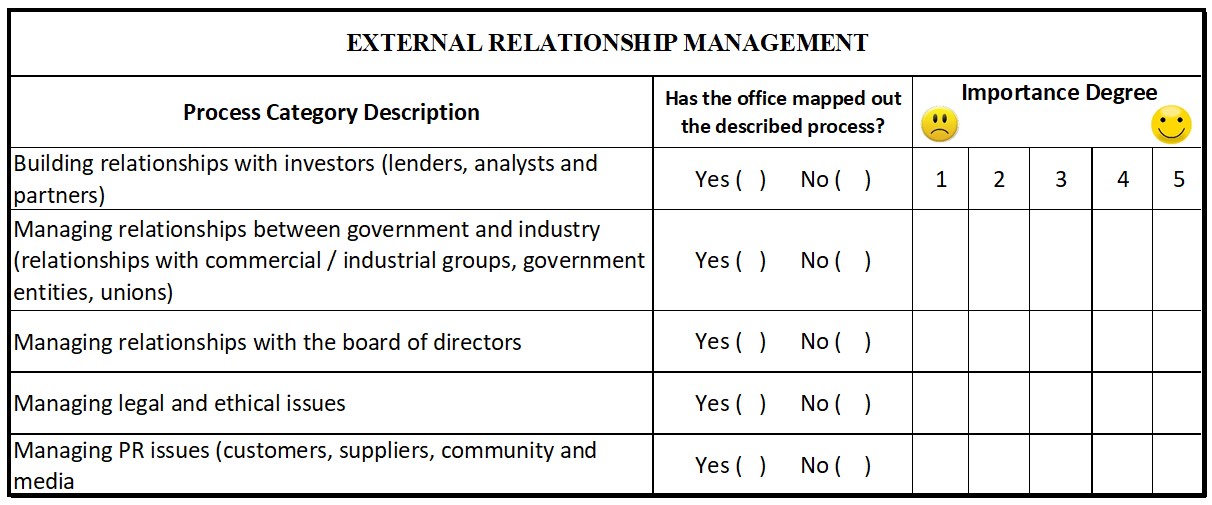
Figure 1.
Example of questions applied to the interviewers
The questionnaire was submitted to content validation with the purpose of aligning the terms used in the instrument to the reality of the analysed context. A professional of Legal Administration, with academic formation, a consulting service provider in the management area for law firms, certified this validation.
Data collection occurred in the period between July and August 2010 with questionnaires sent via e-mail to the people who had been previously contacted by telephone. Therefore, in this initial contact, the researchers presented the thematic and the objectives of the research, dialoguing with the respondents about the researched context. In some cases, more telephone contacts and a new response schedule were necessary. Therefore, out of a total of nine offices , seven answered the questionnaire sent to them.
The analysis of the collected data had the aid of descriptive statistics, using means and standard deviation to analyze the centrality and the variability of the answers with SPSS Student Version 16.0 software support. In order to select the main mapped processes by the researched offices, the criteria of minimum mapping threshold was used, and at least 85% of the offices should have the process mapped.
4 Description and analysis results
4.1 Research with specialists’ results: qualitative-exploratory phase
4.1.1 Terminological dimensions map
The first stage of data collection, as discussed above, consisted in a research with qualitative nature, with the purpose of investigating the fundamental terminologies and concepts used by professionals that work in the researched area. In this way, the technique of individual in-depth interviews was applied. As there were three respondents with different profiles, the scripts were adapted for each professional, which resulted in three basic questionnaires. As it has already been mentioned, the respondents were identified as R1, R2, and R3. Figure 2 shows the list of issues elaborated by the evaluator of the Gaúcho Quality and Productivity Program (R2).
Through the description of the results and analysis of the speeches, eight dimensions of study were identified and defined, organized in the form of a map of the terminological dimensions. These dimensions were classified according to the significant emphasis in the interviewees' speeches. The referred map has four main dimensions, which are "reasons for implementation of quality certifications"; "strategic planning"; "process mapping"; and "management practices". In a secondary line, four other terminological dimensions were raised: "Specialized management consultancies"; "organizational culture"; "Management tools"; and "performance indicators". The terminological dimensions of the research are presented in Figure 3.

Figure 2.
Basic questions guide applied to the PGQP evaluator
Adapted from Ribeiro and Milan (2004 apud MILAN, 2006)
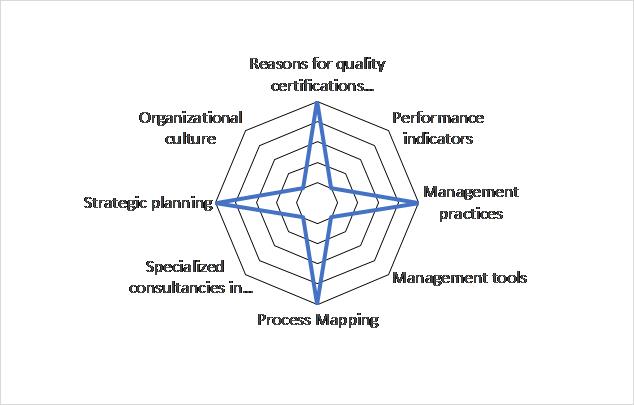
Figure 3.
Terminological dimension Map
4.1.2 Terminological dimensions analysis
Regarding the reasons for implementation of quality certifications, there was a consensus regarding the respondents (R1, R2 and R3) in reference of the need to improve the management and growth of companies through indicators, facts and data, being a differentiating element from other offices. As R3 points out:
[...] is a business opportunity. Many large companies value certification concerning their suppliers. As the legal office is one of these suppliers, it is convenient to seek certification. Unlike many organizations, there is still no market demand for this segment. Offices have realized that with a structured management system it is possible to achieve a more solid and sustainable growth (R3).
In spite of not being required by the market a culture of organization in law firms, according to R1’s testimonial it is perceived an interest in the investment in management tools, such as an ISO certification.
[...] we have always had a concern for management [...] we had, prior to certification, an administrative consultancy that have correctly shaped the officeadministratively since 1999 when it started the activities. [...] When we chose to invest in ISO, a lot things were organized (R1).
When verifying the interviewees perception about standardization, especially the procedures manuals, it was observed that there is no consensus about what standardization is. While R2 states that standardization takes into account behavioral aspects that cannot always be described, R3 standardization ensures "that know how remains inside the organization when the lawyer or employee leaves the office." In addition, issues of organizational culture and legal class tend to represent a barrier to administrative procedures. Respondents' interventions about the barriers faced by legal services organizations when seeking new forms of management were:
[...] people may fear loss of power when asked to describe what they do (R2).
I think the greatest difficulty we had was the culture issue. There is this resistance still, because lawyers, by nature, are rebellious and do not like to follow rules, they like questioning rules, it is our formation (R1).
Regarding strategic planning, it is observed that there is no connection to the certification. What is practiced is an empirical planning, without foundation and without a professional supervision. According to the analyzed speeches, there is no understanding by lawyers of the concept of planning nor the practice functionality. Besides that, as described below, there are evidenced opinions about the chronological order of strategic planning implementation and quality certifications:
[...] the planning contains actions to implement a quality system or a management implementation plan contemplates the need to elaborate a strategic planning (R2). In some cases, after the implementation of the management system, strategic planning can be implemented (R3).
Regarding process mapping, we have noted the lack of certainty manifested by R1 on the existence of two ways of understanding the concept of "process”.
When you talk about mapping, of tracking, to track, does it refer to the process, the lawsuit, or the ISO? (R1).
In this way, we understand that for the Law professionals the concept of process, as its connection to business management model is not clearly understood once the same term, in Portuguese, is used to describe legal proceedings. In addition, it was verified that most of the time, R1 refers to the management processes through the denomination "procedures", as stated below:
In the vast majority, in order to differentiate processes, we are dealing with ISO procedure and what is judicial process, that this was a confusion in our region with the OAB, how to standardize the process, but not the judicial process because this process does not standardize, but rather standardized procedures. Then the rest are the inner things, our documentation, our dossier, those procedures (R1).
Process mapping is also a significant item for appreciation. For R2, first one defines the company’s main and support processes, followed by the identification of clients, suppliers, requirements and indicators. An important factor identified by this respondent refers to the comprehensiveness of the mapping, which is optional, but should always contain the processes that add value to the client.
The used nomenclature is also a factor that deserves analysis. Respondents R2 and R3, professionals who serve as management system consultants, employ the terminology by dividing it into key processes and support processes, in conformity with the theoretical basis of their area. On the other hand, R1, who is a lawyer, is inserted in a context in which it is necessary to have a distinction between business and lawsuits processes.
Among the used methodologies for management, management software and mapping processes flowcharts were named. However, it is observed that for R1, the mapping process is directly linked to the management follow-up software and judicial processes, a tool that synchronizes the clients’ information. Thus, the following statement emerges:
We developed a software for us, because we didn´t find one in the market that would meet our needs. All traceability of legal proceedings parts, all controls parts, deadlines [...] (R1).
The process mapping steps is a concept understood uniformly by the respondents. In all the statements, the mentioned procedure were the stakeholders’ meetings, personnel training regarding the understanding of the procedure and the routine description so that the current process drawing is carried out and the due corrections of the ideal process drawing are made. From the developed flowchart, the adjustments for posterior validation of the systemic view of the business were made.
Regarding processes monitoring and verification, it is evident that the respondents point the performance indicators as mark of the management action check:
[...] we are always reviewing [...] why the mistake happened and how it happened. In a services provision you don´t have necessarily that logical sequence, it doesn´t follow an order, it is very variable. We then measure our communication with the client, things that can affect our work [...] (R1).
It´s done through performance indicators, established upon the process results (R2).
For each process is generated a management indicator with goals. [...] Internal auditors are trained to ensure the efficiency and effectiveness of the management system (R3).
In summary questions, when asked about the processes that most affect business and clients, all respondents identify client communication as one of the key business process. However, there were others quoted as fundamental:
Client service, legal process, labor, civil, criminal, tax and charging areas (R3).
We speak in the critical processes, which are the processes of prospecting, contract, service rendering, which is the movement and after, the process closure (R1).
Certainly, those linked to the final client, from providing services properly said and that attend to the intrinsic quality and term dimensions (R2).
Concerning the advantages obtained with the certification, especially with the processes mapping, we can list: greater control, data-based decision making, meeting the needs of interested parts, knowledge of routines and internal flows, continuous improvement with focus on the client and on the office results. One of the factors that proved to be priority was the possibility of improving communication between the office employees and between the office and the clients.
In the final questions, when asked about the reaction of the interested parts after the implementation of management systems by law firms, the respondents analyzed from four fronts: the perspective of the client, the competitors, the Brazilian Lawyers Organization (OAB) and the forum. About the clients, the following statements are observed:
Greater tranquillity and transparency in relation to meeting their needs, generating greater satisfaction (R2).
Clients value an office that has a broad and consistent view of their management, speaking on an equal basis with their legal clients, companies (R3).
On the reaction of the competitors, the respondents' understanding is very similar, in the sense that with the implementation of new management systems, there is a climate of competition among the offices, thus fostering an increase in competitiveness regarding excellence on providing services. Regarding OAB, the perception is the same among the interviewees, which is, the organization hasn’t recognized administrative practices in the management of law firms yet and little is manifested about the topic.
Management practices for law firms are apparently evaluated positively by respondents, supported by tools that are used systemically to add value to business. In addition, the necessity of change is outlined with practices defining values, principles, planning, processes and measurement systems.
4.2 Research results with law firms: quantitative-descriptive phase
4.2.1 ISO 9001 Implementation
Regarding ISO 9001 in the law offices, it was investigated the reason for the implementation, the use of external consulting and the existence of strategic planning. It is possible to verify that the main reason for the implementation was the business opportunity (71.4%), that most offices hired external consulting (71.4%); and only two offices had strategic planning prior to certification (33.3%) (Table 1).
| Variables | Categories | N | % |
| Reason for the ISO 9001 implementation | Market needs Business opportunity | 2 5 | 28,6 71,4 |
| External Consultancy | Yes No | 5 2 | 71,4 28,6 |
| Strategic Planning | Yes No | 6 1 | 85,7 14,3 |
| Strategic Planning before and after certification | Before the certification After the certification | 2 4 | 33,3 66,7 |
The importance levels of the goals that led the office to adopt business process management were also investigated. Amongst the objectives that presented the highest average of importance are customer satisfaction and profitability; amongst those that presented less importance are products and services quality and reducing costs (Figure 4).
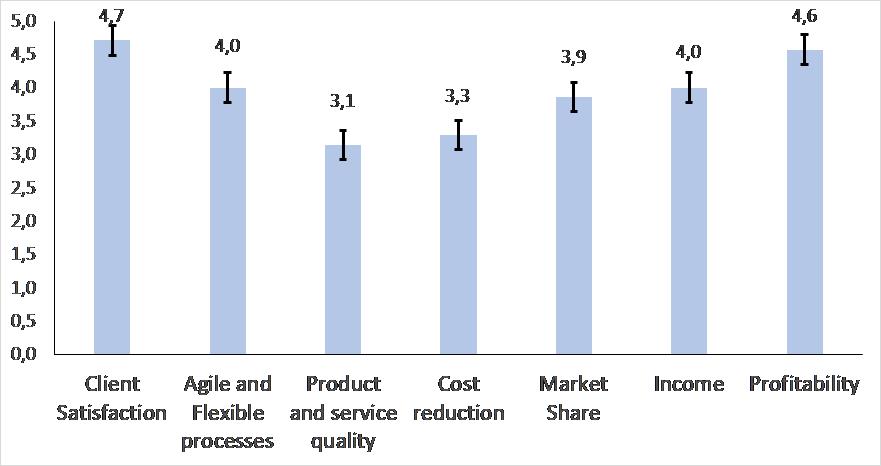
Figure 4.
Importance level of the objectives for the adoption of BPM (n = 7)
4.2.2 Analysed Processes
The main processes evaluation was done taking five dimensions, namely: developing vision and strategy; designing and developing products and services; service market; products and services distribution; and managing customer service. For this evaluation, first it was asked whether the office mapped the process and indicating the importance level of the item came after that. The degree of importance varied from 1 to 5 and the results are presented by mean and standard deviation.
Figure 5 shows the average of importance level attributed to each of the categories on the main business processes that can compose the structure of law firms.
The first evaluated category was " Vision and strategy Development ", in which the three items in the category presented an importance average of 4.0 or greater, but only the item "Defining the concept of business and long-term vision" was mapped by all the offices. The second category "Designing and developing products and services" has only one item and had a low percentage of mapping (28.6%), having also a low importance (2.71).
Of the six items evaluated in the "Service Market" category, four showed importance averages above 4.0, although two items revealed a low percentage of mapping, namely: "Managing partners and alliances (partners and strategic alliances)" and "Managing opportunities for hiring office services and information channels (identify priority clients and establish budgets)".
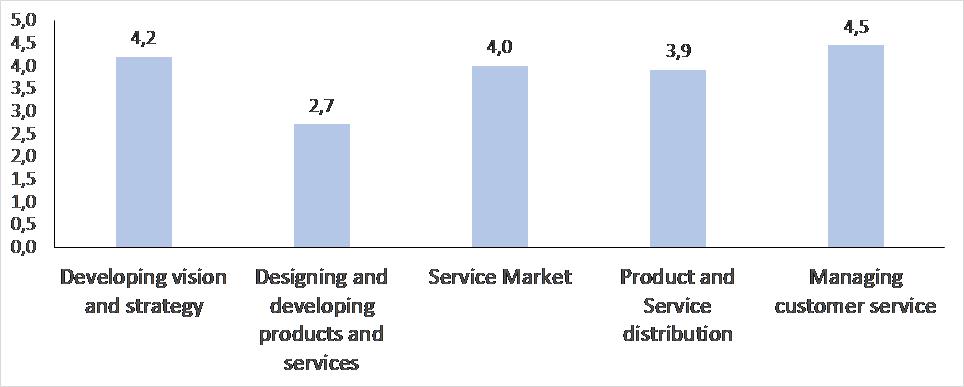
Figure 5.
Description of the average importance level of the main processes
In the " Products and Services Distribution " category, it can be observed that of the five evaluated items, four presented a mapping percentage superior to 83.3%; in addition, three items revealed an average of 4.0 or greater for importance.
The last category evaluated, "Managing Customer Service", presented high percentage of mapping and high averages of degree of importance. On a particular note there is the item "Developing Client Service / Client Service Strategy", which reached 100% mapping and maximum average for degree of importance.
In the same way as the main processes, the support processes were evaluated according to seven dimensions: Human capital development and management; Managing information technology; Managing financial resources; Acquiring, building and managing properties; Managing environmental health and safety; Managing external relationships; and Managing knowledge, improvement, and change.
Figure 6 presents the averages attributed by the surveyed offices to the support processes that compose the business process structure. With the exception of the "Human capital development and management” category, which obtained the lowest average, and "Managing knowledge, improvement and change" category, which obtained the highest average, all others reached averages at the 3-point level, which allows us to infer the linearity of the importance levels of such categories.
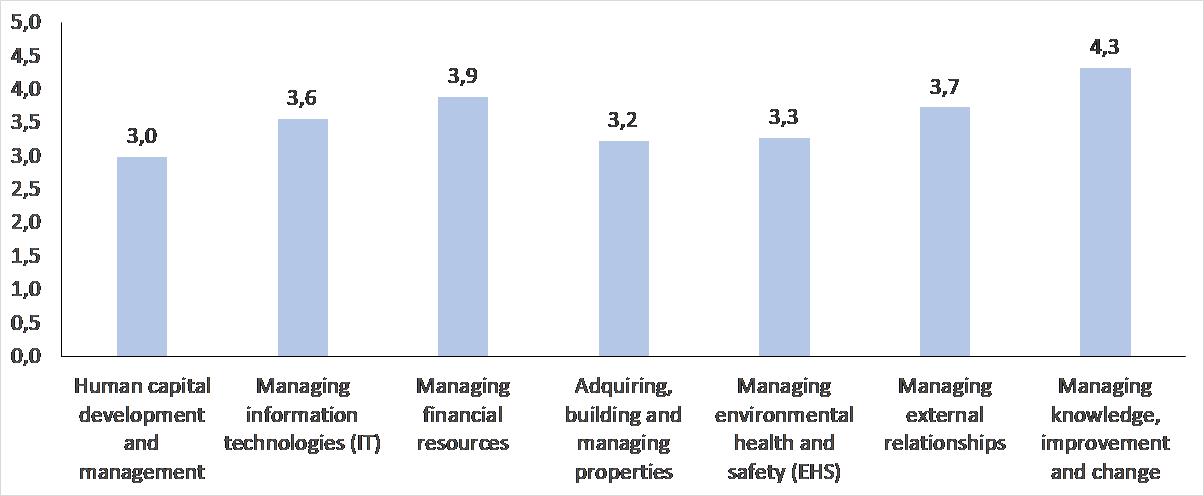
Figure 6.
Description of the average importance degree of support processes
In the “Human capital development and management” category, the low average importance level (1.4) is highlighted for the item "Reuse and retire employees", as well as the fact that none of the offices have mapped this item. In addition, only the item "Creating and managing human resources (HR) planning, policies and strategies" presented an average importance grade higher than 4.0. In the "Managing Information Technologies" category, of the eight items evaluated only two had averages of importance higher than 4.0 and 100% of mapping, namely: "Managing company information (database)" and "Developing and maintaining information technology solutions ".
In the third evaluated category of support processes was "Managing Financial Resources", seven of the nine items revealed a mapping percentage higher than 70% and five items obtained an average of 4.0 or higher. The "Acquiring, building and managing properties" category was more heterogeneous in relation to the averages of importance level: the "Managing physical risk" item presented an average below 2.0 and the "Disposing of workspace and resources" and "Managing capital asset" items, respectively had an average of 4.0 and 4.2.
In the "Managing environmental health and safety" category, of the six evaluated items, three had a percentage of mapping below 35% and the average in these items was not greater than 2.8 for degree importance. Despite this, the item "Ensuring compliance of regulations" presented 100% mapping and an average grade of importance of 4.71. In the "Managing external relationships" category, the items "Managing legal and ethical problems" and "Managing public relations program (clients, suppliers, community and media)" stand out, with an average importance of 4.5 or higher.
The last category "Managing knowledge, improvement and change" revealed an average of 4.0 or greater for all items. In addition, the mapping percentage was above 70% for all evaluated items.
The reaction of the interested parties after obtaining the ISO 9001 was also investigated. It’s observed in Figure 9 that, under the perception of the offices, the best reaction came from the clients, with an average of 4.57, followed by the competition (2.71) and OAB (1.85).
In the final stage of the questionnaire, the respondents were asked if they had any additional comments to make. One of the aspects that stood out was related to the business vision that the offices began to develop and the management practices that became part of the organizational environment, as below,
The decision to implement a Quality Management System in our office in accordance with the ISO standard was the first step in translating our "status" from law firm to company. [...] the implementation of a Management System was very important for our growth, since it opened the horizon for the management tools, optimizing not only our provision of services, but allowing a palpable orientation of what we are, what we want and how to get there (OFFICE 1).
[...] we have awakened in our office the curiosity to implement management tools that endow the structure with greater efficiency and effectiveness in the operational routines of all those involved in the business (OFFICE 3).
The results with the certification were also pointed out by the offices, regarding to the increase in revenue, customer satisfaction indexes and greater market share. These factors can be evidenced in the testimonials as the following:
And the result couldn´t be other; since the implementation of the System, our company has achieved an increase of 70% in revenues, joined by a considerable increase in customer and employee satisfaction rates, as well as bringing Strategic Planning and Project Management to our home (OFFICE 1).
[...] our range of clients has increased significantly due to the certification. It is also possible to say that it was possible to meet with excellence the demand absorbed after certification [...] (OFFICE 3).
In addition, the offices approach the Quality System as a differentiating factor in the market, which allowed them a new focus for the organizational management. They also point out to process management as a tool for standardizing services in order to increase profitability and maintain a good relationship with customers.
Based on the collected data, Figure 7 presents the main business processes in the structure of law firms. Using the criterion of the minimum level of mapping, the processes compose four categories: "vision and strategy development", "service market", "products and services distribution" and, "customer service management".
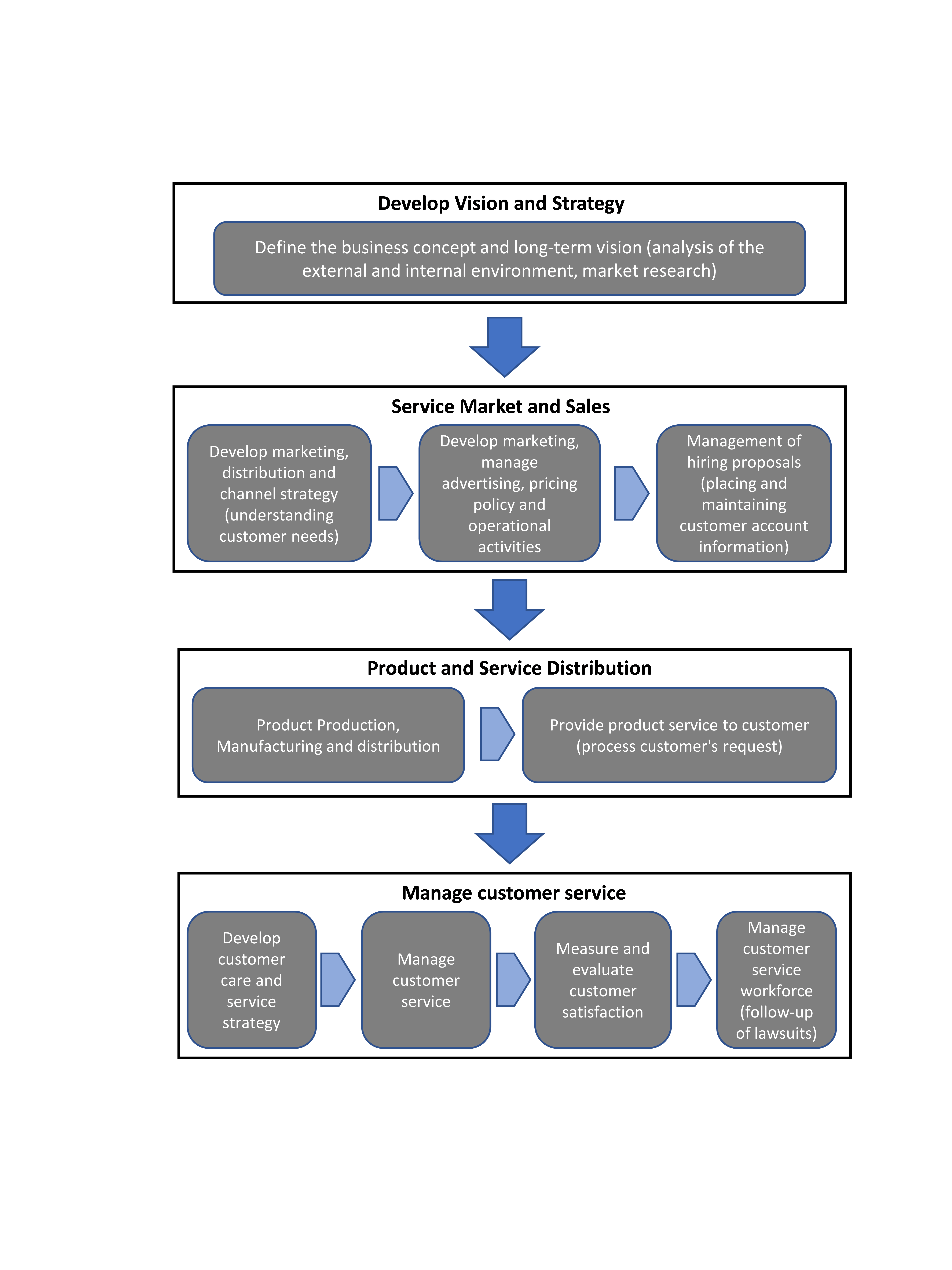
Figure 7.
Generic way of structuring the main processes
In addition to the main processes, it was possible to identify the support processes that compose the structure of these legal service providers, such as: " information technologies management", "financial resources management", "acquiring, constructing and managing properties", " environmental health and safety, "," external relationships management, and "managing knowledge, improvement, and change"(Figure 8).
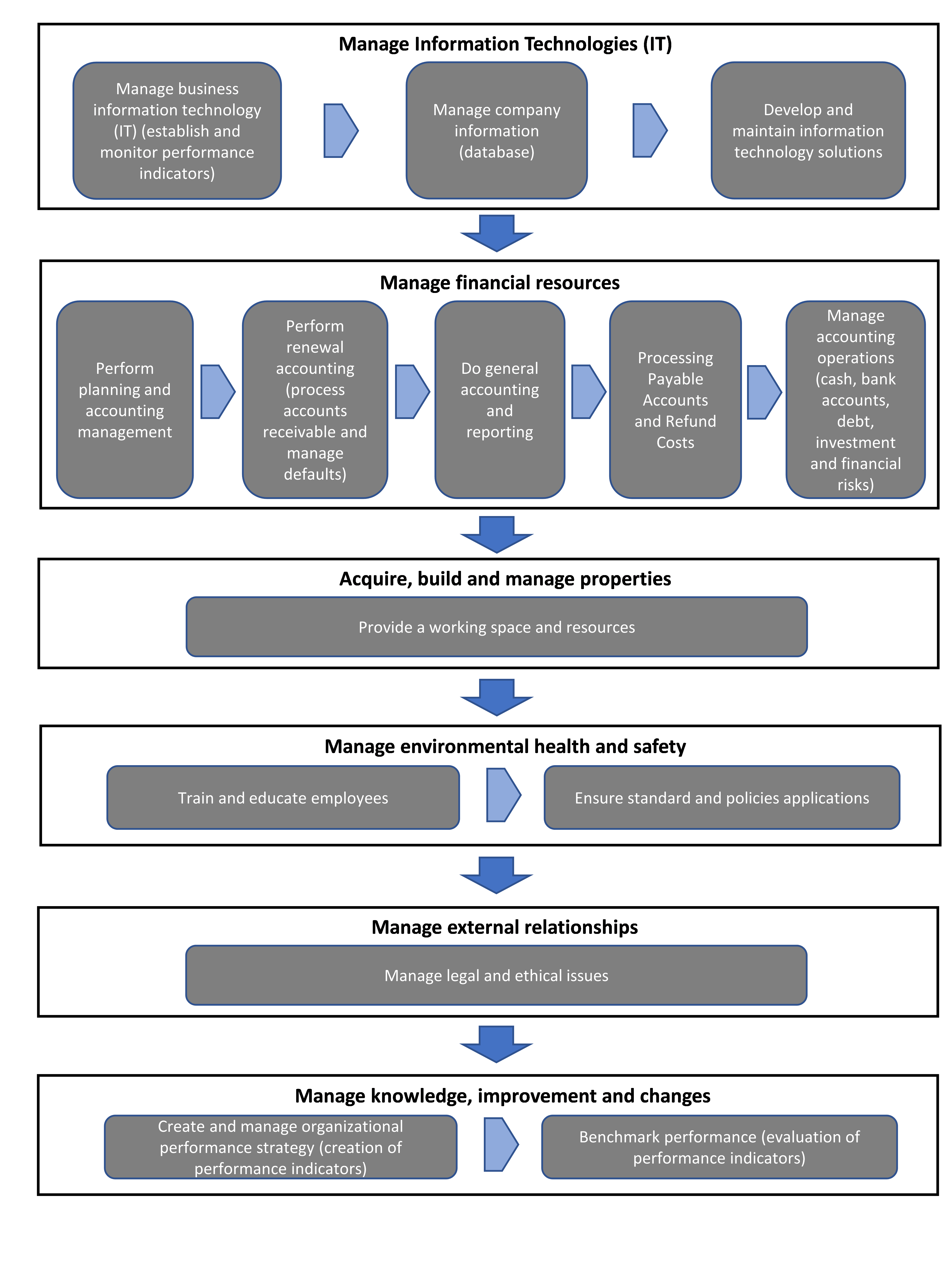
Figure 8.
Generic way of structuring support processes
5 Final considerations
This paper presented a study about the main business processes that compose the structure of a law firm. A qualitative-exploratory and quantitative-descriptive approach research was carried out for this purpose, identifying at first the criteria and terminological foundations of the analysed context, through the application of three individual semi-structured interviews. In a second moment, based on the map of the defined terminological dimensions, the data collection was carried out with the application of a structured questionnaire, which was applied in the offices certified with ISO 9001 in Brazil.
Concerning the identification of the main business processes in the structure of law firms, four categories were identified: "developing vision and strategy", "service market", "distributing products and services" and, "customer service management ". However, one of the original categories of the APQC Process Classification Framework, "designing and developing products and services", was mapped by 28.6% of the surveyed offices suggesting the lowest importance level appointed by the offices. Based on the APQC Process Classification Framework, seven categories of support processes are presented. However, from the data pointed out by this study, the relevance of only six categories for the context of law firms was identified, since the category "developing and managing human capital" did not reach the minimum level of mapping of 85%.
The category “managing information technologies” presented three out of seven of its process groups selected and identified in 100% of the law firms studied. The processes that are part of the category “managing financial resources” were identified as relevant support processes by the law firms. In a similar way, the processes part of the category “managing knowledge, improvement and changes” were identified as mapped support processes by the law firms concerning to the creation of performance indicators and its assessment to the benchmarking routines.
One limitation of this research is that only law firms certificated by ISO 9001 were analysed, which is a limitation for more robust statistical analysis. This requires the extension of the research to other companies. For this research, the APQC Process Classification Framework was used. However, other classifications can be used as framework to define key and support processes. Finally, although the group of specialists covers different areas and knowledge, this group could be extended to other point of view, as example, the clients’ point of view. This can be evaluated in further studies.
6 Acknowledgments
Authors would like to thank the 3 specialists that voluntarily took part in the research as well as the companies that were very helpful in replying the questionnaire. Also, our appreciation to the important and precise comments of the reviewers.