Artigos
FORMATION OF PALM OIL CULTIVATION IN PARA’S AMAZON
FORMAÇÃO DA DENDEICULTURA NA AMAZÔNIA PARAENSE
FORMACIÓN DE LA DENDEICULTURA EN LA AMAZONIA PARAENSE
FORMATION OF PALM OIL CULTIVATION IN PARA’S AMAZON
Mercator - Revista de Geografia da UFC, vol. 19, no. 1, 2020
Universidade Federal do Ceará
Received: 25 October 2019
Accepted: 02 June 2020
Abstract: The formation of palm oil cultivation in Para’s Amazon has as guide the state action. Emphasizing that the state makes possible the arrival of palm oil, encourages business creation through programs, projects and policies. The process of reconstituting milestones on origin, consolidation and expansion, which goes from the 1950s to the second decade of the 21st century, was based on the vast literature review on the topic, data collection about palm oil cultivation, palm oil production, emergence, merger, business extinction and the situation of family farming integration projects. Th first part of the text focus on the arrival of oil palm in the Amazon, next, has highlight the creation of palm oil companies and finally analyze palm oil policies. This explains the distribution of the crop predominantly by the Tomé-açu microregion and the current period marked by the projects of integration of rural farmers into the palm oil agribusiness chain, through the discourse of rural territorial development with social inclusion, and job and income generation.
Keywords: Palm oil, State, Politics, Territory, Amazon.
Resumo: A formação da dendeicultura na Amazônia paraense tem como fio condutor a ação estatal. Ressalta-se que o Estado torna possível a chegada do dendezeiro, incentiva a criação de empresas, por meio de programas, projetos e políticas. O processo de reconstituição dos marcos sobre a origem, a consolidação e a expansão, que vai de a década de 1950 até a segunda década do século XXI, apoia-se na vasta revisão de literatura sobre o tema, levantamento de dados sobre cultivo do dendezeiro, produção de dendê, surgimento, fusão, extinção de empresas e a situação dos projetos de integração da agricultura familiar. A primeira parte do texto enfoca a chegada do dendezeiro na Amazônia; a seguir destaca-se a criação das empresas dendeicultoras e por fim analisa-se políticas para a dendeicultura. Isso explica a distribuição do cultivo predominantemente pela Microrregião de Tomé-açu e o período atual marcado pelos projetos de integração do agricultor rural à cadeia do agronegócio do dendê, através do discurso do desenvolvimento territorial rural com inclusão social e geração de emprego e renda.
Palavras-chave: Dendeicultura, Estado, Política, Território, Amazônia.
Resumen: La formación de la dendeicultura en la Amazonia paraense tiene como hilo conductor la acción estatal. Resaltamos que el Estado torna posíble la llegada del dendezeiro, incentiva la creación de empresas, por medio de programas, proyectos y políticas. El proceso de reconstitución de los hitos sobre el origen, la consolidación y la expansión, que va de la década de 1950 hasta la segunda década del siglo XXI, se apoyó en la vasta revisión de literatura sobre el tema, levantamiento de datos sobre cultivo del palma aceitera, producción de dende, surgimiento, fusión, extinción de empresas y la situación de los proyectos de integración de la agricultura familiar. La primera parte del texto enfocamos la llegada del palma aceitera en la Amazonia, a seguir destacamos la creación de las empresas dendeicultoras y por fin analizamos políticas para la dendeicultura. Eso explica la distribuición del cultivo predominantemente por la microregión de Tomé-açu y el período actual marcado por los proyectos de integración del agricultor rural a la cadena del agronegócio del dende, por medio del discurso del desarrollo territorial rural con inclusión social y generación de empleo y renta.
Palabras clave: Dendeicultura, Estado, Política, Território, Amazonia.
INTRODUCTION
In this analysis of the constitution of oil palm cultivation in the Amazonian region of Pará state, we emphasize that this geographical phenomenon has been planned and structured by state action. The corollary of this is the organization of rural space for the reproduction of capital and, consequently, the modification of the landscape, spatial configuration and social relations in the places where oil palm cultivation is established. It is a revealing dynamic of the dialogue between the political and spatial instances because without state plans and programs this rural activity would not have reached the status of an agribusiness.
For more than half a century the cultivation of the African oil palm (Elaeis guineenses jacq.) has been part of the rural productive space in the Paraense Northeast and has thus aroused analytical interest. Homma (2016) drew up a chronology of this process in the region starting with the crop’s introduction and placing its evolution within the regional economic cycles, without grouping the various events into sets of indicators regarding the activity’s new directions in Amazonia. In turn, Homma and Furlan Júnior (2001, p. 93) wrote about “the chronology of the various events that marked the economic history of the Amazon, the cycles of agricultural activities and the recent insertion of oil palm cultivation as forming a new economic sub-cycle”. Carvalho and Nahum (2014, p. 14) characterized “the geographic period in which oil palm cultivation is inserted, thus proposing a periodization of oil palm cultivation in the state of Pará”. These works focus on oil palm cultivation and enable its trajectory to be traced, marking the milestones, based on the prerequisites for analyzing spatial dynamics.
In this article, we seek to understand the formation of oil palm cultivation in the eastern Amazon, taking state action as the guiding thread. It is the State that made the introduction of the African oil palm possible and encouraged the creation of companies through programs, projects and policies; in short, it created the normative, financial and spatial conditions capable of promoting oil palm cultivation as a vector for rural territorial development. The first part of the text focuses on the arrival of the oil palm in the Amazon, then we highlight the creation of companies cultivating oil palm and finally, we analyze policies for oil palm cultivation.
This analysis helps to explain the crop’s predominant distribution in the Tomé-Açu Microregion and clarifies the period marked by projects to integrate the rural farmer into the oil palm agribusiness chain, through a discourse of rural territorial development with social inclusion and job and income generation. This process of reconstituting the key points of the origin, consolidation, and expansion of the business is supported by a vast literature review on the topic. Data was collected on oil palm cultivation and palm oil production, as well as the emergence, merging and extinction of companies and the situation of the integration projects for family farming.
Furthermore, the study analyzes political actions and their repercussions for oil palm cultivation and its spatial organization, highlighting the impact of those periods singularized by particular policies. We start from the beginning of African oil palm farming until its transformation into large-scale oil palm cultivation, as a logic of spatial production associated with a form of subjectivity built by capital, enabled and disseminated by state/business action and introjected by family farmers and rural laborers, reproducing what Dardot and Laval (2016, p. 17) called a “generalization of competition as a norm of conduct and the company as a model of subjectivation”. Such a rationale results from a market mentality, the only reason operating in human existence, dividing society into entrepreneurs, customers, employees, and consumers.
FIRST STEPS
The African oil palm (Guinean Elaeis Jacq.) reached the Amazon from the state of Bahia betweenthe early 1940s and 1950s, encountering some variations in the optimal conditions that do not preventthe cultivation of the oil palm but which, according to Müller (1980), may reduce the crop’s yield. Theseessential conditions include:
a) An average monthly temperature between 25 and 28ºC; b) an average monthly minimum temperatureabove 18ºC; c) well-distributed insolation over 1,500 hours per year; d) well-distributed rainfall above 2.000mm per year and a maximum of three months with less than 100 mm; e) a flat topography with slopes lessthan 10% declivity; f) the physical structure of the soil must be deep and without compaction up to one meterfrom the surface [...] in terms of texture the preferred soils are those with between 20% and 30% of fineparticles; g) the chemical composition of the soil: oil palm is quite tolerant in terms of chemical composition,but ideally, it should be rich in humus and have well-balanced nutritional elements (MÜLLER, 1980, p.11-12).
Homma (2016, p.15) states that “Francisco Coutinho de Oliveira, head of the Lira Castro AgrarianField of the Ministry of Agriculture” was one of those responsible for the introduction of this crop,through the importation of selected seeds from the Ivory Coast. The state pilot-project was born in theSuperintendence of the Amazon Economic Valorization Plan (SPVEA). Homma’s (2016) interpretationwas that:
José Maria Pinheiro Conduru, from the Northern Agricultural Research and Experimentation Institute(IPEAN), is representative of the standpoint of the technical publications at the time. His work entitled “Oilpalm cultivation has possibilities in the Amazon”, recommends the cultivation of palm trees in themunicipalities in the northern region. Conduru’s (1957) work exemplifies the research that enabledinvestment in areas ecologically favorable to the cultivation of the African oil palm and the possibility ofcontinuous production in the Amazon (HOMMA, 2016, p.17).
Oil palm cultivation was promoted by the State during the first ten years but remained in anembryonic stage until the following decade with Operation Amazon in 1966. According to Nahum(2011), Operation Amazon reinvented the Amazon as a frontier. A ministerial report presented to thePresident of the Republic for consideration by the Extraordinary Minister for the Coordination ofRegional Organizations (MECOR) states
Art. 1. Operation Amazon is hereby instituted, with the primary purpose of mobilizing and coordinatinggovernment efforts that are oriented towards the development and reformulation of federal policy in theAmazon region, in order to update and give new priorities to development and occupation programs of theAmazon territory.
Art.2. Priority will be given to measures of a legislative nature and the regulation of executive tasks aimed atproposing amendments to current legislation, as well as the constitution of public and private bodies,according to the respective federal action articulation criteria, in the Amazon area (MECOR, [196?] p.2)
Among the measures were the transformation of the SPVEA into the Superintendence ofDevelopment of the Amazon (SUDAM) and the Banco de Crédito de Amazônia into Banco daAmazônia S / A (BASA), the implementation of the tax incentives policy, and land concessions. Sincethen, spatial dynamics in Amazonia cannot be understood without taking development plans intoaccount. These plans established areas for rubber production, livestock and oil palm cultivation andallocated resources to the Amazon in order to “invent the region as an agricultural and agropastoralfrontier” (MÜLLER; ALVES, 1997, p. 16). Ianni (1986) argues that it is at this point that the State,based on the ideology of the agricultural frontier, offered inducements for national and internationalcapital to acquire land in the region, deepening the unequal regional agrarian structure and fomentingtensions, conflicts, violence, and murder in Amazonian agricultural space.
It is evident that the territorial planning proposed in Operation Amazon reorganized thelandscape, spatial configuration, and social dynamics, in short, the whole regional space. In the 1960s,the State proposed a large-scale oil palm cultivation project in the Amazon whose goal was to create apalm oil production pole. During the so-called Brazilian economic miracle (1968/1973), oilseedcultivation projects were wrapped in a particular ecological, economic and social philosophy. At thattime, publications indicated broadly favorable environmental conditions (FURLAN JÚNIOR et al.,2006) and evaluated African oil palm cultivation in the Amazon as promising. Homma (2016) views theresearch by José Maria Pinheiro Conduru, from the Northern Agricultural Research andExperimentation Institute (IPEAN), as representative of the leanings of the technical publications of this period.
Conduru (1957) analyzed the efforts that enabled investment in ecologically favorable areas forcultivation in the Amazon that could have continuous production. For Costa (2010), this might generatejobs and income for farmers. This ecological-economic-social philosophy drove the research, thetechnology transfer, the expansion of the irrigation infrastructure, the distribution of hybrid seeds (65thousand seedlings and 160 thousand oil palm seeds), synthetic fertilizers and pesticides, and otheractions to consolidate this activity in the North of Brazil (VILLELA, 2014: HOMMA; FURLAN JÚNIOR, 2001). An example was the transfer of technology by crossing the caiaué oil palm (♀) fromthe Museu Paraense Emílio Goeldi, with the oil palm pollen (♂) from Campo Agrícola Lira Castro(FURLAN; JÚNIOR, 2004; HOMMA, 2016).
In general, the birth, growth, and consolidation of oil palm cultivation in the Amazon waspropelled by state action and within the scope of development planning that perceived rural space as anattractive sector for the economy of investors and investments. This conception of agricultural vocationhas long been part of state action, exemplified in the 1930s by the march to the west (HOLANDA,1986), being reissued in the 1970s in the colonization and agricultural frontier processes in the Amazon(LENÁ; OLIVEIRA, 1992 ). According to Almeida, Guimarães, and Rivero (2009), until 1967 theguidelines for oil palm cultivation were prepared by the Instituto Agronômico do Norte (IAN) andSPVEA, after which SUDAM’s development plans promoted the activity. With these technical andspatial conditions in place the private sector entered the productive chain, financed by Banco daAmazônia, Banco do Estado do Pará and Banco do Brasil. Thus, year after year, new plantations havebeen established, consolidating the oil palm agribusiness in the Amazon of Pará
OIL PALM COMPANIES
Between 1956 and 1981, cooperatives and companies dedicated to oil palm cultivation andproduction were organized in the Amazon, attracted by the extensive anthropized area,
low labor costs, the absence of unionization among rural wage earners, the abundance of water bodiesensuring the water supply for plantations, and the beginning of the construction of highways, such as theBelém - Brasília (BR-230) giving easy access to communication and economic flows, among others (DIAS;SOUZA, 1973, p.10).
When implementing pilot projects, the State defined areas and supported small and medium-sizedfarmers in the acquisition of the inputs, technical assistance and bank credit necessary for planting(DIAS, DE SOUZA, 1973). A bidding process chose the company Indústria e Comércio de FibrasLTDA (Fibroco), which had extensive experience in agro-industrial cultivation and export, to executethe projects. However, the original project was developed by the Paris-based L'Institut de Recherchespour les Huiles et Oléagineux (IRHO), an internationally renowned entity researching oil palmcultivation, which operated from 1942 to 1984.
The first oil palm plantations in the northern region date from 1967 in the rural area of themunicipalities of Castanhal, Santa Isabel and Santo Antônio do Tauá, members of pilot projectsdeveloped based on agreements between the State and IRHO (SANTOS, 2016).
In the following years, the municipality of Benevides had satellite plantations promoted by theCooperativa Agrícola Mista Paraense (Cooparaense), representing the first commercial-scale cultivation(ENRÍQUEZ; SILVA; CABRAL, 2003). The Dendê do Pará (Denpasa), located near the city of Belém,is the oldest oil palm company in Pará and was built with SUDAM tax incentives and opened in 1975.
The implementation of the pilot projects was a period of divisions, reorganizations, andbankruptcies resulting from the economic crisis of 1980 and the anomalies that affected much of theplanting in the metropolitan region.
Oliveira Neto (2017) reports that in the 1980s, the oil palm Fatal Yellowing (AF) disease causedlosses to Denpasa’s plantations, causing apprehension among companies in the sector. In addition to thedisease, between 1982 and 2000, economic instability and recession affected the transfer of federalfunds to SUDAM, which, according to Homma (2016) and Oliveira Neto (2017), financed research and infrastructure, such as setting up palm oil factories and processing plants in 1976.
In 1974, Dendê do Pará Ltda. (Denpal) was the first company to change its corporate namebecoming known as Denpasa, one of the forerunners of oil palm production in Pará. In this scenario ofeconomic crisis and recession in investments in the Amazon, there was a split between the members ofAgrícola Mista Paraense (Coodenpa) leading to the emergence of Dendê do Tauá Ltda (Dentauá).
Divisions and mergers continued between 1982 and 2000, when the agribusinesses CompanhiaRefinadora da Amazônia (Crai), Agropalma, Agropar, Amapalma, Companhia Palmares da Amazônia(Cpa), and Cia Refinadora da Amazônia became part of the Agropalma Group, the largest and mostmodern agro-industrial complex for planting, producing and processing oil palm in Brazil.
In 1989, the Cooperativa Agrícola Mista de Santa Izabel do Pará (Coomasi) was reformulated intothe Companhia de Dendê Norte Paraense (Codenpa). In 1991, a group of entrepreneurs acquiredReflorestadora da Amazônia SA (Reasa), giving rise to Marborges SA, a company located in themunicipality of Moju. (MULLER, FURLAN JR, FILHO, 2006; HOMMA, 2016). There wereshort-lived ventures such as Dendê Moema and Refinorte, which operated for eight and two years,respectively. Another project, Dendê da Amazônia SA (Denam), in São Domingos do Capim, wascompletely abandoned after planting due to the Fatal Yellowing disease (HOMMA, 2016; OLIVEIRANETO, 2017).
Prior to the National Program for the Production and Use of Biodiesel (PNPB) and theSustainable Oil Palm Program (PSOP), the Agropalma Group, Marborges, Dendetuá, and Denpasaboosted oil palm cultivation in the Tomé-açu Microregion, with products destined for the food industry.Based on these State policies, especially Decree n° 7,172 (Brasil, 2010), which approved theagro-ecological zoning of oil palm cultivation, other companies also promoted production in the ruralarea of this micro-region.
Institutional conditions were created for oil palm farming in the rural area of Abaetetuba, drivenby the companies Marborges, Guanfeng, Belém / Bioenergia / Brasil (BBB) / GALP, and Biopalma. Thesame occurred in Acará by Agropalma, BBB / GALP, Biopalma and Marborges; in Aurora do Pará byBiopalma; in Baião by BBB / GALP; in Barcarena by Biopalma; in Benevides by Denpasa; in Bonito byMejer Agroflorestal Ltda; in Bujaru by BBB / GALP and Biopalma; in Cametá by BBB / GALP; inCapitão Poço by Marborges and ADM (Archer Daniels Midland); in Castanhal by Denpasa; inConcórdia do Pará by Biopalma / Dendetauá; in Garrafão do Norte by Marborges; in Igarapé-Açu byBBB / GALP and Palmasa; in Igarapé-miri by BBB / GALP and Biopalma; in Inhangapi by independentproducers; in Ipixuna do Pará by the BBB; in Irituia by ADM; in Mãe do Rio by ADM and Biopalma; inMaracanã by ADM; in Mocajuba by BBB / GALP; in Moju by BBB / GALP, Agropalma, Biopalma,Marborges, Guanfeng do Brasil and WM Agroindustria Ltda; in Nova Timboteua by independentproducers; in Santa Bárbara by Denpasa; in Santa Isabel by Yossan and Denpasa; in Santa Maria doPará by independent producers; in Santo Antônio do Tauá by Dendetauá and Denpsa; in São Domingosdo Capim BBB / GALP and ADM; in São Francisco do Pará by independent producers; in São Migueldo Guamá by ADM; in Tailândia by BBB / GALP, Agropalma and Biopalma; in Tomé-Açu by BBB /GALP and Biopalma; and in Vigia by Dendetauá (Map 1).
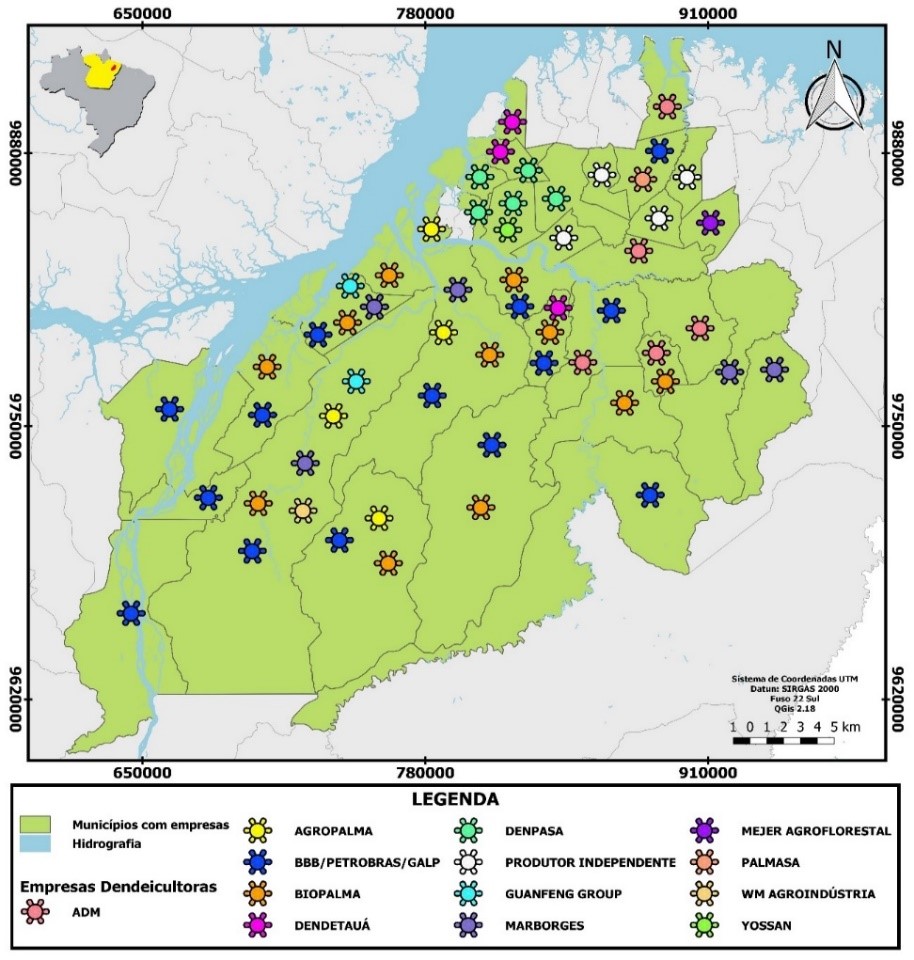
Map 1
Oil palm companies in the state of Pará - 2019.
Fieldwork by the authors
As shown in Table 1, these companies expanded the planting of oil palm in the state of Pará inrelation to the state of Bahia, as well as increasing their contribution to Brazilian production. In the stateof Pará, the area of oil palm clusters harvested rocketed from 38,912 thousand hectares in 2001 to100,852 thousand hectares in 2018. The state of Bahia, the second-largest producer, with a similar areato Pará, actually surpassed the northern state in 2001 (Pará 38,912 and Bahia 45,663) and 2002 (Pará36,612 and Bahia 41,690).
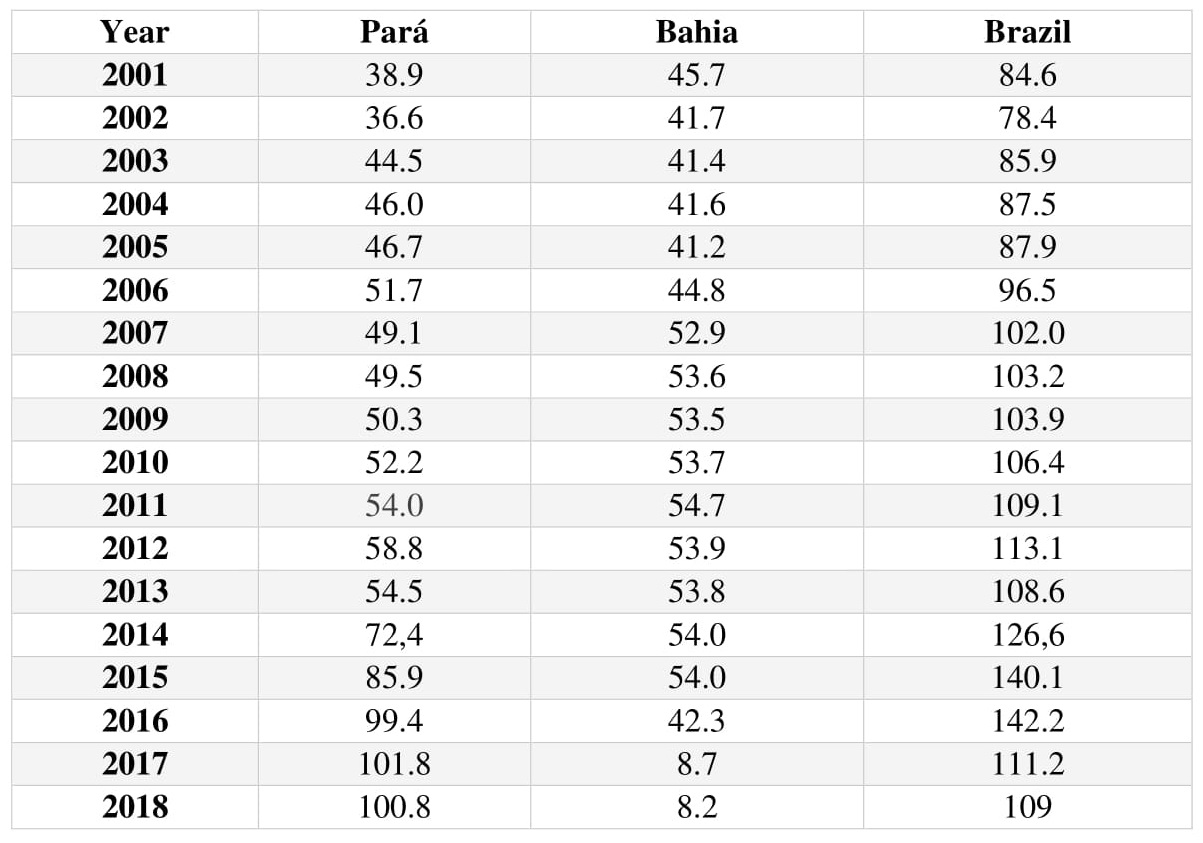
Table 1
Area of oil palm clusters harvested from Brazil, Pará and Bahia (in thousands of hectares)-2001-2018
Source: https://www.embrapa.br/agropensa/producao-agricola-municipal . Access29.01.2020. Organizers: João Santos Nahum; Leonardo de Sousa Santos; Cleison Bastos dos Santos.
Oil palm cultivation in the northeastern state was also above Pará’s from 2008 to 2011. In 2012,Pará surpassed Bahia and in the period between 2013/2014 rose significantly, leaping from 54,475thousand hectares (2013) to 72,375 thousand hectares in 2014. Since then, as graph 1 illustrates,compared to the state of Pará, production in the northeastern state declined, falling to 8,167 hectares in2018, whereas Pará had 100,825. It is noteworthy that in 2018 the total harvested area of oil palm inBrazil was 109,044 thousand hectares.
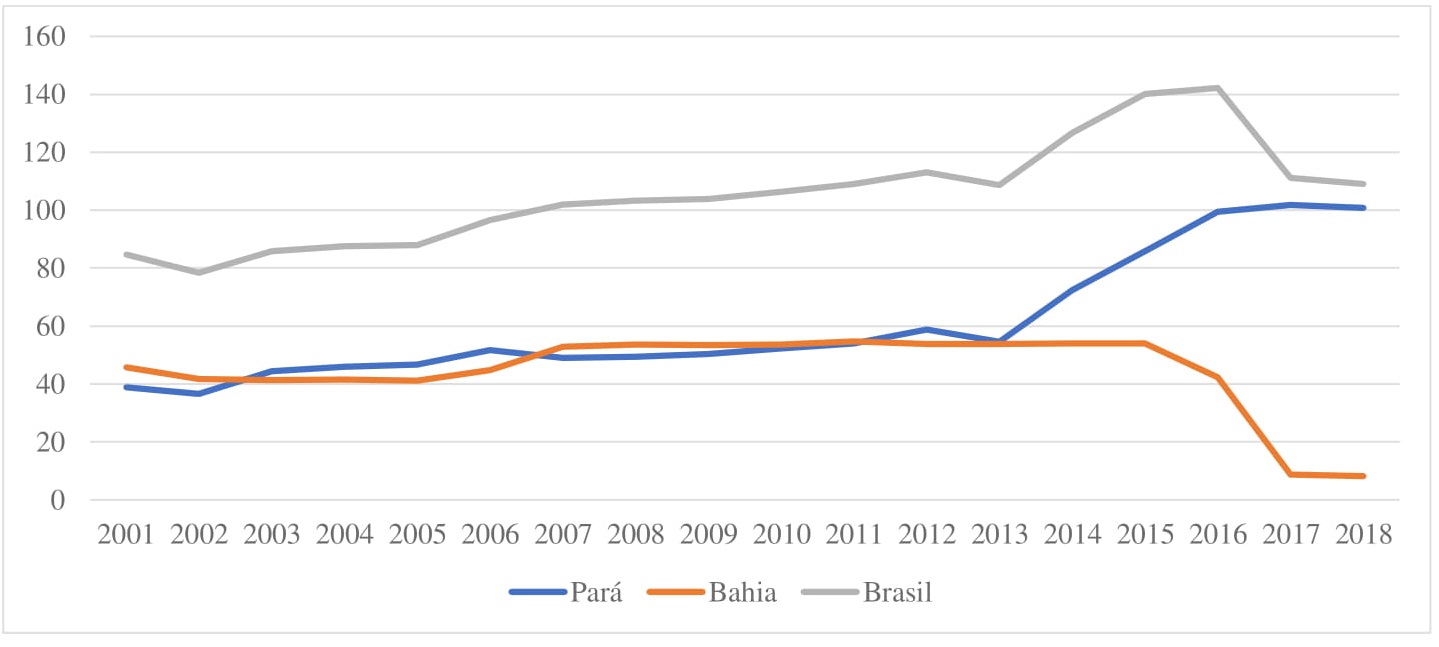
Figure 1
The area of oil palm plantation in Brazil, Pará and Bahia from 2001 to 2016
Source:https://www.embrapa.br/agropensa/producao-agricola-municipal. Access: 01/29/2020. Organizers: JoãoSantos Nahum; Leonardo de Sousa Santos; Cleison Bastos dos Santos.
The graph shows that the expansion of oil palm in Brazil is due to increased cultivation in thestates of Pará and Bahia, the first and second-largest areas in the country, respectively. It is significantthat from 2013 to 2018 the Brazilian expansion of oil palm planting was due to the increase of thispermanent crop in the state of Pará resulting from new ventures, a result of the policy of the Ministry ofAgrarian Development (MDA) with the establishment of the PNPB and PSOP. Before the twenty-firstcentury, although oil palm cultivation was associated with state action, we cannot consider it as astructuring event in the territorial dynamics of the places where it was located. It was not promoteddirectly by any ministry, instead, it was fostered in the Amazon by SPVEA and SUDAM, and the mainfinancing agents were BASA, Banco do Estado do Pará and Banco do Brasil. However, it was still atimid state policy, a situation that changed after the implementation of the National Biodiesel Productionand Use Program ( PNPB), created in 2004.
POLICIES FOR OIL PALM CULTIVATION
From the early pilot projects to January 2020, the time of writing, oil palm cultivation in theAmazon has been associated with state action, configuring itself as a State policy. During the first tenyears (1940-1950) the crop entered the region in the context of the import substitution policies declaredin a series of federal plans. In the following decade, specifically between 1963 and 1967, the federalgovernment projected the concept of empty space, promoted the ideology of the agricultural frontier andencouraged the appropriation of land through large projects.
Nevertheless, in the areas where the large projects were established three and a half centuries ago,the land is part of the way of life of countless peoples and populations and is the main means ofproduction. Raising animals, cultivation, extraction, and production follow the pace of cycles of themineral, vegetable, and animal kingdoms. For three and a half centuries, the scarcity of information,communication, transport and energy systems in the region have fostered demographic dispersion,vitalizing the representation of the demographic void in the imaginary as if space and area weresynonymous. The representation of the demographic void is associated with that of nature as a source ofresources from the soil, subsoil, rivers, fauna and flora that should be used to generate employment,income, and social inclusion. The notion of the Amazonian frontier was divulged as a set of possibilitiesfor the reproduction of capital. This was made possible under the authoritative command of the powerbloc that took over the hegemony of the state structure after the 1964 civil-military coup.
In 1966, Operation Amazon reinvented the Amazon in the twentieth century, based on the State /Market / Capital tripod that promoted the depiction of nature in the Amazon as a source of resources, ademographically empty space with migrants playing the role of the workforce. The purpose of theTripod was the reproduction of capital and it assigned a role to the region in the international division oflabor. Large agricultural, mineral, road, and hydroelectric projects were the delineating vectors of theregion’s role as a supplier of raw materials to the world. To this end, technical systems were built in theform of road, energy, and communication networks, with large spatial prostheses such as highways,ports, airports, electrification, postal services, telephony, and telegraphs. The perspective was one of anempty, expanse of space; in short, synonymous with an opportunity crying out for investors andinvestments, attracted by the tax incentives regulated by SUDAM / BASA. These were the spatialconditions for the emergence of the technical environment and the agrarian period in the rural territorialformation of the Paraense Amazon, when the conflict between capital and peasants prevailed and landwas the object of dispute, given that capital claims, expropriates and appropriates the land where thecaboclo, riverine, quilombola or family farmers have lived for three and a half centuries, without everworrying about land titles.
Agrarian space became marked by tensions, conflicts, and deaths in the production of theAmazonian space. Indigenous people, quilombolas, peasant farmers, extractivists, and trade unionists,among others, were killed, as indicated by the series of studies Conflitos no Campo no Brasil organizedby the Pastoral Land Commission since 1985, the year in which 54 deaths were recorded in thecountryside of the state of Pará (CPT, 1985). During this period, the State was overwhelmed by capital,which, in the name of modernization and the ideology of the agricultural frontier, left a deeply unequaland bloody agrarian structure in the Amazon. It took the slaughter of El Dourado de Carajás, on April 17, 1996, broadcast worldwide by television networks for the State to establish a set of actions andpolicies for land ordering and regularization, as well as to appease conflicting interests.
It was under the aegis of the ideology of the agricultural frontier that in 1980 the State put forwardthe National Program for Vegetable Oils for Energy Purposes (Pro-Oil), the first state program for thecultivation of oil palm, which was not implemented. However, it was in the wake of state interest in thisproductive chain that the companies Cooamsi (1956), Denpal (1974), Coodempa and Coodenpa (1975),Denpasa and Coopama (1976), Denam and Reasa (1980), and Coacará and Agromendes (1981) werecreated (HOMMA, 2016).
From the management of SPVEA and then SUDAM, until the first decade of the twenty-firstcentury, government programs encouraged this activity by associating it with food production or eventhe energy matrix, such as the National Program for the Production and Use of Biodiesel (PNPB) andthe Program for Sustainable Palm Oil Production in Brazil (PSPO). The spatial basis of these programswas generated by the Agro-ecological Zoning of Oil Palm Cultivation (ZAE-Dendê), which set out thetechnical conditions for the expansion of the crop by defining the suitability of anthropized areaswithout environmental restrictions for the production and management of oil palm cultivation in theAmazon. This is because the annex to the decree indicated 23,276.73 km² of preferential land for oilpalm cultivation, distributed in 53 municipalities, and 69,999.88 km² of regular land in 66 municipalities(BRASIL, 2010).
Another state policy that encouraged the cultivation of oil palm was the credit line offered by theNational Program for Strengthening Family Agriculture (PRONAF), launched by the federalgovernment with the objective of financing the integration of farmers into the oil palm production chain.For the ADM (s/d), the credit limit per beneficiary was R$ 80,000.00 (eighty thousand reais) with an R$8,000.00 (eight thousand reais) limit per hectare and an interest rate of 2% pa (two percent per year).According to the technical project, the repayment term was up to 14 (fourteen) years, including a graceperiod of up to six years. The expansion of oil palm through the family farming project integrated smallrural producers from the communities into the agribusiness chain (HOMMA, 2016). Nahum and Santos(2015) show that integrated farmers were from 15 municipalities and there were a total of 706 contracts,with Moju and Tomé-Açu having the highest number of contracts.
The incorporation of peasant farmers in the state of Pará into family farming programs with oilpalm cultivation initially took place in the municipality of Moju, with the Arauaí pilot project (Project Ior Arauaí I), incorporating 50 families, in 2002. The project was coordinated by the Agropalmacompany and other government entities. In 2004, a further 50 families were incorporated by Project II orProject Soledade. In the same year, the federal government launched the National Program for theProduction and Use of Biodiesel in Brazil (PNPB), in which family farmers are the main suppliers ofraw material for the production of biodiesel. In this way, the PNPB fostered economic, social andenvironmentally sustainable development. This program also benefitted the oil palm companies, asparticipants in the program obtained the Social Fuel Seal that guaranteed reduced PIS / Pasep andConfins rates with reduction coefficients (BRASIL), 2004).
In 2005, again in Arauaí, fifty families from the community were selected to establish Project IIIor Arauaí II. In 2006, another 35 families took part in the Settlement Project (PA) Calmaria II (ProjectIV), associated with the Agropalma company. According to data from BASA (2014) apud Nahum andSantos (2015, p. 323), until 2006, there were 214 families integrated into the oil palm production chainin the state of Pará. In 2014, that is, eight years later, they totaled 1,590 (NAHUM; SANTOS, 2015).According to the Brazilian Association of Palm Oil Producers (ABRAPALMA), researcher KátiaGarcez, in the work Associativismo, cooperativismo, economia solidária e mercados institucionais nosmunicípios polo da cadeia da palma de óleo no Pará , found that in 2018 there were 1,800 familiesintegrated with oil palm companies in 23 municipalities in the Northeast of Pará (ABRAPALMA, 2019).
For Nahum and Santos (2015), the oil palm boom gained strength with the new public policies,programs, and projects for territorial management and ordering in the decade of 2001. BASA’s creditpolicy emerged specifically from the Northern Rural Constitutional Fund (FNO-rural), which investedan additional R$ 10,500 million in Pará, between 1991 and 2001(ENRÍQUEZ; SILVA; CABRAL,2003). Thus, based on the tripod of public or private investment, techniques and public policies, there was an expansion of oilseeds in the Amazon, especially in the Tomé-Açu Microregion, where Biopalmada Amazônia SA, Belém Bioenergia Brasil (BBB) and Archer Daniels Midland (ADM) of Brazil werepresent. The oil production figures in table 2 show the constant growth in the Brazilian sector.
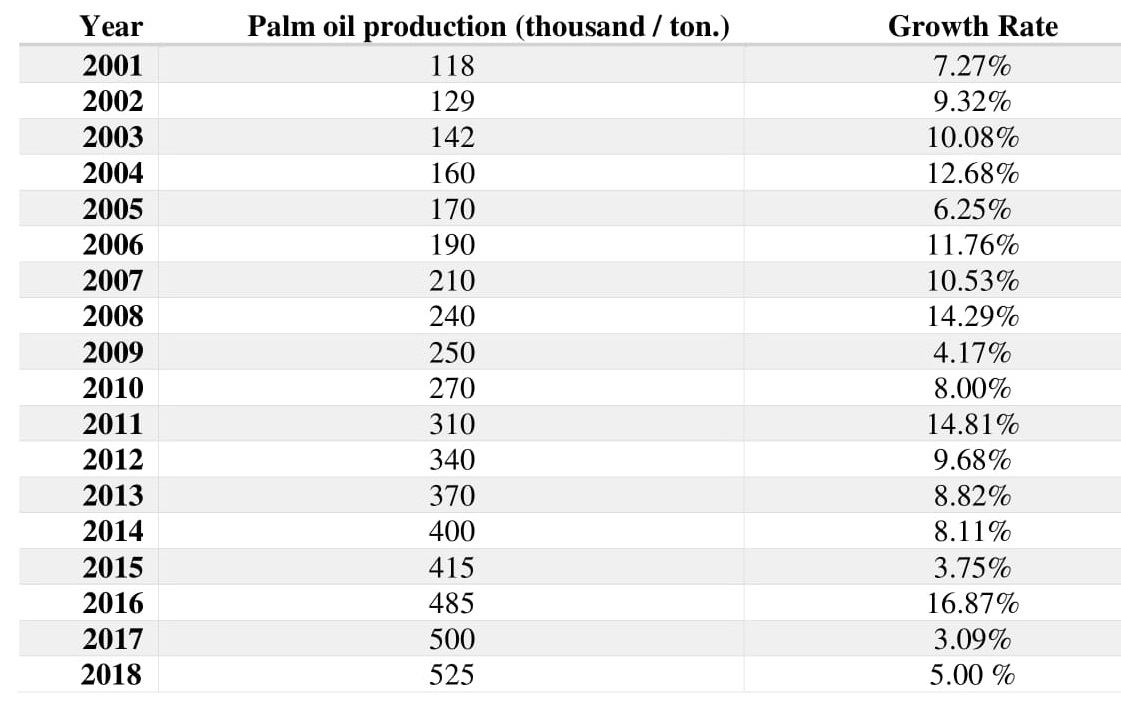
Table 2
Growth of oil palm production in Brazil - 2001-2018.
Source: https://www.indexmundi.com/ .Accessed.01/29/2020 Organizers: João Santos Nahum; Leonardo de Sousa Santos; Cleison Bastos dosSantos.
Such an expansion would not have occurred without the State’s participation and its financial,scientific, technological and infrastructure investment policies (NAHUM et al, 2015). Since the 1980s,study and research institutions such as EMBRAPA have participated in the country’s efforts to obtainrenewable sources of agro-energy (biogas and biofuel), through programs such as the National EnergyResearch Program (PNPE). Nowadays, there is a rise in partnerships between institutions, privatecompanies and social groups (FURLAN JÚNIOR, et. al., 2006).
Environmental legislation states that planting must be in deforested and/or degraded areas in orderto reduce pressure on native forests. Environmental conditions must be considered in the development ofoil palm cultivation. However, the State does not provide the necessary human, technical and financialresources required to monitor the crop’s spread in non-anthropized areas. In this spatial phenomenon’srationale, environmental impacts are externalities inherent to rural development. After all, the priority isto increase production and productivity, generate employment, income, and social inclusion through theprofessionalization of family farmers as producers of fresh oil palm fruit, even though the burden of thisis the concentration of land (BACKHOUSE, 2013; NAHUM; SANTOS, 2013; SILVA, 2016), themonopolization of the use of water resources, the silting of springs (REPORTER BRASIL, 2013;NAHUM; SANTOS, 2013), as well as the risk to the production of traditional food crops, such ascassava (SANTOS, 2016; EDFRANKLIN; NAVEGANTES-ALVES, 2017; EDFRANKLIN;NAVEGANTES-ALVES, 2018, SANTOS, NAHUM, SANTOS, 2018).
CONCLUSION
The history of oil palm cultivation in the Amazon of Pará reveals the relationship betweenpolitical actions and spatial reorganization. Being exogenous, oil palm cultivation needs two pillars: landand a workforce. All state action - from the arrival of the crop, the formation of companies, and the development of programs and policies – has aimed to create normative and spatial conditions for oilpalm enterprises to obtain these two pillars of wealth.
Oil palm cultivation acts as a vector for rural territorial development in the places where it isfound. It is single-mindedly perceived as a panacea for the structural problems that plague the ruralenvironment and unevenly affect businessmen in the sector, peasants, family farmers, and even ruraldwellers. Paving roads, expanding rural electrification, building bridges, ports, establishing telephoneservices, and transportation are among the actions that often accompany the arrival of newdevelopments. This probably explains the rapid acceptance of this activity and its general spread in theNortheast Region of Pará.
The oil palm generates employment, income, and social inclusion. The integration of familyfarmers into the companies seems to solve some structural problems affecting the rural familyproductive unit, for example, the flow of production and the security in the purchase of crops. For allthat, oil palm cultivation would not be part of state policy without first silencing opposition, especiallyfrom those that fight for the land and land reform. This is what happened in the first two decades of thetwenty-first century, dominated by what Antunes (2018) calls the privilege of servitude that promotesthe discourse of employability, income generation and inclusion in the consumer market as the raisond'être of rural life, although the price of wealth is the concentration of land ownership in a fewcompanies, environmental impacts, risk to food production, and the region’s subordination to the globalfood commodities market. However, the above are cynically interpreted by the business community as anecessary externality.
A manifestation of the relationship between politics and space, oil palm cultivation highlights thestrong presence of representatives of agribusiness in the composition of the state power bloc. In fact, theformation of the Brazilian state is umbilically associated with the rentier nature of capital accumulation.This explains why the concentrated agrarian structure is a structural component of capital productionand reproduction in Brazilian society. Without land concentration Brazilian capitalism would not existand this concentration helps us to understand the silencing of the struggle for land, as stated by Martins(2003). Furthermore, it raises the hypothesis that agrarian reform will only occur when the concentratedland structure becomes an obstacle to the processes of production and reproduction of capital. However,this is still very far on the horizon, especially when the agribusiness sector is one of the main pillars ofthe national economy’s export balance in the twenty-first century.
REFERENCES
ADM. Pronaf eco dendê. s/d. slides. Disponível em: https://www.sharp-partnership.org/RSS/ADM_PRONAF_Eco_Dende_en_Brasil.pdf. Acessado: 26/07/2019.
ANTUNES, R. O privilégio da servidão. O novo proletariado de serviços na era digital. São Paulo: Boitempo. 2018.
ASSOCIAÇÃO BRASILEIRA DE PRODUTORES DE ÓLEO DE PALMA. (ABRAPALMA), 2019. Disponível em: http://www.abrapalma.org/pt/reuniao-de-trabalhodocta/?fbclid=IwAR0s3RkI1Lo38_FEaD8quzut8c0ewUTZKq7fxseEYWSz9SdQy7wqj2LI9T0. Acesso em: 26 jul.2019.
BACKHOUSE, M. A desapropriação sustentável da Amazônia: o caso de investimentos em dendê no Pará: Fair Fuels? Working Paper 6, Berlim: 2013. Disponível em:https://www.fairfuels.de/data/user/Download/Ver%C3%B6ffentlichungen/FairFuelsWorking_Paper_6_Portuguese.pdf. Acesso em: 26 jul.2019.
BRASIL. Decreto nº. 7.172, de 7 de maio de 2010. Brasília/DF, 07/05/2010. Aprova o zoneamento agroecológico da cultura da palma de óleo e dispõe sobre o estabelecimento pelo Conselho Monetário Nacional de normas referentes às operações de financiamento ao segmento da palma de óleo, nos termos do zoneamento. Disponível em: http://www.planalto.gov.br/ccivil_03/_Ato2007-2010/2010/Decreto/D7172.htm. Acesso em: 26 jul.2019.
BRASIL. Decreto nº 5.297 de 6 de dezembro de 2004. Brasília, 6 de dezembro de 2004. Dispõe sobre os coeficientes de redução das alíquotas da Contribuição para o PIS/PASEP e da COFINS incidentes na produção e na comercialização de biodiesel, sobre os termos e as condições para a utilização das alíquotas diferenciadas, e dá outras providências. Disponível em: http://www.mda.gov.br/sitemda/secretaria/saf-biodiesel/o-selo-combust%C3%ADvel-social .Acesso em: 01 ago. 2019.
CARVALHO, A. C. A de; NAHUM, J. S. Período do dendê na Amazônia paraense. Dendeicultura e dinâmicas territoriais do espaço agrário na Amazônia Paraense. Belém: GAPTA/UFPA. 2014.
CONDURU, J.M. P. Notas sumárias sobre a cultura do dendê na Amazônia. Belém, PA: Instituto Agronômico do Norte, 1957.
COSTA, E. J. M. Arranjos produtivos locais, políticas públicas e desenvolvimento regional. Brasília: Mais Gráfica Editora.2010.
CPT. Conflitos de terra no Brasil.1985. Disponível em: https://www.cptnacional.org.br/index.php/component/jdownloads/download/41-conflitos-no-campo-brasil-publicacao/266-conflitos-no-campo-brasil-1985 . Acessado: Acesso em: 29 jan.2020.
DARDOT, P; LAVAL, C. A nova razão do mundo. Ensaios sobre a sociedade neoliberal. São Paulo: Boitempo. 2016.
DIAS, C. L; DE SOUZA, R. L. Desenvolvimento de Plantações Satélites. Projeto Dendê. Secretaria de Estado de Agricultura, SAGRI, 1973.
EDFRANKLIN, M. S; NAVEGANTES-ALVES, Lívia F. Transformações nos sistemas de produção familiares diante a implantação do cultivo de dendê na Amazônia Oriental. Revista Desenvolvimento e Meio Ambiente, vol. 40, abril de 2017. Disponível em: https://revistas.ufpr.br/made/article/view/47330/32114. Acessado: Acesso em: 29 jan.2020.
EDFRANKLIN, M. S; NAVEGANTES-ALVES, Lívia F. Organização e diversidade dos sistemas de produção de agricultores familiares integrados à agroindústria de dendê no Nordeste paraense. Revista Brasileira de Gestão e Desenvolvimento Regional. v.14, n. 1, 2018. Disponível em: https://www.rbgdr.net/revista/index.php/rbgdr/article/view/3473. Acesso em: 29 jan.2020.
ENRÍQUEZ, G; SILVA, M. A da; CABRAL, E. Biodiversidade da Amazônia: Usos e potencialidades dos mais importantes produtos naturais do Pará. Belém: NUMA/UFPA. 2003.
FURLAN JÚNIOR, J.; KALTNER, F. J.; AZEVEDO, G. F.; CAMPOS, I. A. Biodiesel: Porque tem que ser dendê. Belém: Embrapa Amazônia Oriental, Palmasa; 2006.
FURLAN JÚNIOR, J.; MULLER, A. A. Agricultura familiar a dendeicultura na Amazônia. Belém: Embrapa Amazônia Oriental, 2004. (Recomendações Técnicas).
HOLANDA, S. B de. O extremo oeste. São Paulo: Editora Brasiliense. 1986.
HOMMA, A. K. Cronologia do Cultivo do dendezeiro na Amazônia. Embrapa Amazônia Oriental Belém, PA. 2016. Documentos. 423.
HOMMA, A. K. Histórico do desenvolvimento de híbridos interespecíficos entre caiaué e dendezeiro. Belém, PA: Embrapa Amazônia Oriental, 2016. 34 p. (Embrapa Amazônia Oriental. Documentos, 421).
HOMMA, A. K; FURLAN JÚNIOR, J. Desenvolvimento da dendeicultura na Amazônia: cronologia. In: MÜLLER, A. A.; FURLAN JÚNIOR, J. Agronegócio do dendê: uma alternativa social, econômica e ambiental para o desenvolvimento sustentável da Amazônia. Belém, PA: Embrapa Amazônia Oriental, 2001. p. 193-207. Disponível em: https://www.embrapa.br/web/mobile/publicacoes/-/publicacao/1056562/cronologia-do-cultivo-do-dendezeiro-na-amazonia . Acesso em: 26 jul.2019.
IANNI, O. Ditadura e agricultura. O desenvolvimento do capitalismo na Amazônia: 1964-1978. 2ª Ed. Rio de Janeiro: Civilização brasileira. 1986.
LENÁ, P; OLIVEIRA, A. E. (Org.). Amazônia. A fronteira agrícola 20 anos depois. 2ª Ed. Belém: CEJUP/MPEG. 1992.
MARTINS, J de. S. O sujeito oculto. Ordem e transgressão na reforma agrária. UF
MECOR. Operação Amazônia (relatório ministerial apresentado à consideração do Senhor Presidente da República pelo Ministro Extraordinário para Coordenação dos Organismos Regionais). S/l. [196?]
MÜLLER, A. A. A cultura do dendê. Belém: Embrapa. 1980.
MÜLLER, A. A. MULLER, A. A. FURLAN JR. J. FILHO, P. C. A Embrapa Amazônia Oriental e o Agronegócio do dendê no Pará. Belém, PA: EMBRAPA-CPATU, 1997. 44 p. (Documentos, 257). Disponível em: https://www.infoteca.cnptia.embrapa.br/bitstream/doc/394940/1/Doc257.pdf. Acesso em: 29 jan.2020.
MÜLLER, A.A., ALVES R.M. A dendeicultura na Amazônia brasileira Embrapa Amazônia Oriental-Documentos (INFOTECA-E), 1997. Disponível em: https://www.infoteca.cnptia.embrapa.br/bitstream/doc/374987/1/CPATUDoc91.pdf . Acesso em 29 jan. 2020.
NAHUM, J. S. Região, discurso e representação: a Amazônia nos planos de desenvolvimento. Bol. geogr., Maringá, v. 29, n. 2, p. 17-31, 2011. Disponível em; http://www.periodicos.uem.br/ojs/index.php/BolGeogr/article/view/11001 Acessado: Acesso em: 29 jan.2010.
NAHUM, J. S; SANTOS, C. B. Impactos socioambientais da dendeicultura em Comunidades tradicionais na Amazônia paraense. ACTA Geográfica, Boa Vista, Ed. Esp. Geografia Agrária, 2013. Disponível em: http://revista.ufrr.br/index.php/actageo/issue/view/117/showToc. Acessado em Acesso em: 29 jan.2020.
NAHUM, J. S. Dendeicultura e Dinâmicas Territoriais do Espaço Agrário Na Amazônia Paraense. Clube de Autores, 2015.
NAHUM, J. S; SANTOS, C. B. O boom do dendê na microrregião de Tomé-Açu, na Amazônia paraense. Confins. Revue franco-brésilienne de géographie/Revista franco-brasilera de geografia, n. 25, 2015. Disponível em: https://journals.openedition.org/confins/10536. Acesso em: 29 jan.2020.
OLIVEIRA NETO, A. C. Territórios subordinados: análise da política de desenvolvimento territorial a partir da produção de óleo de palma pela Agropalma em assentamentos de reforma agrária no Pará. Tese de Doutorado apresentada ao Programa de Pós-Graduação em Geografia da Universidade Estadual Paulista Júlio de Mesquita Filho, 2017. Disponível em: https://repositorio.unesp.br/handle/11449/151496.Acesso em: 29 jan.2020.
PANDOLFO, C. A Cultura do Dendê na Amazônia. Belém SUDAM, 1981, 35p.
PROGRAMA NACIONAL DE PRODUÇÃO E USO DO BIODIESEL. Disponível em: http://www.mda.gov.br/sitemda/sites/sitemda/files/user_arquivos_64/Biodiesel_Book_final_Low_Completo.pdf. Acesso em: 26 jul.2019.
REPÓRTER BRASIL. Expansão do Dendê na Amazônia Brasileira. Elementos para uma análise dos impactos sobre a agricultura familiar no nordeste do Pará. São Paulo, 2013.Disponível em: http://reporterbrasil.org.br/documentos/Dende2013.pdf. Acesso em: 29 jan.2020.
SANTOS, C. B. dos Dendeicultura e Comunidades Camponesas da Amazônia Paraense. Clube de Autores, 2016.
SANTOS, C; NAHUM, J; SANTOS, L. Impactos da dendeicultura na produção de alimentos na Amazônia paraense: os agricultores integrados da Belém Bioenergia Brasil (BBB). Revista Pegada, v.19, n.3, 2018. Disponível em: http://revista.fct.unesp.br/index.php/pegada/article/view/6012. Acesso em: 29 jan.2020.
SUAREZ, P. A. Z.; MENEGHETTI, S. M. P. 70th anniversary of biodiesel in 2007: historical evolution and current situation in Brazil. Química Nova, v. 30, n. 8, p. 2068-2071, 2007. Disponível em: http://www.scielo.br/pdf/qn/v30n8/a47v30n8.pdf. Acesso em: 29 jan. 2020.
SILVA, F. L.; HOMMA, A. K. O.; PENA, H. W. A. O cultivo do DENDEZEIRO na Amazônia: promessa de um novo ciclo econômico na região. Embrapa Amazônia Oriental-Artigo em periódico indexado (ALICE), 2011. Disponível em: https://www.alice.cnptia.embrapa.br/handle/doc/950874 . Acesso em: 29 jan.2020.
SILVA, E. P. Agroestratégia e monocultura do dendê: a transferência silenciosa das terras da Reforma Agrária para o grande capital na Amazônia paraense. Dissertação (Mestrado) – Universidade Federal do Pará, Núcleo de Meio Ambiente (NUMA), Belém, 2016. (Disponível em: http://repositorio.ufpa.br/jspui/handle/2011/7630 . Acesso em: 29 jan.2020.
VILLELA, A. A. Expansão da palma na Amazônia Oriental para fins energéticos. 2014. 360 f. 2014. Tese de Doutorado. Tese (Doutorado)–Instituto Alberto Luiz Coimbra de Pós-Graduação e Pesquisa de Engenharia, Universidade Federal do Rio de Janeiro, RJ. Disponível em http://www.ppe.ufrj.br/images/publica%C3%A7%C3%B5es/doutorado/Alberto_Arruda_Villela.pdf . Acesso em: 29 jan.2020.
WILKINSON, J.; HERRERA, S. (2008). Os agrocombustíveis no Brasil. Quais perspectivas para o campo. 2008. Disponível em: http://www.observatoriodoagronegocio.com.br/page41/files/AgroCBRPerspectivasNov08.pdf. Acesso em: 20 jan.2020.