Artículos
Strategic Planning of the Agribusiness Development in the Conditions of Import Substitution
Planificación estratégica del desarrollo del complejo agroindustrial en términos de sustitución de importaciones

 Mikhail А. ANANIEV ananev.ma@rea.ru
Strategic Planning of the Agribusiness Development in the Conditions of Import Substitution
Utopía y Praxis Latinoamericana, vol. 23, no. 82, pp. 252-260, 2018
Universidad del Zulia

This work is licensed under Creative Commons Attribution-NonCommercial-ShareAlike 3.0 International.
Received: 15 July 2018
Accepted: 04 August 2018
Abstract: For many years, the national agribusiness was not in good shape. Over the last years, the conditions of its functioning have changed drastically, which caused the tendency towards the growth of the entire agribusiness. The agricultural sector has become advanced in the import substitution policy. The paper contains the analysis of the agricultural output dynamics as part of the import substitution policy. The authors emphasize that the success of the implemented policy is connected with the consequential integration of the food security criteria into the strategy of social-economic growth of the country and its agribusiness.
Keywords: agribusiness, export, import substitution, strategic planning.
Resumen: Durante muchos años, el sector agrícola nacional no estaba en las mejores condiciones. En los últimos años, las condiciones de su operación han cambiado radicalmente, y, por lo tanto, ha habido tendencias hacia un aumento en todo el AIC. El sector agrícola ha avanzado en la política de sustitución de importaciones. El artículo analiza la dinámica de la producción agrícola en el marco de la política de sustitución de importaciones. Los autores enfatizan que el éxito de la política implementada está relacionado con la integración constante de los criterios de seguridad alimentaria en la estrategia del desarrollo socioeconómico del país y el complejo agroindustrial.
Palabras clave: complejo agroindustrial, exportación, planificación estratégica, sustitución de importaciones.
INTRODUCTION
The methods for strategic planning imply the presence of the system of the long-, middle- and short-term forecasts and the choice of the priorities in the economic development, as well as the instruments and mechanisms of their implementation. The implementation of the import substitution strategy implies the change in the priorities of the Russian agribusiness development. At the same time, one may highlight the short-term and long-term priorities. The short-term priorities in the conditions of the modern challenges and threats in the food sphere include: increase in the level of self-sufficiency, provision of the equilibrium state due to the balancing of the market capacity and the production capacities, finding the rational balance between the import and the import substitution of the agricultural products complying with the modern stage of development, compensation of the additional inflationary costs to the most vulnerable categories of the citizens, provision of the economic availability of food, and prevention of the decrease in the consumption below the threshold values.
The long-term priorities include as follows: elimination of the structural disproportions (import substituting modernization) due to the additional investments to the scientific-educational sphere, production and infrastructure, ensuring the competitiveness of the agribusiness based on its long-term competitive advantages, which will cause the increase in the contribution to the provision of the global food security based on the participation in the global value chains; the increase in the production of goods with high share of added value competing by the expenditures and prices on the basis of using the innovative strategies of development of the branches and enterprises, investment activities, and the stimulation of the internal aggregate demand (Dorofeeva et al., 2016).
The practice of implementing the import substitution strategy was also undertaken earlier after the USSR dissolution (Russian agriculture…, 2017). So, during the default 1998, the import volume to Russia decreased by 20% (down to $74 billion), in 1999 – by another 28% (down to $53 billion), the population was forced to buy more national goods instead of the foreign ones, however this strategy was not supported by the Government. During the world financial crisis 2008-2009, the import substitution was mostly aimed at the agriculture (animal breeding, production of sunflower oil, and sugar) and automobile production (the import was replaced by the assembly of the same automobiles in the territory of Russia). This period resulted in the partial decrease in the import and the increase in the localization in automobile production and agribusiness, as well as the attraction of the investment resources. Since 2014 up to now, the Government emphasizes that, the most important instrument for the food security provision is the agribusiness of the Russian Federation, the competitiveness of which affects the well-being and stability of the national economy (Anderson et al., 2013; Bokusheva et al., 2012). The products manufactured in it amount to up to 4/5 of all the fast moving consumer goods. By the way, it unites a large economic potential and multiple labor resources, which over the past 5 years have been able to ensure the increase in the agricultural output by 20.6%, grain harvest – 1.9 times, while its export – 2.06 times, the increase in the import in agribusiness – 29.1%, and vice versa the increase in the export by 23.5%.
MATERIALS AND METHODS
The paper applies the methodical approach to the development of the recommendations on the improvement of the control over the development of the national system of food security, which showed its inconsistency, which may be reduced based on the forecasting the parameters of the agricultural market struggling sectors. The objects of the research are large struggling sectors of the food market (Iqbal et al., 2017).
The materials of the research are the statistical data of the investigated struggling sectors put into the open sources and on the official websites, as well as the materials of these sectors presented to the authors by the official requests performed as part of the implementation of the state task. In the conducted research, the authors used such methods as analysis and comparison, the method of induction and deduction, the method of graphical analysis and generalization.
RESULTS AND DISCUSSION
Today, due to the economic sanctions of the USA and the European Union, Russia has imposed the embargo, closed almost the entire market of foodstuffs imported from the other countries. These are the following foodstuffs, according to the Decree of the Government No. 778 dated 08/07/2014 (): fresh, cooled and frozen cattle meat, pork and poultry, cattle meat and poultry offal, fish and crustaceans, mollusks and other water invertebrates, milk and dairy products, vegetables, edible roots and tuber crops; fruits and nuts; sausages and similar products of meat, offal and blood, as well as the products based on them; food items and finished products and their mixes, food supplements; food items, prepared using the cheese producing technology and containing 1.5% weight fraction (and more) of the milk fat. Today, one may be sure to state that despite the economic crisis, the branches of our food industry and the agriculture rapidly grow and develop.
After the import substitution policy had been adopted, the RF Government created Decree No. 1936-р dated 09/30/2014 ‘Schedule of the Support for the Import Substitution in the Industry’, describing the main activities to launch this policy in the form of the branch-related programmes up to 2018. As part of these programmes, they planned to generally implement about 2.5 thousand projects. These schedules had been developed and approved by the orders of the Ministry of Industry and Trade of the Russian Federation by mid-2015 (Farhadi and Moosavi, 2016; Trujillo-Barrera et al., 2016).
The main activities on the launch of the import substitution policy were defined by the Decree of the Government of the Russian Federation dated October 2, 2014 No. 1948-р ‘Concerning the Approval of the Activities Plan regarding the Support for the Import Substitution in the Agriculture for the period of 2014 – 2015’ (it is a roadmap) and Decree No. 214 dated March 1, 2018 ‘Concerning the Amending the State-run Programme of the Agricultural Development and Regulation of the Markets of the Agriculture Products, Primary Products and Food for the Period of 2013 – 2020’ (Edenbrandt et al., 2018). In accordance with the roadmap, the other documents supporting the import substitution policy were amended. The second document has the following goals: provision of food security; development of the lands for the agricultural needs; development of the agricultural enterprises, increase in the competitiveness of their produce; increase in the efficiency of use of the agricultural resources.
Next, the Import Substitution Commission was formed (Decree of the Government of the Russian Federation No. 785 dated August 4, 2015 ‘Concerning the Establishment of the Governmental Commission on the Import Substitution’), which dealt with the issues of the civil branches of economy and defense industry complex. The Commission defined the strategical list of the branches, which to a greater extent depend on the import. The first positions are taken by the products of such branches as agriculture, machinery producing industry and IT, where the import share reaches 90% in the production of specific goods. They are in the focus of the Government according to the Programme up to 2010 providing the green light to the national business.
Earlier it was said about the Decree of the President of the Russian Federation No. 120 dated January 30, 2010 ‘Concerning the Approval of the Food Security Doctrine of the Russian Federation'. The main strategic goal of the Doctrine is the provision of the population with the safe and high-quality agricultural products, fish, and food in general. The relevant level of the food self-sufficiency in Russia is presented below (Table 1).
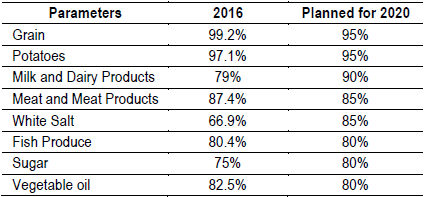
Source: Composed by the authors by using the information from Federal State Statistics Service
We may conclude that in the subsequent 2018-2020, the focus should be laid on the production of milk and dairies, meat and meat product, especially production of the cattle meat because generally this level is set due to the increment in the production of poultry. Also one needs to pay attention to the production of white salt, sugar cane, and sugar, as well as fish products (Pishukhin, 2017).
In the Global Food Security Index, Russia took the 43rd position (63.8 points) (The Global Food Security Index, 2015) in 2016. While the USA takes the leading position and has 89 points, Singapore – 88.2, Germany – 83.9, and Brazil – 67.4. The index measures the policy of the states and the performance of their institutions in the sphere of food security. The research contains the analysis of three main groups of the food security parameters for the world countries:
- 1. Level of availability and consumption of the food products.
- 2. Presence and sufficiency of the food products.
- 3. Level of quality and security of the food products.
The data presented in Annex 3 provide an opportunity of analyzing the dynamics of production of the main kinds of the agricultural products affected by the import substitution. We can state that one may observe the decrease in the outputs almost in all kinds of products in the agricultural primary products processing, so, e.g. the production of sausages in 2017 decreased by 6.2% compared to 2016, while the production of cheese – by 23.7% (Altukhov et al., 2015; Potapov, 2015; Borodin, 2015). These are intimidating tendencies, which evidence the fundamental inconsistency of the implemented economic policy regarding the encouragement of the advanced processing of the primary products. We have concluded this because in the direct production of the agricultural primary products, there is a positive tendency – the production of pork has grown by 8.3%, cattle meat – by 3.2%, poultry – by 6.7%, while in the production of fruits, berries and nuts one may observe the growth by 54.2%.
According to Decree of the RF Government No. 717 dated July 14, 2012 ‘Concerning the State-run Programme of the Agricultural Development and Regulation of the Markets of the Agricultural Produce, Primary Products and Food for the period of 2013-2020’, the federal budget allocated in total ₽1696481362.3 thousand, including: in 2013 – ₽158.9 billion, 2014 – ₽162 billion, 2015 – ₽175.4 billion, 2016 – ₽237.0 billion, 2017 – ₽215.9 billion, and in 2018 – ₽241.9 billion.
The allocation of the budgetary funds will allow ensuring the increase in the production by the following categories by 2020:
-
cattle meat and poultry – about 10 million tonnes, which will decrease the supplies of the imported products by 67.8%;
-
milk – up to 33.5 million tonnes, which will decrease the supplies of the imported products by 29.9%;
-
vegetables – up to 16.5 million tonnes, which will decrease the supplies of the imported products by 70.3%;
-
fruit and berry products (except for grapes) – up to 3.8 million tonnes, which will decrease the supplies of the imported products by 20.0%;
-
grapes – up to 0.7 million tonnes, which will decrease the supplies of the imported products by 54.6 %.
-
The programme contains a series of sub-programmes with the following purposes:
-
At this funding by the forecasted values, the output of the crop production by 2020 should increase by 14.3% compared to the level of 2015, animal breeding – by 10.2%. These values should be achieved for the period of 2018-2020.
-
Also, the funds are targeted to the technical modernization of the agribusiness and the rate of the renewal of the trucks in the farms in 2020 will amount to 2.9%, harvester-threshers – 4.7%, and forage harvesters – 4.3%.
-
The increase in the volume of export in agribusiness up to $21.4 billion in 2020.
Figure 1 presents the dynamics of the agricultural products manufacturing from the beginning of the implementation of the import substitution policy in agriculture.
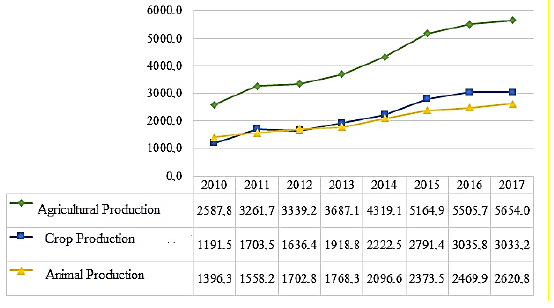
Figure 1
Dynamics of the agricultural products manufacturing (₽ billion).
Source: Composed by the authors by using the information of Federal State Statistics Service
So, we can see that in 2017, all the categories of farms manufacture by 9.5% of the agricultural production more than in 2015: crop production – by 8.7%, while animal production – by 10.5%.
In value terms, it cut the record 2014, having exceeded $7.5 billion, despite the low level of the global grain prices (Russian Agriculture…, 2017).
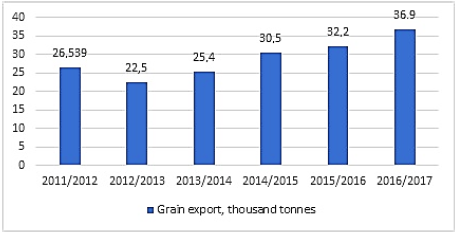
The main share in the grain export, the same as at its bulk yield, belongs to wheat. This year, the wheat export volumes cut the record the same as the previous year. 27 million tonnes were sent abroad, which should ensure the Russian leadership in the global wheat export. Unfortunately, the previous year, the top position was taken by the USA. The corn export slightly dropped to 5.18 million tonnes. However, our country for the first time entered the top five countries by this parameter, having outpaced France with its poor crop yields for the second consecutive year (Figure 2). The growth is observed in the barley export (4.63 million tonnes). It was surpassed only in 2015. Russia takes the fourth position (Figure 3).
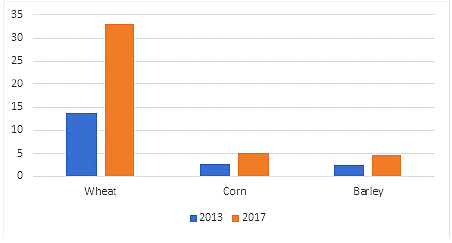
Figure 3
Grain Export from the RF 2013/2017, million tonnes
Source: Russian Statistical Yearbook, 2017
We would like to note the success of the national agribusiness in the sunflower oil export. Russia is currently taking the second position on the global market after Ukraine and has implemented the supplies in 2016-2017 amounted to 2.2 million tonnes of the oil, at the same time having expanded its market outlets. The potato export cuts the records for the second consecutive year. In 2017, the export is equal to 187 thousand tonnes, and in 2016 – 222 thousand tonnes.
Despite the positive results of the production of the agricultural goods, poultry, and milk, there is a series of problems discussed in the previous point to be focused on and provided with the considered ways of their solution (SelkhozPortal).
The Ministry of the Agriculture by using the additional subsidies (Table 2) planes to achieve the following performances by 2020:
-
cattle meat and poultry – up to 10 million tonnes (will decrease the supplies of the imported products by 67.8%);
-
milk – up to 33.5 million tonnes (decrease in the import by 30%);
-
fruit and berry products (without grapes) – up to 3.8 million tonnes (decrease in the import by 20.0%);
-
vegetables – up to 16.5 million tonnes (decrease in the import by 70.3%);
-
potatoes – up to 32 million tonnes (termination of the import supplies);
-
grapes – up to 0.7 million tonnes (decrease in the import up to 54.6%).

Today, the majority of the threshold values of the food security have been achieved, but in the subsequent 2018-2020, the focus should be laid on the production of the milk and dairy products, meat and meat products, especially cattle meat production, as generally this level is set due to the increment in the poultry production. One should also pay attention to the production of white salt, sugar cane, sugar, as well as fish products.
CONCLUSION
As part of nonfinancial actions of the agribusiness support in the framework of the implemented import substitution strategy, one should lay the emphasis on a series of measures. It is necessary to analyze the investment attractiveness of the agribusiness branches and to make them more available for the investors by means of the internet platforms and websites. It is necessary to assess the effectiveness of the investments and to understand to what extent they are interconnected with the results of the implemented policy. Also, it is reasonable to develop the concept of rational use of the farmlands and to present the peculiarities of their strategic introduction into the farming business. Also, it is reasonable to increase the technical provision of the crop seeds, to stimulate the expansion on the renewal and replacement of the seeds and animal population by more efficient and climate-resistant ones. In early 2018, it became known that the Ministry of the Agriculture of the Russian Federation is establishing the Agribusiness Innovations Development Foundation.
As part of this program, they plan to cultivate new species and breeds, as well as to develop new agricultural production means. The Foundation is planned to be established within 2-3 years, the state investments will amount to ₽30 billion, and it may be considered as one of the ways for the solution of the set problems in the selection and the growing technological import. Also, in the animal breeding branch, it is necessary to ensure the timeliness of the funds' receipt, to allocate additional funds for the development of the pedigree stock. Fourth, it is necessary to solve one of the logistic problems of agribusiness, to analyze the presence of the necessary number of the warehouses, production and storage facilities by the kind of products and the entities of the Russian Federation, and to develop the plan on the reduction of the deficiency of some or other capacities. Also, it is necessary to ensure the speed of construction of the winter greenhouse complexes, expansion of the existing and the modernization of the outdated ones for the purposes of the import substitution and the year-round provision of the population with the greenhouse vegetables, to consider the possibility of expanding the cooperation between the Russian Federation and the Asian states (China, Vietnam, and Korea).
Acknowledgements
The given study was performed within the framework of the research pertaining to the core part of the Government Order. Project No. 1.9544.2017/БЧ of the Ministry of Education and Science of the Russian Federation.
BIBLIOGRAPHY REFERENCES
Altukhov, A.I., Drokin, V.V., Zhuravlev, A.S. (2015). Food security and import substitution are the main strategic tasks of modern agrarian policy, The Economy of the Region. 3: pp. 256-266.
Anderson, K., Jha, S., Nelgen, S. (2013). Reexamining policies for food security in Asia, Food Security. 2(5): pp. 195-215.
Bokusheva, R., Hockmann, H., Kumbhakar, S.C. (2012). Dynamics of productivity and technical efficiency in Russian agriculture, European Agricultural Economics Review. 39(4): pp. 611-637.
Borodin, G. (2015). Forecasts for the development of commodity markets in the face of changing measures of protection and investment (on the example of meat markets), Prediction Problems. 3: pp. 54-64.
Dorofeeva, L.I., Ermolova, O.V., Kirsanov, V.V. (2016). Features of the current stage of the strategy of import substitution in the agro-industrial complex, Economy. 1: pp. 5-14.
Edenbrandt, A.K., Smed, S. and Jansen, L. (2018). A hedonic analysis of nutrition labels across product types and countries, European Review of Agricultural Economics. 45(1): 101-120.
Farhadi, N., Moosavi, S. (2016). The effect of competition criteria (measures) in the industry on the level of investment of the company listed on the tehran stock exchange, Turkish Online Journal of Design Art and Communication. 6, Nov., Special Edition: pp. 2632-2644.
Federal State Statistics Service. Retrieved July 17, 2018, from www.gks.ru.
Iqbal, A., Rao, Z., Tauni, M. (2017). Modeling product market competition and reporting quality: the transitional economy of China, Managerial Finance. 43(2): pp. 154-166.
Pishukhin, A.M. (2017). Enterprise management based on the forecast in the assortment space, Economy of the Region. 13(1): pp. 216-225.
Potapov, A.P. (2015). Scenarios of the formation of the resource potential of the agrarian production of Russia, The Problems of Forecasting. 2: pp. 77-88.
Resolution of the Government of the Russian Federation of 07.08.2014 No. 778 "On measures to implement the Decree of the President of the Russian Federation of August 6, 2014 No. 560 "On the application of certain special economic measures to ensure the security of the Russian Federation". (2014). Retrieved July 17, 2018, from http://base.garant.ru/70712500/
Russian agriculture in 2017: records in defiance of. Information Internet portal RIA Novosti. 23.12.2017. (2017). Retrieved July 17, 2018, from https://ria.ru/ny2018_resume/20171223/1511566139.html
Russian Statistical Yearbook. 2017: Statistical Compilation/ Russian Federal State Statistics Service. (2017). Retrieved July 17, 2018, from http://www.gks.ru/free_doc/doc_2017/year/year17.pdf
SelkhozPortal. Retrieved July 17, 2018, from https://сельхозпортал.рф/news/analog-skolkovo-planiruyut-sozdat-dlya-selskogo-hozyajstva-rossii/.
The Global Food Security Index 2015: An annual measure of the state of global food security. (2015). Retrieved July 17, 2018, from https://foodsecurityindex.eiu.com/Home/DownloadResource?fileName=EIU%20Global%20Food%20Security%20Index%20-%202015%20Findings%20%26%20Methodology.pdf
Trujillo-Barrera, A., Garcia, Ph., Mallory, M. (2016). Price density forecasts in the U.S. hog markets: composite procedures, American Journal of Agricultural Economics. 98(5): pp. 1529-1544.