Artículos

Esta obra está bajo una Licencia Creative Commons Atribución-NoComercial-CompartirIgual 3.0 Internacional.
Recepción: 01 Octubre 2019
Aprobación: 03 Noviembre 2019
Abstract: This study is performed to improve the methodology of teaching history in a vocational-pedagogical university. In order to enhance the quality of graduate’s training, as the level of knowing history influences the formation of professional competence in students with specialties related to social activities such as pedagogy, management, economics, and several other lines. The article is aimed at examining critical issues of methodism and methodology of teaching history.
Keywords: Methodism, Methodological, Specialty, Vocational-Pedagogical.
Resumen: Este estudio se realiza para mejorar la metodología de enseñanza de la historia en la universidad vocacional-pedagógica. Con el fin de mejorar la calidad de la formación de los graduados, se influye en el nivel de conocimiento de la historia y en la formación de la competencia profesional en los estudiantes con especialidades relacionadas con actividades sociales como la pedagogía, la gestión, la economía y varias otras líneas. El artículo está dirigido a examinar cuestiones críticas metodicas y metodologica de la enseñanza de la historia.
Palabras clave: Especialidad, Metodismo, Metodología, Vocacional-Pedagógica.
INTRODUCTION
A modern vocational-pedagogical university sets a goal to train a qualified specialist of a certain level (bachelor, expert, master) who is a competent, free master of his profession and can orient in adjacent occupational fields, is ready to work on the level of modern international standards and constantly improve his knowledge, skills and abilities. For the efficient professional activity, knowledge from most versatile fields and abilities to find optimal non-trivial solutions of current tasks and emerging problems on basis thereof are required (Fedorov & Tretyakova: 2017; Usoltsev: 2018), which is necessary to graduates from their professional realization (Zinnatova et al.: 2016; Rybakina: 2018).
As the teacher’s experience of the authors of this article shows, at present, a considerable part of students (both school and university students) possess a rather low level of knowing the world history and history of Russia. It is far from unusual when a man with a higher education diploma has very shallow ideas about significant events and processes of the Russian and world history and even manifests complete ignorance in respect of widely known historical facts. This circumstance leads to degradation of a specialist’s general level of erudition, exercises a negative impact on the culture of his general and professional thinking and makes the quality of his training lower; it hinders his mastering of necessary professional competences and, moreover, can become a reason for spreading, at the mundane level, of all possible pseudo-scientific myths and wrong beliefs. This issue was widely reflected in literature.
There are studies of certain aspects of history teaching and their influence on students’ worldview. So, the research (Özmen: 2015) states about drawing on historical experience aimed at decision-making in the future and training students. Problems of historical facts interpreting and assessing were worked out in the research (Wansink et al.: 2016). Issue of assessing the significance of world history events by teachers of history, the ambiguity of teachers’ opinions are presented on the work (Harris & Girard: 2014). Interesting research about teachers’ ideas of the nature of their subject and as they influence the practice of teaching (McCrum: 2013) should be noted. Problems of students` perception of social sciences teaching are reflected in the work of researchers (Akhan & Altıkulaç: 2014). The research addressed the issue of students` awareness of inner and interdisciplinary variants in academic discourse, particularly in human Science, analyses the differences between history and anthropology. There are interesting studies about the role of teaching professional development history in professional training (Madsen: 2008); the researcher notes that nursing history studying, especially at the beginning of the Baccalaureate program, creates fundamental skills of critical thinking during nurses training. Other authors also address nursing history studying during the training of nurses (Kelly & Watson: 2015).
The author refers to the issue of teaching professional development history (Hocaoglu: 2015), emphasizing the importance of Comparative Design History Course for professional training and offering methods of its teaching upgrading. An exciting aspect of history teaching (The Role of Old Turkic Place Names in Teaching History) is noted in this paper (Nakhanova: 2014). Besides, in the article, methods of pedagogical projecting in history teaching are studied (Harris et al.: 2017). This article reflects the methods of history studying by students (Miller et al.: 2014). Exciting approaches to history teaching for students using online technologies are presented (Buchanan & Palmer: 2017). Problems of integrative history teaching for students and its influence on national education development are worked out in the research. The researcher raises the problem of historical sources applied in history teaching for students. Indeed, the original work "Teaching and learning difficult histories in international contexts: A critical sociocultural approach” (Epstein & Peck: 2017), which contains the conceptual analysis of complicated and problem issues of history teaching for students, should be noted.
In a modern vocational-pedagogical university, students are taught in most various training lines. So, on one hand, when teaching history in the higher vocational education system, it is necessary to adhere to the united universal concept in accordance with FSES (Davydova: 2014; Shchuplenkov: 2015) suitable for students of all training lines (naturally, we don’t speak here about specialties “History explorer”, “Historyteacher” and some others where studying of history is the main element of the curriculum), and students shall assimilate a standard set of knowledge, skills, and abilities. On the other hand, the elective part of the history course is also applied for every branch of training complementing such discipline as “Job- introduction”.
At present, it is Chair of document science, history, and legal assistance, which conducts the history course in Russian State Vocational-Pedagogical University.
In this work, we analyze crucial problematic issues of the history course which have to be examined while working with students; the specificity of approach to studying thereof when working with students of various training lines is reviewed.
1.METHODS
The following principles and methods are laid into the basis of this study:
The primary method is a pedagogical analysis of study material assimilation by students of different groups; the history teaching was carried out in the traditional way in several groups, and methods offered by authors were used in control groups. Performance levels of students from different groups are compared (knowledge of facts, events, causality).
The opinion of students was studied through the questionnaire; students from control groups (approximately 50 people) took part in it; asking questions aimed at determining how much this history course interesting is and what new aspects comparing with school curriculum students got through it. Students of RSVPU took part in the research.
Research stages:
The research was conducted in 3 stages:
1. As the authors` experience demonstrated, in conditions of limited academic time for history studying in university, the course is overburdened with facts and details to the detriment of the analysis of critical processes and phenomena. It leads to such a situation that the process of history studying by students of non-historical specialties comes down to learning facts to the detriment of the analysis of key processes and phenomenon, underachievement is a consequence. Revealing key problem aspects of the history course understanding of which is essential for the assimilation of the whole course and perfecting of general and professional competences of future graduates;
2. As a result of history exams and tests demonstrated, in the case of traditional history teaching, students find no necessity to study history and take a little interest in the subject. That is why the development of methods to explain these issues to students with taking into account their specialization is necessary for developing their professional culture and competencies which could be significant in their future work;
3. Development of methodical and methodological recommendations on teaching history to students ofvocational-pedagogical universities. Recommendations will be revealed based on the questionnaire of students from control groups, in which the research was conducted.
2.RESULTS
History teaching in most of the Russian universities encountered several problems.
Firstly, the authors` assumption that students mostly learn the significant part of stereotypes about some historical events from mass-media was confirmed. Basing on the analysis of mass media, the authors revealed that it contains a mostly negative assessment of events of domestic history, first of all of the Soviet period. Students learn it all pretty non-critically. Thus, according to the results of surveys, 50% of studentsfrom groups under research are strictly convinced that Soviet society is characterized. First of all, by mass government terror of citizens, extensive violations of human rights, fear of repressions, violent prohibitions of the smallest expression of an individual. This picture shows the reality from the very one side, causing exclusion of people from their history and culture and serious separation from patriotic values, which history teaching and educational work with students are based on (Moskalenko et al.: 2018). Strictly negative assessment of the Soviet period from the point of radical liberalism is perceived as objective by students, and they deny facts that contradict this concept, and they do not learn to analyze it. Indeed, such a graduate does not understand the historical and cultural specificity of Russian society in the whole and peculiarities of evolution of an educational system, management, economics, etc., which will become a severe gap in his professional training.
Secondly, the history course for students of non-historical branches of training is overwhelmed by facts, often repeats the school curriculum, and shows the connection between domestic and world history poorly. That is why more than half of the students have no interest in it and learn material only as is necessary for passing an examination.
All the above mentioned hinders the formation of an integral picture of the world and Russian historical process in students.
To form an integral picture of the historical process in students, very important is considering of problem issues of the course, such as particular features of the "catching-up" Russian modernization and socio- cultural contradictions of the Russian society related to this process. Their studying allows us to comprehend today's trends of development of Russian society systematically, to understand the interconnection of history and the present time in many spheres of vital activity. To raise the efficiency of teaching, we can examine the following aspects of this interconnection at our classes, see Table 1.
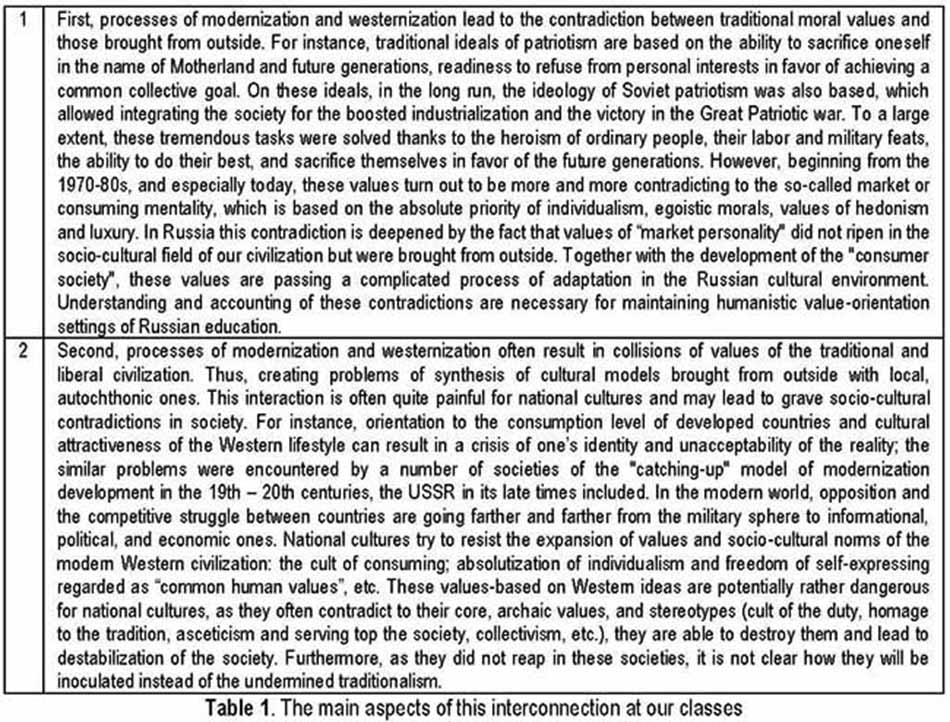
All these aspects can be quite accessibly outlined in the history course of vocational-pedagogical universities. It will make the history course more exciting and attractive and add a larger applied directedness.
Basing on the teacher’s experience of the authors of this work, in the teaching of the history course in a vocational-pedagogical university, at a limited academic time assigned for it in the curriculum, one can single out a number of crucial aspects necessary for the detailed and comprehensive studying the subject at classes.
The first set of questions is connected with the apprehension of the process of “catching-upmodernization” of Russian society. A considerable part of students and even specialists who graduated from a university possess a superficially-simplified idea about modernization, which in practice leads to assimilating false stereotypes, ignorance in trends of the country’s socio-political and economic development or incorrect understanding thereof. It is critical for students in training lines related to active public activities: pedagogy, economics, and management, jurisprudence, etc. This theme is also important in the understanding of the specificity of formation of responsibility in managers and subordinates (Mukhlynina et al.: 2016; Begichev et al.: 2019), as studying thereof makes peculiarities of interrelations of various social groups in the modern society more clear.
In the course “History” or “History of Russia”, it is advisable to explain to students that modernization as a phenomenon appeared in West-European countries, first of all, in the UK and the USA. Most of the other countries of the world were forced, employing active interference of the state into economy and functioning of socio-political institutes, to artificially stimulate modernization processes, first of all, in order not to lag behind the West in military and technological aspects. The Russian civilization, which was initially a traditional agrarian society, encountered the necessity to conduct the industrial modernization in the 18th – 19th centuries. The rates of industrial development defined how efficiently Russia could stand for its national interests.
This circle of problems is of interest to students of pedagogical, engineering-technical, managerial, economic, and other specialties. Studying of the transformation of the public conscience and mentality under conditions of modernization and westernization, changes of mechanisms of interaction between the authorities and the society, the experience of organization of industrial production and creation of new organizational and political structures in societies passing the modernization stage shall have an important practical value. Students shall have a clear idea about processes of modernization, which emerged in the 18th – 19th centuries, about countries of the “catching-up” model of development, or “the second echelon”, and know their political and socio-cultural tradition. Of considerable interest in this context is the analysis of historic alternatives (Kryuchkov: 2016), which is vital for the formation of students' ability to analyze facts and tend to socio-political and economic development.
The second set of problem questions, which usually is quite hard for assimilating by students but at the same time is one of key issues in the understanding of peculiarities of history and today’s development of Russia, is the analysis of socio-cultural contradictions in the Russian society generated in the process of the catching-up modernization. These contradictions are connected, first of all, with the conflict between archaic ideals of traditionalism and values of the liberal capitalistic civilization, which together with the development of the industrial society were penetrating into Russia deeper and deeper, causing dissonance in the mass conscience of the most of workers’ and peasants’ population.
Studying these problematic issues is very important for an adequate understanding of a number of peculiarities of the historical development of our country and modern trends of social development.
All these factors shall be taken into account in the vocational education system (Fedulova et al.: 2017; Neupokoeva et al.: 2017). So, the necessity to improve the teaching of history is essential today.
Naturally, there are a lot of exciting and problem questions in the course of history studying of which is vital for students; unfortunately, the restricted volume of this article does not allow us to consider them.
CONCLUSION
In the course of history, under conditions of restricted academic time for studying thereof, the major attention should be paid at key problem aspects (considered in chapters Discussion and Results), adequate understanding whereof is important for assimilating the course and improving general and professional competences of future graduates. Such topical issues of the course as peculiarities of the "catching-up" Russian modernization and related to that socio-cultural contradictions of Russian society are also of great importance. Their studying allows us to comprehensively ponder over today's trends of development of Russian society to find out the interconnection of the history and contemporary times in various spheres of vital activities for enhancing students' training quality.
In process of the studying questions arose due to the fact that for each training line the variable part of a course is necessary apart from the general one: for example, for pedagogical profile students it is possible to make an accent on studying of influence of socio-historic conditions of each epoch on development of the pedagogical thought and concept of upbringing and socialization of a personality during a certain historical period; for economists it will be influence of historical conditions and geopolitical position of these or those states in different epochs on formation of the economic development concepts; for future managers it will be influence of historical factors on formation of management concepts and approaches, specificity of managerial models under conditions of "catch-up modernization", etc. Studying of the variable part of the history course for students of different training lines may supplement in an organic way such a course as “introduction into Specialty”. Development and perfecting of the variable part of the history course for various training lines are seen as quite a perspective line that will allow raising the efficiency of the training.
BIODATA
MAXIM MOSKALENKO: Lives in Yekaterinburg, Russian Federation. He has a Ph.D. of History and works as an Assistant Professor at the Department of History, Documentation and Legal at Russian State Vocational Pedagogical University. The research interests of the author are: problems of teaching history, analysis of socio-political forecasts, the use of historical science methods in forecasting, the study of issues of national development strategy of the Russian Federation on the basis of consideration of historical alternatives. A recent study of the author is “Short communications: Progress on application of nanotechnology”.
MARINA LARIONOVA: Lives in Yekaterinburg, Russian Federation. She has a Ph.D. in History. She works at the Department of History, Documentation and Legal at Russian State Vocational Pedagogical University. The research interests of the author are modern problems of organizing archives, documentation and information support of management, HHRR records management, modern technologies of the organization of work with documents. A recent study of the author is “Social circle of noble families in the province (based on the example of family of the Ural factory owners P.D. Solomirskogo)”
YEVGENIY DOROZHKIN: Lives in Yekaterinburg, Russian Federation. Yevgeniy is a Doctor of Education, Professor. He works at the Department of Vocational Education and Training Methodology at Russian state vocational pedagogical university. The research interests of the author are agricultural sciences, pedagogical sciences, the methodology of education. A recent study of the author is “Methodology Of Professional Pedagogical Education: Theory And Practice (Theoretical And Methodological Foundations Of Vocational Teacher Education)”.
ANASTASIYA NOVOSELOVA: Lives in Yekaterinburg, Russian Federation. She works at the Department of History, Documentation and Legal at Russian State Vocational Pedagogical University. The research interests of the author are philological research, critical literature analysis. A recent study of the author is “Understanding the meaning of the phrase from the work of L.N. Tolstoy “Kreutzer Sonata. Afterword”
IRINA SAFRONOVICH: Lives in Yekaterinburg, Russian Federation. Irina is a senior lecturer. She works at the Department of History, Documentation and Legal at Russian State Vocational Pedagogical University. The research interests of the author are documentation studies, organization of secretarial services, legal bases of vocational education. A recent study of the author is “The impact of the organizational model of the management system on the division and cooperation of labor”.
BIBLIOGRAPHY
AKHAN, NE, & ALTIKULAÇ, A (2014). “Social Studies Teaching Department Freshmen's Views on Social Studies Teaching”, in: Procedia-Social and Behavioral Sciences, 116, pp.2903-2908.
BEGICHEV, AV, GALUSHKIN, AA, Zvonarev, AA, & Shestak, VA (2019). “History of the creation and activities of the League of Nations”, in: Voprosy Istorii, 9, pp.108–113. (In Russian).
BUCHANAN, TC, & PALMER, E (2017). “Role immersion in a history course: Online versus face-to-face in Reacting to the Past”, Computers & Education, 108, pp.85-95.
DAVYDOVA, МYU (2014). “The experience of teaching history in universities according to new standards”, in: Messages of Volgograd State Technical University. Series: Problems of Social-Humanitarian Knowledge, 15(2(129), pp.88-91.
EPSTEIN, T, & PECK, CL (2017). Teaching and learning difficult histories in international contexts: A critical sociocultural approach. Routledge.
FEDOROV, VA, & TRETYAKOVA, NV (2017). “Vocational-pedagogical education in Russia: historical and logical periods”, in: The Education and science journal, (3), pp.93-119.
FEDULOVA, KA, FEDULOVA, MA, KIRILLOVA, YS, VAGINA, AI, & KUZNETSOV, TM (2017). “SpecialCompetence in the Structure of Vocational Pedagogical Integrity in the Sphere of Vocational Education”, in:Eurasian Journal of Analytical Chemistry, 12(7b), pp.1265–1273.
HARRIS, LM, & GIRARD, B (2014). “Instructional significance for teaching history: A preliminary framework”,The Journal of Social Studies Research, 38(4), pp.215-225.
HARRIS, LM., SHREINER, TL, & HOELTING, M (2017). “Examining an ambitious world history teacher׳ s knowledge for planning”, in: The Journal of Social Studies Research, 41(2), pp.117-130.
HOCAOGLU, D (2015). “Contribution of group work and comparative education to students’ learning: Analysis of comparative design history course”, in: Procedia-Social and Behavioral Sciences, 174, pp.1804- 1811.
KELLY, J, & WATSON, R (2015). “An integrative review of the literature on the teaching of the history of nursing in pre-registration adult nursing education in the UK”, in: Nurse education today, 35(2), pp.360-365.
KRYUCHKOV, NN (2016). “Alternatives of the historic development and teaching of history in a university”, in: Modern technologies in science and education – СТНО-2016: Collection of works of International scientific-technological and scientific-methodological conference: in 4 volumes. Ryazan: Ryazan State Radio-technological University, vol. 3, pp.40-42.
MADSEN, W (2008). “Teaching history to nurses: Will this make me a better nurse?”, in: Nurse Education Today, 28 (5), pp.524-529
MCCRUM, E (2013). “History teachers' thinking about the nature of their subject”, in: Teaching and Teacher Education, 35, pp.73-80.
MILLER, RT, MITCHELL, TD, & PESSOA, S (2014). “Valued voices: Students’ use of Engagement in argumentative history writing”, in: Linguistics and Education, 28, pp.107-120.
MOSKALENKO, MR, DOROZHKIN, EM, OZHIGANOVA, MV, RYZHKOVA, AS, & SAMOYLOVA, TI (2018).“Teaching Socio-Political Courses in the Framework of Modernization of Engineering Education”, in: Journal of Engineering and Applied Sciences, 13(3), pp.727-733.
MUKHLYNINA, OV, ZHDANOVA, NE, KONDYURINA, IM, BASTRAKOVA, NS, KOVALEVA, T, &MIRZABALAEVA, FI (2016). “Special Aspects of Managers and Employees' Responsibility Structure”, in:International Journal of Environmental and Science Education, 11(15), pp.7782-7790.
NAKHANOVA, LA (2014). “The Role of Old Turkic Place Names in Teaching History”, in: Procedia - Social and Behavioral Sciences, 141, pp.1054-1061.
NEUPOKOEVA, EE, CHAPAEV, NK, CHUBARKOVA, EV, TOLSTOVA, NS, FEDULOVA, KA & TOKAR, AV(2017). “Peculiarities of Preparation of a Vocational Teacher for Use of Application Software Taking into Account the Requirements of the Federal State Education Standard”, in: Eurasian Journal of Analytical Chemistry, 12(7b), pp.1383–1398.
ÖZMEN, S (2015). “Teaching “Principles of Ataturk and History of Revolution” Class at the Universities”, in:Procedia - Social and Behavioral Sciences, 174, pp.1630-1634.
RYBAKINA, NA (2018). “Еducational competence: the essence and pedagogical model of formation in the context of lifelong education”, in: The Education and science journal, 20(5), pp.32-55.
SHCHUPLENKOV, ОV (2015). “History teaching in a pedagogical university: Modern approaches within requirements of 3rd generation FSES”, in: The category of "social" in the modern pedagogy and psychology: materials of the 3rd Scientific-Practical Conference (extramural) with international participation. Ulyanovsk: SIMJET, vol. 2, pp.320-326.
USOLTSEV, AP (2018). “Bureaucratism As An Indicator Of Systemic Contradictions In The Education System”, in: The Education and science journal, 20(3), pp.9-32.
WANSINK, BGJ, AKKERMAN, S, & WUBBELS, T (2016). “The Certainty Paradox of student history teachers: Balancing between historical facts and interpretation”, in: Teaching and Teacher Education, 56, pp.94-105.
ZINNATOVA, MV, KONOVALOVA, ME, MAKAROVA, NV (2016). “The Professional Transspective of the Students in the Conflicting Realities of the Post-industrial Society”, International Journal of Environmental and Science Education, 11(14), pp.6925-6933.
