Artículos
Multiculturalism in Kazakhstan
Multiculturalismo en Kazajstán
 A. KADYRALIYEVA altynay_m_kadyraliyeva@rambler.ru
A. MUKHANBET asemmukhanbet0909@mail.ru
Y. SAPAROVA yusaparovaa2@mail.com
A. ZHOLDUBAEVA zholdubaeva_zholdubaeva@gmail.com
A. OMIRBEKOVA omirmir_aliya@bk.ru
R. DARIBAEVA raushan_daribaeva1898@mail.com
A. KADYRALIYEVA altynay_m_kadyraliyeva@rambler.ru
A. MUKHANBET asemmukhanbet0909@mail.ru
Y. SAPAROVA yusaparovaa2@mail.com
A. ZHOLDUBAEVA zholdubaeva_zholdubaeva@gmail.com
A. OMIRBEKOVA omirmir_aliya@bk.ru
R. DARIBAEVA raushan_daribaeva1898@mail.com
Multiculturalism in Kazakhstan
Utopía y Praxis Latinoamericana, vol. 24, núm. Esp.5, pp. 208-217, 2019
Universidad del Zulia

Esta obra está bajo una Licencia Creative Commons Atribución-NoComercial-CompartirIgual 3.0 Internacional.
Recepción: 01 Octubre 2019
Aprobación: 05 Noviembre 2019
Abstract: Unlike the European Union, several Western countries, multiculturalism is still relevant as it allows to tackle effectively the problem of a multicultural society. Also, the leaders of the CIS countries have repeatedly announced their commitment to this ideology. In this paper, based on the experience at Queen's University in Canada, the index of the policy of multiculturalism for the first time was calculated for Kazakhstan, the largest country in the Central Asian region. The policy index of multiculturalism in Kazakhstan allows measuring the level of the democratic system of state policy relating to national minorities and migration.
Keywords: CIS, European Union, Kazakhstan, Multiculturalism.
Resumen: A diferencia de la Unión Europea, varios países occidental multiculturalismo sigue siendo relevante, ya que permite ab eficazmente el problema de una sociedad multicultural. Ademá líderes de los países de la CEI han anunciado repetidamen compromiso con esta ideología. En este documento, basado experiencia de la Queen's University en Canadá, se calculó por pr vez el índice de la política de multiculturalismo para Kazajstán, e más grande de la región de Asia Central. El índice de polític multiculturalismo en Kazajstán permite medir el nivel del sis democrático de políticas estatales relacionadas con las min nacionales y la migración.
Palabras clave: CEI, Kazajstán, Multiculturalismo, Unión Europe.
INTRODUCTION
The concept of multiculturalism, which appeared in the 60 years of the 20th century as a reaction to the cultural diversity of modern society nowadays, is often subjected to severe criticism and attacks. In the early 21st century, several political leaders of the European countries claimed the failure of the policy of multiculturalism in their respective countries. Despite the claims of a failure in the implementation of this policy, today's society remains multiethnic, multicultural, and multi-confessional. Accordingly, the solution to the problems of the peaceful coexistence of different cultures on a scale of one state is still relevant to modern society. Based on the oldest Queen's University (Kingston, Canada), there has been conducted a large-scale scientific research project to analyze the evolution of the policy of multiculturalism in 21 countries. The index of multiculturalism policy has been calculated for these countries the first time at three time points- 1980, 2000, and 2010; following three minority groups have been involved: immigrants, minorities, and indigenous people (http//www.queensu.ca/mcp/index.html). The project aims to provide information in a standardized format, through a comparative analysis of the main problems of a multicultural society and contributes to the analysis of the situation and enables finding out a way out of the problems of multiethnic society. Up until now, Kazakhstan was absent in that list. Modern society is characterized by the formation of a new socio-cultural environment, which is based on wide access to a variety of sources of information. Mass distribution of the Internet has a direct impact on the socialization processes of the representatives of "Z-generation" who spend an enormous amount of time in cyberspace. Quite often losing at the same time the ability of real personal development, interest in the acquisition of skills for real interaction, and effective communication. In this regard, the problem of multiculturalism requires new solutions for new individuals included in the network life (Soldatova & Pogorelov: 2018). The new and original ideas can be derived from the fields of real sectors of productive-economic and social activity where the aspects of determination of the quality of the final product are worked out far better, and interpretations of the results of activity are unambiguous and consistent aim (Tomiltcev & Maltsev: 2018)
In this paper, using the methodology of the project of Queen's University, we calculate the index of the policy of multiculturalism in Kazakhstan concerning national minorities and migrants. For Kazakhstan, for a young democratic state, the calculation of the index is performed for the first time and can be of great practical importance. The index calculated based on this method will contribute to a deeper analysis of the policy of multiculturalism in Kazakhstan and will have a positive influence on the formation of state policy relating to national minorities and migrants. Moreover, of course, any solution found will have to overcome considerable resistance to its implementation, the crisis generated by the lack of new ideas also creates red tape. Identification of the facts of the crisis aggravation and accompanying growth of bureaucratism enables us to distinguish the strategic discrepancy between the managerial decisions and the existing trends in the educational system and society. It is stated that the only proper strategy is the freedom of education, creation of a favorable environment for it instead of imposing one's authoritative and grounded decisions (Usol'tsev: 2018)
Modern Kazakhstan, the largest republic of Central Asia, is home to representatives of 125 nations and nationalities. While taking 9thplace in the world regarding its area, its population has only recently stepped over the 17 million thresholds (Kadyraliyeva et al.: 2015). The ethnocultural image of the country distinguished with a great variety was formed for centuries. Kazakhstan has become home to people of different races, languages, religions, and cultures. According to the statistics agency, the country's population speaks 23 different languages and professes Islam, Orthodoxy, Protestantism, Catholicism, Buddhism, and Judaism. The country can be rightly called a multicultural, poly-confessional, and multicultural. According to the last census which was held in Kazakhstan in 2009, the ethnic composition of the population is as following: Kazakhs - 63.1%, Russians -23.7%, Uzbeks-2.9%, Ukrainians-2.1%, Uighurs-1.4%, Germans-1.1%, Tatars- 1.3%; while all the members of other ethnic groups constitute around 1% of the total percentage the population, i.e., the indigenous population is more than 63% of the total population (http://www.stat.gov.kz).
The national or ethnic minorities in Kazakhstan are representatives of different ethnic groups inhabiting and holding citizenship of Kazakhstan but not belonging to a titular nationality i.e., Kazakhs. There is no officially adopted law on the status of "national minorities" in Kazakhstan, as this term possesses publicist character (Saparova et al.: 2014).
METHODS
The index of the policy of multiculturalism designed by a Canadian group of researchers is multidimensional, as it analyzes policy position of national minorities based on the following six criteria:
-
Federal or quasi-federal territorial autonomy;
-
The official status of the language;
-
Guarantees of minority representation in the central government;
-
State funding of education in minority languages (universities/schools/ media);
-
Constitutional or parliamentary approval of multiculturalism;
-
International legal personality.
The index of the policy of multiculturalism against the migration of minorities in Kazakhstan will also rely on the format of the Royal University. Specifically, it is determined based on the following eight parameters:
-
Constitutional, legislative or parliamentary approval of multiculturalism;
-
Adoption of multiculturalism in the school curriculum;
-
Inclusion of ethnic representation/sensitivity in the mandate media or media licensing;
-
Exemption from dress codes, laws, etc.;
-
Permit of dual citizenship;
-
Funding of ethnic groups, support for cultural activities;
-
Funding for bilingual education or education in the native language;
-
Affirmative action for disadvantaged groups of immigrants.
The calculation is carried out on the principle of a definite answer "yes" - 1 point, a negative answer "no"- 0 points, the answer is "partially" - 0.5 points.
As acknowledged by the participants of the project, there is a specific policy of multiculturalism. In eachcountry, the implementation of this political ideology is streamlined in its unique way. Moreover, as of now, we can say that there are several models of multiculturalism out there. The most well-known amidst them is a model of the “cultural mosaic” or “salad bowl”.
RESULTS
Based on indicators of assessing the policy of multiculturalism developed at Queen's University employees, we consider an index of multiculturalism amidst national minorities in Kazakhstan.
1. Is there a territorial or quasi-territorial autonomy within the country?
No. - The Republic of Kazakhstan is a unitary state. The country is divided into 14 administrative units - oblasts. The mayor of oblast (akim) is appointed by the president of the country, serves as its representative, and is responsible for the implementation of a number of public policies.
The ethnic minorities inhabit in almost all regions of Kazakhstan. However, there is some localization. So, the majority of the representatives of Uzbek nationality reside in the south of the country, in particular in SouthKazakhstan and Zhambyl regions. The representatives of the Uighurs are concentrated in the district of Almaty region; Tatars –in Karaganda and South Kazakhstan regions; Germans –in Karaganda, Kostanai, and Akmola regions and Ukrainians- in Kostanay and Karaganda regions. Representatives of the Russians, second largest after the Kazakhs, inhabit in all regions of the country, but the most prominent settlement is observed in the four areas –in the East-Kazakhstan, Karaganda, Kostanai and North Kazakhstan regions.
2. The official status of the language
Yes. - The official language of the Republic of Kazakhstan is Kazakh; however, the Russian language has the status of interethnic communication. Official records are conducted in the Kazakh language. Meanwhile, we see parallel documentation held in Russian everywhere. The Russian language - is the language of the largest ethnic group in Kazakhstan. In Soviet times, Russian was the official language, while in the post-Soviet period, still, the comprehension of Russian among the population of the country is high. From the census of 2009, we got the following data: in the age group, 15 years and older –11 471.0 thousand people understand spoken language which makes - (94.4%), reading skills - 10 724 900 people or 88.2% and writing - 10 309.5 thousand. People, i.e., 84.8% of the population. In urban areas, the level of proficiency in Russian is higher than in rural areas (http://www.stat.gov.kz).
3. The country has the legislative framework guaranteeing the representation of national minorities in the central government
Partially: There are no formal rules out there to ensure the representation of national minorities in government and parliament of Kazakhstan. However, representatives of all ethnic groups in Kazakhstan have a right, like all citizens, to vote and to be elected to the Parliament, city and regional councils (maslikhats). One of the main characteristics of the Assembly of Peoples of Kazakhstan is the representation of the interests of ethnic groups in the highest legislative body - the Parliament of the country as a guaranteed representation. The Assembly elects nine deputies of Majilis of the Parliament. The elected Assembly deputies represent its interests, as a set of interests of all the ethnic groups of the country. The representatives of 13 ethnic groups work in Parliament, and 32 ethnic minorities in the city and regional councils.
4. Public funding of universities/schools/media in minority languages
Yes. –The Constitution of Kazakhstan guarantees free primary, secondary, and higher education. The country has 88 schools where teaching is conducted entirely in - Uzbek, Tajik, Uighur, and Ukrainian languages. The languages of 22 ethnic groups of Kazakhstan are taught as a separate subject in 108 schools. Also, there have been opened 195 specialized linguistic centers, where not only children but also adults can learn languages of 30 ethnic groups. There are 35 periodicals published in 15 languages in the country. The TV broadcast is held in 11 languages. Besides, we see 14 Russian, Uzbek, and Uighur, Korean, and German theaters, the only in the CIS.
5. Constitutional and parliamentary recognition of "multiethnic" country
Yes. - The Constitution of Kazakhstan begins with the words "We, the people of Kazakhstan, united by a common historical fate, creating a state on the indigenous Kazakh land, considering ourselves a peace-loving civil society, dedicated to the ideals of liberty, equality, and harmony ..." (http://www.constitution.kz) . The 820 ethnocultural associations are functioning in all regions of the country.
No. The government has full jurisdiction in respect of international affairs, including the signing of bilateral and multilateral treaties, participation in international organizations and representative offices abroad. Theminorities do not have separate sports teams at international events. Based on these extracted values, we design the final profile of the country, which is as following (Table 1).

By using the same methodology as in assessment criteria based on the analysis of 8 directions of state policy in respect of migrants, we determine an index of multiculturalism for immigrant minorities in Kazakhstan.
1. The constitutional, legislative and parliamentary approval of multiculturalism at the central and / or regional levels, the existence of the ministry, the Secretariat or the advisory board for the implementation of the policy of multiculturalism in consultations with ethnic communities.
Partially. The country has not confirmed the commitment to multiculturalism explicitly, but it has the relevant authorities. So, in 1995, by Decree of the President of Kazakhstan, the country established the Assembly of Peoples of Kazakhstan - as an advisory body to the President of the Republic of Kazakhstan.
The main challenges facing the Assembly today is equality of rights and freedoms of all citizens of the republic, regardless of race, nationality, language, religion, membership in a social group; to promote the most important goals set by the Assembly is working on the development and preservation of national cultures, traditions and languages of the peoples of Kazakhstan. Assembly contributes to the development and implementation of the state national policy in the field of inter-ethnic relations, ensuring socio-political stability in the Republic of Kazakhstan.
Furthermore, the Assembly assists public authorities in combating extremism and radicalism in society, the formation of political and legal culture of citizens, based on democratic norms. Over its 20-year history, the Assembly was transformed from a consultative body under the President of the Republic of Kazakhstan in the constitutional body that has a firm legal basis and socio-political status. One of the main features of the Assembly is the representation of the interests of ethnic groups in the country's highest legislative body - the parliament of the Republic of Kazakhstan as a guaranteed representation (http://akorda.kz/ru).
2. Adoption of multiculturalism in the school curriculum
Partially: the acceptance of multiculturalism in the school curriculum is ongoing in the country. The educational process is featured with the rhetoric in support of ethnic diversity.
3. The inclusion of ethnic representation in public media/mass media in national minority languages
Yes –There are media (television, radio, print) programs in national minority languages.
4. Exemption from the dress code
No - The country does not provide exemptions on religious grounds.
5. Resolution of dual citizenship
No: Dual citizenship is not allowed in the country; foreign citizens must renounce their original nationality before acquiring citizenship of Kazakhstan.
6. Public funding of national cultural centers, organizations, and national holidays.
Yes: The country is covered by public funding of national cultural centers, organizations, and national holidays.
7. Financing of bilingual education or native education of national minorities.
Yes: The country is covered by the state support of bilingual education in several regions in addition to the native language of major ethnic minority groups.
8. Affirmative action for disadvantaged groups of immigrants
No: The country does not have a policy of affirmative action for immigrant minorities.Based on these values are added to the final profile of the country, which has the following form (Table2).

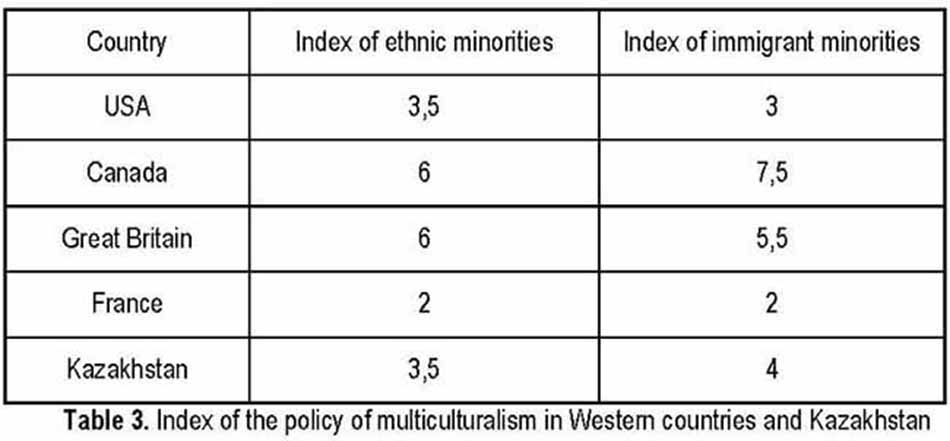
The comparison of the index policy of multiculturalism in Kazakhstan with the European countries and the countries of the classical immigration (Canada, USA, and Australia) showed that Kazakhstan's experience differs significantly from the experience of Western countries since it is in the formative stage, has a unique historical background.
The social stability in multiethnic and multicultural societies has long been at the center of scientific discourse. Multiculturalism, as a philosophical concept, has become one of the most discussed topics only since the mid -70s of the XX century. There is still no consensus in the understanding of this phenomenon within the Western European and domestic scientific community. Moreover, some Western scholars reject the term altogether. Anyhow, we can highlight several major areas within numerous discourses of understanding of multiculturalism. Some scientists regard multiculturalism as an ideology for "aging European nations". Others demonstrate its relation with the American communitarians, which is likely to result in a "Balkanization"and ethnic conflicts rather than national society for the integration and prosperity (Shain: 2016, p.298). Another part of the researchers regards multiculturalism as a "policy for migrants".
Taylor, a Canadian philosopher, has made a great contribution to the development of multiculturalism. Being a supporter of the republican tradition, Taylor put forward the idea of the predominance of the civil and political freedoms over the private or personal (Taylor: 1992). Kymlicka W., another Canadian philosopher, the author of the theory of American multiculturalism and multicultural citizenship, is one of the most well- known proponents of multiculturalism. In his writings, while discussing the inequality, he concludes the admissibility of inequalities, if it brings benefits to man, but they are not allowed if they result in negative consequences (Kymlicka: 2000).
Meanwhile, Benhabib S., the American philosopher, author of the concept of deliberative democracy, attracted public attention to the problem of "internal minorities" of a multicultural society. The gender inequalities problems get particular regard within this concept (Benhabib: 2002). The enhancement of criticisms of multiculturalism led to the widespread belief that many countries, particularly in Europe, are now focused more on the integration of civil society rather than multicultural ideas. However, some researchers have noted that the integration of civil society is simply imposed on existing multicultural programs.
Some researchers agree on that the concept of multiculturalism is closely related to "the concept ofidentity", "policy differences" and "politics of recognition" that share a commitment to overestimation of the individualism and change the dominant models of representation of the infringement of the rights of certain groups of people (Minkenberg: 2018).
Western researchers distinguish the idea of multiculturalism and anti-racism, but by and large, accept their relationship, as the spectrum of multicultural claims is not limited only with anti-racism requirements while covering more broader aspects of the individual rights and freedoms (Blum: 1992). British multiculturalism theoretician believes that “a society can be considered a multicultural only when it recognizes the diversity and it is considered as a value and is supported by various political mechanisms” (Parekh: 2006). Within the long-lasting discussion of multiculturalism, we may highlight two main directions: one generates conviction from a position of liberalism (Foster et al.: 1994), another one avows the protection of all its manifestations (Trotman: 2002).
In the view of Terborn Geran, the current multiculturalism is conscious, arising from increased migration, active processes of civil self-assertion, and self-consciousness (Terborn: 2001.). Later, interest in multiculturalism has emerged within the scientific community of Russia. According to the opinion of some researchers, multiculturalism as a political ideology stems from an awareness of a crisis of ideas of assimilation by the state, meaning the creation of spaces for dialogue and unity in diversity (Hlysheva: 2011). Others also see the basis for the synthesis of multiculturalism with the ideas of communitarians and liberals based on liberal justice ad communitarian pursuit of integration, mutual understanding, complex equality and solidarity (Volkova: 2006). The well-known Russian sociologist Fedyunina S.M. argues that the term "multiculturalism" as a sociological concept is used to refer to the policy of cultural pluralism as opposed to the cultural universalism and assimilation (Fedyunina: 2007).
V. A. Tishkov, Russian Academician, while describing the application of multiculturalism in political spheredistinguishes its three aspects: a) descriptive, for countries with complex ethnic and cultural composition; b) normative or ideological, where multiculturalism is presented as a group of political principles; c) political, where multiculturalism is presented as a series of policy measures (Tishkov: 2002).
There is also increasing interest in this subject within the Kazakh scientific community. The problems of interethnic relations in our country, take an important place in scientific discussions of scientists, public figures and politicians. Multicultural Kazakhstan in international relations policy adheres to tolerant dialogue between different cultures and faiths. Likewise, their European colleagues, Kazakh scientists are keen to develop different aspects of multiculturalism. For instance, Nysanbaev A. expresses the idea that the integration process has a mandatory effect on multiculturalism (Nysanbaev: 2013).
However, it should be noted the fact that the success of multiculturalism can be achieved only in case of a positive assessment of cultural diversity and policy directed to support equal participation in the public life of all groups of minorities (Berry: 2016). In our opinion, the following statement of Nathan Glazer, American sociologist, is still valid and kept its relevance to this day: We are all multiculturalists today. Furthermore, the debate is not about whether to accept it or not, but on what model of multiculturalism we choose (Glazer: 1997).
CONCLUSION
Multiculturalism, as a philosophical concept and political ideology, is a natural consequence of the struggle of national minorities for their civil and political rights. The development of the ideas of “multiculturalism” as a philosophical concept indicates a transition in the public consciousness with the Eurocentric responses to cultural diversity in the 19th century and early 20th century in the form of assimilation and segregation to the democratization of public opinion expressed in the adoption of the equivalence of the values and culture of a "foreign"; European practice of multiculturalism based on recognition of the mass migration into their countries, but each country uses its model of multiculturalism. Despite the lack of full public approval of the multinational character of their societies, migration has been and remains a vital factor in shaping society and the economy. Moreover, it is likely to be more intense in the future, given the sharp decrease in the birth rate among indigenous people and the free movement of the labor force of the expanding European Union. The widespread misconception about the preservation of mono-society was dominant in these countries for an extended period. In the last quarter of the 20th century, the long-lasting official ideology of assimilation has shown its flaws in the classic immigration countries. The mass migration of the population from all over the world has led to a multi-confessional, multicultural society, which no longer fit into the format of assimilation. Multiculturalism, as a political ideology, meets the requirements of time and in those countries, has achieved inevitable success.
Multicultural society in Kazakhstan has its unique features associated with the history of its formation. Minorities in the country do not have the status of a "minority" or "ethnic minorities". These ethnic groups have been formed by migration and the mass deportation of people in the country during the Soviet period, so do not fall under the definition of how migrants have been living here for a long time, neither within the definition of indigenous peoples. Talking about the full development of multiculturalism in Kazakhstan, or any of its specific model is still too early, however, the analysis of the State's policy in the field of interethnic relations, evidence of a shared commitment to the idea of unity in diversity, which is reflected in the official state ideology of One country - one destiny (Nazarbayev: 2010). In the context of maintaining the current dynamics of inter- ethnic relations, we see the prospect of constructing a model - provisionally called “salad bowl” regarding their characteristics.
BIODATA
ALTYNAY KADYRALIYEVA: Altynay lives in Shymkent, Kazakhstan. Altynay has a Ph.D. in Cultural Studies. She works as an associate professor of the Department of Cultural and social activities at South Kazakhstan State University named after M.O. Auezov. The research interests of the author are cultural, leisure and social activities. A recent study of the author is “Cultural Integration as a Factor of Genesis of the Kazakh Nation in the Conditions of Multicultural Society”.
AZHAR ZHOLDUBAEVA: Azhar lives in Almaty, Kazakhstan. She has a Ph.D. in philosophy. She works as an associate professor of the Department of Religious Studies and Cultural Studies at Kazakh National University named after Al-Farabi. The research interests of the author are sociodynamics and phenomenology of culture, the main problems of modern higher education. A recent study of the author is “Post-Modern Discourse of Multiculturalism”.
ASEM MUKHANBET: Asem lives in Almaty, Kazakhstan. Asem works at the department of Cultural Science and Religion of Al-Farabi Kazakh National University. The research interests of the author are philosophy of religion, religious philosophies, Christian theology.
ALIYA OMIRBEKOVA: Aliya lives in Almaty, Kazakhstan. She is a Candidate of Philosophy and works as associate professor of the Department of Cultural Science and Religion at Al-Farabi Kazakh National University. The research interests of the author are analytical philosophy, modern philosophy, continental philosophy, cultural anthropology. A recent study of the author is “National identity in the context of globalization”.
YULDUZ SAPAROVA: Yulduz lives in Shymkent, Kazakhstan. Yulduz is a Candidate of Pedagogical Sciences. She works as head of the department, associate professor of Cultural and social activities. The research interests of the author are the Theory, methodology, and organization of cultural and educational activities. A recent study of the author is “Formation and development of amateur performances in Kazakhstan”.
RAUSHAN DARIBAEVA: Raushan lives in Shymkent, Kazakhstan. She is a Candidate of a Candidate of Pedagogical Sciences and works as an associate professor of the Department of Cultural and social activities at South Kazakhstan State University named after M.O. Auezov. The research interests of the author are modern educational technologies and methods. A recent study of the author is “Problems of improving innovative education and technology for its implementation”.
BIBLIOGRAPHY
BENHABIB, S (2002). The Claims of Culture: Equality and Diversity in the Global Era. Princeton University Press.
BERRY, J (2016). “Comparative analysis of the Canadian policy of multiculturalism and policy of multiculturalism of other countries”, in: Psychology in Russia: current state, 9 (1), pp.4-23.
BLUM, LA (1992). Antiracism, Multiculturalism, and Interracial Community: Three Educational Values for a Multicultural Society. Boston University of Massachusetts.
FEDYUNINA, SM (2007). Conceptual bases and conditions of multiculturalism in modern Russian society. Ph.D. Thesis, Unpublished. Saratov: Saratov State University
FOSTER, LE AND HERZOG, PS (1994). Defending Diversity: Contemporary Philosophical Perspectives OnPluralism and Multiculturalism. Boston. University of Massachusetts Press.
GLAZER, N (1997). We are all Multiculturalists Now. United States. Harvard University Press.
HLYSHEVA, EV (2011). Dynamics of cultural patterns in globalized world. Ph.D. Thesis, Unpublished. Astrakhan: University of Astrakhan
KADYRALIYEVA, AM, ZHOLDUBAEVA, AK, MUKHANBET, A, & ISENGALIEVA, AG (2015). “Origins ofmulticulturalism in Kazakhstan (the example of south Kazakhstan region)”, in: European Journal of Science and Theology, 11(4), pp.213-224.
KYMLICKA, W (2000). Multicultural Citizenship: A Liberal Theory of Minority Rights. Oxford University Press.
MINKENBERG, M (2018). “Between Christian and multicultural democracy: religious legacies and minority politics”, in: West European Politics, 41(1), pp.53-79.
NAZARBAYEV, N (2010). President of the Republic of Kazakhstan at the XVI session of the Assembly of People of Kazakhstan. Astana
NYSANBAEV, A (2013). “Multiculturalism in post-Soviet Kazakhstan: results, problems and prospects”, in:Adam alemu, 56, p.11.
PAREKH, V. (2006). Rethinking Multiculturalism: Cultural Diversity and Political Theory. New York: Palgrave Macmillan.
SAPAROVA, JA, GABITOV, TH, KADYRALIYEVA, AM, BEGALYIEV, N, & TLEUBAYEV, SS (2014). “Mentaland psychological roots of Kazakhstan multiculturalism”. Life Science Journal, 11(6), pp.556-559.
SHAIN, Y. (2016). 12 “Multicultural Foreign Policy”. New Tribalisms: The Resurgence of Race and Ethnicity, p.298.
SOLDATOVA, EL, & POGORELOV, DN (2018). “The phenomenon of virtual identity: The contemporary condition of the problem”, in: Obrazovanie i Nauka, 20(5), pp.105-124.
TAYLOR, CH (1992). The Politics of Recognition. Amy Gutmann (ed.) Multiculturalism and «The Politics of Recognition». Princeton: Princeton University Press
TERBORN, G (2001).” The multicultural society”, in: Sociological Review,26, pp.42-43.
TISHKOV, BA (2002). “Theory and practice of multiculturalism”. Multiculturalism and transformation of post- Soviet societies. Moscow: IDEA.
TOMILTCEV AV, & MALTSEV AV (2018). “The Problems Of Professional Training Assessment: Methodological Approaches”, in: The Education and science journal, 20(4), pp.9-33. (In Russian)
TROTMAN, CJ (2002). Multiculturalism: roots and realities. Indiana University Press.
USOL'TSEV AP (2018). “Bureaucratism As an Indicator of Systemic Contradictions in The Education System”, in: The Education and science journal, 20(3), pp.9-32.
VOLKOVA, TP (2006). The theory of multiculturalism as the synthesis of the philosophical concepts of liberalism and communitarian ideas. Ph.D. Thesis, Unpublished. Murmansk: Murmansk State University.