Artículos
Concept of language politeness and building character education
Concepto de cortesía del lenguaje y construccion la educación del carácter
 K. UMBAR kisno.u@gmail.com
Concept of language politeness and building character education
Utopía y Praxis Latinoamericana, vol. 24, núm. Esp.5, pp. 379-390, 2019
Universidad del Zulia

Esta obra está bajo una Licencia Creative Commons Atribución-NoComercial-CompartirIgual 3.0 Internacional.
Recepción: 01 Octubre 2019
Aprobación: 07 Noviembre 2019
Abstract: This research is based on the increasingly numerous problems of character degradation in education, particularly the loss of language politeness, whether in verbal or written. This research is a qualitative study. In order to finish this research, the researcher used content analysis toward the verse stated in Al-Qur’an as the primary data source. The result of the research was that there are six language politeness principles in Al- Qur’an, namely qawlan sadida, qawlan ma’rufa, quwlan baligha, qawlan maysura, qawlan layyinan, and qawlan karima. There are 26 translatable maxims in those six principles.
Keywords: Al-Quran, Character, Language Politeness, Qualitative Study.
Resumen: Esta investigación se basa en los problemas cada vez más numerosos de la degradación del carácter en la educación, particularmente la pérdida de cortesía del lenguaje, ya sea verbal o escrito. Esta investigación es un estudio cualitativo. Para finalizar esta investigación, el investigador utilizó el análisis de contenido hacia el verso declarado en Al-Qur’an como la fuente principal de datos. El resultado de la investigación fue que hay seis principios de cortesía lingüística en Al-Qur’an, a saber, qawlan sadida, qawlan ma’rufa, quwlan baligha, qawlan maysura, qawlan layyinan y qawlan karima. Hay 26 máximas traducibles en esos seis principios.
Palabras clave: Al-Corán, carácter, estudio cualitativo, cortesía del lenguaje.
1.INTRODUCTION
According to Socrates, education is a development process of the human toward local wisdom, knowledge, and conduct (Elmubarok: 2009). It is in line with the definition of education in the Law of Indonesian Republic No.20 of 2003 concerning National Education System:
Education means conscious and well-planned effort in creating a learning environment and learning process so that learners are able to actively develop their full potential for acquiring spiritual and religious strength, self-control, personality, intelligence, moral and noble character, and skills required by him/herself, the community, the nation, and the State.
This definition is in line with the delegation of PBUH Muhammad as the last prophet to perfect themoral in the Book of Musnad Imam Ahmad section 14 no. 8952:, “that I was sent to perfect the noble moral”. (Halstead: 2007, pp.283-296).
That paradigm and the hadith narrated by Ahmad stated that the aim of education is not only to educate and expand one's knowledge but also to develop personality and regulate human ethics in this world. According to Lickona, that paradigm is called as character education. The education emphasizes three components, namely moral knowing, moral feeling, and moral action (Ekawati: 2011).
The problem is that what happens in the education world is not appropriate with the aims set. There is alot of emerging wrong attitude of the students. The students' actions are no longer reflecting the Indonesian character. The problem happens because the character education in schools so far has just reached the level of norms introduction or the values in the form of mere knowledge in the real daily actions (Hadi: 2016).
One of the problems highlighted by the researcher, in this case, is the impolite language ethics done by among the students and the students to their teachers or widely known as bullying (Kamaruddin: 2012). The number of bullying cases in Indonesia is quite considerable. Based on the data released by Children Protection Commission in Indonesia (KPAI) in 2015, from 2011 to 2014, there were 1,480 cases, and 25% of them were bullying cases. Based on the report from KPAI, the bullying cases happened among the students and the students toward their teachers. According to the newest data from KPAI, in 2019 until April, there were 12 viral bullying cases among the students, and there were 4 cases of teachers bullied by their students. In 2018, there was only 1 case of the teacher bullied by the students (KPAI) (Maradewa: 2019).
The currently happening cases show that bullying among the students and the students toward their teachers are getting worse as the technology advances. Kadi & Fadlyana called it cyber-bullying, a model of bullying cases developing and following the modern communication trends through the comment column on Facebook, Instagram, Twitter, Line, and other media (Kadi & Fadlyana: 2007).
Generally, analyzing several cases that keep developing in the education world in Indonesia, apparently,language became an underlying factor. Almost all violence and murder in the education world are triggered by wrong (impolite) language use.
Leech added that three principles in interpersonal communication must be paid attention, namely cooperative principle, politeness principle, and irony principle (Suherman: 2008). Moreover, politeness in the language, according to Simarmata and Agustiana (2017), must follow the cultural norms applicable in the social environment.
The idea told by the language experts above are highly related to the language teaching in each school. Language teaching is not only about speaking and writing ability but also about its usage in communication (Marcellino: 2015). For instance, as stated by Pratamanti (2017), the students also have to comprehend how to communicate in speech expression (kinetic) and spatial language related to the context (proxemics). Thus, assessment of the language teaching must involve several language aspects simultaneously, which is then known as the whole term language. According to Weaver, the whole language is an idea based on the convergence among several disciplines covering cognitive psychology and learning theory, psycholinguisticsand sociolinguistics, anthropology and philosophy, and education (Sabekti: 2009). The whole language is also the coherence between language function and grammar. Therefore, the communicative competence of a student also becomes an important thing to be noticed in this era, based on the problems happening (Hasanah et al.: 2016).
In the developing language study, interpersonal rhetoric communication, in this case, can be both among the students and between the students and the teachers directly and communicatively if the politeness principles are fulfilled. The politeness principle has several maxims (Salahuddin: 2011). What is meant by the maxims here is the principle of language in the lingual interaction and the principles regulating its act and language use namely tact maxim, generosity maxim, approbation maxim, modesty maxim, agreement maxim, and sympathy maxim (Wahidah & Wijaya: 2017). These politeness principles are related to the two participants of the conversation, namely self and others (Jaeni: 2012).
There are many cases of bullying happening inside or outside the school done by the students, both from the public schools and religious schools. In this case, the researcher sees the urgency to translate religious text, particularly Al-Qur'an, related to interpersonal communication, both verbally and textually (Wati et al.: 2019). The result of that reading is then firstly applied in language learning because the function of language teaching in this era is limited to textbooks and stops in the classical assignments without any continued value implementation becoming the milestones whether the student has been able to speak well among the students or to his/her teacher.
2.METHODS
The method used in this study is qualitative research that uses the content analysis method. The data used in this study are verses of the Qur'an, which are related to language politeness. In this case the researcher limits on, qawlan sadida (QS. Al-Ahzab: 70), qawlan ma'rufa (QS. Al-Baqarah: 235, Q.S. An-Nisa: 5 & 8, Q.S. Al-Ahzab: 32), qawlan baligha (Q.S. An-Nisa: 63), qawlan maysuran (Al-Isra’: 28) qawlan layyinan (QS. Thaha: 44), and qawlan karima (QS. Al- Isra ': 23). As another data source, the author uses a reference to educational theory in creating good characters. Steps in collecting data: the researcher reads the verses above and also looks at the interpretation of the several verses to get messages and concepts related to polite language in the Koran and determines character education values that can be taken from these verses (Qoyyimah: 2016). The instrument of this research is the researchers themselves, according to the characteristics of qualitative research. The researcher analyzed the research object carefully in the form of description, interpretation, and analysis by recording the findings. Research analysis can be described in table form. The data analysis procedure used in this study refers to Sugiyono's opinion, which explains three stages that must be passed to facilitate the study of data analysis, namely data reduction, data presentation, and conclusions or data verification (Cafo & Somuncuo: 2000).
3.RESULTS
A.Language Politeness in Al-Qur’an
Etymologically, the word politeness comes from the root word of polite. Based on The Dictionary of the Indonesian Language (KBBI), politeness is gentleness and goodness (of one's language, behavior), politeness, patience, and calmness (Murjito: 2018). Politeness in the broader context refers not only to the language politeness, but also to the nonverbal aspect such as behavior, faces mimics and voice tone (Bowden: 2010).
Asim Gunarwan stated that politeness pragmatically refers to the speaker’s strategy so that the behavior performed will not cause any offended feeling or threatened face (Nasanius: 2007). Polite behavior is abehavior based on the consideration of another person’s feelings so that the person will not be offended or will not have a threatening face. The definition of politeness is in line with Yule's (1996) definition of politeness, stating that politeness is based on awareness of the public's self-image coming from one's face willing.
On the other hand, Brown and Levinson argue that politeness needs to be used if there is a face- threatening act (FTA). Based on this basis as well, Brown and Levinson classified two kinds of face referring to the politeness, namely positive face and negative face (Nurjamily: 2015). Positive face refers to language solidarity because it prioritizes more on the usage of informal language and offers friendship. Meanwhile, negative face prioritizes more on language formality, referring to the difference and indirectness as well as showing the desire of not getting disturbed in one’s action.
Islam, as a religion and also PBUH Muhammad as the bearer of the treatise, suggest their followers to keep speaking politely to their opponents. In the introduction of the Prophet's hadith, it is also mentioned that PBUH Muhammad was sent to perfect human morals (Duhita & Zulaeha: 2018).
In Al-Qur’an, at least there are six principles in communication that can be made as to the basis in effective communication. They are qawlan sadidan, qawlan ma’rufan, qawlan balighan, qawlan maysuran, qawlan kariman, and qawlan layyinan (Sauri: 2003).
- 1.
Qawlan Sadida
Related to communication, Al-Quran hints and explains to us about the ways of excellent communication. First, Qawlan sadida means words of appropriate justice. It is stated in Al-Quran included in Q.S. An-Nisa verse 9 and Q.S. Al-Ahzab verse 70 as follows:
“And let those [executors and guardians] fear [injustice] as if they [themselves] had left weak offspring behind and feared for them. So let them fear Allah and speak words of appropriate justice.”
“O you who have believed, fear Allah, and speak words of appropriate justice." (QS Al-Ahzab: 70) These verses are messages for the people who have believed, to speak “words of appropriate justice”.
Al-Maraghi (1943) reveals that the context of the verses is related to the people who are instructed to speakrighteously, honestly, and trustworthily. The preceding verse gives an example of people who take care of the orphans. They should be treated well, gently, politely, and affectionately as if they are their children.
Meanwhile, according to Rahmat (1994), qawlan sadida is an honest, righteous, gentle, truthful, andstraightforward speech. Moreover, Mudhofir (2011) explains that the context of the verses is the concern and anxiety of a bequeather about his children uttered truthfully, honestly, gently, politely, clearly, decently, kindly, and fairly.
From that phrase, the researcher can take some values of the principle of qawlan sadida. They are howto speak righteously and honestly without causing any suspicions, and also an advisor to communicate gently, affectionately, and clearly without causing misunderstanding between the speaker and the listener.
- 2.
Qawlan Ma’rufa
The phrase Qawlan ma’rufa in Al-Quran is cited four times. Those are in Q.S. Al-Baqarah (2) verse 235,Q.S An-Nisa (4) verse 5 and verse 8, and Q.S. Al-Ahzab (23) verse 32. This phrase distribution in several verses nearly has the same discussion context related to the proposal, bequeather, and inheritance (Djiwandono: 2016).
Q.S An-Nisa (4) verse 5 and verse 8, and Q.S. Al-Ahzab (23) verse 32. This phrase distribution in several verses nearly has the same discussion context related to the proposal, bequeather, and inheritance (Djiwandono: 2016).
Ma’rufa etymologically means good values that are accepted and recognized by society. Therefore,qawlan ma’ruf is acceptable and kind words from the point of view of the speaker’s environment in accordance with the norms and values.
Al-Buruswi (1996) mentions qawlan ma’rufa as gentle and good language expressions like the expression of a man who is going to propose a woman. Besides, Sayyid Quttub defines qawlan ma’rufa as words without insistency, cues, love poems, jokes, and games (Hasjim: 2013).
From the opinions above, qawlan ma’rufa can be defined as one of the either ways to communicate with same-sex or cross-sex kindly, politely, gently, respectfully, friendly, and following the rules of law and logic.
- 3.
Qawlan Baligha
The phrase qawlan baligha is cited in Q.S An-Nisa verse 63. Qawlan Baligha can be defined as fluentand effective expressions with clear purposes and objectives. While Al-Buruswi (1996) tends to see the phrase as the way of communication, namely a way to express words that are touching and affecting the listener. Touching means the way or the content of the words is received and appreciated by the listener, while affecting means affecting the listener and changing their behaviors.
It is also conveyed by Al-Siddiqi (1977). He defines qawlan baligha in terms of disclosure, which is memorable for the listener. While Rahmat defines it in terms of communication, that is a fluent expression, clear purposes, and in context.
From the explanation above, qawlan baligha can be defined as effective communication. The communication is effective if the message is well delivered by the speaker to the listener according to the situation and condition (Sadiah: 2015).
- 4.
Qawlan Maysuran
Qawlan Maysuran in Al-Quran is cited in verse, namely in Q.S Al-Isra' verse 28. Qawlan maysuran lexically means easy words. While based on its context, Al-Maraghi (1943) defines it as gentle and kind words or trusted promises. While Ibn Kathir in Mudlofir mentions qawlan maysuran as appropriate words, which are pleasant promises.
In the interpretation of Al-Quran and Its Translation Department of Religious, in terms of qawlan maysuran, it is mentioned that if you are not able to give others’ rights, speak to them a gentle word so they are not disappointed because they do not receive any supports yet from you. In that case, you strive for receiving provision from your Lord so that you are able to give others’ rights. Based on the context of the verse, qawlan maysuran means words that give hope and avoid disappointment. It can also be defined as kind words containing a hope of ease, so it does not disappoint others nor put their hopes down.
Based on the relation of the text and its context, qawlan maysuran means words that ease, soften, beautify, and please others as well as give optimism and are not disappointing (Mudhofir: 2011). From the boundaries above, it can be seen that qawlan maysuran gives operational details about the manners of expressing language politely.
- 5.
Qawlan layyina
Qawlan Layyina in Al-Quran is only cited in Q.S Thoha verse 44. Qawlan layyina is lexically defined as gentle words. The context of this verse is the guidance from Allah to Prophet Moses a.s, and Prophet Aarona.s when they visited Fir'aun. Allah instructed Moses and Aaron to speak gently to Fir'aun hoping that the king who claimed himself as God remembered and were afraid to Allah (Ibn Kathir: 1999)
Al-Siddiqi (1977) interpreted the qawl layyina as a gentle speech in which it contained hope that the person to be invited to speak would be reminded of his obligations or afraid to leave his obligations. By communicating gently, there will be interactions that have an impact on absorbing the content of a speech by opponents to speak well.
Therefore, qawlan layyina can be defined as kind words that are gently expressed, so they touch others' heart. Gentle words are from the encouragement and mood of the speaker. If one speaks sincerely and looks at the listener as if he were his beloved brother, a gentle word will be conveyed. The gentleness leads the content of the speech to be easily influencing and affecting others. The communication occurred is heart-to- heart communication, which affects the content of the speech comprehended by the listener. As a result, the speech has a profound influence not only on the delivered information but also on the change of others’ views, attitudes, and behavior (Haryanto & Akhirin: 2018).
- 6.
Qawlan karima
Phrase qawlan karima in Al-Quran is only cited in verse, namely Q.S. Al-Isyra’ verse 23. Qawlan karima lexically means noble words. Mudlofir further explains that what is meant by noble words is the value of the message conveyed to respect and honor the listener.
A child must speak to his/her parents and the elder a noble word. Swearing or even saying “Ah” is not permitted. In the interpretation of Al Qurtubi, it is explained that “noble word” means gentle and beautiful words such as “Oh My Father” and “Oh My Mother” without mentioning their nickname.
By seeing the description above, it can be concluded that "qawlan karima" in terms of language politeness means nobility, honor, excitement, and appreciation to the appropriate interlocutors. Otherwise, insulting and humiliating words to the others are considered as impolite speech.
According to the study that was discussed earlier, it can be concluded that 1) Islam suggests the believer speak a good, right, gentle, polite, easy to understand, noble, and memorable word. 2) Speaking must be intended to spread the peace, 3) the Speaker must respect and love the interlocutor, 4) Not hurting the listener while speaking and this is the real concept of language politeness in the Al Qur’an.
If the six principles are elaborated into maxim forms of language politeness, there will be many maxims that have to be fully filled as follows: 1) truth, 2) honesty, 3) justice, 4) kindness, 5) straightness, 6) softness,7) politeness, 8) appropriateness, 9) excitement, 10) solemnity, 11) optimism, 12) beauty, 13) joyfulness, 14)logic, 15) fluency, 16) clarity, 17) accuracy, 18) memorability, 19) harmony, 20) impressiveness, 21) calmness,22) effectiveness, 23) moderation, 24) generosity, 25) tenderness, and 26) modesty.
However, by looking at the various contexts of verse that teach how to communicate effectively, the researcher compiles the maxims that have to be implemented in a proper condition, for instance, how to speak with the same-age friends, junior class, senior class, teacher, and how to express by words and text in social media.
B:Language Politeness and Language Pedagogy
Language politeness in the perspective of Language Pedagogy can be divided into two points of view, namely the learning material and the used language (Djatmiko: 2013). These points will give a strong influence to the learner to direct them to Language politeness. In the first point, the role will be on the author of the learning module, and the second point will be on the teachers.
Learning material of language pedagogy must be well delivered, have good reading texts, and deliver a correct grammatical order. Regarding the use of vocabulary, it has to be arranged according to the grade and the age of the students. The reading text usually becomes the base to develop the other skills of the student. Therefore, Djatmiko emphasizes that if the reading text of a unit is grammatically and vocabulary controlled, the quality of the other skill will be easier to be set. Besides, the language process and the content material from the unit can be controlled for the sake of the student’s language and character development (Djatmiko: 2013).
On the other hand, Abidin (2012) states that in language pedagogy, particularly reading, it is necessary to make some effort to upgrade the learning process that has the orientation to improve the reading skill and to build up the student’s character as well.
In line with the language politeness, the learning material that theory relates to the effort to equip language politeness in the used language becomes the concern of the learning process. It can be delivered with the model of conversation that uses polite language verbally or non-verbally (Djatmiko: 2013). Therefore, in this case, the first point of view is in learning not only Bahasa Indonesia or mother language, but also all of the learning material delivered to the students.
The second point of view is the used language in the learning process. It does not neglect the existence of the teacher, even though in the delivery of the learning material, the role of the author is stronger. It is because the teacher knows more about the competence of the students. Therefore, the teacher also has a central role in applying language politeness through material delivery (Djatmiko: 2013).
The teacher presents as the figure, and the role model for the students, the parents that should be cared for (Mangkunegara & Puspitasari: 2015). A teacher must have a good manner of using language as well as be right and polite in communicating in or out of the class and in giving advice to the students. A teacher is also demanded to be able to deliver the material and assignment in an attractive way so that the student doesnot feel burdened with the tasks.
C.Character building
The term Character is derived from Latin words Kharakter, Kharassein, and kharax, karakter in bahasa Indonesia, and charassein in Greece, which mean sharp (Fathurrochman & Apriani: 2017). While in KBBI, the definition of character is a mental or moral nature that differentiates a person to another; quality; personality. Then, having character means having personality, quality, nature, or attribute. A person who has a good and excellent character is a person who makes the best effort to do positive things for Allah, himself, others, environment, nation, and country by optimizing all the potential within and followed by the emotional consciousness and motivation (Gunawan: 2012).
Terminologically, Ryan, and Bohlin define that character has three main elements. They are knowing the good, loving the good, and doing the good (Fuad: 2012). Samani and Hariyanto conclude that character is a basic value that builds personality. It can be built by the influence of the heredity or environment, which differentiates the person to others, and also manifested within the attitude in daily life (Afandi: 2019).
Character shows how someone behaves. If someone behaves dishonestly, cruelly, or greedily, it can be said that that person reflects a bad behavior. On the contrary, if someone behaves honestly, responsibly, helping each other, certainly that person reflects a good character (Abidin: 2012). Someone can be said as good people if his/her behavior is appropriate with the moral norm. Thus, a good character education involves not only good knowledge but also a good feel. Lickona (1994) also states as it presents in the following chart:
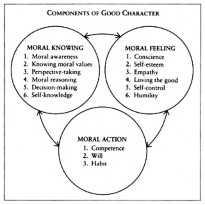
Figure 1. Component of good character
From the chart above, it can be explained as follows (Abidin: 2012). First, moral knowledge, which includes moral awareness, is that someone knows whether it is good or bad. Moral value knowledge is that someone knows kinds of moral values such as honesty, fairness, and discipline. Perspective understanding is someone’s ability to take other people’s points of view in the same manner as other people view. The moral reason is someone's comprehension of why these are said as having morals. Decision understanding is someone's ability to understand decisions correctly and wisely. Self-comprehension means that someone should comprehend his/her own self to review his/her behavior critically.
The second one is moral feeling that includes awareness; meaning that someone really understands what those things are right based on his/her knowledge and feelings, self-confident. Meaning that someone is said as having character if he/she have had self-confident and ability to stand alone, empathy. Meaning that having care toward other people, loving the good one meaning that someone is said as having character if he/she has loved the truth and able to fight for the truth, self-control, meaning that someone is able to control his/herown self emotionally. The modesty meaning that the effective side of the self-knowledge is the ability to accept the truth and to do activities in correcting the mistakes that have been done.
The third one is moral action that includes competence meaning that is the ability to apply the decision and moral feeling into moral action. It wishes to mean that someone’s ability to do all the things which he/she wants to be based on valid moral value, habit meaning that the habit in doing all the things is in accordance with the value and norm.
After understanding the definition of character, it can be formulated the definition of character education. Based on Thomas Lickona, character education is the education to form someone’s personality through character building in which its result can be seen in good behavior, honesty, responsibility, respect of others’ rights, work hard, and so on (Gunawan: 2012). The definition of this character education is following the definition of character education by Elkind and Sweet,
(…) character education is the deliberate effort to help people understand, care about, and act upon core ethical values. When we think about the kind of character we want for our children, it is clear that we want them to be able to judge what is right, care deeply about what is right, and then do what they believe to be right, even in the face of pressure from without and temptation from within (Gunawan: 2012).
From the definitions above, it can be concluded that character education is a process of awareness, intelligence, and character or mental development. Hence, education is generally a cultural process that has the purpose of directing awareness, supply information, form perspective, and mainly develop the character of the young generation.
In the implementation of character education, The Ministry of National Education explains the principles of character education. One of those is the continuity principle. It means that the process of character development is a long process that has been begun from the beginning of students’ entry until finishing a unit of education (Abidin: 2012). Then, through all the subjects, self-development, and education unit culture, it is beckoned that the process of character development is done through every subject and every extracurricular activity. Then, the value principle is not taught, but it is developed by the process of study. It means that character values are not lesson material. Not only can it be obtained by own self or can be taught, but also it is farther internalized through the process of study. Lastly, the education process is done by the students actively and pleasantly. This principle asserts that the character education process is done by the students, not by the educators.
D: The Development of Character Building Model in Indonesia through Language Politeness
In order to develop character building in Indonesia, the researcher proposes Politeness on language as a basis of character building, which will be developed in language learning. Several maxims in language Politeness use qur'ani approach. This approach will be internalized into the language learning process, including the language used in the textbook and during the teaching-learning process. It is appropriate, subtle, favorable, and exalting rather than degrading language. These need to be understood and are able to be applied by the educator during the teaching-learning process and daily communication in school. Then, the steps are carried out following character development steps stated by Kemendiknas to achieve good character, as explained in the previous chart.
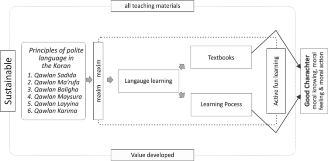
Figure 2. Development of character building model in Indonesia through Language Politeness
Based on the picture, it can be explained that language Politeness in Al-Quran becomes the basis of language learning. It means that language learning is supposed to include values of language Politeness, as explained by the researcher. This step is the language teacher's responsibility. It can change the teaching- learning process course, which previously uses reading text-based learning and the grammatical structure limited to language Politeness values used to communicate among students. This step aims to make the students communicate politely, effectively, clearly, and able to understand the situation and condition.
To internalize the value of language Politeness, firstly, it can be taught from a textbook. The textbook is designed by the teacher to provide several reading texts, grammatical features, and discourse, which include Politeness values. Secondly, it can be applied in the learning process, starting from the material explanation, class discussion; even observation on students' communication processes in school and home, and it can be used as a teacher's evaluation and students' assessment.
These two ways are required to conduct fun and active learning. Therefore, character building, whichstarts from learning language Politeness, can be applied effectively and continuously in order to achieve good character contentedly. Not only is this model suitable for language learning, but also it can be developed in various subjects such as social and science.
4. CONCLUSION
Based on problem statement and discussion, it can be concluded that: First, according to the translation of Al-Quran as massages to Moslem which are delivered by Prophet Muhammad language Politeness has six principles namely 1) qawlan sadida, 2) qawlan Ma’rufa, 3) qawlan baligha, 4) qawlan maysura, 5) qawlan layyinan, and 6) qulan karima. There are 26 maxims in these principles in order to achieve the language Politeness, namely: 1) truth, 2) honesty, 3) justice, 4) kindness, 5) straightness, 6) softness, 7) politeness, 8)appropriateness, 9) excitement, 10) solemnity, 11) optimism, 12) beauty, 13) joyfulness, 14) logic, 15) fluency,16) clarity, 17) accuracy, 18) memorability, 19) harmony, 20) impressiveness, 21) calmness, 22) effectiveness,23) moderation, 24) generosity, 25) tenderness, and 26) modesty. Second, language Politeness is an important thing to be applied and started from language learning in formal or non-formal education. Language Politeness education model is one of the efforts to develop the character building in Indonesia. It can be applied to the learning process through teaching material and teaching-learning process. Besides, it can be applied to the communication process among students as well as between teachers and students or vice versa.
BIODATA
KISNO UMBAR: Kisno (S.S) is currently a student candidate for Arabic language education at the Syarif Hidayatullah State Islamic University in Jakarta, which is sponsored by the Education Fund Management Institute (LPDP) under the Ministry of Finance of the Republic of Indonesia. At present, he is incorporated in the Indonesian Qualitative Research Association (IQRA) of DKI Jakarta-Indonesia. Previously, he obtained a bachelor's degree in literature from the department of Arabic language and literature cum laude at the Maulana Malik Ibrahim State Islamic University of Malang. He has written several articles published in journals and proceedings at national conferences as well as international conferences in the fields of linguistics, Arabic literature, Arabic education, and culture.
ACKNOWLEDGMENTS
The author would like to thank LPDP (Indonesia Endowment Fund for Education), State Islamic University of Syarif Hidayatullah Jakarta for supporting and funding in this research.
BIBLIOGRAPHY
ABIDIN, Y (2012). "Authentic assessment models in learning to read comprehensible across character education", in: Jurnal Pendidikan Karakter, Vol. 2 No.2 Juni, pp.164-178.
AFANDI, R (2019). "Integration of Character Education in Social Studies Learning in Primary Schools", in: PEDAGOGIA: Jurnal Pendidikan, Vol. 1 No. 1, p. 85-98.
AL-BURUSWI (1996) Ruhul Bayan's Tafsir Translation, volume 15. Bandung: CV. Diponegoro
AL-MARAGHI (1943). Tafsir al-Maraghi, volume 3, Bairut: Dar al-Fikr.
AL-SIDDIQI H (1977). Tafsir Al-Bayan, volume 1, Bandung: al-Maarif.
BOWDEN, M (2010). Winning body language: control the conversation, command attention, and convey the right message - without saying a word. NY: McGraw Hill Professional.
CAFO, Z, & SOMUNCUO, D (2000). Global Values in Education and Character Education.
DJATMIKO (2013). Courage in Language in the perspective of Language learning. Surakarta: Eleven University March.
DJIWANDONO, PI (2016). Character Education in Content Courses: Self-Scoring As a Means for Developing Honesty in Students. TEFLIN Journal, 27(2), pp.153-165.
DUHITA, AA, & ZULAEHA, I (2018). The Politeness Speech of Primary School Teacher in the Character Building of Learners. Seloka: Jurnal Pendidikan Bahasa Dan Sastra Indonesia, 7(2), pp.112-121.
EKAWATI, EY (2011). "Internalization of Character Education in Physics Learning Using Group Investigation Model Gi (Group Investigation) Using Action Learning Approach", in: Jurnal Materi dan Pembelajaran Fisika, Vol. 1, No. 1, pp. 1-8.
ELMUBAROK, Z (2009). Grounding Educational Values: Gathering the Scattered, Connecting the Disconnected, and Unifying the Divorced. Bandung: Alfabeta.
FATHURROCHMAN, I., & APRIANI, E. (2017). "Character Education of Islamic Education Perspectives in the Deradicalization of Radical Understanding", in: Potensia: Jurnal Kependidikan Islam, Vol. 3, No. 1, Juni, pp.122-142.
FUAD. J (2012). "Character Education in Islamic Boarding Schools in Sufism", in: Jurnal Pemikiran Keislaman, Vol. 23, No. 1, pp. 60-77.
GUNAWAN, H (2012). Character Education Concept and Implementation. Bandung: Alfabeta.
HADI, NF (2016). "Cultivation of Character Education in Learning in Schools", in: FITRAH: Jurnal Kajian Ilmu- ilmu Keislaman, Vol. 2, No. 1, Januari-Juni, pp. 73-92.
HALSTEAD, JM (2007). “Islamic values: a distinctive framework for moral education?”. Journal of Moral Education, 36(3), pp.283-296.
HALSTEAD, M (2004). An Islamic concept of education. Comparative education, 40(4), pp.517-529.
HARYANTO, H, & AKHIRIN, A (2018). Building Students’ Character Through Integrated Teaching LearningActivities at Madrassa. In PROCEEDINGS INTERNATIONAL CONFERENCE BKSPTIS 2018
HASANAH, A, GUSTINI, N, & ROHANIAWATI, D (2016). Cultivating character education based on sundanese culture local wisdom. Jurnal Pendidikan Islam, 2(2), pp.231-253.
HASJIM, N (2013). Courage in Language in Islam, Proceedings of Courage in Language in a variety of perspectives (Language Study Program, Postgraduate, Muhammadiyah University, Surakarta, pp. 325-353.
IBN KATHIR, I (1999). Tafsir Ibn Kathir, volume 5, Cairo: Daral-Thayibah.
JAENI, M (2012). "Muhammad is a polite speaker", in: Religia, Vol. 15, Vol. 1, April, pp. 27-45.
KADI, FA, & FADLYANA, E (2007). "Cases of Violence in School Children (School Bullying)", in: Sari Pediatri, Vol. 8, No. 4, Maret, pp. 316-321.
KAMARUDDIN, SA (2012). “Character education and students social behavior”. Journal of Education and Learning, 6(4), pp.223-230.
LICKONA, T (1994). Education for Caracter. New York: Bantam Books.
MANGKUNEGARA, AAP, & PUSPITASARI, M (2015). "Teacher emotional intelligence, work stress, and high school teacher performance", in: Jurnal Kependidikan: Penelitian Inovasi Pembelajaran, Vol. 45, No.2. Desember, pp. 142-155
MARADEWA, R (2019). "KPAI Note in Hardiknas: Teacher Bully Children Case Increases Drastically," URL: http://www.kpai.go.id/berita/catat-kpai-di-hardiknas-kasus-anak-bully-guru-meningkat-drastis accessed May 30.
MARCELLINO, M (2015). English language teaching in Indonesia: A continuous challenge in education and cultural diversity. TEFLIN journal, 19(1), pp.57-69.
MUDHOFIR, A (2011). "Character Education Through Cultivating Ethics Communicating in the Koran", in:ISLAMICA, Vol. 5, No. 2, March, pp. 367-382.
MURJITO, J (2018). Character Value Education through Krama Javanesse Habituation for Early Age Children. ATTARBIYAH: Journal of Islamic Culture and Education, 3(2), pp.251-276.
NASANIUS, Y (2007). Linguistics: Translating and Interpreting, editor, Jakarta: Obor Indonesia Foundation.
NURJAMILY, WO (2015). "Indonesian Politeness in a Family Environment (Sociopramatic Study", in: Jurnal Humanika, Vol. 15 No 3. Desember.
PRATAMANTI, ED (2017). "Courage in Language in the Whatsapp Message of Students Addressed to Lecturers", in: Dinamika Sosial Budaya, Vol. 19, No. 2, Desember, pp. 230-230.
QOYYIMAH, U (2016). Inculcating character education through EFL teaching in Indonesian state schools. Pedagogies: An International Journal, 11(2), pp.109-126.
RAHMAT, J (1994). "Principles of communication according to the Qur'an", in: Audenta, Vol. 1, No. 1.
SABEKTI, CA (2009). "Language Acquisition and Language Learning According to Convergence Views", in:Jurnal Pendidikan, Vol. 15, No. 1
SADIAH, D (2015). Education of Religious Values in Building Healthy Personality (Analytical Descriptive Study in Madrasah Aliyah Darul Arqam Garut). Jurnal Pendidikan Islam UIN Sunan Gunung Djati, 1(3), pp.393-406.
SALAHUDDIN, PZ (2011). Character education in a Muslim school: A case study of a comprehensive Muslim school's curricula.
SAURI, S (2003). Development of a Political Language Education Strategy in Schools Mimbar Pendidikan No.1/XXII/, pp. 45-53.
SIMARMATA, MY, & AGUSTIANA, R (2017). "The Effectiveness of Character Education Based Teaching Materials to Increase the Courage of Speech Imperative Actions", in: Jurnal Pendidikan Bahasa dan Sastra Indonesia, Vol. 2, No. 2, September, pp. 41-43.
SUHERMAN, E (2008). "Principles of Cooperation, Politeness and Irony, in Japanese Society: An Overview of the Sociopragmatic Dimension", in: LITE: Jurnal Bahasa, Sastra dan Budaya, Vol. 4, No. 1, Maret, pp. 24- 35.
WAHIDAH, YL & WIJAYA, YL (2017). "Leech Politeness Analysis According to Leech in Arabic Speaking Ibnul Qoyyim Putra Islamic Boarding School Teacher in Yogyakarta 2016/2017 Academic Year (Pragmatic Study)", in: Jurnal Al Bayan UIN Raden Intan, Vol. 9, No. 1, pp. 1-16.
WATI, MA, SUMARWATI, S, & SADDHONO, K (2019). ISLAMIC RELIGIOUS VALUES IN DHUKUTAN TRADITIONAL CEREMONY AS CHARACTER EDUCATION FOR ELEMENTARY SCHOOL STUDENTS. ElHarakah, 21(1), p.65.
YULE G (1996). Pragmatics, Rombe Mustajab's translation. Yogyakarta: Student Library