Artículos
Use of social media in health care by patients and health care professionals: motives & barriers in Thailand
Uso de las redes sociales en la atención médica por parte de pacientes y profesionales de la salud: motivos y barreras en Tailandia
 K TECHASATIAN k.techasatian@gmail.com
Use of social media in health care by patients and health care professionals: motives & barriers in Thailand
Utopía y Praxis Latinoamericana, vol. 24, núm. Esp.6, pp. 215-223, 2019
Universidad del Zulia

Esta obra está bajo una Licencia Creative Commons Atribución-NoComercial-CompartirIgual 3.0 Internacional.
Recepción: 12 Septiembre 2019
Aprobación: 16 Noviembre 2019
Abstract: The purpose of this study was to examine the motives and barriers in the use of social media in healthcare for patients and healthcare professionals. It was found that patients and healthcare professional users constituted on Facebook (62.9%), on Twitter (49.4%) on YouTube (13.4%). The use of Facebook among patients was superior (89%) because it is now becoming a household social networking site. LinkedIn among healthcare professionals was superior (95%) because it is becoming an extended network of colleagues. The results suggested a strong variance in patients and health care physicians motives for the use of social media.
Keywords: healthcare professionals, patients, Social media, social networking sites.
Resumen: El propósito de este estudio fue examinar los motivos y las barreras en el uso de las redes sociales en la atención médica para pacientes y profesionales de la salud. Se encontró que los pacientes y usuarios profesionales de la salud se constituyeron en Facebook (62.9%), en Twitter (49.4%) en YouTube (13.4%). El uso de Facebook entre los pacientes fue mayor (89%) porque ahora se está convirtiendo en un sitio de redes sociales para el hogar. LinkedIn entre los profesionales de la salud fue el sitio más grande (95%) debido a que es una red extendida de colegas. Los resultados sugieren una fuerte variación en los motivos de los pacientes y los médicos para el uso de las redes sociales.
Palabras clave: pacientes, profesionales de la salud, redes sociales, redes sociales.
1.INTRODUCTION
Thailand aims to establish a robust healthcare services framework as a part of its social and financial assets. This is possible only when the Thai government allows its people to open and equivalent access to all types of healthcare services. In order to achieve this objective, Thailand has been trying to improve the quality human services framework since 1975 (Jantavongso: 2013). Nowadays, sensitive healthcare data are accessible through the Internet and online networking sites (Jantavongso, 2015: 25-37). Wellbeing and restorative records, wellbeing advice, individual wellbeing records or databases are effectively developed. Anybody can look into the data and crucial information of others using e-wellbeing frameworks (Shah et al.: 2014, p.10).
Social media is also a secure platform for carrying out online innovations and good practices in order toenhance socio personal communication, experiences and points of view (Gupta et al.: 2013, pp.293-302; Subair & Oriogu: 2016, pp.67-72). Moreover, social media applications are low-cost advertising instruments that assist in encouraging network building, the rapid spread of data, and subsequently promising trust and certainty of public (Jermsittiparsert et al.: 2018, pp.1257-1273). It can take numerous structures like content, pictures, sound, and video (Parida et al.: 2016, pp.1134-1141; Mishra: 2018, pp.1457-1471). Social advertisers confront difficulties, for example, expanded numbers and sorts of medical problems seeking general society's consideration; restrictions on individuals' time; and expanded numbers and kinds of correspondence channels, including the internet. A multimodal approach is the best method to contact the audience about medical problems.
An extensive literature survey was done to facilitate data for the current study. Several sources like journals, books, and websites of health organizations, and hospitals were consulted and examined for the relevant data on the motives and barriers faced by patients and healthcare professionals. A contextual analysis was done to sort out how social media helped in advancing social life and general wellbeing (Constantinides: 2014, pp.40-57; Kaplan & Haenlein: 2009, pp.93-101).
Since the primary purpose of this study was to examine the use of social media in Thailand by patients and health professionals, this study also explored the impact of e-health policies in Thailand, which is facing several health-related issues and barriers of medical services such as lack of funds, no availability of expert doctors and healthcare professionals, and lack of communication (Jantavongso: 2015, pp.25-37; Tyagi & Siddiqui: 2017, pp.61-67; Mitts: 2018, pp.28-36).
Formerly electronic media meant communication through email. Since social media platforms offer bettercommunication, there is an opportunity that one to one individual interaction among physicians and patients should be made. Furthermore, health care information can spread innovatively. Portals such as patient site.org allow filling of a prescription, virtual communication with physicians, and also view laboratory tests online. This is another method to empower patients, as this gives them the chance to take care of themselves (Laranjo et al.: 2014, pp.243-256; Uddin: 2017, pp.311-319).
Digital technologies have made communication and interactions more accessible all around the world (Lupton: 2014, pp.174-183). Furthermore, blogging tools such as Facebook, Twitter, LinkedIn are a few tools that are being used to shape and spread unlimited information at an increasing rate. These tools have addressed all age groups, but it is necessary to enquire whether these social media platforms have the potential to mold health care delivery, address healthcare disparities and integrate collaborative medicine. This is a fundamental fact that social media are accessible to everyone. During the last decade, multiple events were seen on social media related to health care (Lupton: 2014, pp. 174-183). Statistics reveal that health care inquiries were 3.6-5.6% via google. This indicated an increased reliance on social media for gathering healthcare information. The platform social media provides an opportunity for virtual interactions and allows for engagement of natural interaction and sharing of information among patients.
Social media gives a huge market for health advancement, with millions of web-based clients availablefor medical services agencies (Nielson Company May: 2011). Social media is also a significant (i.e.,commendable venture of wellbeing advancement resource) and successful approach to convey health-related data to low-income parents with an end goal to advance their children’s health-related issues. It was discovered that wellbeing messages conveyed to low-salary parents must originate from specialists and ought to be customized (Stroever et al.: 2011, p.1; Mohajan: 2016, pp.31-53).
Better approaches for pulling in clients and impacting patients with better healthcare practices have shownup (i.e., social network sites, web journals, mobile applications, and so forth.). Notwithstanding, there are numerous conflicting perspectives that provide reasons to feel ambiguous about the adequacy of such showcasing in human services, given its specific attributes (i.e. sensitive data, protection issues, security issues, the requirement for an eye to eye meeting with the doctor, less control over social media than with customary showcasing, down to earth and moral worries about the responsibility for data transmitted, and so on) (koumpouros et al.: 2015, pp.495-507; Morgan & Alcocer: 2017, pp.14-22)
Maintaining Privacy would be difficult as HIPAA laws require physicians to archive medical information as a part of the medical record, and communication on social media would require saving it to take medical decisions upon admission to the hospital. This would add extra cost and would be cumbersome (Santesteban- Echarri et al.: 2017, pp.65-73; Mungwari: 2018). Furthermore, medical laws also demand that physicians take and sign agreements and also build the required number of networks to assure privacy. Since this is done privately, this would require physicians to manage their compliance and EHRS efficiently and not to become victims of cybercrime.
Social networking sites for healthcare purposes are utilized mostly by clinicians and hospitals who are affiliated with larger organizations as they are capable of managing resources. This does not add a burden to clinicians and promotes efficiency as well (Santesteban-Echarri et al.: 2017, pp.65-73). Thus, the barriers to e-health include financial burdens that the use of technology tends to add to the physicians.
Formerly surgeons who have posted video cases of patients or tweeted about inappropriate conduct areaddressed by the law as violating patient’s confidentiality and patient privacy and, therefore, not recommended (Barlow et al.: 2015). From a health care employer’s perspective, health professionals responsible for hiring social networking sites and health care professionals can utilize networking sites only for recruitment and hiring. A survey indicated that 79% of employers review social media for their prospective employees, and less than 10 percent of candidates were aware of this activity. Hence caution and discretion should be practiced before online content is published to avoid the formation of negative professional judgment.
The study would be helpful because it identifies the usage of social media among patients and healthprofessionals. It also identifies the social media site commonly used for seeking healthcare information or advice. Moreover, it also identifies barriers faced by patients and healthcare professionals when using social media. It would be helpful in future research as it will help in developing strategies to modify social media as per the needs of patients and healthcare professionals.
2. METHODS
According to the problems identified, specific research questions were developed around the areas of inquiry:
-
What are patients’ motives behind the use of social media on health-related issues?
-
What are the physicians’ motives for using social media on health-related issues?
-
What are the barriers faced by patients’ who use social media for health-related issues?
-
What are the barriers faced by physicians’ who use social media for health-related issues?
The study was conducted on the middle class to upper-class general public and healthcare professionals in Thailand. The data was collected from users of social media. The sample size was 200, comprising patientsbetween 20 and 50 years of age and health professionals between 25 to 66 years. A total of 200 questionnaires were filled up, i.e., 100 questionnaires each by patients and healthcare professionals. The responses were kept anonymous. The respondents were identified through online via social media
Respondents were asked to report their experiences of the use of social media, including Facebook,Twitter, LinkedIn, and YouTube. The emphasis was on finding out the motives and barriers they face in the use of social media for health purposes.
A five-point Likert questionnaire was used on 1-5 scale with one as strongly disagree, and five stronglyagree. This validated 28 item questionnaire was adapted from (Antheunis, Tates & Nieboer: 2013) which included questions associated with barriers and motives.
3. RESULTS
The data was analyzed using SPSS v.21. The descriptive statistics reveal that a majority (99.3%) of patients used one or more of the five social media: Facebook had 83.5% users, Twitter,63.2% users, YouTube 40.2% users, and LinkedIn 38.2% users. Out of the total respondents, among patients, it was found that 31.7% used social media platforms for health purposes, out of which the majority (62.9% ) used Facebook, followed by Twitter (49.4%). The other two media platforms, YouTube (13.4%) and LinkedIn (5.6%) were found to be scarcely used for health purposes. Among health professionals, 59.3% used one or more social media sites, out of which 43.1% used Facebook, 38.6% used YouTube, 35.9% used LinkedIn, and 22.9% used Twitter. Among these healthcare respondents, 26.8% used social media platforms for health purposes, primarily LinkedIn used by 70.7% and Twitter by 51.2%.
When asked about motives for the usage of social media platforms for health issues, patients expressed various reasons, which included adding awareness and familiarity, doctor-patient communication, Social sustenance, Seeking and Sharing Advice, and Personal-care. Table 1 shows the usage of two social media platforms by patients: Twitter used by 23% and Facebook by 37% for social sustenance, followed by sharing advice 22% on Twitter and 35% on Facebook, adding awareness and familiarity 19% on Twitter and 26% on Facebook, and so on. Patients sparsely used Youtube and LinkedIn, so their statistics were not investigated
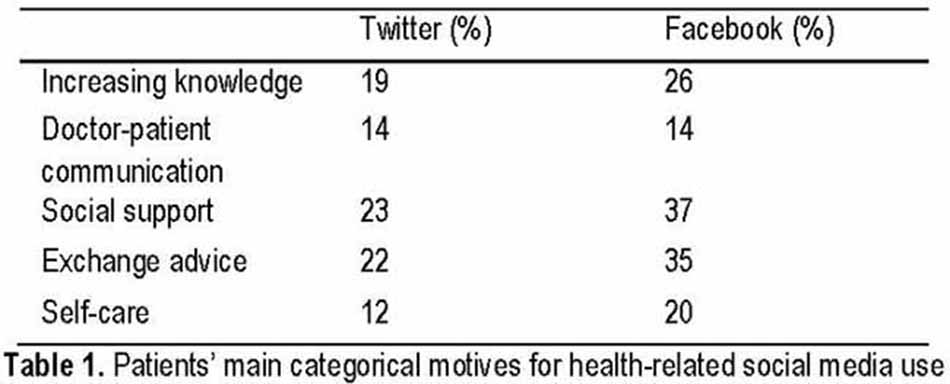
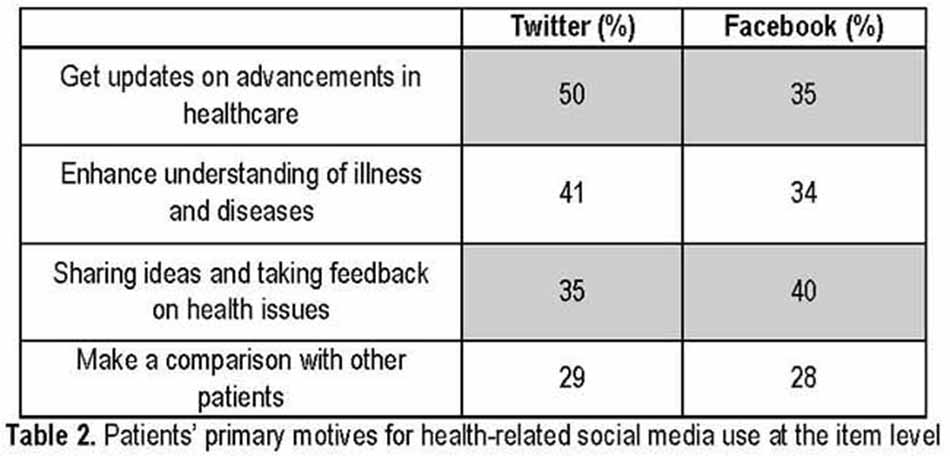
Table 2 depicts the findings at individual item level in the questionnaire, on the Twitter platform, the primary motive of patients was to remain updated on advancements in health care (50%), followed by enhancing understanding about illness and disease (41%); sharing ideas and taking feedback (35%) and making comparison (29%).
On the other hand, the data for Facebook was slightly different. At individual item level in the questionnaire, on Facebook platform, the majority of patients (40%) expressed sharing ideas and taking feedback was the primary motive, followed by getting updated on advancements in health care (35%), and enhancing understanding about illness and disease (34%) while 28% said their motive was to make comparison. (Table 2).
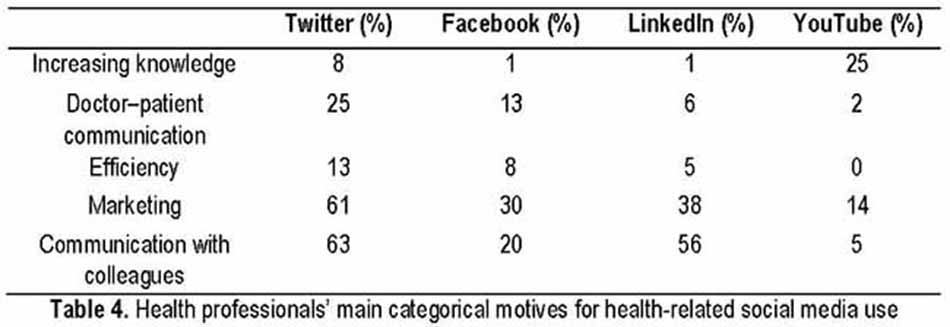
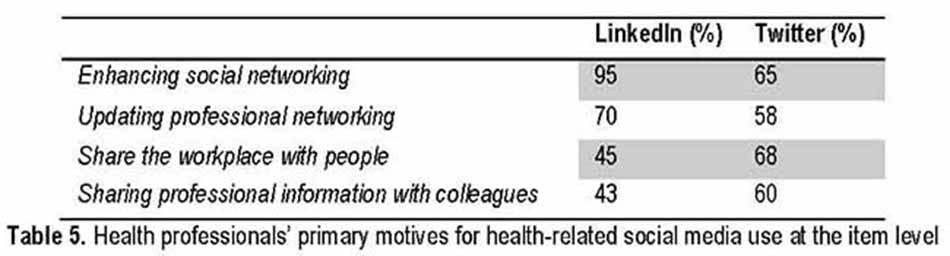
Regarding healthcare professionals, the data revealed that their primary motives included various reasons such as increasing knowledge and awareness, doctor-patient communication, professional Efficiency, marketing, and communication with colleagues. Table 4 depicts the findings with marketing and communication with colleagues rated as the highest motives on all social media platforms. Results on specific items demonstrate that the primary purpose of using social media among healthcare professionals was to enhance their network via LinkedIn (95%) and Twitter (65%), followed by updating their professional networking LinkedIn (70% ) and Twitter (58%) and sharing workplace ideas with outer world via LinkedIn (45%) and Twitter (68%).
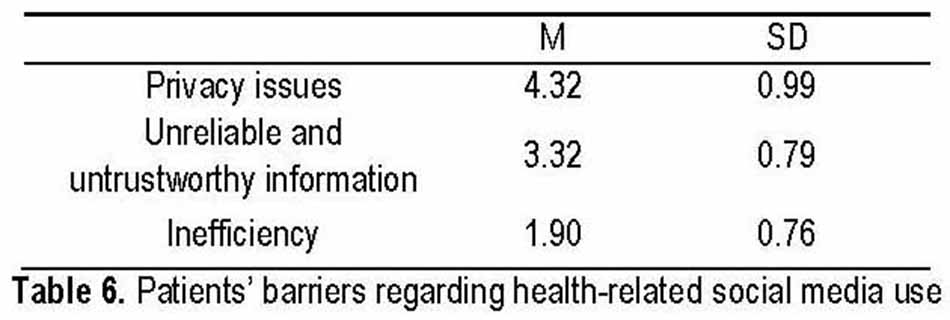
In order to explore barriers faced by both patients and healthcare professionals, we checked the frequencies at both individual and categorical levels. It was revealed that patients faced barriers like Privacy issues, Unreliable and untrustworthy information, and Inefficiency in using social media platforms for health- related issues. The highest mean 4.32, SD=0.99, was measured for privacy issues followed by unreliable and untrustworthy information and inefficiency faced in social media platforms.
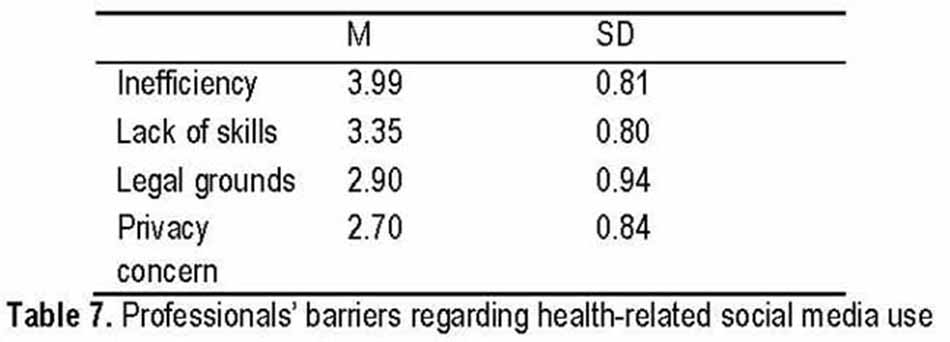
The barriers faced by health professionals varied a little but remained mostly the same such as Inefficiency, lack of skills, Legal grounds, and Privacy concerns. The highest mean 3.99, SD=0.81, was measured for inefficiency, followed by a lack of skills, legal grounds, and privacy concerns.
The study aimed to investigate health professionals’ and patient's intentions and motives for the use of social media for health-related issues. We found that both categories of our study population were actively involved in the usage of social media for health care. In general, the results represented a variance and did not high light dominance of any social medium or motives and preference for medium deferred in both the health care professional and patient population.
During the last decade, social media has broadly affected the field of medicine by increasing the use ofcommunication among patients and the public. Existing examples include virtual patient communities, medical information online and emergency broadcasts during natural disasters to create awareness and educate general masses. Medicine 2.0 is an existing platform specifically catered to the clinician’s use and allows enhanced communication skills. Furthermore, the Dutch Medical Association published guidelines on the usage of social media and acknowledged its dominant role in seeking health care. These guidelines further gave nine recommendations for the use of social media and encouraged the use of specialists in each department to benefit from social media’s role. Our data indicated the usage of social media exceeded that of the health professional, which is consistent with the results of the previously reported studies.
Our first objective was to evaluate if social media was being utilized for health care purposes and if therewas any difference between the studied cohorts. We found that among health care professionals, the usage of LinkedIn and Twitter was more than Face book, but among the patient population, the use of Twitter and Facebook was more. These results are also consistent with previously published studies.
Also, social media platforms like Facebook now tends to play the role of a platform of social support wherepatients and health professional express their experience with a particular physician and express their recommendations to other people. The platform of Twitter and Facebook, in comparison to LinkedIn and YouTube, represented informality in communication among peers. LinkedIn, therefore, was utilized more for connecting healthcare professionals.
Evidence from previous studies also indicated that the usage of social media has increased, which isrevealed in the form of groups created by members of common interest. Our results are consistent with these findings, and we found groups on Facebook that have a vast number of followers from the patient and non-patient populations who trusted other people’s recommendations to join these groups. Although these platforms are intended for their sole purposes, their discussion involved general recommendations on health care and health care physicians.
Our aim was also to find motives behind the usage of social media to identify the factors and motivesbehind the usage of different social media, i.e., Facebook and Twitter. It was found that doctors’ patient’s communication, social exchange, sharing advice, self-care, increasing awareness and knowledge on the disease, expression of emotions on their health, and to achieve a comparison on other patients were a few motives among patients and health care professionals.
Our second aim was to investigate Barriers for the use of social media for health-related issues betweenthe two cohorts. These barriers were found to be variant among patients who were more concerned about maintaining privacy and confidentiality and reliability of the healthcare-related information. The health care professionals, on the other hand, were more concerned with the confusion social media created in patient's minds concerning diagnosis and treatment, and also resolving patients’ issues using social media placed an additional burden of time and resources on physicians. We feel that physicians would be concerned about communicating with the patients using the social medium as formerly, there have been many lawsuits that have been filed against clinicians internationally.
The impact of social media is enormous due to technological developments in health care. Some of the teaching hospitals and private institutions are already using social media to increase awareness and to provide medical education to the public. With the increase in the use of social media and its impact, more health care institutions have opened in Thailand. We feel that hospitals, medical institutions should use discretion in the use of social media in order to ensure a healthy doctor-patient relationship in terms of health care.
4. CONCLUSION
The results of our study have given a deep insight into the motives behind the usage of social media. It is felt that since the data was collected online using social mediums, this could be presented as a way for studying our population that may not be a true representative of the entire population. This indicates the need for future studies in order to generalize these results. Moreover, we have not explored the age or the experience of both the patients and health care professionals. As young people are keener and more active in the use of social media, it is, therefore, necessary to explore future studies with this demographic information. Lastly, our respondents were 70% females; hence, we do not know the motives behind the male population and their intentions behind the use of social media. This calls for future research to study the impact of social media on gender basis too in different health care institutions and to gain a perspective on a more massive scale.
BIODATA
Thammarak SRIMARUT is a lecturer of Suan Sunandha Rajabhat University, Thailand. His research area is Industrial Technology.
Kanlaya TECHASATIAN is an Assistant Professor of the School of Nursing, Shinawatra University, Thailand. Her research areas are Health Care, Nursing, and First Aid.
BIBLIOGRAPHY
ANTHEUNIS, ML, TATES, K, & NIEBOER, TE (2013). “Patients’ and health professionals’ use of social media in health care: Motives & barriers”, in: Patient Education and Counseling, 92, pp. 426–431.
BARLOW, CJ, MORRISON, S, STEPHENS, HO, JENKINS, E, BAILEY, MJ, & PILCHER, D (2015).“Unprofessional behaviour on social media by medical students”, in: Medical Journal of Australia, 203(11), pp. 439-449
CONSTANTINIDES, E (2014). “Foundations of social media marketing”, in: Procedia-Social and behavioral sciences, 148, pp. 40-57.
GUPTA, A, TYAGI, M, & SHARMA, D (2013). “Use of social media marketing in healthcare”, in: Journal of Health Management, 15(2), pp. 293-302.
JANTAVONGSO, S (2013). Ethics and e-health in Thailand, in: Proceedings of the Thai Medical Informatics Association Annual Conference and The National Conference on Medical Informatics; Bangkok.
JANTAVONGSO, S (2015). “Ethics, social media and e-health in Thailand”, in: Journal of the Thai Medical Informatics Association, 1(1), pp. 25-37
JERMSITTIPARSERT, K, SUTDUEAN, J, & SRIYAKUL, T (2018). “Social Customer Relationship Management Capabilities and Customer Relationship Performance: Moderating Role of Social Media (Face- book) Usage among Indonesian Firms”, in: Opcion, 34(86), pp. 1257-1273
KAPLAN, AM, & HAENLEIN, M (2009). “Consumer use and business potential of virtual worlds: the case of second life”, in: The International Journal on Media Management, 11(3), pp. 93-101.
KOUMPOUROS, Y, TOULIAS, TL, & KOUMPOUROS, N (2015). “The importance of patient engagement and the use of social media marketing in healthcare”, in: Technology and Health Care, 23(4), pp. 495-507
LARANJO, L, ARGUEL, A, NEVES, AL, GALLAGHER, AM., KAPLAN, R, MORTIMER, N, & LAU, AY (2014).“The influence of social networking sites on health behavior change: a systematic review and meta-analysis”, in: Journal of the American Medical Informatics Association, 22(1), pp. 243-256
LUPTON, D (2014). “Health promotion in the digital era: a critical commentary”, in: Health promotion international, 30(1), pp. 174-183.
MECHLER, HM, & MCCARROLL, E (2017). “Factors that Influence Parents’ Meta-Emotion Approaches: Implications for Families”, in: International Journal of Emerging Trends in Social Sciences, 1(2), pp. 46-52.
MISHRA, R (2018). “Financial Literacy, Risk Tolerance and Stock Market Participation”, in: Asian Economic and Financial Review, 8(12), pp. 1457-1471.
MITITS, L (2018). “Multilingual Students in Greek Schools: Teachers' Views and Teaching Practices”, in:Journal of Education and e-Learning Research, 5(1), pp. 28-36.
MOHAJAN, HK (2016). “Knowledge is an Essential Element at Present World”, in: International Journal of Publication and Social Studies, 1(1), pp. 31-53.
MORGAN, BM, & ALCOCER, LF (2017). “Descriptive Comparison of Hispanic Doctoral Students (2007-2014) with Carnegie Initiative of the Doctorate National Survey Results”, in: American Journal of Education and Learning, 2(1), pp. 14-22.
MUNGWARI, T (2018). “Media framing of ZANU PF Internal Succession Struggles: Mnangagwa and the Military Factor”, in: American Journal of Social Sciences and Humanities, 3(1), pp. 1-21.
PARIDA, V, MOSTAGHEL, R, & OGHAZI, P (2016). “Factors for Elderly Use of Social Media for Health‐Related Activities”, in: Psychology & Marketing, 33(12), pp. 1134-1141.
SANTESTEBAN-ECHARRI, O, RICE, S, WADLEY, G, LEDERMAN, R, D'ALFONSO, S, RUSSON, P, &MCGORRY, PD (2017). “A next-generation social media-based relapse prevention intervention for youth depression: qualitative data on user experience outcomes for social networking, safety, and clinical benefit”, in: Internet interventions, 9, pp. 65-73.
SHAH, JR, MURTAZA, MB, & OPARA, E (2014). “Electronic health records: challenges and opportunities”, in: Journal of International Technology and Information Management, 23(3), p. 10.
STROEVER, SJ, MACKERT, MS, & MCALISTER, AL (2011). “Peer Reviewed: Using Social Media to Communicate Child Health Information to Low-Income Parents”, in: Preventing chronic disease, 8(6), p. 1.
SUBAIR, RE, & ORIOGU, CD (2016). “Still an Issue: The Use of Electronic Books in University Libraries in Nigeria”, in: American Journal of Social Sciences and Humanities, 1(2), pp. 67-72.
TYAGI, S, & SIDDIQUI, S (2017). “Yield Curve and Momentum Effects in Monthly US Equity Returns: Some Nonparametric Evidence”, in: Asian Journal of Economics and Empirical Research, 4(2), pp. 61-67.
UDDIN, SS (2017). “Existence of External Forces in Afghanistan: Pakistans Security Dilemma Since 9/11”, in: International Journal of Asian Social Science, 7(4), pp. 311-319.
USAK, M, KUBIATKO, M, SHABBIR, M, DUDNIK, O, JERMSITTIPARSERT, K, & RAJABION, L (2019).“Health Care Service Delivery Based on the Internet of Things: A Systematic and Comprehensive Study”, in:International Journal of Communication Systems, 32(14), p. 4179.