Artículos
Effect of teaching English with the eclectic approach on Saudi Arabian students’ communicative skills
Efecto de la enseñanza del inglés con el enfoque ecléctico en las habilidades comunicativas de los estudiantes de Arabia Saudita
Effect of teaching English with the eclectic approach on Saudi Arabian students’ communicative skills
Utopía y Praxis Latinoamericana, vol. 24, núm. Esp.6, pp. 285-293, 2019
Universidad del Zulia

Esta obra está bajo una Licencia Creative Commons Atribución-NoComercial-CompartirIgual 3.0 Internacional.
Recepción: 18 Septiembre 2019
Aprobación: 11 Noviembre 2019
Abstract: This study aims to investigate the effect of an eclectic teaching method on the communicative skills of listening, speaking, reading and writing on the foundation year students, level 104, at the English Language Institute of King Abdulaziz University in Jeddah, Saudi Arabia. The predicted objective of the present study is to observe, and determine, the effect of the eclectic approach on these four skills. The study revealed that the experimental group, taught under the eclectic approach, performed significantly better than the control group, taught according to the scheduled program.
Keywords: Communicative Skills, Eclectic Approach, Saudi Arabian, Teaching English.
Resumen: Este estudio tiene como objetivo investigar el efecto de un método de enseñanza ecléctico en las habilidades comunicativas de escuchar, hablar, leer y escribir en los estudiantes de primer año, nivel 104, en el Instituto de Idioma Inglés de la Universidad King Abdulaziz en Jeddah, Arabia Saudita. El objetivo previsto del presente estudio es observar y determinar el efecto del enfoque ecléctico en estas cuatro habilidades. El estudio reveló que el grupo experimental enseñado bajo el enfoque ecléctico, se desempeñó significativamente mejor que el grupo control, enseñado de acuerdo al programa.
Palabras clave: Arabia Saudita, Enfoque Ecléctico, Enseñanza de Inglés, Habilidades Comunicativas.
1.INTRODUCTION
English, as an international language, has increasingly occupied a vital place at public and private institutions in Saudi Arabia. English is the most commonly used language for communication at the international level. According to Bibi (Bibi: 2002, pp. 1-3), English is the language of diplomacy, science, commerce, aviation, tourism, computing, and publications.
Languages are unified and interrelated modes of communication, teaching and learning them requires a general, diverse, and inclusive teaching approach. It is, therefore, impossible to teach/learn different components of a language, i.e. listening, speaking, reading, writing, pronunciation, vocabulary, and grammar, among others, in isolation and individually.
For Ellis (Ellis: 2002, pp. 223-236) and Rahman (Rahman: 2002), linguistic skills are intricately intertwinedwith one another and are, thus, integrated and inseparable. A holistic approach to learning and teaching a foreign language results in better and improved learning, with more practical and communicative language proficiency. It has been observed, in various academic works, that while listening, a student improves their writing skill as well as practicing listening.
In the same vein, when practicing reading, learners improve their speaking, besides others. In such an integrated learning process, all skills develop in a ‘balanced’ fashion. According to Hornby (Hornby: 2000), the process of learning a language mainly consists of learning the grammatical structure of that language. Since communicative skills, including vocabulary, and grammar, are interrelated, interconnected, and unified, it is, thus, imperative to teach them, since possible, as a unified whole.
Using a language consists basically in putting words in correct and comprehensible order by grammar rules into meaningful utterances, expressions, and sentences and, for this purpose, there are, among many, certain strategies, such as affixation, conversion, clipping, and syllabification, which help with building vocabulary.
According to Subon (Subon: 2015, pp. 284-291) building vocabulary plays an important role in languagelearning and provides a solid base for the development of the four basic communicative skills of listening, speaking, reading, and writing. Grammar-translation method (GT), for instance, mainly focuses on precision in both the learning and using of the language while the communicative approach (CLT) focuses on articulacy and fluency and a tremendous amount of inductive practice to acquire the grammar rules.
However, to overcome the limitations of these approaches and to take full advantage of their strengths, a holistic, diversified, and inclusive approach, i.e. the/an eclectic approach, is both needed and recommended. Implementing one teaching method has proved impractical and one-dimensional, for learners’ needs and problems are largely neglected and left unaddressed.
As an alternative, Brown (Brown: 2000) proposes a comprehensive use of various methods to better meetthe innumerable learning needs of students and equip them with strong and practical communicative skills. For Larsen-Freeman (Larsen-Freeman: 2004) and Aslam (Aslam: 2003, pp. 61), the eclectic approach represents a diversified, comprehensive, inclusive, and technically self-triggered approach of teaching in which the best techniques from different teaching methods are thoroughly and rationally integrated and optimally meets learners’ equally diverse, differentiated, and individual needs.
The current study aims to investigate the applicability of the eclectic approach to teaching communicationskills (listening, speaking, reading, and writing) to foundation year students at the English Language Institute of King Abdulaziz University in Jeddah, Saudi Arabia. The findings of the present research may help English language teachers develop students’ communicative skills and performance. It is also further added to the current literature on the eclectic approach.
The validity and reliability of the research objectives were tested through the null hypotheses below:
Hypothesis 1: Implementing the eclectic method in the classroom setting has no significant impact on the listening skill.
Hypothesis 2: Implementing the eclectic method in the classroom setting has no significant impact on the speaking skill.
Hypothesis 3: Implementing the eclectic method in the classroom setting has no significant impact on reading skills.
Hypothesis 4: Implementing the eclectic method in the classroom setting has no significant impact on writing skills.
2. MATERIAL AND METHODS
Communication, in a language, consists of the language users' ability to decode/encode linguistic, verbal and written, massages. In one-way communication, like a radio broadcast, the listener is left passive, without being allowed to respond. In two-way communication, on the other hand, the listener interacts with the speaker. Tongboonyoun (Tongboonyoun: 2013) defines communication as a process of communal interaction between two or more parties to impart information or knowledge using a mutually understandable language system and relying on each other’s listening, speaking, reading, and writing skills.
Besides the need for a well-organized and cohesive lesson plan to develop and improve communicationskills, teaching/learning a language effectively requires a student-centered, activity-based, and well- equipped classroom and, thus, less teacher talk time. Focusing on only one aspect, e.g. reading authentic materials or straight teacher-centered training, makes effective communication almost impossible. It is, therefore, imperative to have well-planned classroom activities with a clear strategic target, clearly practiced and evaluated, if possible, in an authentic setting (Chan: 2011, pp. 71-79). In their research, Disvar and Tahrir (Disvar & Tahrir: 2009, pp. 105-116), observed that students who were taught according to the eclectic approach displayed significant improvement in their communication skills than those who were exposed to more traditional teaching methods.
According to Mehmood (Mehmood: 2012, p. 12), students display improved performance if they aretaught in a collaborative and relaxed environment. Kim and Kim (Kim & Kim: 2005, 69-90) also pointed out that the eclectic approach helps learners developing their language skills by helping them to better understand the grammatical structure of the target language.
2.1 Teaching Techniques
In the eclectic approach, common techniques practiced in a classroom setting are as follows:
Jun (Jun: 2000) believes that motivation is the guiding principle in any teaching process and method. In speaking, as an outstanding example, students’ success or failure depends largely on warm-up and well- motivated activity presented to them at the start of the class. Teachers are encouraged to implement ‘fun’ student-oriented activities that both trigger their curiosity and create a relaxing learning environment.
In more conventional teaching methods, grammar is taught using a direct method through either clear or explicit instructions or references that are more implicit. In the explicit method, the teacher explains the rules and patterns of the grammar of the target language using a deductive method. In the implicit method, however, the teacher uses inference, followed by examples, and then the explicit explanation of the grammatical point. These two methods, in and of themselves, are applicable but learners have various learning needs that cannot be met using one single method. To overcome this, Savage et. al (Savage et Al.: 2010, pp. 1-39) propose the application of a “fusion” method where grammar rules are presented implicitly, in an evocative setting, then followed by an explicit explanation.
2.2 Peer-Tutoring Method
In the peer tutoring method, learners teach each other. In this process, the teacher (the tutor) and the learner (the tutee) both usually belong to the same age group, the same grade level, and a similar academicstatus. According to Rizve (Rizve: 2012, pp. 99-119), the peer tutoring method helps the tutee to learn the language and grammar rules in a collaborative, unthreatening, and fun way and also facilitates the teaching process for the tutor.
2.3 Mother-Tongue Equivalence
According to Koucka (Koucka: 2007, pp. 17-20), the mother tongue equivalence technique is an effective tool in that it offers students, shy and less ‘self-confident’ ones in particular, ‘an understanding support system’ and a chance at autonomous learning. Clear, well-planned, well-presented, and sensible use of the mother tongue seems indispensable to the classroom setting since it helps with teaching grammar, in particular, and vocabulary and reduces anxiety and frustration in shyer, more introverted students.
2.4 Repeat-after-me Method
‘Repeat-after-me’ is another highly effective teaching technique that can be integrated into the process of language learning. It is especially useful for error-correction of pronunciation, for acquisition and retention of vocabulary, for developing and improving reading and listening skills, and for facilitating the memorization process and helping with second language learning and acquisition. According to Wahlheim et al. (Wahlheim et al.: 2012, pp. 1-4), this technique proves equally effective for special students with learning disabilities.
2.5 Gestures and Mimes
Wickom (Wickom: 2012, pp. 1-19) considers gestures and mimes a tremendously helpful tool that helps both the teacher and students by facilitating communication, comprehension, and participation through well- planned class activities, help give clearer class instructions particularly in relatively overcrowded classroom settings, and improve pronunciation through fun activities, such as games, in the classroom.
2.6 Games
According to Kimhachandra (Kimhachandra: 2010, pp. 24-26), games are excellent tools in language learning since they enhance students’ awareness, reduce anxiety by offering a relaxed learning environment, help teach grammar and vocabulary inductively, and offer a meaningful communication background through creating fun-filled activities that would encourage more introverted students to participate in-class activities.
2.7 Error Correction
Counteractive feedback has a substantial role in error-free communication and avoiding error-forming habits, in both oral and written settings. Error correction strategies include explicit correction, reorganizing ideas, error repetition, elicitation, meta-linguistic feedback, clarification request, renunciation, peer correction, disregarding, and self-correction. Another common practice, in an interactive classroom, occurs when the teacher mingles with the students and silently takes note of their common errors and corrects them at the end of the activity. Al-Faki & Siddick (Al-Faki & Siddick: 2013) also propose peer editing as a practical strategy for error correction.
The current research was carried out as an experimental study, with an equivalent pre- and post-testgroup model designed specifically for this study.
The population of the study consists of the foundation year, first semester, students (5000) at the English Language Institute of King Abdulaziz University in Jeddah, Saudi Arabia.
One hundred female level-104 students were selected as the sample of the study. Based on the pre-test score, the sample was then split into an experimental and a control group using the paired random sampling technique.
The design of the present research was based on two research instruments of the pre-test and the post-test. The validity proportion for the content of the research instruments was guaranteed by making a chart of specific description points, discussions with the class teacher, and close critical counseling with theresearcher. The reliability of research instruments (the pre-test and the post-test) was determined by the test-retest technique. Fifty-six female level 104 foundation year students, who had not participated in the experiment, were given a test to obtain the reliability scores. The reliability coefficient was 0.99. The total time is given for the pre-test and the post-test was one hour and the total mark was 75.
Study method and procedures are:
i. Based on the results obtained through the precise use of the paired random sampling technique and after giving a pre-test to all 100 students, students were put into two experimental and control groups.
ii. Both groups were taught to Unlock English specified for level 104 of the foundation year at ELI- KAU. Accurate lesson plans, based on the eclectic approach, were designed by the researcher for the experimental group. Fourteen lesson plans were taught to both groups for six weeks during the experiment.
iii. A post-test was administered to the students at the end of the six-week experimental phase.
A pre-test was administered to the entire sample of 100 students and the data obtained from the pre- test was analyzed leading to the formation of two corresponding groups, i.e. the experimental and the control group, using the pair random sampling technique. The lesson plan for the experimental group was prepared according to the eclectic approach, while the control group was taught with the regular, routine teaching technique. The experiment lasted for a duration of six weeks. At the end of this period, a post-test was administered to measure the effectiveness of the implemented method.
First, mean scores were premeditated and calculated. Then, the paired t-test was implemented tomeasure the substantial difference between the mean scores of the two groups.
The p-value for testing the null hypotheses of the study was calculated at 0.05.
3. RESULTS
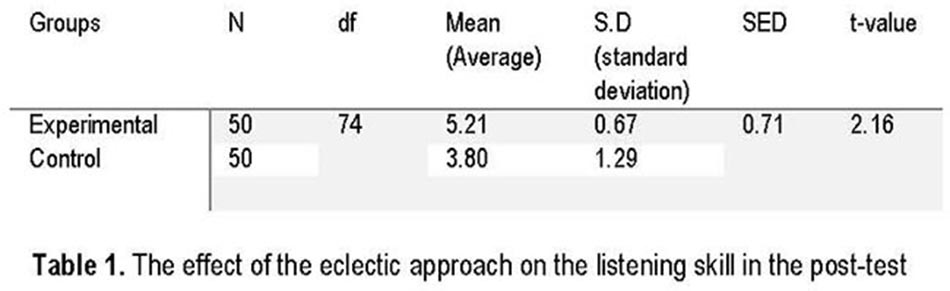
There were 28 students in each group. As shown in Table 1, the average of the control groups and experimental are 3.80 and 5.21 respectively, showing, in turn, the significant impact of the selecting approach on the listening skill of the experimental group. The S.D scores of the control groups and experimental are1.29 and 0.71 and respectively. The S.D values indicate that the experimental group had less variation and better results than the control group. The obtained t value is 2.16 and the t table value was 2.015, resulting in the rejection of the null hypothesis.
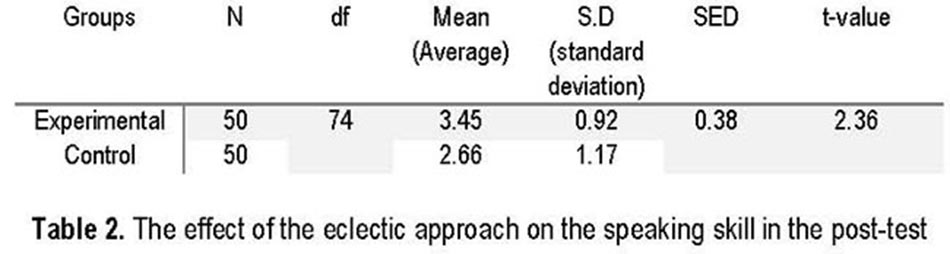
For speaking, there were 50 students in each group. According to Table 2, the average scores of the experimental and control groups were 3.45 and 2.66 respectively. The standard deviation scores of the experimental and control groups were 0.92 and 1.17 respectively. The obtained t value was 2.36 and the t table value was 2.015 which shows a significant difference between the two mean scores in the post-test in speaking, due to the implementation of the eclectic approach and leading, in turn, to the rejection of the null hypothesis.

For reading, there were 50 students in each group. As demonstrated in Table 3, The mean scores of the experimental and control groups were 3.67 and 2.94 respectively, revealing a significant difference. The standard deviation scores of the experimental and control groups were 0.92 and 1.15 respectively. The obtained t value was 2.16 and the t table value was 2.015. The experimental group outscored the control group in the reading skill, thus rejecting the null hypothesis.
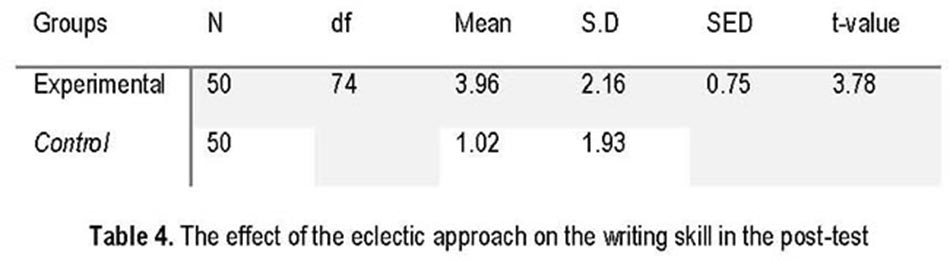
For writing, there were 50 students in each group. As shown in Table 4, the mean scores of the experimental and control groups were 3.96 and 1.02 respectively, revealing a significant difference. The standard deviation scores of the experimental and control groups were 2.16 and 1.93 respectively. The obtained t value was 3.78 and the t table value was 2.015, rejecting the null hypothesis. The experimental group outscored the control group in the writing skill, confirming the effectiveness of the eclectic approach.
The experimental group was exposed to teaching techniques based on the eclectic approach while thecontrol group was given its regular teaching treatment. The pre-test scores obtained by experimental and control groups show the same proficiency in their communication skills. The total treatment period was six weeks. At the end of the treatment period, the post-test was administered to both groups. The collected data were analyzed using the paired t-test of the inferential statistics. The significance level was 0.05 for all statistics and the obtained results have been interpreted as follows.
H01: The null hypothesis was rejected based on t-value 2.16 > 2.015 (table value) which shows thesignificant effect of the eclectic approach on students' listening skills. The results of the current study are consistent with the findings of Sultana (Sultana: 2014, pp. 45-48) who concluded that students who were exposed to the eclectic approach scored better in the listening skill.
H02: The null hypothesis was rejected based on t-value 2.36 > 2.015 (table value). The results of the current study show that students taught according to the eclectic approach outscored the control group in the speaking skill. They also confirm the findings of Hussain (Hussain: 2005, pp. 76-94) and Ubeid (Ubeid: 2013) who observed that students exposed to the eclectic approach obtained better results in the speaking skill compared to the control group.
H03: The null hypothesis was rejected based on t-value 2.16 > 2.015 (t table value). The results of the study confirm the findings of the research conducted by Chen (Chen: 2011) and Katmeba and Hulu (Katmeba and Hulu: 2013) which concluded that the students who were taught according to the eclectic approach obtained better results in their reading skill compared to the control group.
H04: The null hypothesis was rejected based on t-value 3.78 > 2.015 (t table value). In the writingtreatment, the mean score of the experimental group was 3.95 which was significantly higher than the mean score of the control group at 1.00 and showed the effect of the eclectic approach. Similar results were reported in the study of XiaoYun, Zhi-Yang, and Peixing (XiaoYun et al.: 2007) which found that the eclectic approach was significantly conducive to learners’ writing skills.
4. CONCLUSION
The present study has the following conclusions:
- 1. Following the post-test, the results showed that the experimental group performed better than the control group in the listening skill.
- 2. Following the post-test, the results showed that the experimental group performed better than the control group in the speaking skill.
- 3. Following the post-test, the results showed that the experimental group performed better than the control group in the reading skill.
- 4. Following the post-test, the results showed that the experimental group performed better than the control group in the writing skill.
BIODATA
B.M. HAKIM: Dr. Badia Hakim is the Vice Dean of English Language Institute (Women’s Main campus) King Abdulaziz University Jeddah – KSA. She has a Ph.D. in Understanding Reactions to ICT Adoption in Teaching English for Specific Purposes from the University of London- United Kingdom. She has been the core member of many committees about the Higher Education System of the university. Being an active researcher in the ELT field, she is always looking for challenging professional development programs. She has been supervising the academic and administrative affairs at ELI since 2007.
BIBLIOGRAPHY
AL-FAKI, MI, & SIDDIEK, GA (2013). Techniques used by teachers in correcting students' oral errors in an Omani Boys School. Theory and Practice in Language Studies,3(10). Finland: Academy Publisher Manufactured.
ASLAM, M (2003). Teaching of English (Second ed.). New Dehli: Foundation Books Pvt.Ltd. Print. pp.61
BIBI, A (2002). The comparative effectiveness of teaching English grammar with the help of textbooks and byusing group work activities. (Doctoral Dissertation) Alama Iqbal Open University, Islamabad, Pakistan. pp. 1-3.
BROWN, HD (2000). Principles of language learning and teaching. New York: Longman.
CHAN, V (2011). “Teaching oral communication in undergraduate sciences: Are we doing enough and doing it right?”. Journal of Learning Design, 4(3), pp. 71-79.
CHEN, HK (2011). “Efficient analysis of cognitive and eclectic English learning approaches from the perspective of the era of the knowledge economy- and experimental study of preschool education”. Tin Wen University of Sciences and Technology, Taiwan. The Journal of Human Resources and Adult Learning, 8(1).
DISVAR, H, & TAHRIRI, A (2009). “Investigating the Effectiveness of an Integrated Approach to teaching literature in an EFK context”. Journal of Pan-Pacific Association of Applied Linguistics, 13(2), pp. 105-116.
ELLIS, R (2002). “Does form-focused instruction affect the acquisition of implicit knowledge?”. A Review of the Research Studies in Second Language Acquisition, 24(2), pp. 223-236.
HORNBY, AS (2000). Oxford Advanced Learner's Dictionary. Oxford University Press, ISBN 0-19-431585-1
HUSSAIN, I (2005). Teaching English through Direct and Traditional Methods. (Doctoral Dissertation). Arid Agriculture University, Pakistan. pp.76-94.
JUN, YZ (2000). “Warm-up exercise in listening classes”. Kunming University of Science and Technology, Kunming, Yunan, China. The Internet TESL Journal, Vol.VI, No.10.
KATEMBA, VC, & HULU, G (2013). “Comparison of Grammar Translation Method and Eclectic Method in enhancing students' vocabulary achievement”. Journal of Education and Practice, 4(5).
KIM, Y, & KIM, J (2005). “Teaching Korean writing class: Balancing the Process and Genre Approach”. Asian EFL Journal Quarterly, 7(2), pp. 69-90
KIMHACHANDRA, I (2010). English teaching in grade seven. Victoria University, Melbourne, Australia. pp. 24-26.
KOCKA, A. 2007. The role of mother tongue in English Language teaching. Pardubice University, Czech Republic. pp.17-20.
LARSEN-FREEMAN, D (2004). Techniques and principles in language teaching. Oxford: Oxford University Press.
MEHMMOD, MS (2012). A comparative study of Direct, Communicative and Eclectic Approach in teaching ESL. Bhopal: Maulana Azad National Urdu University. LIST SEARCH, 11 (1), p. 12.
RAHMAN, T (2002). Language ideology and power: Language learning among the Muslims of Pakistan and North India. Karachi: Oxford University Press.
RIZVE, R (2012). The effect of peer tutoring on students' achievement in the subject of English at Secondary Level in Pakistan in the light of Vygotsky's theory. (Doctoral Dissertation) Foundation University, College of Liberal Arts and Sciences, Islamabad, Pakistan. pp. 99-119.
SAVAGE, KL, BITTERLIN, K, & PRICE, D (2010). Grammar matter: Teaching grammar in adult ESL programs. New York, USA: Cambridge University Press. pp. 1-39.
SUBON, F (2015). “Direct vocabulary instruction: The effects of contextualized word families on learners’ vocabulary acquisition”. Procedia Social and Behavioural Sciences, (224), pp. 284-291.
SULTANA, SA (2014). “Developing the technical writing skills of professional learners- An Eclectic Approach”.B.S. Abdur Rahman University, Vadular, Tamil Nado, India. International Journal of Research and Humanities, Arts and Literature, 2 (8), pp. 45-85.
TONGBOONYOUNG, N (2013). Use of film clips to enhance the English communicative skills of English Grade Thai Students. (Master’s thesis). (Teaching English as a Foreign Languages). Bankok Graduate School, Srinakharinwirot University.
UBEID, A (2013). The effect of Eclectic Teaching Strategies utilizing British Poetry in developing students' reading proficiencies in the English Language. University of Anbar, Iraq.
WAHLHEIM, A, CHRISTOPHER, N, BRIDGID, F, & LARRY, LJ (2012). “Metacognitive judgments of repetition and variability effects in Natural Concept Learning: evidence for variability neglect”. Memory & Cognition, pp.1- 4.
WICKHAM, R (2012). Role-play, dance, mime as language arts - for DPLI. Brighton Education Learning Service. pp.1-19.
XIAO-YUN, Y, ZHI-YANG, Z, & PEIXING, D (2007). “Principled eclecticism in college English in China”.Asian EFL Journal, Vol.1