Artículos
Sensitivity analysis of a direct problem solution to kinetic parameters changes in a given range
Análisis de sensibilidad de una solución de problema directo a cambios en los parámetros cinéticos en un rango dado
 O.A MEDVEDEVA oamedvedeva@kpfu.ru
S.I MUSTAFINA mustafina.sofya@mail.ru
D.Y SMIRNOV dmitry.box@mail.ru
S.A MUSTAFINA mustafina_sa@mail.ru
D.D YASHIN yashin.denis@mail.ru
O.A MEDVEDEVA oamedvedeva@kpfu.ru
S.I MUSTAFINA mustafina.sofya@mail.ru
D.Y SMIRNOV dmitry.box@mail.ru
S.A MUSTAFINA mustafina_sa@mail.ru
D.D YASHIN yashin.denis@mail.ru
Sensitivity analysis of a direct problem solution to kinetic parameters changes in a given range
Utopía y Praxis Latinoamericana, vol. 24, núm. Esp.6, pp. 304-316, 2019
Universidad del Zulia

Esta obra está bajo una Licencia Creative Commons Atribución-NoComercial-CompartirIgual 3.0 Internacional.
Recepción: 13 Octubre 2019
Aprobación: 30 Noviembre 2019
Abstract: The paper shows a technique of researching the direct kinetic problem sensitivity to the variation of the kinetic parameters within a given range. This technique is based on the use of the computing device of the interval analysis. The direct problem solution in the conditions of kinetic parameter uncertainty was received by the interval method of the solution of a Cauchy problem for differential equations system. The interval characteristics received during this method application were used for the research of reagents and product concentration sensitivity about kinetic parameters of a mathematical model of industrially important reaction.
Keywords: Chemical kinetics, direct kinetic problem, interval analysis, sensitivity of decision.
Resumen: El artículo muestra una técnica de investigación de la sensibilidad del problema cinético directo a la variación de los parámetros cinéticos. Esta técnica se basa en el uso del dispositivo informático del análisis de intervalos. La solución del problema directo en las condiciones de incertidumbre de los parámetros cinéticos se recibió mediante el método de solución de intervalo de un problema de Cauchy para el sistema de ecuaciones diferenciales. Las características de intervalo recibidas durante la aplicación de este método se usaron para la investigación de reactivos y sensibilidad de concentración de productos en relación con reacciones de importancia industrial.
Palabras clave: Análisis de intervalos, cinética química, problema cinético directo, sensibilidad de la decisión.
1.INTRODUCTION
Mathematical modeling of a chemical process begins with a kinetic model. The kinetic model determines the reaction rate. The kinetic model includes the reaction mechanism, the speed equations of individual stages, kinetic parameters (constants of the speed and activation energy) and some simplifying provisions about the role of individual stages. Changes in concentrations of substances can be described by kinetic curves of flow or formation of reaction reagents and products. To construct such dependencies, it is necessary to solve a direct kinetic problem. The main task of chemical kinetics is to calculate the composition of a multicomponent reacting mixture and the reaction rate.
The paper studies the influence of uncertainty in kinetic parameters on the results of solving the directproblem of chemical kinetics. Kinetic data are represented in intervals and are considered as objects of interval analysis. A modified method of interval sensitivity analysis was used to solve the direct kinetic problem (Shary: 2013; Mustafina et al.: 2017, pp. 805-815; Khaydarov et al.: 2012, pp. 112-114; Pakdel & Ashrafi: 2019; Annía, Villalobos, Romero, Ramírez & Ramos: 2018). The main idea of this method is to analyze partial derivatives of the parameter solution. For the implementation of this method, the technique of interval analysis is used.
In work (Shary: 2013) it is shown that the problem of not uniqueness of the solution of the inverse problem of determination of kinetic parameters can be solved by reduction of the generally accepted statement of the given problem, to a kind according to which the area becomes the solution, arbitrary variation of kinetic constants of speeds in which the demanded quality of the description of experiment is kept. One of the approaches to determine the desired area is based on the application of the computational apparatus of interval analysis to calculate the uncertainty intervals of kinetic parameters (Mustafina et al.: 2017, pp. 805- 815; Ramírez, Lay, Avendaño y Herrera: 2018; Rincón, Sukier, Contreras y Ramírez: 2019).
2. MATERIAL AND METHODS
The mathematical model of a chemical reaction is a system of ordinary differential equations of the first order with given initial conditions:

Where i Xi – concentration of the i-th component (molar shares), n – the number of substances, k –vector of kinetic constants of reaction speeds of m dimension, Т – reaction course time. The system of the equations with entry conditions (1) represents the definition of Cauchy problem for ordinary differential equations systems.
In some cases, there is a need for the direct problem solution in the conditions of initial physical and chemical information uncertainty (Mustafina et al.: 2017, pp. 805-815). We will understand representation of speeds constants in an interval form as the partial uncertainty in kinetic data (Khaydarov et al.: 2012, pp. 112- 114). Thus we will present the speeds constants vector in the form (Kalmykov: 1986).

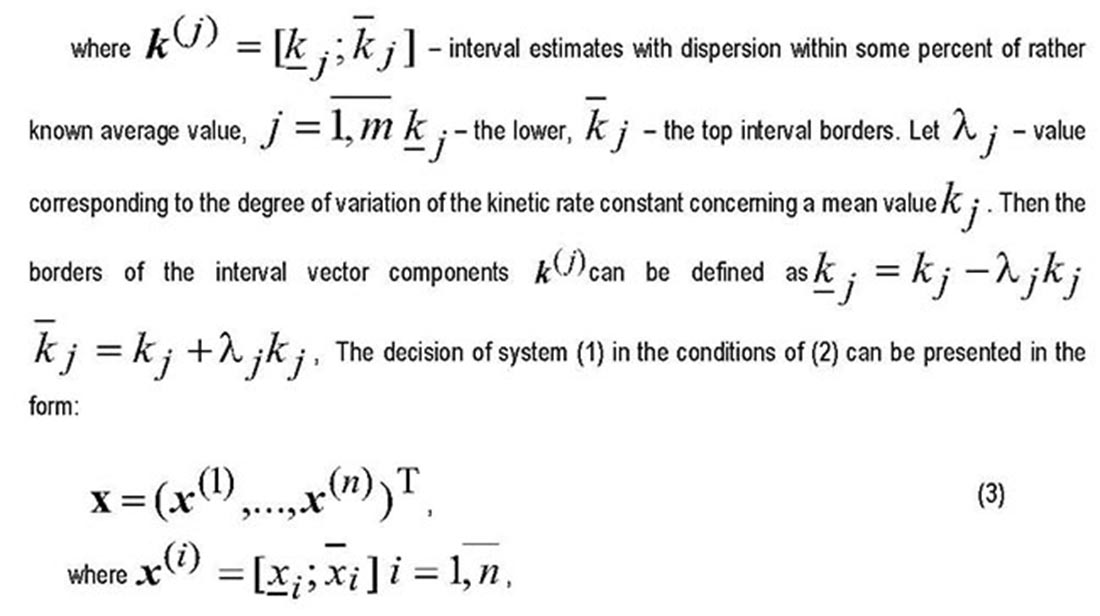
The decision of system (1) in the conditions of (2) can be received by various numerical methods of the Cauchy problem interval solution (Aris: 2000). In (Field et al.: 1974, pp. 1877-1884) the algorithm of the combined method of the sensitivity interval analysis adapted for the solution of chemical kinetics problems is described. Its main idea is reduced to the following actions (Nickel: 2014).
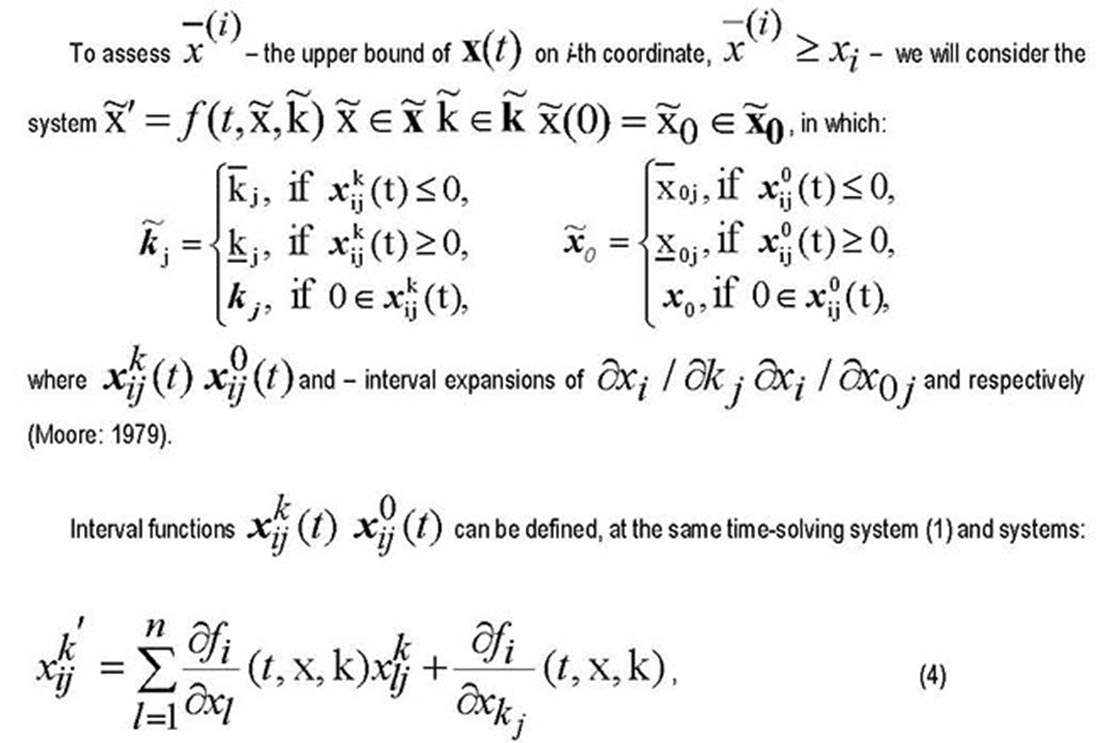
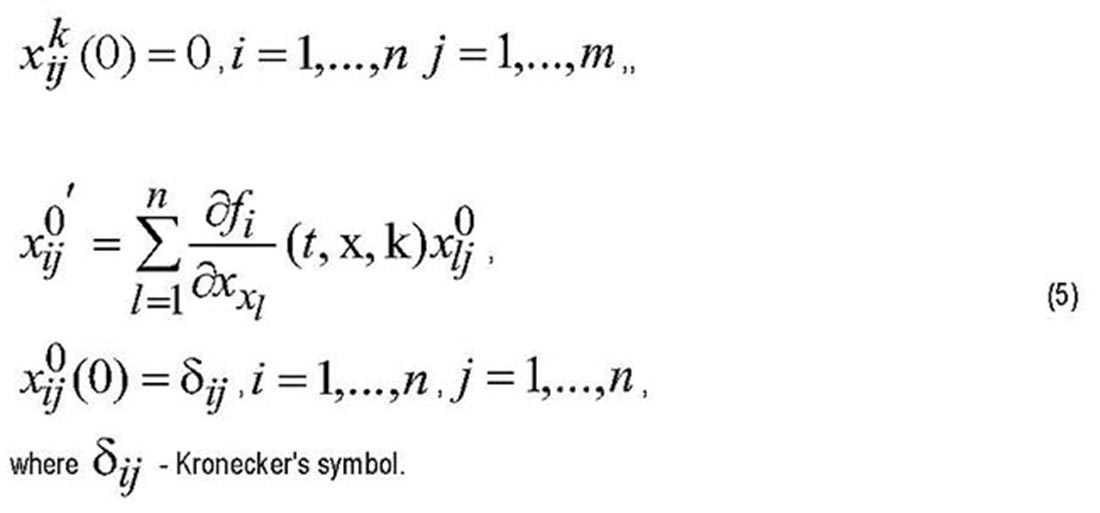
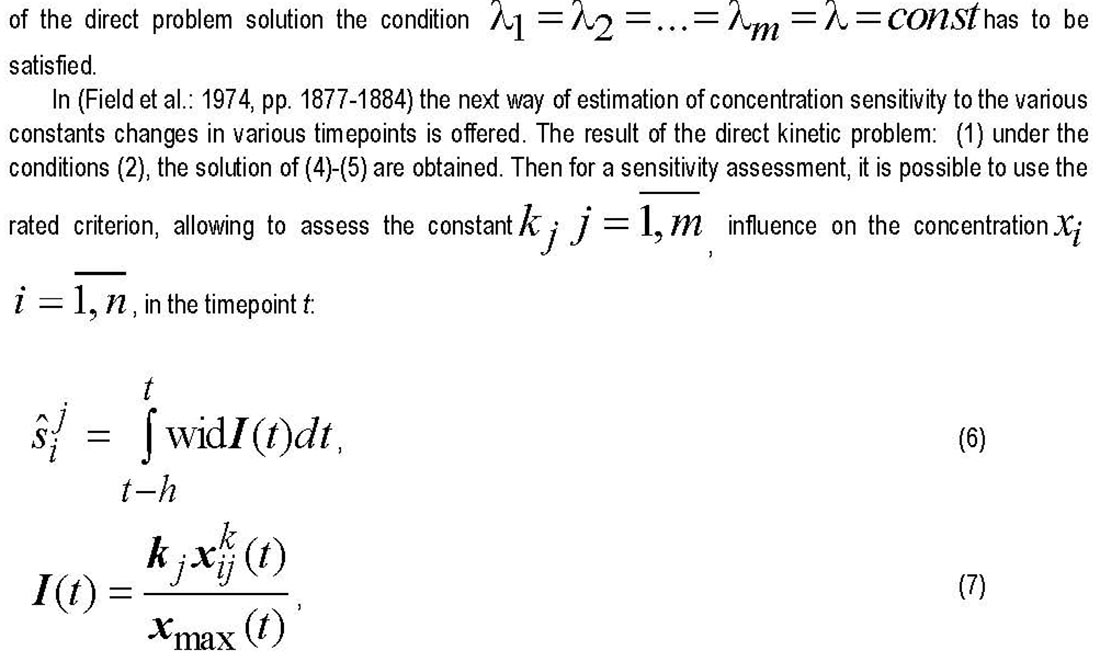
The research of the direct kinetic problem sensitivity to the variation of the kinetic parameters in some areas of uncertainty (2) consists of an assessment of the influence of kinetic model parameters on a reaction yield (Shangareeva et al.: 2016, pp. 645-649). This suggests what of speeds constants are defining at different stages of reaction. The result of solving the direct problem with interval kinetic parameters is the bilateral solution (3). It is characterized not by one dot value of concentration in each time point of reaction course, but by the interval of all possible values (Grigoryev et al.: 2016, pp. 617-622; Mustafina: 2017, pp. 805-815). The width of the received intervals of concentration can be used for an assessment of extent of rate constants influence to the corresponding concentration (Epstein et al: 1983, pp. 112-123; Mohammadi & Yekta: 2018, pp. 1-7). The widest calculated interval testifies to the greatest influence of a constant on this concentration. The narrowest interval corresponds to the smallest constant influence. To adequately assess the sensitivityof the direct problem solution the condition

has to saisfed.

3. RESULTS
The computational experiment was carried out for the reactions proceeding without the change of reaction volume (reaction of reception of phthalic anhydride) and taking into account its change (reaction of oligomerization of α-methyl styrene). We will carry out the sensitivity analysis on the example of the reaction of receiving phthalic anhydride proceeding, without the change of reaction volume (Ostrovsky et al: 1994, pp. 755-767; Laureano et al.: 2018, pp. 4-7). It should be noted that the technique given here applies to the reactions proceeding with the change of reaction environment mole number (Slinko: 2004, p. 488). We will enter the following designations: А1 – naphthalene (initial substance), А2 – naphthoquinone, А3 – target product – phthalic anhydride, А4 – carbon dioxide, А5 – maleic anhydride. A set of the chemical transformations describing the reaction taking into account the entered designations is represented the following scheme of stages:

We will construct a mathematical model of considered reaction course according to the general theory of creation of the mathematical description of chemical processes (Spivak: 2009, pp. 1056-1059). According to the law of the operating masses, the kinetic equations corresponding to the (9) can be expressed the equations:
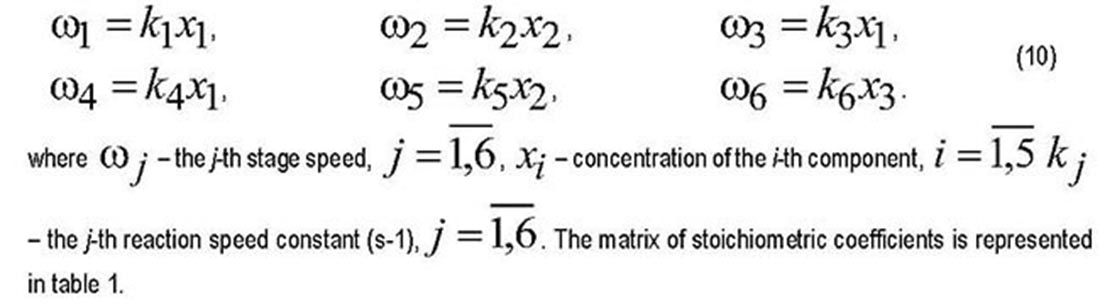
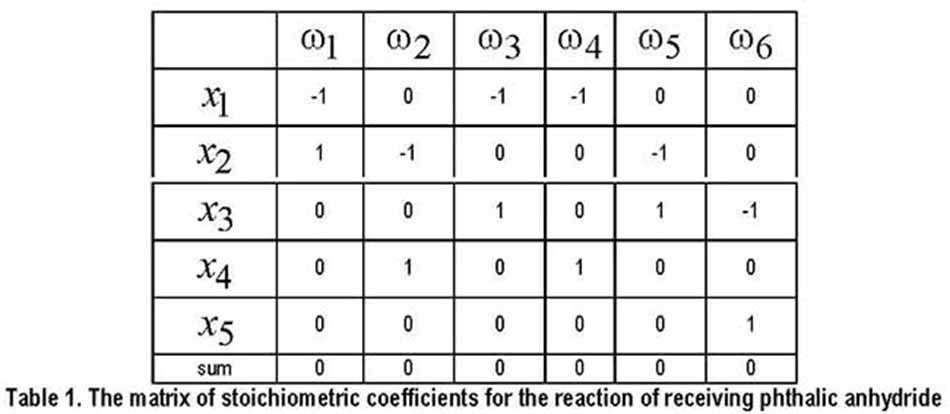
The right parts of the equations in system (11) taking into account (10) and the matrix of stoichiometric coefficients:
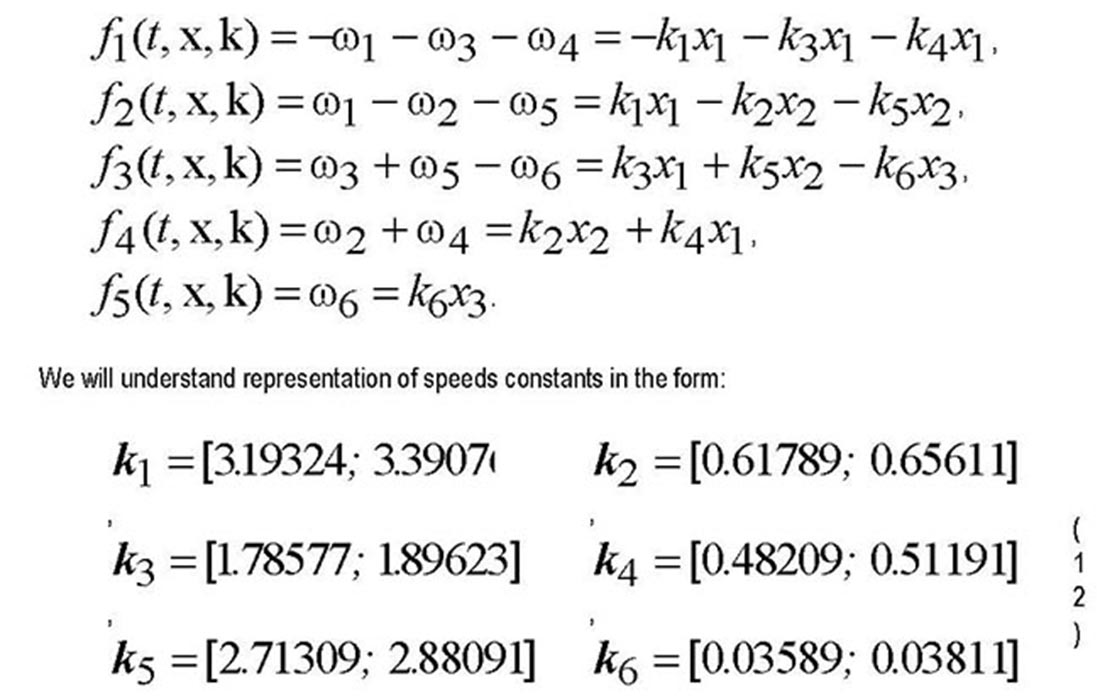
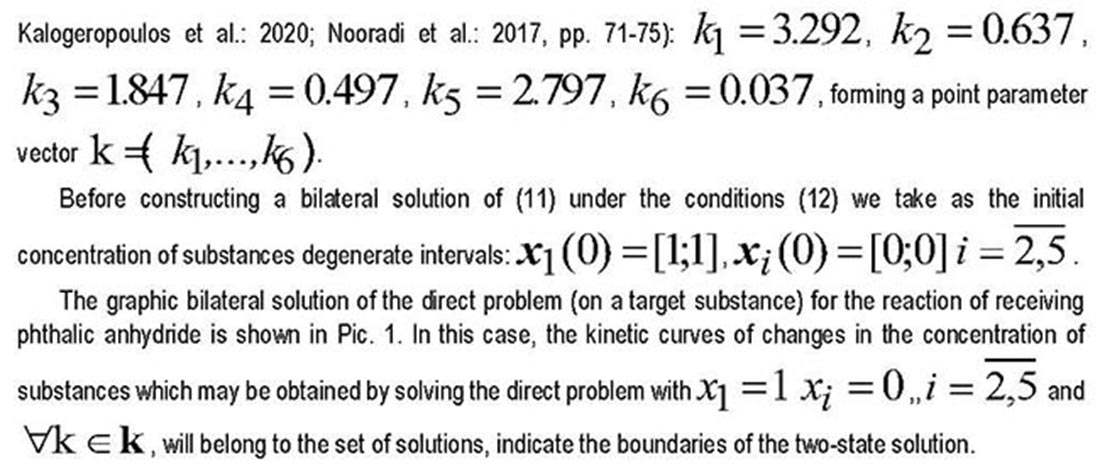
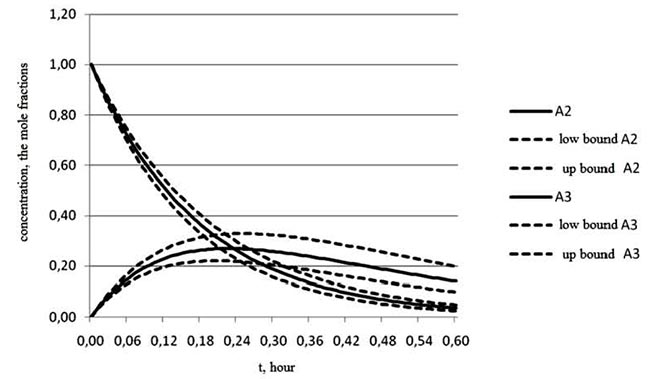
Pic. 1. Changing the concentration of naphthalene and naphthoquinone
Also in this study, we analyzed the influence of variation in values of constant reaction concentrations preparation of phthalic anhydride. The analysis shows that the concentration of the reaction products A2, A5 are insensitive to changes in the parameter k1, thus influence its change in limits of the considered uncertainty interval on the concentration of substances A1, A3, A4 occurs practically equally. The greatest influence of the rate constant k2 is happening about changes in the concentration of substance A2, and only one of the five substances A1 is independent of its variation. The rate constant k3 does not affect the concentration A2 but retains influence on the dynamics of the remaining reagents. The rate constant k4 is the only parameter whose change does not remain traceless at reaction course, though the extent of its influence on concentration is rather small. The rate constant k5 makes the maximum impact on substance A2, not affecting the output A4, A5. The rate of constant k6 has the least impact on the course of the reaction. Change of concentration of a target product depends on the degree of variation of all constants at the same time, thus, as expected, the rate constants k1, k2 and k4 have the greatest impact.
Pic. 2-3 allows analyzing the substances concentration changes sensitivity in the variation of kineticconstants at certain time intervals (the number of columns in the chart, corresponding substance Ai i = 1,5, equal to the number of segments of the partition slot in the numerical solution of the directproblem. The figures show that in all cases where the rate constant influence on the substance concentration occurs, there is a tendency to increase the width of the two-state solution of the direct problem in time. This once again confirms the Moore effect during the interval calculations.
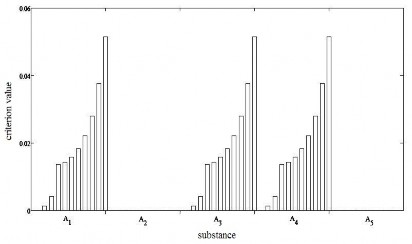
Pic. 2. The sensitivity of reagent and product concentrations of phthalic anhydride tokinetic parameters k1.
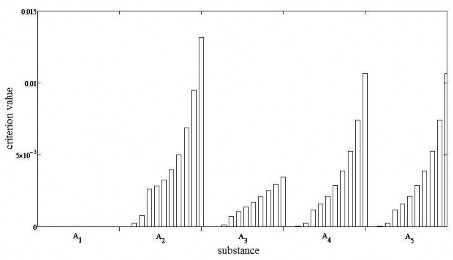
Pic. 3. The sensitivity of reagent and product concentrations of phthalic anhydride tokinetic parameters k2.
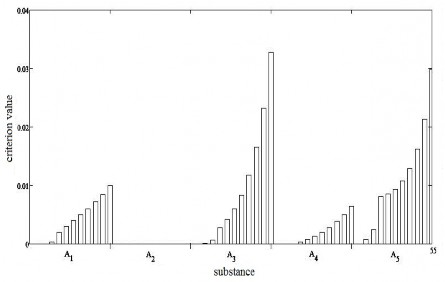
Pic. 4. The sensitivity of reagent and product concentrations of phthalic anhydride tokinetic parameters k3.
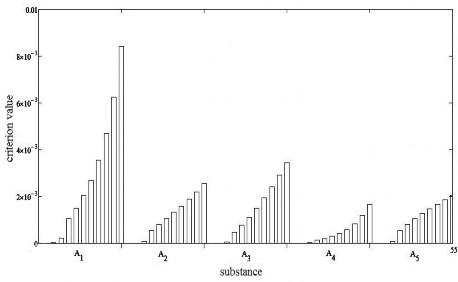
Pic. 5. The sensitivity of reagent and product concentrations of phthalic anhydride tokinetic parameters k4.
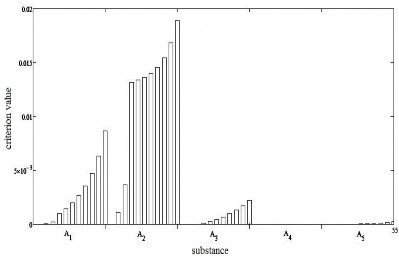
Pic. 6. The sensitivity of reagent and product concentrations of phthalic anhydride tokinetic parameters k5.
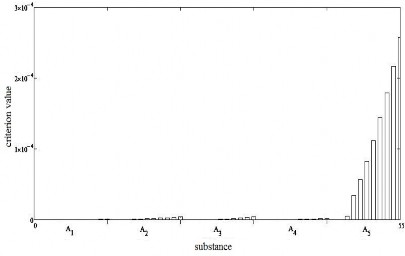
Pic. 7. The sensitivity of reagent and product concentrations of phthalic anhydride tokinetic parameters k6.
The rate constant k 4 is the only parameter whose change does not remain traceless at reaction course, though the extent of its influence on concentration is rather small. The rate constant k5 makes the maximum impact on substance A2 , not affecting the output A4 A5 ,. The rate constant k6 has the least impact on the course of the reaction. Change of concentration of a target product depends on the degree of variation k k k of all constants at the same time, thus, as expected, the rate constants 1, 2 4 and have the greatest impact.
Analyzing the results obtained by changing the porosity of the kinetic parameters in the range from 5% to 10%, we can assume that the variation of the kinetic data is not the crew dynamics grid, while the output of the main products is sensitive to porosity on average by no more than 16% -33% – for the first, 15% -30% - for the second reaction. Also, increasing the error in the kinetic parameters reduces the time interval at which it is possible to build the optimal boundaries of the set of solutions of the direct problem by the method of interval sensitivity analysis.
4. CONCLUSIONS
Thus, based on the interval analysis methods the boundaries of the chemical kinetics direct problem solution were obtained. The result analysis gained under the accuracy measurement of kinetic parameters in the range of 5% to 10% lets us conclude that kinetic data variations do not influence the dynamics of the curves, while the basic product yield is sensitive to the accuracy of not more than 15% -30% in average. Besides, when increasing the accuracy in kinetic parameters the time interval decreases. It allows modeling efficient boundaries of several direct problem solutions with the interval response analysis method.
BIODATA
O.A. MEDVEDEVA: Olga Anatolievna Medvedeva received higher education from 2002-09-01 to 2007-06-26 at the Faculty of Physics and Mathematics in Sterlitamak State Pedagogical Academy, Sterlitamak, Russia. Holds doctor of philosophy (Ph.D.), Associate Professor at Department of Programming Technologies, in Kazan federal university, Kazan, Russia (main employee) from 2017-10-02 to present.
S.I. MUSTAFINA: Sofya Ilshatovna Mustafina received a Bachelor Degree in Biophysics and Biotechnology at Voronezh State University, Voronezh, Russia from 2007-09-03 to 2011-06-30, and received higher education from 2013-09-03 to 2017-06-20 at Bashkir State University, Ufa, Bashkortostan, Russia. The research area is math modeling, scientific modeling, and physical sciences.
S.A. MUSTAFINA: Svetlana Anatolyevna Mustafina received higher education at the Department of Mathematics, Bashkir State University, Ufa, Bashkortostan, Russia from 1984-09-01. Holds Doctor, Professor, and Dean at Faculty of Mathematics and Information Technology in Bashkir State University, Sterlitamak Branch, Sterlitamak, Russia from 1993-09-01 to present. The research area is math modeling, chemical sciences.
D.Y. SMIRNOV: Denis Yuryevich Smirnov received a Bachelor of Software Engineering at Faculty of Computer Science in National Research University Higher School of Economics, Moscow, Russia from 2011- 09 to 2015-06, received Master of Data Science at Faculty of Computer Science in National Research University Higher School of Economics, Moscow, Russia, from 2016-09 to 2018-06, received Master of Computer Science at Université Clermont Auvergne, Clermont-Ferrand, Auvergne, FR, from 2017-09 to 2018- 09.
D.D. YASHIN: Denis Dmitrievich Yashin received higher education at Faculty of Information Systems and Technologies, Ulyanovsk State Technical University, Ulyanovsk, 73, Russia, from 2009-09-01 to 2014-05-31. Holds assistant at Faculty of Information Systems and Technologies, Ulyanovsk State Technical University from 2015-09-01 to present (employment).
ACKNOWLEDGEMENTS
The work is performed according to the Russian Government Program of Competitive Growth of Kazan Federal University and the study was funded by RFBR according to the research project №17-47-020068 and project No. 13.5143.2017 / 8.9.
BIBLIOGRAPHY
ANNÍA G, María Eugenia., VILLALOBOS ANTÚNEZ, José Vicente., ROMERO PABÓN, Julio Cesar., RAMÍREZ MOLINA, Reynier Israel., & RAMOS MARTÍNEZ, Yanelis. (2018). “Conciencia ética en organizaciones universitarias: un estudio fenomenológico de la praxis como continua formación”. In Revista Inclusiones, 5(4), pp. 179-195.
ARIS, R (2000). The Optimal Design of Chemical Reactors A Study in Dynamic Programming by Rutherford Aris (Vol. 3). Elsevier.
EPSTEIN, IR, KUSTIN, K, DE KEPPER, P, & ORBÁN, M. (1983). “Oscillating chemical reactions”. Scientific American, 248(3), pp. 112-123.
FIELD, RJ, & NOYES, RM (1974). “Oscillations in chemical systems. IV. Limit cycle behavior in a model of a real chemical reaction”. The Journal of Chemical Physics, 60(5), pp. 1877-1884.
GRIGORYEV, I, MUSTAFINA, S, & LARIN, O (2016). “Numerical solution of optimal control problems by the method of successive approximations”. International Journal of Pure and Applied Mathematics, 111(4), pp. 617-622.
KALMYKOV, SA, SHOKIN, YI, & YULDASHEV, ZK (1986). “Methods of interval analysis”. Science Press, Siberian Division, Novosibirsk.
KALOGEROPOULOS, P, RUSSO, JA, SULLIVAN, P, KLOOGER, M, & GUNNINGHAM, S (2020). “Re-enfranchising Mathematically-alienated Students: Teacher and Tutor Perceptions of the Getting Ready in Numeracy (G.R.I.N.) Program”. International Electronic Journal of Mathematics Education, 15(1).
KHAYDAROV, AG, CHEPIKOVA, VN, KHOLODNOV, VA, BOROVINSKAYA, ES, & RESHETILOVSKIY, VP(2012). “Research of sensitivity of kinetic parameters of biocatalytic process with the use of an interval method”. In News of the St. Petersburg state institute of technology, 14, pp. 112-114. technical university.
LAUREANO, RMS, FERNANDES, AL, HASSAMO, S, & ALTURAS, B (2018). “Facebook Satisfaction and Its Impacts on Fundraising”: A Case Study at a Portuguese Non-Profit Organization. Journal of Information Systems Engineering & Management, 3(1), pp. 4-7.
MOHAMMADI, S, & YEKTA, P, (2018). “The Effect of Emotional Intelligence on Job Satisfaction among Stuff Nurses in Intensive Care Units”. UCT Journal of Social Sciences and Humanities Research, 6(2), pp. 1-7.
MOORE, RE (1979). Methods and applications of interval analysis. Society for Industrial and Applied Mathematics.
MUSTAFINA, S, VAYTIEV, V, & GRIGORYEV, I (2017). “The method of the research of the direct problem to the variation of the kinetic parameters within a given range”. International Journal of Pure and Applied Mathematics, 112(4), pp. 805-815.
NICKEL, KL (Ed) (2014). Interval mathematics 1980. Elsevier.
NOORADI, M, BAGHERI NIA, H, & OULIAEY, A (2017). “Are the manager's bases of power related to job satisfaction?” UCT Journal of Management and Accounting Studies, 5(3), pp. 71-75.
RAMÍREZ MOLINA, Reynier Israel; LAY, Nelson; AVENDAÑO, Inirida & HERRERA, Belina. (2018). “Liderazgo resiliente como competencia potenciadora del talento humano”. In Opción. Revista de Ciencias Humanas y Sociales. Vol. 34, No. 86: 826-854. Maracaibo (Venezuela).
RINCÓN, Yanyn; SUKIER, Harold; CONTRERAS, Jairo & RAMÍREZ MOLINA, Reynier Israel. (2019). “Responsible Communication Strategies for Small and Medium-Sized Enterprises”. In Opción. Revista de Ciencias Humanas y Sociales. Vol. 35, No.89-2: 1208-1234. Universidad del Zulia. Maracaibo (Venezuela).
OSTROVSKY, GM, VOLIN, YM, BARIT, EI, & SENYAVIN, MM (1994). “Flexibility analysis and optimization of chemical plants with uncertain parameters”. Computers & chemical engineering, 18(8), pp. 755-767.
PAKDEL, M, & ASHRAFI, M (2019). “Relationship between Working Capital Management and the Performance of Firm in Different Business Cycles”. Dutch Journal of Finance and Management, 3(1)
SHANGAREEVA, G, GRIGORYEV, I, & MUSTAFINA, S (2016). “Comparative analysis of the numerical solution of optimal control problems”. International Journal of Pure and Applied Mathematics, 110(4), pp. 645- 649.
SHARY, SP (2013). Finite-dimensional interval analysis. Institute of Computational Technologies, SB RAS, Novosibirsk.
SLINKO, MG (2004). “Fundamentals and principles of mathematical modeling of catalytic processes”. Boreskov Catalysis Institute, Novosibirsk (2004, in Russian), p. 488.
SPIVAK, SI (2009). “Informativeness of kinetic measurements”. Bulletin of the Bashkir University, 14(3 (1)), pp. 1056-1059.
TSAREVA, ZM, & ORLOVA, EI (1986). “Teoreticheskie osnovy khimicheskoi tekhnologii (Theoretical Foundations of Chemical Technology)”. Theoretical Foundations of Chemical Engineering, Kyiv: Vishcha Shkola, 35.