Artículos
Assessment of organizations readiness for networking collaboration
Evaluación de la preparación de las organizaciones para la colaboración en red
 A.R. SADRIEV a-sadriev@yandex.ru
B.N. KAMAEV kamaev_b@mail.ru
A.R. SADRIEV a-sadriev@yandex.ru
B.N. KAMAEV kamaev_b@mail.ru
Assessment of organizations readiness for networking collaboration
Utopía y Praxis Latinoamericana, vol. 24, núm. Esp.6, pp. 324-334, 2019
Universidad del Zulia

Esta obra está bajo una Licencia Creative Commons Atribución-NoComercial-CompartirIgual 3.0 Internacional.
Recepción: 15 Octubre 2019
Aprobación: 30 Noviembre 2019
Abstract: The paper investigates the organization's readiness to network interaction while implementing innovation activities. The inclination to take part is being analyzed with the use of factors, including the “organization competency profile”, “organization flexibility”, “media relevance of organization data on the Internet” and “level of development of the organization’s cooperative relationships”. The process of the quantitative data is carried out with the help of the main components method, the functionality is realized with the implementation of the FactoMinerR software package. As a result, the ranked data on 109 relevant organizations, revealing their predisposition to the cooperation of the innovation network.
Keywords: Innovation network, participants, readiness for network interaction, method of main components.
Resumen: El documento investiga la preparación de la organización para interactuar en red. La inclinación a participar se está analizando con el uso de factores, que incluyen el "perfil de competencia de la organización", la "flexibilidad de la organización", la "relevancia mediática de los datos de la organización en Internet" y el "nivel de desarrollo de las relaciones de cooperación de la organización". El procesamiento de los datos cuantitativos se realiza con el método de componentes principales, la funcionalidad se realiza con el paquete de software FactoMinerR. Los datos clasificados de 109 organizaciones relevantes, revelando su predisposición a la cooperación de la red de innovación.
Palabras clave: Red de innovación, participantes, disponibilidad para la interacción de la red, método de componentes principales.
INTRODUCTION
Management of the network development of innovation when creating various target technologies predetermines the need for investigating the level of organizations’ preparation for participation in the operation of an innovation network of the relevant technological profile. In this respect the issue of the formation of a range of organizations, which profile of activities correlates with the specifics of the tasks on production of the equipment of a certain technological profile, as well as searching in this range the business actors who are most susceptible to participating in-network communities, is gaining exceptional relevance (Sadriev et al.: 2017, pp. 928-938; Ermolaev et al.: 2017, pp. 810-822; Ahmadi & Movahed: 2019, pp. 1-10).
This very study is oriented towards the resolution of this problem, within the course of which it is beingproposed to detect the groups (clusters) of developers of the particular energy equipment, that are capable of joining the members of the innovation network with the corresponding technological specialization.
It is worth being mentioned that a great amount of researches is devoted to addressing a variety ofnetworking issues in the creation of innovations of diverse technological profiles. From the viewpoint of the formal definition of the nature of the open innovative cooperation, the study of K. Larsen and A. Salter deserves special attention (Laursen & Salter: 2006, pp. 131-150; Maragheh et al.: 2019, pp. 6-12; Villallobos & Ganga, 2016; Villalobos & Ganga, 2018; Villalobos, Guerrero & Romero, 2019).
Openness to network interaction is considered in it from the position of company orientation to the third-party organizations’ resources application in innovative activities. The consideration of the corporate innovative activity’s openness, belonging to J. Henkel (Henkel: 2006, pp. 935-969; Martins et al.: 2019), is somewhat different. He suggests linking it to the dynamics of the transmission process of the previously hidden knowledge of the external environment.
System work on knowledge creation, its accumulation and use both within and beyond the organization throughout the entire innovation process, is determined by the openness of innovation activities according toU. Lichtenthaler (Lichtenthaler: 2011, pp. 75-93). One's vision about possible differentiation of the level of the corporate innovative model openness was proposed by L. Dalander and D.M. Gann (Dahlander & Gann: 2010, pp. 699-709).
Among the parameters that can be applied, they listed, first, the organization’s formal and informal protection, second, the number of external sources of ideas used for innovation creation, and, third, the extent to which a company counts on formal and informal relations with the other market actors. V. Lazzarotti and R. Manzini (Lazzarotti & Manzini: 2009, pp. 615-636; Ramos: 2007; Martínez, Ramos y Annía: 2019) outlined the existence of the four main forms of collaboration, depending upon the values of the two variables, including the number of external partners and the number of phases of the company’s innovation process, open for external cooperation.
A different combination of these variables provides, in compliance with their opinion, the following classification of the forms of openness: open innovator; closed innovator; specialized collaborator; integrated collaborator. A. Barge-Gil (Barge-Gil: 2010, pp. 577-607) suggested linking the degree of openness of the company in innovation to the strategy of its behavior. He defined such strategic alternatives such as open, semi-open and closed ones.
Explaining the difference between a closed strategy and an open one, the author of the approach statesa lower degree of importance of external resources for a closed innovator and relates his actions with the orientation towards his efforts. J. West and S. Gallagher (West & Gallagher: 2006, pp. 319-331; Annía, Villalobos, Romero, Ramírez & Ramos, 2018) considered the potential alternatives in terms of open innovations strategy. A similar approach to investigating open innovation systems can be found in the writings by O. Gassmann and E. Enkel (Enkel: 2009, pp. 311-316).
They stipulated three types of open innovative processes: from the external environment – to internal processes (outside-in process); from the internal environment to external processes (outside-in process); and a coupled process. An alternative classification of innovative business models is developed by A. Sandulli and G. Chessbrough (Sandulli & Chesbrough: 2009), who suggests using such types as open, partially open (buying innovations), partially open (selling innovations) and closed.
Recently, there has been quite a lot of research that reveals the weakness and constraints of the open innovation model. The work of M. Elquist, T. Fredberg and S. Ollil (Elmquist: 2009, pp. 326-345; Ramírez, Chacón & El Kadi: 2018; Lay, Ramírez & Villalobos: 2019; Rincón, Sukier, Contreras & Ramírez: 2019) identifies the core situations in which this model can become an effective tool for implementing innovation policy as well as the situations where its application is not advisable. A critical view on open innovation can be seen in the writings of M. Ozman (Ozman: 2011, pp. 26-34), F. Piller and D. Walcher (Piller & Walcher: 2006, pp. 307-318), P. Trott and D. Hartmann (Trott & Hartmann: 2009, pp. 715-736).
MATERIAL AND METHODS
Within the course of the research, the evaluation of organizations’ readiness to participate in the operation of innovative networks was carried out with the help of four synthetic factors. These factors were given the formal names ‘competence profile of the organization’, ‘assortment flexibility of the organization’, ‘media relevance of data on the organization on the Internet’, and ‘level of cooperative relations development’.
The ‘competence profile’ factor is designed to reveal compliance of the accumulated by the organization in question professional abilities with the requirements imposed on the participants of the process of development of a certain technology or a sample of technics. From a formal point of view, the appraisal of the competency profile can be carried out drawing on the analysis of the following basic data.
First, the data on the scale of overlap of the sphere of activity of the organization in question on the subject area the object planned for development by the efforts of the innovation network belongs to. Second, the data, confirming the presence of research, design and experimental units within the structure of the organization, which can be entrusted with the mission of expanding the existing knowledge and skills and creating the new ones in the targeted scientific and technical field.
Third, data on the security of the organization with the relevant intellectual property objects registered in classes and groups (subgroups) of the International Patent Classification, belonging to classes and groups (subgroups), within the boundaries of which the work on the creation of appropriate innovative developments is planned to be performed.
The purpose of the ‘assortment flexibility’ factor is a reflection of the extent of differentiation of the product series of a certain organization and the share of innovative products in this series. The final values of this factor will make it possible to judge the potential ability of the organization to undertake tasks that go beyond its traditional technological way.
In the extreme case when an organization’s product series is limited to the only value proposition, whichis also typical to the industry market, the value of the proposed factor will be minimal. If the product series, on the contrary, is characterized by a considerable number of types of products, a significant part of which has no direct analogs, the ‘assortment flexibility’ factor will take its maximum value.
It is being suggested to use the ‘media relevance’ factor for the determination of the significance of thescope of activity for the organization in question and the products manufactured by it for the current needs in the corresponding segment of the target market. To formalize the procedures of assessing this factor, the data of the so-called organic traffic can be applied, which represents the structured information on quantitative characteristics of the unique visitors’ flow, who visit the Internet resource of a particular organization.
The scale and dynamics of this flow, which is formed and directed by global search engines, depend primarily upon the peculiarities of the semantic core of the corporate site on the Internet. At the same time, the semantic core is inherently derived from keywords, phrases and all their many morphological forms,which predominantly reflect the structure of the site of the organization, and, specifically, the types of activities it is engaged in as well as the products it specializes on (Nalbandi & Zonoozi: 2019).
Thus, it appears to be, that each accomplished transition from the results of the organic output of the search engine to the resource of a specific organization eventually forms the same organic traffic. Given that organic traffic does not include the traffic created by contextual advertising, however, it at the same time largely depends upon the indexation of the site in the search engine, it can rightly be considered as a very objective source of data on compliance of the value proposals of the organization with the most relevant market trends (Revisan et al.: 2020).
Within the confines of this study the specialized analytical platform "SE Ranking," located at the followingdomain https://online.seranking.com/research.overview.html, was used as an informational.
The last, fourth factor – ‘level of cooperative relations development’, is intended for taking account of the degree of openness of the organization under analysis to the development of cooperative chains in analytical procedures. Calculation of values of this factor is proposed to be performed, drawing on the data on the number of links of organization in question with the other participants of the energy equipment market at the time of analysis conducted. Herewith as the sources of information were defined both corporate Internet resources and news feeds, containing reports on active or newly signed partner agreements between developers of various energy technologies and samples of equipment.
In the course of the study, the set of factors presented was analyzed to ascertain their statisticalsignificance. To do this, the method of main components, which functional opportunities have been implemented with the use of a software package "FactoMinerR."The approbation of the proposed approach to investigating organizations’ readiness for networking interaction was carried out on the example of the sphere of activity on the creation of gas turbine power plants with a capacity of up to 300 MW. For this purpose, a preliminary list of more than two hundred organizations which activities are directly or indirectly connected with the design and production of gas turbine plants was made up.
After the iterative processing of the list, some of its member organizations were removed for the reasons,associated with the lack of or the absence of data on their operation. As a result, in the final version of the list 109 organizations were retained, for which the data had been collected, opening up the contents of all four factors necessary for conducting of the procedures on determining the degree of the predisposition of each of these organizations to participate in the network interactions.
RESULTS
At the first stage of the study, the composition of the proposed factors was clarified to maintain in it the most significant factors only. The given task is consistent with traditional factor analysis standards designed to reduce the number of variables describing a particular data array. The application of the two special criteria: the Kettel criterion and the Kaiser criterion can ensure that an optimal number of factors, revealing the predisposition of organizations to form innovative networks, can be identified. This very study appeared the first one to consider the Kettel criterion. It was calculated using the get_eigenvalue [factoextra package] function, implemented in an open software environment for statistical data processing and the work with "RStudio" (R) graphics. The results of the calculations performed are shown in Figure 1.
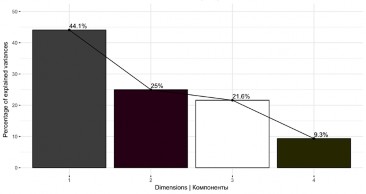
As can be seen from the analysis of the information shown in the figure, the proportion of the first-factor variation in the total data variance is 44.1%. The comparable share values of variation; 25.0% and 21.6% respectively were recorded in the second and the third factors. For the fourth factor, it was registered at just 9.3%. That is reflected in the appearance of the inflection points in the graph, one of which is between the eigenvalues of variation for the first and second factor, and the other one is between the eigenvalues of variation for the third and the fourth factors. The bending at the second point turns out to be a more articulate one, which indicates the minimal significance of the fourth factor – the level of the cooperative connection’s development in a row under consideration.
To confirm this conclusion, the calculation of the Kaiser criterion was performed, the results of which areorganized in Table 1. In the given chart the values of the cumulative share of a variety of factors (principal components) in the overall data variance are of the greatest interest.
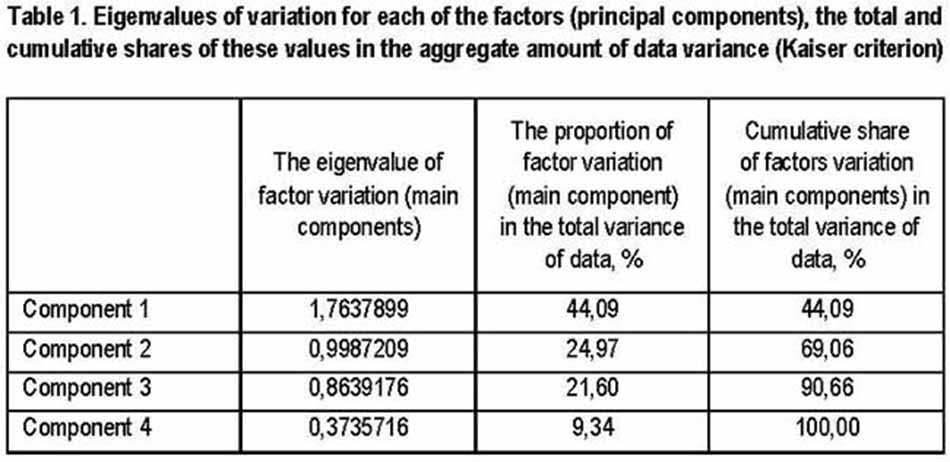
Drawing on the data received, one might conclude, that 69.06% of the variation is due to the eigenvalues of the first two factors, and 90% of the variation is due to the first three factors. Thus, it can be considered that in the course of further analytical procedures, it is possible to confine ourselves merely to 'competence profile of the organization', 'assortment flexibility of the organization', 'media relevance of data on the organizationon the Internet' factors, having stricken the factor 'level of cooperative relations development' off consideration.
For a more thorough study of the contribution of diverse factors to the predisposition of different organizations to participate in network interactions, we build up and analyze a correlation schedule that reveals the nature of the relationship between them. For this purpose, we use the method of main components, with the help of which the factors in question can be represented as vectors in the corresponding scatter diagram. In the contour of the chart boundaries, the coordinates of the factors are determined by the actual correlation value between them and the main components (Figure 2).
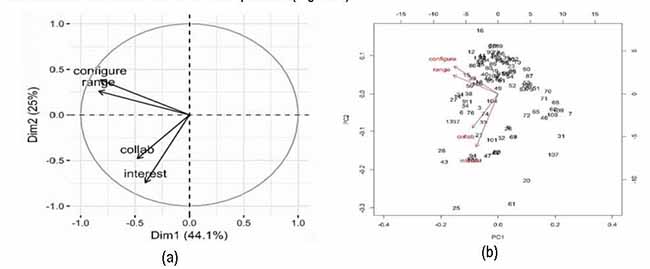
In the given scatter diagram on the X-axis the first main component (РС1) is shown, and on the Y-axis – the second main component is shown (РС2). Data points in the diagram are represented by numeric values, which prove to be serial numbers of the organization in the original selection. Spatial placement of each of these points (organizations) is defined by their synthetic coordinates concerning the first and second principal components.
The vectors highlighted in the red color, demonstrate the degree of proximity of different factors to oneof the two main components, which allow inferring on the level of their relevance in contributing to the predisposition of different organizations to the creation of innovative networks and participation in them. Table 2 contains the data on the coordinates of these vectors in the scatter diagram.
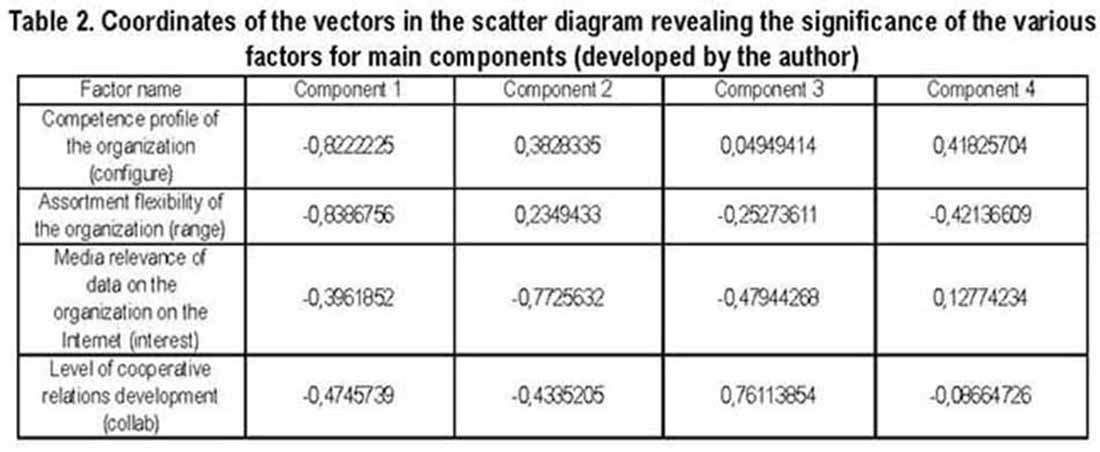
Analysis of the information shown in Figure 2 and Table 2 allows drawing the following main conclusions.
- 1. Positively correlated factors are located within the same quadrant, while negative correlation, bycontrast, resulted in the placement of corresponding factors in different quadrants. Among positively correlated factors are the 'competence profile of the organization'(configure), and 'assortment flexibility of the organization' (range), placed in the second quadrant and oriented towards the first major component (PC1), as well as factors 'media relevance of data on the organization on the Internet'(interest), and 'level of cooperative relations development' (collab), presented in the third quadrant. At the same time, if the factor 'interest' is tied to the second main component (PC2), then factor 'collab’ is equidistant from both principal components.
- 2. The length of the vectors in Figure 2a should be regarded as a quality characteristic of the relevant factors on the factor-map. As is evident, the vector dimensions for the next three factors: ‘configure’, ‘range’, and ‘interest’ have comparable value, whereas the vector of the ‘collab’ factor is slightly shorter than the rest. This once again confirms the assumption about its insufficient relevance for analytical studies with the existing set of initial data.
To enhance the perception of the scale (contrib) and quality (cos2) of the influence of various factors upon the main components, the correlation factor-map was supplemented with the appropriate forms of visualization (Figure 3).
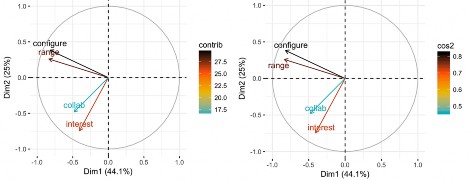
At the same time, the quality of influence (cos2) was being calculated as a square of coordinates: var.cos2=var.coord*var.coord. Table 3 shows the values of the factors that reflect the quality of their representation in the main components.
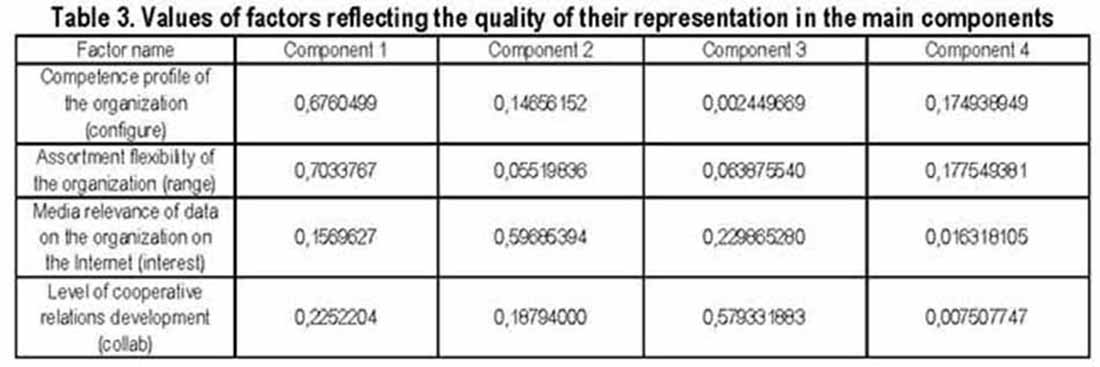
As could be seen, the factor of assortment flexibility of the organization (range) is the most relevant for the first main component, while the factor of the media relevance of data on the organization on the Internet(interest) seems to be the most relevant one for the second main component. A correlation matrix was constructed to interpret cos2 values more accurately (Figure 4).
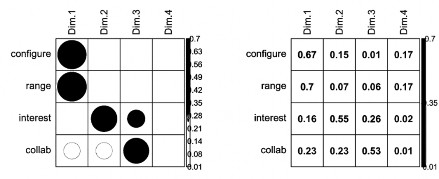
In the figure shown, the circular markers, characterized by the highest correlation values in cos2 are generally located directly along the outer edge of the matrix. The graphical markers of the lower correlation values are offset closer to the center of the matrix. From the study carried out, the factors which circular markers demonstrate their importance to the main components while residing on the periphery of the matrix, are of particular interest.
CONCLUSIONS
Summarizing the results of this phase of the study, the following main conclusions can be possibly drawn. First, determining the readiness of different organizations to participate in networking interactions is one of the most important stages of managing innovative networks in the field of energy technology development. Ensuring the accuracy and objectivity of the research procedures in this process needs the implementation of various methods of quantitative analysis, one of which may be the method of the main components.
Second, the informational base for the practical implementation of this method can be structured aroundfour synthetic factors that reveal the activities of the analyzed organizations in terms of the potential of their participation in the operation of innovative networks. In the course of the study, these factors were given the formal names ‘competence profile of the organization’, ‘assortment flexibility of the organization’, ‘media relevance of data on the organization on the Internet’ and ‘level of development of cooperative relations’. The analysis of the values of these factors in the field of activities related to the development of gas turbine plants confirmed the significance of the first three factors, as well as the feasibility of excluding the last fourth factor from the analysis procedures.
BIODATA
A.R. SADRIEV: Azat Rafailovich Sadriev is the Doctor of Philosophy at Kazan Federal University, Kazan, Russian Federation (main employee). The research areas are Engineering Social, Sciences Arts and Humanities Economics, Econometrics and Finance Business, Management and Accounting Multidisciplinary Environmental Science. There are eleven Documents by the author in this area until now.
B.N. KAMAEV: Bulat Nailevich Kamaev is the Doctor of Philosophy and received higher education at Kazan Federal University, Kazan, Russian Federation. The research areas are Social Sciences Arts and Humanities Engineering Economics, Econometrics and Finance Business, Management and Accounting. There are three Documents by the author in this area until now.
ACKNOWLEDGEMENTS
The work is performed according to the Russian Government Program of Competitive Growth of Kazan Federal University.
BIBLIOGRAPHY
ANNÍA G, María Eugenia., VILLALOBOS ANTÚNEZ, José Vicente., ROMERO PABÓN, Julio Cesar., RAMÍREZ MOLINA, Reynier Israel., & RAMOS MARTÍNEZ, Yanelis. (2018). “Conciencia ética en organizaciones universitarias: un estudio fenomenológico de la praxis como continua formación”. In Revista Inclusiones, 5(4), pp. 179-195.
AHMADI, R, & MOVAHED, SAHS (2019). “Study of Artificial Neural Networks in Information Security Risk Assessment”. UCT JOURNAL OF MANAGEMENT AND ACCOUNTING STUDIES, 7(02), pp. 1-10.
BARGE-GIL, A (2010). “Open, semi-open and closed innovators: towards an explanation of the degree of openness”. Industry and innovation, 17(6), pp. 577-607.
DAHLANDER, L, & GANN, DM (2010). “How open is innovation?”. Research Policy, 39(6), pp. 699-709.
ELMQUIST, M, FREDBERG, T, & OLLILA, S (2009). “Exploring the field of open innovation”. European Journal of Innovation Management, 12(3), pp. 326-345.
ENKEL, E, GASSMANN, O, & CHESBROUGH, H (2009). “Open R&D and open innovation: exploring the phenomenon”. R&d Management, 39(4), pp. 311-316.
ERMOLAEV, KA, MELNIK, AN, & KUZMIN, MS (2017). “Energy efficiency policy activating in Russia by project management methods”. Revista Publicando, 4(13 (3)), pp. 810-822.
HENKEL, J (2006). “Selective revealing in open innovation processes: The case of embedded Linux”. Research Policy, 35(7), pp. 953-969.
LAY RABY, N.D., RAMÍREZ MOLINA, Reynier Israel., & VILLALOBOS ANTÚNEZ, J.V. (2019). Sociología y discapacidad en el contexto laboral en Chile. First edition. Editorial Centro Internacional de Marketing Territorial para la Educación y el Desarrollo CIMTED. Medellín-Colombia.
LAURSEN, K, & SALTER, A (2006). “Open for innovation: the role of openness in explaining innovation performance among UK manufacturing firms”. Strategic management journal, 27(2), pp. 131-150.
LAZZAROTTI, V, & MANZINI, R (2009). “Different modes of open innovation: a theoretical framework and an empirical study”. International journal of innovation management, 13(04), pp. 615-636.
LICHTENTHALER, U (2011). “Open innovation: Past research, current debates, and future directions”. Academy of management perspectives, 25(1), pp. 75-93.
MARAGHEH, SP, AZAR, ML, & MOLLABASHI, FA (2019). “Islamic Iranian Architecture in Various Zones of Iran Dessert Cities From a Social Point”. UCT Journal of Social Sciences and Humanities Research, 7(01), pp. 6-12.
MARTÍNEZ, Suyis; RAMOS MARTÍNEZ, Yanelis y ANNÍA, María Eugenia. (2019). El coaching en educación. Utilidad para la transformación escolar mediante sistematización de experiencias. In Opción. Revista de Ciencias Humanas y Sociales. Año 35, No. 89-2: 1388-1439. Universidad del Zulia. Maracaibo (Venezuela).
MARTINS, D, ASSIS, R, COELHO, R, & ALMEIDA, F (2019). “Decision Support System for Business Ideas Competitions”. Journal of Information Systems Engineering & Management, 4(3).
NALBANDI, H, & ZONOOZI, SJ (2019). “Determine the Impact of Market-orientated Skill Training on Satisfaction and Effectiveness of Trainees in Technical and Vocational Training: A Case Study in Western Azarbaijan Province, Iran”. Dutch Journal of Finance and Management, 3(1).
RAMÍREZ MOLINA, Reynier Israel., CHACÓN ZÚÑIGA, H.C., & El KADI JANBEIH, O. N. (2018). Gestiónestratégica del talento humano en las PYMES. First edition. Editorial Corporación CIMTED. Medellín- Colombia.
RINCÓN, Yanyn; SUKIER, Harold; CONTRERAS, Jairo & RAMÍREZ MOLINA, Reynier Israel. (2019). “Responsible Communication Strategies for Small and Medium-Sized Enterprises”. In Opción. Revista de Ciencias Humanas y Sociales. Vol. 35, No.89-2: 1208-1234. Universidad del Zulia. Maracaibo (Venezuela).
RAMOS MARTÍNEZ, Yanelis. (2007). Estrategias de la gestión directiva y construcción de la grandeza docente en las escuelas bolivarianas. In Revista electrónica de humanidades, educación y comunicación social, (REDHECS). Edición 2, año 2.
OZMAN, M (2011). “Modularity, industry life cycle and open innovation”. Journal of technology management& innovation, 6(1), pp. 26-34.
PILLER, FT, & WALCHER, D (2006). “Toolkits for idea competitions: a novel method to integrate users in new product development”. R&d Management, 36(3), pp. 307-318.
REVISAN, AL, RIBEIRO, AJ, & PONTE, JPD (2020). “Professional Learning Opportunities Regarding the Concept of Function in a Practice-based Teacher Education Program”. International Electronic Journal of Mathematics Education, 15(2).
SADRIEV, AR, KUZMIN, MS, & ANISIMOVA, TY (2017). “Public-Private Partnership in the sphere of Energy Efficiency Enhancement”. Revista Publicando, 4(13 (3)), pp. 928-938.
SANDULLI, FD, & CHESBROUGH, H (2009). “The two sides of open business models”. Available at SSRN 1325682.
TROTT, P, & HARTMANN, DAP (2009). “Why' open innovation old wine in new bottles”. International Journal of Innovation Management, 13(04), pp. 715-736.
VILLALOBOS, J., GUERRERO, J., & ROMERO, L. (2019). “Hermenéutica de la política y legitimidad de su ejercicio: democracia y Estado de derecho”. In Utopía y Praxis Latinoamericana. Año: 24, No. 86: 182-197, Universidad del Zulia. Maracaibo Venezuela.
VILLALOBOS ANTÚNEZ, José Vicente & GANGA CONTRERAS, Francisco. 2018. “Tecnoempresa y Tecnocimiento: Una Perspectiva desde la Bioética Empresarial”. In Revista Fronteiras: Journal of Social, Technological and Environmental Science. Vol. 7, No. 3: 214-230. Unievangélica Centro Universitario, (Brasil).
VILLALLOBOS ANTÚNEZ, José Vicente & GANGA, Francisco. (2016). “Bioética, dignidad e intertemporalidad de los Bioderechos Humanos”. In Revista de Filosofía. Vol. 83, Nº. 2: 7-24.
WEST, J, & GALLAGHER, S (2006). “Challenges of open innovation: the paradox of firm investment in open‐source software”. R&d Management, 36(3), pp. 319-331.