Artículos
E-Government Strategies as a Modern Perspective of Learning Organizations: Practical Study in the Directorate of Work-Iraq of Anbar
Estrategias de gobierno-electrónico como perspectiva moderna de las organizaciones de aprendizaje: Estudio práctico en la dirección de trabajo-Iraq de Anbar
E-Government Strategies as a Modern Perspective of Learning Organizations: Practical Study in the Directorate of Work-Iraq of Anbar
Utopía y Praxis Latinoamericana, vol. 25, núm. Esp.1, pp. 65-78, 2020
Universidad del Zulia
Recepción: 08 Marzo 2020
Aprobación: 28 Abril 2020
Abstract: E-government has become a high priority program for government organizations at the central and regional levels around the world. The follow-up of certain clear brand strategies by e-government organizations can motivate a learning organization to improve its characteristics. The authenticity of the study has been examined through the use of total examination forms
Keywords: Characteristics of learning organizations, e-government strategies.
Resumen: El gobierno electrónico se ha convertido en un programa de alta prioridad para las organizaciones gubernamentales a nivel central y regional en todo el mundo. El seguimiento de ciertas estrategias claras de marca por parte de las organizaciones de gobierno electrónico puede motivar a una organización de aprendizaje a mejorar sus características. La autenticidad del estudio se ha examinado mediante el uso de formularios de examen total (178) compilados de funcionarios de la gestión del tráfico iraquí en Anbar. Los resultados apoyan firmemente el modelo sugerido y hacen referencia a la presencia de una relación positiva y sus efectos entre las estrategias de gobierno electrónico y las características de las organizaciones de aprendizaje.
Palabras clave: Características de la organización de aprendizaje, estrategias de gobierno electrónico.
INTRODUCTION
Many researchers have devoted their writings to the problems of creating the E- governance for there is the theoretical basics for the E-system (Xia, 2017, p.2), the system of the E-government in the Public administration, information approaches and the analytics in supporting the government activities, and the potentials of using the information technology and communication to transfer to a new concept of the state aiming at putting in hand most of needs of people through it (Chernov et al, 2018, p.63). Most of the issued E- government studies are either conceptual or case studies, just limited studies for analyzing the execution of the E- government actions. We shed the light upon the rarity of the study of its impact, and actually the previous studies have shown that transferring of the concepts and actions from the private sector to the public one is a problem that is not always happened (Hossain et al, 2011, p.576). This refers to the importance of realizing the unique side for applying the E-government strategies. In other words, it is a matter of must to study the E- government strategies by themselves.
In spite of the increased interest of the organizations in the applications of the E-government still they front huge challenges, the most important one is that use and adaptation of the E-government applications that might never last plus the inactive investment (Chen et al, 2007, p.199). Specifically the evident significance of the evidence is that not all E- government projects are successful but the great majority of them are failures of some kind or they did not result in the expected results specially on the top tactic and strategic levels (Heeks, 2008, p.8), or there is a comprehension and integration of the E-government systems in the organization which is considered necessary for competition elsewhere. Still there is a lot to learn about the best ways of putting the E- government in a strategic position to ensure the largest positive influence on the activation of the organizations (Hossain et al, 2011, p.577). According to that such these challenges and else are embodied in the strategies of the E- government that is considered a modern introduction to consolidate the Learning organization characteristics.
In this context, the E- government is considered, one of the new constructions in serving the public establishment of the audience, a new shape of the shapes of the technological influence on the public establishments that realized the importance of the Learning organizations required by the a change such as the use of the new technology via the efforts of the E- government (Administrasi Publik, 2011, p.2). The most urgent E-government is the human resources hence the preparation of the human resources is made through the actions of the Learning organizations (Uak Sena,2016, p.1),( Nandan, 2007, p.49). (Gant, 2008, p.52) recommends the construction of the Learning organization which is one of the seven recommendations in developing the E-government systems.
Many factors have been identified that are activating together and showing the need for shifting to the Learning organizations which are (the global, technology, shifting in the work styles, increasing the customers influence, developing the roles and the expectations of the employees and knowledge). It refers to many justifications that lead to the competition between the countries to adapt the Learning organization concept, apply it and keep it up (Thomas & Allen, 2006, p.123). The E-government is also considered as one of the new aspects to run the E- learning since the changes in the E-governorate are extremely dynamic and as a result the shapes of learning are considered a quick motivation to develop the modern society which means that the shift from the traditional approaches to the learning that relies on the activation (Veljkovic & Stoimenov, 2011, p.119). Despite that, little of the efforts of researching that specified the E-government strategies in the public organizations plus their relationship and impact in supporting the Learning organization characteristics. The first motives of our study are that those gaps.
To overcome such gaps and clarify the value of the E-government strategies to enhance the Learning organization characteristics, a conceptual model has been developed that relies on the literatures of the E- government strategies and the Learning organization.
Due to the importance of the location and in the light of the this given information it was needed to run these studies and the researches in the Iraqi organizations and hence the study aims at identifying the modern rolefor the E-government strategies in enhancing the Learning organization characteristics in the Iraqi environment especially in the organization under research process due to the profound the Learning organization characteristics that enable them to face increased influences of environmental pressures and cope with them.
It has been a common thing that many previous researchers came close to applied problem of the point of view of the topic in the developing countries as the Iraqi organizations, face today challenges represented by the sudden variations in the administration samples that came out in the world environment. It is required the adaptation of E-government strategies that will support enhancing the Learning organization characteristics, how to employ them in the way that does the best services and, hence, this study comes to answer a basic question which is (how do the E-government strategies embody the supporting of the Learning organizations characteristics?) Certain questions have been risen up:
- 1. What is the extent of the researchers’ realization and perception of the concept of the E-government strategies?
- 2. What is the range of possession of the researched organization for the Learning organization characteristics?
- 3. What is the level of the E-government strategies applied in the under study organization?
- 4. Are the Learning organization characteristics supported whenever the interest of the organizations increases in the E-governments strategies?
Through treating these questions this study aims at sharing in presenting experimental proofs to support the relationship and the clear influence of the E-governments strategies in enhancing the Learning organization as they are in charge of formulating and executing the proper strategies to confront the challenges of applying the E-government.
In the next part, the remaining of the study will be organized as follows, presenting a theoretical framework for the concept of the E-government and its strategies, the concept of the Learning organization and itscharacteristics followed by presenting a conceptual modeling for the study and its hypotheses and then describing the study community, its sample and its tools. Nest comes the presentation of the findings of the study and, eventually, the conclusions and the recommendations that the study comes out with.
Conceptual Modeling
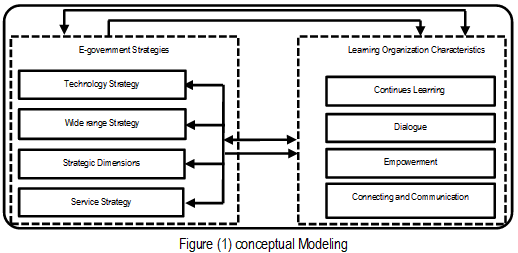
A proposed diagram, to complete the treatment of the problem of the study and achieve its goals, has been put to include all the main and sub-variables of the study as follows:
-
-The independent variable: The E-government strategies that includes (the strategy of technology, wide range strategy, strategic dimensions, and the strategy of the service).
-
-The dependent variable: The Learning organization characteristics which include (the continuous learning, dialogue, empowering, Connecting and communication).
Hypotheses of the study
-
- The first main hypothesis: There is a significant connected relationship between the E-government strategies in all its types and the Learning organization characteristics
-
-The second main hypothesis: there is a significant influence for the strategies of the E-government strategies of all its types on the Learning organization characteristics.
THE THEORETICAL AND PHILOSOPHICAL FRAME OF THE STUDY
There is no one common definition for the E-government but it is a new developed style; even more that it is a new technological information revolution led to a milestone shift in developing the government systems and private sector systems and other traditional administrations to the E-transactions. Briefly the E- government is referred to it as the application of the technologies on the internet in the government and non-government commercial sectors and activities (Criado and Ramilo, 2003, p.191). The E-government was defined (Bruno, 2002, p.1) as the use of the information and communication technology "ICT” in order to change the government performance to make it more efficiency and effective. The E-government always refers to the processes and structures relating to the E-delivery of the government services for the people (Panda & Swain, 2009, p.2). (Maranny, 2011, p.12) sees that the E-government includes creating a safe government network and a central data base for the sake of a more efficiency collaborative activation between the government administrative departments, including the delivery of services depending on the web, and a digital democracy for more transparent government accounting.
The E- government was also widely defined as the usage ICT to encourage the government work to be more efficiency and effective, It aims at easing the reaching to the public services more than before and allowing all the individuals and citizens to get the largest quantity of information and making the government much more responsible before its citizens (Pacific council on International policy: 2002, p.1). (Turban et al, 2006, p.330) defined it as the reaching to the usage of the information technology and the E-commerce to present the getting to the government information and offering the public services to the citizens and business organizations.
It is necessary to refer to fact that the applications of the E-government depend totally on the E-administrations for the directorates and organizations whether they are in the public or private sectors hence, we can say that the relationship of the E-government and the E- administration is the relation of the whole with the part, i.e., the E-government is the whole and the E-administration is the part.
Strategies of the E-government
The E-government strategies are controlled by the actions and the finalized processes according to the government updating concerning these means such as the means of enhancing the transparency, questioning and wise ruling where the activities are decided within a short, medium and long term ranges with goals that could be possibly achieved (Gathungu & Mungai, 2012, p.144). The strategy of the E- government should target the locations and sectors of high opportunities administration for success and product (Pacific council on International policy, 2002, p.2). Among the basic strategies of constructing the E- government are: (Maria and Johanna, 2001, p.329 – 337).
-Businesses reconstruction and updating: it means the reconstruction of the company, new general administration and modern usage for the technology. In this case there should be a reconsideration in the administration frames, communications networks, external and internal transformation of information.
-Finding new ways for the government businesses: Means that finding sharing with government or privatesectors, searching for foreign financing and never depending, thoroughly, on the government financing support, multi-service and shopping job… etc.
Wide range E-government: it is the complete construction for government and the inclusion of the E- administrative projects. Such as the E-administrations, the E- facilities, like the filling up of the passport form, the E-courts, E-health care card, E-learning (Roland and Maria,2001, p.2) .
-
Wide range E-government: it is the complete construction for government and the inclusion of the E- administrative projects. Such as the E-administrations, the E- facilities, like the filling up of the passport form, the E-courts, E-health care card, E-learning (Roland and Maria,2001, p.2) .
-
Narrow range E-government: Applying the local administrative processes within the scope of E- administration in the one sector such as the passport in a some governorate and then to the general directorate for passports in the ministry of interior. It shows that there is a great challenge and inner change that are still spreading silently behind the E-government, hence the development towards the E-society must confront this rising, challenging and appearing for the vision soon.
-strategic dimensions: Shifting into effective, successful and competent E- government requires an adequate vision and a clear facets mission and goals aim at achieving them with adequate priorities in the light of criteria and qualifications go in line with and correspond the developments of the modern technology. As a result it is necessary to choose the government projects based on achieving the possible maximum outcome. In order to develop the strategy it is based on the three-dimensional frame:
-
E-services: it focuses on the increasing of the level of the E-converting of the government componentsand presenting high quality services through various channels enriching the workers’ needs.
-
E-readiness: Focusing on the development of the ability of the united components in Iraq in terms of the technical, systematic and human levels on the application of solutions of ICT and shifting towards the E- government.
-
ICT environment: This dimension includes the coverage of the organizing factors such as the policies and legislations that affect the execution of the initiatives of the E-government.
- Planning for the E-government projects: Priority given to the projects decided to be applied is not enoughand so it is necessary to have a detailed work plan that helps guide the government offices and officials in applying the E-government. Besides choosing the government projects by the best way because it is considered the start point. Many governments have failed in choosing their projects and consequently resorted to the private sector (Pacific council on international policy, 2002, p.18).
(Jordan e-government program, 2006, p.4) refers to the successful execution for the E-government in its wide concept depends on many bases that states and governments must prepare them, The most important of them possibly is shaping effective strategies completing each other to achieve that success and these strategies are: planning and administration, service access service, content, technology and sharing and the public awareness. Wong et al, 2007, p.5 believes that among the strategies that make the development of the E- government sustainable are wide range strategy that includes the challenges that confront the company administration resulted from the technological developments.(Grant 2008, p.51) diagnosed many strategies to achieve success in the E-government in the developing countries represented by the following: strategic service, learning process administration strategy around the new technology, technology strategy, wide range strategy, and E-government services assimilation strategy in the organization.
Learning organization concept
The Learning organization has received a lot of interest in the literatures where the organizations are increasingly encouraged to make use of the learning to gain a competitive advantage (Haley & Lazouskas, 2009, p.3). Learning, in the organization is actually an empowering of the man power and merging work with learning continuously, since the organizations that give focus on the learning and empowering of the employee come out with great success, become more adapted with the changes and resisted for longer time (Nazari & Pihie, 2012, p.211). (Marsick & Watkins, 2003, p.132) described the Learning organization as a continuous learning process and an independent shift through the strategic process in integrate with the work thatconsequently increases the organization ability to invent and develop. In the same context the Learning organization is defined as an organization that keeps learning continuously and is possibly (shifting) itself because it enables people, encourages collaboration, team learning, enhances the open dialogue and certifies the individuals-organization connection (Dawoood et al, 2015, p.94).
As for (Senge, 1999, p.14) he sees that the Learning organization is basically an organization that works continuously on expanding its abilities to create its future, is not enough to just stay existed but to learn from staying alive or what is known as in many times as the adaptive learning and the generative learning that enhances our abilities to invent. Foster, 2001, p.7 sees that the Learning organization is the one that enables each individual of its members identify and solve the problems continuously. So it is the model of the effective change inside the organizing, to what it has of ability of comprehending and understanding through analyzing what it applies from experiences whether failed or successful and what it makes use of from the experiences. As a result of that, it is the kind of organization that enhances the continuous organized renewal via embroidering/ enlisting a group of the core processes that feed the positive inclination to learn, adapt and change (Nthurubele, 2011, p.75).
The cognitive perspective of the Learning organization expresses its ability in having the skill of creating, acquiring and transforming the knowledge that now becomes one of the vital roles for the manager. The Learning organization is the one that constructs its systems with the ability and capability of getting knowledge within a long term plan that enables it to make continuous changing processes (Hunger & Wheelen, 2007, p.4). Malik (2012, p.117) defines it as a continuous method from individuals towards invention and the developed learning environment through the right usage of the organized resources and the real use of the knowledge. Whereas Bleed ( 2004, p.1) describes the Learning organization that is the organization that its administration always checks its experiences and convert them into knowledge accessible to all its human resources and it has a relationship that connects it with its main goals. According to Garvin (2000) the Learning organization is defined as a skillful organization in creating, acquiring, interpreting, transforming, keeping and adjusting knowledge for the sake of the behavior that reflects the knowledge and the new vision (Bratianu, 2015, p.76). For (Yang et al, 2004, p.15) he sees that the Learning organization eases the learning process for all its members and activates with the changes of the surrounding environment positively. Hence the two researchers believe that it is requires from the organizations to work seriously in order to adapt the concept of the Learning organization as an approach to improve its performance, growth, existence, and competition with others.
Learning organization characteristics
The Learning organization is characterized by many characteristics, however researchers agreed that the speed of learning is the basic characteristics that characterizes the Learning organization and compete with the contemporary ones. Some organizations, on the other hand, fail in learning and the key is the constraints that hinder it not to be an Learning organization in the light of the five characteristics (personal mastery, mental models, common vision, team learning, and system thinking) identified by (Senge, 1990). These constraints are implied in the position of ( avoiding the risk) towards personal mastery, the difficulty of keeping the useful mental models in a hasty changing position, the possible role of managers in prohibiting the research from a common vision, shortage of support in building up the team and a way of strict thinking on the level of systems (Fenwick& McMillan, 2005, p.49).
Besides (Vince & Saleem, 2004, p.135-147) identified caution and blaming as factors that prevent the organization from being Learning. When the usual position of the organization depends on caution accompanying the individual blaming, there will be a very little range foe thinking and learning, Though the feelings are always considered an constraint in the work of the organization, fear and worry could actually push for effective learning, fear from mistake could also lead the managers to reach to new effective solutions, or lead to solely blaming and barriers. As it is referred by (Cook, et al. 1997, p.37) there is a group of characteristics that characterize the Learning organization which are: the existence of a clear strategy for continuous learning in the organization, encouraging the employees on the self- developing process to increase their skills andabilities, creating a suitable climate for working that encourages the participation and frank administration by numbers and revealing the mistakes, enhancing the invention and the creativity for the employees, the participation of the employees in taking the decisions, using the system thinking in solving the problems and taking the decisions.
Both of (Ellinger et al, 2000, p.5), (Kerka, 1995, p.2) referred to the most important effectives and activities that are considered the exporter for the organization learning and also represent a part of the all characteristics of the Learning organization, they are: the availability of the continuous learning opportunity, using learning to reach the goals, connecting the individual performance with the organizational performance and encouraging the team learning, enhancing the dialogue and questioning culture in organization, insuring the care of the effective participation and the openness to all the organization members, supporting the organization relationship with the surrounding environment via acquaintance and the activation with its factors and authorizing the individuals in terms of the shared vision.
Courter (2003, p.12) and Yang et al, (2004, p.34) are somewhat consistent in identifying the Learning organization characteristics, including: continuous learning, dialogue and inquiry, team learning, empowerment, systems for capturing shared learning, communication, and strategic leadership. He added to it (Arma et al, 2016, p.7) two characteristics: friendship and sincerity. It is clear from the above that writers and researchers agree on four characteristics, even if it is implied, despite the difference in vocabulary, but the content was the same, namely: continuous learning, dialogue, empowerment, connecting and communication.
Population and sample
The community of the study is represented in the Directorate of Anbar Traffic field to conduct this study which is considered one of the public service organizations working in the Iraqi service sector and its great importance to this sector and other sectors, on the one hand, and its importance to the community on the other hand. The sample of the study was a deliberate one that included all senior leaders represented by officers in the above directorate with actual (178) officials.
Tools of gathering data
The following tools have been adopted in the collection of data and information:
-
- Available sources and references: What was available before the two researchers from books, researches, periodicals, articles, theses and letters related to the subject of the current study in order to cover the theoretical axis.
-
- The questionnaire: It is the main tool for collecting the data and the information related to the practicalaxis which was prepared based on the studies (Maria and Johanna, 2001) and (Watkins & Marsick, 1997) which were adapted to the current research directions, objectives and hypotheses. The questionnaire consisted of two parts: the first part included the E-government strategies (technology strategy, wide range strategy, strategic dimensions, service strategy) that included 16 items with four items for each strategy. The second part included the Learning organization characteristics (continuous learning, dialogue, empowerment, connecting and communication) which was specified with (20) items of five items for each characteristic.
-
- Personal interviews: Several interviews were conducted to obtain first-hand information on the variables of the study through the direct interaction with the respondents of the sample as well as its role in clarifying the dimensions of the questionnaire and items for them.
-
The validity measurement: The two researchers verified the validity of the internal consistency and the consistency of the questionnaire items through the use of (Cronbach's alpha) to calculate the coefficient consistency of the scale which includes (36) items divided into four sub-variables of the independent variable (the E- government strategies) and a consistency coefficient ( 0.78), and five sub-variables of the adopted variable (learning organization characteristics ) with a consistency coefficient (0.83) and it is clear that the coefficient of consistency of the general questionnaire is high as it reached a value of (0.87).
The certainty ofthe measuring instrument and its validity is calculated by the fact that the certainty represents the root of the consistency coefficient that is calculated by the following equation: validity = square root of consistency = 0.93, and represent a high validity rate of the questionnaire.
RESULTS AND DISCUSSION
In this axis, the answers of the sample will be described about the study variables represented by the E- government strategies and the Learning organization characteristics in which a set of measures were adopted using (SPSS-ver.24) program such as mean, standard deviation, and variation coefficient, and the standard mean rated (3) was adopted and extracted from the equation (Total of category / its number) in order to measure the importance of variables for the research sample as well as the importance of its dimensions as the following:
Describing the answers of the respondents on the E-government strategies
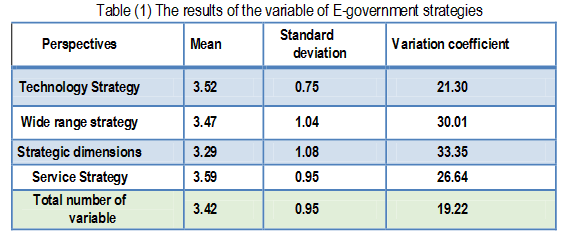
Table (1) shows that the mean of the E-government strategy variable was (3.42) which is an average mean compared to the standard mean and this indicates to the average interest in the E-government strategies variable. The standard deviation of this variable reached (0.95) and this indicates to a good harmony in the responses of the respondents which is supported by the variation coefficient value rated (19.22%). The dimensions of this variable were as follows:
Technology Strategy: It was found that the mean of this dimension was (3.52), which is an average mean compared to the standard mean. The standard deviation of this dimension was (0.75), which indicates a good harmony in the answers of the sample members that is supported by the variation coefficient that reached (21.30%).
Wide range strategy: It was found that the mean of this dimension was (3.47), which is an average mean compared to the standard mean the thing that refers to the average interest of the members in the wide range strategy. Whereas the standard deviation for this dimension reached (1.04) which indicates to the low distraction in the sample members answers. This is largely supported by the variation coefficient rated (30.01%).
Strategic dimensions: It was found that the mean of this dimension has reached (3.29) which is an average mean compared to the standard mean which indicates to the average interest of the sample members in the strategic dimensions. The standard deviation for this dimension reached (1.08) that indicates to the high harmony in the answers of the sample members. This is reinforced by the variation coefficient rated (33.35%).
Service Strategy: It was found that the mean of this dimension was (3.59) which is an average mean compared to the standard mean. This indicates to the average interest of the sample members in the service dimension, while the standard deviation of this dimension was (0.95) this indicates to the high harmony in the answers of the sample members. This is supported by the variation coefficient rated (26.64%).
Describing the answers of the Learning organization characteristics
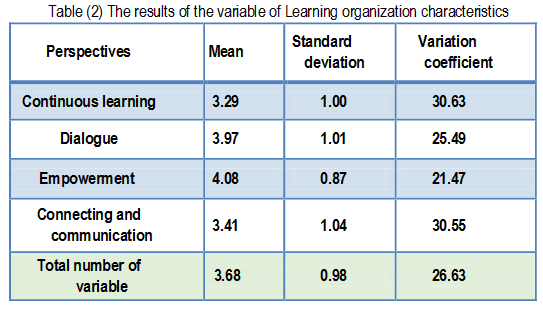
Table (2) shows that the mean of the Learning organization characteristics has reached (3.68) which is an average mean comparing to the standard mean that indicates the average interest, and that the standard deviation of this variable has reached (0.98) This indicates a good harmony in the answers of the sample members. This is supported by the value of the variation coefficient rated (26.63%). The dimensions of this variable were as the following:
Continuous learning: It was found that the mean of this dimension was (3.29) which is an average mean compared to the standard mean. This refers to the average interest for the sample members. Whereas the standard deviation for this dimension reached (1.00) indicating to the high harmony in the answers of the sample members. This is supported by the variation coefficient rated (30.63%).
Dialogue: It was found that the mean of this dimension reached (3.97) which is a high mean compared to the standard mean. This refers to the good interest of the sample members in the dialogue. The standard deviation for this dimension reached (1.01) which indicated to the high harmony in the answers of the sample members. This is reinforced by the variation coefficient rated (25.49%).
Empowerment: It was found that the mean of this dimension has reached (4.08) which is a very high mean comparing to the standard mean. This refers to the distinct interest in this dimension. Whereas the standard deviation of this dimension was (0.87) that indicates to the good harmony in the answers of the sample members. This is supported by the variation coefficient rated (21.47%).
Connecting and communication: It was found that the mean of this dimension was (3.41), which is an average of the mean compared to the standard mean. It indicates to good interest. Whereas the standard deviation of this dimension was (1.04) this indicates the low dispersion in the answers of the sample members. This is supported by the variation coefficient rated (30.55%).
Testing the research hypotheses
The research hypotheses were divided into two main hypotheses: correlation hypothesis and impact hypothesis to find out the relationships between the study variables represented by the E-government strategies and the characteristics Learning organization. A group of the statistical tools represented by the Spearman's rank correlation coefficient has been used and the simple linear descending between the research variables as follows:
Testing the correlation hypotheses between the research variables
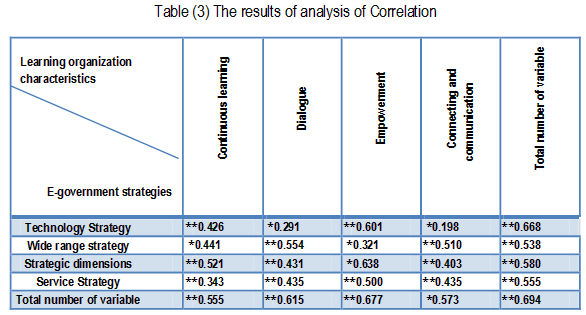
The Spearman's rank correlation coefficient was calculated to determine whether or not correlation relationships exist between the basic components of E-government strategies as an independent variable and the characteristics Learning organizations as a dependent variable. According to Table (3), a set of correlation relationships were obtained as follows:
-
The correlation relationship between the variable of the E- government strategies and the Learning organization characteristics reached (0.694), which indicates a strong correlation relationship of significant indication at the level (0.01). This proves the first main hypothesis of an existed significant correlation relationship between E-government strategies and the Learning organization characteristics. This means that the Learning organization characteristics have deep roots or relate largely to the existence or absence of the E- government strategies in the organization.
-
The correlation relationships, between all the study variables, were statistically significant at the level of (0.01) and (0.05), which proves the sub-hypotheses emanating from the first main hypothesis, and, therefore, there are significant correlations relationships of statistical significance between E-government strategies and Learning organization characteristics.
Testing the effect hypotheses between the research variables
To find out the existence or non-existence of the influence between the variables of the study, a simple linear regression was based on to extract (F), (β) and (R2) to make sure that there are or no affect relations between E-government strategies as an independent variable and Learning organization characteristics as a dependent variable as shown in Table (4) as in the following:
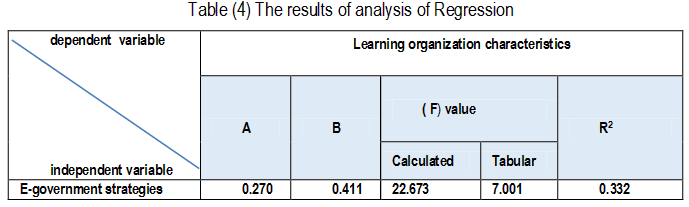
Through table (4) we conclude that the value of (β) was (0.411). This indicates that any change in the value of (E-government strategies) by one unit leads to a change in the value of (Learning organization characteristics) by (41.1%). The calculated value of (F) was (22.673) which is higher than the value of (F) tabular value of (7.001). This means there is a significant statistical relationship for E-government strategies on the components of learning organization characteristics which proves the second main hypothesis. The value of the explanation coefficient reached (R2) (0.332), which means that (E-government strategies) explains what percentage (33.2%) of the changes in the (Learning organization characteristics), while the remaining percentage rated (66.8%) is due to the effect of other variables that do not exist in the model of the current study.
CONCLUSIONS
It was found that organizations are interested in the E-government strategies and are working to develop them. Such an interest has been the result of the organization in service strategy, technology and the strategic dimensions that require the application of these for the sake of the work. It shows that the organization has followed certain characteristics to be a learning organization and that these components and characteristics are important to minimize the negative effects. The most important of them are empowerment, dialogue and connecting and communication. It was found that the organization has relied on technology as a basic strategy of the E-government strategies to combat the negative effects related to the organization. It shows that the organization administration has applied a specific plan and positive view of the application of E-government. It has used the E-government as a tool to enhance its capacity to be learning organization. Finally, It shows that the organization administrations use the E-government strategies combined to enhance their ability to be learning, more than if they used those dimensions individually, and this confirms a logical conclusion on the existence of correlation and complementarity between these strategies that its role is reflected in the collective way more than in its individual use.
Administrations of organization should strengthen the technology strategy as the core and key strategy through which they reform the wrongs and weaknesses in performance, supporting the ability to apply the basic principles of the E-government and showing the mechanism of the E-government work and its future applications. Activating the use of the effective strategies for E-government and working on the development of an action plan for its periodically improvement throgth social networks and Internet service in the province in a way that secures the E-government application successfully through the speed of access, reduce the costs and service improvement.
It is recommended making laws and legislations that will enhance the work of the E-government project.
BIODATA
Khamees Naser Mohammed: Assistant Professor of the Department of Business Administration of the College of Administration and Economy, University of Anbar. Iraq. dr.khamees.n20016@gmail.com
Tarek Tume Atua: Lecturer of the Department of Business Administration of the College of Administration and Economy, University of Anbar. Iraq. alshemarry1983@gmail.com
BIBLIOGRAPHY
ADMINISTRASI PUBLIK, THE NEW PARADIGM ADMINISTRATION, (2011), "Learning Organization Dan E-government", Support: Jay Template & Uak Sena, Copyright Administrasi Publik, Template Created by creating website Published by Mas Template. http://administrasipublikunm.blogspot.com.
ARMA AHMAD RIJAL, HAMZAH DJABIR, LAM SYAMSU & ISMAIL P. MUHAMMAD, (2016), "LearningOrganization in Implementation New Public Services at Palu Local Government, Indonesia", Quest Journals, Journal of Research in Business and Management, Vol. 3, Issue, 12 , pp. 8-19.
BLEED, R. (2004). “A Learning Organization”, http://www.Dist.Maricopa.ed.
BRATIANU, C. (2015). Organizational Knowledge Dynamics: Managing Knowledge Creation, Acquisition, Sharing, and Transformation, Hershey: IGI Global.
BRUNO, L. (2002). "The E-government hand book for developing countries" , A project of info Dev. and the center for Democracy and technology, November,pp.1-41 .
CHEN, G., WU, R., & GUO, X. (2007). "Key issues in information systems Management in China", Journal of Enterprise Information Management, 20, 198–208.
CHERNOV, S., HAIDUCHENKO, S., BIELSKA, T., NAPLYOKOV, Y. & ARJJUMEND, H. (2018). "Leadershipin the Context of E-governance: Lessons for Ukraine", Grassroots Journal of Natural Resources, Vol. 1, No. 1, pp.62-68.
COOK, J. et al. (1997). The Learning Organization in the Public Services, London: Gower Publishing,
LTD. COURTER, S. ( 2003). “What Is a Learning Organization? Reflections on the Literature and PractitionerPerspectives", MadisonArea-Meetingof thoseInterestedinLearning Organizations Host:UniversityofWisconsin-Madison, Engineering Professional Development Dept. Summary of January, 9th, 2003 Meeting, 1-39.
CRIADO, I. & RAMILO, C. (2003). ''E-government in practice: An analysis of web site orientation to the citizens in Spanish municipalities'', International Journal of public sector management, Vol.16.No.3, PP.191-218.
DAWOOOD SAEEDA, SAEED MAMMONA, FAHMEEDA & AHMED AIJAZ, (2015). "Learning Organization–Conceptual and Theoretical Overview", International Journal of Humanities Social Sciences and Education (IJHSSE),Vol.2 ,Issue, 4, April, pp.93-98.
ELLINGER, A., YANG, B., & ELLINGER, A. (2000). “Is The Learning Organization for Real Examining the Impacts of the Dimension of The Learning Organization on Organizational Performance?” The Learning Organization, 8(4), P.1-9.
FENWICK, J. & MCMILLAN, J. (2005). "Organisational Learning and Public Sector Management: An Alternative View", Public Policy and Administration Vol. 20, No. 3, Autumn, pp.42-55.
FOSTER, J. (2001). “Developing A Learning Organization: Three Critical Elements“, Paper Presented at The American Association for Higher Education National Conference on Higher Education, Washington DC online Available at http: www.fpc.educ/strtegic.
GANT, J.P. (2008). "Electronic Government for Developing Countries", This report was commissioned by the (ITU)International Telecommunication Union, Telecommunication Development Sector’s ICT Applications and Cyber security Division, August, www.itu.int/ITU-D/cyb/app/e-gov.html.
GATHUNGU, J. & MUNGAI, A.N. (2012). "Contextual Factors Affecting E- government Strategy Implementation and ITS Impact on Public Sector performance in Kenya", Journal of Arts and Humanities (JAH), Vol. 1, No. 1, August,pp.143-157.
HALEY, C.K. & LAZOUSKAS, L. ( 2009). "Leadership development and learning organization: a literature review", Referred paper, Ref 6.32: pp.1- 12.
HEEKS, R. (2008). "Success and Failure Rates of E-government in Developing / Transitional Countries: Overview", Institute for Policy Development and Management, University of Manchester, Manchester, UK. http://www.egov4dev.org/ success/sfrates.shtml.
HOSSAIN, M.D., MOON, J., KIM, J.K. & CHOE, Y.C. (2011),"Impacts of organizational assimilation of e- government systems on business value creation: A structuration theory approach", Electronic Commerce Research and Applications, 10, pp. 576–594.
HUNGER, D. & WHEELEN, T. (2007). Essentials of Strategic Management, New Jersey, Pearson: Prentice Hall.
JORDAN E-GOVERNMENT PROGRAM (2006). Ministry of information and communications Technology, e- government Strategy.
KERKA, S . (1995). "The Learning Organization: myths & Realities", Eric Clearinghouse, http://ericacve.org/docs/mr000004.htm
MALIK, M.E., DANISH, R.Q. & MUNIR, Y. (2012). "Determinants of Learning Organization in Higher Education Institutes of P a k i s t a n : A Correlational Study", International Journal of Innovation, Management and Technology, Vol. 3, No. 2.pp117-120.
MARANNY, E. (2011). Improving E-government performance by utilizing M-government characteristics, master thesis, University of Twents.
MARSICK, V. & WATKINS, K. (2003). "Demonstrating the Value of an Organization’s Learning Culture: The Dimensions of the Learning Organization Questionnaire", Advances in Developing Human Resources, Vol. 5, No. 2,2003, pp. 132-151.
NANDAN, S,.(2007). E-governance: Overcoming Obstacles through Effective Human Resource Management Strategies, Adopting E-governance, Computer Society of India.
NAZARI, K. & PIHIE, Z.A.L. (2012). "Assessing Learning Organization Dimensions And Demographic Factors In Technical And Vocational Colleges In Iran", International Journa Of Business And SocialScience, Vol. 3, No. 3, February, pp. 210-219.
NTHURUBELE, ABRAHAM THSHOSANE. (2011). Facilitating a Learning Organization: The Case of a Small Consulting Firm, Thesis presented in fulfillment of the requirements for the degree of Master of Philosophy (Information and Knowledge Management) at the University of Stellenbosch.
PACIFIC COUNCIL ON INTERNATIONAL POLICY: The western partner of the council on foreigner relations (2002). Road map for E-government in the developing world: 10 questions E-government Leaders should Ask Themselves, the working Group on E-government in the developing world, April, with Grant support provided by: Carnegie Corporation of New York
PANDA, B.P. & DILLIP K., S. (2009). “Effective Communications through e-Governance and e-Learning”. Chinese Librarianship, an International Electronic Journal, 27.
ROLAND, T. & WIMMER, M. (2001). Directions in E-government: processes protals, knowledge, proceedings DEXA 12th international workshop on Database and Expert Systems Applications, IEEE.
SENGE, P. (1999). The fifth discipline. The art & practice of the learning organization. London, UK: Random House.
THOMAS, K. & ALLEN, S. (2006). “The Learning Organization”, Vol. 13, No. 2, pp.123-139
TURBAN, E., DAVID, K. & DENNISVIEHL, J. (2006). E-Commerce: A managerial perspective Pearson, prentice Hall, person education international, upper saddle, River New jersey.
UAK, S. (2016). "Learning Organization Dan E-government", Semoga, Copyright Uak Sena, University Hub by WEN Themes, Indonesia, http://uaksena.com/.
VELJKOVIC, N. & STOIMENOV, L. (2011). "E-Learning Opportunities for E-Government", The Second International Conference on e-Learning (eLearning-2011), 29-30 September, Belgrade, Serbia, pp.117-123.
VINCE, R. & SALEEM, T. (2004). “The Impact of Caution and Blame on Organizational Learning”, Management Learning, Vol. 35, No 2, pp.133-154.
WATKINS, K. & MARSICK, V. (1997). Dimensions of the learning organization questionnaire Survey, Warwick, RI: Partners for the Learning Organization.
WIMMER, M. & KRENNER, J. (2001). ''An integrated online one-stop government Platform : the eGOV Project '', 9th inter disciplinary information management Talks, proceedings, IDIMT-2001, universitatsverlag Trauner Linz, pp.329-337.
WONG, K., FEARON, C. & PHILIP G. (2007). "Understanding E-government and E-Governance: stakeholders, partnerships and CSR", International Journal of Quality & Reliability Management, 24(9).
XIA, S., (2017). "E-Governance and Political Modernization: An Empirical Study Based on Asia from 2003 to 2014", Administrative Sciences, Vol.7, No.25.
YANG, B. et al. (2004)."The Construct of the Learning Organization: Dimensions, Management and Validation", Human Resource Development Quarterly Wiley, Periodical, Vol. 15, No. 1, pp.31-55.