Artículos
Inter-Relationship between Economic Development and Human Development- Analytical Study of selected Arab Countries
Inter-relación entre desarrollo económico y desarrollo humano- estudio analítico de países árabes seleccionados
Inter-Relationship between Economic Development and Human Development- Analytical Study of selected Arab Countries
Utopía y Praxis Latinoamericana, vol. 25, núm. Esp.1, pp. 85-95, 2020
Universidad del Zulia
Recepción: 29 Febrero 2020
Aprobación: 15 Abril 2020
Resumen: La investigación tiene como objetivo estudiar la interrelación entre el desarrollo económico y los indicadores de desarrollo humano para países seleccionados (Jordania, Egipto, Reino de Arabia Saudita y Bahrain) mediante el uso de la prueba de regresión de minimos cuadrados de dos pasos. Los resultados de la prueba mostraron que existe una relación de causalidad entre el desarrollo económico y el desarrollo humano. Descubrimos que el desarrollo económico tiene un efecto claro sobre los indicadores de desarrollo humano en los países árabes seleccionados.
Palabras clave: Crecimiento económico, índice de indicadores de desarrollo humano..
Abstract: The research aims to study the inter-relationship between economic development and human development indicators for a selected countries (Jordan, Egypt, Kingdom of Saudi Arabia and Bahrain) by using two stage least Square Test. The results of the test showed that there is a causality relation between the economic development and human development. We found economic development has clear effect on human development indicators in the selected Arab countries.
Keywords: Economic growth, human development indicators index..
INTRODUCTION
Human development is a social, economic and political process by its nature and human beings are its object and tools, and at the same time, its objective. This process of development allows human beings to renew, create and innovate. It is one of the most important processes because it generates unlimited energy, through education, health, nutrition and the improvement of the standard of living. Therefore, human development considers economic growth to be a necessary condition, but not a sufficient one.
The research problem stands the appearance of the difference in vision (theoretical and experimental) regarding the direction of the causal relationship between economic development and a guide to human development indicators within the Arab countries.
Research Objective: The research aims to estimate the mutual effect between economic development and the human development indicators index by formulating a model that measures the causal relationships between variables using the two stage least square test.
The research hypothesis: The research is based on the hypothesis that economic development is the one that determines development paths of humanity for Arab countries.Continuisly several studies that deal with the relationship between economic development and human development are presented:
- 1. Robert Solo Study (RMSolow, 1975) (Abiodun, 2011, p.22), which concluded the importance of the (remaining) factors in increasing production and achieving economic development other than capital and labor factors, and education, knowledge, technological progress (technical) and scientific research represent the largest part of them statistically, through his study of (economics of agricultural production) that he conducted on the American economy in the period from 1909 to 1949, that per capita productivity per hour has doubled, and he also found that the remaining factors have a very big role in increasing production, as it became clear that their contributions increasing the productivity of every hour of work, 87.5%, while the financial capital did not contribute a 12.5% of that increase (Maliki and Obaid, 2009, p.5).
- 2. Javad study (Javad M. Sadeghi, 1999) reached to reveal a relationship between primary and secondary school enrollment rate with the growth of per capita gross national product (GNP) in 98 countries including OPEC countries and East Asian countries, and concluded that the relationship is positive and was stronger for enrollment in secondary education (Javad M, 1999, p.15).
- 3. The World Bank study (1998, p.217) aimed to study the extent to which education contributes to economic growth (measuring the relationship between the rate of economic growth, literacy and the average life expectancy of an individual) in 83 developing countries during the period 1960-1977 and reached The study indicates that the countries that achieved the highest rates of economic growth enjoyed higher rates of education as well as longer life rates for their members.
- 4. A study of UNESCO (Unesco, 2003, p.16) in the period 1950-1959 conducted on eleven countries aimed at calculating the correlation coefficients between education and per capita gross domestic product, and concluded that there is a correlation between the education sector and per capita GDP.
- 5. A study (Mukherjee and Chakraborty, 2010) examined the relationship between economic growth and human development in 28 major Indian states during four time periods ranging from the past two decades: 1983, 1993, 1999-00 and 2004-2005. To build the human development index for Indian countries, the aim of this study is to find out the effect of per capita income (as an indicator of economic growth) on human development and that there is a difference between rural and urban in achieving human development, the human development index for rural and urban areas is built separately for each of the states. The result shows that the per capita income does not translate into the individual's well-being but rather the growing influence of other variables in determining the HD's achievements for the state.
METHODOLOGY
In an attempt to test the research hypothesis, an applied study was conducted using descriptive analysis and quantification according to the experimental method for the period (2000-2016) for five selected Arab countries (Jordan, Arab Republic of Egypt, Kingdom of Saudi Arabia, Bahrain) which are the countries that have been available.
The importance of the research comes from the search on a very important topic, which is:
- 1. In terms of economic development, it expands options for human resources in particular and individuals in general.
- 2. The investment in human capital is one of the most important factors that affect economic development.
DEFINITION OF HUMAN DEVELOPMENT
The concept of human development is an evolving one to previous development concepts, which considered that investing in improving human capabilities to contribute to economic development is no less important than investing in material capital, but disagreeing from these concepts its what makes individuals focus on the development and participantion, bringing people back into their place.
The correct thing in the development process, after several decades has passed, was the focus in whichcapital accumulation increased production and wealth, and the growth of national income as a measure of economic development, focusing on the benefits of society members from the fruits of economic growth in a more equitable way.
The United Nations Development Program (UNDP) adopted this concept, where it seemed by issuing an annual report since the early nineties that explains the dimensions of human development, and reviews their conditions in the countries of the world and its various regions, building a guide to compare the conditions of human development called the Human Development Index (HDI) (Najafi, Al Dama, 2001, p.26).
Human development is the knowledge, skills, capabilities, attributes, and various characteristics inherentin individuals that are related to economic activity. Also, not only focuses on the knowledge and skills that individuals possess but on the wealth, attributes and characteristics they possess. It is a set of skills, capabilities and experiences that the individual acquires, and enables him to participate in economic life and gain income, which can be improved through investment in education, health care, training and other forms of human capital (Abu Al-Ezz, 2010, p.3).
Human development is also called the stock of knowledge, skill, experience and ability to invent, and it can be acquired at all stages of life, but the ability of a person to acquire knowledge varies from one stage to another of his life years, and is affected by the health and psychological status, educational level and environment in which he lives (interview Al-Alawneh, 2016, p.339).
The highest rates of human development in society have become a driving force for progress. Al-Raqi (Interview, Al-Alawneh, previous source, p.338).
RELATIONSHIP BETWEEN ECONOMIC DEVELOPMENT AND HUMAN DEVELOPMENT
The relationship between what is known as human development and economic development is a two-way relationship, as each of them is reflected negatively and positively on the other, that economic growth takes place through improving human capabilities, and achieving the desired growth reflected in human development as it expands options in front of human resources in particular for individuals in general (Mukherjee and CHkraborty, 2010, p.3).
Investing in human capital is one of the most important factors that affect economic growth in the national economy or society. The formation of human capital does not depend only on education and training, but also on the amount of health and social services that work on building and maintaining human capital, as health and education are the main factors determining the composition of growth in production and exports. The higher the level of education achieved by the workforce, the greater the total productivity, because the more educated are the ones most likely to innovate and thus affect the overall productivity. Education also affects the growth of per capita income through vinegar. For the reduction of population growth, and the equitable distribution of income leads to increased demand for better nutrition education and thus increase overall productivity and increase economic growth (Beine, Giading and Olaniyn, 2014, p.19).
The links between economic growth and human development depend on
- 1. Accumulation of human capital through investments in health, education and training skills.
- 2.
- 3. Opportunities for individuals to contribute to economic development.
-
From economic growth to human development:
Many studies have shown that economic growth is a necessary condition for human development, even if it is not a sufficient condition to achieve them. Also, it has shown that the fairness of distribution or (equity) is one of the requirements of human development and is not a stumbling block to economic growth, but rather that it is greatly enhanced by, on the other hand, the improvement in Income distribution may be at risk of stopping, and from there it may hinder the path of human development, or be stalled if society does not maintain the economic momentum, and if it enhances its ability to economic growth.
The Human Development Report for 1996 explained that there is no automatic link between economic growth and human development, but this link Formed by a Policies and design, and they can reinforce each other, because economic growth will effectively and quickly enhance human development, and the role of government policies in this regard should be based on improving its nature (structure) and the quality of economic growth, as well as working to increase its pace in some Al-Dawul (Najafi and al-Da`ma, previous source, p.12)
-
From human development to economic growth:
Good education and health are intrinsic value to the well-being of people, and they are closely linked. Education helps improve good health and the latter contributes to better education. Moreover, education contributes to increased economic growth, raises the incomes of the poor, and improvements in health generate economic returns.
This two-way link between human development and economic growth contains an integral link, as it is strengthened.
Good human development and economic growth, which in turn drives human development forward.
The synergy between the different aspects of human development is also important, as improving health and education requires relevant interventions in school enrollment, health care, nutrition, water and sanitation, and many of these synergies are based on effectiveness and fairness, when the poor have a political ability protected by civil and political rights, they can To be more effective in pushing for policies that create social and economic opportunities (Rains, 2000, p.7).
The success or failure of economic growth is closely related to how the economy integrates with the scientific markets, as some forms of globalization help to produce economic growth, but some of them do not help in this, because success or failure are less related to the primary income of the country than they are to the structure of its exports with the exception of countries that pass through a stage Transitional and that oil- exporting (Najafi and al-Da`ma, previous source, p.15).
The role of the education sector in the economic growth of countries is to prepare the workforce, qualified and skilled manpower with expertise and employment specialists and technicians in order to contribute to a scientific and practical participation that is a catalyst and an engine of economic development (Monteils, 2002, p.47).
The importance of education also comes from bringing the promising community members closer to each other by fine-tuning social behavior, freedom from customs and traditions that stand in the way of economic development, and moving the general national feeling toward general national interests, and on this the education link to the economy is very close and definitely contributes to achieving growth The Economist (Barro, 2009, p.7).
Standard Form Description:
Firstly. Measuring the relationship between economic growth and human development:
Based on previous empirical studies on the relationship between economic growth and human development and based on the previous discussion on the causal relationship between economic growth and human development, we used a form of immediate equations and this model is based on the economic theory of the determinants of the human development indicators guide for the purpose of measuring the relationship between economic growth and human development:
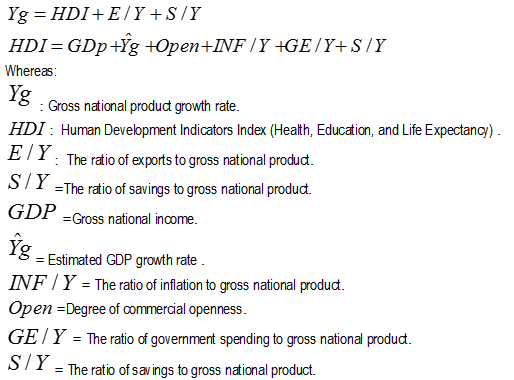
The model proposed above has been diagnosed with a diagnostic test (*) (Identification) and it has been found that the model is an overhead diagnosis and accordingly we will use the Tow Stag Least Square method for the purpose of solving the immediate equations model of our research as it gives the best unbiased linear estimates (Koutsoyiannis). , 1977, p.384-385).
- 1. Local inflation rate (INF): the annual change rate in the implicit reducer of the GDP Implicit, which clarifies the rate of change of local prices in the economy as a whole. In local currency as well, with the product of division divided by 100.
- 2. The degree of commercial openness (Open) is the sum of exports and imports of the country for goods and services at constant prices measured in US dollars divided by GDP, multiplying the divide by 100.
- 3. Government spending (GE) The amount of government spending as a proportion of gross domestic product.
Secondly. Behavior of form variables: The first equation:
The expected impact of human development on economic growth:We expect human development to have a positive impact on economic growth in the Arab countries, whose national product volume and level of per capita income increase, and a lesser impact on Arab countries whose national product volume and per capita income decrease.
The second equation:
- Human Development:
We expect that economic growth will have an impact on human development in the Arab countries, as the human development index is a measure of the capabilities and education of individuals, and it is known that the health and education of individuals and their income increases the volume of productivity.
Estimated GDP growth rate
We expect the gross national product to have a positive impact on human development, and this depends on the nature of the Arab countries that meet the preconditions for continued growth, namely low inflation and interest rates and their stability.
- Economic openness:
We expect that the economic openness will have a positive impact on human development in the Arab countries.
Inflation rate of gross national product:
We expect inflation to have a negative impact on human development in Arab countries where the price level is high, due to the instability of economic policy.
Ratio of government spending to gross national product:
We expect that there will be two effects of government spending on human development. The first is a direct impact on human development in Arab countries where government spending is directed towards health and education and a negative impact in countries where government spending is directed towards other purposes.
Ratio of saving to gross national product
We expect that the impact of local savings on human development will be a direct impact, as local savings lead to increased investment and production, job creation, increased productivity and per capita income, and thus an increase in the human development index, especially for oil states.
Implementing the proposed model for a sample of Arab countries for the period (2000-2016).
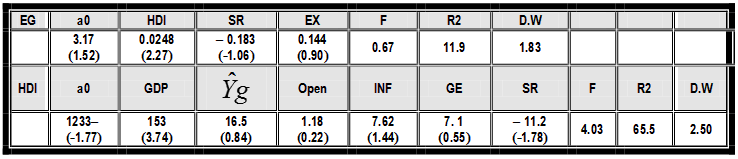
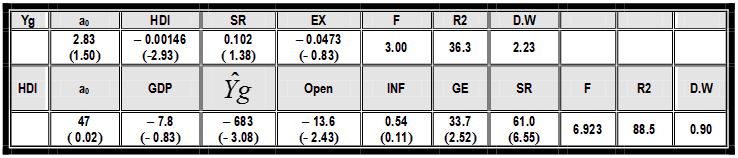
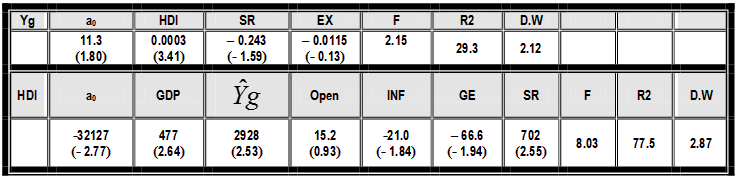
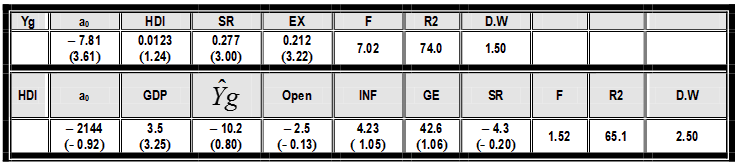
The model was applied to a sample of Arab countries, namely (Jordan, Saudi Arabia, Bahrain, Algeria, and Egypt) using the statistical analysis model for the economic growth equation and the human development index indicators equation and by the two-stage small squares method to show the relationship between economic growth and human development. As in the table (1) the following: Table (1)
Results of estimating the human development equation using (S. L. 2. S) Method in the sample countries during the period 2000-2016.
Jordan:
Saudi:
Bahrain:
Algeria:
Egypt:
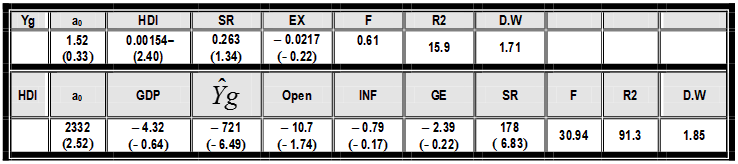
Table (1) shows the results of estimating the equation of the gross national product growth rate and the method of the regular least squares (OLS) and the human development equation by means of the two-stage least squares method (2. SL S). We notice from Table (1) that the first equation is the equation of the gross national product growth rate It is noted that the positive impact of the Human Development Index on the rate of growth in this equation appeared in Jordan, Bahrain and Egypt at the level of moral 5%, that the indication of the variable of human development indicators correspond to the operative of the economic theory that the investment in human development indicators leads to an increase in the rate of output growth.
The production processes in these countries rely on qualified labor and trained more than a reliance on cutting-edge technologies and technological capital and be a productive style labor-intensive. Also, the notable and continuous improvements in the education and health sector as well as previous and current investments in this sector. However, the effect was positive and unimportant in Saudi Arabia and Algeria.
As for the second equation, the formula for determining the indicators of human development indicators by applying the method (2. SL S) for the period 2000-2016 that the effect of gross national product was significant and positive on human development at the level of significance of 5% in Jordan, Saudi Arabia, Algeria and Bahrain, and this is consistent with the operative of economic theory. That is, whenever the gross national product is represented in raising the growth rates, it will lead to an improvement in human development indicators. The results also show that the impact of the gross national product on human development is not significant in Egypt.
The estimates presented in Table (1) also showed that the effect of the estimated gross national product growth rate has a positive effect on human development at a level of 5% in Saudi Arabia and Bahrain, as these are among the oil countries that have witnessed stability in economic growth rates and are the countries with high incomes (High income from oil exports) This is due to the varied nature of its economy and to relatively privatization programs, as well as the impact of the estimated growth rate on human development is positive despite its lack of significance in Jordan and Algeria, and this means that there is a large role and influencing the rate of growth of the gross national product on Human development in some Arab countries, and the estimated growth rate showed a negative moral impact on human development in Egypt at a moral level of 5%, and this is due to the deterioration of the terms of trade as a result of the decrease in the prices of primary commodities, in addition to the restrictions imposed on foreign trade in Egypt .
The estimates shown in table (1) also showed that trade openness showed a negative moral at the level of moral 5% in Egypt and Saudi Arabia, and this is because trade openness in these countries was not a major determinant of human development in these countries because it will lead to increased imports and thus discouraging local industry. In addition to these countries depend on the export sector, as the decline in oil prices during that period led to internal imbalances that led to budget deficits, as estimates show that trade openness appeared negatively
Significant in Algeria, just as estimates showed that the effect was significant in Jordan and Bahrain.
The estimates mentioned in Table (1) also indicate that the rate of inflation appeared significantly negative at the level of significance of 5% in Bahrain, and this is consistent with the operative of economic theory, that is, whenever the rate of inflation increases, it leads to a decrease in human development indicators, and despite its lack of significance, the signal appeared negative in Egypt. The effect was not significant in Jordan, Saudi Arabia, and Algeria
The estimates presented in the above table also showed the ratio of government spending to gross national product at both a moral and negative level of 5% in Bahrain, and this is consistent with the operative of the economic theory that the increase in government spending leads to a decrease in human development indicators because this spending is not directed towards human development But for other purposes, however, that effect was not significant negative in Morocco and Egypt, and the estimates provided in the above table indicate that the ratio of government spending to gross national product has shown positive morale in Saudi Arabia and this means that government spending in these countries does not satisfy the Ie, it is unable to fill the requirements of the country's need of infrastructure spending. Non-significant estimates also appeared in Jordan and Algeria.
From the note of Table (1), it was found that the ratio of saving to gross national product appeared with a positive moral effect on the Human Development Indicators Index at the level of significance of 5% in Bahrain, Saudi Arabia, and Egypt, and this can be due to the large development programs adopted by these countries, which Its financing is not commensurate with the available savings, which led to an increase in the need for foreign direct investment to reach the target growth rate due to the weakness of its production devices, the low efficiency of its investments, the low efficiency of operation in it, the increase in the size of the population, andthe low rates of capital accumulation and savings as a result of the low income The ineffectiveness of its fiscal and monetary policy despite an increase in the proportion of savings, as estimates show that the proportion
Savings have a negative moral effect on the human development indicators index in Jordan at a 5% level of significance because the benefits achieved by the private sector are offset by a deficit in the state budget,i.e. the government borrows family sector savings through banks and spends them as running expenses, so low savings will lead to a decrease in investment in evidence Human development indicators, as it appeared unimportant in Algeria.
The estimates provided in Table 1 also indicate that the independent variables used in the model explain 65.5% of the changes in human development indicators in Jordan, 77.5% in Bahrain, 91.3% in Egypt, 88.5% in Saudi Arabia and 65.1% in Algeria and this It means that there is a small percentage of changes that occur in human development indicators, which these independent variables cannot explain, and we can refer some of them to political instability, fluctuations in weather conditions, deterioration in the terms of trade and restrictions imposed by some Arab countries. These variables were not able to be studied by the researcher and included in the estimated model due to the lack of necessary data about them.
CONCLUSIONS
The research included analyzing the relationship between economic development and human development index indicators for the sample countries. Through the descriptive and analytical study, the research reached the most important conclusions that are summarized as follows:
The research showed a direct, reciprocal relationship between economic growth and the human development indicators index in most Arab countries, meaning that increasing the index of human development indicators leads to an increase in the real gross national product, and an increase in the real gross national product results in an increase in the human development indicators index.
The results in the first equation showed the equation for the gross national product growth rate, the positive effect of the human development indicators index on the growth rate in Jordan, Bahrain, and Egypt at a 5% level of significance.
The results in the second equation show the determinants of the human development indicators index, that the effect of gross national product was significant and positive on the human development indicators index at a 5% level of significance in Jordan, Algeria, Saudi Arabia and Bahrain, and an unimportant appearance appeared in Egypt.
It was found that the effect of the estimated gross national product growth rate was significant and positive on the human development indicators index at the level of significance of 5% in Saudi Arabia and Bahrain, and showed no significant in Jordan and Algeria, and a negative moral in Egypt.
The results showed that the effect of commercial openness was significant and negative on the index of human development indicators at the level of significance of 5% in Saudi Arabia and Egypt, and an unimportant appearance in Jordan, Algeria and Bahrain.
The results of the standard analysis showed that the inflation rate was negative and significant on the indicators of the human development index in Bahrain and this is consistent with the operative of economic theory, and a negative negative emerged in Egypt, and a non-significant positive in Jordan, Saudi Arabia and Algeria.
The estimates showed that the coefficient of the volume of government spending was moral and negative in Bahrain, and appeared morally and positively in Saudi Arabia, and positive morale in Bahrain, Saudi Arabia and Egypt.
The estimates are indications that the effect of saving was significant and positive on the indicators of the Human Development Index in Bahrain, Saudi Arabia and Egypt, but the effect was positive despite its lack of significance in Algeria, and it appeared morally and negatively in Jordan.
There are challenges facing the development of human capital, such as the education system, poverty rates, illiteracy, unemployment rates, and the emigration of palm capital to the country.
The percentage of Arab countries, especially Saudi Arabia and Bahrain, increased within the human development index, and this is due to the narrowing gap between human development and economic growth as a result of interest in health, education and ownership of resources, which reflects positively on the levels of human development in social and humanitarian terms and the reason for this increase is due to the export of oil. The increase in gross national product is not of interest unless it is accompanied by employment of these resources.
Continue to increase spending on education at different levels and to prioritize spending on primary, secondary, and higher education, also opening more colleges and expanding in this field for both sexes and directing higher education specialization toward the job market to reduce external employment.
Rethink training policies, and this helps in correcting imbalances between supply and demand for work, by developing and training skills that are appropriate to the needs of the labor market.
Direct studies towards research into the nature of the relationship between economic growth and human development with its components (education, health and income).
Pay attention to the qualitative aspects of health, education, cognitive skills, encouraging innovations,improving levels of justice in distributing the productivity of the human element and improving the value of the indicator.
BIODATA
Dina Ahmad Omar: Assistant Professor of the Nineveh Technical Institute of Northern Technical University. Iraq. Research area, tourism and hotel management techniques. dinaao@ntu.edu.iq
BIBLIOGRAPHY
ABIODUN, N. (2011).”Education and Economic Growth: The Nigeria Experince”, Jetems Scholzrlink research.org / articles / education% 20 and% 20 economic.
AMOURI HADI KAZEM. (1988). Econometric Methods, First Edition, Higher Education and Scientific Research Press, Baghdad.
BEINE, G. & OLANIYN. (2014). “economic growth and human development – a theoretical justification”. http://shodhganga.inflibnet.ac.in/bitstream/10603/38461/7/chapter%203.pdf
GUSTAR, R. (2000). “economic growth and growth in human development”. http://www.usc.es/economet/journals1/aeid/aeid1521.pdf
HAMDOUCHE ALI. (2013). “The Relationship of Economic Growth with Human Development - With Monitoring of the Algerian Experience, Journal of Economics and Trade Management, Issue 27, Volume 2. https://www.asjp.cerist.dz/en/article/10529.
KOUTSOYIANNS, A. (1997). Theory of Econometric, Second Edition, the Macmillan Press Ltd. London.
MUKHERJEE & KHAKRABORTY. (2010). “Is there any any relationship between Economic Growth andHuman Development?” Evidence from Indian States. https://mpra.ub.uni-muenchen.de/22997/1/MPRA_paper_22997.pdf
NAHLA ABU AL-EZZ. “The Relationship between Human Capital and Economic Growth: Nigeria as an Example”.
ROBERT, B. (2009). “Education as Determinant of Economic Growth”, media. French Case, hsr- trans.zhsf.uni-koeln.de/hsrretro/docs/artikel/hsr2002-550pdf.
SADEGHI, JAVAD M. (1999). The Relationship of Education to Economic Growth Across –country Analysis, Working paper series 9617, economic research form, cairo, Egypt.
SALEM TAWFIQ AL-NAJAFI, IBRAHIM MURAD AL-DAIMAH. (2001). "Human Development and Economic Growth - An Analytical Study”, Journal of Economic Research, Tenth Year, No. 26.
SHADI JAMAL AL-GHARBAWI. (2015). "The Impact of Human Capital on Economic Growth” in Palestine, Master Thesis, Islamic University - Gaza. Https://www.mobt3ath.com/uplode/book/book-13932.pdf
SUHAIL ISSA INTERVIEW, MUSTAFA MUHAMMAD AL-ALAWNEH. (2016). "Human Development andEconomic Growth, an Empirical Study on Jordan", Journal of Administrative and Economic Sciences, No. 92, Volume 22.
https://www.researchgate.net/publication/329315112_altnmyt_albshryt_walnmw_alaqtsady_drast_ttbyqyt_n
WORLD BANK (1998). “World Development Indicators”, Washington, www.worldbank.com.