Artículos
Development of Nahwu Learning media based on Android
Desarrollo del aprendizaje Nahwu basado en media android
Development of Nahwu Learning media based on Android
Utopía y Praxis Latinoamericana, vol. 25, núm. Esp.1, pp. 225-231, 2020
Universidad del Zulia
Recepción: 03 Marzo 2020
Aprobación: 30 Abril 2020
Resumen: Este estudio tiene como objetivo desarrollar medios de aprendizaje Nahwu para mejorar el proceso de enseñanza de los estudiantes. El método utilizado en esta investigación fue ADDIE (investigación y recopilación de información, planificación, desarrollo de una forma preliminar de producto, prueba de campo preliminar, revisión de producto principal, prueba de campo principal, revisión de producto operacional, prueba de campo operacional, revisión de producto final, y difusión e implementación). La población de estudio estuvo conformada por 30 estudiantes del idioma árabe en clases experimentales y de control. Los datos se analizaron mediante la prueba t. y muestran que los medios de aprendizaje Nahwu son “muy buenos”, factibles de usar y se han desarrollado con bastante efectividad para mejorar el aprendizaje de los estudiantes.
Palabras clave: Género de autoaprendizaje, medios de aprendizaje, Nahwu..
Abstract: This study aims to develop Nahwu learning media to improve the teaching process of students. The method used in this investigation was ADDIE (research and information gathering, planning, development of a preliminary product form, preliminary field test, main product review, main field test, operational product review, operational field test, final product review, and dissemination and implementation). The study population consisted of 30 students of the Arabic language in experimental and control classes. Data were analyzed using the t-test. and show that Nahwu learning media are "very good", feasible to use and have been developed quite effectively to improve student learning.
Keywords: Learning media, Nahwu, self-learning gender..
INTRODUCTION
Learning Arabic at the Islamic State University of Malang is a compulsory subject that must be taken by students, one of which is Nahwu course. The science of Nahwu discusses the arrangement of sentences in accordance with the rules of science in understanding Arabic lessons, both related to the form or line at the end of a sentence [1]. The aim of Nahwu learning is for students to be able to know Arabic sentences in terms of changes in i’rab (sentence change) and bina’ (sentence structure) [2].
In studying Nahwu in Islamic State University of Malang, students have difficulty understanding the subject. Apart from the fact that some students came from public schools and had never studied Arabic before, other obstacles were caused by the limited learning media available. So, in this case, students need appropriate teaching media so they can improve student learning outcomes well. Multimedia is one of the media that can meet the needs of teaching materials that can be used in learning nahwu science. Media components include; text, images, audio, and video. These components can support more optimal student learning. Multimedia enables easier and more efficient understanding, learning and application of knowledge [3]. Reiser defines learning media as any means that can be used to convey learning material and stimulate students' senses, thoughts, interests and attention to improve learning outcomes. One of the most important components in a learning system is learning media [4]. The use of multimedia will be optimized if supported by tools that are easy to use, one of which is an Android-based smartphone.
Android is a Linux based operating system designed for devices, such as smartphones and tablet [5]. Android is an open-source which is mean that various application features in the android can be changed according to the needs of its users, including in making learning applications [6]. And Android which is currently growing rapidly compared to other smartphones. Android has advantages such as an operating system that is open (open source) [7]. In 2017, mobile smartphone shipments amounted to around 1.47 billion units. As of the second quarter of 2017, Android accounted for approximately 87.7% of the mobile OS market share [8]. Data released on the website https://gs.statcounter.com shows that the use of Android-based smartphones is increasing very rapidly, in August 2015 from 68.39% to 92.27% in September 2018. This is also strengthened by the data obtained from S1 students majoring in Arabic Language, the Islamic State University of Malang, from 30 students all using Android-based smartphones. In this connection, the opportunity to use software (mobile devices) in the world of education is very useful.
The software in the learning process is known as mobile learning (m-learning). Clark Quinn said, the intersection of mobile computing and e-learning: accessible resources wherever you are, strong search capabilities, rich interaction, powerful support for effective learning, and performance-based assessment. ELearning independent of location in time or space [9]. Mobile learning is one of the learning media that uses smartphones that can be accessed anywhere and anytime [10]. So in this research, the development of android-based learning multimedia is expected to support and enhance the learning success of special students in realizing Nahwu Science.
METHODOLOGY
This research uses research and development methods. The product developed in this research is Android-based learning media nahwu. The product development procedure adapts the ADDIE development model which consists of five stages namely Analysis, Design, Development, Implementation, and Evaluation [11]. The steps in developing learning media with the ADDIE model are shown in the following figure:
Figure 1. ADDIE model [12]
Product development results are then assessed for their feasibility and effectiveness. The feasibility of an Android-based nahwu learning media product is obtained from expert judgment on the product eligibility questionnaire. In addition, a product feasibility assessment questionnaire was given to participants after product implementation to determine students' responses to the product being developed. The effectiveness of the product development results obtained from the results of student tests on learning nahwu. Test scores obtained by students were analyzed for significance using SPSS 24.0. Significance analysis was conducted to determine differences in learning outcomes before and after learning in the experimental class and the control class. The test subjects in this study were second-semester students majoring in Arabic Language Education at the Islamic State University of Malang.
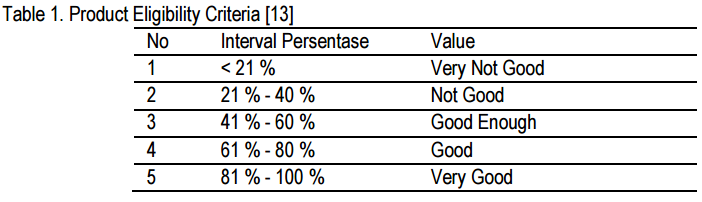
Sampling class is done randomly by simple random sampling so that class A is determined as the experimental class and class B as the control class. Both classes consist of 30 students each. Data collection techniques are done using questionnaires and tests. A questionnaire is used to determine the feasibility of the product being developed. The test is used to determine the effectiveness of the product developed on student learning outcomes in learning nahwu. The type of data in this study is quantitative data consisting of scores of product worthiness assessments by material experts and media experts, student questionnaire scores and student learning outcomes test scores. The product feasibility scores obtained are categorized using the interval of the eligibility percentage as in the following table:
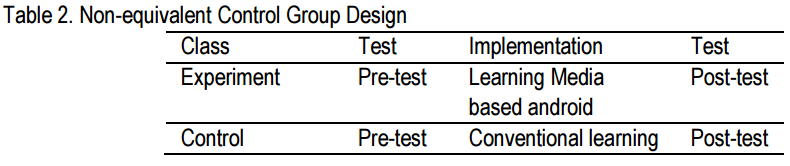
The product implementation phase is carried out with the quasi-experimental design method because there are external variables that cannot be controlled by the researchers in this study. The design used is non- equivalent control group design where, before treatment, both the experimental class and the control class are given a pre-test to determine the students' initial abilities. Furthermore, after being given treatment, the experimental group and the control group were given a post-test that aims to determine the state of the two classes after being given a different treatment. In this study, the experimental class received treatment in theform of an android-based nahwu learning while the control class conducted conventional learning. The research design is illustrated by the following table:
RESULT AND DISCUSSION
Data on the feasibility of android-based nahwu learning media is obtained through a questionnaire distributed at the trial stage. Data obtained from material expert lecturers, media experts and students are illustrated in the following table:

From the table above it can be seen that the results of the assessment by both material experts and media experts indicate the percentage of eligibility that can be categorized as very feasible. Therefore, it can be said that successfully developed products in the form of Android-based learning media nahwu are feasible to be implemented in the field during extensive trials.
The effectiveness of the Android-based nahwu learning media is obtained through the provision of test results in the experimental class and the control class. . At this stage, students work on pre-test and post-test questions, each of which consists of 20 multiple choice questions. Data values obtained by students were compared between the experimental class and the control class. Thus, it can be seen the difference in learning outcomes between pre-test and post-test Recapitulation of the average results of the test scores of the experimental class and the control class are illustrated in the following figure:
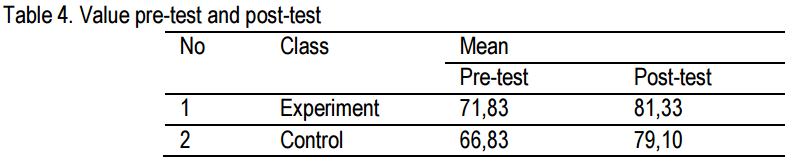
Based on the table it can be seen that between the experimental class and the control class both experience an increase in the average value of the post-test value. In addition, the average value of nahwu learning in the experimental group showed higher numbers than the control class. This shows learning by using android-based learning media is more effective in improving student learning outcomes.
The test score results obtained in the form of pre-test scores and post-test scores were further analyzed to determine the achievement of students' cognitive understanding of nahwu learning. Achievement data of learning outcomes in hypothesis testing using non-parametric statistical test analysis due to not achievingparametric prerequisites in the data obtained. Non-parametric test used is U Mann Whitney. U mann whitney test is used to analyze the presence or absence of an average difference between two independent data. The results of the hypothesis prerequisite test in this study are shown in the table below.
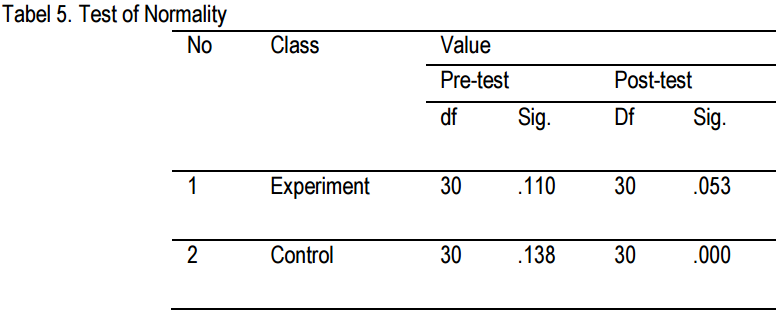
Based on the above table, it is known that the post-test data results are not normally distributed. The result of homogeneity of variance shown in the table below.
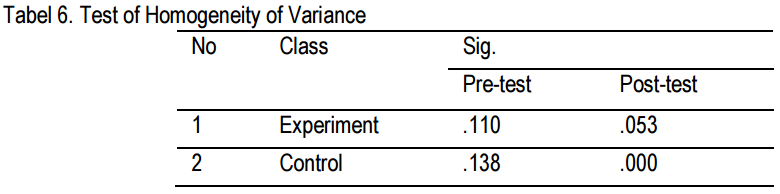
Based on the above table, it is known that the variance were not homogeneous so that the parametric test prerequisites are not achieved. Therefore a hypothesis test was performed with the Mann Mann Whitney test. The results of the U mann whitney test are shown in the following table.

Based on the results of this study the Android-based nahwu learning media can significantly improve student learning outcomes. Android-based nahwu learning is very interactive media because it provides features of images, video audio, and others, which can attract the attention of students to learn actively in understanding learning nahwu [14]. In addition, the android application can be easily accessed anywhere and anytime by students, in accordance with the objectives of mobile learning developed [15]. Based on the observations of teachers in learning in the classroom shows that students are enthusiastic about learning compared to students in the control class.
The Android-based nahwu learning media has several main menu, namely competency, material, evaluation, glossary, and application menus. The "Competencies" menu contains the competencies that are expected to be mastered by the user after studying the material presented in the application. On the "Material" menu there are material summaries then users can test their understanding of the material presented in the "Evaluation" menu. In addition, there is a "Glossary" menu which contains several terms related to the material presented. While the "About Application" menu contains a brief description of the application. The existenceof these menus allows users to choose their own content to be studied. All these features on this application can automatically students’ learning interest and effectively improve their understanding on nahwu course. This is in accordance with the opinions [16]. Regarding some content criteria that make multimedia based mobile learning effective.
CONCLUSION
Android-based learning media successfully developed and effective to applied in Nahwu course in college student of Arabic education in Islamic state university of Malang. This result shown by the calculation of the feasibility value is based on the eligibility category table. In accordance to the learning outcome result on nahwu course, it was found that there is a significant difference to learning outcome between experiment class and control class. The result of this study indicates that Android-based learning media, which are successfully developed, were effective to increase Student College learning outcomes.
BIODATA
M. Khairil Asrori: Is a lecturer at Yogyakarta State University, Yogyakarta, Indonesia.
Mochammad Bruri Triyono: Is a lecturer at Yogyakarta State University, Yogyakarta, Indonesia.
Acknowledgments
The authors would like to thank to the University of Yogyakarta and everyone for supports and guidance.
BIBLIOGRAPHY
ARIKUNTO, SUHARSIMI. (2009). Prosedur Penelitian, Suatu Pendekatan Praktek. Jakarta: Rineka Cipta.
BRANCH, R.M. (2009). Instructional Design-The ADDIE Approach. New York: Springer.
QUINN, C. (2011). Mobile learning: Landscape and trends (The eLearning Guild Research)
DARMAWAN, D. (2012). Pendidikan Teknologi Informasi dan Komunikasi. Bandung: PT Remaja Rosdakary.
FENG P, LI Q., ZHANG, P. & CHEN, Z. (In press). Logical acquisition method based on data migration forAndroid mobile devices, Digital Investigation. The International Journal of Digital Forensics & Incident Response.
LEE, W. (2004). Multimedia Based Instructional Design: Second Edition. San Francisco: Preiffer
MILOVANOVIC, M. OBRADOVIC, J. & MILAJIC, A. (2013). “Application Of Interactive Multimedia Tools InTeaching Mathematics – Examples Of Lessons From Geometry” TOJET Turkish Online Journal of EducationalTechnology, vol. 12 Issue 1
MULYANA EUEUNG. (2012). App Invendor: Ciptakan Sendiri Aplikasi Androidmu Yogyakarta, Andi Offset MUSLIMIN & SURJONO, H.D. (In Press). “Developing Bima-Indonesia Mobile dictionary with Input outputgoogle voice feature” Journal of Physics: Conference Series.
MUSTOFA AL-GULAYAINI. (2004). Jamiud Durus Al-Arobiyah, Beirut: Daar Al-Kitab AlIlmiyah
KIDI, N. et al. (2017). “Android Based Indonesian Information Culture Education Game,” ICCSCI Indonesia vol. 116, p. 99-106.
NAZARUDDIN SAFAAT H. (2014). Android Pemrograman Aplikasi Mobile Smartphone dan Tablet PC Berbasis Android. Bandung: Informatika
RAZIN. A. (2015). Ilmu Nahwu Untuk Pemula. Jakarta: Pustaka Bisa
PAMBUDI, S., SUKARDIYONO, T. & SURJONO, H.D. (In press). “The development of mobile gamification learning application for web programming learning”. IOP Conf. Series: Journal of Physic.SERIES, C. (In Press). ME science as mobile learning based on virtual reality. Journal of Physics: Conference Series.
SURJONO, H.D. (2017). Multimedia Pembelajaran Interaktif: Konsep dan Pengembangan, Edisi Pertama. Yogyakarta: UNY Press.