Artículos
Agricultural Ecology of Irrigation Systems and Sustainable Development in Simalungun region, Indonesia
Ecología agrícola de los sistemas de riego y desarrollo sostenible en la region de Simalungun, Indonesia
Agricultural Ecology of Irrigation Systems and Sustainable Development in Simalungun region, Indonesia
Utopía y Praxis Latinoamericana, vol. 25, núm. Esp.1, pp. 272-281, 2020
Universidad del Zulia
Recepción: 01 Marzo 2020
Aprobación: 24 Abril 2020
Resumen: El propósito de este artículo es describir los problemas agrícolas y ambientales que se enfrentan hoy en día, como lo es la ecología agrícola. El problema surge debido a los cambios en el entorno agrícola, lo que hace que ya no sea adecuado para mantener la vida de los seres vivos causada por el uso de agua de riego insuficiente que no cumple con las necesidades. Si esto no se resuelve, eventualmente resultará en la interrupción de la cadena alimentaria en el ecosistema, lo que causará la explosión y destrucción de criaturas vivientes.
Palabras clave: Agricultura, desarrollo sostenible, ecología agrícola, producción, sistemas de riego..
Abstract: The purpose of this article is to describe the agricultural and environmental problems that are face nowadays, such as agricultural ecology. The problem arises due to changes in the agricultural environment, which makes it no longer adequate to maintain the life of living beings caused by the use of insufficient irrigation water that does not meet the needs. If this is not resolved, it will eventually result in the disruption of the food chain in the ecosystem, which will cause the explosion and destruction of living creatures.
Keywords: Agricultural ecology, agriculture, irrigation systems, production, sustainable development..
INTRODUCTION
Indonesia is an agricultural country and is still an agricultural country, meaning that agriculture plays an important role in the overall national economy. This can be shown from the number of residents or workers who live or work in the agricultural sector or from national products derived from agriculture.Having very fertile soil, the land is an important agricultural production factor. The balance of the soil with the content of organic matter, microorganisms and biological activities as well as the presence of nutrients and nutrients will be very important for the sustainability of agriculture of agriculture in the future
Ecosystems are the basic functional units in ecology, because ecosystems include living things in the environment of organisms and the abiotic environment, each of which affects other properties and both need to maintain life so that there is balance, harmony, and harmony of nature. When this has been different from the first plant has been reduced because it is used as a place for human activities, but instead plants are needed by humans for survival. As is the case with agriculture, which is deliberately cultivating plants and expecting results from cultivating.
Agricultural environmental problems faced today are basically problems of agricultural ecology. problemsfaced today are basically problems of agricultural ecology. The problem arises because of changes in the agricultural environment, which causes the environment is no longer suitable to support the lives of living things caused by the use of irrigation water that is not in accordance with the needs. If this is not resolved it will eventually result in disruption of the food chain in the ecosystem which causes the explosion of one living creature and the destruction of other living creatures. But in cultivating a plant, it is necessary to pay attention to what plants can grow well. One of them is by understanding the scope around these plants and the needs of these plants, namely by studying agricultural ecology in the field.
Development in principle is a process and effort carried out by a society systematically to achieve a situation or condition that is better than now and is directed towards the development of advanced agriculture. The implementation of this development process is none other than the community feeling dissatisfied with the current situation which is felt to be less than ideal. However, it must be realized that agricultural development is an evolutionary process, so that people need to carry out gradually in accordance with their resources and the main problems being faced.
Agricultural development as a holistic way of farming based on various ecological processes and ecosystem services such as nutrition cycles, natural regulation of pests, soil and water conservation, biodiversity conservation, and carbon sequestration with the aim of increasing ecosystem sustainability and bringing economic and environmental benefits to farmers and society. Characteristics of agricultural development or agriculture by producing high quality products, natural cultivation of plants, increasing biological cycles, increasing soil fertility, avoiding pollution and maintaining biodiversity. So that it is promising for modern agriculture because it is associated with negative environmental impacts that are much lower.
REFERENCY STUDY
Agriculture is identical to farming in agriculture needs to learn about living things and the cultivation environment that is sought by humans. Agricultural ecology is an agricultural production system that relies on natural ingredients and avoids or restricts the use of synthetic chemicals, chemical fertilizers, pesticides, plant regulating substances, addictive feed, with the aim of providing agricultural products [2], that are safe for the health of producers and consumers as well as maintain environmental balance with nature and agricultural development directed at developing environmental balance with nature and agricultural development directed at developing advanced, efficient and resilient agriculture [12].
Concerns about sustainability in agricultural systems center on the need to develop technologies and practices that have no adverse effects on environmental goods and services, are accessible and effective forhalf century, with crop and livestock productivity greatly driven by increased use of fertilizers, irrigation water, agricultural machinery, pesticides and soil, it would be too optimistic to assume that this relationship will remain linear in the future [23]. New approaches are needed that will integrate biological and ecological processes into food production, minimize the use of non-renewable inputs that cause damage to the environment or the health of farmers and consumers, utilize farmers' knowledge and skills productively, thereby replacing human capital for expensive external inputs, and utilize the collective capacity of the community productively [[6]
Agricultural ecology as interactions between plants, animals, humans, and the environment in agriculturalsystems based on the related geographical location. Ecology plays a political role aimed at fulfilling social and economic equality to traditional agricultural actors, productivity, stability, sustainability, and equality to develop new production methods, or cultural factors that determine cultivation practices [9]. Agricultural ecology is needed because by understanding the ecosystems that exist in the agricultural environment, we can prevent natural damage from the use of agricultural ecology itself [23].
Irrigation system as a human effort to modify the distribution of water, which is contained in natural channels, by using buildings and artificial channels for all or part of water for the purposes of the production of agricultural crops. The existence of physical elements as well as institutional elements that are interrelated in an irrigation system used In channeling water from water sources.
Irrigation has many benefits for nature as well as for living things that live in nature, including us as humans, among others, launching the flow of water in the paddy fields, eating the rice fields, regulating the wetting of land paddy fields, make it easier for farmers to irrigate paddy fields, meet the water needs of the paddy fields, as a means of supporting food security, fertilize the soil, for flushing water, as a place for cultivating certain plants or animals, as a store of water supply, depositing salts, protecting the soil, regulating temperature in the ground [22]. The intensification of sustainable agriculture is defined as producing more output from the same land area while reducing the negative environmental impacts and at the same time increasing the contribution of natural capital and the flow of environmental services [40]
Irrigation technology allows the control and distribution of water to meet various needs in water systems, such as agriculture, industry, and household needs [1]. Water is a vital economic resource, especially in agriculture, because water plays a very important role in the fertility of agricultural land. In addition, accessibility to water resources contributes to improving the livelihoods of small-scale agricultural households [7]. Agricultural water needs require supplying water and channeling it from areas that grow as well as water conservation for the dry season and ecological maintenance of agriculture [10].
Irrigation schemes are a systematic approach to managing water on agricultural land, water is provided for and channeled away from agricultural land and also includes water conservation for the dry season and ecological maintenance, acceptance of appropriate water management technology for agricultural practices can further increase agricultural production capacity and increase efficacy use of water in agriculture [29].
METHODOLOGY
The population in this study is the overall number of villagers who have the livelihoods of rice farmers who use irrigation in Pane District. The population of Panei Village as a rice field farmer is 837 families. The study population was 1,837 households. For the research sample, 837 heads of family were selected purposefully. The collected data will then be analyzed using analysis of variance (ANOVA).
Our model included the irrigation system, the benefits of irrigation and productivity. We examine the correlation between economic improvement, and sustainable agriculture using the Spearman rank correlation or Pearson correlation coefficient, based on whether the data meet the normality and homogeneity of the variance assumptions.
Research variables for irrigation agriculture, ecosystem with indicators: integrated pest control, rotation and cultivation systems, land conservation, maintaining water quality due to wetlands, and diversification of land by planting and having superior varieties, better management of plant nutrients.
Sustainable agriculture variables are: produce high quality agricultural production with adequate quantity, naturally cultivate plants, encourage and enhance biological life cycles in the agricultural ecosystem, maintain and increase soil fertility over long periods, avoid all forms of pollution caused by the application of agricultural techniques, maintain a diversity genetic system of agriculture.
RESULTS AND DISCUSSION
Results
The age of most respondents is> 50 years, amounting to 37.21%, age 31-40 years at 12.79% and age 20- 30 years at 4.65%. Elementary / junior high school education is 11.63%, high school is 82.56%, undergraduate is 4.65% and a master is 1.16%. Monthly respondent's income is 2,500,000-3,500,000 in the amount of 5.68%, 3,600,000-4,500,000 is 61.36% and> 4,500.00 is 32.95. Respondents who have land greater than 20 range amounted to 6.98%, land area of 15-20 rannge amounted to 13.95%, land area of 11-15 range amounted to 22.09%, land area of 6-10 range amounted to 48.84% and land area of 1-5 range ofThe age of most respondents is> 50 years 37,21%, age 31-40 years is 12.79% and age 20-30 years is 4.65%. Elementary / junior high school education is 11,63%, high school is 82,56%, undergraduate is 4,65% and a master is 1.16%. Monthly respondent's income is 2,500,000-3,500,000 in the amount of 5,68%, 3,600,000-4,500,000 is 61,36% and> 4,500.00 is 32,95. Respondents who have land larger than 20 range are6 people by 6.98%, land area of 15-20 range is 12 people for 13.95%, land area for 11-15 range is 19 people for 22.09%,land area 6-10 range as much as 48.84% and land area of 1-5 as many as 7 people amounted to 8.14%. Land ownership of respondents who own their land is 86.05% and rented land is 13.95%. The number of family members> 8 people is 12.79%, 5-8 people is 79.07 people and 1-4 people are 8.14%.
The results of multiple linear regression testing can be shown in the following table below.
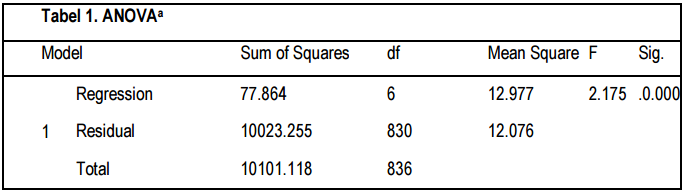
Obtained F count is 1,075 while the F table is 2.12, where F count is smaller than the F table or 1.075>2.12 with a significance level of 0.00 <0.05, thus it can be concluded that together the agricultural irrigation system positive and significant effect on sustainable agricultural development.
Significant influence occurs because agricultural activities such as land management, drainage, inter- planting, rotation, and extensive use of pesticides and fertilizers have significant implications for flora and fauna. Species that are able to adapt to agricultural landscapes create fundamental habitat changes that result in significant changes in composition.
To find out the joint effect of X on Y, the F test is carried out with the results as shown in the following table.
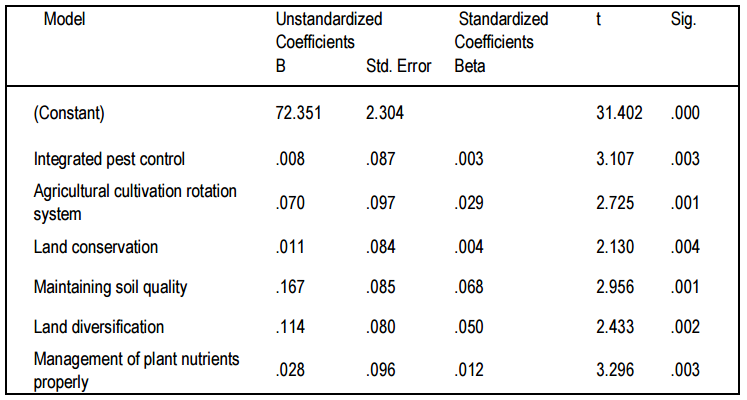
Agricultural ecology of the irrigation system with integrated pest control, rotation system of agricultural cultivation, land conservation, maintaining soil quality, land diversification, better management of plant nutrients have no significant effect on sustainable agricultural development.
As the main basis for all agricultural activities, soil is one of the main natural resources, because farmers do not get to compensate for the loss of soil fertility with nutritional inputs, fertilization in organic farming is based on organic substances such as manure, compost, green manure, plant residues and fertilizers organic. As a result, there is a broad supply of organic matter through the aerobic decomposition process affected by humidity, temperature and oxygen. Intense biological activity increases metabolism between soil and plants and must be the focus of sustainable crop production and fertilizer management. In contrast to conventional agriculture, organic farmers are more dependent on a high and sustainable supply of organic matter including crop rotation.
DISCUSSION
Age naturally affects labor productivity. Within certain limits, the more a person's age increases, the more productive their workforce will be, and after a certain age the productivity will decrease. Farmer, age is also related to the process of transfer and adoption of technological innovations, where young farmers tend to be more progressive in the process of transfer of new innovations, so as to accelerate the process of technology transfer that can increase the productivity of these farmers. Education is very important for someone in living this life. High or low level of farmer education influences decisions in land conversion, the higher the level of education the farmer becomes more critical in making decisions. Conversely, the lower the farmer's education, the easier the farmer is influenced by others. Income between respondents and other respondents is not the same, the size of the respondent's income is determined by the type of work they have. If they work as farmers, their income comes from harvests from agriculture. The size of the income of farmers is very dependent on the area of land they have. In addition, those who have a high income have the ability to meet their needs higher than those who have a low income. Land area really influences the amount of income for farmers, because land is one of the factors of production from agriculture. If farmers have a large area of land, then the possibility of income is also greater than that of a small area, this is because they are interrupted to wait for the harvest.
The farmers have free time to do work on other fields, and the agricultural sector has many opportunitiesto do other work. Land ownership is the total area of land cultivated by farmers with their own land, land ownership determines the income, standard of living and degree of welfare of the farmer's household. Land ownership will affect the adoption of innovation, because the farm owner himself is more willing to adoptinnovation, the higher the yield of production so that it will also increase farmers' income. The number of family members of the farmer greatly influences welfare because the smaller the number of family members, the fewest needs that the family must meet, and vice versa. So that in a family with a large number of members, it will be followed by many needs that must be met.
The agricultural ecology of the irrigation system has an effect of 7.1% on agricultural development. In its implementation, the agricultural development system using organic agricultural materials is very concerned about environmental conditions by developing environmentally friendly cultivation methods and processing. Organic farming systems are applied based on the interaction of soil, plants, animals, humans, microorganisms, ecosystems and the environment by taking into account the balance and biodiversity.
This system is directly directed at efforts to improve the process of natural recycling rather than efforts to damage the agricultural ecosystem. Organic farming views nature as a whole, its components are interdependent and supportive, and humans are part of it. Ecological principles applied in organic farming can enhance the relationship between organisms and their natural surroundings and between these organisms develop in a balanced manner. The pattern of relations between organisms and their nature is seen as an inseparable unity, as well as basic guidelines or laws in the management of nature, including agriculture.
The continuous use of pesticides will have a negative impact on health and the environment. Integrated pest control is an innovation that farmers must apply in reducing the use of pesticides.
The other side of the application of pesticides that are easy to use also negatively affects farmers, the environment, plants and the community as consumers of agricultural products, the use of pesticides by farmers causes poisoning for farmers, pesticide residues settling into the soil and pesticides sprayed on plants absorbed through leaves, stems and plant roots.
Agriculture carried out by the community is still a monoculture farming system throughout the year; this causes an explosion of pest populations that attack agricultural crops throughout the year, reduced soil fertility due to hardening of the soil structure, loss of vegetation of organisms that are symbiotic with plants and the ability of infiltration by the soil. The benefits of crop rotation can reduce the intensity of pests and diseases, increase soil fertility, and be able to form a stable micro ecosystem.
Land conservation and maintaining soil quality are agricultural systems that integrate soil and water conservation techniques into existing farming systems with the aim of increasing farmers 'incomes, improving farmers' welfare and at the same time reducing erosion and water balance can be maintained so that the farming system can continue continuously without limits.
The conservation farming system is a typical dry land farming. Dry land with a high level of slope as a place for farmers to run their farming business, so that it will be able to be processed into productive and sustainable land that guarantees land resources, which are able to permanently support the national economy. This can only be achieved when the principle of using socioeconomic factors is still low; land damage that occurs is often caused by the necessities of life, because poor farmers are unable to cultivate farming independently.
It is indeed not easy to realize conservation farming business, given the many challenges, especially the characteristics of farmers and agriculture in areas that require conservation farming area: 1) farmers are generally poor and lack capital to carry out conservation farming business, 2) farmers with narrow land, farmers, landless or tenant farmers so that they are not eager to carry out conservation farming business, 3) farmers do not think that erosion in agricultural areas is a matter of agricultural management or problems of farmers even though they are aware that agricultural cultivation erosion, 4) knowledge of farmers about conservation techniques can increase agricultural production is still low, 5) agricultural land is generally poor (infertile), marginal land, lack of water, erosion that has occurred so that land productivity is low, 6) the price of agricultural products is very low, 7) employment opportunities in outside the agricultural business is very limited
Agricultural diversification is an effort to diversify types of businesses or agricultural crops to avoid dependence on one agricultural product. Agricultural diversification can be done in two ways, namely: multiplying various types of agricultural activities, for example, farmers besides farming also raising chickensand raising fish, land, for example, in a field besides been planting corn is also planted with fields. Diversified agriculture is also called mixed farming. Plant nutrient management is a holistic approach to plant nutrient management by considering in full all agricultural resources that can be utilized as a source of plant nutrients aimed at optimizing the use of nutrients from an agronomic, economic and environmental perspective.
With proper and good nutrition in a location-specific total crop production system. The provision of nutrients ensures that the plant has enough to obtain all essential nutrients, but not to excess. The main principle of providing nutrition is by maximizing the use of organic inputs and minimizing nutrient loss and creating fertilizer supplements. Efforts to maximize the use of organic inputs include returning plant residues to the soil, involving nitrogen-fixing legume plants in crop rotation, and using organic material produced outside the soil if possible.
The cause of the agricultural ecology of irrigation systems does not significantly affect agricultural development is that there are other factors outside the research variables, including rainfall, climate, wind speed, soil composition and color, plant cover, slope, temperature and plant evaporation rate.
Farmers as the main actors in agricultural development have problems, and this prevents farmers from developing their farming. The problem often faced by farmers is a basic problem that must be resolved to develop agriculture. Issues to note: capital is often a problem when farmers start farming, the price of production is unstable, the nature of agricultural products is seasonal, which means the product will have sufficient amounts at a certain time, narrow tenure, one of the problems that continues to haunt development agriculture is the narrow control of land, scarcity of production input, the problem faced by farmers is the scarcity of agricultural production facilities. Whereas production input plays a role as an input for farming by farmers.
CONCLUSION
The agricultural ecology of the irrigation system has no significant effect on agricultural development and the results of the analysis concluded that the agricultural ecology of the irrigation system has an effect of 7.1% in agricultural development. It is necessary to strengthen the capacity of institutions, both government institutions and community institutions in the context of agricultural development. In order to pay attention to the concept of agricultural ecology, it is necessary directed community action to lead to the growth of formal community institutions and management of agriculture with the concept of agricultural ecology so that it leads to the emergence of sustainable agricultural development.
BIODATA
Sarintan Efratani Damanik: Is a lecturer at Simalungun University, North Sumatra, Indonesia.
BIBLIOGRAPHY
AMOAH, P., DRECHSEL, P., ABAIDOO, R.C. & ABRAHAM, E.M. (2009). Improving food hygiene in Africa where vegetables are irrigated with polluted water.
AYANWALE, A.B. & ALIMI, T. (2004). “The impact of the National Fadama facility in alleviating rural poverty and enhancing agricultural development in south-western Nigeria”. Journal of social sciences, 9(3), 157-161.
AHMED, B., MUME, J. & KEDIR, A. (2014). “Impact of Small-scale Irrigation on Farm Income Generation and Food Security Status: The Case of lowland Areas, Oromia, Euhiopia”. International Journal of Economics and Empirical Research (IJEER), 2(10), 412-419.
ALSTON, J.M., & PARDEY, P.G. (2014). “Agriculture in the global economy”.
BACHMANN, F. (2011). “Potential and limitations of organic and fair trade cotton for improving livelihoods of smallholders: evidence from Central Asia”. Renewable Agriculture and Food Systems FirstView Article: 1-10.
BACON, C. (2005). “Confronting the coffee crisis: can fair trade, organic, and specialty coffees reduce small- scale farmer vulnerability in northern Nicaragua?” World development 33(3): 497-511.
BADGLEY, C. et al. (2007). “Organic agriculture and the global food supply”. Renewable Agriculture and Food Systems 22(02): 86.
BAKEWELL-STONE, P. et al. (2008). “Potentials for organic agriculture to sustain livelihoods in Tanzania”. International Journal of Agricultural Sustainability 6(1): 22-36.
BALITBANG PEKERJAAN UMUM. (2012). Operation and Maintenance of Participatory Irrigation in Chea, Kementerian Pekerjaan Umum, Jakarta.
BAWA, K.S. & SEIDLER, R. (1998). “Natural forest management and conservation of biodiversity in tropical forests. Conserv Biol. 12:46–55”. [Crossref], [Web of Science ®], [Google Scholar]
BENGTSSON, J. et al. (2005). “The effects of organic agriculture on biodiversity and abundance: a meta- analysis”. Journal of Applied Ecology 42(2): 261-269
BRANDT, K. & J. MØLGAARD, P. (2001). “Organic agriculture: does it enhance or reduce the nutritional value of plant foods?” Journal of the Science of Food and Agriculture 81(9): 924-931.
BRAY, D.B. et al. (2002). “Social dimensions of organic coffee production” in Mexico: lessons for eco-labeling initiatives. Society & Natural Resources 15(5): 429-446
CAMBRIDGE, UK, DIRECTORATE GENERAL OF WATER RESOURCES DEVELOPMENT, GOVERNMENT OF, FACULTY OF AGRICULTURAL TECHNOLOGY, GADJAH MADA UNIVERSITY, YOGYAKARTA,INDONESIA, January. (1995). Asset Management Procedures For Irrigation Schemes,-Preliminary guidelines for the preparation of an asset management plan for irrigation infrastructure.
CECCON, E., GONZÁLEZ, E.J. & MARTORELL, C. (2016). “Is direct seeding a biologically viable strategy for restoring forest ecosystems?” Evidences from a meta-analysis. L Degrad Dev. 520:511–520. [Crossref], [Google Scholar]
CLARK, C.J., POULSEN, J.R., LEVEY, D.J. & OSENBERG, C.W. (2007). “Are plant populations seedlimited?” A critique and meta‐analysis of seed addition experiments. Am Nat. 170:128–142.http://www.journals.uchicago.edu/doi/10.1086/518565.[Crossref],[Webof Science ®], [Google Scholar]
COLLA, G. et al. (2000). “Soil physical properties and tomato yield and quality in alternative cropping systems”. Agronomy Journal 92(5): 924-932
CROSSON, P. & BRUBAKER, S. (1982). Resource and Environmental Effects of U.S. Agriculture. Washington: Resources for the Future.
DAMGAARD-LARSEN. (2009). “Conservation farming strategies in East and Southern Africa: yields and rain water productivity from on-farm action research.” Soil and Tillage Research 103: 23-32ECONOMIC PERSPECTIVES 28(1), 121-146.
FIRST WORLD IRRIGATION FORUM, MARDIN, TURKEY. (2013). Economics of Irrgation System, Water for Sustainable Agriculture, ICID.
FOOD AND AGRICULTURE ORGANIZATION FOR THE UNITED NATIONS. (2012). State of the world ’sforests. Rome (Italy).
GARDNER, T.A., BARLOW, J., CHAZDON, R., EWERS, R.M., HARVEY, C.A., PERES, C.A. & SODHI, N.S.(2009). “Pros pects for tropical forest biodiversity in a human-modified world”. Ecol Lett. 12:561–582. [Crossref], [Web of Science ®], [Google Scholar]
HADIHARDAJA,I.K. & GRIGG, N.S. (2011). “Decision support system for irrigation maintenance” in Indonesia: a multi-objective optimization study, Water Policy Vol 13 No 1 pp 18–27.
HARWOOD, R.R. (1990). "A History of SIJ.s.tainable Agriculture", in C.A. Edwards, R. Lal, P. Madden,R. Miller and G. House (eds.), Sustainable Agricultural Systems. Ankeny: Soil and Water Conservation Society.
HOLT-GIMΕNEZ, E. (2002). “Measuring farmers' agroecological resistance after Hurricane Mitch in Nicaragua: a case study in participatory, sustainable land management impact monitoring”. Agriculture, Ecosystems & Environment 93(1-3): 87-105
INSTITUTE OF IRRIGATION STUDIES, UNIVERSITY OF SOUTHAMPTON, UK in association withWRcEngineering, Swindon, UK, Mott MacDonald,
LEE, D.R. (2005). “Agricultural sustainability and technology adoption: Issues and policies for developing countries”. American Journal of Agricultural Economics 87(5): 1325-1334.
LEIFELD, J. & FUHRER, J. (2010). “Organic farming and soil carbon sequestration: what do we really know about the benefits?” AMBIO: A Journal of the Human Environment: 1-15
SAINJIU, U.M., WHITEHEAD, W.F. & SINGH, B.P. (2003). “Agricultural Management Practices to sustain Crop Yields and Improve Soil and Environmental Qualities.” The Scientific World Journal 3: 768-789.
SMIT, B. & SMITHERS, J. (1992). "Adoption of Soil Conservation Practices: An Empirical Analysis in Ontario, Canada", Land Degradation and Rehabilitation, forthcoming.
SUMARYANTO, SIREGAR,M., HIDAYAT,D. & SURYADI, M. (2006). Evaluasi Kinerja Operasi dan Pemeliharaan jaringan Irigasi dan Upaya Perbaikannya. Pusat AnalisisSosial dan Kebijakan Pertanian, Badan Penelitian dan Pengembangan Pertanian, Departemen Pertanian.
SUNWATER, O. (2010). Review of Irrigation Prices Asset Management Planning Methodology Paper.
SUPADI. (2009). Model Pengelolaan Irigasi Memperhatikan Kearifan Lokal, Disertasi Doktor Teknik SipilUniversitas Diponegoro, tidak dipublikasikan, Semarang
TOVIGNAN, D.S. & NUPPENAU, E.A. (2004). Adoption of organic cotton in Benin: does gender play a role. Conference on Rural Poverty Reduction through Research for Development and Transformation, Berlin
VALKILA, J. (2009). “Fair trade organic coffee production in Nicaragua-Sustainable development or a poverty trap?” Ecological Economics 68(12): 3018-3025.
VOHLAND, K. & BARRY, B. (2009). “A review of in situ rainwater harvesting (RWH) practices modifying landscape functions in African drylands.” Agriculture, Ecosystems & Environment 131(3-4): 119-127.
WELCH, R. M. & GRAHAM, R.D. (1999). “A new paradigm for world agriculture: meeting human needs: Productive, sustainable, nutritious”. Field Crops Research 60(1-2): 1-10
ZHEN, L. & ROUTRAY, J.K. (2003). “Operational indicators for measuring agricultural sustainability in developing countries”. Environmental Management 32(1): 34-46.
ZHEN, L., ROUTRAY, J.K., ZOEBISCH, M.A., CHEN, G., XIE, G. & CHENG, S. (2005). Three dimensions ofsustainability of farming practices in the North China Plain: a case study from Ningjin county of Shandong province
ZHEN, L., ZOEBISCH, M.A., CHEN, G. & FENG, Z. (2006). “Sustainability of farmers' soil fertility management practices: a case study in the North China Plain”. Journal of Environmental Management 79(4): 409–419
ZHEN, L., ZOEBISCH, M.A., CHEN, G. & FENG, Z. (2006). “Sustainability of farmers' soil fertility management practices: a case study in the North China Plain”. Journal of Environmental Management 79(4): 409–419