Artículos
The Arabic Language in Social Medias' era
La lengua árabe en la era de los medios sociales
The Arabic Language in Social Medias' era
Utopía y Praxis Latinoamericana, vol. 25, núm. Esp.1, pp. 356-366, 2020
Universidad del Zulia
Recepción: 10 Febrero 2020
Aprobación: 26 Abril 2020
Resumen: Este artículo tiene como objetivo identificar los desafíos que enfrentan los países árabes para establecer su idioma en la sociedad de la información y las redes sociales en particular. Se trató de identificar el impacto del mundo digital en el idioma, seguido de un enfoque estadístico de análisis. El tipo de estudio ameritó análisis de datos de la realidad extrapolando el uso de la lengua árabe y sus niveles entre diversos grupos con múltiples culturas y etapas de edad distribuidas entre menos de 18-65 años.
Palabras clave: Información, lengua árabe, medios sociales..
Abstract: This article aims to identify the challenges that are facing Arab countries to establish their language in the information society and social networks in particular. An attempt was made to identify the impact of the digital world on the language, followed by a statistical analysis approach. The type of study merits an analysis of reality data extrapolating the use of the Arabic language and its levels among diverse groups with multiple cultures and age stages distributed between less than 18-65 years
Keywords: Arabic language, information, social media..
INTRODUCTION
Today's world is witnessing a rapid acceleration and advancement of technology covering all fields of science and knowledge, and since the network community has overwhelmed the world and entered all fields of life, it is natural to be affected by the language, since it is a social networking material.
The research section is divided into several paragraphs:
-
Communication revolution and its impact on language.
-
Language and the challenges of the technological revolution
-
Language attributes used in social networking sites.
We then conducted a statistical study that included the following:
-
Access to the Internet and devices that work on the Internet.
-
The quality and amount of time people spend on the Internet.
-
Language used and usage levels.
-
Gender, category and housing.The question that this research wanted to answer is: What is the Arabic language in social networking sites? Are they capable of meeting global challenges?
Communication revolution and its impact on language
The world has witnessed in the modern era many events, and most important and most notable of these events, the electronic boom witnessed by the world, which is truly a transformational revolution in communication systems and methods that have shortened distances and contributed to a noticeable change, which has a direct impact on the lives of people and methods of education and ways Communication.
Social networking sites are defined as: “A class of sites that provide web-based services that allow individuals to build a publicly available feature within a specific system,” or “a set of applications on the Internet that operate on the philosophy and techniques of the web, which allows the exchange of content between users”
The emergence of electronic media has affected all aspects of life until it re-emerged as the biggest qualitative leap in the world. It influenced attitudes, methods, behaviors and mutual activities until it emerged as part of the cultural globalization that swept the world.
This is what Manuel Castell argued when he saw the emergence of the networking community as a resultof the interaction of two phenomena:
- 1. A cultural shift started in the 1960s as the spirit of chaos spread, and the tendency was to build more flexible and interactive social relations.
- 2. The technological revolution that emerged in the seventies of the last century, especially in the areas of wireless communication.
If we take these words seriously, the technological revolution that has swept the world is only part of the cultural globalization, hence the idea of the “global village”, which is the birth of the digital technological revolution that covered the whole world.
It is obvious that this affects language, like any intellectual cultural activity practiced by man, through the use of language functionally in communication sites for correspondence, at a time when the spread of the media can be a factor of linguistic creativity contributes to the service of language and achieve security and spread, We do not have the negative impact that is spreading, especially if we know that the users of these means are not on a single level of educational education, which poses a clear danger to the language, exposing it to internal and external conflicts at the same time.
Language and the Challenges of the Technological RevolutionIt is indisputable that the Arabic language has been exposed to many challenges through its long history, and this is evident in the era of digital media, scientific progress, technology and the boom witnessed in theworld caused a defect in the language, and this is even more dangerous if we know that it touches all segments of society, As well as the breadth of its geographical area and its social, economic and educational effects, and perhaps we do not exceed the truth and do not move away from it if we make this danger beyond language to touch identity, because identity is closely linked to the language, because it is not only a means of communication and understanding, but is a tool expressing confidence These components are directly related to each other because "language is the basis of culture, culture is the basis of civilization, and civilization is a translation of identity, hence the language is the most important factors that contribute to the formation of the identity of the nation. Nation and carry it. "
This link between language and cultural identity has led some thinkers to think about what is happening between languages from a linguistic conflict in which the strongest survive, in pursuit of linguistic unity, so the British thinker Herbert George Wales sees the possibility of a linguistic conflict wondering which language will prevail, What is the reason for this, and then goes on to say that there is a possibility of fierce competition between the leading languages left two or three languages called the languages of the whole.
David Cristial, who also spoke about the impact of the Internet and the role it plays in language, posed several questions:
-
Does the English-controlled Internet put an end to other languages?
-
Do loose e-mail standards end the writing and spelling as we know it?
-
Does the invention of the Internet begin a new era of technological mobilization?
Cristial's view is something of a prediction of the occurrence of a fourth linguistic mediator.If we previously put spoken language versus written language, and sign language versus computerized language, now we have a new word, that of the network, it is something radically different from writing and speech, ie It is as we called it a fourth mediator.
The Arabic language, like the rest of the international languages, must be affected by what is going onaround it, especially as it faced and faced such challenges a long time ago, and perhaps the challenge has become more fierce in the era of digital technology, it was evident in the language of messaging, communication and media through the means available, especially Among young people, the language has changed at their hands and lost its original features, to the extent that the mix of Arabic and Western terms as well as the spread of vernacular in which the language lost its essence and luster.
To this great challenge, and because "every language in this era has no presence on the Internet .... is completely out of the range of movement, that is, in one word is not present" so the location of the language between languages is measured by the extent to which any If we apply this to the Arabic language, we find that it has registered a distinct presence in the World Wide Web, stopping the statistics provided by the "Arab Network for Information and Human Rights" and "Lebanese Skills Foundation" on the report entitled "Internet Report in the Arab world until the end 2015 'shows a relatively high level of progress Arabic was ranked among the top ten languages with different rankings according to the criteria used.
The report, prepared by the Mohammed bin Rashid School of Government on the Arab Social Media Report, found that the number of social media users in the Arab world has increased with the limited availability of relevant Arabic content on the Internet. The 285-language platform is less than 0.9%, which is small compared to the Arab world's population.
Features of the language used in social networking sites
Language is linguistic symbols or signs or codes understood by the language of one language, and in return for this language understood other symbols (non-linguistic) and popularized in social media carrying a guiding, religious, educational or recreational character, and appeared in the form of graphics or images Or other symbols such as hearts, miscellaneous signs, etc.
The abbreviation style is also common in letters, sentences and phrases, such as (on) you write (p), and(in) you write (q) whether singly or in common with other words, also abbreviated some phrases such as:(good night) you write (v. G), the words (peace be upon you) write (SA), (peace be upon you) write (SA) and much more.
Furthermore, we note that the language of the Internet is a language with attributes that can be summed up as follows:
- 1.
It is a hybrid language between different languages (including Arabic and English) and thus emerged what is known as (Arabic), which is as follows:
a. Write Arabic words with English letters, and replace numbers with unrivaled letters in English, suchas assalam3 Laikom
B. The use of special symbols instead of Arabic letters towards the number (7) corresponds to the letter H, and the number (2) corresponds to Hamza, and the number (3) corresponds to the eye ... And so
C. Write English words in Arabic letters such as: (Cansel, Sword, Dalit, JQuery, Restart) and others.
- 2. That the language used is not subject to the rules of the recognized language because of the abbreviations, whether in Arabic or foreign letters, the word (YOU) is written (u) and the word (For) is written (4).
- 3. It is a language where abbreviations abound, emotions are expressed in symbols, such as:
-
The ةملاعلا tag indicates a smile.
-
The ةملاعلا sign indicates sadness.
-
This language is characterized by being a coded language whose meaning is understood only by those who use it, for example:
In the face of this huge number of terms and symbols and the rapid acceleration in their spread and transition to the language of the modern talk, we carried out a regional study, aimed at ascertaining the status of the Arabic language and its location from other languages. The questionnaire was conducted in a credible manner according to comprehensive paragraphs that were met for research purposes. This questionnaire covered all available and common means of communication, and was applied to different age groups and from different environments and the Arab world.
We have relied on four dimensions:
-
First: access to the Internet and devices that operate the Internet. Second, the quality and quantity of time people spend on the Internet. Third: the language used and levels of use.
-
Fourth: Gender, category and housing.
-
First: access to the Internet and devices that operate the Internet
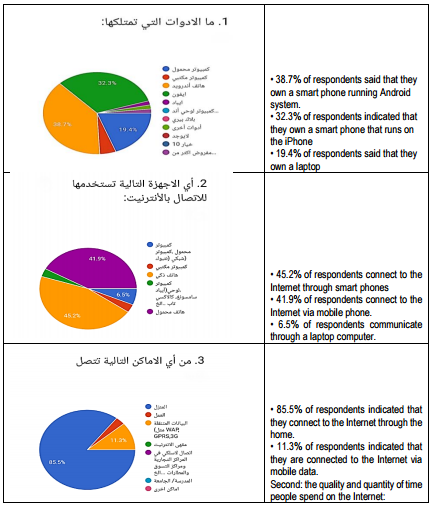
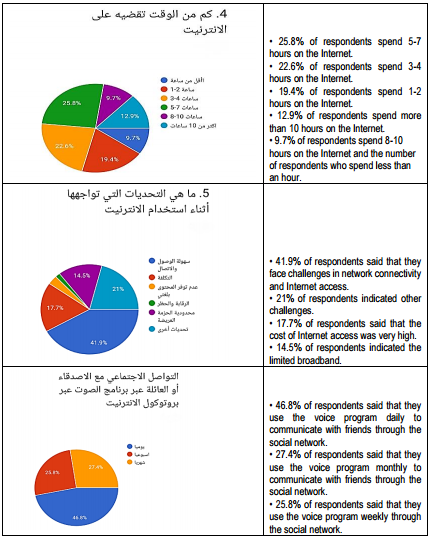
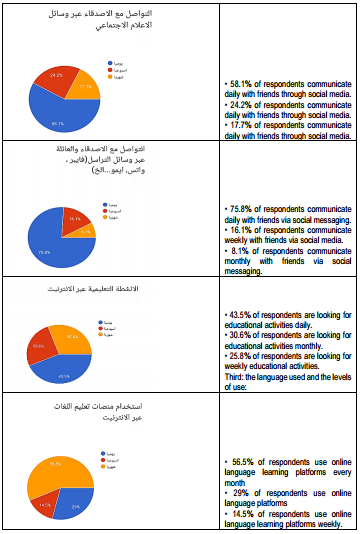
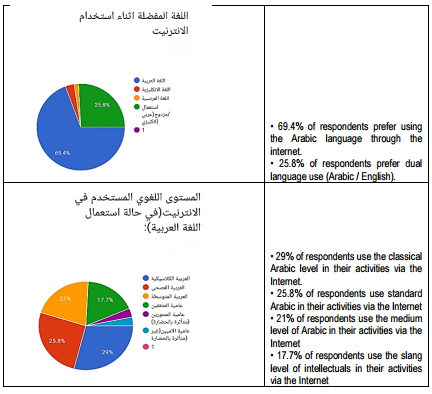
Fourth: Type, category and housing:
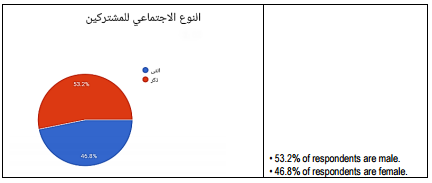
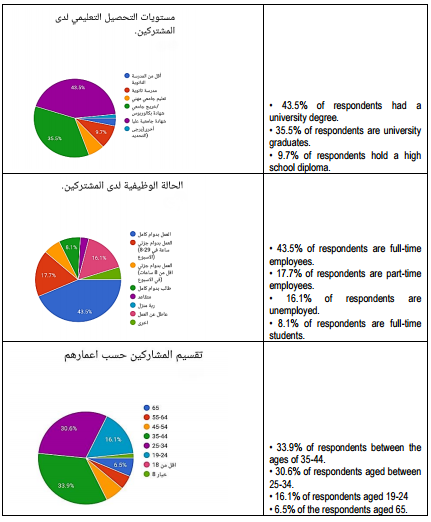
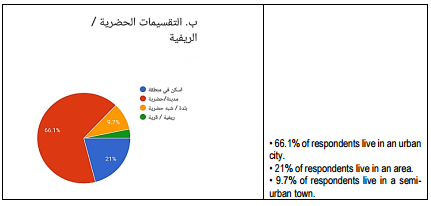
It is evident from the advanced statistical data conducted that the Arabic language occupies a distinct position among the languages on the social networking site, despite the cultural, cultural and environmental diversity of users _ within the Arab world _, but this research found that most users of the social network tend to use the Arabic language on Other languages This enhances the status of the Arabic language and makes it among the most widely used international languages.
The research has monitored all the linguistic levels of the Arabic language used through electronic social networking applications and we found a variety of levels of use, some of which are very close to classical Arabic and classical Arabic, and some of which are very far away to reach vernacular, while slang intellectuals stood a middle position between them, became We have multiple forms of Arabic depending on the user's cultural and age levels.
CONCLUSION
In conclusion, we list here the most important findings of the research, which are the following:
-
The emergence of the networking community has a significant impact on language, like any intellectual intellectual activity practiced by man, through the use of language functionally in the communication sites for correspondence, while the spread of the media can be a factor of linguistic creativity contributes to the service of language and achieve. We do not see the negative impact that is spreading, especially if we know that the users of these means are not at the level of one educational education, which poses a danger to the language exposed to internal and external conflicts at the same time.
-
The challenge has become more fierce in the age of digital technology; it was evident in the language of correspondence, communication and media through the means available, especially among young people; the language changed at their hands and lost its original features, to the extent that the mix of Arabic and Western terms as well as the spread of vernacular and lost Language is its essence and luster.
-
It was found from the advanced statistical data conducted that the Arabic language occupies a distinct position among the languages on the social networking site, despite the cultural, cultural and environmental diversity of users _ within the Arab world, but this research found that most users of the social network tend to use the Arabic language This enhances the status of the Arabic language and makes it among the most widely used international languages.
-
Call for attention to the Arabic language through the unification of the efforts of linguistic assemblies and research centers to Arabize social networking programs.
-
Call for computerization of the Arabic language
-
The work of Arab search engines comparable to foreign search engines (yahoo, Google)
-
Creating digital audiovisual contents with Arabic content comparable to Western ones.
BIODATA
Huda Salaah Rashid: Dr. of the College of women of Tikrit University. dhuda19@yahoo.com
BIBLIOGRAPHY
ACADEMIA MAGAZINE, TUNISIA. How to Think about Social Networks. 2012.
BUSHRA JAMIL AL-RAWI. The role of social networking sites in change: a paper presented to the seventeenth scientific conference entitled "Culture of Change", Philadelphia University, Amman, 2012.
ENCYCLOPEDIA UNIVERSALILS, France.SA, 1997
HIGH TECH EVENTS Website WWW.ahdath.info/p=71518
INTERNATIONAL COUNCIL FOR ARABIC LANGUAGE. Arabic Language and the Formation of Identity inthe Context of Globalization: Jamila Qaysmon, Research Conference 1.19-23 March.
The Status and Challenges of Arabic in Globalization: www.majma.org.jo/majma/imdex.php/2002-2 www.arab social media report.com
WALID IBRAHIM AL-HAJ, DAR START – JORDAN. Arabic and modern means of communication 2007.
Notas