Artículos
Recepción: 10 Febrero 2020
Aprobación: 26 Abril 2020
DOI: https://doi.org/:10.5281/zenodo.3784831
Resumen: El teatro funciona desde su inicio, lidiando con los problemas de la sociedad y simulando sus supuestos y requisitos, así como el hecho de que el teatro es uno de los medios más importantes de entretenimiento y aprendizaje al mismo tiempo. Esto ha llevado a un mayor interés en los aspectos intelectuales que se están abordando, especialmente el tema del aspecto social, que es uno de los temas que tuvo una amplia gama en los tratamientos teatrales, especialmente después del predominio de las filosofías modernas (controversia, duda, existencialismo) después de la Era de la Ilustración, la tendencia hacia la evidencia material, y alejarse del mundo de los ideales y la metafísica.
Palabras clave: Aprendizaje, discurso teatral, entretenimiento, societcietmeaia..
Abstract: The theater works since its inception, dealing with the problems of society, and simulates the assumptions and requirements, as well as the fact that the theater is one of the most important means of entertainment, and learning at the same time. This has led to increased interest in the intellectual aspects that are being addressed, especially the subject of the social aspect, which is one of the topics that took a wide range in theater treatments, especially after the prevalence of modern philosophies (controversy, doubt, existentialism) after the Age of Enlightenment, and the tendency towards material evidence, and move away from the world of ideals, and metaphysics.
Keywords: Entertainment, learning, societcietmeaia, theatrical discourse..
INTRODUCTION
To determine the theatrical treatments of the Societcietmeaia theme, the research included four chapters; the first chapter included a statement of the research problem centered on the following question: (What is Societcietmeaia and its representations in the contemporary theatrical discourse?). (The detection of Societcietmeaia in the contemporary theatrical discourse), then the chapter introduced the limits of space-time research, determining the time period between (2005 - 2013), and spatially in Iraq, as well as the objective limit, which was limited to the study of Societcietmeaia and representations in the contemporary theatrical text. While the second chapter included the theoretical framework, the most important result of the theoretical framework, and distributed to two topics: The first concerned the concept of Societcietmeaia. The second topic: Societcietmeaia representations in the theatrical text; this chapter also dealt with indicators of the theoretical framework, while the third chapter included the research community, as it consists of (5) texts of the play, including what was Arab, and another Iraqi, and some other foreign, and the tool adopted by the researcher in the analysis of the sample.
The fourth chapter contains the results of the research, and the conclusions reached by the researcher, and then a list of the most important sources and references on which the researcher relied on his study.
The researcher cites the most important findings reached as follows:
- 1. Societcietmeaias are formed by symbolic interactions, of which language is the main cause of their development.
- 2. Social behavior as a result of direct interactions cause the emergence of Societcietmeaias.
- 3. Societcietmeaias are not required to be the originators of large human groups.Social relations are the main pillar in the creation of societies, as these relations are formed by semantics and symbols, which determine the identity of a society only, and thus become a symbol and semi-active, and contribute to the formation of collective awareness of these communities.
Theatrical discourse is closely related to the idea of Societcietmeaia influences significantly affect the direction of human behavior, as "the multiplicity of the mechanisms of discourse, and the variety of various means of putting this discourse and tools." Semiotics and sociology constitute an important role in social life. It is the main source of values that guide human behavior, and here we find that the sociological discourse gives life a sense of belonging, and makes them sure that there is a goal behind this life, and that life must live in order to achieve this goal. Here is not only a source of values; it is energy, and the existence, and from it derives human identity, and belonging.
Sociologists have attached great importance to the study of cues and symbols in their analyzes of the foundations of psychosocial life.
The theater cannot be isolated from the discourse of Societcietmeaia, as the theater is one of the mostimportant types of social communication, and the oldest, as well as the symbol and signals the foundation upon which the work of the theater since its beginnings.
Dramatic texts have expressed this phenomenon in many of its theatrical productions, and in different cultures, and from different perspectives.
Through the foregoing, the researcher sees the need to study Societcietmeaia, and know the mechanisms and workings in the theatrical discourse, thus formulating the problem of research, which centered on the following question: -
What are Societcietmeaia representations in contemporary theatrical discourse? Importance and need for research:
The importance of the present research is to study the subject of Societcietmeaia representations to reflect this concept, and study the means, and know the types, and mechanisms used in the theatrical text, in order to reach the nature of employment, and ways to address them in the theater text.
The need to answer the advanced question is not limited to the students of the theater department, but also to those interested and studying in the faculties of literature (literature and criticism) and workers in the literary fields.
Research Objective
Current research aims to:
Exposing Societcietmeaia in contemporary theatrical discourse. search limits:
- 1. Time: 2005-2013.
- 2. Spatially: Iraq.
- 3. Objectively: the study of Societcietmeaia and its representations in contemporary theatrical discourse.
Define terms:
Procedural definition of theatrical discourse: A set of theatrical work data (text or presentation) subject to a system of relationships can be analyzed according to the context in which it was organized, whether the speech is a direct speech or performance act or a symbol of symbols.
The procedural definition of Societcietmeaia: is a synthetic characteristic of social and indicative featuresrevolve in the mind of man, and take a kind of diffusion, to be a signal or social symbol.
LITERATURE RIVIEW
The Societcietmeaia Concept
The concept of sociochemistry incorporates two terms, the first (sociological), and the second part of this term (semiotics). Semiotics "deals with the general principles underlying the structure of all signals, whatever they are, as well as the characteristics of their use in transmitters and characteristics of various signal systems and different transmitters that use different types of signals." All words, pictures, sounds, scientific gestures and other things. While Villar Guillaume sees it as "science that cares about the systems of signs, signal systems and instructions," Vizdna de Sausser says in his book Lectures in Linguistics: Traded in the community, and this science constitutes the general psychology, and we call it the term semantics (science), a science useful to us the subject of the semantics and meanings.
Semiotics has taken a wide field in the scientific research process, thus not only a specialized field, but also occupied a central position in scientific research in general, as it had the task of discovering the common language in scientific theory, as well as the first pillars of semiotics is the mark and consists of signs. Among them according to two types of tags:
- 1. Contextual systemic markers: The ability of marks to form stems from a one-dimensional axis that makes marks related to each other in a sequence of marks belonging to the same context.
- 2. Replace marks: It stems from the ability of marks to form tables linked to each units
A table between them, one can replace the other, if the context changes.
Sausser sees the mark as "an incomprehensible union between the signifier and the signifier, and the signifier is an auditory conception consisting of a series of sound received by the listener and calls to his mind a conceptual conceptual concept that is connoted." Pierce goes and identifies signs on three types:
- 1. Iconic sing: such as images, charts, maps, models and objects. They simulate what they mean, that is, they simulate what they refer to, and this simulation may be as high as in television images. Or low as in Surrealist paintings, dreams and some vocabulary that mimic their meaning as the names of sounds.
- 2. Indicative sign (Indexicalsing): It is that between them and the connotation of a concomitant such as: the indication of smoke on fire.
- 3. Symbol or symbol (symbol): It is what was agreed upon by a group of people based on a particular term and not between them or between the evidence of any simulation such as musical marks as well as singular words in any language.
There is another division of marks:
- 1. Natural: Any produced by nature such as sounds of thunder, lightning and other sounds produced by nature
- 2.
Industrial: which marks formed by human intervention such as bells and the movement of the clock or what was olfactory such as perfume or gustatory or touch as heat and cold devices.
Some scholars believe that schools and trends in semiotics have two main directions:
- 3.
- 1. The American trend and its leader (Pierce) in addition to (Carnap) and (Seabuck)
- 2. the French direction and pioneer (De Sausser) and who followed his approach such as (Boisens) and(Mopan) and (Roland Bart). There are sub-trends represented by (Krimas) and (Bushenki), sometimes known as the Paris School and its most important members (Joseph Curtis).
Others believe that the Russian trend is the direction of a third president, and that the French school should be divided into branches:
- 1. The psychology of communication as (George Monan).
- 2. The semantics of semantics have several forms: the direction of (Bart) who tried to apply the language to non-linguistic formats, the direction of Paris and its symbols (Michel Arifi) and (Claude Cooke) and (Crimas), and the direction of materialism when (Julia Kristeva), and the direction of symbolic forms At Molino and others.
The most prominent features of semiotic thinking, which consists of the logical origins of the semiotic square and what he calls (Kremas) semantic square consists of three relations: contradiction, and the implication and antithesis.
While studying the sociology (human interaction) Human Interaction, which regulates matters of mutual influence between individuals through mutual relations between them. In other words, he studies the "mutual influence exercised by individuals in multiple relationships", as well as through which "the study of society in its phenomena, systems, structure and relations between its members is a scientific and analytical formulation, with the aim of reaching the social function it performs." The science meeting aims to "understand the social act in an explanatory way and thus explain its causes in the sequence and its effects." Here the act means human behavior, and is not required to be one-way, it can be external or internal behavior. It is not directly associated with
Already existing (ie, conduct) or its perpetrators.
Although the study of sociology is based on an understanding of human behavior that human beings are "social beings that practice multifaceted activity and interfere with others in multiple relationships," it is not / is in isolation from the study of the human environment, being influential behaviors and relationships emerging (semiotics ) For a social incubator only.
Different aspects of determining the field of sociology study, and this is what made them divided more than one team and in this regard their views were as follows:
- 1.
First Team: -
He argues that the subject of sociology is the study of social relations, and the members of this team are known as the owners (School of Relationships) and the top of this school (George Smile).
- 2. Second Team:
This group argues for the need for partial social sciences besides sociology, each of which includes a study of aspects of social life that the function of general sociology is limited to the development of general principles. It is members
This team (Durkheim). Third Team:
Scientists do not represent a specific trend, but their views express their own views, some of them argue that the subject of sociology is the study of social change. Some of those who believe that the subject of the study of social systems, and some of those who believe that science should study the introductions that lead society to Evolution, and lead him to unity and brilliance among its members.
Unlike teams and their supporters, including overlapping contradictions and contradictions, sociology is interested in the study of human social lifestyles, and these patterns require the presence of interaction spread between individuals expresses
About him (symbolic interaction) or (symbolic interaction), which was associated with the Americansociologist (George Herbett Mead Gorge H.mead), and believes that it is linked to a particular position of social life positions and does not seek to understand society as a whole, or is not usually the theory in society, As far as what is a theory of socialization, however, this theory is based on a set of basic concepts namely, symbols, meaning, expectations, behavior, roles and interaction. This is what is shared between this theory and Societcietmeaia, which is based on the social symbol and semiotics that have social connotations, and therefore does not require this social symbol or social semiotics, which is the component of Societcietmeaia to take the character of inclusiveness in terms of the human race, but may recede to a small group of humans, Requirement to have interactive interactive avatar.
Symbolic interactivity is based on a set of constituent characteristics:
- 1.
Symbol and meaning: -
George Mead starts from the basic obelisk that man, like other animal species, is an active and effective being, that all animal species practice movements and signals, and make voices in their responses to each other, but only the human type that quickly turns facial expressions or signals into symbols , Sounds and deeds contain meaning. Symbols gain importance and become meaningful when they acquire the same meaning in their recipients, the meaning that was in the mind of the sender or owner, in another way when the symbol has a common meaning is in this case social symbols acquired through social interaction with others. This is required by the concept of Societcietmeaia, ie, the social reference with the person receiving the message that moved the environmental surrounding the sender.
- 2.
Expectations and Behavior
Ultimately, a society is a certain amount or volume of interactions between its members. It is made up of groups through which individuals relate to each other as well as the relationships that bind these groups. Behavior within groups is organized together. And here you are
Societcietmeaia is a social signal transformed into the social behavior of individuals within groups. And it is created through expectations, which are expectations that are created and developed by the (other) important or influential or (generalized) generalized other, to the other as a general symbol of people, and through interaction learn to behave the way others expect from them, and then take into account that their behavior In conformity with the behavioral patterns that occur in the institutions and social systems they created, they also learn that others have the same expectations. Hence, the patterns of relations betweenpeople and their groups constitute the social environment, and the nature of society is manifested in the interchange of mutual expectations and the behavior that fulfills these expectations.
- 3.
Roles and interaction: -
Society performs its functions and continues to survive because of the ability of people to use symbolic behavior, behavior that uses the symbol as a result of possessing language, and the most important consequences of this fact is called self - awareness. The human child becomes self - conscious as a result of his experience of the language, and deal with it to the extent that the development of language abilities. He learns the meanings of words and the attitudes associated with these meanings, expressed by those who use those words, and then learns them after what others expect from his behavior, and over time, he acquires similar expectations for others. The sets of expectations associated with the behavior of certain people have roles, and these roles serve as a function or reflection of the membership of a particular group. This means that Societcietmeaias are a constant reproduction of each person's role in creating different types of them.
All Societcietmeaia patterns fall according to specific levels as the researcher sees, which are determined by four levels or determinants, namely:
- 1. Societcietmeaia Teleology: The intention is a symbolic rational behavioral pattern that arises through the expectations of the behavior of things in the outside world, or the behavior of other people, and these expectations are a means of expected rational ends.
- 2. Societcietmeaia Values: Here they have qualities derived from historical references, which take the nature of originality regardless of understanding the content, but they are required to be moral and inherent values.
- 3. Societcietmeaia Subconscious: It is an immediate Societcietmeaia occurring as a result of special emotions, due to current effects.
- 4. Traditional Societcietmeaia: This type is limited may not exceed some individuals, but it is a tradition,or it is just a reaction to the usual stimuli in the direction of the internal perception that happened to adapt. The second topicSocietcietmeaia representations in theatrical text
Understanding the term sociochemistry is not required to penetrate deep into theatrical history to determine its representations in this social system. In conjunction with this act, proceeded from psychology, as well as (the Electra complex) is not without the same thing, it is also similar to the Odeep node Societcietmeaia, except by sex because the first node is a male node, and the electra node belongs to females. And Hercules, which carries a symbol and behavioral values, as seen through this so - called qualities of heroism and thus is a picture to represent the sociological.
The researcher believes in this paper the need to clarify the Societcietmeaia through the four levels that were identified in the previous research through the passages of the theatrical important global impact of her book or that it constitutes a historical turning point of its content.
In the Middle Ages, theater was forbidden, but "the play was interrupted for several centuries, but the dramatic instinct, a permanent feature of human nature, had to find a way to satisfy itself. Religious life was first introduced" in churches.
Taken from the life of Christ, or what the Bible contains in the stories and news, the play of Adam expressed expression of Societcietmeaia values, and this is evident in the dialogue of Adam to the symbol:
Adam: I will keep your will Bhdhaverha, will not disagree in anything, neither me nor Eve. For the sake of one fruit all these indwelling are lost! It is fair to throw me out in the wind; if I gave up your love for an apple. Those who blaspheme and betray his Lord must be subject to the law of traitors. "
The apple has taken a valuable symbol of the sociological aspect that it is the cause of the landing on the ground. Satan, the prince of the demons of hell, has not been free from Societcietmeaia
"Faustus: Why hesitate? Uh, there is something whispering in my ears! Deny this magic, and come back to God again! But he does not love you. The God who serves is your own lust, where the love of the demons will be. new born.
Marlowe goes on to show contradictory social behavior in the character of Faustus. The first is the religious behavior that builds churches, and a historical Societcietmeaia derived from the ancient history of offering blood to the gods, to bring him closer to Satan.
In the play of King Lear written by Shakespeare in which King Lear tries to distribute the sentence to his three daughters, is represented in the aspect of Societcietmeaia, according to Cordelia, the daughter of King Lear to the doctor:
"Cordelia: O Merciful Gods, my mother has made that grave rift in the stressful nature and stretched the tendons of relaxing senses in that Father who became like a child."
It shows an emotional Societcietmeaia representation caused by the emotions caused by the actions of King Lear, they resemble a child as a sign of the impossibility of his mind.
The playwright Müller appears in his plays, which were known for their satirical social character representing the Societcietmeaia. The illusion play, written by Müller in the seventeenth century, contained a traditional Societcietmeaia. Being limited to being a reaction to stimuli in the direction of internal perception, it gives a symbolic indication of conscience and how to hold it by hand.
"Twannett: Well, this is an excuse; a heart-warming response among us. Put your hand, sir, on your conscience.
The playwright Sartre also included his plays on Societcietmeaia.
"Garsen: I was going to bet on that. Why sleep one? Sleep takes you from behind your ears, and you feel with your eyes closed? But why sleep?
Server: Why are you my imagination! "
It aims to show a symbolic behavioral pattern of rationality, and here the question that arises from the character of Garcín takes a logical character, which is why we sleep, and the answer by the character of the servant also rational behavior, that is, the Societcietmeaia teleological arises by anticipating the behavior of things in the surrounding world.
The Arab theater was not far from the Societcietmeaia representations of all kinds. "The first prisoner: (looking at the other person) What is this? ... It is not human ?! Al-Samra: He's the robot I told you about ... All the guards and police are like this ... The first prisoner: (meditates) does not eat, sleep, do not get sick and die!
The Iraqi theater came as part of the Arab theater to give a representation of the Societcietmeaiarepresentations of the emotional that emerged as a result of the emotions of the time, represented by the characters of the play of the playwright Ali Abdul Nabi Zaidi
"Moses: whisper master of the place here, this is a sacred valley only enter from the permission of Rahman!
Mother: I waited my whole age and did not authorize.
Moses: So you have to go home.
Um: I will not return until God speaks to me. "
What resulted from the theoretical framework:
- 1. Societcietmeaia is a term for the study of social signal.
- 2. The systemic and contextual mark shall be the component part of the Societcietmeaia after these marks take the social pattern and behavior.
- 3. The Societcietmeaia is conceived and formed by indicative, idiomatic or iconic signs.
- 4. Societcietmeaia is either communicative or semantic.
- 5. Interactive symbolism is one of the basics of the work of Societcietmeaia, its purpose is to identify the symbols and signals that have a social agreement.
- 6. There are four types of Societcietmeaia:
-
Societcietmeaia tele
-
Societcietmeaia value
-
traditional Societcietmeaia d- Societcietmeaia feeling.
METHODOLOGY
The researcher identified the research community in the texts that were published for the period limited between 2005 until 2013, and the variety of theatrical works between Iraqi, Arab, and foreign works. The following table is arranged by year of publication.
Play texts
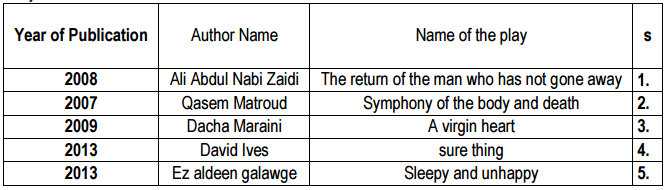
The researcher selected the research sample and was chosen by intentional method, for the following smogs:
- 1. The elected sample is representative of the research problem and its importance and purpose.
- 2. Diversification of the Societcietmeaia levels presented in the selected text. The sample included texts as shown in the table below.

The researcher adopted the indicators resulting from the theoretical framework, as a research tool, according to which the process of description and analysis, after formulating it as a (research tool).
The researcher followed the descriptive approach (analytical) in the research in terms of describing the story of the play, and determine the positions of Societcietmeaia in the text content.
Samples Analysis
Play: The return of the man who did not miss
Written by Ali Abdul Nabi Zaidi
Characters
- Woman
- The groom
Play Story:
The play revolves around a social incident that is almost fictional between two personalities of women and the groom, or is evoked from the imagination of the woman's imagination, as the elements of fear and time struggle with the absence of her groom, which is waiting for nearly twenty-one years. The Supreme, believing that he slept for almost the whole day, and when a woman requests to wash his head shocks through a mirror of what is seen from the whiteness of his head;
Analysis:
The play was characterized by the return of the man who did not lose many social attributes coded Societcietmeaia different systems and contexts and signs of replacement, the writer depicts the reader features of the character of the woman as a woman who passed the menopause, and the character of the groom that comes from the upper room, although there is no room for peace in the middle of space Presumably for the event and lead to this ladder chicken coop only, as a young man in the prime of life, and that the reason for the large character of the woman came from the act of waiting, which lasted for nearly 21 years. A subconscious, symbolic reactivity is represented by this statement.
"Woman: Yesterday! Is this all that holds your head from time? An hour, two hours, three, tell my headhow many tons of hours he carries screaming, tell my body: I really became a black mass walking only. Tell my bed: Have you slept over my bride since I left .. . "
These gestures were the result of immediate emotions. In the groom's belief that he slept one day, although the signs of a woman's personality do not suggest it, he hardly knows her features.
Groom: Why didn't you let me sleep so long?
Woman: Why did you leave me sleepless all that time? P. 122
Societcietmeaia is transmitted through the idiomatic signs in which the woman's character behaves through language with meanings and symbols expressing her anger and loathing all these years.
Woman: Your honor ?! How wonderful that men swear by their honor, wonderful, but who believes that his honor .. After leaving him a cheap dress in an auction. P. 122
Also available in the text Societcietmeaia values derived from historical references, the writer returns to the primitive man and hunting operations, and to those rituals followed by staining hands red pigment, which was used by the woman 's personal evidence of murder.
Woman: Your hands are contaminated. Groom: What?
Woman: Red pigment. P. 123
The adaptation of the woman's personality with the wait made her refuse the return of her long-awaited husband, or do not want to see her took the years beauty, Susitosemia hands
Woman: Your hands were cut off all the roses and music that were sleeping here safely.
Groom: Any cruelty carries your tongue, you are pretending to manhood not worthy of your femininity. P.123
There is a Societcietmeaia teleological and it happened because of the constant wait, and this behavioralpattern originated through the expectations of women for what is coming by assuming that the age did not remain much, it is a rational expectations of the personality of the woman and see it in this way, but the person of the groom does not want to acknowledge these expectations.
Woman: You didn't stay old enough to stay. Groom: (yelling out) you traitorous wife.
Woman: Scare me with cocks while you're wearing chicken. Pp. 129--130 But she is sure about this man's cheese, so she calls him a chicken.
the fourth chapter
research results First: the results
- 1. Contemporary plays were characterized by types of Societcietmeaias with social implications based on symbols symbols.
- 2. Societcietmeaias are formed by symbolic interactions, of which language is the main cause.
- 3. Social behavior as a result of direct interactions cause the emergence of Societcietmeaias.
- 4. does not require the Societcietmeaia that the originators of large groups of human beings arise between two or more people because of a social situation in the immediate possession of semantic symbols addressed to the other and interpret these symbols properly.
CONCLUSIONS
Language is the means that have the largest part of the communication mechanism, and therefore be the largest share in the events of Societcietmeaia, but can occur Societcietmeaia through gestures and signals.
Societcietmeaia is the interpretation of a message addressed from one person to another through a social position and this position is the carrier of this message, and therefore may vary the content and form of Societcietmeaia change of this medium, except in the rise and take the form of value, the content is of almost constant significance in the context of the use the first.
BIODATA
Rafid Mahmood Mashi Teacher of philosophy, literature and criticism of College of Fine Arts. University of Diyala. rafid834@gmail.com
