Artículos
Portrayal of Rohingya People: Discourse Structure Analysis
Retrato de la gente de Rohingya: Análisis de la estructura del discurso
Portrayal of Rohingya People: Discourse Structure Analysis
Utopía y Praxis Latinoamericana, vol. 25, núm. Esp.1, pp. 506-514, 2020
Universidad del Zulia
Recepción: 08 Febrero 2020
Aprobación: 24 Febrero 2020
Resumen: Este estudio tiene como objetivo revelar la representación del pueblo Rohingya, en un artículo titulado "Las tropas de Myanmar sistemáticamente violan en pandillas a las mujeres de Rohingya: un enviado de la ONU", publicado en The Jakarta Post. Al aplicar un enfoque cualitativo para describir cómo se utiliza el lenguaje para retratar a las personas rohingya, los datos de este estudio se recibieron del sitio web oficial de The Jakarta Post. El artículo de noticias comprende dos amplios niveles de estructura del discurso, que son las estructuras globales y la estructura local. Las estructuras globales analizan el tema global y el esquema global del informe de noticias. El segundo nivel es la estructura local o microestructura.
Palabras clave: Estructura del discurso, pueblo Rohingya, representación, The Jakarta Post.
Keywords: Discourse structure, portrayal, Rohingya people, The Jakarta Post.
INTRODUCTION
Since reformation era, Indonesia foreign policy still follows the constitution (Dharmaputra, R., Felayati ,A., & Suhito, 2019). Meanwhile, media are the center arena for public debate (Eberl, Boomgaarden and Wagner 2015). However, Media is not neutral (Fisher, M. R., Dhiaulhaq, A., & Sahide, M. A. K., 2019), by choosing what news to cover (Baron, 2004; Ciang, 2007; Gentzkow and Shapiro, 2006; and McCarthy and Dolfsma, 2014). Media can influence people's opinion because media not only report the news but also create the news (McCarthy and Dolfsma 2014). It can be seen that media strives to distribute its tendency towards particular ideas through its news coverage (Pandin, Munir, & Sumartono, 2019). One of the media that is able to reverse public’s opinion is about news media.
In the ASEAN Community (Putra, Darwis, & Burhanuddin, 2019), news media contains power to shape public’s perception (Tsfati and Oren 2008). It has structure to showing and reporting implicitly. According to Pajunen (2008), the structure of news media is as an inverted pyramid. Van Dijk (1988a) states that the most important information must be at the beginning of news article. Rohingya crisis becomes one of the controversial issues that has received a lot of attention in local media and foreign media because the issue has not reached a long-term solution, one of the newspapers that published about Rohingya crisis is The Jakarta Post.
Rohingya is one of the ethnic groups living in Rakhine province in Myanmar. The plight of Rohingya has received international headlines, particularly starts with the denial of ethnic identities and rejection of their citizenship (Rahman 2015). The conflict became more intense, after the Arakan Rohingya Salvation Army (ARSA) launched smaller-scale attacks post-police in 2017 (South 2018). The Myanmar Army quickly unleashed a systematic murder, raped, burned and deadly campaigned of repression (Sutiarnoto, 2017).
News article about Rohingya crisis can be analyzed through its news structure by applying theory of Van Dijk (1988), namely Discourse Structure. There are at least three studies which have been conducted by applying Discourse Structure framework proposed by Van Dijk, such as Feng (2013), Amaliah and Syukri (2015), and Rofiliansyah (2018). However, Feng used broadcast news program which the theory of Discourse Structure is designed for analyzing print news. Therefore, he added one grand theory which is Discourse of Broadcast News proposed by Montgomery (2007). Meanwhile, Amaliah and Syukri (2015) analyzed the portrayal of Women and men politicians in Indonesia and Rofiliansyah (2018) analyzed Indonesia’s position related to the South China Sea conflict and Harahap and Humaizi analyzed Islamic political parties in South East Asia (Harahap, H. I., 2019; Humaizi, Yusuf, M., & Sinaga, R. S., 2019). The current study analyzes the portrayal of Rohingya people within the Rohingya crisis, which is different from the three previous studies, and the current study will enrich the research on discourse structure in news report.
In the previous explanation, news media contains its structure in reporting and showing implicitly its tendency towards certain perceptions. To reveal how The Jakarta Post portrays Rohingya people within the Rohingya crisis, this study analyzes the news structure of news article by applying a theory of discourse structure proposed by Van Dijk (1988a), namely Discourse Structure.
Theoretical Framework
Van Dijk (1988a) in his book “News as Discourse” proposed a term called Discourse Structure that is characterized as an analytical framework for the structure of discourse that particularly relevant to a news report within a newspaper. It comprises two elements of structural description to convey how language is utilized in news report, global structure and the local structure or microstructure.
Global structure deals with global level or the overall segments of discourse (Van Dijk 1988a, 26). Van Dijk (1988) categorized the structures into two categorizations which are macrostructure concerning the global topic, and superstructure, concerning the global schema of a news item.
Macrostructure is not merely on the topic, but revealing the meaning of a whole text as well (van Dijk 1988b, 13). Van Dijk categorized macrostructure into five concepts; macro proposition; macro rules; degreeDijk 1985); and headline and leads express the most crucial information in a news item.
Superstructure deals with a schematic of discourse. Superstructure consists of Summary and Story. Summary includes headline and lead. Story is created by two elements; Situation and Comments. Situation is divided into two elements; Episode consists of Consequences and Main Event. Main Event is the actual situation that is being reported. Consequences, sometimes, perceive more crucial, than the Main Events. Thus, it is possible that Consequences of an event is the highest level topic in a news item. Furthermore, Background consists of Context and History. Comment consists of Verbal Reaction Verbal reaction is another element of news schemata, as important news participants by giving the comment.
Local structure or microstructure focus on the analysis of the local level of words and sentences that distinguished the meaning and its expression, such as word, clause, phrases, and sentence forms (Van Dijk 1988a, p.59). Local structure deals with semantic style, syntactic style, lexical style, and rhetoric style.
Semantic style deals with the meaning which placed in the local level of words and sentences. It includes the analysis of proposition, local coherence, and presupposition. Renkema (2004, p.85) stated that a sentence may have more than one proposition. Proposition in semantic style comprises a predicate and a number of arguments that may contain numerous roles. Local coherence deals with how the connection between sentences helps the reader to understand the meaning from the texts (Van Dijk 1988a, p.61). Van Dijk (1988a, p.63) defined presupposition as the arrangement of propositions assumed by the speaker to be known to the listener to be viewed suitable in context.
Syntactic style analyzes the special constructions, such as the use of active and passive voice and the roles. The role of active and passive sentences is as the agents or subject position of news actors in news text.
Lexical style deals with how the diction is used in news content. It reveals the formality and non-formality, the relationship between speech patterns and in this case, the attitudes or stance of a newspaper towards a specific issue (Van Dijk 1988a, p.81-82).
Rhetoric style is one of the ways to persuade and strengthen the specific information that wants to be shown to the reader by using language style. There are three strategies in rhetoric style. The first strategy is Direct Descriptions and Eyewitness. The second strategy is sources and quotations (Van Dijk 1988a, p.87). The last strategy is the use of the precise number (Van Dijk 1988a, p.87-88).
There had been several previous studies on discourse structure; Feng’s study (2013), entitled “National Voice: A Discourse Analysis of China Central Television’s News Simulcast. News Simulcast” is a flagship national news program in China. He found that News Simulcast broadcasted news with an authoritative national voice. However, he selected broadcast news program as source data. In fact, the theory of Van Dijk (1988) about Discourse Structure is designed for analyzing print news. Therefore, he added one grand theory which is Discourse of Broadcast News proposed by Montgomery (2007). Feng made some contributions to the issue.
Another study comes from Amaliah and Syukri (2015) entitled “The Portrayal of Men and Women Politician in The Jakarta Post’s News Article about Corruption Cases”. The result showed that male politician portrayed powerful, respected, and high-status corruptors while female politicians portrayed less powerful and less respected corruptors. They selected four news articles, two articles covering male politicians and two articles covering female politicians. They adopted Critical Discourse Analysis which was proposed by van Dijk.
Further, the study was conducted by Rofiliansyah (2018) entitled “Tribunnews Online Media Reports on Indonesia’s Position Related to South China Sea Conflict: A Discourse Analysis”. She also selected two news articles from Tribunnews online newspaper. The first news article was four months away from the second news article. There was an absent category, which was the Background. However, she found that Tribunnews portrayed Indonesia’s position inconsistently on two article reported.
METHODOLOGY
In this study, the data source was taken from the official website of The Jakarta Post online newspaper. The Jakarta Post is one of the national media in Indonesia written in English. Automatically, it distributed the target readers of the newspaper are different from Indonesian newspaper. The writer selected one news article reporting Rohingya crisis which was posted in 2017 by using purposive sampling. The writer selected the news article entitled “Myanmar Troops Systematically Gang-Raped Rohingya Women: UN Envoy”. The news came from an Agence-France Press. The news article was posted on November 12, 2017.
There were four steps to analyze the news article through the use of discourse structure proposed by van Dijk (1988); identifying the words and the sentences which portrayed Rohingya people. Analyzing macrostructure by appointing the macro propositions of each paragraph in news article and applying the macro rules to reveal the global topics. Analyzing superstructure, it concerned with the schematic of news article. In analyzing scheme, the writer needed to discover the story and the summary of the news report. Story can be found in situation and comment, whereas summary can be seen from the headline and lead of the news article. Analyzing microstructure, it concerned more on the details of the news report, such as sentences and words.
RESULTS
Macrostructure
To obtain a global topic in the news article, it needs to determine the macroproposition in each paragraph by deleting the least information based on the macrorules. Here is the writer analyzes the macrostructure by applying the macrorules: (1) Myanmar soldiers “systematically targeted” Rohingya women for gang-rape; (2) It proven with many women and girls died.; (3) The pattern of sexual violence against Rohingya women and girls due to target the ethnic cleansing.
In this level, the paragraph boundaries are reduced. Regarding that, the first paragraph is the majorparagraph that intends as a summary of the article, it allows the reduction of information in the next few paragraphs. Another point is that the sense of truth in the bad effects of the Myanmar soldiers’ atrocities remains relevant. Further reduction of second level; finally yield the highest level of macrostructure of the news article (M3):
- 1. Myanmar soldiers systematically gang-raped Rohingya women and girls.Importar listaIn this level, only the major Agent (Myanmar soldiers), the main action (gang-raped) and the significant subject or issue (Rohingya women and girls) remain kept. It expresses that the headline of the news article in The Jakarta Post suggests the suitable macrostructure.
Superstructure
Superstructure deals with the schematic of discourse (Van Dijk 1988a). It comprises two categories, which is Summary and Story. Headline and Lead involve to Summary. Moreover, Story consists of Main Event, Context, Background, Verbal Reaction, and Comment.
Here, the writer analyzes the superstructure of the news article in the table:
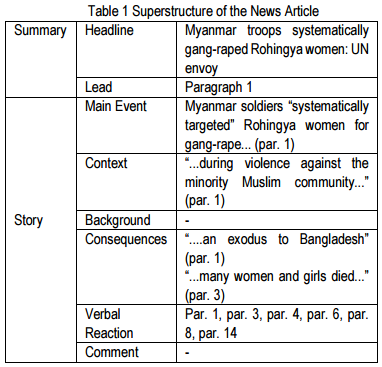
The first category of superstructure is the Summary. Summary comprises two categories which are Headline and Lead. The headline is the title of the news article while the lead section is in the paragraph one. The Headline and the Lead are straightforward. As van Dijk (1988) argued, these elements contain the most possibility to show the main topic of a news item. Thus, in this news article of Rohingya crisis coverage in The Jakarta Post, what news is about is summarized in the Headline and Lead.
The next category is Story. The story involves the Main Event, Context, Background, Consequences, Verbal Reaction, and Comment. Van Dijk (1988, 57) stated that Headline and Lead may also feature the Main event due to their summarizing function. Main Event in this news article appears in the first paragraph. The next category in the article is Context. Van Dijk (1988, 54) mentioned Context may be attached in the Main Event which is often signed by previous event and the expression of the actual event. The information in the first paragraph that said “...during violence against the minority Muslim community...” is an example of Context because it indicates the previous event before Rohingya people take refuge to Bangladesh. However, there is no Background included in the news article.
The Consequences is shown in the paragraph one and three. The Consequences, here, means they havehad consequences rather than may have consequence. Therefore, the consequences are the seriousness effect of the Main Event. Furthermore, Verbal Reaction is expressed throughout the first, third, fourth, sixth, eight, and fourteenth. Most of them are taken from Pramila Patten and followed by Ariful Islam. The last section is the Comment which is also not appeared in the news article.
Local Structure (Microstructure)
Not all the sentences and words are being analyzed; it only involves the one which contains the portrayal of Rohingya people in The Jakarta Post news article. Below is the finding of microstructure of the news article
Table 2 Microstructure of the news article
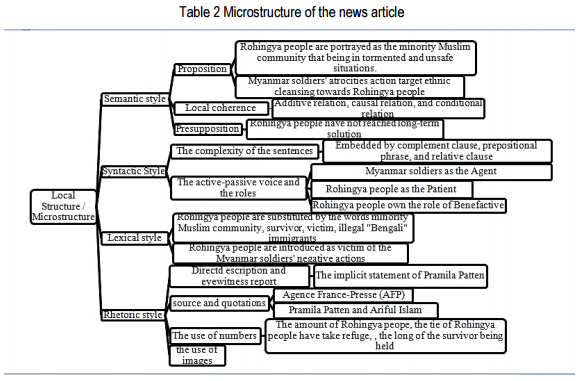
In the local structure or microstructure analysis, it analyzes the smaller unit of the news item, involving the semantic style, syntactic style, lexical style, and rhetoric style. In the semantic style analysis, the most dominant propositions are: (1) Rohingya people are portrayed as minority Muslim community that being in tormented and unsafe situations; and (2) the Myanmar soldiers’ atrocities action target ethnic cleansing towards Rohingya people. The local coherence involves the three types of relation; causal relation, additive relation, and conditional relation. The news article suggests the presupposition that Rohingya people have not reached long-term solution. Moreover, the syntactic style indicates the Myanmar soldiers as the Agent of negative action and Rohingya people as the Patient. In the last analysis of local structure, rhetoric style, it applies all four strategies; direct description and eyewitness report, source and quotations from high-ranking members, the use of numbers, and image.
CONCLUSION
Drawing on the above analysis, it can be concluded that The Jakarta Post produces biased news in this case. The newspaper takes Rohingya people’s side. It is expressed how it portrays Rohingya people as minority Muslim community, survivor, and refugees, that being in tormented and unsafe situation. The news article, thematically, that are being analyzed position Myanmar soldiers as the Agent while Rohingya people as the Patient of the Myanmar soldiers’ cruel action. In the headline, it also has introduced the Myanmar soldiers, followed by the Rohingya women who received the role of Patient, and then the information source (UN Envoy). Therefore, both headline and global topic portrayed Rohingya women are in the tormented situation.
The categories of Superstructure express the portrayal of Rohingya people within the superstructure analysis. For instance, Context emerges to remind the readers what has happened to the Rohingya people, especially Rohingya women and girls, and then show the motive behind the action. Consequences are also attached to deepen the seriousness of the Main Event in which position the Rohingya people as the one’s on miserable. Furthermore, the Verbal Reaction category contains the one-sided of the news article in reportingthe issue. Almost all of the Verbal Reactions appear within the statement of Pramila Patten, a UN Secretary- General on sexual violence in conflict. Here, the writer assumes that Pramila Patten takes Rohingya people side because she has visited the refugee camp of Rohingya people. Not only has that, with all of her statements, it can be assumed that Patten puts empathy towards Rohingya people.
Another Verbal Reaction also appears from Ariful Islam, a Bangladesh Deputy Permanent Representative; he also takes the side of Rohingya people due to his statement indicates his urgency to international community to protect Rohingya women. Considering that the choice of the speakers and quotations incline to be subjective (Van Dijk 1988a, 56). In addition, the participants are selected from the one of UN members which is the high-ranking members. Since the purpose of the establishment of UN for making the world, a better and more peaceful place (The New York Times 2018). Thus, it confirms the tendency of The Jakarta Post is in the Rohingya people.
In the level of microstructure analysis, it also distributes in depicting the Rohingya people as the minority, survivor, and victim, that being in a tormented and unsafe situations. Semantic style indicates that Rohingya people are still positioned as the minority, survivor, refugee, victim of the atrocities by Myanmar soldiers. They are also portrayed as illegal “Bengali” immigrants. However, this term is used by Myanmar to address Rohingya people. It is proven according to SBS that in Myanmar, Rohingya people are popularly referred to ‘Bengali’ rather than being recognized as their own ethnic group (Thein 2017).
The syntactic style of the news article introduces the Myanmar soldiers as the Agent. However, if high- ranking members are the major actor of the negative action, they incline to show less in Agent position (Van Dijk 1988a, 81). Conversely, in this case, the newspaper openly positions the Myanmar soldiers as the Agent of the negative action while Rohingya people as the Patient. Furthermore, Rohingya women own the role of Benefactive. Thus, it leaves out no doubt that The Jakarta Post here supports the voice of minority by opening up acts of atrocity committed by Myanmar soldiers against Rohingya people.
Furthermore, another fact is that The Jakarta Post also underlines the urgency to protect the Rohingyawomen and girls and end the violence. Through the lexical style section, the word Rohingya women and girls are preceded by the verb ‘protect’, and then the word ‘violence’ is preceded by the verb ‘end’. In this sense, the newspaper wants to underline the long-term solutions for Rohingya people. In addition, in the lexical style, the actions of Myanmar soldiers are all about negative actions.
In the rhetoric style, it also reflects The Jakarta Post’s tendency towards Rohingya crisis issue. It has been analyzed that the source of news is Agence France-Presse where it is still the accurate source. For the quotations, most of them are distributed by the statement of Pramila Patten and followed by the statement of Ariful Islam. In fact, it is involved in the headline as well. According to van Dijk (1988a, 87), without sounding too subjective, the use of quotations is suggested to create journalist’s opinions. Thus, it expresses the tendency of the newspaper towards an issue. Then, it leaves out no doubt that The Jakarta Post to be one- sided in reporting the Rohingya crisis.
The analysis of macrostructure, superstructure, and microstructure distribute the portrayal of Rohingya people within Rohingya crisis issue in The Jakarta Post news article. They are portrayed as the minority Muslim community, survivor, victim, refugee, being in tormented, unsafe conditions that needs protection. Then, they are portrayed as illegal “Bengali” immigrants, but this term is used by Myanmar to address Rohingya people. In addition, the newspaper inclines to distribute the voice of minority Muslim community, or in this case Rohingya people to receive a long-term solution. It supports the minority with describing the atrocities of Myanmar soldiers’ action and distributing the form of sexual violence and the involvement of sexual violence against Rohingya women and girls.
BIODATA
Lydia Puspita Sari: Student of undergraduate program, English Department, Faculty of Humanities, University of Airlangga, Surabaya, Indonesia. Her research interest is linguistic and Media Studies.
Yulia Indarti: Lecturer and researcher at English Department, Faculty of Humanities, University of Airlangga, Surabaya, Indonesia. Her subjects are language, and linguistic studies. Master of Arts from University of Gadjah Mada, Yogyakarta, Indonesia.
BIBLIOGRAPHY
BARON, P. D. (2004) "Persistent Media Bias." Journal of Public Economics, 1-36.
CHRISTINAWATI, & PANDIN, M. G. R. (2019). “Andrew Marvell’s poems viewed from history of the british coloniser perspective”. International Journal of Innovation, Creativity and Change, .(9), 31–43.
CIANG, C. F. (2007). "Sources of Media Bias". Review of Economic Studies, 1-20.
DHARMAPUTRA, R., FELAYATI , R. A., & SUHITO, Y. P. (2019). “From Acceptance to “ Othering ”: An Analysis of Swedish Changing Identity towards the Refugees and Muslim Minority Groups”. Global Strategies, 13(2), 75–92. Retrieved from https://e-journal.unair.ac.id/JGS/article/view/16020/8680
EBERL, J. M., BOOMGAARDEN, G. H., & WAGNER, M. (2015). "One Bias Fit All? Three Types of Media Bias and Their Effects on Party Preferences ." Communication Research: SAGE , 1125-1148.
FENG, D. (2013). "National Voice: A Discourse Analysis of China Central Television's News Simulcat ." Discourse and Communication, 255-273.
FIRDAUS, F. (2019). “Strategi Perlawanan Venezuela dalam Menghadapi Tekanan Amerika Serikat melalui ALBA Tahun 2015-2017”. Jurnal Hubungan Internasional, Tahun XII (1), 41–58. https://e- journal.unair.ac.id/JHI/article/view/12973/8090
FISHER, M. R., DHIAULHAQ, A., & SAHIDE, M. A. K. (2019). “The Politics, Economies, and Ecologies of Indonesia’s Third Generation of Social Forestry: An Introduction to the Special Section”. Forest and Society, 3 (1), 152–170. https://doi.org/10.24259/fs.v3i1.6348
GENTZKOW, M., & SHAPIRO, M. J. (2006). "Media Bias and Reputation." Journal of Political Economy, 280- 316.
HARAHAP, H. I. (2019). “Islamic Political Parties in Southeast Asia: The Origin and Political Problems”. Humanities and Social Sciences Reviews, 7 (5), 481–489. https://doi.org/10.18510/hssr.2019.7555.
HUMAIZI, YUSUF, M., & SINAGA, R. S. (2019). “The Interest Pattern of Ethnic Groups as Supporters: A Case Study of Pilkada of Medan City in 2015”. Intellectual Discourse, 27 (1), 269–283. https://www.scopus.com/inward/record.uri?eid=2-s2.0- 85068399933&partnerID=40&md5=15d10cf3601c2661578118cb865bed2d.
INHIMAS, A. & SYUKRI, A. M. (2015). "The Potrayal of Men and Women Politicians in The Jakarta Post's News Articles about Corruption Cases." English Department, 84-93.
MCCARTHY, J. K., & WILFRED, D. (2014). "Neutral Media? Evidence of Media Bias and its Economic Impact." Review of Social Economy: Routledge, 42-54.
MEIER, KATE. BKA CONTENT (2019). November 19, 2015. https://www.bkacontent.com/breaking-down-relative-pronoun (accessed June 09, 2019).
NOVIEKAYATI, I. G. A. A., UTOMO, D. B., PRATIKTO, H., & PANDIN, M. G. R. (2019). “Rational decisionsin communities affected by annual floods in east java”, Indonesia. International Journal of Innovation, Creativity and Change, 8(8), 405–415.
PAJUNEN, J. (2008). Linguistic Analysis of Newspaper Discourse in Theory and Practice. University of Tampere Press.
PANDIN, M. G. R., MUNIR, M., SUMARTONO (2019). “The Ludruk Aesthetics Experience”. Opcion, 35 (20), 1521 – 1538. https://produccioncientificaluz.org/index.php/opcion/article/view/24597.
PURNAMA, W.D.C., & MAHYUDIN, E. (2018). “Indonesian Foreign Policy in the Era of Susilo Bambang Yudhoyono (2004-2014) towards Myanmar in Supporting Democratization”. Jurnal Hubungan Internasional, XI (2), 265–278. https://e-journal.unair.ac.id/JHI/article/view/10500/8092.
PUTRA, B. A., DARWIS, & BURHANUDDIN (2019). ASEAN political-security community: Challenges of establishing regional security in the Southeast Asia. Journal of International Studies, 12(1), 33–49. https://doi.org/10.14254/2071-8330.2019/12-1/2
RAHAYUNINGSIH, S., MATULESSY, A., RINI, R. A. P., PANDIN, M. G. R. (2019). “The Local GovernmentTransformation, The Big Five Personality And Anxiety”. Opcion, 35 (88), 759 – 770. https://produccioncientificaluz.org/index.php/opcion/article/view/24225/24675
RAHMAN, K. M. A. (2015). "Ethno-Political Conflict: The Rohingya Vulnerability in Myanmar ." Humanities and Social Science Studies , 2015: 288-295.
RENKEMA, J. (2004). Introduction of Discourse Studies . Philadelphia: John Benjamins Publishing Company.
ROFILIANSYAH, M. (2018). Tribunnews Online Media Reports on Indonesia's Position Related to SouthChina Sea Conflict: A Discourse Analysis. Airlangga University Press, An Undergraduate Thesis.
SOUTH, A. (2018). Myanmar's "Rohingya" Conflict. Contemporary Asia.
SUTIARNOTO (2017). “Protection for Rohingya immigrants under serious human rights violations in Myanmar”. Man in India, 97(24), 385–400. https://www.scopus.com/inward/record.uri?eid=2-s2.0- 85039042372&partnerID=40&md5=81e9ee27167c5b07b3c108c0fd1daf8b
THE NEW YORK TIMES (2018). September 25, 2018.https://www.google.com/amp/s/www.nytimes.com/2018/09/25/world/americans/what-is-united-nations- facts.amp.html (accessed June 08, 2019).
THEIN, MU LAING. SBS (2017). September 13, 2017.https://www.sbs.com.au/yourlanguage/burmese/en/article/2017/09/13/biased-media-coverage-has- worsened-rakhnies-conflict-myanmars-ambassador (accessed June 11, 2019).
TSFATI, Y., & OREN, L. (2008). "Exploring Journalists' Perceptions of Media Impact." Journalism and Mass Communication Quarterly: Sage: 113-130.
VAN DIJK, T. A. (1988). News Analysis. New Jersey: Lawrence Erlbaum Associates. VAN
VAN DIJK, TEUN A. (1985). "Structures of News in the Press." Discourse and Communication, 69-93.