Artículos
Surrounding the reason for women to continue the tradition of child marriage
Rodeando la razón por la cual las mujeres continúan la tradición del matrimonio infantil
 I Nurmala iranurmala@fkm.unair.ac.id
F.N Astutik nurma.fuji.astutik-2015@fkm.unair.ac.id
Y.P Devi yuli.puspita.devi-2014@fkm.unair.ac.id
I Nurmala iranurmala@fkm.unair.ac.id
F.N Astutik nurma.fuji.astutik-2015@fkm.unair.ac.id
Y.P Devi yuli.puspita.devi-2014@fkm.unair.ac.id
Surrounding the reason for women to continue the tradition of child marriage
Utopía y Praxis Latinoamericana, vol. 25, no. Esp.2, pp. 24-32, 2020
Universidad del Zulia

This work is licensed under Creative Commons Attribution-NonCommercial-ShareAlike 3.0 International.
Received: 02 March 2020
Accepted: 10 April 2020
Abstract: Both the words “child” and “marriage” are sometimes interpreted differently. Child marriage brings health problems especially to women who currently remain experiencing gender inequality. This unpreparedness to get married can contribute to maternal and infant mortality. Using a qualitative design with an in-depth interview, this study explores the underlying reasons for women to continue the child marriage tradition in Sumenep Indonesia. The primary health center has conducted several interventions in the form of education and socialization. Religious Affairs Office in Indonesia needs to create a program to improve knowledge and understanding of the risk in continuing child marriage tradition.
Keywords: Child marriage, qualitative method, tradition, women..
Resumen: Tanto las palabras "niño" como "matrimonio" a veces se interpretan de manera diferente. El matrimonio infantil trae problemas de salud especialmente a las mujeres que actualmente siguen experimentando desigualdad de género. Esta falta de preparación para casarse puede contribuir a la mortalidad materna e infantil. Usando un diseño cualitativo con una entrevista en profundidad, este estudio explora las razones subyacentes de las mujeres para continuar la tradición del matrimonio infantil en Sumenep Indonesia. El centro de salud primario ha realizado varias intervenciones en forma de educación y socialización. La Oficina de Asuntos Religiosos en Indonesia necesita crear un programa para mejorar el conocimiento y la comprensión del riesgo de continuar la tradición del matrimonio infantil.
Palabras clave: Matrimonio infantil, método cualitativo.
INTRODUCTION
The international community has agreed that child marriage brings health problems especially to women who currently remain experiencing gender inequality. Women in a marriage are also still considered as a weak party and are assumed to be fully responsible for parenting.
This unpreparedness to get married can contribute to maternal and infant mortality. WHO (World Health Organization) stated that 90% of 16 million married young women give birth annually, and 50 thousand of them die. The risk of maternal and newborn death is 50% higher for mothers who gave birth at age < 20 years than those who gave birth at age ≥ 20 years (WHO: 2012).
Globally, 720 million girls marry at age < 18 years. Annually, there are 340,000 girls married at age < 18 years and 50,000 girls married at age < 15 years (Kemenkes: 2018). United Nations, Departement of Economic and Social Affairs (UNDESA: 2011) ranks Indonesia 37th in the world and 2nd in ASEAN as one of the countries with high early marriage rates.
In Indonesia, it is regulated that biological, physical, and psychological maturity for women is reached at 20-25 years old and for men are 25-30 years old (Saifuddin: 2006). Act number 1 of 1974 Article 7 also stipulates that the age limit for marriage is when the male reaches the age of 19 and the female reaches 16 years. As many as 54.2 per 1000 women under the age of 20 have given birth, 46.7% of all married women, they married at a young age (<20 years) (Kemenkes: 2018).
Based on the data collection result from the East Java province's BKKBN in 2017, the number of women who married for the first time at the age of <20 years was 2692 people (BKKBN: 2017). The results of data collection from KUA of Manding Subdistrict, Giring Village show an increase in the number of young marriages<20 years, respectively increases 8 people (2015), 10 people (2016), 14 people (2017) per year. Theinfluencing factors are the existence of customary law, which merges with religious understanding, supported also by the social environments, economic conditions, and low educational levels.
The impact on physical health shows that marriages under the age of 20 cause underage pregnancy(under the age of 20) which results in complications (Abdurradjak et al.: 2016). As for complications, pregnancy complications (59 cases of baby with breech, 53 cases of premature rupture of membranes, 28 cases of preeclampsia, 17 cases of oligohydramnios, 11 cases of anemia), delivery complications (8 cases of post- partum hemorrhage, 4 cases of uterine inertia), complications of infant outcomes in labor <0 years (406 cases of asphyxia, 178 cases of LBW) (Abdurradjak et al.: 2016).
Social norms play role in the sustainability of the child marriage tradition since it regulates how a girl must behave to be accepted in the environment and thus the social environment plays role in facilitating this tradition as well (Taylor et al.: 2019, pp. 45-51). Other research shows that although the norm obliges girls to marry before 18 years, the concern whether this tradition violates the rules remains a consideration for society (Steinhaus et al.: 2019, pp. 37-44).
The social-ecological model (conceptual framework)
This study employed social-ecological models since they can explain various perspectives ranging from individual, social, and organizational (Centers for Disease Control and Prevention, 2018). The tradition of child marriage is closely related to social situations and family views, thus the purpose of this study is to analyze various reasons from the family and from the social environment that influence women to continue or stop the tradition of child marriage in Sumenep Regency, especially in rural areas namely Giring Village Manding District.
METHODS
Study design
This study employed a qualitative design by conducting in-depth interviews with mothers who were married at the age of 18 years old or under and supplemented by interviews with key informants regarding their perspective of child marriage tradition. This study followed the items in Standards for Reporting Qualitative Research (SRQR) guidelines.
Setting and sampling
Manding District was chosen since the number of young marriage cases (84 people) in the January- October 2018 period. The study was conducted from October 2018 to June 2019. The main informants in this study were women with the first age of marriage ≤18 years in Giring Village, Manding District, Sumenep Regency. Informants were obtained through information from the village head and KUA data in the marriage registration section. The in-depth interview was chosen as a method to maintain the confidentiality of the informant by choosing a place that was considered comfortable by the informant.
The key informants of this research are husband, parents, community leaders, health workers. Information from key informants was undertaken as a triangulation of resources to better understand the tradition of child marriage from various perspectives (Plotnikova & Strukov: 2019, pp. 1-10).
Data collection
Data were collected from women who had married at the age of 18 years old or younger (n=9) also from key informants (n=22). All of the informants were the residents of Desa Giring, Kecamatan Manding, Kabupaten Sumenep, Madura Island. The interviews took place from April to Mei 2019. The interviews were audio-recorded, and the participants gave their permission by signing an inform consent form before the interviews started. On average, an interview with an individual participant lasted for about an hour. The interviewer explained the purpose and the general procedures of the study to the participants using the informed consent sheet. The data were collected until the point of data saturation which means at a state at which no new information is obtained (Morse: 1995, pp. 147-149). In this study, we felt that data saturation was achieved by the 9th interview.
Field notes were also taken to describe any characteristics or behavior of the interviewees, and she critically reflected on the meanings that were analyzed through such observations to address reflexivity (Liamputtong: 2010). The interviews with the key informants were conducted to get a multi-perspective and breadth of understanding of the tradition of child marriage from the social environments of the women that experienced child marriage (Shih: 1998, pp. 631-641; Ionescu et al.: 2019, pp. 31-42).
Data analysis
Reflection of the interviewer during the interview process was added in the analysis denoting any specific issues that were worth mentioning for analysis. Transcripts and field note data were analyzed using the six phases of thematic analysis introduced by (Braun & Clarke: 2006, pp. 77-101)
In this study, the team discussed their interpretation of the data collected. The next step is we generate codes that facilitate potential themes that emerge and aligned with the layers of the social-ecological model: individual, relationship (familial), and society. The team then shortened a long list of codes that emerged and re-focuses the analysis at the broader level of themes. Our team reviewed and refined these collections of candidate themes and sub-themes. After naming these themes, we define and further refine the themes for analysis, and analyze the data within them.
RESULTS
Participant characteristics
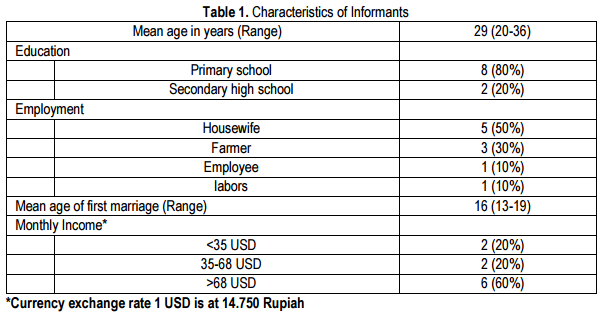
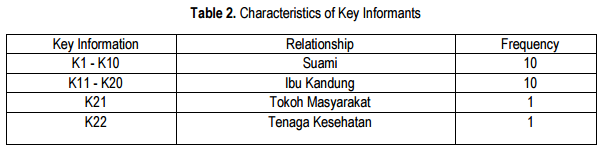
A total of 9 women and 22 key informants participated in this study. Table 1 presents the socio-demographic characteristics of women, and table 2 presents the characteristics of the key informants. The average age of the women was 29 at the time of the interview, and their mean age of marriage was 16. All of them reached either a primary or secondary level of education. The key informants in this study were husband, parents, Religious Affairs Office (RAO), and health workers from the district health center of 22 people.
Individual and familial level
At the Individual level, three themes emerged as reasons to continue child marriage tradition, they are married within the big family, adulthood, and a mandate from elderly people in the family.
Arranged marriage on the grounds of strengthening family relationship
6 informants said that the reason for early marriage is to strengthen family relations. The following are excerpts from an interview with the informant:
I do not know. It is according to what parents were said in the past. When they said so then be it. It was arranged marriage by parents and my family. His family is still distant relative to mine. It was arranged for four years old. It was parents who directly decided. I only obeyed them. Yes, I said what the parents said. Tradition first. (I.5, 31 years old)
Arranged marriage on the grounds of physical appearance
Physical growth is the reason that influences the behavior of matchmaking children. The reason for physical growth such as the women have already grown up (tall, looks fertile) and someone has seen it (the men). The following are excerpts from an interview with the informant:
Yes, it was arranged. The man saw me. He was the one who proposes the woman and accepted by her parents. It was from the man’s side who rush into marriage, because he already grows up, mature. Grow up means physically big, it has nothing to do with age. (I.6, 30 years old)
In the village, people cannot accept that. When they saw you grow up already, they will talk about you. Youshould be married. (K.16, 45 years old)
Arranged marriage on the grounds of meeting the elderly wishesElder people in the family become the reasons that influence the implementation of matchmaking behavior. The following are excerpts from an interview with the informant:
Arranged by parents. Introduced by neighbors. I have married the elder in my family and can see memarried. (I.9, 35 years old)
Societal level
Based on the results of the study, the information obtained shows that three themes were underlying the reasons for child marriage: reasonable age for marriage, access to information, and interventions from the social environment.
Reasonable age for marriage
The informant revealed that the average age of girls to get married is 14 years old, preceded by previous engagements. Some other informants said the average marriage age was 15-17 years old. The following are excerpts from an interview with the informant:
Here, children are already engaged. At fourteen, they are already married off. (I.4, 30 years old)
As long as there is someone who proposes, then it will be accepted. From fifteen, sixteen, seventeen, to high school graduates, they are all married. (I.6, 30 years old)
Access to Information
Information obtained in this study is in the form of information through the media and information through interventions. The following are excerpts from an interview with the informant:
There was an Indian movie on ANTV, which tells about the early arrangement. I do not like to see it; an early marriage is such a pity (I.4, 30 years old)
It was on TV, there are a lot of early marriages (K.14, 54 years old)
Yes, they have. It usually comes from TV like a true story. They were also on YouTube, it can be seen on the smartphone, open a true story. (I.8, 36 years old)
Yes, it was from the smartphone. Nowadays, everything is on a smartphone. We can see anything. Looking for anything, even news can be accessed from a smartphone. (K.10, 42 years old)
Interventions from the social environment
The social environment is an environment that able to influence a person in providing information related to early marriage. The intended social environment is information obtained from person to person until finally it reaches the informant and influences the attitude of the informant. The following are excerpts from an interview with the informant:
I heard from people “it must be good”. If we are old, too old they will say “not sold quickly”. Here, if you are above fifteen you will be called as not sold. (I.2, 20 years old)
I am afraid, nowadays we are afraid of promiscuity. I am afraid we will fall into that mistake, mostly marriedby accident. The villagers are mostly concern about it (I.6, 30 years old)
Community health center tells us that it is ok to marry young. However, we should not have a descendant first, if possible. If we are pregnant at underage, it will barely possible to give birth normally. (I.7, 25 years old)
The community health center and RAO conducted several interventions to prevent child marriages. As for the excerpts from the interview with informants.
There is outreach at an integrated health center, inviting people to the village hall. I always insert an early marriage topic within an outreach I deliver. Second, I usually visit schools. About the outreach, I give them to the students who are already growing up like in junior high school, and senior high school. It was about reproduction health problems, drugs, HIV, AIDS. They are also related to teenage promiscuity, free sex, et cetera. Third, individual counseling toward future bride and groom. Collaborating with RAO, we undertake coordination with RAO in terms of the future bride and groom Kerja Sama juga dengan KUA, melakukan koordinasi dengan KUA terkait pasangan calon pengantin.” (K.22, 28 years old)
There is one from RAO, I have joined in the district, it contains tells about recommended age problem. For women at what age, and for men at what age. That is all, giving an outreach. (I.8, 36 years old)
Temporarily, this is all that we able to do: to give information if there are people who apply at the office. We advise about how he passed through marital life well. I also go to the village head, village officials, including stakeholder to deliver things that also related to the marriage. It is around a marriage problem, including the marital age. (K.21, 52 years old)
The results showed that the informants married at a young age since they experienced an arranged marriage by their parents in the past. Similarly, research conducted by Munawarah, et al in 2015 reveals that the occurrence of early marriages in the Madurese community is matchmaking by parents (Munawarah et al.: 2015). Parents undertook to matchmake when the child is still in the womb, the child is still little, and the child is a teenager/adult. This shows the individual does not have a voice in determining to matchmake that occurs because what determines the matchmaking is the family supported by the community. Child marriage is mainly based on family interests and social demands, poor economic factors and cultural norms (Kohno et al.: 2019).
Matching a child to a person who is still in a family relationship becomes a separate control for parents sothat the family tree is not lost. For example, when there are problems in a child's home, parents will find it easier to help solve them.
Child marriage also occurs when the physical body already appears as fertile and some people are interested in marrying. Furthermore, it is reinforced by the fear of parents of unwanted things such as promiscuity. Thus, parents will immediately accept men's proposals without having to listen to the child's opinion. The desire to marry off a child at a young age is also undertaken so that elderly people in the family able to watch their grandchildren get married.
The desire of the family to sustain the tradition of child marriage is supported by the view of the community as well. In the village of Goring, most of the girls have been married at the age of 15-17 years. Even some have been engaged since the age of 4 years before they were married at the age of 14 years. The community follows the "kappa" or tradition that already exists and is still ongoing today. Cultural and religious values that develop in the community are also a factor driving the occurrence of early marriages (Musfiroh: 2016).
The custom of Madurese people in arranging or marrying their daughters by force with a male chosen by parents (Sa’dan: 2015, pp. 35-42). They are usually arranged when they remain in the womb or are still children. The tradition was formed because of customary law, which merged with the religious understanding of Madurese people, supported also by economic conditions and low levels of education. The Madurese have made early marriage a local customary law that is obeyed by the community, thus its implementation has been considered as common (Munawarah et al.: 2015). Manipulation of age and Siri marriage first has become commonplace for people in the village of Goring, since it is considered better than having to postpone marriage. Age manipulation is considered legitimate since the purpose is only to get a marriage book (Munawarah et al.: 2015).
DISCUSSION
Currently, the media most accessed by the public are internet mass media (Facebook, WhatsApp, Instagram, YouTube, and Google) and television (Rusliman: 2019). The more a person depends on the media to meet their needs, the more important the media is to that person (Wulandari: 2018, pp. 121-134). Television is one of the most selected electronic mass media by the public. Drama on television tells the story of a character who is affected by the ritual of early marriage to children (Wulandari: 2017).
In addition to information via television, some informants obtain information through YouTube content. The content contains true stories that tell about young marriage, which provides additional knowledge and understanding to informants. Ease of access through YouTube can also transmit a risk of misleading information related to pornography, violence, and racism (Mangole et al.: 2017).
Girls who were not engaged or married after graduating from elementary school became public gossip.
Social environmental factors influence the occurrence of young marriages due to parents' fear of close neighbor gossip (Astuty, 2013). In addition to the fear of children being gossiped about as a spinster, the fear of their daughters falling into promiscuity is another reason for child marriage.
The results showed that two institutions or agencies were intervening about early marriage: the Manding District Health Center and Kanding Manding District. Community outreach is undertaken twice a month, discussing cervical cancer and high-risk pregnant women. Furthermore, counseling to adolescents is undertaken twice a year in schools about reproductive health, HIV AIDS, drugs. Individual counseling is given to the bride and groom who comes to the community health center. Outreach interventions can affect the increase in adolescent knowledge (Khatarina & Yuliana: 2018). Interventions can also reduce the intentions of early marriage in adolescents through psychoeducation (Rahmah & Anwar: 2015, pp. 158-172).
The fostering atmosphere undertook by RAO of Manding District is included in the fostering of the individual atmosphere: the building of the individual atmosphere undertook by individual community leaders. In this category, community leaders become role models individuals in terms of the behavior that is being introduced (Kemenkes: 2011). The intervention of the RAO was taken place when a person registered the marriage to the RAO office. There is still no extension program that is undertaken routinely due to the cost and human resource constraints. Early marriages have a psychological impact such as the occurrence of problems in the family (African: 2016). Intervention from the RAO is more about preventing divorce in the future. Divorce is the impact of an early marriage since it is not psychologically ready to foster the household. Therefore, a great number of people in the Giving village experienced a divorce.
CONCLUSION
Arrange marriage by the family happens due to several reasons; they are to strengthen the family relationship, physical appearance and the wishes of the elderly to see their grandchild is getting married. Mass media has contributed to delivering information that easily accessible to the public. Observation showed that the current program by the primary health center including health promotion activities to students and counseling to brides and grooms. However, this study showed that the intensive program from the primary health center and marital office needs to be improved to prevent the continuation of the child marriage tradition.
Acknowledgment
The researchers would like to thank the respondents who were willing to share their experiences about child marriage.
BIODATA
I NURMALA: Ira Nurmala has been a researcher with the Faculty of Public Health Universitas Airlangga since 2004. She received her Ph.D. in health promotion from The University of Georgia (United States) after she received her master's degree in public health from Maastricht University (The Netherlands). Dr. Ira Nurmala is a scholar, researcher, and lecturer majoring in health promotion with a recent publication about adolescent’s health problems.
N.F ASTUTIK: Norma Fuji Astutik is an alumnus from the Faculty of Public Health Universitas Airlangga majoring in Health Promotion and Behavior. Her final thesis related to maternal health. She is a scholar, researcher, and lecturer majoring in health promotion with the recent publications. Her research area is to positively influence the health behavior of individuals and communities, as well as improve the living and working conditions that influence their health.
Y.P DEVI: Yuli Puspita Devi is an alumnus from the Faculty of Public Health Universitas Airlangga. She is a research assistant in the Faculty of Public Health Universitas Airlangga majoring in Biostatistics and Population with a special interest in the health of adolescent’s health, maternal health, and child health. She is a scholar, researcher, and lecturer majoring in health promotion.
BIBLIOGRAPHY
ABDURRADJAK, K, MAMENGKO, LM & WANTANIA, JJE (2016). “Karakteristik kehamilan dan persalinan pada USIA”< 20 tahun di RSUP Prof. Dr. RD Kandou Manado periode 1 Januari 2013–31 Desember 2014. E-CliniC, 4(1).
AFRIANI, R (2016). “Analisis Dampak Pernikahan Dini pada Remaja Putri di Desa Sidoluhur Kecamatan Godean Yogyakarta”. In PROSIDING SEMINAR NASIONAL & INTERNASIONAL, 1(1).
ASTUTY, SY (2013). “Faktor-faktor Penyebab Terjadinya Perkawinan Usia Muda Dikalangan Remaja di Desa Tembung Kecamatan Percut Sei Tuan Kabupaten Deli Serdang”. Welfare StatE, 2(1).
BKKBN (2017). BKKBN: Usia Pernikahan Ideal 21-25 Tahun. Retrieved September 24, 2019, from https://www.bkkbn.go.id/detailpost/bkkbn-usia-pernikahan-ideal-21-25-tahun.
BRAUN, V & CLARKE, V (2006). “Using thematic analysis in psychology”. Qualitative research in psychology, 3(2), pp. 77-101.
CENTERS FOR DISEASE CONTROL AND PREVENTION (2018). “The social-ecological model: A framework for violence prevention”.
IONESCU, C., FISCHER, C., HOECK, V., & LÜTTGE, A. (2019). “Discrimination of Ceramic Surface Finishing by Vertical Scanning Interferometry”, Archaeometry, 61(1), pp. 31-42.
KEMENKES, RI (2011). Promosi Kesehatan di Daerah Bermasalah Kesehatan: Panduan bagi Petugas Kesehatan di Puskesmas. Jakarta: Kementrian Kesehatan Republik Indonesia.
KEMENKES, RI (2018). “Promosi kesehatan di daerah bermasalah kesehatan panduan bagi petugas kesehatan di puskesmas, Jakarta: Pusat Promosi Kesehatan Kemenkes Republik Indonesia”. Tersedia di http://www. depkes. go. id/resources/download/promosi-kesehatan/panduanpromkes-dbk. pdf, diunduh tanggal, 28.
KHATARINA, T & YULIANA, Y (2018). “Pengaruh Penyuluhan Kesehatan Reproduksi melalui Audio Visual dengan Hasil Pengetahuan Setelah Penyuluhan pada Remaja SMA Negeri 2 Pontianak Tahun 2017”. Journal Kebidanan, 8(1), 265367.
KOHNO, A, DAHLUI, M, NIK FARID, ND, ALI, SH & NAKAYAMA, T (2019). “In-depth examination of issues surrounding the reasons for child marriage in Kelantan, Malaysia: a qualitative study”. BMJ Open, 9(9), e027377.
LIAMPUTTONG, P (2010). “Research Methods in Health: Foundations for Evidence-Based Practice (2nd ed.)”. South Melbourne: Oxford University Press.
MANGOLE, KDB, HEMPONG, M & KALESARAN, ER (2017). “Pemanfaatan Youtube dalam Meningkatkan Pengetahuan Masyarakat di Desa Paslaten Kecamatan Remboken Minahasa”. ACTA DIURNA KOMUNIKASI, 6(4).
MORSE, JM (1995). “The Significance of Saturation”. Qualitative Health Research, 5(2), pp. 147–149
MUNAWARAH, M, YASAK, EM, & DEWI, SI (2015). “Budaya Pernikahan Dini Terhadap kesetaraan GenderMasyarakat Madura”. Journal Ilmu Sosial dan Ilmu Politik Universitas Tribhuwana Tunggadewi, 4(3), 42455.
MUSFIROH, MR (2016). “Pernikahan Dini dan Upaya Perlindungan Anak di Indonesia”. Journal De Jure: Journal Hukum dan Syari’ah, 8(2).
PLOTNIKOVA, N. F., & STRUKOV, E. N. (2019). “Integration of teamwork and critical thinking skills in the process of teaching students”, Cypriot Journal of Educational Sciences, 14(1), pp. 1-10.
RAHMAH, M & ANWAR, Z (2015). “Psikoedukasi Tentang Risiko Perkawinan USIA Muda untuk Menurukan Intensi Pernikahan Dini pada Remaja”. JIP (Journal Intervensi Psikologi), 7(2), pp. 158-172.
RUSLIMAN (2019). Pengaruh Media Massa dalam Praktek Pernikahan Dini di Kecamatan Pantan Cuaca Gayo Lues. Institut Agama Islam Negeri Ar-Raniry.
SA’DAN, M (2015). “Tradisi Nikah-Paksa di Madura: Perspektif Sosio-Legal Feminisme. Tradition of Forced-Marriage in Madura: a Perspective of Socio-Legal Feminism”. Journal Perempuan, 20(1), pp. 35–42.
SAIFUDDIN, AB (2006). Buku panduan praktis pelayanan kontrasepsi. Jakarta: Yayasan Bina Pustaka Sarwono Prawirohardjo.
SHIH, FJ (1998). “Triangulation in nursing research: issues of conceptual clarity and purpose”. Journal of advanced nursing, 28(3), pp. 631-641.
STEINHAUS, M, HINSON, L, RIZZO, AT, & GREGOWSKI, A (2019). “Measuring social norms related to child marriage among adult decision-makers of young girls in Phalombe and Thyolo, Malawi”. Journal of Adolescent Health, 64(4), pp. 37-44.
TAYLOR, AY, MURPHY-GRAHAM, E, VAN HORN, J, VAITLA, B, DEL VALLE, Á & CISLAGHI, B (2019). “ChildMarriages and Unions in Latin America: Understanding the Roles of Agency and Social Norms”. Journal of Adolescent Health, 64(4), pp. 45–51.
UNITED NATIONS, DEPARTMENT OF ECONOMIC AND SOCIAL AFFAIRS (2011). “World Fertility policies 2011”.United Nations Publication.
WHO (2012). “World Health Statistics 2012”. France.
WULANDARI, IE (2017). Hubungan Intensitas Menonton Tayangan Anandhi ANTV Terhadap Pemahaman Gender Kalangan Ibu-Ibu Dusun Sukorejo, Ngawi, Jawa Timur.
WULANDARI, IE (2018). “Sinema Dan Gender (Studi Kasus Perubahan Pemikiran Gender Perempuan Penggemar Sinetron Anandhi)”. Marwah: Journal Perempuan, Agama dan Jender, 17(2), pp. 121-134..