Artículos
Market driven by sustainable construction and demolition waste in UAE
Mercado Impulsado por la construcción sostenible y los desechos de demolición en los EAU
 M.L Gernal liza.gernal@aau.ac.ae
R.P Sergio rommel@cud.ac.ae
A.J Musleh A19j91@gmail.com
M.L Gernal liza.gernal@aau.ac.ae
R.P Sergio rommel@cud.ac.ae
A.J Musleh A19j91@gmail.com
Market driven by sustainable construction and demolition waste in UAE
Utopía y Praxis Latinoamericana, vol. 25, no. Esp.2, pp. 56-65, 2020
Universidad del Zulia

This work is licensed under Creative Commons Attribution-NonCommercial-ShareAlike 3.0 International.
Received: 07 March 2020
Accepted: 15 April 2020
Abstract: This paper aims to evaluate the regulations in the United Arab Emirates (UAE) treatment plant, and its market-driven acceptability of using construction and demolition waste (CDW). This research paper highlights the exceptional work of the 10 construction companies in the UAE in their operational achievements as turnaround after the recession. Effective strategies helped businesses during this period including the expansion into crisis-resistant markets such as acceptability of the market to use CDW; introducing market lines; maintaining prices while augmenting existing products; developing adaptive positioning; using informative advertisements; and pruning marginal channels.
Keywords: Construction, demolition waste, market- driven, sustainability..
Resumen: El objetivo de este documento es evaluar las regulaciones en la planta de tratamiento de Emiratos Árabes Unidos (EAU), y su aceptabilidad impulsada por el mercado del uso de residuos de construcción y demolición. Este trabajo de investigación destaca el trabajo excepcional de las 10 empresas constructoras en los EAU en sus logros operativos como respuesta tras la recesión. Las estrategias efectivas que ayudaron a las empresas durante este período incluyen la expansión a mercados resistentes a las crisis, como la aceptabilidad del mercado para usar el desecho de construcción y demolición (CDW); introducción de líneas de mercado; mantener los precios al tiempo que aumenta los productos existentes; desarrollo de posicionamiento adaptativo; utilizando publicidad informativa para la eliminación de canales marginales.
Palabras clave: Construcción, impulsado por el mercado, residuos de demolición, sustentabilidad..
INTRODUCTION
Construction and Demolition Waste (CDW) is a mixture for inactive non-inert materials emerging from different construction activities similar to excavation, demolition, construction, renovation, furthermore roadwork. The hard-inactive materials of development waste, for example, rocks broken concrete, representable more or less 12–15% of the aggregate waste, which a chance to be reused/recycled Similarly as granular materials alternately reused aggregates for development exercises. Those reused aggregates could make utilized within street sub-base, waste padding layers, cement blend provisions. Those non-inert waste (like timber, bamboo, what is more, bundling waste) represent give or take 15–18% from claiming constantly on development waste, which needs aid fundamentally arranged of in landfills (Yuan: 2017, pp. 84-93).
Construction and demolition waste were a problem in the country, however, due to the integration and collaboration of the various sectors to reduce landfilling, the government and private sectors created an initiative to address the ballooning of CDW in the landfill. As economic downturns occur across countries globally from time to time, construction and demolition activities have introduced varying meanings to sustainable development downturn or decline due to the recession (Akinade et al.: 2016).
The United Arab Emirates has become a hub in the GCC region because of its winning entry in Expo 2020. With these busy activities that the UAE has, it has been sourcing metal scrap from India and China. As the world became more aware of the consequences of the proliferation of industrialization and the huge effect this has on the environment thus the UAE government, for example, is urging private and non-government sectors for help to create, innovate, and implement the Breen standard projects. With this governmental initiative, the country has been adopting a mix of assessment of green buildings and other building standards for the country to address the reduction of waste in making the towers, skyscrapers, villas, others (Wang et al: 2010, pp. 931- 936).
The stages that have been looked into the various standards mentioned range from overall sustainability of the building life cycle starting from planning, to design, through construction, operation, and finally to demolition and those standards have the potential to make a real difference. Past research works into which of these stages cause the majority of waste in construction projects. They have indicated that waste can arise at any stage of the construction process from inception, right through the design, construction and operation of the built facility (Spivey: 1974, pp. 501-506; Gavilan & Bernold: 1994, pp. 536-552; Craven et al.: 1994, pp. 89- 98; Faniran & Caban: 1998, pp. 182-188; Teo & Loosemore: 2001, pp. 741-751). Waste is produced in the normal course of operation in domestic, industrial, commercial, construction, and institutional operations and can be made of organics, non-organics, inert material, hazardous, and recyclable materials. Wastes come in solid, liquid, and gaseous form. Waste is defined as “any discarded, rejected, abandoned, unwanted or surplus matter, whether or not intended for sale or recycling, reprocessing, recovery or purification by a separate operation from that which produced the matter (Environment Protection Act).
The quantity of waste generated is related to the population and economic activities. Arab Countries generate 90 million tons of waste every year and it is predicted to increase to 200 million tons per year in 2020 by which the cost is estimated at around five 5 billion US$. The GCC countries are among the top waste generators, whereby the waste generation is 1.2 – 2.7 kg per capita per day. Relatively recent data indicates that Abu Dhabi Emirate generates approximately 33,000 tons of waste daily in which 65% is constituted of Construction and Demolition waste.
The Emirate of Dubai generated less CDW in 2011 compared to 2010. In 2011 it generated 6,638,471 tons CDW while it was 10,205,034 tons in 2010. This clearly shows a reduction of 65% and this was mainly because of the green initiatives of the Municipality of Dubai and the directives of the government. Despite the amazing economic achievements of Dubai, a detailed examination of its practice and research of CDW exhibits that the current expertize and understanding of CDW management are relatively low. For this reason, the government urged the research body to conduct a case study to solve the pressing problem of the city. Also, some contractors are willing to carry on-site sorting, which is regarded as an effective means to increase waste ratiosof reuse and recycling (Wang et al: 2010, pp. 931-936).
In 2013, the CDW comprise about 17,011,669.4 tons and 13,673,271.90 have been dumped in the landfill, 3,243,835.4 have been recycled and 94,562 treated with other means of disposal. In the country itself, the CDW and Municipal Waste have been mixed and dumped in the landfill.
With this, the CDW recycling facilities that are installed in every emirate have been receiving daily a minimum of 4 tons of mixed CDW and the recycling plant itself is the one responsible for it. In Al Dhafra Recycling plant is only receiving concrete CDW and most of the concrete still has its wirings, steel, the cement that usually takes a long time to segregate.
However, the acceptability in the market of the output product yielding from the recycling facility plant is not clear. Contractors and project engineers do not want to buy recycled materials because they are reluctant to use recycled material in constructing towers, skyscrapers and other infrastructure. As they said that road concretes and parks would be acceptable but not in the residential and commercial complex since they are not of the quality required.
To measure the waste component of CDW we used the case study and exploratory research approaches. We also have employed the standard municipality assessment tools combined with the accreditations of Green Building Certifications such as LEED in US (Leadership in Energy and Environmental Design) and Green Building Certification, BREEAM in UK (Building Research Establishment Environmental Assessment Methodology, GBCA in Australia (Green Building Council Australia) Green Star, and BCA Green Mark in Singapore. The LEED rating system applies to buildings that are being newly constructed or going through a major renovation. The following criteria make the scope of LEED coverage: Building Design and Construction, Interior Design and Construction, Building Operations and maintenance, and Neighborhood Development and Homes.
METHODS
Legalities
UAE Regulation
Every emirate has its policy in terms of keeping waste management and how to possibly reduce the CDW that has been accumulated in construction. The Government of Abu Dhabi (Capital of United Arab Emirates) constituted the center for Waste Management (CWM) under the decree 17/2008 to manage the waste sector. Based on this decree, the government of Abu Dhabi has allocated a certain budget for CWM for its first five 5 year’s operations. CWM has to provide its services independently and based on the income generated from its projects. The Emirate of Abu Dhabi has a contract with Al Dhafra Recycling Plant in Dubai, they have contracted with Emirates Recycling Group who initiated the setup to perform work and projects to recycle construction and demolition waste as well as tires. The company recycles the construction and demolition waste emanating from the Emirate of Dubai. This is a Build Operate Own and Transfer (BOOT) project under the patronage of the Dubai Municipality. The recycled aggregate produced from waste concrete and asphalt shall reduce the impact on precious natural resources as well as reduce vehicle emissions through improved transport logistics (Zinnatullina & Popp: 2019, pp. 6-19; Sagdieva et al.: 2019, pp. 103-117).
The data collected for this study are both primary and secondary and of qualitative nature. The data collection comprised of three activities to enable the understanding of the problem statement and to support the findings.
-
The data about the actual generation and composition of CDW in Abu Dhabi, Al Ain, and Dubai where collected from Service Provider reports; (Star International).
-
Other data concerning the related key factors such as waste management strategy and illegal dumping, were collected from reports provided by CWM / Competent Authorities.
-
Data collected from private constructional sites.
RESULTS
Private Companies Construction Sites
With the government’s initiative to increase the level of awareness, acceptance of the public to practice more BGreen building standards, we find on the other hand the private sector and in particular small contractors practicing the opposite. The segregation of waste was observed during the site walk and it was noticed that only three streams of waste were separated: steel, wood and what the interviewee called ‘construction waste’. This latter stream contains concrete, bricks, unused metal, damaged wood, and plastics. In addition to that, the skips intended for waste were neither labeled nor contained any indication of their contents. MRF should have been installed onsite to sort the different types of waste.
There were three types of storage practiced as per the type of materials; uncovered, shuttled and air- conditioned that has been imposed by some projects as they specified waste management plan during the submission of tender. But other projects did not have waste management plans.
Meanwhile onsite, there are some have formal waste management that was implemented onsite although that the waste minimization is part of their cost control and of their value management activity but they stick to the design and target plan to finish the project.
Usually, project managers labeled out that due to the maximization of profit and minimization of cost, it is known that the poor quality of products is a main cause of damage particularly for wood which pointed out that the market conditions impose sometimes an over-ordering of materials to avoid shortage.
Apart from that at this stage of the project were: off-cuts due to standard sizes in the market (e.g. plasterboard) the laborers shows lack of awareness how to recycle in the site and due to deadlines in order not to be penalized with the municipality, it shows also that fast track method of construction leading to design errors and rework. Although waste minimization has both economic and environmental benefits, it is a fact that cost savings must be achieved to have the support of senior managers.
After the end of the project life cycle, there are no recycled materials that will be handed over to next projects since the woodcuts, steel-cuts, concrete, paint, plasterboard off-cuts, cables off-cuts, wood off-cuts, packaging, and other hazardous and non-hazardous materials were already thrown out in the landfill and there is no on-site sorting that separates the construction waste that is ready to be used for next project.
Apart from that, the market is not accepting recycled materials that have been used in previous constructions since the strength of the woods is not the same as the new one.
Comparison of Dubai CDW to Other EU places
The amount of yearly CDW generated from construction in the Emirates of Abu Dhabi is shown in Table 1 below.
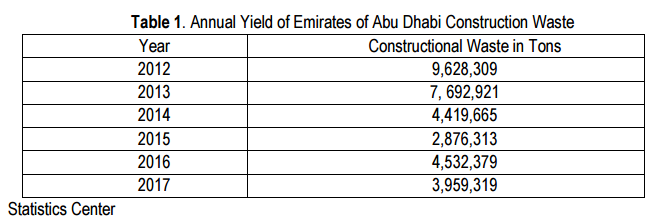
The table 1 shows a dramatic reduction in waste production over six-year’ time However, comparing this to the amount of waste produced in Europe, for example, is still too high. In 2010, the CDW yielded by 27 countries were 859,730 (1,000 tons) (Eurostat).
While most legislation about CDW management has been developed at the national level, a revision of the European Union’s Waste Framework Directive (WFD) requires that 70% CDW of each member state to be reused or recycled by 2020 (BIO Intelligence Service). This legislation will likely to be the main policy driver for European CDW waste management until 2020. However, since each member state must incorporate the requirements into its legislation, the techniques for achieving this target will vary across the continent. This is no less true due to the wide variation in CDW reuse and recycling rates across Europe. While Germany, Denmark, Ireland, the Netherlands, and the United Kingdom have already surpassed the Waste Framework Directive’s CDW of waste diversion requirements, countries such as Spain, Poland, and Greece have diversion rates that are currently below 20% (BIO Intelligence Service). This means that the WFD will play a more significant role in the development of some member states. Meanwhile, UAE as an emerging economy in which the country is still constructing buildings and towers, in comparison to the UK generates 100 million tons yearly of CDW. In 2007, a total of 27.7 million tons were removed in Dubai, which is around 75 thousand tons per day. In 2008 a capacity of 1500 tons per day was generated in Sharjah while Abu Dhabi generated 4.7 million tons per year in 2005 (Center of Waste Management: 2017; Toumi & Chief: 2009).
The capacity of Al Ain Crushing and Demolition Treatment Plant
In December 2008, the Government of Abu Dhabi established the Center of Waste Management - Abu Dhabi (CWMAD or Center) with the mandate of handling all waste management matters in the Emirate of Abu Dhabi. A CDWaste processing plant project was established in Al Ain at the same time and became operational in March 2011.
The crushing plant for Al Ain was proposed by the municipality to process the construction and demolitionwaste generated by different construction activities in Al Ain and its region. It was also a requirement from an environmental perspective that the construction waste should be processed to divert a large amount of waste from going to the landfill and disposal sites. The plant capacity of a minimum of 2000 tons/day was estimated following the number of construction projects and activities and estimated quantities during the year 2006.
The proposed capacity of the Caldehusa-Spain plant was 3520-7040 tons/day as mentioned in the technical specifications of their submittal. However, the contractor has planned its equipment and manpower based on the contractual requirements of processing 2000 Tons/day.
The CDW crushing plant project was developed to segregate and transform the CDW to obtain ballasts and filling materials thereby reusing and recycling the CDW waste for the conservation of natural resources and fulfilling the increasing demand for building materials. A careful review of the requirements and the processes needed was done to select the best options based on Best Available Techniques (BAT) and Best Environmental Practices (BET) in CDW processing using top-tier “state of the art” technologies. The plant is unique in that it can proceed with two different types of materials depending on the degree of contamination, as follows:xed with other wastes like metals, plastics, etc.
For the project, the CDW and road excavated waste is being delivered to the Crushing Plant through external collectors and transporters. The final processing products are of different types and sizes of aggregates, such as recycled steel, plastic, paper, wood, etc. The process is started with the inspection of the waste carrying vehicle and only authorized waste vehicles carrying acceptable waste are allowed to enter the facility. Weighing is done at the gate and necessary information is recorded. Then, depending on the type of waste, trucks are diverted towards the unloading area. Oversize (more than 200mm) wastes are broken into small pieces by the jackhammer before loading into the primary and secondary feeders. Steel is removed through the powerful crusher.
CDW Recycling Facility
One plant was completed in 2010 to recover steel components and produce aggregates from Construction and Demolition Wastes. The plant has a capacity of 560 tons per hour and is being operated by Emirates Recycling LLC. Dubai currently has one Materials Recovery Facility started operating in 2006 and is being operated by Tadweer LLC and has a Contractual capacity of 4000 tons/day. However, the present capacity is around 1000 tons/day.
Marketability
To guarantee the competitiveness of the recycled CDW material, the quality of the recycled aggregates must be assured. The pure material in the market is of an approved standard and specifications. Unacceptance or low demand on the recycled aggregates is an expected resistance to a major change in the CDW industry. Therefore, the sale price of aggregates is dependent on the sale price of the pure material.
The pure material can be obtained from several sources within the Al Ain region or beyond. To manage and overcome the buyers’ resistance at this early phase of the change, the sale price was set at approximately 75% of the pure material price. This percentage is expected to remain consistent unless changes in CDW laws and regulations are announced.
In addition to that, the municipality will be given brochures so that the public will be aware of the existenceof recycled construction waste so that they will be first-hand buyers and made aware to the public of the benefits of buying recycled materials. It should have strong support from the government body and voluntary lectures among the project engineers, foreman, and workers to the community. In this area, the word of the mouth is the most prevalent marketing tool.
Apart from that, it is a must also that the public will be made aware of buying recycled materials instead of new construction materials. The government shall reward construction companies who have been using recycled materials from the Industrial Area.
Tipping Fee
This study is an attempt toward introducing an optimum cost recovery scenario of the Al Ain CDW treatment plant and developing an integrated solution for the management of CDW waste treatment projects. However, the concept of an integrated waste management solution is a combination of waste prevention/reduction, waste reuse, and enhance waste recycle. The goal of these principles is to divert wastes from landfills.
The waste hierarchy or the 3R’s principle is the basis of the environmentally sound strategies and the most efficient guiding principle of the waste management integrated solutions. Waste reduction, reuse, and recycling are respectively the most favored option and the disposal as the least favored option in the waste management systems. The waste reduction not only assures environmental protection but also contributes to economic benefits. It will lead to higher amount of waste diversion from landfills (Akinade et al.: 2016, pp. 3-21) and subsequently lower cost of waste management bared by governments, in addition to possibility of selling specific waste material at a lower cost which enables construction firms to reduce their cost (Snook et al., 1995, and Guthrie et al., 1999). This will lead to a higher level of social/economic impact in terms of increasing the competitiveness of the construction industry (Begum et al.: 2006, pp. 86-98). (Lu & Yuan: 2010, pp. 201-208) concluded the waste management regulations and awareness of CDW management as critical success factors (CSFs) for developing effective CDW strategies. Likewise, (Zhao et al.: 2011, pp. 933-944; Yuan: 2017, pp. 84-93 discussed the relative factors that contribute to the economic feasibility of CDW management. The “extra revenue” (from location advantage in his study) was identified as a major factor of economic viability.
Smart City Government – EXPO 2020
Smart government is the winning entry of UAE- Dubai in Expo 2020 and this is truly centered around the constituent, whether resident or guest. The country is getting arranged to guarantee that they have keenadministrations and items that are promptly consumable, even to people who are non-inhabitants. The UAE is hoping to give a level of modernity and serviceability for any individual who ventures inside of its vicinity. This has prompted a two-dimensional way to deal with improvement. The government emphasis has been ongoing top-down and base up to the leader and has been included in a portion of the key activities and laying out the visioning and mission parts of smart government. It is keen to the government orientation about the culture of from the base up; how you empower these keen rich administrations coming online to be conveyed to individuals' mobile phones and other smart gadgets.
In Dubai, smarting the services is an example of automating the services and fast services to the locals,residents, and tourists. As an example, can rapidly have the capacity to call a taxi on their telephone, and that taxicab will know where they’re going from their agenda, he recommends. The taxi will know the best route to their destination, given continuous movement data. Their inn will know when they've touched base, through coordination with the vehicle framework.
To the guest, the greater part of this will be consistent and straightforward in a manner that puts everything readily available. While key drivers, for example, proficiency and building a lighter, government base have a section to play, the smart government might likewise prompt more compelling and focused on arrangement advancement, on account of its potential for substantial scale information gathering.
DISCUSSION
Smart governments will depend on more brilliant data innovation (IT) arrangements that can convey effective examination, transform the undeniably immeasurable measure of information into significant understanding, to empower them to settle on better choices. Thusly this will put a great deal of accentuation on the IT's administration surroundings, to bolster the expanded number of end clients and endpoints and guarantee execution, steadiness, and security.
In smarting Dubai, it will be an example throughout the Emirates to use the technology to reduce waste in construction. By installing proper inventory and material recovery facilities of every detailed component used in the construction sites will be beneficial not only to the country but the environment as well. The brilliant government's drivers are constrained to IT as well as in all operational fields in the nation, might it be the savvy environment, shrewd therapeutic wellbeing, and so forth. The smart city idea will have a prompt gathering of waste from high need receptacles is a testing issue in cutting edge social orders. The reason is that these days, because of the expanded populace joined by the mechanical improvement, the likelihood of presenting unsafe waste to residents is expanded too. Particularly, in the situations where waste is hazardous for human lives or particular parts of the populace, the requirement for the prompt accumulation is basic. We propose an arrangement of models for reducing the examined issue.
The proposed models manage particular methodologies for serving high need containers. Every one of them means to cover particular parts of the issue. Construction companies or partners could receive a model to be connected in genuine situations. A high number of reproductions uncover the points of interest and impediments of the proposed models. These measurements manage quantitative and additionally subjective attributes of a waste administration framework.
CONCLUSION
In the first place of our future exploration plan is the meaning of a savvy system for the administration of verifiable information identified with the heap of high need containers. Thus, our framework will be fit for giving master dynamic reactions in the interest of gathering waste from high need trucks and bins. Professional handling will expand the framework's proficiency as they will be the premise of building novel directingcalculations that consolidate such information in their outcomes. The CDW loading schedule from construction sites will be recorded information will give us the chance to reduce air pollution that, in particular hours of the day and for particular divisions of the city, will offer need to the examined containers... Finally, dynamic reallocation of routes according to a load of each truck will be another extension of our work. Through this approach, borders between sectors will be eliminated and, if necessary, trucks will undertake the responsibility of collecting waste in their ‘neighbors’.
To establish nationwide, uniform and legally binding rules that ensure the safe use of mineral substitute building materials for technical purposes and recovery, below are the recommendations:
- 1. Removal of uncertainties in the use and exploitation of mineral substitute materials for all participants,
- 2. Reduction of administrative procedures for installation or the use of mineral substitute construction materials for technical purposes,
- 3. Increase competition chances of nationwide construction and delivery performance by eliminating country-specific regulations.
The waste management plans shall include descriptions of the following:
- 1. The aims of waste prevention and recovery, and in particular preparation for re-use and recycling, as well as waste disposal,
- 2. The existing situation in waste management,
- 3. The necessary activities to improve the recovery of waste and waste disposal, including an evaluation of their aptitude to achieve the objectives, and
- 4. The waste treatment installations to ensure waste disposal, as well as the recovery of mixed wasteImportar listafrom private households including that which is collected in other areas of origin within the national borders.
The waste management plans shall list the following:
- 1. Authorized waste treatment installations
- 2. Areas suitable for landfilling, for other waste disposal installations, as well as for waste treatment installations
BIODATA
L.M Gernal: Dr. Gernal holds a Ph.D. in Management at the University of Liverpool, UK and has earned him has been working in the Gulf Countries for the past 6 years and her 14 years of teaching experience. She has been active in Small Medium Enterprise concerning Zero Waste Management and Environmental Conservation. She has been active in the Non-Government Organization concerning peace and development in the southern part of the Philippines. Aside from teaching experience, she has been an accredited trainer for Grassroots Entrepreneurial Management (GEM) and Strategic Social Enterprise in Cooperation with the PEARL 2 - Canadian International Development Agency (CIDA). Her research interest includes human resource management, organizational behavior and development, SME, and sustainable development business.
R.P Sergio: Dr. Sergio holds a Ph.D. in Management at the University of Liverpool, UK and has earned his Ph.D. in Psychology (summa cum laude) at De La Salle University-Dasmarinas, Philippines. He also acquired his Post-Doctoral Bridge to Business in Management certificate at Tulane University, New Orleans, Louisiana, the USA in 2011. He is currently a Professor at the Canadian University of Dubai, United Arab Emirates. It can be noted that Dr. Sergio was awarded certified by the AACSB (The Association to Advance Collegiate Schools of Business) in Florida, USA as AQ (Academically Qualified) to teach in Management. He has also published and co-authored several academic research papers that he presented in several international academic conferences, including Harvard University. He has been recognized by local and foreign award-giving bodies for his magnanimous contribution both to the academy and the community, to wit: Presidential Award by Philippine President Rodrigo Duterte for Outstanding OFW-Individual Category; Top 50 Global Educators Award by The Oxford Journal: An International Journal of Business and Economics; 100 most influential Filipinos in the Gulf by Illustrado Magazine; Outstanding Global Research Leader by International Association of Scholarly Publishers, Editors, and Reviewers; and Huwarang OFW-People’s Choice.
A.J Musleh: Mr. Musleh is a GIS Specialist and Analysis of Barari Forest Management from 2011 in Abu Dhabi, United Arab Emirates. He designs, develop, and implement systems and databases for storing and accessing geospatial data. In his work, it involves standardizing and defining metadata for geographic data, and track needs for data format conversion. He does the research and tests new data using sources, software, and organizational tools.
BIBLIOGRAPHY
AKINADE, OO, OYEDELE, LO, MUNIR, K, BILAL, M, AJAYI, SO, OWOLABI, HA ... & BELLO, SA (2016).“Evaluation criteria for construction waste management tools: towards a holistic BIM framework”. International Journal of Sustainable Building Technology and Urban Development, 7(1), pp. 3-21.
BEGUM, RA, SIWAR, C, PEREIRA, JJ & JAAFAR, AH (2006). “A benefit-cost analysis on the economic feasibility of construction waste minimization: the case of Malaysia”. Resources, Conservation and Recycling, 48 (1), pp. 86–98.
CENTER OF WASTE MANAGEMENT – Abu Dhabi, Strategy Document (2017).
CRAVEN, DJ, OKRAGLIK, HM & EILENBERG, IM (1994). “Construction waste and a new design methodology”. In Proceedings of the First Conference of CIB TG, 16, pp. 89-98.
FANIRAN, OO & CABAN, G (1998). “Minimizing waste on construction project sites”. Engineering Construction and Architectural Management, 5(2), pp. 182-188.
GAVILAN, RM, & BERNOLD, LE (1994). “Source evaluation of solid waste in building construction”. Journal of construction engineering and management, 120(3), pp. 536-552.
LU, W & YUAN, H (2010). “Exploring critical success factors for waste management in construction projects of China”. Resources, conservation, and recycling, 55(2), pp. 201-208.
SAGDIEVA, R., HUSNUTDINOV, D., MIRZAGITOV, R., & GALIULLIN, R. (2019). “Kinship Terms as Proof ofGenetic Relationship”, Journal of Social Studies Education Research, 10(3), pp. 103-117.
SPIVEY, DA (1974). “Construction solid waste”. Journal of the Construction Division, 100(4), pp. 501-506.
TEO, MMM & LOOSEMORE, M (2001). “A theory of waste behavior in the construction industry”. ConstructionManagement and Economics, 19(7), pp. 741-751.
TOUMI, H & CHIEF, B (2009). Gulf News.
WANG, J, YUAN, H, KANG, X & LU, W (2010). “Critical success factors for on-site sorting of construction waste: a China study”. Resources, conservation, and recycling, 54(11), pp. 931-936.
YUAN, H (2017). “Barriers and countermeasures for managing construction and demolition waste: A case of Shenzhen in China”. Journal of Cleaner Production, 157, pp. 84-93.
ZHAO, W, REN, H, & ROTTER, VS (2011). “A system dynamics model for evaluating the alternative of type in construction and demolition waste recycling center–The case of Chongqing, China”. Resources, Conservation and Recycling, 55(11), pp. 933-944.
ZINNATULLINA, Z. R., & POPP, I. A. (2019). “Rural Justice in the Russian Empire after the abolition of serfdom”, VOPROSY ISTORII, (4), pp. 6-19.