Artículos
Role of youth centers in developing social responsibility
Roll de los centros juveniles en el desarrollo de la responsabilidad social
 A Rakan Rakan.alhrahsheh@aau.ac.ae
A. Ayman Khaldy77@yahoo.com
A Rakan Rakan.alhrahsheh@aau.ac.ae
A. Ayman Khaldy77@yahoo.com
Role of youth centers in developing social responsibility
Utopía y Praxis Latinoamericana, vol. 25, no. Esp.2, pp. 125-135, 2020
Universidad del Zulia

This work is licensed under Creative Commons Attribution-NonCommercial-ShareAlike 3.0 International.
Received: 14 March 2020
Accepted: 20 April 2020
Abstract: The study aims to identify the role of youth centers in developing individual responsibility towards society. The study used the social survey method. A random sample of 272 individuals was collected. The study concluded that there is a large role for youth centers in developing social responsibility towards society. According to these results, the study recommended not to restricting affiliation to youth centers with a specific age group, encouraging young people to affiliate with youth centers, and undertaking external visits to gain experience in this field.
Keywords: Social development, social responsibility, society, youth..
Resumen: El objetivo del estudio es identificar el papel de los centros juveniles en el desarrollo de la responsabilidad individual hacia la sociedad. El estudio utilizó el método de encuesta social. Se recolectó una muestra aleatoria de 272 individuos. El estudio concluyó que los centros juveniles tienen un papel importante en el desarrollo de la responsabilidad social hacia la sociedad. Según estos resultados, el estudio recomendó no restringir la afiliación a centros juveniles con un grupo de edad específico, alentar a los jóvenes a afiliarse a centros juveniles y realizar visitas externas para adquirir experiencia en este campo.
Palabras clave: Desarrollo social, juventud, responsabilidad social, sociedad..
INTRODUCTION
In recent times, state institutions have been increasingly focusing on developing social responsibility in the members of society. Social responsibility plays an important role in enhancing cohesion within the society, organizing lives within it, and increasing interdependence and coherence among individuals. Social responsibility is also an expression of how closely an individual is associated with a community and his or her state and sense of belonging to family, society, and country. On the contrary, ignorance about our lack of social responsibility, or individuals’ weak sense of social responsibility, represents a serious threat to society. Social responsibility is vital in making young people assume responsibilities; it prepares and allows them to perform their roles in the best possible way of building society. Also, a responsible individual of sound mental health and psychosocial well-being has a social responsibility toward not only oneself but also others (Al-Kharashi: 2004).
Since youth form a significant part of society, they have an important and prominent role in supporting society's progress and activating its development process. The state, therefore, needs to work with all its different sectors and authorities in developing the sense of social responsibility of this important part comprising the youth in society. This is because developing social responsibility among the youth people protects them from the risk of delinquency and saves them from problems threatening society’s security and stability. Moreover, youth care is a long-term investment process, as the more, we give care and prepare the youth properly, the more generously we gain human experiences representing wealth in the modern world and the nation’s weapon in the present and in the future to face both internal and external challenges.
Before we proceed to review previous studies, some terms related to the subject of this study need to be explained. From a procedural point of view, social responsibility can be defined as the extent to which young people are aware of and exercise their social role toward themselves, their family, friends, society, and country, and bear the consequences of such a role. The degree of social responsibility can be assessed by the measure of social responsibility adopted by the researcher for this study. Meanwhile, the terminological definition of social responsibility is the close association of an individual with society, the feeling of belonging to it, and the strong desire to preserve and develop it. A socially responsible individual is one who cares about discussing and understanding the social and political problems of society, cooperates with other members of society, respects their opinions, makes all efforts for them, maintains the reputation of the community, and respects social duties (Ahmad & Ahmad, 2019; Abdul Hameed: 2012, pp. 173-191). Al Khawaldeh (Al Khawaldeh: 1987, pp. 124-147) believes that raising a man to bear his responsibilities toward what he says and does is an important part of organizing life within the human society, as when individuals bear responsibility for their actions, life becomes stable and peace prevails. This leads to people being able to enjoy the sense of justice and psychological and social security in their private and public lives. It also leads to transparency in their sensitivity toward responsibility within the social entity, which helps them choose optimal behavior, thanks to the sensitivity toward responsibility thereby spreading care, caution, accuracy, awareness, interest, and involvement in their actions and deeds while performing their social roles. Furthermore, social responsibility is largely a social product, because it is learned, acquired, and developed gradually through education and socialization and the institutions of upbringing such as the family, school, university, houses of worship and the media, which contribute to increasing and developing social responsibility in line with the requirements of society (Al-Shayeb: 2003).
On reviewing the different definitions of the term “social responsibility,” it may be noticed that it focuses on the social role of the individual ranging from an individual’s participation and cooperation with others to caring about them and understanding their needs. It is also inferred that man is a social creature who lives in society, interacts with others, respects their opinions, complies with social and political values and standards, and enjoys rights as well as performs duties imposed on him to cooperate, participate, and interact with others. Moreover, the different institutions, be it the family, school, universities, civil society institutions, or youth centers, shall develop the social responsibility of the individual. Also, previous definitions indicate that the individual has a role in society, which s/he plays, and that s/he does not live in a society in conflict with others, but rather, is part of it, bearing responsibility for self and others in society. Based on the foregoing, social responsibility can bedefined as the participation of the individual, along with other members of the society playing the role required of them, to maintain stability and progress of society. It also means political participation and volunteering in civil society institutions for achieving the prosperity and progress of society (Malysheva: 2019, pp. 147-158).
By reviewing the previous studies related to the field of study, it has been found that many of them have addressed the topic of social responsibility as well as the youth centers and their different roles from different perspectives and aspects as follows.
(Jarrar & Hammud: 2018, pp. 25-36) is titled “The Current State of Social Responsibility of Al-Quds Open University Students and a Suggested Proposal for a Community Service-Based Program for its Development.” The two researchers chose a stratified random sample of (500) students from the north of West Bank. The most important conclusions of the study are as follows: The average total score of social responsibility among students of Al-Quds Open University in all fields of study was (72.8%), which is a high score, while the highest degree of social responsibility was seen in the field of collective responsibility, followed by the national responsibility, religious and moral responsibility, and finally self (personal) responsibility. Also, no statistically significant differences were seen in the degree of social responsibility among Al-Quds Open University students based on gender and school year variables. Al-Shayeb’s study (Al-Shayeb: 2003) titled, “Social Responsibility of Saudi Universities’ Students and Its Relationship with Social Preventive Awareness: A Comparative Study between Public and Private Universities,” was applied to a study sample of (836) students. The most significant finding of this study was the direct correlation among social responsibility, variables of social preventive awareness, and moral and national responsibility. The higher the social responsibility, the higher the preventive, moral, and national awareness of university students in public and private universities toward the environment and order.
Furthermore, the targets of this study were a sample of young men and women belonging to youth centers, and it differs from other studies that targeted the youth. It also differs from Al-Kharashi’s study (Al-Kharashi: 2004), which examined workers and members of youth centers to develop youth center services. Jamali & Karam’s study (Jamali & Karam: 2018, pp. 32-61), which considered a sample of young people and youth center staff discussed only the values of citizenship. Moreover, this study is different from other studies in that it addresses the role of youth centers in developing social responsibility among the youth people and discusses applying the measure of social responsibility to the members of such centers, as suited for the study. Thus, the present study will add new knowledge by discussing the sociological aspect of the role played by youth centers and will address the social responsibility issue and whether these centers play their role in developing it properly.
METHODS
Problem of the Study
Social responsibility is considered a vital and important requirement to prepare the youth to assume their roles in society. An individual’s value in society is measured by the extent to which the individual bears responsibility toward oneself, others, and society. Furthermore, social responsibility is a human trait that must be inculcated in the individual, because a responsible individual is one who can benefit himself and the entire society. In recent times, many social problems have surfaced, especially among the youth, leading to their delinquency and thereby constituting a risk to society by threatening its security and stability. Consequently, various institutions and organizations should protect the youth from delinquency and immunize them by developing their sense of social responsibility so that they realize they are an important and vital part of their societies and that they have a major role to play in preserving their society.
The youth are responsible for assuming a pioneering role in dealing with the problems of life as they represent the most significant element in the comprehensive social and economic development process of modern societies. The youth also represent a social force characterized by a high degree of activity and vitality due to their ability to (a) develop in the physical, mental, social, psychological, and educational spheres at theirage and (b) innovate and actively participate in all issues of interest to their societies. All the above-mentioned points place the youth at the heart of the social process and social responsibility in a society’s renaissance and development. To ensure that the youth play their role competently, society is deeply responsible for forming youth attitudes toward social responsibility, by working on their upbringing and rehabilitating them in a way suits the role assigned to them. In other words, the major components of social structure are responsible for providing social education to the youth, contributing to developing their social roles, starting with the family, school, and various other social institutions that aim at supporting the social role of the youth so that they can develop their personalities to become positive members of society.
Various institutions including the family, school, houses of worship, and the media play a significant role in developing an individual’s sense of social responsibility. Youth centers are one among such institutions. The Supreme Council for Youth supervises youth centers, which organize activities and programs targeting the youth, both genders, particularly in the age group 12-24 years. Such activities and programs are aimed at enhancing their sense of belonging to the country, loyalty to the Hashemite leadership, refining their talent and their personalities, preparing them for active participation in sustainable development, inculcating values of teamwork and volunteering among them, equipping them with the contemporary skills, and making them capable of leveraging modern technology and information technology. Consequently, the problem of the study is summarized in the following question:
What is the role of youth centers in developing the social responsibility of young men and women enrolled in them?
Importance of the Study
The importance of the study lies in its focus on understanding the social aspect of the role of youth centers in their contribution to developing youths’ sense of social responsibility through programs and activities targeting the youth at such centers, that is, those in the age group of 12-24 and belonging to both genders. Since the youths are the future leaders and the powerful, strong actors of society, this study is expected to provide a database for officials and those interested in the issues of youth and society to enable them to identify the weaknesses in developing social responsibility among youth and find methods to address them (Gabidullina et al.: 2019, pp. 45-54).
Objectives of the Study
The study is meant to achieve the following objectives:
-
Recognize the role of youth centers in developing an individual’s responsibility toward society.
-
Examining whether there are statistically significant differences at a significance level of 0.05≥ α in social responsibility toward society attributed to the gender variable.
-
Examining whether there were statistically significant differences at a significance level of 0.05≥ α in social responsibility toward society attributed to the age-group variable.
Questions and Hypotheses of the Study
The study tried to respond to the following questions:
- 1. What is the role of youth centers in developing social responsibility of the youth toward society?
- 2. Are there any statistically significant differences at a significance level of 0.05≥ α in the responsibility toward society attributed to the gender variable?
- 3. Are there any statistically significant differences at a significance level of 0.05≥ α in responsibility toward society attributed to the age group variable?
Elements of Social Responsibility
Othman (1993) believes that social responsibility consists of three elements: passionate interest in the community, understanding, and participation.
Participation refers to an individual’s participation with others in taking actions dictated by the interest of the community and understanding the needs of the community to resolve its problems, attain its goals, ensure its welfare, and maintain its continuity.
Areas of Social Responsibility
El Harethy believes there are many areas of social responsibility, such as responsibility toward oneself, in terms of satisfying one’s basic needs of hunger, thirst, and rest, a responsibility toward self-maintenance. In other words, an individual has to preserve his self, reputation, identity, and extremities by protecting them and bearing responsibility for them. Also, an individual bears responsibility toward protecting one’s self and life at the physical and emotional levels, maintain one's health and personal safety, ensure livelihoods in legitimate ways, educate oneself, and no one’s rights. All these can be termed “personal responsibility.”
The next is an individual’s responsibility toward family, in which the social roles are divided among father, mother, siblings, offspring, and the rest of kin and relatives. There is also individual’s responsibility toward one’s colleagues and friends, which requires caring about strengthening relationships with them, interacting with them, caring for their interests, resolving problems among them, being punctual in appointments with them, clarifying the seriousness of certain problems they face and work with them on resolving such problems. Finally, the individual bears a responsibility toward the society to which s/he belongs (Al-Kharashi: 2004).
This refers to an individual’s responsibility and obligations toward society members, public property and facilities, as well as societal issues. This responsibility includes issues related to the environment, water, preservation of lives, and traffic accidents, drugs, and other threats to society. Social responsibility interrelates, overlaps, is affected by and arises from rights and duties, individual and social conscience, identity and citizenship, and morals and values (Al-Shayeb: 2003).
Social Responsibility from a Structural-Functional Theory Perspective:
The theory is defined as follows:
It is a cognitive logical and structured approach, which includes a visualization of the reality that it deals with, issues, concepts, definitions, and assumptions. It clarifies the relationships between facts and their regularity in an indicative way and suggests the reasons and conditions that shape and change reality and the empirical distance, which includes the components and data of reality, to explain and understand this reality and predict what it might be in the future (Davies: 2019, pp. 89-105).
Regarding the Functional Theory, Manzur (Manzur: 1997, pp. 15-409) believes that societies are made up of many parts added together and that the nature of each society varies following the nature and number of elements involved in its structure and the forms of its combination. He also believes that the social phenomenon exists in every part of society because it is found in the whole complex, created by a combination of these parts and that societies are nothing but compounded forms arising from a primitive society. Also, Durkheim stressed the importance of function in social phenomena, such as religion, which is an important aspect of human societies as it unites people and creates a spirit of social solidarity within communities.
Moreover, functional theory considers society a reality and a goal, based on balance and functional performance, and that balance is achieved by the processes of consistency among the components of social construction, and integration of its basic functions. Such balance contributes to achieving a conceptual line involving values, cultural standards, and ideas, which society marks for its individuals and groups who do not have the right to depart from them; otherwise, they would fall under the sanctions of formal social control (Manzur: 1997, pp. 15-409).
METHODS
Approach of the Study: The social survey approach is used in this study as it the most widely accepted approach in social studies and the most appropriate one for this study because it relies not only on the descriptive method, but rather determines, analyzes, and explains the characteristics of the examined phenomenon and arrives at results that can be generalized.
Study Subjects: The study was targeted at all the youth centers in Jordan's city of Mafraq, which comprised 18 centers, among which 13 were for males and 5 for females. The total number of young men and women enrolled in these centers is 2250, as described in Table (1):
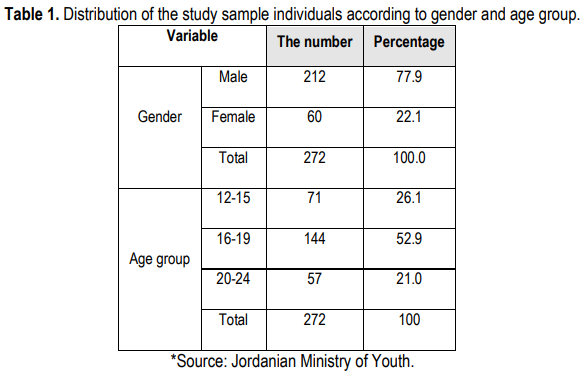
Sample of the Study: A sample of 272 members from among all the youth centers in Mafraq were selected by systematic random sampling during the study period from 09/07/2015 to 06/08/2015, with an equal number of young men and women from the centers.
RESULTS
Findings of the Study:
First question: What role do youth centers play in developing the social responsibility of youth enrolled in them?
To answer this question, the arithmetic means and standard deviations of the responses of the sample members were extracted on the scale of youth centers’ role in developing responsibility, as specified in Table (2).

From the data in Table (2), it can be understood that youth centers play a major role in developing an individual’s responsibility toward society, as the grand arithmetic mean was 4.27, with a standard deviation of0.58. Regarding the clauses in the questions, all clauses received a high degree of validation as the highest arithmetic mean of the answers was for Clause No. 3, with a mean of 4.44 and a standard deviation of 0.82 for the youth stating, “We hear about the news and events happening in the country from the center.” The lowest arithmetic mean of the answers was for Clause No. (4), with a mean of 4.16 and a standard deviation of 0.88, for which the youth said, “The center makes sure that I watch any world event that affects my country.” Second question: Are there any statistically significant differences at a significance level of 0.05≥ α in the social responsibility toward society attributed to the gender variable?
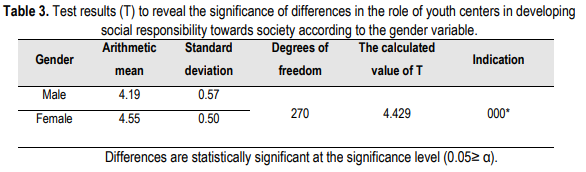
The results of the independent-sampling T-test indicate statistically significant differences at a significance level of 0.05≥ α regarding the role of the youth centers in developing responsibility toward the country, attributed to the gender variable, as the calculated (T) values were 4.429 with the degree of freedom at 270. The differences were in favor of the females.
Third question: Are there any statistically significant differences at a significance level of 0.05≥ α in responsibility toward society attributed to the age group variable?
Table 4. Arithmetic averages and standard deviations of the answers of the members of the study sample on the role of youth centers in developing responsibility towards society according to the age group.
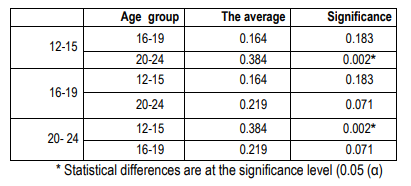
Table (4) indicates the apparent differences in the arithmetic means of the youth centers’ role in developing individuals’ responsibility toward society, attributed to the difference in age, favoring the older age group 20-24 years; to test the significance of the differences, one-way analysis of variance (One Way ANOVA) was performed.
It can be observed from the stated results of Scheffe test that there are statistically significant differences at a significance level of 0.05≥ α between the age groups 12-15 years and 20-24 years, in favor of the older group 20-24 years.
DISCUSSION
Discussion and Analysis of Findings:
The findings from the study could give us indicators linked to the objectives and questions of the study, namely:
A higher percentage of members of the study sample were in the age group 16-19, nearly 52.9%, because around this age, that is, late adolescence, young men feel the need to be independent of the parents and begin to look for oneself a place outside the home. The youth center then becomes a favorite place enabling them to feel independent and allowing them to engage in various activities, especially those that require sleeping outside the home in camps. This age group is also more in number because it mostly comprises students of universities, male or female, or those who have newly joined the labor market after not being lucky enough to join the university. Joining the university would not allow one time to join youth centers. In the case of women, most in this age group are either married or engaged, which leads to a decline in the percentage of female members in the youth centers belonging to this age group.
The findings from Table 2 show that youth centers have a major role in developing the youth’s responsibility toward the country, as the grand arithmetic means in this area reached 4.27, which is the highest compared to other areas of the study. This should be recorded as a significant positive point of a strategic dimension, as youth centers contribute to the development of social responsibility among the youth, who are the pillars of a country and play a key and important part in protecting and advancing the nation. As has been indicated in the introduction, this age group forms about 33.5% of the Kingdom's total population, as per the Department of Statistics.
In the present times, promoting national culture and patriotism is another important duty of youth centers because, with the advent of globalization, national and cultural identity has been lost in an attempt to createone world with one culture. The group most affected by such culture is the youth, and if they are not supported and protected, their national identity and sense of social responsibility toward the country will be affected. However, as the results showed, youth centers play a great role in protecting the youth, spreading the spirit of loyalty and belonging, and inculcating values of good citizenship among them with the help of programs and activities. These activities to develop a sense of social responsibility among the youth toward their country include the following: attending camps, doing volunteer work, attending seminars and lectures, having access to major projects in the country, following global events, preserving the reputation and public and private properties of the homeland, participating in national celebrations, and reading about the history of the country and the ancestral sacrifices and contributions that were made to protect and build the country.
Regarding the findings varying according to gender, in Table 3, we note that there are statistically significant differences at a significance level of 0.05 α in the youth centers’ role in developing a sense of social responsibility toward the country, with the differences in favor of females. This can be attributed to theconservative nature of a rural society, which does not give women the freedom to enroll in the different civil society institutions or move from one place to another; it rather restricts them. However, society allows young women to join the youth centers catering only to women and located in the same region. These centers are supervised by women as well. They apply to programs and activities that do not conflict with the nature, customs, and traditions of the society. Consequently, youth centers have become the only outlets for females in a region, unlike males, who have the freedom to move around and join any club, association, or forum, as there are many options available to them. Further, they are not limited to youth centers alone, and hence, young men can satisfy their various needs through more than one institution, forum, or club. Thus, when young women enroll in youth centers, they are more committed to regulations, laws, and instructions, more serious about adhering to the activities and programs provided, and more careful to apply thereof. This is confirmed through reviewing the general high school results of the year in 2014; female students were superior to male students in scoring higher marks; 77% of females scored high marks compared to 13% male students who scored well (Al-Haj: 2019). Hence, the findings of the study confirm that females show greater commitment and care toward the regulations when they apply to programs and activities, and hence, their sense of social responsibility is greater than that of their male counterparts.
CONCLUSION
On the one hand, the findings from this study are consistent with Jasper’s study (Jasper: 2010, pp. 965- 976), as the findings of the latter regarding the level of social responsibility of adolescents in social welfare institutions and their counterparts in families with a normal structure showed that there were statistically significant differences in the social responsibility level of the study sample members depending on the gender, in favor of female adolescents.
On the other hand, the study findings are inconsistent with those of Al Tek (Al Tek: 2004), who found statistically significant differences at the social responsibility level of a sample of the University of Mosul students in favor of males considering the gender variable. Also, it disagrees with the study of Ali et al (Ali et al.: 2017, pp. 273-294), as their study indicated the absence of any differences in the strength of correlation between social responsibility and achievement motivation based on student gender. It also differs from the study of Al-Haj (Al-Haj: 2019), whose findings showed that there are no statistically significant differences based on gender between social responsibility and the system of values practice of Al-Balqa Applied University students. The findings from this study also differ from that of Al-Malkawi & Javaid (Al-Malkawi & Javaid: 2018), who demonstrated a lack of statistically significant differences among the responses of the members of the dimensional study sample in all study instrument areas attributed to the gender variable. This is also true of the Razak’s study (Razak: 2015, pp. 2388-2398), who concluded that there are no statisticallysignificant differences in the degree of social responsibility of students of Al-Quds Open University depending on the gender variable. Finally, disagreement is seen between the findings of this study and that of (Giddens& Birdsall: 2005), who stated that there are no statistically significant differences based on the gender variable on the overall scale of social responsibility.
Amending the enrollment conditions in youth centers in terms of the age requirement, such that the ageof joining youth centers can be increased to 30 years, to allow the largest possible number of youth to benefit from the services and programs offered by youth centers.
Improving the programs and activities that focus on developing an individual’s sense of responsibility toward oneself, as this aspect received a low score from the findings of the study. Besides, youth centers must also focus on programs and activities related to developing a sense of responsibility toward one’s friends, colleagues, and city (village), toward which only an intermediate degree of responsibility was seen.
The study recommends conducting studies to address the issue of male and female supervisors of these youth centers, as they have an important role in implementing programs and activities and studies involving parents and the degree to which parents affect and are affected by the programs and activities offered to their young children.
Studying other variables not included in this study, but which can affect the level of social responsibility of the youth, is also recommended.
Promoting various group programs and activities and developing them, and providing financial and moral incentives and awards, to encourage more young men and women to join the youth centers is another recommendation.
Youth centers should also encourage or assist Jordanian youth in making overseas visits so that theymay benefit from the experiences they can gain from other countries in the field of youth care and learn about other cultures.
BIODATA
A Rakan: Alhrahsheh Rakan born in Jordan in 1974, he studied MA in Sociology at the University of Jordan and worked in several academic positions, and also taught Ph.D. in Sociology from the same University. Graduated in 2015, he worked as a part-time lecturer at the University of Philadelphia and the University of Petra and worked as an assistant professor at Al Ain University in the United Arab Emirates. He is now the director of the Applied Sociology Program at the same university.
A Ayman: Alkhaldy Ayman born in Jordan in 1977, he studied MA and Ph.D. in Sociology at the University of Jordan. Graduated in 2016, he is working as a part-time lecturer at the University of Jordan, also as a social worker in the schools of the Jordanian Ministry of Education, and a social expert is now working in the embassy of the State of Kuwait.
BIBLIOGRAPHY
ABDUL HAMEED, N (2012). “The effectiveness of a training program to raise the level of social responsibility among students of the upper basic stage”. Arab Studies in Education and Psychology, 30(2), pp. 173-191
AL-HAJ, M (2019). Social change and family processes: Arab communities in Shefar-A'm. Routledge.
ALI, W, FRYNAS, JG & MAHMOOD, Z (2017). “Determinants of corporate social responsibility (CSR) disclosure in developed and developing countries: A literature review”. Corporate Social Responsibility and Environmental Management, 24(4), pp. 273-294.
AL-KHARASHI, W (2004). The Role of Student Activities in the Development of Social Responsibility. Master Thesis, King Saud University.
Ahmad, I., & Ahmad, S. (2019). “The Mediation Effect of Strategic Planning on The Relationship Between Business Skills and Firm’s Performance: Evidence from Medium Enterprises” in Punjab, Pakistan. Opcion, 35(24), 746-778.
AL KHAWALDEH, M (1987). “The concept of responsibility among university youth in Jordanian society and an invitation to teach responsibility in school education”. Arab Journal of Humanities, 26 (7), pp.124-147.
AL-MALKAWI, HAN, & JAVID, S (2018). Corporate social responsibility and financial performance in Saudi Arabia. Managerial Finance.
AL-SHAYEB, M (2003). Social Responsibility and its Relation to Time Management. Master’s Thesis, Damascus University.
AL TEK, Z (2004). The Mature Personality and its Relationship with Social Responsibility among Mosul University Students. Master’s Thesis, University of Mosul.
DAVIES, B (2019). “The Local Youth Service Experience”. In Austerity, Youth Policy and the Deconstruction of the Youth Service in England, pp. 89-105. Palgrave Macmillan, Cham.
GABIDULLINA, F. I., KORGANBEKOV, B. S., MAKAROVA, V. F., ZAKIROV, R. A., & KAYUMOVA, G. F.(2019). “Concept «teacher» in language consciousness of students of philological faculty”, XLinguae, 12(3), pp. 45-54.
GIDDENS, A & BIRDSALL, K (2005). Sociology, translated by Fayez Al-Sayagh.
JAMALI, D & KARAM, C (2018). “Corporate social responsibility in developing countries as an emerging field of study”. International Journal of Management Reviews, 20(1), pp. 32-61.
JARRAR, A & HAMMUD, M (2018). “The Role of Social Media in Developing Social Responsibility and Political Awareness of Jordanian Youth”. Asian Social Science, 14(3), pp. 25-36.
JASPER, JM (2010). “Social movement theory today: Toward a theory of action?”. Sociology Compass, 4(11), pp. 965-976.
MALYSHEVA, S (2019). “The rehabilitation of idleness: The productionof new values and meanings for leisure in the late 19thand early 20th centuries”, Logos (Russian Federation), 29(1), 147-158.
MANZUR, I (1997). “Lisan al-'arab (Vol. 15)”. Dar Ihya Turath Arabiy. pp. 15-409
RAZAK, RA (2015). “Corporate social responsibility disclosure and its determinants in Saudi Arabia. Middle- East Journal of Scientific Research, 23(10), 2388-2398.