Artículos
Optimization of Indonesian Telematics Smes cluster: Industry 4.0 challenge
Optimización del grupo de empresas telemáticas indonesas: Desafío de la industria 4.0
 E.T Tosida enengtitatosida@unpak.ac.id
I Wahyudin irfan.wahyudin@gmail.com
A.D Sanurbi Apridiana.sanurbi@gmail.com
F Andria fredi.andria@unpak.ac.id
A Wartini Atrik.wartiniii@gmail.com
E.T Tosida enengtitatosida@unpak.ac.id
I Wahyudin irfan.wahyudin@gmail.com
A.D Sanurbi Apridiana.sanurbi@gmail.com
F Andria fredi.andria@unpak.ac.id
A Wartini Atrik.wartiniii@gmail.com
Optimization of Indonesian Telematics Smes cluster: Industry 4.0 challenge
Utopía y Praxis Latinoamericana, vol. 25, núm. Esp.2, pp. 160-170, 2020
Universidad del Zulia

Esta obra está bajo una Licencia Creative Commons Atribución-NoComercial-CompartirIgual 3.0 Internacional.
Recepción: 18 Marzo 2020
Aprobación: 25 Abril 2020
Resumen: El objetivo de esta investigación es explicar el proceso de optimización de la formación del grupo de pequeñas y medianas empresas (PYME) telemáticas de Indonesia. El proceso de optimización del clúster se lleva a cabo mediante particionamiento en torno a Medoids (PAM) y Fuzzy C-Means (FCM). Los datos utilizados son los datos de los servicios telemáticos de las PYME en Indonesia según los datos del Censo Económico Nacional (SUSENAS) de la Oficina Central de Estadísticas de Indonesia (CBS) de 2006. El grupo de PYME telemáticas indonesas se validó utilizando el Coeficiente de Silhoutte, que resultó en un valor superior a 0,99.
Palabras clave: Económica, optimización, técnica, telemática.
Abstract: The purpose of this research is to explain the optimization process of the formation of the Indonesian telematics SMEs cluster. The cluster optimization process is carried out by partitioning around Medoids (PAM) and Fuzzy C-Means (FCM). The data used is the data of SMEs telematics services in Indonesia according to the National Economic Census (SUSENAS) data in 2006 Indonesian Central Bureau of Statistics (CBS). The 2006 data usage is caused by the SUSENAS 2016 not yet released by Indonesian CBS. The cluster of Indonesian telematics SMEs was validated using the Silhouette Coefficient which resulted in a value of upper than 0.99.
Keywords: Economics, optimization, technique, telematics.
INTRODUCTION
The Industrial Revolution 4.0 (IR 4.0) era has become a reference for several countries in technological, economic, social, cultural, defense and security development. Indonesia also needs to implement this, if it wants to be highly competitive. Therefore, various sectors that are the pillars of Indonesia's development are continuously strengthened to be able to be highly competitive in the IR 4.0 era. The concept of developing the IR 4.0, which divides the interconnections between 3 levels of intelligence and 3 levels of automation (Qin et al.: 2016, pp. 173-178), becomes one of the frameworks that can be used as a reference for strategies to strengthen the management of SMEs, especially SMEs in the field of telematics in Indonesia. Optimization of SME governance has also been conceptualized by (Iqbal: 2015, pp.387-398), covering the main factors is how SMEs can be considered feasible to be assisted both financially and other forms of assistance. The Indonesian SME empowerment strategy also needs to consider the limitations of SMEs, especially in financial management that includes aspects of formalities, business scale, and information (Supriyanto: 2017)).
The competence of SMEs in the field of Indonesian Telematics Services is divided into three parts, namely business services, communication services and educational services (Tosida et al.: 2015, pp. 151-156). Efforts to empower Indonesian telematics SMEs have been carried out through ranking factors that influence the provision of SME assistance (Tosida et al.: 2015). The determination of the cluster of telematics SME associated with the provision of assistance has been carried out with the Self Organizing Map (SOM) technique, which was followed by the determination of the basis for the provision of assistance through a Data Mining approach (Tosida et al.: 2017, pp. 1-18) and (Tosida et al.: 2017, pp. 12-17). In this study, the factors that need to be strengthened for its development have also been described. But the potential of SMEs in Indonesian Telematics Services needs to be explored more deeply related to its existence against the challenges of IR 4.0.
The challenges of IR 4.0 will be impacted by the SME’s condition in a global area. In (Sommer: 2015, pp. 1512-1532) described the impact on the German SMEs. When the size of SME is going to huge, this is could be the readiness and capabilities to face the IR 4.0 challenge. The strategy that has been proposed is the gift of technology update assistance which relevant to the IR 4.0, financial, and the reinforcement of human resources. Thailand has been formulating a Thai model based on the three pillars of three-powers (Jones & Pimdee: 2017, pp. 4-35). The main power is the character of Thailand and is the competitiveness characteristic in IR 4.0. The most crucial challenges come from the network-security and information sector and the readiness of low-human resources who’s existence is still at a low level.
This research describes the optimization process of the formation of SMEs in Indonesian Telematics Services clusters as an effort to map Indonesia's potential and strength to face the challenges of IR 4.0. The intended optimization uses PAM and FCM clustering techniques to see the potential strengths and weaknesses of Indonesian Telematics Services SMEs. Clustering techniques have been used by (Hadighi et al.: 2013, pp. 37-49) to develop a framework and formulation of corporate development strategies. (Dhewanto et al.: 2012, pp. 867-872; Korotkov et al.: 2019, pp. 106-115) also produce business clusters based on the level of innovation in the ICT sector, and the basis of this cluster can be used as a reference in the formation of clusters for Indonesian ICT / telematics services.
During the economic crisis that hit Indonesia in 1999, Indonesian SMEs were able to maintain their existence. One of the SMEs that helped strengthen and even develop the Indonesian economy so that it can survive until now is an SME in the field of telematics. In the 2006 Susenas data, nearly twelve thousand Telematics Services SMEs contributed to improving Indonesia's economy. Indonesian Telematics Services SMEs are divided into three types of businesses (Tosida et al.: 2015, pp. 151-156). The potential of each region and its scope of business is explained in detail in the competency map of the Indonesian telematics services business (Ahmad 7 Ahmad, 2019; Tosida et al.: 2017, pp. 1-18).
The development of an independent and highly competitive Indonesian telematics service business is oneof Indonesia's visions in 2024. Therefore various efforts to strengthen the competitiveness of telematics business are one of the priorities of government programs. Efforts to strengthen the competitiveness oftelematics SMEs through the process of empowerment and provision of assistance have been mapped in previous studies (Afifah & Najib: 2018, pp. 377-386). Research on mapping important factors in the development of SMEs in Indonesian telematics services through a Data Mining approach to obtain a basis for the provision of aid provision has been elaborated in detail (Sommer: 2015, pp. 1512-1532)).
METHODS
The research method applied in this study uses a data mining approach. This stage is also known as the Knowledge Discovery and Data mining (KDD) stage which includes the collection and use of historical data to find order and determine patterns or relationships in large data sets. The data used in this study is still using data from the Indonesian SUSENAS in 2006. This is done because the Indonesian SUSENAS process is only done once every 10 years, and until the publication of this paper, the results of the 2016 Indonesian Susenas have not been released. Based on the results of previous research related to the Indonesian Telematics Services business that uses 2006 SUSENAS data shows the results are still relevant. Therefore, the database used is still referring to the results of (Tosida et al.: 2015). Likewise, the KDD stages which include pre- processing data such as the cleaning process, integration, selection, and transformation still refer to the results of this study (Tosida et al.: 2015; Akhmetkarimov: 2019, pp. 1-24).
The stage of the Mining process is done using PAM and FCM clustering-optimization techniques. The PAM algorithm includes a partitioning clustering method to group a set of objects into a cluster of clusters. The PAM or K-Medoids algorithm used refers to (Hadighi et al.: 2013, pp. 37-49), that is :
-
Randomly select k objects in a set of objects as medoid;
-
Repeat step 3 to step 6;
-
Place a non-medoid object into the cluster closest to the medoid;
-
Select 𝑂𝑟𝑎 in randomly: A non-medoid object;
-
Calculate the total of cost divided by space, S, from the exchange of medoid with 𝑂𝑟𝑎;
-
If S < 0 then replace with 𝑂𝑟𝑎 to form a batch of new k-object as medoid;
-
Until there’s no transformation.
Distance measurement is done by the Euclidean distance technique. This technique is a measurement of object distance and cluster center which is widely used in various cases of pattern matching, including clustering (Simatupang: 2008, pp. 1-9).

The total cost/distance value is calculated by finding the distance of the data with medoid so that the smallest distance of each data is obtained in one medoid. The smallest distance per data is summed to obtain the total distance. While to calculate the difference value (S) is stated by the following equation below:
𝑆= new total cost − old total 𝑜 (2)
Where:
new total 𝑜: Amount of cost non-medoids
old total 𝑜: Amount of cost medoids
Fuzzy C-Means (FCM) is a data clustering technique where the presence of each data point of a cluster isdetermined by the membership value. The membership value will include real numbers at 0-1 intervals. FCM isone of the optimizing partitioned cluster methods. The advantage of the FCM method is that the cluster center placement is more appropriate than other cluster methods. The trick is to repair the cluster center repeatedly, it will be seen that the center of the cluster will move towards the right location. Here the algorithms of FCM are :
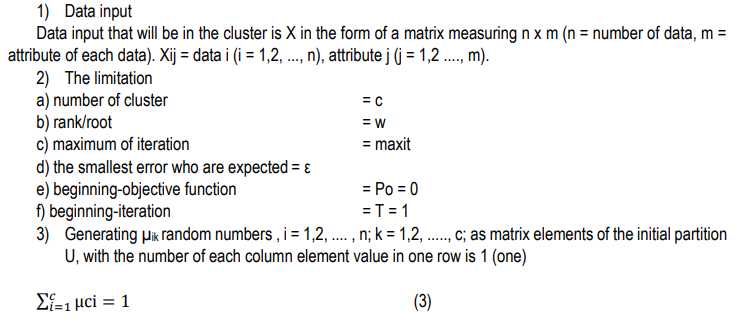

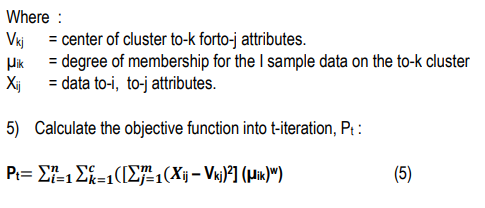
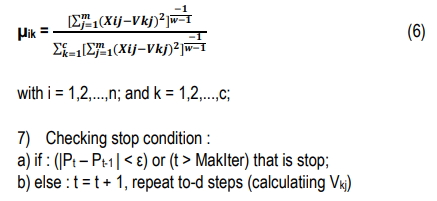
7) Checking stop condition :
a) if : (|Pt – Pt-1 | < ε) or (t > MakIter) that is stop;
b) else : t = t + 1, repeat to-d steps (calculatiing Vkj)
The next step is evaluating the results of data mining patterns. This stage is done to identify interesting patterns into Knowledge-Based that are found. The results of data mining techniques in this study are typical patterns of SME telematics clustering models in Indonesia. The pattern is evaluated to assess the achievement of the hypothesis made. Evaluation of clustering patterns is measured using the Silhouette Coefficient (SC)parameter. The SC is a method used to validate both a cluster that combines both cohesion and separation values. SC can be used to validate both data, a single cluster (one cluster of several clusters), as well as a whole cluster.
The process for calculating the SC value first calculates the Silhouette Index (SI) from an i-data. The SIvalue consists of 2 components there are and . is an average distance of data I to all other data in one cluster, while is obtained by calculating the average data distance I to all data from other clusters that arenot in one cluster with data I, then the smallest is taken. The SC follows this following equation:

Where:
SC: Silhouette Coefficient
SI: the value of Silhouette Index Global
k: total cluster
Subjective criteria measure whether or not grouping according to SC according to presented in Table 1:
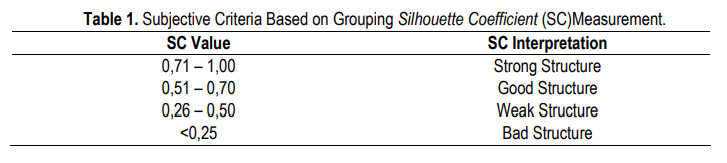
The last stage in this study is knowledge presentation. This stage is a visualization and presentation of knowledge about the methods used to obtain knowledge obtained by users. In this presentation, data grouping of SMEs in Indonesian Telematics Services was applied in the R Studio learning machine and the results of the grouping were displayed on the website. The R application is a programming language for statistical and graphic computing. R Studio is an additional application with a more user-friendly interface.
RESULTS
The grouping of SMEs in Indonesian telematics services is intended to identify the strengths and w eaknesses of each group so that it is easier to process problems in the group. The global challenge of IR 4.0 is one of the triggers of the right information needs regarding the strengths and weaknesses of Indonesian telematics SMEs. The weak point of SMEs can be targeted for assisting the government. The purpose of assisting SMEs is none other than to overcome the problems that arise in small and medium micro enterprises (Tosida et al.: 2018, pp. 12-18).
The implementation of the PAM and FCM algorithms for grouping assistance to Indonesian Telematics Services is applied to machine learning at R Studio. The SMEs data which amounted to 8,798 data with 20 categorical attributes need to be imported first into CSV format and the SMEs data which are categorical are converted to numeric form using the function in R Studio which aims to calculate the distance between each data. The results of the grouping of Indonesian Telematics Services SMEs are displayed on web-based applications.
The number of cluster trials refers to the research of (Tosida et al.: 2017, pp. 12-17). The initial phase of the trial uses 3, 5 and 7clusters. The results of the clustering process using the PAM algorithm and FCM are in the form of plots that describe the condition of Indonesian Telematics Services on 5 clusters (shown in figure1)
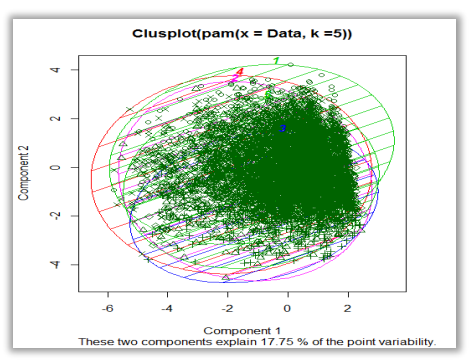
Figure 1. Result of Clusteringusing PAM.
The analysis of the clustering result has done through dominant attributes that show-up in every cluster. Based on analysis against dominant attribute in every cluster can be used for reference for Indonesian telematic services SME’s assistance determination. The result of domination analysis by attribute in Indonesian telematic service SMEs cluster is shown in Figures 2 and 3.
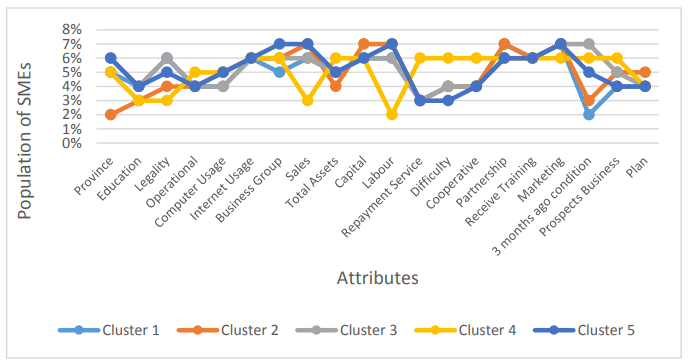
Figure 2. Attribute Dominance Analysis Results in Indonesian Telematic Service SME Cluster throughthe FCM algorithm.

Figure 3. Attribute Dominance Analysis Results in Indonesian Telematic Service SME Cluster throughthe PAM algorithm.
Dominance analysis of the clusters formed based on the PAM algorithm and FCM shows that there are the most dominant attributes and often appear in each cluster. This can be used to identify the level of feasibility of determining the assistance of telematics services SMEs in Indonesian Telematics services. based on the dominance analysis of attributes using PAM and FCM algorithms, it can be concluded that:
-
The higher the percentage value of education (equivalent high school) in a SMEs, the higher the expectation of assistance to SMEs;
-
The higher the percentage value of business groups (telecommunications services) in an SME, the higher the expectation of assistance to SMEs;
-
The higher the percentage of sales (micro) in an SME, the higher the expectation of assistance toSMEs;
-
The higher the percentage value of total assets (micro) in an SME, the higher the expectation of assistance to SMEs;
-
The higher the percentage value of capital (own capital) in an SME, the higher the expectation of assistance to SMEs;
-
The higher the percentage of labor (micro) in ASME, the higher the expectation of assistance to SMEs;
-
The higher the percentage of reward (micro) in ASME, the higher the expectation of assistance to SMEs;
-
The higher the percentage value of marketing (district) in an SME, the higher the expectation of assistance to SMEs; and
-
The higher the present value of SME conditions 3 months ago (equally good) the higher the expectation of assistance to SMEs.
Based on the dominance analysis, it can be concluded that the feasibility level of assistance is shown in Table 2.
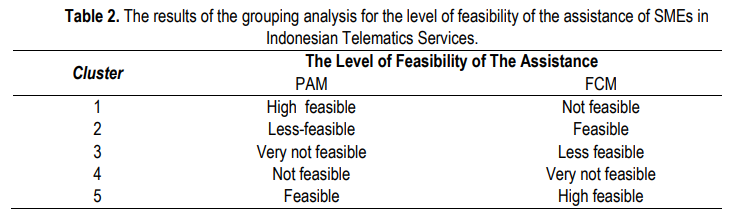
There is a difference in the level of feasibility of assistance in clusters formed by PAM and FCM algorithms. However, the second algorithm classifies which can show good performance. This is evident from the results of the validation test using the SC value index in equation 3, where the value obtained from the maximum value of SI in the cluster formed. Trials are carried out in three stages; each part is done using some different clusters. The first stage of the trial used 5 clusters, both 7 clusters, and the third 10 clusters. The results of the trial validation of cluster formation are shown in Table 3.
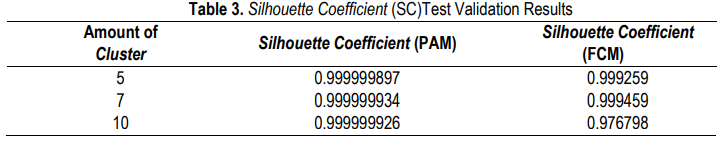
Based on the test results in Table 3, both the PAM algorithm and FCM can form the SME cluster of Indonesian telematics services well. The formed cluster has a "strong structure". This can be seen from the subjective criteria of cluster measurement based on the SC index in Table 1, the SC value in all three tests is in the range of 0.71-1.00. However, from the three tests above, on testing 7 clusters, the SC value is closest to the value of 1. The results of the study (Tosida et al.: 2017, pp. 1-18) stated that the formation of the Indonesian SME service cluster using the Neural Network approach was able to perform well without being influenced by the number of clusters formed.
DISCUSSION
Clusters formed by the two algorithms can be used as a reference for the focus of the empowerment of telematics SMEs, especially in increasing their competitiveness against IR 4.0. The government can focus on specific assistance to clusters 1 or 5 labeled "Very Eligible" to be assisted. The condition of telematics services UKM in cluster 1 or 5 has very good opportunities to be developed into highly competitive SMEs. The form of assistance that can be provided by the government in the form of business management training or business capital assistance (Iqbal: 2015, pp. 387-398). So, it is relevant for the development of their business because the telematics services SMEs in the cluster have relatively good development plans and prospects.
There are interesting findings in this study. The trial results of cluster formation by FCM show that the main differentiator of cluster one with other clusters is the attribute of internet usage. This attribute is the most dominant in each cluster. These results are also following research (Tosida et al.: 2015, pp. 151-156). The condition of Indonesian SMEs telematics services in 2006 was dominated by SMEs who did not use the internet. This contrasts with the demands of Industry 4.0 (Qin et al.: 2016, pp. 173-178). One of the efforts of the Indonesian government in the development of SMEs focuses on providing incentives for cheap electricityand internet networks. The development of SME telematics services will not be separated from the needs of electric power. Electricity and internet networks are the main energy source for computer use and basic capital in the production process. Internet needs are also necessary for Indonesian SME telematics services. The internet is currently very much needed to expand the marketing range (Tosida et al.: 2015). Marketing coverage that is still relatively narrow (covering only districts), can be developed to an international scope through simple social media-based marketing. This strategy can be applied primarily to face the challenges of IR 4.0. This effort is also in line with one of the ICT development visions (Sommer: 2015, pp. 1512-1532).
The real IR 4.0 challenge is the readiness of human resources. Based on the results of the grouping whichshows that the education of owners and managers of SMEs in Indonesia. The power of innovation in SMEs is very well suited to the education of the owner or manager. In the Industry 4.0 era, SMEs are indispensable for training their managers in innovative and creative matters [18]. Complementing one of the strengths of SMEs in Indonesian telematics services is in application/software development services. Like the experience of Thailand which has the Thailand 4.0 concept, it has prioritized the education sector, digital e-commerce, and integration with the concept of "smart farmers" (Jones & Pimdee: 2017, pp. 4-35). Indonesia can emulate Thailand 4.0 by generating effort. Revitalization of local wisdom can be represented in the form of digital- based creative economic products. Digital applications such as animated films, educational games, digital comics or other digital products have been produced by Indonesian telematics services. This is supported by data from the (Afifah & Najib: 2018, pp. 377-386) which shows the GDP growth of digital creative economy products for 2014-2016 reached 13 % -14%. The weaknesses of Indonesian telematics services SMEs based on clusters formed include the low level of human resource education of owners or managers so that it affects the power of innovation and creativity (Simatupang: 2008, pp. 1-9). Marketing coverage is still limited also and access to capital assistance institutions is still low. The potential that has been owned by Indonesian telematics services SMEs to answer the challenge of Industry 4.0 is Indonesian telematics services SMEs dominated by the type of telecommunications business, as well as the assessment of better business prospects. If the 2016 Susenas data has been released, the determination of the type of assistance will be easier and will be on target. This is based on the identification of the types of difficulties experienced by SMEs (Simatupang: 2008, pp. 1-9).
CONCLUSION
The SME cluster model of Indonesian telematics services uses the PAM and FCM algorithm can provide relevant information related to Indonesia's preparation to face the challenges of Industry 4.0. There is no significant difference between the results of clustering formed using the PAM and FCM algorithms. The results of the cluster formed from the two algorithms have a strong structure proven by the value of SC which is more than the value of 0.99. Optimization of clusters can be used to identify potential strengths and evaluate the weaknesses of Indonesian telematics SMEs. The main weakness is the low level of education and the scope of marketing. The potential strength that can be identified in the assessment of better business processes and the dominance of telecommunication business types that are relevant to business development to meet the challenges of Industry 4.0. The products of Indonesian telematics services SME which intersect with digital- based creative economic products become the main potential to reach the global market in the competition of Industry 4.0.
ACKNOWLEDGMENT
[1] DRPM RistekDikti, as the main sponsor, which gives us Competitive Grants Scheme
[2] Computer Science Department, Mathematics and Natural Science Faculty, Universitas Pakuan and Research and Community Services Insitute of Universitas Pakuan, for supporting, coordinating and facilitating to achieve these grants.
[3] Agro-Industrial Engineering IPB and Computer Science IPB who have become the companion research team in this research grant schemeIndonesian Communication & Information Ministry, Indonesian Cooperation and SMEs Ministry andBandung Technopark for active participation in the activities of interviews and user requirements.
BIODATA
E Tita Tosida: Eneng Tita Tosida is a lecturer at the Department of Computer Sciences, Faculty of Mathematics and Natural Sciences, Universitas Pakuan. She teaches in Simulation Techniques and Data Mining, Linear Programming and Optimization Models and Research Methods. She leads a research group of Decision Support System (DSS) and Socio Informatics, and actives on educational digital media base on a game, Augmented Reality and Virtual Reality research. She also actives on the Indonesian Operations Research Association (IORA) as Secretary.
I Wahyudin: Irfan Wahyudin is a lecturer at the Department of Computer Sciences, Faculty of Mathematics and Natural Sciences, Universitas Pakuan. He teaches in Artificial Intelligence, Data Base and Text Mining. He also acts as a researcher in Data Science and Machine Learning, and since 2017 he continued his career as a Lead of Data Analytics in Docotel Group and Data synthesis.
F Andria: Fredi Andria is a lecturer in the Department of Management, Economic Faculty, Universitas Pakuan. He teaches marketing management, marketing research, global marketing, international business, business statistics, research methodology. He also acts as a researcher in marketing strategy and marketing research, and since 2018 he acted as a Lead of the Center of Excellent Research and Innovation in Economic Faculty, Universitas Pakuan.
A.D Sanurbi: Apri Diana Sanurbi was a student of the Computer Science Department, Faculty of Mathematics and Natural Sciences, Universitas Pakuan, Bogor, Indonesia. Lives in Bogor, Indonesia. She was active on Decision Support System (DSS), Computer Sciences, Artificial Intelligent, DataBase, Text Mining, and Data Mining research.
A Wartini: Atik Wartini was a student of the Computer Science Department, Faculty of Mathematics and Natural Sciences, Universitas Pakuan, Bogor, Indonesia. Lives in Bogor, Indonesia. She was active in the Decision Support System (DSS), Computer Sciences, Artificial Intelligence, DataBase, Text Mining, and Data Mining research.
BIBLIOGRAPHY
AFIFAH, AN, & NAJIB, M (2018). “Digital Marketing Adoption And The Influences Towards Business Successes Of MSMEs Creative Sector In Indonesia And Malaysia”. Jurnal Aplikasi Manajemen, 16(3), pp. 377-386.
AHMAD, I., & AHMAD, S. (2019). The Mediation Effect of Strategic Planning on The Relationship Between Business Skills and Firm’s Performance: Evidence from Medium Enterprises in Punjab, Pakistan. Opcion, 35(24), 746-778.
AKHMETKARIMOV, BG (2019). Common sense is not so common: integration and perceptions of ‘traditional Islam’in Russia’s Volga-Ural region. Contemporary Islam, pp. 1-24.
DHEWANTO, W, PRASETIO, EA, RATNANINGTYAS, S, HERLIANA, S, CHAERUDIN, R, AINA, Q &RACHMAWATY, E (2012). “Moderating effect of the cluster on a firm's innovation capability and business performance: A conceptual framework”. Procedia-Social and Behavioral Sciences, 65, pp. 867-872.
HADIGHI, SA, SAHEBJAMNIA, N, MAHDAVI, I, & SHIRAZI, MA (2013). “A framework for strategy formulation based on clustering approach: A case study in a corporate organization”. Knowledge-Based Systems, 49, pp. 37-49.
IQBAL, M (2015). “SME Governance in Indonesia–A Survey and Insight from Private Companies”. Procedia Economics and Finance, 31, pp. 387-398.
JONES, C & PIMDEE, P (2017). “Innovative ideas: Thailand 4.0 and the fourth industrial revolution”. Asian International Journal of Social Sciences, 17(1), pp. 4-35.
KOROTKOV, P. A., & ZAGAYNOVA, E. A. (2019). Suicide Rate and Time Use in Daily Life and Leisure. Sotsiologicheskie issledovaniya, (1), pp. 106-115.
QIN, J, LIU, Y & GROSVENO, R (2016). “A categorical framework of manufacturing for industry 4.0 and beyond”. Procedia Corp, 52, pp. 173-178.
SIMATUPANG, TM (2008). “Perkembangan Industri Kreatif”. Sekolah Bisnis dan Manajemen Institut Teknologi Bandung, hlm, pp. 1-9.
SOMMER, L (2015). “Industrial revolution-industry 4.0: Are German manufacturing SMEs the first victims of this revolution?”. Journal of Industrial Engineering and Management, 8(5), pp. 1512-1532.
SUPRIYANTO, S (2017). The Implementation Of Sak Etap And The Effect Of Umkm Preparation In Dealing With Mea (Asean Economic Society)(Case Study On Umkm Medan & Binjai In 2016) (No. sdtp5). Center for Open Science.
TOSIDA, ET, MARYANA, S, THAHEER, H & DAMIN, FA (2015, September). “Visualization model of small and medium enterprises (SMEs) telematics services potentiality map in Indonesia”. In 2015 International Conference on Information & Communication Technology and Systems (ICTS), pp. 151-156. IEEE.
TOSIDA, ET, SEMINAR, KB & HERDIYENI, Y (2015). “Attribute Selection of Indonesian telematic services MSMEs assistance feasibility, using AHP”. Cursor, 8(2).
TOSIDA, ET, THAHEER, H, & MARYANA, S (2017). “Strategi Peningkatan Daya Saing Melalui Framework Rantai Nilai Untuk Kompetensi Usaha Jasa Telematika Indonesia”. Jurnal Penelitian Pos dan Informatika, 5(1), pp. 1-18.
TOSIDA, ET, MARYANA, S & THAHEER, H (2017). “Implementation of Self Organizing Map (SOM) as decision support: Indonesian telematics services MSMEs empowerment. In IOP Conference Series: Materials Science and Engineering, 166(1), pp. 12-17. IOP Publishing
TOSIDA, ET, HAIRLANGGA, O, AMIRUDIN, F & RIDWANAH, M (2018). “Application of decision rules for empowering of Indonesian telematics services SMEs”. In IOP Conference Series: Materials Science and Engineering, 332(1), pp. 12-18. IOP Publishing.