Artículos
Coverage of crime news: content analysis of Al-Yaum Saudi online newspaper
Cobertura de noticias delictivas: Análisis de contenido del periódico en línea saudita Al-Yaum
 H.M Sulieman hmsulieman@iau.edu.sa
Coverage of crime news: content analysis of Al-Yaum Saudi online newspaper
Utopía y Praxis Latinoamericana, vol. 25, no. Esp.2, pp. 211-222, 2020
Universidad del Zulia

This work is licensed under Creative Commons Attribution-NonCommercial-ShareAlike 3.0 International.
Received: 22 March 2020
Accepted: 30 April 2020
Abstract: This study aims to answer the question of how Saudi’s Al-Yaum online newspaper covers the crime news, from Jan - Dec 2018. The descriptive method is used, and data is collected through a structured content analysis sheet. 24 versions represent a systematic random sample was analyzed. The results were: Saudi newspapers cover mere internal crime news, the most types of the crime news were cover was the murder, assault, sale of illegal beverages and drugs, and the least published was news dealing with topics of felonious assault, interfering with an officer, contempt of court, and criminal libel.
Keywords: Coverage, crime, news, Saudi online newspapers..
Resumen: Este estudio tiene como objetivo responder a la pregunta de cómo el periódico en línea Al-Yaum de Saudi cubre las noticias del crimen, de enero a diciembre de 2018. Se utiliza el método descriptivo y los datos se recopilan a través de una hoja de análisis de contenido estructurado. 24 versiones representan una muestra aleatoria sistemática analizada. Los resultados fueron: los periódicos sauditas cubren meras noticias de crímenes internos, la mayoría de los tipos de noticias de crímenes eran el asesinato, el asalto, la venta de bebidas y drogas ilegales, y el menos publicado fue noticias que trataban temas de asalto criminal, interfiriendo con un oficial, desacato al tribunal y difamación criminal.
Palabras clave: Cobertura, crimen, noticias, periódicos en línea Saudita..
INTRODUCTION
As residents of a highly technological society undergoing rapid transformations in the conduits for information on crime, we have an increasing array of options in forming our ideas about crime and justice. A staple assertion of introductory texts and lectures is that societal perceptions of crime are formed through exposure to various forms of media, including television, film, video, and Internet services. Our knowledge acquisition has changed dramatically in the past 200 years, from first-hand knowledge of crime and deviance in rural communities and small urban centers to a society in which we are inundated with so much information that it is difficult to assess what specific impacts media have on our ideas and attitudes. Therefore, when we speak of "knowledge of the crime," we must also be specific about the type of information we receive and the form in which this information is presented. (Dowler et al.: 2006, pp.837-865). Nevertheless, crime and punishment in the newspapers continue to be a focus of much public fascination and anxiety, thus this research paper aims to describe and analyze the crime news that was covered and published in the online Saudi papers (Kenzhebekuly et al.: 2016, pp. 1331-1341).
Few people see events. But everyone will be able to read, see or hear about them because a reporter is covering the news as it develops. The reporter is the middleman between the event and the reader, viewer or listener. The literature suggests that a news event is influenced by convention and prior experience. The regularities of behavior and thinking which result from these routines give rise to empirical generalizations and to the possibility of theorizing about what is going on. (McQuail: 1997, pp.212). A closer look at this literature reveals a shortcoming. As Kamath (2004, pp.13) notes said the important thing for an editor is, to be intellectually honest. he does not always have to be right; things, he cannot be so. but if he is honest and is seen, to be honest, his responsibility to his profession ceases there. nothing more can be expected of an editor and nothing more should (Piteira et al.: 2018, pp. 1-9).
Typically, editors assume that readers have high interest in news from specific locations , from specific institutions , and about specific topics(Burgh: 2005, pp.142) like crime, the dictionary meaning says crime is ‘a wrong act that is against the law’ or ‘a violation of law’ and it is also defined as an act or omission punishable by law. As an offense means any act or omission made punishable by any law for the time being in force. Offenses can be bailable or non-bail able, the bail is security offered by the accused of his appearance before the officer or court granting him bail. (Kamath: 2004, pp.196), and when any crime event happens in which people are interested it will be cover for publication as news.
News is report of a recent or current event or information published in a newspaper or other periodical. In its final analysis, news may be defined as any accurate fact or idea that will interest many readers; and of two stories the accurate one that interests the greater number of people is better news. In news strangeness, abnormality, unexpectedness and nearness of an event, all add to the interest in the story but none of these absolute. (Kumar: 1995, pp.126), and the news is one of the editorial forms is published in Saudi newspapers that appeared in the Kingdom of Saudi Arabia since 1926, with the issuance of the officials Umm al-Qura newspaper, and there are currently about 19 newspapers, cover a wide variety of fields, each with a parallel online version, and there are three newspapers published on websites as online newspapers, that do not have a printed origin (Rostaminiya & Hossin Zadeh Fard: 2019, pp.1-10).
Online newspapers have an important function, different ways, dipping into the Web version to get updates on breaking stories for background information and detail. The other benefit, of course, is that readers from further afield can keep abreast of local affairs. Online newspapers have become an integral part of the regional newspaper package and provide an element of interactivity and people like that. They like being able to look things up on the website and getting updates as things happen (Pape & Featherstone: 2005, pp.2).
LITERATURE REVIEW
Reporting crime news can be demanding, and at the time, if properly done, it is a public service that perhaps can even be deterrent to certain types of crime. But badly handled, it can show how to commit crime successfully. It can give a false impression of the amount of crime or build sympathy for all glorify criminals. Crime news also can help criminals by informing them of police strategy or hamper justice by ‘trying the case out of court’ – making it difficult to get a fair trial. And, of course, it can turn the spotlight on the law-abiding family of the criminal, adding to their humiliation. Over the years, leaders in the news media have come to recognize these problems, and most newspapers today practice considerable restraint in handling crime news. At the same time, the news media continue to fight for their First Amendment rights to report freely and fairly all crime news, despite repeated efforts over the years force controls upon them. (Harriss, 1985, pp.310), crime news is divided into broad categories, each having specific crimes associated with the categories: crimes against persons, crimes against property, and inchoate (attempted) crimes. (Lee: 2007, pp.146), but Harriss (1985, pp.312) classified the more common crimes as follows: Homicide, Killing a person, including manslaughter, voluntary (intentional, in a fit of passion), Involuntary (unintentional, through negligence), murder, assault, kidnapping. ( A person is guilty of kidnapping if he unlawfully removes another from his place of residence or business, or a substantial distance from the vicinity where he is found, or if he unlawfully confines another for a substantial period in a place of isolation, with any of the following purposes: to hold for ransom or reward, or as a shield or hostage; or to facilitate commission of any felony or flight thereafter, or to inflict bodily injury on or to terrorize the victim or another, or to interfere with the performance of any governmental or political function.) (Lee: 2007, pp. 146), Violating property rights, obstructing justice, gambling, manufacture, possession, or sale of illegal beverages and drugs, disturbing the peace, and sexual crimes.
Criminal libel, there are common property crimes include; Larceny: (Taking of property of another with intent to permanently deprive the person of the property.) (Lee: 2007, pp.146), Burglary (entering the dwelling to take the property, housebreaking). Robbery (larceny with assault, threatened or committed), Embezzlement (larceny through a trust). Or (fraudulent conversion of the property of another- an accountant takes money belonging to his or her employer for his or her own use), forgery, arson, and receiving stolen property (Lee: 2007, pp. 146).
In crime stories, the reporter should be sure to write only privileged facts gathered from public records,and they must be accurate (A news organization`s responsibility is to truthful reporting, and at the heart of truthful reporting is accuracy. Without that, a news organization loses its credibility. Without credibility, it loses its audience and cannot survive) (Ludwig & Gilmore: 2005, pp.244), It should be noted that accuracy is important in every news story, but it is vital in crime stories because a libel suit lurks behind every one of them. If a person is arrested and charged with a certain crime, the reporter can say just that. It is a matter of public record. But a detective’s chance remark that a certain person committed a crime is not a matter of public record and therefore is not privileged. Its publication may result in a libel suit. Even in cases in which police obtain confessions, the reporter must exercise care. In one case on the records, a man arrested for a crime confessed. During the trial be repudiated his confession and was found not guilty. He then sued the newspaper that had reported his confession and won the libel suit. (Harriss: 1985, pp.312). A person who is arrested is not necessarily guilty of a crime. No matter how damaging the evidence may appear, the reporter’s story should not imply guilt. The story should include the evidence the police have against the person, but it should be fair and accurate and should not draw conclusions (Harriss: 1985, pp.312).
Crime news is mostly covered by the novice reporter who is assigned to the police beat. The police peat is the best training ground for future diplomatic correspondents. Crime coverage gives the new reporter a broad range of events on which to exercise his talents, usually providing action stories with a narrative as well as human drama. (Kamath: 2004, pp.196). A reporter is covering the news as it develops. The reporter is the middleman between the event and the reader, viewer or listener. Even when people witness events, directobservation is insufficient. They want to savor the experience again and to review the details they may have missed. A good news story also will provide interpretations and explanations. Readers want to know. Thus, a tacit agreement exists between the reporter and the public. The reporter does his or her best to give the reader, viewer, and listener the truth of the event. The public presumes that the reporter’s account is honestly and fully reported and accurately written. This agreement is important, for people to act on what they read and hear. (Mencher: 1998, pp.3).
Ludwig and Gilmore (2005, pp.194) determined the following ten rules for writing the crime news :don’t write until you understand the event, don’t write until you know what you want to say, the show, don’t tell, put good quotes high in the story, put good illustrations or anecdotes up high in the story, use concrete nouns and colorful action verbs, avoid adjectival exuberance and resist propping up verbs with adverbs, avoid judgments and inferences. let the facts talk, don’t raise questions you cannot answer in your copy, write simply, succinctly and quickly.
Thus the journalist must consider the laws of Contempt: This means broadly any conduct or spoken or written words or printing of pictures which might impede the working of a court or bring justice into disrepute, and it is a law aimed at everyone, not just the press. Yet the press, because it publishes the proceeding of courts, is particularly exposed to the danger of being in contempt. Here are some of the things that a subeditor, and anyone else involved in editorial production, must watch for: (Hodgson, 1987, pp.173). No picture should be published of a person accused or expected to be accused of an offense until he or she has been identified in court. An exception would be where the police have issued a picture of a wanted person. A newspaper must not publish new facts or evidence about people being tried before a court while the trial is in progress. The people charged are not able to refute them, the defense or prosecution case might have damaged them, and the jury influenced. The newspaper must not try to interview any witness or person involved in a trial. The printing of such an interview can put the paper in contempt. Any criticism of the judge or the court proceeding while a trial is in progress is considered serious contempt. No attempt must be made by a newspaper to get in touch with a member of the jury during a trial. These are the points concerning news about court proceedings but there is a wide area beyond this in which, at the decision of a judge, a newspaper might find itself in contempt of court. (Hodgson: 1987, pp.173). The idea of the laws of contempt of courts is that the person, once accused, should be able to get a fair trial in front of magistrates or jury. This point leads to a review of the provisions of Article ninth of the Saudi Press and Publications Law, which states: "Every official in the publication shall be committed to objective and constructive criticism aimed at the public interest, based on correct facts and evidence, and shall not be published by any means whatsoever." What violates the provisions of sharia law or regulations in force. What calls for disturbing the security of the country or its public order, or what serves foreign interests contrary to the national interest. Exposure or prejudice to reputation, dignity, defamation or personal abuse to the Grand Mufti of the Kingdom, members of the Senior Scholars, Statesmen or any of its employees or any person of a natural or legal character. Stir up strife and divide citizens. Encourage criminality. What is harmful to public affairs in the country. The facts of investigations or trials, without the permission of the authorized party.
METHODS
This study is a descriptive one; among the descriptive methods, the researcher used the content analysis method, which allows to systematically evaluating data gathered by means of qualitative methodologies. The content analysis enables us to look at qualitative data in a quantitative manner. as a method, content analysis allows us to break up the information we have obtained from in-depth interviews, focus groups, and participant observation into units that can be placed into categories that can be counted and thus quantified.) (Stacks: 2017, pp.143). For analyzing crime news was published on the first page of the Saudis’ Al-Yaum online newspaper, which is published by Dar Al-yaum for Press, Printing, and Publishing in the Kingdom of SaudiArabia. This newspaper began its career in the eastern region with the issuance of the Saudi Press Institutions Law in 1383, it is issued in 28 pages, it has a print newspaper, plus an online edition. At the time of data collection, it has had at least 9 sections (e.g., Kingdom today, economic vision, she and her sisters, East today, sports field, Th seven Continents, Word articles, Today and people, Infographics) this newspaper is publishing the crime news (Mikusev et al.: 2019, pp. 178-197).
The researcher used the descriptive methodology, and some of the descriptive methods were used to answer the main question: How Saudis’ online newspapers Coverage the Crime news? To satisfy the real needs of the reader’s knowledge about the various crimes’ events. By using the content analysis process seeking to answer the following questions:
Q1: What is the crime news topic types in the Saudis’ journalism?
Q2: What are the means of presentation and affecting accompanied the publication of the news in the newspaper under consideration?
Q 3: What are the news values found in the crime’s news published in the newspaper underconsideration?
Q 4: What are the news sources in the Saudis’ Journalism?
Q 5: Who’s the targeted audience?
Q 6: What is the type of language used in writing the news in the newspaper under consideration?
Q 7: What are the methods of crime news editing?
To determine the categories and indicators of the analysis, the analysis material must first be determined. Through this study, the researcher analyzed the content of published news in Al-Youm newspaper. The news content analyzed under consideration included several categories which are related to the research problem, following is an overview of the content analysis categories which was used by the researcher.
Firstly: Qualitative analysis category- How it was told? Contains, categories of the subject, means of projection and impact, the place of publication of crime news, type of titles used with the crime news.Secondly: the quantitative analysis: What was told? Contains, types of the crime’s news, from an editorialpoint. News values categories, news sources, targeted audience, the function of the crime news, publication pattern.
Thirdly: Identification of the content analysis units: Fourthly: The researcher used the following units to analyze the content of the newspaper:Unity of the subject: Media content can be analyzed on several levels, ranging from single information elements within a news story to a whole issue or news show. The units of analysis are defined with respect to the research targets, they can relate to formal structures and content of the material. (Loffelholz & Weaver: 2008, pp.123; AlAsaad: 2019, pp. 224-236).The researcher selected the topic to be a measurement unit. By topic, it means information. If the news contains more than the information it could be classified under more than one category of the information topics, according to its content.
Fourthly: Applying credibility and firmness tests: The researcher prepared content analysis form on which she applies credibility and firmness tests. Following are the most important steps to be carried out by the researcher:
Analysis credibility: Credibility or verification means validity of the approach or method used to measurewhat is intended to be measured, and to how extent this approach can provide the needed information to achieve a degree of analysis credibility or verification. The researcher followed some steps to achieve credibility:
The researcher determined the categories and units of the analysis and clearly defined each category or unit, and studied views, data, and trends of some experts, to get acquainted with their dominant concept about this terminology, or the group of terms used in the analysis, to reach to the closest, most accurate, inclusiveand expressive concepts, thus The stability process seeks to assure that there is a high level of compatibility as to the following:
CR= 2N or N1+N2 (1)
N= Number of the cases which the researcher agreed with the external analyst
N1= Number of the cases coded by the researcher
N2= Number of the cases coded by the external analyst
Compatibility among the analyses, the more degrees of compatibility achieved by the content on these two dimensions the more it is accredited as a scientific tool. To that end, the researcher conducted the firmness test with another person than herself. Then the researcher and the external analyst reached the same results when applied the categories and units of the analysis on the same content of the newspapers understudied and to identify the firmness of the analysis on the overall level.
The researcher used the style of the sample in the study where the researcher resorted to using the following sample:
Systematic Random Sampling: (Systematic random sampling selects units from a population-based on some system. Systematic sampling may be simple or stratified.) (Stacks: 2017, pp.226). To select the sample of crime news was published by Al-Youm online newspaper. The researcher selected regular random sampling from the newspaper understudy populations. During the period from Jan 2018 to Dec 2018, as per 24 versions from Al-Yaum online newspaper. If the numbers of the online newspaper issued in the study duration are 360 version the sample a skip interval is:
360/24=15 (2)
Therefore, the item number (1) will randomly be selected from the 360 versions published at the research duration in the study newspaper. The researcher selected the other items after each 15 version for every month to reach to research sample.
RESULTS
This part of the research is applied study, which aims at the results of content analysis of the crime news, which were chosen by the newspapers for publication, during the period 1st Jan, up to the end of Dec 2018. The researcher analyzed the crime news, which was published by the Saudi newspaper, on the duration of twelve months, in Al-Yaum; as a representative sample of the daily Saudi newspapers, which gave important to published crime news, in the newspaper pages.
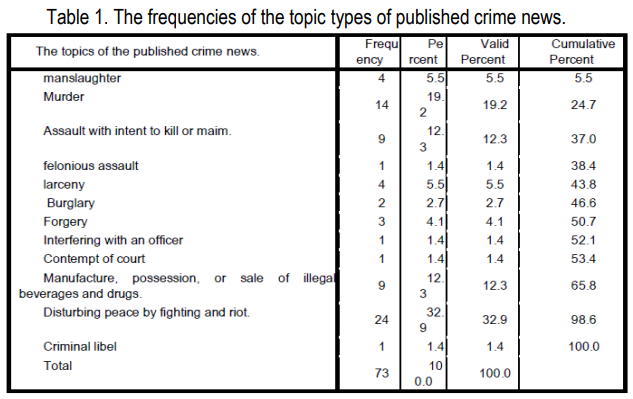
The data of table 1, indicate that the issues disturbing the peace by fighting and riot, came the first item of the crime news types which were reflected by Saudi newspapers, during the period of analysis, the number of news frequencies reached 32.9%, of the total of the published crime news. Next of this came the issue of Murder, with a ratio of 19.2%. The publication rates of assault with intent to kill or maim, and sale of illegal beverages and drugs were reached 12.3% of the total of the news of the published crime, then followed by the manslaughter, and larceny came with equal publication ratio of 5.5%, the followed by Burglary with a ratio of 2.7%, while the publishing of the issues of felonious assault, interfering with an officer, contempt of court, criminal libel came with equal weakened publication ratio of 1.4%.
These results show the clear weakness, in the publication of news about the felonious assault, thenewspaper focused on the publication of the disturbing peace by fighting and riot; this was due to the role is playing by the press in the Saudi society.
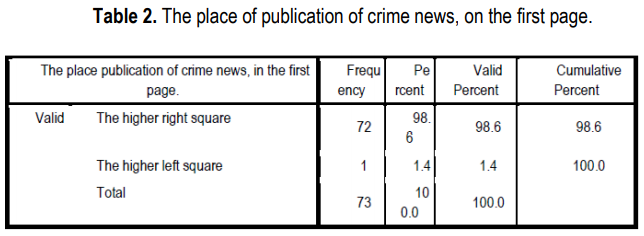
Table 2 shows that the larger side of the crime’s news published by the newspaper understudy appeared on the higher right quarter. It is the most important space, for the newspaper, which is read, from the right to the left. With a ratio of 98,6%. Next of this, comes the high left of the page, by a ratio of 1,4%.
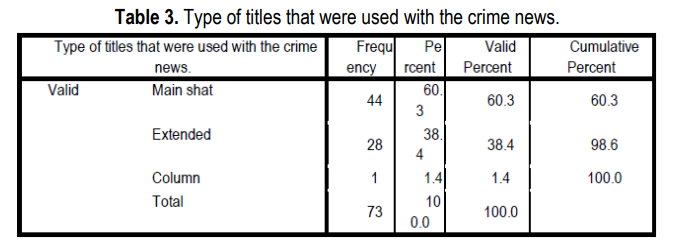
Table 3 shows the rise of the ratio of the crime’s news, which carries a ‘mainsheet’ title. data indicated that 60,3% titles of the total publish crimes news, in the Saudi’s newspaper, appeared with ‘mainsheet’ title. while 38,4% titles, appeared with extended title, and the column title, reduced to 1.4%.
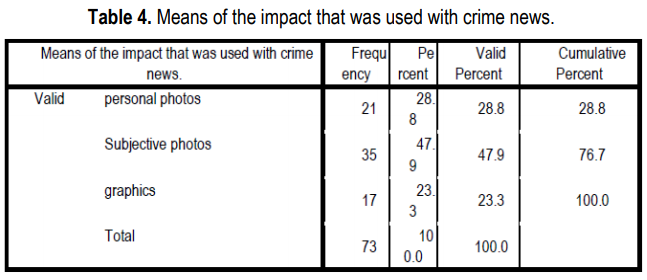
The press photographs stand side by side, with the types of titles. In transmitting the information message, through the pages of the newspapers, to the readers. The photo contributes effectively in the arrival of the content, if the good photo was well chosen, which expresses the topic in question; and while adding to it; and not repeat what photo bear. The photo, also, attracts the attention of the reader, to the page, and they to the accompanying piece of news. This increases the number of readers. The data in table 4, indicated that the major part of photos used in covering the crime news, on the pages of the Saudi’s newspaper, were mostly subjective photo which a ratio is 47,9 %, while personal photos a ratio reached to 28.8%.and the graphics reached a ratio of 23,3%.
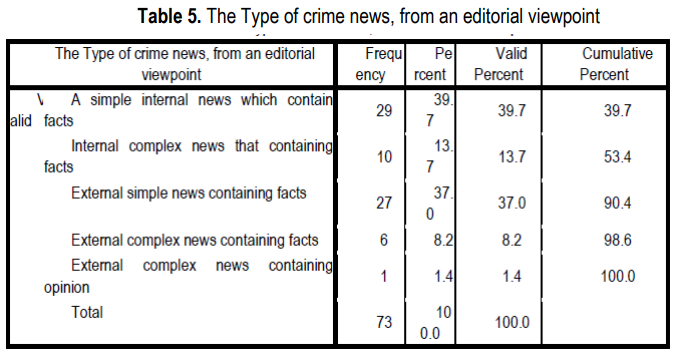
It is clear, from the data of tables 5, that most of the news published in the newspaper, are simple internal news, which contained facts, by a ratio of 39,7%, the ratio of external crime news, which contain facts came at the second with a ratio of 37%, and an internal complex news containing facts reached to a ratio of 13,7%, while the frequencies of an external complex news with facts were decreased to a ratio of 9.6%. and external complex news with opinion to 1.4%.
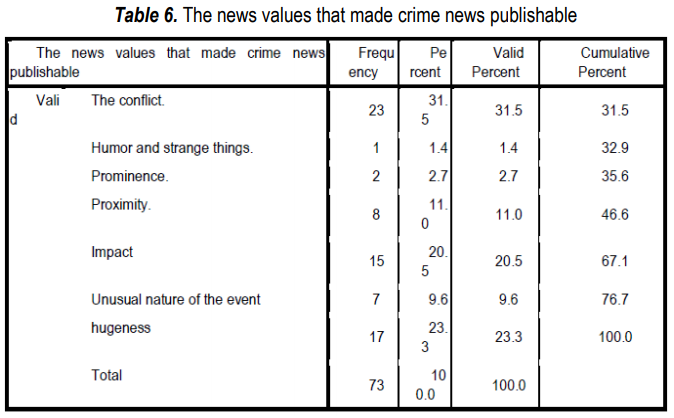
The study of the news values is important to understand the process of selection and publication of news and knowing the editorial policy of the Saudi’s press, and the efficiency of the published news and their effective force. This research endeavors to uncover a group of values, which the published crime newsreflects. Table 6. exposed that the value of the conflict is the more of the news values around which the published news, in the newspaper under study. This value achieved a ratio of 31.5% of the total frequency of the news values, in the published crime news. Next of the value of a conflict, as far as, the rate of frequency is concerned, comes the value of the hugeness, this indicates there is utmost care in the important internal news, which affects the social aspect (see the bar chart 1. This value scores a ratio of 23,3%, of the total frequencies of the news values which were included in the published crime news in the newspaper under study. In a third way, as so the rate of frequency, of the value of impact, this value scored a ratio of 20,5%. The value of proximity scored 11%, then the unusual nature of the event with a ratio of 9,6%. Then prominence with a ratio of 2,7%. In the last rank, there comes to humor and strange things, this value scored a ratio of 1,4%. This is the less news value in the newspaper under study.
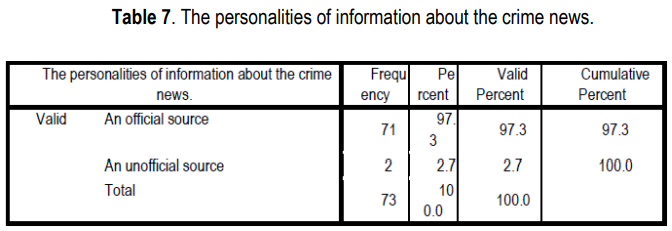
The data on table 7; indicated that 97,3% of the published news, in the Saudi newspaper, in the period of the study, were informed by official sources, these sources are confined in the circle of the decision-makers. This polarization around a certain person, as sources of information, is considered as organizing information in a way that agrees with the editorial policy of the newspaper. As those sources are influential people, the newspaper offered content that agrees with the policy of its ideology.
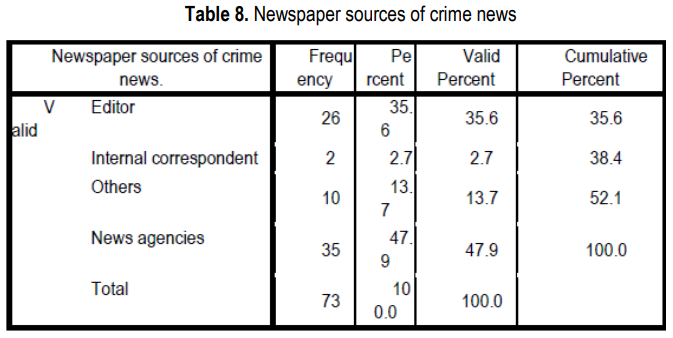
Table 8 shows that the major published part of the news, in the newspaper understudy, depends, basically, on the journalists for obtaining the news from the information sources. This is one of the best ways for obtaining the vital news; these were a ratio of 35.6%. Next of that is 35 pieces of crimes news, by the ratio of 47.9%, were obtained, by the newspaper under study, from the press agencies; while 10 pieces of news, by the ratio of 13.7% were obtained from others sources, and internal correspondent came with weakness ratio of 2.7%. The researcher views that the sources of information about the World news, are centered in the international and World major news agencies, which supply the press institutions with news which are obtained from its offices and correspondents in the various Capitals and centers in the World.
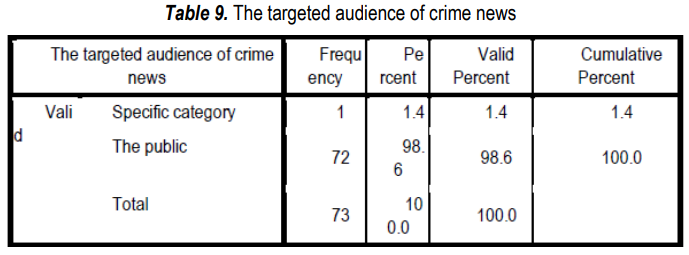
A major part of the editorial policy of the newspaper is determined, on the right of what is imagined that it represents the needs of the individuals, in society. The newspaper cares to respond to these interests, on the consideration that the reader is the consumer of the newspaper or the one who is meant by the impact unless these interests were responded to, the public would not need this newspaper. Thus the move that the news materials tend to address the public; the more it becomes logical to expect that these materials, be powerful and vital and have an impact on the society; the opposite occurs in the case of confining these materials, to a certain category in the society, it would be expected that they be of less power and effect. Table 9 shows that 98.6% of pieces of crime news have been targeted to the public masses by the newspaper and that 1.4% pieces of news, only, were targeted to specific categories.
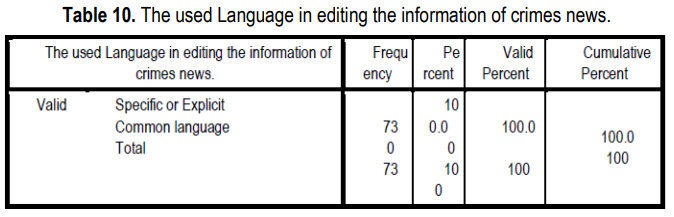
The information in table 10, indicated that 100% pieces of crimes news, in the newspaper, were published in a specific or clear language, thus there was no way for the newspaper to use the common language. The use of official sources of information is due that they are people of high jobs and influence, in the administration of State. Thus, they are earnest to give a glittering image and suitable language.
DISCUSSION
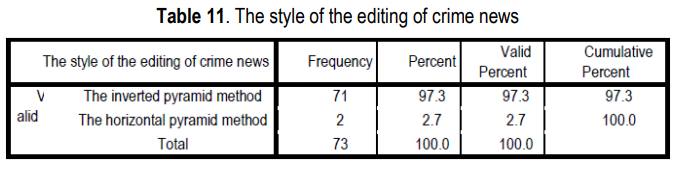
The formation of the news material of the newspaper, has great importance, in the judgment on the efficiency of the news material, the determination of its effectiveness and its ability to have an impact and reach the meant reader. The formation of news means the methods followed by the journalists in writing news. Normally there are methods for the formation of the newspaper news.in the preliminary research of the sample of the study, the researcher found that the Saudi’s newspapers, use the following methods: The information on table 19, indicates that; the newspaper under the study depends, almost totally on the use of an inverted pyramid form. (the journalist starts with writing the most important facts or statements, which are included at the beginning of the piece of news. Then he writes in the next paragraph, the important information of the journalist news.) In this context, the newspaper wrote 97.3% pieces of news, by the method of the inverted pyramid form, while the pieces of crime news which confirm the form of the horizontal pyramid form, the rate was 2.7%.
CONCLUSION
In this paper, the analysis showed moderation recurrence of the crime news in the study newspaper generally. However, the most news published was the murder, assault with intent to kill or maim, sale of illegal beverages and drugs, and the least published was news dealing with topics of felonious assault, interfering with an officer, contempt of court, criminal libel. They were published in the higher right square of the first page. All these news except one of them was published in the top right side which is the most important to attract the reader’s attention, also accompanied that news subjective photos, personal photos, and graphics. Mostly it was of a simple kind which is about one incident and reflects most of the news values came the forefront of more value, the conflict, hugeness, and impact, most of that news were obtained, by the newspaper under study, from the press agencies, and targeted the public. This news has targeted to achieve social regulation; by using specific language and were written in an inverted pyramid style to helps the reader understand what happened.
BIODATA
HALIMA MOHAMMED SULIEMAN ALTALIB: Nationality Sudanese, Date of Birth | 1/1/ 1974, assistant professor in the department of communication and Media Technology. Collage of arts, Imam Abdulrahman Bin Faisal University, PhD holder in the field of communication, University of Bahri, Sudan, published 3 research papers, and book, participated in 4 conferences, supervised on two research masters. I am Teaching some media subjects, Administrative Responsibilities are head of the field training committee, coordinator of the scientific student conference.
BIBLIOGRAPHY
ALASAAD, S (2019). “Current state and development prospects of" Bosra" museum and archaeological site”, Povolzhskaya Arkheologiya, 2(28), pp. 224-236.
BURGH, H (2005). Making Journalist. London: UK, Routledge Publication.
DOWLER, K, FLEMING, T, MUZZATTI, S (2006). “Constructing crime: Media, crime, and popular culture.” Canadian Journal of Criminology and Criminal Justice, 48(6), pp.837-865.
HARRISS, J (1985). “The Complete Reporter”, 5th Edition, London, Collier Mac Milan Publication.
HODGSON, F (1987). Modern Newspaper Editing and Production, London, William Heinemann Ltd.
KAMATH, M (2004). Professional Journalism, New Delhi, Vikas Publishing House.
KENZHEBEKULY, S, SHAITMAGANBETOVNA, A, KUANDYK, O, KAMALKYZY, Z (2016). “Methods andWays of News Reports Rewriting: Comparative Analysis. ” International Electronic Journal of Mathematics Education, 11(5), pp. 1331-1341.
KUMAR, I (1995). Dimensions of Modern Journalism, India, Manan Sachdeva Publication.
LEE, D (2007). “American Legal English”, 2nd edition, United States of America, The University of Michigan Press. p.146.
LOFFELHOLZ, M, WEAVER, D (2008). Global Journalism Research. USA, Blackwell Publishing.
LUDWIG, D, GILMORE, G (2005). “Modern news editing”, Oxford, Blackwell Publication. p.194.
MCQUAIL, D (1997). Mass Communication Theory. London, Sage publication Ltd.
MENCHER, M (1998). Eighth Edition, News Reporting and Writing, New York, Cambridge Publication.
MIKUSEV, I, MAGOMEDOV, R, MIKUSEV, G, MISHAKIN, T & BAIKEEV, R (2019). “Technology for prognosisof the functional status of hand after surgical treatment of Dupuytren's disease (Contracture)”, Periodico Tche Quimica, 16(33), pp. 178-197.
PAPE, S, FEATHERSTONE, S (2005). Newspaper Journalism: A Practical Introduction, London: UK, SAGE Publications Ltd.
PITEIRA, M, COSTA, C, APARICIO, M (2018). “Computer Programming Learning: How to Apply Gamification on Online Courses?” Journal of Information Systems Engineering and Management. 3(2), pp. 1-9.
ROSTAMINIYA, M, HOSSIN ZADEH FARD, A (2019). “Investigate the Business Intelligence Development and Improvement.” Dutch Journal of Finance and Management, 3(1), pp.1-10
STACKS, D (2017). Primer of public relations research. New York, Library of Congress Cataloging-in- Publication Data.