Artículos

This work is licensed under Creative Commons Attribution-NonCommercial-ShareAlike 3.0 International.
Received: 22 March 2020
Accepted: 30 April 2020
DOI: https://doi.org/10.5281/zenodo.3809445
Abstract: This study highlights the importance of cultural interactions between university and community through understanding the modern university’s role in servicing its community. The study also confronts the challenges that universities face in creating cooperative partnerships with their communities. The university community activities at AlAin University have been tracked for five academic semesters to predict their pattern of development. It supports the data generated from a Likert-scale questionnaire with two open ended questions. The questionnaire explores the extent of faculty involvement with community via teaching, research and service. Results have been analyzed, then activities to improve this collaboration culture are recommended.
Keywords: Community engagement, community service culture, employment, faculty involvement.
Resumen: El estudio enfrenta los desafíos de las universidades para crear asociaciones cooperativas con sus comunidades. Las actividades de la comunidad universitaria en la Universidad de AlAin han sido rastreadas durante cinco semestres académicos para predecir su patrón de desarrollo. Admite los datos generados a partir de un cuestionario a escala Likert con dos preguntas abiertas. El cuestionario explora el alcance de la participación del profesorado con la comunidad a través de la enseñanza, la investigación y el servicio. Los resultados han sido analizados, luego se recomiendan actividades para mejorar esta cultura de colaboración.
Palabras clave: Compromiso comunitario, cultura de servicio comunitario, empleo, participación del profesorado..
INTRODUCTION
Numerous scholars and authors have explored the role of relationships between communities and universities in marginalized urban areas, with a particular interest in determining the potential for truly collaborative relationships that are mutually beneficial. Research on this topic has generally focused on community engagement through community service or through community-centered research endeavors (e.g. Allahwala et al.: 2013, pp. 43–57; Anyon & Fernandez: 2007, pp. 40-45). However, universities can have a more direct link to community development. They facilitate academic and cultural community development by utilizing the expertise of their faculty members to serve their community through research and courses, as confirmed by Markus et al. (1993, pp. 410-419; Emmanuel et al.: 2004, pp. 930–937). The main goal of a university is to graduate outstanding individuals, giving them high standards of knowledge, and to provide students with a strong moral, ethical and cultural foundation which they can transfer into a sincere intent to serve their community. Following Khan (2012), “Knowledge was not something the advantaged few could have and exclude others from”.
This study investigates the role of a university in community development in the modern era and presents data from AAU, which currently participates in a community development program, including an analysis of its effectiveness and future possibilities for advancement. It is a detailed quantitative and qualitative investigation that provides knowledge that can be transferred to other universities and aid them in the establishment of their community development programs and evolution of their role in the community.
LITERATURE REVIEW
Community service comes from organizations, groups and individuals of the community who want to improve social and economic conditions in their community by identifying societal needs and designing activities and programs to meet them. Considered one of the best at serving community issues, universities create development in various fields and services through methods corresponding to meet community needs. First, we must define the specific concept of community service.
University as part of a community
Universities, as institutes with educational target, play a key role in determining how to serve/develop and support its community. The university is one of the most important institutions with a set of goals that fall under three main functions: education, scientific research and community service (Al-Samad & Ahmed, 2005, p.127); many scholars consider it an academic or material "imperative", but the need of its presence is to the community (Schofer & Meyer: 2005, pp. 898–920).
Society’s expectations of the university have become more intensive and interactive in light of both the scientific and human experiences of universities, and the research or studies that contribute to solving and confronting many problems and issues faced by the surrounding community. Universities are the intellectual and scientific hub in society, they do not just act as the "House of Wisdom" or the "Platform of Science". Rather, they have become the "House of Expertise" for different sectors of production and providing services to different societal activities. Therefore, the features and areas of a university serving its community have been comprehensive in these three areas: education, research and service.
Role of faculty and students in community service
According to the previous research recommendation students can be placed directly in the community to experience, reflect, understand, and synthesize the learning through action (Kolb, 2014). Consequently, there are two prerequisites for ensuring that academic colleges are associated with community service: College qualifications and potential; and community interest and readiness.
The role of faculty development in community services includes among faculty members’ responsibilities, which includes research, teaching and professional services, community service is also key for them towards promotion and tenure. (O’Meara et al.: 2015; Ramazonovich: 2018, pp.52-56). The faculty service roles are considered to be linked with the wellbeing of the public. It can also provide professional services to the community, using their expertise to help address the communities’ real issues and concerns, as well as to help serve their interests (Hurtado et al.: 2012). This is in addition to the fact that collaboration efforts between faculty members and communities can reinforce professional service so both parties can identify sharedinterests and address concerns (Umbach & Wawrzynski: 2004, pp. 153‐184).
ANALYSIS OF THE RESEARCH
Commenting on previous studies, the university’s role in different countries in this generation of knowledge is positive. Universities do provide improved progress in community development. In this study, we examined the role of universities in general, and AAU in particular, in education, as well as in community awareness, service and development.
The role of the university in community service
Society’s expectations of the university have become more intensive and interactive in light of both the scientific and human experiences of universities, and the research or studies that contribute to solving and confronting many problems and issues faced by the surrounding community. Universities are the intellectual and scientific hub in society; they do not just act as the "House of Wisdom" or the "Platform of Science". Rather, they have become the "House of Expertise" for different sectors of production and providing services to different societal activities (Al-Khamisi, 2006). In addition to preparing human resources to achieve necessary development for the working-class and enabling members to cope with scientific and technological changes in the modern world, University Services for Community also creates opportunities for experienced teaching staff to benefit production and service associations, conduct research, and hold conferences that improve community status and help resolve its issues. In addition, the university can provide continuing education services for adults of all ages, giving them the necessary expertise to perform their profession and improve their earnings. Lastly, they can help spread knowledge to the local community and university graduates to help raise awareness of and solve issues for the community and to keep them up-to-date on professional developments to help them in their careers.
All of the above activities for community support contribute to improving overall growth of a community by creating positive social change and strengthening human interaction and knowledge through initiative and participation. Overall, they help individuals cope with current changes in technology and science.
AAU and community service
As part of its philosophy, AAU asserts that it is “a symbol of the society’s renaissance and a significant pivot around which cultural life revolves on the intellectual, scientific, academic, and technological levels” (aau.ac.ae). The University works to accomplish these principles as part of its commitment to catering for the UAE’s need for highly qualified leaders who possess a profound and comprehensive understanding of the requirements and challenges of the twenty-first century in all fields and in all occupations.
Community engagement plays an integral part of the university’s growth and development in the region. Al Ain University engages with its community predominantly through its partnerships with local organizations and its commitment to the educational, technological, and economic development of the country and the region. The university demonstrates this commitment with having its Community Engagement Committee (CEC) work in close collaboration with the Deanship of Students’ Affairs. The CEC is comprised of a Chair, who is the Dean of Students’ Affairs, in addition to, 2-3 staff members from each college. The Committeefunctions on the premise that the CEC should provide an opportunity for true community building and collaboration. Accordingly, the committee focuses on three main areas of community involvement and engagement as follows: Institutional Engagement, Community Relationships and Employer Engagement.
METHODS
Given the existing literature, this study addresses the need to further our understanding of the role of the university in the modern era as an integral part of the community, by providing a thorough analysis of an ongoing university community program. It analyzes the program’s development, the effectiveness of its activities, and the role of faculty members in its success. In addition, it highlights the challenges faced and potential solutions to allow for continuous evolution. This has direct application to other universities that are establishing and developing their role in community engagement.
The first step in this study was the use of the descriptive method for collecting and analyzing the content of studies, research and published literature related to the topic to gain a better understanding and perspective. This was covered in the previous two sections. The second step was to track the community engagement activities at AAU for the five consecutive semesters during the academic years from 2011 to 2014. The third step was to use a questionnaire and distribute it to the faculty members of AAU. In particular, the present study attempts to answer the following research questions:
Q1: What is the level and pattern of community engagements’ progress in AAU?
Q2: To what extent do faculty members perceive their work of teaching, research and community service as helping the university achieve its mission of responsibility toward that community?
Q3: To what extent do faculty members perceive their academic department as helping the university achieve its mission of responsibility toward that community?
Q4: To what extent do faculty members perceive their college as helping the university achieve its missionof responsibility toward that community?
Q5: To what extent do faculty members perceive their institution as achieving its mission of responsibility toward that community?
Q6: What do faculty members perceive as the conditions that can support or hinder their contributions tocommunity engagements.
Step one: Analysis of previous studies, research and published literature
A detailed analysis was conducted in the previous sections, entitled Literature Review and Analysis of the Research, utilizing the descriptive method to gain a better understanding and perspective of the role of the university in community engagement.
Step two: Community engagement activities at AAU
The AAU’s community engagement committee was created at the beginning of 2011, and tracked activities undertaken by the university. The following are details of three of AAU’s community engagement activities in the first semester of 2013/2014.
A-Participation in the launch of Ministry of Interior Award for Smart Applications
The contest aimed to transplant the concept of creativity and innovation in the younger generation and encourage them to contribute to the creation of a society of knowledge, and motivate college students to provide solutions in the field of applications of smart phones, and also strengthening the bonds of strategic partnerships with institutions of higher education.
B-Launching the Abu Dhabi Science Festival
In line with AAU vision to enhance interaction with the community, the Deanship of Student Affairs delegation took part in a press conference held on Sept 23 to launch Abu Dhabi Science Festival organized by Technology Development Committee.
C-Participation in Najah Exhibition
AAU takes part in NAJAH every year to familiarize students with the programs and specializations offered at AAU and help them stay abreast with the latest developments in higher education.”The total number of activities increased from 9 activities in the first period to a total of 41 in the fifth period asshown in Table 1.

The questionnaire distributed to the faculty members of AAU was the third step of the current study. The questionnaire consists of four core questions related to how much the faculty members believe that their academic department, college and institutions encourage them to utilize their competencies in community service/engagement. Institutional Review Board approval was not required because the data collected tracking past activities was for internal departmental purposes and the survey was designed for evaluation of the community engagement program. The questionnaire constructed in a five point Likert-scale format. The participants were given five choices: very small extent (1), some extent (2), a moderate extent (3), a great extent (4) and very great extent (5) was constructed as shown in Table 2. Participants were asked to select the choice that represent their feeling/prospective.
The questionnaires were distributed to and collected from the participants. The research sample consists of 37 AAU faculty members. 11 of them were females while 26 were males. They were from four different colleges. They were distributed as (12 Education, 9 Business, 10 Law and 6 Pharmacy). Data generated from the research instruments were collected, tabulated, analyzed and discussed.
RESULTS
Q1: What is the level and pattern of community engagement progress in AAU?
To answer the first research questions, the researchers analyzed the number of community engagement activities for the five selected consecutive semesters. The generated data showed that community engagement has more than tripled and the number of faculty members getting involved in these events has grown during this specific period as well. The university successfully executed more than 41 activities (Table 1) and events within the first semester of the 2013/2014 academic year, in contrast to the 9 activities in the first semester of 2011-2012 as shown in Figure 1.
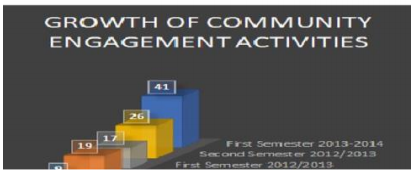
Figure 1. Growth of Community Engagement graph
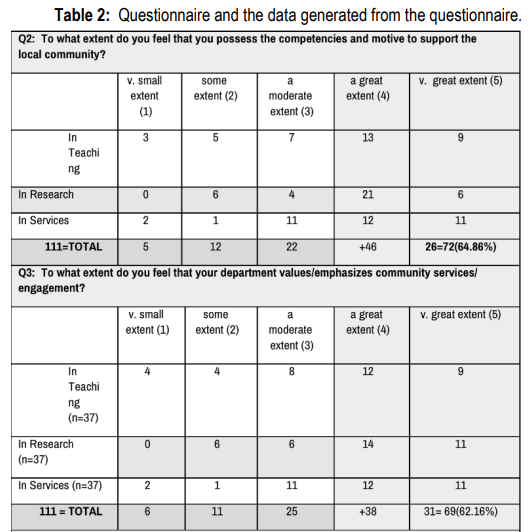
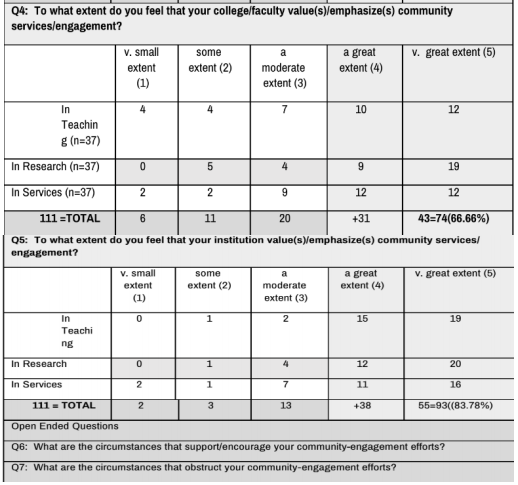
Data generated from Likert-scale (Table 2) was analyzed and the following answers to the first research questions were as follows:
Q2: The majority of the sampled respondents feel that they are motivated to a great extent to support the local community, mainly by conducting research activities … Ranging from great to very great extent, around two third of the sample (64.87%) feel they are motivated to support the local community with research activities, followed by teaching and service activities.
Q3: More than one-third (34.24%) of the sampled population thinks that their departments value community engagement to a great extent. On the department level, it seems that all activities (teaching, research, and services) share nearly the same interest levels of the respondents’ perceptions.
Q4: Mainly, the respondents in this study feel that the college values community engagement to a very great extent in terms of teaching, research and community service activities, but with a high emphasis on research. This indicates that each college has a clear orientation towards research activities, in the opinion of its faculty members.
Q5: The vast majority of the sampled lecturers (83.78%) think that their institution emphasizes community engagement to a great or very great extent, whereas very few of them feel differently.
It is noteworthy that many respondents think that either the college or the institution values community engagement to a very great extent. Whereas the same community engagement interests are seen with lower emphasis at lower levels such as the departmental and the individual, which may indicate that lecturers may be more externally motivated towards providing such community engagement activities than being self- motivated.
DISCUSSION
Overall, the dominant activity that is perceived highly by the respondents on all levels (individual, department, college, and institution) is research. This is because academics indicated that scientific research is an essential constituent of success in the academic institutions. Consequently, articles published in well- known academic journals and indexed in reputable databases, such as SCOPUS, are among the common measures of faculty research performance. This is in line with the findings of Goldberg-Freeman et al., (2007, pp. 231–240) and Kennedy et al., (2009, pp. 3–16).
The answer of the sixth and the seventh research questions were based on the participants’ answers to the followings open-ended questions:
Q6: What are the circumstances that support/ encourage your community- engaged efforts?
Q7: What are the circumstances that obstruct your community‐engaged effort?
Supported circumstances cited by faculty included:
1- 89% (33 participants) of the participants see themselves as having an obligation to use their knowledge and skills toward the improvement of society.78% (29
- 1. 78% (29 participants) are promoted to pursue community engaged activities because it is explicitlyacknowledged and included in the review, promotion policies and procedures.
- 2. 67.5% (25 participants) Faculty are encouraged and are provided various incentives, like grants and funds, to participate in community engagement conferences and to pursue community engaged activities.
Obstacles cited by faculty included:
- 1. 94.5% (35 participants) of the faculty cited that their teaching load was their biggest obstacle impeding community engagement; it requires and consumes a lot of time. Therefore, they worried about the time it takes to create, organize and implement the new community service activities.
- 2. 86.45% (32 participants) cited that a lack of resources to support new activities as a problem, in spite of the fact that many faculties learned that some outreach efforts can be resource-generating
- 3. 62% (23 participants) of the faculty cited that the curriculum / course was also a frequent obstacle for those specifically seeking to introduce service learning into a syllabus.
CONCLUSION
The results of this study provide us with information needed to make decisions regarding the improvement and evolution of the role of the university in the community. Since the university is an educational institution, it derives its role in community service from the word "education" which is the process of "adapting to society”. In other words, it aims to adapt individuals to fit well in their community, to prepare them to do their part in serving their country in a scientific and intellectual capacity. In turn, the university is helping advance their nation to reach new levels of knowledge, advancing their students intellectually, culturally, economically and socially through experience and development.
The results of the study indicate that there are best practices that should be maintained to add to the effectiveness of community service programs. Namely, community service information and news programs are regularly updated on the University's website and is distributed at the beginning of every year as a printout.
BIODATA
SHANA : is an Associate Professor in Educational Technology at the Faculty of Education at Al-Ain University (AAU), UAE. In the past fifteen years, she conducted several researches in the field of educational technology and community development. Dr. Shana has also designed and developed educational software as a part of a Research Agenda focused on Educational Reform for Student Success in UAE. She possesses over 20 years of teaching, consulting, training and research experience in different academic institutions in USA, Saudi Arabia, Canada and the United Arab Emirates.
HANENE LAHIANI: is an assistant Professor in English Language and Linguistics at Al Ain University (AAU), UAE. She previously taught at the University of Sfax, Tunisia. She got her Bachelor degree from Laval University (Canada) and her Master and PhD degrees from Manouba University (Tunisia). Dr. Lahiani has taught in B.A., Diploma and M.A. levels. Her teaching interest includes general Linguistics, semantics, phonology, morphology, semiotics and Business English. Her research interest encompasses visual semiotics, visual rhetoric and applied linguistics.
SUAD ALWAELY: is specialized in Arabic language curricula and methods of their teaching. She is an Associate Professor in Al-Ain University (AAU), UAE. She has taught courses in Arabic language and in education in B.A., Diploma and M.A. levels. She published several papers in education and methods of teaching. Her research interests also include teacher-training and educational technology. She supervised several theses in teacher education and development.
NAHLA ALSHALABI: is an Assistant Professor in Arabic language and grammar in Al Ain University (AAU), UAE. Her research interests include Arabic language linguistics (Phonology, Morphology and Syntax), Rhetoric and semiotics studies. She has been teaching in the universities of Al Ain and ... for … years. She teaches Arabic language, Grammar of Arabic, Arabic linguistics and Islamic culture. The several papers she published study the language of Coran.
BIBLIOGRAPHY
AL-KHAMISI, S (2006). The Role of Colleges of Education in Community Service and Environmental Development. Between Successes, Failures and Future Options (Case Study of College of Education - King Saud University, 1427H). Saudi Society for Educational and Psychological Sciences (Justin). The 13th Annual Meeting Preparation and development of the teacher in the light of contemporary variables.
ALLAHWALA, A, BUNCE, S, BEAGRIE, L, BRAIL, S, HAWTHORNE, T, LEVESQUE, S, von MAHS, J &SPOTTON VISANO, B (2013). “Building and sustaining community-university partnerships in marginalized urban areas”. Journal of Geography 112(2), pp. 43–57.
AL-SAMAD, I & AHMED, S (2005). “Activate the role of university faculty member Egyptian in the field of community service”. Journal of Education, Faculty of Education, Al-Azhar University, p.127.
ANYON, Y & FERNÁNDEZ, MA (2007). “Realizing the potential of community-university partnerships”. Change: The Magazine of Higher Learning, 39(6), pp. 40-45.
EMMANUEL, EJ, WENDLER D, KILLEN J, GRADY, C (2004). “What makes clinical research in developing countries ethical? The benchmarks of ethical research”. Journal of Infectious Diseases, 189(5), pp. 930–937.
GOLDBER-FREEMAN, C, KASS, N, TRACEY, P, ROSS, G, BATES-HOPKINS, B, PURNELL, L, CANNIFFE,B & FARFEL, M (2007). “You’ve got to understand community: Community perceptions on “breaking the disconnect” between researchers and communities”. Progress in Community Health Partnerships, 1(3), pp. 231–240.
HURTADO, S, EAGAN, K, PRYOR, JH, WHANG, H & TRAN, S (2012). Undergraduate Teaching Faculty: The 2010–2011 HERI Faculty Survey. Los Angeles: Higher Education Research Institute, University of California, Los Angeles.
KENNEDY, C, VOGEL, A, KASS, N, GOLDBERG-FREEMAN, C & FARFEL, M 2009. “Faculty perspectiveson community-based research: I see this still as a journey”. Journal of Empirical Research on Human Research Ethics, 4(2), pp. 3–16.
KHAN, S (2012). Privilege. The making of an adolescent elite at St. Paul's School. Princeton and Oxford: Princeton University Press.
KOLB, DA (2014). Experghiential learning: Experience as the source of learning and development. Upper Saddle River, New Jersey: Pearson FT press.
MARKUS, GB, HOWARD, JPF & KING, DC (1993). “Integrating community service and classroom instruction enhances learning: Results from an experiment”. Educational Evaluation and Policy Analysis, 15(4), pp. 410- 419.
O’MEARA, KA, EATMAN, T & PETERSEN, S (2015). “Advancing engaged scholarship in promotion and tenure: A roadmap and call for reform”. Liberal Education 101 (3). Retrieved from: http://www.aacu.org/liberaleducation/2015/summer/o%27meara.
RAMAZONOVICH, LH (2018). “SOULS STRIVING TO GOD OR FROM THE WORLD OF WISE PEOPLE”.Journal of Social Sciences and Humanities Research, 6(03), pp. 52-56.
SCHOFER, E & MEYER, JW 2005. “The worldwide expansion of higher education in the twentieth century”. American Sociological Review, 70(6), pp. 898–920.
UMBACH, PD & WAWRZYNSKI, MR 2004. “Faculty do matter: The role of college faculty in student learningand engagement”. Research in Higher Education, 46(2), pp. 153‐184.
and engagement”. Research in Higher Education, 46(2), pp. 153‐184.
