Artículos
Family cultural norms and its role in negative internet choices of children
Normas culturales familiares y su papel en la elección negativa de sitios web de los niños
 Mastur Rehim mastur.rehim@aau.ac.ae
Jamal Abu-Attiyeh amal.abuattiyeh@aau.ac.ae
Mastur Rehim tamim.hussain@aau.ac.ae
Mastur Rehim mastur.rehim@aau.ac.ae
Jamal Abu-Attiyeh amal.abuattiyeh@aau.ac.ae
Mastur Rehim tamim.hussain@aau.ac.ae
Family cultural norms and its role in negative internet choices of children
Utopía y Praxis Latinoamericana, vol. 25, no. Esp.2, pp. 312-324, 2020
Universidad del Zulia

This work is licensed under Creative Commons Attribution-NonCommercial-ShareAlike 3.0 International.
Received: 22 March 2020
Accepted: 30 April 2020
Abstract: In the current study, it was tried to recognize the variability of family upbringing when monitoring their children to prevent exposure to the disadvantages or negatives uses of the internet. The study adopts the use of a sample-based social survey methodology. Each sample was selected on the condition that the father and mother shall have children still studying in school and using the internet. This study observes 300 families in Al-Ain, UAE.
Keywords: Children, disadvantages of the internet, family values, monitoring websites, raising children..
Resumen: El objetivo de este estudio es reconocer la variabilidad de la educación familiar al monitorear a sus hijos para evitar la exposición a las desventajas o usos negativos de Internet. El estudio adopta el uso de una metodología de encuesta social basada en muestras. Cada muestra fue seleccionada en la condición de que el padre y la madre tengan hijos que aún estudien en la escuela y usen el Internet. Este estudio observa a 300 familias en Al-Ain, EAU.
Palabras clave: Crianza de los hijos, desventajas de internet, monitoreo web, niños, valores familiares..
INTRODUCION
Many sociologists, pedagogics, and psychologists agree that greater use of social media websites and internet networking generally result in the loss of direct communication and change many traditional values. Not only does this have an impact on youth and adolescences, but it also affects the family as a whole. Some parents are not fully aware of the risks and methods of dealing with the latest emerging technologies. They let their children use modern electronic devices without being aware of the potential risk factors or providing them with any advice or guidelines. Moreover, the matter may go beyond that with the misconception that internet use will intellectually benefit their children.
Due to the large role generally played by internet culture and its influence on trends, values, ethics, behaviors, lifestyles and social values and standards, a society may want to limit or monitor unwanted cultural norms and beliefs from outside that society. Thus, many researchers in various human sciences are being obliged to seriously confront this by researching to study the loss of cultural heritage and value simultaneously occurring with the spread of globalization and material values. On the other hand, we find that Arab communities, especially the Gulf regions, faced a boom in the field of development and modernity. Thus, a substantial number of children began to imitate these witnessed values and focus on materialism and a culture of consumption. Also, the threats suffered by the community and family system have an equal impact on the adolescences and children. Many families encounter difficulties while attempting to monitor their children. The family no longer functions as the ground force that cannot be disobeyed. Thus, family influence is generally weakened. Social upbringing is limited to matters which can be materially and observed. This role is represented in a family monitoring of the negative behaviors of children, including the misuse of the internet.
The problem of this study
The present study examines the impact of family social upbringing in monitoring children in the use of the internet and the resulting consequences caused by its prolonged use that ultimately affects their academic success or lifestyle behaviors. Family is considered the essential center of establishing the stability of the society since it has a central role in influencing the upbringing of children that directs and raises their awareness. This is because family is the foundation of establishing ethics and socially correct behavior for their children and is the primary element supporting behavioral control. Also, the family is the framework within which the individual first receives the moral lessons of social life. A family must play its positive role in such serious areas by concentrating all efforts to maintain a steady role by raising awareness, directing their children, and reminding children of the dangers of the misuse of the internet. There is no doubt that with the spread of the internet, there is increasing time spent by the individual using the internet. The average time spent by the population of UAE per day while using the internet is estimated to be 7 hours and 49 minutes according to the report of “Hootsuite”, while the residents of the State spend 2 hours and 56 minutes per day as an average in pursuance of the social media channels from any device. If we suppose that such a figure is correct, we shall assume that the figure is a general average. The time spent by the adolescences of both sexes is much higher. The future is expected to find youths, adolescences, and children spending a lot of time chatting and visiting pornographic sites. All these behaviors are critical areas to be studied, analyzed and positively changed.
The study also attempts to consider the role and influence of the family based on the levels of existing interaction and social relationships within the home. Such family functions and roles can be considered as controls of behavior to prevent one from deviating from essential and accepted social values, habits, and traditions by safeguarding behavior and reminding the individual of the importance of compliance and consequences of violations of these views. This is achieved by the role played by the family in raising their children’s awareness and warning them of the risks caused by misuse of the internet.
Therefore, we can start from this problem that emphasizes the role of censorship through socialization, and we can define our problem in identifying the role of socialization of the family and its impact on the poor use of the Internet. We will conduct this study on a sample of families in the UAE city of Al Ain.
The importance of the study
Such scientific studies have profound importance because of the factors and reasons revealed and ignored by many people. The study deals with the issue relating to each family, household, and community. The misuse of the internet about family upbringing is a topic of great importance to family and society members as a whole. At the community level, studies of this nature draw the attention of society and all of its institutions, schools, and universities, to understand the phenomena, assuming control over it yet, benefiting as much as possible, and rejecting all that may cause danger to the individuals of this community.
Objectives of the study
This study attempts to “Understand the impact of the family social upbringing in children monitoring in terms of internet misuse” with the following as secondary objectives:
Recognizing the impressions and family cognitive background of the disadvantages of the internet, whichmay negatively affect the children.
Determining the internet misuses by the children and the impact of how family social upbringing may implicate such.
Specifying the controlling measures and procedures taken by the family to protect the children from internet misuse.
Questions of the study
Many studies in sociology achieve their objectives by raising several inquiries or verifying assumptions. These studies typically adopt the descriptive research approach and depend on inquires, while experimental approach-based research relies upon assumptions made and examined by the researcher. This study adopts the descriptive approach to answer the following questions:
-
What impact does monitoring internet use have on upbringing?
-
Does the family examine the online websites accessed by the children?
-
What are the control measures used by the family to guard against the misuse of the internet by children?
Family social upbringing
Social upbringing is the process that requires that the biological organism be transformed into a social being. It is a continuous process for the individual intentionally or unintentionally through the different tools of upbringing starting with the family, the school and the community environment in all its material and non- material aspects. Durkheim defines social upbringing as "the process of replacing the biological aspect with social and cultural dimensions, which become the basic guides of the individual's behavior within his society" (Leila: 2006, p.193). It is the process of "giving the individual the basic characteristics of the society represented in the values, attitudes, and norms prevailing in his society and the standards of desired social behavior in this society. It is a continuous process through time, starts from the early moments of the person’s life until his death” (Mesch: 2006, pp.473-495; Abu Arqoub & Al-Khaddam: 2012, pp.423-435; Al-Kabbani: 2019).
As for our procedural concept in this study, the parents’ behavioral habits in supervising children’s use of social networks are considered tools for evaluation. Since modern technology has expanded, parents must confront this, either by interfering or advising and trying to preserve the behavior desired. The family is the place where the social upbringing process begins, which means "a group of individuals who believe that they belong to an independent group within the community and have special relationships. The family mediatesbetween the individual and society." It helps the individual to take his place in society "(Darwish: 1999, p.68; Mohamed: 2007; Nasef: 2014, pp.275-298; Othman: 2017). About the control and supervision process, we have included a set of expressions represented in directing the parents regarding their children's use of the Internet. One of the most important of these expressions is to follow the children in their free time and while studying their lessons, doing duties and other oversight that would make their electronic or virtual communication to not negatively affect their behavior.
Internet negatives
Electronic means that reach us through unknown and known sources. “George Ritzer” defined it as “an interconnected global network of computer hardware and software systems. This makes it possible to store, process, retrieve and circulate information and communications across time and space. "(Huisman & Allison Edwards, 2012, p.21; Sultan: 2010; Al-Janafawi: 2017, pp. 11-43). What matters in this study is how families can control the websites that their children use?
Electronic means that reach us through unknown and known sources. “George Ritzer” defined it as “an interconnected global network of computer hardware and software systems. This makes it possible to store, process, retrieve and circulate information and communications across time and space. "(Huisman & Allison Edwards, 2012, p.21; Sultan: 2010; Al-Janafawi: 2017, pp. 11-43). What matters in this study is how families can control the websites that their children use?
There is no doubt that the Internet, as well as other things that we face in our daily lives, have many negative aspects that can leave negative effects, especially on children and adolescents and adults as well. Therefore, parents should pay attention to such matters through the parental control process that each parent can exercise over their children (Jaafar & Muslim: 2012; Jayyousi: 2015; Zahmoush & Makhloufi: 2018). For example, one of the negatives that children may be exposed to while using the Internet is viewing porn sites, websites promoting terrorism, extremist religious views, violence and suicide, gambling, and sites promoting racist ideas. In addition to the disadvantages caused by long periods on the Internet, negatives include isolation and weak social interaction which is in turn replaced by virtual communication (Al-Kandari & Al- Qashaan: 2001, pp.7-45; Ogar et al.: 2018, pp. 63-67).
METHODS
Study methodology: The researcher relied on the method of the social survey using the sampling method as one of the most suitable methods used in descriptive studies.
Data collection tool: The study relied on a questionnaire form, which was assessed by several sociology and psychology specialists and was reviewed systematically and scientifically through a questionnaire that tries to achieve the goal of this study by dealing with all aspects of the problem of the study.
Validity and reliability of the tool: The validity of the form was measured by presenting it to a group of arbitrators. It was discussed and necessary notes and amendments were made that contributed to preparing the form in its final form to apply to the sample.
Stability was also measured by doing a pretest for the form before the basic data collection process. The researcher performed this test by administering the form to a group of families in the study community. The test included (15) heads of household. This test is repeated ten days after the initial application to find out the suitability of the form to collect necessary data, to know the extent of the respondents' understanding of the questions and to discover the clarity of the questions and their understanding of them. Some of the questions have been modified linguistically to make them more accessible and easier.
Domains of the study
Geographical Spatial (Domain): the researcher has chosen Al Ain City in the Emirate of Abu Dhabi for several reasons. We can also acknowledge that the Internet is used in every family normally and that the study community has its members and the means of advanced digital technology such as mobile and tablet devices.
Human Domain: A deliberate sample was chosen, amounting to 300 of the parents who have children from Internet users, and the questionnaire was also applied by (Google). 18 forms were excluded as the answers given were not clear.
Time Domain: The study lasted approximately three months, from December 2019 to the end of January 2020, followed by data extraction, analysis, and presentation of results.
RESULTS
First: Preliminary data
Sample Characteristics include
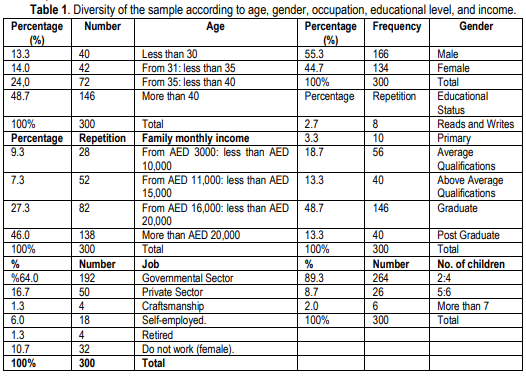
Gender: In reviewing the data of the above table, it is noted that the percentage of males of household heads in the study sample was 55.3%, while the percentage of females was 44.7%. It can be observed from these statistical data that the ratio of males to females is nearly equal.
Age distribution: The study sample is divided into four age groups. The first category ages (40 years and older), represented 48.7% of the total sample population; ages (35 to less than 40 years) represented 24.0%.; ages (30 years to less than 35 years) represented 14.0%, while the group (less than 30 years) represented 13.3% of the study sample.
Educational level: As for the educational level, we find that 48.7% of the total sample population has a university degree, while 18.7% of the population have an intermediate qualification, 13.3% have post-graduatedegrees. While 13.3% have above-average qualifications, and 3.3% have a preparatory certificate, 2.7% of respondents have not completed primary education but can read and write. This indicates the high educational level of most subjects and emphasizes their awareness and cultural beliefs.
Professional Status: The data of the above table also show that the occupational status of 64.0% of the respondents in the households surveyed works in government jobs; 16.7% of the respondents work in the private sector; 10.7% are homemakers; 6.0% are self-employment, and 1.3% are retired.
Income: According to income, the percentage of the individuals who live in families whose monthly income is greater than 20 thousand dirhams was approximately 46%. This is an indication of the high standard of living of the majority of the families in the sample. (Nationalities of the sample were not a factor.) The percentage who lives in families whose income ranges from 16 to 20 thousand was approximately 27.3%. Individuals whose monthly income ranged between 3 thousand and 10 thousand dirhams accounted for 9.3% of the sample, while those whose income ranged from 11 to 15 thousand dirhams were slightly lower at 7.3% of the sample. This confirms that there is a relation between the economic status and the rates of household use of the Internet and the ownership of advanced technological devices.
Several Family Members: It was clear from the previous table that the vast majority (89.3%) of the sample has 2-4 children, while 8.7% have 5-6 children and 2.0% have 7 or more. Second: Family's perceptions of negative uses of the Internet.
DISCUSSION
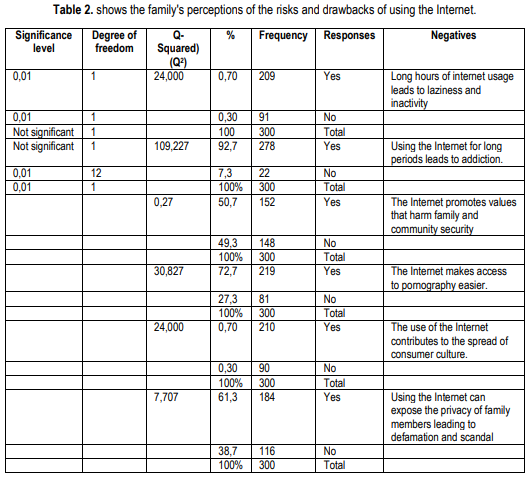
Before starting the study, we polled the opinions of a small sample from the study community about the negatives that children and adolescents in the family might be exposed to as a result of entering the electronic network. We then classified them in a questionnaire form and summarized their answers.
It is evident from the previous table that 70.0% of the total sample population believes that thefrequent use of the Internet leads to laziness and inactivity. It is also clear that 92.7% believes that the frequent use of the Internet leads to addiction. Of the total sample population, 50.7% believes that the internet does affect values negatively and harms family and society’s security. The majority (72.7%) hold that the Internet facilitates greater access to pornography. It is worth noting that there is a danger of (electronic sex). This is, of course, the result of the sexual suppression of young people, or is a result of the difficulty of intermingling males and females in our society. Some 70% believe that the Internet contributes to the spread of consumer culture. In the sample, some 61.3% believe that postings on the Internet can endanger the privacy and security of family members.
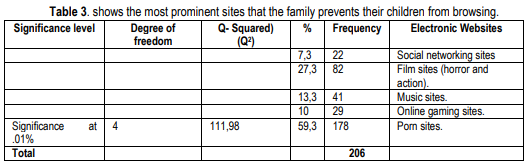
The measures and procedures used by the family to protect the child’s usage on the Internet: Table 3. shows the most prominent sites that the family prevents their children from browsing.
It should be noted that the total number here indicates the frequency of the answers, where some members of the sample referred to more than one site
A high percentage of the sample population prevents children from browsing harmful sites. Regardless of the technical capabilities available to block such content, it is sometimes insufficient. However, the best means is preventive education. The table shows that pornographic sites ranked first (59.3%) among sites that the family wants to restrict from browsing. Watching movies on many non-pornographic sites ranked second with 27.3% of parents concerned with possible traumatic negative effects on their children. Music and video clips sites ranked third (13.3%) while online games sites ranked fourth with 10.0% of parents saying that they prevent their children from accessing gaming sites. Some individual says gaming sites consume a great deal of time for their children. The social networking sites came in fifth with 7.3% preventing browsing these sites.

The previous table shows the reasons for preventing children from browsing some sites, and the reasons came in order as follows:
-
Because it conflicts with our values and our morals: 62.0%
-
Because they are for adults: 18.0%
-
Because they waste time: 14.0%.
-
To encourage good sleep habits: 12.0%
-
to complete their school homework: 11.3%

The vast majority of respondents (83.3%) do take precautionary measures to monitor and regulate their children’s internet use. They want to know what they are watching and how long. The above table indicates that 60.0% of the respondents are keen to regulate the use of the Internet so as not to neglecting school homework; 37.3% of respondents stated that they fear addiction causing the child to repeat habitual negative behavior and the loss of social sense of interacting with the family and its values and principles.
Respondents (36.7%) said that they are keen to regulate their children's use of the Internet so that they do not stay up late. About 31.3% were concerned with maintaining the order and sequence of daily habits. Letting children know they are watched was of importance to some. Religious values greatly affect the advice given to children; such values inculcate benevolent values and principles, whether by repeating advice or evoking values and principles in stories that would influence avoidance of communication deemed harmful. Finally, 22.0% of the respondents mentioned harm to health from inactivity and damage to eyesight.
Parents who do not control their children's use of the internet gave three reasons. The primary reason (60%) is that Children use the internet in their leisure time. About 24% say they do not want to put pressure on children and16% say that children use the internet for their studies.

The use of the internet itself has become one of the methods that some parents use for discipline when children fail or their behavior does not satisfy their parents. We asked the respondents about the punitive methods they use for modifying their children's behavior. The above table indicates that about 70.7% of the respondents deprive their children of their daily monetary allowance, while 64.7% of the respondents answered that they deprive them of using the internet. This reveals the significance of the internet in children's lives. Just as parents previously punished their children by preventing them from going out of the house, today they punish them by preventing them from using the internet. About 60.7% of the respondents said that they talk to their children about ill behavior as a first warning; however, if repeated, they may use alternative methods of discipline according to the behavior and the age of the child. About 54.0% said that they reprimand their children as a means of discipline, while 49.3% stated that they warn their children that they will be punished if they repeat the behavior. method of discipline, and does not correct behavior. About 35.3% of the respondents consider beating as a method of discipline, while 30.0% punish their children by ignoring them. Finally, about 28.7% punish their children by depriving them of going out.
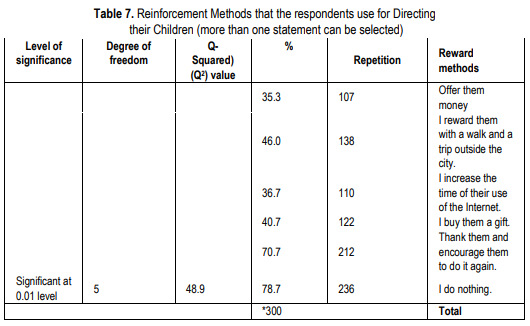
*It is clear that the number is more than 300, but the total number of answers are what meant here, as many respondents have referred to more than one method for rewarding their children.The above table indicates that 78.7% of the respondents do not reward their children when they do something good, while 70.7% of the respondents said that they reward their children morally, by thanking them and encouraging them to repeat the good behavior. About 46.0% of the respondents grant their children the opportunity to go out in a walk or a trip; while 36.7% allow extra time on the internet, which implies that the Internet has become a new method of rewarding and reinforcing behavior, and discipline in the case of deprivation.
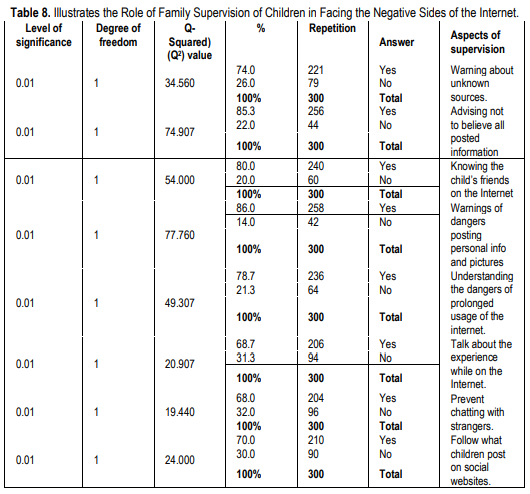
The above table indicates that 74.0% of the respondents supervise their children by warning them not to receive electronic messages from strangers; while 85.3% of the respondents indicated that they advise their children not to believe the information published on the internet without ensuring its credibility. About 80.0% of the respondents were also keen to know about their children's friends on the Internet. About 86.0% of the respondents stated that they warn their children about the social dangers caused by posting personal information and photographs on the internet; while 78.7% said they ask their children about the reason for using the Internet for a long period. About 68.7% of the respondents said that they discuss their own experiences with their children when they use the Internet and about 68.0% said that they prevent theirchildren from chatting with strangers. About 70.0% of the respondents said that they follow what their children post on their accounts on social media sites and apps. These high percentages shown above indicate that most of the respondents are highly active in supervising their children through a variety of means. The above precautions are considered an indication that there is existing family awareness of the harmful effects of using the Internet.
CONCLUSION
This study aimed to answer several objectives:
The main objective: "To know the impact of the family socialization in controlling their children regarding the negative uses of the Internet." The sub-objectives were as follows:
-
Identifying the family's background knowledge of the dangers of the Internet which can negativelyimpact their children.
-
Identifying children's misuse of the internet and its effect on family socialization.
-
Identifying measures taken to protect children while they use the Internet.Accordingly, this study was conducted and applied to a sample of parents. We can summarize the results of the study as follows:
-
There is no doubt that socialization plays an important role in parental control over children who use the Internet: 68.7% of the respondents indicated that they prevent their children from using the Internet, which indicates the parents' awareness of the negative influences that may come from browsing the internet.
-
83.3% of respondents are concerned with regulating time spent by their children that prevents them from performing their duties and obligations, including neglecting their studies and getting used to late nights. However, 16.7% of those who say that they do not control their children because of the preference for their children to stay at home.
-
Denial of internet use 64.7%; talking to children 60.7%; reprimand 54.4%, and warning 49.3%. These are the methods that parents use if their children use the Internet negatively indicating that they see negative aspects of the Internet.
-
About the role of family supervision over children in facing the negative sides of the Internet, we foundthat 74.3% of respondents warn their children not to receive messages from people they do not know; and 80% of parents are concerned to know who their children's friends are on the Internet. Further, 70% of parents care about what their children post on their accounts on social media.
There is no doubt that the Internet as a means of communication through many websites is an important and useful thing in our life and has changed many aspects of lifestyle. Moreover, many people work from home through their laptop or tablet devices as an important tool instead of going to the institution or the company.
On the other hand, this has brought a lot of negatives to homes. The issue is related to socialization ofchildren, since controlling them has become difficult after the widespread of the Internet and its penetration into even the most pious family units.
Our study could open horizons for researchers studying similar aspects of the internet’s implications for the family.The most important of which are:
-
Studying values on electronic devices and their impact on daily life
-
Inclusion of the Internet in studies related to marriage choice and ‘electronic love’.
-
Conducting studies in identifying the best means of controlling children and trying to forcefully introduce education and curricula into this problem.
-
Opening horizons of educational studies through schools, especially in the UAE community, as students have electronic accounts linked to their schools under educational supervision to try to address problems before they may escalate.
BIODATA
MASTUR REHIM is an associate professor of sociology at Al Ain University in the UAE. In 1990-91, he obtained his graduate diploma in Social Sciences, Faculty of Social Science at the University of Tripoli. Later on in his life, Dr. Rehim accomplished a Ph.D. in sociology at Poitiers/France University (2007). Following his doctorates degree, Rehim published a book entitled ‘Problematic Development in Libya’: The Case of the Local Community of the City of Al-Bayda. His research interests include social change, sociological theories, and marriage/divorce studies. Mastur.rehim@aau.ac.ae.
JAMAL ABU-ATTIYEH is an assistant professor of Education/Special Education at Al-Ain University in the UAE. He received his B.A in TEFL from Bir Zeit University. After finishing his Bachelor's degree, Dr. Abu- Attiyeh went on to do his first M.An at the University of Notre Dame in International Peace Studies. Dr. Abu- Attiyeh continued his studies and received his second M.A in Special Education from The College of Charleston in South Carolina. Later throughout his career, he studied at Miami University of Ohio and obtained his Ph.D. in Educational Leadership. His main area of research interest coincides with giftedness as well as language acquisition. Jamal.abuattiyeh@aau.ac.ae.
TAMIM AHMAD JABARAH is an academic instructor and researcher holding many academic and administrative positions in various institutions and universities. He initially received his bachelor’s degree in Philosophy. After completing his undergraduate degree, Mr. Jabarah obtained a post-graduate diploma in Islamic Studies from the Institute of Islamic Studies in Cairo, Egypt in 1982. Subsequently, Mr. Jabarah continued his education at the Institute of Islamic Studies and accomplished a master’s degree in Social Studies. Mr. Jabarah has worked for a veritable number of institutions as a lecturer on Arab Society & Sociology. Tamim.hussain@aau.ac.ae.
BIBLIOGRAPHY
ABU ARQOUB, I & AL-KHADDAM, H (2012). “The effect of the Internet on personal communication with family and friends”, Journal of Humanities and Social Sciences Studies, University of Jordan, Amman, 39(2), pp. 423-435.
AL-JANAFAWI, KM (2017). “A study on the obstacles of socialization under contemporary social media from the viewpoint of parents in Al-Farawaniyah Governorate”, Kuwait, 6(6), pp. 11-43.
AL-KALBANI, I (2019). Protecting Children's Privacy in the Virtual World, Master Thesis, College of Law, Emirates University, Al Ain.
AL-KANDARI, Y & AL-QASHAAN, H (2001). “The Relationship of the Internet with Social Isolation among Kuwait University Students”, Journal of Humanities and Social Sciences, United Arab Emirates University, 17(1), pp. 7-45.
DARWISH, ZEA (1999). “Social Psychology - Foundations and Applications”, Dar Al-Fikr Al-Arabi, Cairo. p.68
HUISMAN, S & EDWARDS, A (2012). “The impact of Technology on Family”, International Journal ofEducation and Psychology in the Community IJEPC, 2(1). p.21.
JAAFAR, DAL & MUSLIM, SH (2012). “The Impact of Using the Internet on Family and Social Disintegration- A Survey Study for Iraqi University Students”, Al-Mustansiriya Center Journal for Arab and International Studies, 3.
JAYYOUSI, M (2015). “The reality of family relations resulting from social networking sites from the viewpoint of parents of students in the city of Tulkarm”, the Jordanian Journal of Applied Sciences - Humanities Series, 17(2).
LEILA, A (2006). “Child and Society - Socialization and the Dimensions of Social Affiliation”, Egyptian Library, Cairo. p.193.
MESCH, GS (2006).“Family characteristics and intergenerational conflicts over the Internet”, pp.473-495.
MOHAMED, AI (2007). The Implications of the Information Revolution on the Egyptian Family - A Field Studyon a Sample of the Internet User in Cairo, Unpublished Master Thesis, Department of Sociology, Faculty ofArts, Ain Shams University.
NASEF, SAM (2014). “The effect of digital technology on family efficiency and performance: sociological analysis of the effects of internet use”. Police thought magazine, Police Research Center, Sharjah, 23(3), pp. 275-298.
OGAR, JN, OGAR, TE & BASSEY, SA (2018). “Ambivalence Human Nature and Social Justice”. Journal of Social Sciences and Humanities Research, 6(02), pp. 63-67.
OTHMAN, K (2017). New Media and its Impact on Socializing in the Arab Society, Master Thesis, faculty of Graduate Studies, Sudan University of Science and Technology.
SULTAN, RYM (2010). The Impact of Contemporary Changes on the Rural Family in Social Upbringing, Unpublished Master Thesis, Department of Rural Sociology, Faculty of Agriculture, Assiut University.
ZAHMOUSH, N & MAKHLOUFI, F qouted in: ZAYED, A and others (2018). Raising Hope: A New Model for Raising the Arab Child - Social Raising of Children in the Arab Countries (Field Study), Arab Council for Childhood and Development, Cairo.